From our rare book vault: What makes a book rare?

Version française

When you hear the words “rare book,” you might think of an old, valuable book that’s hard to find. That’s a pretty good general definition, but let’s take a closer look at some factors that can make a book “rare”:

Age

Although old books are often rarer than new books, age can be relative. The first printing press did not arrive in Canada until 1751—about 300 years after the first books were printed in Europe. A book printed in France in 1760 might not be considered very old. By contrast, one printed in Canada in the same year is extremely old, in Canadian terms. And, at Library and Archives Canada (LAC), we consider anything printed in Canada before 1867 old enough to go in the Rare Book Collection.

Provenance

A book’s provenance is the history of its origin and ownership. A book once owned by a famous person may have added value, particularly if the owner signed it or made notes in the margins.

[Coloured photo of a book’s front inside cover, with William Lyon Mackenzie King’s inscription dated September 8, 1894 on the right page. The opposite page has a Public Archives Canada/Archives publiques Canada book plate.]

William Lyon Mackenzie King’s inscription on the front page of An Introduction to the History of the Science of Politics by Sir Frederick Pollock (OCLC 1056964672).

Physical condition

A book in perfect condition is more desirable than one with a detached cover and missing pages. Maps or illustrations, or an intricate binding may also add to a book’s rarity. Old books do not always live their entire lives between the same covers, and it is common to find several copies of the same book that look different on the outside.

Scarcity

If there aren’t many copies of a book, it is, by definition, rare. Books printed in editions of fewer than 300 copies generally go into LAC’s Rare Book Collection, regardless of their publication date.

Significance

Some books, such as first editions of well-known novels, have more historical value than others. However, significance can be subjective; collectors may see value in a little-known edition of a favourite author’s work, while others might look at the same book and see no value at all.

That being said, a book might have all these qualities and still not be considered “rare” if no one is interested in it. In the end, rarity, like beauty, is often in the eye of the beholder.

Visit our Facebook album for illustrations of some of these points.

Stay tuned for upcoming articles as we explore the hidden gems in LAC’s rare book vault!

Did your ancestors come from the Ukraine?

Library and Archives Canada Blog's avatarLibrary and Archives Canada Blog

Do you ever wonder who your first Ukrainian ancestor was and when he or she left the Ukraine and arrived in Canada? Are you curious about your family’s Ukrainian heritage?

If so, our website is a great place to begin your research. For instance, you will find a page specific to genealogical research about Ukrainians.

It provides you with historical background information, archival and published material from our collection, as well as links to other websites and
institutions.

If your ancestor came to Canada between 1865 and 1935, you might find his or her name on passenger lists.

Questions or comments? We would love to hear from you!

View original post

Did your ancestors come from Acadia?

Library and Archives Canada Blog's avatarLibrary and Archives Canada Blog

Do you ever wonder who your first Acadian ancestor was and when he or she arrived in Acadia? Are you curious about your family’s Acadian heritage?

If so, our website is a great place to begin your research. For instance, you will find a page specific to genealogical research for Acadians. It provides you with historical background information, archival and published material from our collection, as well as links to other websites and institutions.

You may begin by consulting the Parish Registers fonds, which contains transcriptions of parish registers of various Acadian parishes and from the Gaspé peninsula.

You may also consult the biographies of the 37 main Acadian families, such as “Surette” and “Poirier” [available in French only], from the Université de Moncton’s website.

Questions or comments? We would love to hear from you!

Summary of comments received in French up to September 30th, 2013
  • A user mentioned…

View original post 32 more words

Sicilian Campaign (July and August 1943)

During the Second World War, Allied maritime traffic in the Mediterranean was under constant threat of Italian and German attack. In an effort to turn the tide, at the Casablanca Conference in January 1943, the Allies proposed an invasion of Sicily, code named “Operation Husky.”

Two Canadian soldiers on board a warship.

Canadian troops en route to Sicily. Source

After long months of preparation, Allied troops, made up of American, Canadian, British, French, Australian and South African units, landed in the night of July 9 to 10. The 1st Canadian Infantry Division and the 1st Canadian Army Tank Brigade were under the command of Major-General Guy Simonds. Canadian troops fought in difficult conditions, dealing with very hilly terrain and temperatures of over 40 degrees Celsius.

Six soldiers advancing past a tank on a narrow road. Three other soldiers are positioned on top of the tank.

Personnel of Princess Patricia’s Canadian Light Infantry advancing past a Sherman tank, Valguarnera, Italy, July 19, 1943. Source

From their landing point on the Sicilian beaches near Pachino, Canadian troops advanced toward the interior of the island, taking part in the battles at Grammichele, Piazza Armerina and Valguarnera. The towns of Leonforte and Assoro, situated in good strategic positions at the top of hills, put up a strong defence, but the Canadians prevailed in the end. A total of 562 Canadian soldiers lost their lives during this campaign.

The Sicily landing opened the way for the Allies to launch the Italian campaign a few weeks later.

Library and Archives Canada holds a large collection of military documents relating to Operation Husky and the Sicilian Campaign. Other examples can be accessed via the links below.

Discover also:

To view more photos, please visit our Flickr album.

July 15, 1870: Manitoba joins Confederation

Before becoming a province, Manitoba was the stage for many events and pivotal moments in Canada’s history. Pending the transfer of Rupert’s Land to Canada, the federal government sent survey crews led by Lieutenant Governor William McDougall to map the Red River area in 1869. The Métis became concerned about the redistribution of land to future settlers and the effect this would have on their own lands.

The Métis group’s leader, Louis Riel, declared that the survey was a menace and established a “National Committee” of which he became secretary and John Bruce president. On October 25, 1869, Louis Riel was ordered to appear in front of the Legislative Assembly of Assiniboia to explain himself. Riel indicated that the “National Committee” would prevent the entry of McDougall or any governors into Red River unless the union with Canada was based on negotiations with the local population.

In November, Riel proposed a first provisional government to replace the Legislative Assembly of Assiniboia as part of the negotiations for the transfer of Rupert’s Land.

Drawing of a panoramic view of Fort Garry, 1868.

Fort Garry, Red River Settlement, 1868, the administrative centre for the provisional government. (c105625)

In January 1870, 20 English and 20 French representatives of the Red River Settlement met to debate a List of Rights and endorse Riel’s second provisional government. The fourth version of the List of Rights became the basis of the Manitoba Act.

Members of the Métis Nation Provisional Government , 1870.

Councillors of the Provisional Government of the Métis Nation, 1870. (http://central.bac-lac.gc.ca/.redirect?app=fonandcol&id=3194516&lang=enge011156794)

The secretary of the Provisional Government, Louis Schmidt, moved to accept the Manitoba Act, and enter the Dominion of Canada, on the terms proposed in the Confederation Act. The motion was passed.

In his closing statements, Louis Riel underlined the significance of the vote:

I congratulate the people of the North-West on the happy issue of their undertakings (cheers). I congratulate them on their moderation and firmness of purpose; and I congratulate them on having trust enough in the Crown of England to believe that ultimately they would obtain their rights (cheers). I must, too, congratulate the country on passing from under this Provisional rule to one of a more permanent and satisfactory character.1

The Manitoba Act went into effect on July 15, 1870.

1 http://www.gov.mb.ca/chc/archives/leg_assembly/pdf/leg_assembly_transcript.pdf

Related documents:

How to read AMICUS records—Part 2

Our previous article on this topic explained how to decode an AMICUS record for books, documents and reports (monographs). Today’s article provides you with tips on decoding an AMICUS record for journals, magazines, newspapers or any type of ongoing publication (serials).

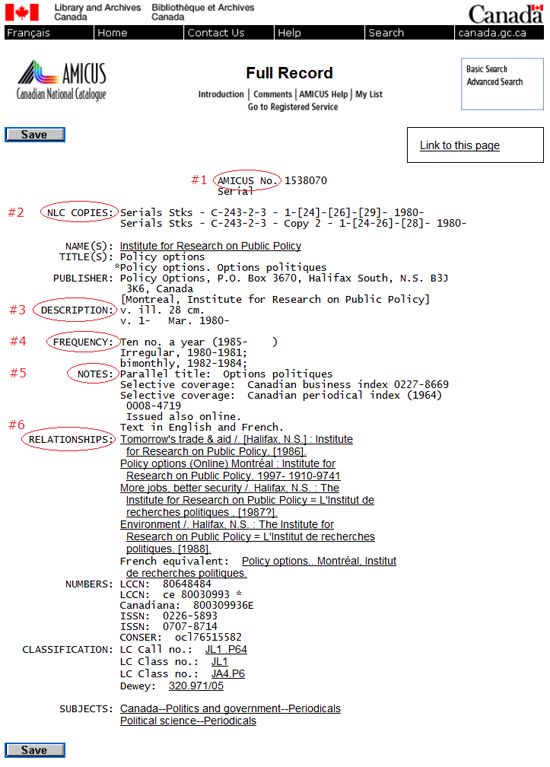
To help you better understand, the numbers on the image correspond to the fields described in the article.

Screen capture of the AMICUS full record with corresponding fields (source: AN1538070)

1. AMICUS No.: Keep track of this number! You will need it to request issues of the serial, whether you place a request for retrieval before visiting Library and Archives Canada (LAC) or once you are on site.

2. NLC (National Library Collection) Copies: Provides key information on which issues of the serial record are available in our collection. It is essential to distinguish between the LAC holdings for the serial found in NLC Copies (No. 2) and the description of the publishing history of the serial found in the Description (No. 3). The complete run of a serial is sometimes unavailable at LAC or may be available in a microform version. If a microform version exists, it will be included as a link in Relationships (No. 6).

The following punctuation marks are used to describe serial holdings:
Punctuation Mark Meaning Example
Hyphen   An unbroken range of holdings v. 1-30 means the library has each issue of the serial from volumes 1 to 30 in its holdings.
Square brackets  [ ] Incomplete holdings [1950] means that holdings include some issues published in 1950.
Question mark  ? Uncertain holdings information v. 18-42? means that holdings may include volumes 18 to 42.
Slash  / A single physical item with two connected volumes v. 12/13 indicates that volumes 12 and 13 are contained in a single physical item.
Comma  , A gap in the holdings v. 1-3, 5 means the library has volumes 1 to 3 and 5 but not volume 4.
Semicolon  ; A publication break (not a gap) in the holdings v. 1-3; 5- indicates that after volume 3 the publisher jumped to 5 without publishing volume 4.

3. Description: Indicates when the serial began publication.

4. Frequency: Specifies how frequently the serial has been published over the years.

5. Notes: Offers additional information about the serial, such as where it has been indexed and its alternate titles.

6. Relationships: Provides links to related versions, for example, in other languages or in other formats, such as a journal available online or on microfilm. In this case, you will find a link to the online version of this journal held in our electronic collection.

Questions or comments? We would love to hear from you!

How to read AMICUS records—Part 1

Have you ever used our AMICUS library catalogue to try to find a book and were unsure about how to decode the information?

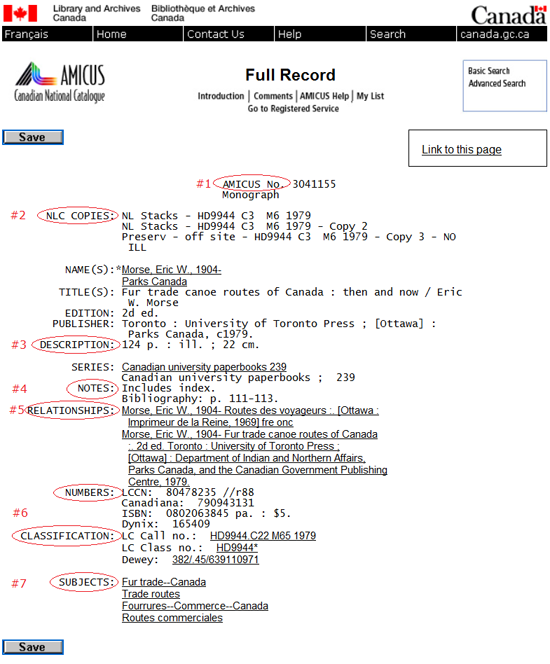
Here are tips on decoding an AMICUS record for books, reports or documents (monographs). To help you better understand, the numbers on the image correspond to the fields in the article.

Screen capture of the AMICUS full record with corresponding fields (source: AN 3041155)

1. AMICUS No.: Keep track of this number! You will need the AMICUS No., the name(s) of the author(s) and the title of the work to place a request for retrieval before visiting Library and Archives Canada (LAC) or once you are on site. Immediately below the AMICUS No., the type of record is specified; this tells you if the record is for a book, a report or a document (monograph), or a journal, a magazine, a newspaper or any type of ongoing publication (serial).

2. NLC (National Library Collection) Copies: Indicates the number of copies available at LAC. If you do not find NLC copies in the record, start your search over and make sure that you are searching the LAC catalogue only, not the entire database. As we are a closed stack library, the shelf location information is for internal purposes only and is not useful to you. Please note that preservation copies are presently unavailable.

3. Description: Tells you the number of pages and if the work contains illustrations or maps.

4: Notes: Provides additional information about the work, for example, other title information, additional information on the contents, whether it contains bibliographic references.

5. Relationships: Provides links to related versions of the work, for example, in other languages or in other formats, such as online or on microfiche.

6. Numbers and Classification: Generally of interest to other libraries only. The call numbers are suggestions for other libraries and are not LAC call numbers.

7. Subjects: Provides the standardized subject headings assigned to the work. Click on any subject heading to find additional materials on that topic.

Stay tuned for an upcoming article on how to read AMICUS records for journals, magazines, newspapers or any other type of ongoing publication (serials).

Questions or comments? We would love to hear from you!

The Korean War

In the wake of the Second World War, the Korean Peninsula was divided into two zones along the 38th parallel, with the North occupied by the Soviet Union and the South by the United States. Soon after the election of a northern communist government in 1948, open war broke out on June 25, 1950, when North Korean troops invaded the South.

Given the situation, the United Nations Security Council passed a resolution to approve sending troops to defend South Korea; a number of countries, including Canada, contributed by supplying armed forces.

The Royal 22e Regiment mortar platoon ready to fire, (left to right) Private Daniel Primeau, Private Raymond Romeo, and Private Julien Blondin, all of Montreal, Quebec.

The Royal 22e Regiment mortar platoon ready to fire, (left to right) Private Daniel Primeau, Private Raymond Romeo, and Private Julien Blondin, all of Montreal, Quebec. Source

More than 26,000 Canadian soldiers fought in the Korean War. They battled communist troops on the ground, while the Royal Canadian Navy—with eight warships—helped control the Korean coasts. The Royal Canadian Air Force did its part transporting troops and equipment. A few pilots saw combat at the controls of American fighter planes.

 Black-and-white photo of two Canadian snipers aiming at an unknown target..

Two snipers. Source

On July 27, 1953, an armistice agreement was signed at Panmunjom, bringing three years of fighting to an end.

In all, 516 Canadians lost their lives during this armed conflict. Their names are entered in The Books of Remembrance… The Korean War, exhibited at the Peace Tower in Ottawa and available online. These registers remind us of the important contribution and tremendous sacrifice of these Canadians.

The Library and Archives Canada collection contains many documents about this war, which marks the 60th anniversary of its armistice in 2013. Here are a few examples:

Part of the war diaries (War Diary, 1951) of the Commonwealth troops, including Canadian troops:

The war diary (1950–1951) of the advance party:

For more photos, visit our Flickr album.

For more information about ordering military service files, please read our blog article on this topic.

The Canadian Arctic Expedition—100th anniversary

At the beginning of the 20th century the Canadian government, led by Sir Robert Borden, wanted to strengthen Canada’s sovereignty in the Arctic, in response to the presence of the United States and Russia in the North. The Canadian Arctic Expedition was established by Order-in-Council 406, dated February 22, 1913, under the responsibility of the Ministry of Naval Services and other government bodies.

The expedition was comprised of two groups, each with its own objective: the Northern Party, led by Vilhjalmur Stefansson, was responsible for geographic exploration of the Arctic to ensure Canadian sovereignty in the western part, while the Southern Party, led by Dr. Rudolph M. Anderson, focused on scientific discovery.

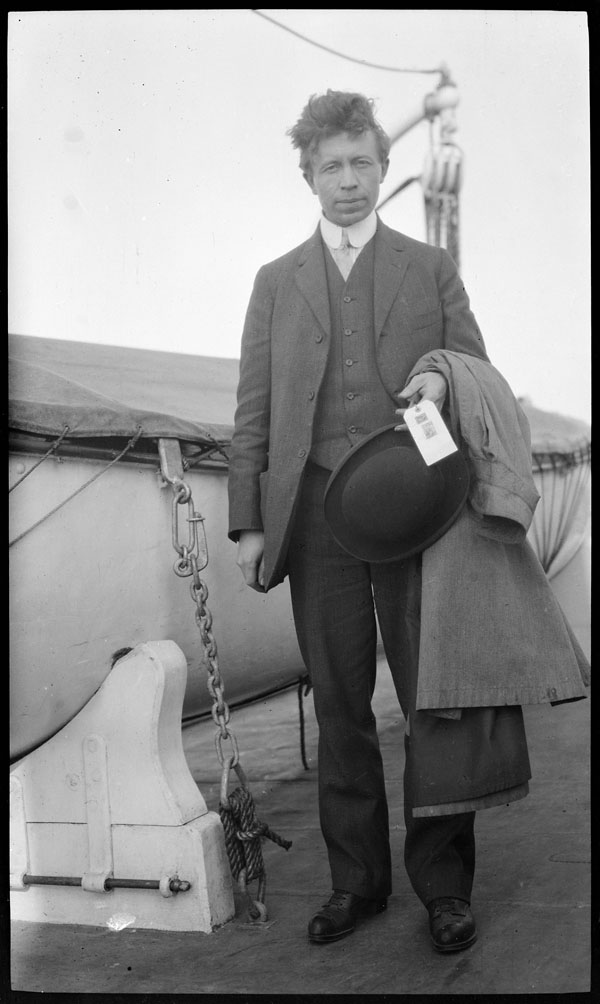
V. Stefansson on board the Karluk.

V. Stefansson on board the Karluk. Source

Rudolph Martin Anderson.

Rudolph Martin Anderson. Source

An expedition fraught with challenge

On June 17, 1913, the expedition set sail from Esquimalt Harbour in British Columbia aboard the Karluk headed for Herschel Island in the Beaufort Sea. In August, the ship became trapped in ice and drifted for over four months, eventually sinking in Siberia. The ship’s captain, Robert Bartlett, describes the final days of the voyage in his book Northward ho! The last voyage of the Karluk. Stefansson’s decision to leave the ship on September 19, 1913, to continue his exploration occurred in a climate of crisis. Stefansson’s departure remains a source of controversy and debate among historians.

The Karluk sails near Esquimalt Harbour.

The Karluk sails near Esquimalt Harbour. Source

To find out more

The following are some of the archival documents and government reports that constitute the information resources related to this expedition.

For consultation on-site at Library and Archives Canada:

Available online from Library and Archives Canada:

Other sources:

Please note that the majority of the documents are available in English only.

For more information, be sure to visit the virtual exhibition at the Canadian Museum of Civilization: Northern People, Northern Knowledge: The story of the Canadian Arctic Expedition 1913-1918.

Visit our Flickr album for more photographs.

Immigration and Citizenship records at LAC: Did your ancestor arrive in Canada before 1865?

This article, the first of a series depicting Immigration and Citizenship sources, offers insight into pre-Confederation arrivals in Canada. Very few records compiled before 1865 still exist. Most surviving records, which are from various sources, have been indexed by name in databases.

Here are the key resources*:

The Immigrants to Canada database was compiled from documents such as immigration and land records and some private fonds, namely the Peter Robinson Papers. It provides access to more than 28,000 references to records held at Library and Archives Canada (LAC).

The Montreal Emigrant Society Passage Book (1832) database provides access to 1,945 references and digitized documents to people who received assistance from the Montreal Emigrant Society in 1832.

The Immigrants at Grosse-Île (1832-1937) database is the result of an agreement between Parks Canada and LAC. It contains more than 33,000 records spanning a 100-year time period. The references describe various events for immigrants arriving at the city of Québec and their time spent at the Grosse-Île Quarantine Station.

The Upper Canada and Canada West Naturalization Records (1828-1850) database gives references to the names of 2,967 persons naturalized in what is now the province of Ontario between 1828 and 1850. The 188 registers have been scanned and digitized images are accessible in this database.

The Citizenship Registration Records for the Montreal Circuit Court (1851-1945) database provides access to more than 8,000 references to the Citizenship Registration Records for the Montreal Circuit Court. The records have been digitized and linked to the database references.

If you think some of your “ancêtres” can be traced back to France, LAC holds a small number of lists from the French Regime (1717-1786).

Coming soon!

Stay tuned for the following related upcoming articles:

  • Validating your ancestor’s presence in Canada before 1865
  • Immigration sources from 1865 onwards (most of them in databases)
  • Border entries to Canada via the United States

*Note: Don’t forget that the Search Help page of a database is the best place to find out how the records are arranged.