Did your ancestors come from Germany?

Do you want to know who your first German ancestor was and when he or she left Germany and arrived in Canada? Are you curious about your German origins?

If so, our website is a great place to begin your research. Here you will find a page dedicated to genealogical research on the Germans. This page provides you with historical information, archival documents and published material from the Library and Archives Canada collection, as well as links to other websites and institutions.

If your ancestor came to Canada between 1865 and 1935, you might find his or her name on the passenger lists.

Questions or comments? We would love to hear from you!

Celebrate Glenn Gould on the 80th Anniversary of His Birth (1932–1982)

Library and Archives Canada (LAC) celebrates, today, the life and career of iconic Canadian musician Glenn Gould .

Born in Toronto, Ontario on September 25, 1932, Glenn Gould is internationally recognized as one of the greatest musicians of the 20th century. Gould was, and remains, a pianist widely revered for his probing musical thought, his clear sound and his unearthly, flawless technique. His performances and recordings of works by Johann Sebastian Bach are renowned.

Did you know?

LAC is the official home of the Glenn Gould Archive, which contains:

  • handwritten diaries and unpublished writings
  • annotated scores and compositions
  • incoming and outgoing correspondence
  • concert programs
  • school and conservatory records
  • recording session logs and papers designated by Gould as “keepers”
  • promotional material
  • medical and financial records
  • photographs and non-commercial audio and video recordings

LAC gifted Glenn Gould’s piano and equally iconic custom-made chair to the National Arts Centre (NAC) in Ottawa this year. Read about the piano by visiting NAC’s website [http://www.nac-cna.ca/en/stories/series/glenn-goulds-piano].

To learn more about Glenn Gould and listen to samples from the Glenn Gould Archive, visit LAC’s virtual exhibition on Glenn Gould.

Please remember that not all of our material is available online. Consult our article:
How to Consult Material that Is Not Yet Available Online.

Questions or comments? We would love to hear from you!

Celebrating International Day of Peace – Part I: Julia Grace Wales

Black and white photograph of a woman with her hair pulled back and a faint smile.

Julia Grace Wales (MIKAN 3361984)

September 21 is recognized as International Day of Peace. To celebrate this event, our blog will feature Canadian women who played a key role in the international peace movement, as documented in the collections of Library and Archives Canada (LAC). We will begin by presenting Julia Grace Wales, who played a key role in promoting peace during the First World War, an unusual role for a woman at this time in history. LAC holds the Julia Grace Wales fonds. Born in the Eastern Townships of Quebec in 1881, Wales was an academic who pursued her studies first at McGill University in Montreal, and later at the University of Wisconsin in Madison, where she taught English literature. Horrified by the news reports of the brutal struggle under way in Europe, Wales responded by proposing a plan to end the fighting.

In December 1914, Wales produced a draft of the now famous document entitled “Continuous Mediation Without Armistice,” which later came to be known as the
Wisconsin Plan. This plan proposed that the United States organize a conference composed of intellectuals from all neutral nations to act as mediators. These individuals would propose solutions that incorporated not only their own ideas, but those of warring nations.

The work of Wales was immediately endorsed by the newly formed Wisconsin Peace Party. State officials around the United States also supported it. The  National Peace Party was so impressed that it sent a delegation to Washington to present the idea to President Woodrow Wilson and Congress. In Europe, Wales presented the plan to the International Congress of Women, whose members unanimously selected it as the solution to the war. They had it printed in four languages and distributed throughout Europe and North America.

By 1916, however, the peace movement began to decline and, despite the efforts of influential citizens like industrialist Henry Ford and leading pacifists, the plan never gained official support from the American government. The entry of the United States into the war in 1917 essentially meant that the mediation plan of Julia Grace Wales was no longer up for discussion.

After returning from Europe in 1917, Wales continued with her academic career, but always maintained an interest in the peace movement. She published articles on the subject, as well as one book. She returned to Quebec in 1947 to retire, and died there in 1957.

For more information, consult the digitized copies of the writing of Julia Grace Wales and other images in our Flickr set or consult her fonds.

Please remember that not all of our material is available online. To learn more, consult the article How to Consult Material that Is Not Yet Available Online.

Questions or comments? We would love to hear from you!

Happy 50th Anniversary to the Jamaican Canadian Association!

On August 6, 1962, Jamaica gained its independence from Great Britain. The Jamaican community in Toronto organized a banquet and party for that date to  celebrate the historic occasion. In the following weeks, the Jamaican Canadian Association (JCA) was born, holding its inaugural meeting on September 23, 1962.

Over the past 50 years, the JCA has provided a variety of social, cultural and community services to Jamaicans in the Toronto area.

Library and Archives Canada (LAC) is proud to hold the historical records of the Jamaican Canadian Association, which document its history and development. LAC also holds the records of Jamaican-Canadian and civil rights advocate, Stanley Grizzle *, who began his career as a Sleeping Car Porter with the Canadian Pacific Railway, and retired as a Canadian citizenship judge.

You can explore these two fonds in LAC’s online Archives Search database to find out more about the history of Jamaicans in Canada. Although the contents of the fonds are not digitized, the Archives Search database will provide you with a  general overview of what they contain.

(*) Access to the Stanley G. Grizzle fonds is restricted. Therefore, researchers must first agree to sign the Application for Access form before they can  consult the records. By signing this form the researcher agrees to respect the Canadian Copyright Act and the right to privacy of living persons.

For information about the possibility of gaining access to these records, ask us a question.

Please remember that not all of our material is available online; however, it is possible to order archival material through our online Request for Retrieval of Documents Form. Archival material can be consulted on site at 395 Wellington Street, Ottawa.

Questions or comments? We would love to hear from you!
Anniversary of the participation of military tanks in combat

Tanks first appeared for military use in September 1916 at the Battle of Flers-Courcelette in France. The First World War was at a pivotal point, since the Battle of the Somme had begun a few months earlier.

Developed in great secrecy over a number of years, the tanks did not, in general, inspire confidence from military authorities of the time. However, their trial in combat conditions in 1916 revealed their true potential. Well-known officers, such as American George S. Patton, were firm believers in the role of the tank; Patton was one of the first officers to command an armoured unit.

Tanks were heavy, slow, loud and could be easily located by the cloud of black smoke they spewed behind them. The first models were made of wood with metal frames; a full metal structure was quickly adopted, since it was fire resistant and shellproof.

The period between the two World Wars saw some major improvements to the tanks. When the Second World War began in 1939, the usefulness of tanks was no longer in doubt. Tanks became a common feature of any army. In 1941, Canada produced its first tank, the Cruiser, and its production continued during the entire conflict.

Canadian armoured units used numerous tank models during the Second World War, such as the Sherman, an American model.

Questions or comments? We would love to hear from you!

Summary of comments received in French up to September 30th, 2013

  • A user asked when and where the Canadian tanks were used. LAC answered that the Canadian tank « Cruise » also called « Ram » was used for the training of Allied Forces in England from 1941 until mid-1944. This tank was not used for combat during the Second World War.

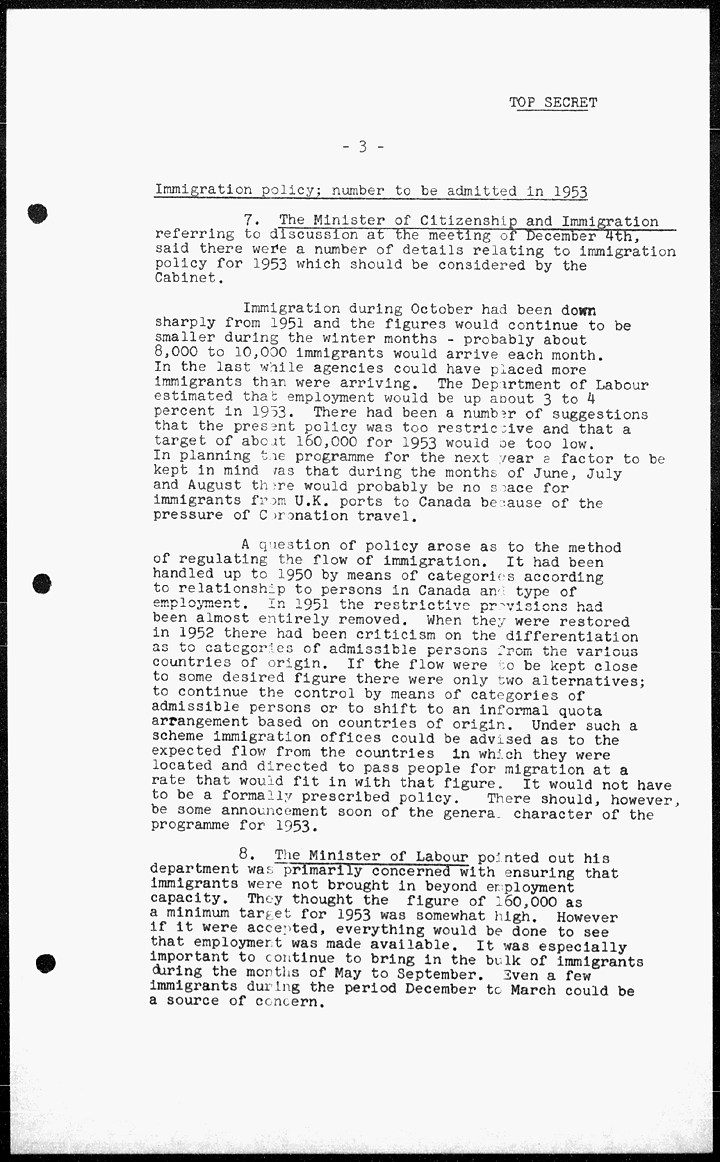
Cabinet Conclusions: A Window into Federal Policy

Are you curious about historic federal Cabinet discussions? Did you ever wonder what happened behind those closed doors? Find out more by using our Cabinet Conclusions database.

Here are some examples:

Cabinet Conclusions is a research tool that provides a record of the discussions that took place at federal Cabinet meetings for the years 1944–1976. Although they are not a verbatim transcript, the Cabinet Conclusions are the only official record of these Cabinet meetings.

For each meeting of Cabinet, the Clerk of the Privy Council prepared a summary of the discussions, a list of the officials who attended the meeting and an agenda. The summary can be very short or can cover several pages. The Cabinet Conclusions database does not include Cabinet Documents.

This research tool has a Search Help section that contains many useful search tips plus helpful background information on Cabinet and their records.

You may notice that the majority of the documents are in English, as this was the primary working language of the federal government at the time. For Cabinet Conclusions from 1944–1969, you can only search using English terms. For Cabinet Conclusions from 1970–1976, you can search using either French or English; however, the documents are usually only available in English.

Did you know?

  • The Privy Council Office only began to record Cabinet Conclusions in 1944. Prior to 1944, there were no formal records of Cabinet.
  • The Privy Council Office still holds the Cabinet Conclusions from 1977 onwards.

Questions or comments? We would love to hear from you!

Take a summer road trip and discover your ancestors

Did you head out to visit your family this summer? Whether you were attending a family reunion, a wedding or an informal get-together, the time spent with
family may have started you thinking about your family history. Did you know that you can discover exciting facts and details about your family by visiting
the Genealogy and Family History pages of the Library and Archives Canada website?

If family history research is new to you, we’re here to help

Begin your search by looking up the following Web pages and use these helpful tips when preparing your quest in family history:

Next, gather the information that you already have in your possession. An attestation paper from the First World War, a marriage certificate, even family pictures can reveal
information about your ancestors.

Talk to your family members and ask questions such as the names of the children in your parents or grandparents families. Did they come to Canada as
immigrants? If so, from which country did they originate? Passenger lists and
their list name indexes can sometimes provide surprising details about a family arriving in Canada.

Now that you have the basics, what else do you need?

A copy of the records in your possession, some writing material (whether in the form of pen and paper or a laptop computer) and a digital camera, will
assist you in documenting your discoveries. Maps of the area where your ancestor was living are also useful in your family history research. For instance,
knowing precisely where your ancestor was living in 1911 or in 1916 (for example, in what county or district) will enable you to find him or her in the Census returns, which contain information such as the profession, date of birth and the siblings living in a given household.

Are you visiting relatives in Ottawa?

If so, visit our Genealogy Services room, located at 395 Wellington Street.
Ensure successful research by watching the video Orientation Services for Clients at 395 Wellington before you
arrive.

Happy research and discoveries!

Questions or comments? We would love to hear from you!

Did your ancestors come from the Ukraine?

Do you ever wonder who your first Ukrainian ancestor was and when he or she left the Ukraine and arrived in Canada? Are you curious about your family’s Ukrainian heritage?

If so, our website is a great place to begin your research. For instance, you will find a page specific to genealogical research about Ukrainians.

It provides you with historical background information, archival and published material from our collection, as well as links to other websites and
institutions.

If your ancestor came to Canada between 1865 and 1935, you might find his or her name on passenger lists.

Questions or comments? We would love to hear from you!

New LAC RSS Feed – Finding Aid, Database and Digitization News

This new RSS feed highlights updates and additions to Library and Archives Canada (LAC)’s resources, such as finding aids, its various databases and provides information on newly digitized content.

Subscribe to this new RSS feed or visit LAC’s RSS page to access other LAC RSS feeds.

For more information on recent announcements at LAC, visit “News”.

The Queen’s Diamond Jubilee – Government Records and Private Archives

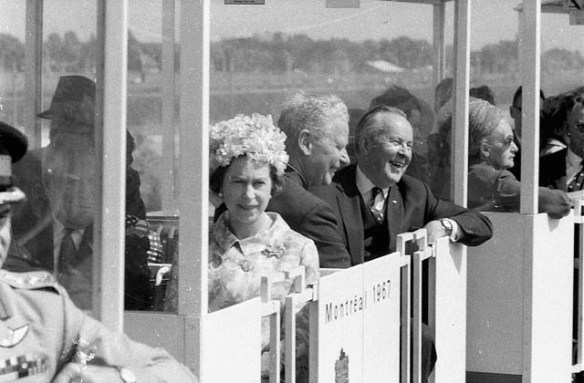
Black and white photograph of Her Majesty Queen Elizabeth II and Prime Minister of Canada Lester B. Pearson in the minirail at Expo 67

Her Majesty Queen Elizabeth II and Prime Minister of Canada Lester B. Pearson in the minirail at Expo 67 (e000996577)

As mentioned in previous articles, the collection at LAC contains a vast amount of information regarding Queen Elizabeth II. In this last article on The Queen, we present a selection of textual materials held by LAC. While few of them have been digitized, the descriptions are all accessible online so you can discover the contents.

Government Records

Private Archives

Questions or comments? We would love to hear from you!