John George Diefenbaker images now on Flickr
Reply

Tanks first appeared for military use in September 1916 at the Battle of Flers-Courcelette in France. The First World War was at a pivotal point, since the Battle of the Somme had begun a few months earlier.
Developed in great secrecy over a number of years, the tanks did not, in general, inspire confidence from military authorities of the time. However, their trial in combat conditions in 1916 revealed their true potential. Well-known officers, such as American George S. Patton, were firm believers in the role of the tank; Patton was one of the first officers to command an armoured unit.
Tanks were heavy, slow, loud and could be easily located by the cloud of black smoke they spewed behind them. The first models were made of wood with metal frames; a full metal structure was quickly adopted, since it was fire resistant and shellproof.
The period between the two World Wars saw some major improvements to the tanks. When the Second World War began in 1939, the usefulness of tanks was no longer in doubt. Tanks became a common feature of any army. In 1941, Canada produced its first tank, the Cruiser, and its production continued during the entire conflict.
Canadian armoured units used numerous tank models during the Second World War, such as the Sherman, an American model.
Questions or comments? We would love to hear from you!
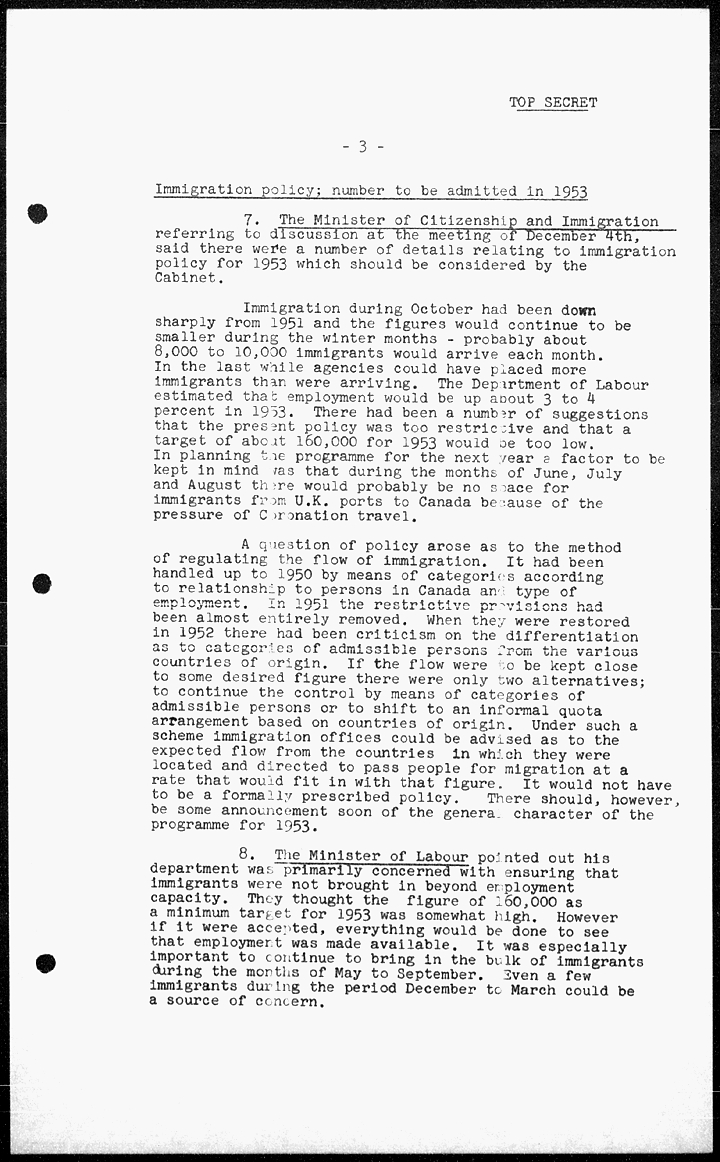
Are you curious about historic federal Cabinet discussions? Did you ever wonder what happened behind those closed doors? Find out more by using our Cabinet Conclusions database.
Cabinet Conclusions is a research tool that provides a record of the discussions that took place at federal Cabinet meetings for the years 1944–1976. Although they are not a verbatim transcript, the Cabinet Conclusions are the only official record of these Cabinet meetings.
For each meeting of Cabinet, the Clerk of the Privy Council prepared a summary of the discussions, a list of the officials who attended the meeting and an agenda. The summary can be very short or can cover several pages. The Cabinet Conclusions database does not include Cabinet Documents.
This research tool has a Search Help section that contains many useful search tips plus helpful background information on Cabinet and their records.
You may notice that the majority of the documents are in English, as this was the primary working language of the federal government at the time. For Cabinet Conclusions from 1944–1969, you can only search using English terms. For Cabinet Conclusions from 1970–1976, you can search using either French or English; however, the documents are usually only available in English.
Questions or comments? We would love to hear from you!
In our post on “How to Find Digitized Publications”, we promised to share more recommendations from our reference specialists about where to find digitized publications. The following sources point to a wealth of publications from across Canada and from specific regions.
CANADA-WIDE SOURCES
Internet Archive – Text Archive [http://archive.org/details/texts]
The Internet Archive Text Archive contains a wide range of historical texts, academic books, government publications, fiction, popular books and children’s
books. The Internet Archive includes many digitized federal government and parliamentary publications from Library and Archives Canada’s collection.
Canadiana Discovery Portal [http://search.canadiana.ca/]
The Canadiana Discovery Portal allows you to search the digitized collections of libraries, archives and museums from across Canada. The Portal includes a
wide range of historical materials such as books, journals, newspapers, government documents, photographs, and maps.
Our Roots: Canada’s Local Histories Online [http://www.ourroots.ca/]
Our Roots is a wonderful resource for family history research. This extensive collection of digitized local histories, including historical publications,
from across the country permits full-text searches for family names, place names and events.
REGIONAL SOURCES
Bibliothèque et Archives nationales du Québec – Digital Collection
[http://www.banq.qc.ca/collections/collection_numerique/index.html?language_id=1]
Bibliothèque et Archives nationales du Québec offers extensive collections of digitized materials including newspapers, magazines, municipal directories,
books and musical scores, reference works, maps and plans, and images.
Peel’s Prairie Provinces [http://peel.library.ualberta.ca/index.html]
Peel’s Prairie Provinces is an indispensable research resource on Western Canada and its history. It includes a bibliography with over 7000 fully searchable digitized books [http://peel.library.ualberta.ca/bibliography/], many dating back to the earliest days of exploration in the region.
Island Archives.ca at the University of Prince Edward Island [http://islandarchives.ca/]
A growing repository of records and images held in Prince Edward Island’s libraries and museums. Of particular interest are the digitized newspapers [http://islandarchives.ca/inewspapers] and maps [http://islandarchives.ca/imaps].
Questions or comments? We would love to hear from you!
Did you head out to visit your family this summer? Whether you were attending a family reunion, a wedding or an informal get-together, the time spent with
family may have started you thinking about your family history. Did you know that you can discover exciting facts and details about your family by visiting
the Genealogy and Family History pages of the Library and Archives Canada website?
Begin your search by looking up the following Web pages and use these helpful tips when preparing your quest in family history:
Next, gather the information that you already have in your possession. An attestation paper from the First World War, a marriage certificate, even family pictures can reveal
information about your ancestors.
Talk to your family members and ask questions such as the names of the children in your parents or grandparents families. Did they come to Canada as
immigrants? If so, from which country did they originate? Passenger lists and
their list name indexes can sometimes provide surprising details about a family arriving in Canada.
A copy of the records in your possession, some writing material (whether in the form of pen and paper or a laptop computer) and a digital camera, will
assist you in documenting your discoveries. Maps of the area where your ancestor was living are also useful in your family history research. For instance,
knowing precisely where your ancestor was living in 1911 or in 1916 (for example, in what county or district) will enable you to find him or her in the Census returns, which contain information such as the profession, date of birth and the siblings living in a given household.
If so, visit our Genealogy Services room, located at 395 Wellington Street.
Ensure successful research by watching the video Orientation Services for Clients at 395 Wellington before you
arrive.
Happy research and discoveries!
Questions or comments? We would love to hear from you!
Do you ever wonder who your first Ukrainian ancestor was and when he or she left the Ukraine and arrived in Canada? Are you curious about your family’s Ukrainian heritage?
If so, our website is a great place to begin your research. For instance, you will find a page specific to genealogical research about Ukrainians.
It provides you with historical background information, archival and published material from our collection, as well as links to other websites and
institutions.
If your ancestor came to Canada between 1865 and 1935, you might find his or her name on passenger lists.
Questions or comments? We would love to hear from you!
This new RSS feed highlights updates and additions to Library and Archives Canada (LAC)’s resources, such as finding aids, its various databases and provides information on newly digitized content.
Subscribe to this new RSS feed or visit LAC’s RSS page to access other LAC RSS feeds.
For more information on recent announcements at LAC, visit “News”.
 Library and Archives Canada Blog