The Queen’s Diamond Jubilee – Government Records and Private Archives

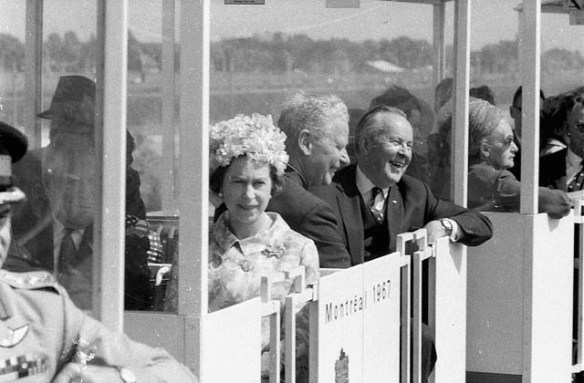
Black and white photograph of Her Majesty Queen Elizabeth II and Prime Minister of Canada Lester B. Pearson in the minirail at Expo 67

Her Majesty Queen Elizabeth II and Prime Minister of Canada Lester B. Pearson in the minirail at Expo 67 (e000996577)

As mentioned in previous articles, the collection at LAC contains a vast amount of information regarding Queen Elizabeth II. In this last article on The Queen, we present a selection of textual materials held by LAC. While few of them have been digitized, the descriptions are all accessible online so you can discover the contents.

Government Records

Private Archives

Questions or comments? We would love to hear from you!

Did your ancestors come from Acadia?

Do you ever wonder who your first Acadian ancestor was and when he or she arrived in Acadia? Are you curious about your family’s Acadian heritage?

If so, our website is a great place to begin your research. For instance, you will find a page specific to genealogical research for Acadians. It provides you with historical background information, archival and published material from our collection, as well as links to other websites and institutions.

You may begin by consulting the Parish Registers fonds, which contains transcriptions of parish registers of various Acadian parishes and from the Gaspé peninsula.

You may also consult the biographies of the 37 main Acadian families, such as “Surette” and “Poirier” [available in French only], from the Université de Moncton’s website.

Questions or comments? We would love to hear from you!

Summary of comments received in French up to September 30th, 2013

  • A user mentioned that he used and will still use Library and Archives Canada’ services to document the descendants of Jacques Bourgeois and Jeanne Trahan. The results of this work is available online at http://Histoire-de-Bourgeois.ca.

The Queen’s Diamond Jubilee – Caricatures, stamps and other documents!

Colour photograph of Queen Elizabeth II in a crowd, smiling.

Queen Elizabeth, 1990 (e010994341-v8)

In addition to photographs, you can also find in the collection of Library and Archives Canada (LAC) caricatures, stamps, audiovisual materials and, of course, books; all of which illustrate and discuss Queen Elizabeth II.

Caricatures

As a public figure, Queen Elizabeth II is the subject for editorial cartoonists. Here are a few examples from the caricatures collection at LAC, some of which are digitized and available online:

Philatelic Documents

A vast number of stamps with Queen Elizabeth II as the main theme were issued. The first one dates from 1932 when she was only a child. A search using the keywords “Queen Elizabeth II, philatelic” in our Collection Search database provides access to over 30 online records.

Audio-visual

The LAC collection includes many films and sound recordings of Elizabeth II. Although these recordings are not available online, you can easily discover our collection by making a keyword search of the Film, Video and Sound Recordings database, which is found on our website.

Here are a few examples:

Publications

Don’t forget our large published collection! To find a publication about Queen Elizabeth II, consult AURORA.

In the meantime, here is a publication (in PDF format) available online:

A Crown of Maples: Constitutional Monarchy in Canada. Canadian Heritage, Gatineau, 2008 (archived) [PDF 55.9MB].

Stay tuned for our next and final blog on The Queen, which will focus on government records and private archives.

Questions or comments? We would love to hear from you!

Discover Canada’s Olympic and Sports History – Part II

Do the London Olympics inspire you to learn more about the history of the evolution of sports in Canada?  If so, a great place to begin your research is at Library and Archives Canada. We hold the records of the national bodies for the following sports:

You will also find more information in the Fitness and Amateur Sport Branch records of the former Department of National Health and Welfare (now Health Canada); this is the main source for learning about the federal government’s involvement in the area of sports. It includes over 40,000 photographs documenting the performance of Canadian athletes at national and international competitions (including the Olympics) during the 1960s and 1970s.

For more information on sports, please visit our other websites:

Please remember that not all of our material is available online; however, it is possible to order archival material through our online Request for Retrieval of Documents Form, or by telephone at 613-996-5115 or 1-866-578-7777 (toll-free).

Questions or comments? We would love to hear from you!

Discover Canada’s Olympic and Sports History – Part I

With the London Olympics well underway, it is fitting to remember the past Canadian accomplishments at the Games and to get acquainted with Canada’s relationship with sports throughout history.

For those interested in a visual history of Canada’s participation at the Olympic Games, Library and Archives Canada’s (LAC) Canadian Olympians database and web pages consist of more than 10,000 images of athletes from the 1904 St. Louis Olympics in the United States to the 2004 Olympics in Athens, Greece.

Some of the early important events in Canada’s Olympic history documented at LAC.

*For more information on George Hodgson and other athletes, visit Sporting Lives: Images of Canadian Athletes (archived site).

Please remember that not all of our material is available online; however, it is possible to order archival material through our online Request for Retrieval of Documents Form, or by telephone at 613-996-5115 or 1-866-578-7777 (toll-free).

For more photographs from past Olympics, visit our Images of summer sports and leisure activities Flickr set.

Enjoy the London Games!

Questions or comments? We would love to hear from you!

Archives vs. Mould: Facts on Fungus

Have you ever opened your fridge to discover something green and fuzzy inside? Or opened an old book and been hit with a strong musty odour? Chances are you have come into contact with mould.

Mould spores occur naturally outdoors and you come into contact with them every day. But in an archival setting indoors, it’s a much different story. Problems begin when the spores come into contact with collection material in an environment that nurtures their growth. Besides the physical damage that mould brings to the material, mould can also affect your health. With this in mind, there are certain precautions you need to take when handling contaminated material.

Fortunately, most of the mould that we come across in the holdings of Library and Archives Canada (LAC) is dormant. This means the spores are in a state of hibernation because the humidity level and temperature are carefully controlled. Ensuring that the environment is not favourable for mould activation and growth is one of the main factors we consider when storing collection material.

All treatment work is done in a biological containment hood after freezing the contaminated material for 48 hours at -35^(0) Celsius to ensure that the mould is inactive before cleaning. Because mould contains pigments that can cause staining, treated material often does not look any different than untreated material. For this reason, material that has been cleaned is clearly identified with a “Treated for Mould Contamination” label.

However if, during a visit at LAC, you suspect that the collection material you are handling is contaminated by mould, the rule of thumb is that it is best not to disturb mould. Therefore, you must immediately stop handling the contaminated documents! Then:

Report the problem to staff immediately; and

  • Leave it to the staff who will take the appropriate actions such as segregating and sealing the material in a plastic bag to ensure that the mould does not spread.

The most important thing to remember is to protect yourself. The following is a list of protective equipment you can use when handling personal documents affected by mould:

  • gloves (Nitrile™ or latex);
  • mask respirators (specially designed and fitted to filter out spores);
  • lab coats;
  • goggles.

As long as you use common sense and take the necessary precautions when dealing with contaminated material, you should be fine, and with any luck, most of the mould you encounter will be limited to the inside of your fridge.

Questions or comments? We would love to hear from you!

New Finding Aids Online: Department of Militia and Defence (RG9) circa 1914–1919

Did you know that several finding aids from the RG9 fonds–the Department of Militia and Defence–refer to documents created during the First World War? These finding aids allow users to find historical documents pertinent to Canada’s participation in the first global conflict.

The following is a list of new online finding aids, which were previously only available in a paper format. These new additions make reference to over 6,000 sublevels.

  1. General Staff, London – 501 descriptions (Finding aid 9-31-36)
  2. Headquarters, Canadian Troops, Seaford-106 descriptions (Finding aid 9-31-41)
  3. No. 5 Canadian General Hospital, Kirkdale-239 descriptions (Finding aid 9-31-39)
  4. Military Hospital No. 12, Bramshott-363 descriptions (Finding aid 9-31-38)
  5. Director of Supply and Transport, London-1159 descriptions (Finding aid 9-31-42)
  6. Quartermaster General, London-1367 descriptions (Finding aid 9-31-43)
  7. Canadian Army Service Corps, London-684 descriptions (Finding aid 9-31-44)
  8. War Graves (Adjutant General Branch)-188 descriptions (Finding aid 9-31-51)
  9. Canadian Air Force-89 descriptions (Finding aid 9-31-49)
  10. Assistant Director Medical Services, Shorncliffe-236 descriptions (Finding aid 9-31-47)
  11. Canadian Forestry Corps, 51st District (Scotland)-198 descriptions (Finding aid 9-31-46)
  12. Canadian Army Veterinary Corps-1077 descriptions (Finding aid 9-31-45)

If you are not certain how to use finding aids, read over Discover Finding Aids Part One and Part Two (The second part is particularly relevant for searching the RG9 finding aids).

.

To search the finding aids below, you will need to select the hyperlinked number located beside “Series consists of” text as in the example below:

A sample record description in the Archives Search database displaying the Series consists of row.

Once on the results page, scroll to the list and explore the sublevels that might be of interest to your search. Note that finding aids generally point to elements of the collection that are not available online, so read How to Consult Material that Is Not Yet Available Online to determine the best method for you.

Questions or comments? We would love to hear from you!