Images of Dinner now on Flickr

A black-and-white photograph of two women preparing dinner in a kitchen. On the left, one stirs food in a pot on a wood burning stove. To the right, one holds an armful of firewood.

Two women preparing dinner in their first home, St. Jean Baptiste, Manitoba [MIKAN 3599459]

During the 17th and 18th centuries, a regimented workday developed in Europe, and this custom was adopted in Canada. Consequently, people working far from home pushed dinnertime into the evening.

A black-and-white photograph of three women and a man eating dinner at home in the dining room.

Munitions workers at the Dominion Arsenals plant dining with friends, Québec, Quebec [MIKAN 3196131]

A black-and-white photograph of two women sitting in a Japanese restaurant with a variety of dishes on the table. The woman on the right instructs the one on the left how to use chopsticks.

Colleen Watt instructed on how to use chopsticks by a server at a Japanese restaurant, Tokyo, Japan [MIKAN 4949090]

Dinner is the third significant meal of the day for Canadians and North Americans in general. A variety of foods are available to enjoy, whether at home or at a restaurant, and there can be several courses. The dining setting may be informal or formal.

A black-and-white photograph of a formal dinner-buffet setting of three tables staffed by a chef wearing a white coat and hat.

Cold collation (cold dinner) at Manoir Richelieu, Canada Steamship Lines, Pointe-au-Pic, Quebec [MIKAN 3553254]

Visit the Flickr album now!

Private Walter Leigh Rayfield, VC

By Ashley Dunk

Library and Archives Canada’s blog series on Canadian Victoria Cross recipients remembers soldiers on the 100th anniversary of the day they acted bravely in battle and for which they were awarded the Victoria Cross. Today we commemorate the courageous actions of Private Walter Leigh Rayfield.

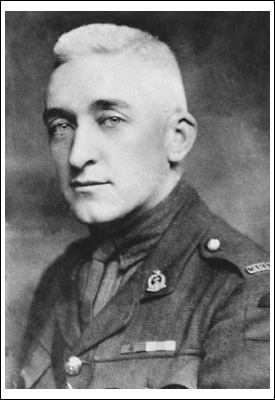
A black-and-white photographic portrait of a soldier.

Walter Leigh Rayfield, VC, undated (a006711)

Born on October 7, 1881 in Richmond, England, Rayfield immigrated to Canada before the war. He worked as a lumberjack before enlisting on July 10, 1917 at Victoria, British Columbia, joining the 7th Infantry Battalion of the Canadian Expeditionary Force (CEF).

At the beginning of September 1918, the Canadian Corps was making efforts to break through the six-kilometer front known as the Drocourt-Quéant Line, east of Arras, France. Having taken the enemy strong point, the Crow’s Nest, on September 1, 1918, the Corps needed an intense assault to break through the German lines and head toward the Canal du Nord.

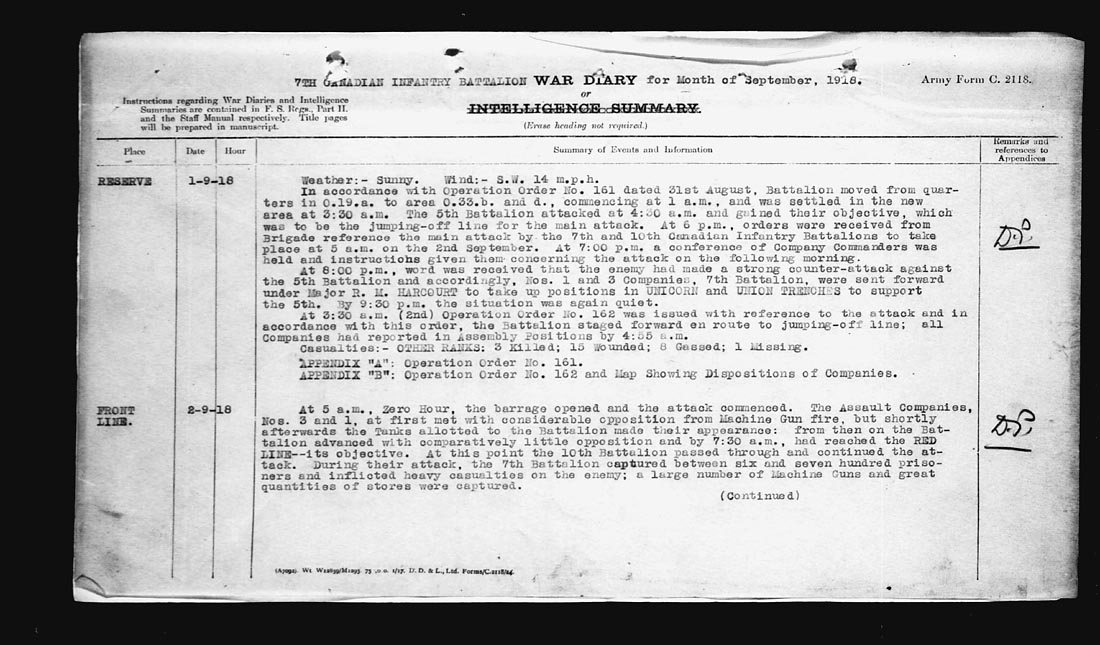
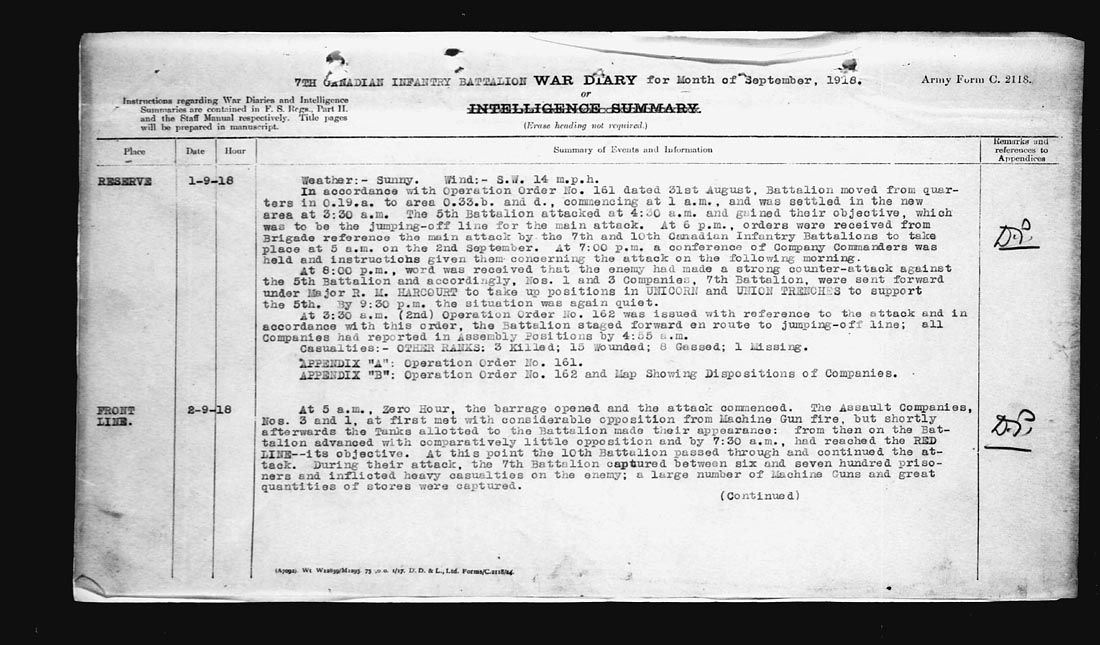
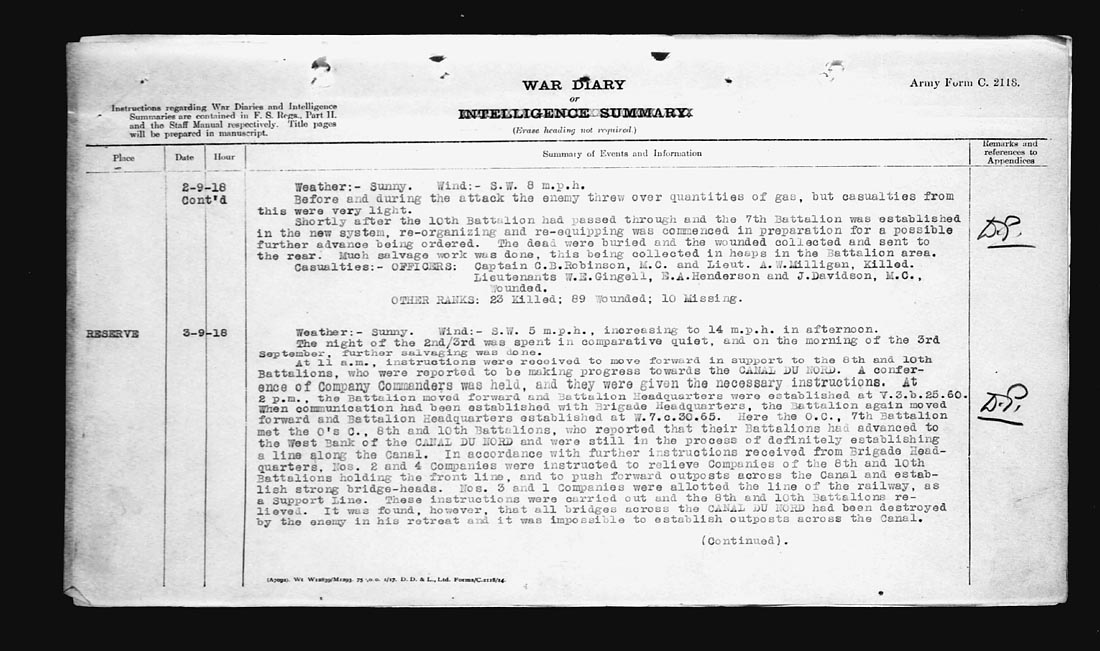
A black-and-white image of a textual document summarizing the activities of the 7th Canadian Infantry Battalion on September 2, 1918.

7th Canadian Infantry Battalion’s war diary with a description of the start of the attack on September 2, 1918, Page 4 (e001084295)

A black-and-white image of a textual document summarizing the activities of the 7th Canadian Infantry Battalion on September 2, 1918, continued onto a second page.

7th Canadian Infantry Battalion’s war diaries with a description of the conclusion of the attack on September 2, 1918, Page 5 (e001084296)

At 5:00 a.m. on September 2, 1918, Canadian artillery fire rained down in a barrage over enemy positions, enabling the Canadians to advance. Tanks provided supporting offensive fire, and by 7:30 a.m., troops reached the Red Line and the village of Dury. During this advance, Rayfield found himself ahead of his company. He rushed a trench occupied by a party of enemy soldiers, killed two soldiers with his bayonet, and took ten men prisoner.

Later, through heavy and consistent rifle fire, he located and engaged an enemy sniper who had been causing many casualties. As reported in the London Gazette two months later:

He then rushed the section of trench from which the sniper had been operating, and so demoralised the enemy by his coolness and daring that thirty others surrendered to him.

London Gazette, no. 31067, December 14, 1918

A black-and-white photograph of hundreds of guns, rifles, and machine guns of varying sizes laying on the ground. A soldier stands examining the guns, and a second soldier bends over examining the strap of a gun.

Guns captured by Canadians on the Arras front, September 1918. (a003291)

He acted again without regard for his personal safety when he left cover under heavy machine gun fire and carried a badly wounded comrade to safety. Rayfield was lauded for his courage, bravery, and initiative during these assaults. Through gas attacks, rapid machine gun fire, and direct attacks from enemy rifles, Rayfield performed gallantly in battle, and heroically for the benefit his comrades.

Rayfield was awarded the Victoria Cross for his actions from September 2 to 4, 1918, in Arras.

He survived the war and was discharged on April 25, 1919.

Rayfield died on February 20, 1949. Today his Victoria Cross is on display at the Canadian War Museum.

Library and Archives Canada holds the digitized service file of Private Walter Leigh Rayfield.


Ashley Dunk is a project assistant in the Online Content Division of the Public Services Branch of Library and Archives Canada.

Hutcheson, Knight, Metcalf, Peck and Young, VCs

By Andrew Horrall

Bellenden Seymour Hutcheson

Bellenden Seymour Hutcheson was born at Mount Carmel, Illinois, on December 16, 1883. He studied medicine at Northwestern University near Chicago and worked as a doctor. Hutcheson was physically striking—he had white hair and piercing blue eyes. Like many Americans, Hutcheson decided to fight for Canada. On November 6, 1915, he joined the Canadian Army Medical Corps at Hamilton, Ontario, and was assigned to the 75th Battalion.

A black-and-white portrait photograph of a soldier with very light hair and looking directly at the viewer.

Captain B.S. Hutcheson, VC, Canadian Army Medical Corps. Source: Directorate of History and Heritage

On September 2, 1918, near Cagnicourt, France, Hutcheson advanced into open ground with his battalion and “without hesitation and with utter disregard of personal safety he remained on the field until every wounded man had been attended to. He dressed the wounds of a seriously wounded officer under terrific machine-gun and shellfire, and, with the assistance of prisoners and of his own men, succeeded in evacuating him to safety, despite the fact that the bearer party suffered heavy casualties. Immediately afterwards he rushed forward, in full view of the enemy, under heavy machine-gun and rifle fire, to tend a wounded sergeant, and, having placed him in a shell-hole, dressed his wounds.” (London Gazette, no. 31067, December 14, 1918)

For his bravery in another action, Hutcheson received the Military Cross.

Dr. Hutcheson married a woman from Nova Scotia at the end of the war and returned to his medical practice in Illinois. He visited Canada regularly over the years, and took part in battalion reunions, but he rarely spoke about his wartime experiences. He died in Cairo, Illinois, on April 9, 1954. His Victoria Cross is held by the Toronto Scottish Regiment Museum.

Sources

“VC from Illinois modestly declines to details exploits,” The Globe and Mail, March 6, 1930, p. 13.

“‘Six-bits’ reunion is first since war,” The Globe and Mail, April 13, 1931, p. 14.


Arthur George Knight

Arthur George Knight was born at Haywards Heath, England, on June 26, 1886. In 1911, he immigrated to Canada and worked as a carpenter. He joined the Canadian Expeditionary Force in December 1914 and served with the 10th Battalion. He was awarded the Belgian Croix de Guerre in November 1917.
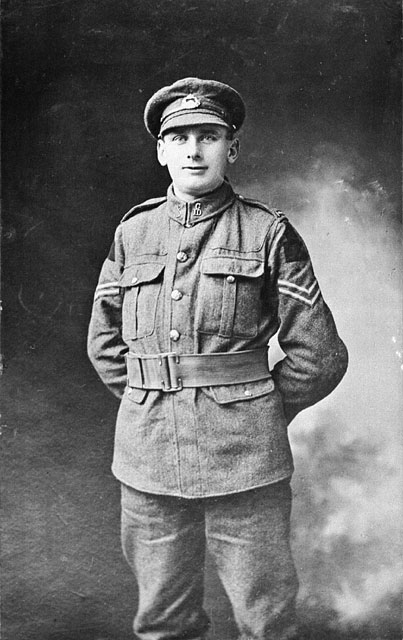
A black-and-white studio photograph of a soldier standing with his hands behind his back.

Sergeant A.G. Knight, VC, undated (a006724)

On September 2, 1918, near Cagnicourt, France, Knight “led a bombing section forward under heavy fire and engaged the enemy at close quarters. Seeing that his party continued to be held up, he dashed forward alone, bayoneting several of the enemy machine-gunners and trench mortar crews, and forcing the remainder to retire in confusion.” As Knight’s platoon chased the retreating Germans, he “saw a party of about thirty of the enemy go into a deep tunnel which led off the trench. He again dashed forward alone, and, having killed one officer and two NCOs, captured twenty other ranks. Subsequently he routed, single-handed, another enemy party which was opposing the advance of his platoon.” (London Gazette, no.31012, November 15, 1918)

Knight was badly wounded in this fighting and died the following day. His Victoria Cross is held by Calgary’s Glenbow Museum.


William Henry Metcalf
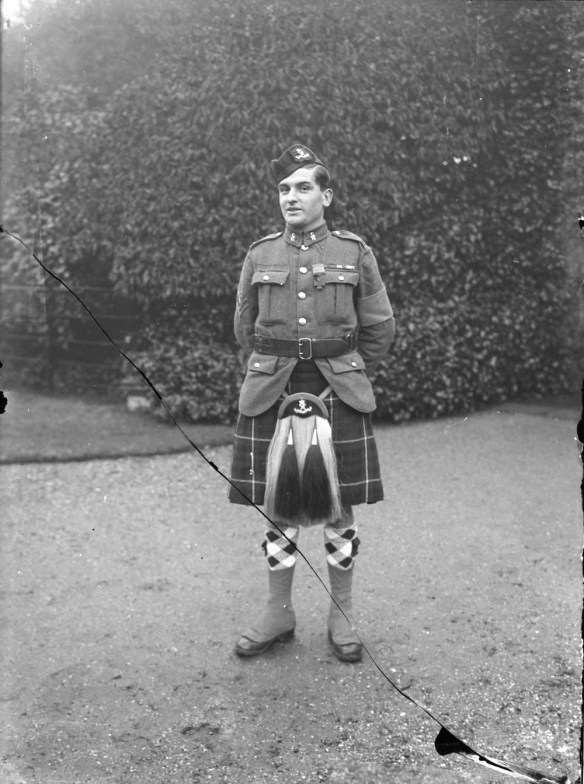
A black-and-white photograph of a standing soldier wearing a kilt.

Lieutenant-Corporal W. H. Metcalf, VC, undated photograph (a006727)

William Henry Metcalf was born in Waite Township, Maine, on January 29, 1885. He worked as a barber before travelling to Fredericton, New Brunswick, to join the Canadian Expeditionary Force on August 15, 1914. He served as a signaler with the 16th Battalion. Metcalf was awarded the Military Medal for his actions in September 1916 at the Battle of the Somme when he volunteered to provide medical assistance to a severely wounded comrade in no man’s land. Having saved the man’s life, Metcalf then repeatedly exposed himself to heavy shelling in order to repair telephone wires. His medal citation notes that “during twenty months of service in the field his conduct has been one of uniform bravery and cheerful devotion to duty.” (London Gazette, no. 29893, January 6, 1917)

Metcalf was awarded the Military Medal for a second time for his actions on August 8, 1918, during the Battle of Amiens. He laid telephone wire across no man’s land during the initial attacks and remained all day under intense shell fire, ensuring that the wire was not damaged. (London Gazette no. 31142, January 24, 1919)

Metcalf was awarded the Victoria Cross for his actions on September 2, 1918, near Cagnicourt, France. When his battalion’s advance began to falter, Metcalf “rushed forward under intense machine-gun fire to a passing tank on the left. With his signal flag he walked in front of the tank, directing it along the [German] trench in a perfect hail of bullets and bombs. The machine-gun strong points were overcome, very heavy casualties were inflicted on the enemy, and a very critical situation was relieved.” (London Gazette, no. 31012, November 15, 1918)

Metcalf died at Lewiston, Maine, on August 8, 1968. His Victoria Cross is held by the Canadian Scottish Museum, Victoria, BC.


Cyrus Wesley Peck

Cyrus Wesley Peck was born at Hopewell Hill, New Brunswick, on April 26, 1871. He trained to be a soldier, but was unsuccessful in taking part in the South African War. At the start of the First World War, Peck was managing a salmon cannery in British Columbia and serving in the militia. He enlisted in the 30th Battalion on November 8, 1914, at the rank of Major. In late 1916, Peck was promoted to Lieutenant-Colonel and given command of the 16th Battalion, the Canadian Scottish Regiment.

A black-and-white photograph of a mustachioed man wearing tartan pants, a Sam Brown belt and a cap walking with a walking stick through ornate gates. A crowd on the right is looking toward the gates.

Lieutenant-Colonel Cyrus W. Peck, VC, DSO, 16th Battalion, leaving Buckingham Palace (a006720)

Peck received the Distinguished Service Order, was mentioned in dispatches five times, and was wounded twice. He was also elected to the House of Commons for the riding of Skeena, British Columbia, in the federal election of December 1917. This so-called “Khaki Election” was the first one in which soldiers on active service were allowed to vote. Though Peck was now a Member of Parliament, he continued to carry out his military duties in France.

Peck is Canada’s unlikeliest Victoria Cross hero. Though his walrus moustache gave him a military look, he was 47 years old, 5 feet and 9 inches tall, and a portly 250 pounds. Nonetheless, on September 2, 1918, near Cagnicourt, France, Peck saw that his battalion’s advance had stalled. So he “made a personal reconnaissance under heavy machine-gun and sniping fire, across a stretch of ground which was heavily swept by fire. Having reconnoitered the position he returned, reorganised his battalion, and, acting upon the knowledge personally gained, pushed them forward and arranged to protect his flanks. He then went out under the most intense artillery and machine-gun fire, intercepted the tanks, gave them the necessary directions, pointing out where they were to make for, and thus pave[d] the way for a Canadian Infantry battalion to push forward. To this battalion he subsequently gave requisite support. His magnificent display of courage and fine qualities of leadership enabled the advance to be continued, although always under heavy artillery and machine-gun fire, and contributed largely to the success of the brigade attack.” (London Gazette no. 31012, November 15, 1918)

Peck lost his seat in the House of Commons in the 1921 federal election. He sat in British Columbia’s provincial legislature from 1924 to 1933, and died at Sydney, British Columbia, on September 27, 1956. His Victoria Cross is held by the Canadian War Museum.

Sources

“Won VC in 1918 while a member of parliament,” The Globe and Mail, September 28, 1956, p. 7.


John Francis Young

John Francis Young was born in Kidderminster, England, on January 14, 1893, and immigrated to Canada sometime before the war. He enlisted in the 87th Battalion at Montreal on October 20, 1915, and served as a stretcher bearer. Young was wounded at the Somme in November 1916.

A black-and-white photograph of a smiling soldier standing with his arms behind his back.

Private J. F. Young, VC, undated. Source: Directorate of History and Heritage

Young was awarded the Victoria Cross for his actions on September 2, 1918, near Dury, France. When German artillery and machine guns cut down Young’s company, he spent over an hour treating wounded comrades in full view of the enemy. He repeatedly travelled back to the Canadian lines for more medical supplies, but always returned to the wounded men. Young then organized the stretcher bearers who carried the wounded men to safety. (London Gazette no. 31067, December 14, 1918)

Young was gassed in a subsequent battle and suffered permanent and debilitating lung damage. He died at Sainte-Agathe-des-Monts, Quebec, on November 7, 1929. His Victoria Cross is held by the Canadian War Museum.

Sources

“John F. Young, VC, is dead in Quebec,” The Globe and Mail, November 8, 1929, p. 1.


Library and Archives Canada holds the service files for Bellenden Seymour Hutcheson, Arthur George Knight, William Henry Metcalf, Cyrus Wesley Peck and John Francis Young.


Andrew Horrall is a senior archivist in the Private Archives Division at Library and Archives Canada.

Claude Nunney, VC

By Andrew Horrall

When Claude Joseph Patrick Nunney joined the 38th Battalion on March 8, 1915, he stated that he was born in Dublin, Ireland, on December 24, 1892. This appears not to have been strictly true, though it is unclear why Nunney obscured his origins. Archival records point to Nunney having been born on that day in Hastings, England, and given the name Stephen Sargent Claude Nunney. It is certain that he was orphaned as a child and sent across the Atlantic to Ottawa, where he was adopted at first by Mrs. D. J. MacDonald, of North Lancaster, Ontario. By the time he enlisted, he was living with the Calder family of Glengarry County, Ontario, whom he identified as his next of kin and to whom he remitted money each month.

Nunney was an outstanding soldier who was awarded the Distinguished Conduct Medal for his actions at the Battle of Vimy Ridge in April 1917, when “although wounded in two places and his section wiped out he continued to advance carrying his gun and ammunition and alone stopped an attack by over 200 enemy. He continued on duty for three days showing exceptional fearlessness and doing magnificent work.” (London Gazette, no. 30234, 16 August 1917) Soon afterwards, he was awarded the Military Medal for another act of bravery.

A black-and-white portrait photograph of a seated soldier who holds his cap and swagger stick on his lap.

Private Claude Nunney, VC, of the 38th Battalion (a006859)

Nunney’s promotion to sergeant in June 1917 testified to his battlefield leadership and courage. But the following April, he was court-martialed for striking a superior officer. The incident is detailed in the records of Nunney’s court-martial, which are held by LAC. The facts of the case were clear, though two officers testified in Nunney’s defence, with one calling him “one of the best front line fighting men in the Battalion.” Nunney was convicted and demoted back to private, though his sentence of one year’s hard labour was soon commuted “on account of [Nunney’s] previous good service.”

Private Nunney was awarded the Victoria Cross posthumously for his actions on September 1 and 2, 1918, during the fighting at the Drocourt-Quéant Line in France. During a German attack “Nunney, who was at this time at company headquarters, immediately on his own initiative proceeded through the barrage to the company outpost lines, going from post to post and encouraging the men by his own fearless example. The enemy were repulsed and a critical situation was saved. During the attack on 2nd September his dash continually placed him in advance of his companions, and his fearless example undoubtedly helped greatly to carry the company forward to its objectives.” (London Gazette, no. 31067, December 14, 1918)

Nunney was severely wounded while carrying out these courageous acts and died on September 18, 1918. He left all his effects, including his medals, to the Calders. When Canadian Victoria Cross recipients assembled at Toronto in 1938, the widowed Mrs. Calder was too old to attend. So she asked a female friend in Alexandria, who was an advocate for veterans’ welfare, to wear Nunney’s medals at the gathering. The orphaned Irish boy had been adopted by an entire community. His Victoria Cross is held by the Cornwall Armoury. Library and Archives Canada holds his service file.

Sources

“Spirit of war hero marches on in VC,” The Globe and Mail, August 2, 1938, p. 5.


Andrew Horrall is a senior archivist in the Private Archives Division at Library and Archives Canada.

Canada’s Earliest Printers

By Meaghan Scanlon

As you walk through the exhibition Premiere: New acquisitions at Library and Archives Canada, you will see two items from Library and Archives Canada’s (LAC’s) Rare Book Collection. One is a short medical pamphlet published in Quebec in 1785 that explains the symptoms and treatment of a disease thought to have been a form of syphilis. The other is a proclamation on the subject of French fishing rights, issued by the Governor of Newfoundland in 1822.

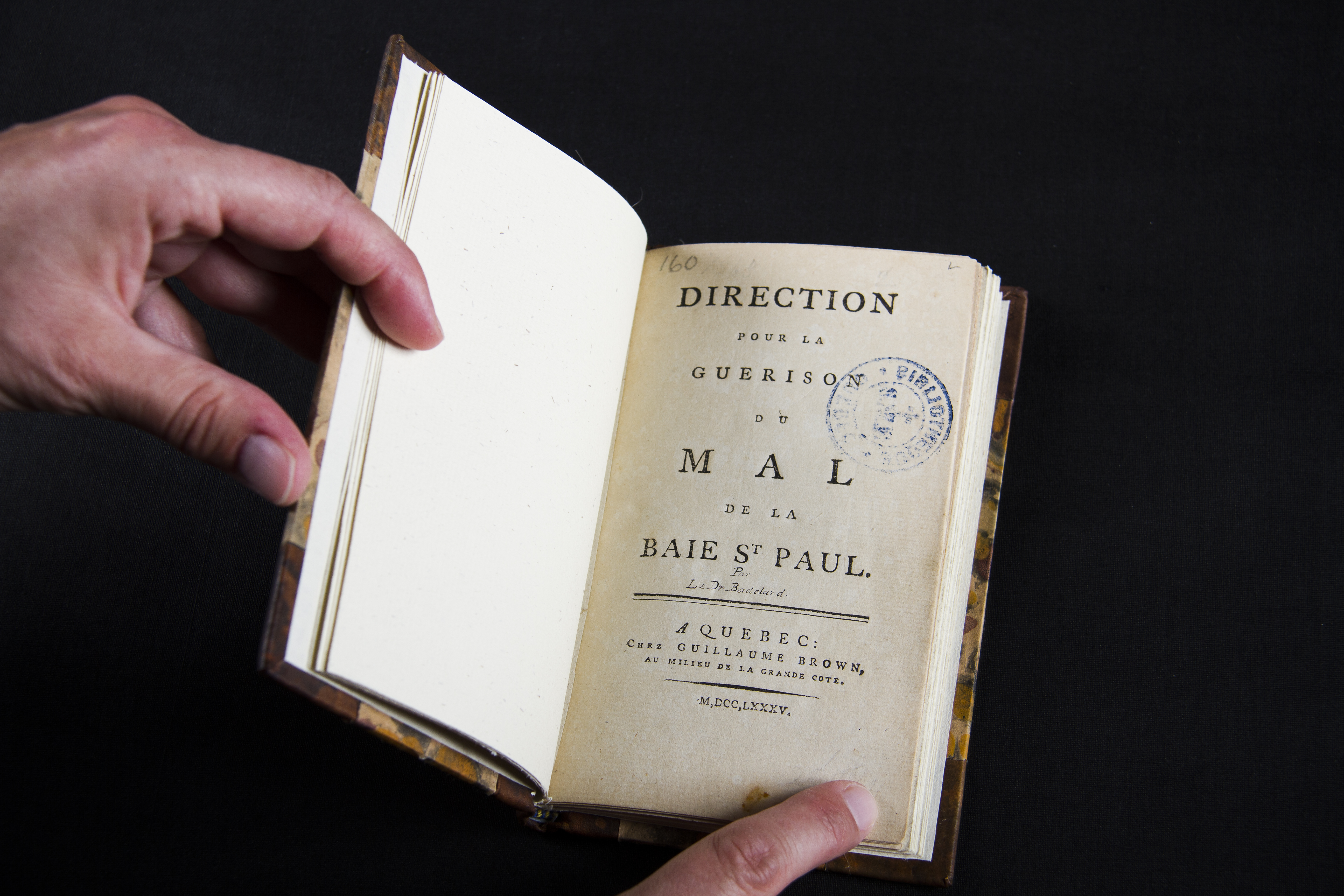
A colour photograph of a book open to the title page. It reads: Direction pour la guerison du mal de la Baie St Paul. A Quebec : Chez Guillaume Brown, au milieu de la grande cote. M, DCC, LXXXV.

Title page of Direction pour la guerison du mal de la Baie St Paul. Printed by Guillaume (William) Brown at Quebec City in 1785 (AMICUS 10851364)

These two publications may not appear to have much in common. In fact, though, they share an interesting historical connection: both are the work of the first printers in their respective provinces. William Brown, publisher of Direction pour la guerison du mal de la Baie St Paul [A guide to treating the Baie St Paul malady], and his partner, Thomas Gilmore, became the first printers in the province of Quebec when they set up shop at Quebec City in 1764. John Ryan, who produced the Newfoundland broadside, holds the distinction of having been the first printer in two separate provinces. Ryan and his partner, William Lewis, were already in business in Saint John when the province of New Brunswick was created in 1784. Ryan then relocated to St. John’s, Newfoundland, in 1806, and opened the island’s first press.

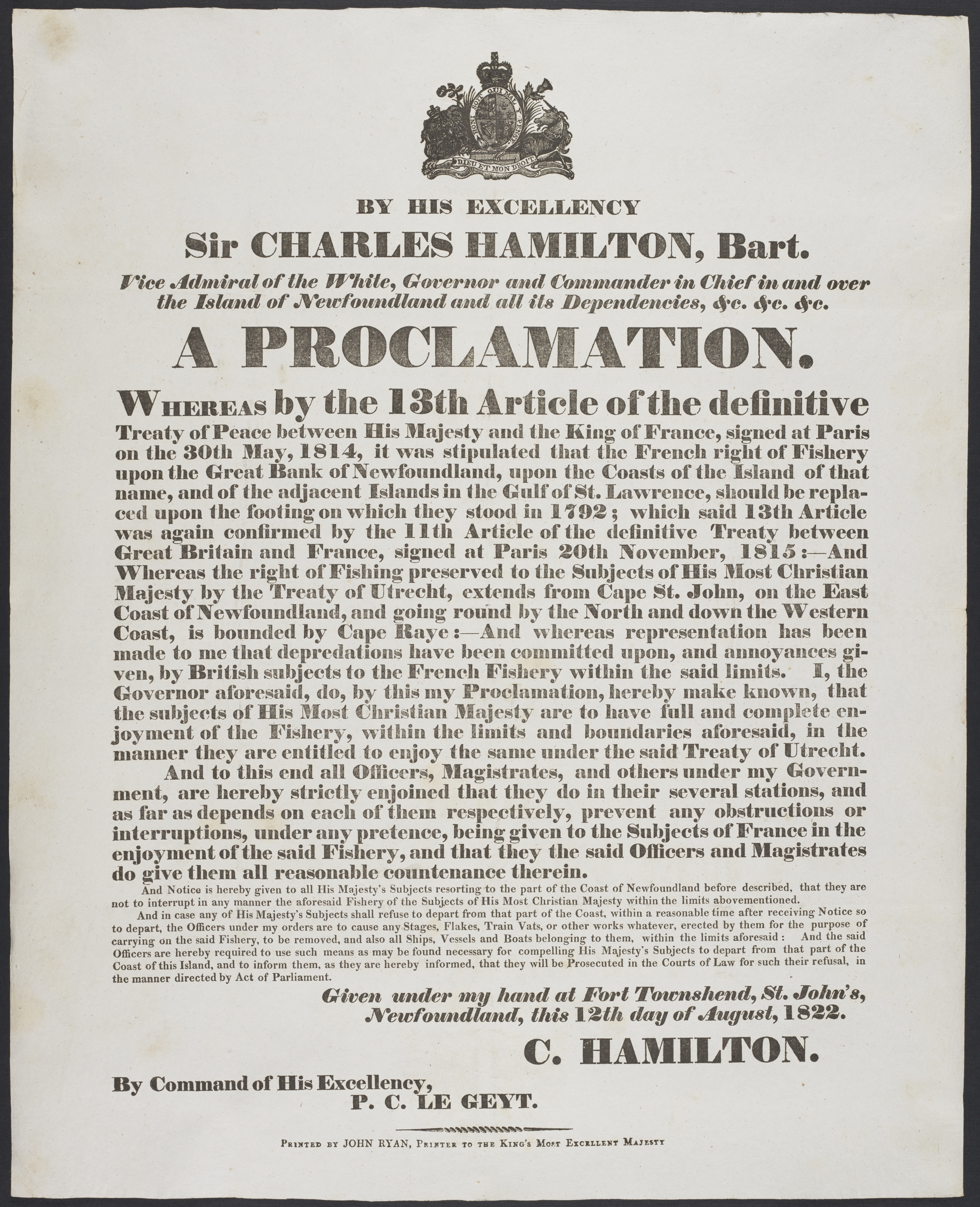
A black-and-white document proclaiming the rights of French fishermen under the Treaty of Paris, which confirmed the rights laid out in the Treaty of Utrecht, to fish in the waters off Newfoundland without hindrance or harassment by British subjects. The proclamation directs officers and magistrates to prevent British subjects from obstructing the French fishery, and gives warnings about potential actions to be taken against those British fishermen who refuse to comply.

By His Excellency Sir Charles Hamilton … a proclamation. Printed by John Ryan at St. John’s, Newfoundland, ca. 1822 (AMICUS 45262655)

Johann Gutenberg introduced printing to Europe in the middle of the 15th century, completing his famous Bible in Mainz, Germany, around 1454. By 1500, Gutenberg’s innovation had been adopted widely in Europe. European colonists then transported printing technology to the Americas. It was not until 1751—almost 300 years post-Gutenberg—that the first press reached Canada. This alone seems to us like an incredibly lengthy interval, accustomed as we are to rapid changes in technology. But it actually took close to another 150 years for printing to spread to all regions of the country. Through holdings like these items printed by William Brown and John Ryan, LAC’s Rare Book Collection documents the long and fascinating history of how printing made its way across Canada.

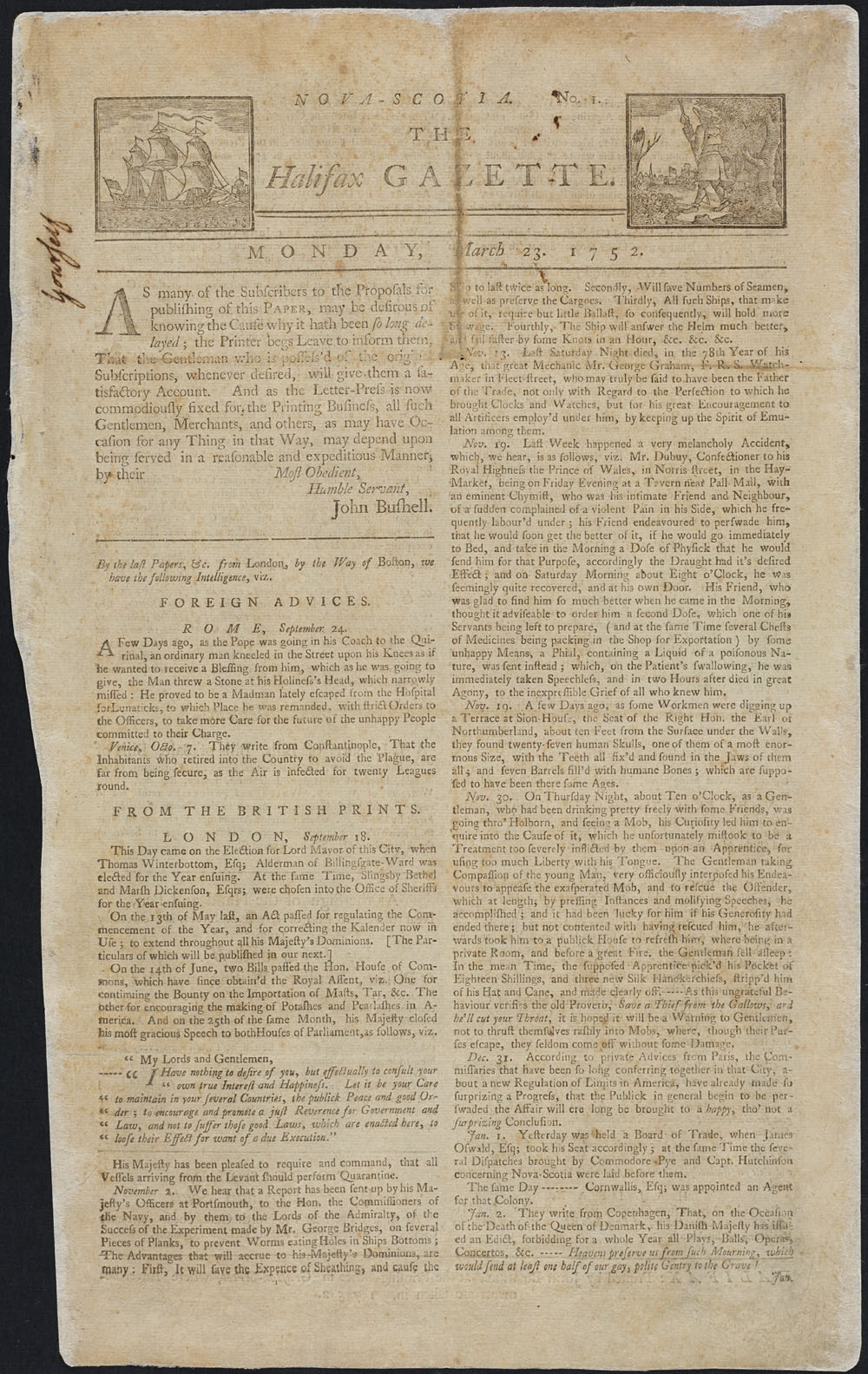
A colour reproduction of the cover page of a newspaper. The newsprint is creased near the top and sepia-tinged.

The Halifax Gazette, no. 1 (March 23, 1752). Printed by John Bushell (AMICUS 7589124)

This history begins with John Bushell, Canada’s first printer. In 1751, Bushell moved from Boston, Massachusetts, to Halifax, Nova Scotia. There, he published the country’s first newspaper, The Halifax Gazette, on March 23, 1752. As previously noted, Quebec and New Brunswick got their first presses in 1764 and 1784, respectively. By the end of the 18th century, printers had come to Prince Edward Island and Ontario, where Louis Roy established the first press in Newark (Niagara-on-the-Lake) in 1792. After John Ryan’s arrival in Newfoundland in 1806, there were presses in all of the eastern provinces. Many early eastern Canadian printers, including Ryan and Prince Edward Island’s first printer, James Robertson, were Loyalists—Americans who left the United States during the American Revolutionary War out of loyalty to the British monarchy.

The advent of printing in Western Canada and the North occurred before the close of the 19th century. In both Alberta and Manitoba, the first printers were missionaries who produced Indigenous language translations of Christian religious texts. Using a makeshift press and type he had cast himself, Methodist minister James Evans started printing in Cree syllabics at Rossville, Manitoba, in 1840. The Oblate priest Émile Grouard brought the first press to Alberta when he settled at Lac La Biche in 1876. In 1878, Grouard completed the province’s first book, entitled Histoire sainte en Montagnais (“Montagnais” was the term non-Indigenous people used for the Dene language). That same year, Saskatchewan’s first printer, Scottish-born Patrick Gammie Laurie, began publishing his newspaper, the Saskatchewan Herald (AMICUS 4970721), in Battleford. Laurie had walked to Battleford from Winnipeg—a distance of about 1000 kilometres!—leading an ox cart that carried his press.

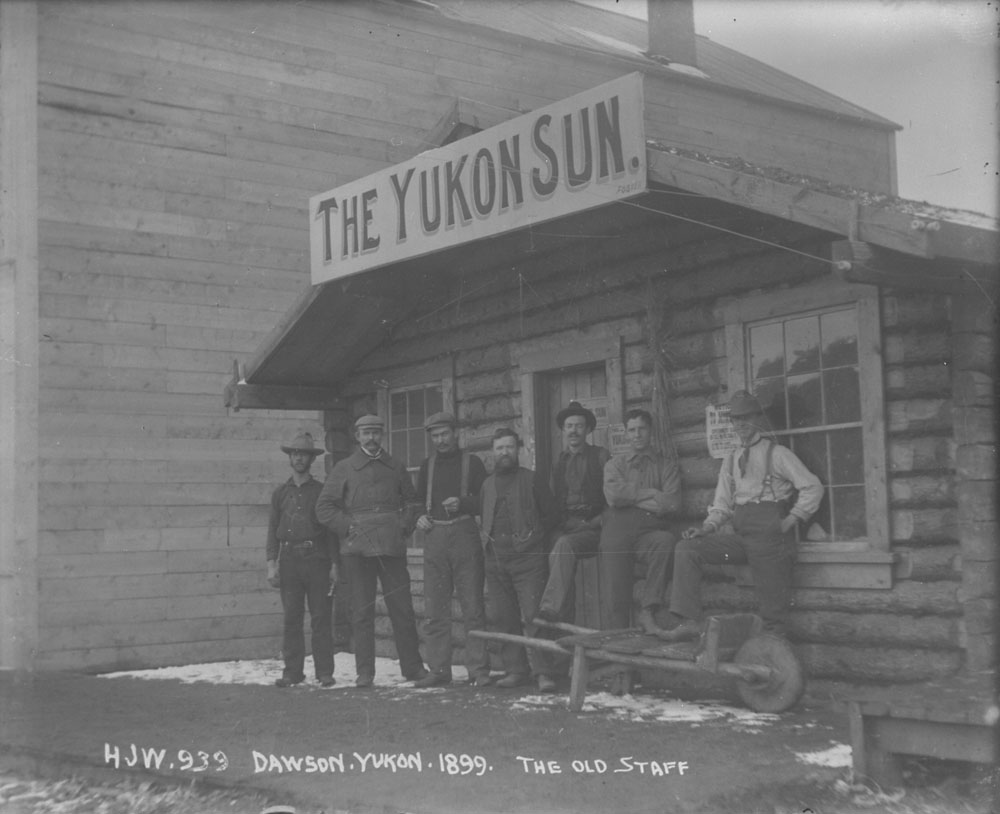
The Fraser River gold rush lured prospectors to the west coast in 1858. A demand for printed news accompanied this influx of people, resulting in the establishment of British Columbia’s first five newspapers, all in Victoria. One of the five was The British Colonist (AMICUS 7670749), founded by the future premier of British Columbia, Amor de Cosmos. Gold also spurred the introduction of the press to Canada’s northern territories. During the Klondike gold rush in 1898, printer G.B. Swinehart left Juneau, Alaska, with the intention of starting a newspaper in Dawson City, Yukon. Swinehart’s journey stalled at Caribou Crossing due to the weather, so he published a single issue there while he waited. This paper, the Caribou Sun (AMICUS 7502915) for May 16, 1898, is the first document known to have been printed in Canada’s North.

A black-and-white photograph of a group of men standing in front of a log building with a sign that reads The Yukon Sun.

Office of G.B. Swinehart’s paper, renamed The Yukon Sun, at Dawson City, 1899. (MIKAN 3299688)

LAC’s published collection holds a lot of early Canadian printed material, including over 500 items printed in Canada before 1800. This is a significant number, but the collection still has many gaps. It is always exciting for LAC staff when we come across imprints that aren’t already in the collection because documents printed by Canada’s first printers tend to be very rare. The two publications featured in the Premiere exhibition are good examples. Only about five copies of Direction pour la guerison du mal de la Baie St Paul survive today. The John Ryan broadside was previously unrecorded, meaning that no other copies are known to exist.

If you’re in the Ottawa area, check out Premiere: New Acquisitions at Library and Archives Canada to see these rare early Canadian imprints in person, along with new acquisitions from other parts of LAC’s collection. The exhibition runs at 395 Wellington Street in Ottawa until December 3, 2018. Admission is free!

Additional resources


Meaghan Scanlon is Senior Special Collections Librarian in the Published Heritage Branch at Library and Archives Canada.

William Hew Clark-Kennedy, VC

By Andrew Horrall

William Hew Clark-Kennedy was born in Dunskey, Scotland, on March 3, 1880, and began working for the Standard Life Assurance Company at age 16. He served with a British cavalry regiment in the South African War before moving to Canada in 1902 to work in Standard Life’s Montreal office. There he met and married Katherine “Kate” Reford.

Clark-Kennedy joined the 13th Battalion, Royal Highlanders of Canada, at Valcartier, Quebec, on September 23, 1914, and arrived in France the following February. On April 24, 1915, an artillery shell landed near where he and two other men were standing. Clark-Kennedy’s companions were killed instantly, while he was buried by earth and mud. Clark-Kennedy’s comrades believed that he also had died and that his body had been either obliterated or buried. They reported that he had been killed in action. But Clark-Kennedy had suffered only minor injuries, and without anyone noticing, he dug himself out and resumed fighting. It took a couple of days to sort out the error and for Clark-Kennedy to cable his family and tell them he was fine.

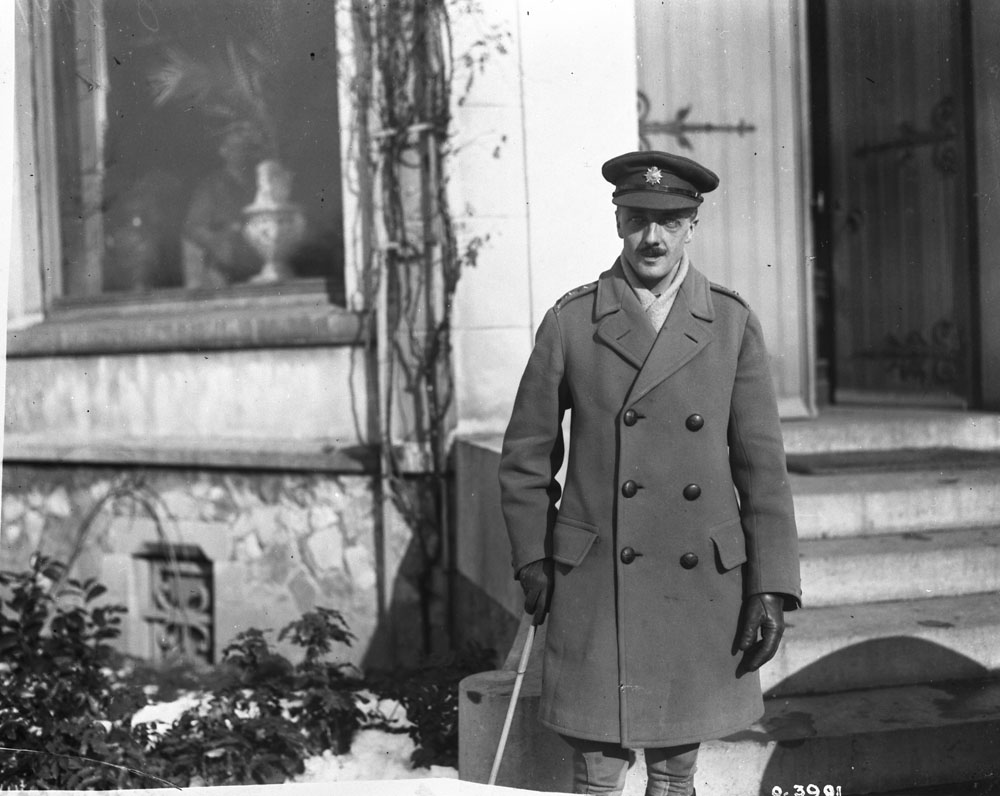
A black-and-white photograph of an officer standing in front of a building wearing his officer’s cap and carrying a walking stick in his right hand.

Lieutenant-Colonel Clark-Kennedy, VC, OC, 24th Battalion. Photograph taken January 1919 (a003909)

Clark-Kennedy was awarded the Victoria Cross for his actions while commanding the 24th Battalion on August 27 and 28, 1918, during the Battle of Arras. An excerpt from the London Gazette shows his exceptional bravery: “from the outset the brigade, of which the 24th Battalion was a central unit, came under very heavy shell and machine-gun fire, suffering many casualties, especially amongst leaders. Units became partially disorganised and the advance was checked. Appreciating the vital importance to the brigade front of a lead by the centre and undismayed by annihilating fire, Lieutenant-Colonel Clark-Kennedy, by sheer personality and initiative, inspired his men and led them forward. On several occasions, he set an outstanding example by leading parties straight at the machine-gun nests which were holding up the advance and overcame these obstacles. By controlling the direction of neighbouring units and collecting men who had lost their leaders, he rendered valuable services in strengthening the line, and enabled the whole brigade front to move forward.”

Clark-Kennedy showed equal courage the following day, despite a very serious gunshot wound to his right knee. The citation for his Victoria Cross ends with the declaration that “it is impossible to overestimate the results achieved by the valour and leadership of this officer.” (London Gazette, no. 31067, December 14, 1918)

In addition to the Victoria Cross, Clark-Kennedy was mentioned in despatches four times, received the Distinguished Service Order twice, was appointed a Companion of the Order of St Michael and St George, and was awarded the French Croix de Guerre.

A black-and-white photograph of two officers standing in front of a car in which a driver is seated. They both wear officers’ caps and greatcoats.

Lieutenant-Colonel W.H. Clark-Kennedy (right), VC, CMG, DSO and Bar, and Brigadier-General J.H. MacBrien, DSO and Bar, CB (a006743)

After the war, Clark-Kennedy returned to Canada and his job at Standard Life, and eventually became the firm’s director. He died in Montreal on October 25, 1961. Clark-Kennedy’s Victoria Cross is held by his family. Library and Archives Canada holds his service file.

Sources

“Officer, feared dead, continued to fight,” The Globe and Mail, October 27, 1961, p. 31.

“Lt.-Col. Clark-Kennedy VC, dies here in 83rd year,” Montreal Gazette, October 27, 1961, p. 4.


Andrew Horrall is a senior archivist in the Private Archives Division at Library and Archives Canada.

Charles Smith Rutherford, VC

By Ashley Dunk

Today in Library and Archives Canada’s blog series on Canadian Victoria Cross recipients, we remember Charles Smith Rutherford, who earned his Victoria Cross one hundred years ago today for his heroic actions on the battlefield.

A black-and-white photograph of a military officer standing with a cane.

Lieutenant Charles S. Rutherford, VC, ca. 1914–1919 (a006703)

Born on January 9, 1892, in Colborne, Ontario, Rutherford was a farmer before the war. On March 2, 1916, he enlisted in Toronto, Ontario, joining the 83rd Battalion of the Canadian Expeditionary Force as a private. He arrived in France on June 10, 1916. Rutherford was a decorated soldier, earning the Military Medal on February 23, 1918, and the Military Cross on January 11, 1919. He was promoted to Lieutenant on April 28, 1918.

On August 26, 1918, while serving in the 5th Battle of the Scarpe, near Monchy, France, Rutherford was in command of an assault party. Finding himself noticeably ahead of his men, he observed an enemy party standing outside a pillbox. With his revolver, Rutherford beckoned them to come to him. Instead, they waved for him to approach. Through skillful bluffing, he convinced the enemy soldiers that they were surrounded. The party of 45 men, which included two officers and three machine guns, surrendered to him.

A black-and-white photograph of three people standing and posing for a photograph: a woman in a fur coat, a military officer with a cane, and a soldier with a cane and beret.

Lt. C.S. Rutherford, VC (centre), ca. 1914–1919 (a006705)

After capturing the party, he persuaded one of the enemy officers to stop a nearby machine gun from firing, which then allowed Rutherford’s men to advance to his position.

Beyond the pillbox, Rutherford saw that some of his assault party was held up by heavy machine-gun fire from another pillbox. With the support of the rest of his party, he attacked the pillbox with a Lewis gun section, successfully capturing an additional 35 prisoners and their machine guns. His leadership enabled his assault party to continue its advance.

As reported in the London Gazette two months later:

The bold and gallant action of this officer contributed very materially to the capture of the main objective and was a wonderful inspiration to all ranks in pressing home the attack on a very strong position.

London Gazette, No. 31012, November 12, 1918

On March 20, 1919, Rutherford was discharged through general demobilization.

He died in Ottawa, Ontario, on June 11, 1989, at the age of 97.

A black-and-white photograph of a military officer in a ceremonial uniform.

Captain Charles S. Rutherford, VC, Sergeant-at-Arms, Ontario Legislature, 1937 (a053785)

Library and Archives Canada holds the digitized service file of Lieutenant Charles Smith Rutherford.


Ashley Dunk is a project assistant in the Exhibitions and Online Content Division of the Public Services Branch at Library and Archives Canada.
Images of Rugby now on Flickr

A black-and-white photograph of two rugby teams in a scrum for the ball. Two referees watch the play unfold.

Second rugby game at Godalming between Seaford and Witley, England [MIKAN 3385967]

British settlers and military personnel most likely introduced rugby to Canada during the early 1800s. Play and competition seemed to be informal until 1864 when F. Barlow Cumberland and Fred A. Bethune at Trinity College, Toronto, codified rules for Canada. The first Canadian match under these rules was held in Montréal between English regimental officers and civilians from McGill University.
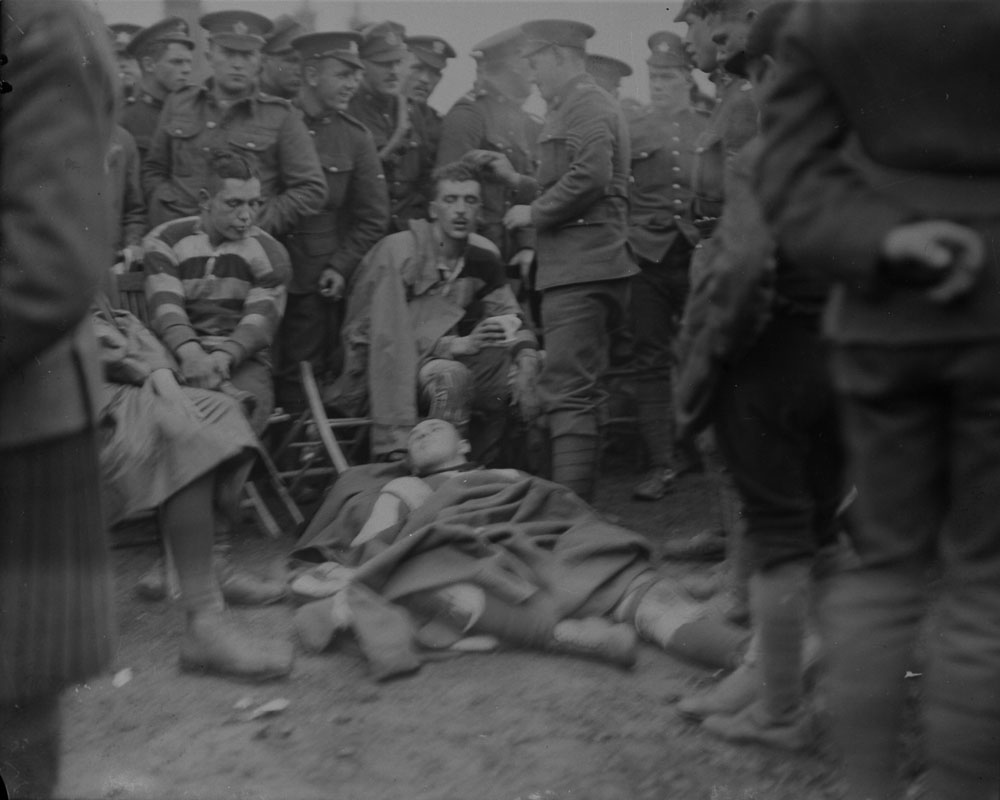
A black-and-white photograph of injured rugby players. One player sits on a chair and has a head injury treated. A second player lies on the ground covered by a blanket. Spectators stand close to the players on the sideline.

Spectators and injured players on the sideline at the rugby football match between Canadians of Seaford and Witley, Godalming, England [MIKAN 3385975]

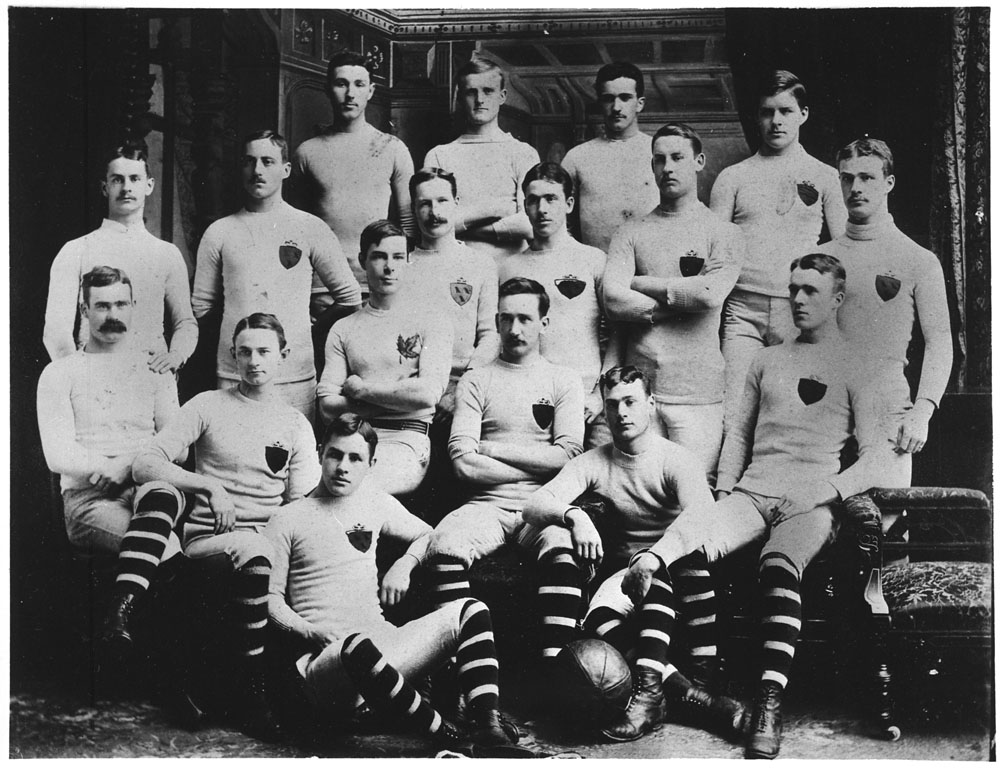
A black-and-white photograph of the McGill University rugby team, 1884-1885. James Naismith sits with his teammates (far-left of the second row of four).

McGill rugby team, 1884-1885 season (seated 2nd row, far left, James Naismith), Montréal, Quebec [MIKAN 3650079]

Provincial rugby clubs formed across the country where interprovincial play occurred and eventually international competition. Naturally, it was Canada (McGill University) versus the United States (Harvard University) in 1874!

A black-and-white photograph of the Senior University Rugby Team, Ontario. The members stand in a row at an angle with their left hands on their hips, and their right hands on the right shoulder of the person in front of them.

Senior university rugby team, Ontario [MIKAN 3715584]

The 20th century saw a continued growth of the sport as international teams visited Canada to play matches. Canada also sent teams to countries overseas such as Japan, England, Ireland, Argentina, and Australia. An important development of the game is the emergence of women participating in the sport. Starting in the early 1980s, clubs formed to play locally and internationally. There are over 30 women’s clubs across the country.

Visit the Flickr album now!

Researching early census records

Library and Archives Canada (LAC) is pleased to announce the launch of an expanded version of one of our most popular research guides: Finding Aid 300: Other census and related documents (1640 to 1945).

This tool is a comprehensive guide to early census and related records found at LAC, with references mainly dating from 1640 to the 1800s. There are also some records from the 1900s, including Newfoundland and Labrador from 1921 to 1945.

New to this version of Finding Aid 300 are links to digitized images of most of the documents. Researchers can access numerous digitized records relating to Acadia, Nova Scotia, New Brunswick, Newfoundland and Labrador, Prince Edward Island, Quebec, Ontario, Manitoba, and British Columbia.

We also invite you to visit our updated Censuses page, which includes links to our databases of census returns (1825 to 1921) and other resources.

What lies beneath the fig tree: Solomon Ibn Gabirol and the search for wisdom

Web banner with the words: Premiere: New acquisitions at Library and Archives Canada showing a small picture of an otter fishing on the rightBy Dr. Guy Berthiaume

There is a legend that a jealous poet murdered Solomon Ibn Gabirol, the 11th- century Jewish poet and philosopher, and buried him under a fig tree. The fruit of that tree was so sweet and so plentiful, the people of the town where the tree was located decided to dig it up and uncover the source of its richness. The legend finishes with the discovery of Gabirol’s remains beneath the tree, lending a truly poetic explanation of the tree’s abundant nature, one Gabirol himself might well have appreciated.

Legend aside, Gabirol was an important philosopher and the author of over 100 poetical works. His writings contain a fascinating blend of Jewish, Islamic, Neoplatonic, Pythagorean, Biblical, mystical and philosophical sources, bearing out Gabirol’s advice that we should “seek wisdom with the avidity with which thou wouldst search for hidden treasures, for it is more precious than gold and silver.” This sage instruction is taken from Mivachar Ha-Peninim, or Choice of Pearls, the most recent addition to Library and Archives Canada’s collection of incunabula, acquired with the generous donation of Ruth and Arnon Miller.

While incunabulum is actually a five-star Latin word for “cradle,” it has come to mean any book, pamphlet or broadside printed before the year 1501. In fact, before this term came into popular use, such books were known as “fifteeners,” which, while descriptive, lacks a certain syntactical mystique! But whichever way you choose to describe them, incunabula are compelling artifacts, both for their contents, and for their beauty as objects in and of themselves. Choice of Pearls is no exception.

Gabirol had a wide following in both Islamic and Christian circles, and this collection of proverbs, moral reflections and maxims was probably the equivalent of a New York Times bestseller in its day. Choice of Pearls feels surprisingly modern, with a relevance that applies as much today as it did in the 11th century. The book is studded with insights and observations such as these:  “Wisdom lying dormant is like an unproductive treasure”; “Man without wisdom is like a house without a foundation”; and the surprisingly prescient “Truth establishes all things; falsehood overthrows them,” which takes on a special meaning in this age of “post-truth”.

Although the text was originally written in Arabic by a Jewish philosopher who has been compared to Plato, its wisdom and wit was popular with both Jewish and Arab readers of the time. This demonstrates something I have long believed, that poetry and philosophy have a unique ability to transcend boundaries, and that libraries, by sharing works across cultures, can do the same.

The book is also significant because its publisher, Soncino Press, is one of the oldest and most influential printers in the history of Jewish books. Based in Northern Italy, Joshua Soncino set up one of the world’s first Hebrew printing presses in 1484.

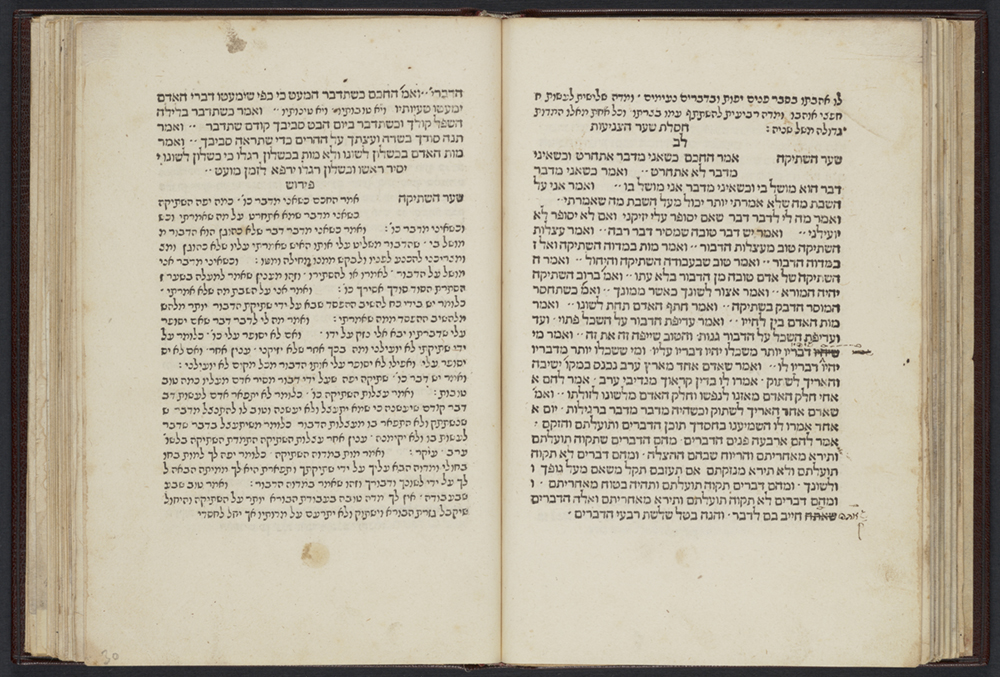
A colour photograph of an open book with Hebrew writing.

Mivachar Ha-Peninim by Solomon Ibn Gabirol, 1484 (AMICUS 45283149)

Choice of Pearls was purchased at auction from the Valmadonna Trust Library, which was the world’s largest private collection of rare Judaica. It now joins its fellow incunabula in Library and Archives Canada’s Jacob M. Lowy Collection. The Collection, amassed over a lifetime, contains over 3,000 old and rare books printed between the 15th and 20th centuries in Hebrew, Latin, Yiddish and other languages. Highlights include first and early editions of the Talmud, 34 incunabula, and over 120 Bibles in many languages, including Inuktitut.


Dr. Guy Berthiaume is the Librarian and Archivist of Canada.