Sir Wilfrid Laurier podcast images now on Flickr 

Sir Wilfrid Laurier had the largest unbroken term of office as Canada’s seventh prime minister. He was considered one of Canada’s greatest politicians, full of charisma, charm and passion, qualities that served him well in office, and also in his personal life. This passion is seen in many of the letters he wrote to his wife Zoé. But perhaps we gain a deeper insight into his character through his letters to Émilie Lavergne.

Images of Canadian war artists now on Flickr

Canadian War Artists brings together the portraits of eighteen Canadian war artists who painted during the Second World War. These portraits, from the collections of Library and Archives Canada are accompanied by short biographies.

120th anniversary of the birth of Harold Anthony Oaks: pioneering Canadian aviator

Version française

By Laura Brown

Harold Anthony Oaks was one of 22,000 Canadians who served with the British flying services during the First World War. While many did not return home, Oaks survived the conflict and transitioned his wartime flying experience into a successful career as a bush pilot and award-winning aviator.

Oaks was born in Hespeler (now Cambridge), Ontario on November 12, 1896. A student when he enlisted in the Canadian Expeditionary Force (CEF) in October 1915, Oaks was soon sent to France and served in the 1st Canadian Divisional Signal Company, Canadian Engineers as a motorcycle dispatch rider. While overseas Oaks continued to study, spending some time on leave learning French and Spanish. Whether it was his bookish nature or that his father was a doctor, Oaks earned the nickname “Doc,” which stayed with him for life.

In the summer of 1917, Oaks left the CEF to join Britain’s Royal Flying Corps. Less than a year later, he had cemented his reputation as a skilled fighter pilot, serving in numerous battles with the 48 Squadron in France. Oaks received a Distinguished Flying Cross (DFC) for his efforts.

A black and white portrait showing a young man in uniform. He sits facing the camera and sports a slight smile.

Harold Anthony Oaks, ca. 1918. (MIKAN 3219517)

After returning to Canada, Doc Oaks attended the University of Toronto, where he obtained a degree in mining engineering in 1922. In the following years, he began numerous aviation ventures which focused on how planes could assist in prospecting in Canada’s north. In 1926, Oaks started Patricia Airways and Exploration Limited with a former Royal Flying Corps pilot, Tommy Thompson. The goal of the one-plane operation was to transport people, goods, and mail to remote mining areas in Northern Ontario. In its first year, the company transported 260 passengers, 14,000 pounds of freight and 3,000 pounds of mail.

A yellow, green and red postage stamp showing a frontal view of a Curtiss Lark airplane in flight with trees and water below. The words “Patricia Airways and Exploration Limited” appear above the plane and “Special Delivery, Sioux Lookout to Pine Ridge and Red Lake” appear below it. Bordering the stamp is a line design with maple leaf motif in each corner, accompanied by the word “Canada.” The words “Airmail” and “Red Lake” appear on the four sides of the stamp.

Postage Stamp, Patricia Airways and Exploration Limited, 1926. (MIKAN 3854727)

The success of his first air transport business prompted Oaks to expand. He went on to become the manager of Western Canada Airways and helped establish new flying routes in Northern Ontario, Manitoba, and Saskatchewan. In addition, Oaks spearheaded a number of engineering projects that revolutionized winter flying, including special skis for planes and a portable nose hangar, which enabled crews to work on aircraft even under frigid temperatures.

A black-and-white photograph showing a floatplane at the edge of a lake. Two figures stand on the floats near the propeller and a third figure stands on the shore to the right. A fourth figure, partially in view on the far right, looks at the plane.

Harold Anthony Oaks and associates with Fairchild KR-34C, Oaks Airways Limited, Jellicoe, Ontario, 1934. (MIKAN 3390361)

In 1927, Oaks became the first recipient of the Trans-Canada Trophy for “meritorious service in the advancement of aviation.” Throughout the years, he would continue to engage in new projects including the establishment of his own airline, Oaks Airways Limited. He died in 1968 at the age of 71.

Oaks’ career as a successful aviator stems from his flying experience in the First World War. However, in January 1917, well before Oaks became a famed pilot, he was one of thousands of soldiers facing the relentless damp, cold, and mud of the Western Front. At the time, he recorded in his diary that he longed “to see a bit of real Canadian winter.” Following the war, Oaks went on to spend hundreds of hours flying above snowy Canadian landscapes. Undoubtedly, he got his wish.

Related resources


Laura Brown is a Military Archivist in the Government Archives Division at Library and Archives Canada.

The Altona Haggadah: The conservation and rebinding of an 18th-century illuminated manuscript

By Doris St-Jacques, Lynn Curry and Maria Trojan-Bedynski

The 1763 Haggadah manuscript is part of the Jacob M. Lowy collection of Judaica and Hebraica at Library and Archives Canada. It was created in Altona, Germany, which at the time was one of the Danish monarchy’s most important harbour towns and a major center of Jewish life and scholarship. The manuscript could be described as a sophisticated form of folk art and an important social document, giving testimony to how middle-class Ashkenazi Jewish families celebrated Passover. The Haggadah contains 97 illuminated miniatures and was intended to be read during the Jewish Passover Seder meal.

An analysis of the 48 pages of handmade paper textblock conducted at the Canadian Conservation Institute (CCI) revealed that the text is handwritten in iron gall ink and the pigments used in the miniature paintings are predominantly vermilion (red), Prussian blue, and atacamite/verdigris (green copper-based). A yellow glaze-like paint was also identified and the gold-toned colours were found to contain flakes of brass.

The paper, inks and many painted areas were in fragile condition due to corrosion of the iron gall inks and the copper-based pigments. There are also large brown stains on several pages caused by splashed red wine, likely having occurred during the Seder meal.
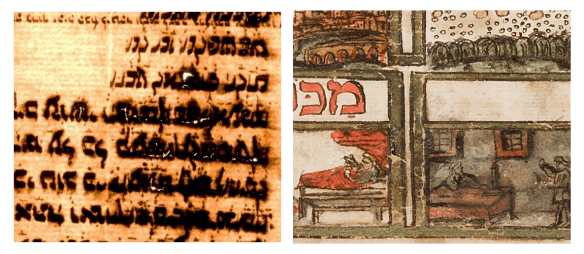
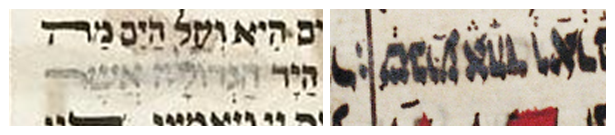
Two close-up colour images of pages from the manuscript. On the left, Hebrew writing with cracks in the ink letters and on the right, some colour miniature paintings in red and green.

Two examples of cracks and losses in the manuscript, caused by the corrosive nature of the iron gall inks and copper-based pigments.

Over 20 years ago, the Haggadah was removed from its covers for deacidification of the textblock and repair of cracks and tears. A more recent examination of the manuscript revealed new cracks and losses in the paper, inks and pigments (media). It was evident that the previous deacidification treatment was unable to completely protect the paper from continued deterioration. Damage caused by the corrosion of copper-based media is a problem in archival collections worldwide. To find a treatment that would protect the Haggadah media from further corrosion, a joint research project between Library and Archives Canada (LAC) and CCI was conducted to test known antioxidants. Due to the water sensitivity of the media in the Haggadah, only solvent-based antioxidants were included in the research project.

Laboratory-prepared inks and pigments similar to that of the Haggadah—iron gall ink, iron-copper ink, atacamite and verdigris pigments—were applied to strips of paper. These samples were then artificially aged to simulate the aged paper and media of the Haggadah. The aged samples were then treated with one of the six treatment combinations used in the study, followed by additional heat aging intended to simulate the effectiveness of the various treatments after many years. Tests conducted on the samples included colour analysis, pH measurements and strength testing of the paper, carried out before and after the treatments and aging.
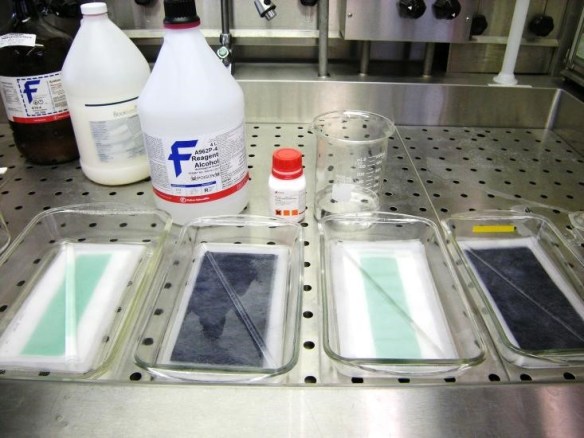
Colour photograph of laboratory material: four clear glass containers placed side by side with a sheet of paper in each one and bottles of chemicals behind them.

Ink and pigment samples in glass trays are being treated with solvent-based antioxidants.

We will confirm the results of this project with other research studies before selecting a specific antioxidant treatment for the Haggadah. In the meantime, the cracks and losses in the paper were mechanically stabilized using a solvent-remoistenable, ultra-thin transparent paper called Berlin tissue, which had been pre-coated with gelatin. Gelatin is known to prevent the spread of corrosive iron ions further into the surrounding paper.
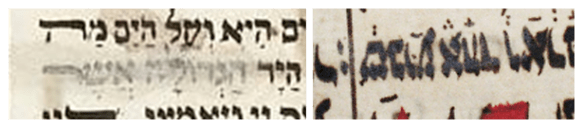
Close-up images side by side of an old, opaque repair and a new transparent repair which allows the text to be read easily through it.

On the left, a close-up of an old repair, which obscured the text beneath. On the right, a new ultra-thin Berlin tissue repair, which allows the text to be read easily.

To prevent the transfer of inks, pigments or corrosion products onto facing pages, interleaving paper was required. Though the Haggadah was not being treated directly with an antioxidant, we decided to improve the aging properties of the manuscript indirectly by impregnating the interleaving papers with both an alkaline buffer and an antioxidant.

It was not possible to re-use the damaged original cover boards of the binding for various reasons. Instead, possible binding structures were researched and many samples were created and tested. We concluded that a sewn-board binding would meet the requirements for the Haggadah. The binding opens flat and stress-free and will provide optimal support during handling. Using supple boards and very little adhesive, the binding integrates the interleaving tissue, is dimensionally stable, and will be reversible in the future if further treatments of the Haggadah are conducted. The sewn-board binding style is also documented and supported as a conservation binding for 17th to 19th century volumes, so it was an appropriate style for the Haggadah.
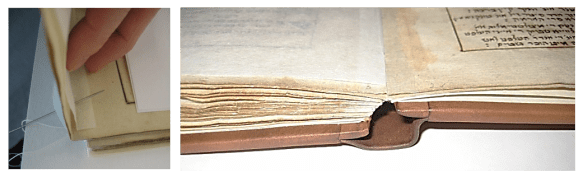
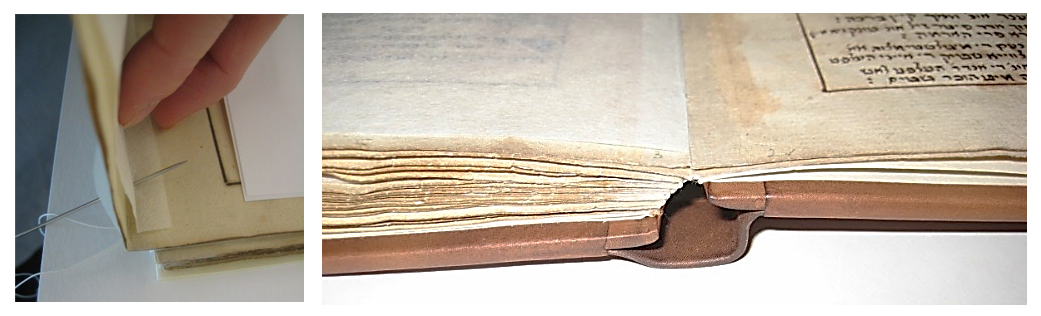
On the left, a close-up of a hand holding a page of a book and a needle piercing through the page. On the right, a close-up of the bottom spine of the book laying open on a table.

On the left, a conservator is sewing the interleaving into the textblock. On the right, the sewn-board binding is open showing that the manuscript can be viewed without stress.

To be consistent with the design elements on the covers of the previous binding, the new leather covers were finished with blind tooling, which is the impressing of text or a design on a book cover without the use of colour or gold leaf. Five small fleuron were blind stamped onto the spine to provide a visual clue to the orientation of the book, which opens left to right.

The newly bound Haggadah manuscript is currently stored in a custom clamshell box along with the original covers in a controlled environment of 18°C and 40% RH. Its condition has been greatly improved, and it can now be handled safely while awaiting a future antioxidant treatment.

For more historical information, read the previous blog, “From the Lowy Room: the brightly illuminated manuscript of the Altona Haggadah.”

Links to articles about the conservation of the 1763 Altona Haggadah:

Tse, Season, Maria Trojan-Bedynski and Doris St-Jacques. “Treatment Considerations for the Haggadah Prayer Book: Evaluation of Two Antioxidants for Treatment of Copper-Containing Inks and Colorants.” The Book and Paper Group Annual, American Institute for Conservation, Vol. 31, 2012, pp. 87–97.

St-Jacques, Doris, Maria Bedynski, Lynn Curry, Season Tse. A 1763 Illuminated Haggadah Manuscript: How Ineffective Past Treatments Resulted in an Antioxidant Research Project, Impacting Current Treatment Decisions.” Paper Conservation: Decisions and Compromises, Vienna, 17–19 April 2013, pp. 17–20.

Bedynski, Maria, Doris St-Jacques, Lynn Curry, Season Tse. “The Altonah Haggadah: The History, Conservation and Rebinding of an Eighteenth-Century Illuminated Manuscript.” Care and Conservation of Manuscripts 14: Proceedings of the thirteenth international seminar held at the University of Copenhagen, 17–19 October 2012, Museum Tusculanum Press, edited by M.J. Driscoll pp. 157–176.

“Collaborative Research on Antioxidants and Its Impact on Treatment Decisions for the 1763 Altona Haggadah.” Annual Review 2012–2013, Canadian Conservation Institute, pp. 6–7.


Doris St-Jacques is Paper Conservator in the Preservation Branch at Library and Archives Canada.

Lynn Curry is a Book Conservator in the Preservation Branch at Library and Archives Canada.

Maria Trojan-Bedynski is a Paper Conservator in the Preservation Branch at Library and Archives Canada.

Images for the Last Spike, 1885 now on Flickr

Craigellachie, British Columbia, located near Eagle Pass in the Rocky Mountains, is where Donald Smith, on November 7, 1885, drove the symbolic “last spike” in a ceremony marking the completion of the Canadian Pacific Railway (CPR). The CPR company was incorporated in 1881 to construct a transcontinental railway connecting British Columbia with the rest of Canada upon the province’s entry into Confederation. It was four years of dangerous work and controversies, with thousands of workers, including 15,000 temporary Chinese labourers, laying ties and rails, hammering spikes and exploding pathways through the mountains. The result of this hard labour was a country joined by transportation and enhanced communication—thanks to greater ease of mail delivery and telegraph lines that were built along the railway—and moving steadily into the twentieth century.

Portia White: In honour of the 75th anniversary of her Toronto debut

By Joseph Trivers        

Throughout the 20th century, great operatic singers have populated Canada’s cultural landscape—from Raoul Jobin, Maureen Forrester and Jon Vickers to Gerald Finley and Measha Brueggergosman. Their lives are often as dramatic and inspiring as the roles they play on stage in an opera. The life of Portia White, Nova Scotian contralto, was no exception. Praised for her radiantly beautiful and consistently even tone as well as her regal and dignified stage presence, White was the first African-Canadian concert singer to win international acclaim. November 7, 2016, marks the 75th anniversary of her triumphant national debut in Toronto and gives us a welcome opportunity to reflect on her life, accomplishments and career.

“I really made my debut here [in Toronto] when I sang in November, 1941. It was my fourth professional engagement, but it was my first big city. The next day I received a contract. I always feel it was Toronto which discovered me.” – Portia White

White’s remarks about her debut in Toronto might give the impression that her success came quickly. However, the path to that 1941 concert, and the contract that followed, was marked by years of hard work, some good fortune, and plenty of support from her family and the people and governments of Halifax and Nova Scotia.

Early life and education

It seemed as if Portia was destined for a career in the performing arts and to have a strong and determined character. She was given the name Portia after the heroine of Shakespeare’s Merchant of Venice by a family friend. In the play, the character Portia achieves her goal of marrying the suitor of her choice through intelligence, grace and quiet determination. Whether or not such a name foreshadowed these same traits in Portia White, her upbringing certainly encouraged them.

Her parents were themselves remarkable people. Her father, the Reverend William A. White, was the son of freed slaves from Virginia, only the second African-Canadian admitted to Acadia University and the first to receive a doctorate in Divinity from Acadia. He also served as the only black chaplain in the British Army in World War I. Portia’s mother, who was descended from Black Loyalists in Nova Scotia, gave Portia her first music lessons. The family moved from Truro, Nova Scotia, to Halifax after Portia’s father returned from the First World War and became the pastor of the Cornwallis Street Baptist Church.

The family’s life was centred around the church, so it is no surprise that much of Portia’s early musical life and education began there. She began singing in the church choir under her mother’s direction. She later took teacher training at Dalhousie and became a teacher in black Nova Scotia communities such as Africville and Lucasville. The work helped to pay for her music lessons. Throughout the 1930s, she took lessons from Bertha Cruikshanks at the Halifax Conservatory of Music. A scholarship enabled White to study with the Italian teacher Ernesto Vinci at the Conservatory in 1939. It was Vinci who began to have her train and sing as a contralto.

Toronto and beyond

Portia White first gained recognition and acclaim in Nova Scotia by performing in local festivals and benefit concerts and by singing on her father’s weekly radio program. She won the Helen Kennedy Silver cup at the Halifax Music Festival in 1935, 1937 and 1938. Further opportunities beckoned when Edith Read, principal at Branksome Hall, a private girls’ school in Toronto, heard her singing. Read was originally from Nova Scotia and was on vacation from Toronto at the time. It was through the support of the Branksome Ladies Club that White came to sing at Eaton Hall in Toronto on November 7, 1941.

The Toronto concert was such a success that White was immediately offered a contract by a branch of Oxford University Press for concerts and a touring career. She resigned from her teaching job to devote more time to her music. In 1942 and 1943 she toured across Canada, which helped boost her Canadian reputation, eventually giving a command performance for the Governor General. White eventually gave her first performance in the United States at New York City’s The Town Hall, in March 1944, to wide acclaim. She moved to New York to be closer to her managers, and was supported financially by the governments of Halifax and Nova Scotia through the Nova Scotia Talent Trust. It marked the first time two different levels of government came together to support an artist’s career. White signed with Columbia Concerts Incorporated and went on to tour Canada, parts of the United States, the Caribbean, and Central and South America.

Later career and legacy

Concert life was hectic, and White eventually began to feel she didn’t rest enough between concerts and travelling. She started experiencing difficulties with her voice, and some critics began complaining of flaws in her voice. This, and disagreements with her managers, led White to retire from public performance. She settled in Toronto, where she took further singing lessons at the Royal Conservatory with the soprano Gina Cigna. She also taught singing privately and at Branksome Hall. White did perform again, throughout the 1950s and 60s, but not very often. One such notable concert was for Queen Elizabeth on October 6, 1964, at the Charlottetown Confederation Centre of the Arts in Prince Edward Island. Less than four years later, in February 1968, White passed away in Toronto after a battle with cancer.

As an artist, Portia White was renowned for her versatility and varied repertoire. She was equally at home singing spirituals as she was singing arias from Italian operas, German Lied or French mélodies. No commercial recordings of White were made during her lifetime; however, Library and Archives Canada (LAC) acquired audio recordings, from the White family, of concerts she gave in Moncton, New Brunswick, and New York City. Some commercial recordings were released posthumously, including the album Think on Me from 1968, two songs on the Analekta label’s Great Voices of Canada (Volume 5), and the album First You Dream (1999), all of which are in LAC’s collection. A documentary, Portia White: Think on Me, was directed by Sylvia Hamilton and released in 1999. White’s legacy continues to live on in the trust fund that was created in her name. Each year the Nova Scotia Talent Trust presents the Portia White Scholarship to a young person showing “exceptional potential as a vocalist.” The Government of Canada named Portia White a person of historical significance 1995 and honoured her with a millennial stamp issued in 1999.

A colour stamp featuring, in the foreground, a young woman singing and, in the background, a close-up of the woman’s face with her eyes closed. A musical score with notes and lyrics appears faintly in the bottom half of the stamp.

Portia White: Irrepressible Talent [philatelic record], 46-cent Canadian millennial stamp (MIKAN 2266861)


Joseph Trivers is Music Acquisitions Librarian in the Published Heritage Branch at Library and Archives Canada.

Library and Archives Canada to commemorate the 20th anniversary of the Royal Commission on Aboriginal Peoples through a new digitization initiative

By Benjamin Ellis, Strategic Advisor, Public Services Branch, Library and Archives Canada.
The Federation for the Humanities and Social Sciences is posting this guest blog in support of the Sharing the Land, Sharing a Future National Forum.

Established in 1991, the Royal Commission on Aboriginal Peoples (RCAP) travelled across Canada documenting the issues and challenges facing Indigenous Canadians and their communities. Over its six-year mandate, RCAP amassed thousands of hours of recorded testimony and hundreds of thousands of pages of documents, culminating in the publication of the 1996 RCAP final report complete with a series of recommendations for a renewed relationship between Aboriginal and non-Aboriginal people in Canada.

Following the conclusion of the Commission, the entire RCAP archive was transferred to the National Archives of Canada, now Library and Archives Canada (LAC). The archive is a rich collection of scholarly studies, written submissions, oral transcripts, photographs, audio and video recordings, as well as duplicate digital files on floppy disks. To date, access to this collection has been facilitated through on-site consultation at LAC’s Ottawa location and through the submission of requests for reproductions.

In late 2015, organizers of the Sharing the Land, Sharing a Future National Forum, commemorating the 20th anniversary of RCAP in November 2016, approached LAC to propose the creation of a digital database of RCAP holdings.

LAC launched a searchable database of select RCAP records at the commemorative national forum. The database contains transcripts of more than 175 days of hearings; nearly 200 research reports; more than 100 submissions from tribal councils, organizations and interest groups; as well as RCAP publications and the final report.

The contents of the database were selected over the past year with LAC staff combing through the RCAP records, selecting documents for digitization, and conducting Access to Information reviews to ensure that the records could be made public. Several documents were recovered from the original floppy disks, which required LAC to use computers and software from the 1990s.

LAC hopes that the RCAP database will renew interest in this important inquiry which remains so relevant today.

Voices of the Past

By Harriett Mathews

Library and Archives Canada (LAC) has roughly 30 million photographs from various collections in its possession, a large number of which have Aboriginal content. During my time here as part of the Federal Student Work Experience Program (FSWEP) working on Project Naming, I have been able to explore the database and discover breath-taking photographs from different Aboriginal communities all over Canada.

Correcting the Historical Record

Although the photographs themselves are quite wonderful to behold, the records often leave something to be desired. For many Aboriginal images, the titles contain antiquated and offensive language, or are simply vague. It is imperative that these records be updated with modern terminology and information gathered from members of the communities where these photographic records originated. The involvement of Aboriginal people in this process is crucial because these records depict their history, their culture, and their families; their voices are the ones that have been omitted and lost. As I myself belong to the First Nations, I have greatly enjoyed being able to share my culture and help restore the lost voices of photographs by helping to update the records.

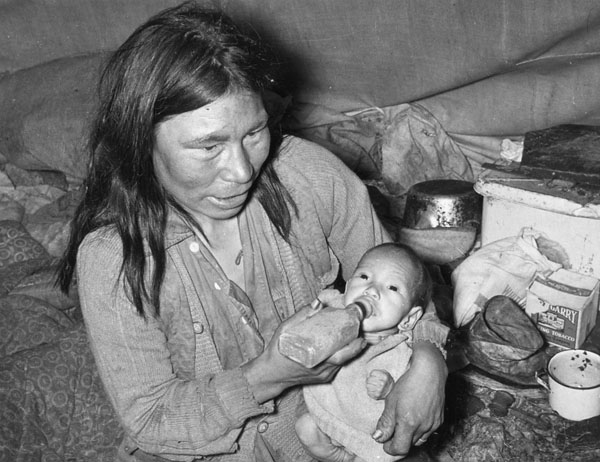
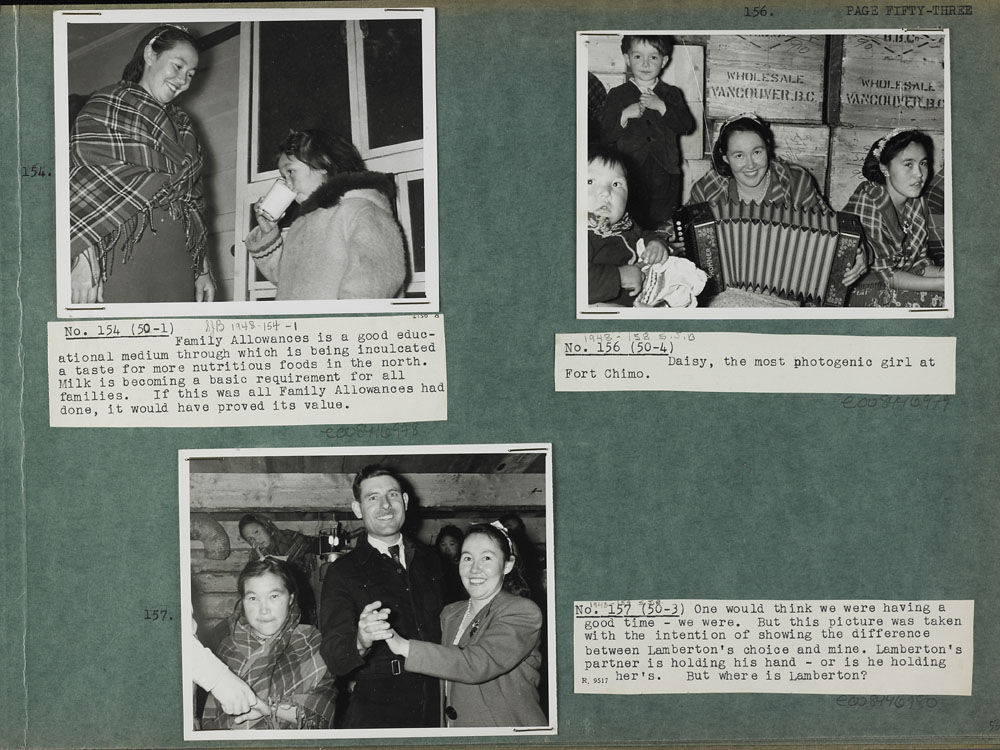
One example is an image titled “Dirty Daisy and her baby.” The photograph depicts an Inuit woman and her child suffering from malnutrition. “Daisy” was not the name of this woman; it is more likely the name that was assigned to her by a government official. By calling this woman “Dirty Daisy”, the individual who wrote the caption effectively stripped her of both her dignity and her name. Hopefully, through Project Naming, the real name of this woman and her child will be uncovered. In the meantime, the record has been updated so that the title now reads “An Inuit woman (Daisy) feeding her baby while seated in a tent in Chesterfield Inlet (Igluligaarjuk), Nunavut.”

Black and white photograph of a gaunt looking Inuit woman and child sitting in a small tent with cooking supplies in the background. The woman is feeding the baby with a rectangular bottle.

Inuit woman (Daisy) feeding her baby while seated in a tent in Chesterfield Inlet (Igluligaarjuk), Nunavut (MIKAN 3855414)

Improving Access – Photo by Photo

Since Project Naming began in 2002, more than 2,000 photographs have been identified. Additionally, thousands of records have had inaccurate and insensitive terminology removed from their titles and moved into a general notes field in order to provide historical context and perspective. Identifying names, places, events, and cultural objects facilitates the sharing of Aboriginal culture and stories with all who are interested in searching the archives. These include stories about Aboriginal politicians, for example Inuit Senator Charlie Watt who represents Quebec. I had the pleasure of working on DIAND Album 38, which contains several photographs of young Charlie Watt and his parents, Daisy and Johnny Watt. The photographs take place at a party in Kuujjuaq (formerly Fort Chimo), Quebec, and even though the photographs are black and white, the vibrancy of that Inuit community shines through.

Photograph of a green album page with three black and white photographs (numbered 154, 156, and 157) with typed captions on white paper. The photograph in the top left corner is of an Inuit woman in a plain dress and plaid shawl standing on a porch with a little girl in a parka drinking glass of milk. The photograph in the top right corner is of two Inuit women in plaid shawls and flower headbands sitting in front of wooden crates, one holding an accordion, with a baby sitting in the foreground to the left and a little boy in dress clothes standing beside the woman with the accordion. The photograph at the bottom of the page is of a woman in a blazer and ribbon headband dancing with a man in a suit; the woman on the left is holding a man’s hand – the rest of the man is out of the shot – and there are three women and an oil lamp in the background.

Album page fifty-three with photographs of an Inuit woman and girl (Daisy Watt, possibly with Harriat Ruston), a group of Inuit women and children—Daisy Watt is playing the accordion, Christina Gordon is on the right, and Charlie Watt (Daisy’s son) is standing on the left—and S.J. Bailey and H. Lamberton dancing with two Inuit women—Daisy Watt is on the right with S.J. Bailey, the woman behind her is Susie, and Hannah (Susie’s sister) is on the left holding H. Lamberton’s hand—in Kuujjuaq (formerly Fort Chimo), Quebec (MIKAN 4326945)

Black and white photograph of five women, four of them seated and one on the far right standing with a baby wrapped in a plaid shawl. The woman in the centre of the photograph is playing an accordion, and the woman to her left has a young boy in her lap. Behind them are several wooden crates labeled “Marven’s Biscuits” and one marked “H.B.C. Wholesale Vancouver.”

A group of women and children at a party in Kuujjuaq (formerly Fort Chimo), Quebec, the woman playing the accordion is Lizzie Suppa and to her immediate left are Daisy Watt and Charlie Watt (Daisy’s son) (MIKAN 3855585)

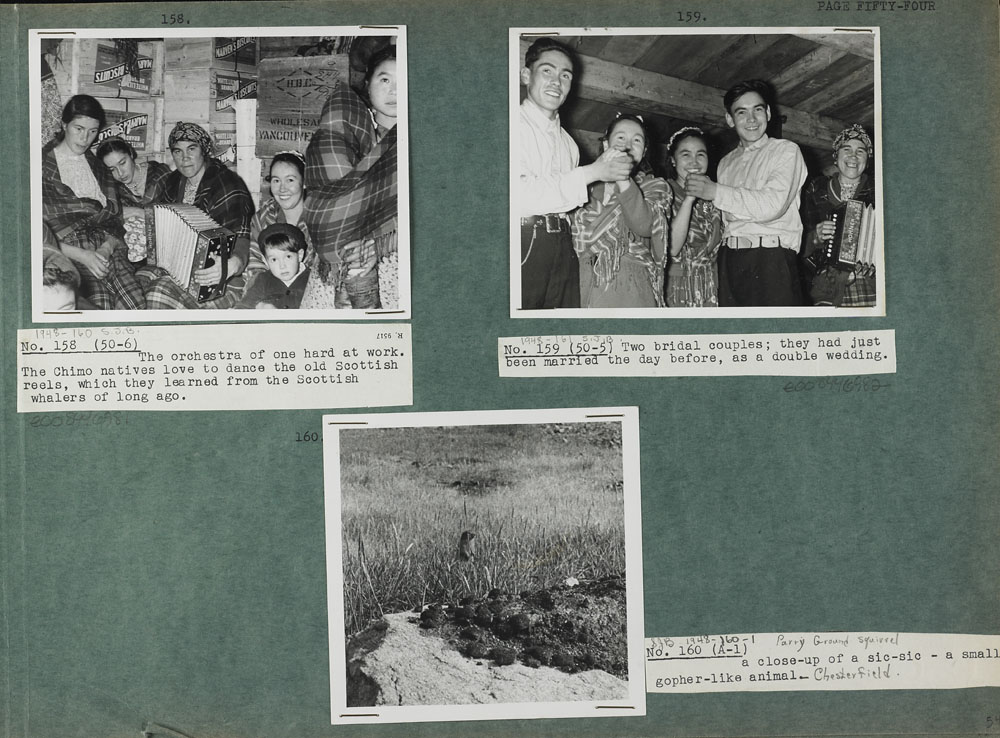
Photograph of a green album page with three black and white photographs (numbered 158, 159, and 160) with typed captions on white paper. The photograph in the top left corner is of women and children sitting in front of several wooden crates labeled “Marven’s Biscuits” and one marked “H.B.C. Wholesale Vancouver.” The photograph in the top right corner is of two couples dancing while a woman plays the accordion. The photograph at the bottom of the page is of an Arctic ground squirrel in a grassy field with a rock in the foreground.

Album page fifty-four with photographs of a group of women and children [Lizzie Suppa is playing the accordion, seated to her left are Daisy Watt and Charlie Watt], two Inuit couples dancing [Johnny and Daisy Watt are on the left, on the far right is Lizzie (with her accordion again)], and a Siksik (an Arctic ground squirrel) (MIKAN 4326946)

Restoring Aboriginal Voices

All of these photographs are essential to the telling of Canadian history. They demonstrate the narrative of the relationship between Aboriginal people and the Canadian government, and most significantly, they tell the stories of the individuals in the photographs and share their culture. For decades, First Nations, the Metis Nation, and Inuit voices have been lost in these records. Project Naming is vital because it provides Aboriginal people a forum through which they can reclaim their stories and identities. I am glad that I have been able to contribute my voice, as a First Nations woman, to these records. There are so many stories to be told, and I am sure that as LAC continues to move forward in partnership with Aboriginal peoples, we will be able to hear them.


Harriett Mathews was an FSWEP student who worked in the Exhibition and Online Content Division at Library and Archives Canada during the summer of 2016.

New Books in the Genealogy Services Collection at 395 Wellington – October 2016

We’re excited to announce recently acquired genealogy publications. You can consult them in the Genealogy and Family History Room located on the 3rd floor of the Library and Archives Canada building at 395 Wellington Street.

Check out the list below. The link to the AMICUS record gives the call number you need to find the book on the shelves.

If you’re just starting out in genealogy, you should visit the Genealogy and Family History section of our website.

Happy exploring!

Church, Cemetery and Newspaper Indexes

Obituaries from the Christian guardian, 1891 to 1895, by Donald A. McKenzie (AMICUS 42197735)

Répertoire des naissances, des mariages et des décès de la paroisse de Saint-Ludger-de-Milot, 1934-1941, et de la paroisse de Saint-Augustin, 1924-1941, by the Société d’histoire du Lac-Saint-Jean, Service d’archives et de généalogie, Comité de Généalogie (AMICUS 43692197)

Baptêmes, mariages, annotations marginales et sépultures de Notre-Dame-du-Rosaire de Sherbrooke, 1942-1995, by the Société de généalogie des Cantons de l’Est (AMICUS 42040268)

Baptêmes, mariages, sépultures et annotations marginales de Sainte-Jeanne-d’Arc de Sherbrooke, 1913-2012, by the Société de généalogie des Cantons de l’Est (AMICUS 41994325)

Baptêmes, mariages, annotations marginales et sépultures de Christ-Roi de Sherbrooke, 1936-2012, by the Société de généalogie des Cantons de l’Est (AMICUS 41849903)

Baptêmes, mariages, annotations marginales et sépultures de Saint-Antoine-de-Padoue de Lennoxville, 1878-2010, by the Société de généalogie des Cantons de l’Est (AMICUS 41849905)

Baptêmes, mariages, annotations marginales et sépultures de Saint-Joseph de Sherbrooke, 1946-2010, by the Société de généalogie des Cantons de l’Est (AMICUS 42040250)

Baptêmes des paroisses Notre-Dame-de-Lourdes, 1928-1941 et Notre-Dame-Auxiliatrice, 1939-1941, by Michel Chrétien (AMICUS 41279336)

Baptêmes, mariages, sépultures et annotations marginales de Saint-Fortunat, comté de Wolfe, 1877-2013, by the Société de généalogie des Cantons de l’Est (AMICUS 42160267)

Cataraqui Cemetery burial registers: Kingston Township, Frontenac County, by the Kingston Branch, Ontario Genealogical Society (AMICUS 41669821)

Outremont, naissances : archives civiles (greffe) 1921-1941, St-Germain 1929-1942, Ste-Madeleine 1908-1941, St-Raphaël 1930-1941, St-Viateur 1902-1941, by Cécile de Lamirande (AMICUS 43564793)

Military

American loyalists to New Brunswick: the ship passenger lists, by David Bell (AMICUS 43913838)

Dictionnaire prosopographique des militaires beaucerons incluant le Régiment de la Chaudière depuis 1914, by Sylvain Croteau (AMICUS 43027689)

Family Histories

Généalogie ascendante de Irénée Bergeron, 1838 (Sainte-Croix-de-Lotbinière) – 1923 (Saint-Paul-de-Chester), by Linda Bergeron Szefer (AMICUS 42856232)

Généalogie des familles-souches de Saint-Casimir, by G.-Robert Tessier (AMICUS 43150466)

Saint-Just-de-Bretenières: cent ans d’histoire, 1916-2016: de la mémoire à la plume, by Louise Lefebvre (AMICUS 44279124)

Images of the Altona Haggadah now on Flickr 

The Altona Haggadah, a colourful handwritten and hand-illuminated manuscript on paper, created in 1763, is one of the treasures of the Jacob M. Lowy Collection at Library and Archives Canada (LAC).

The Haggadah, which means “telling” in Hebrew, is an important text in the Jewish tradition that is used during the Passover Seder, a ceremonial meal held in Jewish homes to commemorate the Israelites’ liberation from Egypt. It is a compilation of biblical passages, prayers, hymns and rabbinic literature.

You can also find incunabula (books printed before 1500), Bibles, ancient Jewish manuscripts and about 80 other Haggadot (plural of Haggadah) in LAC’s collection.