Version française
This article contains historical language and content that some may consider offensive, such as language used to refer to racial, ethnic and cultural groups. Please see our historical language advisory for more information.
Today’s Inuit use a combination of Euro-Christian given names with Inuit surnames. This has not always been the practice. Prior to the first half of the 20th century, Inuit did not use surnames. Traditional Inuit names reflected things of importance (family, spirits, animals, the environment) and were neither gender-specific nor recognized shared family names.
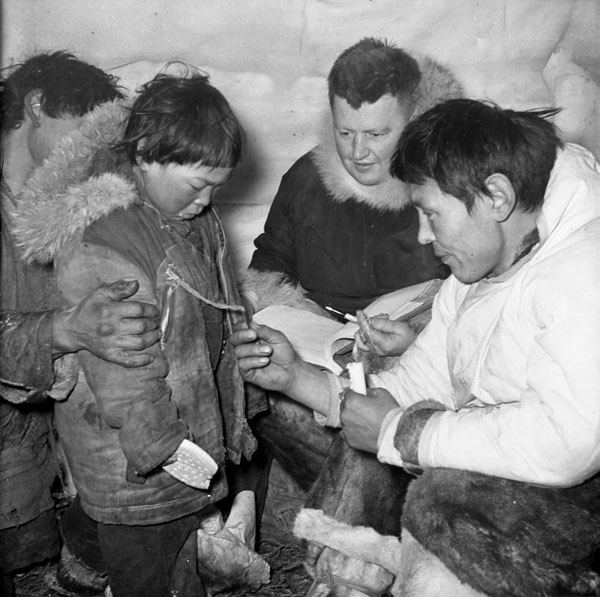
By the 1920s, there was a push by missionaries, fur trade employees and government officials to identify Inuit in accordance with European norms and the patriarchal social model. These groups believed that the lack of surnames and consistent spelling made it difficult to identify each Inuk for trading, census information, and other records. The introduction of disc numbers was implemented not only to identify Inuit, but also to administer the distribution of family allowance, other benefits, and health care.

Taking the census and checking on family allowance matters, Windy River, [N.W.T. (Nunavut)], December 10, 1950 (a102695)
At the time, several suggestions were put forward to the federal government such as introducing a binomial naming system with family names, standardizing spelling, creating individual
RCMP files and obtaining fingerprints of each Inuk. The RCMP started fingerprinting but it was not well-received, largely due to its association criminal activity.
Finally, in 1941, the federal government chose to register each Inuk with a unique numeric identifier, which was stamped on a disc or printed on a card. These identifiers were often called “Eskimo disc numbers” or ujamiit (ujamik) in Inuktitut. Inuit were required to carry these numbers on their person, so they were often sewn onto clothing or hung from laces around the neck. These numbers were used until 1972 except in Quebec where the practice continued for a few more years.
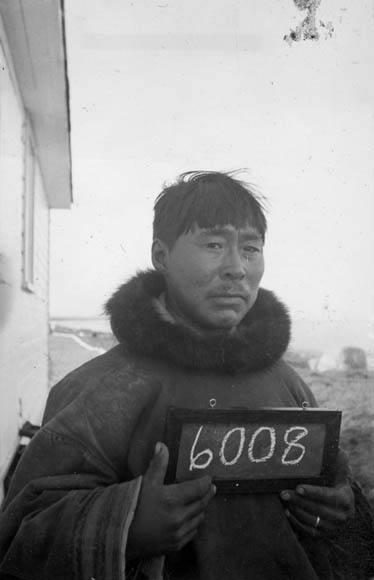
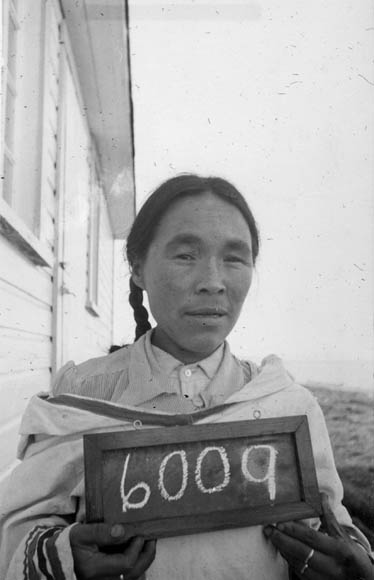
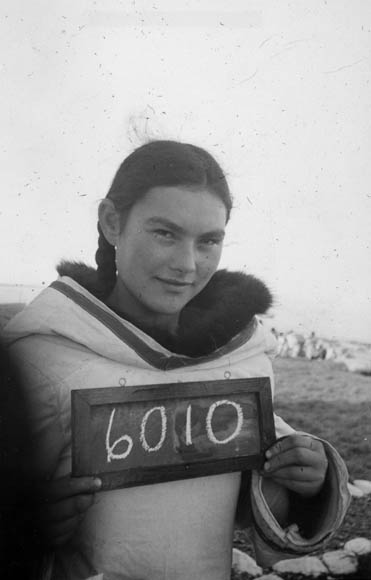
Following are three photographs of a family taken sequentially holding their disc number that was written on a chalkboard.

Portrait of a man [David Arnatsiaq] holding a small chalkboard with the number 6008, at Pond Inlet (Mittimatalik/Tununiq), Nunavut, August 1945 (e002344278)

Portrait of a woman [Tuurnagaaluk] holding a small chalkboard with the number 6009, at Pond Inlet (Mittimatalik/Tununiq), Nunavut, August 1945 (e002344279)

Portrait of a woman [Juunaisi/Eunice Kunuk Arreak] holding a small chalkboard with the number 6010, at Pond Inlet (Mittimatalik/Tununiq), Nunavut, August 1945 (e002344280)
From 1968 to 1971, the federal government with the Northwest Territories Council undertook to change the identification system from disc numbers to the use of last names under
Project Surname. This project was headed by Abraham “Abe” Okpik who toured the Northwest Territories and northern Quebec (Nunavik) with a linguist.
Library and Archives Canada holds evidence of the disc number system in photographs and documents, such as lists of individuals and their disc numbers, as well as lists showing the transition to surnames and social insurance numbers. Note that these records are restricted as they contain personal information.

![A large screen shows the X-Men fighting a giant robot. Prime Minister Pierre Trudeau stands in front of the screen along with Alpha Flight team leader Vindicator. Trudeau asks Vindicator to explain who the X-Men are. The words “The Uncanny X-Men” appear in large text at the top of the page. The story title is “Wanted: Wolverine! Dead or Alive!” The location of the scene is given as “The War Room of the Canadian Ministry of Defense – Ottowa [sic], Ontario, Canada …”](https://thediscoverblog.com/wp-content/uploads/2016/06/p_e_trudeau-alpha_flight.jpg)





 Library and Archives Canada Blog