Go North, Sir!

In 1894, the Canadian government’s interest turned towards the Yukon. There were concerns about the influx of American citizens into the region as the new border was disputed in certain areas. In addition, there were mounting concerns over law and order, and the liquor trade among the resident miners.

Inspector Charles Constantine of the North West Mounted Police (NWMP) was dispatched to the Yukon to carry out law enforcement, border and tariff control, and to assess the policing needs of the territory. After four weeks of duty, Constantine returned south and submitted his report to the government recommending that a larger force of seasoned, robust and non-drinking constables between the ages of 22 and 32 years be sent to the Yukon to carry out border and law enforcement. It wasn’t until 1895 that a contingent of 20 constables under Inspector Constantine’s command finally set out from Regina towards the Alaskan border. They reached the town of Forty Mile and established Fort Constantine in July 1895. The year was marked by logging, enduring the elements and insects, and constructing their detachment building. Remarkably, crime during this time was rare.

Two black-and-white photos mounted on an album page depicting two groups of North West Mounted Police personnel outside in the snow

Fort Constantine detachment (now Forty Mile) on the Yukon River, 1895, the first North West Mounted Police group in the Yukon (MIKAN 3715394)

Things changed drastically in 1896. Gold was discovered near the Klondike River and news spread quickly. From a population of about 1,600 in the area, it swelled by tens of thousands by the summer of 1897 with prospectors, gamblers, speculators and those with criminal intent. A majority of these miners came from the United States. The NWMP commanded by Inspector Charles Constantine faced a challenge in policing the influx of miners streaming into the region from all directions. Customs posts were set up at the Chilkoot and White Pass summits and the collection of duties and tariffs began. Those miners with insufficient provisions to make it to Dawson City and survive the winter were turned back. By 1898, outnumbered, under-supplied and under-staffed, 51 NWMP members and 50 members of the Canadian militia maintained Canada’s sovereignty, and law and order at the border passes and in the mining areas in the Yukon.

Three North West Mounted Police constables in uniform standing at ease with clasped hands over the muzzles of their rifles.

North West Mounted Police in the Yukon, 1898–1899 (MIKAN 3379433)

The Klondike gold rush lasted into 1899 until gold was discovered in Alaska. The migration of fortune seekers turned their attention and travelled towards that state’s Nome region. However, the Klondike gold rush left an infrastructure of supply, support and governance that led to the continued development of the territory to such a great extent that the Yukon was made into a Canadian territory on June 13, 1898. The North West Mounted Police also stayed to maintain peace and order under their steady hands.
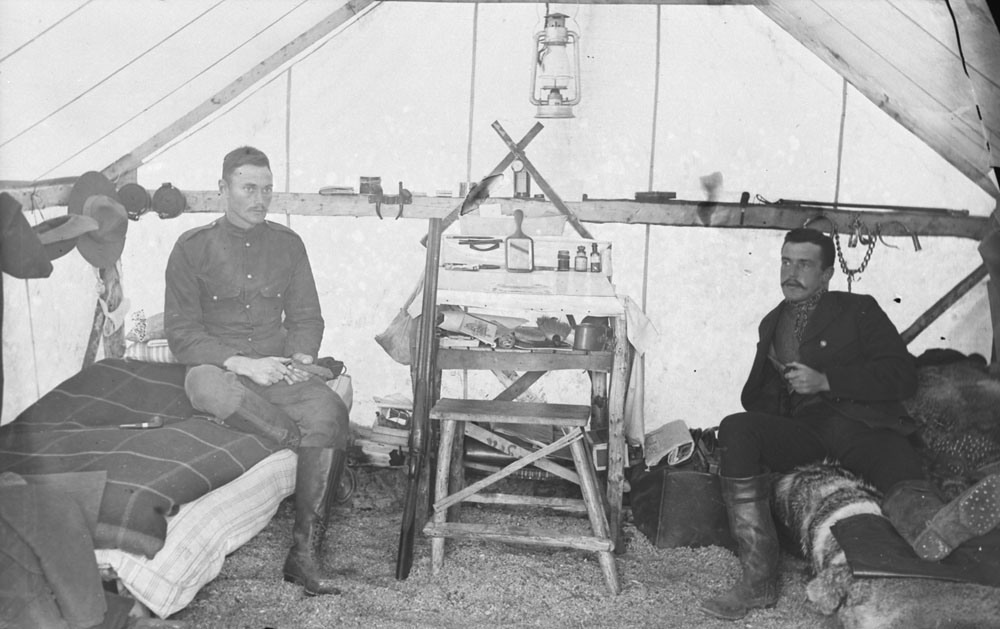
Black-and-white photograph of two men in North West Mounted Police uniform sitting on cots in a tent

North West Mounted Police in the Yukon, 1898–1910 (MIKAN 3407658)

A wide variety of documentation is available at Library and Archives Canada (LAC) related to the North West Mounted Police, the Klondike gold rush, and their time in the territory. You may start your initial research in Charles Constantine‘s fond using Archives Search. A general search using his name will provide further records from the Department of Justice.

Try searching with some of these keywords to get more records from the era:

Bennett Lake / Lake Bennett
Chilkoot Pass
Dawson City Yukon
Dyea
Forty Mile
Gold rush
Klondike River
Skagway
White Pass
Yukon River
Related sites

Did your ancestors come from Denmark?

Do you want to know who your first Danish ancestor was and when he or she left Denmark and arrived in Canada? Are you curious about your Danish origins?

If so, our website is a great place to begin your research. Here you will find a page dedicated to genealogical research on the Danes. This page provides you with historical information, archival documents and published material from the Library and Archives Canada collection, as well as links to other websites and institutions.

If your ancestor came to Canada between 1865 and 1935, you might find his or her name on the passenger lists.

“The Pointe”

Pointe St. Charles or “The Pointe” as it is more commonly known, is a Montréal, Quebec neighbourhood located southwest of downtown that has a rich and varied history. The area known as Pointe St. Charles was first acquired by Charles le Moyne in 1654, and is named in his honour. Throughout its early history, it was occupied by various religious communities and is also where Marguerite Bourgeoys, founder of the Congregation of Notre-Dame, welcomed and housed les Filles du Roi, the young French women who immigrated to New France to increase its population. Thereafter, Pointe St. Charles remained primarily a farming community until the mid-nineteenth century.

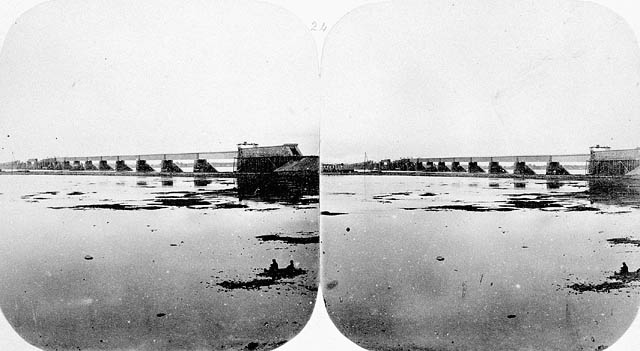
Black-and-white stereoscopic photograph showing the construction of a bridge.

Stereoscopic photograph of the Victoria Bridge construction in progress from Pointe St. Charles (MIKAN 3357662)

The landscape and population of Pointe St. Charles changed dramatically upon completion of the Lachine Canal in 1848, and further still with the new railway infrastructure and construction of the Victoria Bridge to Montréal’s south shore. Several companies were drawn to the area; new jobs were created, and land previously given to agriculture was bought for residential housing. According to Héritage Montréal, by the beginning of the 20th century, Pointe St. Charles had become the largest industrial sector not only in Montréal but in all of Canada. It was at this time that The Pointe also became the quintessential example of an ethnic melting pot. Populated primarily by English (75%) and French (25%) Canadians, The Pointe increasingly became home to many different ethnic groups.

Black-and-white photograph showing a locomotive under construction.

“Trevithick” railway engine under construction at Pointe St. Charles, from the Alexander Mackenzie Ross collection by William Notman, 1859 (MIKAN 3192802)

Several factors would contribute to The Pointe’s dramatic turn from Canada’s largest industrial sector to one of its most notorious slums. The Great Depression was the first event that contributed to the decline of the area’s primary economic activities. This was followed by the exodus of various factories and businesses to other industrial areas around Montréal, then culminating with the opening of the St. Lawrence Seaway in 1959 and the closing of the Lachine Canal. Adding further to the area’s decline was the building of expressways that now run along The Pointe’s north and southwest borders. The Richard Arless photographic collection held by Library and Archives Canada substantiates the existence of these slum conditions. Montréal-born Richard Graham Arless (1906-1995) began his career as a Second World War military photographer. After the war, he worked for various newspapers and magazines, eventually opening his own commercial studio in Montréal. His photographs of the slum conditions of Pointe St. Charles, all taken on the same April day in 1946, capture the bleakness and poverty of this once vital, now broken-down and battered neighbourhood.

Black-and-white photograph showing a courtyard with laundry hanging from various clotheslines. Three children are playing on the ground.

Children playing in a courtyard in the Pointe St. Charles district, April 25, 1946 by Richard Arless (MIKAN 3380642)

Black-and-white photograph showing a long, narrow lane strewn with garbage. A young child stands at the far end looking at the viewer.

View of a child in a narrow, garbage-strewn lane in Pointe St. Charles district, April 25, 1946 by Richard Arless (MIKAN 3380643)

The people of Pointe St. Charles have always been a gregarious and hardy bunch. As their population dwindled and their neighbourhood and living conditions deteriorated, the residents banded together to confront and improve their lot. Community groups were started to improve housing, build parks and promote recreation and health care.

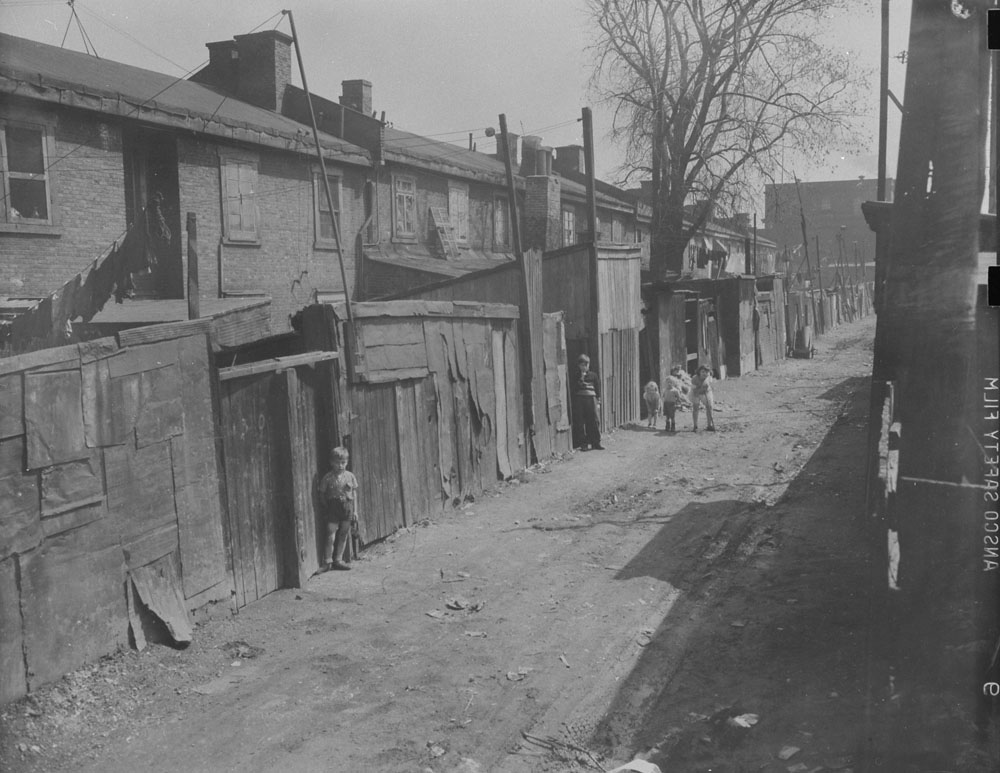
Black-and-white photograph showing the dilapidated back lane behind the row houses. Children look towards the viewer.

View of a dilapidated back alley in Pointe St. Charles district, April 25, 1946 by Richard Arless (MIKAN 3380652)

Most recently, The Pointe has experienced a revitalization. Land around the Lachine Canal was transformed for recreational use with bike paths, while many of the abandoned factories have been converted into condos that have attracted many new residents.

Project Naming is Expanding!

This article contains historical language and content that some may consider offensive, such as language used to refer to racial, ethnic and cultural groups. Please see our historical language advisory for more information.

In early 2002, Library and Archives Canada (LAC) teamed up with the Nunavut Sivuniksavut Training Program and the Government of Nunavut’s Department of Culture, Language, Elders and Youth, to create Project Naming. The goal was to digitize photographs of Inuit from present-day Nunavut in LAC’s photographic collections in order to identify the people depicted in the images. At the time of the launch, LAC expected that the project would be concluded the following year. We never imagined that this initiative would become such a successful and popular project with the public.

To mark the annual National Aboriginal History Month in June 2015, LAC is pleased to announce the launch of Project Naming. While the project still includes communities located in Nunavut, it will be expanded to Inuit living in Inuvialuit (Northwest Territories), Nunavik (northern Quebec) and Nunatsiavut (Labrador), as well as First Nations and Métis communities in the rest of Canada. Project Naming: 2002–2012 will still be available online, but new content will only be added to the new project site.

Project Naming: 2002–2012 began with the digitization of 500 photographs from the Richard Harrington fonds. Since then, LAC has digitized approximately 8,000 photographs from many different government departments and private collections. Thanks to the enthusiasm and support from Inuit and non-Inuit researchers, nearly one-quarter of the individuals, activities or events portrayed in the images have been identified, and this information along with the images is now available in the database.

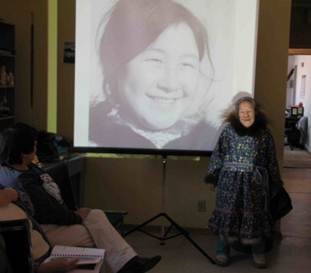
Over the years, LAC has received many wonderful stories and photographs from members of the public who have reconnected with their family and friends through the photographs. Among these was a photograph shared by the Kitikmeot Heritage Society that organized several community slide shows during the winter of 2011. Mona Tigitkok, an Elder from Kugluktuk, discovered her photograph as a young woman during one of these gatherings.

Colour photograph of an elderly Inuit woman wearing a fur-trimmed floral parka posing in front of a screen with a slide projection of her photograph when she was a young woman, taken at a community hall.

Mona Tigitkok posing with a picture of herself taken more than 50 years ago, Kugluktuk, Nunavut, February 2011. Credit: Kitikmeot Heritage Society.

Author and historian, Deborah Kigjugalik Webster, has used Project Naming, both personally and professionally. In her words:

I was first introduced to Project Naming a few years ago through my work in the Inuit heritage field, but there is also a personal connection for me—the database allows people to search by communities in Nunavut so I’ve discovered photographs of relatives and community members.

It was not uncommon in the past for photographers not to name the subjects of images. Often photo captions were simply “group of Eskimos” or “native woman” and so on. One afternoon, over tea, I showed some of the photographs from the Project Naming database to my mother, Sally Qimmiu’naaq Webster, and we were able to add a few names to faces from our home community of Baker Lake (Qamanittuaq). I felt a sense of satisfaction in identifying unnamed individuals in photographs and providing names to replace nondescript captions provided by the photographer. In a sense, when we do this we are reclaiming our heritage.

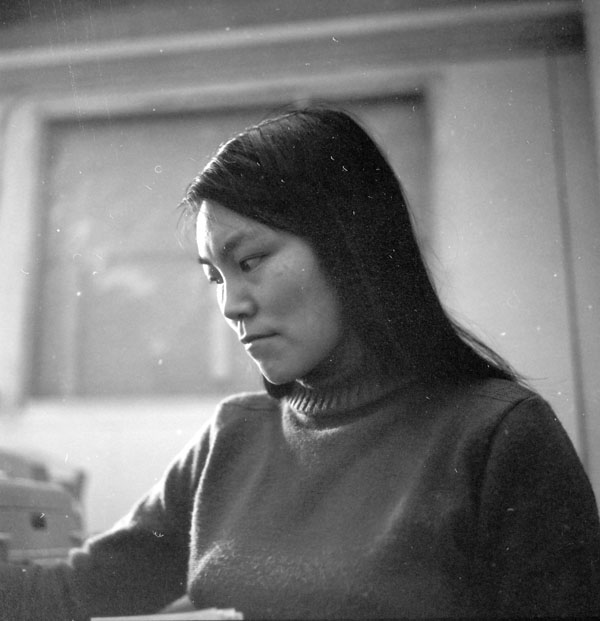
Photograph of a young Inuit woman wearing a turtle neck sweater looking away from the camera.

Photograph of the late Betty Natsialuk Hughson (identified by her relative Sally Qimmiu’naaq Webster). Taken in Baker Lake (Qamanittuaq), Nunavut, 1969 (MIKAN 4203863)

Project Naming allows people to not only identify individuals in images, but to add information including corrections to the spelling of names in an online form. It is well worth checking out the database, especially with an Elder, because seeing the image opens up discussion.

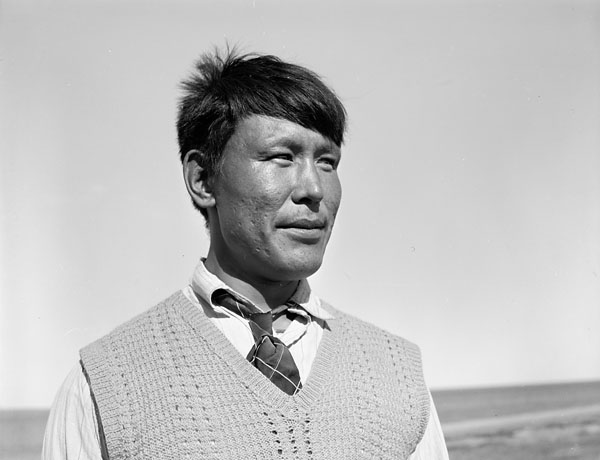
As part of my work I manage a Facebook page Inuit RCMP Special Constables from Nunavut to acknowledge the contributions of our Inuit Specials and pay tribute to them. Last year I posted a portrait photograph that I found on the Project Naming database of Jimmy Gibbons, taken in Arviat in 1946. Special Constable Gibbons was a remarkable man who joined the RCMP in 1936 and retired to a pension in 1965. This post was met with many enthusiastic likes, shares and comments from S/Cst. Gibbons’ descendants saying that he was their father, uncle or great-grandfather. Some people also simply said “thank you.” Shelley Ann Voisey Atatsiaq proudly commented, “No wonder I wrote earlier that I highly respect the R.C.M.P. I’ve got some R.C.M.P-ness in my blood. Thank you for sharing!”

Black-and-white photograph of a close-up of an Inuit man wearing a knitted vest and tie standing outside.

Jimmy Gibbons, Royal Canadian Mounted Police Special Constable, Arviat, Nunavut, August 1, 1946 (MIKAN 4805042)

For more information about the history of the project, read the article Project Naming / Un visage, un nom, International Preservation News, No. 61, December 2013, pp. 20–24.

As with the first phase of the project, LAC wants to hear from you through The Naming Continues form.

Start your search for Aboriginal content

Images of Canada in the Netherlands now on Flickr

Near the end of the Second World War, Canadian forces had the responsibility of liberating the Netherlands from Nazi occupation. During the fighting, civilians behind the German lines suffered from malnutrition, starvation, and the lack of proper shelter. Over the course of many months, approximately 18,000 civilians died, and over 6,700 Canadian troops lost their lives for the liberation of the Dutch.

Library and Archives Canada releases its latest podcast episode, “Guardians of the North: Comic Books in Canada”

Library and Archives Canada (LAC) is releasing its latest podcast episode, Guardians of the North: Comic Books in Canada.

You don’t have to go far to see the influence that comic books have had on contemporary culture, but you might be surprised to learn that LAC holds an extensive collection of comic books and related material within its vaults. In this episode, we speak with comic book historians Hope Nicholson and Rachel Richey about their work and LAC’s role in it. We also talk to special collections librarian Meaghan Scanlon who takes us deep into the comic book collection, and tells us what can be found there and online.

Subscribe to our podcast episodes using RSS or iTunes, or just tune in at Podcast–Discover Library and Archives Canada: Your History, Your Documentary Heritage.

For more information, please contact us at podcasts@bac-lac.gc.ca.

Comic books at Library and Archives Canada

As the keeper of Canada’s national documentary heritage, Library and Archives Canada (LAC) collects a wide range of published Canadiana, including comic books. The collection includes not only comics published in Canada, but also comics by Canadian creators published in other countries. Comic books published in Canada are often acquired via legal deposit. But LAC has also received two important collections from private sources that greatly enhance its holdings of Canadian comics. The largest of these is the John Bell Canadian Comic Book Collection. Donated by comic book historian and former LAC archivist John Bell, the collection includes approximately 4,000 comic books, ranging from Second World War era superhero comics to 21st century zines. Currently, the collection is uncatalogued, but a complete list of all items in the first two accessions is available in AMICUS.

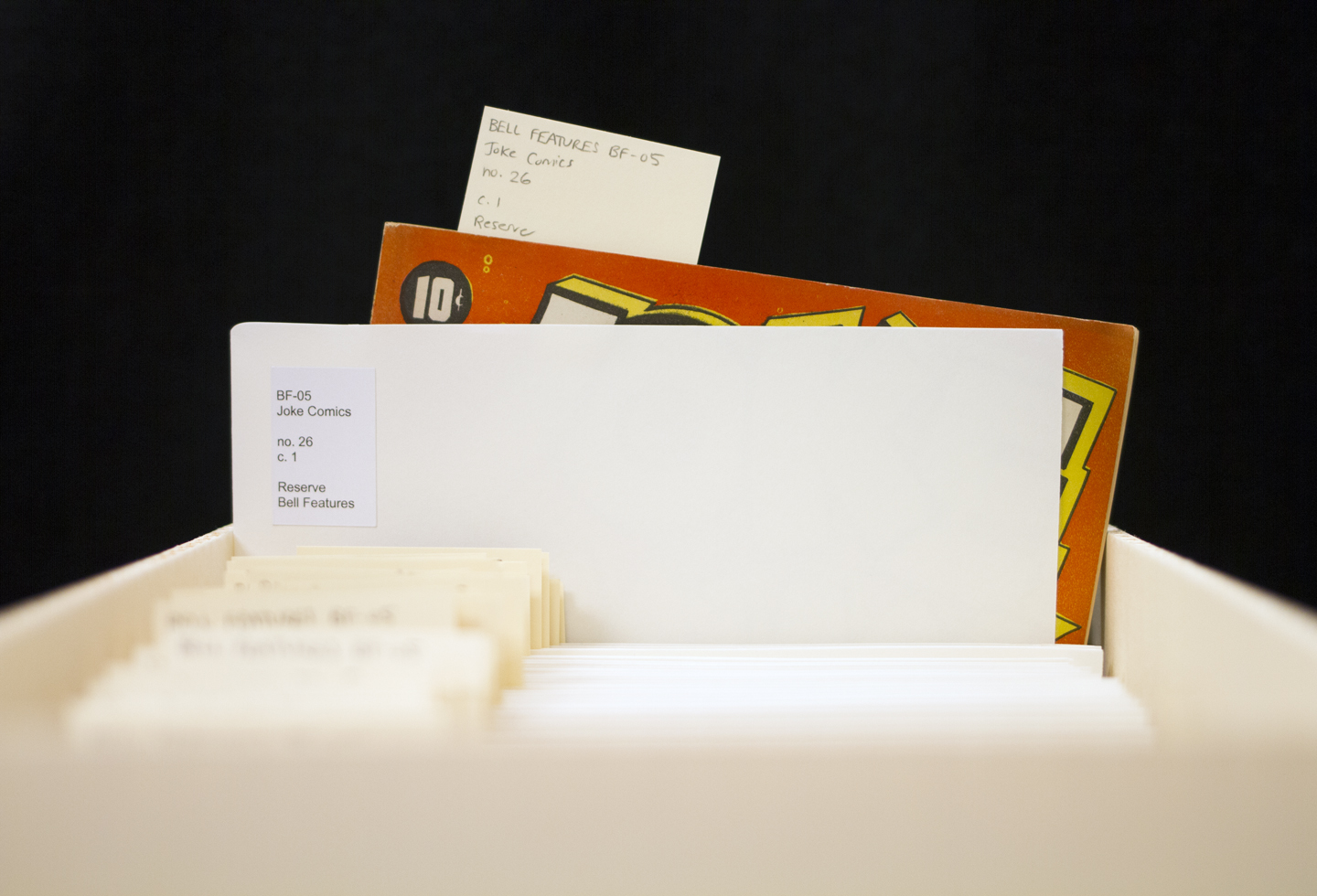
Colour photograph showing a filing box with folders with labels, one is pulled out half-way and a red comic book with the 10¢ price peeks out of the folder.

One box from the catalogued and housed Bell Features Collection

Second World War era Canadian comics are also well-represented in LAC’s Bell Features Collection, which consists of 382 comic books from the corporate archive of one of the major publishers of the period, Toronto-based Bell Features. These older Canadian comics are extremely rare, and the Bell Features Collection is one of the richest resources available. The collection has been fully catalogued, and a collection-level description listing all the titles is available in AMICUS. Over the last few decades, comic books and graphic novels have been increasingly recognized as a literary genre worthy of serious study. In the 1940s, however, comics were considered “throwaway” books for children, as demonstrated by the fact that many Bell Features comics include games and activities for young readers. Because of their ephemeral nature, 1940s comic books were printed on cheap, poor-quality newsprint. As a result, there are various conservation issues to consider when storing comics. Fortunately, the vaults at LAC’s state-of-the-art Preservation Centre provide optimal environmental conditions. The Bell Features Collection is stored in acid-free, closed boxes that protect the comics from harmful light exposure and dirt. Inside the boxes, each comic book is kept in a paper envelope that is open on the top and front edges allowing the comics to slide in and out of their housing with a reduced risk of catching or tearing on a tight opening. The envelopes also contain an alkaline reserve that helps slow down the harmful effects of the acid in the paper. Listen to the podcast Guardians of the North: Comic Books in Canada to learn more about Canadian comics.

Related resources

New additions to the Rare Books Collection: a census

After receiving the recent additions to the Rare Books Collection, the conservation team conducted a census or survey, to determine the state of the collection. The questions on the census were developed by Library and Archives Canada (LAC) conservators, in consultation with the rare book librarians. The conservation team then assessed the books individually and recorded the information.

The primary information recorded was on the condition of the collection, but also included information about the decoration and style of the books. Everything was documented regarding the initial condition of each book and any need for conservation—whether minor or major conservation was needed, and if there was any structural damage. The level of leather deterioration and the need for leather consolidation (a surface treatment to stop the deterioration of the leather) was also noted. The specific housing needs for each book was also assessed and noted—whether a wrap, wrap and tie or box was needed. Other details recorded were: cover decoration, the presence of marbled paper and bookplates, and any interesting inscriptions, missing volumes, etc.

Pie chart showing the portions of the new collection in conditions ranging from poor to excellent.

Figure 1. The results of the new rare books condition census.

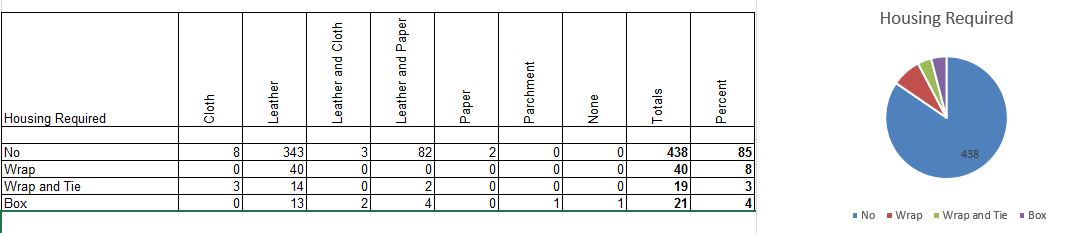
After the completion of the census, leather consolidation was carried out on 499 of the 518 books. Following these treatments approximately 8% of the collection was upgraded from fair to good condition. The number of books in fair condition decreased from 38% to 30% and the number of books in good condition increased from 27% to 35%. Rehousing was only needed for 15% of the collection and has been completed.

A table and pie chart showing the housing types required for the collection. The vast majority do not require any special housing, while some require wrap, wrap and tie, or boxes.

Figure 2. How much of the collection required rehousing.

Now that the census has been completed, the team has written a report that summarizes and presents all the results in easy-to-read graphs and charts. The report will be an invaluable tool for conservators, and will help plan future conservation projects as well as serve as a research tool for librarians and archivists.

Molly Lamb Bobak: Canada’s first female Canadian war artist

May 24, 2015 marks the 70th anniversary of Molly Lamb Bobak’s appointment as Canada’s first female war artist during the Second World War.

In 1942, Molly Lamb Bobak was fresh out of art school in Vancouver. The talented young painter promptly joined the Canadian Women’s Army Corps (CWAC) as a draughtswoman—dreaming of one day becoming an official war artist. She worked serving in canteens before being sent on basic training in Alberta, eventually being promoted in 1945 to Lieutenant in the Canadian Army Historical Section.

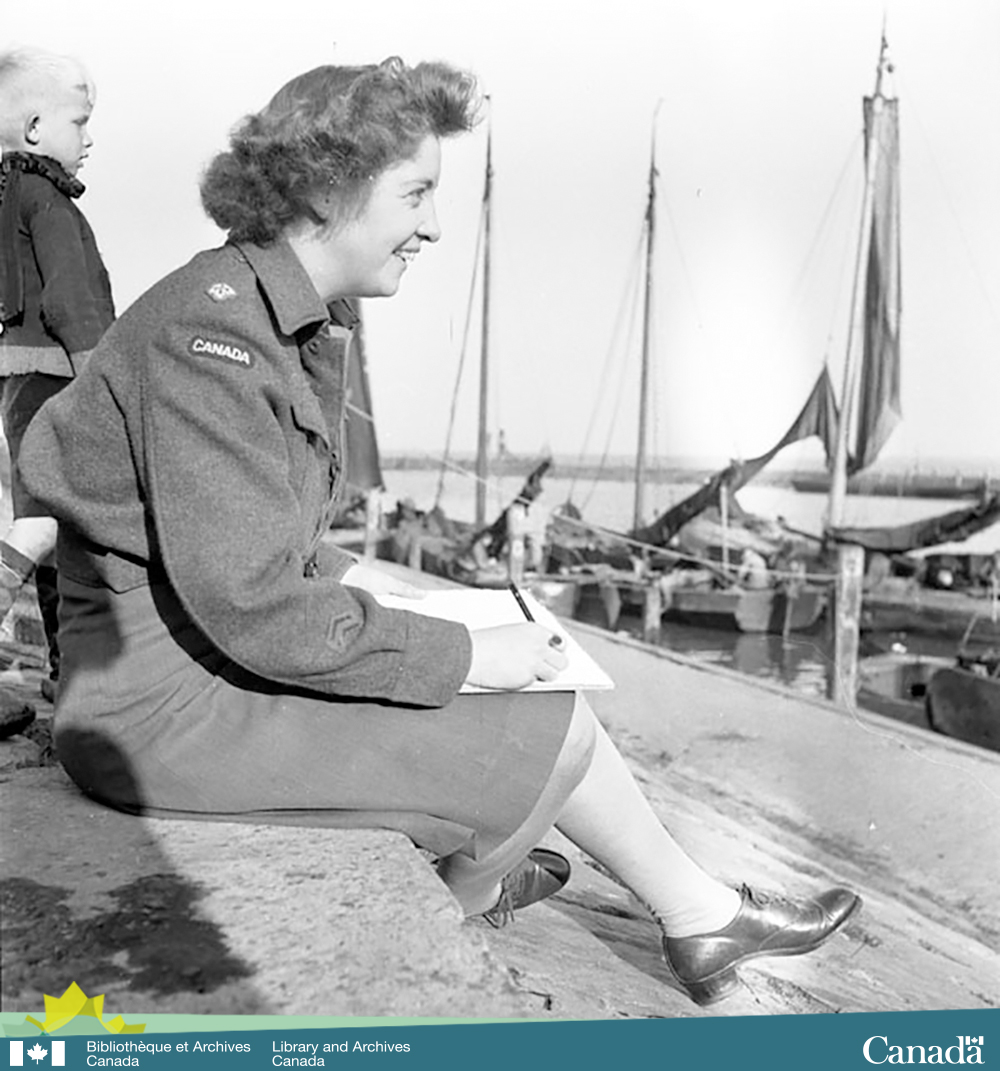
Black-and-white photograph taken from the side showing a smiling woman in uniform sitting on a pier with a drawing tablet and pencil in hand. In the background, there is a young blond child and sailboats docked nearby.

War artist Lieutenant Molly Lamb, Canadian Women’s Army Corps, sketching at Volendam, Netherlands, September 1945 (MIKAN 3217951)

Shortly after enlisting, Lamb Bobak began writing a unique diary that provides an invaluable record of the CWAC’s role in the war effort. Titled simply W110278, after her service number, it is a personal and insightful, handwritten account of the everyday events of army life, accompanied by her drawings. Dating from November 1942 to June 1945, the diary contains 147 folios and almost 50 single sheet sketches that are found interleaved among its pages.

The diary’s first page captures the humorous tone and unique approach of the diary. Written as a pseudo newspaper, with the pages resembling big-city broadsheets, the first headline reads “Girl Takes Drastic Step! ‘You’re in the Army now’ as medical test okayed.”

What follows are handwritten news bulletins with amusing anecdotes and vibrant illustrations that reveal women’s experiences in Second World War army life and form part of a personal daily record of Lamb Bobak’s time in the CWAC.

Three years after enlisting, Moly Lamb Bobak achieved her ultimate goal when she was appointed as Canada’s first female official war artist and was sent overseas, after the ceasefire, where she painted in England, the Netherlands, Belgium and Germany.

To celebrate the 70th anniversary of Molly Lamb Bobak’s appointment as the country’s first female official war artist, Library and Archives has digitized her entire Second World War diary in colour, making this national treasure available online.

Related resources

Ordering documents: what numbers do I need?

Trying to find the right reference number when you want to request documents from the Library and Archives Canada (LAC) collection can be a little daunting to a newcomer and sometimes even to the seasoned researcher. With titles such as Item ID number, archival reference no., former archival reference no., related control no., and other system control no., it can be difficult to know which number is required to place your request.

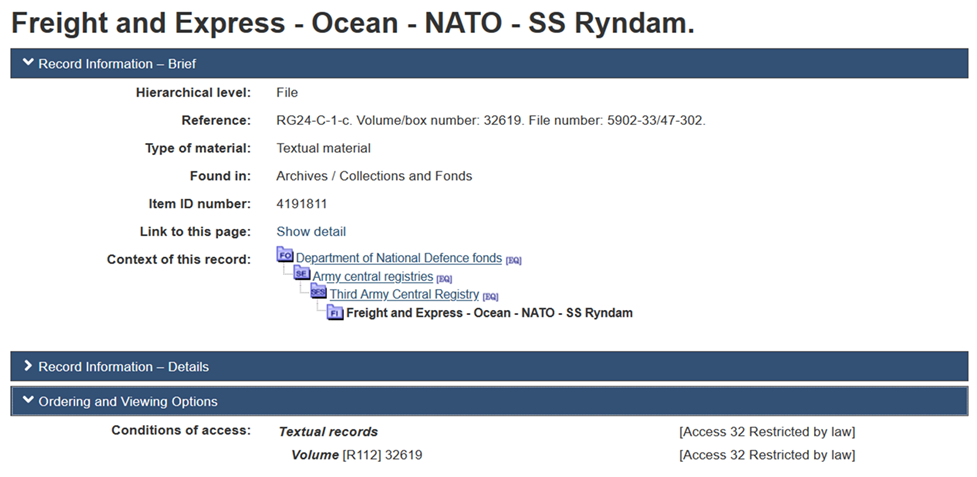
In general, the complete archival reference information that you need to request documents for consultation (or reproduction) can be found in the Reference field in the “Record Information – Brief” section of the online description for files, items and accessions, etc, available through our Collection Search database.

In the case where some information is missing from the reference field, it is always worth looking at the “Ordering and Viewing Options” section.

A sample record description in the Library and Archives Canada Collection Search database. Note the Reference field near the top of the page and the Conditions of access at the bottom of the page.

You will need to make note of the following information (if available), in the order indicated (1 to 6), in addition to the document title (located at the top of the description page):

  1. Archival Reference number – e.g., R112
  2. Former archival reference no. – e.g., RG, MG, LMS, MUS. It is also important to transcribe all of the information that follows the letter identification.
  3. An accession or BAN number – e.g., 2003-00459-9
  4. A volume or box number—without a volume or box number, nothing can be ordered.
  5. File no. (creator) or Item no. (creator)
  6. File title

It is important to note that the Item ID number found in Collection Search (formerly known as Mikan number) is not an accepted reference number. This number is a system number for Collection Search. It refers to the descriptive record, not the document itself. While useful for searching online, this number, unlike complete references, will likely change

That said, for the preceding example the following information would be needed for document retrieval:

RG24-C-1-c, Volume 32619, File no. 5902-33/47-302

Here are other examples of reference numbers and titles organized by media type.

Please note that the “Conditions of access” field, available under the header “Ordering and Viewing Options” also contains important information on access restrictions (identified by an access code) that apply to the records described and that indicate whether documents may or may not be freely consulted for research and reproduction purposes. For more information about access codes, please consult the following blog posts: Introduction and Part II.

Important considerations:

  • Retrieval times for archival documents are between 36 and 48 hours as the documents are kept offsite and must be brought to 395 Wellington for viewing.
  • Pay close attention to the restriction codes on the documents, which may require you to provide additional information if the files happen to be restricted.
  • Some documents have already been microfilmed and are available for immediate viewing in the consultation room. If you see a record with a microfilm reel number, you can go directly to the microfilm room and pull the reel from the shelf for viewing.
  • In addition, some microfilm reels starting with the letters C-, T- and H-, have been digitized through our collaboration with Canadiana and are available on the Héritage website.

If all else fails, feel free to ask the Orientation or Consultation staff for help to find the correct reference number, or complete the Ask Us a Question form.