Reconnecting families through digitization

As part of Project Naming, a community engagement and photo identification project that aims to reconnect Inuit and their past, Library and Archives Canada (LAC) has undertaken the digitization of a series of photographs from the Indian and Northern Affairs Collection. These albums have been the starting point of a great story regarding a family from Nunavut.

In this collection, are a number of images of the Weetaltuk family taken during the summer of 1949 on the Cape Hope Islands in Nunavut. The original captions accompanying the photographs provided basic details. Fortunately, the database records for these images are now more complete after several family members contacted LAC to provide the names of relatives and other relevant information about these pictures. Most importantly, they were able to correct the Weetaltuk surname, as well as community names that had been incorrectly recorded. From the original captions, we knew that George Weetaltuk was a community leader, a skilled hunter and an expert boat builder. His family members explained the detailed process that George followed in creating his boats, as seen in this photograph of him with his son, William, and his adopted son, Simon Aodla, constructing an 11.58 metre (38-foot) boat.

Another record that the Weetaltuk family was able to correct was this group photograph taken in front of a log cabin. The caption states that this picture was taken on Cape Hope Islands. We now know that the picture was probably taken on nearby Charlton Island, James Bay, where for many years, George and his family resided while he was employed seasonally by the Hudson’s Bay Company. In addition to this information, the family was also able to identify five of the people in the photograph, and provide genealogical connections.

Weetaltuk family photograph. Back row: Adla (far left), married to William, George’s oldest son (2nd from left),  George Weetaltuk (centre) and his first wife, Ugugak (4th from left). Front row: George’s sons Alaku (far left) and Tommy (sitting on the ground). (PA-099605)

Weetaltuk family photograph. Back row: Adla (far left), married to William, George’s oldest son (2nd from left), George Weetaltuk (centre) and his first wife, Ugugak (4th from left). Front row: George’s sons Alaku (far left) and Tommy (sitting on the ground). (PA-099605) Source

In addition, another of George’s sons, Edward, was a member of the Princess Patricia’s Canadian Light Infantry. He was the first Canadian Inuk to serve in military combat with the Canadian Army during the Korean War. Following his 15 years of service, he began writing his life story. According to a news article, Edward (Eddy) Weetaltuk “wanted to show young Inuit that education was important and that Inuit can become anything they want and even become famous, if that’s what they want.” (Nunatsiaq Online, July 16, 2009)

Although Eddy started writing E9-422: Un Inuit, de la toundra à la guerre de Corée in 1974 (in French only), it was not published until 2009 only a few days before his death.

Through these family connections and dialogue with the community, our photographic collections are constantly improved and enriched for future generations.

For more information about Project Naming, read our Blog article, published on May 9, 2013, and listen to our Project Naming and Canada’s North podcast.

How to find photographs that are not yet available online – part two

Our previous article “How to find photographs that are not yet available online—part one” explained the best-case scenario for finding photographs that are not yet available online. But what happens when things don’t go that smoothly?

What if I find items that are close but not what I want?

If there are items in your search results that aren’t quite what you’re looking for, don’t despair. It’s quite possible that we have what you want, but that it hasn’t been described yet. The items that have already been described offer you a useful clue as to where those non-described items might be.

First, note the fonds, collection, or accession where each item is from and look at the field labelled “extent.” How many other photographs make up that collection? Perhaps there are more images relating to your topic.

Does the item have:

– an item number?
– a particular photographer?
– certain keywords?

Use variations of those keywords, item number and photographer’s name to do other online searches in Archives Search. If those don’t yield any results, try the finding aid related to each item, either online or on paper. See “How to find photographs that are not yet available online—part one” for tips on using the finding aid.

What if the finding aid is not online or the finding aid is only available in paper?

If you find a fonds, collection, or accession that seems relevant to your research but that doesn’t have an electronic finding aid, look to see if it has a paper one. If it does, you can visit us at 395 Wellington Street in Ottawa, to have a closer look at it. If there is no reference to a paper finding aid, then you have to search through the boxes from that collection. If you cannot come to Ottawa, you can contact our reference staff for guidance, or you may wish to hire a freelance researcher.

With more than 25 million images, chances are we have your “perfect shot.” You just have to find it!

Questions or comments? We would love to hear from you!

Why Consult Newspapers on Microfilm?

We have already discussed how to find Canadian newspapers on microfilm; and you might have wondered why we have to turn to microfilm in the first place? Aren’t these newspapers available online?

The short answer is that only some of them are (*). Most newspaper editions available electronically for free are limited in their content, and the issues usually start only in the 1980s. If you are interested in full-page content and original layouts, or need to access older issues, some major dailies like the Globe and Mail, the Toronto Star and the Winnipeg Free Press offer historical versions in PDF format for a fee. As well, your local library may subscribe to a particular daily, or you may also purchase access yourself.

Another option is to access Library and Archives Canada’s newspapers on microfilm, an extensive collection that:

  • includes major newspapers, as well as local, labour, ethnic and student papers;
  • allows you to research aspects of newspaper publishing, such as design, layout and advertising, not contained in the electronic versions; and
  • provides access to content excluded in the electronic versions, including photographs, classifieds and obituaries.

Come visit us in Ottawa to consult these newspapers on microfilm and discover our collection, or contact us for more information.

* The following are examples of free digital newspaper collections:

Questions or comments? We would love to hear from you!

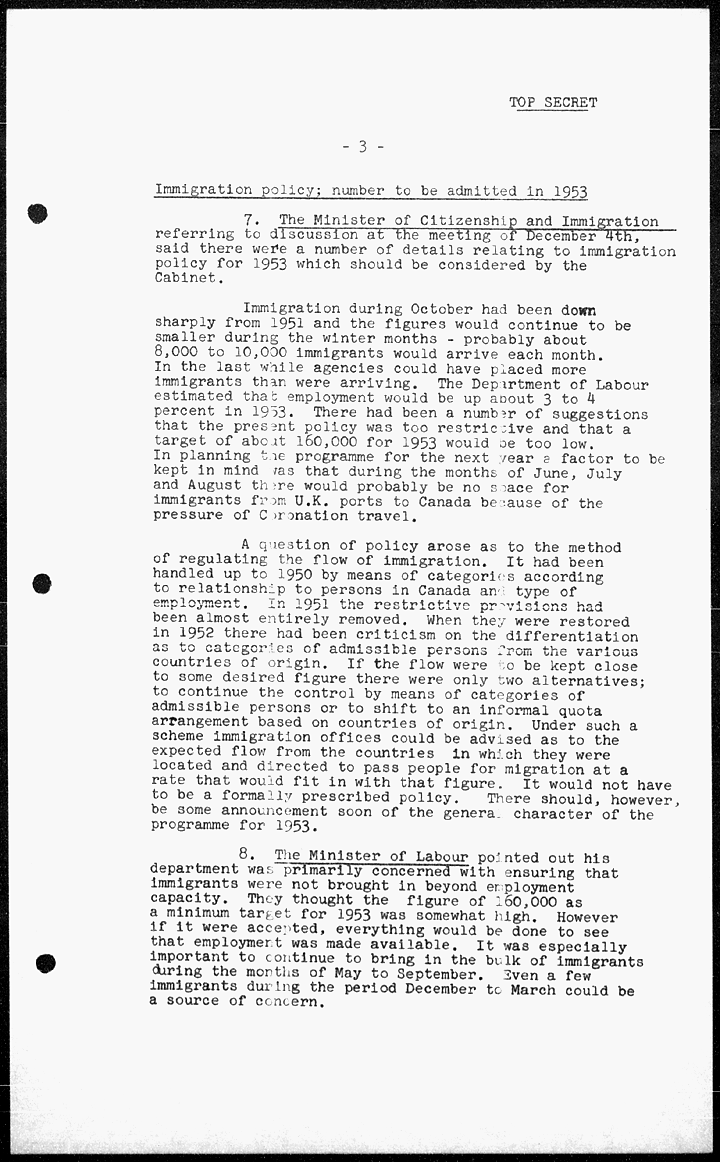
Cabinet Conclusions: A Window into Federal Policy

Are you curious about historic federal Cabinet discussions? Did you ever wonder what happened behind those closed doors? Find out more by using our Cabinet Conclusions database.

Here are some examples:

Cabinet Conclusions is a research tool that provides a record of the discussions that took place at federal Cabinet meetings for the years 1944–1976. Although they are not a verbatim transcript, the Cabinet Conclusions are the only official record of these Cabinet meetings.

For each meeting of Cabinet, the Clerk of the Privy Council prepared a summary of the discussions, a list of the officials who attended the meeting and an agenda. The summary can be very short or can cover several pages. The Cabinet Conclusions database does not include Cabinet Documents.

This research tool has a Search Help section that contains many useful search tips plus helpful background information on Cabinet and their records.

You may notice that the majority of the documents are in English, as this was the primary working language of the federal government at the time. For Cabinet Conclusions from 1944–1969, you can only search using English terms. For Cabinet Conclusions from 1970–1976, you can search using either French or English; however, the documents are usually only available in English.

Did you know?

  • The Privy Council Office only began to record Cabinet Conclusions in 1944. Prior to 1944, there were no formal records of Cabinet.
  • The Privy Council Office still holds the Cabinet Conclusions from 1977 onwards.

Questions or comments? We would love to hear from you!

How to Find Digitized Publications – Part II

In our post on “How to Find Digitized Publications”, we promised to  share more recommendations from our reference specialists about where to find digitized publications. The following sources point to a wealth of  publications from across Canada and from specific regions.

CANADA-WIDE SOURCES

Internet Archive – Text Archive [http://archive.org/details/texts]
The Internet Archive Text Archive contains a wide range of historical texts, academic books, government publications, fiction, popular books and children’s
books. The Internet Archive includes many digitized federal government and parliamentary publications from Library and Archives Canada’s collection.

  • Tip:
    Once you have found a work of interest, you can then use full-text searching options provided by the website.

Canadiana Discovery Portal [http://search.canadiana.ca/]
The Canadiana Discovery Portal allows you to search the digitized collections of libraries, archives and museums from across Canada. The Portal includes a
wide range of historical materials such as books, journals, newspapers, government documents, photographs, and maps.

Our Roots: Canada’s Local Histories Online [http://www.ourroots.ca/]
Our Roots is a wonderful resource for family history research. This extensive collection of digitized local histories, including historical publications,
from across the country permits full-text searches for family names, place names and events.

REGIONAL SOURCES

Bibliothèque et Archives nationales du Québec – Digital Collection
[http://www.banq.qc.ca/collections/collection_numerique/index.html?language_id=1]
Bibliothèque et Archives nationales du Québec offers extensive collections of digitized materials including newspapers, magazines, municipal directories,
books and musical scores, reference works, maps and plans, and images.

  • Tip:
    The Municipal Directories collection
    [http://www.banq.qc.ca/collections/collection_numerique/index.html?categorie=1]includes the Lovell’s Montréal directories starting in 1842.

Peel’s Prairie Provinces [http://peel.library.ualberta.ca/index.html]
Peel’s Prairie Provinces is an indispensable research resource on Western Canada and its history. It includes a bibliography with over 7000 fully searchable digitized books [http://peel.library.ualberta.ca/bibliography/], many dating back to the earliest days of exploration in the region.

Island Archives.ca at the University of Prince Edward Island [http://islandarchives.ca/]
A growing repository of records and images held in Prince Edward Island’s libraries and museums. Of particular interest are the digitized newspapers [http://islandarchives.ca/inewspapers] and maps [http://islandarchives.ca/imaps].

Questions or comments? We would love to hear from you!

New LAC RSS Feed – Finding Aid, Database and Digitization News

This new RSS feed highlights updates and additions to Library and Archives Canada (LAC)’s resources, such as finding aids, its various databases and provides information on newly digitized content.

Subscribe to this new RSS feed or visit LAC’s RSS page to access other LAC RSS feeds.

For more information on recent announcements at LAC, visit “News”.

New Digitized Reels: War of 1812 Records

We are pleased to announce that you can now access 73,000 new images of War of 1812 records on its website.

Discover these valuable resources and other miscellaneous records for the War of 1812 with the Microform Digitization research tool. This tool allows you to browse these records page by page.

Library and Archives Canada (LAC) holds a unique and vast collection of records about the Canadian men and women who were involved in the War of 1812. Muster rolls, paylists, claims, certificates of service, medal registers, maps, paintings, and published sources are featured in LAC holdings that document this key event.

With these images now online, you have easy access to records for:

  • Board of Claims for War of 1812 losses, 1813–1848, Series RG19 E5A
  • Lower Canada militia nominal rolls and paylists, Series RG9 1A7
  • Upper Canada militia returns, nominal rolls, and paylists, Series RG9 1B7

For more information on recent announcements at LAC, visit “News“.

Listen to Canada’s Musical History with the Virtual Gramophone

From patriotic songs and sentimental ballads from the First World War era to classical vocalists and instrumentalists from the 1920s to 1940s; that is what you will find on the Library and Archives Canada website the Virtual Gramophone. This is a great place to listen to recordings from our music collection!

Our Virtual Gramophone website documents the history of the recorded sound industry in Canada, provides biographies of Canadian performers, presents a video of a working gramophone, allows you to search the database, and you can listen to some recordings.

Some of the recordings available online include:

  • Patriotic songs and sentimental ballads of the First World War era
  • Recordings from the rising vaudeville and jazz scenes, and the dance band craze of the 1920s
  • Music from Quebec in the 1920s and 1930s, including the recordings of Madame Édouard (Mary Travers) Bolduc
  • Popular music of the post-First World War era, including recordings from New Brunswick’s Henry Burr, the most prolific recording artist of his time
  • Classical vocalists and instrumentalists from the 1920s, 1930s, and 1940s, including Emma Albani, Pauline Donalda, Sarah Fischer, and Hubert Eisdell
  • Military bands, popular songs, and other material in both English and French recorded or released by the Berliner Gramophone of Montreal circa 1901 to 1910

Although the website is no longer updated, it is still a great place to access some of our digitized recordings of the 78-rpm and cylinder music collection held by Library and Archives Canada.

If you have a keen interest in Canadian music, our other websites may also be of interest:

Questions or comments? We would love to hear from you!

New Digitized Reels: Border Entry Records

We are pleased to announce that you can now access 121,302 new images of immigration records on our website, with the Microform Digitization research tool.

Before 1908, people were able to move freely across the border from the United States into Canada. Beginning in that year, entry ports were established along the border. From 1908 to 1918, and from 1925 to 1935, border entry records were compiled in a list format to record the names of immigrants.

By providing these images online, Library and Archives Canada (LAC) is now offering all immigration records containing nominal information for immigrants from 1865 to 1935 in its custody. Discover these valuable resources with the Microform Digitization research tool, which allows you to browse, page by page, the border entry records.

For more information on recent announcements at LAC, visit “News”.

How to Find Digitized Publications

Now, more than ever, you can access print publications online. The trick is finding them. So, our reference specialists at Library and Archives Canada (LAC) offer the following tips to help you discover published works that are just a click away!

Library Search

Get started with our Library Search tool. Just follow these easy steps to find Canadian published materials digitized by LAC and other libraries across the country.

  1. Go the Library Advanced Search screen.
  2. Select the Title Keyword search option and enter keywords from the title of a book that interests you.
  3. Search in: Canadian Libraries.
  4. From the Format dropdown menu, select Online.
  5. Click the Submit button. This will open a new page with your search results.
  6. Select any relevant search result to access the full record with the description of the book.
  7. Click on the link in the description to access the digitized version of the book.

Early Canadiana Online

Our reference specialists recommend the Early Canadiana Online (ECO) [www.eco.canadiana.ca/?usrlang=en] digital library as the go-to source for 19th century published material. Offering a vast online collection, ECO not only lets you search for specific works, but it also allows full-text searching. Some of the digitized content in ECO is only available to subscribing institutions, so ask your local library.

Here are a few tips for searching the ECO collection:

  1. Use the Advanced Search screen to narrow your search.
  2. To find specific titles, select the title option from the Search in drop-down menu.
  3. From the Find documents matching drop-down menu, select the option all terms in close proximity when searching the full-text of the digital library. This ensures that your search terms occur close together, not on separate pages of the full document.

Our next post on How to Find Digitized Publications will cover the following sources:

Also, stay tuned to find out about some regional digitization initiatives that provide access to provincial and local materials.

Do you have any sources you like to use? If so, share them with us!

Questions or comments? We would love to hear from you!