“I want to ride my bicycle!”: Cycling in the Canadian Expeditionary Force during the First World War

Version française

By Dylan Roy

“Get on your bike and ride,” my mother often told me in my youth when I would ask for a lift somewhere. Although I would sometimes begrudge her for forcing me to stay active (being the indolent child that I was), looking back, I am glad that I biked to the places I needed to go in my teenage years. Biking provided not only exercise, but also a form of agency and sorely needed sociability.

On reflection, cycling is a virtually ubiquitous phenomenon wherever people live. It came to me as a surprise that even the Canadian military used cycling. I just didn’t think of the reasons why they would. To me, it seemed like a far-fetched thing and an activity in which only civilians partook. However, the Canadian military has implemented the use of cyclists within its ranks throughout much of its history.

This series will focus on the military units who used bicycles as one of their primary duties during their service. The first entry into this series will focus explicitly on the divisions that served during the First World War. So, strap on your helmet and start peddling down the road of the following paragraphs to learn more about the brave bikers who served in our military during the Great War.

Dozens of soldiers standing at attention while holding bicycles for a panoramic photograph.

Panoramic photograph of the 2nd Division Cycle Corps, Canadian Expeditionary Force. (e010932293)

Before starting, it is important to highlight that Library and Archives Canada (LAC) offers a wide variety of resources to find information concerning the cyclist divisions, companies and Corps that took part in the First World War. One of the handiest is the Guide to Sources Relating to Units of the Canadian Expeditionary Force: Cyclists. This guide can inform a researcher about many aspects of the cyclist units. However, be warned: there are some transcription errors mentioned in the preface to the guides on the Sources Relating to Units of the Canadian Expeditionary Force page. They are, nonetheless, valuable tools for research.

Outside of LAC, the Official History of the Canadian Army in the First World War: Canadian Expeditionary Force, 1914-1919 is another secondary source that can provide important information concerning the cycling units.

With that out of the way, what did the cyclist units actually do during the war? The Canadian Encyclopedia provides this succinct summary of the cyclist units: “In WWI young men with the cycling urge were encouraged to join the Canadian Corps Cyclists’ Battalion. Over 1000 men eventually did so, their duties ranging from message delivery and map reading to reconnaissance and actual combat.”

Moreover, since our troops were equipped with bicycles, it meant that they were relatively mobile compared to infantry units. They were therefore considered “mounted” and, in fact, fell under the same umbrella as the Canadian Light Horse regiment. When they said “get off your high horse,” the cyclist units took it very seriously. You can see where the cyclists fell in the military hierarchy with the 1918 Canadian Expeditionary Force (CEF) organization chart below:
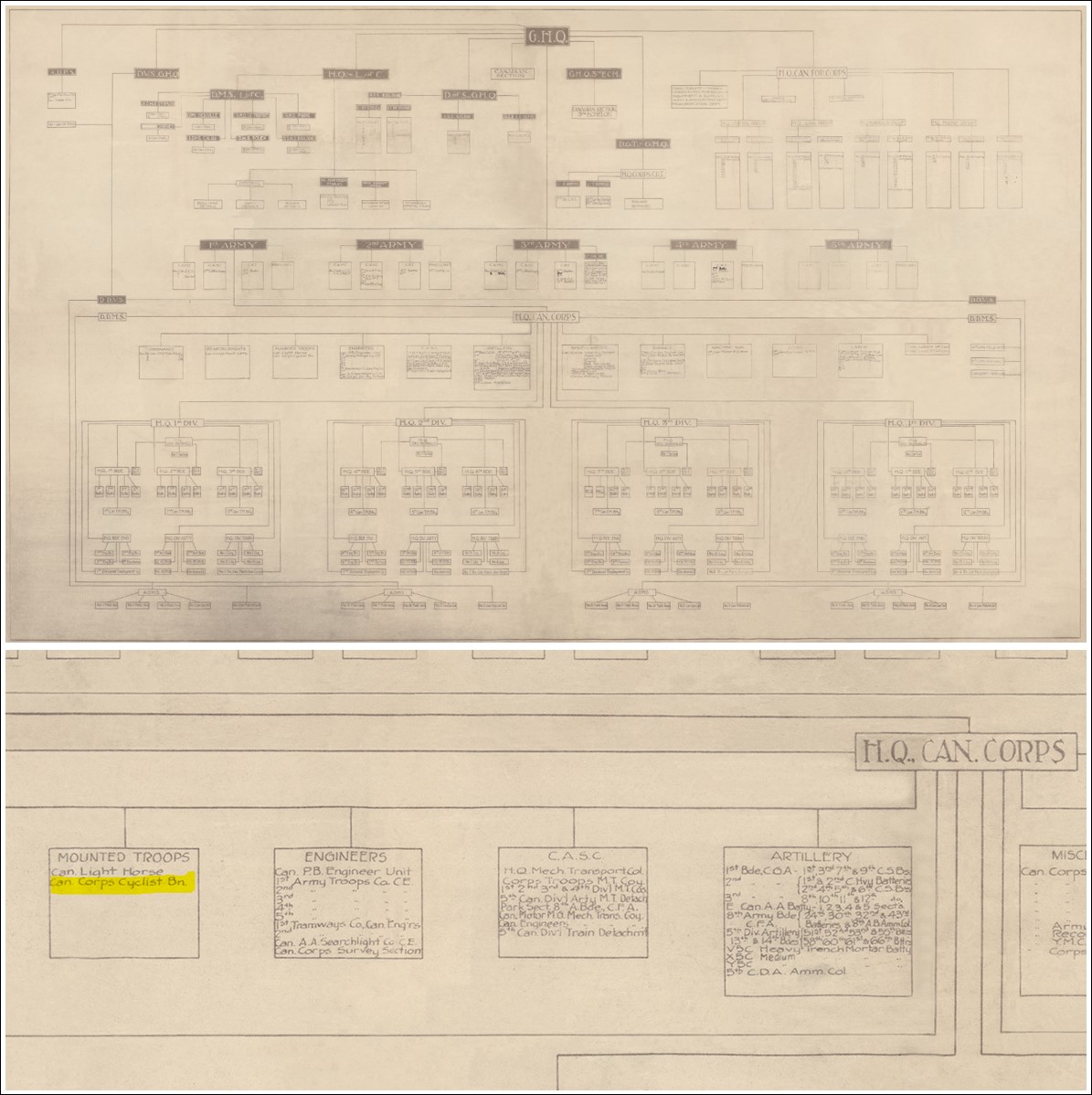
Two screenshots of a chart made for the organization of the Canadian Expeditionary Force (CEF) in 1918. The first chart outlines the hierarchy of the CEF during 1918 via chains of command. The second screenshot is from the same chart but highlights where the Canadian Corps Cyclist Battalion falls within the hierarchy.

Two screenshots of the 1918 Canadian Expeditionary Force organization chart. Full chart is displayed on top and the section which highlights the Canadian Corps Cyclist Battalion below. (Government of Canada website)

Although the cycling units were actively involved in the war, they first needed to be trained. LAC has a variety of videos on YouTube focusing on the Canadian military, including one that features some of the training aspect of the cyclist units titled The Divisional Cyclists : A Glimpse of a Day’s Training (1916).

The video demonstrates the importance of many topics, such as the more mundane aspects of military life (like laundry), while also shedding light on more crucial elements of training, such as drills, signalling and reconnaissance.
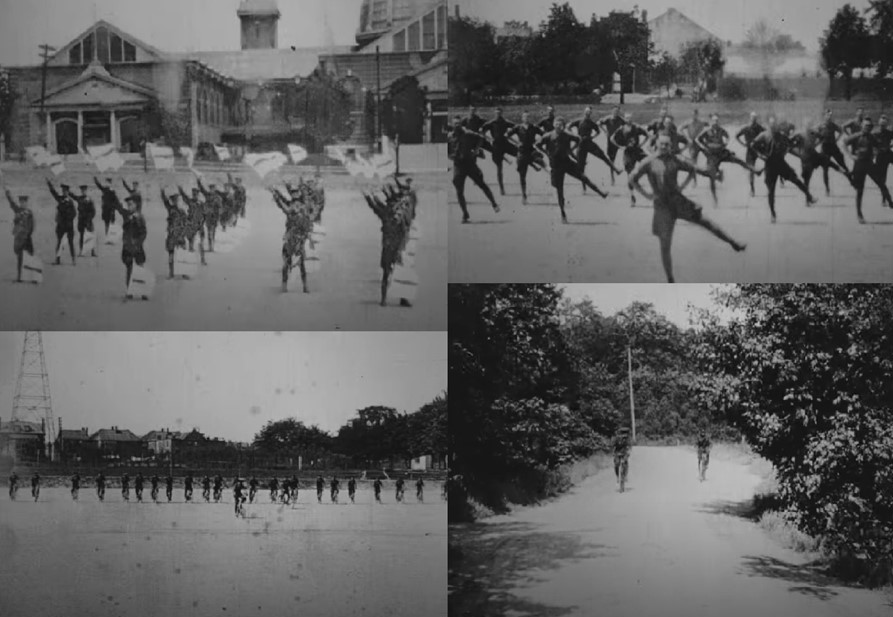
Four scenes from the film The Divisional Cyclists : A Glimpse of a Day's Training (1916). Top left features men in synchronization performing signalling drills with flags. Top right shows soldiers performing light aerobic exercises. Bottom left shows soldiers biking in unitary fashion along one another. Bottom right includes two men biking in a reconnaissance drill in a forest.

Four scenes from the video The Divisional Cyclists : A Glimpse of a Day’s Training (1916) demonstrating signalling, drill and reconnaissance training initiatives. (ISN 285582)

Once the cycling units had completed their training, they could partake directly in the war efforts. Our hardworking biking men-at-arms were no strangers to conflict, and they were part of some of the most notable battles of the First World War such as Ypres and Vimy. The following entry below from a war diary by the 1st Canadian Divisional Cyclist Company covers the horrific aspects of the battle of Ypres and how the division was involved on April 22nd, 1915, near Elverdinghe:

Terrific bombardment started on the front immediately EAST of here about 4:30 P.M. The whole line appeared to be enveloped by cloud of greenish smoke. At 6:30 P.M. requested arrival of many stragglers of the South African troops from the first line trenches all in a state nearing on collapse complaining of a new and deadly gas which had been wafted from the enemy’s trenches by a gentle NORTH-EAST wind, orders were given to D.M.T. to “stand-to.” At 7:15 orders came from DIV. H.Q. to proceed with all possible speed to there, which place was CHATEAU DES TROIS TOURST. Cyclists were ordered to “stand to” on the avenue leading to the ELVERDINGHE – YPRES road. Communication being down with various infantry, and artillery units of Division H.Q. from time to time asked for orderlies from the cyclists to report to different BRIGADE H.Q. as despatch riders. At 10:10 P.M. LIEUT. CHADWICK and No 1 Platoon were sent on a reconnoitering patrol on our immediate front across the canal. Corpl WINGFIELD with his section was despatched as a reconnoitering patrol behind the trench lines on our left.
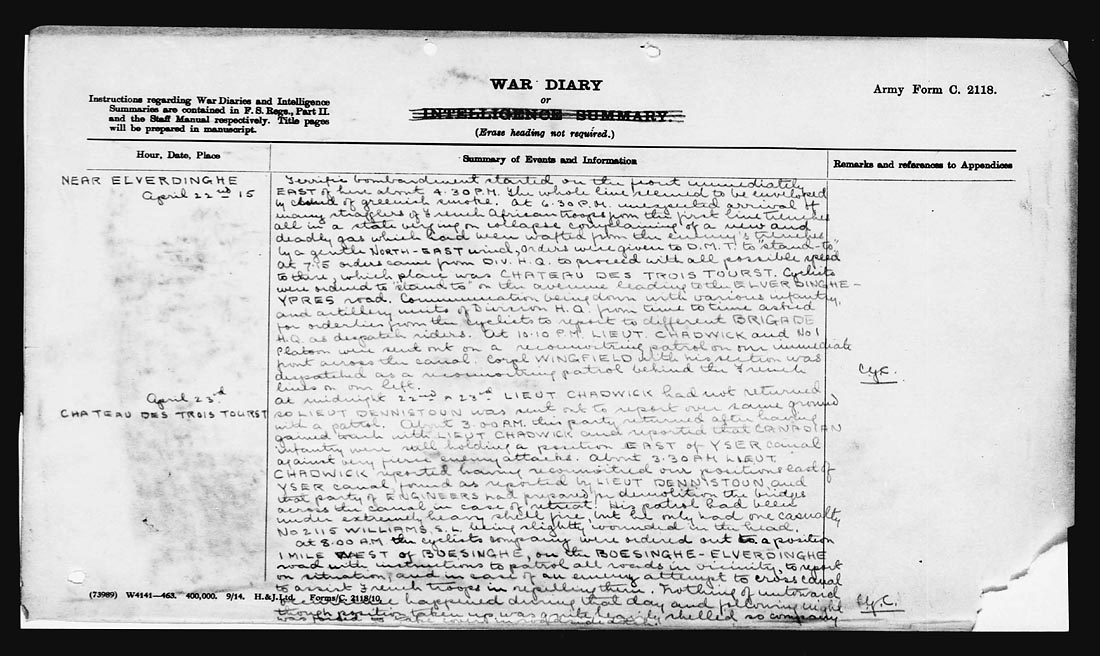
 

Screenshot of the war diary that was shared directly above.

Screenshot of War diaries – 1st Canadian Divisional Cyclist Company / Journal de guerre – 1re Compagnie divisionnaire canadienne de cyclistes. (e001131804, image 53)

The entry highlights the chaos of war and the hardships that many men suffered on that fateful day in April 1915. It also shares some of the more haunting aspects of the First World War, such as the use of gas described as green clouds of smoke. Additionally, it provides insight into some of the main tasks accomplished by the cyclists including communication, acting as despatches and reconnaissance.

The cyclist divisions continued to expand during the war and, as highlighted earlier, an entire battalion was eventually formed called the Canadian Corps Cyclist Battalion. At LAC, there is an entire sub-series devoted to this battalion that shares further information in the Biography/Administrative history section on how it was formed and eventually disbanded. It reads:

The Canadian Corps Cyclist Battalion was organized at Abeele in May 1916 under the command of Major A. McMillan, and was formed by amalgamating the 1st, 2nd, and 3rd Canadian Divisional Cyclist Companies. The battalion was demobilized at Toronto in April 1919 and was disbanded by General Order 208 of 15 November 1920. In Canada Cyclist Companies advertised for recruits “possessing more than average intelligence and a high standard of education.” (MIKAN 182377)

By viewing the lower-level descriptions from this sub-series, one can see records that pertain to the battalion. The sub-series includes a variety of topics such as a training syllabus of the reserve cyclist company and statements by Canadian prisoners of war (among others).
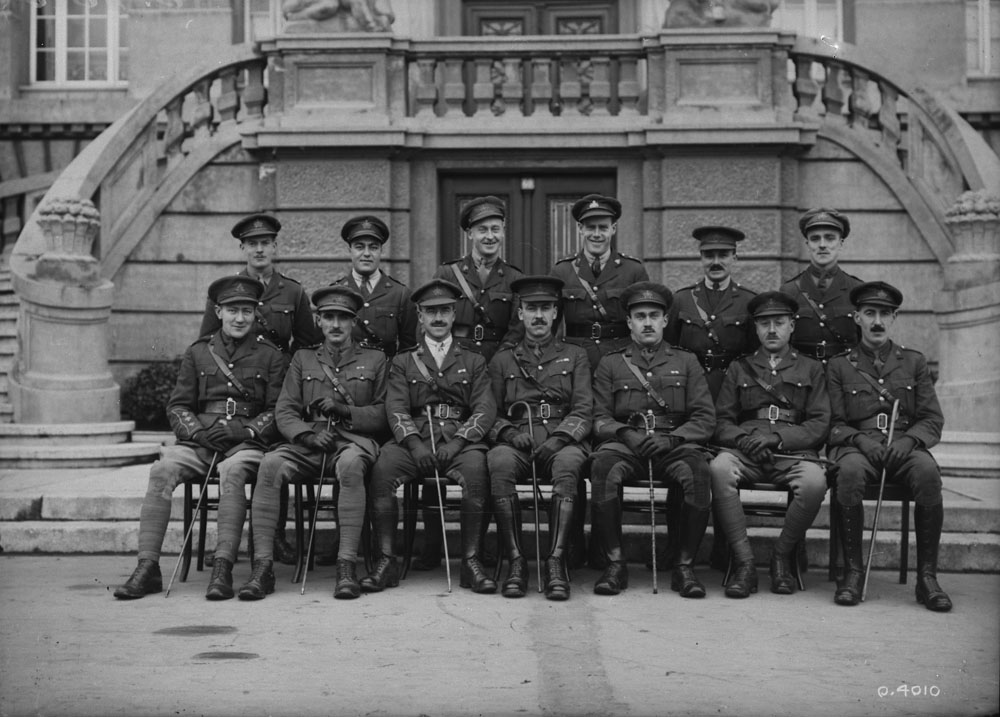
A black and white photograph of thirteen officers in uniform who served the Canadian Corps Cyclist Battalion taken in January 1919. Seven men sit on chairs in front of six men standing behind them.

Photograph of officers in the Canadian Corps Cyclist Battalion from January 1919. (PA-003928)

The Canadian cyclist units were no slouches, and they had a definitive impact on the war effort by facilitating reconnaissance, communication, signalling and direct combat. It is impressive to think that these men, who used very archaic forms of bicycles were able to tread the perilous terrain of Europe during the First World War to accomplish their duties while I, using a much better modern bike, complain about having to bike up a small hill on my way to work. It shows how much determination and bravery the men within the cyclist units of the Canadian military exerted during the First World War.

Additional Sources


Dylan Roy is a reference archivist in the Access and Services Branch at Library and Archives Canada.

The Kapuskasing Internment Camp

Version française

By Ariane Gauthier

We make surprising connections throughout our lives. Things we thought were confined to our work or social circles unexpectedly surface in other areas. For me, several long drives with my husband to Northern Ontario led me to learn more about the Kapuskasing internment camp. Few people know that there were internment camps in Canada during both world wars. And even fewer know that these camps were not all for prisoners of war—many detained Canadian civilians of so-called “enemy” nationality.

The Kapuskasing camp was active from the start of the First World War in 1914 until 1920. It mainly held Ukrainian civilians. They were sentenced to forced labour, including constructing buildings and clearing several hectares of surrounding forests so the government could establish an experimental farm.

Black-and-white photograph of the Kapuskasing internment camp in July 1916. The image features a row of wooden huts with rows of prisoners and camp guards lined up in front.

The Kapuskasing internment camp. (e011196906)

My work as a reference archivist has allowed me to delve deeper into the resources of Library and Archives Canada to learn more about this grim period in Canadian history. During my research, I came across the documents of William Doskoch, born on April 5, 1893, in Laza, Galicia, a territory of the Austro‑Hungarian Empire that is now part of Ukraine.

In 1910, at the age of 17, William Doskoch joined his brother in Canada to work in the coal mines in Nanaimo, British Columbia. While he was in Vancouver in 1915, he was arrested, as he was considered an enemy alien. He was interned in several camps: first at Morrissey, then at Mara Lake, and later at Vernon, before finally being transferred to Kapuskasing. It was from there that he was released five years later, on January 9, 1920.

The William Doskoch fonds is rich in resources that help us understand internment camps from an internee’s perspective. While it contains information on several camps, I was mainly interested in William’s notes about Kapuskasing. According to his writings, the conditions were similar to those at Vernon: mistreatment of prisoners, random executions, many cases of tuberculosis, and inadequate internment conditions for the cold weather.

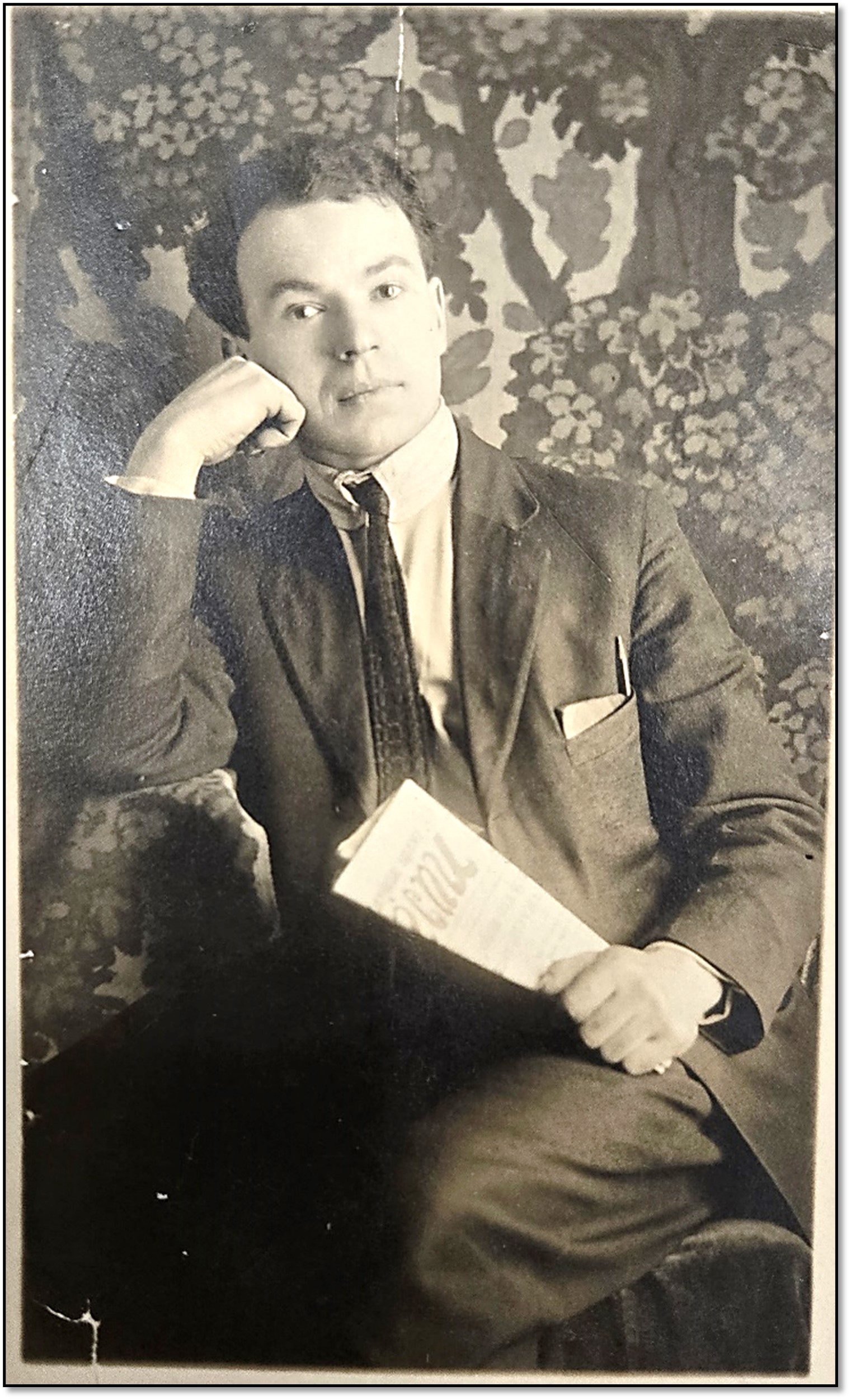
Studio portrait of a seated man. He is holding a newspaper.

Portrait of William Doskoch. (MIKAN 107187)

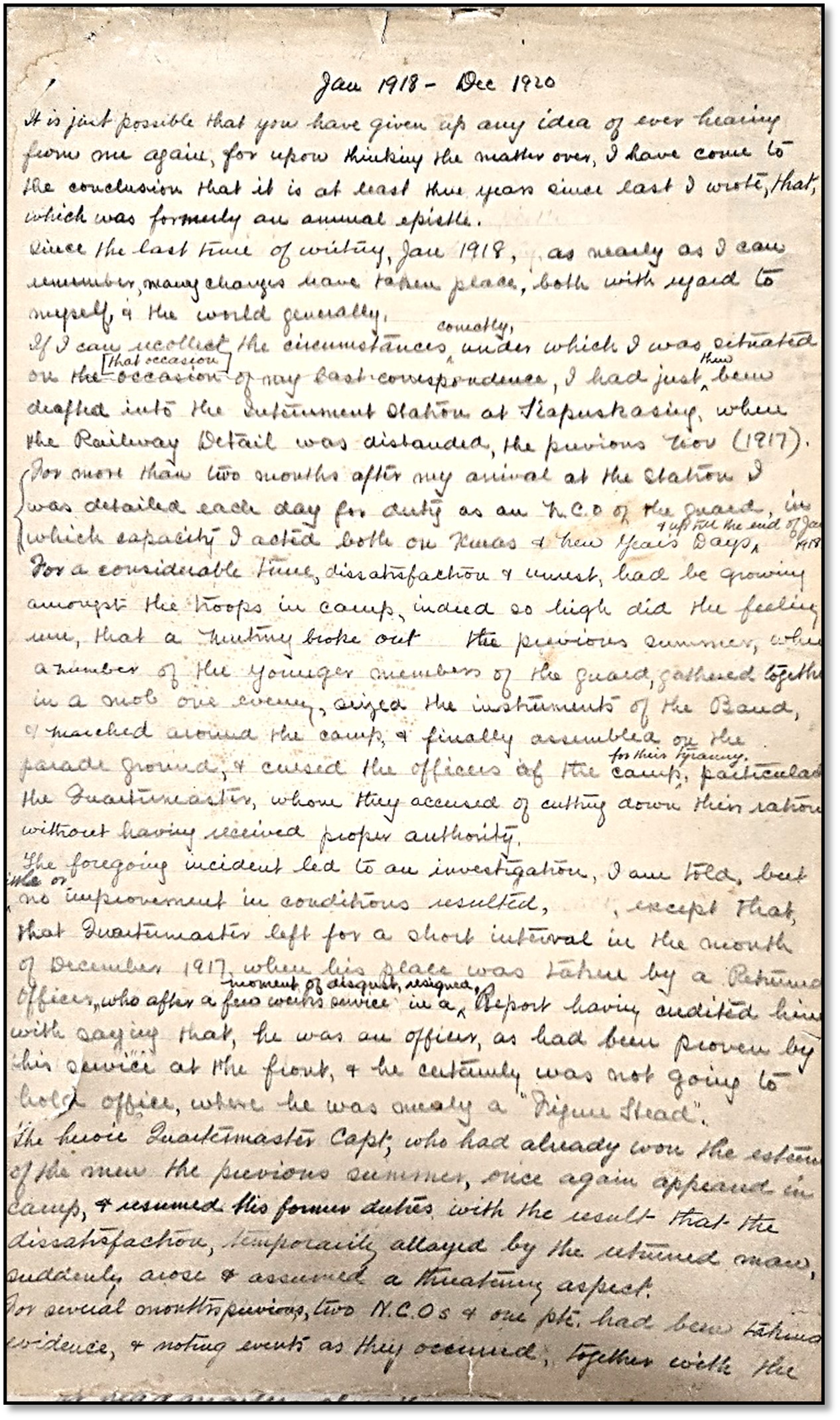
I also found a letter written by George Macoun, a guard at the Kapuskasing camp, detailing events that occurred there between November 1917 and the summer of 1919. Although of lesser magnitude than the William Doskoch fonds, the letter provides us with a rare glimpse into the experience of an internment camp guard.

First page of a letter written by hand.

Letter from George Macoun, a guard at the Kapuskasing internment camp. (MIKAN 102082)

Originally from Ireland, George Macoun immigrated to Canada, where he joined the militia in February 1915. This is how he became involved in the operations at the Kapuskasing internment camp. He wrote this letter after the war ended, following his dismissal as a guard. Reminiscent of a memoir, he recalls the significant experiences of his time in Kapuskasing, including the conflicts and tensions among the guards due to abuses of power. He recounts the following:

“One little incident took place in March 1918, which aroused the wrath of the company generally against this commander owing to the manner in which the case was brought up being considered, according to military custom, absolutely irregular. One evening, whilst an entertainment was being held in the recreation room about the last week of Feb 1918 a certain corporal, one of the most popular men of the guard had the misfortune to get drunk and a disturbance during the night, not only in his own room but also in one of the other rooms. This information was conveyed to the popular O.C. [officer commanding] by some weak about two weeks later, when a charge was at once laid against the corporal.”

The Department of the Secretary of State of Canada fonds also contains a wealth of information. Notably, it includes a sub‑series entitled Custodian of Enemy Property and Internment Operations records, covering the period from 1914 to 1951 (R174-59-6-E, RG6-H-1). During both world wars, the Secretary of State was responsible for, among other things, matters arising from internment operations. However, some activities, such as those related to the management of properties confiscated by the State from internees, were eventually transferred to other departments over the years. The fonds still contains documentation on the certificates of release from internment camps and on the administration of the camps. Boxes 760 to 765 inclusively hold documents concerning the operations of the Kapuskasing camp.

Because there’s a lot of information, I will only focus on a few interesting elements for Kapuskasing. For example:

  • According to correspondence from the director of internment operations, the experimental farm built by the prisoners at Kapuskasing was completed in early December 1917.
  • According to statistics from December 1918, the camp housed the following prisoners: 607 Germans, 371 Austrians, 7 Turks, 5 Bulgarians, and 6 classified as “other.” A note suggests that the term “other” was used for prisoners of war, but it is not clear.
  • Several letters written by prisoners to their family members were censored. This is the case for the letters that Adolf Hundt sent to his wife. Discouraged by the extent of censorship, he gave up writing to her, leading his wife to worry about his health.

This blog post gives you an overview of the information available about the Kapuskasing camp in the Library and Archives Canada collection. This rich resource offers valuable insights into this troubling chapter of Canadian history. To support further research, we have created a guide on internment camps in Canada during the two world wars, which was very helpful to me in writing this blog post.

To consult the guide, follow this link:


Ariane Gauthier is a reference archivist in the Access and Services Branch at Library and Archives Canada.
Censored Valentines: When Cupid Met Government Scrutiny

Version française

By Rebecca Murray

A few months ago, I stumbled upon something unexpected while digging through the archival database of the Office of the Chief Press Censor. Established by Order in Council on June 10, 1915, this office had sweeping authority to oversee the censorship of printed materials during wartime. It was authorized by the Secretary of State to “appoint a person to be censor of writings, copy or matter printed or the publications issued at any printing house.” Naturally, I was interested. I began to review the series of documents from 1915 to 1920 found within the Secretary of State fonds (RG6/R174). These records mostly pertain to censorship restrictions during the First World War, covering everything from subversive elements in Canada to war propaganda.

With over 1,500 file-level descriptions, the series details a variety of publications flagged by the Press Censor. Unsurprisingly, most of the materials under scrutiny were related to the war: German-language publications, pro-German writings, and other sensitive information. But a file on Valentine’s Day cards? Maybe they were too racy, I thought to myself.

Curious, I opened the file (available on digitized microfilm at Canadiana by Canadian Research Knowledge Network). The correspondence between the Deputy Postmaster General R.M. Coulter, Chief Press Censor Lt. Col. E.J. Chambers, and the Department of Justice began in mid-January 1916. The offending item in question was a Valentine’s Day card and envelope produced by the Volland Company of Chicago.

Valentine’s Day card depicting a woman wearing a wide-brimmed hat with black type below, partially obscured by the stamped words “CENSORED (ENEMY COUNTRY).”

The Valentine’s day card in question, published with censor markings. Source: RG6 volume 538 file 254, microfilm reel T-76, page 655.

The main issue? Deputy Postmaster General Coulter flagged the card on January 18, 1916, to Chief Press Censor Chambers, complaining that the label on the envelope and the facsimile of a rubber stamp on the card resembled official censorship markings. His concern was that these could “mislead the Officials of the Government.” Unfortunately, the file does not include a copy of the censored envelope.

Chambers responded the very next day, agreeing with Coulter: “I certainly think that it would be a grave mistake to allow these particular envelopes to gain general circulation in Canada, for they would not only attract unnecessary attention to the censorship, but might prove a stumbling block in the event of it being found necessary to apply a general censorship to the mails later.”

The issue continued to escalate with a memorandum sent to the Deputy Minister of Justice on January 20, followed by a letter dated January 21 explaining that “it would be most injudicious at the present time to permit Valentines and envelopes such as those referred to me, to be circulated in Canada.”

The same letter also sheds light on the broader role of the Office of the Chief Press Censor: “I might explain confidentially, that one of the main objects sought to be accomplished by Censorship in Canada at the present time, is to intercept enemy correspondence passing to and from Teuton Agents and sympathisers in Canada and Intelligence Officers of the enemy Governments in either enemy countries or neutral ones. Consequently, it is the established practice of the censorship to endeavor to conduct its operations with as little publicity as possible, it being felt that to advertise the fact that there is an active censorship system in Canada is but to defeat the object explained in the preceeding.”

Although the Valentine’s Day card in question was not labelled as “enemy correspondence,” its use of what appeared to be censor markings drew significant concern from both the Postmaster General and the Chief Press Censor. During a time when censorship was highly active but intentionally discreet, they were particularly wary of anything that might expose or ridicule their work.

Something that struck me in the latter part of the file was a series of notes exchanged between regional censor officials and booksellers, along with other vendors who had ordered or purchased the card. In response to government letters, several vendors replied promptly, assuring they would return the cards to the American publisher. However, it’s unclear how many cards were already in circulation or if any had been sold before the recall.

White page with black type, stamp and handwriting.

Letter to Chief Press Censor Chambers from the Regional Press Censor’s office in Western Canada. Source: RG6 volume 538 file 254, microfilm reel T-76, page 674.

In addition to the intergovernmental correspondence, the Chief Press Censor reached out to the publisher in a letter dated January 25, noting that the Canadian authorities wished to avoid letting the war interfere with trade and relations between Canada and the United States: “The sincere desire of the Canadian Authorities is to prevent as far as possible, the war from interfering with the trade and other relations existing between Canada and our good neighbours to the South.” Despite the firm stance, the Chief Press Censor’s diplomatic tone reflected a desire to manage the situation tactfully.

White page with black type and handwriting.

Letter from P.F. Volland & Co to Chief Press Censor for Canada. Source: RG6 volume 538 file 254, microfilm reel T-76, page 669.

A response letter from the publisher to the Press Censor dated January 24, sheds light on their reaction to the product’s removal from the Canadian market. Regardless of the original intent behind the censor markings, the publisher assured the Chief Press Censor that “it was not our intention to direct attention in any undesirable way to the censorship at present in force in the Dominion.”

The work of the Chief Press Censor during the First World War highlights the government’s influence over the flow of information during the conflict. While this particular case may seem benign—more likely to amuse than alarm us today—it serves as a reminder that censorship, in various forms, remains an ongoing issue. To learn more, explore Library and Archives Canada’s role in Freedom to Read Week, an annual campaign that raises awareness of censorship and book challenges across Canada.


Rebecca Murray is a Literary Programs Advisor in the Outreach and Engagement Branch at Library and Archives Canada.


Guide to DIY personal military displays

Version française

By Sacha Mathew

Did you know that you can easily make your own military heritage display by using the tools and digitized records found on the Library and Archives Canada website? Using the display we presented at a recent event as an example, I’ll show you step-by-step how you can make your very own display at home or at school.

Library and Archives Canada held a hugely successful Open House event in May, welcoming more than 3000 visitors to our Gatineau facilities and allowing them to enjoy an opportunity to view treasures in our vaults.

This small display of photographs and textual documents from our military collection was very popular. It had a personal touch, and many visitors asked us how we selected the records to display.

Overhead view of glass display case containing military photos and textual documents.

Military display used during LAC Open House event. Image courtesy of Alex Comber, archivist.

Your display can easily be tailored to present a person, an anniversary or a specific military unit. In our case, we wanted to highlight the 100th anniversary of the Royal Canadian Air Force (RCAF) taking place this year. That was our starting point.

Next, we needed to narrow our focus to make it easier to tell a story. Records give facts, but they don’t tell a story — that’s where interpreting the records comes in. Since the event was in Gatineau, we thought the public would be interested in exploring the personal stories of servicemen from the local area. We started by choosing the 425 “Alouette” Squadron, an RCAF unit. This is a French-Canadian bomber squadron established at the outbreak of the Second World War. By researching the 425 Squadron personnel roster and cross-referencing it with a list of RCAF casualties provided by the RCAF Association, we were able to find two local airmen: one from Montreal and the other from Ottawa.

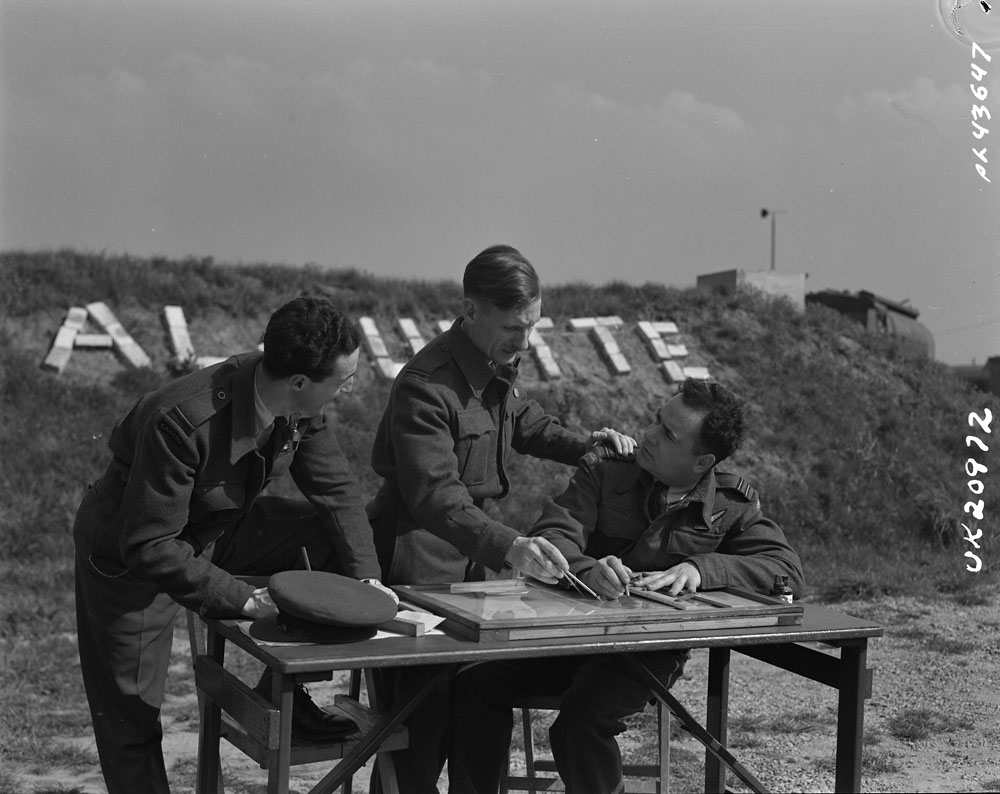
By an English airstrip, three Air Force officers planning while looking over a table with maps.

Pilot Officer J.W.L. Tessier; Pilot Officer J.A. Longmuir, DFC (Distinguished Flying Cross) of the Royal Air Force, attached to the Alouette squadron as Bomber Section Training Officer; and Flight Lieutenant Claude Bourassa, DFC, Commander of the French-Canadian squadron’s bomber section. 425 Squadron. 24 April 1945, PL-43647, e011160173.

For our display, we looked for specific individuals to feature in our display, which can also be done for local service members from your community or school. Choosing an individual is even easier if you are making a display for a family member, since you may already have someone in mind.

Once you’ve chosen an individual, you may look for their military personnel file. This file provides a tremendous amount of information and includes personal details (ever wonder what your great-grandfather’s address was in 1914?). The file can be easily found on the LAC website. However, it should be noted that not all records are open to the public and available online. All personnel files for the First World War are open and have been digitized (First World War Personnel Records), but only “War Dead” files are available online for the Second World War. “War Dead” refers to members that died during the war (Second World War Service Files – War Dead). Other Second World War and post-Second World War service files can still be obtained, but they must be requested through an Access to Information and Privacy request (Records you may request).

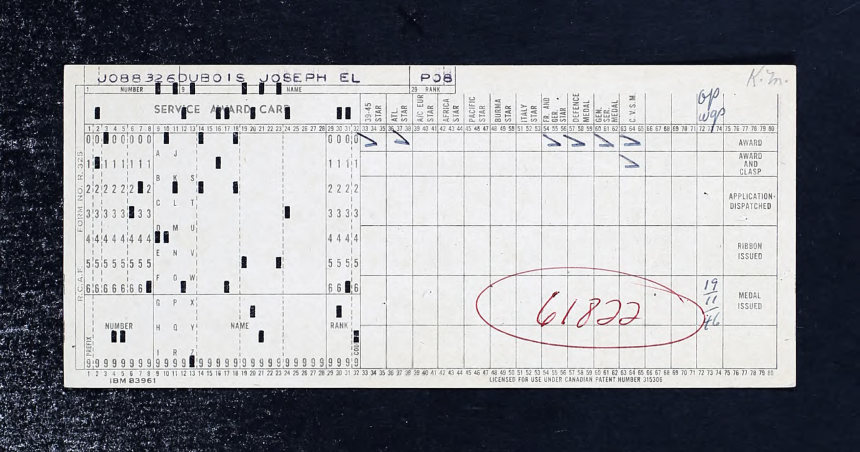
Now that you have the service file, you can decide what you want to display. For our display, we were limited by the size of the display case. If you have more space, you can pick as many documents as you like. You’ll find a variety of documents in the service file. For our airman, Pilot Officer (PO) J. Dubois, we selected a few documents that we found interesting: a letter of recommendation from his employer (T. Eaton & Co), his attestation papers, his medal card, his pay book, official correspondence with his parents in French and the report on his death. You can scroll through and read the digitized service file, then choose what you’d like to feature. Please remember to cite your sources, including reference numbers for archival documents.

As mentioned, interpreting the records you find can help you tell a story rather than just display your research. In the case of PO Dubois, we looked to his squadron records from the day he died, and we were able to better understand the circumstances of his final flight. Each of the three services has an official unit journal of their daily actions. They are called “War Diaries” for the Army, “Ship’s Logs” for the Navy and “Operations Record Books” for the RCAF. The personnel file gives you biographical information, and the unit journal gives you the context. The journal allows you to understand how the individual fits into the unit’s operations. You would interpret the documents by examining them together, giving you a much broader picture. That picture is the story, which you could write up or present orally.

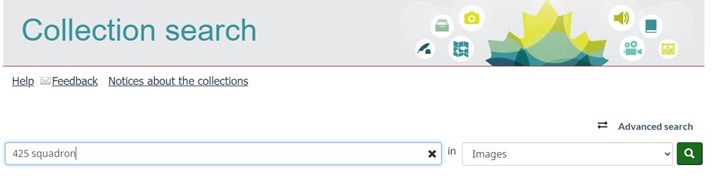
The only thing remaining is to add some photos to make the display more visually compelling. You may find the member’s photo in the service file, but this is not common for files from the World Wars. To find photos, I suggest setting Collection Search to “Images”. Here you can search by the unit designation and choose a few photos that are appropriate to the time frame that you are looking at. For our display, we easily found a few photos of 425 Squadron in England during the 1940s. Like the textual documents, it is important to give accurate photo credits for any photographs used in your display.

A screen capture from the LAC website showing the search bar set to “Images”.

Collection Search, LAC website.

By using the tools and resources from LAC’s online collection, you can make your own custom display for an individual or for a unit. It’s your choice how you’d like to present your display: you can print copies of documents and photos to make a framed display or scrapbook, or you can make a digital presentation. Making a display is an excellent way to connect with ancestors by learning about their lives, and it allows people to explore Canadian military heritage in a personal way. It is also an excellent research exercise and would prove a wonderful Remembrance Day project for young students.


Sacha Mathew is an archivist in the Government Archives Division at Library and Archives Canada.

Potato Biscuits from 1917: How the Housekeeper May Help to Save the Country’s Wheat Supply

Version française

Cooking with Library and Archives Canada bannerBy Ariane Gauthier

Canada joined the First World War on August 4, 1914, alongside Great Britain and the rest of the British Empire. What began as a mobile war quickly turned into a static one, with the entrenchment of the Allied and Entente armies. By 1915, the momentum that had previously animated early fighting had vanished, leading to a grueling war of attrition in the trenches across Europe and the Mediterranean.

The devastation of Europe’s countryside reduced accessible food supplies, a situation that was made worse by the arrival of unprecedented numbers of soldiers mobilized from all corners of the world. Great Britain was quick to marshal the resources of its empire, hoping to fuel its war effort. Canada contributed by supporting troops overseas through its agricultural and industrial output, but it wasn’t enough. Soon, all levels of government had to consider other means of bolstering aid, ultimately settling on rationing key resources.

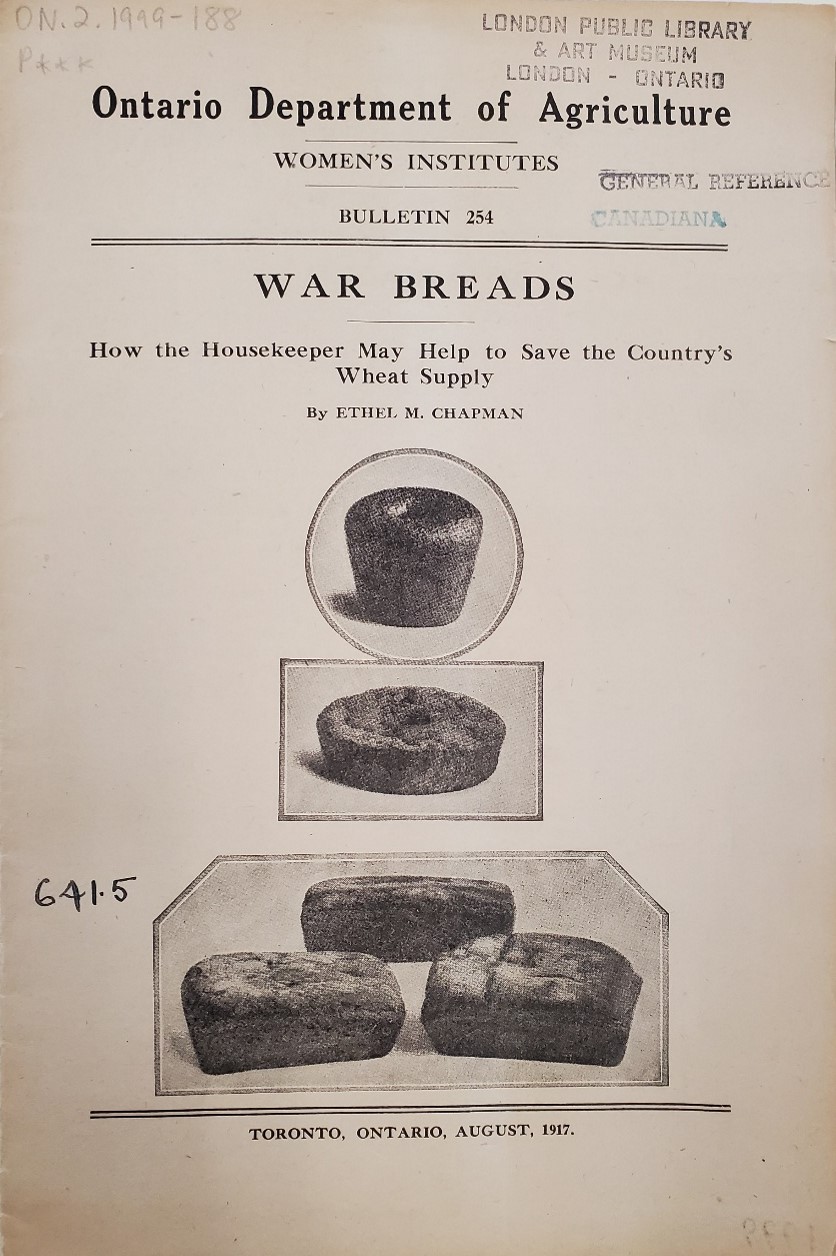
By the third year of the war, wheat was becoming scarce. Anticipating a ration order, the Ontario Department of Agriculture published the pamphlet “War Breads: How the Housekeeper May Help to Save the Country’s Wheat Supply” in August 1917, claiming that “every pound of flour saved means more bread for the army.” However, it admitted that its suggested wheat flour substitutes wouldn’t necessarily yield tasty breads or biscuits: “The constant use of these coarser breads might not agree with some people, but as a rule they will be found more healthful than the finer white bread.”

Cover of a pamphlet with photos of different types of breads.

Cover of the pamphlet “War Breads: How the Housekeeper May Help to Save the Country’s Wheat Supply” (OCLC 1007482104).

Intrigued by this unique pamphlet, I chose a recipe that might give me a taste of a housekeeper’s patriotic efforts: potato biscuits. Having enjoyed potato breads and donuts before, I felt hopeful.

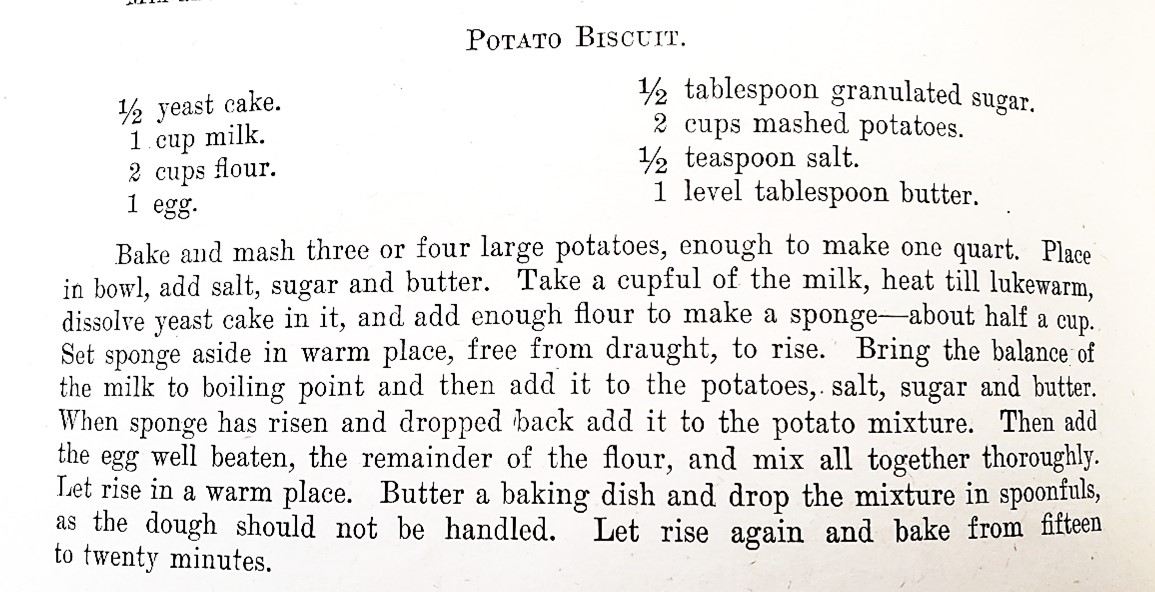
Recipe for potato biscuits including ingredients and instructions.

Recipe for potato biscuits from the pamphlet “War Breads: How the Housekeeper May Help to Save the Country’s Wheat Supply” (OCLC 1007482104).

I only glanced at the recipe’s ingredients initially. They seemed adequate, but as I started assembling the potato biscuits, the meager half tablespoon of granulated sugar and single tablespoon of butter made it clear that these biscuits might end up bland or very yeasty. Given the war-era context, this wasn’t entirely surprising—wheat flour wasn’t the only ingredient being rationed.

Photo of baking ingredients: yeast, three potatoes, butter, one egg, milk, sugar, and flour.

Ingredients for the potato biscuit recipe. Photographer: Ariane Gauthier.

First, I assembled my ingredients. Strangely, the recipe called for baking the potatoes instead of boiling them. Perhaps this was to control the moisture content. I heated the oven to 400°F and baked the potatoes for 45 minutes to an hour until they were fork-tender.

Top photo shows three potatoes in a pan lined with parchment paper in an oven. Bottom photo shows roughly mashed potatoes in a bowl.

Potatoes baked in the oven and then peeled and mashed. Photographer: Ariane Gauthier.

While the potatoes baked, I prepared the yeast mix. Unable to find cake yeast, I used bread yeast instead. I mixed lukewarm milk with the yeast and some flour, setting it aside until it bubbled and rose.

Photo of yeast, flour and milk mixed in a cooking dish.

Yeast, flour and milk mix. Notice the myriad of bubbles produced by the yeast as it froths. Photographer: Ariane Gauthier.

I mashed the potatoes and mixed them with salt, sugar, butter, and boiling milk until smooth. I added the yeast mixture, the egg, and the remaining flour. By this point, the oven had cooled slightly, making it an ideal spot to let the dough rest and rise.

Five photos illustrating various steps of mixing ingredients together to make dough.

Making the potato biscuit dough. I vigorously mixed the ingredients at every step to ensure everything was as uniform as possible. Photographer: Ariane Gauthier.

The dough was gloopy, much to my surprise. With such little liquid compared to the dry ingredients, I hadn’t expected this. Taking the recipe’s warning to heart, I avoided handling the dough and used spoons to scoop it into a buttered muffin tin.

Four photos of various stages of mixing and handling dough, including picking up the raised mix with a spoon and spooning into a muffin pan.

The dough mixture before and after rising for a few hours in a warm place. As the recipe indicated, it was very gloopy and could not be handled by hand. Photographer: Ariane Gauthier.

As seems to be the custom with these old recipes, the recipe didn’t specify the oven temperature for baking, so I settled on 400°F and watched closely as the potato biscuits baked for 15 to 20 minutes until golden.

Photo of a plate with four potato biscuits. One potato biscuit has strawberry jam spread on it, another one is filled with berries, and the other two are plain.

The completed potato biscuits. The one on the left has been garnished with jam. I decided to add berries to another on the right before baking. Photographer: Ariane Gauthier.

And voilà! What do you think?

The strong yeast smell hit me as soon as I pulled the biscuits from the oven. As for the flavour? Shockingly bland. Luckily, I had some traditional strawberry jam on hand, which saved the day (thanks mom and dad!). These potato biscuits were better as a jam vehicle than a standalone treat.

As per my tradition, I took the biscuits to work and offered them to my colleagues. Never have I made such polarizing food! They either loved it or hated it; no one was neutral. So, if you’re feeling adventurous or just want a taste of history, give these potato biscuits a try—and don’t forget the jam!

If you try this recipe, please share pictures of your results with us using the hashtag #CookingWithLAC and tagging our social media: FacebookInstagramX (Twitter)YouTubeFlickr and LinkedIn.

Additional resources:


Ariane Gauthier is a reference archivist with the Access and Services Branch at Library and Archives Canada.

The Final Charge of the Canadian Cavalry

Version française

By Ethan M. Coudenys

Shells were falling, machine guns were firing, and horses were whinnying as the final cavalry charge of the Great War on the Western Front took place at Moreuil Wood. The line had broken, and Field Marshal Douglas Haig called for the Canadian Cavalry Brigade—specifically the Lord Strathcona’s Horse—to charge through the gap in the line to advance further into German-controlled territory. This ill-fated charge would be the last wartime charge for the Canadians in military history.

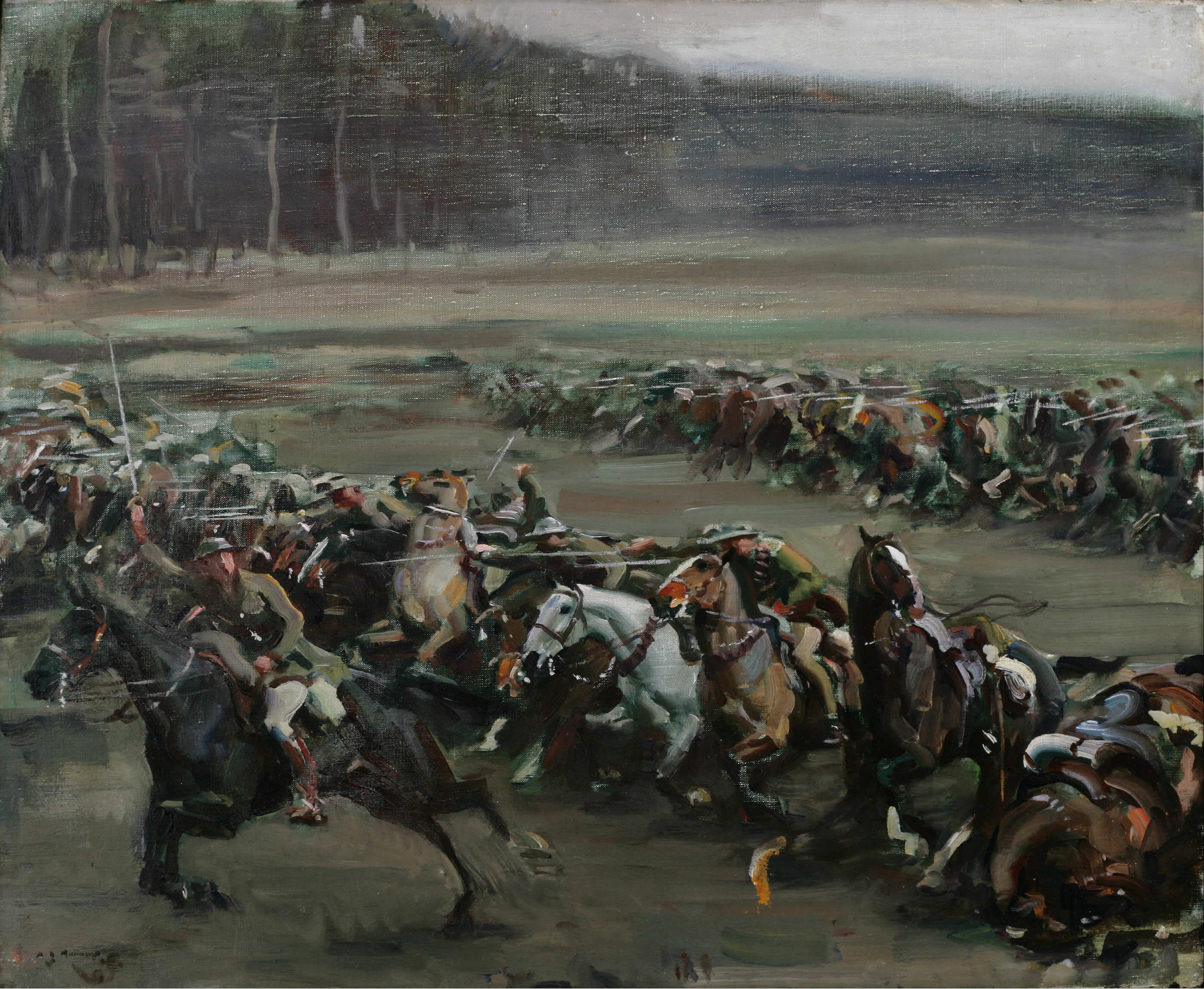
Canadian Cavalry Brigade on horseback charging.

Sir Alfred Munnings
The Charge of Flowerdew’s Squadron
CWM 19710261-0443
Beaverbrook Collection of War Art
Canadian War Museum

March 30, 1918, was the mid-point of the 100 Days Campaign—a campaign which saw incredible advances through German-controlled lines on the Western Front and the beginning of the final phase of the First World War. At Moreuil Wood, the infantry and artillery attacks had, in the opinion of the generals commanding the attack, broken the German defensive line, and for the first time since 1914, the Canadian Cavalry Brigade would remount and attack.

Between January 1915 and early 1918, cavalry soldiers—referred to as “troopers”—took on the role of infantry personnel. They worked in the same trenches as all the other soldiers and were required to defend and attack using the same tactics as the infantry. For all intents and purposes, they were infantry troops, however, they also had to pack their kits according to their actual designation: cavalry troopers. They were therefore always required to carry their tack, feed and water for their mounts, rations and water for themselves, ammunition, etc. Yet, they were not given the same packs as infantry troops. They were able to hold some of these supplies in their saddlebags, but they had to transport heavy equipment without a proper way of storing it.

Group of soldiers on horseback.

Lord Strathcona’s Horse in 1916, moving behind the front line (a000119).

Despite the negligible use of cavalry on the Western Front after the first months of the Great War, the cavalry remained at the forefront of the minds of those planning Allied offensives. In Great Britain, the General Planning Staff was largely composed of cavalry officers, and Douglas Haig was one of them. Cavalry was therefore considered vital to winning the war against the German Empire. Rarely used in battle as actual cavalry troopers, this final charge proved, once and for all, that in modern warfare, the cavalry was of little strategic value.

On that fateful day, Lieutenant Gordon Muriel Flowerdew led the Lord Strathcona’s Horse Company C cavalry group on two charges against a myriad of German defensive positions. Three hundred German infantrymen defended their position. Using the feared MG-08 heavy machine gun and the newly invented light machine gun, they mowed down the advancing cavalry within minutes. Nevertheless, the only surviving trooper remembers Lieutenant Flowerdew shouting “It’s a charge, boys! It’s a charge!” Racing at a full gallop, the squadron met the German Army, but ultimately failed in its attempt to take the position.

This earned Flowerdew the Victoria Cross, the highest award for bravery in the British Commonwealth. However, Flowerdew’s story did not end happily since his squadron lost all but one trooper in the attack.

Today, at Moreuil Wood, a small memorial commemorates the sacrifice made by Company C of the Lord Strathcona’s Horse. The battlefield there is strewn with the remains of the attacking Canadian horses, their men, and the German soldiers who defended their line. This was the last charge of the Canadian Cavalry Brigade. After the Second World War, the Canadian Cavalry Brigade was largely reorganized into armoured, tank and motorized corps. All but a small number of troopers were assigned ceremonial roles in the Royal Canadian Army.

Unfortunately, no wartime photographers were able to capture the final charge of Company C, led by Lieutenant Flowerdew, but the famous British painter, Sir Alfred Munnings, captured the moment and immortalized it in an oil painting completed in the 1920s. The painting is now held at the Canadian War Museum.

Additional resources


Ethan M. Coudenys is a Genealogy Consultant at Library and Archives Canada.

Accessing Personnel Records of the First World War: A new database at Library and Archives Canada

Version française

By Richard Yeomans

On August 4, 1914, Britain formally declared war on Germany, a decision that brought Canada into the theatre of conflict in Europe because of its status as a dominion within the British Empire. Though the Dominion Government could decide the extent of its involvement, Prime Minister Robert Borden declared in a speech to the House of Commons on August 19, 1914, that Canada would “stand shoulder to shoulder with Britain and the other dominions in this quarrel. And that duty we shall not fail to fulfill as the honour of Canada demands it. Not for love of battle, but for the cause of honour.” More than half a million Canadians enlisted in the Canadian Expeditionary Force (CEF) between 1914 and 1918, including volunteers and conscripts, while thousands more found ways to contribute to the war effort on the home front.

There are roughly 622 000 individual First World War service file records held by Library and Archives Canada (LAC), which document enlistment (attestation), movement between units, medical histories, pay and discharge or notification of death. These files are generally between 25 and 75 pages in length and are excellent sources for many different types of historical and genealogical research.

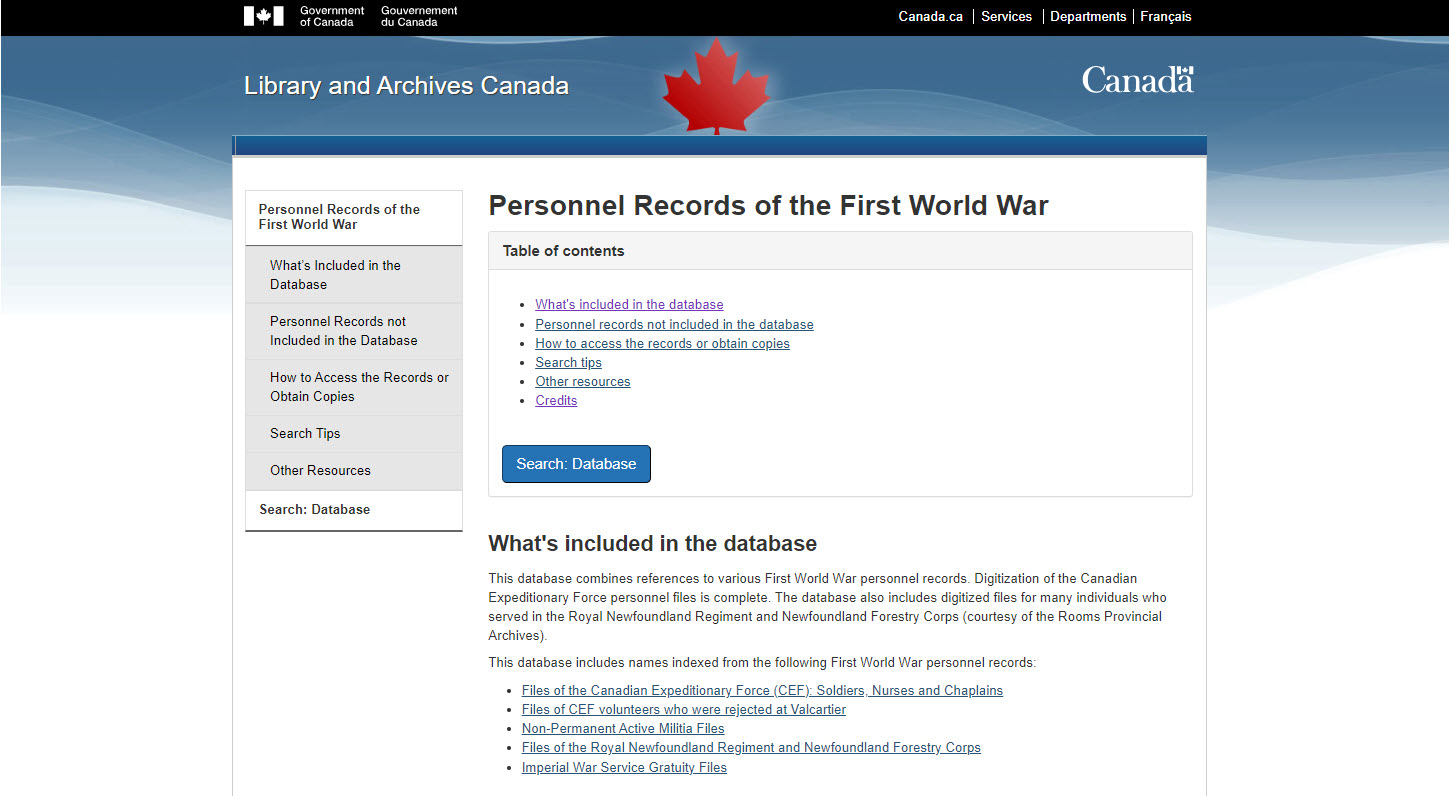
Screenshot of the original Personnel Records of the First World War page on Library and Archives Canada’s website.

Original Personnel Records of the First World War database (Library and Archives Canada).

Access to the Personnel Records of the First World War database at LAC has been available for free online for nearly two decades via a standalone Personnel Records database. This database incorporated CEF files with Imperial Gratuities, Non-Permanent Active Militia, Rejected CEF Volunteers, and Royal Newfoundland Regiment and Forestry Corps records. Researchers familiar with this older database were able to search the archives by first and last names, regimental numbers, city or province of birth and/or enlistment and box number. Results were displayed in alphabetical order but could be reordered by date of birth, rank or regimental number.

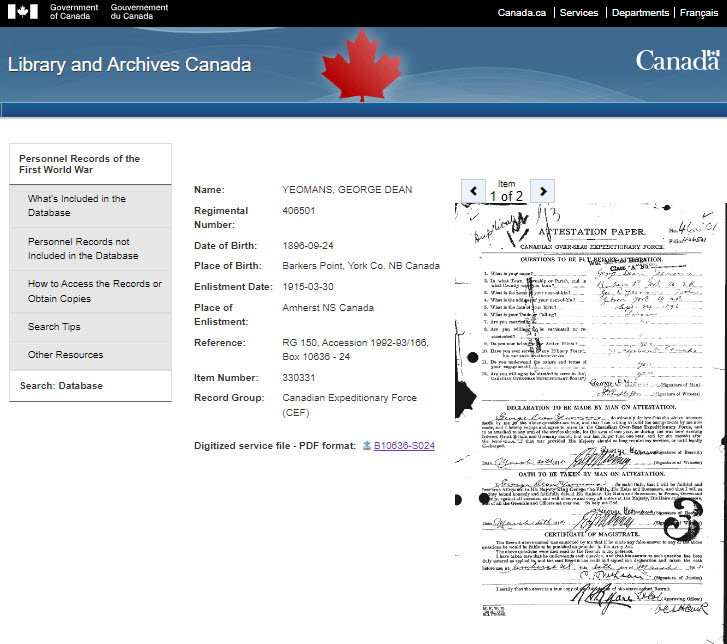
Selecting an individual file from the results list provided a generic description of the record and included a digitized copy of the service file in PDF format that could be either opened and read or downloaded and saved to your computer. Every service file had a unique web URL, which historical researchers and genealogists alike could copy or save to easily access later.

Screenshot of an individual file view in the Personnel Records of the First World War database on Library and Archives Canada’s website.

Individual file view in the original Personnel Records of the First World War database (Library and Archives Canada).

For 10 years, this database provided Canadians at home and across the globe with access to a collection of records that document an important part of their family histories and connections to a shared national history. Library and Archives Canada is committed to maintaining and expanding that level of access as we continue to develop and improve upon our digital archival databases including Collection Search, Census Search and our new First World War Personnel Records database.

Launched in November 2023, this new database was developed as part of ongoing work to bring all of LAC’s standalone databases into one federated search tool, Collection Search. This work is necessary because the older web application that hosts the standalone CEF database is no longer sustainable to maintain. To keep these records accessible for years to come, these files were successfully migrated into Collection Search and a new database tool was created to streamline access to the Personnel Records of the First World War. This database tool offers all the same search features as the original application while also offering new ways to search, filter and extract records and data for research.

Screenshot of the new First World War Personnel Records database on Library and Archives Canada’s website.

New First World War Personnel Records database (Library and Archives Canada).

Researchers may search the new database by using first and last names, regimental number, enlistment city and province, or by using specific terms including unit number and enlistment date.

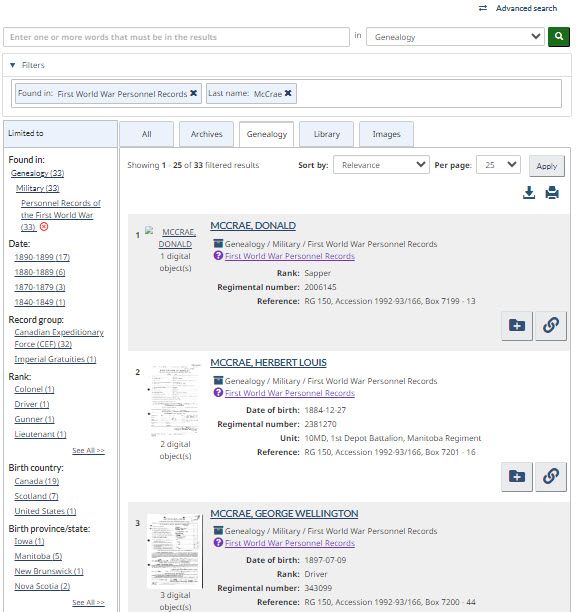
New features include the ability to search by date range, to save records of interest to your My Research using your LAC My Account and to apply filters during your search to help organize and limit the number of record results listed. It is important to note that both databases will provide you with the same number of search results based on similar search criteria. For example, searching the last name McCrae in either database will produce 33 different search results that you may select from. However, in the newer Personnel Records database, you can reduce the number of results using a variety of limiter options located on the search results page. These limiters include information such as military rank, date range for year of birth, birth country or different enlistment geographic options.

Screenshot of the search results for the last name McCrae on Library and Archives Canada’s website.

Search results for last name McCrae (Library and Archives Canada).

Applying these limiters will generate a reduced list of results that is more specific and refined according to the search parameters that you control. Because you control the search criteria, it is possible to perform both extremely specific and very general searches using the new Personnel Records database.

Finding Lieutenant-Colonel John McCrae

Accessing attestation papers and personnel records available online, for free, through LAC remains an important staple within our digitized archival catalogue. For example, researchers can access digitized archival records using the personnel records of Lieutenant-Colonel John McCrae, the Canadian physician and poet best known for authoring the war memorial poem “In Flanders Fields.”

Lieutenant-Colonel McCrae’s records may be found in several different ways, including searching by his first and last name, unit number, city of enlistment, or regimental number. Even just a name is a good starting point. Searching the last name McCrae yields 33 results in both the old and the new database, while searching for John McCrae generates 4 results.

Side by side screenshots of the search results for John McCrae in both databases on Library and Archives Canada’s website.

Search results for John McCrae in either database (Library and Archives Canada).

From the list of results, displayed above in both the old and new CEF databases, researchers can also view a general abstract about the file that includes (if available) regimental numbers, date of birth and archival reference information. In the older CEF database, this information could also be used to reorganize the list view of records. In the new database, it is still possible to reorganize results by date of birth or alphabetically, but unlike in the older database, you can reduce the number of results in the list view using the filters available. In this instance, we know that the John McCrae who penned “In Flanders Fields” was born in Guelph, Ontario, and we can select that option located under “Birth City” on the left-hand side of the results list. Doing so will generate a new list, now filtered to only one result that we can open and view.

Screenshot of the viewing tool showing the personnel record of John McCrae on Library and Archives Canada’s website with arrows pointing to specific parts of the image.

Viewing the personnel record of John McCrae (Library and Archives Canada).

Opening a record in the new CEF database looks different but still retains the functionality of the original database. The first page of the attestation paper will display, by default, on the screen as shown in the image above.

Green Arrow: In the image carousel below the attestation page, you can navigate between the pages of that record. At the end of the image carousel is a PDF icon. Selecting the icon will load a scan of the entire personnel file, which includes a copy of the attestation paper. This file may be downloaded, for free, as it was in the original database.

Black Arrow: If you have a LAC My Account, you can save records of interest to a research list. Clicking the “Add to My Research” button while signed into your LAC My Account will generate a list of your current save folders that you may select and add to, or you may create a new folder and add the record. Previously, researchers had to copy and save internet URLs to quickly access the records they viewed. Using the My Research feature of LAC’s My Account, you may now build entire research lists with records held at LAC, like a bibliography.

Yellow Arrow: To download the file in its entirety, simply click the download button, check that you agree to our copyright terms and conditions and select “Download file.” The record will then be downloaded to your computer or electronic device in PDF format.

Behind the scenes: Digital Access Services

Maintaining consistent and sustainable online access to the records that document the Canadian experience during the First World War presents many challenges. Building a database tool that can serve not only historians and genealogists but also individuals with limited experience using online archives is a balancing act. Creating a tool that can meet the needs of many kinds of researchers begins by asking how researchers experience LAC online and what products we can develop or adjust to improve that overall experience. Improvements to our digital products, such as the new First World War Personnel Records database, are ongoing and responsive to the feedback that we receive from users. If you wish to submit feedback about how we can improve the new First World War Personnel Records database or other digital products currently offered by LAC, please consider emailing your suggestions to the Digital Access Services team or scheduling a feedback session with our UX Designers. LAC’s Digital Access Services team is committed to preserving access to digitized military personnel files and recognizes the significance of these documents to researchers here in Canada and around the world.

The Digital Access Services team is comprised of User Experience Designers, Data Scientists, Web Programmers and Product Managers. The members of our team are also experienced genealogists, historians, historical researchers, archivists, and client-focused public servants who are likewise stakeholders in the preservation and promotion of Canada’s history and heritage. Maintaining free and public access to the roughly 622 000 individual First World War service files in addition to millions of census records, immigration and citizenship records, government publications such as the Canada Gazette, audio files, images, and so much more is a huge job. It is a task that requires time, patience, and more than a little bit of teamwork. Nevertheless, our work continues, and the Digital Access Services team looks forward to bringing new research tools and updates in 2024.

FAQ about Library and Archives Canada’s CEF records and databases

Why is the older First World War Personnel Files Database being decommissioned?

The original database is fast approaching being 10 years old. The platform that hosted the database, Microsoft SharePoint, was first released in 2001 and is becoming more obsolete as time goes on. This means that it will become more difficult for our Web Designers and Programmers to maintain the original database and we risk losing access to the military personnel records altogether. Library and Archives Canada’s Digital Access Services team has been proactive and began migrating records into Collection Search in 2019. This way we can preserve free and public access to these and other records for years to come.

Who oversees the new First World War Personnel Records database?

The Digital Access Services team at LAC is responsible for the maintenance of LAC’s online databases, including Collection and Census Search. Our team does not alter or edit archival documents. Rather, our work focuses on access to the digitized copies of records.

Is the First World War Personnel Records database distinct and separate from Collection Search?

Yes and no – the new database pulls records that have been migrated into Collection Search, which is LAC’s federated archival catalogue search tool. Digital Access Services continues to migrate records from other older standalone databases into Collection Search, while also acknowledging that many users have more specific research needs. Using database filters, or by creating search forms such as the new First World War Personnel Records database, we can streamline access to specific groups of records as if the standalone databases still exist within Collection Search.

Will internet URLs to the older database stop working? 

No – using URL redirects, saved internet links to specific files will redirect users to the location of that specific record within Collection Search. This means that if you have a collection of saved links to the location of specific military service files in the older application, you can still use those links to locate those records in the new application.

Am I still able to save and download service files?

Yes – the option to download PDF formatted copies of attestation and personnel files is available. Users with a LAC My Account may also save records to their My Research and create entire lists of service records that can be retained without the need to saving an internet URL link.


Richard Yeomans is the Quality Assurance Officer on the Digital Access Team – Access and Services Branch at Library and Archives Canada.

“Are You Fit, Soldier?”: Fitness in the CEF during the First World War

Version française

By Dylan Roy

Are you fit, soldier? Do you have what it takes to make it in the Canadian Expeditionary Force (CEF)? War is upon the world since 1914, and we need brave young recruits like yourself to take up the mantle of freedom and fight for the Crown!

However, before you can join the fight, we need to ensure that you are ready for the arduous rigours of battle! I do not say that lightly; it will be a gruelling task. Are you up for it?

To get you in shape, we need you to exercise regularly. However, the Special tables. Physical training note that “Exercises if correctly performed strengthen and stimulate every portion of the body. Some are harmful if correct positions are not assumed.” So remember, not only do you need to exercise, but you need to do it properly for it to be effective.

To get you in gear whilst carrying your gear, we need you to carry out the following exercises.

First, we need to train you how to stand at attention. Although it may seem like a simple thing, you must avoid two main faults: do not slouch back nor lean too far ahead. We need you straight and narrow. If you can first properly stand at attention, you are well on your way to being a disciplined soldier. For visual cues, consult the picture below:

Guide with two figures in incorrect positions of attention and two figures in correct positions of attention.

Guide on how to stand at attention (MIKAN 3831498).

Marching effectively is a fundamental aspect of any soldier worth his salt. However, one cannot simply march around willy-nilly. There needs to be structure and order in the way a soldier marches. The image below shows how to execute both a proper march and jump within the CEF’s principles:

Guide with three figures showing how to slow march, double march and upward jump.

Guide on how to properly march and jump within CEF’s principles (MIKAN 3831498).

Now that we have the fundamentals in order, we need to show you how we are going to make you true soldiers who can overcome the numerous obstacles that await you on the other side of the pond. This requires strength, agility and flexibility, and there are numerous exercises that will test such abilities.

“On-the-hands” exercises will allow you to rise up from a prone position. This is essential in warfare as taking cover and recovering from the prone position is crucial to success during battle. It could also be the determining factor between life and death.

Leg raises will test your core muscles as well as your upper body and legs. All these muscles work in conjunction with one another to facilitate full-body movements. A good soldier needs to be able to contort and control his body in many ways in order to execute both simple and complex actions.

Leg raises are great exercises as they can be performed in a variety of ways. You can do a sideways one-handed leg raise; a two-handed variation with the trunk facing the floor; and, finally, leg raises with your back on the ground. Remember, the core is the connector of both the arms and legs, and it therefore needs to be strong and flexible!

Below you will find examples of on-the-hands movements and leg raises, as well as the trunk backward-bend, which aids in flexibility. All these exercises will help to ensure both your safety and that of your comrades-at-arms while in battle!

Guide with five figures showing exercise positions of on the hands, on the left hand turn with leg raised, on the hands with leg raised, trunk backward-bend and right leg raised from lying on back with arms raised upward.

Guide of leg raise exercises and trunk backward-bend (MIKAN 3831498).

Where would the CEF be without the speed and agility of its soldiers? One way to ensure quick speed is through strong legs. To make a powerful lower body, train it! Exercises like heel raises and knee bends will strengthen the multitude of leg muscles necessary to run, sprint, march, jump, dip, duck, dodge and dive. Fortify them and you in turn fortify yourself! For examples of these two critical movements, see the picture below:

Guide with five figures showing position of closed, open and full open feet, heel raises and knee bends.

Guide on how to build strong legs (MIKAN 3831498).

Where would the legs be without the arms? We need strong soldiers who can lift their share and shoulder the burden that is sure to surface during the war. One of the best types of exercises to improve the strength of the arms is heaving exercises. As the Manual of physical training explains, “Heaving exercises are those in which the body hangs by the hands from some apparatus, either without other support or with the weight partially taken by the feet.” To see examples of heaving exercises, consult the image below:

Guide with eight figures showing the proper positions of pull-ups and one figure showing the incorrect way to do a pull-up.

Guide on how to improve arm strength through heaving exercises (MIKAN 3831502).

To conclude, we need soldiers who can not only face the hardships of war but who can overcome them. To do so requires strict discipline, obedience and regimentation. So what say you, soldier, are you fit enough to join the CEF?


Dylan Roy is a Reference Archivist in the Access and Services Branch at Library and Archives Canada.

Far in distance, but near at heart: the thorny issue of Canadian war graves

By Ariane Gauthier

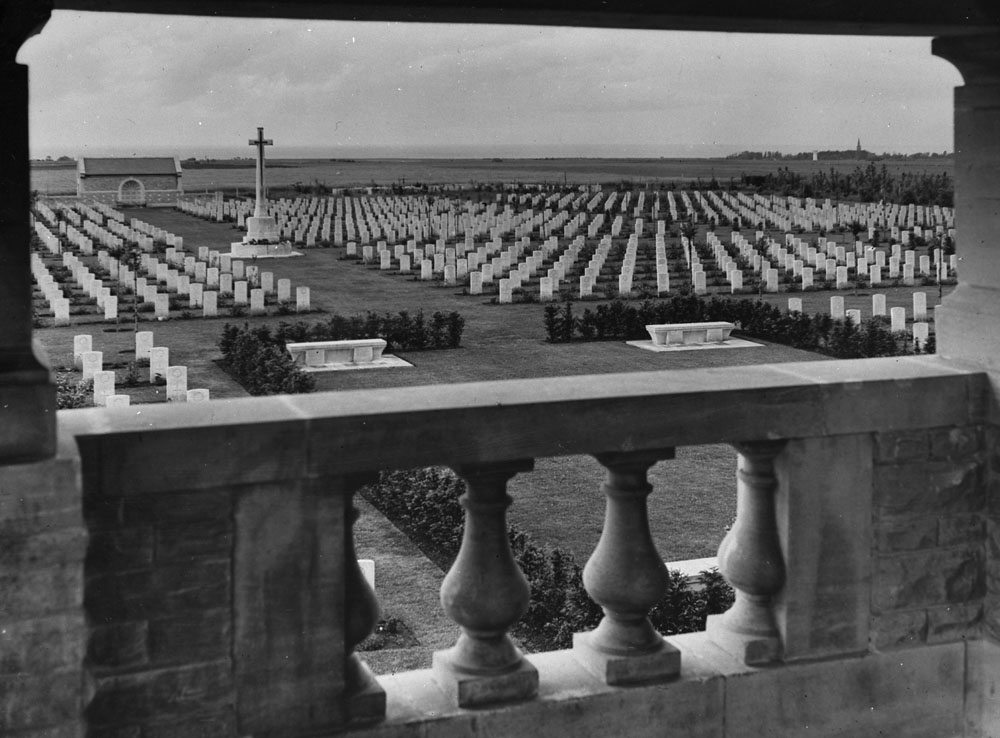
Many Canadian war graves and military cemeteries have been established around the world, as a result of the conflicts in which Canada has been involved since Confederation (1867), from the Boer War (1899–1902) in South Africa to the conflict in Afghanistan (2001–14).

Three graves of Canadian soldiers who died in the Boer War (1899–1902).

The graves of soldiers Elliott, Laming and Devereaux, killed in the South African War (e006610211).

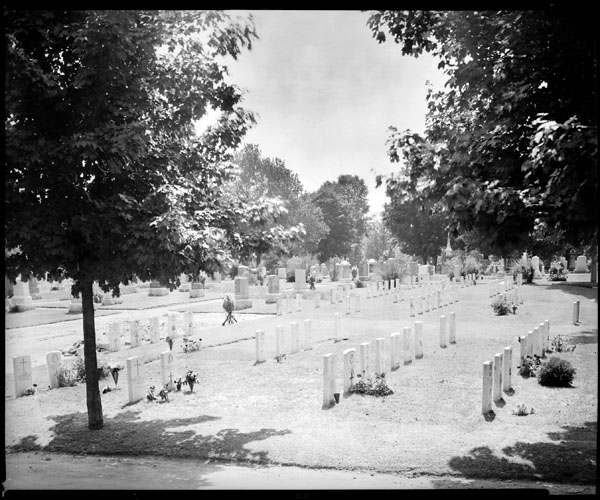
Photo of military cemetery in Ottawa, Ontario, taken by renowned photographer Yousuf Karsh on August 13, 1934.

Colonel H.C. Osborne, war graves (e010679418_s1).

The Canadian cemetery at Bény-sur-Mer in France, where Canadian soldiers who lost their lives during D-Day and the Battle of Normandy in 1944 are buried.

Canadian military cemetery at Bény-sur-Mer, France (e011176110).

The Canadian cemetery in Agira, Italy, where Canadian soldiers who died during the Sicily campaign in 1943 are buried.

Canadian cemetery in Agira, Sicily (e010786150).

War cemetery in Japan, where Canadian soldiers who were killed during the Korean War (1950–53) are buried.

Mrs. Renwick lays a wreath on behalf of Canadian mothers and wives on Remembrance Day in Japan (a133383).

Have you ever wondered why so many Canadian families allowed for the final resting place of their loved ones to be where they fell in combat?

Quite simply, because it was the only option—at least, initially.

To understand, we must delve into the context of the First World War, the first mass industrial war. The technological and military advances of the modern era caused skyrocketing mortality rates. As a result, the British Empire had to manage the rapid recruitment of reinforcements in addition to the thousands of deaths in a war where the repatriation of bodies was practically impossible if not discouraged. It was dangerous to search for remains in active combat zones, and moving so many corpses could easily have led to worldwide epidemics. That said, the door remained open to changing the status quo once hostilities were over. On May 10, 1917, the Imperial War Graves Commission was created by Royal Charter, with a mandate to look into the issues of deceased soldiers and war cemeteries for the entire British Commonwealth.

Text document dated May 10, 1917, written by J.C. Ledlie, from “At the Court at Buckingham Palace, Present, The King’s Most Excellent Majesty in Council.”

War Office (United Kingdom) – Imperial War Graves Commission – Charter (MIKAN 1825922).

There was no consensus among families regarding the question of cemeteries being maintained in perpetuity. Lively debates about the war graves issue took place in many parliamentary institutions. Speakers appealed to the humanity and compassion of politicians, so that the families of fallen soldiers could bring home the bodies of their fathers, brothers, husbands or sons, and in some cases, their sisters and daughters. However, no petition could change the verdict issued by the Imperial War Graves Commission:

Two-page text document explaining that the repatriation of soldiers’ bodies is not permitted.

War Office (United Kingdom) – Imperial War Graves Commission – Refusal to permit removal of bodies from countries in which they are buried (MIKAN 1825922).

“To allow removal [of war dead] by a few individuals (of necessity only those who could afford the cost) would be contrary to the principle of equality of treatment; to empty some 400,000 identified graves would be a colossal work, and would be opposed to the spirit in which the Empire had gratefully accepted the offers made by the Governments of France, Belgium, Italy and Greece to provide land in perpetuity for our cemeteries and to “adopt” our dead. The Commission felt that a higher ideal than that of private burial at home is embodied in these war cemeteries in foreign lands, where those who fought and fell together, officers and men, lie together in their last resting place, facing the line they gave their lives to maintain. They felt sure (and the evidence available to them confirmed the feeling) that the dead themselves, in whom the sense of comradeship was so strong, would have preferred to lie with their comrades. These British cemeteries in foreign lands would be the symbol for future generations of the common purpose, the common devotion, the common sacrifice of all ranks in a united Empire. […]”

This decision ensured that Canadians who had died overseas during the First World War remained on those fields of honour. The cemeteries that were built in their memory can still be visited today; they are maintained by the Imperial War Graves Commission, now the Commonwealth War Graves Commission. On July 15, 1970, Canada’s policy on the repatriation of soldiers who had died overseas changed. Order in Council P.C. 1967-1894 stated that the family of a soldier killed in action on or after that date could request his or her repatriation for a funeral. The loved ones of deceased service members can now have them brought home.

Additional resources


Ariane Gauthier is a reference archivist in the Access and Services Branch at Library and Archives Canada.
Indigenous Peoples in the First World War: researching forgotten veterans

On the left of the graphic, Tatânga Mânî [Chief Walking Buffalo] [George McLean] in traditional regalia on horse. In the middle, Iggi and girl engaging in a “kunik”, a traditional greeting in Inuit culture. On the right, Maxime Marion, a Métis guide stands holding a rifle. In the background, there is a map of Upper and Lower Canada, and text from the Red River Settlement collection.By Ethan M. Coudenys

This article contains historical language and content that some may consider offensive, such as language used to refer to racial, ethnic and cultural groups. Please see our historical language advisory for more information.

Understanding the First World War from the perspective of the Indigenous Peoples of this land has been of paramount importance for many Indigenous researchers, such as myself. Dedicating hours upon hours to research a single Great War veteran is sometimes required just to identify that they were indeed Indigenous. While we have excellent resources about some of the very well-known First Nations, Inuit and Métis Nation service members from that war, there is still much to discover in this realm of historical knowledge.

This post is not meant to convey the story of the Indigenous people who served during the First World War, nor would I attempt to simply generalize the experiences of Indigenous peoples into a single blog post. Instead, I will share the stories of two very different individuals and relate how research techniques can be used to better research an Indigenous person who served in the Great War.

The story of John Shiwak

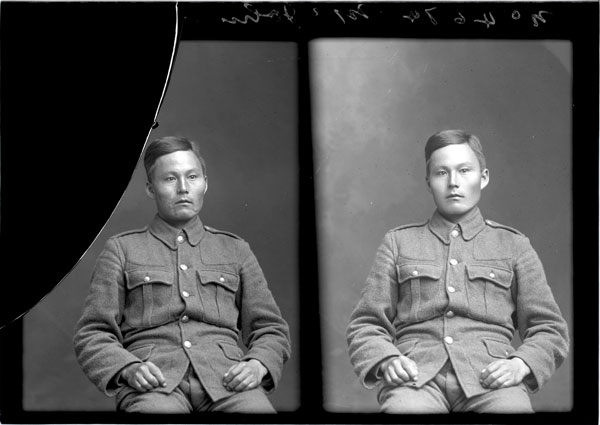
Two side-by-side photos of the same man seated and wearing an army uniform.

John Shiwak, Royal Newfoundland Regiment # 1735. The Rooms, Item E 29-45.

John Shiwak was born in 1889 in Rigolet, Labrador. A member of an Inuit community, he was an experienced hunter and trapper when he enlisted with the First (later “Royal”) Newfoundland Regiment on July 24, 1915. He was still in training when the regiment was sent over the top of the St. John’s Road trench at Beaumont-Hamel on July 1, 1916, the first day of the Battle of the Somme. When Shiwak joined the regiment in France a few weeks later, on July 24, he was one of many who saw the aftermath of the near destruction of the regiment in the 45 minutes that they fought on the Somme battlefield. In April 1917, Shiwak was promoted to lance corporal. Unfortunately, that November, less than a year before the guns fell silent, Lance Corporal John Shiwak met a sad end. In the middle of the battle for Masnières (during the larger First Battle of Cambrai), Shiwak’s unit was struck by a shell, killing him and six others.

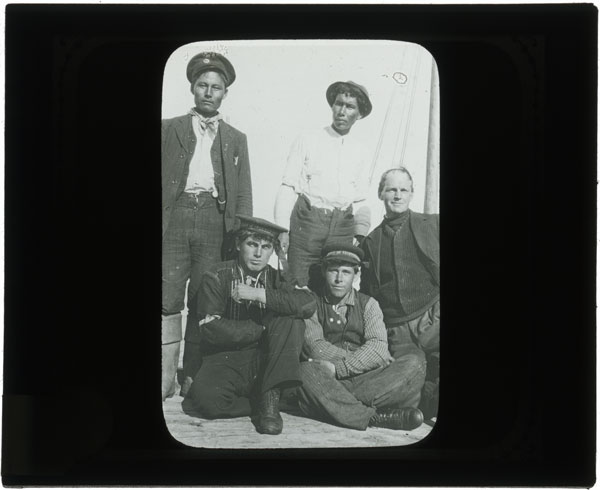
Group of five men standing or sitting.

Members of the Legion of Frontiersmen (before 1915); John Shiwak is standing at the left. The Rooms, Item IGA 10-25.

This story is not uncommon in accounts of the First World War. The Inuk man was killed in the line of duty, in the midst of his brothers in arms. Yet his story is even sadder: until now, the gravesite of Shiwak and those six other brave men were never located. It is theorized that a school was built above the grave, the construction happening without the knowledge that seven soldiers of the Great War were buried there. Nevertheless, as with all casualties without a known resting place, Shiwak is commemorated. His name is forever etched on the bronze plaques at the Beaumont-Hamel Newfoundland Memorial in France, and at a similar memorial in St. John’s, Newfoundland and Labrador.

The story of Angus Edwardson

The story of Private Angus Edwardson is of personal interest to me. He was my great-great-grandfather and fought at Passchendaele. He was born in 1894 in the northern, primarily Algonquin Anishinaabe, community of Lac-Barrière, about 300 kilometres northwest of Ottawa. On his enlistment form, Edwardson stated that he and his family resided in Oskélanéo, Quebec. For a very long time, our family did not know that he was Indigenous, nor did we know about his time in the trenches in any detail.

Luckily, in my line of work, one can discover some very interesting pieces of information. During a search through the 1921 Census, I found information that he was an “ancien soldat” (veteran); I was therefore able to find his attestation papers. While Edwardson’s story is much less noteworthy than that of Shiwak, his story provides an insight into the challenges of researching Indigenous men who fought in the Canadian Expeditionary Force (CEF) and indeed in the British forces as a whole.

Two pages of the attestation papers of Angus Edwardson.

Attestation papers of Angus Edwardson (regimental number 1090307).

In the physical description of Edwardson, the enlistment officer wrote that his complexion was “fair,” his eyes “blue,” and his hair “dark.” This description does not reflect the racial idea of an Indigenous person, nor did the enlistment officer note that Edwardson was First Nations by writing the commonly used term “Indian” under the section of the form entitled “Distinctive marks, and marks indicating congenital peculiarities or previous disease.”

From what we can see in his records, Edwardson was a member of the 253rd (Queens’ University) Highland Battalion, though he served with a number of other battalions and regiments during his time on the front. Notably, while serving with the 213th Battalion on August 28, 1918, he was wounded in the left hand by a bullet.

Challenges facing researchers

As I mentioned, not knowing that a member of the CEF was Indigenous is a major sticking point for researchers. The attestation files may not contain this information at all. In fact, this is very common in the later years of the First World War. Neither of the two men that I have written about have the telltale designation “Indian” on their attestation forms. The only way we can know for certain that these two men were indeed Indigenous is by relying on additional sources.

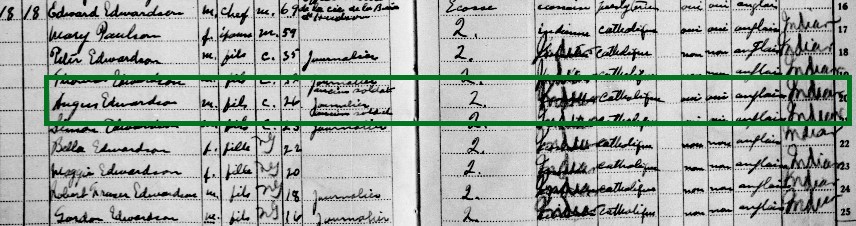
The first of such sources is the often-overlooked census records. The census provides vital information about research subjects, and individual information can greatly increase success in researching Indigenous members of the CEF and the Royal Newfoundland Regiment (RNR). In the case of Edwardson, I discovered that he was in fact Indigenous by looking at his record in the 1921 Census. For Shiwak, there was an entirely different route to finding his identity, which was incredibly difficult. I uncovered information about Shiwak’s ethnic heritage through the memoirs of Sydney Frost, a captain with the RNR, entitled A Blue Puttee at War. This memoir, however, is not the only way to find out that Shiwak was Indigenous.

List of names, ages and genders from the 1921 Census.

Census entry for Angus Edwardson and family, 1921 (e003065155).

Secondary sources about the First World War are numerous. For Shiwak, several appear when simply searching his name, but for other, lesser-known Indigenous members of the CEF, this may be more difficult. The excellent book For King and Kanata: Canadian Indians and the First World War by Timothy Winegard shows how we may be able to improve search techniques for Indigenous individuals and groups that served in the CEF. Though not explicitly, Winegard indicates the role of individual communities and their part in deciding to send men to enlist for the war effort. That said, this effort can be difficult, and it is worth reaching out to local genealogical societies and/or Indigenous communities for help in locating a list of names or simply an idea of how many men served from that community.

The final source of information that is quite useful in these cases is the so-called Indian Registers. These are archival documents with lists of names of members of bands. While the registers are a great resource for those researching members of a specific First Nations band and who are able to visit Library and Archives Canada in Ottawa, there are challenges remaining for those who do not know the band of their research subject or whether their subject died during the war. For individuals researching an Inuk or a member of a Métis Nation community, the challenges deepen, as there is very little primary source material from the period immediately after the Great War. It may be possible to identify Inuit or Métis Nation members of the CEF or RNR through secondary sources, but this can be challenging and take time.

Conclusion

Lance Corporal John Shiwak and Private Angus Edwardson both fought during the First World War. The former was Inuk and the latter was First Nations. The two cases exemplify the many challenges that face researchers when they are looking to find information about members of the CEF or RNR who were Indigenous. These challenges are multi-faceted, and they can pose significant difficulties in research into the stories of Indigenous veterans who fought in the Great War. There are some solutions and resources, including consulting archival records (census records specifically), checking with local Indigenous communities, and accessing some resources specific to Indigenous Peoples at Library and Archives Canada. Nevertheless, these proposed solutions can only go so far in helping researchers find information about Indigenous people who served in the First World War.
Additional resources 


Ethan M. Coudenys is a Genealogy Consultant at Library and Archives Canada. They are proudly of Innu heritage and the descendant of a residential school survivor.