Censored Valentines: When Cupid Met Government Scrutiny

Version française

By Rebecca Murray

A few months ago, I stumbled upon something unexpected while digging through the archival database of the Office of the Chief Press Censor. Established by Order in Council on June 10, 1915, this office had sweeping authority to oversee the censorship of printed materials during wartime. It was authorized by the Secretary of State to “appoint a person to be censor of writings, copy or matter printed or the publications issued at any printing house.” Naturally, I was interested. I began to review the series of documents from 1915 to 1920 found within the Secretary of State fonds (RG6/R174). These records mostly pertain to censorship restrictions during the First World War, covering everything from subversive elements in Canada to war propaganda.

With over 1,500 file-level descriptions, the series details a variety of publications flagged by the Press Censor. Unsurprisingly, most of the materials under scrutiny were related to the war: German-language publications, pro-German writings, and other sensitive information. But a file on Valentine’s Day cards? Maybe they were too racy, I thought to myself.

Curious, I opened the file (available on digitized microfilm at Canadiana by Canadian Research Knowledge Network). The correspondence between the Deputy Postmaster General R.M. Coulter, Chief Press Censor Lt. Col. E.J. Chambers, and the Department of Justice began in mid-January 1916. The offending item in question was a Valentine’s Day card and envelope produced by the Volland Company of Chicago.

Valentine’s Day card depicting a woman wearing a wide-brimmed hat with black type below, partially obscured by the stamped words “CENSORED (ENEMY COUNTRY).”

The Valentine’s day card in question, published with censor markings. Source: RG6 volume 538 file 254, microfilm reel T-76, page 655.

The main issue? Deputy Postmaster General Coulter flagged the card on January 18, 1916, to Chief Press Censor Chambers, complaining that the label on the envelope and the facsimile of a rubber stamp on the card resembled official censorship markings. His concern was that these could “mislead the Officials of the Government.” Unfortunately, the file does not include a copy of the censored envelope.

Chambers responded the very next day, agreeing with Coulter: “I certainly think that it would be a grave mistake to allow these particular envelopes to gain general circulation in Canada, for they would not only attract unnecessary attention to the censorship, but might prove a stumbling block in the event of it being found necessary to apply a general censorship to the mails later.”

The issue continued to escalate with a memorandum sent to the Deputy Minister of Justice on January 20, followed by a letter dated January 21 explaining that “it would be most injudicious at the present time to permit Valentines and envelopes such as those referred to me, to be circulated in Canada.”

The same letter also sheds light on the broader role of the Office of the Chief Press Censor: “I might explain confidentially, that one of the main objects sought to be accomplished by Censorship in Canada at the present time, is to intercept enemy correspondence passing to and from Teuton Agents and sympathisers in Canada and Intelligence Officers of the enemy Governments in either enemy countries or neutral ones. Consequently, it is the established practice of the censorship to endeavor to conduct its operations with as little publicity as possible, it being felt that to advertise the fact that there is an active censorship system in Canada is but to defeat the object explained in the preceeding.”

Although the Valentine’s Day card in question was not labelled as “enemy correspondence,” its use of what appeared to be censor markings drew significant concern from both the Postmaster General and the Chief Press Censor. During a time when censorship was highly active but intentionally discreet, they were particularly wary of anything that might expose or ridicule their work.

Something that struck me in the latter part of the file was a series of notes exchanged between regional censor officials and booksellers, along with other vendors who had ordered or purchased the card. In response to government letters, several vendors replied promptly, assuring they would return the cards to the American publisher. However, it’s unclear how many cards were already in circulation or if any had been sold before the recall.

White page with black type, stamp and handwriting.

Letter to Chief Press Censor Chambers from the Regional Press Censor’s office in Western Canada. Source: RG6 volume 538 file 254, microfilm reel T-76, page 674.

In addition to the intergovernmental correspondence, the Chief Press Censor reached out to the publisher in a letter dated January 25, noting that the Canadian authorities wished to avoid letting the war interfere with trade and relations between Canada and the United States: “The sincere desire of the Canadian Authorities is to prevent as far as possible, the war from interfering with the trade and other relations existing between Canada and our good neighbours to the South.” Despite the firm stance, the Chief Press Censor’s diplomatic tone reflected a desire to manage the situation tactfully.

White page with black type and handwriting.

Letter from P.F. Volland & Co to Chief Press Censor for Canada. Source: RG6 volume 538 file 254, microfilm reel T-76, page 669.

A response letter from the publisher to the Press Censor dated January 24, sheds light on their reaction to the product’s removal from the Canadian market. Regardless of the original intent behind the censor markings, the publisher assured the Chief Press Censor that “it was not our intention to direct attention in any undesirable way to the censorship at present in force in the Dominion.”

The work of the Chief Press Censor during the First World War highlights the government’s influence over the flow of information during the conflict. While this particular case may seem benign—more likely to amuse than alarm us today—it serves as a reminder that censorship, in various forms, remains an ongoing issue. To learn more, explore Library and Archives Canada’s role in Freedom to Read Week, an annual campaign that raises awareness of censorship and book challenges across Canada.


Rebecca Murray is a Literary Programs Advisor in the Outreach and Engagement Branch at Library and Archives Canada.
 

Freedom to Read

By Mary-Francis Turk

At Library and Archives Canada (LAC), we never judge a book by its cover (or its content, for that matter)! We want to make sure that readers and researchers have access to all Canadian publications. LAC’s mandate, as outlined in the Preamble to the Library and Archives of Canada Act, puts emphasis on preserving the documentary heritage of Canada while making it available to the public.

Libraries across Canada have a responsibility to create policies that protect the freedom to read and intellectual freedom. As a national library, LAC has created a permanent collection by acquiring published books, rare and early editions of books and related print material of all kinds.

Through its legal deposit program, LAC acts as a quiet champion against censorship. Every Canadian publication has its place in the national collection. The program has been crucial in aiding LAC’s ongoing efforts to build an inclusive, expansive and accessible national collection.

LAC works closely with publishers to build its collection through the legal deposit program, which is responsible for collecting “materials created in Canada and intended for sale or public distribution.” In doing this, we are able to make material available and preserve it for future generations.

Materials accepted through legal deposit

Canadian publishers and producers submit materials such as

  • Books (monographs)
  • Serials (such as magazines, journals, newsletters)
  • Physical music and video recordings
  • Audiobooks
  • Sheet music
  • Maps
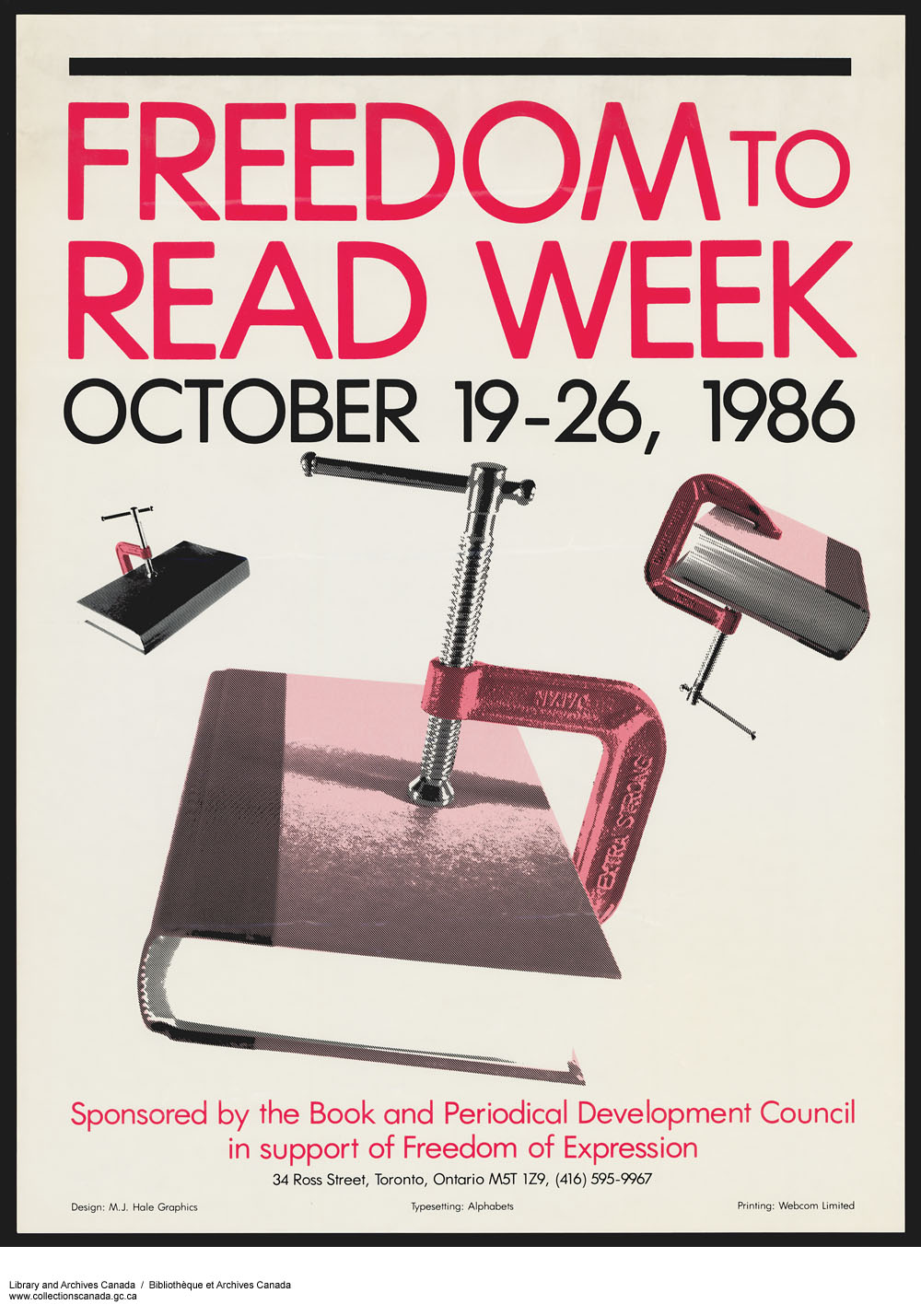
Poster for Freedom to Read Week dated October 19–26, 1986, with three books closed by clamps.

An advertisement promoting reading put out by the Book and Periodical Development Council for Freedom to Read Week in 1986. Library and Archives Canada/Robert Stacey fonds/e010758305. Credit: Michael Hale / Susan Reynolds.

Although it can sometimes feel like censorship is something from the past, there are many examples of more recent instances of challenged publications. This includes several publications that can be found in LAC’s collection:

  • In 2018, David Alexander Robertson’s book Betty: The Helen Betty Osborne Story was “not recommended” for use in Alberta classrooms.
  • In 2016, Robin Stevenson’s book Pride: Celebrating Diversity and Community met resistance during Stevenson’s school visits in British Columbia, Ontario and Quebec.
  • In 2011, Timothy Findley’s book The Wars was used by an Ontario school board in Grade 12 English classes and was subsequently challenged by parents. The school board ultimately decided to keep the book as part of the secondary curriculum.

Canada’s Book and Periodical Council’s Challenged Works List reminds us that publications have historically been and continue to be challenged and censored in Canada. Freedom to Read Week further reminds Canadians that access to publications should not be taken for granted.

Making Canadian publications available to the public and ensuring they are available for future generations is imperative to ongoing intellectual freedom in Canada. This is exactly what we strive to do here in LAC’s legal deposit team.

As we reflect on the freedom to read and the right to intellectual freedom, the task of acquiring and making Canadian publications available to readers across the country seems more important than ever.

Interested in learning more about free expression and censorship in Canada? See a list of the Book and Periodical Council’s English or French works on free expression and censorship in Canada.

Additional resources


Mary-Francis Turk is a Legal Deposit Supervisor in the Private Archives and Published Heritage Branch at Library and Archives Canada.

Diversity and the Freedom to Read: Who’s Missing?

By Liane Belway

Readers and writers across Canada will celebrate Freedom to Read Week this February 18–24. This annual event raises awareness about access to books for all Canadians and about how published material can be challenged, all in support of the fundamental right of Canadians to freedom of expression. One way to gain perspective on the freedom to read is to ask the simple question: who’s missing?

Readers have opportunities to read material that reflects the diversity of Canadian authors, readers and communities, with increased opportunities to discover even more. Now more than ever, we celebrate and support this discovery. For instance, did you know that Canada has our very own Festival of Literary Diversity (FOLD) to celebrate Canadian and international authors? The FOLD even includes a monthly challenge to encourage readers to explore diverse authors and books. Spoiler alert: February’s challenge is to read a book that has been challenged in Canadian schools!

Social media is another great place to find diversity in Canadian books and reading. On some platforms, a quick search with keywords and hashtags devoted to discussing all things bookish will produce a wealth of reading recommendations. Some videos and other content celebrate and critique diverse and exciting books, sometimes bringing them to a mainstream audience that might otherwise have not had the chance to learn about them. Other social media posts include critical and often passionate discussions about why people love, and sometimes don’t love, certain books, all with an eye for the inclusion of ideas and voices and, of course, that encourage people to read! Reading diverse material is one of the best defenses against book challenges, as well as misinformation, misunderstanding, and generally missing out on so many interesting, moving and often award-winning books.

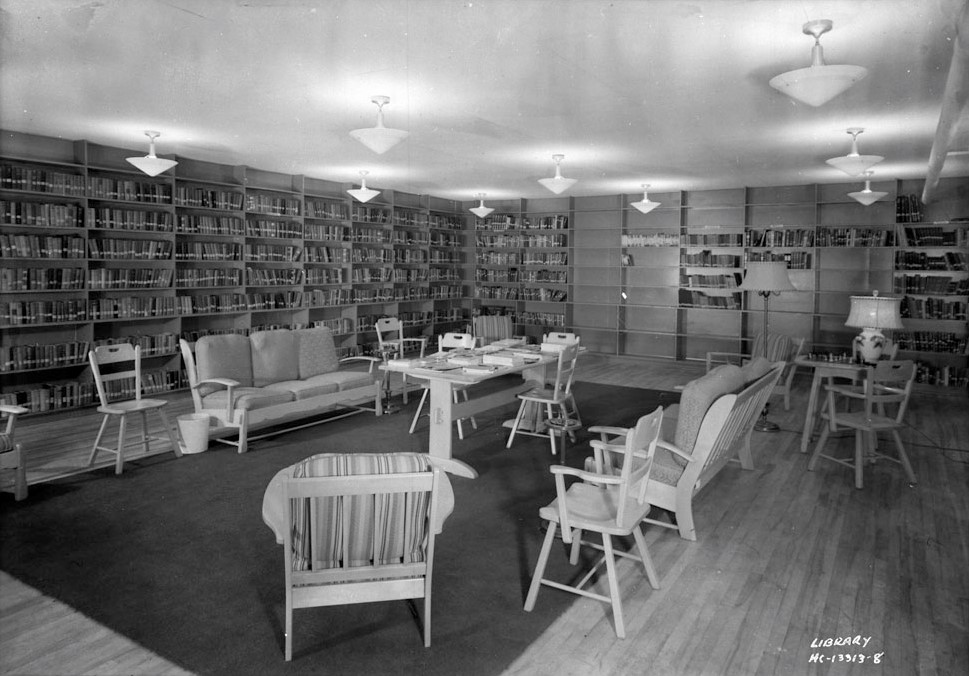
Chairs circling a table in the middle of a room surrounded by shelves with books.

Making sure there are enough seats to discuss diversity in Canadian books (a064449).

Library and Archives Canada (LAC) has always played a unique role in the protection of the freedom to read and in the preservation of Canada’s voices. Diversity takes work, and LAC strives to include and protect all voices, including taking steps to better reflect the realities of the past for the benefit of the present and the future. One example is determining what we might have missed or not fully represented historically, and then working to change that, improving both the collection and the experience of readers and researchers. As Canada’s national library, LAC’s role will also be changing and expanding this year to become a campaign partner for Freedom to Read Week.

For forty years, the Book and Periodical Council (BPC) has been championing Freedom to Read Week. Now LAC, along with the Canadian Urban Library Council and the Ontario Library Association, proudly joins BPC in the important work to support the Canadian freedom to read. In addition, LAC aims to facilitate co-operation among communities involved in the acquisition, preservation and diffusion of knowledge in Canada.

LAC also works tirelessly to preserve the diverse documentary heritage of all Canadians. We collect and make accessible published works that reflect this rich variety and depth. LAC’s mandate includes the monumental task of acquiring copies of Canadian publications. There are a few rules, of course! The Library and Archives of Canada Act requires us to collect works published in Canada: under the Act, a publisher who makes a publication available in Canada must submit copies to LAC in order to make the publication available to the public. This process includes steps like LAC accepting second physical copies, when required, and digital publications in non-proprietary formats to ensure long-term preservation for future generations. LAC also works to collect and preserve publications in formats accessible to all readers.

Did you know that LAC also collects and preserves books that have been challenged in Canada? You can consult the list of Challenged Titles and Authors from our collection to see for yourself. Another spoiler: you might be genuinely surprised by some of the books you find here.

Reading diverse material is more important than ever in a time where challenging publications can interfere with the freedom to read. Canada has a long, if often little-known, history of challenging books and voices. Across Canada, publications can be challenged for different reasons and for various audiences, including school libraries and public libraries with differing mandates and policies. The freedom to read can be notoriously challenging to protect, despite its inclusion in the Charter of Rights and Freedoms. Libraries and readers share the responsibility to protect and support the freedom to read and always work towards a vital goal: when it comes to authors that Canadians read, no one is missing.

Freedom to Read Week will take place from February 18–24, 2024. To learn more about this year’s campaign, check out the Freedom to Read website.


Liane Belway is an Acquisitions Librarian with the Industry Outreach team in the Private Archives and Published Heritage Branch at Library and Archives Canada.