Turning the Page on Censorship: Navigating Freedom to Read in Fourth Wing and Beyond

Version française

By Rebecca Murray

From fantasy to historical fiction, contemporary authors are incorporating the topic of banned and challenged books in their writing. In Rebecca Yarros’s popular Fourth Wing, a would-be archivist is thrust into the perilous world of dragon riders and, along the way (spoiler), uncovers the truth about a “rare” (i.e., banned) book passed down through her family. Meanwhile, Kate Thompson’s The Wartime Book Club follows a courageous librarian in German-occupied Jersey who smuggles books to her neighbours during the Second World War. Through these tales, both authors bring the issue of censorship to the forefront, celebrating heroines who share forbidden stories and defend the right to read.

However, one need not look to fictional realms or even historical accounts to grasp the importance of this issue. Established in 1984, Freedom to Read Week is an annual campaign that sheds light on the covert nature of censorship, raising awareness about the challenges faced by publication and library programs within our very own communities.

Did you know that even seemingly banal works such as The Complete Fairy Tales of the Brothers Grimm and Bambi have been challenged internationally? The history of censorship and challenges to books and other publications is long and varied both here in Canada and abroad. Library and Archives Canada (LAC) plays a unique role amongst Canadian libraries, preserving copies of all books published in Canada—including audio and electronic formats—to ensure these stories remain accessible for future generations.

Read on to learn about key themes in Freedom to Read Week’s history and how they relate to LAC’s mandate and involvement in the campaign.

Photograph of rows of shelves filled with books.

Access copies of books and other publications preserved at Library and Archives Canada. Photograph: Rebecca Murray, Library and Archives Canada.

School libraries

Classrooms and school libraries are often subject to book challenges due to wide-sweeping policies and book-specific complaints. Since the inception of Freedom to Read Week, numerous challenges in school settings have been documented with responses ranging from training teachers on how to address sensitive topics in literature, to stopping the removal of books from libraries to board meetings drawing hundreds of attendees and, in extreme cases, even book burnings.

National library collections, like the one at LAC, differ from public and school libraries in that they are non-circulating (outside of our reading rooms) and not influenced by public demand or policy changes. As a result, the removal of books from other libraries or schools does not affect the holdings at LAC.

Works about censorship

From the earliest days of Freedom to Read Week to now, writers and thinkers have explored the topic of censorship in Canada, examining its impact across literature, libraries, cinema, and beyond. These important works allow us to trace the history of censorship and publication bans in Canada, offering valuable perspectives on how these issues have evolved over time.

Examples in LAC’s published holdings include Dictionnaire de la censure au Québec: Littérature et cinéma (2006), by Pierre Hébert, Kenneth Landry and Yves Lever; Fear of Words: Censorship and the Public Libraries of Canada (1995), by Alvin Schrader; and Women Against Censorship (1985), by Varda Burstyn.

Three books displayed on a tabletop.

Dictionnaire de la censure au Québec: Littérature et cinéma (2006), by Pierre Hébert, Kenneth Landry and Yves Lever; Fear of Words: Censorship and the Public Libraries of Canada (1995), by Alvin Schrader; and Women Against Censorship (1985), by Varda Burstyn.
Photograph: Rebecca Murray, Library and Archives Canada.

Shifting trends

When we think of classic fairy tales and stories like Bambi, it might be hard to imagine how anyone could find fault with them. Yet, as our society evolves, so do our perceptions of what is considered offensive or appropriate. Ideas about acceptable content are always shifting, and this is evident in various policies and debates: from decisions on whether to include graphic novels (often referred to as comic books) in public libraries, to petitions seeking to revoke awards from past literary winners, to the regulations on importing and selling certain publications in Canada. These changes are part of a broader historical trend that will undoubtedly continue. By examining data on content challenges reported by librarians on the front lines, we can observe how these societal attitudes evolve over time.

You can read all about Freedom to Read Week’s history in Canada and find out about other challenged titles on the campaign’s website.

The 41st edition of Freedom to Read Week will take place from February 23rd to March 1st, 2025. Stay up to date on the campaign and related events.


Rebecca Murray is a Literary Programs Advisor in the Outreach and Engagement Branch at Library and Archives Canada.

Censored Valentines: When Cupid Met Government Scrutiny

Version française

By Rebecca Murray

A few months ago, I stumbled upon something unexpected while digging through the archival database of the Office of the Chief Press Censor. Established by Order in Council on June 10, 1915, this office had sweeping authority to oversee the censorship of printed materials during wartime. It was authorized by the Secretary of State to “appoint a person to be censor of writings, copy or matter printed or the publications issued at any printing house.” Naturally, I was interested. I began to review the series of documents from 1915 to 1920 found within the Secretary of State fonds (RG6/R174). These records mostly pertain to censorship restrictions during the First World War, covering everything from subversive elements in Canada to war propaganda.

With over 1,500 file-level descriptions, the series details a variety of publications flagged by the Press Censor. Unsurprisingly, most of the materials under scrutiny were related to the war: German-language publications, pro-German writings, and other sensitive information. But a file on Valentine’s Day cards? Maybe they were too racy, I thought to myself.

Curious, I opened the file (available on digitized microfilm at Canadiana by Canadian Research Knowledge Network). The correspondence between the Deputy Postmaster General R.M. Coulter, Chief Press Censor Lt. Col. E.J. Chambers, and the Department of Justice began in mid-January 1916. The offending item in question was a Valentine’s Day card and envelope produced by the Volland Company of Chicago.

Valentine’s Day card depicting a woman wearing a wide-brimmed hat with black type below, partially obscured by the stamped words “CENSORED (ENEMY COUNTRY).”

The Valentine’s day card in question, published with censor markings. Source: RG6 volume 538 file 254, microfilm reel T-76, page 655.

The main issue? Deputy Postmaster General Coulter flagged the card on January 18, 1916, to Chief Press Censor Chambers, complaining that the label on the envelope and the facsimile of a rubber stamp on the card resembled official censorship markings. His concern was that these could “mislead the Officials of the Government.” Unfortunately, the file does not include a copy of the censored envelope.

Chambers responded the very next day, agreeing with Coulter: “I certainly think that it would be a grave mistake to allow these particular envelopes to gain general circulation in Canada, for they would not only attract unnecessary attention to the censorship, but might prove a stumbling block in the event of it being found necessary to apply a general censorship to the mails later.”

The issue continued to escalate with a memorandum sent to the Deputy Minister of Justice on January 20, followed by a letter dated January 21 explaining that “it would be most injudicious at the present time to permit Valentines and envelopes such as those referred to me, to be circulated in Canada.”

The same letter also sheds light on the broader role of the Office of the Chief Press Censor: “I might explain confidentially, that one of the main objects sought to be accomplished by Censorship in Canada at the present time, is to intercept enemy correspondence passing to and from Teuton Agents and sympathisers in Canada and Intelligence Officers of the enemy Governments in either enemy countries or neutral ones. Consequently, it is the established practice of the censorship to endeavor to conduct its operations with as little publicity as possible, it being felt that to advertise the fact that there is an active censorship system in Canada is but to defeat the object explained in the preceeding.”

Although the Valentine’s Day card in question was not labelled as “enemy correspondence,” its use of what appeared to be censor markings drew significant concern from both the Postmaster General and the Chief Press Censor. During a time when censorship was highly active but intentionally discreet, they were particularly wary of anything that might expose or ridicule their work.

Something that struck me in the latter part of the file was a series of notes exchanged between regional censor officials and booksellers, along with other vendors who had ordered or purchased the card. In response to government letters, several vendors replied promptly, assuring they would return the cards to the American publisher. However, it’s unclear how many cards were already in circulation or if any had been sold before the recall.

White page with black type, stamp and handwriting.

Letter to Chief Press Censor Chambers from the Regional Press Censor’s office in Western Canada. Source: RG6 volume 538 file 254, microfilm reel T-76, page 674.

In addition to the intergovernmental correspondence, the Chief Press Censor reached out to the publisher in a letter dated January 25, noting that the Canadian authorities wished to avoid letting the war interfere with trade and relations between Canada and the United States: “The sincere desire of the Canadian Authorities is to prevent as far as possible, the war from interfering with the trade and other relations existing between Canada and our good neighbours to the South.” Despite the firm stance, the Chief Press Censor’s diplomatic tone reflected a desire to manage the situation tactfully.

White page with black type and handwriting.

Letter from P.F. Volland & Co to Chief Press Censor for Canada. Source: RG6 volume 538 file 254, microfilm reel T-76, page 669.

A response letter from the publisher to the Press Censor dated January 24, sheds light on their reaction to the product’s removal from the Canadian market. Regardless of the original intent behind the censor markings, the publisher assured the Chief Press Censor that “it was not our intention to direct attention in any undesirable way to the censorship at present in force in the Dominion.”

The work of the Chief Press Censor during the First World War highlights the government’s influence over the flow of information during the conflict. While this particular case may seem benign—more likely to amuse than alarm us today—it serves as a reminder that censorship, in various forms, remains an ongoing issue. To learn more, explore Library and Archives Canada’s role in Freedom to Read Week, an annual campaign that raises awareness of censorship and book challenges across Canada.


Rebecca Murray is a Literary Programs Advisor in the Outreach and Engagement Branch at Library and Archives Canada.


Freedom to Read

By Mary-Francis Turk

At Library and Archives Canada (LAC), we never judge a book by its cover (or its content, for that matter)! We want to make sure that readers and researchers have access to all Canadian publications. LAC’s mandate, as outlined in the Preamble to the Library and Archives of Canada Act, puts emphasis on preserving the documentary heritage of Canada while making it available to the public.

Libraries across Canada have a responsibility to create policies that protect the freedom to read and intellectual freedom. As a national library, LAC has created a permanent collection by acquiring published books, rare and early editions of books and related print material of all kinds.

Through its legal deposit program, LAC acts as a quiet champion against censorship. Every Canadian publication has its place in the national collection. The program has been crucial in aiding LAC’s ongoing efforts to build an inclusive, expansive and accessible national collection.

LAC works closely with publishers to build its collection through the legal deposit program, which is responsible for collecting “materials created in Canada and intended for sale or public distribution.” In doing this, we are able to make material available and preserve it for future generations.

Materials accepted through legal deposit

Canadian publishers and producers submit materials such as

  • Books (monographs)
  • Serials (such as magazines, journals, newsletters)
  • Physical music and video recordings
  • Audiobooks
  • Sheet music
  • Maps
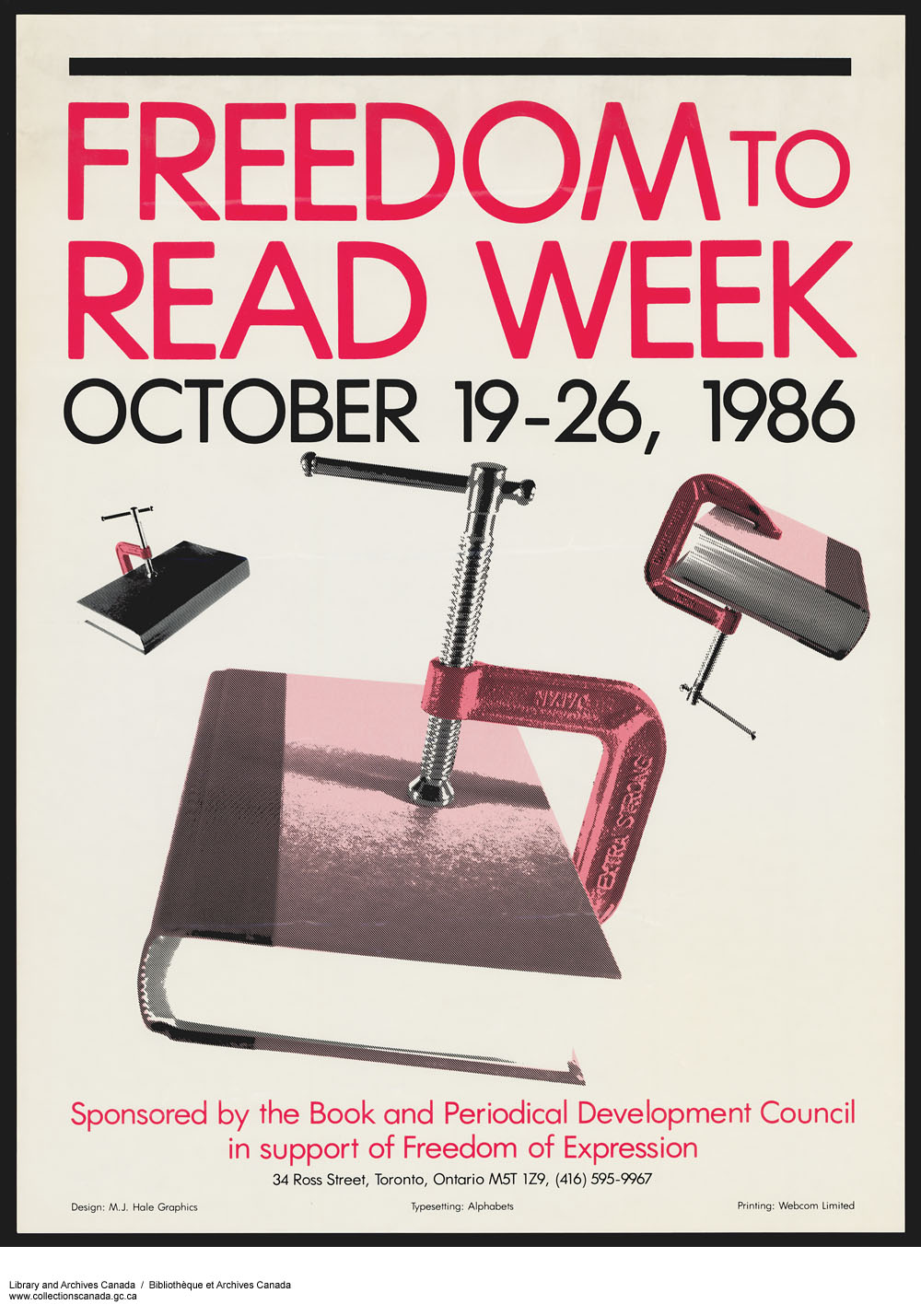
Poster for Freedom to Read Week dated October 19–26, 1986, with three books closed by clamps.

An advertisement promoting reading put out by the Book and Periodical Development Council for Freedom to Read Week in 1986. Library and Archives Canada/Robert Stacey fonds/e010758305. Credit: Michael Hale / Susan Reynolds.

Although it can sometimes feel like censorship is something from the past, there are many examples of more recent instances of challenged publications. This includes several publications that can be found in LAC’s collection:

  • In 2018, David Alexander Robertson’s book Betty: The Helen Betty Osborne Story was “not recommended” for use in Alberta classrooms.
  • In 2016, Robin Stevenson’s book Pride: Celebrating Diversity and Community met resistance during Stevenson’s school visits in British Columbia, Ontario and Quebec.
  • In 2011, Timothy Findley’s book The Wars was used by an Ontario school board in Grade 12 English classes and was subsequently challenged by parents. The school board ultimately decided to keep the book as part of the secondary curriculum.

Canada’s Book and Periodical Council’s Challenged Works List reminds us that publications have historically been and continue to be challenged and censored in Canada. Freedom to Read Week further reminds Canadians that access to publications should not be taken for granted.

Making Canadian publications available to the public and ensuring they are available for future generations is imperative to ongoing intellectual freedom in Canada. This is exactly what we strive to do here in LAC’s legal deposit team.

As we reflect on the freedom to read and the right to intellectual freedom, the task of acquiring and making Canadian publications available to readers across the country seems more important than ever.

Interested in learning more about free expression and censorship in Canada? See a list of the Book and Periodical Council’s English or French works on free expression and censorship in Canada.

Additional resources


Mary-Francis Turk is a Legal Deposit Supervisor in the Private Archives and Published Heritage Branch at Library and Archives Canada.
Diversity and the Freedom to Read: Who’s Missing?

By Liane Belway

Readers and writers across Canada will celebrate Freedom to Read Week this February 18–24. This annual event raises awareness about access to books for all Canadians and about how published material can be challenged, all in support of the fundamental right of Canadians to freedom of expression. One way to gain perspective on the freedom to read is to ask the simple question: who’s missing?

Readers have opportunities to read material that reflects the diversity of Canadian authors, readers and communities, with increased opportunities to discover even more. Now more than ever, we celebrate and support this discovery. For instance, did you know that Canada has our very own Festival of Literary Diversity (FOLD) to celebrate Canadian and international authors? The FOLD even includes a monthly challenge to encourage readers to explore diverse authors and books. Spoiler alert: February’s challenge is to read a book that has been challenged in Canadian schools!

Social media is another great place to find diversity in Canadian books and reading. On some platforms, a quick search with keywords and hashtags devoted to discussing all things bookish will produce a wealth of reading recommendations. Some videos and other content celebrate and critique diverse and exciting books, sometimes bringing them to a mainstream audience that might otherwise have not had the chance to learn about them. Other social media posts include critical and often passionate discussions about why people love, and sometimes don’t love, certain books, all with an eye for the inclusion of ideas and voices and, of course, that encourage people to read! Reading diverse material is one of the best defenses against book challenges, as well as misinformation, misunderstanding, and generally missing out on so many interesting, moving and often award-winning books.

Chairs circling a table in the middle of a room surrounded by shelves with books.

Making sure there are enough seats to discuss diversity in Canadian books (a064449).

Library and Archives Canada (LAC) has always played a unique role in the protection of the freedom to read and in the preservation of Canada’s voices. Diversity takes work, and LAC strives to include and protect all voices, including taking steps to better reflect the realities of the past for the benefit of the present and the future. One example is determining what we might have missed or not fully represented historically, and then working to change that, improving both the collection and the experience of readers and researchers. As Canada’s national library, LAC’s role will also be changing and expanding this year to become a campaign partner for Freedom to Read Week.

For forty years, the Book and Periodical Council (BPC) has been championing Freedom to Read Week. Now LAC, along with the Canadian Urban Library Council and the Ontario Library Association, proudly joins BPC in the important work to support the Canadian freedom to read. In addition, LAC aims to facilitate co-operation among communities involved in the acquisition, preservation and diffusion of knowledge in Canada.

LAC also works tirelessly to preserve the diverse documentary heritage of all Canadians. We collect and make accessible published works that reflect this rich variety and depth. LAC’s mandate includes the monumental task of acquiring copies of Canadian publications. There are a few rules, of course! The Library and Archives of Canada Act requires us to collect works published in Canada: under the Act, a publisher who makes a publication available in Canada must submit copies to LAC in order to make the publication available to the public. This process includes steps like LAC accepting second physical copies, when required, and digital publications in non-proprietary formats to ensure long-term preservation for future generations. LAC also works to collect and preserve publications in formats accessible to all readers.

Did you know that LAC also collects and preserves books that have been challenged in Canada? You can consult the list of Challenged Titles and Authors from our collection to see for yourself. Another spoiler: you might be genuinely surprised by some of the books you find here.

Reading diverse material is more important than ever in a time where challenging publications can interfere with the freedom to read. Canada has a long, if often little-known, history of challenging books and voices. Across Canada, publications can be challenged for different reasons and for various audiences, including school libraries and public libraries with differing mandates and policies. The freedom to read can be notoriously challenging to protect, despite its inclusion in the Charter of Rights and Freedoms. Libraries and readers share the responsibility to protect and support the freedom to read and always work towards a vital goal: when it comes to authors that Canadians read, no one is missing.

Freedom to Read Week will take place from February 18–24, 2024. To learn more about this year’s campaign, check out the Freedom to Read website.


Liane Belway is an Acquisitions Librarian with the Industry Outreach team in the Private Archives and Published Heritage Branch at Library and Archives Canada.
Denied Entry

By Forrest Pass

Canadians have a reputation for being quiet and unassuming. As we mark Freedom to Read Week, it is worth noting that even censors have demonstrated these national traits, working quietly in the shadows to determine what Canadians can and cannot read.

Consider how different countries censored D.H. Lawrence’s erotic classic, Lady Chatterley’s Lover. In the United States, the question of banning this work warranted a congressional debate. In the United Kingdom, the release of an unexpurgated edition provoked a well-publicized obscenity trial.

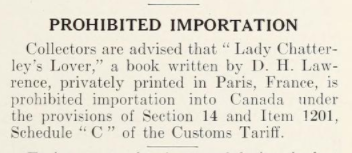
In Canada, by contrast, the decision to ban Lady Chatterley’s Lover was announced in the back pages of the National Revenue Review, an internal magazine for customs officers:

A newspaper article with the words Prohibition importation in bold

Announcement of the ban on the importation of Lady Chatterley’s Lover by D.H. Lawrence, National Revenue Review, 3, no. 5 (February 1930), p. 13. (OCLC 42299612)

From Confederation onward, the Minister of National Revenue, who was responsible for customs enforcement, and his staff had virtually absolute power to prohibit the importation of publications that they deemed obscene or seditious. By the 1950s, customs censors had banned well over a thousand titles.

Although authors and publishers sometimes protested, they could not appeal these decisions until 1958. Even then, the importer had to prove that a challenged publication was not obscene or seditious. Only in 2000 did the Supreme Court of Canada rule that it was unconstitutional to consider questionable books and magazines guilty until proven innocent.

Customs censors worked discreetly. For decades, the Department of National Revenue refused to publish a cumulative list of banned publications. However, Library and Archives Canada’s collections preserve evidence of the books and magazines that the department’s censors targeted.

When the minister decided that a publication was obscene or seditious, he issued a brief memorandum instructing customs officers to intercept the book or magazine at ports of entry. Copies of these memoranda survive, pasted into a series of scrapbooks alongside notices of duty exemptions and procedures for staff holidays. Beginning in the 1920s, notices also appeared in the National Revenue Review; the magazine was publicly available, and newspaper editors regularly reprinted these announcements.  

The customs censors’ earliest targets, before the First World War, were mostly American newspapers and magazines. With titles like Chicago Despatch and American House and Home, these publications seemed innocent enough, but one memorandum warned that they might contain advertisements unfit for Canadian eyes.

In the twentieth century, a wide range of books and magazines attracted the customs censors’ attention. Unsurprisingly, sexually suggestive content—mild by today’s standards—was a persistent concern, as were some “true crime” stories, which allegedly glorified gangsterism. The customs censors also banned extreme anti-Catholic propaganda, some of which might qualify as hate literature today. During the 1920s and 1930s, communist and socialist newspapers in foreign languages also appeared regularly in announcements of prohibited publications. 

More surprising is the department’s effort to keep out publications promoting atheism. In 1931, the Toronto Globe praised the exclusion of works by the American freethinker Emanuel Haldeman-Julius. “To let this sort of literature into the country would be to welcome ridicule on religion,” warned the Globe. “If the Department errs, it is in not going far enough with its ban on subversive reading matter.”

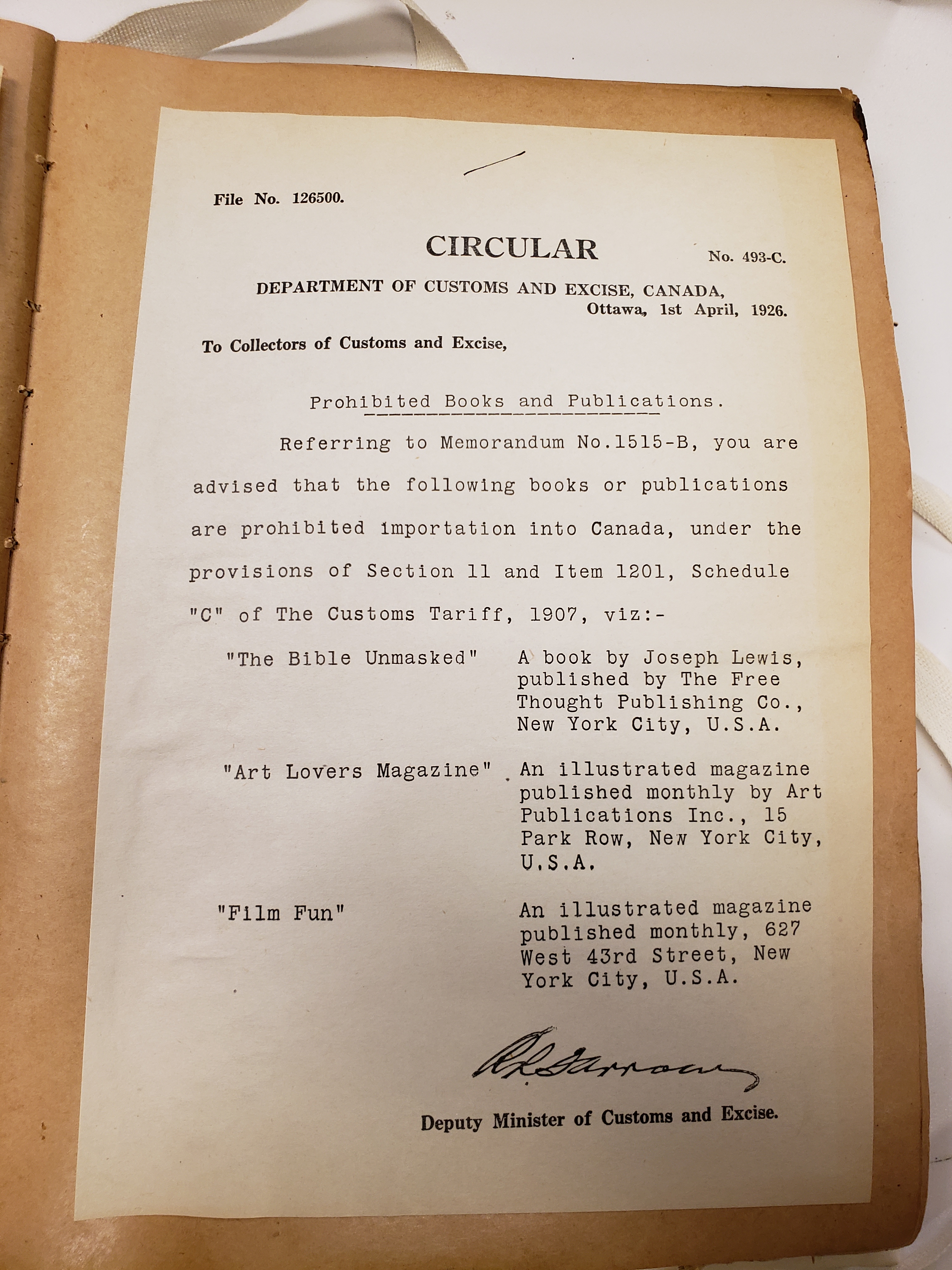
A photograph of a typed document with a signature on the bottom right hand corner

A typical memorandum announcing a ban on the importation of certain publications. The Bible Unmasked was an atheist tract. Art Lovers Magazine published suggestive photographs alongside commentary on artistic and cultural subjects. Film Fun featured “pin-up” illustrations. (RG16-A-3, Volume number: 888)

Canadian customs censors seldom targeted well-known literary works. Lady Chatterley’s Lover was a rare exception; so was James Joyce’s Ulysses, banned in 1923. Such decisions were the most likely to provoke criticism. Some magazines and newspapers, including Maclean’s and the Ottawa Citizen, occasionally criticized the customs censors. So, too, did Quill & Quire, the magazine of the Canadian publishing trade.

A typed document with the a signature at the bottom

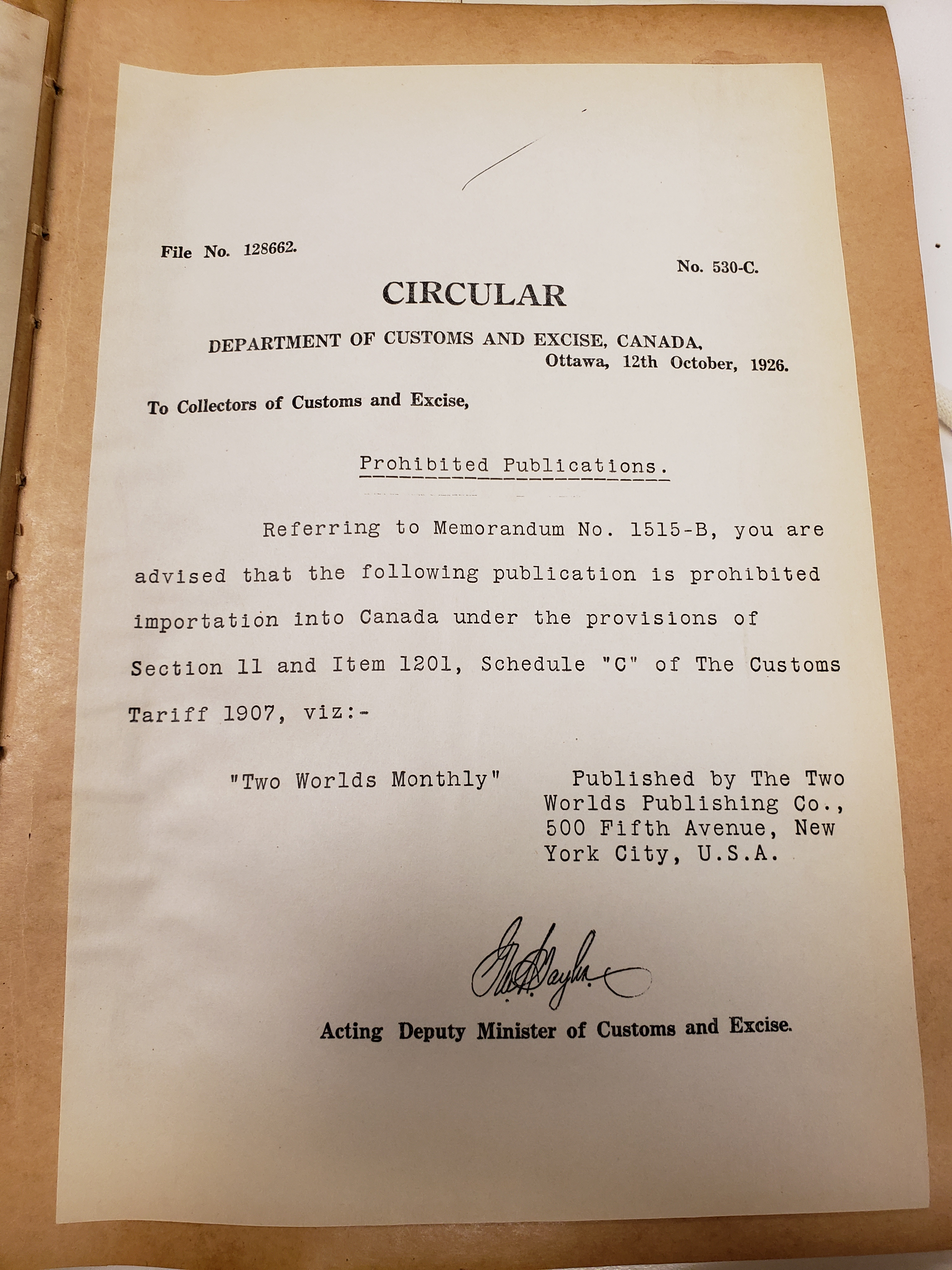
Memorandum announcing the banning of Two Worlds Monthly in 1926. The New York City literary magazine serialized Ulysses by James Joyce, which Canada’s customs censors had already banned. (RG16-A-3, Volume number: 888)

Canadian publishers knew, however, that there were ways to evade censorship. Customs censors could prohibit only the importation of publications, not the production and distribution of those publications in Canada. Seizure records hint at publishers’ efforts to use this loophole. In 1932, customs officers seized two copies of A Jew in Love, a racy novel by Hollywood screenwriter Ben Hecht that the department had banned some months earlier. The importer, Toronto publishers G.J. Macleod and Company, specialized in reprinting foreign titles and may have planned a legal Canadian edition of Hecht’s novel. To ban a book produced in Canada, the aspiring censor had to convince a judge that the work was criminally obscene or seditious—a high standard that only the most offensive publications met.

A ledger with columns and blue ink writing.

Record of the seizure of “2 books, – ‘A Jew in Love,’ – prohibited importation” imported by G.J. McLeod and Company, and of the Department of National Revenue’s decision concerning them: “That the books be and remain forfeited and be destroyed.” (RG16-A-3, Volume number: 864)

The standard for banning imported publications was much lower, and customs censors almost never gave justifications for their decisions. Canadian censors’ objections to Lady Chatterley’s Lover probably echoed those of their British and American counterparts. The title of Frederic Arnold Kummer’s Gentlemen in Hades: The Story of a Damned Debutante hints at grounds for its 1932 exclusion from Canada; libraries in Canada and elsewhere preserve several copies of this all-but-forgotten flapper fantasy. But no library in the world holds Krums of Komford (banned in 1895) or American Beauties magazine (banned in 1926).

We can only guess at the reasons for banning these lost works because the customs censors did not keep their reading copies. In 1938, the department’s chief censor, J. Sydney Roe, revealed to the Ottawa Citizen that, twice a year, he and a departmental messenger took a wheelbarrow-load of illicit publications to the basement of his office building and threw them in the coal furnace.

Private and without ceremony, these were very Canadian book burnings.

Forrest Pass is a curator with the Exhibitions team at Library and Archives Canada.
The Freedom to Read

By Liane Belway

[January 2024] This blog post has been updated to reflect changes to the Freedom to Read Week campaign.

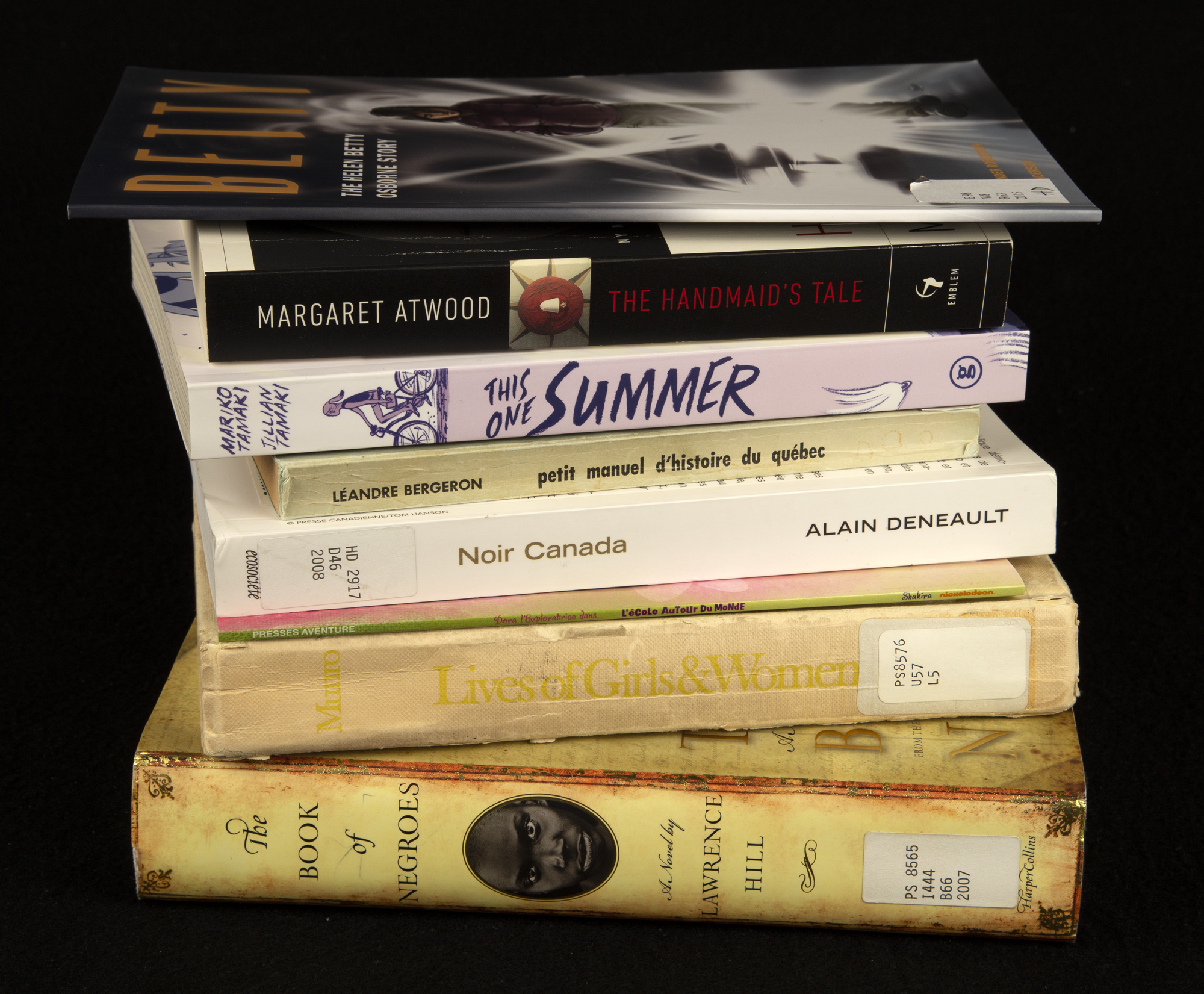
A colour photograph showing the spines of a stack of books against a black background.

A sample of the variety of books held in the Library and Archives Canada collection, which have been challenged.  Photo credit: Tom Thompson

In Canada, we enjoy the freedom to read what we choose, so much so that we may not always consider how important this right is, or whether it could be interfered with in a country such as ours. After all, our intellectual freedom is guaranteed under the Canadian Charter of Rights and Freedoms. Yet, freedom to read can never be taken for granted.  Even in Canada, books and magazines are frequently challenged in libraries and schools. Freedom to Read Week encourages Canadians to talk about and celebrate our intellectual freedom. Each year, Canada’s Book and Periodical Council ensures that this event raises awareness of Canada’s often little-known history of censorship and book banning, and the battles fought to keep books on the shelves of schools and libraries. Nationwide events throughout this week help raise awareness about the importance of protecting our right to read.

The right to intellectual freedom means that each person has the right to choose what to read, within the limits of Canadian law. Challenging a book’s right to be on a shelf and available to readers involves more than a personal expression of taste or the choice not to participate in a conversation about controversial issues. It is an attempt to limit public access to the works in schools, libraries, or bookstores, often for political or moral reasons, and prevent others from reading them. Libraries have a core responsibility to protect the freedom to read and are required to have library policies reflect this duty.

Each case is different, and libraries respond differently, according to their mandate and their responsibilities to users. Most public libraries have intellectual freedom policies in place to deal with individual concerns while protecting the collective right to read, for example by shelving according to age appropriateness, while the mandate of many school libraries is mainly to support the curriculum for the school’s relevant age group. At Library and Archives Canada, our mandate is to acquire, describe, and make accessible all Canadian publications to readers and researchers from Canada and around the world.

Not all challenged books wind up being banned. When a famous author like Margaret Atwood has a book like The Handmaid’s Tale challenged, the result is often greater media attention, increased sales, and more readers. Alice Munro’s Lives of Girls and Women was challenged decades before she won the Nobel Prize for Literature.

However, the process of trying to ban a book can have a more insidious effect, especially in school and public libraries. A children’s book with a controversial reputation can simply be dropped from reading lists and curricula to avoid confrontation. When books with themes like that of Maxine’s Tree, a picture book with an environmentally friendly message, are challenged, sometimes the challenge is denied, as in this case from 1992, where the book was allowed to remain in elementary schools. Today, we take for granted picture books that teach kids about the environment, or same-sex families, or different religious views, or any number of topics, but this was not always the case.

Who knows how many such books were not purchased (or not written) over the decades because of a culture of banning? We like to think that, today, we are more open to the views of others. Nevertheless, as Canadians, we should remain aware at all times of how valuable our right to read is and should protect this right for ourselves as well as for other readers.

For more information, check out Freedom to Read Week online.


Liane Belway is a librarian in the Acquisitions section of Published Heritage at Library and Archives Canada.