Vimy Ridge: a journey of maps (part 2)

By Ethan M. Coudenys

Picture the scene of the moments leading up to a massive military advance. On the morning of April 9, 1917, a cold rain falls on the Douai plain in France. To the west, a great number of Canadians have gathered to begin their attack on Vimy Ridge at precisely 5:30 a.m. Of the approximately 30,000 men preparing to advance that day, roughly a third are hidden underground in tunnels built specifically to hide them from the German forces’ lookouts. At the moment of attack, the men burst from the tunnels and shower brimstone and hellfire on the forces that oppose their advance.

A tunnel at Vimy Ridge.

Grange Subway under Vimy Ridge, August 17, 2022. Image courtesy of the author, Ethan M. Coudenys.

These tunnels were mainly constructed by the Welsh Companies of the Royal Engineers. The Welsh miners were mostly professional miners, and they would cut through the chalk stone 10 to 15 metres below the battlefield in near-total darkness. Some 10 kilometres of underground tunnels ran from the furthest Canadian rear trench to the front of the line. They were used to move supplies, run messages and conceal the advancing army on the day of the attack.

Speaking from my experience as a tour guide at the Canadian National Vimy Memorial at Vimy Ridge, these tunnels, often filled with water, bats, rats and unusual smells (probably far worse back then), were incredibly confusing to traverse during the First World War. There were electric lights every 20 metres or so, but the tunnels were dark, twisting and loud. Chalk conducts sound, so soldiers could hear, not only every shell falling on the surface with some clarity, but also miners digging away and the few soldiers and officers shuffling through the tunnels.

To avoid confusion, maps were created to prevent messengers and officers from getting lost in the subterranean labyrinth. Only one of these tunnels, the Grange Subway, is currently open to visitors at the Vimy Ridge National Historic Site. The Durand Group, a research and exploration association, is carrying out the dangerous work of investigating and uncovering tunnels and redoubts, but these efforts have not yet resulted in additional tunnels being opened to the general public. Nevertheless, the Durand Group’s work provides insights into what the maps of different tunnels were like at this time in the war, as the association maps and reports on newly uncovered tunnel systems in France and Belgium.

The attack on Vimy Ridge consisted of two different phases. The first, and most famous, is the taking of the ridge along the 12-kilometre-long front line for which the Canadian Expeditionary Force (CEF) was responsible. The CEF had four main objectives, but Hill 145, the highest part of the ridge, was the declared central target for the operation. The second phase was taking the Pimple (also known as Hill 119). This was a heavily fortified and well-manned artillery and heavy machine gun post at the top of a hill. It was very easy to defend, and very useful if the German forces wanted to regain territory lost in the first phase. Thus, the second phase of the Battle of Vimy Ridge is now known as the Battle of Hill 119 (or the Pimple).
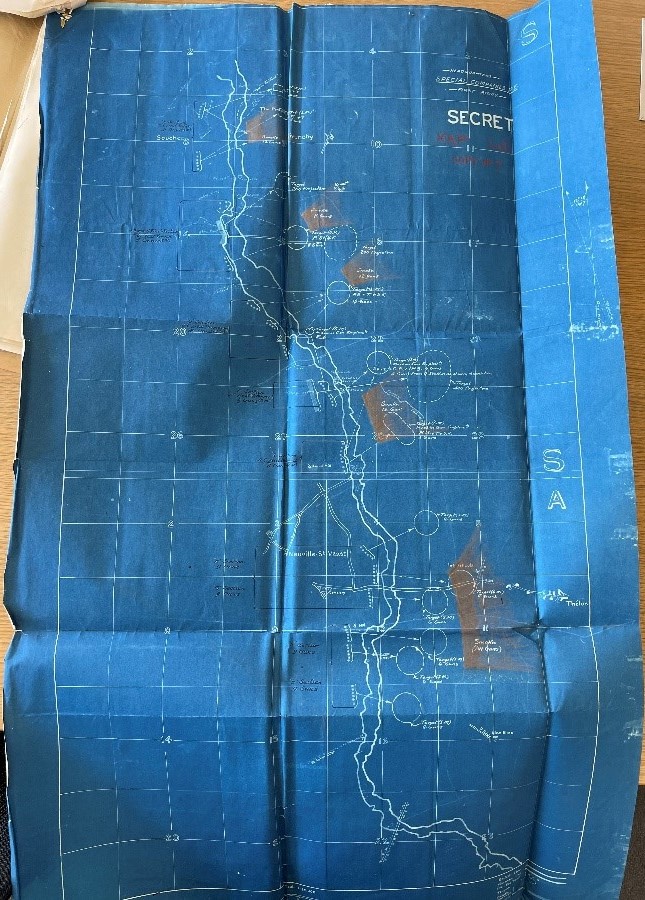
Map showing artillery plan, including smoke screens.

Artillery barrage plan – Battle of Hill 119 (or the Pimple) (MIKAN 3946966). Photo: Ethan M. Coudenys.

Mapping the artillery attack

The Vimy Ridge and Pimple attacks were Canada’s contribution to the larger military operation of the Battle of Arras, which took place along a 30-kilometre front led by mostly British forces. One of the most important elements of the attacks was the efforts of the artillery brigades, for which both Canadian and British artillery units worked in tandem to aid the advance of the infantry troops. This effort required immense preparedness and incredible tenacity. It was critical for artillery units to follow the same schedule, to ensure that the barrage of artillery shells would advance at a very specific pace of 100 metres every three minutes. Every unit was therefore issued maps and specific timings on each of the changes in range, as well as the speed of firing. This tactic was called a rolling (or creeping) barrage.

To expand on the discussion in part 1 of this post, a rolling barrage is a military tactic largely developed by British and Canadian generals who had witnessed the failure of artillery support at the Battle of the Somme in France (July–mid-November 1916). The rolling barrage tactic involved firing a wall of shells into no man’s land and advancing the wall slowly, so that the opposing forces could not exit their shelters to mount an effective defence before the infantry troops reached their line. This tactic was effective in eliminating defensive enemy snipers and machine guns during the start of the Vimy Ridge battle. Canadian writer Pierre Berton states in his work on Vimy Ridge that the roar of the artillery firing was so loud that it could be heard as far away as London. To the soldiers advancing into dangerous territory, it seemed as though the sky was made of lead, because of the sheer number of shells flying overhead.

Let us now turn to the various maps of the artillery on Vimy Ridge. For the assault on Hill 145, it was important for the infantry and artillery to be synchronized. The artillery commanders received the same maps as the infantry units so they could measure the advances of the various divisions and brigades, sometimes kilometres away.

More importantly, the artillery officers received maps of specially chosen target areas, to help them destroy major defensive installations before the infantry came into range of those positions. These target areas could be machine-gun nests, sniper posts, defensive artillery pieces or mortar emplacements. Part of the plan of attack was to ensure that there was a significant time gap between the first and second advance. For example, the distance between a red line and a black line would be roughly a 30-minute interval, during which the secondary wave of infantry and supporting troops could move up. In other words, the artillery would fire on specific targets for a set amount of time, wait 30 minutes to allow the infantry to advance, then fire on more distant targets. This allowed for the infantry to rest and fortify their newly taken positions, while the artillery targeted the potentially dangerous defensive fortifications further along the front.

To capture the Pimple, the strategy was quite different. While the artillery continued to use the rolling barrage, they also used two new tactics that were introduced and developed during the Great War. The first was creating what some scholars have called a “killing field,” where, through heavy artillery fire, defending troops are forced to leave their shelter for open space and then are targeted by machine guns and artillery. The second was the launching of smoke screens. The artillery would launch barrels of burning oil into the battlefield, creating a thick, black cloud of smoke to hide the advancing infantry. These two tactics would become a trademark approach of the Canadians in later battles, including the Battle of Hill 70 in Lens, France (August 15–25, 1917) and the Third Battle of Ypres (Passchendaele) in Belgium (July 31–November 10, 1917).

While the rolling barrage was successful in the preliminary attacks on Hill 145, the capture of the Pimple was one of the most costly battles in Canadian military history, with over 10,000 men killed, injured or missing.

Conclusion

The mapping of a battlefield is not a new concept. From the age of the Roman Empire to the Napoleonic Wars, generals and warlords have used maps to plan attacks and navigate battlefields. However, the development and production of these maps was usually done exclusively for high-ranking officers and non-commissioned members. At the Battle of Vimy Ridge, to ensure better overall preparedness among troops and to prevent confusion among infantry soldiers, maps of the battlefield were produced and distributed widely, so that even low-ranking lieutenants and lance-corporals would have access to the plan of attack. This innovation in how the allies fought during the First World War resulted in a hugely successful attack upon the German forces’ position on Hill 145 (Vimy Ridge) and Hill 119 (the Pimple) during the Battle of Vimy Ridge, part of the greater Battle of Arras. Maps illustrated clear and focused goals for individual units, and they demonstrated the tactics that the soldiers, artillery and support services would use to take the ridge. These maps followed many months of preparations for the Vimy Ridge battle; they were a major contributing factor in the CEF’s successful capture of Hill 145.

Additional resources


Ethan M. Coudenys is a Genealogy Consultant at Library and Archives Canada.

Vimy Ridge: a journey of maps (part 1)

By Ethan M. Coudenys

Cartography is the practice of drawing or making maps; during the First World War, this was vital for planning and preparing attacks and defensive actions. Battles in France like those of the Marne, Somme and Verdun were mostly planned with large maps by high-ranking officers and non-commissioned members. However, for the battle at Hill 145—better known as Vimy Ridge—cartography played an integral role in the planning of the assault by the Canadian Expeditionary Force (CEF).

Group of men going through barbed wire with shells exploding in the background.

Canadians advancing through German wire entanglements, Vimy Ridge, April 1917 (a001087).

Before we begin, we should set the scene by talking about the CEF before the Battle of Vimy Ridge. The Canadians had fought in various battlefields in France and Belgium, including with distinction at Flers-Courcelette (August–November 1916) in France, about 50 kilometres from Vimy. Under the command of Lieutenant-General (later Field Marshal and Governor General) Sir Julian Byng, the CEF had become a very successful fighting force. In November 1916, the Canadians began moving to the east of the French town of Arras. There, they began preparing for an attack on Hill 145, where the German forces had taken nearly three years to build very heavily fortified lines of trenches.

The Battle of Vimy Ridge, which began on April 9, 1917, was not an isolated operation; it was a small part of the Battle of Arras. The two major points of the battle for the ridge, for which the Canadians were responsible, were the ridge itself (Hill 145) and the Pimple (Hill 119). Incredible preparations went into planning this attack.

Between the beginning of the war in 1914 and when the Canadians took up positions in late November 1916, French and Moroccan divisions had tried to take Vimy Ridge. They advanced the allied front line closer to the ridge. During the Battle of Verdun, the British took over these positions, and they expanded and strengthened the relatively weak fortifications. By November 1916, the CEF entered the front line at Vimy with very good fortifications.

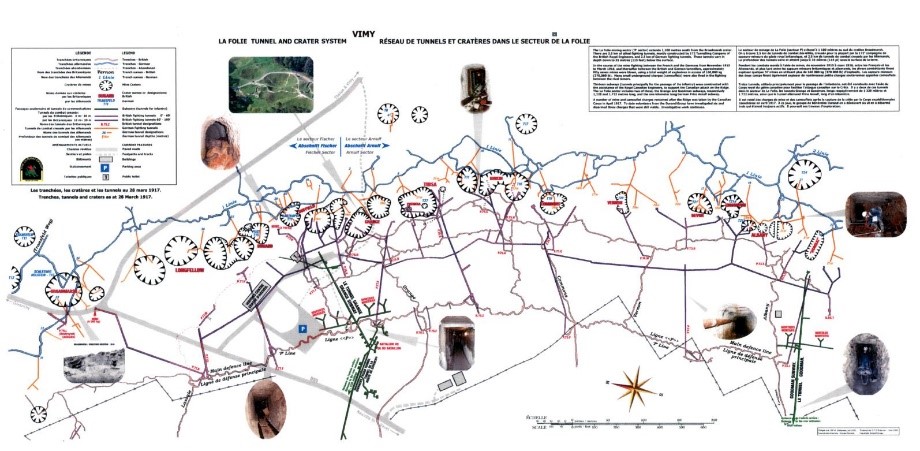
Map showing a tunnel-and-crater system.

Map 1 – Map of La Folie battlefield: group of tunnels, near Vimy. Courtesy of Veterans Affairs Canada – European Operations.

The Canadians were called to the line at Vimy for the first time as an entire corps, fighting side by side. This was incredibly important not only for the soldiers but also for the young nation. For many, it signified the start of a process whereby Canadians would collectively build their cultural and national identity.

We can better understand the importance of cartography in battle by first reviewing some of the maps that are presented today at the Visitor Education Centre in the Canadian National Vimy Memorial in France. There, Canadian guides—all university and college students—educate the public about the Battle of Vimy Ridge, including the tunnels that were built to support the advance of Canadian troops in April 1917. In maps 1 and 2, the different tunnels and trench lines used during the battle for the ridge are shown.

Map showing the battlefield during the Battle of Vimy Ridge.

Map 2 – Battlefield map of the Battle of Vimy Ridge: modern map. Courtesy of Veterans Affairs Canada – European Operations.

How were the maps made?

Maps were important for infantry soldiers because they helped to ground and situate them in an environment marked by constant fear, confusion and proximity of death. During the months leading up to the Vimy Ridge battle, soldiers were sent into the German forces’ trenches to gain information about the enemy’s fortifications and weapon emplacements that lined the front. Moreover, the Royal Flying Corps (later the Royal Air Force) used aerial photography to pinpoint areas of fortifications and map points of interest for the attack. Let us examine this gathering of information by soldiers.

The CEF collected information by sending small incursions into the German lines, with soldiers memorizing the layouts of the other side’s trench systems. These could be completed by a small group of men or a very large group (5,000 or more in one instance) and took place from November 1916 until the eve of the battle in April 1917.

During the infamous trench raids, Canadian soldiers would be tasked with memorizing the layout of the trenches and important locations in the German forces’ lines. These vital recollections were later reflected in detailed maps, which were used by the Canadians to help reduce confusion among the infantry. The trench raids could be incredibly dangerous, both for the men raiding and for the defenders. Often these attacks would take place at night, and both attackers and defenders could suffer heavy losses.

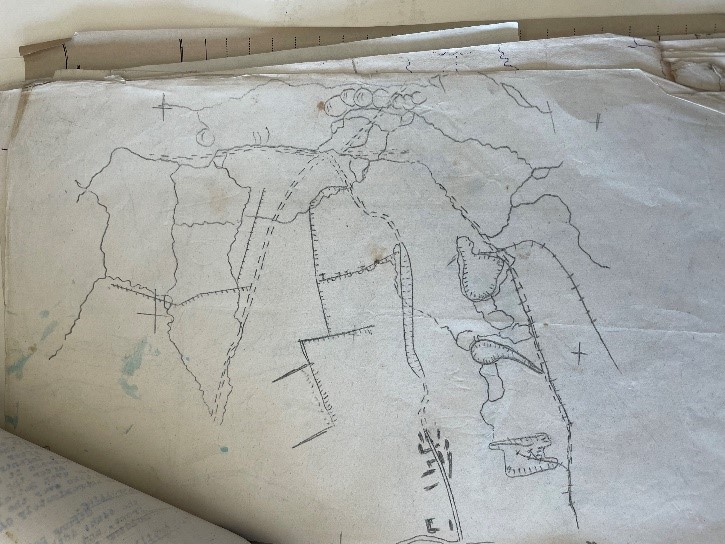
Hand-drawn map of German trenches after a raid before the Battle of Vimy Ridge.

Hand-drawn map of German forces’ trenches after a raid, Vimy Ridge, 1917 (MIKAN 4289412). Photo: Ethan M. Coudenys.

The maps that were created as a result of these raids, such as the example above, were often drawn by hand, from memory, by individual soldiers.

What maps were made?

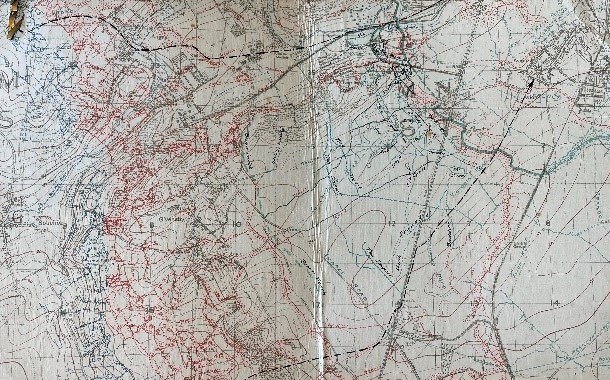
Map showing artillery barrage in the Vimy region in France.

Artillery barrage map, 1st Field Survey Company, Royal Engineers, near Vimy, 1917 (e000000540).

We are very fortunate to have access to a vast number of maps from the Great War in the collection at Library and Archives Canada. Some of the most frequently requested by researchers are the trench line maps of the Western Front. As mentioned above, these maps were drawn through painstaking and sometimes bloody collection of information by soldiers, engineers and pilots. These maps were issued widely to both low-ranking officers and non-commissioned members of the infantry to help them succeed in the attack on April 9, 1917.

The first map issued, and perhaps the most important for the advance, was the barrage map. During the attack on Vimy Ridge, the Canadian artillery, supported by numerous British field artillery units, used the tactic of a rolling (or creeping) barrage to subdue resistance by the German forces while the infantry advanced behind a wall of falling shells. This process was incredibly well timed, and it needed to be, to avoid any friendly fire casualties. Thus, maps were created and used by the artillery units to launch this barrage on the German forces’ lines. These maps detail the targets of the artillery leading up to the four main objectives of the CEF between April 9 and 12, 1917. They show the 100-metre advances of the rolling barrage every three minutes, allowing the infantry units following the barrage to successfully move behind the wall of fire. The maps also show the various targets of particular interest, including fortifications, machine gun emplacements, mortar emplacements and munitions storage areas.

Cardboard map detailing the Western Front at Vimy Ridge.

Infantry soldier’s pocket map, made of cardboard, Vimy Ridge, 1917 (MIKAN 4289412). Photo: Ethan M. Coudenys.

The most widely used maps in the attack on Vimy Ridge were those issued to infantry units. These maps were small copies of larger planning maps used by high-ranking officers, but they included the individual objectives of each platoon and company. This was an incredibly important step in planning and executing the attack on the ridge. Despite the confusion caused by gun and rifle fire, the maps helped the advancing soldiers to stay on course.

The change of policy allowing soldiers to carry their own battlefield maps might seem like a minor one, but it had a significant effect on the CEF’s success in the Battle of Vimy Ridge.

 Additional resources

  • The Underground War: Vimy Ridge to Arras by Phillip Robinson and Nigel Cave (OCLC 752679022)
  • Vimy by Pierre Berton (OCLC 15063735)
  • Vimy 1917: Canadians and the Underground War by Dominique Faivre (OCLC 1055811207)

Ethan M. Coudenys is a Genealogy Consultant at Library and Archives Canada.

Improving your online experience: What to expect at LAC’s new online home

Image of fingers on a keyboard

By Andrea Eidinger

Here at Library and Archives Canada (LAC), we take user feedback very seriously. Over the years, one point has come through loud and clear: our existing website is not meeting the needs of the public. This is why we are proud to announce that we will be launching a completely new website later this summer—library-archives.canada.ca. In this blog post, I will go over what LAC’s new web presence will involve and how these changes will impact your experience.

New website

So, what does this mean in practical terms? We spent a lot of time gathering feedback from members of the public, expert researchers and members of our staff to make our website user-centric. This involved creating several working groups as well as user-testing different possibilities for the new website. We also incorporated the latest research on how people actually use websites.

A major part of this work has been to ensure that all our users can easily find and understand the information on our website. Two very important components of the new website are consistent web navigation and plain language. All our new web content is organized in the same way so that users always know where to go, and the language has been simplified to make it clearer and easy to understand, no matter your skill level.

Finally, our website is dynamic. Our goal was to create a website that lives and breathes. Gone are the days of web pages being posted and then never touched again. Part of renewing our web presence is a commitment to continually update the website with new material and make improvements based on user feedback. We are also taking what is called an “iterative approach.” Essentially, we will start with a scaled-back version of the new website. This will be a launching pad for us. Our work will build on this initial version to develop the new website.

Screenshot of the Rare Book Collection webpage on the LAC website.

An example of the new template for subject guides for the new LAC website.

New structure

One of the biggest changes users will notice is the look and feel of the website. To make the information on the website more easily accessible to the public, we have developed a new structure for the website based on tasks, topics and themes that align with our users’ needs. In other words, we looked closely at how members of the public were using our existing website and what they were looking for (tasks). We then grouped those tasks into broad categories (topics). Finally, we grouped these topics into themes.

These themes are the basis for the website’s new structure and align with the Government of Canada’s design system. This system provides a more practical, consistent and reliable online experience for people who access Government of Canada digital services.

The first theme, Corporate, contains all of the institutional information relating to LAC. This includes information about our mandates, policies, initiatives and partners. This is where you will also find information about transparency at LAC and be able to read reports and plans about our activities.

The second theme, Services, is self-explanatory. It is where users can access our services or complete a task related to one of our programs. Under this theme, users will find information on how to visit us, how to order material, how to apply for ISBN numbers, how to make an ATIP request, and more. Also under this theme is information about the various services that we offer for gallery, library, archives and museum (GLAM) professionals, publishers, public servants, and Indigenous communities and individuals. This section will also contain information about our different funding programs.

Finally, there is the Collection theme. Our goal in rethinking how we present the Collection theme was to build user autonomy and discovery. This section will be home to all kinds of materials that will help Canadians access the documentary heritage under LAC’s care. In this section, you will find our databases, guides on researching various topics, publications, and podcast episodes, as well as a basic introduction to research. This section also includes many of LAC’s more interactive features, such as Co-Lab, our transcription program.

New navigation

One of the biggest challenge that users faced on our website was finding the information they were looking for. This was a problem particularly for material included under the Collection theme. Often, users would travel down rabbit holes and never be able to find their way back again. We have corrected this problem with a completely new navigational system based on tables. The new navigational table will include all pages listed by topic, sub-topic and type. For example, a web page on the First World War personnel files we have available would be appear as follows:

First World War Personnel Files – Military History – First World War (1914-1919) – subject guide

Even more important: this table will be filterable and searchable. This means users can easily see all of the resources that we have on a particular topic and find their way back without difficulty.

New content

The last exciting change to tell you about is the new content on our website. The existing site is enormous: it consists of 7,000 pages. Much of the information it contains is no longer up to current web and historical standards. We also know that many of the pages are hard to read, especially for beginners, and sometimes confusing. In preparation for our new website, we have systematically reviewed every single one of those 7,000 pages. Anything outdated or no longer up to current standards was archived (and will be available to the public), and the rest of the pages were reworked. All of the information on LAC’s new website is presented in plain language and is therefore clear and easy to understand. We hope this approach will attract an entire new wave of users interested in learning about Canada’s documentary heritage.

Since there is so much content, we focused on preparing material for the three most popular and most consulted topics for the launch: genealogy and family history, Indigenous history, and military history. Please note that, in the weeks and months ahead, we will add more material to these and other topics. We will be updating our material regularly in response to user feedback and to reflect the latest available information.

We’re so excited to show you all of the new material we’ve been working on! So, while this does mean that your URLs will change, we’re hoping that these changes will make your online experience at LAC a more positive one. Since this work is only beginning, the best is yet to come!

We look forward to your feedback. Please send us your comments and thoughts when we go live.


Andrea Eidinger is a team lead in the Online Experience Division at Library and Archives Canada.
Top 5 topics addressed by our Reference Librarians

By Emily Dingwall

At Library and Archives Canada (LAC), reference librarians respond to requests on a wide variety of interesting topics from clients. This blog post outlines five types of reference questions librarians frequently handle and suggests resources to consult on these subjects.

The cover page from Sessional Papers of the Dominion of Canada with the title “Public Accounts of Canada, for the Fiscal Year ended 30th June, 1884.”

“Public Accounts of Canada” report found in Sessional Papers of the Dominion of Canada, 1885, Vol. 1, No. 1. (OCLC 1007491677, image from Canadiana)

  1. Federal government documents

Annual departmental reports. Clients are often seeking annual departmental reports. Annual reports from Confederation in 1867 to 1925 are printed in the Sessional Papers of the Dominion of Canada. Learn more about the Sessional Papers of the Dominion of Canada, 1867 to 1925. If you are in Ottawa, you can access the Sessional Papers at LAC by requesting them from staff in the 2nd floor reference room. They are also available through these websites:

Departmental reports post–1925 are published separately from other government documents in the Sessional Papers. You can request 1925–1930 annual reports from LAC staff or through the Internet Archive.

After 1930, search our library catalogue Aurora for annual reports by the name of the department as it was known  during that period.

Beginning with 1995, you can find annual reports at the Government of Canada’s Departmental Results Reports. For more recent years, you can search the specific government department website.

Parliamentary documents. We also receive many questions on searching parliamentary debates, journals and committee materials of the House of Commons and the Senate, such as for a speech made by a prime minister in the House. You can find these documents online:

A typewritten page with two columns of text, separated by a crest. The text on the left is in English and the text on the right is in French.

Front page of the Canada Gazette, Part II, Vol. 137, No. 23, November 5, 2003. (OCLC 1082716964, image from Canada Gazette)

  1. Legislative Research

Librarians frequently receive questions about legislation in print or legislation that can be found online through Justice Laws.

You can trace legislation through these main sources:

  • The Statutes of Canada include all acts and amendments to laws passed during each session of Parliament.
  • The Revised Statutes of Canada (R.S.C.) are consolidations of the Statutes of Canada incorporating amendments and acts that have been added since the last revision. The R.S.C have been published for the years 1886, 1906, 1927, 1952, 1970, and 1985.

The Statutes of Canada and the Revised Statutes of Canada are available in print format in our reference collection at LAC, as well as at many public and academic libraries. They are also accessible through the legal database LLMC Digital, which can be searched onsite at LAC.

To learn more about the Statutes and researching legislation, see the blog post Tracing Historical Legislation.

You can find official regulations and statutory instruments in Part II of the Canada Gazette, the official newspaper of the Government of Canada. Published in three parts, the Canada Gazette is searchable by keyword at these sites:

To learn more about the three parts of the Canada Gazette please see Canada Gazette publications.

Readings of bills, such as the First and Third readings, can be found by searching the library catalogue Aurora.

LEGISinfo, the Library of Parliament’s research tool, provides information on all bills considered by the Senate and the House of Commons since the start of the 37th Parliament in 2001.

An image of a four-column newspaper, Courrier canadien.

Courrier canadien, March 11, 1900. (OCLC 109270836)

  1. Newspaper Research

Librarians often assist clients in searching newspapers for information such as local histories, articles on individuals, or references to a past royal visit to Canada.

We hold newspapers in print and microfilm formats, which can be found through the Aurora library catalogue. We also subscribe to several newspaper databases.

The Geographical microform list names all the newspapers that we hold on microfilm (click on the OCLC number), as well as newspapers available online. The list is organized by province/territory, then alphabetically by location.

Major newspaper titles such as Le Devoir, the Montreal Gazette, and the Ottawa Citizen are available in our self-service microform reading room.

These newspaper databases can be accessed on the public workstations in our reference room: The Globe and Mail, Toronto Star, Paper of Record and Newspaper Archive.

Online newspaper resources include:

The cover page of “Official History of the Canadian Army in the Second World War.”

Cover page of Colonel C.P. Stacey’s Official History of the Canadian Army in the Second World War, Volume I: Six Years of War: The Army in Canada, Britain and the Pacific. (OCLC 317352934, image from Government of Canada publications)

  1. Military History Research

Librarians receive military history questions from clients looking for published histories of specific regiments/units, recruitment statistics per year, and locations of Canadian units in Europe during World War II.

Resources for military history research include:

An image of a Grand Trunk Railway timetable from 1922.

Timetable of the Ontario lines of the Grand Trunk Railway from 1922. (e011297622)

  1. Railway Histories

Many clients contact Reference Services about railway history research. Examples of questions we receive include the histories of specific train stations, the histories of railway companies (Canadian Pacific Railway, Canadian National Railways, Grand Trunk, etc.), and routes of particular railway lines.

We hold railway maps, as well as passenger and employee timetables in print format that can be located by searching Aurora. Many timetables are part of the Merrilees Transportation Collection, which contains about 5,000 publications including books, trade literature, technical manuals, timetables, broadsides, periodicals and pamphlets.

An Ontario railway historian has made rail timetables available on Charles Cooper’s Railway Pages.

Canadian Pacific Railway timetables from 1930–1985 are available through the Chung Collection at the University of British Columbia Library.

These are two excellent print publications to consult on railway history:

  • Andreae, C., & Matthews, G. Lines of Country: An Atlas of Railway and Waterway History in Canada. Erin, Ont.: Boston Mills Press, 1997. This publication is a comprehensive outline of railway and waterway history in Canada and includes maps of railways in Canada from early days to the present. It can be accessed in our reference room.
  • Ballantyne, B., and Bytown Railway Society. Canadian Railway Station Guide. Ottawa: Bytown Railway Society, 1998. This publication lists stations, plans and pictures.

 I hope that these resources will help you with your research on these subjects. Of course feel free to ask us a question on any topic, and a reference librarian will be happy to assist you!


Emily Dingwall is a Reference Librarian in the Reference Services Division at Library and Archives Canada.

Images of the First Special Service Force (The Devil’s Brigade) now on Flickr

A black-and-white photograph of around a dozen soldiers wearing parachute gear, lined up to board a Douglas C-47 for training.

Personnel of the First Special Service Force boarding a Douglas C-47 aircraft for parachute training, Fort William Henry Harrison, Helena, Montana, United States [MIKAN 3378674]

The First (or 1st) Special Service Force, nicknamed The Devil’s Brigade, was a combined Second World War Canadian and American commando group. It was located and trained at Fort Harrison near Helena, Montana, United States. Force members received intensive training as ski troops and in stealth tactics, hand-to-hand combat, the use of explosives for demolition, parachuting, amphibious warfare, rock climbing and mountain warfare.

A black-and-white photograph of a soldier wearing white winter gear and crouching down to fix his ski bindings. A parachute is blowing in the wind behind him.

Member of the First Special Service Force during a winter training exercise, Blossburg, Montana, United States [MIKAN 3378683]

The Force saw extensive combat duty during the years 1943–1944 in Italy and southern France. It was known for always achieving its objectives. The Force was disbanded on December 5, 1944, but many modern Canadian and American Special Forces units, such as Joint Task Force 2 (JTF2), the Green Berets and the Navy SEALs, trace their heritage to this unit.

A black-and-white photograph of three soldiers with camouflage makeup preparing to go out on an evening patrol.

Personnel of the First Special Service Force preparing to go on an evening patrol, Anzio beachhead, Italy [MIKAN 3378968]

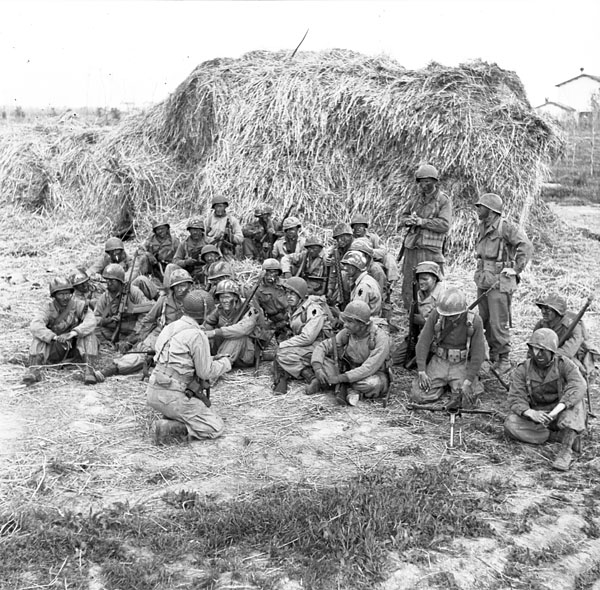
A black-and-white photograph of some two dozen soldiers sitting behind a large hay bale. The soldiers are being briefed before setting out on patrol.

Personnel of the First Special Service Force being briefed before setting out on a patrol, Anzio beachhead, Italy [MIKAN 3396066]

Visit the Flickr album now!

Arthur D’Orr LePan, Camp Kosciuszko and the Polish Army in France

By Catherine Butler

Poland on the eve of war

On the eve of the First World War, an independent Poland had been absent from the European map for nearly 120 years. In the late 18th century, Poland was partitioned by Russia, the Austro-Hungarian Empire and Prussia; Prussia would eventually become part of a unified Germany. Polish lands were carved up and absorbed, and Polish people were scattered among three powerful empires.

In the century following the partitions and the profound social and political transformations they precipitated, millions of Poles emigrated to North America. At the outbreak of the First World War, several hundred thousand Poles were living in Canada, while nearly four million were living in the United States. With such a large diaspora, countless Polish Americans and Polish Canadians were eager to fight on the Allied side with the aim of restoring their homeland.

After a series of meetings between the representatives of Sir Robert Borden’s government and Polish delegations from the U.S., the Canadian government, with the approval of Britain, agreed to provide training to Polish officers living in North America. These officers, recruited from Canada and the U.S., would be sent to fight for the Polish Army in France, which ultimately financed their training. Although initial training efforts started in early 1917, a designated Polish Army camp at Niagara-on-the-Lake in Ontario opened in September 1917. Colonel Arthur D’Orr LePan was appointed as Commandant to the camp, a facility that came to be known as Camp Kosciuszko.

A black-and-white photograph showing a field with a group of officers following their commander in the foreground, and officers standing at attention in a line in the background

Recruits at the Polish military camp, Niagara, Ontario, November 8, 1917 (a071288)

The diaries of Colonel LePan

Colonel A.D. LePan was born in Owen Sound, Ontario, in 1885 and was educated at the University of Toronto. He served in the Canadian Army from 1915 to 1919, including as Commandant until the camp closed in March 1919. His involvement in training Polish officers began in January 1917 with the arrival of 23 American volunteers at the School of Infantry in Toronto. As Commandant, Colonel LePan saw over 20,000 recruits from the U.S. and Canada pass through Camp Kosciuszko en route to France between September 1917 and March 1919.

Many of Colonel LePan’s activities at Camp Kosciuszko are described in diaries he kept during his time as Camp Commandant. These diaries were donated to Library and Archives Canada by his son, Douglas V. LePan, in 1977. Colonel LePan’s writings offer interesting insights into a fascinating episode of Canadian history.

In addition to lists of camp personnel, the diaries contain information about training, troop movements, lists of deaths in France, along with cause and location, and a plan of grave plots of Polish soldiers at the St. Vincent de Paul churchyard in Niagara-on-the-Lake. Colonel LePan also kept a copy of the telegram authorizing the establishment of the Polish camp.

Also included in these papers are remarks given in March 1919 by Colonel LePan during a banquet in Buffalo, New York, addressing the closing of the camp. In his speech, he spoke about how crucial international co-operation between France, Canada, the U.S. and the Polish Military Commission was in making the camp a success and, most importantly, in re-establishing an independent Polish state.

“One can quite readily conceive that the camp presented interesting international associations … It was no unusual sight to have gatherings of officers at which the countries of Poland, France, United States and Canada were represented and on each occasion was found officers who from their environment and education had different ideas and ideals, all cooperating with the one great ideal of making this new creation as big a factor as possible, not only in the creation of a national Poland, but as an agency for freeing the world from an oppression that not only Poles had heard of as we have on this continent, but also that they had felt in body and soul.”


Catherine Butler is a Reference Archivist in the Public Services Branch at Library and Archives Canada.