Library and Archives Canada Blog

This is the official blog of Library and Archives Canada (LAC).

Library and Archives Canada Blog

What’s in a Name: the Carnegies in context

Version française

By Sali Lafrenie

“What a trip. It was as if I had been shot through a time tunnel from the fields of Willowdale to a field of dreams. The many threads of my life have all come together to produce a beautiful tapestry.”

Herb Carnegie, A Fly in a Pail of Milk: The Herb Carnegie Story (OCLC 1090850248)

Herb “Swivel Hips” Carnegie (1919–2012) was an exceptional athlete with multiple golf championships and an impressive career in hockey spanning over a decade. During his playing career, he travelled to numerous cities and played at the amateur and semi-professional levels for teams like the Toronto Observers, the Toronto Young Rangers, the Perron Flyers, the Timmins Buffalo Ankerites, the Shawinigan Cataractes, the Sherbrooke Randies (also known as the Saints), the Quebec Aces and, in his last season, the Owen Sound Mercurys. Carnegie had a decorated sports career, winning MVP for three straight years in the Quebec Senior Hockey League (QSHL) and playing on the first all-Black line in semi-pro hockey since the Colored Hockey League.
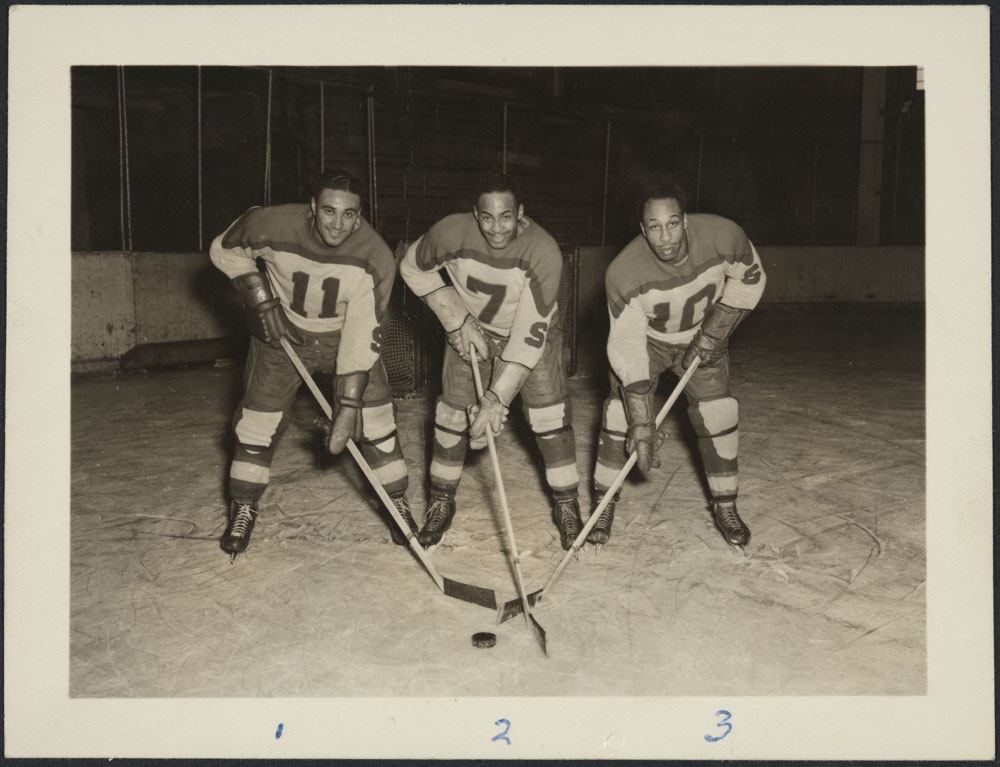
A black and white photograph of three Black hockey players standing in a line with their sticks on the ice.

A photo of the famous all-Black Line: Herb Carnegie, Ossie Carnegie, and Manny McIntyre. (Library and Archives Canada/e011897004)

After hanging up his skates, Carnegie became a successful businessman and the first Black Canadian financial advisor employed by Investors Group. He had a 32-year long career with Investors Group, and an award was established in 2003 in his honour: the Herbert H. Carnegie Community Service Award. Carnegie was more than just an example of business excellence; he was a community leader and an entrepreneur. He founded one of the first hockey schools in Canada, invented a hockey instructional board and devised a board game with the hope of helping people understand the sport and improve their hockey IQ. Further, Carnegie established the Future Aces Foundation and Philosophy alongside his wife and daughter, Audrey and Bernice. His impact can be seen in many places like the comic book features he received, the halls of fame he has been inducted into, the awards named after him, and the schools that adopted his Future Aces Creed (there is even a school named after him).
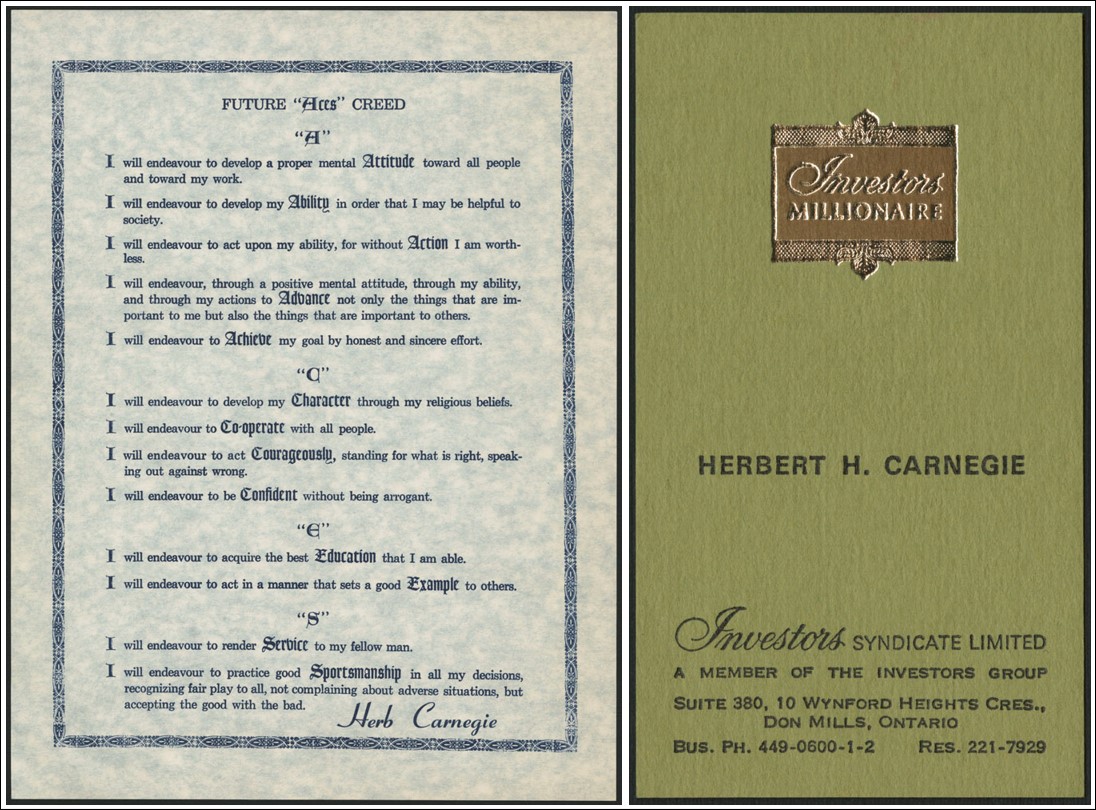
Two colour photographs of records related to Herb Carnegie. The first photograph is a paper with an intricate blue border surrounding text that consists of I-statements. The second photograph is a vertical green business card bearing an embossed “Investors Millionaire” logo with the name “Herbert H. Carnegie” printed in the middle, and the company’s contact information at the bottom.

Future Aces Creed and Investors Millionaire Card. (Library and Archives Canada/e011897005 and e011897007)

But what’s in a name?

 I’d disagree with Shakespeare, at least in this instance, and say that names do have power. They have histories, they have legacies, and they can act as maps. The Carnegie name does this for the world of sports, entrepreneurship, business, labour, and nursing.

Drawing attention for his skills and style of play, along with his race, there is even more we can learn from Herb Carnegie’s ice time if we stop to ask a few questions:

  • How does Herb’s experience in hockey reflect larger issues in Canadian society at the time?
  • If Black hockey players existed in 1895, why wasn’t the colour barrier in the NHL broken until 1958 by Willie O’Ree?
  • Whose shoulders are hockey players of colour standing on today?

While Herb Carnegie is often remembered for his exceptional hockey skills and for being the best Black hockey player to never play in the NHL, his impact off the ice has also been significant. He deserves to be remembered for all his contributions and for all the ways he and his family have worked for generations to make their communities better.

Pivoting to Herb Carnegie’s sister, we find Bernice Isobel Carnegie Redmon, the first Black public health nurse in Canada (1945) and the first Black woman appointed to the Victorian Order of Nurses in Canada (VON). We can learn more about the context of nursing and blackness in Canada by asking more questions:

  • How did Bernice Redmon become the first Black public health nurse in Canada in 1945?
  • What prevented Black women from entering the field before World War II?
  • When did the first Canadian nursing program start?

A quick search tells us that Bernice Redmon trained to become a nurse in the United States because Black women were prohibited from training as nurses in Canada until the mid-1940s, and that while the VON was established in 1897, the first Canadian nursing program opened  in 1919. However, Bernice Redmon was not alone for long, as Ruth Bailey, Gwen Barton, Colleen Campbell, Marian Overton, Frieda Parker Steele, Cecile Wright Lemon, Marisse Scott and Clotilda Douglas-Yakimchuk joined her in the following years. Despite the roadblocks and unofficial policies like quotas, the face of medicine and nursing began to change in the 1940s and 1950s. This year marks the 80th anniversary of Bernice Redmon’s achievement.
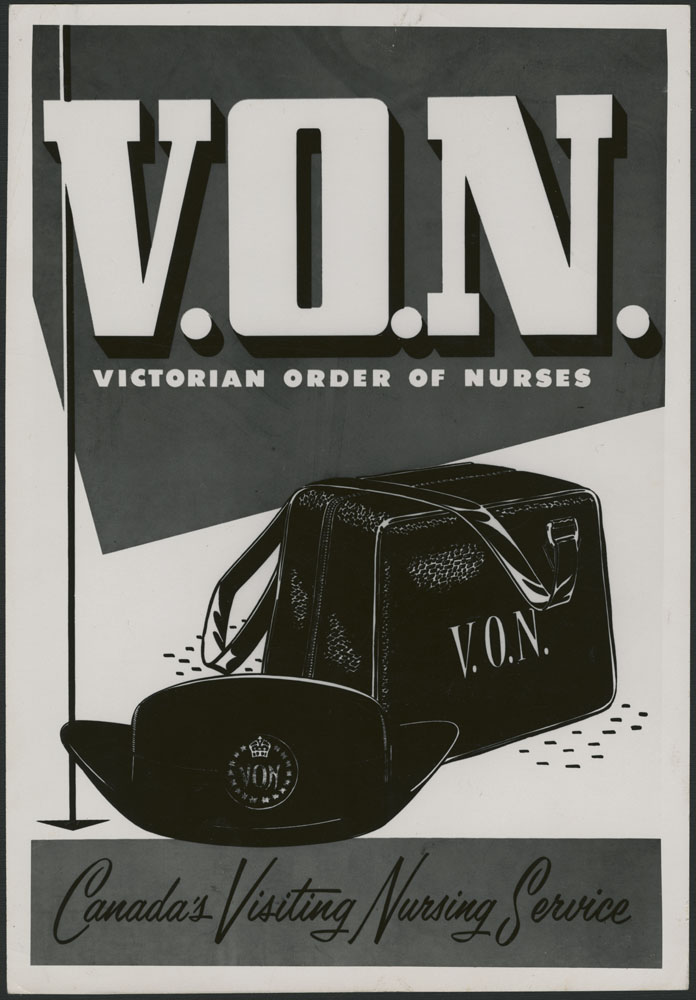
A black and white promotional poster of a white nurse’s hat and a black medical bag.

Victoria Order of Nurses poster. (Library and Archives Canada/e011897008)

Shifting to the next generation of Carnegies, we find Bernice Yvonne Carnegie, Herb’s daughter. She is the self-dubbed family historian and a leader in the hockey community, co-founding the Future Aces Foundation with her parents and establishing the Carnegie Initiative in 2021. Like her father, Bernice is working to support her community and to ensure that hockey is more inclusive. She has been giving back for over a decade through educational programming using the Future Aces Philosophy, academic grants, and her work as a public speaker. Moreover, she was a member of the BIPOC ownership group that purchased the Toronto Six hockey team.

In 2019, Bernice updated her father’s memoir, A Fly in A Pail of Milk, by sharing her own reflections on his life, lessons learned, and how she has continued the work he started. Once you read Herb Carnegie’s memoir and her reflections, it’s hard to stop there. I found myself diving into the family histories she maintains online, and I was struck by how deep the roots between her family and Canada run. I found myself asking questions again:

  • What jobs were available to Black men between 1900 and 1950?
  • What was the average salary at a mining company? What about for hockey players?
  • How do we define the Carnegie family’s multigenerational legacy?

Trailblazing is exciting, but it’s also important to remember that the individuals who broke through colour bars, de-segregated schools, and advocated for their inclusion are people too. In their extraordinary achievements, they face obstacles, racism and often trauma at the hands of the organizations they admire. Navigating predominantly white institutions is not easy; it has a cost. Being the first or one of few is challenging. It’s not often that we take the time to think about how history maps onto our lives and our families. Like the Carnegies, I know there are other families in Canada whose lives and family trees contain branches that blaze a trail through the national landscape. Without hesitation, I can think of families like the Nurses, the Grizzles, the Crowleys and the Newbys.

So, what’s in a name? A tapestry. A history. An archive.

Additional resources


Sali Lafrenie is an archivist in the Private Archives and Published Heritage Branch at Library and Archives Canada.
The Ancient Art of Archery

Version française

By Dylan Roy

This article contains historical language and content that may be considered offensive, such as language used to refer to racial, ethnic and cultural groups. Please see our historical language advisory for more information.

Archery, like most other sports or physical endeavours, can teach an individual many things, including discipline, perseverance, patience and focus.

I began my archery saga very recently and, despite my obvious inadequacies in the sport, I have had a great time learning about its various intricacies. This newfound hobby led me to scour the published and archival collection at Library and Archives Canada (LAC) to see what could be found about the bow and arrow.

Lo and behold, there was a plethora of books to read and many interesting archival materials to choose from. Like Robin Hood of yore, I shall share some precious gems from the rich resources we have at LAC.

First, if you were ever stuck on where to start for archery, there are many beginner guides and archery club-endorsed publications available. One of my personal favourites, due to its charm and whimsical cartoon art style, is the book Archery is fun! This book is mainly geared towards children, but it can also teach adults the basics of archery. With this swell book, you’ll be shooting arrows like Katniss in no time!

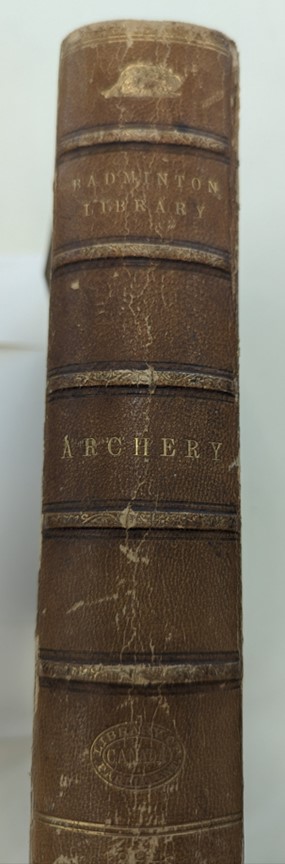
Second, as noted in the title of this blog, archery is an ancient art. To learn about the history of archery, why not use a book that was written over a century ago? Archery, by C.J. Longman and Henry Walrond (published in 1894), is a wonderful piece of literature to learn about archery’s ancient roots. Moreover, the book can enable you to understand the shifting thought patterns and language of authors writing over a hundred years ago.

The spine of an old-fashioned book with the title “Archery” printed in the middle.

Spine of the book Archery by C.J. Longman and Henry Walrond. (OCLC 342853)

According to Longman and Walrond, only hunting “can lay greater antiquity than archery.” The archaic allure of archery is one of the things that attracted me to the sport. It’s fun to think that, long ago, our far-distant ancestors were most likely taking part in archery in much the same way as we do today. This intriguing sport connects us with the past through actions in the present.

Longman and Walrond also included a quote in their book from a Hindu poet, which can be seen below:

“May the bow bring us spoils and oxen, may the bow be victorious in the heat of the fight; the bow fills the foe with terrible fear, may the bow give us victory over the world.”

This poem demonstrates the importance of archery and the impact that it has had on human civilization. The unknown poet declares that with the bow, humans may ultimately be victorious over the earth itself—thus indicating the sheer power associated with archery.

The book also provides lovely illustrations of some prehistoric arrowheads, which can be seen below:

Black-and-white illustrations of five arrowheads with a description under each of the drawings.

Five different prehistoric arrowheads found on page 19 of the book Archery. (OCLC 342853)

Many societies have held archery in high regard and many deities have been associated with it, especially in relation to hunting, such as the Greek goddess Artemis.

With the history of archery behind us, I will now share some sources that provide insight on how to get in shape for archery. You’ll be looking buff like Hawkeye in no time!

Floyd W. Johnson’s Fitness for Archery is a wonderful read for anybody looking for some pointers on the types of exercises that facilitate archery. Johnson advises that there are four main criteria needed for fitness as an archer: aerobic capacity (or stamina), flexibility, strength and relaxation.

According to Johnson, “aerobic capacity is the maximum amount of oxygen that can be taken into the blood and delivered to the muscle. Flexibility is the range of movement in a joint or series of joints (spinal column). Strength is the capacity of a muscle to exert force against a resistance.” Finally, relaxation is important because “archery is a sport which demands full mental and physical concentration at all times.” Therefore, if one wishes to practice archery, it is crucial to address all four of these fitness priorities.

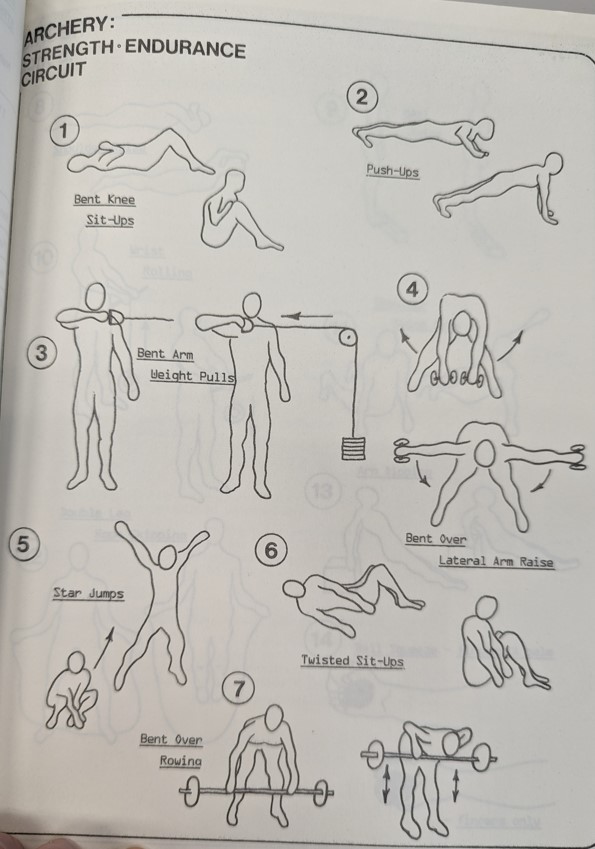
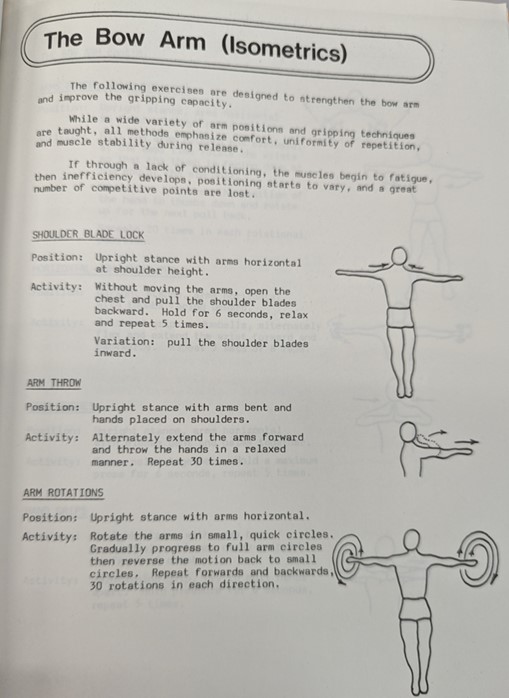
Johnson also supplies the reader with several exercises to enhance one’s fitness, which you can see in the images below:

Page titled “Archery: Strength–Endurance Circuit” with illustrations of figures showing how to do seven exercises.

Seven different exercises for building strength and endurance, including bent-knee sit-ups, push-ups, bent-arm weight pulls, bent-over lateral arm raise, star jumps, twisted sit-ups and bent-over rowing. (OCLC 15918112)

Page titled “The Bow Arm (Isometrics)” with instructions and illustrations of figures doing the exercises described.

Three different exercises for bow arm isometrics: shoulder blade lock, arm throw and arm rotations. (OCLC 15918112)

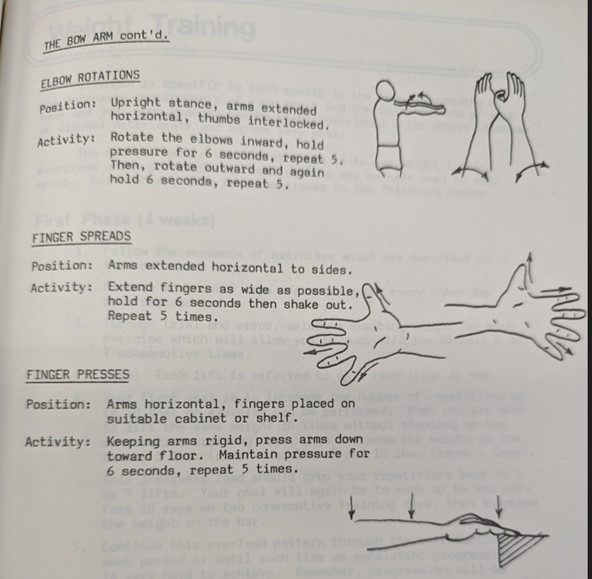
Page titled “The Bow Arm cont’d” with instructions and illustrations of figures doing the exercises described.

Three other exercises for bow arm isometrics: elbow rotations, finger spreads and finger presses. (OCLC 15918112)

By including these exercises in your regimen, you’ll be fit enough to surf down a flight of stairs on a shield while shooting arrows, just like Legolas!

Although our published section provides a vast array of content concerning archery, we also hold many records about archery in our archival holdings.

A good fonds to consult is the Federation of Canadian Archers fonds. This fonds contains a multitude of records concerning the federation. Researchers can garner a wide array of information by consulting the sections found under “Record information – Details.” For example, the “Scope and content” section conveys the following information:

Fonds consists of publications, bulletins, minutes and correspondence; competition records; finances, membership, history; instructional programmes, rules; scrapbooks; athletes’ files; president’s files.

Photographic material depicts various Canadian archery championships and activities of the Federation of Canadian Archers, 1949–1972. Medallic objects consist of six competition medals (1966–1971), and one 1969 Federation of Canadian Archers pendant. Maps contain plans of the competition sites in Montréal and Joliette during the 1976 Summer Olympic Games.

Something interesting I learned from the “Biography/Administrative history” section—also located under the “Record information – Details” header—was the fact that the first time Canada competed internationally in archery was in 1963 at the world championships in Helsinki!

Aside from this fonds, I located many photographs of archery that are available entirely online in our archival holdings. You won’t need to scour the physical records for these!

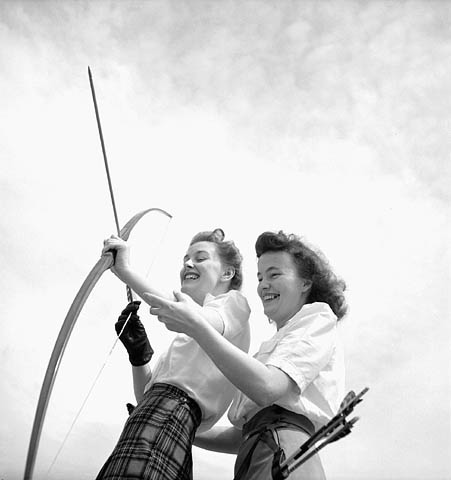
Some of our photographs show how much a delight archery can be, such as the photograph below:

One woman holding a bow and arrow while another woman with arrows in her pocket helps her with her form.

Two women participating in archery while smiling. (e000762820)

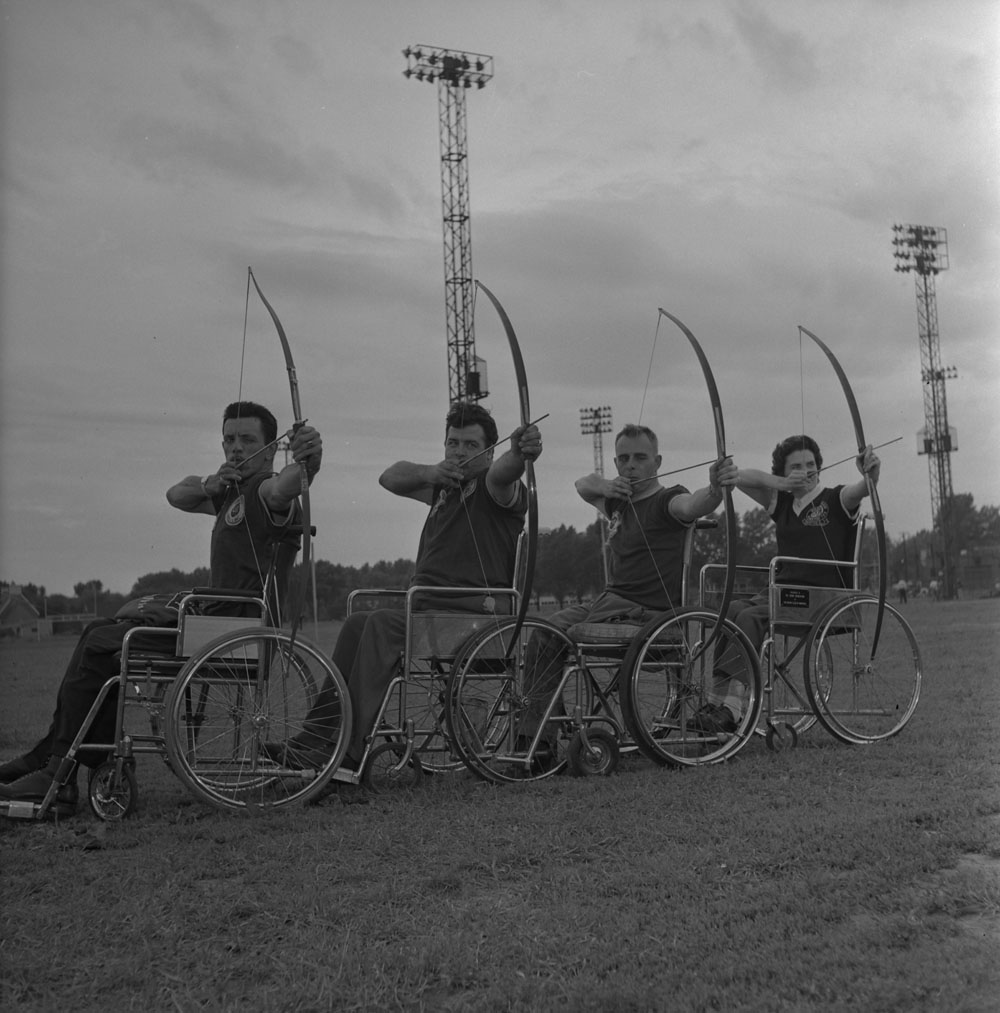
Other photographs demonstrate that archery is practiced by a wide variety of individuals—for example, wheelchair archery is a prominent part of the Paralympics:

Three men and one woman in wheelchairs in position to shoot their arrows.

Four Canadian Paralympic archers in a field. Left to right: Pierre Brousseau, Roch Poirier, Jean Rochon, Thérèse Tourangeau. (e011176636)

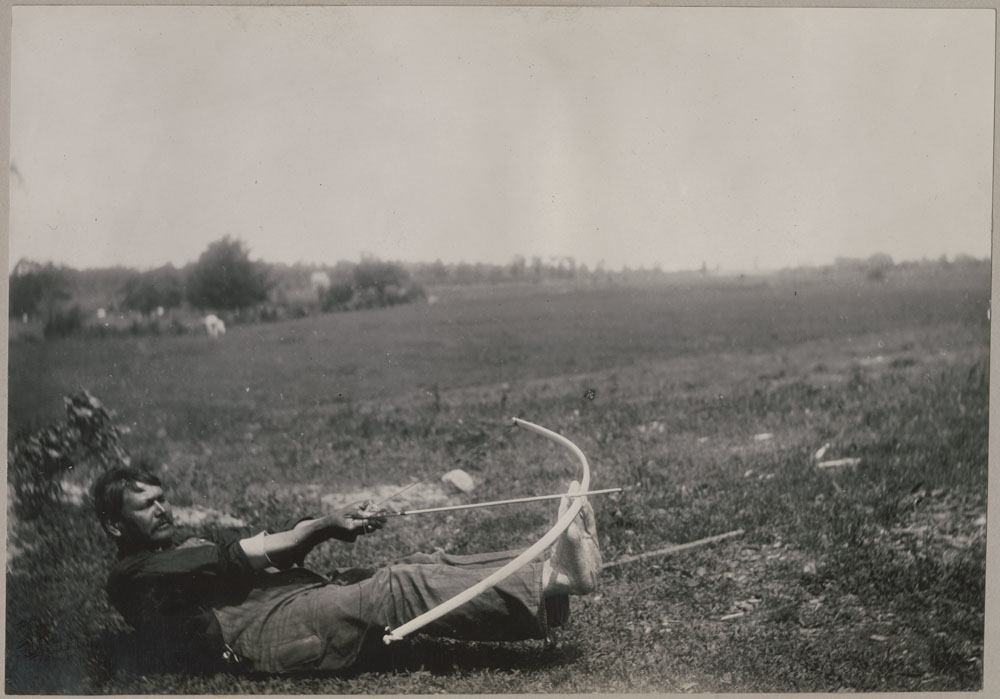
Some of our photographs demonstrate some remarkable archery techniques, like the one below wherein the archer is drawing the bow while holding it with his feet—let’s see Robin Hood do that!

A man preparing to shoot an arrow holding the bow string with his hands and bracing the bow with his feet.

Archer John Jamieson Jr. drawing a bow with his feet while lying down. (e011310538-037_s3)

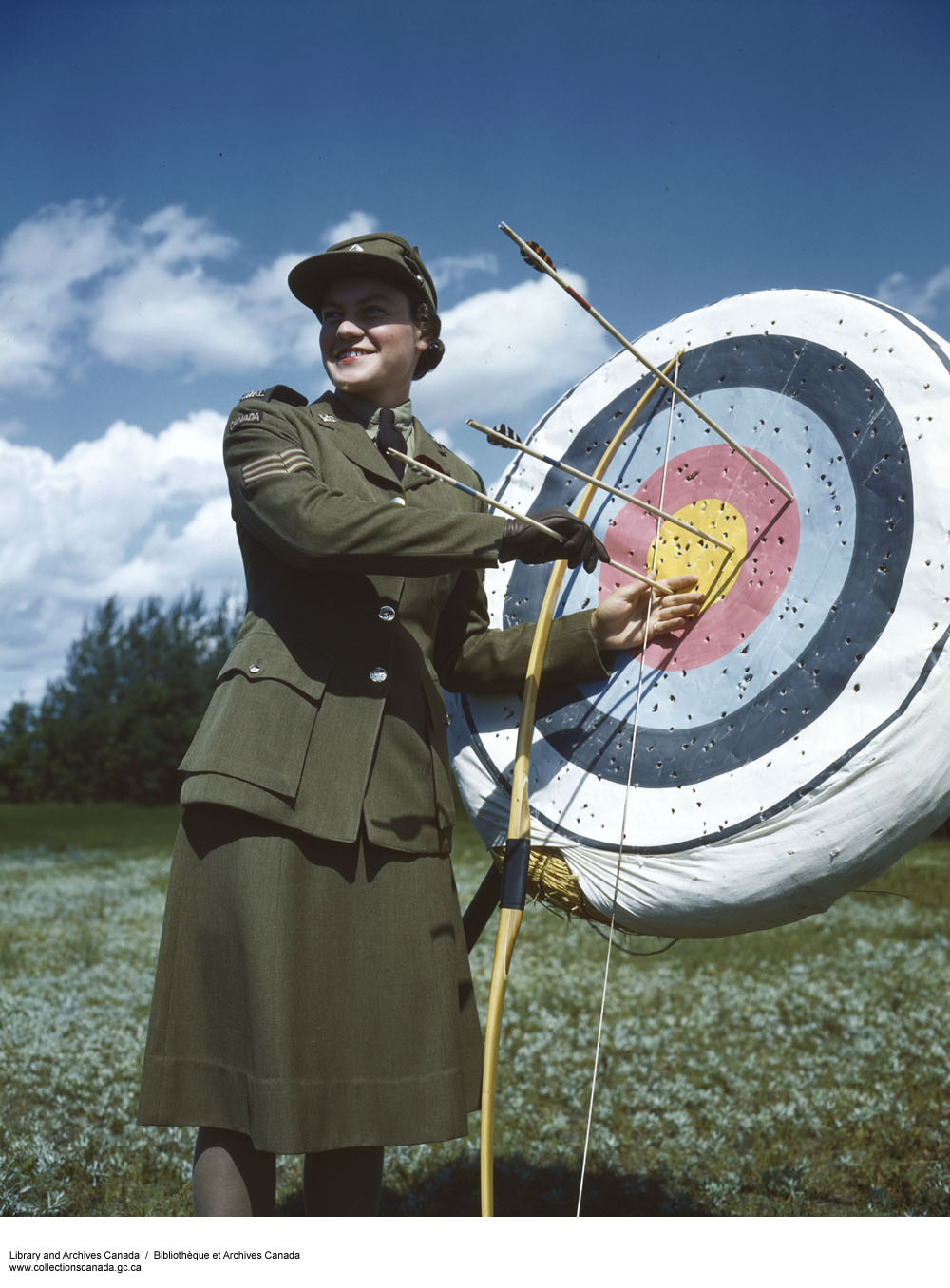
During my search, I noticed that we had several pictures of military service women practicing archery. The photograph below shows a Canadian Women’s Army Corps (CWAC) member next to a target, demonstrating that they were indeed a force to be reckoned with!

A woman in military uniform taking an arrow out of a target while holding her bow.

CWAC archer in front of target. (e010778805)

Throughout my hunt for archery photographs, I came across some offensive language that I think is important to highlight as it is an unfortunate part of LAC’s archival history, such as the original title of the photograph below:

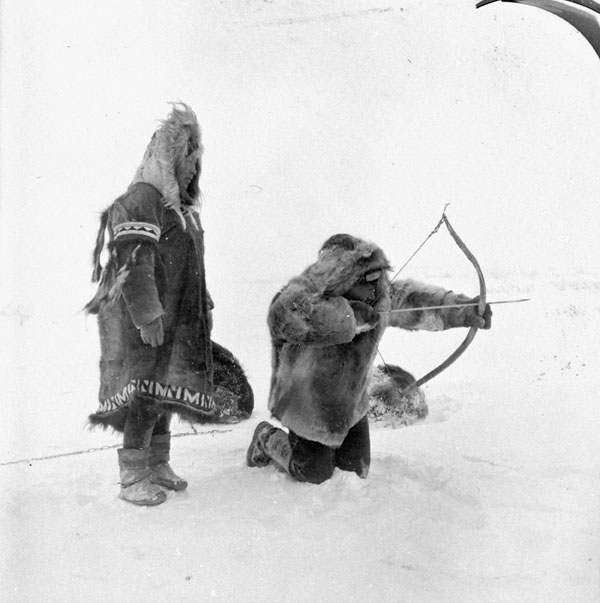
Man kneeling on snow in position to shoot his bow and arrow, with a woman standing behind him.

Inuk man using a bow made of muskox horn as his wife watches. (a211284)

Archival descriptions such as the one above reflect historical language and content that may be considered offensive—for example, language used to refer to racial, ethnic and cultural groups.

Items in the collection, their content and their descriptions reflect the time when they were created and the views of their creators. The items retain their original descriptions to ensure that attitudes and viewpoints are not erased from the historical record. LAC provides additional descriptive information to give background on such records. This is an ongoing process.

If you see records with inappropriate language or content that you think LAC should review, please contact us at reference@bac-lac.gc.ca.

Archery is a sport that requires many faculties to perform well. Although it can be frustrating at times, it is so rewarding to see the arrow strike the centre of a target and to hear that triumphant *thump* as the arrow penetrates its target.

I hope you enjoyed looking through some of the archery-focused holdings we have at LAC, and I hope it inspires you to get out there and try your hand at the ancient art of archery.


Dylan Roy is a Reference Archivist in the Access and Services Branch at Library and Archives Canada.

Faster, Higher, Stronger: Canada at the Summer Olympics

Version française

By Sali Lafrenie

The Olympics are heating up! With the games underway, now is the perfect time to dive back into our Olympic coverage here at Library and Archives Canada. While Canada is often considered a powerhouse in winter sports, Canadian athletes have earned more medals at the Summer Games than at the Winter Games. To date, Canada has earned a total of 326 medals at the Summer Olympics, with the most success in athletics, aquatics (swimming, artistic swimming, and diving) and paddle sports (canoe/kayak and rowing).

In this instalment of our Olympics series, we’re revisiting these popular medal sports and a few others!

Five Canadian postage stamps depicting various Olympic sports, such as diving, cycling, swimming, athletics, and gymnastics.

Canadian postage stamps depicting sports moments from the 1992 Olympic Games. (e003576364)

The Matchless Six: Amsterdam 1928

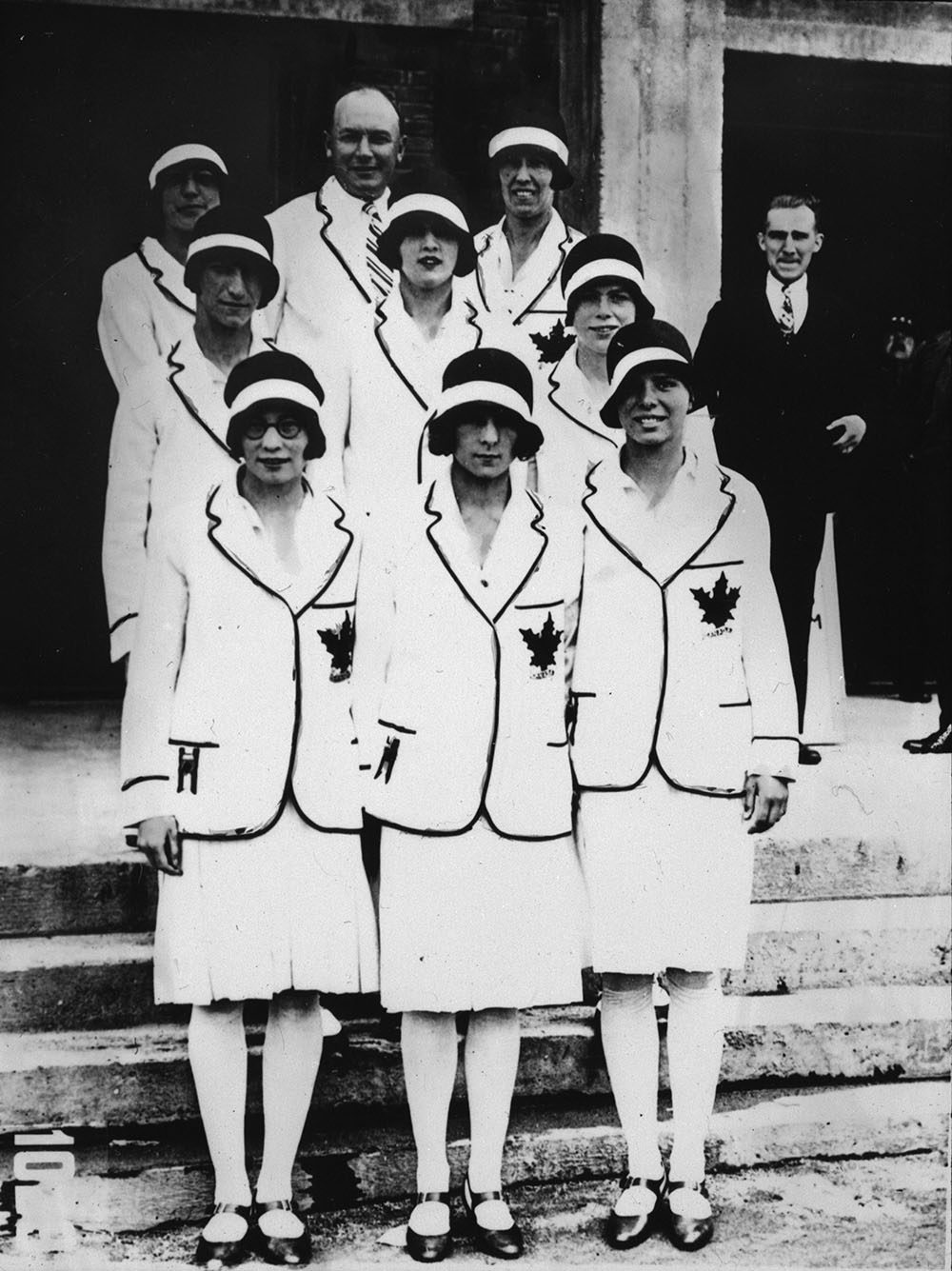
Remembered for their outstanding performances at the 1928 Olympics, the “Matchless Six” were Canada’s first Olympic women’s team. But why were they the first? And what did they do?

Despite the modern Olympic Games beginning in 1896, women were not allowed to compete in athletics until 1928. The team, consisting of Fanny Rosenfeld, Jean Thompson, Myrtle Cook, Florence Jane Bell, Ethel Smith, and Ethel Catherwood, made history by collectively winning four medals and competing in four events. Their dominance was particularly impressive given that women could only compete in five athletics events at the time.

The Matchless Six paved the way for future generations of Canadian women in athletics. They have since all been recognized individually in multiple halls of fame in Canada and in Parks Canada’s registry of National Historic Persons.

Photograph of six women dressed in white blazers and skirts posing for a photo. Four other individuals are present in the background.

The Matchless Six: Canadian women’s track and field team taking part in the 1928 Summer Olympics in Amsterdam. (a151001)

A Family of Olympians: 1912, 1960–1968

After qualifying for and competing in the 1912 Olympics, John “Army” Howard became the first Black Olympian to represent Canada (the first Black Canadian-born Olympian to medal was Raymond Lewis in 1932). Although his athletic career was put on hold while he served in the Canadian Expeditionary Force during the First World War, he got the chance to compete one more time for Canada at the 1919 Inter-Allied Games where he won bronze in the 100-metre event. Photos of the 1919 Inter-Allied Games can also be found in our collection.

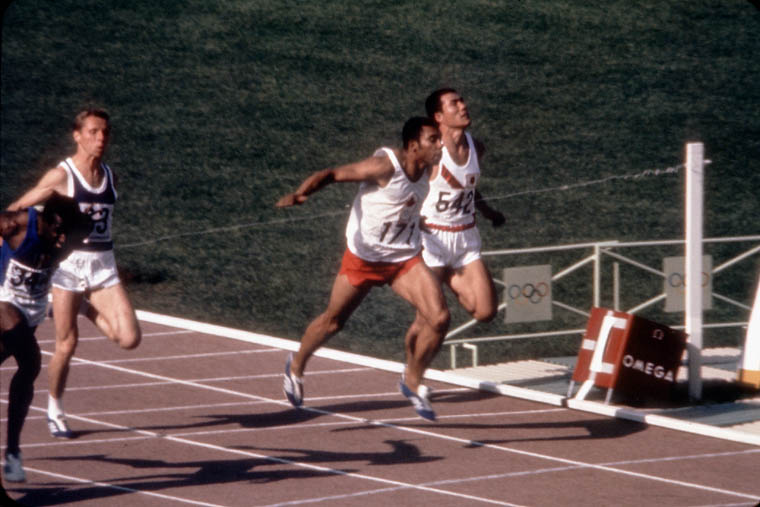
His legacy continued through his grandchildren, Valerie and Harry Jerome, both of whom competed at the Olympics during the 1960s. Making their Olympic debut together in Rome 1960, the brother-sister duo made an impact on and off the track. They both won numerous medals at the National Championships, the Pan American Games, and the Commonwealth Games. However, it was Harry who made multiple Olympic appearances, winning bronze in the 100-metre event. Their family left an enduring mark on Canadian athletics and provided early representation for Black athletes on Team Canada.

Photograph of three athletes running on a track across the finish line at the Olympics.

Harry Jerome competing at the 1968 Summer Olympics in Mexico. (a209764k)

Medal Droughts: 1912–1984 and 1936–2024?

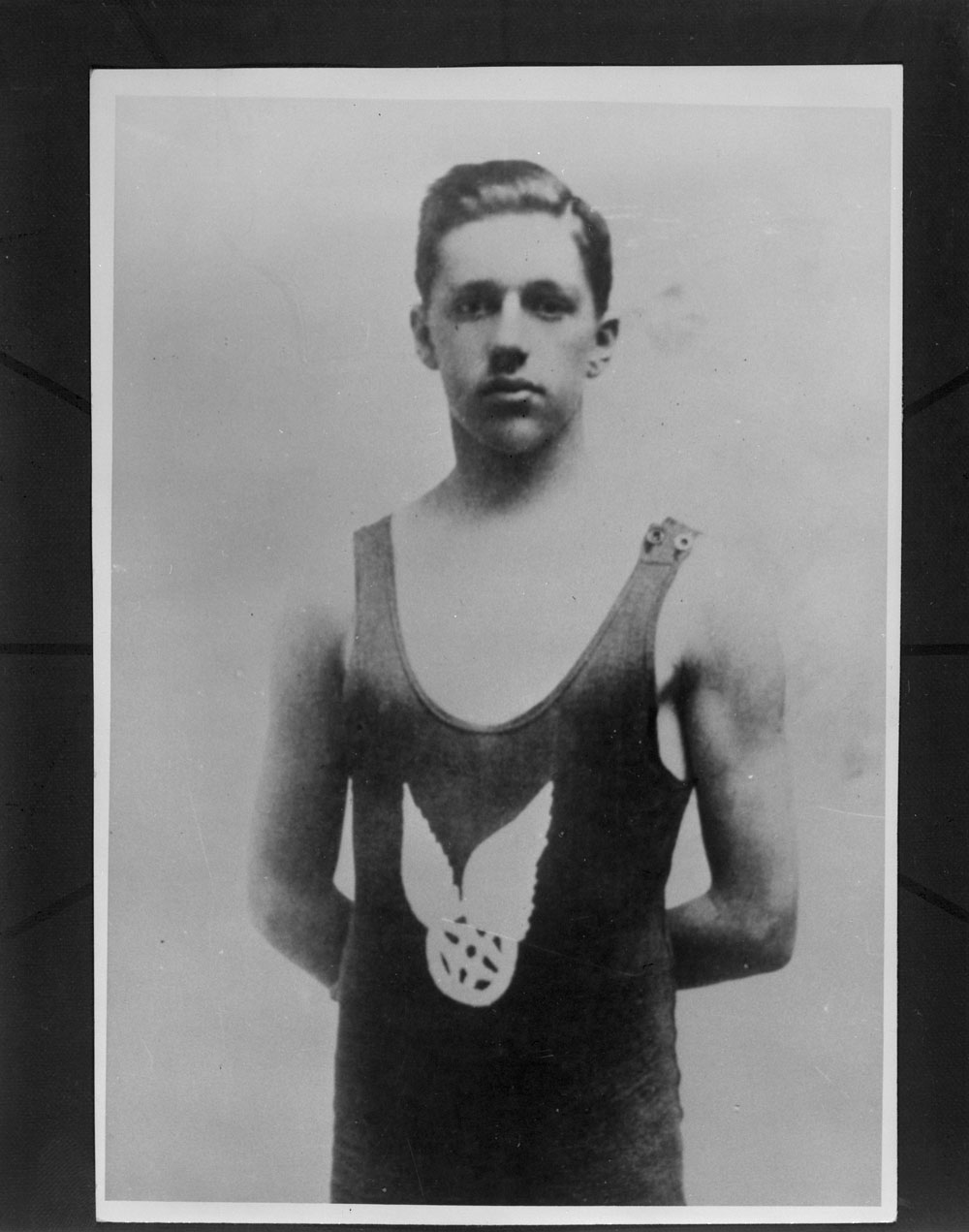
Sometimes medal droughts happen, but the important part is when they end. Canada has experienced two notable medal droughts, particularly in swimming and basketball. For decades, Canadian swimmers were shut out from the top of the podium, leaving George Hodgson as our sole gold medal winner—he won two gold medals and set four world records in 1912. With the outbreak of the First World War, Hodgson put his athletic career on hold to serve as a flight sub-lieutenant with the Royal Naval Air Service. In 1984, the 72-year drought ended spectacularly with golden finishes by Alex Baumann, Anne Ottenbrite (the first Canadian woman to win gold in swimming), and Victor Davis.

Photograph of a man in a swimsuit.

George Hodgson. (a050291)

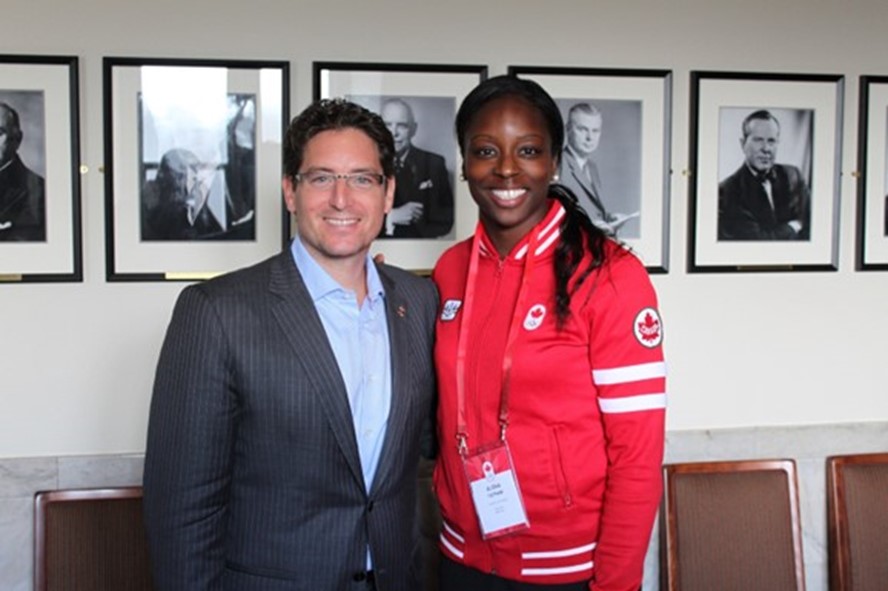
In basketball, Canadian teams have been working hard to end an 88-year drought. However, with recent success at the FIBA World Cup and the Pan American Games, both the men’s and women’s teams are suiting up for the Olympics together for the first time in over two decades. With Canadian players at an all-time high in the NBA and growing buzz about a new WNBA franchise coming to Canada in 2026, will 2024 be the year that Canadian basketball ends its medal drought?

Photograph of a man and a woman standing together.

Alisha Tatham, a member of the London 2012 women’s basketball team—the team’s first appearance since the Sydney 2000 Olympics. Credit: Jason Ransom. (MIKAN 5609841)

Paddling to the Podium: 1992–1996 and 2004–2012

Team Canada has an extensive history of success in paddle sports, winning a total of 69 medals at the Summer Games in rowing (introduced at the Paris 1900 Games) and kayaking (introduced at the Paris 1924 Games). So, it should come as no surprise that rowing ranks as the third most successful event for Canadians at the Summer Olympics, with kayaking coming in fourth.

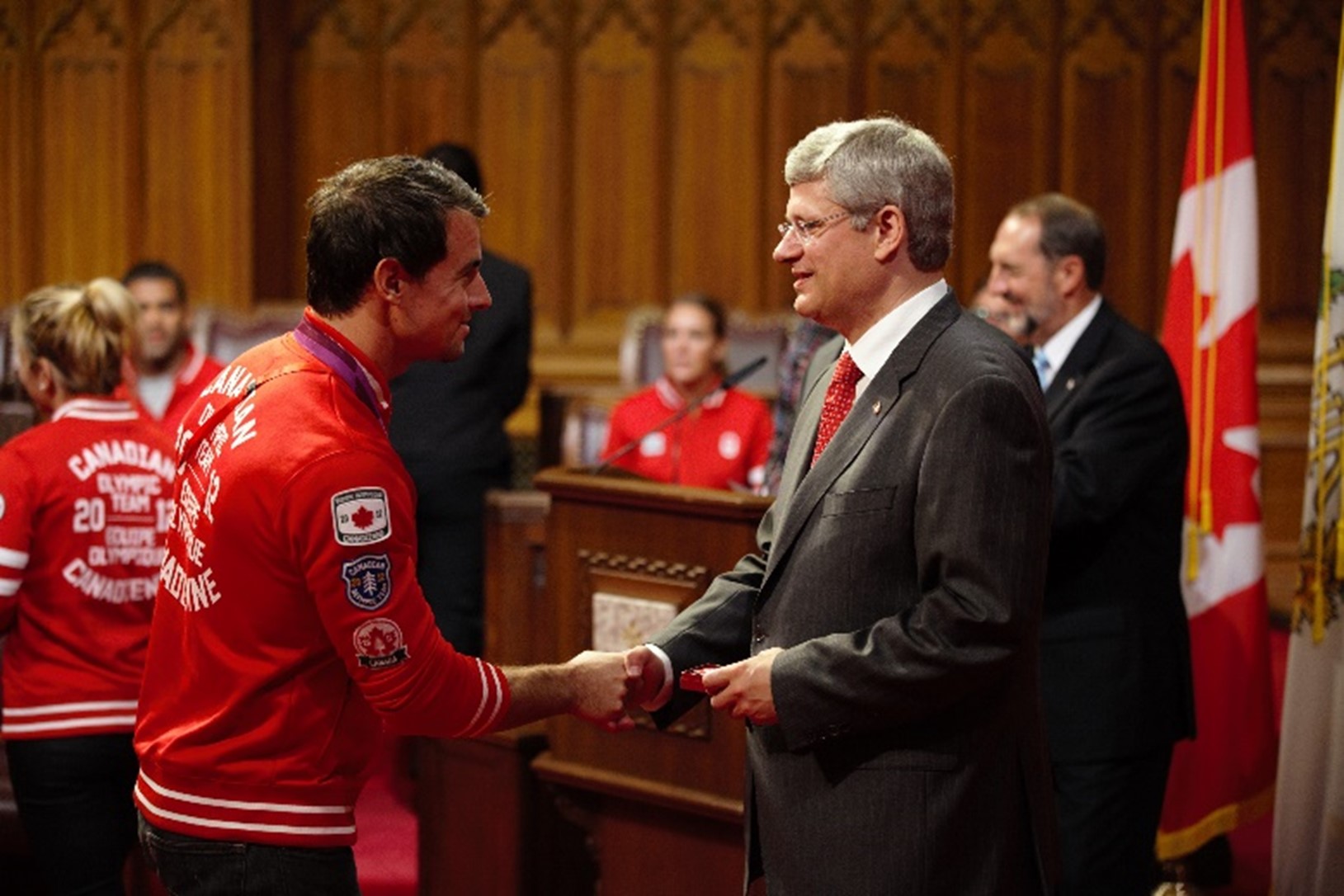
The most successful Canadian athletes in these sports have each earned four medals: Marnie McBean, Kathleen Heddle, and Adam van Koeverden. McBean and Heddle competed at Barcelona 1992 and Atlanta 1996, earning four medals in two games and the titles of triple gold medallists. Now a member of Parliament, kayaker van Koeverden earned four medals in three games and is often referred to as Canada’s most successful paddler.

McBean and Heddle’s golden achievements have earned them both induction into the Canadian Olympic Hall of Fame and Canada’s Sports Hall of Fame—a recognition van Koeverden should expect to receive as well.

Photograph of two men smiling and shaking hands.

Adam van Koeverden meeting with Prime Minister Stephen Harper after the London 2012 Olympics. Credit: Jason Ransom. (MIKAN 5609841)

Back-to-Back Appearances: 2000–2004 and 2020–2024

Competing in the women’s water polo event at Paris 2024, Team Canada is making their fourth appearance at the Summer Games. Earning their Olympic berth in dramatic fashion earlier this year, the women’s water polo team is looking to make some waves. While we eagerly wait to see how the team will do, let’s look back at the team from Sydney 2000 and their notable co-captain, Waneek Horn-Miller.

Known for her athletic skills and motivational speaking, Waneek Horn-Miller is one of Canada’s most influential women in sport. She’s also the first Mohawk woman to compete for Team Canada at the Olympics. Co-leading the first women’s Olympic water polo team in 2000 to their best-ever finish, she also competed at the 1999 Pan American Games and at the 2001 FINA World Championships. While Horn-Miller no longer competes, she continues to share her love for sports and community through her work as a sports commentator, brand ambassador, and public speaker. In addition to sharing her experiences of the Oka Crisis, Waneek is the director of the Storyboot Project and served as assistant chef de mission at the 2015 Pan American Games in Toronto.

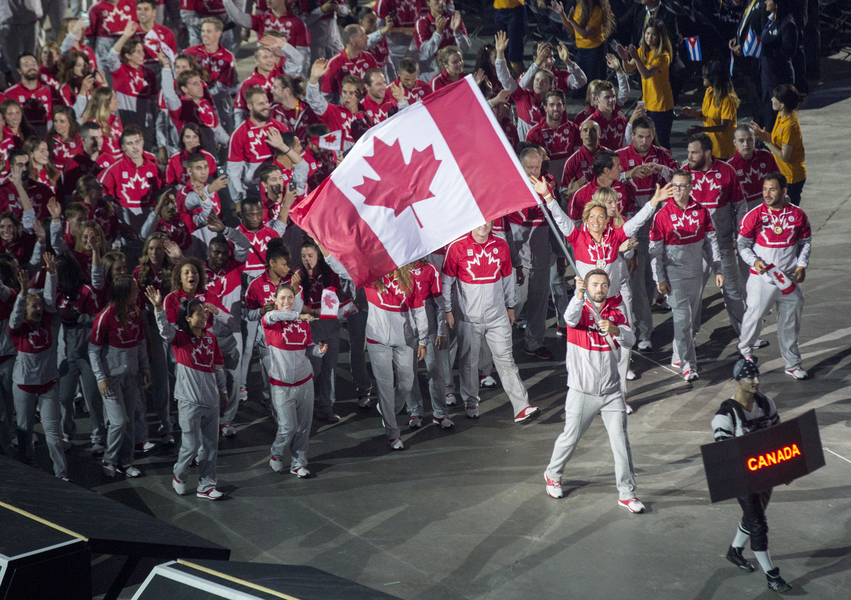
Photograph of numerous athletes marching behind a man carrying a large Canadian flag.

Team Canada at the opening ceremony for the 2015 Pan American Games in Toronto. Waneek Horn-Miller can be seen in front with both of her arms stretched out wide. Credit: Deborah Ransom. (MIKAN 5603894)

While the hunt for the podium continues for popular sports like hockey, football, volleyball, and basketball, the games have yet to begin for newer sports like skateboarding, sport climbing, and breaking (making its debut). So, what’s in store for Team Canada? Which sports are you most excited to watch? And, who’s going to be the flagbearer for the closing ceremony?

Additional Resources


Sali Lafrenie is a Portfolio Archivist in the Private Archives Branch at Library and Archives Canada.
Ahead by a Century: remembering the Paris 1924 Olympics

Version française

By Sali Lafrenie

Picture it. Paris, 1924.

You’re at the Summer Olympic Games. And there are roughly 3,000 other athletes there with you.

What sport are you playing? Tennis? Maybe soccer? Basketball? Oh wait, is it aquatics? Athletics? No, boxing? Well, whatever it is, I bet you’re excited. You should be: Team Canada only sent 65 competitors, and this is the first time the Games are going to be broadcast live on the radio!

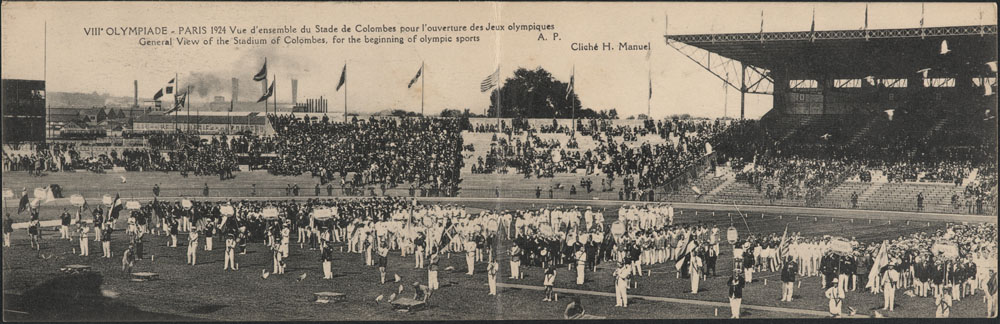
A black and white panoramic photograph of an outdoor stadium with hundreds of athletes.

General view of the Stadium of Colombes at the beginning of the 1924 Olympic Games (e011783298).

Considered to be the most successful of the Modern Games, the 1924 Summer Games in Paris looked very different from the Olympics that we know and love today. For starters, there were only 17 sports included in these Games. Five sports had been dropped from the previous iteration in 1920, with others included solely for demonstration or exhibition purposes.

Playing host for a third time, Paris 2024 will see Canada send 338 athletes to compete. The Games boast a whopping 32 sports, doubling the number of sports included at the 1924 Olympics.

In honour of the centenary, let’s dive into the 1924 Olympic Games!

1924 Winter Olympics

Did you know that when France bid to host the Summer Olympics in 1924, they accidentally started a new trend? That trend was the Winter Olympic Games.

The practice of hosting the Summer and Winter Games in the same year—sometimes in the same country—continued until 1992 when the International Olympic Committee decided to shift the Games to an alternating two-year schedule.

Before 1924, the Olympics only consisted of summer sports and did not have a winter sports equivalent. But there’s always a first. Hosted in Chamonix, France from January 25 to February 5, 1924, 260 athletes competed across 16 events. This means that 2024 is also the 100-year anniversary of the first Winter Olympic Games.

While Canada only sent 12 athletes to these Games—collectively earning a singular medal—there’s more to the story than that. The Chamonix Olympics was just the beginning for these athletes and the Canadian Winter Olympic Team, which had a roster of 215 athletes in 2022.

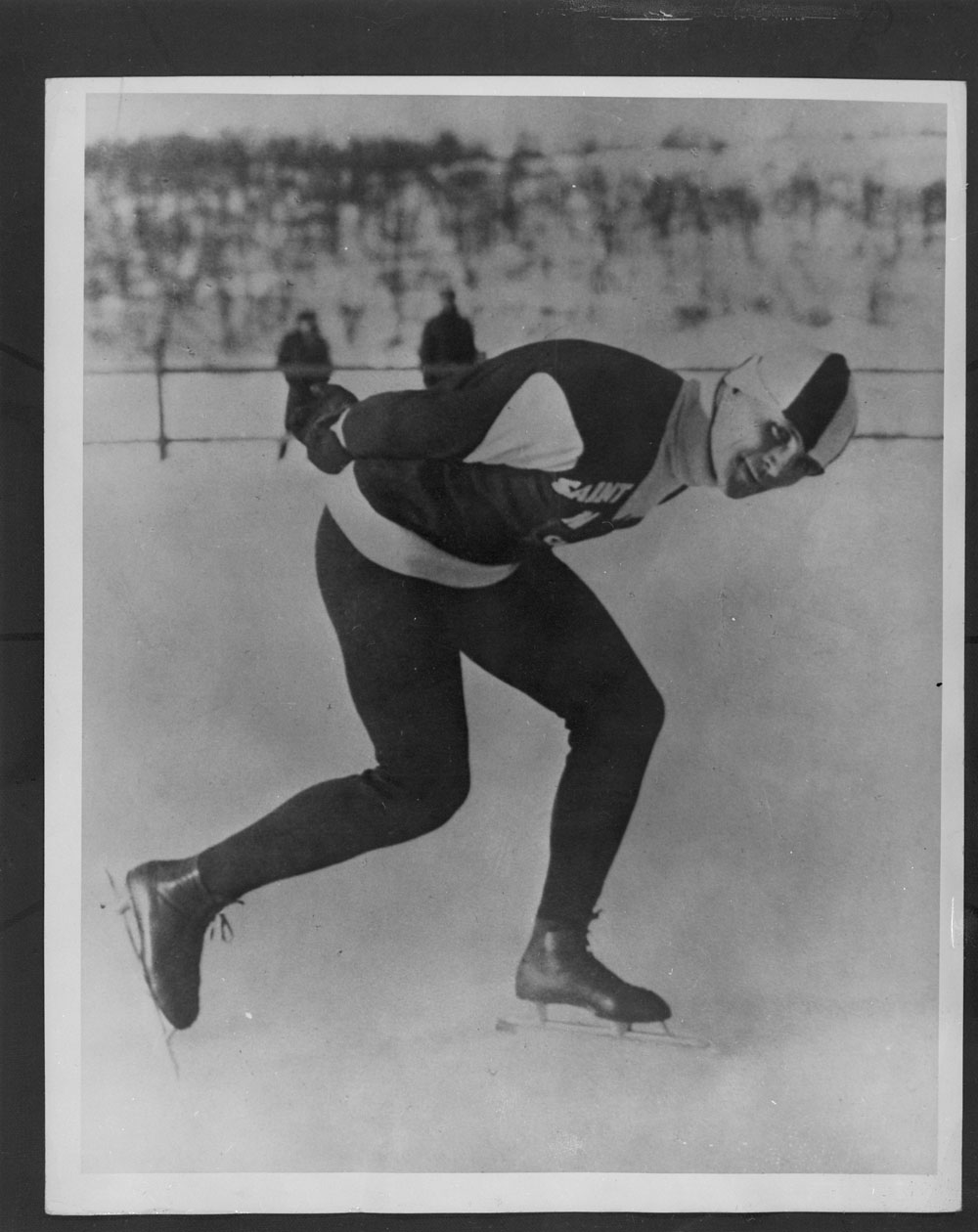
Charles “Charlie” Gorman, New Brunswicker and First World War Veteran, was one of these athletes. He made his Olympic debut in speed skating alongside the debut of the sport itself. Despite a disappointing finish in the 1924 Games, Gorman competed and won medals for Team Canada in numerous competitions, such as the American Championships, the Canadian Championships, and the World Championships.

A black and white photograph of a man speed skating and looking directly at the camera.

Photo of Charles Gorman speed skating (a050382).

Cecil Smith Hedstrom also made history at these Olympic Games when she became the first female Olympian to represent Canada. Competing in figure skating, Smith appeared in three Olympic Games and achieved many early feats to propel Canadian figure skating onto the world stage. For all these reasons and more, Smith was inducted into the Skate Canada Hall of Fame in 1991.

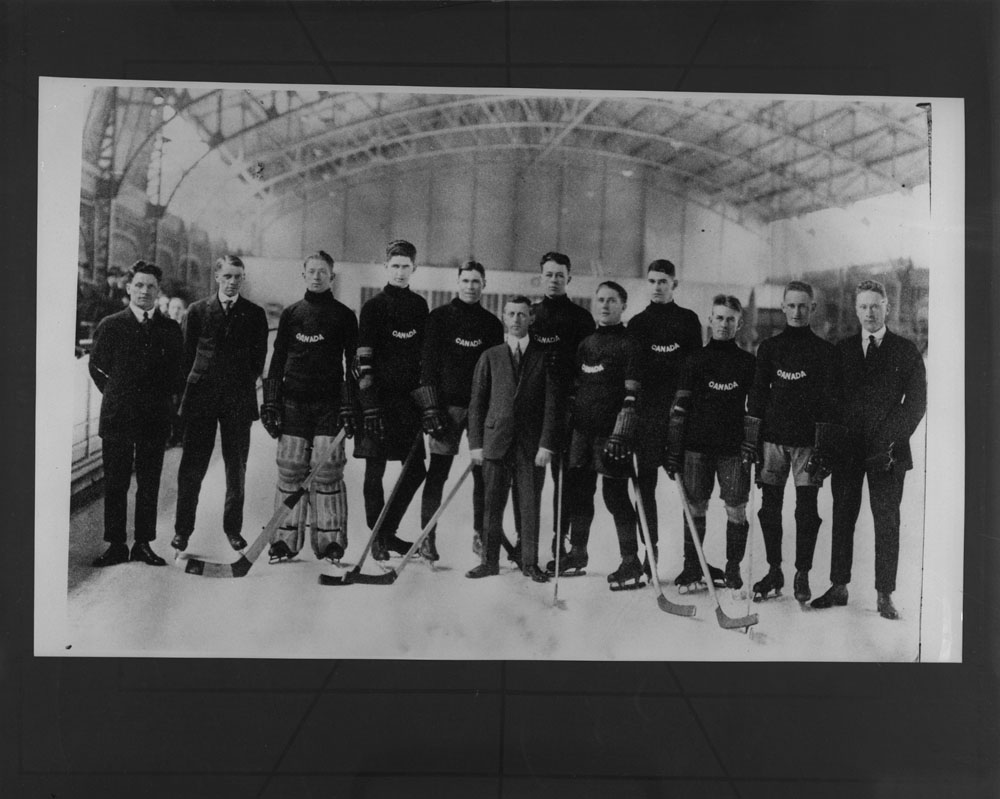
Earning the only medal for Team Canada at the Chamonix Games, the Toronto Granites Hockey Club won Canada’s first Winter Olympic gold medal. With this win, the Granites extended Canada’s Olympic ice hockey medal streak, initiated in 1920 by the Winnipeg Falcons who won gold in Antwerp. While ice hockey made its debut in the Antwerp Games, that was the first and last time the sport was included in the Summer Olympics. This means that Canada is the only country to have won a gold medal in ice hockey at both the Summer and the Winter Olympic Games.

A black and white photograph of a men’s hockey team standing on the ice holding hockey sticks.

Winnipeg Falcons, Olympic Champions (a049622).

1924 Summer Olympics

While all Olympic Games are important, the 1924 Summer Games had a special glow to it: live radio transmissions, the introduction of the Athlete’s Village, and the debut of the Olympic motto, “Faster, Higher, Stronger.”  The Modern Games ushered in a new era of international sports competitions that has only continued to expand in size and spectacle since 1924.

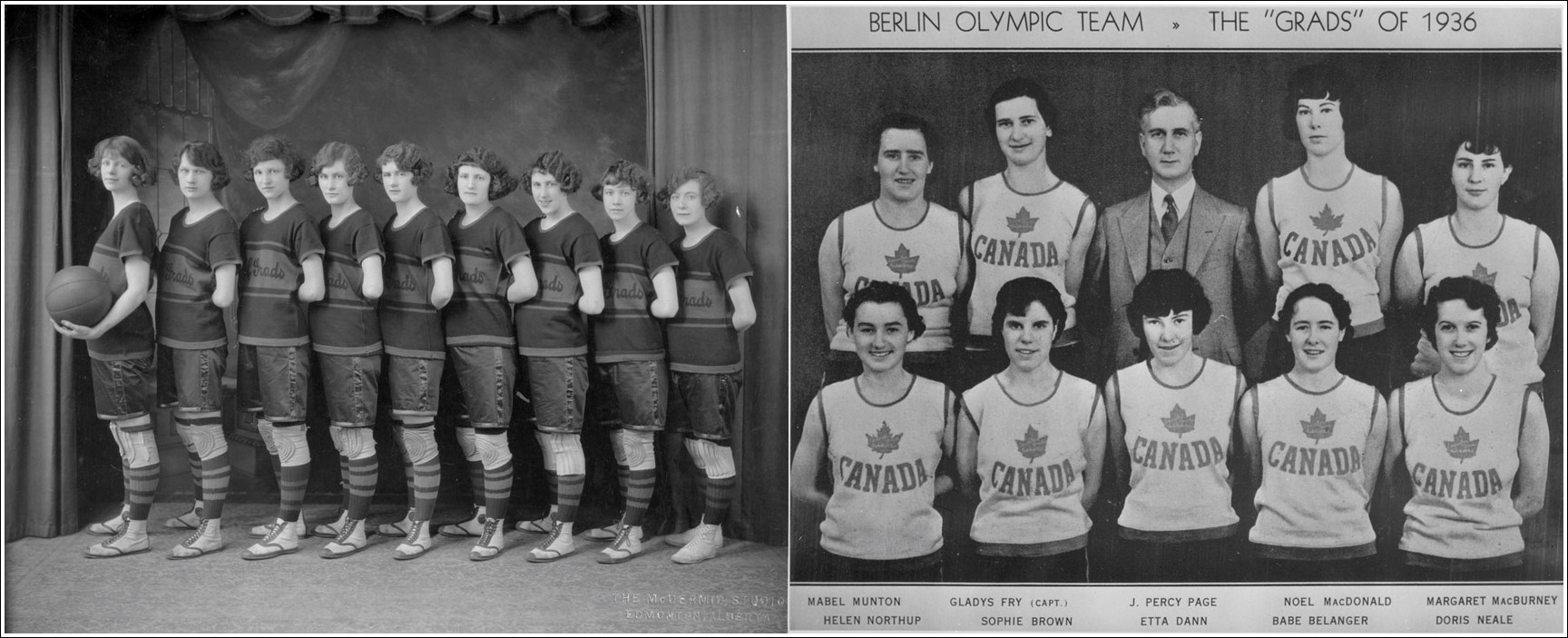
One of the greatest success stories of the 1924 Olympics comes from a group of athletes who technically were not a part of the Games: the Edmonton Grads. Although basketball was not officially included in the Olympics—men’s basketball would join in 1936 and women’s basketball would join in 1976—the Fédération sportive féminine internationale (FSFI) decided to hold their own matches alongside the Summer Games.

At home and abroad, the Grads were a difficult team to beat. They won approximately 95% of all the games they ever played and won the FSFI women’s basketball tournaments in 1924, 1928, and 1936.

Two black and white photographs of a group of female athletes. The first photograph has nine women standing in a line with one holding a basketball. The second photograph has nine women posing in two rows with a man standing in the middle of the back row.

Team photos of the Edmonton Grads in 1924 and 1936 (a050440) and (a050442).

Making his Olympic debut, Canadian hurdler Warren “Monty” Montabone soared onto the world stage in Paris 1924 and then again in Amsterdam 1928. In between Olympic appearances, Monty also set a Canadian record that stood for 58 years in the 110 m hurdles event. His athletic career can be traced beyond the Olympics all the way back to his time as a student athlete at Loyola and as an amateur athlete with the Montreal Amateur Athletic Association.

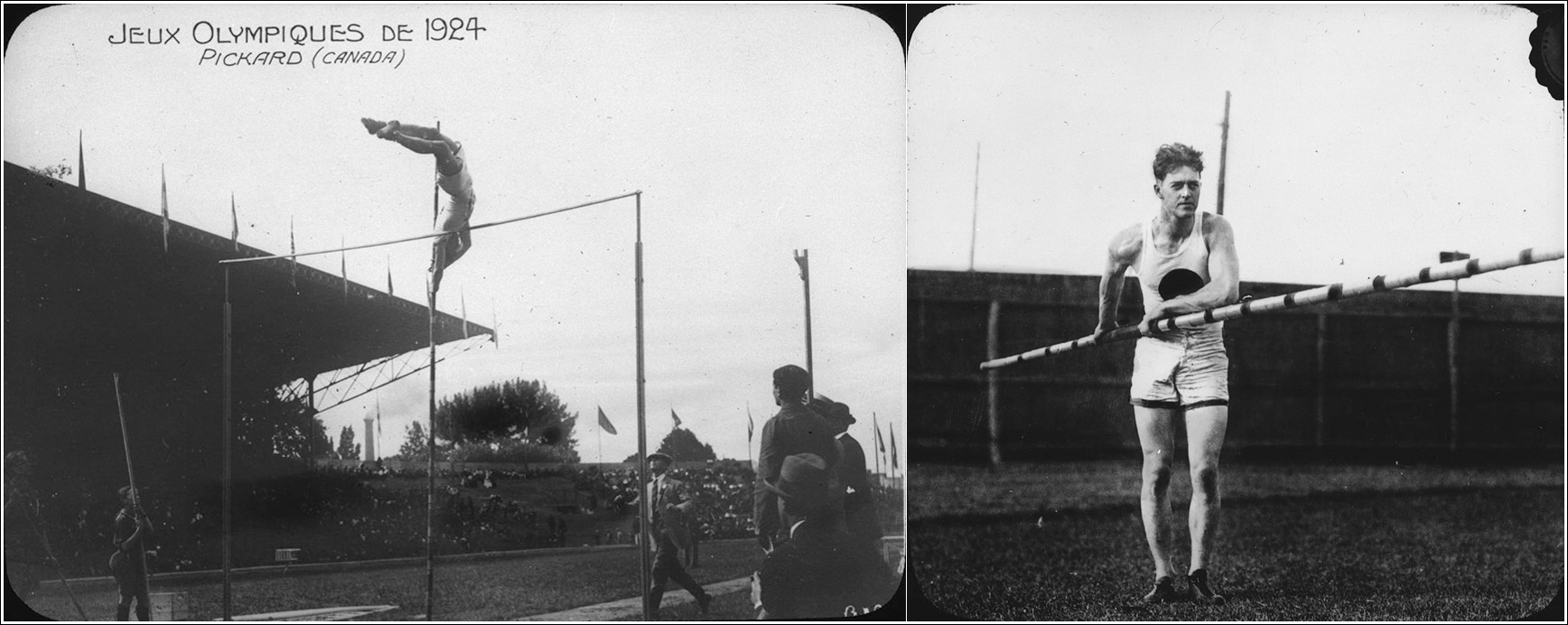
Another athlete who made his Olympic debut in 1924 is Victor Pickard, the pole vaulter and javelin thrower. Pickard represented Canada at two Olympic Games (1924 and 1928) and won a gold medal in pole vaulting at the British Empire Games in 1930. During his athletic career, Pickard’s highest jump at the Olympics was 3.45 m, but his personal best was 4.15 m. Today, the Canadian pole vault record stands at 6.00 m and the world pole vault record stands at 6.24 m.

Two black and white photographs of a male pole vaulter. The first shows a man jumping over a bar with a vaulting pole. The second shows a man holding a vaulting pole horizontally before beginning to run.

Victor Pickard at the 1924 Olympics (a151000) and (a151014).

While every Olympic Games is different, they always guarantee two things: excitement and excellence. Whether that’s through record-breaking performances, making a political statement or rallying around an athlete in need, the Olympics have got something for everyone. The Games have come to symbolize a lot more than just fair play, athleticism, and national identity. They’re a cultural moment. They bring people together in bars, in living rooms, and in schools. They’re history in the making and they’re just getting started.

Additional Resources


Sali Lafrenie is a Portfolio Archivist in the Private Archives Branch at Library and Archives Canada.
“The Man of Bronze”: Olympic athlete Dr. Phil Edwards

Version française

By Dalton Campbell

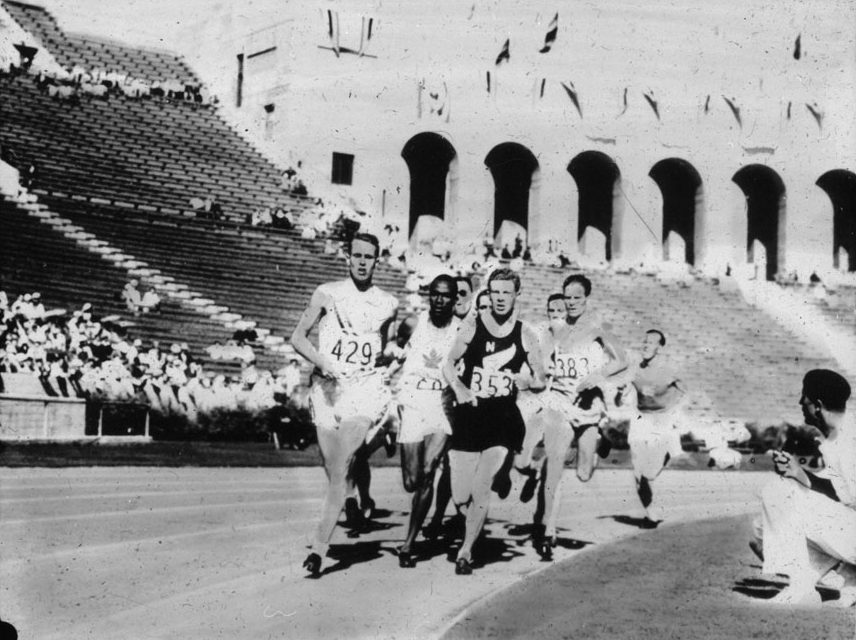
Dr. Philip Aron “Phil” Edwards earned five Olympic bronze medals in the 1920s and 1930s. It was the most career Olympic medals won by a Canadian athlete to that point and a Canadian record that would stand for 70 years.

Male athletes competing in a race.

Phil Edwards crossing the finish line, 1928 Olympics (a150990)

Nicknamed “The Man of Bronze,” his specialty was the middle distance. He finished on the podium at three Olympic Games: the 1928 Amsterdam Olympics (4 × 400 metre relay), the 1932 Los Angeles Olympics (800 m, 1500 m and 4 × 400 m relay) and the 1936 Berlin Olympics (800 m).

In 1936, he was the inaugural winner of the Lou Marsh Trophy as Canadian athlete of the year.

Edwards was born in Guyana (then called British Guiana). As a young man, he moved to the United States, studying at New York University and competing in track. But his British citizenship prevented him from joining the U.S. Olympic team. Edwards was invited to join the Canadian Olympic team for the 1928 Games. In 1931, he moved to Canada and enrolled at McGill University, where he joined the track team.

A group of male athletes competing in a race.

Phil Edwards leading the field, 1932 Olympics (a150989)

Edwards was the first Black Canadian to win an Olympic medal. He was one of few Black Canadian Olympians in the first half of the 20th century, along with John Armstrong Howard, Sam Richardson and Ray Lewis, who won bronze with Edwards on the Canadian relay team at the 1932 Olympics.

Edwards had an extraordinary year and a half in 1935–36. He led McGill to a fifth consecutive Canadian university track title in the autumn of 1935. Before the 1936 Olympics in Berlin, he completed his medical studies, becoming one of the first Black graduates from the McGill medical program. The Globe and Mail reported that he was named co-captain and associate physician of the 1936 Canadian Olympic team. At year’s end, he won an unofficial triple crown when he was named Canadian athlete of the year, Canadian amateur athlete of the year and Canadian Press male athlete of the year.

Edwards won bronze in Berlin, where he ran in the face of open racial hostility from Germany’s Nazi government, which saw the Olympic Games as a propaganda showcase for its racist ideas. He was among the Black athletes who won medals, which included U.S. track stars Jesse Owens and Mackenzie “Mack” Robinson, older brother of Jackie Robinson.

On the return trip to Canada, the team was booked in a hotel in London, England. Edwards was refused a room, so the rest of the team decided to leave the hotel and find accommodations where their teammate would be accepted.

Dr. Edwards’ medical specialty was tropical and chest diseases. In 1937, he was appointed resident house surgeon at Barbados General Hospital. He served with the Canadian Army as a captain during the Second World War. After the war, he studied at McGill and practised at the Royal Victoria Hospital in Montréal, where he would become head of the parasitology department. He worked with the Red Cross program in Congo in 1960.

Several male athletes competing in a race.

Phil Edwards, second from left, competing at the 1932 Olympics (a150988)

He managed British Guiana’s (now Guyana) Olympic team at the 1956 Olympics, held in Melbourne, Australia.

His record for most Olympic medals by a Canadian—five—was unbeaten for 70 years. In 2002, speed skater Marc Gagnon matched this achievement. In 2006, speed skater Cindy Klassen earned her sixth Olympic medal, breaking the record. In 2010, speed skater and cyclist Clara Hughes also earned a sixth medal.

Edwards died in 1971, just short of his 64th birthday. He was survived by his wife, three daughters and two siblings. The Phil A. Edwards Memorial Trophy, named in his honour, has been awarded annually to the top Canadian track athlete since 1972. In 1997, Dr. Phil Edwards was elected to Canada’s Sports Hall of Fame.

Additional resources

  • Photograph of Edwards celebrating with Canadian sprinter Percy Williams, 1928 (a150983)
  • Radio program featuring Edwards, “Trans-Canada Matinee” (ISN 382550)
  • Interview with Edwards and other Canadian athletes, “Crysdale and Company” (ISN 382973)
  • File on Edwards, Stanley Grizzle fonds (MIKAN 3728970)
  • Video of 1932 Olympics (ISN 385532, 331681)
  • Video of 1936 Olympics (ISN 191253, 300159)
  • Highlights of 1932 Olympics (ISN 447089)
  • Footage of 1932 and 1936 Olympics (ISN 300321)
  • Highlights and footage of 1936 Olympics (ISN 191253, 300159, 33542)
  • Rapid Ray: The Story of Ray Lewis, by John Cooper (OCLC 49047597)

Dalton Campbell is an archivist in the Science, Environment and Economy section of the Private Archives Division at Library and Archives Canada.
Norman Kwong: “I always want to be the winner”

By Dalton Campbell

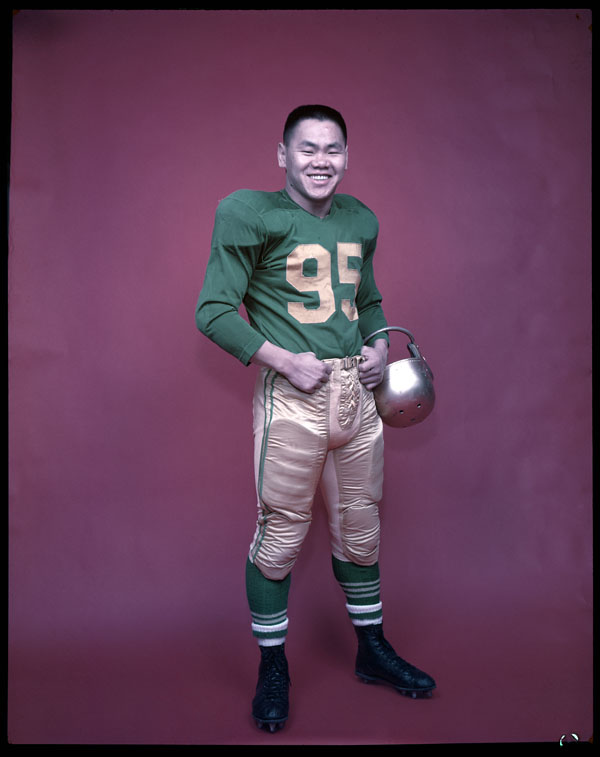
In 1948, Norman Kwong stepped onto the field with the Calgary Stampeders of the Canadian Football League (CFL) for the first time. The 18-year-old rookie, and eventual Hall of Famer, was the league’s first Chinese-Canadian player.

A colour studio photograph of a football player in uniform, holding his helmet in the crook of his left arm.

Norman Kwong (1929–2016), photo from August 1957 (e002505702)

Norman (born Lim Kwong Yew) was born in Calgary in 1929, the fifth of six children. His parents, Charles Lim and Lily Lee, operated a grocery store. They had immigrated to Canada from Guangdong, China, several years before Norman was born. His obituary in the Edmonton Journal stated that in the 1920s, there were fewer than 5,000 Chinese Canadians in Alberta. The vast majority were men, in large part because the racist and discriminatory “head tax” kept most men from bringing their wives and children to Canada. Norman’s mother was one of only five married Chinese women in Calgary. In 1923, the government passed the Chinese Immigration Act (commonly known as the “Chinese Exclusion Act”), effectively ending immigration from China. In 1947, the year before Norman began his professional football career, the Act was lifted, and Chinese Canadians gained the right to vote.

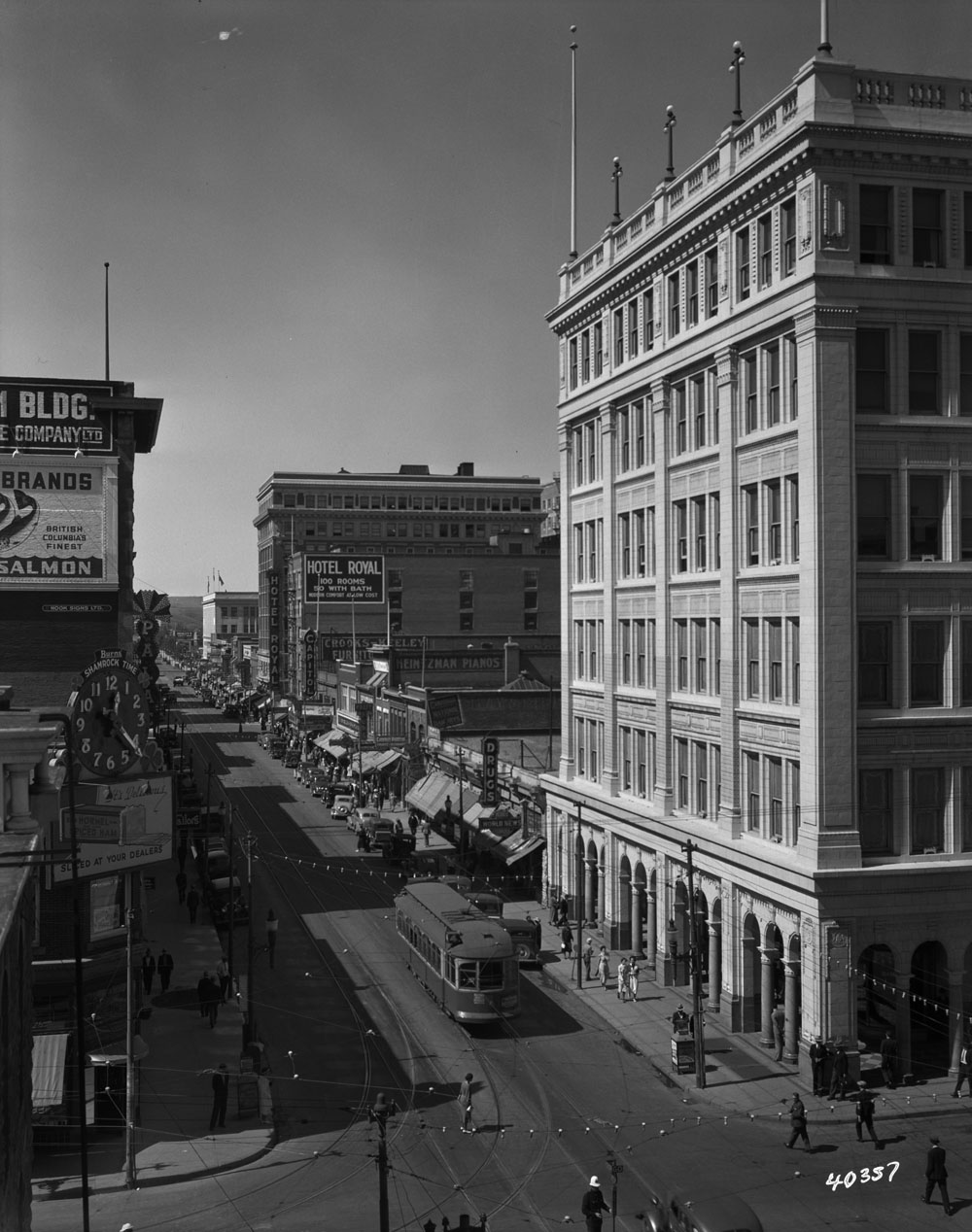
A black-and white-photograph of downtown Calgary, looking down at an intersection, with streetcars, cars and people visible on the streets and sidewalks.

8th Avenue, Calgary, Alberta, 1937 (e010862070)

In 1950, Norman was traded from Calgary to Edmonton, where he spent the rest of his career. He led the CFL in rushing three times (1951, 1955 and 1956), rushed for over 1,000 yards in four consecutive seasons, and set numerous league and team records. He was a four-time CFL West All-Star (1951, 1953, 1955 and 1956), was twice named the CFL’s Most Outstanding Canadian (1955 and 1956), and received the Lionel Conacher Award as the outstanding Canadian male athlete (1955). In 13 seasons, he played in seven Grey Cup games, winning the championship four times (1948, 1954, 1955 and 1956). He was named to the CFL Hall of Fame in 1969, to Canada’s Sports Hall of Fame in 1975, and as one of the top 50 players in CFL history (by TSN) in 2006.

His Edmonton Journal obituary quotes him as saying, “Sports is life, only it’s distilled into a shorter time. It’s clear-cut. Everything’s out in the open. There’s no way to hide. There’s always a winner and a loser. And I guess that appeals to my competitive nature. Of course, I always want to be the winner.”

Norman retired at the age of 30. He married Mary Lee and entered post-football life, working primarily in commercial real estate. In the 1980s, he returned to sports as an executive with the Calgary Stampeders and was part of the original ownership group of the Calgary Flames of the National Hockey League. When the Flames won the Stanley Cup in 1989, he became one of only five people to have won both the Grey Cup and the Stanley Cup as a player, manager or executive.

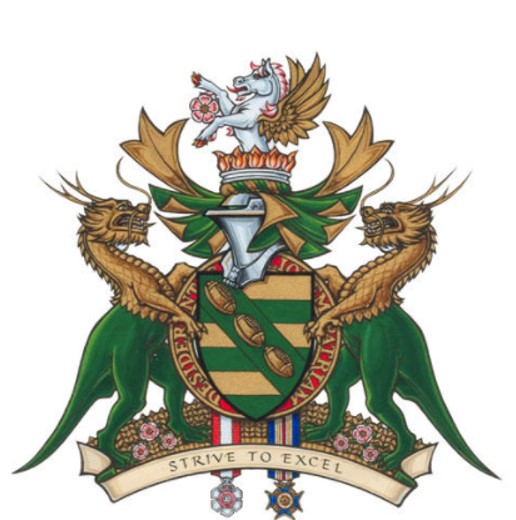
A colour image of a coat of arms. The shield in the centre has three footballs lined up diagonally from the upper left to lower right. There are two dragons, one standing on each side of the shield. The motto reads, “Strive to Excel.”

Coat of Arms of Norman Lim Kwong, courtesy of the Canadian Heraldic Authority (Office of the Secretary to the Governor General). The green and gold are the Edmonton team colours, and the horizontal stripes represent the 10-yard lines from a football field. The horse represents his first team, Calgary. The rose represents his wife, Mary, an avid gardener. The dragons represent his Chinese heritage, and the dragons’ hindquarters are representative of the Albertosaurus dinosaur.

Norman Kwong was the National Chair of the Canadian Consultative Council on Multiculturalism (1979–80) and Honorary Chair of the Easter Seals Campaign in Calgary (1982–84). He was named to the Order of Canada (1988) and later served as the Lieutenant Governor of Alberta (2005–10). The Calgary Flames named a bursary for medical students in his honour. He died in Calgary in 2016.

For further research


Dalton Campbell is an archivist in the Science, Environment and Economy Section of the Private Archives Division.

Big league baseball makes its way north

By Kelly Anne Griffin

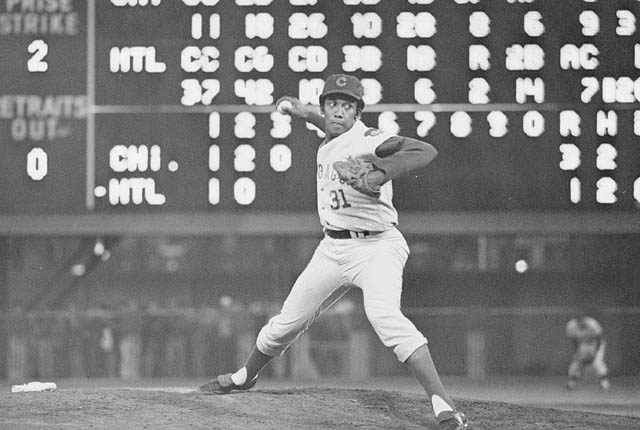
Canadians have been playing in various major baseball leagues since the 1870s. The first to do so was New Brunswick native Bill Phillips, who played first base for the Cleveland franchise. In 1883, Ontario native Tip O’Neill, the greatest pre-1900 Canadian player, would make his Major League Baseball (MLB) debut. Since then many have followed suit. The only Canadian to earn his place with a plaque on the walls of the National Baseball Hall of Fame and Museum in Cooperstown, New York, is Chatham, Ontario, native Ferguson Jenkins. Jenkins had a remarkable pitching career with 284 major league wins.

A black-and-white photograph of a pitcher throwing the ball from the mound. Behind him is a large score board displaying the score and outfielders preparing for the ball to come into play.

Hall of Famer Ferguson Jenkins pitching for the Chicago Cubs in a game against the Montreal Expos on September 19, 1970. Jenkins is now active in philanthropic work, including the Fergie Jenkins Foundation based out of St. Catharines, Ontario. Credit: Montreal Star (MIKAN 3195251)

While Jenkins is the only Canadian in Cooperstown, the Canadian Baseball Hall of Fame in Saint Marys, Ontario, honours Canadians’ contributions to the game both on and off the field. Canada has also been home to two MLB franchises, starting with the National League expansion in 1968.

The Montreal Expos – Nos Amours

The Expos had an exhilarating first week. At Shea stadium on April 8, 1969, “O Canada” played at an MLB game for the first time, bringing team owner Charles Bronfman to tears and giving rise to “Les Expos, Nos Amours”, the nickname affectionately given to the team by fans. The exciting game ended with an 11 to 10 Expos win over the New York Mets. On April 14, in the first MLB game played outside the US, the Expos won over a packed house of fans at Jarry Park in Montreal. Three days later pitcher Bill Stoneman threw a no-hitter against the Phillies. Montreal was captivated and the wild ride began.

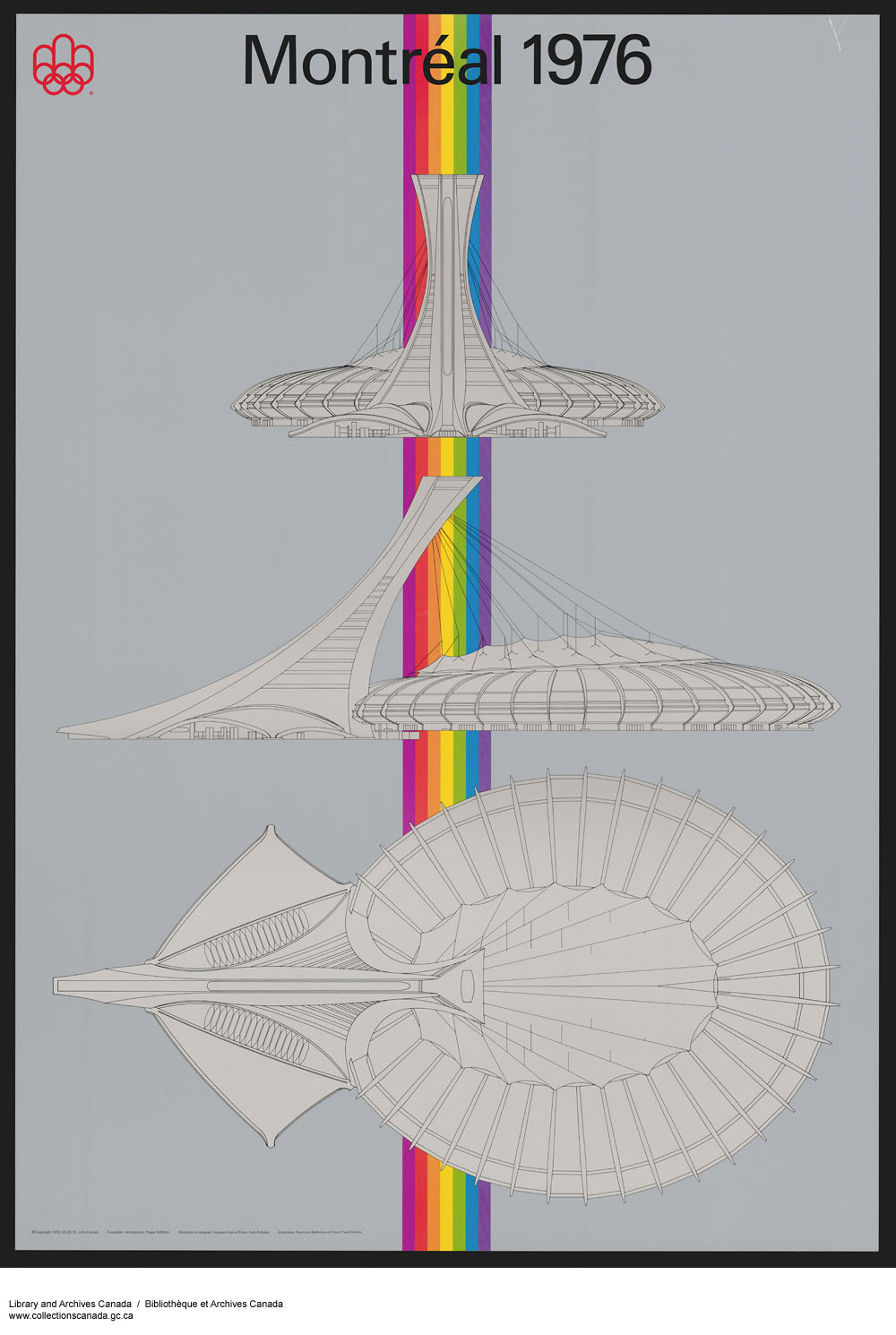
A coloured poster designed for the 1976 Olympic Games. It depicts three different views of the Olympic stadium built for the 1976 Summer Olympics in Montreal.

The Olympic Stadium in Montreal was built for the 1976 Summer Olympics, and the Expos started playing there in 1977. The stadium was problematic as a baseball venue for many reasons, including structural issues with the roof and a thin astroturf that was notouriously hard on players’ knees. Since 2014, the Blue Jays have hosted exhibition games there. © Canadian Olympic Committee (MIKAN 3929420)

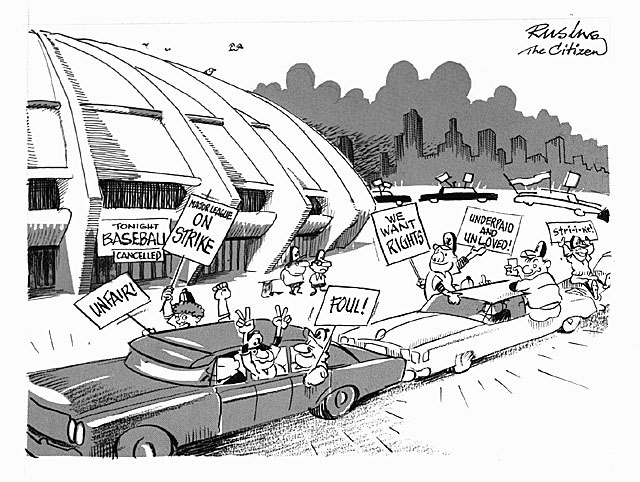
Despite an excellent farm system and outstanding talent, the Expos made it to the postseason only once, in 1981. Under the guidance of Canadian Baseball Hall-of-Fame manager Jim Fanning, the ’81 season saw Warren Cromartie, Andre Dawson and Gary Carter all hitting over .300, and Hall of Famer Tim Raines stealing a league-high 71 bases. The season, interrupted by a strike, saw them win the National League East title. They went on to play the Dodgers and came within one win of advancing to the World Series when Rick Monday hit a 9th inning home run securing Dodgers victory. That hit ended the Expos’ run and the fateful day became known as “Blue Monday” to fans.

A black-and-white cartoon showing a line of luxury cars driving in a circle around a baseball stadium. In the cars are characters leaning from the windows and holding signs with slogans, including "Unfair," "We Want Rights" and "Major League On Strike."

An editorial cartoon depicting Expos players on strike outside Olympic stadium in Montreal during the 1981 players’ strike. The strike caused the cancellation of 713 games in the middle of the season. Credit: Rusins Kaufmanis (MIKAN 2841681)

Ironically, a second work stoppage dashed fans’ hopes in 1994. In that magical season, manager Felipe Alou had the Expos sitting on top of the baseball world with a 74 wins and 40 losses record. The 232-day strike resulted in commissioner Bud Selig cancelling the World Series and so ending the chances of an Expos playoff run.

The franchise never recovered from the strike, either on the field or in the stands. In 2004, after 36 years, the Expos played their last game at Olympic stadium. The Expos’ first French-Canadian player, Claude Raymond, who had played in their inaugural 1969 season, gave a tearful final speech to fans, providing a bookend for the franchise.

Toronto Blue Jays

The Toronto Blue Jays were founded in 1977 as part of the American League expansion. The team has won six Eastern Division titles, two American League pennants and two World Series titles.

The Blue Jays first game in franchise history took place at Exhibition Stadium on April 7, 1977. Fans braved the unseasonably frigid temperatures to witness the historic event that resulted in a 9 to 5 win over the Chicago White Sox. An unknown first-baseman named Doug Ault slammed two homeruns to become the first Jays hero.

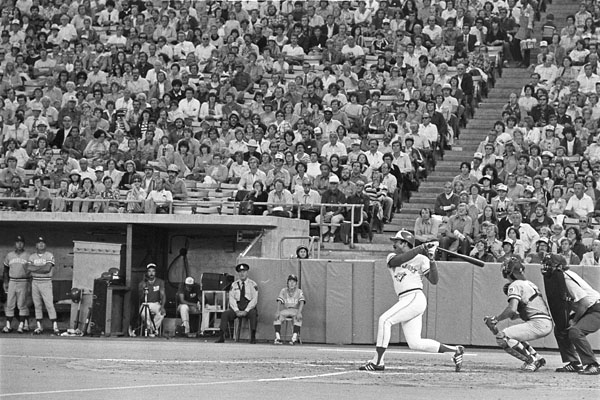
A black-and-white photograph of a baseball game. There’s a man who has just swung at the ball. Behind him is a man wearing catcher equipment and crouching, while behind him is an umpire, also crouching. In the background are players in baseball uniforms and a man wearing police uniform, all watching the action. Behind them spectators are seated in the stands.

The Toronto Blue Jays play the Kansas City Royals in their inaugural season on August 12, 1977, at Exhibition Stadium in Toronto. They played at Exhibition Stadium until 1989, when the Skydome (now Rogers Center) opened its doors. Credit: Toronto Star/Frank Lennon (MIKAN 3796691)

After many turbulent years, the Blue Jays finally made 1992 a historic one for Canadian baseball. They won their first American League championship and became the first team based outside the United States to win a World Series Championship. As a sign of respect for the team that had paved the way, the Jays asked the Expos’ original owner, Charles Bronfman, to perform the ceremonial first pitch prior to Game 3 of the series. The impressive six-game World Series concluded with Dave Winfield driving in the winning runs in the 11th inning. Jays catcher Pat Borders was awarded the series MVP.

The Blue Jays’ success continued into the 1993 season as they defended their title of American League champions. John Olerud became the first Blue Jay to win a batting title. The Jays went on to defend their World Series championship, defeating the Philadelphia Phillies in six games. In a moment forever etched in the memory of fans, Joe Carter hit a theatrical home run in the bottom of the ninth inning to win the deciding game. It was only the second time in World Series history that a series had ended on a home run.

The luck ended two years later when the Jays finished dead last in the American League East. Jump ahead to 2015, however, and the 22-season streak of failing to reach the post-season was broken under Manager John Gibbons, with the Jays winning their sixth American League East Division title. They then came back from a two-game deficit to beat the Texas Rangers in the Division Series. That series included the iconic home run and bat flip by right fielder Jose Bautista. In the American League Championship Series, the Jays lost to the Kansas City Royals, who would go on to win the World Series.

For the Jays, the 2016 regular season proved inconsistent and found them in second place in the American League East. However, they battled to make it to the sudden-death American League Wild Card game, where, in a nail-biter, they defeated the Baltimore Orioles 5 to 2, thanks to Edwin Encarnacion’s dramatic walk-off homerun in extra innings before a packed Rogers Centre crowd of roaring Canadians. A new generation of Canadian baseball fans had arrived.

Canada and baseball have not always had an easy relationship, but it has been one full of exciting and individual moments. Baseball in Canada has served as an introduction for children to the importance of team work, it has been there for soldiers in wartime, and it has united the country in times of both triumph and defeat.

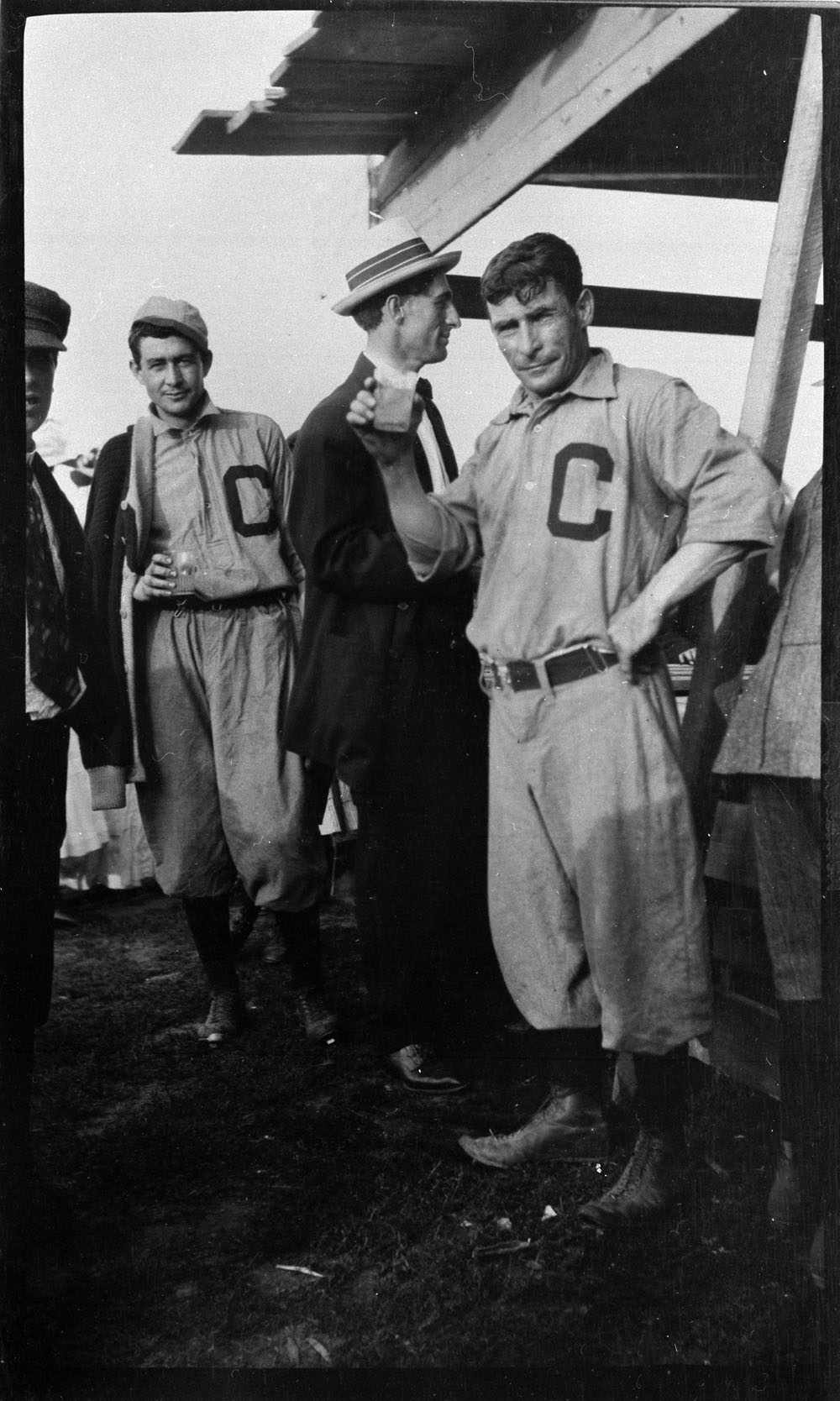
A black-and-white photograph of five men standing around a counter. Two of the men are wearing baseball uniforms with a large letter ‘C’ on the chest. The other men are wearing suits and hats. One of the uniformed men is holding up a drink and looking towards the camera.

Players in Cobden, Ontario, grab a refreshing drink after a game in 1909 (MIKAN 3379777)

“Cheers” to many more memories and many more moments for the history books as Canada plays ball!

Other resources


Kelly Anne Griffin is an archival technician in the Science, Environment and Economy section of the Archives Division at Library and Archives Canada.
From humble beginnings to making history in Montreal

By Kelly Anne Griffin

Long before unforgettable Canadian baseball moments, such as Joe Carter’s World-Series-winning home run, the emotion and pride Canadians felt as our national anthem was performed for the first time at a Major League Baseball (MLB) game, and Jose Bautista’s iconic bat flip, baseball already had a strong presence in Canada. While many of us consider baseball a North American sport, it actually has its origins in the European bat-and-ball game played by British schoolkids known as rounders. Variations of baseball were being played in Canada at least three decades before Confederation. The first documented account of the game, however, comes from Beachville, Ontario, on June 4, 1838. Southwestern Ontario was where the game was most prominent in these early days.

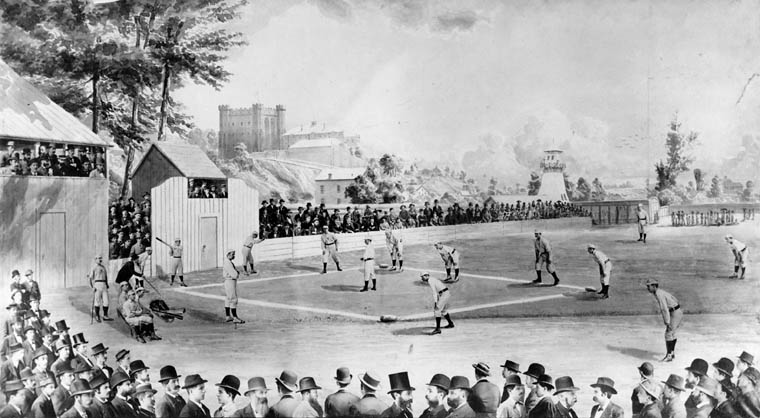
A black-and-white photograph of an outdoor baseball field with a game underway. The crowd watches from the packed stands. The background shows the buildings of the cityscape.

A baseball game at Tecumseh Park between the International League’s London Tecumsehs and the Stars of Syracuse in 1878. Now called Labatt Park, it is the world’s oldest continually operating baseball grounds, opening on May 3, 1877. It was designated a heritage site in 1994 (MIKAN 3261769)

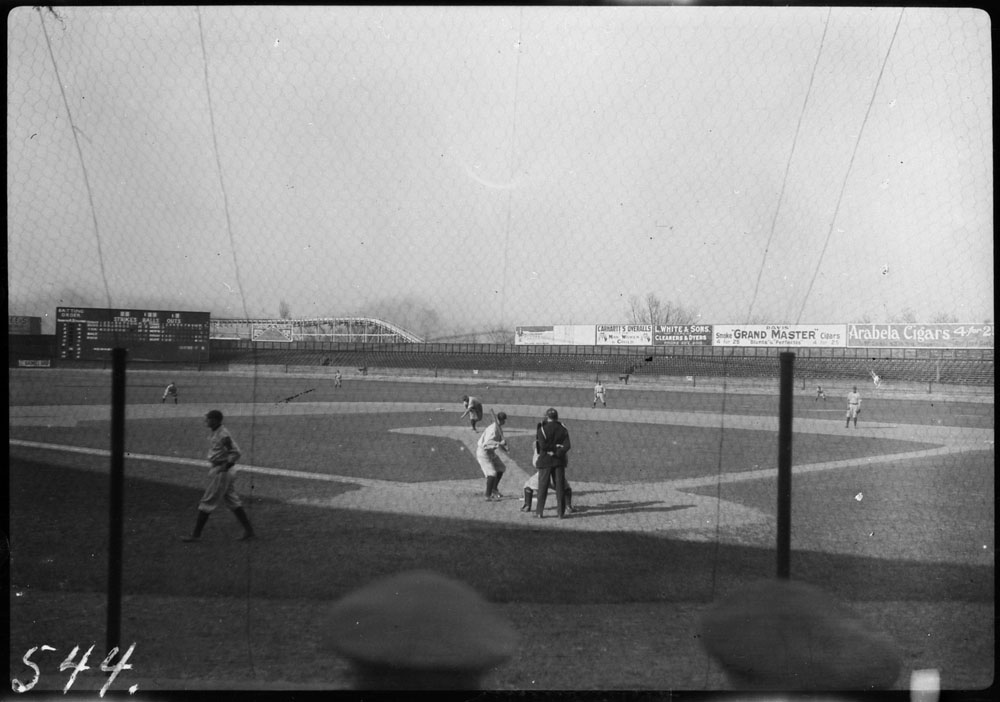
A black-and-white photograph of a baseball game from behind home plate. A player is at the plate as a pitch comes in. The umpire stands behind him to make the call.

Hanlan’s Point Stadium on Toronto Island in 1917, the first home of the International League’s Toronto Maple Leafs baseball club. It was also where Babe Ruth hit his first professional home run while playing for the Providence Grays (MIKAN 3384487)

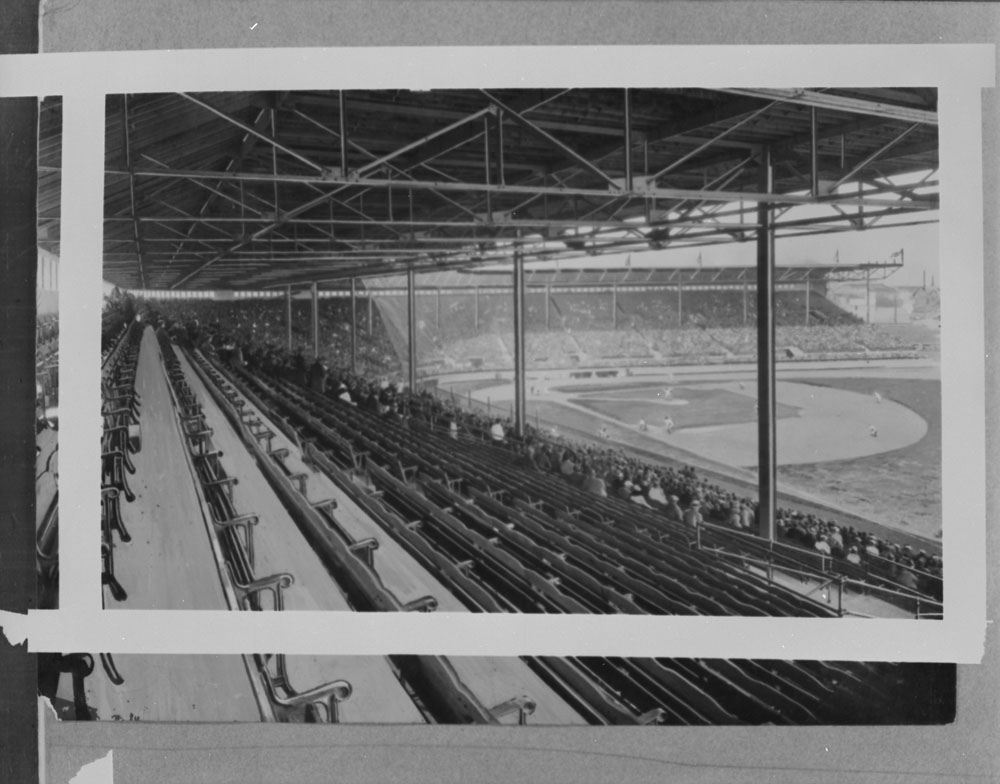
A black-and-white photograph of a baseball stadium, taken from the vantage point of the right field bleachers. The bleachers and the field, including the diamond and outfield, are visible.

View from the outfield stands at Maple Leaf Stadium in Toronto. Built in 1927 for the Toronto Maple Leafs of the International League, it was built to replace Hanlan’s Point Stadium (MIKAN 3327476)

The first official Canadian baseball team was formed as a result of efforts by William Shuttleworth, who was known as the father of Canadian baseball. The first pioneering team, comprised of various working class men from around Hamilton, was called the Young Canadians. For the next two decades, teams adhering to different rules sprouted up all over Canada. As the popularity of the sport soared, businessmen sponsored their favourite teams as a way to promote their products, and the Canadian Association of Baseball Players was founded. At this time, rather than competing nationally, many local baseball clubs competed cross-border with their closest American neighbours. By 1913, there were 24 minor league teams in Canada.

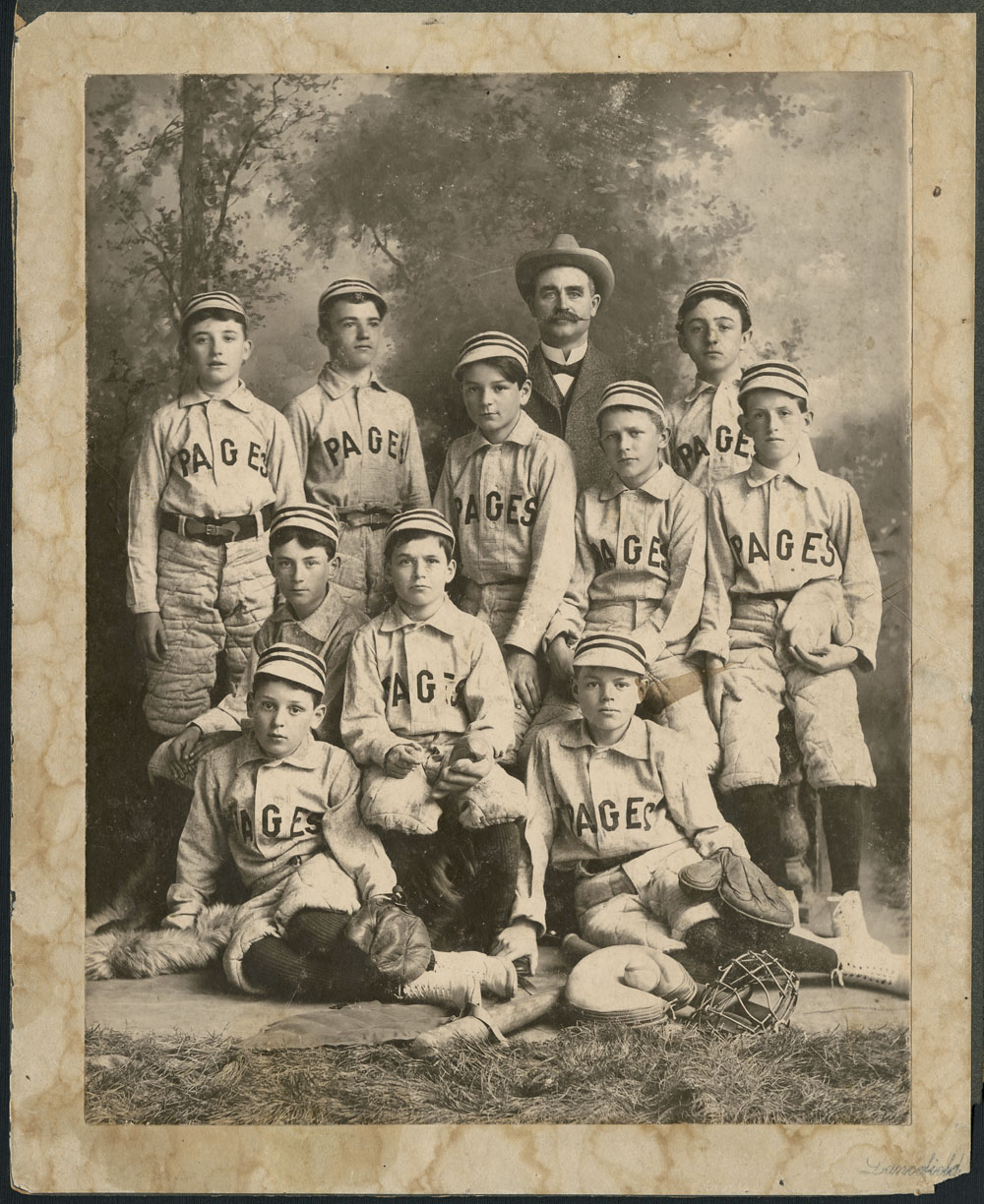
A black-and-white photograph of 10 children wearing baseball uniforms. The jerseys read "Pages" across the front. The boys are sitting and standing with bats, gloves and other baseball equipment. Behind the boys stands an adult man, wearing a suit and hat. The background is a studio backdrop showing trees.

House of Commons “Pages” baseball team, circa 1900. Baseball was enjoyed by people of all ages in Canada. It was seen as a great way to develop team skills and it was common for companies and their staff to form teams, such as these young men who worked on Parliament Hill (MIKAN 3549043)

First World War

Sports were an important part of everyday life in Europe for Canadian troops during the First World War. They served as a way to break the monotony of the troops’ duties and relieve stress. The leadership saw sports as a way of keeping the men out of trouble and boosting their morale while they stayed physically fit. Baseball became so beloved by soldiers that it was even sponsored by the government. In April 1916, the government held a fundraiser with the proceeds going towards baseball equipment.

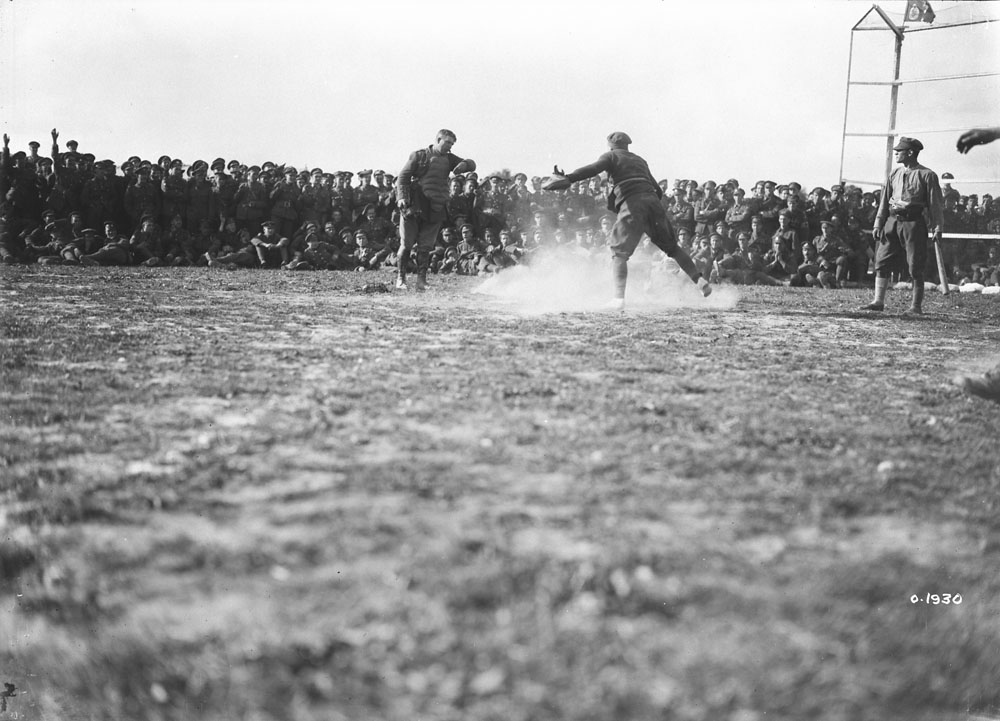
A black-and-white photograph of a player sliding into home plate. The catcher is standing over the base while the umpire makes the call. A crowd of soldiers cheers them on.

member of the Canadian team slides into home as troops cheer him on in 1917. Baseball was immensely popular with troops and games were held regularly during down time (MIKAN 3384451)

Second World War

During the Second World War, baseball continued to be a favourite pastime of troops. With the Americans’ arrival in 1942, there were suddenly plenty of other teams against which to compete. As was the case in the early days of the game back at home, Canada-versus-the-US games were commonplace. One of the most memorable games occurred at Wembley Stadium on August 3, 1942, with 6,000 cheering fans in the stands. The Canadian troops defeated US Army Headquarters, 5 to 3.

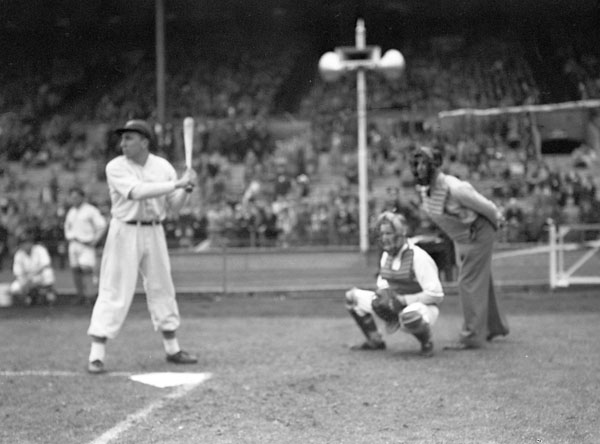
A black-and-white photograph of a baseball game. A player stands with a bat and behind him are a catcher and an umpire. In the background are players watching the play and spectators in the stands.

A game between Canadian and US servicemen in August 1942 at Wembley Stadium in London, England, a venue that held many baseball games during the Second World War (MIKAN 3211157)

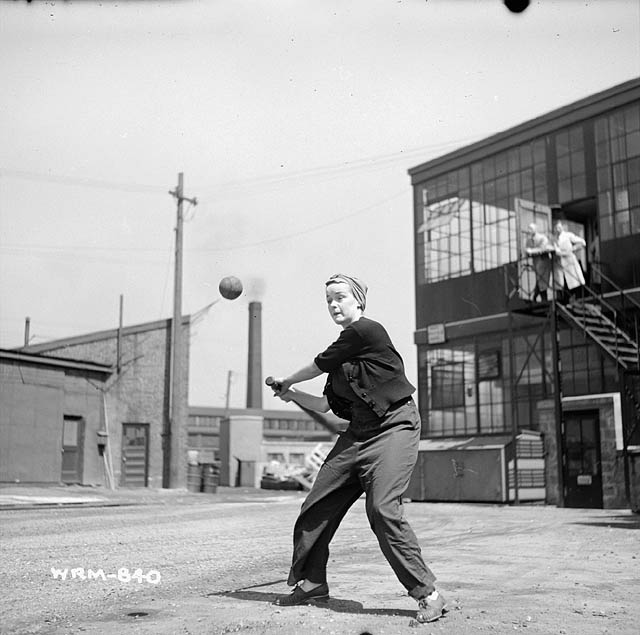
A black-and-white photograph of a woman in work clothes and a headscarf swinging a baseball bat at a ball. She stands in a vacant lot with industrial buildings and other structures in the background.

It wasn’t just those contributing to the war efforts overseas who enjoyed baseball during the war years. Here, a woman from an ammunition factory in Toronto joins a game on her break (MIKAN 3195852)

Upon returning to Canada, many soldiers spoke fondly of the baseball games and continued playing and watching back home. While Canadians played many sports during war times, none was played as often or to such an enthusiastic audience as baseball.

Jackie Robinson

In 1945, the young Negro Leagues player Jackie Robinson was approached by Brooklyn Dodgers general manager Branch Rickey. Shortly after that initial, secret meeting it was announced that Robinson had signed a contract with the organization. The plan was to find the path of least resistance to his race to ease him into the Majors. The first step was to assign Robinson to spring training in Florida then ease him into professional baseball in Montreal with the team’s triple-A affiliate. Montreal was a deliberate selection, a city in which Rickey believed Robinson could get acclimated to baseball with less of a negative experience than he likely could in many American cities. However, during that first spring, in 1946, Robinson experienced unrelenting racism. In Sanford, Florida, the sheriff stepped onto the field and cancelled an exhibition game because African Americans were not allowed to compete with white players.

Montreal was a more welcoming city for Jackie and his wife Rachel. While still not without incident, the city and its fans embraced him. In his first and only season in Montreal, Jackie helped lead the team to an exceptional record of 100 wins and only 54 losses.

Learn more about Jackie Robinson’s groundbreaking career.

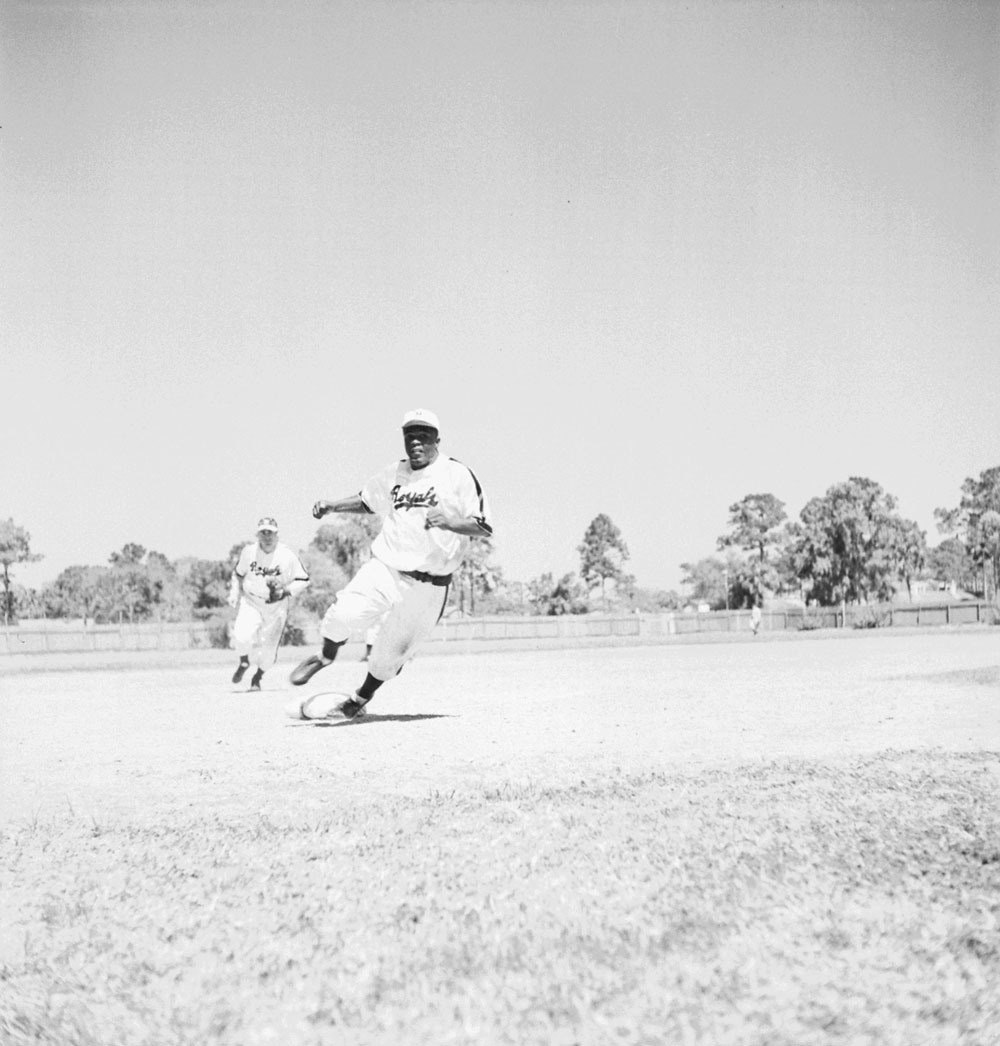
A black-and-white photograph of a baseball player rounding the bases as a player on the opposing team tries to catch up to him.

Jackie Robinson in Florida for spring training in 1946. Fans loved the way he sped around the diamond mesmerizing crowds, stealing a remarkable 40 bases during his first and only season in the minors, including many at home plate (MIKAN 3574533)

From humble beginnings in southwestern Ontario to a favourite wartime activity to the city of Montreal embracing Jackie Robinson, by the middle of the 20th century baseball had captured the heart of the nation. Still, Canada’s love of baseball was about to take on new heights. With Major League Baseball on its way, more Canadians than ever would soon fall in love with the game.

Other resources:


Kelly Anne Griffin is an archival technician in the Science, Environment and Economy Section of the Archives Division at Library and Archives Canada.
Images of Boxing now on Flickr

Boxing is the sport of fighting with padded, gloved fists in a square, roped-off ring under a set number of rounds and rules.

A black-and-white photograph of two boxers fighting on the deck of the SS Justicia, surrounded by the ship’s complement of soldiers.

Canadian troops aboard the SS Justicia, en route to Liverpool, England, watch a boxing match (MIKAN 3384735)

However, the first boxers in Canada did not use gloves. Bareknuckle fisticuffs were the norm during the early 19th century, with some bouts lasting 40 rounds. Outside of the military and a few men’s clubs, boxing was not sanctioned in the provinces of Canada, as the sport did not have a great reputation for fair play or honest promotion. Respectability for the sport came slowly, and views changed during the 1890s. The popularity of the sport grew steadily during the early 20th century.

A black-and-white photograph of two soldiers boxing. One wears black trunks and the other wears white trunks. Soldiers outside the ring watch the match.

Soldiers boxing in the exhibition grounds (MIKAN 3384740)

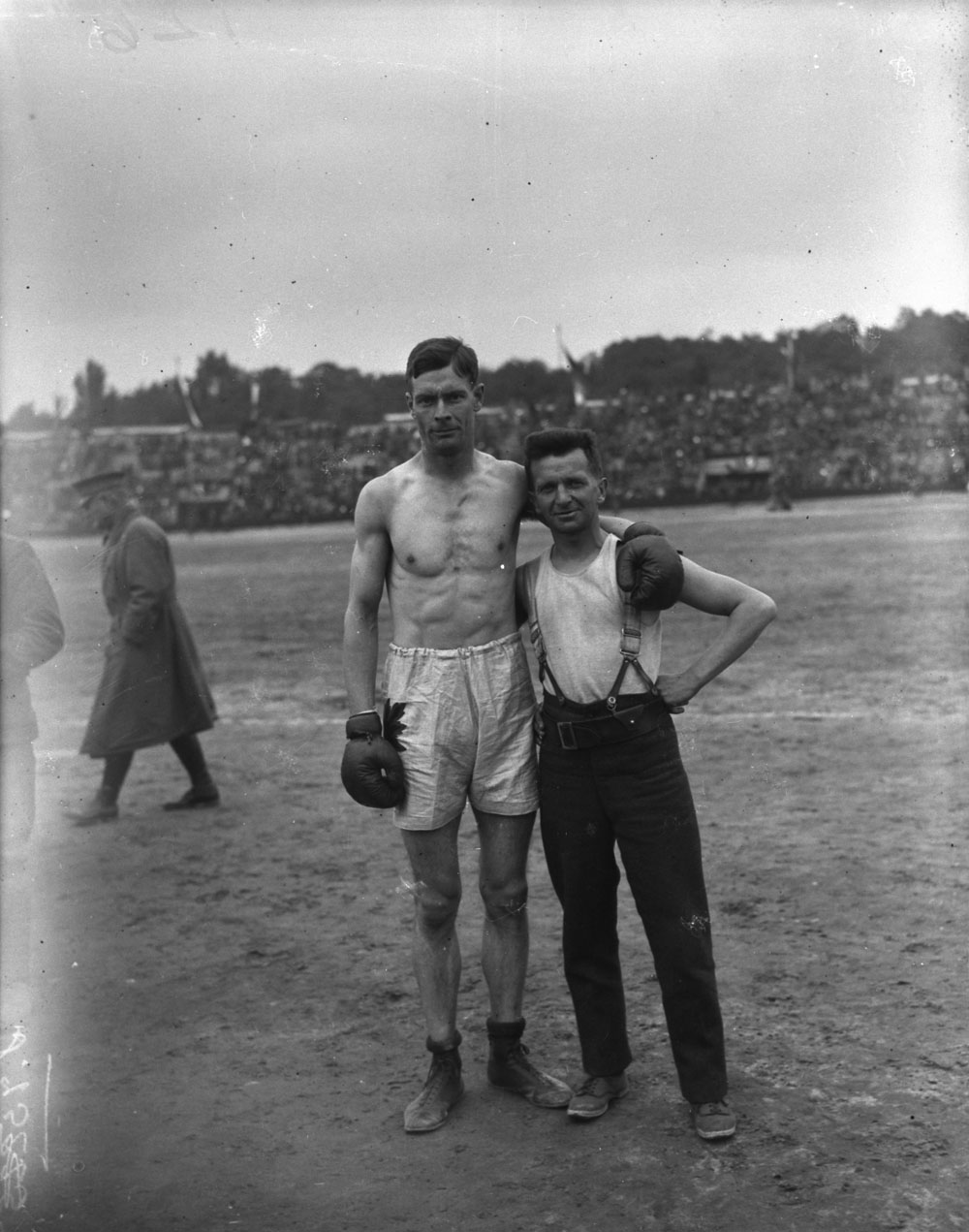
A black-and-white photograph of middleweight boxer Edwin A. Harris (Canada) in his trunks and gloves, posing with another soldier.

Edwin A. Harris (Canada), middleweight finalist in boxing, at the Inter-Allied Games, Pershing Stadium, Paris, France (MIKAN 3384730)

Today, the Canadian Amateur Boxing Association oversees the sport in coordination with 10 provincial and three territorial boxing associations. Some athletes eventually turn to professional boxing, while others retain their amateur status with the intent to represent Canada in international events, such as the Olympics or Commonwealth Games.

Visit the Flickr album now!

“Unity Through Sport”: Organizing the first Canada Games in Québec in 1967

Version française

By Normand Laplante

Minus 33 degrees Celsius (wind chill: –52)! It was bone-chillingly cold when the competitions started at the first Canada Winter Games, in the city of Québec on February 12, 1967. Three days later, organizers and athletes faced more bad weather: a blizzard that dumped 76 centimetres of snow on the sports venues. Despite the harsh winter conditions, this first national multi-sport event, which brought 1,800 athletes together from across Canada, was a great success. Fifty years on, on the eve of the 26th Canada Games in Winnipeg, those first Games stand as an important milestone in the development of sport in Canada.
In 1962, the Canadian Sports Advisory Council decided to create a large national sporting competition that would bring together amateur athletes from every province and territory. The competition would be held every two years, alternating between winter and summer editions. André Marceau, a member of the newly established National Advisory Council on Fitness and Amateur Sport, proposed that Québec host the first Canada Winter Games. His proposal was accepted, and in 1963, a group of athletes from Quebec’s capital set up a corporation for those first Games, with Georges Labrecque as president and Marceau as vice-president. Guy Rousseau became chief executive officer for the Games.

In March 1965, the federal and Quebec governments officially announced that the first Canada Winter Games would take place in February 1967. The competition would be one of the events held to celebrate the centennial of Confederation. Organizers of the Games had initially planned on 20 sports, including winter Olympic sports, indoor sports and lesser-known disciplines such as barrel jumping, dog racing and ice canoeing. This list was revised many times in the months that followed because organizers had to consider a number of issues, including logistics. In the autumn of 1966, the corporation announced the 13 sports for the first Games: skiing (downhill and cross-country skiing, and ski jumping), speed skating, figure skating, hockey, curling, basketball, volleyball, badminton, wrestling, synchronized swimming, artistic gymnastics, shooting and table tennis.

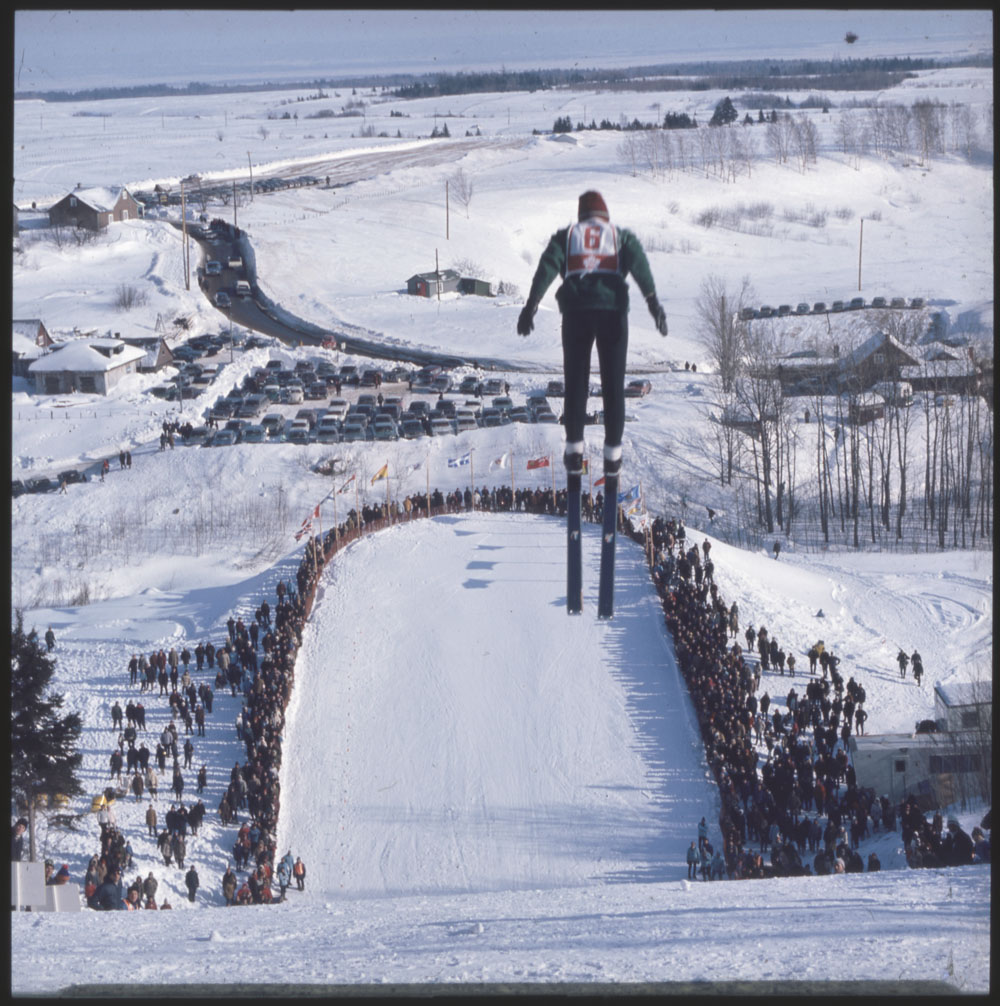
A colour photograph of a ski jumper flying above a crowd of spectators.

A ski jumper above a crowd of spectators at the first Canada Winter Games, Québec, 1967. (MIKAN 4741180)

A black-and-white photograph of a woman kneeling and aiming a rifle, surrounded by spent cartridges.

A shooting competition at the first Canada Games, Québec. (MIKAN 4741178)

Choosing the athletes for the provincial delegations required an unprecedented level of coordination between provincial governments, national sports associations and the organizers of the Games. The organizing committee of the Games in Québec estimated that 75,000 people participated in preparations for the first Canada Winter Games. These included not only athletes from the 10 provinces and 2 territories, who competed in elimination rounds to determine who would qualify for the teams, but also officials, organizers, coaches, and heads of provincial and national sports associations. One result of this exercise was the creation of many provincial administrative bodies responsible for sport.

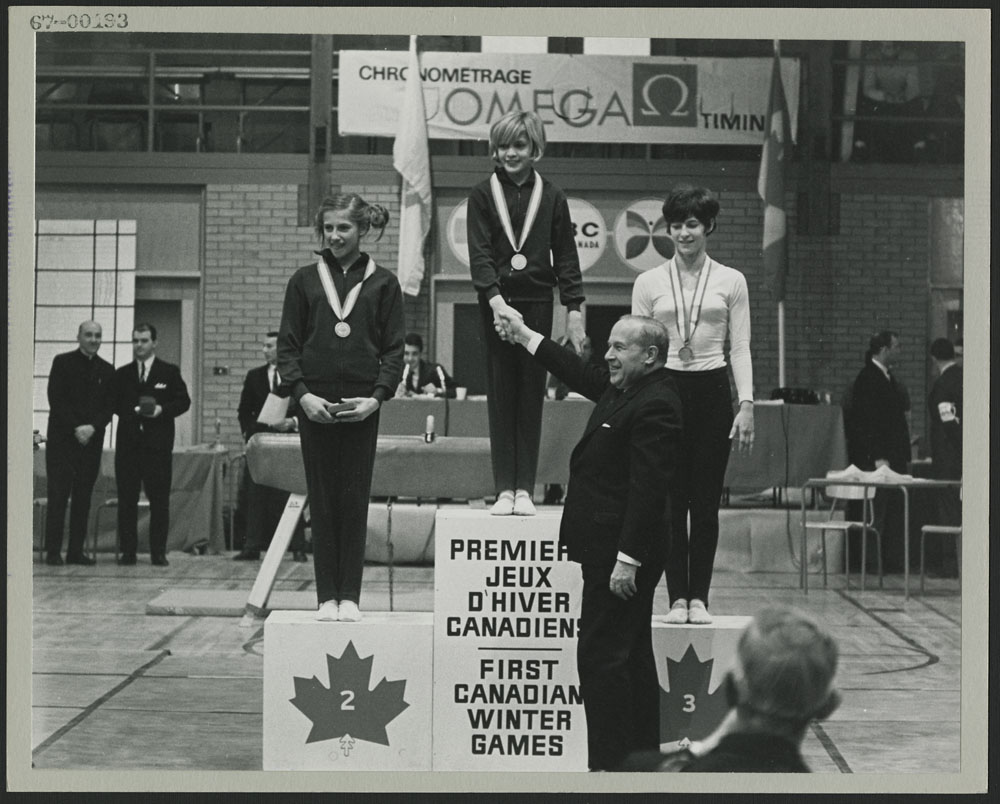
The Prime Minister of Canada, Lester B. Pearson, accompanied by provincial premiers Jean Lesage of Quebec, Louis Robichaud of New Brunswick and Alex Campbell of Prince Edward Island, opened the Games on February 11, 1967, in front of the Legislative Assembly of Quebec, with the theme of “Unity Through Sport.” During the nine days of competition, 184 medals were awarded. Ontario won the most medals, ahead of teams from British Columbia and Alberta. Teresa McDonnell, winner of three artistic gymnastics events, and Toller Cranston, gold medallist in figure skating and a future bronze medallist at the Winter Olympics, were two of the athletes whose performances stood out at these first Games.
A black-and-white photograph of a podium on which three young women wearing medals are standing. A man is shaking hands with the gold medallist.

The Prime Minister of Canada, Lester B. Pearson, congratulates Teresa McDonnell and her fellow medallists, Jennifer Diachun and Marie St-Jean, after a women’s gymnastics competition at the first Canada Winter Games in Québec, photographed by H. Leclair. (MIKAN 4741173)

The success of the first Games encouraged the national sports organizations and the federal government to hold the first Canada Summer Games in Halifax-Dartmouth, Nova Scotia, in 1969. In later years, several provinces would launch their own provincial winter and summer games, modelled on the Canada Games.

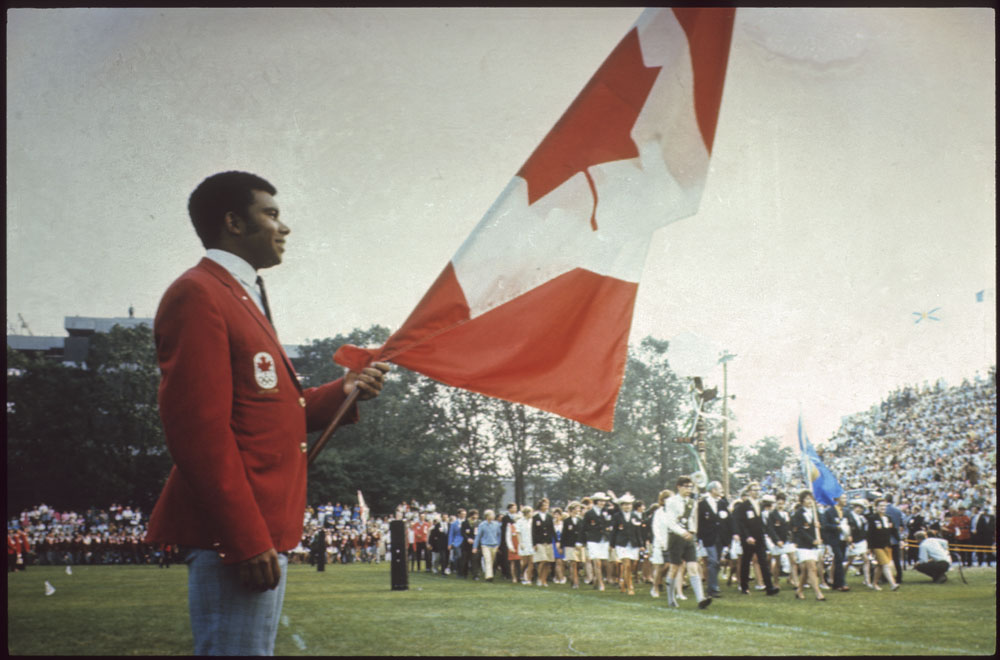
Colour photograph of a man in a red jacket carrying the Canadian flag while athletes enter the stadium.

Harry Jerome carries the Canadian flag at the opening ceremonies of the first Canada Summer Games in Halifax-Dartmouth. (MIKAN 4741182)

Additional Source:

Were you there? Do you have a story to tell?


Normand Laplante is a senior archivist in the Society and Culture Division of the Private Archives Branch at Library and Archives Canada.