Kingston Penitentiary: Home to Canada’s most notorious criminals

Canada’s oldest penitentiary opened on June 1, 1835, under the name “Provincial Penitentiary for Upper Canada.” Located in Portsmouth, now part of Kingston, this institution was designated for the incarceration of prisoners from both Upper Canada and Lower Canada. Kingston Pen, as it is commonly known, closed its doors on September 30, 2013.

Who were the inmates over the course of the penitentiary’s 178 years of existence? To discover their stories, consult the Kingston Penitentiary inmate history description ledgers, which have been digitized and can be viewed on the Library and Archives Canada (LAC) website.

The ledgers provide photographs (mug shots) of inmates and information such as name; alias; age; place of birth; physical description; occupation; crime committed; and date, place and length of sentence.

Sample page, Kingston Penitentiary inmate history description ledgers.

Sample page, Kingston Penitentiary inmate history description ledgers. (e011054572-v8)

To find the pictures of some of the inmates who were incarcerated at the Kingston Penitentiary, search for a person’s name in the Collection Search menu: type their name and add “RG73” and “Kingston” as keywords, then select “Collections and Fonds” in the dropdown menu. The list of results will show the photographs.

Where else to look

Census returns, the official record of the population of Canada, also list the inmates who were incarcerated at the time of the census enumeration. In addition, nominal indexes can be searched for a reference to an inmate’s name. Remember that spelling variations are common.

Search for books on the Kingston Penitentiary and other Canadian penitentiaries in AMICUS using the author’s name, the book title, or subject keywords such as Kingston (or name of the city), penitentiary, prisons and criminals.
The digitization of the Lord Grey banner

We have explained the origins of a large banner donated to Canada by Lord Grey in a previous blog.This current blog post reveals the work involved in digitizing this unique piece of Canadian history.

Library and Archives Canada’s (LAC) digitization staff are accustomed to handling a range of objects, such as documents, photographs, negatives, microfilm, paintings, maps and books. Occasionally, non-conventional objects present unusual challenges, such as the digitization of the Lord Grey banner, a tall embroidered banner in fragile condition.

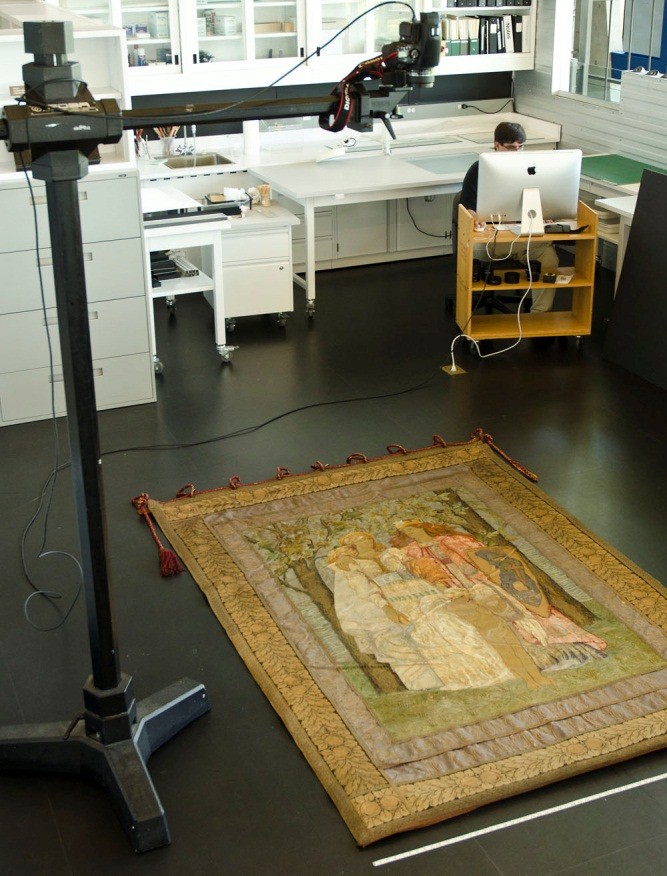
Due to limitations in the existing digitization equipment and the size and condition of the banner, the technicians needed to come up with some creative solutions. To minimize the amount of movement, the banner was delivered from storage to the photo conservation lab in LAC’s Preservation Centre in Gatineau, Quebec. As it could not be hung vertically, it was placed on the floor in an evenly lit open space.

The camera is positioned above the banner, which is laid on the floor.

The camera is positioned above the banner, which is laid on the floor.

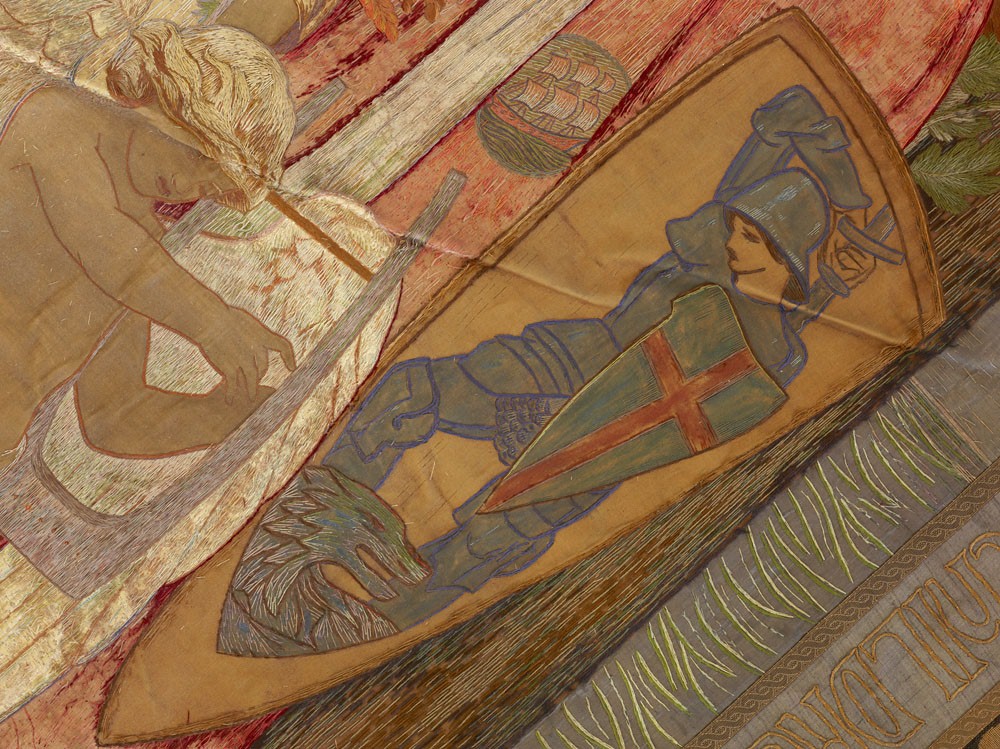
Images of the banner were taken using a Phase One 645 DF+ medium format digital camera mounted on the largest camera stand available. With the camera suspended seven feet away, the banner was captured in eight separate sections and the images reassembled using Photoshop for a complete view. Switching to a 150 mm macro lens, the camera was then lowered to get a selection of detail shots showing the many parts of the banner, such as the signature on the back, the shield with St. George and the dragon, and the types of stitching used. When the front was fully documented, the banner was turned over so that the back could also be captured.

Part of the fabric depicting St. George, patron saint of England and the dragon.

Part of the fabric depicting St. George, patron saint of England and the dragon.

The digitization work was undertaken to create a visual representation of the banner, providing the details of its design and the beautiful workmanship. LAC has now created a permanent digital record, making the banner accessible online, reducing the need to handle the physical item and thereby ensuring its long-term preservation.

Visit our Facebook album to see what went on behind-the-scenes to digitize this banner.

Unravelling the mystery of the Lord Grey banner

A large banner depicting two female figures in a rural setting is among the most interesting and unique items in the Library and Archives Canada (LAC) collection. Measuring 2.4 x 1.8 metres, this needlework is made from linen, cotton and wool, in addition to being beautifully embroidered with silk and other threads. On the back of the banner, more embroidery indicates that is was “worked by Agnes Sephton 1907.” According to former archivists, Governor General Albert Henry George Grey, 4th Earl Grey, gave the banner to the Dominion Archives sometime between 1907 and 1911. The banner hung in the office of the Assistant Dominion Archivist until 1953 when it was put into storage. In 1967, it was moved to the National Archives at 395 Wellington Street in Ottawa, and has been housed at LAC’s Preservation Centre in Gatineau, Quebec since 2000.

The banner donated by Lord Grey.

The banner donated by Lord Grey. Source

During preparations for the latter move, staff learned more about the circumstances surrounding the banner’s creation. It is thought to be one of a series commissioned by Lord Grey in hopes of making a lasting impression upon the minds and hearts of young Canadians. He planned for banners to be hung in schools across the country to reinforce the ties between Great Britain and Canada. According to legend, St. George, the patron saint of England, demonstrated immense courage in slaying a dragon. Lord Grey wanted young men and women to emulate these heroic qualities. St. George can be found on the shield held by Britannia, the female figure dressed in red. She extends a protective arm around young Canada, who is wearing a white dress adorned with doves and pine trees.

Recently, while preparing the banner to be photographed, LAC staff tracked down the identity of the woman who created it. When Canadian sources failed to reveal a possible candidate, archivists found one in British census and marriage records. Agnes Bingley was born in 1868 in London, England, the daughter of James Bingley, a landscape artist. In 1901 she married George Sephton, who was a painter. The couple lived in London and were associated with a group of artists and designers linked to the Arts and Crafts Movement. It is hoped that further research will reveal more clues about Agnes Sephton’s banner and how it came to LAC .

The Mountain Legacy Project: An Archive-Based Scientific Project

Beginning in 1871, the Dominion Lands Branch had been surveying and mapping Canada from East to West. By 1886, the Dominion Lands Survey had extended to the Rocky Mountains, but the rugged terrain made traditional survey methods impractical. Édouard-Gaston Deville, Surveyor General of Canada, devised a new methodology called “phototopography,” (also known as photogrammetry) based on the use of survey photography from hot-air balloons in France and Italy. A special camera was constructed for surveyors, who ascended thousands of peaks in Alberta, British Columbia and the Yukon. They rotated and levelled their cameras on tripods to create 360-degree views of the surrounding terrain. Between 1887 and 1958, more than 100,000 glass plate negatives were used to create the first topographic maps of the Canadian Rockies, of which 60,000 are now part of the Library and Archives Canada (LAC) collection.

Since 2002, LAC has been a major participant in the Mountain Legacy Project, an ongoing partnership led by the University of Victoria, which includes stakeholders in universities, archives, government, and non-governmental organizations.

LAC identifies, describes and digitizes the original negatives. These photographic records are the foundation of this multidisciplinary project, which uses “repeat” photography. It consists of re-photographing the landscape from the precise original locations to provide information about environmental changes that have occurred over the last 120 years.

To search LAC holdings of original photographs, follow these easy steps:

  1. Go to the Basic Archives Search.
  2. Enter the archival reference number R214-350-0-E in the search box.
  3. From the Type of material drop-down menu, select Photographic material and then click on Submit. Your search will generate a list of results.
  4. Select an underlined title to access the full description of a photograph. The descriptive records display images of photographs that have been digitized.

For more information about how to search for photographs at LAC, consult our articles “How to Find Photographs Online” and “How to Search for Images Online.”

If you wish to narrow your search:

  1. Go to the Archives Advanced Search.
  2. Select Photographic material from the drop-down menu labelled Type of material
  3. Use one or a combination of the following options as keywords in the Any Keyword search box:
    1. Name of the surveyor (e.g., Bridgland, McArthur or Wheeler).
    2. Year of the survey (must be used along with another keyword to limit search).
    3. Name of a survey (e.g., Crowsnest Forest Reserve, or Interprovincial Boundary Survey, although these may have taken place over several years, by various surveyors).
    4. Name of a particular landscape feature, such as mountain peak, river, creek, or valley (often the views are identified by the station/peak they were taken from, rather than by the peak or landscape featured in the photograph).
    5. Name of the park (Note: The LAC collection does not contain reproductions of the images from Jasper and Banff National Parks).
  4. Limit your search results by selecting a decade under the label “Date” on the right side of the screen.

For more information about the Project, and to compare the archival images with the repeat photography, visit the Mountain Legacy Project website. To view a sampling of paired photographs, visit our Flickr Set. To view some images of the surveyors, visit our Facebook Album.

Questions or comments? We would love to hear from you!

Reconnecting families through digitization

As part of Project Naming, a community engagement and photo identification project that aims to reconnect Inuit and their past, Library and Archives Canada (LAC) has undertaken the digitization of a series of photographs from the Indian and Northern Affairs Collection. These albums have been the starting point of a great story regarding a family from Nunavut.

In this collection, are a number of images of the Weetaltuk family taken during the summer of 1949 on the Cape Hope Islands in Nunavut. The original captions accompanying the photographs provided basic details. Fortunately, the database records for these images are now more complete after several family members contacted LAC to provide the names of relatives and other relevant information about these pictures. Most importantly, they were able to correct the Weetaltuk surname, as well as community names that had been incorrectly recorded. From the original captions, we knew that George Weetaltuk was a community leader, a skilled hunter and an expert boat builder. His family members explained the detailed process that George followed in creating his boats, as seen in this photograph of him with his son, William, and his adopted son, Simon Aodla, constructing an 11.58 metre (38-foot) boat.

Another record that the Weetaltuk family was able to correct was this group photograph taken in front of a log cabin. The caption states that this picture was taken on Cape Hope Islands. We now know that the picture was probably taken on nearby Charlton Island, James Bay, where for many years, George and his family resided while he was employed seasonally by the Hudson’s Bay Company. In addition to this information, the family was also able to identify five of the people in the photograph, and provide genealogical connections.

Weetaltuk family photograph. Back row: Adla (far left), married to William, George’s oldest son (2nd from left),  George Weetaltuk (centre) and his first wife, Ugugak (4th from left). Front row: George’s sons Alaku (far left) and Tommy (sitting on the ground). (PA-099605)

Weetaltuk family photograph. Back row: Adla (far left), married to William, George’s oldest son (2nd from left), George Weetaltuk (centre) and his first wife, Ugugak (4th from left). Front row: George’s sons Alaku (far left) and Tommy (sitting on the ground). (PA-099605) Source

In addition, another of George’s sons, Edward, was a member of the Princess Patricia’s Canadian Light Infantry. He was the first Canadian Inuk to serve in military combat with the Canadian Army during the Korean War. Following his 15 years of service, he began writing his life story. According to a news article, Edward (Eddy) Weetaltuk “wanted to show young Inuit that education was important and that Inuit can become anything they want and even become famous, if that’s what they want.” (Nunatsiaq Online, July 16, 2009)

Although Eddy started writing E9-422: Un Inuit, de la toundra à la guerre de Corée in 1974 (in French only), it was not published until 2009 only a few days before his death.

Through these family connections and dialogue with the community, our photographic collections are constantly improved and enriched for future generations.

For more information about Project Naming, read our Blog article, published on May 9, 2013, and listen to our Project Naming and Canada’s North podcast.

Project Naming: The first ten years and beyond

Initiated in 2002, Project Naming is a community engagement and photo identification project that aims to reconnect Inuit with their past by identifying the people and events portrayed in photographs held at Library and Archives Canada (LAC). We have added the names of individuals and descriptions of activities to our database, which you can search online.

Over the last ten years, we have digitized more than 8,000 of those photographs and have received identifications for approximately 1,900 individuals. New information about these pictures is gathered through a variety of methods, including an online form, community slide shows and other social gatherings, weekly features in local newspapers, social media and on-site research visits.

Quite often, identifications come as a result of intergenerational conversations that take place in person or virtually—or both. Such was the case when Nunavut News/North published a photograph of Rhoda Qaqsauq, and her daughters, Lucy Evo and Janet Tagoona, on February 11, 2013; upon discovering this picture, Deborah Kigjugalik Webster shared it on Facebook, thus sparking a lively conversation between her and other family members.

An example of a successful on-site visit occurred in June 2012 when a group of Elders and youth from Arviat, Nunavut, located on the southwest coast of Hudson Bay, made a trip to Ottawa. They looked through hundreds of photographs and negatives taken between the 1920s and the 1970s.

This enabled them to identify 31 family members in 17 images. Louisa Gibbons discovered her mother, Catherine Kopak, and her grandmother, Yarat, in a picture taken in Kingayualik, near Padlei.

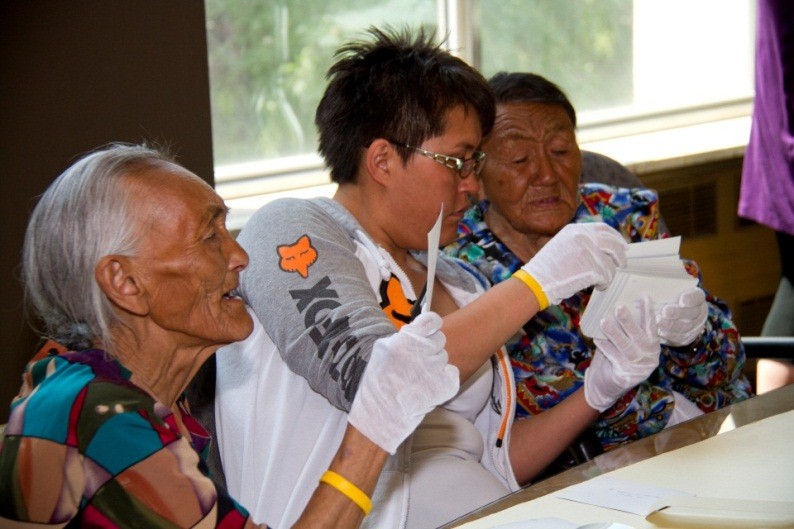
Elder Eva Muyunaganiak (left), Louisa Gibbons (centre) and Elder Mary Nowtalik (right).

Elder Eva Muyunaganiak also discovered a photograph of her mother, Uyaupiak, dating from the late 1960s. Today, the remaining 22 Elders in the community of Arviat are the only ones able to recognize people and describe what life was like in photographs taken more than 50 years ago. Elder Muyunaganiak passed away in September 2012; her death reminds us of how time-sensitive an initiative Project Naming is.

Project Naming has now evolved into a broader community engagement initiative that has expanded beyond the territory of Nunavut to other Aboriginal communities in the Yukon, the Northwest Territories, Nunavik (northern Quebec) and Labrador. We hope to build upon this dialogue with members of Northern communities using new technologies and social media.

To learn more, listen to our Project Naming and Canada’s North podcast.

The Receiver General Buy Button (RGBB): What is it and how does it work?

Library and Archives Canada (LAC) clients can use their credit or debit cards to purchase digital copies of textual material* through the Government of Canada’s Receiver General Buy Button (RGBB). The RGBB is a safe and secure service that provides convenient, reliable and secure payment services to clients and businesses during their online dealings with the federal government.

The RGBB is much safer than other methods of payment such as mailing or faxing a credit card number, or even providing it over the phone, as your personal information is protected throughout the entire payment process. When using the RGBB, your credit card number is immediately encrypted, then placed in secure transaction storage and no longer retrievable in an unencrypted format.

When you order copies and reproductions from LAC, a link to the RGBB will be sent to the email address you have provided. The link will be sent to you after LAC has completed the processing of your order. You may then pay the Receiver General by credit or debit card.

The Treasury Board Secretariat (TBS) and the Office of the Privacy Commission (OPC) have studied the safety and security aspects of the RGBB. They published their research in a report entitled “Receiver General Buy Button Privacy Impact Assessment”, which concludes that privacy, safety and security concerns are low since the RGBB appropriately addresses any such concerns.

* Please note that clients who purchase photographic prints, videos, sound recordings or microfilm reels will continue to be contacted by our third-party suppliers for payment. LAC price lists and service standards are all available online.

Why Consult Newspapers on Microfilm?

We have already discussed how to find Canadian newspapers on microfilm; and you might have wondered why we have to turn to microfilm in the first place? Aren’t these newspapers available online?

The short answer is that only some of them are (*). Most newspaper editions available electronically for free are limited in their content, and the issues usually start only in the 1980s. If you are interested in full-page content and original layouts, or need to access older issues, some major dailies like the Globe and Mail, the Toronto Star and the Winnipeg Free Press offer historical versions in PDF format for a fee. As well, your local library may subscribe to a particular daily, or you may also purchase access yourself.

Another option is to access Library and Archives Canada’s newspapers on microfilm, an extensive collection that:

  • includes major newspapers, as well as local, labour, ethnic and student papers;
  • allows you to research aspects of newspaper publishing, such as design, layout and advertising, not contained in the electronic versions; and
  • provides access to content excluded in the electronic versions, including photographs, classifieds and obituaries.

Come visit us in Ottawa to consult these newspapers on microfilm and discover our collection, or contact us for more information.

* The following are examples of free digital newspaper collections:

Questions or comments? We would love to hear from you!

How to Find Digitized Publications – Part II

In our post on “How to Find Digitized Publications”, we promised to  share more recommendations from our reference specialists about where to find digitized publications. The following sources point to a wealth of  publications from across Canada and from specific regions.

CANADA-WIDE SOURCES

Internet Archive – Text Archive [http://archive.org/details/texts]
The Internet Archive Text Archive contains a wide range of historical texts, academic books, government publications, fiction, popular books and children’s
books. The Internet Archive includes many digitized federal government and parliamentary publications from Library and Archives Canada’s collection.

  • Tip:
    Once you have found a work of interest, you can then use full-text searching options provided by the website.

Canadiana Discovery Portal [http://search.canadiana.ca/]
The Canadiana Discovery Portal allows you to search the digitized collections of libraries, archives and museums from across Canada. The Portal includes a
wide range of historical materials such as books, journals, newspapers, government documents, photographs, and maps.

Our Roots: Canada’s Local Histories Online [http://www.ourroots.ca/]
Our Roots is a wonderful resource for family history research. This extensive collection of digitized local histories, including historical publications,
from across the country permits full-text searches for family names, place names and events.

REGIONAL SOURCES

Bibliothèque et Archives nationales du Québec – Digital Collection
[http://www.banq.qc.ca/collections/collection_numerique/index.html?language_id=1]
Bibliothèque et Archives nationales du Québec offers extensive collections of digitized materials including newspapers, magazines, municipal directories,
books and musical scores, reference works, maps and plans, and images.

  • Tip:
    The Municipal Directories collection
    [http://www.banq.qc.ca/collections/collection_numerique/index.html?categorie=1]includes the Lovell’s Montréal directories starting in 1842.

Peel’s Prairie Provinces [http://peel.library.ualberta.ca/index.html]
Peel’s Prairie Provinces is an indispensable research resource on Western Canada and its history. It includes a bibliography with over 7000 fully searchable digitized books [http://peel.library.ualberta.ca/bibliography/], many dating back to the earliest days of exploration in the region.

Island Archives.ca at the University of Prince Edward Island [http://islandarchives.ca/]
A growing repository of records and images held in Prince Edward Island’s libraries and museums. Of particular interest are the digitized newspapers [http://islandarchives.ca/inewspapers] and maps [http://islandarchives.ca/imaps].

Questions or comments? We would love to hear from you!

Looking for the Debates of the House of Commons (Hansard) online?

Are you searching for the Debates of the House of Commons, also known as Hansard? Depending on the dates you are looking for, a great place to start your research is online. However, only the very early years and the very recent years are available online; those in between are not.

Here is the breakdown:

1867–1900

The full texts of Hansard for the years 1867–1900 are available online through the Early Canadiana Online (ECO) website [http://eco.canadiana.ca/?usrlang=en]. While some of the content in ECO is only available to subscribers, the Debates of the House of Commons are available for free and do not require a subscription.

1901-1993

Hansard for the years 1901–1993 are not yet available online. Library and Archives Canada holds these years in print and in microform. Many university and public libraries hold print or microfilm/microfiche copies of Hansard. Please contact your library for more information. If you are a university or college student, check your school library website to see if there is a research guide for government or parliamentary publications, which can save you a lot of time.

Library and Archives Canada has participated in a project to digitize the full-text of Hansard for 1901-1993. When this digitized content is available online, we will post an announcement on this blog.

1994-Present

The full texts of Hansard from the 35th Parliament (January 1994 onwards) are accessible online from the Parliament of Canada website [www.parl.gc.ca]. Select “Parliamentary Business” (top left), then “In the House of Commons Chamber” (left column). Choose the Parliament and Session from the list on the left.

Tips

  • The Debates are always organized by Parliament and Session. A handy reference tool to find the Parliament and Session [www.parl.gc.ca/ParlInfo/Lists/Parliament.aspx?Language=E] that correspond to the dates you are looking for is available on the Parliament of Canada website.
  • The Debates have detailed indexes. In the early years, these indexes were in the same volume as the Debates. In the later years they were printed in a separate volume.

Questions or comments? We would love to hear from you!