P.K. (Patricia Kathleen) Page is regarded as one of Canada’s most beloved creative voices. Both a poet and artist, Page crafted beautiful images through her words and art in her home office in Victoria, British Columbia. When Page passed away in 2010, her literary executor Zailig Pollock documented the contents of her office to preserve a sense of the physical creative space that inspired her while she wrote and worked on her art pieces.
Category Archives: Literature
Images of Poet P.K. Page’s Creative Space now on Flickr
Sharpen Your Skates!
Below is a selection of children’s books inspired by Canada’s passion for its national winter pastime, hockey.
Le chandail de hockey, by Roch Carrier, is a Canadian children’s literature classic. Generations of children have read about the misadventures of the young narrator, who is forced to wear a Toronto Maple Leafs sweater instead of the Montreal Canadiens’ number 9 immortalized by Maurice Richard. Written in 1970 for radio, the story was translated by Sheila Fischman (AMICUS 20121258). The original French version, Les enfants du bonhomme dans la lune (AMICUS 877142), and the English translation, The Hockey Sweater and Other Stories (AMICUS 905257), were published in 1979. The story inspired Sheldon Cohen’s animated film, The Sweater / Le chandail, produced by the National Film Board. Sheldon Cohen then illustrated the 1984 storybook, published by Tundra Books (AMICUS 5003239).
Did you know that a copy of The Hockey Sweater travelled to the International Space Station in 2009, and that Abigail Richardson composed a symphony based on the story?
Other hockey-related books include the Hockeyeurs cybernétiques (AMICUS 3970428), which brings together the complete science fiction series by Denis Côté, published in 1983 and again in 1993 under the title, L’arrivée des inactifs (AMICUS 12293147). The new edition uses the original title. The hero of the story, Michel Lenoir, is a beloved hockey star who is used by a dictator to control an exploited population. The sport-recreation aspect of hockey is used as a backdrop to reveal an insensitive and programmed futuristic society.
In the 22 novels of The Screech Owls series (AMICUS 28705721), by sports journalist Roy MacGregor, readers follow a peewee hockey team on their adventures at tournaments. The Screech Owls travel throughout Canada, and even attend the Olympic Games in Nagano, Japan, and in Lake Placid in the United States.
The majority of hockey-themed children’s books have been aimed at boys. However, the international reputation of Canada’s women’s hockey team has also inspired female characters. La fabuleuse saison d’Abby Hoffman, by Alain M. Bergeron (AMICUS 40395119), tells the story of Abigail Hoffman, who as a little girl in Toronto in 1955, pretended to be a boy so she could register for Little League hockey. Later in her athletic career, she competed in the women’s 800 metres at the 1964 Tokyo Olympic Games, the 1968 Mexico City Games, the 1972 Munich Games, and the 1976 Montreal Games, at which she was Canada’s flag bearer.
Here are some other reading suggestions:
- “Denis Côté : Le bon et le mauvais côté des choses,” appearing in Lurelu in 2013, by Marie Fradette (AMICUS 829835).
- Mystery at Lake Placid, by Roy MacGregor (AMICUS 16776029).
Library and Archives Canada releases ninth podcast episode
Library and Archives Canada (LAC) is releasing its latest podcast episode: Pulp Canada: between the covers. Pulps, with their screaming story titles and attention-grabbing cover art, already began to capture the public interest by the turn of the 20th century.
Professor Carolyn Strange, author of True Crime True North: The Golden Age of Canadian Pulp Magazines, and author Ian Driscoll join us to talk about LAC ’s pulp fiction collection. They discuss the different aspects of the collection and bring to light some of the incredible stories surrounding this literature form.
Subscribe to our podcast episodes using RSS or iTunes, or just tune in at: Podcast – Discover Library and Archives Canada: Your History, Your Documentary Heritage.
For more information, please contact us at podcast@bac-lac.gc.ca.
Pulp Magazine Images Now on Flickr
The Governor General’s Literary Awards for 2013
The Governor General’s Literary Awards are given annually to the best English-language and the best French-language book in each of the seven categories of Fiction, Literary Non-fiction, Poetry, Drama, Children’s Literature (text), Children’s Literature (illustration) and Translation.
Every year, Library and Archives Canada works to ensure that each Canadian nominee is acquired, catalogued and made available prior to the final announcement of the winners. Usually, this is done through legal deposit, but in some cases the nominated books are not published in Canada and need to be acquired through other means so that a complete selection of the Governor General’s nominees are preserved for future generations.
Congratulations to all!
Fiction
English
The Luminaries, by Eleanor Catton (AMICUS 41787649)
French
Quand les guêpes se taisent, by Stéphanie Pelletier (AMICUS 40915742)
Poetry
English
North End Love Songs, by Katherena Vermette (AMICUS 40823688)
French
Pour les désespérés seulement, by René Lapierre (AMICUS 40824154)
Drama
English
Fault Lines, by Nicolas Billon (AMICUS 41530643)
French
Bienveillance, by Fanny Britt (AMICUS 41316358)
Non-Fiction
English
Journey with No Maps: A Life of P.K. Page, by Sandra Djwa (AMICUS 40812690)
French
Aimer, enseigner, by Yvon Rivard (AMICUS 40909709)
Children’s Text
English
The Unlikely Hero of Room 13B, by Teresa Toten (AMICUS 41749214)
French
À l’ombre de la grande maison, by Geneviève Mativat (AMICUS 40696767)
Children’s Illustration
English
Northwest Passage, by Matt James (AMICUS 40320781)
French
Jane, le renard et moi, by Isabelle Arsenault (AMICUS 41921688)
Translation
English
The Major Verbs, by Donald Winkler (AMICUS 40717619)
French
L’enfant du jeudi, by Sophie Voillot (AMICUS 40772400)
TD Summer Reading Club 2013

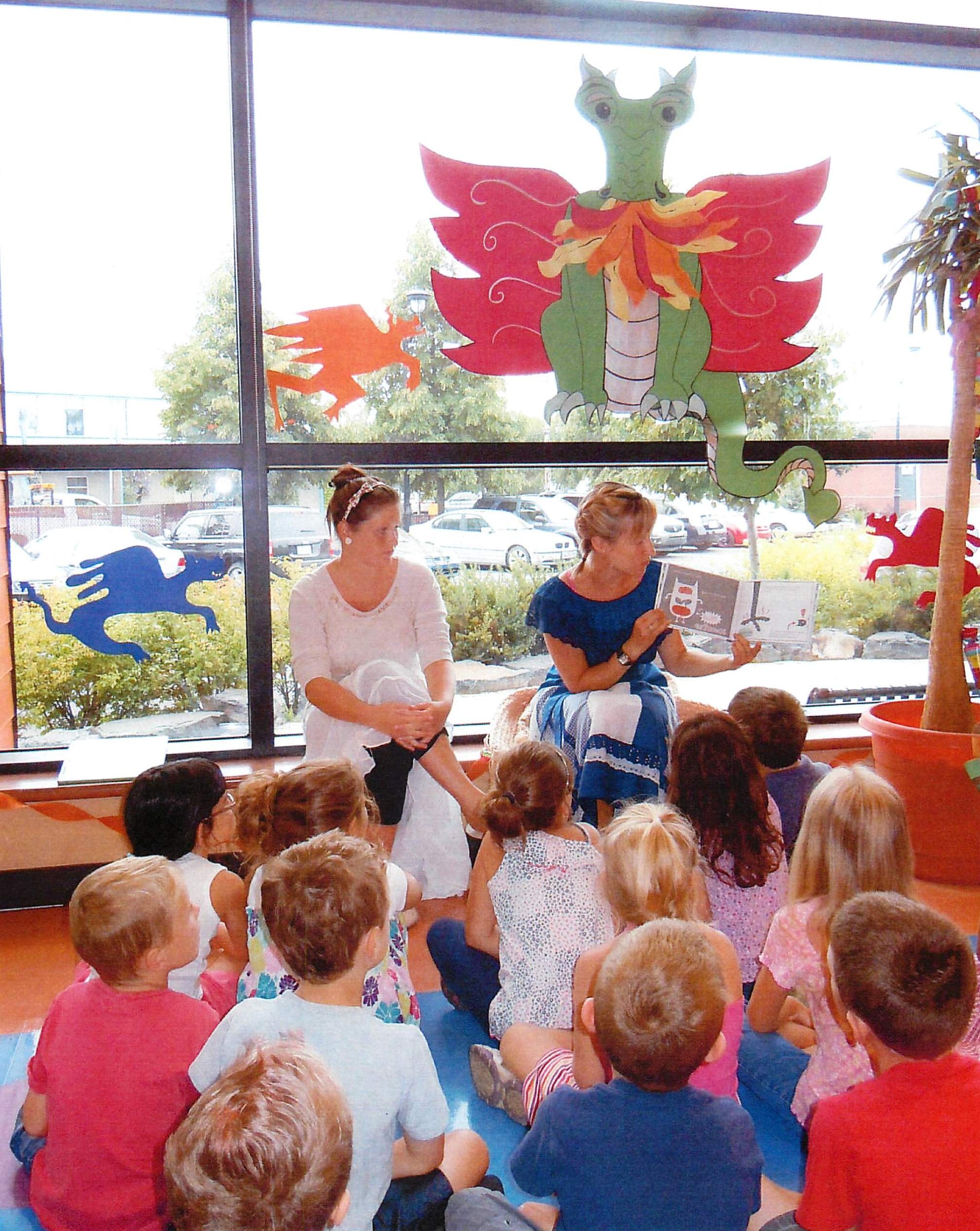
This year, the TD Summer Reading Club invited children and their parents to become explorers and discover the world. Under the theme, Go!, the young people set off on an adventure, uncovered fascinating cultures and explored exotic locations, all the while making unforgettable discoveries through the magic of reading.
The TD Summer Reading Club is a bilingual program that aims to instil in children the fun of reading during the summer. This summer’s edition, launched by the TD Bank, the Toronto Public Library and Library and Archives Canada on May 29th, was a great success: 600,000 young people participated in over 28,000 activities and read a total of 2 million books!

To continue the fun, the TD Summer Reading Club’s website is full of exciting activities and surprises. Young readers are invited to leave comments about their favourite books, participate in a scavenger hunt, write silly stories and share their favourite jokes with their friends! Lastly, they can also learn to draw with the Club artist, Matt James, and share their creations online!
How to read AMICUS records—Part 2
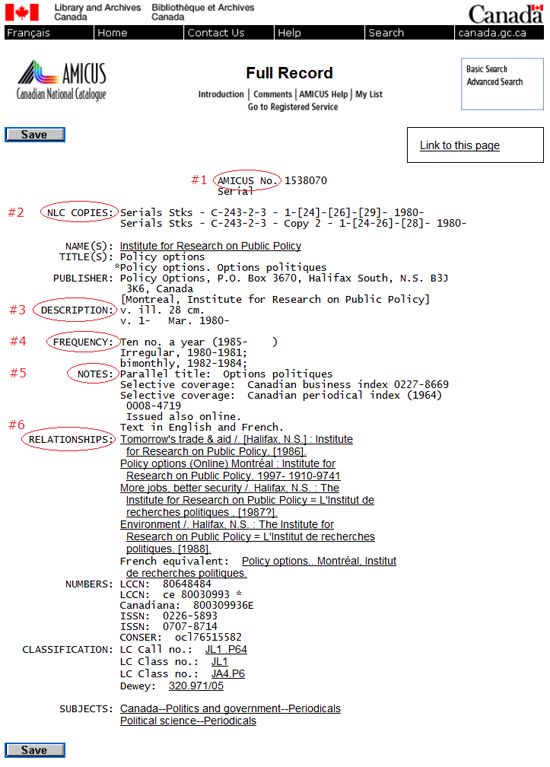
Our previous article on this topic explained how to decode an AMICUS record for books, documents and reports (monographs). Today’s article provides you with tips on decoding an AMICUS record for journals, magazines, newspapers or any type of ongoing publication (serials).
To help you better understand, the numbers on the image correspond to the fields described in the article.
1. AMICUS No.: Keep track of this number! You will need it to request issues of the serial, whether you place a request for retrieval before visiting Library and Archives Canada (LAC) or once you are on site.
2. NLC (National Library Collection) Copies: Provides key information on which issues of the serial record are available in our collection. It is essential to distinguish between the LAC holdings for the serial found in NLC Copies (No. 2) and the description of the publishing history of the serial found in the Description (No. 3). The complete run of a serial is sometimes unavailable at LAC or may be available in a microform version. If a microform version exists, it will be included as a link in Relationships (No. 6).
| Punctuation Mark | Meaning | Example |
|---|---|---|
| Hyphen – | An unbroken range of holdings | v. 1-30 means the library has each issue of the serial from volumes 1 to 30 in its holdings. |
| Square brackets [ ] | Incomplete holdings | [1950] means that holdings include some issues published in 1950. |
| Question mark ? | Uncertain holdings information | v. 18-42? means that holdings may include volumes 18 to 42. |
| Slash / | A single physical item with two connected volumes | v. 12/13 indicates that volumes 12 and 13 are contained in a single physical item. |
| Comma , | A gap in the holdings | v. 1-3, 5 means the library has volumes 1 to 3 and 5 but not volume 4. |
| Semicolon ; | A publication break (not a gap) in the holdings | v. 1-3; 5- indicates that after volume 3 the publisher jumped to 5 without publishing volume 4. |
3. Description: Indicates when the serial began publication.
4. Frequency: Specifies how frequently the serial has been published over the years.
5. Notes: Offers additional information about the serial, such as where it has been indexed and its alternate titles.
6. Relationships: Provides links to related versions, for example, in other languages or in other formats, such as a journal available online or on microfilm. In this case, you will find a link to the online version of this journal held in our electronic collection.
Questions or comments? We would love to hear from you!
How to read AMICUS records—Part 1
Have you ever used our AMICUS library catalogue to try to find a book and were unsure about how to decode the information?
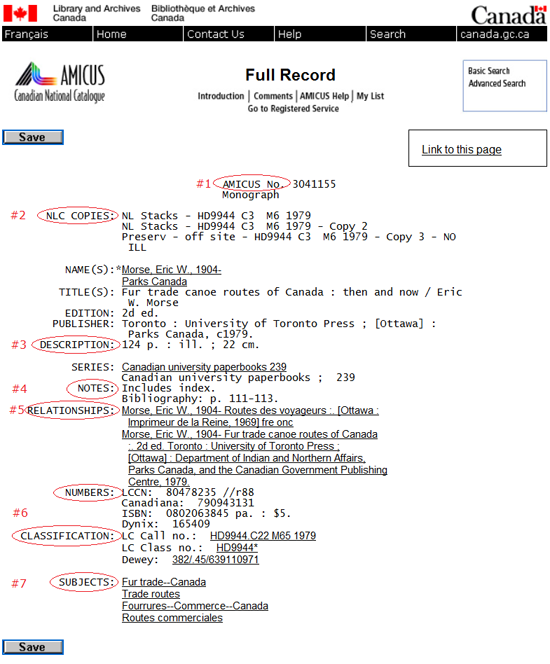
Here are tips on decoding an AMICUS record for books, reports or documents (monographs). To help you better understand, the numbers on the image correspond to the fields in the article.
1. AMICUS No.: Keep track of this number! You will need the AMICUS No., the name(s) of the author(s) and the title of the work to place a request for retrieval before visiting Library and Archives Canada (LAC) or once you are on site. Immediately below the AMICUS No., the type of record is specified; this tells you if the record is for a book, a report or a document (monograph), or a journal, a magazine, a newspaper or any type of ongoing publication (serial).
2. NLC (National Library Collection) Copies: Indicates the number of copies available at LAC. If you do not find NLC copies in the record, start your search over and make sure that you are searching the LAC catalogue only, not the entire database. As we are a closed stack library, the shelf location information is for internal purposes only and is not useful to you. Please note that preservation copies are presently unavailable.
3. Description: Tells you the number of pages and if the work contains illustrations or maps.
4: Notes: Provides additional information about the work, for example, other title information, additional information on the contents, whether it contains bibliographic references.
5. Relationships: Provides links to related versions of the work, for example, in other languages or in other formats, such as online or on microfiche.
6. Numbers and Classification: Generally of interest to other libraries only. The call numbers are suggestions for other libraries and are not LAC call numbers.
7. Subjects: Provides the standardized subject headings assigned to the work. Click on any subject heading to find additional materials on that topic.
Stay tuned for an upcoming article on how to read AMICUS records for journals, magazines, newspapers or any other type of ongoing publication (serials).
Questions or comments? We would love to hear from you!
PS 8000 collection of early 20th-century digitized Canadiana
To mark Canada Book Day, we take a closer look at the PS 8000 collection of early 20th-century Canadian publications available in the Electronic Collection of Library and Archives Canada. PS 8000 is the standard classification for Canadian literature, one of the core strengths of our holdings.
To browse this collection
• Click “Search the Electronic Collection” on the left side of the screen
• Choose “Any keyword” from the drop-down menu in the first search box
• Enter “PS 8000” in the second field as the search term
This search produces a list of pre-1926 Canadian publications that have been digitized and are accessible online. Other key terms can be used to further refine the search (e.g. world war and poetry).
For other online resources, consult our blog articles on how to find digitized publications Part I and Part II.
Also, explore our Flickr album for a selection of cover images of these publications.