Images of the Canadian Women’s Army Corps now on Flickr 

During the Second World War, Canadian women were mobilized to serve in the armed forces. Approximately, 50,000 women enlisted and a majority of them served with the Canadian Army. A variety of tasks were assigned to the Canadian Women’s Army Corps (CWAC) formed in 1941. These women enrolled from a sense of patriotism or a desire to see the world, no different from their male counterparts of the time.

However, they faced skepticism and harassment at home and abroad. Their perseverance coupled with wartime labour demands enabled women to work in numerous fields of work, such as mechanical and technical repairs, communications, drafting, or driving vehicles. The Canadian government and the Department of National Defence in 1943 started a recruitment drive and public relations campaign to support women contributing to the war effort. Over time their salaries increased, and public and military opinions began to change in favour of women serving in the armed forces.

The thousands of women who served their country during wartime gained new skills and expertise, confidence, and a much improved respect and support from Canadians. The CWAC was an opportunity and milestone for those choosing to step away from traditional gender roles in Canada.

75th Anniversary of the Canadian Women’s Army Corps

By Laura Brown

On August 13, 1941, after many months of cross-country campaigning during the early days of the Second World War, women were given the opportunity to join the Canadian Army. Like the Royal Canadian Air Force, which created a women’s division a month earlier, the army recognized that women could be placed in non-combatant roles to release more men to fight overseas. At first the Canadian Women’s Army Corps (CWAC) was not a formal part of the military and operated instead as an auxiliary organization. However, on March 13, 1942 the CWAC was officially integrated into the Canadian Army. Uniforms and insignia, including badges displaying the figure of Athena were issued to army women or “CWACs” as they were commonly called.

A coloured poster showing a female and a male member of the Canadian Army striding forward in unison. The figures wear helmets, uniforms, and carry gas mask bags around their necks. The male soldier carries a rifle on his left shoulder. At the bottom of the poster are four small black-and-white photos of women performing different jobs in the army.

Second World War Recruiting Poster, “Shoulder to Shoulder – Canadian Women’s Army Corps – An Integral Part of the Canadian Army” ca. 1944 (MIKAN 2917721)

While many Canadians were supportive of women in khaki, some were apprehensive and even fearful, viewing the acceptance of female soldiers into the military as a disturbing lapse of traditional gender roles in society. In 1943 the government launched an extensive advertising campaign in an effort to address such concerns and to encourage enlistment. Recruitment materials, such as the poster above and the film Proudest Girl in the World presented female recruits as professional, respectable, and feminine, as well as eligible for various types of work.

Before commencing basic training at one of Canada’s regional training centres, recruits were given a test to determine the job for which they were best suited. In 1941 there were 30 different jobs or “trades” available and, by the end of the war, that number nearly doubled. Some positions open to CWACs were unconventional for women at the time (such as working as a mechanic) but the most numerous trades were those associated with traditionally female work, including cook, laundry worker, or typist.

A black-and-white photo showing a crowd of smiling CWAC recruits. They wear summer dress uniforms and caps with diamond-shaped cap badges.

Personnel of the Canadian Women’s Army Corps at No. 3 CWAC (Basic) Training Centre, April 6, 1944 (MIKAN 3207287)

During their war service, many CWACs hoped for a posting outside of Canada, though only a few thousand were successful in obtaining such positions. Among them was Molly Lamb Bobak, Canada’s first female war artist. In addition to her paintings and sketches created to document the contributions of the CWAC, Bobak produced an illustrated diary, which today is held at LAC and available in digitized format. Peppered with self-deprecating humour, this work provides a frank and funny view into army life. You can learn more about Bobak by consulting this blog post.

A black-and-white photograph showing Molly Lamb Bobak posing in front of an easel with brushes and palette in hand. Bobak wears an army battledress jacket and smiles at the camera. The partially completed painting behind her depicts male and female members of the Canadian Army standing inside a room.

Second Lieutenant Molly Lamb Bobak, Canadian Women’s Army Corps, London, England, July 12, 1945 (MIKAN 3191978)

Out of the three branches of the military—army, air force and navy—the army saw the highest enlistment of Canadian women during the Second World War with a total of 21,624 recruits. The many documents related to the CWAC in LAC’s collection, some of which you can find below, help illustrate the important service of Canada’s first army women.

Related Resources


Laura Brown is a Military Archivist in the Government Archives Division at Library and Archives Canada.

Are we missing part of the historical record regarding Oronhyatekha?

By Richie Allen

Searching through archival records can sometimes lead to unexpected discoveries.

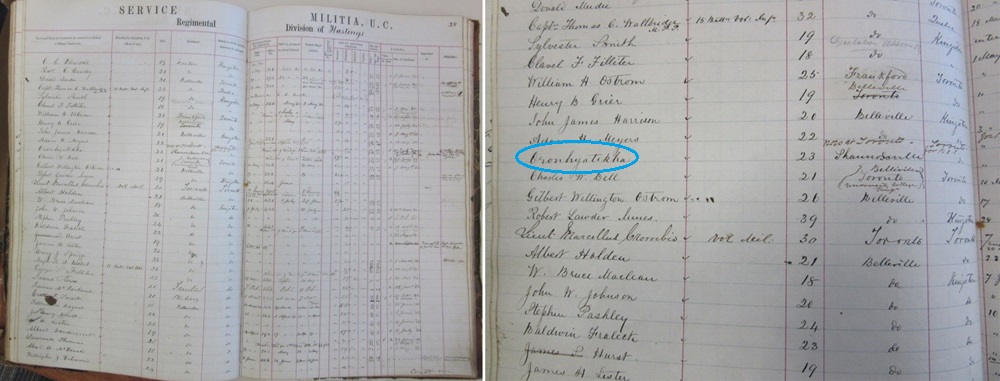
 In my work as a reference archivist at Library and Archives Canada, I regularly conduct research for researchers’ requests. While investigating if a certain individual had actually received formal military training in 1865 at the Toronto School of Military Instruction, I consulted Library and Archives Canada’s online database, Archives Search. A keyword search located the first Register of Candidates Admitted to the School of Military Instruction, Upper Canada (Toronto), 1865-1867, in the record group relating to the Department of Militia and Defense (RG9), Volume 7.  When I consulted the school ledger, the name I was looking for was not there, but another name instantly caught my attention.  Standing out clearly on the list, amid the old script of European first-middle-last name format, was the single Mohawk name Oronhyatekha.

A colour photo showing on the left side an opened book and on the right side a close-up showing a name on the page of the book.

Register of Candidates Admitted to the School of Military Instruction, Upper Canada, 1865-1867. The name “Oronhyatekha” has been highlighted with a blue circle (R180-124-1-E, MIKAN 195106)

The ledger contains many columns of information. In particular, on page 9, it indicates that Oronhyatekha was 23 years old, from Shannonvillle, but living in Toronto. In subsequent lists, he is indicated as being admitted to the school at Toronto on May 6, 1865. On July 29, 1865, he is noted as the “candidate permitted to remain in school for purpose of qualifying for 1st class certificate”—an honour accorded to few students.

A colour image showing a close-up of a page from a book.

Information from the ledger indicating that Oronhyatekha is permitted to remain in the school for the purpose of qualifying for a 1st class certificate (MIKAN 195106)

Information can also be found on Oronhyatekha, also known as Peter Martin, born in 1841, in the Dictionary of Canadian Biography, where select biographical entries on significant Canadians can be found. Upon reading this entry, you will note that there is no specific mention of Oronhyatekha attending the School of Military Instruction. Therefore, it appears that there are gaps in the historical record, and we are wondering if this is something new to add to his biography. Please contact us if you have any additional information on this important individual.


Richie Allen is a reference archivist in the Reference Services section at Library and Archives Canada.

Visit the new webpage dedicated to the Carignan-Salières Regiment

Hear ye! Hear ye! Interested in the history of New France? Visit our new webpage dedicated to the Carignan-Salières Regiment, where you can access all of our resources related to this important unit in the history of New France.

We had the opportunity to sit down with Jean-François Lozier, Curator of French North American history at the Canadian Museum of History, and ask him some questions about the regiment. You can listen to the audio recording of his responses.

Lieutenant Thomas Orde Lawder Wilkinson, VC

Today our series First World War Centenary: Honouring Canada’s Victoria Cross recipients remembers Lieutenant Thomas Lawder Wilkinson of the 7th Battalion, Loyal North Lancashire Regiment, British Expeditionary Force, who was awarded the Victoria Cross for his actions on the Somme battlefields one hundred years ago today on July 5, 1916.

Lieutenant Wilkinson was born in Shropshire, England, and immigrated with his family to Canada prior to the First World War. On September 23, 1914, he enlisted with the 16th Battalion, Canadian Scottish, Canadian Expeditionary Force (CEF), later transferring to the Loyal North Lancashire Regiment, to serve as a Gunnery Officer. It was with this unit that Wilkinson found himself fighting in the Battle of the Somme.

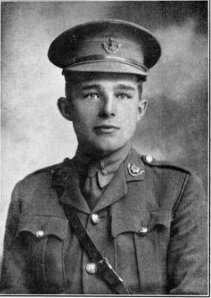
A black-and-white photograph of a young man wearing a cap and uniform and gazing beyond the photographer.

Lieutenant Thomas Orde Lawder Wilkinson, VC, undated (AMICUS 2715209)

Four days after the most devastating single day in the history of the British forces, Wilkinson and two other men were fighting their way to a forward machine gun, recently abandoned by a retreating party of British soldiers. On their own they succeeded in holding up advancing German soldiers until another unit was able to reach and reinforce them. Later that day, Lieutenant Wilkinson reached several men of different units trapped at a wall of earth over which German troops were throwing bombs. His citation in the London Gazette recounts how:

With great pluck and promptness [Wilkinson] mounted a machine gun on the top of the parapet and dispersed the enemy bombers. Subsequently he made two most gallant attempts to bring in a wounded man, but at the second attempt he was shot through the heart just before reaching the man. Throughout the day he set a magnificent example of courage and self-sacrifice (London Gazette, 26 September 1916).

A black-and-white photograph of four soldiers carrying a stretcher with a shrouded body on it through a devastated landscape.

Bringing in the Dead on the Somme Battlefields, July 1916, Canadian War Records Office (MIKAN 3520928)

The body of Lieutenant Thomas Orde Lawder Wilkinson was never recovered. He is commemorated on the British Memorial to the Missing at Thiepval, France.

Library and Archives Canada holds the CEF service file for Lieutenant Thomas Orde Lawder Wilkinson.

75th Anniversary of the Royal Canadian Air Force Women’s Division

By Laura Brown

When Canada entered the Second World War on September 10, 1939, Canadian women were not permitted to enlist in the armed forces. As in the First World War, nursing was the only opportunity women had to help in the war effort. Looking for other ways to “do their bit,” many women turned to volunteer work, paid labour, or joined unofficial military organizations that permitted members to wear uniforms and practice drills. By 1941, mounting pressure from women wishing to join up, as well as an impending shortfall of male recruits, forced the Canadian government to examine the potential role that women could play in the military. At the same time, the expansion of the British Commonwealth Air Training Plan in Canada resulted in a need to staff ground positions at its newly opened centres across the country. The authorities, therefore, decided that the Royal Canadian Air Force (RCAF) should be the first service to begin accepting women. The Canadian Women’s Auxiliary Air Force (CWAAF) was formed on July 2, 1941, its name changing to the Royal Canadian Air Force Women’s Division (RCAF-WD) seven months later. By the summer of 1942, Canadian women were serving in all three branches of the armed forces – the air force, army, and navy.

A coloured poster showing the faces of a male and a female member of the Royal Canadian Air Force. The man wears an aviator’s hat and goggles and the woman wears a blue cap with a visor. A medallion consisting of a blue circle with a red maple leaf in the centre is situated between the man and the woman.

Second World War Royal Canadian Air Force Recruiting Poster, “Men, Women The RCAF Needs You Now!” [1943] (MIKAN 2999983)

Despite their title of “airwomen,” the female members of the RCAF stayed on the ground during their war service. Women may have not been permitted to fly planes, but the messages in recruiting posters, newspapers and films, such as Jane Marsh’s National Film Board film, Wings on her Shoulder (1943), reinforced the idea that the roles women could play were every bit as important to the war effort. In fact, the jobs that women took on in the RCAF-WD, such as working as typists, cooks, and parachute packers, were essential, and recruits were reminded that every military support role taken by a woman would release a man to go and fight. The RCAF-WD promoted this idea with its motto, “We Serve that Men May Fly.”  In total, 17,038 women donned the blue cap and uniform to serve in the RCAF-WD during the Second World War.

A black and white photo showing two women dressed in coveralls standing on either side of a long table, upon which a folded parachute rests.

Unidentified airwomen demonstrating parachute packing technique, RCAF Station Rockcliffe, Ontario, 1943 (MIKAN 3583064)

Two women who took on unique roles within the Women’s Division were Willa Walker and Jean Davey. Walker joined the service in 1941, excelled in her training, and eventually achieved the rank of Wing Officer, the commanding officer of the RCAF-WD. Jean Flatt Davey also joined the RCAF in 1941 and became the first female member of its Medical Division. She later attained the role of Chief Medical Officer of the RCAF-WD.

A black and white photo showing seven members of the Royal Canadian Air Force Women’s Division. The women stand outdoors, their hands clasped behind their backs as they smile at the camera. The figures wear standard issue uniforms including jackets, skirts, caps and shoes.

RCAF Women’s Division Personnel, undated. Jean Flatt Davey and Willa Walker are seen third and fourth from the left, respectively (MIKAN 4674254)

You can learn more about these women by exploring the Willa Walker fonds and the Jean Flatt Davey fonds. In these collections, as well as in other private and government collections at Library and Archives Canada, you can find a range of documents related to the RCAF-WD. This documentary heritage is a reminder of the remarkable contributions made by Canada’s first airwomen during the Second World War.

Related resources


Laura Brown is a military archivist in the Government Archives Division.


Newfoundland and the 100th Anniversary of the Battle of the Somme

Among the most infamous battles of the First World War and the most emblematic of its horrific slaughter, the Battle of the Somme began on July 1, 1916.

A black-and-white photograph of a pastoral landscape.

General view of the battlefield looking towards Contalmaison (Battle of the Somme). July, 1916 (MIKAN 3520937)

The attack was launched along a 30-kilometre front in northern France. Initially planned by the Allies as a French-British assault, it was intended to divert German forces from their ongoing siege at Verdun. The expectation was that an eight-day preliminary artillery bombardment would destroy the German wire and the forward German lines, allowing advancing forces to simply walk in and take possession of the territory. The artillery, however, failed to destroy either of these targets and at 7:30 a.m. on July 1, 1916, when the bombardment lifted, German infantry emerged from their bunkers to aim their machine guns at the gaps in the otherwise intact wire. An estimated 60,000 British and Allied troops, including close to 800 Newfoundlanders, were killed or wounded on that one day alone. The Battle of the Somme lasted until November 18, 1916. Only 12 kilometres of ground were gained, with 420,000 British, 200,000 French, and 500,000 German casualties.

A black-and-white photograph of a devastated forest, only a few tree trunks are left standing

Scene in Maple Copse (Battle of the Somme). July, 1916 (MIKAN 3520908)

Continue reading

Canadians at the Naval Battle of Jutland, May 31–June 1, 1916

By Alex Comber

A century ago, the largest naval battle of the First World War took place off the coast of Denmark’s Jutland peninsula. More than 250 warships of the Royal Navy and the Imperial German Navy manoeuvred to get ready for action.  The first salvoes of long-range cannon fire were discharged at 14:30 on May 31, 1916, and the ensuing clash lasted into the morning of June 1. With three British battle cruisers and 11 other ships destroyed, and more than twice as many sailors killed and injured, British naval power seemed to have suffered a setback. However, in a strategic sense, the smaller German fleet could not afford its more modest losses, and Kaiser Wilhelm II’s military commanders avoided a similar fleet battle for the duration of the War, focusing instead on submarine attacks.

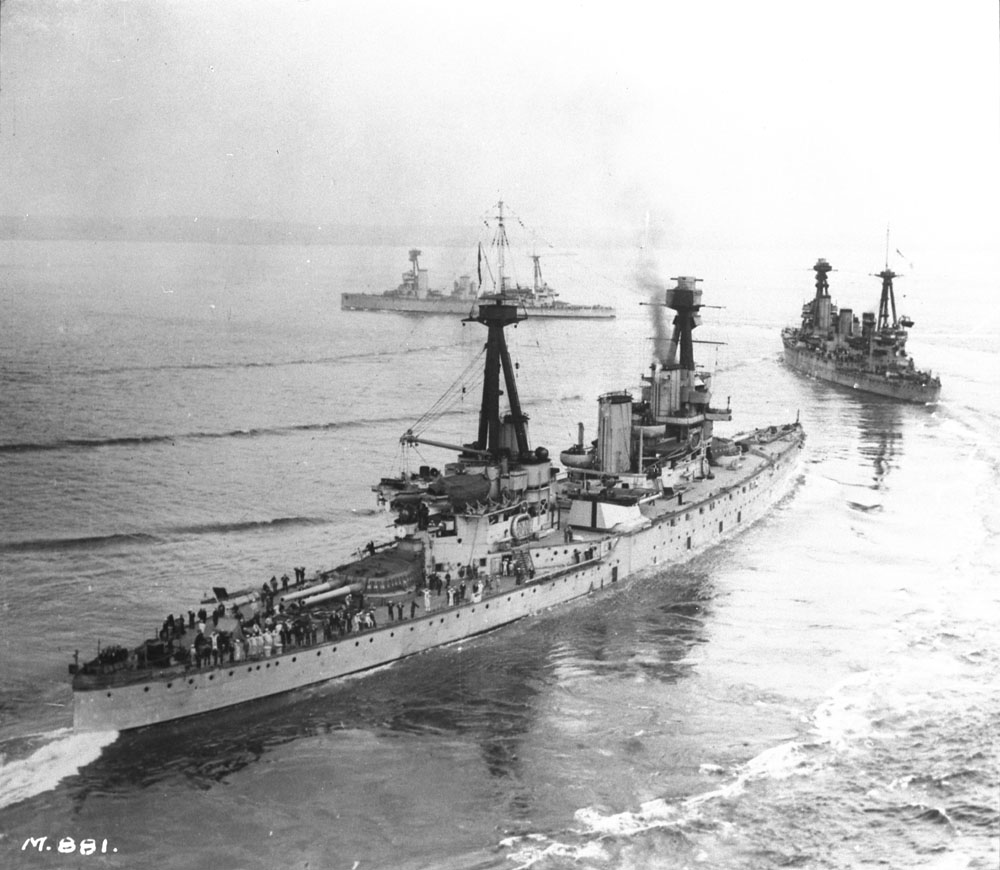
A black-and-white photograph showing three large warships.

HMAS AUSTRALIA, HMS NEW ZEALAND, HMS INDOMITABLE, Second Battle cruiser Squadron ca. 1917–1919. This unit was at Jutland, where one of its ships, HMS INDEFATIGABLE, was destroyed (MIKAN 3400004)

In many regions of Canada, there were very strong pro-imperial sentiments and cultural ties to Britain. Many had recently emigrated, and still had family back in the “old country.” Though there was a small Canadian Navy (created in 1910), many residents of Canada and of the Dominion of Newfoundland volunteered to serve with the Royal Navy in a variety of roles. With ports across the British Empire and the prospect of an alternative to a soldier’s life in the trenches of the Western Front, there was much to appeal to recruits.

A black-and-white recruitment poster showing the silhouette of a sailor with ship’s guns and the following words: Royal Naval Canadian Volunteer Reserve – Overseas Division wants men ages 18 to 38, seamen & stokers. Join today. No previous experience necessary. Apply at nearest recruiting office.

Recruitment poster for the Royal Naval Canadian Volunteer Reserve Overseas Division, appealing to Canadians to serve in British ships overseas (MIKAN 3635562)

Careful searching of the Commonwealth War Graves Commission’s online casualty database reveals that at least a dozen of the approximately six thousand sailors killed serving in the British Fleet at Jutland came from Canada or Newfoundland. Stanley de Quetteville, a member of the Royal Canadian Navy, was attached to the Royal Navy and served in the massive battle cruiser HMS INDEFATIGABLE. He was originally from the English Channel island of Jersey and had emigrated to Canada in the years before the First World War in search of opportunities. A qualified engineer, he enlisted in 1910 and had served on the cruiser HMCS NIOBE, one of Canada’s first ships. He married Phyllis Fisher of Halifax, Nova Scotia, in Edinburgh, Scotland, in 1915.

A black-and-white photograph showing a group of men sitting or standing on the deck of a ship. The photo is mounted on a black background with the words “Gun Room” written at the top and a list of names at the bottom.

Members of the Gunroom, HMCS NIOBE, Halifax, N.S. Taken 1910–1911. Several of these young men went on to become important figures in the Royal Canadian Navy. Stanley Nelson De Quetteville is shown standing, the third officer from the right (MIKAN 3398852)

De Quetteville died at 16:03 on May 31, when HMS INDEFATIGABLE exploded after being hit by accurate shellfire from the German Dreadnought VON DER TANN. Of the crew of 1,019 men, there were only two survivors. The Minister of the Naval Service, J. D. Hazen, sent his widow a letter of condolence, which reads: “I wish to express to you not only my personal sympathy, but that of the whole Canadian Naval Service, which, in his death, has lost an Officer of undoubted ability and great promise. That he died a sailor’s death, in action against the King’s enemies, and in defence of the Empire, must be to you some consolation in your great sorrow.” Today, Mount Indefatigable in the Canadian Rockies stands as a tribute to de Quetteville and his fellow crew members.


Alex Comber is a Military Archivist in the Government Archives Division.

Polysar, or the adventure of producing synthetic rubber in Canada

By François Larivée

If you were born before 1980, you may remember a picture of a large industrial complex on the back of the ten-dollar bill. An image of the Polysar (originally Polymer) plant in Sarnia, Ontario, was featured on the bill between 1971 and 1989. The company was created by the Government of Canada in 1942 as a Crown corporation, and its archives are held by Library and Archives Canada. Its history is nothing short of fascinating.

Black and white photograph showing three large spherical reservoirs and a complex network of pipes in the foreground. In the background we see a tall chimney spewing out flames and smoke as well as a building with five other chimneys.

View of pipes and three Horton Spheres storing a mixture of butylene and butadiene used in the manufacture of synthetic rubber at the Polymer Rubber Corporation plant, September 1944 (MIKAN 3627791)

Continue reading

John Boyd

As Canadians we appreciate discovering stories about our country through the works of our painters and photographers, past and present. Canadian archives hold many collections, and sometimes the collection of a particular artist or photographer may contain literally thousands of images for us to explore. This is the case with photographer John Boyd whose collection at Library and Archives Canada (LAC) boasts 28,959 black-and-white photographs.

John Boyd (1865–1941) was born in Emyvale, Ireland. His family immigrated to Toronto in the late 1860s. He was a railway official as well as a photographer. His work with the railroad gave him ample opportunities to take photographs as he travelled across Ontario.

These photographs represent Boyd’s amateur work from 1898 to 1926. A large collection in itself, it is nonetheless dwarfed by the collections held at the City of Toronto Archives. One collection in particular is that of The Globe and Mail, which contains 140,000 of Boyd’s photographic negatives taken from 1922 to before his death in 1941.

The collections at LAC and the City of Toronto Archives complement each other in their dates of creation and subject matter.

The John Boyd fonds consists of photographs portraying all manner of Canadian life, all worth exploring. There are images of towns and cities, royal visits, military life, modes of transportation, industry and agriculture, social conditions, pastimes, and nature.

During the First World War, Boyd focused mainly on the home front, photographing recruiting campaigns, training exercises, and the manufacture of munitions, airplanes and ships. He also photographed everyday Canadians who contributed to the war effort at home as soldiers fought overseas. The following selection of images provides a glimpse of the activities during that time.

A black-and-white photograph of well-dressed men, women and children looking at and exploring an outdoor exhibit of a reconstructed Canadian military trench.

Visitors to a reconstructed 35th Battalion trench, Canadian National Exhibition, Toronto, Ontario, 1915 (MIKAN 3395547)

A black-and-white photograph of women, soldiers and children gathered outside a train. Other soldiers on the train are leaning out of the windows, presumably saying goodbye to their families.

Personnel of the Cycle Corps leaving Exhibition Camp for overseas service, Toronto, Ontario, May 15, 1915 (MIKAN 3194471)

A black-and-white photograph of two soldiers descending the steps of a train car. They are both looking down at the photographer and one is holding a kitten.

Volunteers for war and cat mascot with the 28th Regiment, Toronto, Ontario, August 22, 1914 (MIKAN 3403478)

A black-and-white photograph of soldiers re-enacting how they move out from their trenches for a crowd of spectators at an exhibition.

Soldiers moving out from their trenches, Exhibition Grounds, Toronto, Ontario, September 11, 1915 (MIKAN 3403554)

A black-and-white photograph of two soldiers stopped on a dirt road. One is taking a compass reading as the other takes notes.

Soldiers taking a compass traverse on the intelligence course at Camp Borden, Ontario, September 26, 1916 (MIKAN 3403628)

A black-and-white photograph of a soldier standing in a field holding a large wrench.

Private Vasili Salivarsky, D Company, 123rd Battalion, Toronto, Ontario, March 30, 1916 (MIKAN 3220871)

You can view a selection of Boyd’s images in this Flickr album. To explore the entire collection, start your exploration in the John Boyd fonds, and select “Lower-level descriptions.”

Happy searching!