Buttery discoveries at Library and Archives Canada

Version française

By Rebecca Murray

Butter—what could be better? You don’t have to look far, or very hard, to be inspired when working with Canada’s documentary heritage. Think documents of great historic importance, photographs and artistic works of iconic significance, and objects that tell stories we can only dream of living ourselves. Oh, and butter wrappers. What? Those icky, waxy wrappers that are harder to manipulate than fitted sheets? They are helpful for measuring how much butter to cut into my baking or cooking, but are otherwise destined for the garbage bin, as soon as I can wrangle them off the stick of butter. Yet, one day while reading a finding aid, I happened upon a file titled “Collection of butter wrappers and boxes used in retailing.” My friends, I just had to see what was in this file.

Let’s cut to the chase: yes, it was full of butter wrappers. They were lovely. They weren’t waxy or buttery or crinkled. They were all flat and shiny and quite well preserved, although I don’t think they were actually ever wrapped around fatty sticks of butter.

As a reference archivist, I read a lot of finding aids and open a lot of archival boxes. I get to hold history in my hands. Each of these three butter labels represented an agricultural product that comes from our great land and the people who inhabit and work it. Do you recognize any of these labels?

A colour wax-paper wrapper with a picture of a farm with trees. The text above the image reads: “Marshall’s Brand. Creamery Butter. Pasteurized. Canada First Grade.” Another text box (on the wraparound portion of the paper) reads: “Reg. No. 1018. Only butter that conforms to Government standards for first grade are allowed to display on the wrapper CANADA FIRST GRADE.”

A butter wrapper from Jarvis, Ontario (e011180784-v8)

A colour printed foil wrapper with an image of cows grazing in a meadow. The text reads: “Co-op. First Grade. Creamery Butter. Reg. No. 4054.” One of the other sides has the following text: “Saskatchewan Co-Operative Creamery Association Limited. One lb net weight.”

A butter wrapper from Saskatchewan (e011180785-v8)

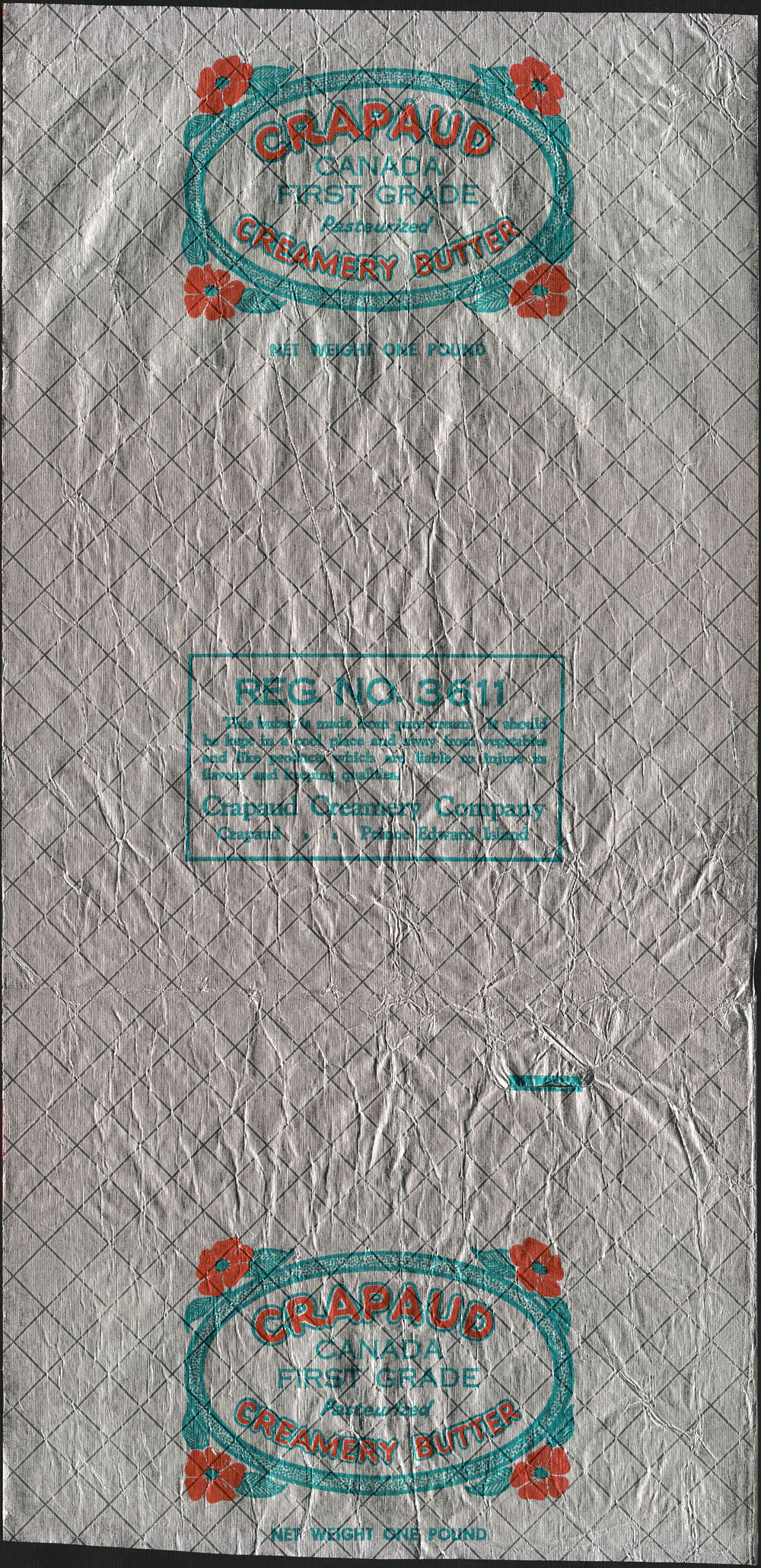
A wrapper with the following text: “Crapaud Creamery Butter. Canada First Grade. Pasteurized.”The words are in an oval medallion adorned with red flowers.

A butter wrapper from the Crapaud Creamery Company from Prince Edward Island (e011180786-v8)

Something that struck me while consulting the wrappers is that they represent a long, rich tradition of dairy farming in our country. Wrappers like these must have been found in kitchens and cold rooms in big cities and small towns alike, uniting Canadians in their daily rituals of butter consumption.

Each of these butter wrappers represents a jumping off point from which any number of archival documents or published items could be identified, allowing a researcher to discover the history of the company or the region-specific industry.

Does the history of the production and consumption of dairy in Canada pique your interest? You might want to check out some of the following holdings:

Or, you can search for keywords like dairy, butter or cheese in Collection Search and see what comes up! You never know what you will find in the holdings of Library and Archives Canada.


Rebecca Murray is a reference archivist in the References Services Division, Library and Archives Canada

Images of moose now on Flickr

Moose are the largest members of the deer family.

A coloured print of two moose calves lying on the ground and an adult bull moose standing next to them.

“Moose Deer,” coloured lithograph by John James Audubon, 1845 (MIKAN 3025621)

They are typically very tall, having long legs to help them wade through water or snow. Other characteristic features include a humped shoulder region, dark-coloured fur, an elongated face with prominent snout and lips, large ears, and broad flat antlers on the male. They inhabit the boreal forests across Canada and similar regions over the world. Preferring a colder climate, they seek out habitats with seasonal snow cover and move further north during the summer months.

Visit the Flickr album now!

Carlyle Smith Beals: a great Canadian astronomer

By François Larivée

Canada’s Dominion Astronomer and the Dominion Observatory

It may be a little-known fact now, but for several decades, Canada had a Dominion  Astronomer. This person was in charge of the Dominion Observatory in Ottawa, located on the Experimental Farm. The observatory was built in 1905 by the Geological Survey of Canada to provide precise temporal and spatial data for its mapping and topographic surveys. In those days, there were no atomic clocks to tell the exact time, so the movements of certain reference stars were used. Spatial coordinates were also determined by observing the precise position of a large number of stars. All of these observations were made using the telescope at the observatory. The Dominion Observatory was in operation until 1970, when its activities were transferred to the National Research Council of Canada.

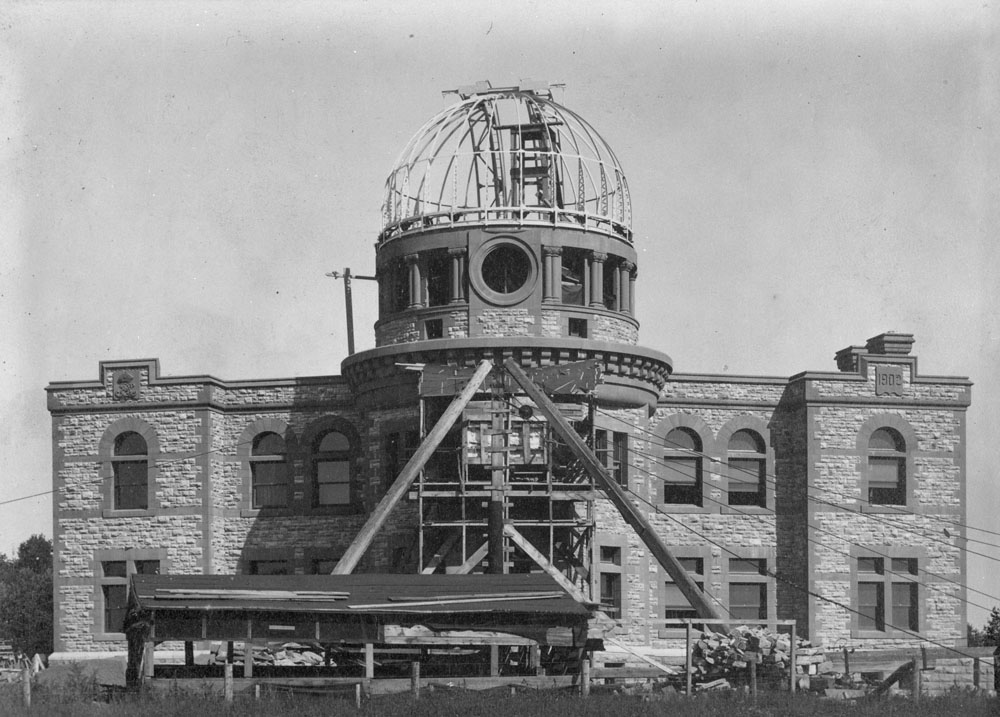
View of a building under construction. The building’s construction is almost complete, but there is scaffolding in front of the building, and the metal structure of the cupola is still under construction.
The Dominion Observatory in Ottawa under construction, ca. 1905 (a053076)

Documents on the Dominion Observatory are archived in the Department of the Interior fonds and the Natural Resources Canada fonds. In addition, Library and Archives Canada has the fonds of the astronomer who was one of the Observatory’s most important directors, Carlyle Smith Beals (1899–1979), Dominion Astronomer from 1947 to 1964. During his career, Beals garnered international acclaim for his high-quality research and important discoveries. He not only was the director of the Dominion Observatory for nearly 20 years, but also carried out research in the vanguard of his field since the 1930s, when he began his career as assistant astronomer at the Dominion Astrophysical Observatory in Victoria, British Columbia.

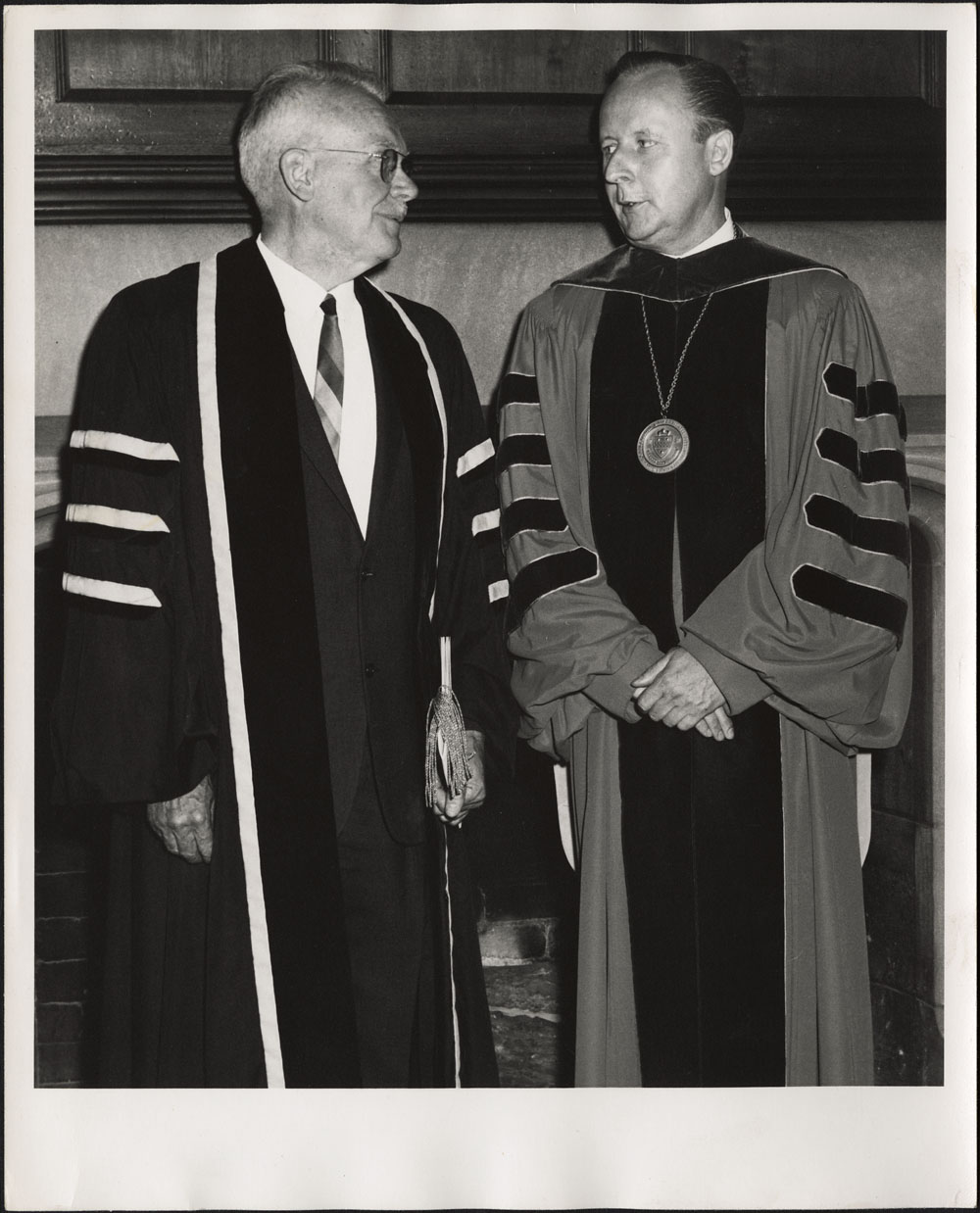
A black-and-white photograph of two men standing side by side in doctoral gowns.
C.S. Beal (left) receiving an honorary doctorate from Queen’s University, 1960 (a149328)

From studying very hot stars and interstellar matter to studying impact craters

Beals conducted research at first on certain kinds of hot stars (P Cygni and Wolf-Rayet stars) and the chemical composition of interstellar matter. Among his important discoveries, Beals proved that hot stars are made up of large gas pockets and that interstellar matter is not distributed evenly throughout space. These discoveries were made while Beals was at the Astrophysical Observatory in Victoria, before he went to the Dominion Observatory in Ottawa. Another interesting fact about the Victoria Observatory, which is still in operation, is that when it first opened in 1918, the telescope, with its 1.83-metre-wide mirror, was for some months the largest in the world.

A black-and-white photograph of a cylindrical building, with an observatory cupola, on top of a hill.
Dominion Astrophysical Observatory in Victoria, British Columbia, ca. 1925 (a032169)
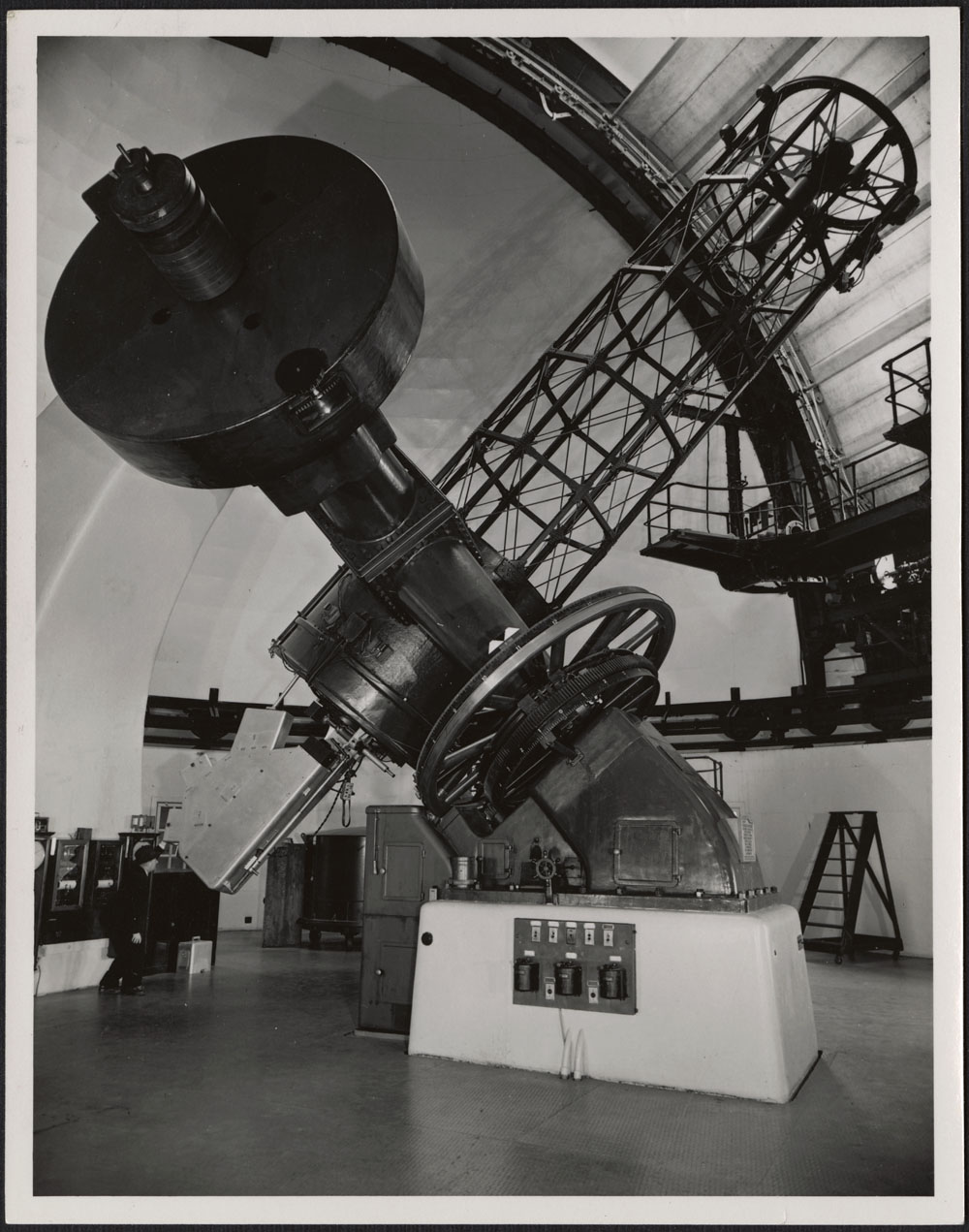
A black-and-white photograph of the inside of an observatory.
Telescope in the Astrophysical Observatory in Victoria (a149328)

As Dominion Astronomer in Ottawa, Beals was very active both as a scientist and as an administrator. He was renowned for his research on meteor craters (also called impact craters) in Canada. This research was a key part of his later career and won him worldwide acclaim. After two meteorite impact craters, the Brent crater in Ontario and the New Quebec crater (now called the Pingualuit crater), were identified in the early 1950s, Beals launched a comprehensive program to find meteor craters across Canada. The work involved analyzing thousands of aerial photos from the National Air Photo Library and from National Defence, and conducting geological studies in the field. This extensive research program earned international recognition for Canada.

Continue reading

Images of Quebec now on Flickr

Quebec is the largest province in Canada, sharing borders with Ontario to the west, Newfoundland and Labrador to the east, and New Brunswick to the south. First Peoples in Quebec are generally from three main language groups: Algonquin, Inuit and Iroquoian. The arrival of Jacques Cartier in 1534, and Samuel de Champlain in 1608, signalled the beginning of early interactions between First Peoples and Europeans. Champlain established a fort at the site of Quebec City and French colonists settled within the area. However, in 1763 all French possessions in North America were surrendered by treaty to the British. New France became the Province of Quebec.

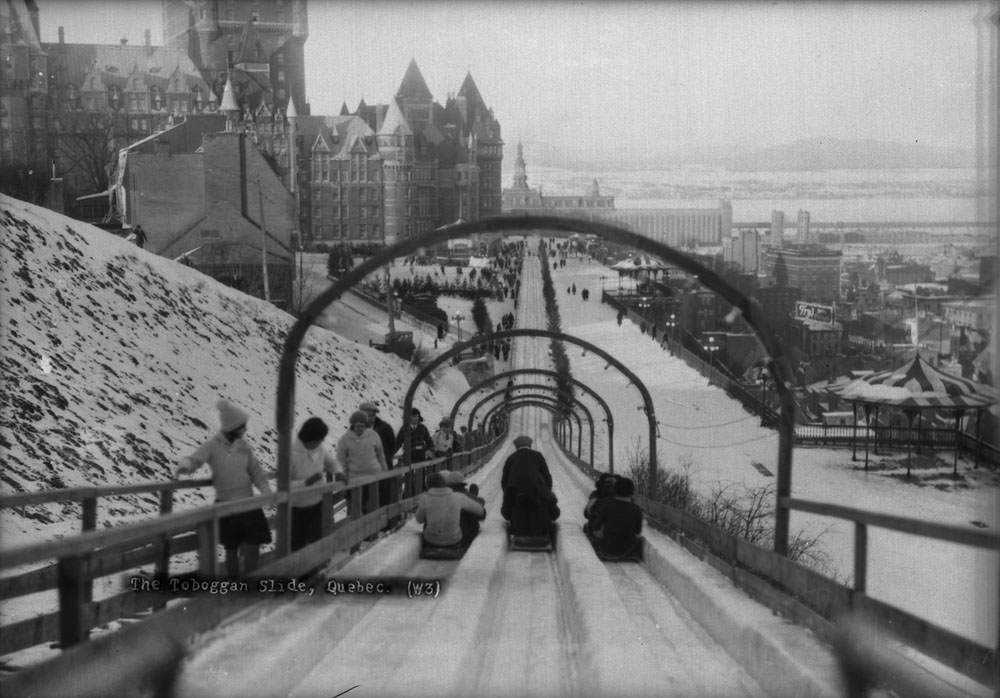
Black and white photo of tobogganists sliding past a group of people walking up to the top of the run.

The Toboggan Slide, Quebec City, Quebec (MIKAN 3387443)

In 1774, the Quebec Act was created to provide the people of Quebec with their first charter of rights. This paved the way for the recognition of French language and culture. The province was known as Lower Canada from 1791 until 1841, when it was merged with Upper Canada, following the 1837 Lower Canada Rebellion, and renamed Canada East. The merger was aimed at assimilating French-Canadians into the predominantly English-speaking culture of Upper Canada, but this was not to be. In 1848 the colony was granted self-government, and its French-Canadian identity was taken into account during the road to Confederation. In 1867, Canada East once again became the Province of Quebec, and part of a greater Canadian Confederation.

Did you know?

  • Quebec is the only province to have French as its sole provincial official language.
  • Throughout the 1960s and 1970s, Quebec underwent the Quiet Revolution, a period of intense social, political and cultural change.

Visit the Flickr album now!

First World War photographs in private fonds at Library and Archives Canada

By Rebecca Murray

A.F. Duguid, an early Canadian military historian, noted as he researched the First World War in its aftermath, “It is remarkable how much of the most useful historical material is still held in private possession.” (Clio’s Warriors by Tim Cook, page 79)

The photographs of the Canadian War Records Office photographic collection (accession 1964-114) are illustrative of the life and work of soldiers during the First World War. As many of the photographs are digitized and available online, they are heavily used by researchers.

That said, many researchers come to Library and Archives Canada (LAC) wanting to see images of the conflict that aren’t part of the official government records. This is a great example of when our private holdings—archival documents donated to LAC by individuals or organizations—can serve as an excellent complement to government holdings by providing an alternative view of an historic event.

This blog post highlights three fonds within our holdings, but there are many more. Please note that the complete references are provided below (in italics) to allow researchers to easily order the material for consultation, as not all of the items are digitized.

W. L. Kidd collection, accession 1974-137

Extent: 405 photos

Content Description: Personnel and activities of No. 7 Canadian General Hospital, Etaples, France (KIDD, W. L. 1974-137 SC 0333); examples of various types of wounds suffered by Canadian soldiers during the First World War (KIDD, W.L. 1974-137 06221). (1916–1918)

Comments: Search using the keyword “1974-137” in Collection Search to see descriptions and digitized images for a portion of the collection.

A black and white photograph of a group of soldiers and nursing sisters in a tent.

“Nursing sisters attending to soldiers in the dressing tent at the No. 7 Canadian General Hospital” (1917). Credit: W.L. Kidd (e002712847)

Margaret D. Cooke collection, accession 1989-248

Extent: 57 photos

Content Description: Canadian Army Medical Corps in England during the First World War, including 21st Battalion personnel; Saltwood Castle; soldiers at outdoor kitchen; Duchess of Connaught Red Cross Hospital at Cliveden, Taplon; No. 2 New Zealand Hospital at Walton-on-Thames; Moore Barrack, Shorncliffe, Kent; Mount Felix, Walton-on-Thames. War photographs: destroyed tank; trench; destroyed town (COOKE, MARGARET D. 1989-248 04147).

A black and white photograph of a woman in a nursing sister uniform with the cape, pin, hat and white gloves.

Nursing Sister Beatrice Baker, 1916 (PA-210762)

Anne E. Ross fonds, accessions 1982-174 and 1965-041

Extent: 1588 photographs

Content Description: Photographic material depicting […] activities and personnel of No. 3 Stationary Hospital, C.A.M.C., in Canada, England, and in the Mediterranean theatre of operations while based on the island of Lemmos, 1915–1917; photographs by E.R Owen of staff, patients, faculties, major events and visitors at the Duchess of Connaught’s Canadian Red Cross Hospital, Taplow, England, 1915–1916; photographs from the First World War (ROSS, ANNE E. 1982-174 05618, ROSS, ANNE E. 1965-041 05680A).

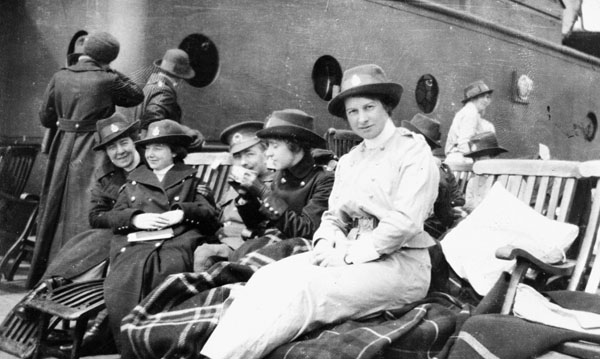
A black-and-white photograph of a group of four women sitting on deck chairs with blankets. Three of the sisters are wearing the dark overcoat while one is wearing a lighter coloured jacket. A soldier can be seen slightly in the middle of the group.

Nursing sisters sitting on deck of ship with a soldier (1916). Credit: Anne E. Ross (PA-202409)

If you’re interested in discovering these or other photographs held in private fonds at LAC, please contact us using our online form.


Rebecca Murray is a reference archivist in the Reference Services Division of Library and Archives Canada.

Guest curator: Brian Thompson

Banner for the guest curator series. CANADA 150 is in red along the left side of the banner and then the bilingual text: Canada: Who Do We Think We Are? and under that text is Guest curator series.Canada: Who Do We Think We Are? is a new exhibition by Library and Archives Canada (LAC) marking the 150th anniversary of Canadian Confederation. This exhibition is accompanied by a year-long blog series.

Join us every month during 2017 as experts, from LAC, across Canada and even farther afield, provide additional insights on items from the exhibition. Each “guest curator” discusses one item, then adds another to the exhibition—virtually.

Be sure to visit Canada: Who Do We Think We Are? at 395 Wellington Street in Ottawa between June 5, 2017, and March 1, 2018. Admission is free.


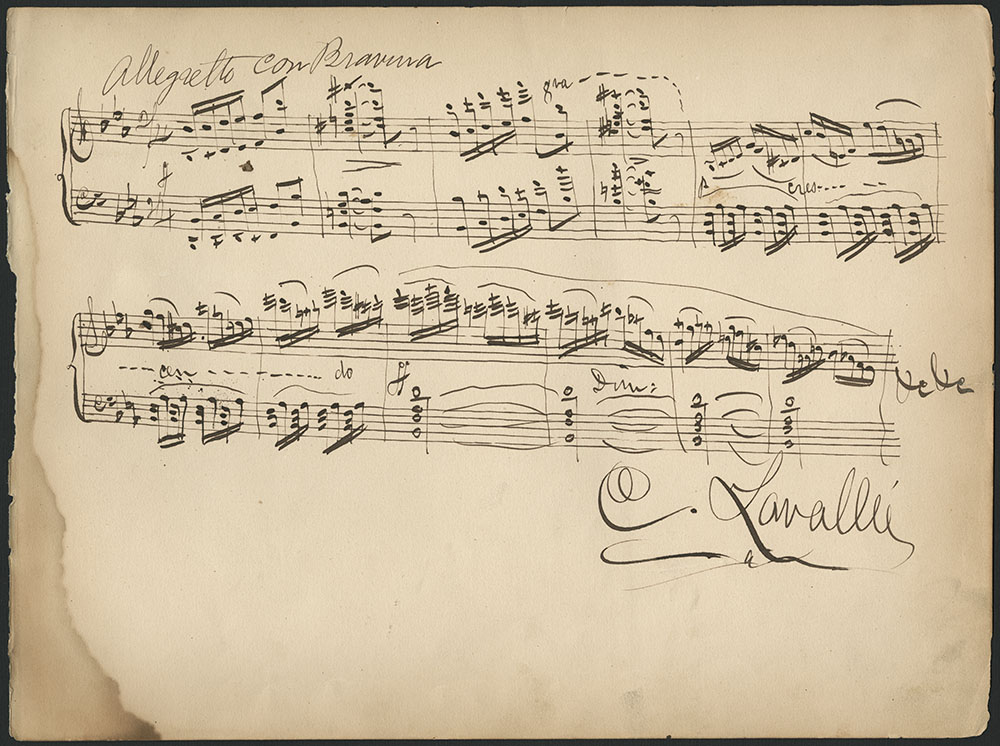
The opening measures of “Une Couronne de Lauriers” by Calixa Lavallée, ca. 1864
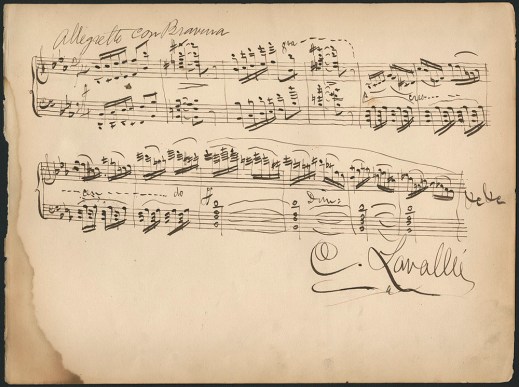
Sepia page of handwritten musical notations signed C. Lavallée.

Sheet music of “Une Couronne de Lauriers” by Calixa Lavallée, ca. 1864 (MIKAN 4903777)

Calixa Lavallée didn’t think Canada would work as a nation. He may even have written anti-Confederation music. There were certainly heavy hints in the newspapers about a radical known for his crown (couronne) and laurels (lauriers).


Tell us about yourself

As a boy, hockey, music, history and politics all fascinated me. The first two I had in common with most kids my age. The third and fourth were more obscure. Nevertheless, as a musicologist, I made music, history and politics part of my work, and while writing about Calixa Lavallée, the composer of “O Canada,” I realized that I had found a way to bring hockey into the mix—the national anthem, as sung by the great Roger Doucet, had been a part of my Saturday nights from fall until spring.

Is there anything else about this item that you feel Canadians should know?

Lavallée was born just outside Montréal in 1842. By the time he was in his mid-teens, he was a professional musician, employed as musical director of travelling minstrel troupes and performing as a pianist. He would go on to become an important educator, both in Canada and the United States, and a composer of nearly every form of music common in his time. His published works include songs, sacred music, concert overtures, operas, numerous piano pieces and “O Canada,” which he composed in 1880.

Lavallée returned to Montréal from the U.S. in 1863 and remained until late in 1865. It was a momentous time on both sides of the border. In 1864, while the U.S. Civil War entered its third year, Canadians began to debate the merits of Confederation. In Montréal, opinions were divided on the creation of a new country. Through his contributions to nationalist newspapers La Presse and l’Union nationale, the 22-year-old Lavallée aligned himself with opponents of Confederation who believed it would lead to the assimilation of French Canadians. On stage, he maintained a high profile, leading a group of young vocalists and instrumentalists in numerous concerts, and devoting much of his time to raising funds for charity.

On February 19, 1864, Lavallée gave a concert at Nordheimer’s Hall, in Montréal, and played “Une Couronne de Lauriers” for the first time in public. The local firm of Laurent, Laforce et cie published it that summer, and in August La Presse printed a review of it by the pianist Gustave Smith, who called it “the first major piece that has been issued by a Montréal music publisher” [« la premier morceau d’importance qui ait paru chez un éditeur de musique de Montréal »]. It would seem likely that Lavallée jotted down these opening bars of “Une Couronne de Lauriers” at about this time.

Two pages containing signatures of major opera singers.

Autograph sheets containing signatures from major opera singers of the time (MIKAN 4936687)

This fascinating document raises many questions. It was acquired by LAC together with a double-sided sheet titled “Autographes des dames et messieurs de l’Opéra Italien.” Markings clearly indicate that the first sheet, containing a musical fragment, was from the same book as the second, a page of autographs. They were both acquired by LACthrough a rare book dealer, and we can now only speculate on their origins and purpose.

The autograph sheet contains the signatures of many opera personalities of the time, including the impresario Max Strakosch and the mezzo-soprano Amalia Patti Strakosch. Most of the performers, if not all, were active in New York City in the mid-1860s. The page also contains a cryptic message: “What will be the future for us? Montréal 5 Nov. 1866” (« Que sera l’avenir pour nous deux? Montréal 5 nov 1866 »).

So, to whom did these two sheets belong? I can only speculate. One possibility is that they were the property of Lavallée himself, perhaps passed on to his widow after his death in Boston in 1891, and then to someone else. Lavallée often worked with opera singers and may have collected their autographs. A photograph album that he owned has survived and contains many signed pictures of other artists. It would, however, have been unusual for him to have contributed a short piece of music to his own autograph book.

Perhaps a more likely possibility, then, is that these pages were the property of the pianist Gustave Smith. He was Lavallée’s colleague in Montréal in the 1860s, and he also often worked with opera singers. He too left for the U.S. late in 1865, or in early 1866, staying for a brief period in New York before settling in New Orleans. He returned to Canada later that decade to take a position as organist in Ottawa’s Catholic cathedral.

A third possibility is that these items belonged to another of Lavallée’s collaborators: the violinist Frantz Jehin-Prume. This Belgian musician paid an extended visit to Montréal in 1865, during which time he performed at least once with Lavallée. The two later became close friends and frequent performing partners. He toured on more than one occasion with a company that included Amalia Patti Strakosch. He was in New York City in the fall of 1865 and returned to Montréal in 1866.

While this manuscript still has secrets to reveal, it provides a little window into the past, giving us a glimpse of cultural life at the time in which Canada was being conceived and into the life of the musician whose music would help to define a country to whose creation he initially objected.

Through their training and experience, historians and archivists—and musicologists—learn the potential importance of a handwritten document. They know that a letter, a memo or a few notes of music written quickly on a scrap of paper may help us to better understand an earlier time and may hold far more value than is immediately apparent. Studying history can be about analyzing major historical and political events, but it can also be detective work. Those exploring our time are likely to rely largely on information in electronic formats: digital images, emails, posts, blogs. This exhibition may then provide an opportunity for the public to consider and admire original documents, such as these—documents created by human hands, and by people who have left something of themselves and their time for the future.

Tell us about another related item that you would like to add to the exhibition
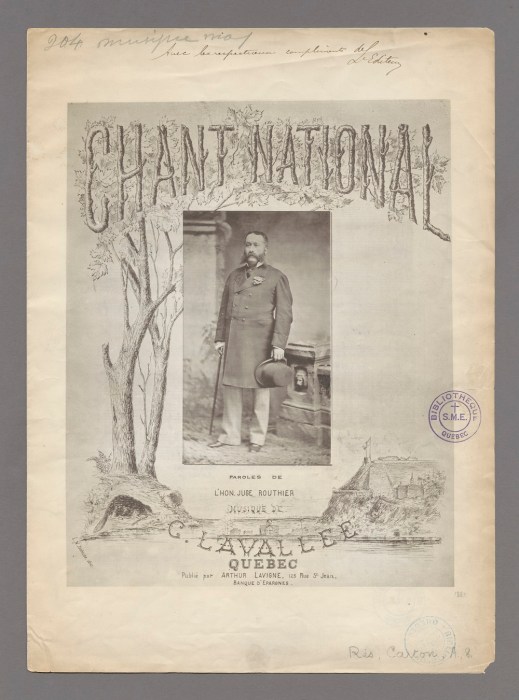
Sheet music cover. In the centre, there is a photo of a man in an overcoat and trousers holding a top hat and a cane. The composer’s and lyricist’s names are at the bottom between a sketch of the city of Québec and a tree that stretches to the top of the page to decorate the title with maple leaves.

Cover of the first edition of “O Canada” (AMICUS 5281119) L.N. Dufresne, cover “O Canada” (Québec: Arthur Lavigne, 1880). Musée de la civilisation, bibliothèque du séminaire de Québec. Fonds ancient, 204, SQ047145.

The cover of the first edition of “O Canada” (“Chant national”) is a rare item of important historical significance. The anthem was composed for the Congrès Catholique Canadien-français of 1880, a gathering of intellectuals, politicians and thousands of members of the general public, intended to celebrate French-Canadian culture and reflect on the future. The event included many musical performances. It was also seen as an opportunity to create a national song that had the dignity of “God Save the Queen,” the anthem then sung at all public events in Canada.

The organizing committee of the Congrès selected Calixa Lavallée as the composer, and judge Adolphe-Basile Routhier as the poet, of the new anthem. Both were then living in Québec and knew each other at least casually. They completed their work by April of 1880 and newspapers announced that it would published by the local music dealer Arthur Lavigne. The cover’s designer was L.N. Dufresne, a painter and illustrator. Dufresne intended his artwork to capture visually the essence of the music. The title is presented at the top, surrounded by maple garlands. On the right is the Québec Citadel, on the left a beaver, at the bottom the St. Lawrence River. The centre of the page features a photograph of Lieutenant-Governor Théodore Robitaille. His prominence on the cover was an acknowledgement of his place as a patron of the arts and a leading proponent of the creation of a new national song—a song that he hoped would come to represent the people of Quebec and French-Canadians everywhere.

Biography

A colour photograph of a man with a beard Brian Christopher Thompson is the author of Anthems and Minstrel Shows: The Life and Times of Calixa Lavallée, 1842–1891 (Montréal and Kingston: McGill–Queen’s University Press, 2015), and the compiler and editor of Calixa Lavallée: L’œuvre pour piano seul / The Complete Works for Solo Piano (Vancouver: The Avondale Press, 2016). He completed his PhD in musicology at the University of Hong Kong, under the supervision of Michael Noone and Katherine Preston, in 2001, after completing degrees at Concordia University, the University of Victoria and McGill University. He is currently a senior lecturer in the Department of Music at the Chinese University of Hong Kong.

Related resources

Grist for the Mill – Poems on war, labour and progress

By Kelly Anne Griffin

Alex Gibson was an immigrant, a veteran of the First World War, a mill worker and a poet. His experiences are reflected in Grist for the Mill, a book of poetry that he self-published in 1959. A copy of this book was discovered during the processing of the archival records of the Canadian Paperworkers Union.

Gibson was born in 1893 in Scotland, and he immigrated to Canada around 1913. He enlisted with the Canadian Expeditionary Force in the 10th Field Ambulance Battalion. Many of the poems in his book deal with the challenges of adjusting to the often routine life of working in a paper mill after surviving the horrors of war. Many young Canadian men faced similar challenges when they returned from the war in Europe.

He contemplates the struggles of returning soldiers in “What Shall It Be”:

What shall it be when victory’s won
And our men come marching home;

Shall it mean the same as it always means –
The broken lives and the shattered dreams

And a desolate land to roam?

[…]

Answer ye men of the shop and rail –
The mill and the mine – the sea and the mail,

For answer it ye shall?
(pp. 90–92)

A black-and-white photograph showing a crowded war scene: wounded soldiers are on stretchers while soldiers mill around, with destroyed buildings in the background.

The 10th Field Ambulance Battalion of the Canadian Expeditionary Force at the Battle of Amiens in August 1918. Gibson served in the field, caring for the wounded after battle. This devastating experience underlies his poetry (a002864-v8).

Gibson worked in the pulp and paper industry for over 38 years and was passionate about labour issues. He served in several important roles within the Canadian Paperworkers Union during his career. He even ran for federal office in the riding of Port Arthur in 1935 and 1940 for the Co-operative Commonwealth Federation. This party, a predecessor of the New Democratic Party, was dedicated to progressive social and labour issues. Gibson’s socialist stance is clear in nearly all of the poems in the book, which provides an informative first-hand account of working-class struggles. The plight of the worker and the need for workers to come together in a strong brotherhood are recurring themes. In “Hoboes and Heroes,” he writes about the class of society that could be called the working poor:

He said that every place he went
He found that there were thousands such as he;
Who, with the last of all their money spent
Were forced to beg for charity.

[…]

And as he spoke I sensed the bitter note.
Of dark despair, the utter lack of hope.
(pp. 77–80)

Working for over three decades in a factory, and being active in union activities, Gibson was acutely aware of the hardships and struggles in a production mill. These come up frequently in his writings. Days were long, pay was poor and conditions were not as regulated as they are today. He continually tried to improve this situation through his work with the union. The vivid picture he paints of what life was like for these men shows his empathy for his fellow workers. In the book’s dedication, he writes:

To ye who toil in the murk;
To ye who swine in the drift

Making an epic of work,
Single or double shift.

Knowing you as I do;
Living the life you live,

This is my gift to you,
All that I have to give.
(p. 3)

A black-and-white photograph of a man leaning over a grinder machine holding a plank of wood in his hands.

Worker in a pulp and paper mill operating a grinder machine. Gibson’s poetry often describes the monotonous and dangerous conditions in mills and the effects on workers. Photo taken by Harry Foster (e000761635).

Most of Gibson’s poems cover issues relating to labour and social injustices in Canada, but some provide glimpses into important moments in history. “A Constitutional Crisis” relates the abdication of Edward VIII to wed twice-divorced Wallis Simpson, a huge scandal at the time. “A Note to the Hon. Minister of Justice” is about the jailing of Tim Buck, a leader in the labour movement. Buck’s imprisonment at Kingston Penitentiary caused much public outcry, especially among labourers like Gibson.

This collection of poems, though written primarily about personal conflicts and workers’ struggles, has an underlying tone of hope. Many of Gibson’s poems are still relevant for Canadian readers today. This is one reason why Grist for the Mill is a true treasure in the collection of Library and Archives Canada.

Guest Curator: Arlene Gehmacher

Banner for the guest curator series. CANADA 150 is in red along the left side of the banner and then the bilingual text: Canada: Who Do We Think We Are? and under that text is Guest curator series.Canada: Who Do We Think We Are? is a new exhibition by Library and Archives Canada (LAC) marking the 150th anniversary of Canadian Confederation. This exhibition is accompanied by a year-long blog series.

Join us every month during 2017 as experts, from LAC, across Canada and even farther afield, provide additional insights on items from the exhibition. Each “guest curator” discusses one item, then adds another to the exhibition—virtually.

Be sure to visit Canada: Who Do We Think We Are? at 395 Wellington Street in Ottawa between June 5, 2017, and March 1, 2018. Admission is free.


Bunch of Wildflowers by Susanna Moodie, ca. 1870

Yellow dandelion in front of blue and pink wildflowers mingled with leaves, painted on sepia card.

Bunch of Wildflowers by Susanna Moodie, ca. 1870. (MIKAN 2837436)

Susanna Moodie called Canada’s woods “the prison house.” Flower painting may have been her form of therapy. It allowed her to impose order and refinement on one small piece of nature.


Tell us about yourself

Studying the visual culture of Canada has been a pursuit of mine since first being hired to research primary archival and printed sources for an exhibition on historical art produced in Canada. I was hooked—the material satisfied both my love of fine art as well as cultural context. I feel very fortunate to have been able to make it my career.

Is there anything else about this item that you feel Canadians should know?

Watercolours, such as Bunch of Wildflowers, were for Moodie not just a pastime to create gifts for family and friends, but also a commodity that could be used for cash income or trade. With a price tag of $3 to $5, she could pay her servant. William Notman, the famed Canadian photographer, is known to have accepted—at his own suggestion—an autographed watercolour as payment for his photographs. (Moodie obliged with A Group of Crimson, White, Yellow, and Pink Roses.)

The bunch of wildflowers—including periwinkle, dandelion, and clematis—may well have been picked by Moodie herself, but her arranging them into a watercolour was part of her domestic economy.

Tell us about another related item that you would like to add to the exhibition.

Two colour plates of colourful flowers with green leaves. Left: Wild Orange Red Lily, Harebell, and Showy Lady’s Slipper. Right: Sharp-lobed Hepatica, Large-flowered Bellwort, Wood Anemone, and Spring Beauty.

Image on the left: Wild Orange Red Lily, Harebell, and Showy Lady’s Slipper (MIKAN 2905466) Image on the right: Sharp-lobed Hepatica, Large-flowered Bellwort, Wood Anemone, and Spring Beauty (MIKAN 2905471) Plates from Canadian Wild Flowers by Agnes FitzGibbon, published by John Lovell, Montréal, 1868 (AMICUS 49189)

Agnes FitzGibbon, daughter of Susanna Moodie, collaborated with her aunt Catharine Parr Traill (Susanna’s sister) on Canadian Wild Flowers, published in 1868 and praised for its scientific accuracy. Susanna Moodie’s Bunch of Wildflowers bespeaks her joy and passion in picking and aesthetically arranging flowers, and immortalizes her artistry in watercolour. In contrast, FitzGibbon’s fine illustrations are informative, her delineation precise to ensure legibility of specimen.

FitzGibbon’s project was from the start a business venture, each of the 500 copies containing 10 lithographed plates, each hand coloured (with help!), and accompanied by Parr Traill’s descriptions both poetic and naturalist. Executed over 1867 and 1868, Canadian Wild Flowers in subject and timing surely assumed a mantle of national relevance.

Biography

Colour photograph of a woman standing against a turquoise tiled wall.Arlene Gehmacher, PhD, is Curator of Canadian Paintings, Prints & Drawings at the Royal Ontario Museum (ROM) in Toronto, Ontario, where she develops collections-based research and exhibits. She also teaches; her course “Collecting Canada” deals with the acquisition, interpretation and display of the ROM’s picture collection and is offered through the Art History Department of the University of Toronto. Her publications cover the 19th to 21st centuries, and include articles on Ozias Leduc (1996), Cornelius Krieghoff (2003), Naoko Matsubara (2003, 2016), Paul Kane (2010, 2014), Arthur Heming (2013), and William Blair Bruce (1999, 2014).

Related resources

From the Lowy Room: remnants of Spanish Jewry

By Michael Kent

As a librarian, people often question me about the value of the print book in the digital age. After all, many of the books in the collections I serve can be found in digital formats online. While it is true that even the oldest works in Library and Archives Canada’s collections are now accessible in a range of formats online, I maintain that the power of the physical items—and the stories behind them—go far beyond the mere content of the page.

One of the items that evokes this sentiment in a powerful way is the fragment of the 1491 Pentateuch, the Jewish canonical scriptures, from Spain.

This Bible, printed by Eliezer ibn Alantansi in Hijar, Spain, was the last dated Hebrew book printed in Spain before the Spanish expulsion of the Jews in 1492. While the age, the print quality, or the level of scholarship necessary to produce this book alone make it an important work in early printing, it is the story it tells about the expulsion of Spain’s Jews that makes it a powerful item to behold.

Sadly, refugee crises are not new. Currently, our world is in the midst of a global refugee crisis, a crisis we are able to observe almost first-hand due to the rise of social media. The modern world has allowed us to gain an important and humbling glimpse into the struggles of those living in refugee camps.

The breadth of media content, blogs, pictures and personal accounts will allow future generations of scholars to understand the struggles of contemporary refugees in a way previous generations of scholars could never have imagined. But what about past refugees—how do we try to understand the struggles of medieval refugees, their expectations, their former lives, their hopes for the future, and the devastation caused by their upheavals?

These questions represent a tremendous challenge for historians who wish to uncover the experiences of those in the past. History needs to be more than dates and the stories of the elites; the stories of the masses and the collective experiences we need to learn from are the important episodes that should be investigated.

This is where I return to the biblical fragment found in the Lowy collection. From a content-on-the-page perspective, does the Pentateuch represent anything more than a standard Rabbinic Bible, the type that could be downloaded for free? The simple answer is no. Looking outside the text, does this item provide insights into the lives of Spanish Jewry on the eve of expulsion? I believe the answer is a resounding yes.

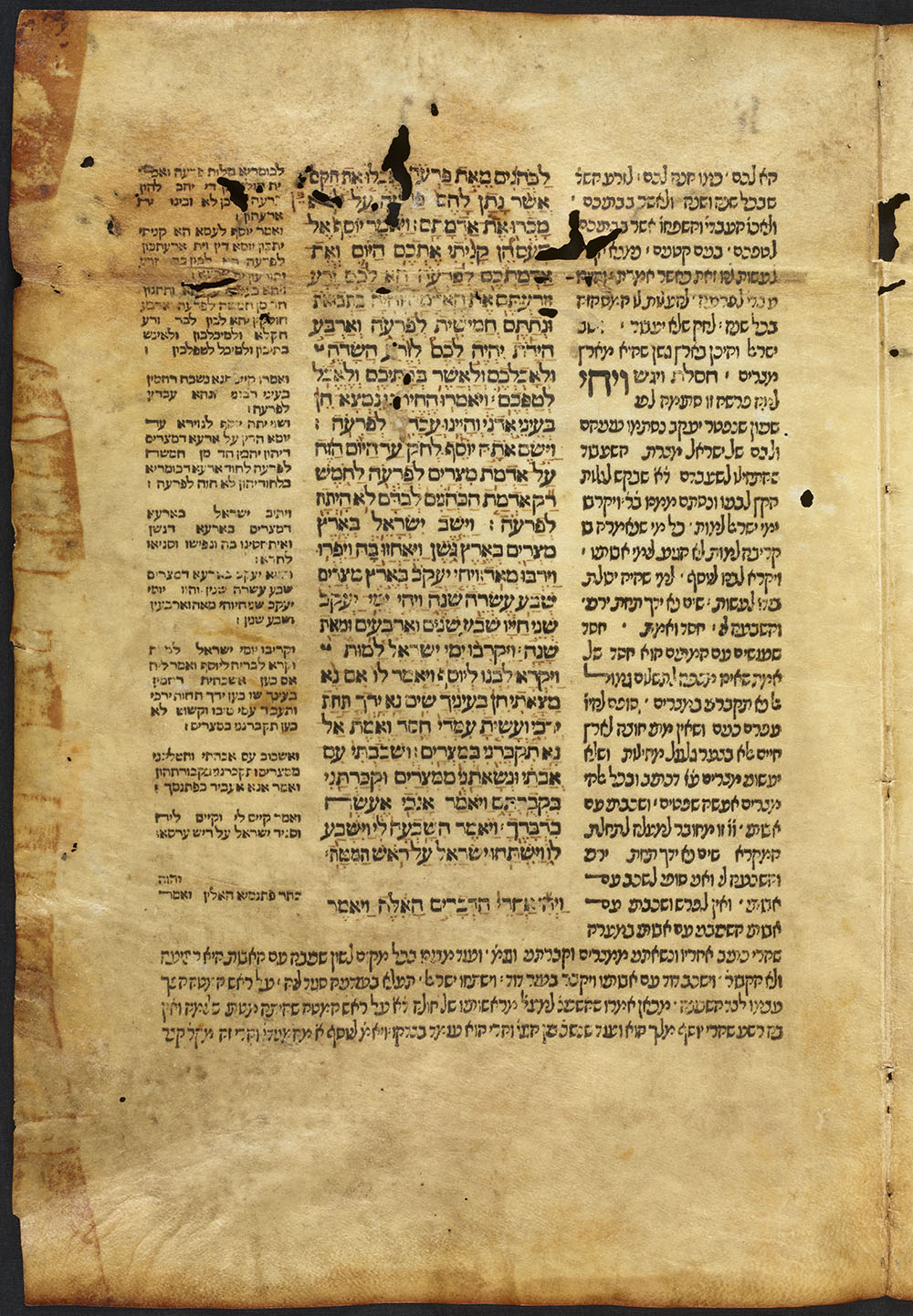
A colour photograph of a yellowed, printed page written in Hebrew.

A leaf of the 1490 Hebrew Bible printed by Eliezer ben Avraham Alantansi (AMICUS 32329787)

I look at this page and see a community that saw itself as stable and with a future in Spain. In the early days of printing, a Bible like this would have been a major undertaking. The establishment of communal infrastructure in the form of a printing press, the investment in scholarship, and a major economic undertaking are, to me, evidence that Spain’s Jews saw themselves as secure and with a long and stable future in the Iberian Peninsula. I look at this page and see people who did not imagine the major upheaval and communal devastation that was less than two years away. In short, I see firsthand evidence of one of Medieval Europe’s largest refugee experiences.

As a librarian and curator, I strongly believe in the power of the physical book, a power that goes far beyond the content of the work. While e-books and websites ensure global access to a range of intellectual content, the humbling experience and historic evidence offered by the physical book are irreplaceable.


Michael Kent is the Curator of the Jacob M. Lowy collection

Lieutenant Frederick Maurice Watson Harvey, VC

The Discover Blog returns to the First World War Centenary: Honouring Canada’s Victoria Cross recipients series, in which we profile each of Canada’s Victoria Cross recipients on the 100th anniversary of the day that the actions for which they were awarded the Victoria Cross took place. Today we present the story of Lieutenant Frederick Maurice Watson Harvey, an Irish-born Canadian VC recipient from Medicine Hat, Alberta.

A black-and-white portrait of an officer wearing a Sam Brown belt and looking directly at the viewer.

Captain Frederick M. Harvey, V.C., undated (MIKAN 3216613)

Harvey, born in Athboy, County Meath, Ireland, was one of three Irish rugby union internationals to have been awarded the Victoria Cross, and the only one to have been awarded the medal during the First World War. He settled in Medicine Hat, Alberta, in 1908 and enlisted on May 18, 1916 with the 13th Regiment, Canadian Mounted Rifles, transferring to Lord Strathcona’s Horse (Royal Canadians) after arriving in France.

On March 27, 1917, Harvey’s troops advanced on the village of Guyencourt, France. As German machine gun fire inflicted heavy casualties, Harvey’s Victoria Cross citation recounts what occurred next:

At this critical moment, when the enemy showed no intention whatever of retiring and fire was still intense, Lt. Harvey, who was in command of the leading troop, ran forward well ahead of his men and dashed at the trench, still fully manned, jumped the wire, shot the machine gunner and captured the gun. His most courageous act undoubtedly had a decisive effect on the success of the operation (London Gazette, no.30122, June 8, 1917).

A black and white reproduction of a war diary entry showing the place, date, hour and a summary of events and information.

Extract from the Lord Strathcona’s Horse war diaries for March 27, 1917 (MIKAN 2004721)

Lieutenant Harvey was initially granted the Distinguished Service Order but was later awarded the Victoria Cross. He received the Military Cross for his role in the Lord Strathcona’s Horse advance on Moreuil Wood on March 30, 1918 and was also awarded the French Croix de Guerre.

Harvey remained with Lord Strathcona’s Horse and was promoted to Captain in 1923. He instructed in physical training at the Royal Military College of Canada from 1923 to 1927, was promoted to Lieutenant Colonel in 1938, and, in 1939, was made Brigadier General. Harvey served as Honorary Colonel in Lord Strathcona’s Horse from 1958 to 1966. He died in August 1980 at age 91.

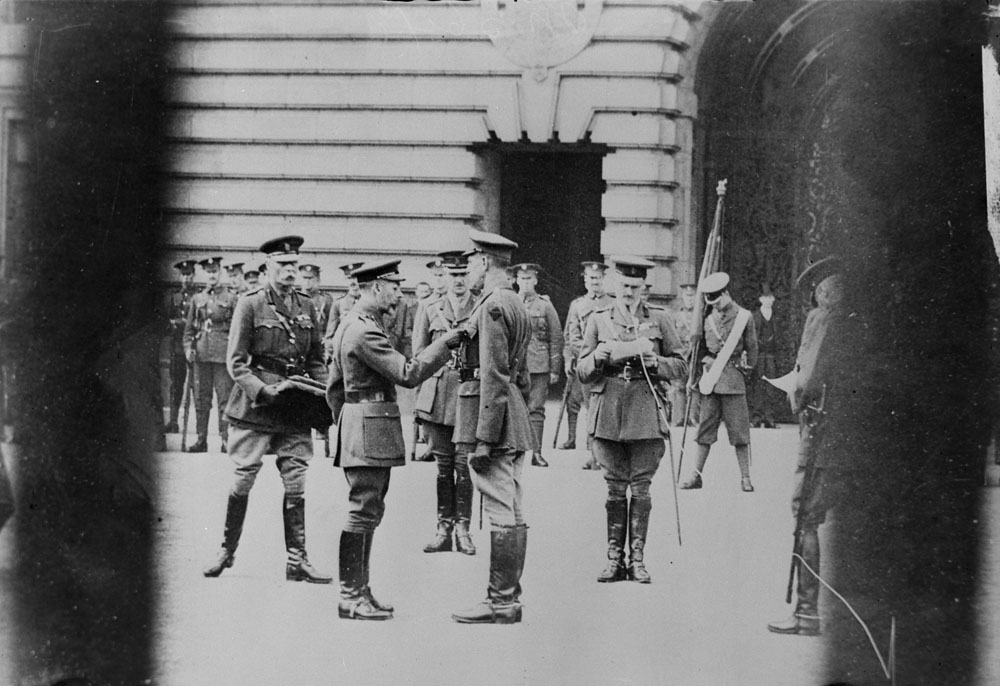
A black and white photograph of a man pining an award on another man’s pocket. Another man is reading the citation while a third man is carrying a case. In the background, rows of soldiers are standing at ease.

H.M. The King decorating Lieutenant Harvey L.S.H. with the Victoria Cross (MIKAN 3362384)

Library and Archives Canada holds the CEF service file for Lieutenant Frederick Maurice Watson Harvey.

Related Resources