Preventive Care and Maintenance: Laura Secord and the Grassy Knoll

Chris Smith, Library and Archives Canada Collections Management Clerk, was recently assigned an interesting and challenging rehousing project. Chris found himself looking at a Laura Secord chocolate box filled with not sweets, but a tangled mess of Dictaphone belts: 27 in total.

Introduced by the Dictaphone Corporation in the 1940s, the Dictabelt was a voice recording system using a thin plastic belt. The Dictabelt Re-Recording Service describes how the recordings worked: audio could be impressed onto the belt utilizing a needle-type stylus to emboss or plough a groove into the soft plastic. They were predominately employed for business, medical and scientific recordings. After use, Dictabelts were usually stored flat in boxes or file folders. This caused creasing and damage to the recordings.

For the conspiracy theorists out there, certainly the most famous use of a Dictabelt was by the American House Select Committee on Assassinations, which investigated the assassination of President John F. Kennedy on November 22, 1963. Based on “acoustic evidence” supplied by a Dallas Police Department Dictabelt, the committee concluded that there were at least four shots fired in Dallas that fateful day, and that one of them came from the “grassy knoll.”

Following considerable research on Dictabelt preservation techniques and consultation with our audiovisual conservation experts, Chris began his rehousing process. He wrapped each belt around a piece of custom-cut acid-free board to reduce creasing. Chris then placed each wrapped belt in an envelope, built spacers, and rehoused all 27 belts. They now safely reside in an 18C and 40% relative humidity (RH) environment at our Preservation Centre.
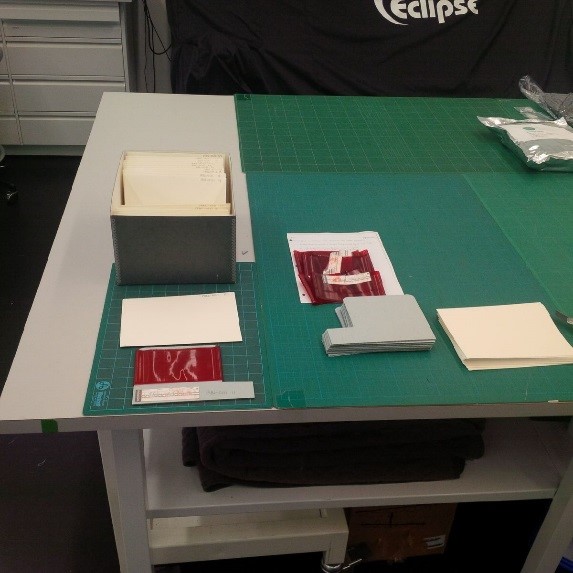
A colour photograph shows how the Dictaphone belts were received, with rusty paper clips holding the paper captions to each belt. Below the belts are the archival supplies used: blue board and envelopes. The bottom left shows the blue board inside the belt and the paper caption affixed to the bottom of the board. Above are the items placed inside envelopes and the new container that they will now be stored in.

This photo demonstrates the steps required for properly housing Dictaphone belts for long-term preservation.
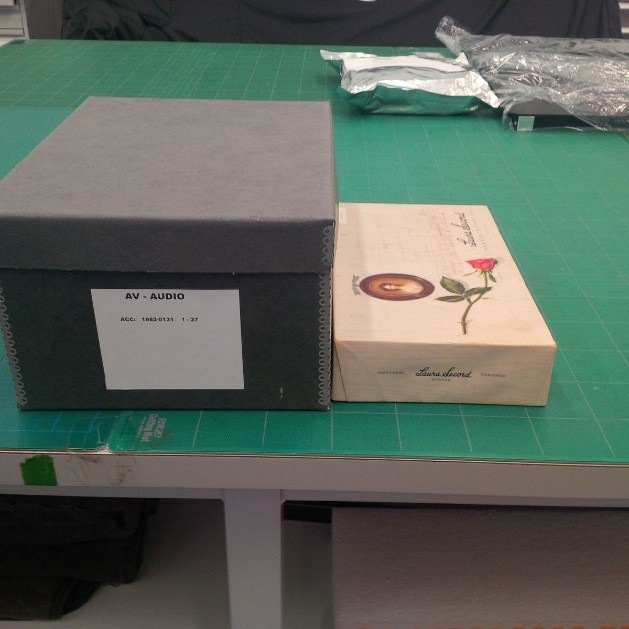
A colour photograph showing, on the right, the Laura Secord chocolate box that the material was original received in, and to the left, the new container the Dictaphone belts are stored in for the long-term preservation of this collection.

The Laura Secord box beside the new enclosure. Now the dictaphone belts will no longer be at risk.

The near-surgical precision in all this rehousing work is most impressive, and plays a vital role in our preservation activities. Well done, Chris!
A few of our favourite things

Collection Managers at Library and Archives Canada (LAC) frequently receive questions related to the preservation of a variety of objects. In addition, whenever we offer in-house training sessions to staff, we also like to include information about references and further reading.

We thought we’d share some of our go-to online resources, as it can be hard to sift through all the information out there. These, in our opinion, are trusted sources that keep up to date with changing information and best practices that reflect scientific developments. They generally include source references as well, such as suppliers and bibliographies.

Please note: Invasive treatment should not be attempted without conservation training in the relevant medium. While anyone who can wield a knife and a straightedge can successfully make protective enclosures, if actual repair work is called for, please consult a conservator.

These sites provide information on a variety of media. We recommend you consult the indexes to see if what you’re looking for is included.

Canadian Conservation Institute (CCI)

CCI’s site has preservation information on a variety of objects including books, paper, photos, musical instruments and outdoor art.

http://canada.pch.gc.ca/eng/1443109395421

Centre de conservation du Québec (CCQ)

CCQ’s site hosts Preserv’Art, a database of acceptable materials. It is a great source of information about supplies that are safe to use with particular media/objects. Note also that it contains info about what is NOT safe, which can be very useful as well.

http://preservart.ccq.gouv.qc.ca/index.aspx

Northeast Document Conservation Centre (NEDCC)

NEDCC’s series of Preservation Leaflets is also an excellent source of information. These publications are continually reviewed and updated as necessary.

https://www.nedcc.org/free-resources/preservation-leaflets/overview

National Park Service (NPS)

The United States’ NPS has an extensive series of Conserve O Grams, which are excellent publications on a variety of topics. While geared more toward the museum professional, they can still be useful sources of information about a range of subjects such as protective enclosures. Of particular interest are the new Conserve O Grams on the creation, care and storage of digital materials.

http://www.nps.gov/museum/publications/conserveogram/cons_toc.html

Ottawa’s Uppertown: A lost neighbourhood uncovered

Version française

By Andrew Elliott

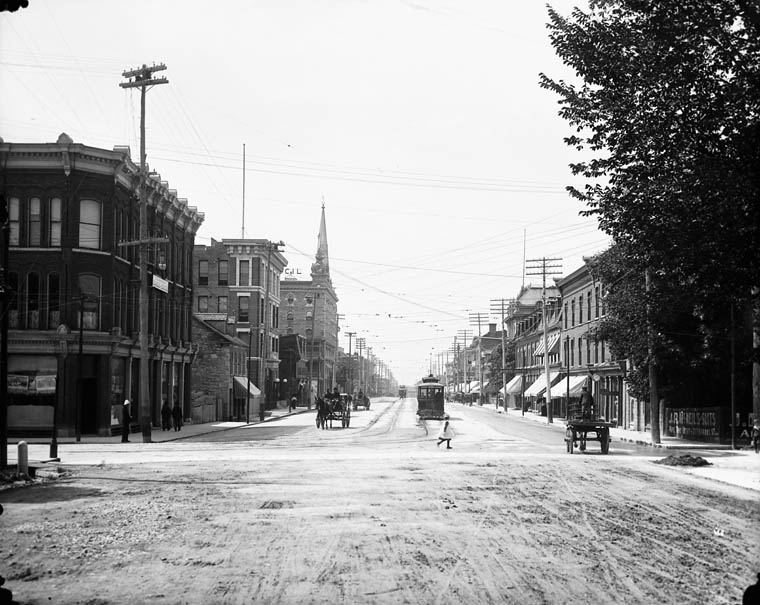
A black-and-white photograph showing a streetscape at a crossroads.

Wellington and Bank, ca. 1900 (MIKAN 3325940)

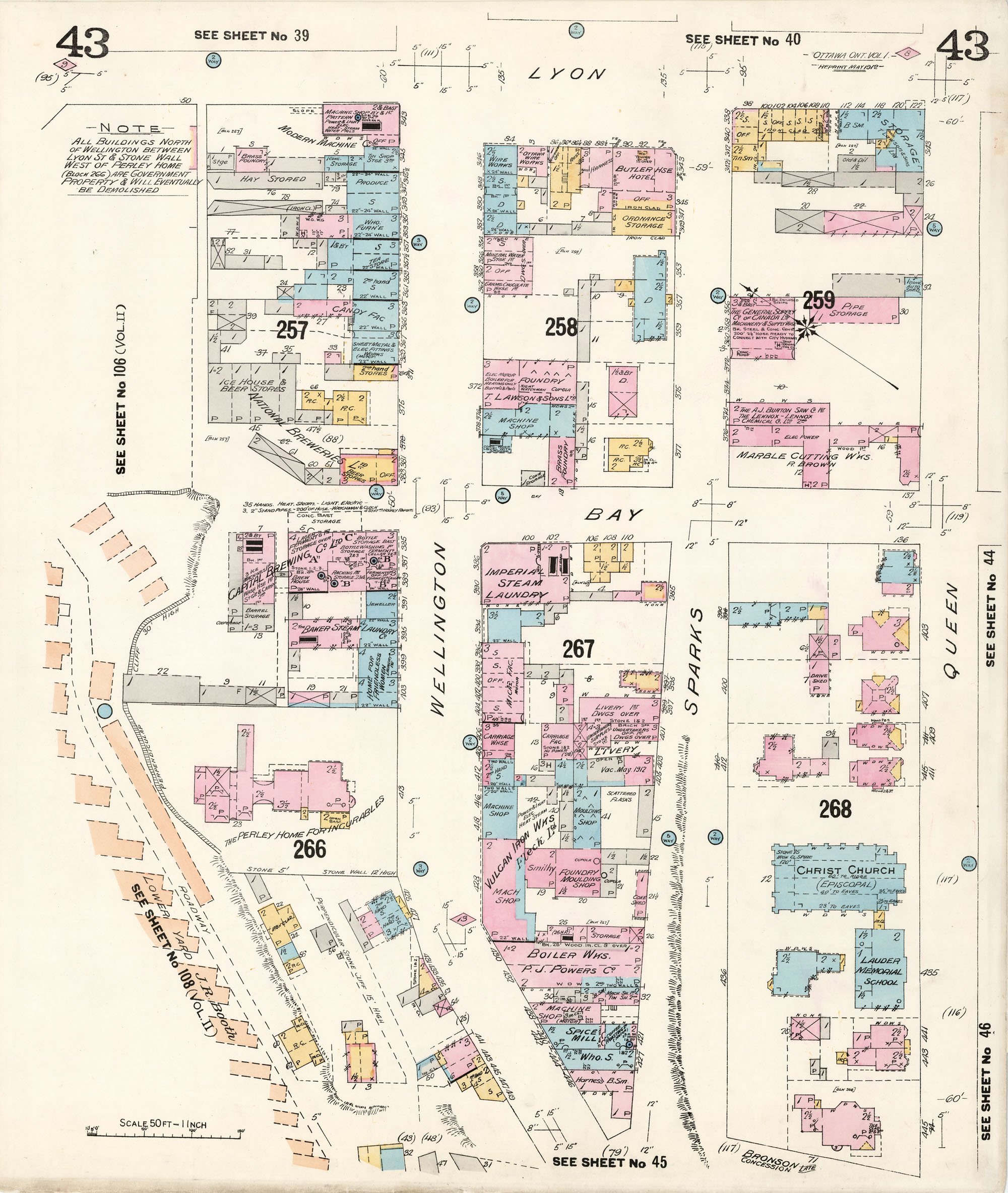
On February 27, 1912, following what appears to have been at least a few years of behind the scenes deliberations, the federal government expropriated all properties located in Uppertown, an area bounded by Bank, Wellington, and Bay streets and the cliff along the Ottawa River. On March 9, 1912, a notice of expropriation was filed at the Ottawa City Registry Office (the area can be seen on these fire insurance plans: east view and west view (MIKAN 3816030).

The area was expropriated to make way for a new supreme court and other federal buildings. In 1913, the government launched a design competition, in response to which many of the major architects of the day submitted designs for the building complex. The designs can be found in the following LAC collection, which comprises 11 designs for the location of proposed departmental buildings. With the outbreak of the First World War, the fire and subsequent reconstruction of the Parliament Buildings, and changes in government, no concrete action was taken with respect to these plans until the early 1930s.

The area expropriated was both commercial and residential in nature. We have come to think of the stretch of Wellington between Bank and Bay streets as a boulevard flanked by grand, iconic government structures and large green spaces, but this is a relatively recent development. The towers of the Confederation and Justice buildings were built in the 1930s, followed by the Supreme Court building and, finally, the National Library building (now Library and Archives Canada), which was erected for the 1967 centennial. Continue reading

Library and Archives Canada releases its latest podcast episode, “La Bolduc: Queen of Canadian Folksingers”

Library and Archives Canada is releasing its latest podcast episode, “La Bolduc: Queen of Canadian Folksingers.”

In this episode we explore the story of Mary Travers Bolduc.  It is a rags-to-riches tale of a Quebec housewife who rose from impoverished obscurity to become a major 1930s recording phenomenon. This ordinary, traditional woman became a most extraordinary musical spokesperson for her time and her people, earning the title “Queen of Canadian folksingers.”

We sit down with Library and Archives Canada Music Historian and Archivist Rachel Chiasson-Taylor to discuss who La Bolduc was, what her influences were, who she influenced, and how her career, that started out of simple economic necessity and, building on the music of her own roots, became the stuff of legend.

Subscribe to our podcast episodes using RSS or iTunes, or just tune in at Podcast–Discover Library and Archives Canada: Your History, Your Documentary Heritage.

For more information, please contact us at podcasts@bac-lac.gc.ca.

Jackie Robinson and the baseball colour barrier

Version française

By Dalton Campbell

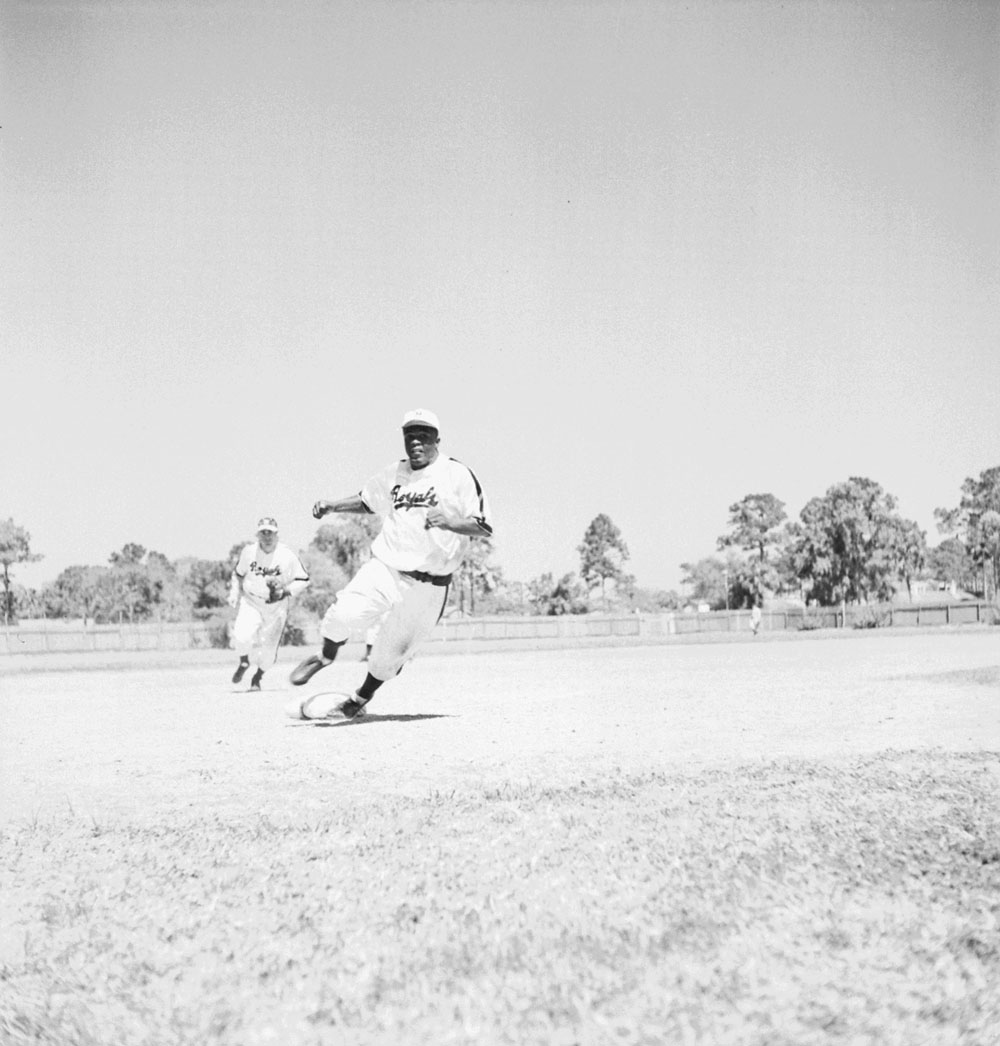
In April 1946, Jackie Robinson took the field with the Montreal Royals baseball team, which played in the International League. He was the first Black man signed to a Major League Baseball team in the twentieth century. After signing a contract in October 1945 with the Brooklyn Dodgers, he was assigned by Dodgers’ management to the Royals, the Dodgers’ top minor league affiliate, in order to gain experience. They thought that Montreal would be a less hostile city for him to learn to deal with media scrutiny and fan attention and to endure on-field discrimination and physical intimidation.

Black-and-white photograph of a baseball player running the bases. His foot is on third base and he is turning and heading to home plate. In the background are other players, and in the distance the outfield fence and trees.

Jackie Robinson, in a Montreal Royals’ uniform, circles third base and heads for home during spring training. April 20, 1946 (a201547)

In the first game of the season, he more than held his own. He had four hits, three runs, and a home run. A famous photograph captures Royals’ teammate George “Shotgun” Shuba shaking Robinson’s hand as he crossed home plate after his home run. This is believed to be the first photograph of a white man congratulating a Black man on a baseball diamond. Continue reading

Photography of John Boyd now on Flickr 

John Boyd (1865–1941) was born in Emyvale, Ireland. His family immigrated to Toronto in the late 1860s. He was a railway official as well as a photographer. His work with the railroad gave him ample opportunities to take photographs as he travelled across Ontario. The John Boyd fonds consists of photographs portraying all manner of Canadian life, all worth exploring. There are images of towns and cities, royal visits, military life, modes of transportation, industry and agriculture, social conditions, pastimes, and nature.

Don’t miss a post!

There are several ways to make sure that you don’t miss any of Library and Archives Canada’s blog articles. The simplest one is to look at the bottom right corner of your browser and find the “Follow” icon.

Follow iconOnce you click on the plus sign, a box will pop up and prompt you to enter your email.

Enter your email address boxA confirmation email will be sent to you and you can confirm that you do, indeed, want to subscribe to the blog. Once you get to the confirmation page you can stipulate whether you want to receive updates daily or weekly or when an article is published.

You can also follow the blog by subscribing to the RSS (Really Simple Syndication) feed. In the lower left-hand corner of the page where an article appears, there’s a little orange icon labelled RSS – Posts.

Suscribe to our RSS feed.When you click on the icon or its label, another page opens up where you can choose which application will handle the feed. If you do not already have a default feed reader, you can select one at this point. Find out more about RSS here. Or you can follow other RSS feeds offered by Library and Archives Canada, by visiting the RSS page.

Tips for aviation accident research

Let’s be honest: Finding information on a civil aviation accident is no small feat. In the federal government, organizational changes involving aviation accident management and the evolution of records classification are making the researcher’s task even harder.

But seek and, generally, ye shall find! So let’s look at how to go about researching an aviation accident effectively.

First, you need to have certain basic information on the accident you’re researching:

  • Aircraft model
  • Accident date and location
  • Aircraft registration number
  • Aircraft type (civilian or military)

This will make things easier, because the finding aids related to aviation accidents are put together based on that basic information.

You must then determine where the records you are looking for might be located, i.e., select the right record group. The following reference table will help guide your first steps:

Years of Responsibility Department Record Group Number
1923–1936 Department of National Defence

Civil Aviation Branch

RG24 / R112
1936–1984 Department of Transport
Air Services Branch (1936-1970)
Canadian Air Transportation Administration (1970-1985)
RG12 / R184
1984–1989 Canadian Aviation Safety Board R13086
1990–present Transportation Safety Board RG156 / R1009

Each record group is divided into series and sub-series. For each of those subdivisions, you will need to consult a finding aid to determine whether a file exists pertaining to your research topic. It is a painstaking process, but some aids are available online (for example, the accession “Aviation Accident Reports 1919-1977“—RG12), which narrows down the research that needs to be done at 395 Wellington Street, Ottawa.

Here are some things to take into consideration:

  • Two types of records pertain to accidents: the accident report and the occurrence investigation. They are not always filed in the same location, so you’ll have to check the entire record group to find them.
  • In the 1920s and 1930s, National Defence had the mandate to investigate accidents. Even if your research is on a civilian aircraft, consult RG24.
  • Your file could be located in the Central Registry (records originally stored in Ottawa) or in the regional registries (stored in the regions: Maritimes, Pacific, etc.).
  • Library and Archives Canada’s (LAC) collection has gaps: we do not have all records pertaining to aviation accidents. Sometimes, a file simply does not exist.
  • Some records are still at the accession stage. They have been transferred to LAC but have not yet been processed by an archivist. If the description in our database contains a note to that effect, consult the links under the heading “Accession” (see “Scope and Content” in connection with the note “Please consult the related accessions”).

For example, here is a screenshot associated with the series Central Registry Files from the Transportation Safety Board fonds:

Screenshot showing that the files have indeed been acquired, but not yet processed.

List of accessions from Central Registry Files (RG156)

Each record group has its own challenges but the basic concepts explained here will help you to conduct your research effectively.

Standing Committees: finding their printed information, pre-1995, or print-based access (Part 2)

Now that we’ve explored finding Standing Committee information on the Web, how do we access the paper versions? We will be examining the following documents:

  • Minutes of Proceedings: the official record of the committee
  • Evidence: verbatim transcripts of the meetings
  • Reports: the final results of business or study completed by the Standing Committee, presented to the House of Commons

As in Part 1, we will use the Standing Committee dealing with the Environment as our example. AMICUS, the Library and Archives Canada catalogue, is our access point and we will use the Advanced Search so that all searching options are available.

Continuing with the environmental theme for documents published in 1986, search using the following:

  1. In the Name Keyword field, type standing committee inside quotation marks.
  2. In a second Name Keyword field, type environment.
  3. Type 1986 in the Any Keyword field,* then press Enter.

*Note: Start with the date in the Any Keyword field, as the session may span several years and you’ll have a better chance of retrieving relevant records. Or, you can omit the date completely and sort your results by date.

The results list shows:

  • the report produced that year, Forest Resources and Industries in Eastern Canada
  • two microform versions of the Minutes of Proceedings and Evidence
  • the paper version of the Minutes of Proceedings and Evidence for the session

Most importantly, we discover that the name of the committee in 1986 was the Standing Committee on Environment and Forestry.

The catalogue record for the report follows. Key information for retrieval has been highlighted.

AMICUS No. 6662440 Monograph
NLC COPIES: C.O.P. – COP.C.XC50 – Add specific Parliament, session and issue no. / Ajouter la législature, la session et la livraison désirée
NAME(S): *Canada. Parliament. House of Commons. Standing Committee on Environment and Forestry
TITLE(S): Forest resources and industries in Eastern Canada : first report / Standing Committee on Environment and Forestry
PUBLISHER: [Ottawa] : The Committee, 1986.
DESCRIPTION: ii, 95, [17, 18], 107, ii p.; 27 cm.
SERIES: Canada. Parliament. House of Commons. Standing Committee on Environment and Forestry. Minutes of proceedings and evidence of the Standing Committee on Environment and Forestry = Procès-verbaux et témoignages du Comité permanent de l’environnement et des forêts. 1984-85-86, issue no. 7
NOTES: Text in English and French with French text on inverted pages.
June 1986”.
Includes bibliographical references.
RELATIONSHIPS: Canada. Parlement. Chambre des communes. Comité permanent de l’environnement et des forêts Ressources et industries forestières de l’est du Canada :. [Ottawa] : Le Comité, 1986.

You’ll notice that the record specifies that you should “Add specific Parliament, session and issue no.” This is required for the physical retrieval of these publications at Library and Archives Canada.

Where do we find this information?

Specific Parliaments are listed on PARLINFO. In this case, 1986 spans both the 1st and 2nd sessions of the 33rd Parliament. If we were to order the report released in June 1986 (see highlighted Note in record above), we would request the 33rd Parliament, 1st Session (1984.11.05-1986.08.28), Issue no. 7 (see highlighted Series note in record above).

And so ends our brief introduction to searching the Standing Committees!

Standing Committees: finding their electronic information, post-1995, or Web-based access (Part 1)

Parliamentary Standing Committee information can be tricky to find, if you don’t know how the process works. In this two-part series, we’ll link the methods of finding the current, Web-based information to locating earlier hardcopy materials (as far back as the mid-1800s) held at Library and Archives Canada.

A good deal of parliamentary work is done in committee, where members study and amend bills, or examine current issues or departmental spending plans referred to them by the House of Commons.

After every meeting, two official documents are published:

  • Minutes of Proceedings: the official record of each committee meeting contained in a numbered issue. Each issue includes that meeting’s date, content, subjects discussed, list of witnesses, and references to any reports to the House.
  • Evidence: the verbatim transcripts of the meeting

A third official document, the committee report, is the document that most researchers are interested in. These reports are produced irregularly, upon the committee’s completion of specific business or study, and are subsequently presented to the House. There may be responses by the government and/or the parties.

As an example, we will use a study on urban conservation, produced by the Environment committee. Information about standing committees from 1995 to present day, is located on the Parliament of Canada website. The printing of paper versions of committee materials ceased in 1998.

From the front page of the website, follow the links for Parliamentary Business [tab at top of page] → Committees → House of Commons Committees → List of Committees → ENVI Environment and Sustainable Development.

How to find a report

The quickest way to find reports is to use the Search box at the top right of the page. Type “urban conservation” report (keep the words together inside quotation marks); the first item on the list is the report we’re looking for – Urban Conservation Practices in Canada.

Note: Print format [upper right] gives you the searchable .pdf version.

Upon opening the document, we discover the parliament and session in which the report was released (important for further research), i.e., 41st Parliament, 1st Session, June 2, 2011-September 13, 2013.

To search by session, go to the Committee home page, click “Select a different session” and choose the one in which our report was tabled, i.e., 41-1. This opens up a page showing the Summary of Work of the committee during that session. Click on All Reports. Here we find more information about our document—the report number, the dates it was presented to the House, and the government’s response. By clicking on Study Details for Report 7, you’re brought to the page with a list of Witnesses (Evidence) as well as the transcripts of the related Meetings (Minutes of Proceedings).

This brings us to the end of Part 1 on the Standing Committees. There’s more to come in Part 2, where we deal with the task of finding the paper formats!