All papers are not created equal

You may be aware that over the last 25 years, there has been a major effort to convert paper production from acidic products that deteriorate quickly to more stable paper. The movement largely came from the library community’s concerns about rapidly deteriorating paper in their collections. The result is that there are now no western producers making acidic papers anymore (other than newsprint), which is great news for libraries, archives and consumers.

Not all of these papers, however, can be guaranteed to truly last long-term (by that we mean over 300 years). Manufacturers can, and do, change the chemical composition of papers quite regularly, and as consumers and staff in a library/archive, it is good to know what is available and how to use it best.

So, let’s look at what’s around us. Our inexpensive everyday photocopy paper is not acidic when tested with a pH pen. This paper can be labeled “acid-free.”

Colour photograph of piece of paper with the words: “Purple = Ok!!” on it. This means that the paper is acid-free.

Test of the pH on everyday photocopy paper.

But it does not meet standards for longevity that we want for paper that will be incorporated with collections on a permanent basis. It’s perfectly fine for bookmarks and flags—items used temporarily.

For long-term quality, look for papers that are marked “permanent” or “archival,” with the infinity symbol set inside a circle.

An image of the acid-free paper symbol—the number eight lying on its side enclosed in a circle.

Infinity symbol designating a permanent or archival quality paper.

Permanent papers can be made with wood pulp (where the harmful acidic lignin is found), but the lignin is generally removed and no acidic additives are included during manufacture. Permanent papers are expected to last several hundred years under normal library or archival storage conditions. To be labeled “permanent” with the infinity symbol, the paper must meet either ISO 9706 or ANSI/NISO Z39.48-1992 standards.

Archival papers are made to an even higher standard and will last up to 1000 years. These papers are produced with cellulose fibres from plants other than wood and do not contain lignin (usually cotton or linen). Also, the standard for archival papers (ISO 11108) includes requirements for paper strength, which the standards for permanent papers do not include.

Papers labeled as either permanent or archival are recommended for long-term use with collections. It is probably best to choose archival papers when strength is a consideration, such as wrapping or enclosures.
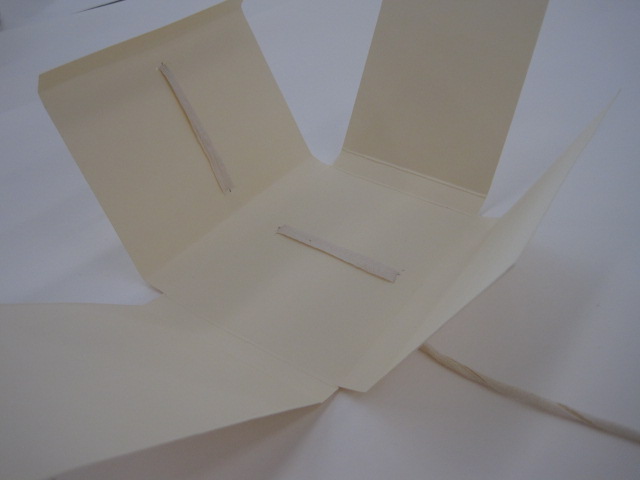
A colour photograph showing an enclosure to house textual documents.

An archival quality paper enclosure.

As a final note, it is important to remember that the storage environment for paper also has a huge impact on its longevity. For every five-degree reduction in temperature, it is estimated that the lifespan of paper doubles. Everybody put on a sweater!

“The Complete Set”: Some fascinating examples in Library and Archives Canada’s portrait collection

The Library and Archives Canada (LAC) holdings include one-of-a-kind historical artifacts that relate directly to specific portraits in the collection.

In some cases, items that were separated over the years were reunited at LAC. In others, LAC was fortunate to take over the custodianship of a carefully preserved ‘set.’ In all cases, these somewhat unexpected holdings provide invaluable context for better understanding the portraits they are associated with.

Copper plate image showing Captain George Cartwright checking his fox traps during the winter in Labrador. He wears snowshoes, carries a gun over one shoulder and has a dog on a leash, tethered to his belt.

Captain Cartwright visiting his fox traps (MIKAN 3986048)

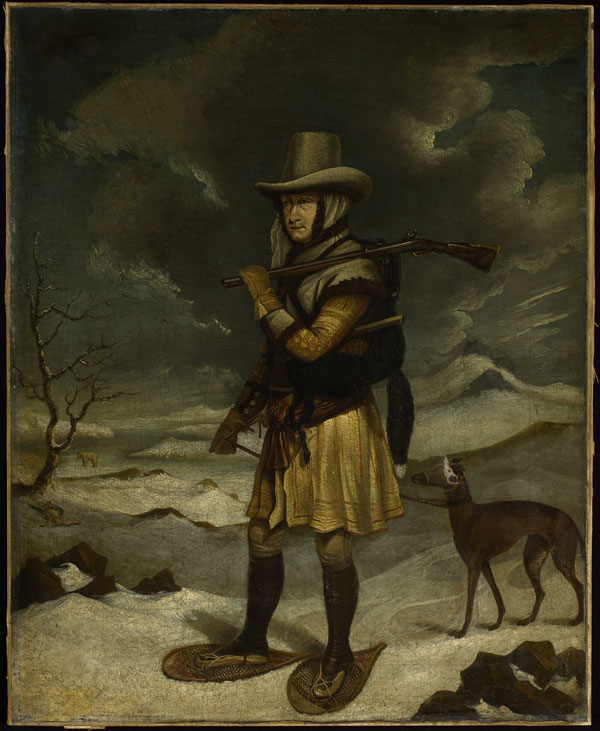
This copper plate, for example, was created as a means of ‘publishing’ the evocative oil portrait of Captain George Cartwright (1739–1819), a retired army officer who set up trade as a trapper and fur trader in Labrador.

Oil painting showing Captain George Cartwright checking his fox traps during the winter in Labrador. He wears snowshoes, carries a gun over one shoulder and has a dog on a leash, tethered to his belt.

Captain Cartwright visiting his fox traps (MIKAN 3964571)

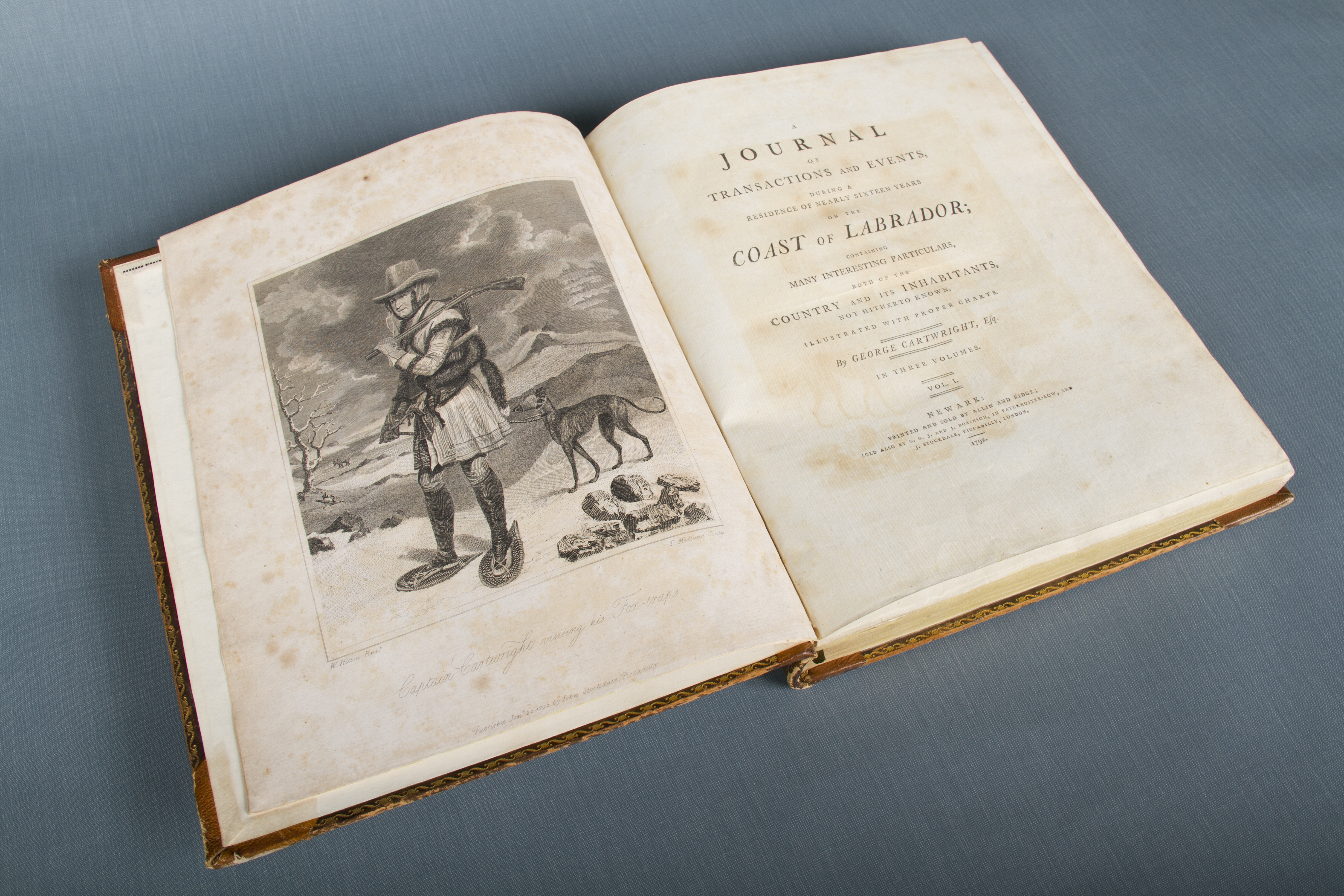
It illustrates one process that was used, before the development of photography, to “translate” paintings into a printable format, so that they could appear in books. The painted portrait was created specifically to provide a frontispiece image for Cartwright’s important Memoir, A journal of transactions and events, during a residence of nearly sixteen years on the coast of Labrador… (1792).

The same image as above, except in printed form, published in a first edition of the 1792 book.

Frontispiece from Captain George Cartwright’s Memoir (AMICUS 4728079)

Special Notes on the Frontispiece, compiled by Cartwright, underline the significance he attached to every one of the painting’s details. Like the Memoir, the painting reads like a primer for would-be adventurers—including innovative, Aboriginal-inspired solutions for survival, such as wearing snowshoes when checking traplines in winter.

Copper is a soft metal that allowed engravers to faithfully reproduce these details, as well as something of the feel of the original oil painting. Here, for example, the soft-edged atmospheric landscape of winter was created by protecting some areas of the plate with wax, while allowing acid to wash over other exposed areas.

It’s rare for any institution to hold a painting, its copper plate and a first-edition copy of the resulting book, but LAC’s collection includes all of these items.

Another example: LAC’s collection includes this pendant and earrings.

Colour photograph of two gold earrings with a stylized spiral pattern and a matching pendant.

Marie-Louise Aurélie Girard’s earrings and pendant (MIKAN 3994256)

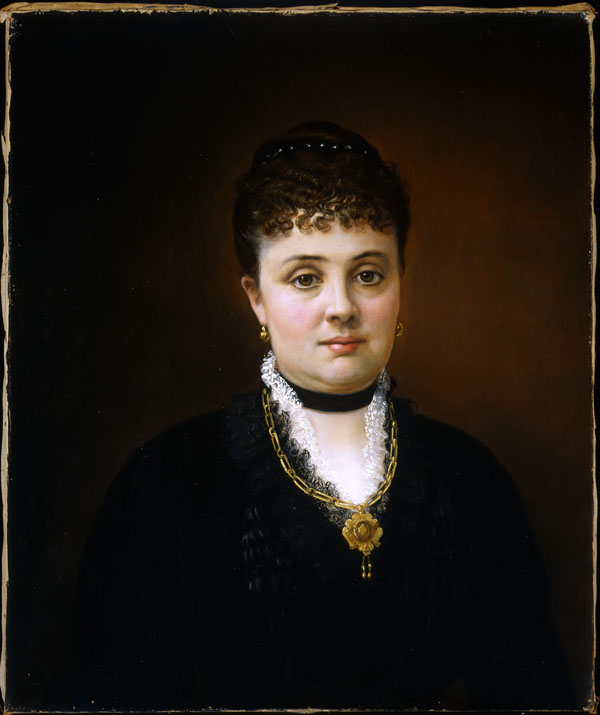
This was the actual jewellery that Marie-Louise Aurélie Girard (ca. 1868–?) wore when she sat to have her portrait painted by the distinguished Montreal artist, Alfred Boisseau (1823–1901):

Oil painting showing a woman in a black dress looking straight at the viewer. She is wearing the same pendant and earrings as shown in the previous photograph.

Marie-Louise Aurélie Girard (MIKAN 3993116)

These precious items remind us of the human process behind historical portrait painting. Prominent and wealthy sitters would often deliberate over which items to wear or include in a portrait, not only for sentimental reasons, but also to convey social status. In this case, the sitter was the wife of a former Premier of Manitoba.

The William Redver Stark sketchbooks: the details

Over the next few months, the blog will feature a series of articles to uncover behind-the-scenes conservation work. This work ensures that the Library and Archives Canada collection is maintained, preserved and available for future generations to enjoy. We will be following along as the conservation team conserves the William Redver Stark sketchbooks. We had a preliminary overview of the restoration of the sketchbooks this year as well as a podcast about William Redver Stark. Now over the next months, the team will be conserving the sketchbooks and documenting the conservation process on the blog, Facebook and Twitter.

Examining the sketchbooks: the groundwork

The paper in the 14 sketchbooks is either wove watercolour or wove drawing paper. Wove paper is paper made on a closely woven wire roller or mold and having a faint mesh pattern. Unsurprisingly, the eight sketchbooks with drawing paper do not have watermarks. Watermarks are a design or symbol, such as the maker’s name, that is impressed on a piece of paper and can be seen when the paper is held up to the light. Three of the six watercolour paper sketchbooks have watermarks from different English papermakers.

Colour photograph showing a watercolour sketch of a horse. Along the bottom edge is the faint imprint of a watermark reading “1915 England”

Watermark reading “1915 England” on one of the sketchbooks.

The dimensions of the sketchbooks range from 84 x 126 mm to 145 x 240 mm which makes them roughly the size of a smart phone or a deck of cards. There is no pagination in any of the sketchbooks but a close examination reveals the sequence in which the artist used the sketchbooks—some were used from front to back, some back to front or in a completely random order.

Colour photograph of three stained sketchbooks on a white table with a smartphone beside them to show the relative sizes of the items.

Three sketchbooks laid out beside a smart phone for size comparison.

Further examination reveals other important nuggets of information. Some of the books have bookseller tickets, artists’ colourmen labels or ink stamps. These can provide further information on the composition of the paper, the format and provenance of the book. Some labels indicate the number of pages which is very useful in determining if pages are missing. The examination concluded that many pages were missing from these sketchbooks. The provenance information also reveals that the books came from a variety of book makers and booksellers in London and France and that some were marketed to English, French and German consumers.

Colour photograph of a yellow label with information on the maker of the sketchbook.

An example of an artists’ colourmen label showing the maker, the provenance of the sketchbook, the number of pages and quality of the paper.

The text blocks (the main book body) are composed of signatures of between four to eight folios. A signature is a group of folios. A folio is a single page, folded once. All but two of the sketchbooks were traditionally bound, one with two metal spine rings and another with a stapled binding. These two simple binding structures were hand produced and do not use the commercial industrial manufacturing commonly used in book production at the time. All the sketchbooks have hard board covers. The bindings are plain and utilitarian with no decoration on the covers or spines except for manuscript notations in ink or graphite possibly written by the artist. Two sketchbooks have leather spines with cloth on the boards. The others have beige canvas bindings with an elastic-wrap closure. Most of the sketchbooks have pencil holders.

The sketchbooks have not been previously repaired or conserved and all exhibit multiple minor or major stability issues as follows:

  • pages breaking off at the spine
  • paper tears and pieces of paper broken off
  • missing pages
  • pages out of their original order
  • broken sewing threads
  • weak or broken attachment of text blocks to covers
  • adhesive tape on covers
  • fragile areas on cloth covering and boards

The next article in the series, “The William Redver Stark sketchbooks: page mapping,” will look at how the conservation team determined the order of the pages in the sketchbooks.

Visit Flickr to view more images of the conservation examination.

Building a case for the Proclamation of the Constitution Act 

It was raining on Parliament Hill as Queen Elizabeth II and Prime Minister Pierre Elliot Trudeau signed the Proclamation of the Constitution Act on April 17, 1982. Marks left by the raindrops, as they smudged the ink, can still be seen as physical reminders of the rich history of the Act.

The Proclamation of the Constitution Act is a fundamental document for all Canadians as it symbolizes Canada’s journey from colony to independent country. Like many of history’s most valued documents, it has spent most of its time sealed in a vault for preservation reasons.

As with the display of all collection materials, a balance must be struck. Exhibiting materials involves exposing items to potentially damaging light, while not exhibiting means restricting access to the collection. The loan of the Proclamation of the Constitution Act to the new Canadian Museum of Human Rights in Winnipeg presented an exciting challenge to the Library and Archives Canada (LAC) Preventative Care and Conservation staff—to make the document accessible to Canadians.

So, what does it take to prepare one of Canada’s most significant documents for display?

Studies conducted in 2012 by the Canadian Conservation Institute concluded that the signature inks on the Act are extremely light sensitive. In an effort to prolong its life, the document is allowed only a limited number of display hours per year. LAC staff designed and created a state-of-the-art encasement and display case to protect the Act from harmful light, vandalism and theft.

First, the Act was housed in a custom case that allows the control of humidity, UV exposure, and oxygen levels which will help to further reduce deterioration of the document. A display case was then designed to help limit the total amount of light exposure during exhibition.

Conservators fitting the interior of the case with an an activated carbon cloth which filters the air, absorbing atmospheric pollutants.

Conservators fitting the interior of the case with an an activated carbon cloth which filters the air, absorbing atmospheric pollutants.

The display case incorporates a special layer of opaque black glass (which protects the document from 97% of visible light) but, at the press of a button, it can quickly become translucent as the document is illuminated. The whole system runs on a timer, controlling the length of time the document is visible and records the total exposure over an entire loan period. This will help LAC to monitor the amount of light exposure the Act receives over the course of its life.

This project enhances public access to our country’s heritage without compromising the long-term preservation of the Proclamation of the Constitution Act, and ensures that Canadians will be able to see this national treasure, including generations to come.

Visit the Canadian Museum of Human Rights in Winnipeg for this rare opportunity to see the Proclamation of the Constitution Act and other significant documents from LAC’s collections during the museum’s inaugural exhibitions.

Dora de Pédery-Hunt

“Medals are my favourite form of expression,” Dora de Pédery-Hunt once said. “They are like short poems.” You may not know who Dora de Pédery-Hunt is, but chances are, at one time or another or even now, you have an example of her work in your possession.

Black-and-white photograph of a woman holding a ceramic model of a medal and looking at it intently.

Portrait of Dora de Pédery-Hunt working on a medal (MIKAN 2267060)

Dora de Pédery-Hunt (1913–2008), was a Hungarian-born sculptor and medalist. After graduating with a master’s diploma in sculpture from the Royal Academy of Applied Arts in Budapest in 1943, she came to Canada by way of Germany in 1948. In Hungary, she had studied bronze and plaster casting along with stone and wood carving. After arriving in Canada, however, her need for regular work to support herself and her family was paramount. Setting aside her artistic aspirations for a short while, Dora took work as a housekeeper. In due time, Dora was introduced to sculptors Frances Loring and Florence Wyle (often called the first women of Canadian sculpture) by her Canadian immigration sponsor Major Thomas S. Chutter. Realizing her talent, Loring and Wyle helped Dora acquire a job teaching sculpture. Now free to devote most of her time to her art, Dora de Pédery-Hunt flourished.

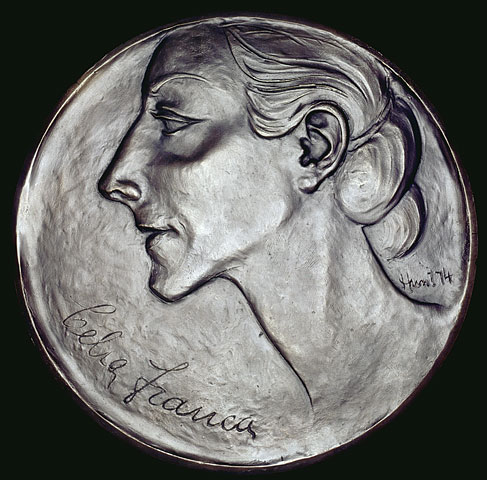
Photograph of a bronze medal showing the profile of a woman and the inscription “Celia Franca” along the bottom left.

Medal with a portrait of Celia Franca in profile (MIKAN 3704296)

Throughout the 1950s Dora received several private and public commissions. An entry Dora placed in the Canadian National Exhibition show caught the eye of Alan Jarvis, then director of the National Gallery of Canada. Through his support, Dora obtained a grant from the Canada Council enabling her to study and hone her talents in Europe for the next six months. Upon returning to Canada, Dora used the experience she gained abroad to begin working on larger scale projects, creating religious iconography such as ornate tabernacles and Stations of the Cross. At the same time, she continued to create smaller objects including many commemorative, award and portrait medals.

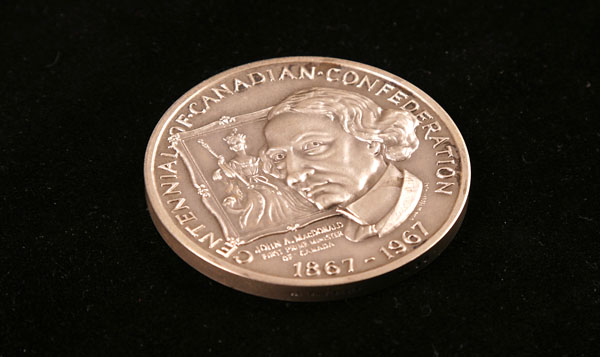
Colour photograph showing a a coin with the image of John A. Macdonald on it with a portrait of a queen behind it.

Coin commemorating the 100th anniversary of the Canadian Confederation: 1867-1967 (MIKAN 3637375)
© The Royal Trust Company. Reproduced with the permission of The Royal Trust Company.

From teaching at a small vocational college, Dora would eventually become a faculty member of the Ontario College of Art. Throughout her industrious career she received several national and international awards and accolades including the Order of Canada.

Photograph of a bronze medal showing a stylized image of a person sitting down, inscribed with the words “Canada” along the top edge and “expo 67” on the bottom right.

Commemorative medal of Montreal’s Expo 67 (MIKAN 2834429).

And what about that example of Dora de Pédery-Hunt’s artwork you most probably have in your possession? That would be the profile of Queen Elizabeth II minted on late 20th century Canadian coins.

Photograph of the face of a Canadian quarter showing the profile of Queen Elizabeth II.

Profile of Queen Elizabeth II on a Canadian quarter.

Explore the Dora de Pédery-Hunt fonds.

Happy 100th birthday, Hockey Canada!

On December 4, 2014, Library and Archives Canada (LAC) is celebrating the 100th birthday of the national governing body for amateur hockey in Canada.

Hockey is Canada’s national winter game and is played by young and old on frozen ponds and arenas from coast to coast to coast. The centennial of Hockey Canada gives us an opportunity to understand and learn more about hockey’s roots in Canada.

Minister of State (Sport), the Honorable Bal Gosal, October 30, 2014

The Canadian Amateur Hockey Association (CAHA) was founded in December 1914 in Ottawa, Ontario as the national administrative, regulatory and developmental body for amateur hockey in Canada. Representation at the founding meeting included the provincial hockey associations of Alberta, Saskatchewan, Manitoba and Ontario; the Montreal City Hockey League; the Canadian Intercollegiate Hockey Union; the Allan Cup Trustees; the Canadian Olympic Association; and the Amateur Athletic Union of Canada. Other groups affiliated with the CAHA after its creation include the Quebec Amateur Hockey Association in 1919, the Ottawa District Amateur Hockey Association in 1920, the Maritime Amateur Hockey Association in 1928, the Newfoundland Amateur Hockey Association in 1966 and the New Brunswick Amateur Hockey Association in 1968.

Black and white composite photograph showing portraits of the entire team in little medallions with the inscription Monarch Hockey Club, Amateur Champions of Canada, Winners of Pattison Trophy’s Allan Cup 1913-1914,

Winnipeg Monarch Hockey Club. Allan Cup Winners 1913-1914 (MIKAN 3657113)

Library and Archives Canada, in partnership with Canadiana.org, provides digital access to some of the important records from the CAHA fonds such as the official rule books governing amateur hockey going back to 1927.

Reproduction of a 1927 booklet describing the rules of the game by the Canadian Amateur Hockey Association.

Rules of the Game from the Canadian Amateur Hockey Association in 1927 (source on page 77)

In 1994, the CAHA merged its activities with the Canadian Hockey Association, better known as Hockey Canada, which had been created in 1968. The new organization’s mandate was to select teams to represent Canada in international competition and to foster the development of skills in Canadian hockey players. LAC’s Hockey Canada material documents many international hockey series and tournaments, which captured the attention of all Canadians such as the 1972 Summit Series and the 1976 Canada Cup.

Black-and-white entry form for a draw to see a Canada/Soviet game in 1972.

Mail-in coupon for a draw to receive tickets for a 1972 Summit Series game
Source: Hockey Canada Fonds/ Chronological file July 4/72 to Aug 31/72/ (e001217378)

You can discover the evolution of hockey in Canada by exploring LAC’s records of Hockey Canada and its predecessor, the CAHA.

Also, be sure to explore the Hockey Hall of Fame, which has the largest collection of hockey history resources, and visit its new exhibit co-produced with LAC, The First World War and a Century of Military Ties to the Game.

Library and Archives Canada’s “false” portraits

A false portrait is an imaginary portrait, usually of a well-known or famous person. The portrait is usually not based on a true likeness and is often created long after the person’s death.

Extremely significant historical figures often did not sit for portraits during their lifetimes. Yet, there has always been a demand for “true” portraits of them.

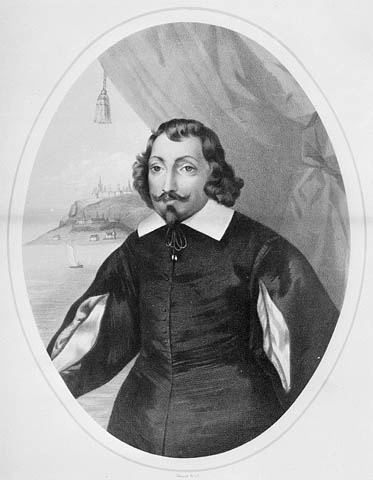
False portraits were not necessarily attempting to trick or fool people—in many cases, those who created or promoted them did so for very public-spirited reasons. From the 19th century onwards, this famous false portrait of Samuel de Champlain, the founder of Quebec City, served an important commemorative and educational role.

Lithograph attributed to Louis-César-Joseph Ducornet, 1854. It shows an image of a man facing slightly away from the viewer. He wears a black doublet with sleeves that reveal a white shirt underneath. In the background is a view of Quebec City.

False portrait of Samuel de Champlain (MIKAN 2919672)

A false portrait often tells us a lot more about the society that created it than about the historical figure that it is meant to represent. It has been suggested that this pious-looking image made the perfect frontispiece to 19th-century histories of New France, developed by historian-churchmen. It doesn’t seem to have mattered that the portrait is actually copied from a 17th-century engraving of a French civil servant, whose morality was dubious (in French only).

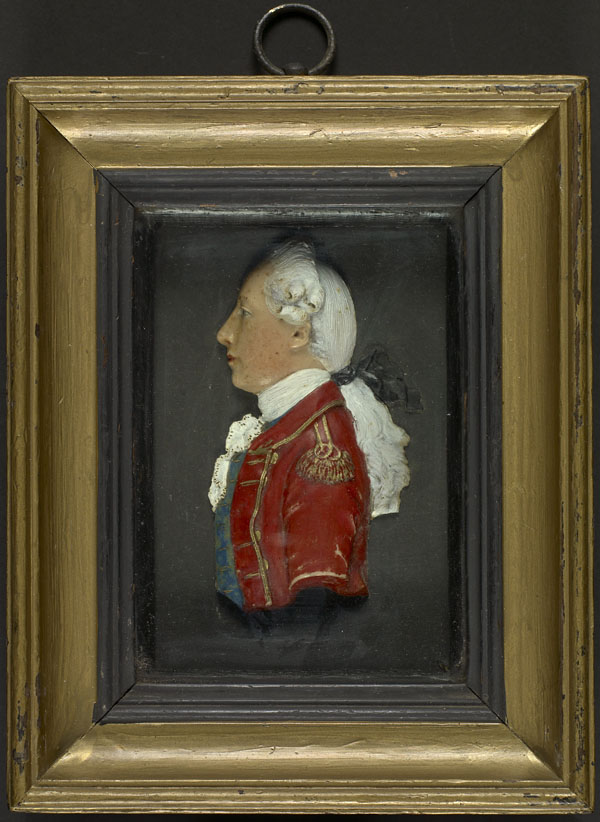
Library and Archives Canada (LAC) holds other intriguing false portraits in its collections. For example, LAC acquired this rare miniature wax portrait, one of very few portraits in this fragile medium to survive.

Wax miniature, by an anonymous artist, early 19th century. This rather generic wax miniature shows a man in profile wearing a red British coat embellished with gold trimming, a white cravat and a blue waistcoat. He has long white hair, tied back. The miniature is quite sculptural.

Wax portrait of General James Wolfe (MIKAN 3793977)

Though labelled a portrait of General James Wolfe, famous for his role during the decisive Battle of Quebec (1759), the miniature does not reproduce any of Wolfe’s known physical features. Yet several near identical wax miniatures exist in other collections—each of these also labelled, in the past, as Wolfe portraits. It’s possible to speculate that many casts of this portrait must have been made, for so many fragile examples to have survived.

Wax was cheap and easy to produce in multiple copies. The portrait was likely created as a kind of mass-produced celebrity image, in response to a vast appetite for portraits of “Wolfe the Hero” that arose among the general public during the 19th century. Probably created long after Wolfe’s death by an anonymous entrepreneur, it presents an idealized and heroic-looking profile view of a young officer—exactly the kind of image guaranteed to satisfy the public imagination.

Library and Archives Canada’s Alma Duncan fonds

Art lovers interested in researching the life and working methods of Canadian artist Alma Duncan (1917–2004) must make Library and Archives Canada (LAC) one of their first stops. With the acquisition of Duncan’s complete records (fonds) between 1998 and 2005, LAC became the major centre for the study and preservation of artworks, and supporting material documenting Duncan’s personal and professional life.

The collection includes major oil paintings such as this early self-portrait:

Self-Portrait with Braids

Self-Portrait with Braids (MIKAN 2996876)

In this painting, Duncan portrays herself wearing pants at a time when this type of attire was still considered somewhat risqué for a woman.

The collection also includes drawings, preparatory work, material related to Duncan’s separate career as a graphic designer, and original films by Duncan. Probably the most fascinating items are related to the film company, Dunclaren Productions, formed by Duncan and Canadian photographer Audrey McLaren between 1951 and 1960. That collaboration resulted in three internationally acclaimed short animated films created for the most part in an Ottawa attic. Today these films are recognized as milestones in the history of short animated film, a genre in which Canada has always been a leader.

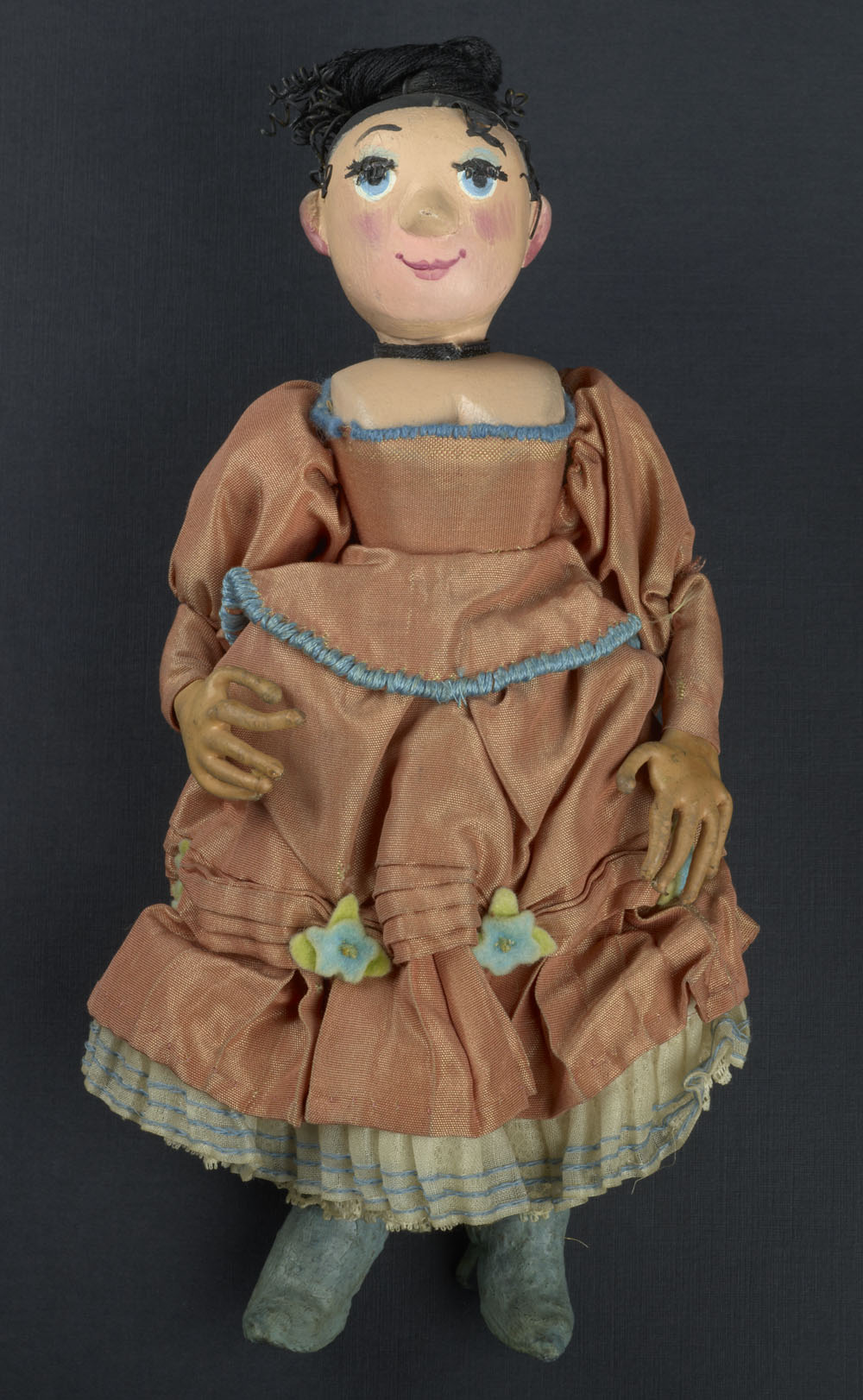
The Dunclaren Productions holdings include most of the original handmade puppets and props that Duncan created for the films.

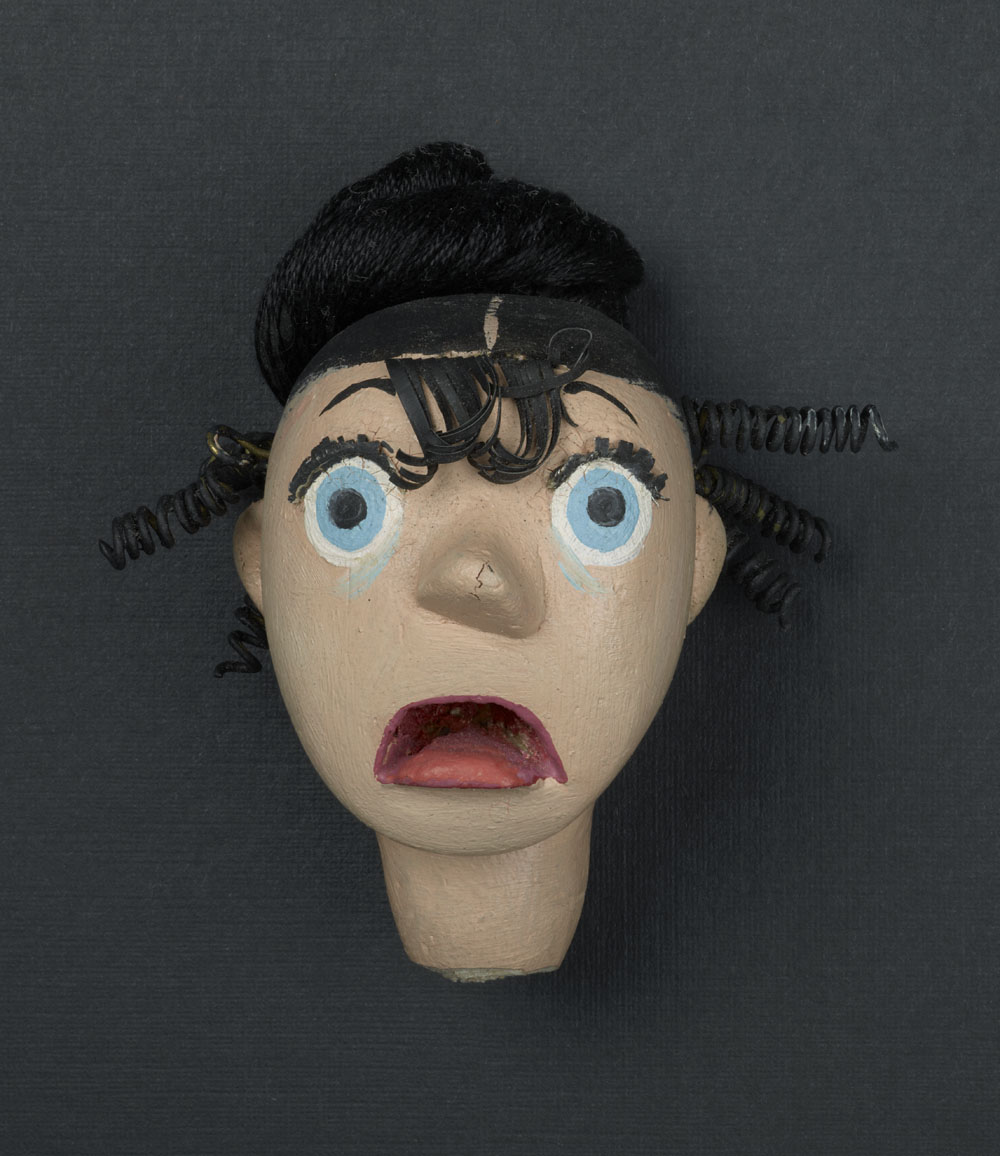
This puppet and its accompanying “scared” replacement head created for the film, Folksong Fantasy, illustrate the painstaking methods Duncan used to make the characters in her films appear to change expression.

Wife Puppet in Orange Dress

Wife Puppet in Orange Dress (MIKAN 4488575)

Wife Puppet Head—Scare

Wife Puppet Head—Scared (MIKAN 4488578)

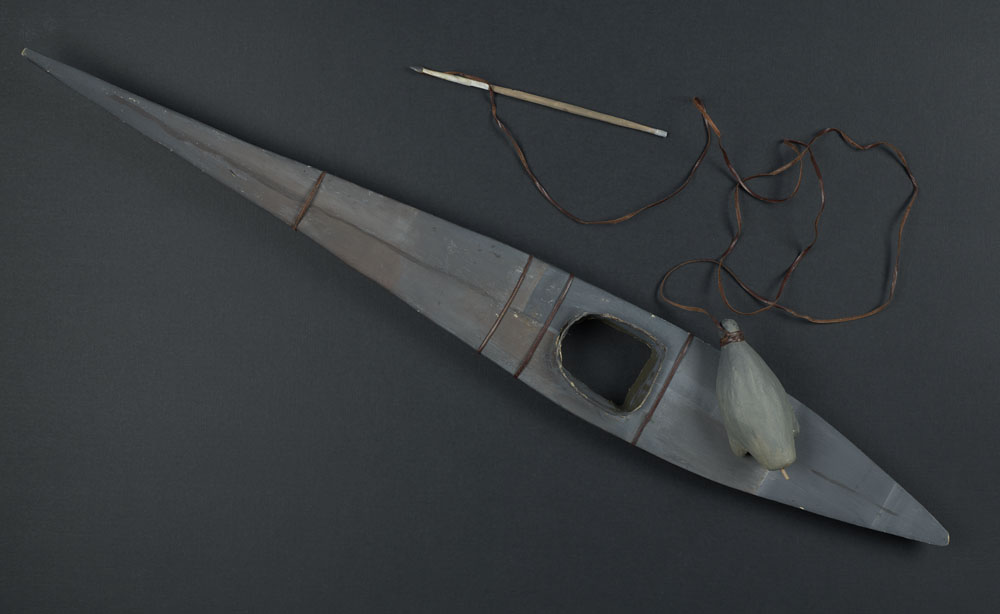
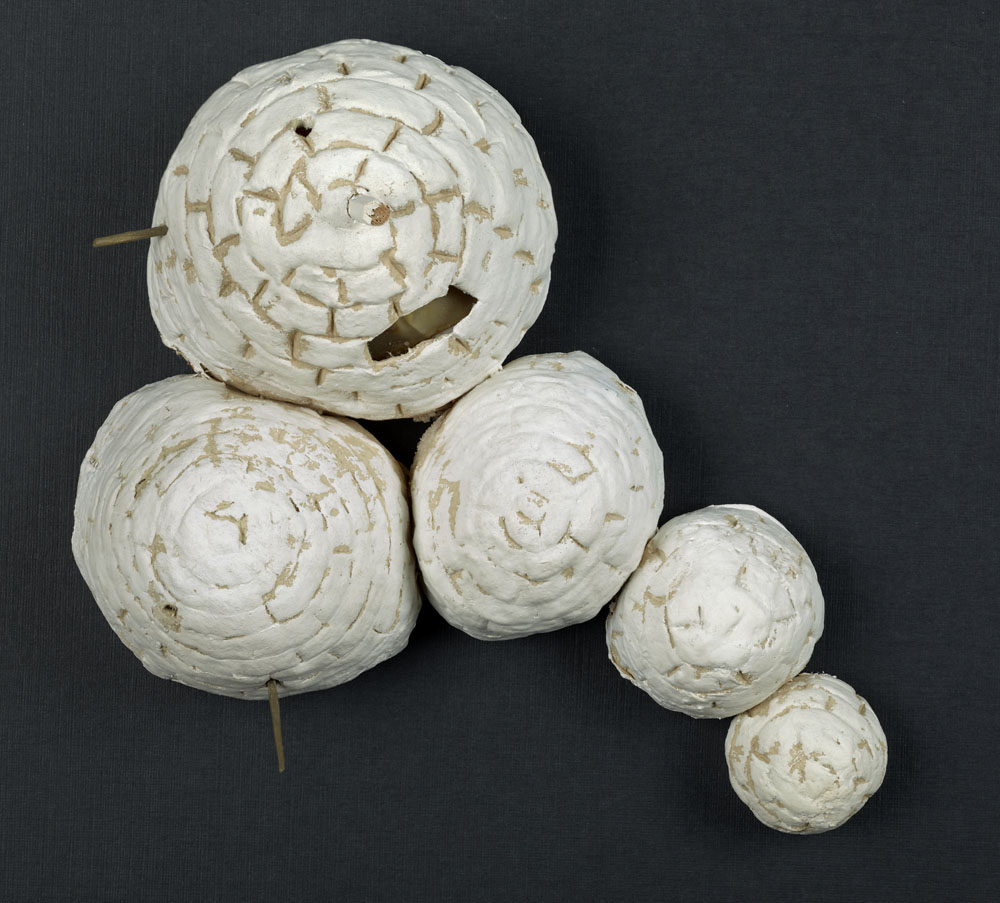
Meticulously crafted props like this tiny igloo and kayak created for the film, Kumak, the Sleepy Hunter, highlight Duncan’s lifelong interest in themes related to the Canadian arctic:

A major retrospective exhibition on Duncan’s life and work, ALMA: The Life and Art of Alma Duncan (1917-2004), opens on October 2, 2014 at the Ottawa Art Gallery. LAC is a major lender to this exhibition, which will include many of the original art works illustrated above.

A Sticky Situation: The Perils of Sticky Notes

The convenience of the sticky note cannot be beat… the variety of sizes and colours allows us to organize and place our notes and thoughts exactly where we want them. They are used in offices, homes, schools—I only wish I held the patent!

There are strong arguments, however, against their use in libraries and archives. Between 1988 and 1989, when conservation scientists at the U.S. National Archives and Records Administration first tested sticky notes, they found that an adhesive residue remains on the surface of the paper that comes into contact with the note (even if the note is placed and removed immediately), that the adhesive can remove electrostatic images (that is, printing ink), and that the dye in the note can run if exposed to water. A more recent repeat of the testing confirmed these findings, showing that most of the note adhesives will stain over time.

The following images show the results of a highly unscientific test conducted at Library and Archives Canada. Although the results are startling, they are not surprising.

1. This is a good book—I will need to reference this chapter later…

A sticky note showing colour fading from the sun

A sticky note showing colour fading from the sun

2. “Goodness, I’ve heard about what light can do to colours. That really faded in a short time.”

A sticky note is used as a bookmark

A sticky note is used as a bookmark

3. “Uh oh… I was not expecting THAT… this didn’t even get wet.”

Evidence of glue residue on a page after a sticky note is removed

Evidence of glue residue on a page after a sticky note is removed

So, that’s why sticky notes are not approved for use with collection materials, not even for temporary use!

Remember, please keep sticky notes away from collection materials, and continue to contribute to the long-term preservation of Canada’s documentary heritage.

William Redver Stark: Restoring the Sketchbooks

Different approaches have been tried over the years for conserving sketchbooks or bound volumes. For a long time, the works were simply detached in order to remove the binding. Nowadays, the historical and archival value of the binding is widely recognized. Library and Archives Canada (LAC) is no exception in this regard, and conservation treatments are now designed to preserve the work in its entirety, including the binding.

In a previous article, we introduced you to the work of soldier William Redver Stark. The sketchbooks that are part of the William Redver Stark fonds were never repaired or preserved, and were beginning to show signs of wear:

  • Tears and holes
  • Pages detached, missing or in the wrong order
  • Broken binding threads
  • Covers weakly bound to pages or completely detached

The sketchbooks therefore are undergoing various conservation treatments, undertaken by a team of LAC’s highly specialized conservators in the field of book conservation and restoration. These conservators worked with the collection managers and archivists to respect the integrity of Stark’s work, and to give him his full moment of glory.

The drawings and watercolours in this collection are in very good condition. Some even look like they might have been completed only a few days ago. It should be noted that the sketchbooks remained closed for nearly a hundred years, and that the pages were rarely exposed to air or light. Thus, to study a Stark work is to travel through time, to see the work of an artist exactly as it was created a hundred years ago, during one of the most deadly and crucial wars of our time.

In sum, the restoration work done by LAC‘s conservation and restoration team will make it possible to stabilize the condition of the sketchbooks in order to ensure that they will withstand the ravages of time, and will allow future generations to have access to an important part of our history.

Example of a required restauration treatment: the adhesive tape must be removed.

Another example of a required restauration treatment : the cover must be sewn back on.

See Also:

Summary of comments received in French between July 1, 2014 and September 30, 2014

  • A reader from Wimereux (France) thanks LAC for its work on the restauration of William Stark’s sketchbooks. It turns out that William Stark was stationed in Wimereux and made a lot of sketches of the surroundings. The reader was able to identify some of the sketches and he is offering his work to LAC.