Frequently Asked Questions for the Personnel Records Unit

Are you looking for the service number of a former service person?

If so, you must contact Library and Archives Canada by telephone to speak with an analyst from the Personnel Records Unit. The toll-free numbers are 1-866-578-7777 or Service Canada at 1-800-O-Canada (1-800-622-6232).

The Personnel Records Analyst will ask you to provide the full name and date of birth of the former service person. Most military service numbers can be released over the telephone. However, service numbers issued after February 1, 1968, remain protected and are not provided or confirmed over the telephone.

To learn more about ordering this type of record, read the Library and Archives Canada Blog post – How to Order Military Records from the Personnel Records Unit.

Which documents are needed to receive benefits?

Veterans Affairs Canada (VAC) is the department that administers services and benefits to former military service personnel and their families.  Since numerous services and benefits are available, VAC may require a variety of documents to determine eligibility requirements.

With respect to benefit applications, Library and Archives Canada can assist in providing copies of the required documents from the military personnel records of former service personnel.

Questions or comments? We would love to hear from you!

Opa! Did Your Ancestors Come From Greece?

Do you wonder who your first Greek ancestor was and when he or she left Greece and arrived in Canada? Are you curious about your family’s Greek heritage?

If so, the LAC website is a great place to begin your research. For instance, you will find a page specific to genealogical research for the Greeks. It provides you with historical background, LAC’s archival collections and published material, as well as links to other websites and institutions.

If your ancestor came to Canada between 1865 and 1935, you might find his or her name on passenger lists.

Tip

Tracing your Greek ancestor in Canada is the first step. Joining a genealogical society  is an ideal way to begin your genealogy research.

Questions or comments? We would love to hear from you!

What’s New? The Release of a New Video Tutorial

Black and white drawing of a man sitting in front of a computer screen that is displaying a family tree, diary, photograph and mapOur rich and varied holdings are just a click away. Tune in to our video to start your online search today!

This video is the first in a series of tutorials that provides useful tips and recommends tools to help you discover and access archival records, genealogical resources and published materials at LAC.

The tutorial series is just one of a number of LAC modernization initiatives that focuses on providing you with quick and useful information about our services.

For more information on recent announcements at LAC, visit “News”.

“Time Travel” Research Tools: Discover Canadian Mail Order Catalogues

Reference specialists at Library and Archives Canada often wish they had a time machine where they could just dial in a year and away they would go!  While this is just fanciful thinking, Library and Archives Canada’s online collection of Canadian Mail Order Catalogues is a “time travel” research tool. This site provides an opportunity to discover English and French mail order catalogues, from a number of different stores, from the 1880s to the 1970s.

These department store catalogues provide a detailed record of many aspects of everyday life over the last century.  They contain everything from household furnishings and furniture, to all manner of clothing and accessories, kitchenware, patent medicines, toys, tools, and sporting equipment.

These catalogues can be used to identify and date collectables and memorabilia; to price household items from a certain time period; to establish the approximate dates of photographs by studying fashion trends; or to research props, sets and costumes for theatre and film. The possibilities are endless.

Whether you browse the catalogues for research purposes or just for fun, we hope that you will enjoy the trip back in time.

Tip

You can navigate each catalogue page by page or search all the catalogues by keyword.  For example, the results of a search for the keyword “hockey” will include a wonderful image of hockey sweaters from the Eaton Automne et hiver 1950–1951 catalogue.

Tidbit

To convert catalogue prices into today’s dollars, the Bank of Canada’s Inflation Calculator [www.bankofcanada.ca/rates/related/inflation-calculator/] is a handy tool.

Questions or comments? We would love to hear from you!

Did Your Ancestors Come From Ireland (Eire)?

Do you wonder who your first Irish ancestor was and when he or she left Ireland and arrived in Canada? Are you curious about your family’s Irish heritage?

If so, the LAC website is a great place to begin your research. For instance, you will find a page specific to genealogical research for the Irish. It provides you with historical background, LAC’s archival collections and published material, as well as links to other websites and institutions.

If you know your Irish ancestor came to Canada before 1865, the following three databases are great starting points for your research:

If your ancestor came to Canada between 1865 and 1935, you might find his or her name on passenger lists.

Tip

Tracing your Irish ancestor in Canada is the first step. Tracing your ancestor in Ireland will require more research as the county where he or she came from in Ireland might not be known. Joining a genealogical society is an ideal way to begin your genealogy research.

Don’t forget to listen to The Shamrock and the Fleur-de-Lys, our podcast about the mass immigration of Irish settlers to Quebec in the 1800s.

Questions or comments? We would love to hear from you!

Discover Finding Aids – Part Two

As we discussed in our first article “Discover Finding Aids”, finding aids are tools that provide information about the archival documents held in a fonds or a collection. One of the most common types of finding aid is the content list. It typically provides general file-level reference information. In Archives Search, a content-list finding aid for a fonds or a collection can appear in a number of ways:

  1. It can be attached to the fonds-level description as a portable document format (.pdf file). This is generally true for collections or materials acquired from private individuals (usually identified by collection codes beginning with “MSS”) as in the example below:
A two-column, black-and-white image of a search result in Archives Search. The left column displays the word “Finding aid.” The right column displays the result with a link to a pdf finding aid.

Mikan 103625

  1. It may also be accessed by clicking on the hyperlinked number found beside the “consists of” text. This is generally true for collections of materials acquired from government departments (usually identified by collection codes beginning with “RG”).
A two-column, black-and-white image of a search result in Archives Search. The left column displays the words “Series consists of.” The right column displays the words “7893 lower level description(s).”

Mikan 133700

  1. Sometimes the content list is only identified by a number in the text paragraph, which can be found beside the Finding aid field label in a fonds, collection, series or sub-series description.
A two-column, black-and-white image of a search result in Archives Search. The left column displays the words “Finding aid.” The right column displays a brief written description of the content list.

Mikan 106943

Content lists simply identified by number generally exist in paper format only and must be consulted in person (or copies must be obtained). Numbers beginning with MSS (e.g., MSS0211) most often refer to content lists for collections or materials acquired from private individuals. Finding aids composed of numbers separated by a hyphen (e.g., 12-13) usually refer to content lists for collections of materials acquired from government departments.

This concludes “Discover Finding Aids – Part Two.” You can now read the Archives Search results to help you locate the finding aids.

 Questions or comments? We would love to hear from you!
What Can Canadian Directories Do for You?

Canadian directories have long been a valuable resource at Library and Archives Canada (LAC) and can be used for a variety of purposes. Before telephone books came into use, Canadian directories (sometimes simply referred to as city directories), were used as a tool for advertising and marketing within a community and were intended to facilitate communication between buyer and seller.

Our collection includes national, provincial/territorial, county and city directories from across Canada, primarily from the 19th and 20th centuries. Genealogists are frequent users of the directories as they provide opportunities to track a person within a given time period and place. An individual’s address, occupation and the names of other household members are only a few of the gems that lie ready to be discovered within their pages.

Canadian directories are a popular tool for genealogists but they aren’t the only ones who can benefit from this resource! These directories have many other excellent uses.

Canadian Directories can…

  • help determine the urban development of an area
  • be used to determine the history of a building
  • showcase advertisements from a certain time period that can be a valuable source of information about the services, products and entertainments available to Canadian society
  • provide information on the companies that were active during that time period
  • furnish a list of city officials
  • supply researchers with population statistics for that time period
  • offer the names and locations of important community institutions such as schools, churches, etc.

Useful Resources

Questions or comments? We would love to hear from you!

Discover Finding Aids!

Did you know that the concept of the finding aid dates back to the very origins of archives? The ancient Sumerians created finding aids on clay tablets so that they could locate specific bureaucratic documents. We have moved a long way from the clay tablet, but the principles of the finding aid remain the same.

An archive contains all of the documents created and used by a person, family, government institution, or corporate body in the course of that creator’s activities or functions. Generally called fonds or collections, the documents of an archive are arranged in a hierarchy, from the general to the specific. In other words, from the fonds level to the item level:

Fonds/Collection

(Sousfonds – if it exists)

Series

(Sub-series – if it exists)

File

Item

If you have never used an archive before, you may wish to consult the guide Using Archives: A Practical Guide for Researchers for more information.

Finding aids are tools that provide information about the archival documents held in a fonds or a collection. While finding aids can take many forms, they are generally used in the same way. Researchers use finding aids to help determine whether a certain fonds or collection of archival materials contains the documents, photographs, etc. that they might need to consult for their research project. Finding aids are created for fonds or collections but can also be created for series and sub-series of very large fonds or collections.

One of the most common types of finding aid is the content list. It typically provides general file-level reference information and contains the following elements:

  • Archival fonds orcollection code (i.e.,MG26-A or RG10)
  • Volume or box numbers
  • File number (and sometimes a file part number)
  • File title
  • Date of creation or date range of documents held within a file

It does not provide content listings of all the documents in each file.

For a percentage of our collection, there are no content lists available. For example, lists are not created for collections of less than 10 boxes of material. Many photographic and cartographic collections do not have content lists. Some older holdings of government documents also lack content lists.

Lastly, not everything is available online;for some fonds or collections, the content list exists in paper format only, and must be consulted in person. You may also order copies of material by following the instructions outlined in our post “How to Order Digitized Reproductions and Help Build the Digital Collection.

Questions or comments? We would love to hear from you!

A Behind-the-Scenes Look at LAC: The Nitrate Film Preservation Facility

In our last article we discussed the Gatineau Preservation Centre. Today, we would like to introduce to you LAC’s Nitrate Film Preservation Facility.

Colour photograph of the exterior of a building. Front: Parking lot area; Back: Main entrance to the building

Exterior view of the LAC Nitrate Film Preservation Facility

Did you know that a portion of LAC’s film and photographic negative collection is nitrate-based? The collection consists of 5,575 reels of film, dating from as early as 1912, and close to 600,000 photographic negatives. Because of the potential for nitrate-based cellulose film to combust if storage temperatures are too high, LAC chose to house this material in a facility that provides a stable, cold, dry environment essential for preservation.

Colour photograph of light boxes on a table. Nitrate negatives are on top of the boxes. Back: Three people standing next to the table.

Light boxes displaying nitrate negatives, some of which show obvious signs of deterioration

This collection captures some of Canada’s most significant moments up until the 1950s when the medium became obsolete. Among the materials preserved at the new facility is one of Canada’s first feature films, Back to God’s Country, along with works produced by the National Film Board of Canada and photographic negatives from the collections of Yousuf Karsh.

The Nitrate Film Preservation Facility, which opened in 2011, is an eco-designed building with various sustainable features that include a “green” roof, well-insulated walls to reduce energy consumption, high-efficiency mechanical systems to reclaim energy, and technology to reduce water use.

Colour photograph of workers at a nitrate work station. Front: A female employee handling a nitrate negative; Back: A group of people discussing another nitrate negative.

Nitrate Film Preservation Facility work station

The state-of-the-art facility also features a range of technical innovations that meet the current standards for preservation environments and provide the required fire prevention and protection measures. The building is also equipped with 22 individual vaults, specialized monitoring and an exterior buffer zone of land for added security.

For more photographs of the Nitrate Film Preservation Facility, visit Flickr!

Questions or comments? We would love to hear from you!

A Behind-the-Scenes Look at LAC: The Gatineau Preservation Centre

National Capital Region map displaying Library and Archives Canada buildings

National Capital Region map displaying Library and Archives Canada buildings

Library and Archives Canada (LAC) provides services to the public at the 395 Wellington Street building in downtown Ottawa where most of the published material and microform collection is housed. One main challenge in serving the public is that the archival material must be transported from five different storage facilities to be available for consultation in Ottawa in a timely fashion. That said, the best solution for avoiding any delay in accessing the records you need is to plan your visit and order the material ahead of time.

Also, did you know that there are other LAC facilities throughout Canada? Some buildings are for staff offices, while others are dedicated to the management and preservation of LAC holdings. Let’s begin by exploring the Preservation Centre, which is about 25 kilometres away from downtown Ottawa.

Opened in 1997, the Preservation Centre is located in Gatineau, Quebec, and is a building within a building. Its outer shell of glass and steel creates an environmental buffer zone for the interior concrete structure which houses the storage vaults, preservation laboratories and a mechanical plant. The mechanical plant is designed to be separate from, but connected to, the records storage and laboratory facilities. This feature separates and isolates the sensitive laboratory and storage functions of the building.

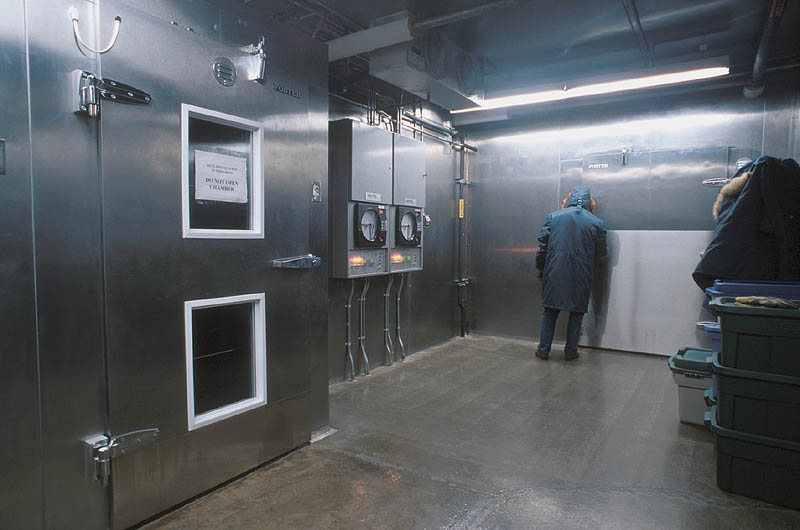
Photograph of the antechamber of the cold stprage vault where colour and black-and-white film records are kept.

Ante-chamber of cold storage vault for colour and black-and-white film records

The individual laboratories are constructed in a village-like setting directly above the three-story vault structure. This permits all LAC preservation experts, approximately 70 in total, to work together under the same roof.

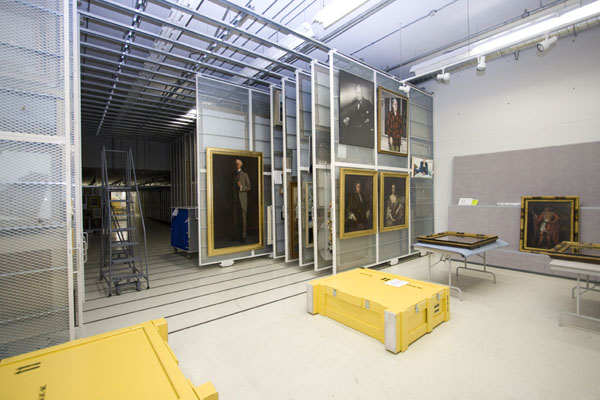
Photograph of the interior of the art storage vault for paintings and other artwork.

Storage – Art Vault. Paintings are stored on mobile hanging racks in an environment of 18 degrees Celsius (+/- 2°C) and 50% relative humidity (+/- 5%). Other multi-media objects stored in this environment include globes and miniatures. The front of the vault provides a work area for collections management activities.

There are 48 vaults for the storage and handling of archival records, each of which measures approximately 350 square metres. They house a variety of archival records in four different storage environments. Each vault is designed to protect documents by eliminating potential threats, by having a sophisticated fire detection and suppression system, and by carefully controlling all materials used inside it to maintain a contaminant-free environment.

Questions or comments? We would love to hear from you!