Trailblazers: a road trip in the summer of ’54

Version française

By Beth Greenhorn

Four women, one Plymouth station wagon, five provinces, and four states in 38 days…

On July 31, 1954, freelance photographer Rosemary Gilliat and her girlfriends, Anna Brown, Audrey James and Helen Salkeld, left Ottawa, Ontario, for what would be an adventure of a lifetime—a road trip on the Trans-Canada Highway. Their final destination was Vancouver, British Columbia, and after a little more than a month of driving, the women covered over 12,000 kilometres before their return to Ottawa on September 6.
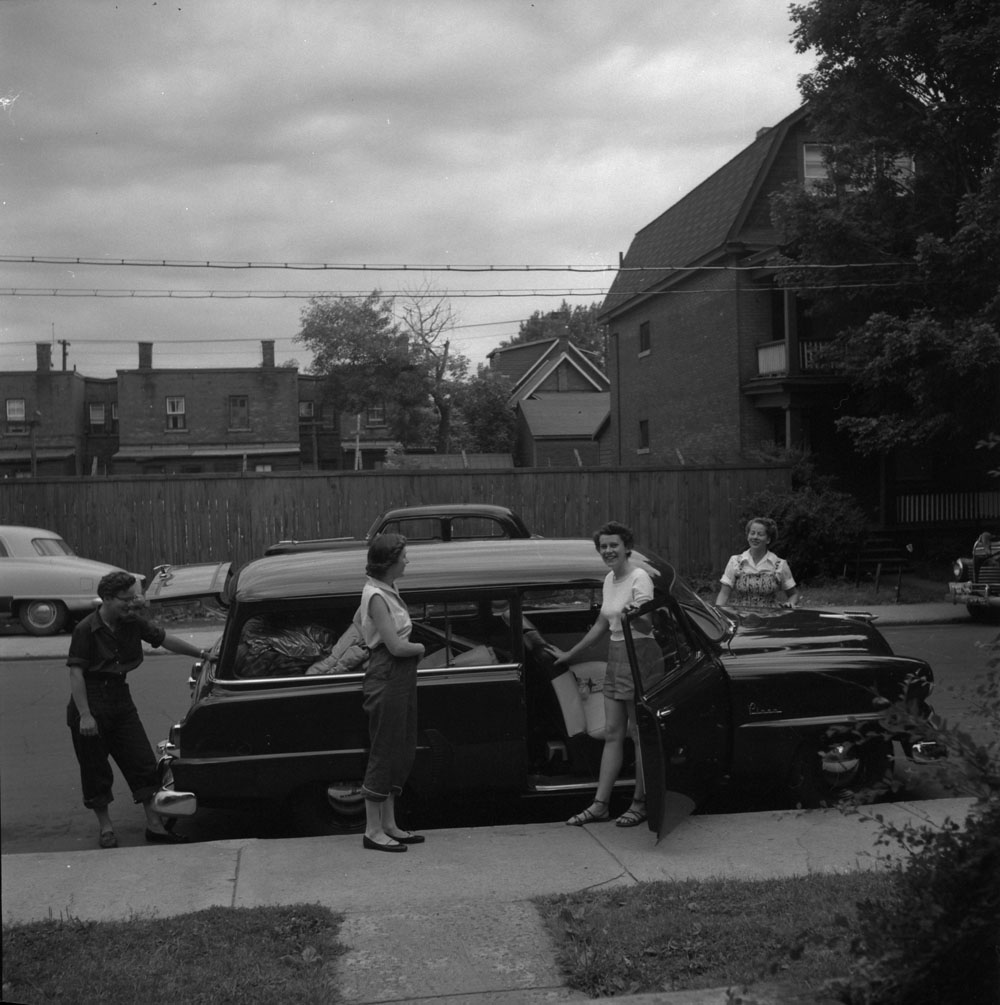
A black-and-white photograph of four women posing around a station wagon packed for a road trip.

Day One – July 31. Left to right: Helen Salkeld, Audrey James, Anna Brown and Rosemary Gilliat getting ready to leave Ottawa, Ontario, for their Trans-Canada Highway trip. (MIKAN 4306200)

Until the mid-twentieth century, the only way to travel and really ‘see’ Canada was by train. Following the Second World War, thousands of new immigrants from across the globe immigrated to Canada. This increase in population was coupled by a huge growth in the automobile industry. During the post-war years, and with Parliament passing the Trans-Canada Highway Act in 1949, construction had begun to link Canada’s major cities with paved roads.

By the summer of 1954, work on the Trans-Canada Highway going west from Ottawa had started, but many stretches were still under construction, and in some areas work had not even begun. Rosemary described the road conditions near Cochrane, Ontario as “dirt and rutted and huge bumps which could easily break a spring.” At the border of Manitoba and Saskatchewan “the average road turned into a downright bad road, dried mud, stones lying on the road, dips & holes.” Further west, just past Kicking Horse Pass, British Columbia, the conditions became even more treacherous. Rosemary wrote:

“We soon came to bits of road under construction—engineers have been working at it already for two years. They have to blast out the side of the mountain—most of it above the C.P. Railway. We marvelled once more at the building of the railway through this impossible territory. The road was often just a rocky lane with towering rock walls above and jumbled masses of blasted rock below—other places were mud, with streams & pools of water on the road & one got the feeling that the whole lot might easily slip into the canyon hundreds of feet below.”
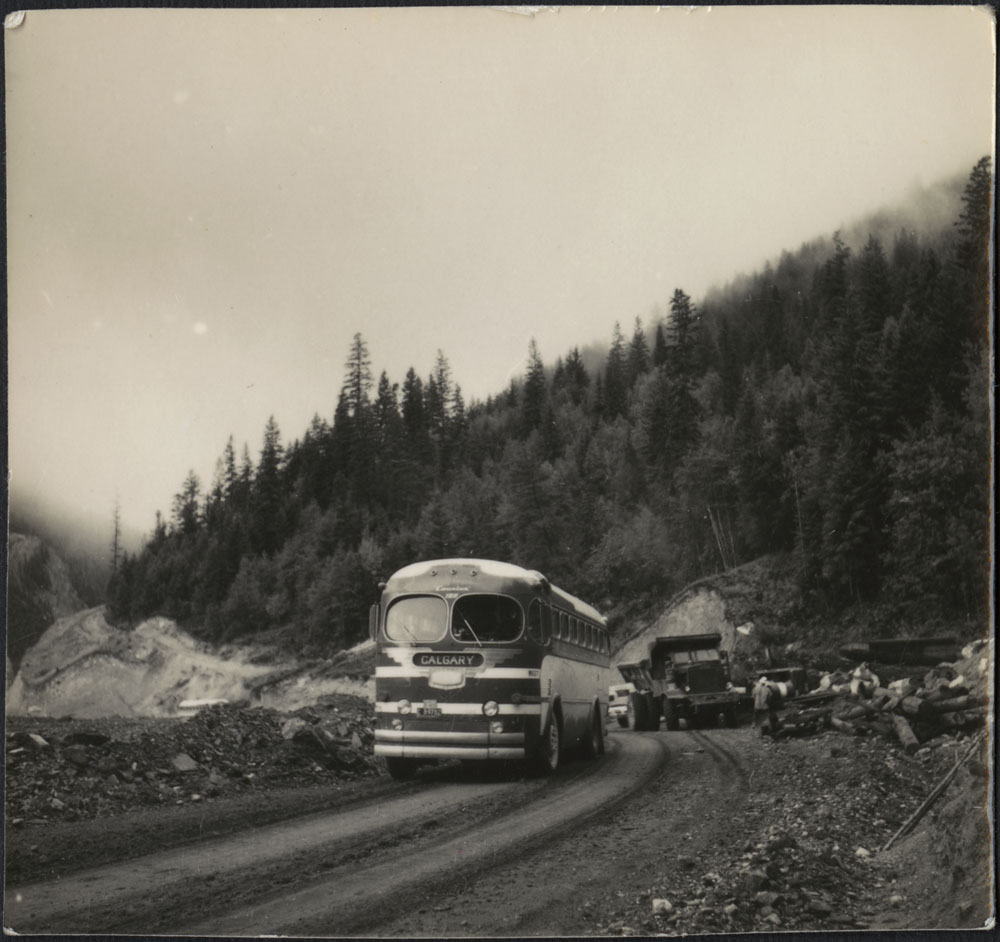
A black-and-white photograph of a public bus travelling on a gravel road and passing a construction crew working in the background. The area is mountainous.

Day 18 – August 17. The daily Calgary bus passes through a blasting area in Kicking Horse Canyon, British Columbia. Travel is between hours of 5 p.m. and 8 a.m. only on this stretch. (MIKAN 4359684)

In spite of the many challenging stretches of highway, the windshield of Helen’s Plymouth only suffered a few cracks from flying rocks and remained intact until the women returned to Ottawa, when it was replaced.

Rosemary and her friends were not what you would call stereotypical women, or even conventional tourists, for their era. While there were some amenities available along the Trans-Canada Highway in 1954, such as motels and public camping grounds, the women preferred to have lunch and camp in wooded and secluded areas off the beaten path. As Rosemary put it, “one wonders at all the days of the year one spends in bed—when it is so perfect camping—every morning and every evening being a revelation.”
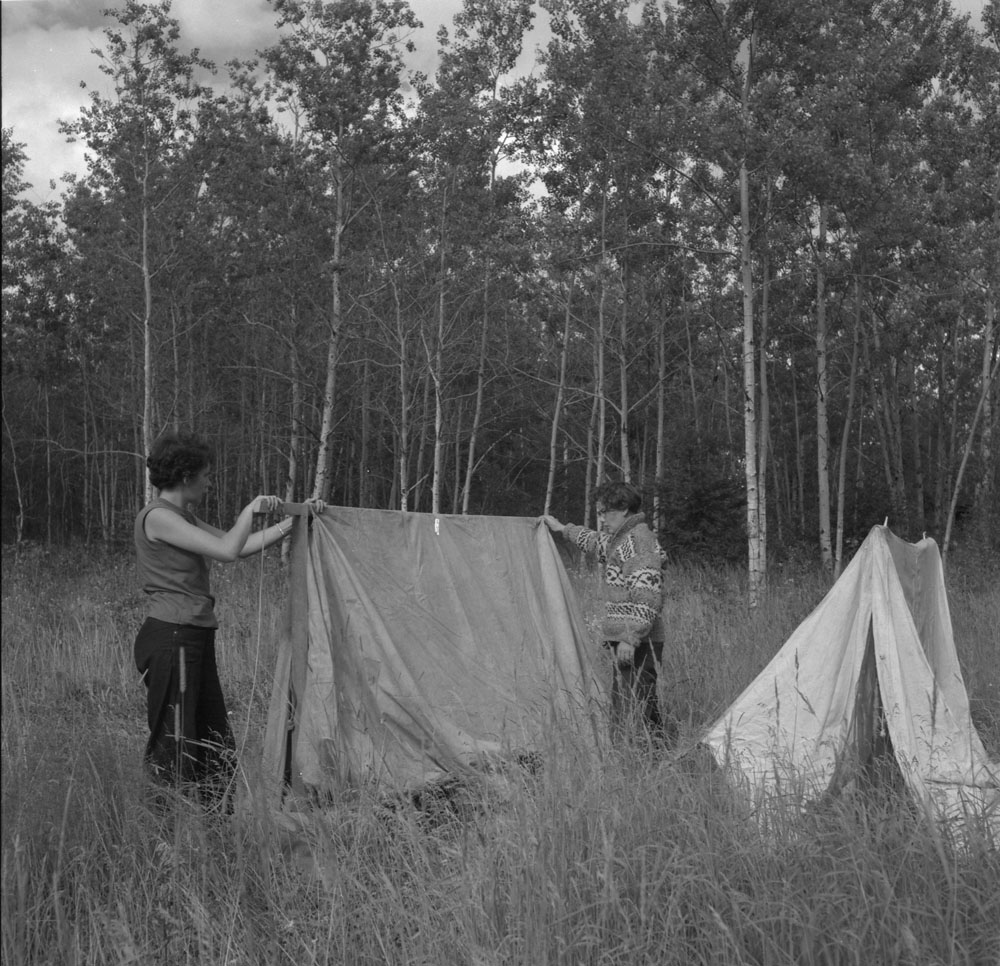
A black-and-white photograph of two women putting up two tents in a meadow with long grass surrounded by trees.

Day 4 – August 3. Anna Brown and Helen Salkeld pitching their tents, English River, Ontario. (MIKAN 4306206)

Rosemary and her friends were seeking an “authentic” wilderness experience and were not discouraged by insects, rain or possible encounters with wildlife. Midway through their trip, Rosemary observed: “What always strikes me as odd is this business of people motoring 1000’s of miles into the wildest country in order to have all the luxuries they have at home in a different setting.”

A black-and-white photograph of three women in a wooded area preparing dinner in the rain.

Day 20 – August 19. Making dinner in the rain, near Yale, British Columbia. (MIKAN 4306339)

Packed to the max, Helen’s station wagon was loaded with all of their camping supplies and utensils. Among their equipment was a Coleman stove and two water bottles, but no cooler or ice for perishable food. So part of their daily routine included picking up groceries and finding drinking water while getting gas for the car. This was not a luxury vacation!

A colour photograph of two women in a grassy area with mountains in the distance—one is reading reclined on a picnic blanket and the other is kneeling at a camp stove located behind a station wagon.

Day 20 – August 19. Helen Salkeld and Audrey James relaxing after lunch near Cache Creek, British Columbia. (MIKAN 4323864)

Their travels took them through remote forests and small towns of north and northwestern Ontario, endless kilometres of the golden prairies of Manitoba and Saskatchewan, the foothills and Rocky Mountains of Alberta, and along the rushing glacial rivers of British Columbia to Canada’s beautiful pacific coast. Rosemary recorded their fantastic adventures, taking hundreds of photographs and keeping a detailed travel diary that describes the people they met and things they experienced along the way, including friendly farmers, charismatic cowboys, and murderous mosquitoes.
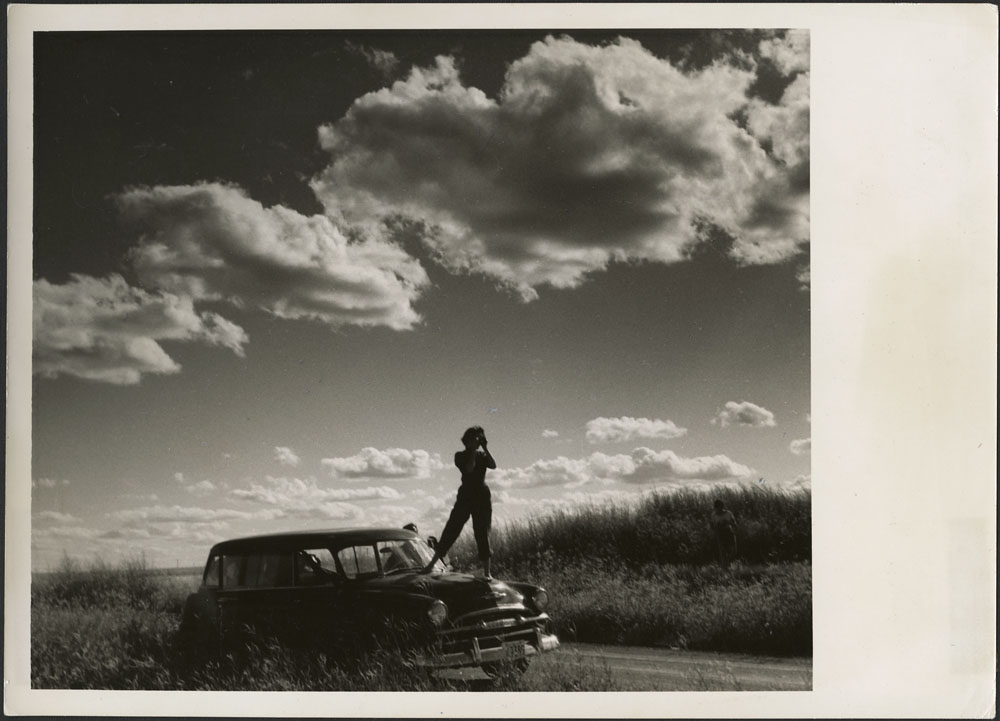
A black-and-white photograph of a woman in silhouette taking a photograph while standing on the hood of a station wagon parked on the side of the road in the prairies.

Day 9 – August 8. Audrey James standing on the hood of Helen Salkeld’s station wagon taking a photograph of the prairies, southern Saskatchewan. (MIKAN 4814411)

On July 31, 2015, Library and Archives Canada launched Road trip—summer of ’54 on Facebook, which features a selection of Rosemary Gilliat’s photos and diary excerpts. Visit Facebook daily to see where she and her friends travelled and who they met along their journey. At the end of each week, these photographs will be added to Flickr.


Beth Greenhorn is a Senior Project Manager in the Outreach and Engagement Branch at Library and Archives Canada.

Photography of Yousuf Karsh now on Flickr

Yousuf Karsh came to Canada as a teenager and pursued his dream to become an internationally renowned photographer.

Images of national parks now on Flickr

Canada’s national parks are protected areas established under federal legislation to preserve Canada’s natural heritage for public understanding, appreciation and enjoyment. The parks are maintained for future generations and have existed in Canada for well over a century.

Photo Album 47: Record of a real and a constructed journey to western Canada: a mystery!

In the previous posts, Sir Arthur Conan Doyle Tour of Western Canada, June 1914 and Visit to Jasper National Park, we followed on Sir Arthur Conan Doyle’s trail as he travelled through Canada in 1914. The images of the trip came from a large album of photographic prints put together by William Topley capturing the author’s travels—supposedly. Upon doing further research, there are some curiosities with the way the album has been presented.

The photo album (see pages from the album below) appears to be not only a record of the Conan Doyle tour of 1914, but also a constructed record of a journey that an immigrant or tourist would take on the Grand Trunk Pacific Railway.

A black-and-white photograph showing a group of people sitting on a veranda overlooking a wooded area.

The Conan Doyle party sitting on a veranda. Sir Arthur Conan Doyle is on the far right.

Clues

First, the original nitrate and glass plate negatives are located in the Topley fonds rather than the Department of the Interior, which employed the photographer for the Conan Doyle tour.

Second, the photo album resides within the Department of the Interior’s fonds in a series entitled, Immigration Branch — Photographic Albums of Canadian Settlement. The MIKAN record notes that the albums in this series contain photographs taken by two photographers, John Woodruff and Horatio Topley, working for the William Topley Studio. However, the photographs in the Sir Arthur Conan Doyle album are clearly identified as having been taken by William Topley, rather than his brother, who died in 1910.

Third, while the MIKAN record—Sir Arthur Conan Doyle Tour—suggests that the entire album is of Conan Doyle’s tour, a close inspection of the physical album reveals that only a portion of the photographs are from the tour! The last part of the album has photos of places along the remainder of the Grand Trunk Pacific Railway route from Jasper, Alberta through central northern British Columbia to Prince Rupert on the Pacific coast—places which Conan Doyle did not visit as he returned east after his stay in Jasper National Park.

So why are these other photos in the album? By looking at the finding aid for the Topley Studio Series SC, we learn that Topley may have travelled on the Grand Trunk Pacific Railway to photograph the Mount Robson Glacier and Berg Lake in 1913. In July 1915, he may have taken the railway from Jasper, Alberta all the way to Prince Rupert, British Columbia. Along the way, he photographed:

Photograph of a typewritten list with photograph numbers and titles of locations along the Grand Trunk Railway.

The finding aid at the beginning of the Sir Arthur Conan Doyle photo album from the Immigration Branch listing the photographs contained in the album.

Topley was quite probably employed by Department of the Interior to record these trips as he had a number of prominent assignments with the Department in the first two decades of the 20th century.

In 1917, the Department of the Interior published the book, Description of and Guide to Jasper Park, which includes several of Topley’s photos from his 1914 trip with Conan Doyle and one photo of his 1915 trip.

A photograph of an album, showing three black-and-white photographs of a city.

A page taken from the album showing photographs of the city of Edmonton.

A photograph of a photo album, showing four black-and-white photographs of groups of people with horses and tents.

A page from the album showing photographs taken of a press excursion at Jasper Park that are clearly labelled 1915.

A photograph of an album, showing four black-and-white photographs of various scenes in British Columbia, including the totem poles at Kitwanga, a view of the village, an unidentified medicine man and a person fishing on a stream.

The album showing locations in British Columbia that Conan Doyle did not go to during this trip.

A collage of two images. The first one is a label explaining how to reorder the binder if necessary, and the second one shows two black-and-white photographs: one of an Ottawa bridge and the other captioned, “Str. Prince Rupert leaving for Vancouver.”

First and last pages of the album. The last photograph shows a steamer heading towards Vancouver. However the Conan Doyle party never made it past Mount Robson.

Whether the Department of the Interior album was intended for public viewing or not, one thing is certain—Topley’s western excursions were addictive. The photographer was drawn to the grand western landscapes. Retired Library and Archives Canada photo archivist and Topley expert Andrew Rodger writes in the Dictionary of Canadian Biography: “Topley and his wife, who died in 1927, spent much of their last years in Edmonton with their daughter, Helena Sarah, and son-in-law, Robert C.W. Lett, an employee of the Grand Trunk Pacific Railway. The latter was probably influential in the naming of the town of Topley, a community on the rail line in northern British Columbia.

William Topley died in Vancouver in 1930.

Sir Arthur Conan Doyle Tour of Western Canada – Visit to Jasper National Park

On June 11, 1914, Sir Arthur Conan Doyle and his wife travelled via the Grand Trunk Pacific railway to the town of Jasper within Alberta’s Jasper National Park. Of the place, the author later wrote:

“Jasper Park is one of the great national playgrounds and health resorts which the Canadian Government with great wisdom has laid out for the benefit of the citizens. When Canada has filled up and carries a large population, she will bless the foresight of the administrators who took possession of broad tracts of the most picturesque land and put them forever out of the power of the speculative dealer.”

This statement proved to be pure gold for government travel marketers! During Conan Doyle’s visit, the commissioner for Canada’s national parks, J.B. Harkin, created his own promotional campaign for national parks, releasing the booklet entitled “Just a Sprig of Mountain Heather.”

The Jasper Park trip lasted eight days. Conan Doyle was the guest of an old friend, Colonel Rogers, who was the park’s superintendent. The author noted: “For a week we lived the life of simplicity and nature.”

A black-and-white photograph showing a veranda with seating to take advantage of the view. The architectural style is rustic, with river stones and rough-hewn beams.

The veranda of the Administration Building in Jasper Park, Alberta, by William Topley, 1914 (MIKAN 3587685)

Conan Doyle wrote of his experience in the town of Jasper as follows: “Life in Jasper interested me as an experience of the first stage of a raw Canadian town. It will certainly grow into a considerable place, but at that time, bar Colonel Rogers’ house and the station, there were only log-huts and small wooden dwellings.” He and his wife visited many now-famous locations, such as Pyramid Lake, Lake Edith, and the Maligne River and Canyon.

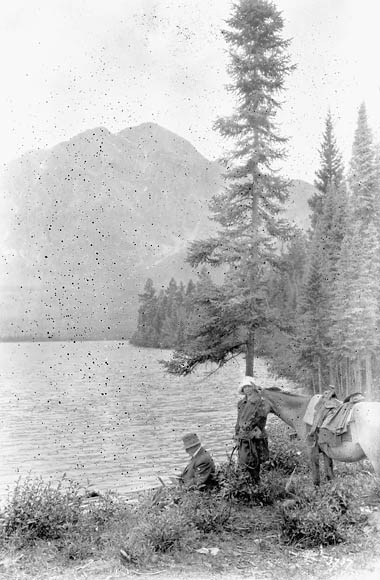
A black-and-white photograph showing a man and a woman with a horse by a lake. The man is seated and the woman is holding the lead to the horse. There are tall coniferous trees behind them.

A couple with a horse at Pyramid Lake, Alberta, by William Topley, 1914 (MIKAN 3587697)

A black-and-white photograph of a group of people outside a rustic log cabin.

The Conan Doyle party preparing lunch outside (MIKAN 3587725)

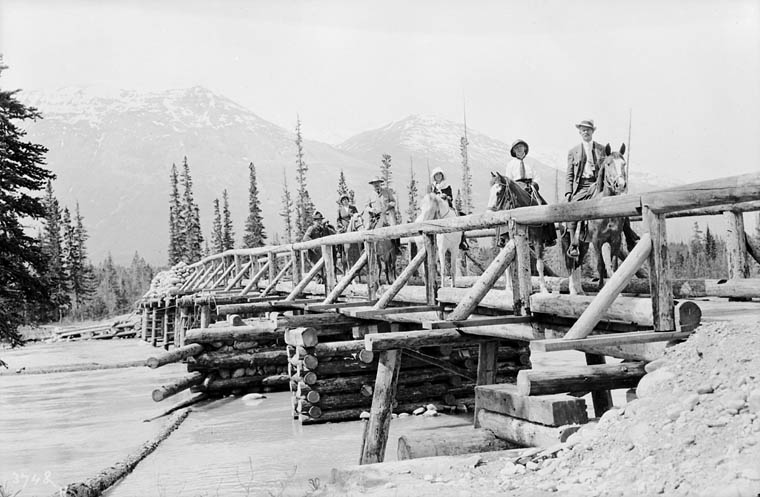
A black-and-white photograph showing one person walking and five people on horseback, on a log bridge crossing a river, with mountains in the background.

The Conan Doyle party crossing the Athabasca River in Alberta (MIKAN 3303264)

A special train was organized to take Conan Doyle, his wife, and friends to visit the area near Mount Robson. The mountain, located just over the Alberta border in British Columbia, is one of the highest and most iconic mountains in the Canadian Rockies. William Topley, the celebrated Ottawa photographer, dutifully took these photos.

A black-and-white photograph showing a train stopped beside a river.

The train near Lucerne, British Columbia, by William Topley, 1914 (MIKAN 3587749)

A black-and-white photograph showing a man walking along train tracks, with a view of Mount Robson in the distance.A black-and-white photograph showing a man walking along train tracks, with a view of Mount Robson in the distance.

A man walking along the railway tracks, with a view of Mount Robson in the background, by William Topley, 1914 (MIKAN 3587770)

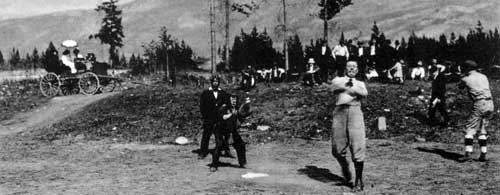
Today, a century later, the landscape looks much the same. Mount Robson is notoriously difficult to photograph without clouds obscuring its peak, so Topley was extremely lucky to get such clear shots. After this excursion, Conan Doyle would survey the layout for the first golf course in Jasper (as noted in the 1914 edition of “Golf Illustrated”) and take part in a baseball game between teams from the towns of Jasper and Edson, making sure to pitch the first ball! Although Topley missed capturing the moment, another local photographer was lucky enough to get this shot.

Conan Doyle’s Return Journey East

We do not have any images of the return trip back East, perhaps because the point of the expedition was to promote the Canadian West and its newly minted national park. We do know that the couple left Jasper on June 19 and that the return journey meandered through Winnipeg, along the north shore of Lake Superior, through Algonquin Park, down to Niagara Falls, and finally back to Ottawa for Dominion Day (Canada Day). They headed back to England on July 4. The visit resonated deeply with them as they would take their children to Jasper Park in the 1920s.

The First World War would begin one month later, giving Conan Doyle’s daydream poem The Athabasca Trail an even greater poignancy.

In the last article in this Blog series, we will take a closer look at the photo album associated with Conan Doyle’s trip, and explore some of the mysteries surrounding the images it contains. Why, for example, are there photos of places in British Columbia that Conan Doyle never visited?

Sir Arthur Conan Doyle Tour of Western Canada, June 1914

Imagine if the Canadian government invited a famous British writer to travel across Canada by train and stay at one of the country’s newest national parks—all at the expense of taxpayers! Think this scenario is impossible? Well, it happened a little over a century ago. In the spring of 1914, Sir Arthur Conan Doyle (of Sherlock Holmes fame) was invited to travel on the newly opened Grand Trunk Pacific Railway from Montreal to Jasper National Park. Conan Doyle accepted the invitation, and he and his wife, Jean Leckie, conducted the trip between May and July, 1914. The official photographer for the journey was none other than the celebrated William James Topley—a real public relations coup! Topley’s son-in-law, R.C.W. Lett, held a prominent position with the Grand Trunk Pacific Railway, and persuaded him to photograph Conan Doyle’s travels.

Montreal to Winnipeg

Conan Doyle’s trip to Jasper by train was, as it is today, a quintessential Canadian travel adventure. Writing about the experience later in Memories and Adventures, Conan Doyle stated:

“…We accepted an invitation from the Canadian Government to inspect the National Reserve at Jasper Park in the Northern Rockies. The Grand Trunk Railway (Canadian) made matters easy for us by generously undertaking to pass us over their system and to place a private car at our disposal. This proved to be a gloriously comfortable and compact little home consisting of a parlour, a dining-room and a bedroom. It belonged to Mr. Chamberlin, the president of the line, who allowed us the use of it. Full of anticipation we started off in May upon our long and pleasant journey.”

Thus the celebrated author set out with his wife by ship from England to New York City in late May 1914, and travelled by train to Montreal, arriving in the city on June 3, 1914.

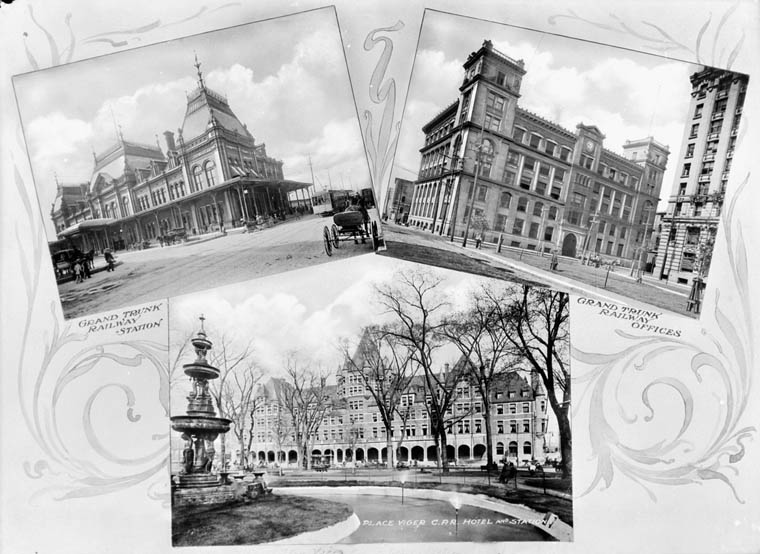
A black-and-white postcard featuring three photographs of the sights around the train station in Montreal.

A postcard published by the Albertype Company, showing three views: Grand Trunk Railway Station, Grand Trunk Railway Offices and Place Viger C.P.R. Hotel and Station (MIKAN 3335217)

Conan Doyle visited the sights of the city and went on a side trip to Trois-Rivières. The author then spoke to the Montreal branch of the Canadian Club on The Future of Canadian Literature. This same speech would be repeated in Winnipeg, Edmonton and Ottawa. Between June 5 and 8, Conan Doyle travelled from Montreal to Winnipeg by train and by boat. First, by train to Sarnia, Ontario, then on the S.S. Harmonic steamship to Fort William (near Thunder Bay). Of this part of the trip, he observed: “Then comes the enormous stretch of the Great Lakes, those wonderful inland seas, with great oceangoing steamers.”

Of Northwest Ontario, he noted: “The true division between the East and West of Canada is not the Great Lakes, which are so valuable as a waterway, but lies in the 500 miles of country between the Lakes and Winnipeg.” They stayed one night at the Minaki Lodge near Sioux Lookout, arriving in Winnipeg, Manitoba, late on June 8.

A black-and-white photograph showing the entrance to an imposing building. Automobiles and horse-drawn buggies are lined outside, and people are standing near the entrance.

The entrance of the Grand Trunk Pacific and Canadian National Railway Station in Winnipeg, by William Topley, 1914 (MIKAN 3587592)

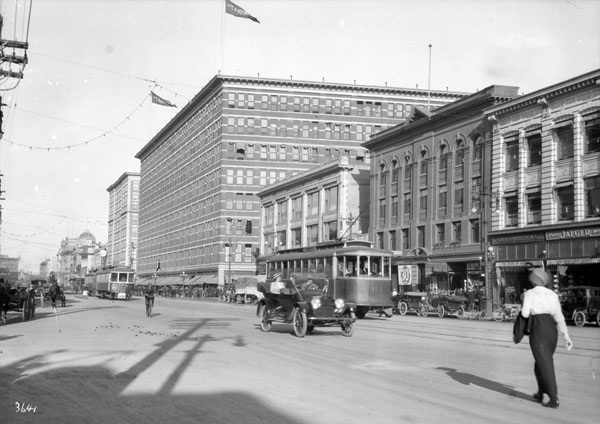
A black-and-white photograph showing a wide street, busy with streetcars, automobiles, horse-drawn buggies, cyclists and pedestrians. The buildings along the street look new and prosperous.

The Eaton’s store on Portage Avenue, in Winnipeg, by William Topley, 1914 (MIKAN 3587605)

These images are superb at documenting the bustling prairie city. The stop in Winnipeg was not long, but Conan Doyle remarked: “I do not suppose the average Briton has the least conception of the amenities of Winnipeg. He would probably be surprised to hear that the Fort Garry Hotel there is nearly as modern and luxurious as any hotel in Northumberland.”

From Winnipeg to Edmonton

By June 9, Conan Doyle was in Edmonton, having crossed the Prairies.

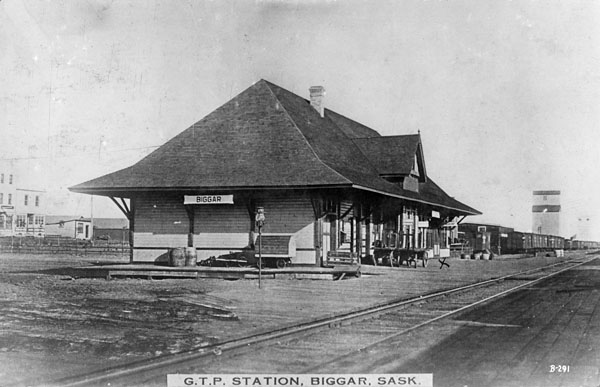
A black-and-white photograph of a train station taken from the other side of the tracks. There is a sign with the word Biggar, and there’s a note at the bottom of the photograph identifying it as G.T.P. Station, Biggar, Sask.

The Grand Trunk Pacific Railway Station, Biggar, Saskatchewan (MIKAN 3393480)

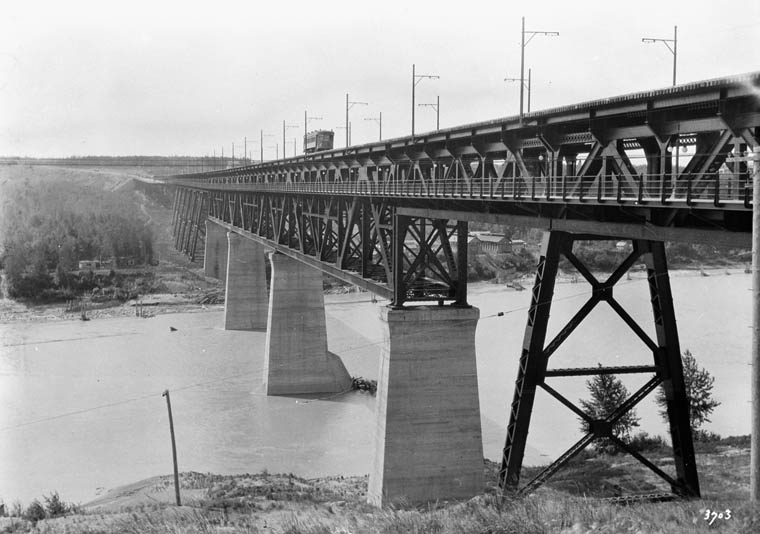
And he would have crossed over the high-level bridge entering Edmonton.

A black-and-white photograph showing a high-level railway bridge spanning a river.

The high-level bridge in Edmonton, by William Topley, 1914 (MIKAN 3587671)

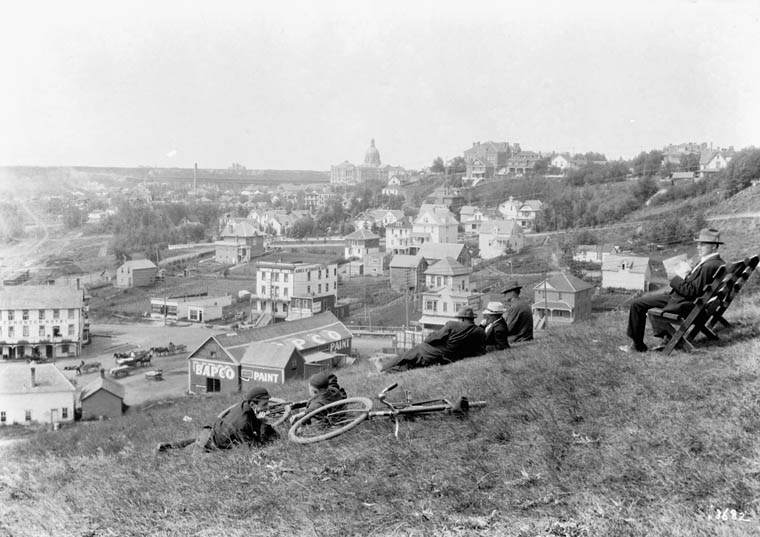
The couple stayed in Edmonton for two days. Here, Conan Doyle noticed the rough-hewn nature of the city, comparing it to Winnipeg: “There were no such luxuries in 1914 in Edmonton. The town was in a strangely half-formed condition, rude and raw, but with a great atmosphere of energy, bustle, and future greatness. With its railway connections and waterways it is bound to be a large city.”

A black-and-white photograph taken from a hillside overlooking a town, showing cyclists resting on the grass and other men seated nearby.

The town of Edmonton from “Summer House,” by William Topley, 1914 (MIKAN 3587646)

A black-and-white photograph showing a wide avenue, roughly paved, where streetcars, horse-drawn carriages and automobiles share the road. It is a streetscape bustling with activity.

Edmonton—a street view of this frontier town, by William Topley, 1914 (MIKAN 3587667)

The two prairie cities, Winnipeg and Edmonton, contrasted greatly with the breathtaking mountain scenery of Jasper National Park. In the next Blog, we will look at Conan Doyle’s extended stay at Jasper, a place that inspired him to write a poem of some importance…

“The Pointe”

Pointe St. Charles or “The Pointe” as it is more commonly known, is a Montréal, Quebec neighbourhood located southwest of downtown that has a rich and varied history. The area known as Pointe St. Charles was first acquired by Charles le Moyne in 1654, and is named in his honour. Throughout its early history, it was occupied by various religious communities and is also where Marguerite Bourgeoys, founder of the Congregation of Notre-Dame, welcomed and housed les Filles du Roi, the young French women who immigrated to New France to increase its population. Thereafter, Pointe St. Charles remained primarily a farming community until the mid-nineteenth century.

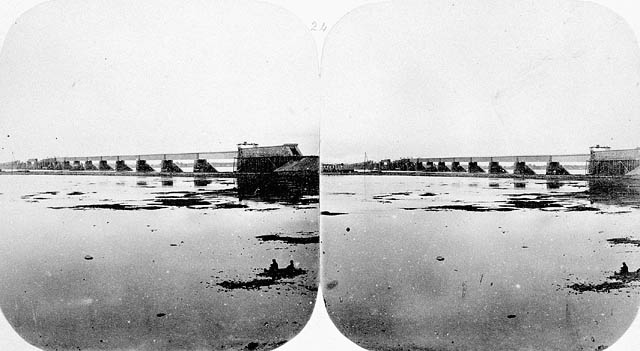
Black-and-white stereoscopic photograph showing the construction of a bridge.

Stereoscopic photograph of the Victoria Bridge construction in progress from Pointe St. Charles (MIKAN 3357662)

The landscape and population of Pointe St. Charles changed dramatically upon completion of the Lachine Canal in 1848, and further still with the new railway infrastructure and construction of the Victoria Bridge to Montréal’s south shore. Several companies were drawn to the area; new jobs were created, and land previously given to agriculture was bought for residential housing. According to Héritage Montréal, by the beginning of the 20th century, Pointe St. Charles had become the largest industrial sector not only in Montréal but in all of Canada. It was at this time that The Pointe also became the quintessential example of an ethnic melting pot. Populated primarily by English (75%) and French (25%) Canadians, The Pointe increasingly became home to many different ethnic groups.

Black-and-white photograph showing a locomotive under construction.

“Trevithick” railway engine under construction at Pointe St. Charles, from the Alexander Mackenzie Ross collection by William Notman, 1859 (MIKAN 3192802)

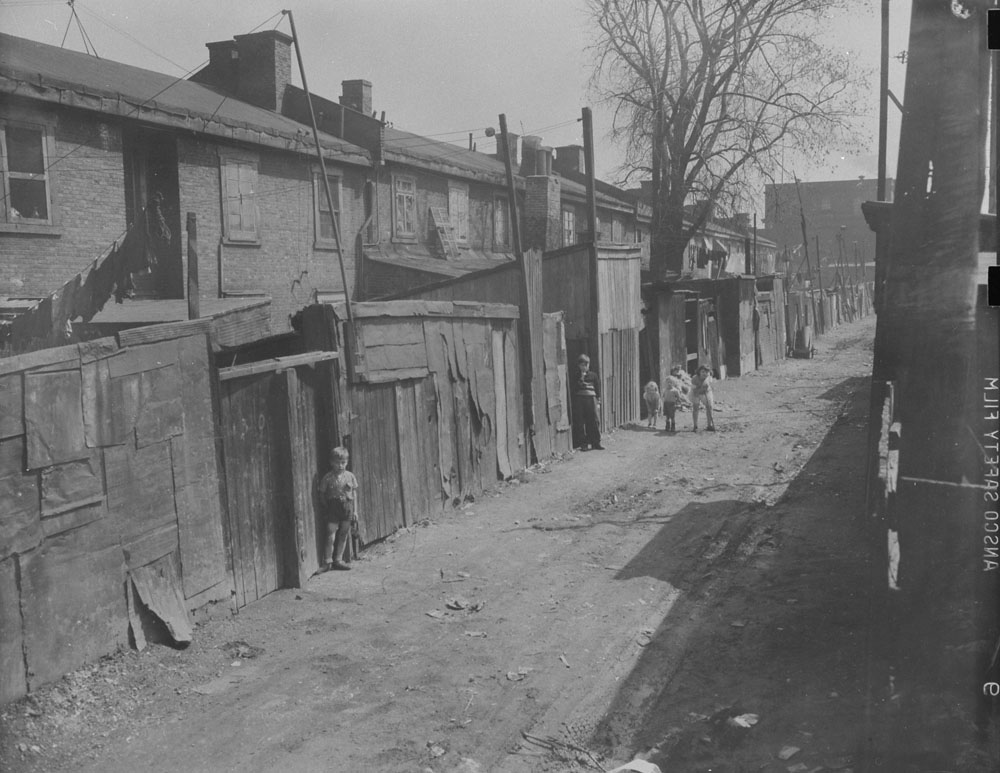
Several factors would contribute to The Pointe’s dramatic turn from Canada’s largest industrial sector to one of its most notorious slums. The Great Depression was the first event that contributed to the decline of the area’s primary economic activities. This was followed by the exodus of various factories and businesses to other industrial areas around Montréal, then culminating with the opening of the St. Lawrence Seaway in 1959 and the closing of the Lachine Canal. Adding further to the area’s decline was the building of expressways that now run along The Pointe’s north and southwest borders. The Richard Arless photographic collection held by Library and Archives Canada substantiates the existence of these slum conditions. Montréal-born Richard Graham Arless (1906-1995) began his career as a Second World War military photographer. After the war, he worked for various newspapers and magazines, eventually opening his own commercial studio in Montréal. His photographs of the slum conditions of Pointe St. Charles, all taken on the same April day in 1946, capture the bleakness and poverty of this once vital, now broken-down and battered neighbourhood.

Black-and-white photograph showing a courtyard with laundry hanging from various clotheslines. Three children are playing on the ground.

Children playing in a courtyard in the Pointe St. Charles district, April 25, 1946 by Richard Arless (MIKAN 3380642)

Black-and-white photograph showing a long, narrow lane strewn with garbage. A young child stands at the far end looking at the viewer.

View of a child in a narrow, garbage-strewn lane in Pointe St. Charles district, April 25, 1946 by Richard Arless (MIKAN 3380643)

The people of Pointe St. Charles have always been a gregarious and hardy bunch. As their population dwindled and their neighbourhood and living conditions deteriorated, the residents banded together to confront and improve their lot. Community groups were started to improve housing, build parks and promote recreation and health care.

Black-and-white photograph showing the dilapidated back lane behind the row houses. Children look towards the viewer.

View of a dilapidated back alley in Pointe St. Charles district, April 25, 1946 by Richard Arless (MIKAN 3380652)

Most recently, The Pointe has experienced a revitalization. Land around the Lachine Canal was transformed for recreational use with bike paths, while many of the abandoned factories have been converted into condos that have attracted many new residents.

The Children of Topley – Pint-sized portraits from the William Topley collection

The William Topley collection at Library and Archives Canada is an invaluable resource for those interested in nineteenth-century Canadian photographic portraiture. Comprised of over 150,000 glass plate negatives as well as studio proofs and counter books, the Topley collection dates from 1868 to 1923, and illustrates the prolific career of Topley, a Montreal-area native, who began his solo career by opening a branch of the William Notman studio on Ottawa’s Wellington Street. While Topley did photograph subject matter other than people, portraits were his chosen specialty and the collection is a wonderful example of early Canadian studio work.

By the early 1870s Topley had purchased the studio he had been managing for William Notman, and was attracting upwards of 2,300 sitters per year. Topley’s prestigious downtown Ottawa location—he moved multiple times over the years, but always within walking distance to parliament—meant he attracted much of the city’s elite, including politicians and other important figures, who made their way to the photographer’s studio to have their portraits taken.

Children were often the subject of these portraits, posing alone or with siblings. In looking through these images we notice not only recognizable names, identifying some of these children as the offspring of the capital city’s movers and shakers, but something unchanged despite the time period. We see beyond the formality, the constricting clothing and stiff poses, and recognize that these portraits are not too different from those we might take today. We recognize children dressed up for a photo, attempting to sit still, looking either overly eager or slightly bored.

Black-and-white photograph of a young girl in a white dress.

Missie McLaren, 1873 (MIKAN 3461050)

Studio photographers of this era often had clients pose with props, and Topley was no different. In his portraits of children we notice items like books, skipping ropes, dolls or pets clutched in the hands of the small sitters. Some children stand or sit up very straight with serious, concentrated expressions on their faces, while others lounge tiredly in chairs. In these ones especially, we can imagine how tedious the long exposures must have felt to a child, how many plates the photographer might have had to take to get a proper, non-blurry image.

Black-and-white photograph of a young girl with her chin resting on her hands, a book beside her.

Missie Cambie, 1877 (MIKAN 3435180)

Also interesting are the portraits of babies with hidden, or barely-in-the-frame mothers. It was quite common at the time for babies to sit on their mothers’ laps for a portrait, while a blanket or other fabric was thrown over the mother so that only the baby would be the focus. In several of Topley’s portraits of babies, we see a more subtle approach, with the mother encouraging the child from the edge of the frame. The photographer would later crop the mother out for the final print.

Black-and-white photograph of a young child with the mother to the right, partially blacked out.

Missie Ruttan, 1876 (MIKAN 3434482)

These wonderful portraits provide an alternative perspective on the face of Canada’s capital in the nineteenth century, and seem to offer a bridge from past to present, where some things never change.

Black-and-white photograph of two young boys in black jackets, one seated and one standing on a chair.

Two boys posing—Master Borthwick, 1882 (MIKAN 3418410)

Black-and-white photograph of a young girl dressed in winter clothing.

Missie Helena Topley, 1882 (MIKAN 3418246)

Related resources:

Early Canadian Travel Photography now on Flickr

The concept of Canadian tourism emerged during the early nineteenth century. Improved modes of transportation, such as new railways stretching across the country, facilitated leisure travel and offered people the chance to witness some of the nation’s greatest marvels and modern achievements.

Photographs were the ideal medium with which to attract potential visitors, and photographers were hired by transportation companies to produce images of majestic scenery that would promote destinations. Later rivaled by amateur picture-takers, eager to create their personal holiday mementos, these photographs were a vital component of the burgeoning tourist industry. The imagery created during this period helped to characterize the country, establishing a sense of national identity by introducing viewers to iconic images of Canadian scenery.

Early Canadian Travel Photography now on Flickr

For the Record: Early Canadian Travel Photography – an exhibition at the National Gallery of Canada

In the early 19th century, tourism in Canada was an emerging concept. Improved modes of transportation, such as new railways and passenger steamships, finally allowed Canadians and visitors alike the chance to witness some of the nation’s greatest sights and scenery.

Contrasting interests dictated what the most popular tourist attractions were, with pristine, untouched nature (waterfalls and mountains) as well as industrial, modern achievements (bridges and railways) being the biggest draws.

A new exhibition at the National Gallery of Canada in Ottawa showcases some of these fascinating images. Drawn from the collection of Library and Archives Canada, these photographs show us how visitors saw the country, often for the very first time. They demonstrate the wonder travellers felt with the natural world, and with the new impressive infrastructure that was developing all around them.

Black-and-white photograph of a woman standing in front of a large, hollowed-out tree.

Great Cedar Tree, Stanley Park, Vancouver, British Columbia, 1897 (MIKAN 3192504)

Almost immediately, capturing and recording these experiences became a popular and lucrative endeavour. Photography was the ideal medium with which to attract potential tourists, and it was quickly utilized by professional photographers who produced images for promotional material as well as traveller souvenirs. Later, as amateur photography became easier and more affordable, the personal snapshot rivalled these commercial images.

Black-and-white photograph of Montréal’s Victoria Bridge, with a young man seated on a rock in the foreground.

Victoria Bridge, Grand Trunk Railway, Montréal, Quebec, 1878 (MIKAN 3323336)

Niagara Falls was the first major tourist destination in North America, and was a bustling scene of commercialism even in the 19th century. Having your picture taken in front of the Falls was a prestigious event, but if you couldn’t make it there in person, you could always have Niagara as a painted backdrop in your studio portrait.

Black-and-white tintype photograph of a woman standing in front of a wooden fence with a painted backdrop of Niagara Falls behind her.

Studio portrait with Niagara Falls backdrop, ca. 1870 (MIKAN 3210905)

Vital components of both the burgeoning tourist industry and of the growing interest in amateur photography, the travel and tourism photographs produced during this period helped to define the country. By creating a familiarity with popular scenery, these images introduced the viewer to what are now recognized icons of the Canadian landscape.

Black-and-white stereograph of two men (one with binoculars) standing on a bluff overlooking Alberta’s Bow River.

Bow River Valley, Banff, Alberta, 1900 (MIKAN 3509496)

Black-and-white stereograph of three small children standing on a pathway in Halifax’s Public Gardens.

Public Gardens, Halifax, Nova Scotia, n.d. (MIKAN 3509481)

Visit the exhibition at the National Gallery of Canada, in Ottawa, from March 6 to August 30, 2015. Check out our Flickr set to see more 19th-century travel photographs or listen to the podcast – Canada’s photographic memory!