Paws and reflect: the legacy of Margaret Marshall Saunders’s Beautiful Joe

By Alyssa Currie

The Story

Beautiful Joe is a bestselling children’s story written by Margaret Marshall Saunders. The novel describes the life of a mistreated dog who finds happiness when he is adopted by a kind family. It gives a voice to domestic animals by presenting the story from Joe’s perspective and stressing animal cruelty. Using the name Marshall Saunders, the author originally entered her story into a contest by the American Humane Society in 1893 and won first place. The text was published a year later and quickly became a bestseller, reportedly the first Canadian book to sell over a million copies.

Our collections include two photographs and two autographed postcards related to Beautiful Joe. These records are remarkable because they document the real-life inspiration for the story and its connection to Saunders’s animal advocacy efforts. The preface to Beautiful Joe reads:

BEAUTIFUL JOE is a real dog, and “Beautiful Joe” is his real name. He belonged during the first part of his life to a cruel master, who mutilated him in the manner described in the story. He was rescued from him, and is now living in a happy home with pleasant surroundings, and enjoys a wide local celebrity.

The character of Laura is drawn from life, and to the smallest detail is truthfully depicted. The Morris family has its counterparts in real life, and nearly all of the incidents of the story are founded on fact.

Margaret Marshall Saunders, Preface to Beautiful Joe

The Photographs

Margaret Marshall Saunders first encountered “Beautiful Joe” during a visit to her brother and his fiancé, Louise Moore, in Meaford, Ontario. Upon returning to her family home in Halifax, Nova Scotia, Saunders began writing, determined to share Joe’s story. Though Saunders based her novel on reality, she adapted elements of the story to suit her fictional setting. For example, the location was changed to an American town to suit the rules of the contest and appeal to American readers. Saunders also renamed the Moore family, who originally adopted “Beautiful Joe,” as the Morris family and introduced elements of her own family into their narrative.
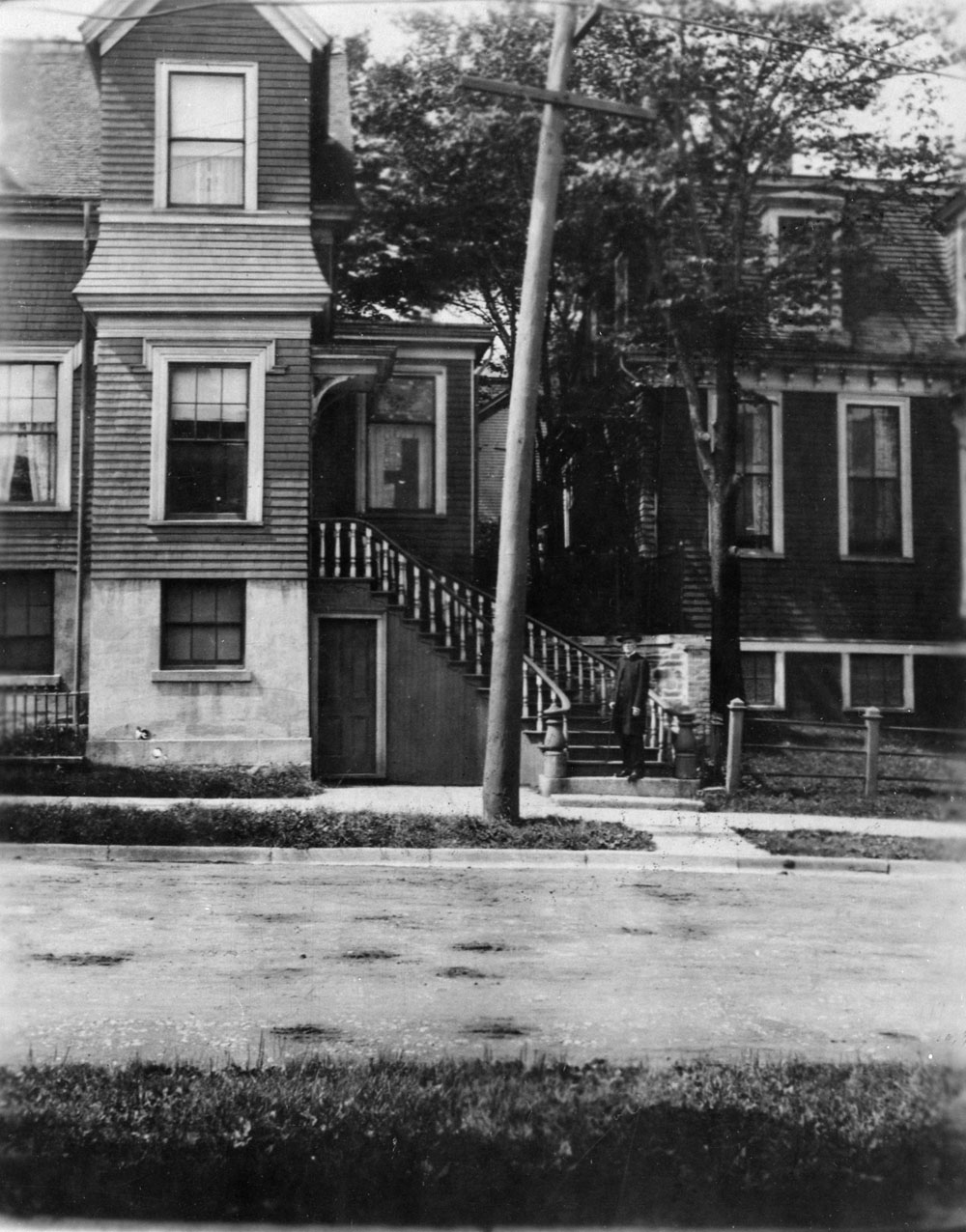
Black-and-white photograph featuring Dr. Edward M. Saunders, standing on the front staircase of a three-story Victorian style house. Dr. Saunders is wearing a black clerical suit and a black hat. The photograph was taken from across a residential street.

The Saunders family residence in Halifax, Nova Scotia where Beautiful Joe was written (a051627-v8)

Throughout the narrative, Saunders appears to model the Morris family after her own. This likeness is supported by a photograph of Dr. Edward M. Saunders donated by the author. A handwritten note, possibly from Margaret herself, on the reverse of the photograph reads:

Dr. Saunders original of Mr. Morris in “Beautiful Joe”
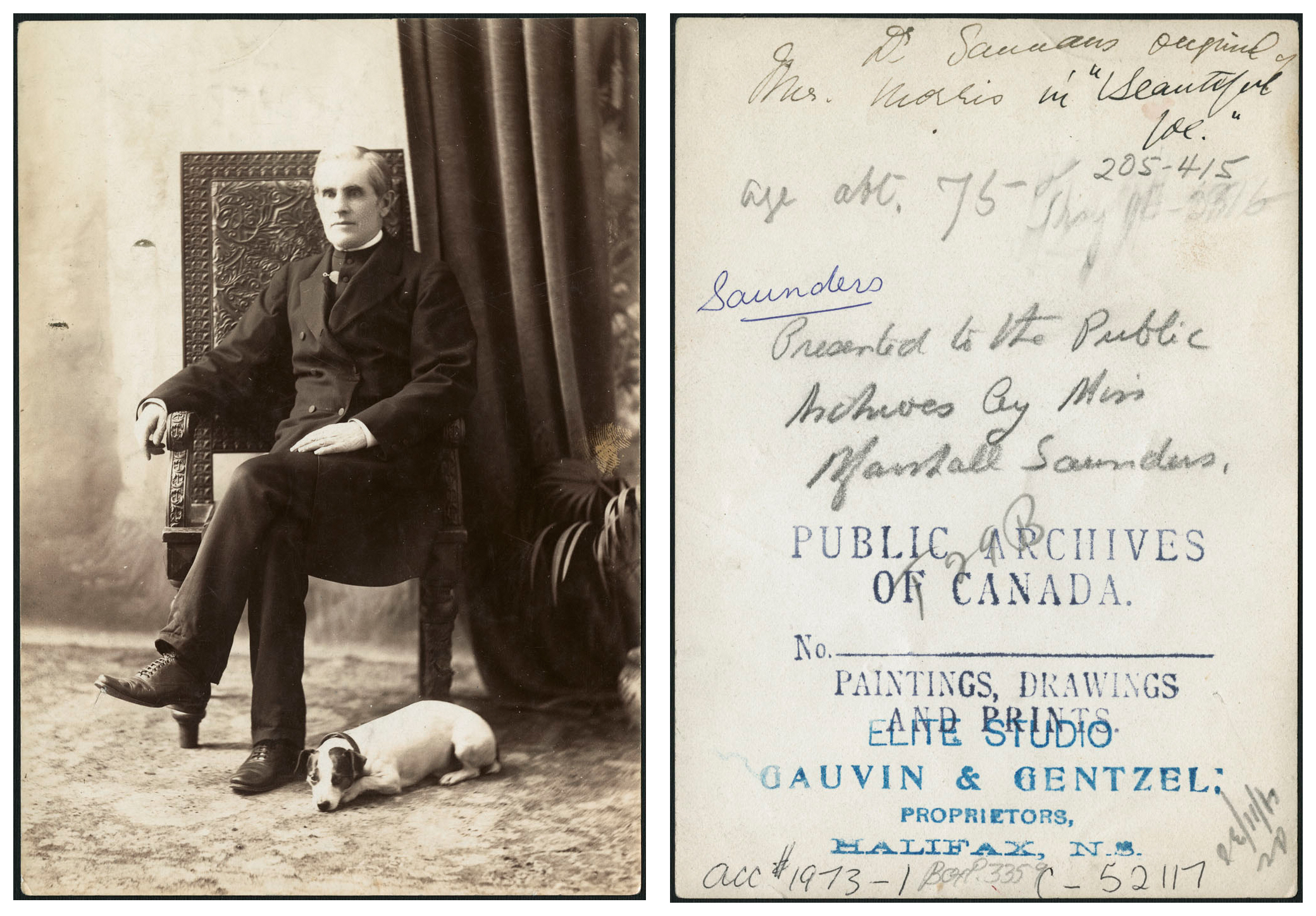
Black-and-white photograph of a middle-aged man sitting in an ornate chair with a small dog, possibly a Russell terrier, laying at his feet. The man is wearing a black clerical suit. Dark drapery and a potted plant appear in the right of the portrait. The back of the photograph includes a stamp from Gauvin & Gentzel Studio.

Dr. Edward M. Saunders, father of Margaret Marshall Saunders and inspiration for the character Mr. Morris in Beautiful Joe. Handwritten notes on the back of the photograph document its connection to Beautiful Joe (e011184730-v8)

The Postcards

Two recently described postcards from our literary archives further emphasize the story’s connection to reality and the enduring legacy; both postcards were printed years after the book’s original publication and signed by the author. The first postcard features a picture of the original “Beautiful Joe” and provides a visual counterpart for the story’s protagonist.

Black-and-white postcard featuring a photograph of a dark dog with no ears in a sitting position. The postcard is captioned “BEAUTIFUL JOE” and autographed in black ink, “Marshall Saunders, 1930.” The back of the postcard features a small picture of Margaret Marshall Saunders with the caption, “Marshall Saunders, author of the world famous book, ‘Beautiful Joe.’” The postcard has not been mailed.

Autographed postcard featuring the original “Beautiful Joe” who inspired the story (e011184731-v8)

As Beautiful Joe gained national and then international recognition, Saunders used its popularity to promote animal welfare. She collaborated with animal advocacy groups on campaigns, which in turn promoted the sale of her own literary works. A postcard issued by the Canadian Antivivisection Society demonstrates this reciprocal relationship; it features Saunders, with the caption, “Author of the world-famous book ‘BEAUTIFUL JOE.’” The author autographed the front of the postcard and signed the back:

“Please do not vivisect our dear dogs, Marshall Saunders.”
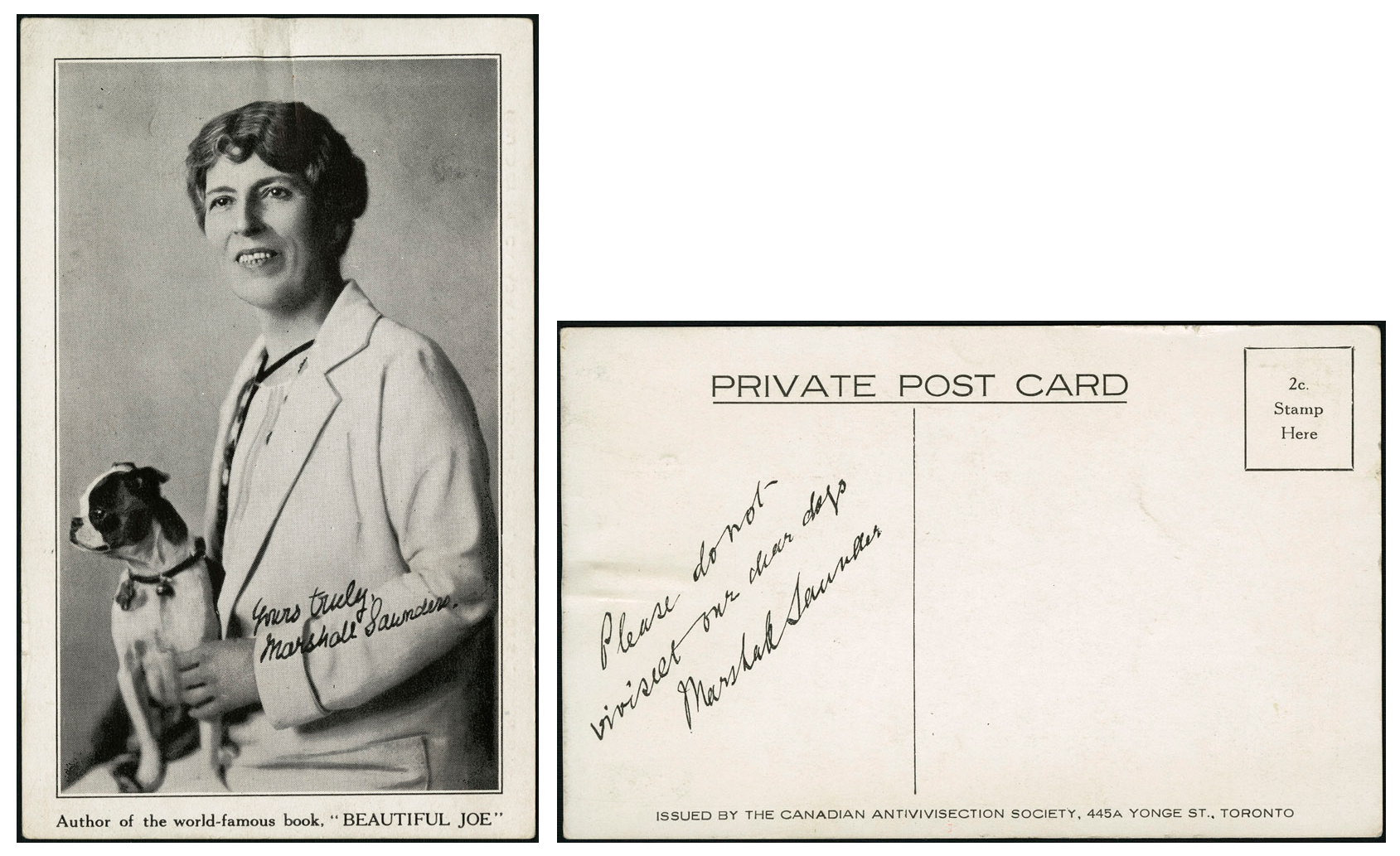
Black-and-white postcard featuring a photograph of a middle-aged woman wearing a lab coat and holding a small dog on her lap. The postcard is captioned, “Author of the world-famous book, ‘BEAUTIFUL JOE’” and autographed in black ink, “Yours truly, Marshall Saunders.” The back of the postcard reads “ISSUED BY THE CANADIAN ANTIVIVISECTION SOCIETY, 445A YONGE ST., TORONTO” and is signed by the author. The postcard has not been mailed.

Autographed postcard featuring Margaret Marshall Saunders, “Author of the world-famous book, ‘BEAUTIFUL JOE’” (e011184732-v8)

The Legacy

Saunders was a bestselling author by the time of her death on February 15, 1947. Later that year, the Government of Canada recognized her accomplishments by naming her a “Person of National Historical Significance.” Over a century has passed since Margaret Marshall Saunders wrote Beautiful Joe, but still her legacy remains.


Alyssa Currie is a master’s student from the University of Victoria working in the Literature, Music, and Performing Arts Archives Section at Library and Archives Canada.
Images of Swimming and Pools now on Flickr

Swimming is an important survival skill. However, it wasn’t considered a sport or leisure activity until organized competitions were held in countries like Japan in the 1600s, and eventually in Europe in the 1800s. Men’s swimming was included in the 1896 Olympic Games, and women competed in the 1912 competitions, cementing its place as a sport. Various associations around the world were created to support and promote swimming as a leisure activity and sport. Canada was no different, in this regard.

Over time, a variety of pool facilities appeared across Canada, near natural bodies of water and purpose-built ones in more populated urban centres. Examples include in Vancouver near English Bay, Toronto’s Lakeshore Drive, and Montreal’s Bain Maisonneuve and Bain Généreux. Swimming and its facilities eventually evolved into places of fitness, hygiene, leisure and community gathering.

Images of Dentists and Dentistry now on Flickr

Few dentists were available during Canada’s early colonial period. Individuals made claims of dental expertise, however, it was “buyer-beware” if someone needed care. Professional dentistry in Canada was far behind professional and medical developments in Europe at the time.

During the 1800s, Canada benefited from the arrival of dental practitioners from the United States. These professionals started a movement for better education, training and practices in the country, which sparked the first Canadian publication on dentistry, The Summum Bonum, in 1815 by L.S. Parmly based in Montréal. Eventually, medical expertise took root in Canada and various associations were formed such as the Ontario Dental Association (1867), and the Royal College of Dental Surgeons (1868).

As standards of practice and education evolved, the inclusion of dental schools into university programmes cemented dentistry’s standing in the medical professions. Dental practices and services continued to spread and became available in cities and towns across the county. Care was also provided to our soldiers outside of the country during times of conflict such as during the First and Second World Wars.

Mirrors with Memory: Conserving Daguerreotypes from the Library and Archives Canada Collection – Part II

By Tania Passafiume and Jennifer Roger

Glass Deterioration

Depending on conditions, the rates of deterioration of the materials that make up a daguerreotype package (e.g., copper, silver, paper, brass, leather, velvet, silk and glass) can vary substantially. One of the most common problems found by conservators is glass deterioration.

Glass deterioration often makes the daguerreotype appear dull and hazy. This does not necessarily mean that the plate itself has deteriorated. A number of the daguerreotypes from the Library and Archives Canada (LAC) collection that were prepared and treated for exhibition showed distinct signs of glass deterioration

Glass deterioration can occur as a result of fluctuations in either temperature or humidity. There are a couple of ways in which this type of degradation can manifest itself. One is cracking, which is when tiny hairline cracks appear on the surface of the glass. The other is chemical decomposition, which affects older glass with a higher concentration of sodium oxide, causing the glass to appear hazy or cloudy.

Keeping the original glass of a daguerreotype is always encouraged, and in cases where the glass is in an early stage of deterioration, e.g., it appears hazy or foggy, it can possibly be cleaned and reused. Treating this type of deterioration is relatively straightforward: the glass is removed, cleaned with distilled water and a neutral soap, rinsed with ethanol, then left to air dry. When placed back onto the daguerreotype, the plate will immediately appear brighter and clearer. Continue reading

Mirrors with Memory: Conserving Daguerreotypes in the Library and Archives Canada Collection—Part I

By Tania Passafiume and Jennifer Roger

The Daguerreotype, a one-of-a-kind photograph, was largely produced between 1839 and 1864. It was the first publicly-available photographic process and was renowned for its image detail and clarity.

The photographs are highly susceptible to image loss, corrosion build-up and other forms of deterioration caused by poor handling and environmental exposure.

To protect the image, the photographic plate was delicately placed under glass, from which it was separated by a protective mat.  This assembly was then hermetically sealed using paper tape and covered with a brass foil called a “preserver”. The entire package was housed in a small, often decorative, case made of leather, wood, papier mâché or moulded plastic, with an interior lining of silk or velvet.

Daguerreotype hallmarks or plate marks

Makers’ marks, known as hallmarks or plate marks are stamped markings found on many, but not all, daguerreotypes. When they are present, they are often found on the edge of the plate and are, thus, invisible when the daguerreotype is sealed. Marks typically consist of initials, symbols and numbers. The number most commonly found is “40”, which refers to the physical makeup of the plate, 1 part silver to 39 parts copper. Plate marks can offer clues about where the copper plate was manufactured and where the photographer sourced materials. They can sometimes also help to date an image.

When daguerreotypes were being prepared for the exhibition at the National Gallery of Canada, several of them were found to contain plate marks.A hand-tinted daguerreotype of three young women. The woman in the middle is standing between two women, who are seated. Continue reading

Ottawa’s Uppertown: A lost neighbourhood uncovered

Version française

By Andrew Elliott

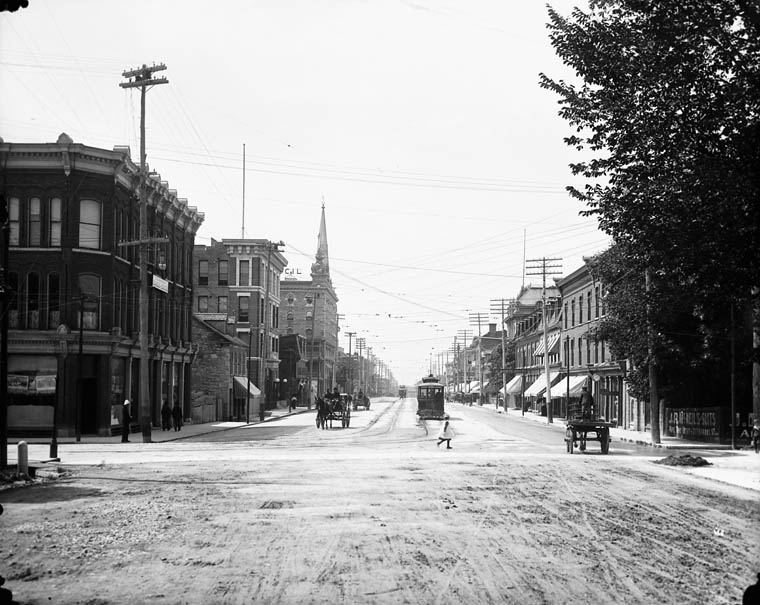
A black-and-white photograph showing a streetscape at a crossroads.

Wellington and Bank, ca. 1900 (MIKAN 3325940)

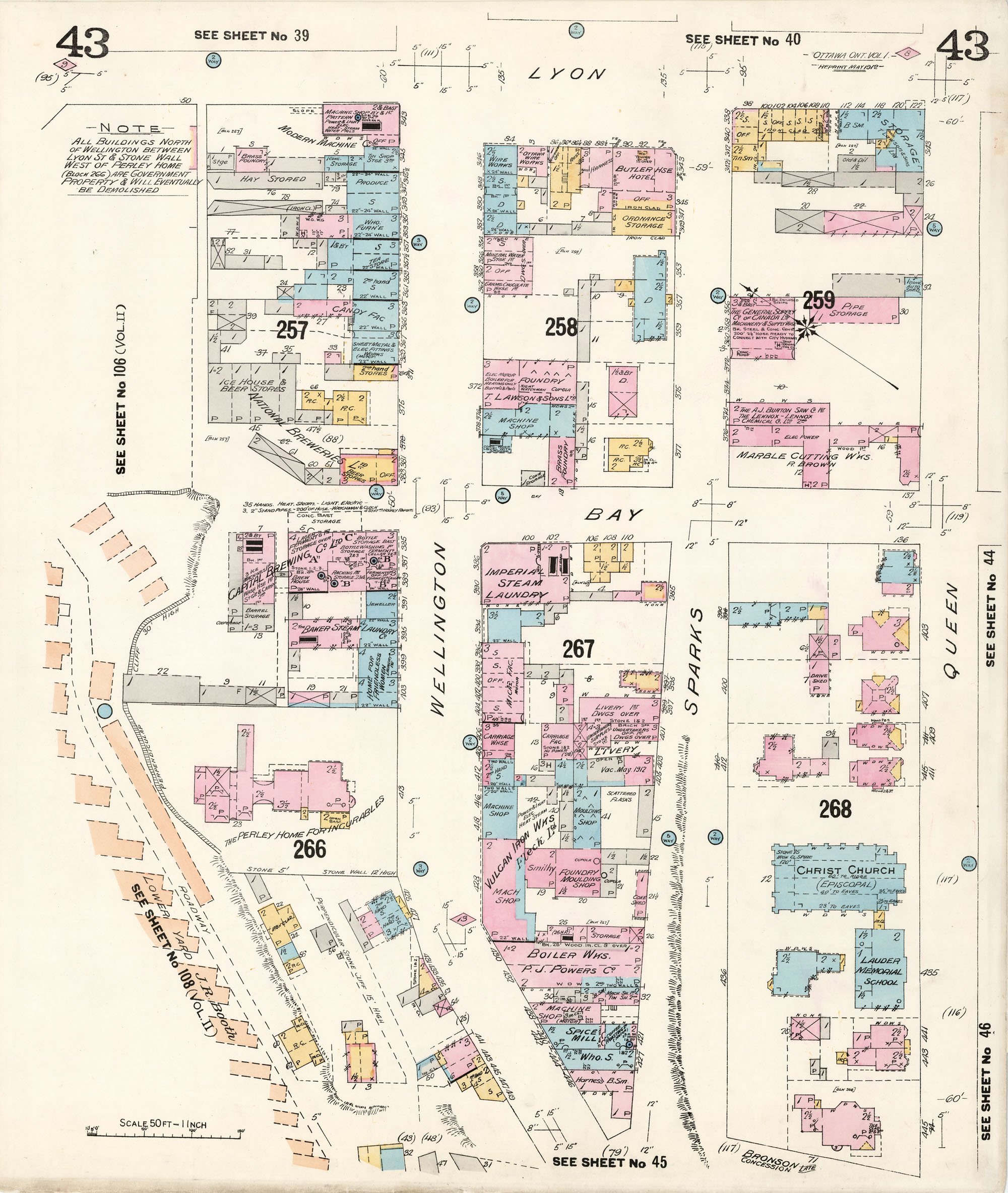
On February 27, 1912, following what appears to have been at least a few years of behind the scenes deliberations, the federal government expropriated all properties located in Uppertown, an area bounded by Bank, Wellington, and Bay streets and the cliff along the Ottawa River. On March 9, 1912, a notice of expropriation was filed at the Ottawa City Registry Office (the area can be seen on these fire insurance plans: east view and west view (MIKAN 3816030).

The area was expropriated to make way for a new supreme court and other federal buildings. In 1913, the government launched a design competition, in response to which many of the major architects of the day submitted designs for the building complex. The designs can be found in the following LAC collection, which comprises 11 designs for the location of proposed departmental buildings. With the outbreak of the First World War, the fire and subsequent reconstruction of the Parliament Buildings, and changes in government, no concrete action was taken with respect to these plans until the early 1930s.

The area expropriated was both commercial and residential in nature. We have come to think of the stretch of Wellington between Bank and Bay streets as a boulevard flanked by grand, iconic government structures and large green spaces, but this is a relatively recent development. The towers of the Confederation and Justice buildings were built in the 1930s, followed by the Supreme Court building and, finally, the National Library building (now Library and Archives Canada), which was erected for the 1967 centennial. Continue reading

John Boyd

As Canadians we appreciate discovering stories about our country through the works of our painters and photographers, past and present. Canadian archives hold many collections, and sometimes the collection of a particular artist or photographer may contain literally thousands of images for us to explore. This is the case with photographer John Boyd whose collection at Library and Archives Canada (LAC) boasts 28,959 black-and-white photographs.

John Boyd (1865–1941) was born in Emyvale, Ireland. His family immigrated to Toronto in the late 1860s. He was a railway official as well as a photographer. His work with the railroad gave him ample opportunities to take photographs as he travelled across Ontario.

These photographs represent Boyd’s amateur work from 1898 to 1926. A large collection in itself, it is nonetheless dwarfed by the collections held at the City of Toronto Archives. One collection in particular is that of The Globe and Mail, which contains 140,000 of Boyd’s photographic negatives taken from 1922 to before his death in 1941.

The collections at LAC and the City of Toronto Archives complement each other in their dates of creation and subject matter.

The John Boyd fonds consists of photographs portraying all manner of Canadian life, all worth exploring. There are images of towns and cities, royal visits, military life, modes of transportation, industry and agriculture, social conditions, pastimes, and nature.

During the First World War, Boyd focused mainly on the home front, photographing recruiting campaigns, training exercises, and the manufacture of munitions, airplanes and ships. He also photographed everyday Canadians who contributed to the war effort at home as soldiers fought overseas. The following selection of images provides a glimpse of the activities during that time.

A black-and-white photograph of well-dressed men, women and children looking at and exploring an outdoor exhibit of a reconstructed Canadian military trench.

Visitors to a reconstructed 35th Battalion trench, Canadian National Exhibition, Toronto, Ontario, 1915 (MIKAN 3395547)

A black-and-white photograph of women, soldiers and children gathered outside a train. Other soldiers on the train are leaning out of the windows, presumably saying goodbye to their families.

Personnel of the Cycle Corps leaving Exhibition Camp for overseas service, Toronto, Ontario, May 15, 1915 (MIKAN 3194471)

A black-and-white photograph of two soldiers descending the steps of a train car. They are both looking down at the photographer and one is holding a kitten.

Volunteers for war and cat mascot with the 28th Regiment, Toronto, Ontario, August 22, 1914 (MIKAN 3403478)

A black-and-white photograph of soldiers re-enacting how they move out from their trenches for a crowd of spectators at an exhibition.

Soldiers moving out from their trenches, Exhibition Grounds, Toronto, Ontario, September 11, 1915 (MIKAN 3403554)

A black-and-white photograph of two soldiers stopped on a dirt road. One is taking a compass reading as the other takes notes.

Soldiers taking a compass traverse on the intelligence course at Camp Borden, Ontario, September 26, 1916 (MIKAN 3403628)

A black-and-white photograph of a soldier standing in a field holding a large wrench.

Private Vasili Salivarsky, D Company, 123rd Battalion, Toronto, Ontario, March 30, 1916 (MIKAN 3220871)

You can view a selection of Boyd’s images in this Flickr album. To explore the entire collection, start your exploration in the John Boyd fonds, and select “Lower-level descriptions.”

Happy searching!

Captain James Peters: War correspondent and photographer

Photography is now an integral part of our lives; our daily events are recorded whether they be monumental or mundane. From its beginnings in the 1830s, photography was used to chronicle the events of war. Early photographers struggled to capture the rapid action of combat as photographic equipment was unable to record movement. Consequently, early images of war were often staged recreations of the actual campaign. Generally, they depicted the less active aspects of war, such as portraits of soldiers, camp life, fortifications, artillery placements, and the battle sites before and after the action.

Captain James Peters recorded the dramatic events of the North-West Resistance as a photographer and a correspondent for the Quebec Morning Chronicle. The North-West Resistance was a five-month insurgency against the Canadian government, fought mainly by citizens of the Métis Nation and their First Nations allies. Peters was a pioneer in capturing the events on the battlefield.

Captain Peters and the “A” Battery of the Canadian Artillery left Quebec City on March 28, 1885 for the northwest. The “A” Battery was to provide artillery support for Major-General Frederick D. Middleton and the Canadian Militia. Peters would serve with Middleton at Fish Creek, Batoche and during the militia’s search for Mistahimaskwa (Big Bear). Continue reading

Hiding in Plain Sight: Discovering the Métis Nation in the Collection of Library and Archives Canada

Banner for the Hiding in Plain Sight exhibitionBy Beth Greenhorn

This article contains historical language and content that some may consider offensive, such as language used to refer to racial, ethnic and cultural groups. Please see our historical language advisory for more information.

Who Are the Métis?

The Métis Nation emerged as a distinct people during the course of the 18th and 19th centuries. They are the second largest of the three Indigenous peoples of Canada and are the descendants of First Nations peoples and Europeans involved in the fur trade.

Métis communities are found widely in Manitoba, Saskatchewan, Alberta, and the Northwest Territories, with a smaller number in British Columbia, Ontario, Minnesota, Montana and North Dakota.

Library and Archives Canada (LAC) has a great variety of archival documents pertaining to the Métis Nation (including textual records, photographs, artwork, maps, stamps and sound recordings); however, finding these records can be a challenge.

Challenges in Researching Métis Content in the Art and Photographic Collections

While there are easily identifiable portraits of well-known leaders and politicians, including these portraits of Louis Riel and Gabriel Dumont, images depicting less famous Métis are difficult to find. Original titles betray historical weaknesses when it comes to describing Métis content.

In many cases, the Métis have gone unrecognized or were mistaken for European or First Nations groups—such as the people in this photograph entitled “Chippewa Indians with Red River Carts at Dufferin.”

Black and white photograph of a man, on the left, wearing European clothing and standing in front of a Red River cart, and a group of First Nations men, women and children wearing First Nations-style clothing and standing in front of another Red River cart, on the right.

Chippewa Indians with Red River Carts at [Fort] Dufferin, Manitoba, 1873 (e011156519)

Clad in blankets and wearing feathered headdresses and other hair ornaments, the group on the right appears to belong to the Chippewa (Ojibwe) First Nation, as the title indicates. In contrast, the man on the left is dressed in a European jacket and pants and wears a different style of hat. However, both the man and the group pose in front of Red River carts, which are unique to Métis culture. Given his different style of clothing, coupled with the carts, it is possible that the man was Métis.

In other cases, archival descriptions exemplify colonial views of the “other” culture. Penned over a century ago, the language is often outdated, and the terminology racist, by today’s standards.

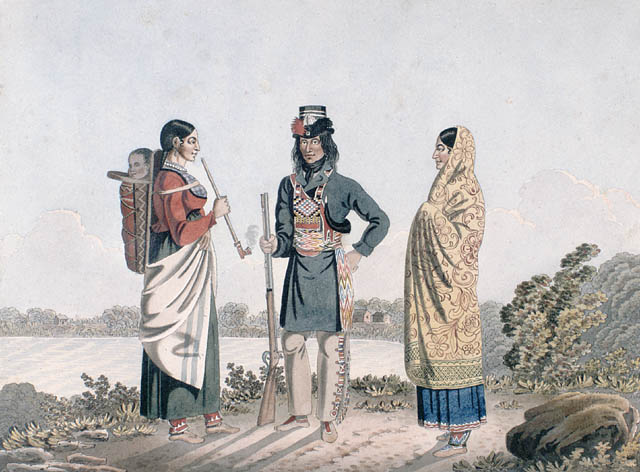
A watercolour landscape of a man, flanked by two women, standing in front of a body of water. The man is holding a rifle and the woman on the right is holding a long pipe and carrying an infant in a cradleboard on her back.

A halfcast [Métis] and His Two Wives, 1825-26 (e008299398)

Terms such as “halfcast,” “half-breed,” and “mixed breed” were widely used by the dominant society to describe members of the Métis Nation. This vocabulary is commonly found in older archival records.

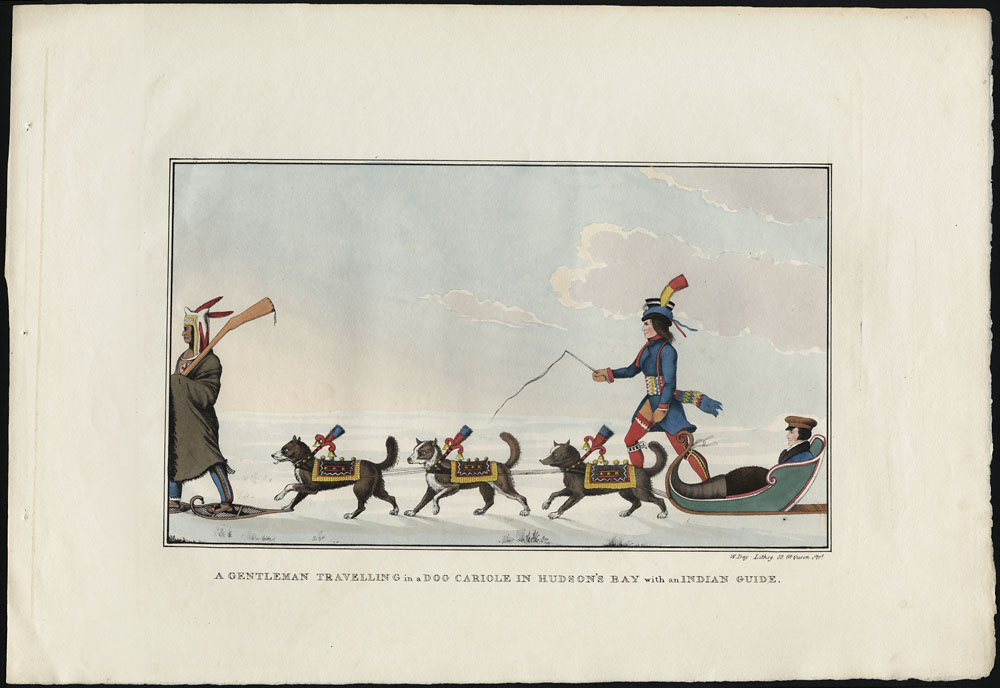
In other instances, descriptions of Métis were completely omitted, as is the case with this lithograph, entitled “A Gentleman travelling in a dog Cariole in Hudson’s Bay with an Indian Guide.”

A lithograph of a snowy landscape with a man seated in a cariole (sled) pulled by three dogs in colourful coats. A man wearing a blanket and snowshoes is on the left in front of the dogs. A man holding a whip and wearing clothing associated with Métis culture (a long blue jacket, red leggings and an embellished hat) walks on the right-hand side of the sled.

A Gentleman travelling in a dog Cariole in Hudson’s Bay with an Indian Guide, 1825 (e002291419)

Hiding in Plain Sight: Discovering the Métis in the Collection of Library and Archives Canada

In the fall of 2014, a keyword search for “Métis” in art, photographic, cartographic and stamp records yielded less than 100 documents. LAC has since updated and revised over 1,800 records by adding “Métis” to the titles or descriptive notes in order to make these documents more accessible. In addition to improving existing records, LAC has digitized over 300 new photographic items pertaining to Métis history.

The Hiding in Plain Sight: Discovering the Métis in the Collection of Library and Archives Canada exhibition presents a selection of reproductions of artwork and photographs with Métis content. LAC hopes that the images featured in this exhibition will provide a better understanding of the history of the Métis Nation and that the public will be encouraged to research LAC’s collection.

The exhibition ran from February 11 to April 22, 2016, in the lobby of Library and Archives Canada at 395 Wellington Street, Ottawa.

Additional resources


Beth Greenhorn is a settler living on the unceded, traditional territory of the Kitigan Zibi Anishinabeg and the Algonquins of Pikwakanagan. She is a Senior Project Manager in the Outreach and Engagement Branch at Library and Archives Canada.

Mirrors with Memory: Daguerreotypes from Library and Archives Canada—an exhibition at the National Gallery of Canada

When the daguerreotype was invented in 1839, it was a revelation. The first photographic process to be made available to the public, daguerreotypes were shiny, reflective objects that delighted and astonished viewers by capturing the likenesses of friends and family with brilliant clarity. For the first time in history, portraits of loved ones could be recorded and shared or passed down to descendants. The impact of the daguerreotype and of photography on the lives of ordinary people was immense.

A hand-tinted daguerreotype portrait of a seated woman in a polka-dot dress.

Kate McDougall, ca. 1848 (MIKAN 3192966)

The science of capturing light on a photographic surface was co-developed in France by Louis-Jacques-Mandé Daguerre (1787–1851) and Joseph-Nicephore Niépce (1765–1833). Niépce died before practical success was achieved, and Daguerre went on to perfect the process. Highly polished silver-plated sheets of copper that were sensitized with iodine vapours and developed in mercury fumes, daguerreotypes created compelling, one-of-a-kind images with infinite detail.

A new exhibition at the National Gallery of Canada features examples of these special objects. While not rare, daguerreotypes are not often exhibited due to their susceptibility to light and environmental degradation. Drawn from the collection of Library and Archives Canada, the objects in this exhibition have undergone careful preservation and conservation treatment, and offer the viewer an extraordinary look at these unique photographs. Intimate, detailed and captivating, these objects—reflective by their very nature—are some of the earliest photographic glimpses of Canada in existence.

A daguerreotype photograph of a man (standing) and a woman sitting on the ground, among the destroyed remains of the brewery.

The Molson family brewery after the fire, Montréal, Quebec, 1858 (MIKAN 3192967)

The exhibition features street scenes as well portraits of both well-known and unknown personalities. Most likely taken in Europe in the late 1840s, the portrait of Maungwudaus, a member of the Anishnaabe Nation of the New Credit Mississauga, is one of the earliest photographic portraits of an Aboriginal person in the Library and Archives Canada collection. Maungwudaus grew up near what is now Kitchener-Waterloo, Ontario. Educated by Methodist missionaries, he later worked in mission outreach and as a translator and writer before finding acclaim as a performer in a “Wild West” show that he along with friends and family members, organized and travelled through parts of the U.S. and Europe. The troupe was celebrated in England and in France where Maungwudaus was presented with several medals by King Louis Philippe I.

Daguerreotype portrait of Maungwudaus wearing ceremonial dress including a feathered headdress and two medals.

Maungwudaus, ca. 1846 (MIKAN 3198805)

As one-of-a-kind objects designed to be stored in a closed case and looked at by one viewer at a time, daguerreotypes are intimate by nature. Some show the wear and tear expected of objects over a century old. Often, the names of the sitters or any other accompanying information has long since disappeared, making the exceptions even more special. One such example is the portrait of a group of merchants from Yarmouth, Nova Scotia, dated 1855. This daguerreotype had a small manuscript tucked inside at the back of the plate, which is signed by one of the sitters and lists all the members of the group, as well as the location of the sitting and the name of the daguerreotypist, Wellington Chase. In this portrait, among others, we can see Loran Ellis Baker, seated front row, centre. Twenty-four years old at the time of this portrait, Baker was one of Yarmouth’s most prominent businessmen and civic leaders, and a member of the Legislative Council of Nova Scotia from 1878 to 1900.

A velvet-lined case with a daguerreotype portrait of nine men: five seated in front, four standing.

Group of merchants from Yarmouth, Nova Scotia, 1855 (MIKAN 3622937)

Visit the exhibition at the National Gallery of Canada in Ottawa from September 4 to February 28, 2016.