Richard Bedford Bennett images now on Flickr
1

In our post “Discover the Access Codes for Archival Records“, we reviewed four of the most common access codes 90, 32, 10, and 18. However, there are other access codes that you may encounter while undertaking your research. They include access codes 96 and 99.
Access code 96 indicates that within a group of records there exists more than one type of access condition. For example, since the Department of Transportation fonds (RG12) contains records that are open (code 90) and others that are restricted (code 32), the fonds-level access condition are indicated by “restrictions vary” (code 96).

Access code 96 can be applied to more than just fonds-level descriptions. It can also be linked to series, sub-series and accessions. However, it does not apply to individual volumes and files.
Access code 96 usually means that there are more specific descriptions available for the records you are researching. In some cases, these records can be accessed by simply clicking on the “lower level descriptions” link in the “Fonds consists of” section of a record description.
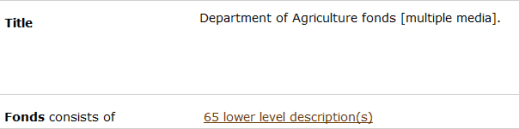
In other cases it will be necessary to consult a printed finding aid. To learn more, read our post Discover Finding Aids.
Access code 99 means that the access conditions for a group of records have yet to be determined. Usually this is because the records are being processed. In the following example, while the photographic material is open, the access conditions for the textual records have yet to be determined:

Access code 95 indicates that the records are open and can be consulted, however, at the request of the donor, the records cannot be copied or reproduced.

Questions or comments? We would love to hear from you!
Did you know that Library and Archives Canada (LAC) has a YouTube channel where historical films are made available from our holdings?
The latest addition to our YouTube channel is the silent documentary The Tide of Immigration. This film is part of the Canadian National Pictorial Series and was produced by Pathéscope of Canada Limited between 1919 and 1921.

Early 20th-century films depicting the lives of newcomers to Canada are rare, especially film footage of immigrant children who were cared for at the Dr. Barnardo Homes. This compilation of news reels includes varied footage of new settlers and life in Canada during that time period.
Film sequences show Irish immigrants in a knitting factory; people enjoying the scenery at Grand Beach, Manitoba; and other stories for you to discover. Intertitles (text that appears between the film sequences) provide some contextual information.
Discover more! Consult Discover the Collection: Films, Videos and Sound Recordings to begin your online search today!
Questions or comments? We would love to hear from you!
We are pleased to announce the release of our latest podcast episode: The Shamrock and the Fleur-de-Lys.
In this episode, we consult a panel of experts about the massive immigration of Irish settlers to Quebec in the 1800s. We examine the journey they made in order to establish their new lives on foreign soil, as well as the cultural bond that formed between the Irish and the Québécois.
Subscribe to episodes using RSS or iTunes, or just tune in at: Podcasts – Discover Library and Archives Canada: Your History, Your Documentary Heritage.
For more information on recent announcements at LAC, visit “News“.
Library and Archives Canada (LAC) is pleased to announce the launch of the online toolkit Wahkotowin—Indigenous Imprints in Canadian Heritage, on the new Indigenous Heritage portal.
The toolkit gives access to the significant stories of numerous Aboriginal individuals and communities across Canada and streamlines digital content from LAC‘s databases, virtual exhibitions and digitized resources through a single portal.
Wahkotowin is a Cree-Michif term that embodies the notion of “kinship” in the context of identity, relationships and shared histories.
This first toolkit introduces the Métis, one of three Indigenous groups in Canada, and Louis Riel, one of Canada’s most talked about and controversial figures.
Through Wahkotowin, you can follow the lives of Indigenous people, places and events, and connect to our shared history, culture, heritage and identity.
For more information on recent announcements at LAC, visit “News“.
We are pleased to announce that a new set of images depicting the 9th Prime Minister of Canada Arthur Meighen is now available on Flickr.
Arthur Meighen was born in Anderson, Ontario on June 16, 1874. Running as a candidate for the Conservatives in Portage la Prairie, Meighen was elected to the House of Commons in 1908. In 1920, Arthur Meighen became leader of the Conservatives and Prime Minister of Canada until 1921. Arthur Meighen became Prime Minister again on June 29, 1926 but only for four months until September 24, 1926. Meighen retired in 1927 and was appointed to the Senate in 1932.
To learn more about Arthur Meighen:
Dictionary of Canadian Biography Online, Arthur Meighen.
For more information on recent announcements at LAC, visit “News“.
June 5, 2012, marked the Diamond Jubilee of Her Majesty Queen Elizabeth II. To celebrate this exceptional event, Library and Archives Canada (LAC) presents an outline of the types of photographs held in its collection about Queen Elizabeth II.Since the 1950s, The Queen has made more than 20 visits to Canada! Our collection contains numerous photos, movies, private and government documents, stamps and even some cartoons of Her Majesty, which were used to convey a particular message. Ready for an overview of the photographs?

Queen Elizabeth II wearing the Vladimir Tiara, the Queen Victoria Jubilee Necklace, the blue Garter Riband, Badge and Garter Star and the Royal Family Orders of King George V and King George VI (1959). (e010975985-v8)
We have many photographs of Queen Elizabeth II in our collection; several of which are digitized and accessible via Flickr. You can also browse photographs from Collection Search.
Here are some interesting references:
Questions or comments? We would love to hear from you!
 Library and Archives Canada Blog