Sergeant Holmes, Major O’Kelly and Lieutenant-Colonel Shankland, Victoria Cross recipients

By Emily Monks-Leeson

Sergeant Thomas William Holmes is Canada’s youngest recipient of the Victoria Cross (VC). Born in Montreal on October 14, 1898, Holmes gave his date of birth as August 17, 1897, when he enlisted with the 147th Grey Overseas Battalion, making himself out to be older than he was. He served with the Canadian Mounted Rifles and was part of the first assault against the German defences at Passchendaele 100 years ago. When the right flank of the Canadian force was halted and heavy casualties inflicted by machine-gun and rifle fire from a German pillbox, Holmes repeatedly ran forward alone and bombed the machine gun crew, eventually taking the pillbox’s 19 occupants prisoner. Sergeant Holmes survived the war and returned to Canada. He died on January 4, 1950, and is buried at Greenwood Cemetery in Owen Sound, Ontario.

A black-and-white photograph of a smiling young man in uniform with his cap slightly askew.

Private Thomas William Holmes, VC, dated January 1918 (MIKAN 3216873)

Major Christopher Patrick John O’Kelly, born on November 18, 1895, in Winnipeg, Manitoba, was commissioned as a second lieutenant in the Canadian Expeditionary Force (CEF). At the age of 21 he was an acting captain in the 52nd Battalion (96th Lake Superior Regiment), leading his men against the German defences at Bellevue Spur near the Passchendaele Ridge. Captain O’Kelly led his unit almost a kilometer into German-held territory without artillery support and successfully captured the German positions. He then organized and led attacks against German pillboxes, capturing 100 prisoners and 10 machine guns. For his leadership, Captain Christopher O’Kelly was awarded the Victoria Cross. He later achieved the rank of major. O’Kelly survived the war, but died a few years after in a boating accident near Red Lake, Ontario, on November 15, 1922.

A black-and-white photograph of a muddied soldier leaning on the wall of a trench, smoking a cigarette and looking directly at the photographer.

Captain Christopher Patrick John O’Kelly, VC, MC, dated December 1917 (MIKAN 3219566)

A densely typed page carefully describing the events of the day and mentioning both Captain O’Kelly and Lieutenant Shanklin [sic].


War diary of the 52nd Canadian Infantry Battalion, dated October 26, 1917, Page 19 of the war diary (MIKAN 1883263)

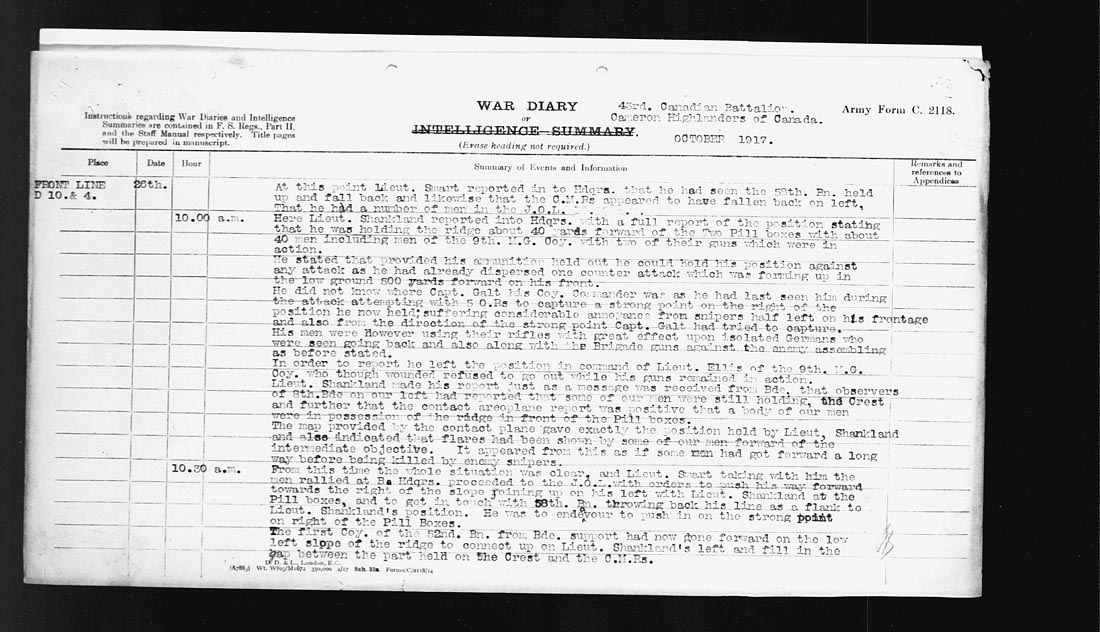
Lieutenant-Colonel Robert Shankland, born in Ayr, Scotland in 1887, immigrated to Canada in 1910 and settled in Winnipeg, Manitoba. He enlisted as a private with the 43rd Battalion and earned the Distinguished Conduct Medal at Sanctuary Wood in June 1916, after which he received a battlefield commission. On October 26, 1917, Shankland and a platoon of 40 men captured and held the crest of Bellevue Spur in the face of heavy fire and the collapse of the Allied line. With both flanks exposed, Shankland turned over command to another officer and set out alone to reach battalion headquarters, where he gave a plan for counter-attack. He then returned with reinforcements to carry out the attack. His citation in the London Gazette from December 14, 1917, reads:

Having gained a position he rallied the remnants of his own platoon and men of other companies, disposed them to the command the ground in front, and inflicted heavy casualties upon the retreating enemy. Later, he dispersed a counter-attack, thus enabling supporting troops to come up unmolested.

A typed list of the events of October 26, 1917; specifically, what was happening to the 43rd Canadian Infantry Battalion between 10 and 10:30 a.m.

War diary of 43rd Canadian Infantry Battalion from October 1917, Page 14 of the War diary (MIKAN 1883254)

LieutenantColonel Shankland survived the war and served overseas during the Second World War as camp commandant of the Canadian Army Headquarters in England. He lived on Pine Street in Winnipeg, Manitoba, along with two other Victoria Cross recipients: Leo Clarke and Frederick William Hall. Pine Street was renamed Valour Road in 1925 to honour the three men.

Library and Archives Canada holds the CEF service file for Sergeant Holmes, Major O’Kelly and Lieutenant-Colonel Shankland.


Emily Monks-Leeson is an archivist in Digital Operations at Library and Archives Canada.

Canada and the 3rd Battle of Ypres: Passchendaele

“I died in hell. They called it Passchendaele.”

Siegfried Sassoon

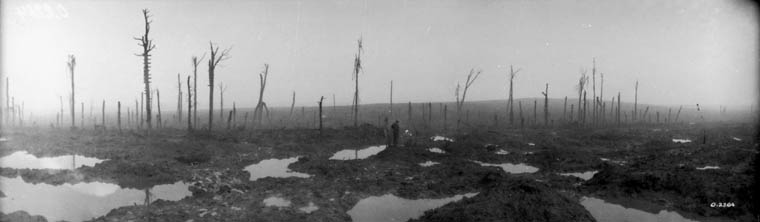
A black-and-white photograph of a bombed landscape. The ground is muddy with water-filled craters and a burned out forest.

Passchendaele, now a field of mud. Photo taken by William Rider-Rider in November 1917 (MIKAN 3194937)

The town of Ypres, Belgium and its surrounding countryside has special significance to the history of the Canadian Corps. In 1917, this area was the last portion of Belgium that remained outside German control. Little had changed in the region since Second Ypres in April 1915; the British held the city of Ypres while the Germans held the high ground of the Messines-Wytschaete Ridge to the south, the lower ridges to the east, and the flat terrain to the north.

On July 31, 1917, British, Australian, and New Zealand forces launched an offensive that would be known as the Third Battle of Ypres. As heavy rains poured down on the thick clay soil, shell holes created by a massive artillery barrage filled with water. Attacking soldiers struggling in deep mud offered easy targets for German gunners, and by some accounts as many soldiers drowned in the heavy mud as died from their wounds. Casualty estimates for the battle, which lasted from July 31 to November 20, 1917, range from 300,000 to 400,000 for the Allies and a roughly equal number for the Germans.

A black-and-white photograph of a soldier walking in a field of mud and puddles.

Mud and barbed wire through which the Canadians advanced during the Battle of Passchendaele. Photo taken by William Rider-Rider in November 1917 (MIKAN 3194807)

In early October, the four divisions of the Canadian Corps were transferred to the Ypres salient and tasked with the near impossible: capturing Passchendaele and the ridge. The offensive, to be executed in three stages, began on October 26, 1917. In the first stage, the 3rd Canadian Division captured Wolf Copse before reconnecting with the British 5th Army line. In the second stage, beginning on October 30, Canadian units secured a number of objectives and sent patrols into Passchendaele itself. In the final stage, from November 3 to 5, troops of the 1st and 2nd Divisions captured the village of Passchendaele in less than three hours. A final push on November 10 ended the campaign as the Canadians captured the remaining high ground north of the village.

While the Canadian Corps had achieved what no other Allied force had been able to, over 4,000 men died in the effort and 12,000 were wounded. The Third Battle of Ypres bolstered the Canadians’ reputation as storm troops, one of the best fighting forces on the western front. Nine Canadians were recognised with the Victoria Cross for their extraordinary actions in one of the most horrific battlefields ever known.

Library and Archives Canada’s series, First World War Centenary: Honouring Canada’s Victoria Cross recipients will profile each of them over the next three weeks.


Emily Monks-Leeson is an archivist in Digital Operations at Library and Archives Canada.

Behind the scenes at the library: a glance at cataloguing librarianship

By Arouce Wasty

October is Library Month, a time to celebrate libraries and the work that librarians, library technicians and library staff do to ensure that knowledge and information resources are available and accessible to everyone. In the spirit of this month, let us look at a side of the library not normally visible to library-goers and library staff. We’ll take a behind-the-scenes look at the work of the cataloguing librarian.

A black-and-white photograph of two women in a library. One is looking through a card catalogue and the other is holding a book and looking at the work of the other.

An archival image of librarians processing books. Photograph taken March 1941 (MIKAN 3571070)

You’ll rarely, if ever, see a cataloguing librarian behind the reference desk at your local library. Often, cataloguing librarians work in a different building—though one just as packed with books as the library itself, if not more so! The cataloguing librarian, along with cataloguing technicians, prepares the various resources, such as books, CDs, DVDs, video games, etc., to be placed within the main library. Furthermore, they enter the bibliographic information from these library items into the library’s computer system. The main goal of cataloguing is to enter accurate bibliographic information for an item, making that item easy to find through the library catalogue.

Seems fairly simple, right? Actually, cataloguing can be quite complex. Essentially, there are two major steps in cataloguing: descriptive cataloguing and subject analysis.

Descriptive cataloguing involves finding and entering information describing the library item according to cataloguing standards. Descriptive information includes pieces of information such as the name of the author, the title, the name of the publisher, the number of pages, the file type, and so on. These pieces of information are entered into the bibliographic record for that item.

Next is the subject analysis of the item. Here, the cataloguing librarian determines the main topic presented by the item. This is where things can get quite tricky. Even if the librarian figures out the subject of the item, s/he has to use tools such as Library of Congress Subject Headings (LCSH), or Canadian Subject Headings (CSH), to find the appropriate term(s) or heading(s) associated with the subject. For example, for a book about cars, the appropriate subject heading, according to LCSH, would be “Automobiles”, and not “Cars”. Sometimes multiple terms are put together to create a subject heading. For example, a book about the social conditions of African countries in the 1990s would likely have the subject heading “Africa—Social conditions—20th century”. Some items may have multiple subject headings to cover either the range of major topics they touch on or all the aspects of a topic they discuss.

Another aspect of subject analysis is assigning a call number to the item. A call number groups the item with others on the same subject. You may be familiar with the Dewey Decimal System used in public libraries; academic libraries use the Library of Congress Classification system. A cataloguing librarian assigns either one or both of these types of call numbers to an item. Call numbers and subject headings are also entered into the bibliographic record.

A colour screen capture of a cataloguing entry showing the division of descriptive and subject information.

Figure 1: Example of a bibliographic record

Remember, cataloguing is not just about describing or determining the subject of an item. The main aim of cataloguing is to allow library users to find and access library items. Descriptive cataloguing allows users to find items via the library catalogue by using keyword searches as well as advanced search options, such as title or author searches. Subject analysis allows library users to find items on a particular subject by using the “subject search” option in their local library catalogue. And, of course, call numbers allow users to find the item on the library shelves.

This is just a glimpse of the work of cataloguing librarians and technicians. Although you may never see or meet with them, the work they do has a great impact on the workings of a library and the experience of the library user.


Arouce Wasty is a cataloguing librarian in the Descriptive Division of Published Heritage.

Images of Island Life now on Flickr

Islands are portions of land surrounded by water, and Canada has an abundance of them. However, the exact number in the country has not been established. Of the many thousands of islands in Canada only a few hundred are significantly populated. The most densely populated island is the Island of Montreal, with approximately 1.75 million people. Whether situated in rugged, rural settings or in more densley populated urban environments, whether surrounded by fresh water or sea water, island communities throughout Canada continue to grow and evolve.

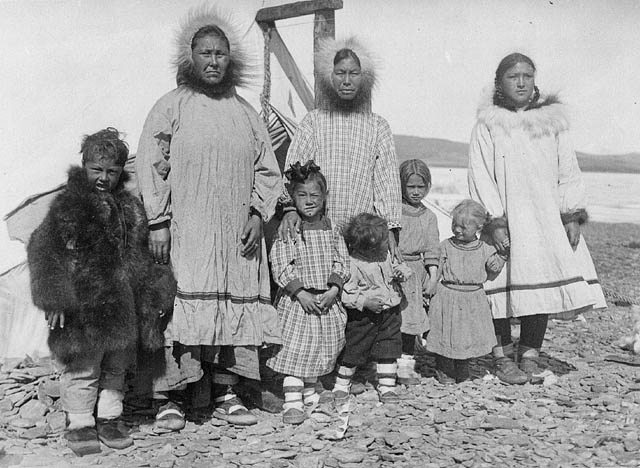
A black-and-white photograph of an unidentified Inuit family of eight people posing for a group portrait. From left to right: boy, woman, girl, woman, boy, girl, girl, woman.

Mackenzie Inuit family on Banks Island, Northwest Territories (MIKAN 3376397)

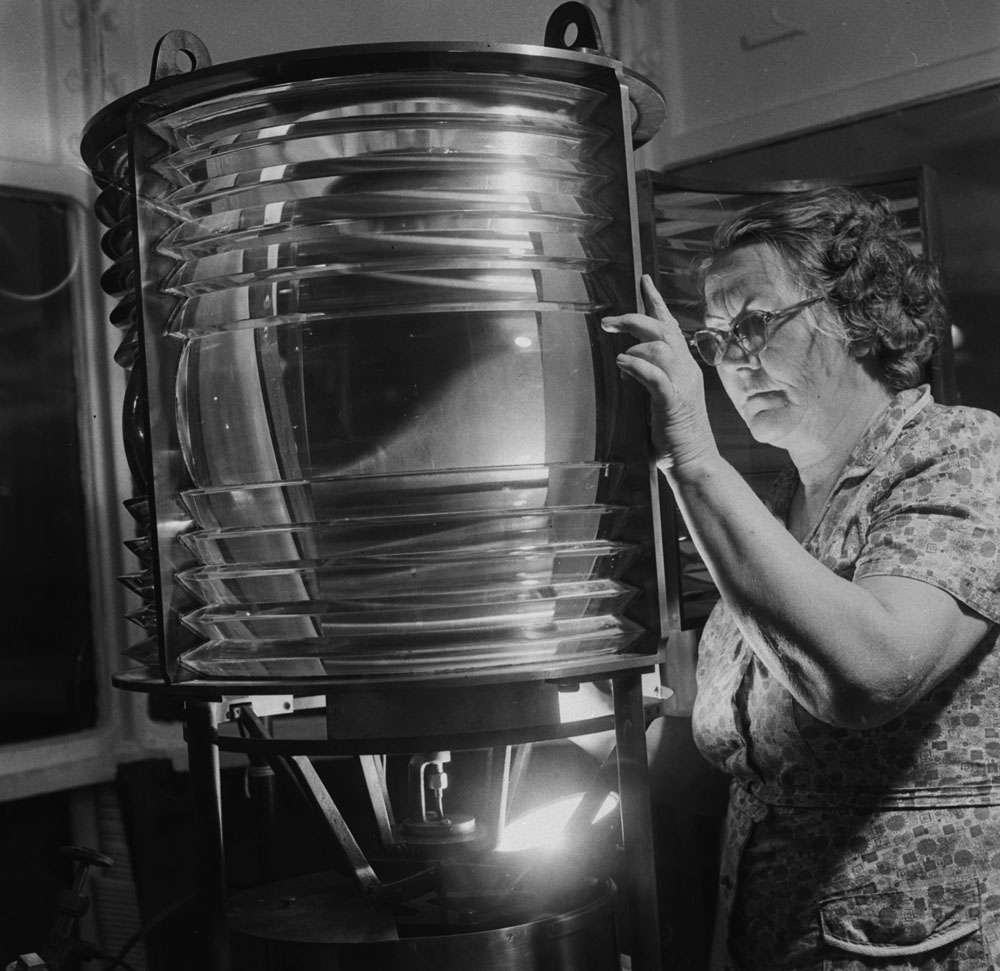
A black-and-white photograph of Eliza Campbell examining a lighthouse lamp.

Ms. Eliza Campbell, Scatarie Island light keeper, Nova Scotia (MIKAN 4949728)

A black-and-white photograph of a park and playground. There are two swing-sets and a teeter-totter. Boys and girls play on the equipment under the supervision of some adults.

Park and playground, St. George’s Island, Calgary, Alberta (MIKAN 3385072)

Visit the Flickr album now!

Pre-Confederation St. Lawrence maritime pilot certificates at Library and Archives Canada

By Rebecca Murray

The details of when and where our ancestors were born, lived and died are the building blocks of genealogical research. Knowing how they spent their time or were employed can help connect the dots.

By any chance, might one of your ancestors have been a certified maritime pilot on the St. Lawrence River?

This blog post will focus on records specific to Quebec, beginning with the Trinity House fonds (MG8-A-18), which includes a list of certified maritime pilots for the period 1805–1846. Found in MG8-A-18, Volume 5, this list includes the date of certification and any suspensions of that certification along with reasons for the suspensions. The documentation is in French and arranged in chronological order.

A note in the fonds description gives us a clue about where to look next for related records: “Trinity House […] continued in existence until 1875 when its functions were taken over by the Department of Marine and Fisheries.”

This leads us to the Department of Marine fonds (RG42), specifically the “St. Lawrence river pilot’s certificates” series (1762–1840). The certificates are described at the item level in Finding Aid 42-1 and the documents themselves can be found in RG42 volumes 1 through 6, which are open for consultation and reproduction.

You’ll notice, though, that this series covers up until only 1840, which means that if you’ve identified a certified pilot from the Trinity House fonds list you might not be able to identify their certificate in RG42. The series description tells us that “[related] records that serve as a second source of authorization for pilotage are […] found in the Registrar General sous-fonds (RG68, Vols. 210-211, MIKAN 311, R1008-10-1-E). These registers have a different format than the Marine Branch certificates but the information contained is the same.”

To find these related records, first consult the General Index on digitized microfilm reel C-2884 on the Héritage website and look for the name of the individual of interest in the alphabetical key at the beginning of the reel.

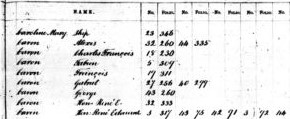
A blurry black-and-white table with names, numbers and folio references.

RG68 key to the general index (C-2884), image 30

When you identify the individual you are looking for, there may be several pairs of numbers next to his name. For example, if I am looking for Fabien Caron, I will look under ‘C’ to find his name, and will then see that the pair of numbers next to his name is 5, 309. The second number indicates the page of the index where we will find the relevant entry, and the first number indicates the line number on that page.

We can scroll ahead on the same microfilm reel to find the general index for the same time period. The fifth line of page 309 does indeed refer to Fabien Caron, and provides us with further information that will allow us to identify the actual certificate: liber 2, folio 117, 5th September 1845.

A black-and-white table with numbers, liber number, folio, dates and names.

RG68 general index (C-2884), image 650

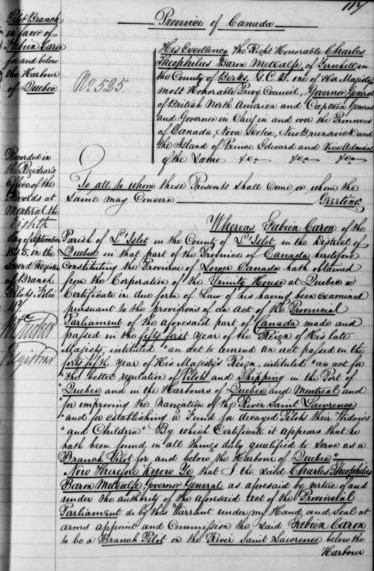
We can now perform a search Collection Search for RG68 and file number 2. By filtering our search results for those from the 1840s we can quickly identify RG68 volume 211, file 2, “Commissions – Branch Pilots” (1838 – 1867) as the relevant source. This volume is available on digitized microfilm reel C-3950. Folio (page) 117 is where we will find the entry for Fabien Caron’s certification.

A black-and-white reproduction of the commission that entitled Fabien Caron to be a maritime pilot.

RG68 volume 211, file 2, “Commissions – Branch Pilots” (C-3950), image 475

If you think Library and Archives Canada might hold this type of record for one of your ancestors, give this method a try! You never know what you might find.


Rebecca Murray is an archivist in Reference Services at Library and Archives Canada.


Guest curator: Carole Gerson

Banner for the guest curator series. CANADA 150 is in red along the left side of the banner and then the bilingual text: Canada: Who Do We Think We Are? and under that text is Guest curator series.Canada: Who Do We Think We Are? is a new exhibition by Library and Archives Canada (LAC) marking the 150th anniversary of Canadian Confederation. This exhibition is accompanied by a year-long blog series.

Join us every month during 2017 as experts, from LAC, across Canada and even farther afield, provide additional insights on items from the exhibition. Each “guest curator” discusses one item, then adds another to the exhibition—virtually.

Be sure to visit Canada: Who Do We Think We Are? at 395 Wellington Street in Ottawa between June 5, 2017, and March 1, 2018. Admission is free.


“Ode to Brant” by Pauline Johnson, 1886

Two pages of a handwritten poem signed and dated by the author, Pauline Johnson.

Handwritten poem by Pauline Johnson, 1886. (MIKAN 4936704)

This poet’s mixed Mohawk-British heritage helped shape her vision for Canada’s future. She writes that Indigenous and British-Canadians should form a “brotherhood.” And all should be loyal servants—together—of the British Empire.


Tell us about yourself

As a child, I was an obsessive reader—my friends called me a “reader-bug” because I always had my nose in a book. Perhaps that’s why I became an English professor—so that I could read as much as I wanted, and encourage others to do the same. I think that it is especially important to read works by Canadian writers, who help us to understand our history and who we are today.

Is there anything else about this item that you feel Canadians should know?

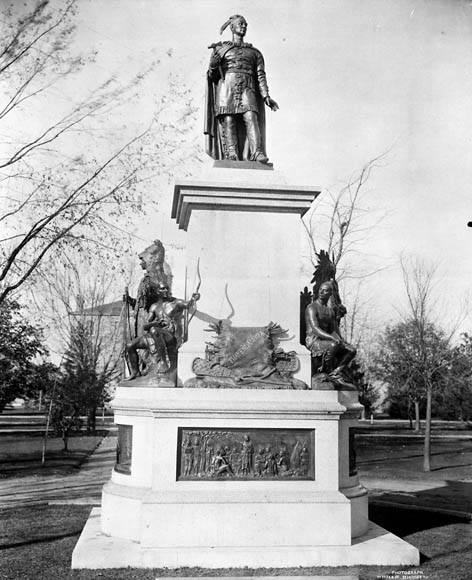
A black-and-white photograph of a bronze statue atop a large stone pedestal decorated with bronze reliefs and statues around the sides. A park with bare trees can be seen in the background.

View of the Brant Memorial in Brantford, Ontario by photographer Hannah Maynard, Park & Co. (MIKAN 3559483)

“Brant” was one of Pauline Johnson’s first published poems. She composed it for the unveiling of a statue of the Mohawk leader, Joseph Brant, in the town of Brantford on October 8, 1886, and it was included in a souvenir brochure prepared for the occasion. During Johnson’s lifetime, fans of literature often collected autographs from their favourite writers. Regarded as one of Canada’s most important poets, Johnson not only signed many copies of her books for her admirers, but also frequently wrote out her poems in longhand for them to keep.

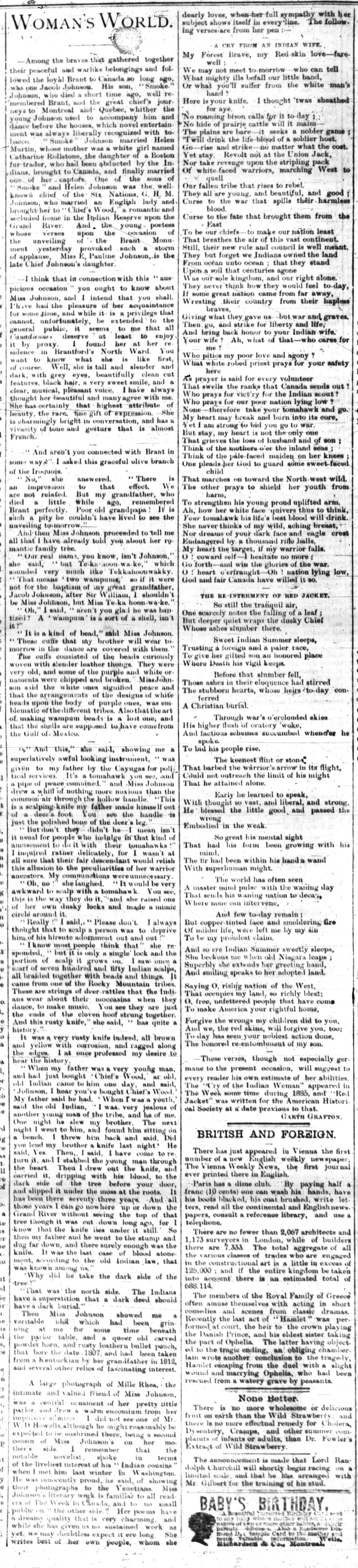
A black-and-white newspaper column describing Pauline Johnson’s family, her work and her role in the unveiling of the Brant memorial.

An interview with Pauline Johnson by Canadian journalist Garth Grafton (Sarah Jeannette Duncan) about Johnson’s work, her family, and the unveiling of the Brant Memorial, in Woman’s World, October 14, 1886. (AMICUS 8086919)

Tell us about another related item that you would like to add to the exhibition.

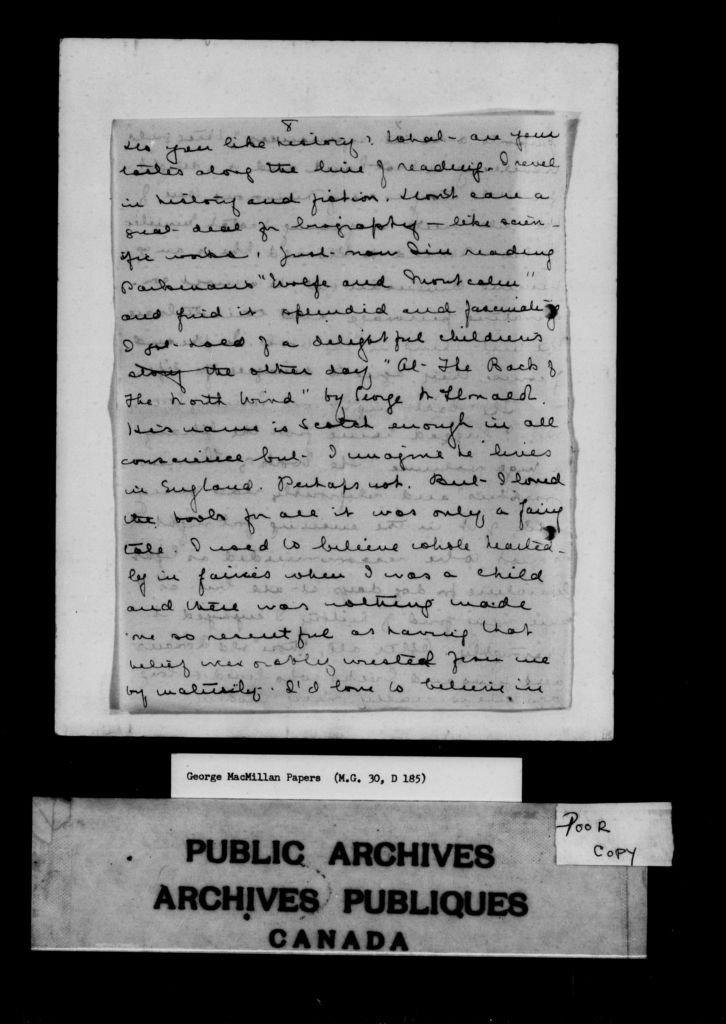
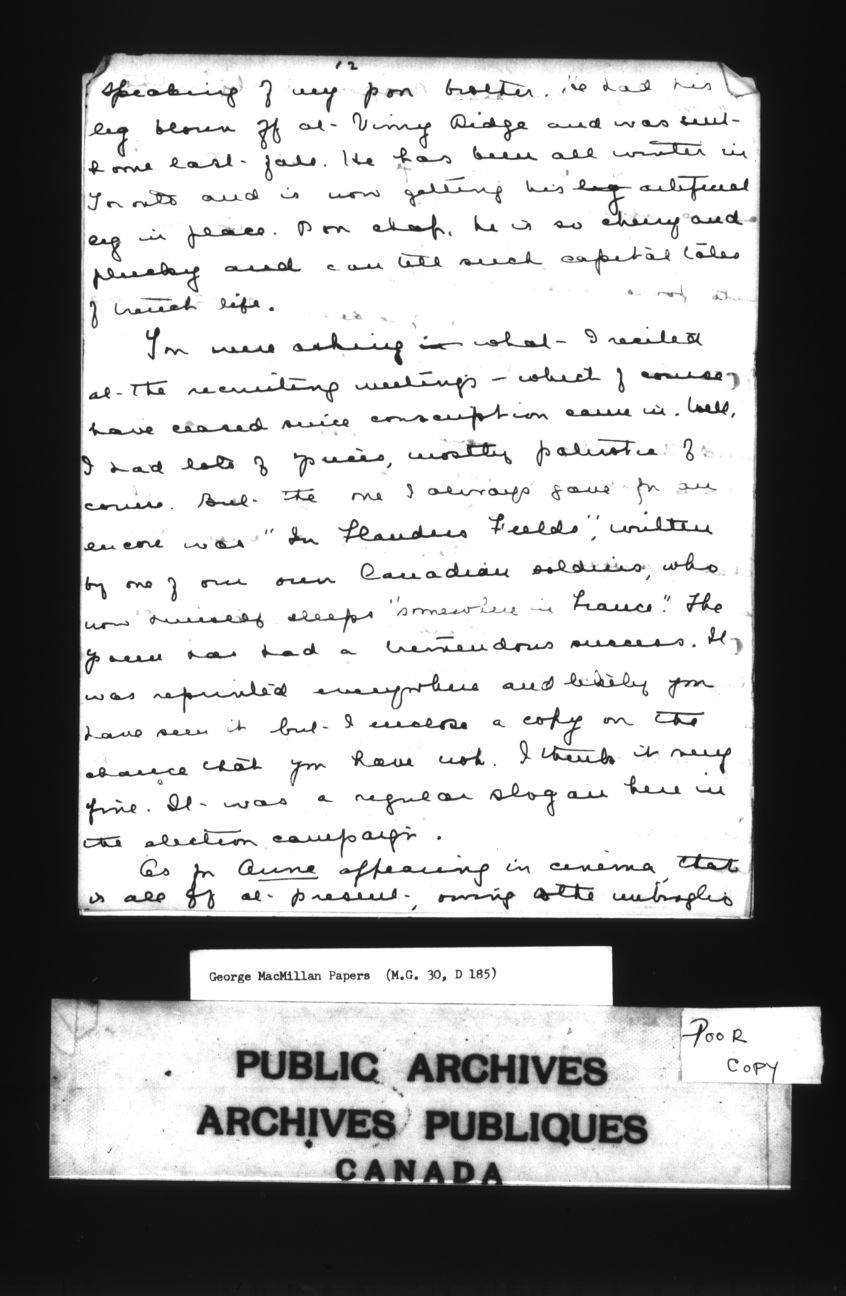
LAC holds a large collection of letters that L.M. Montgomery (author of Anne of Green Gables) wrote to her friend, George Boyd Macmillan, a pen pal who lived in Scotland. This correspondence lasted for many years, from 1903 to 1941. Montgomery’s letters are very long and newsy, discussing everything from the books that she read and the places she visited, to the doings of her family and her beloved cats. Over the years, the tone changes from youthful optimism to sad disappointment as she lives through the First World War and the Great Depression, giving us an inner view of the Canadian experience during a tumultuous time. Montgomery’s distinctive handwriting is less stylish than Johnson’s elegant script, perhaps reflecting her early years as teacher, when she needed to show children how to form their letters.

A black-and-white page of a letter from Lucy Maude Montgomery to George Boyd Macmillan. Discusses her love of historical books and recalls her love of fairies as a child.

A page from a letter (page 757) from Lucy Maud Montgomery to George Boyd Macmillan, a Scottish writer, dated April 7, 1904 discussing her love of historical books and fairies as a child (MIKAN 120237)

A black-and-white page of a letter from Lucy Maude Montgomery to George Boyd Macmillan. Discusses the popularity of “In Flanders Fields” and its use in election campaigns.

A page of a letter (25) from Lucy Maud Montgomery to George Boyd Macmillan, April 7, 1917 which discusses the popularity of “In Flanders Fields” and its use in election campaigns. (MIKAN 120237)

Biography

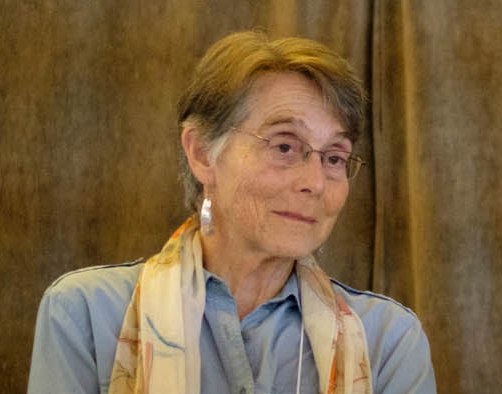
A colour photograph of a woman with short hair looking over to the side.Carole Gerson is a professor in the Department of English at Simon Fraser University. Co-editor of Volume 3 (1918–1980) of History of the Book in Canada / Histoire du livre et de l’imprimé au Canada, she has published extensively on Canada’s literary and cultural history with a focus on women writers, including L.M. Montgomery and Pauline Johnson. Her book, Canadian Women in Print, 1750–1918 (2010), won the Gabrielle Roy Prize for Canadian criticism. In 2013 she received the Marie Tremaine Medal from the Bibliographical Society of Canada.

Related resources

O Canada! A bilingual history

Version française

By Jessica Di Laurenzio

Library and Archives Canada has recently acquired the records of the Frederick Harris Music Company, a large Canadian music publisher often associated with the Royal Conservatory of Music in Toronto. In the company’s early days, beginning in the 1910s, Frederick Harris rigorously fought to obtain Canadian copyright for as much music as possible. One of the songs he published around this time was the English-language version of “O Canada.” However, the “O Canada” that Harris first published was not the same song that Canadians know today as their official national anthem.

“O Canada” became the official national anthem in 1980, exactly 100 years after Calixa Lavallée first composed the music. He was commissioned to write it by Lieutenant Governor Théodore Robitaille of Quebec. Judge Adolphe-Basile Routhier wrote the French lyrics at the same time, and the anthem was performed on Saint Jean-Baptiste Day in Quebec City in 1880. “Chant National” (the original name for “O Canada”) was an anthem for the French-Canadian people, written in part as a response to the popularity of “God Save the Queen” in English Canada.

A black-and-white photograph of a man with a prominent mustache, wearing a suit and bow tie. The photo is oval-shaped on a grey matte board.

Portrait of Calixa Lavallée (e010900310)

People in English Canada liked Lavallée’s music so much that, a couple of decades later, they decided to create their own version. However, rather than simply translating Routhier’s lyrics into English, several Anglophone lyricists wrote their own words, which helps explain why today the meaning of some of the French and English lyrics of “O Canada” differ greatly.

Sheet music cover. In the centre, there is a photo of a man in an overcoat and trousers holding a top hat and a cane. The composer’s and lyricist’s names are at the bottom between a sketch of the city of Québec and a tree that stretches to the top of the page to decorate the title with maple leaves.

Cover of the first edition of “O Canada” (OCLC 1007545258).
L.N. Dufresne, cover “O Canada” (Québec: Arthur Lavigne, 1880).
Musée de la civilisation, bibliothèque du séminaire de Québec. Fonds ancient, 204, SQ047145.

Original French lyrics by Routhier:

O Canada! Terre de nos aïeux,
Ton front est ceint de fleurons glorieux!
Car ton bras sait porter l’épée,
Il sait porter la croix!

Ton histoire est une épopée
Des plus brillants exploits.
Et ta valeur, de foi trempée,

Protègera nos foyers et nos droits.

English Translation:

O Canada! Land of our ancestors,
Glorious deeds circle your brow.
For your arm knows how to wield the sword,
Your arm knows how to carry the cross.

Your history is an epic
Of brilliant deeds.
And your valour steeped in faith

Will protect our homes and our rights,
Will protect our homes and our rights.

English-speaking lyricists took a different approach to the lyrics, often focusing on Canada’s natural beauty instead of the country’s valour and epic history. Sometimes, their approaches were a little too similar, causing accusations of plagiarism. Robert Stanley Weir and Edward Teschemacher were two of the Anglophones who came up with their own versions, and both chose to use the phrase “our home and native land.” The similarities created copyright tension between Delmar Music Co. and Frederick Harris, the respective publishers of the Weir and Teschemacher versions, both published around 1910.

Cover of sheet music for “O Canada!,” Canadian National Anthem by C. Lavallée.

Cover of sheet music for “O Canada,” published by Frederick Harris Music Co., 1914, words by Edward Teschemacher (OCLC 1007512736).

Along with Weir and Teschemacher, people across Canada came up with their own English versions of “O Canada.” By 1927, the Weir version had emerged as the most popular rendition, and was used as an official song for the Diamond Jubilee of Confederation. However, because so many other versions existed, it did not gain official status as the national anthem for some time.

Prime Minister Lester B. Pearson tried to introduce a bill to make it the official version in 1967, but it was not until the centennial anniversary of Lavallée’s music, in 1980, that “O Canada” became the country’s official national anthem. Routhier’s original lyrics from 1880 made up the French version, while Weir’s words gained official status as the English version—regardless of the fact that their meanings were so different.

Photo of a rectangular postage stamp with colourful graphics of three men, with their names written beside them: Calixa Lavallée, Adolphe-Basile Routhier, and Robert Stanley Weir. The stamp reads “Canada Postes-Postage, O Canada! 1880–1980.”

Commemorative stamp, 1980, showing Lavallée, Routhier, and Weir (s000844k).


Jessica Di Laurenzio is an archival assistant with Literature, Music, and Performing Arts, Private Archives Branch at Library and Archives Canada.

Images of Turkeys now on Flickr

Turkeys are large birds native to North America. The domestic turkey, also known as the wild turkey, is found from Canada to the midwestern and eastern United States, and in parts of Mexico. The ocellated turkey, which is smaller than the domestic turkey, inhabits the southeastern portion of Mexico and small areas of Central America. Males are typically larger and more colourful than females. The male sports a snood (a distinct fleshy proturberance), which hangs from the top of its beak. Because of their large size, domestic turkeys are hunted and raised for their meat. Many Canadians eat turkey on special occasions, such as Thanksgiving or Christmas.

A black-and-white close-up photograph of a male turkey.

A male turkey (MIKAN 4949749)

A black-and-white photograph of a young girl sitting on top of a bridled male turkey.

“I would like to turkey trot with you” (MIKAN 3259488)

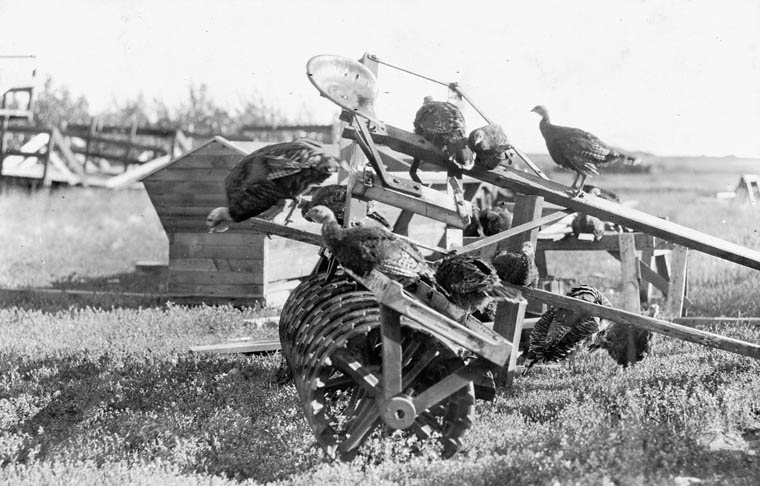
A black-and-white photograph of eight turkeys roosting on a horse-drawn disc harrow, with two turkeys on the ground behind it.

Turkeys on a horse-drawn disc harrow, Radisson, Saskatchewan (MIKAN 3361253)

Visit the Flickr album now!

Highlights from the Sir Sandford Fleming Diaries

By Andrew Elliott

As I have noted in a previous post, Sir Sandford Fleming—inventor of International Standard time, creator of Canada’s first postage stamp, surveyor and mapmaker—was a productive individual in 19th-century Canada. He seemed to have time for many things, including recording his activities in various diaries. And Fleming was a voracious writer. While he didn’t write novels, he did record everything he saw and experienced in his world. He combined his written observations with the occasional pencil sketch from landscapes, to people, to every day implements, to engineering works.

Remarkably, these diaries were kept for most of his long life, dating from 1843 when he was 15, until his death in 1914. Being a man who also thought of how he would be perceived in posterity, in later life Fleming transcribed the most important parts of his diaries into three condensed diaries. Additionally, Fleming kept various journals that recorded many special trips across Canada, England and the United States. All these are here within the Sir Sandford Fleming fonds at Library and Archives Canada. See specifically the diaries, journals of trips and miscellaneous journals and notebooks.

There are many things of interest to read in these diaries. A couple of diaries from Fleming’s early life are of particular interest. One dating from 1843 records his thoughts and observations about school life in Kirkcaldy, Scotland. Here there are numerous sketches from drawings of ships, a church, and a diagram of early roller skates.

Another two diaries from 1845 record Fleming’s voyage—mostly by ship—from Kirkcaldy, Scotland to the town of Peterborough, Upper Canada. The first diary has handwritten entries for late April to early June 1845, while the second diary documents the remaining portion of the journey from June to August 1845. The second diary contains his visual documentation of the trip, a graphic record of a journey before photography. There are views of Scotland from on board the ship, sketches of ships passing by, sketches of his cabin and other people on board, views of the first sighting of landfall in North America, a view of Québec City, a sketch of the locks at Bytown (now Ottawa), a view of Niagara Falls, and several sketches of Peterborough buildings.

A pencil sketch showing a person reading on the deck of a ship, with another ship in the background.

Sketch of part of a ship, 1845. (MIKAN 4938907)

Fleming arrived in Canada with valuable skills—drawing, drafting, surveying, engraving—and he used these to make a living. For Fleming, the diary was a way to record his movements, key events, and family events especially; he often made no entries if his day had been a routine one. The diaries contain irregular and brief entries noting board meetings, social engagements, arrivals and departures of prominent persons, health and fortune of family and friends, and travel in Canada and abroad. This last point about travel is particularly striking. While he was based first in Toronto, his work meant that he had to travel extensively. In the 1840s and 1850s, for example, despite having to travel by stagecoach, sleigh, and steamer, he would cover an area almost as extensive as the Greater Toronto Area. Later, while based in Halifax and Ottawa, numerous rail trips would see him frequenting remote parts of Ontario, Quebec, the Maritimes, and Western Canada.

Two pages from a journal. The first page shows a sketch of a campsite in a river valley with woods and mountains in the background with some handwritten text underneath. On the second page is a sketch of a tent with someone sitting in front of it, tending a fire.

Excerpt from the journal about his Intercolonial Railway survey, dated 1864. (MIKAN 107736)

In the early 1870s, Fleming travelled with others on a surveying expedition. A digitized record of this expedition can be found in Master-Works of Canadian Authors: Ocean to Ocean.

An 1885 diary has a pocket containing a six-page handwritten account of a train trip across Canada in November. Included in this account are his impressions of the November 7 ceremony at Craigellachie, British Columbia of the driving of the “last spike” to complete the Canadian Pacific Railway.

He also kept a list of all the trips he made by ship across the Atlantic Ocean. Here’s a sampling for the period from the 1840s to the 1880s, such as a May 17, 1863 voyage to England on the S.S. United Kingdom.

A handwritten list of dates, destinations and names of ships, which has been attached to some ruled paper.

A list of Fleming’s trips made between 1845 and 1883, which includes the destinations and names of ships. (MIKAN 107736)

Fleming also wrote about his personal and family life. Here are a few examples of diary entries from the 1850s and 1860s (spelling is his own):

  • December 31, 185 9: “Another year on the eve of closing and here I am sitting in Mr. Halls family, Peterboro, with my good wife close by, two dear little boys, and little girl sound asleep in bed…”
  • June 6, 1861: He writes that his wife “gave me my second little daughter about 12 o’clock (noon) today at Davenport. She did not feel very well at breakfast and thought I had better go for the nurse and doctor.”
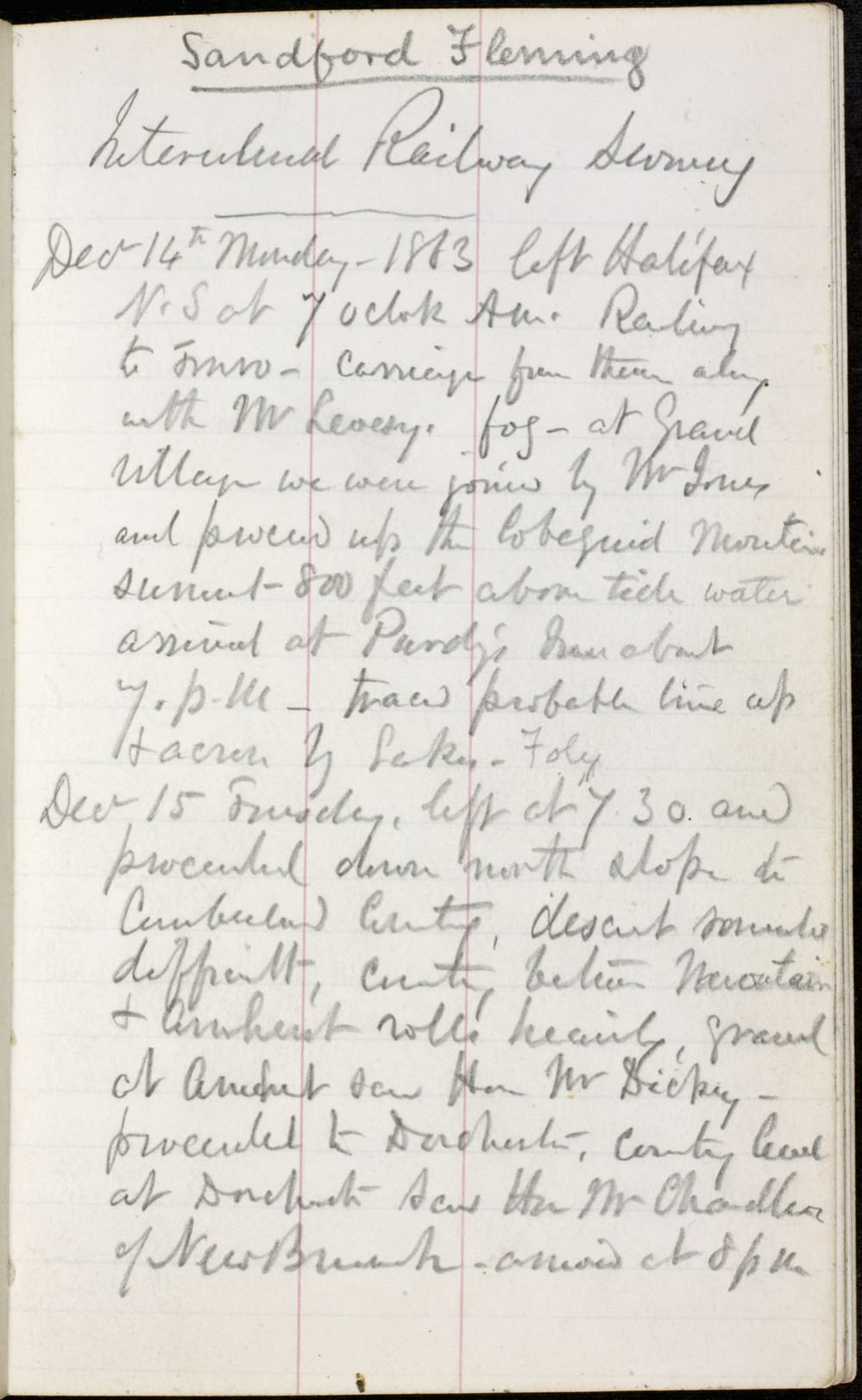
  • September 9, 1863: “Messrs Tilly and Tupper informed me that they had decided, subject to approval of their government) to appoint me to act on behalf of Nova Scotia and New Brunswick…to proceed at once with survey.” Here’s a scanned image of an entry he made about the Intercolonial Railway survey:
Handwritten entries in pencil for two days.

Excerpt of two diary entries dated December 14 and 15, 1863, describing activities during the Intercolonial Railway survey. (MIKAN 107736)

  • January 1, 1864: “Morning train to Collingwood, Stage to Craigleith—Father and Mother had all their children around them…they thought I was in New Brunswick and were astonished and glad to see me…very cold and stormy.”
  • February 28, 1866: Fleming writes about the death of his 3-month old son, “This morning about 4 o’clock after rallying a little…our dear child at last passed quietly away…This is the first death that has really come home to me—part of us is now really in another world.”
  • June 29, 1867: “Preparing for Celebration of Confederation of the Provinces next Monday.”
  • July 1, 1867 (Dominion Day): “Up at 5 o’clock, very cloudy and rainy…putting up flags etc. Clouds cleared away. Halifax very gay, a perfect sea of flags. Beautiful day. The demonstration went off splendidly.”

Although Fleming was at the centre of the modernization of Canada, the hundreds of mundane details Fleming recorded also reveal something of the world he inhabited. There is a wealth of information here, if one is willing to take the time to read them and decipher his handwriting.


Andrew Elliott is an archivist with the Science, Governance and Political Division of Library and Archives Canada.

Guest curator: Annabelle Schattmann

Banner for the guest curator series. CANADA 150 is in red along the left side of the banner and then the bilingual text: Canada: Who Do We Think We Are? and under that text is Guest curator series.Canada: Who Do We Think We Are? is a new exhibition by Library and Archives Canada (LAC) marking the 150th anniversary of Canadian Confederation. This exhibition is accompanied by a year-long blog series.

Join us every month during 2017 as experts, from LAC, across Canada and even farther afield, provide additional insights on items from the exhibition. Each “guest curator” discusses one item, then adds another to the exhibition—virtually.

Be sure to visit Canada: Who Do We Think We Are? at 395 Wellington Street in Ottawa between June 5, 2017, and March 1, 2018. Admission is free.


The Chewett Globe by W.C. Chewett & Co., ca. 1869
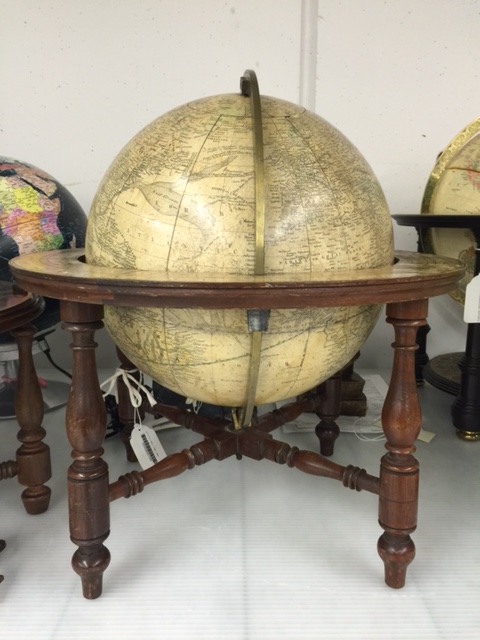
A large globe in a wood and brass stand.

Terrestrial globe by W.C. Chewett & Co. for the Ontario Department of Education, ca. 1869. (AMICUS 41333460)

This globe was one of the first produced in Canada, around the time of Confederation. Designed for use in schools, it was part of a nationalistic push to define and explain the brand new country.


Tell us about yourself

I have travelled extensively for both pleasure and work. I have been to Europe multiple times, and Peru for archaeological digs as a student. I also spent over a year living in Japan as a high school student, and it was an unforgettable experience. The most important lesson I learned was to appreciate and respect things that are different, strange, and sometimes incomprehensible. It taught me to be critical of my biases and the culture I live in, reflexes which promote cohesive living in a multicultural world.

Is there anything else about this item that you feel Canadians should know?

Because of my expertise and love of travel, I have chosen to discuss the Chewett Globe. Maps are a lot of fun! Whenever I travel, I like to look up the country’s world map because they always put their country in the middle of the map. This inevitably causes distortion in the distances between countries and the size of oceans as our planet is spherical. Seeing Canada shrink and stretch has always made me smile and helped me understand how other people see and understand their world, if only a little bit.

Our world is also ever changing, from its physical features, such as rivers and mountains, or abstract constructs, such as names and borders. Therefore, maps must be continuously updated, which allows us to trace history through changes in maps. Maps are critical to my work as an archaeologist. Old city plans might reveal where old buildings once stood or abandoned cemeteries were located but have since been built over and faded from our collective memory. I also must consider how the landscape may have looked like in the past to understand what resources people could access, and what might have inspired them to choose a specific location to camp or imbue meaning onto the landscape through stories and legends.

I think Mr. William Cameron Chewett, the person whose company created this globe, would have appreciated these thoughts. Although his profession was printing, his family were involved with mapping Upper Canada. His grandfather, William Chewett, worked as surveyor-general and surveyed most of what is now Ontario, while his father, James Chewett also worked as a surveyor before building many known Toronto buildings. W.C. Chewett and Co. was considered one of Canada’s foremost printing and publishing firms. The firm produced award-winning lithographs between 1862 and 1867, with yearly first place awards, and had a large publication output ranging from periodicals, directories, and the Canadian Almanac, to law and medicine books. In addition, the retail store was a popular social gathering spot. The globe was created in the company’s last year (1869) prior to it being bought and renamed the Copp, Clark and Company.

A map of Canada West, what is now southern Ontario, with coloured outlines to indicate counties. The legend contains a list of railway stations with their respective distances [to Toronto?].

Map of Canada West, engraved and published in the Canadian Almanack for 1865 by W.C. Chewett & Co., Toronto. (MIKAN 3724052)

For Canada’s150th anniversary, I think it is worth reflecting on the changes that have come to pass in the last 150 years, which the Chewett Globe can literally show us. In my lifetime, I observed the creation of the territory of Nunavut and the renaming of various streets in my neighbourhood. What changes have you seen in your life and how did they affect you and your community?

Tell us about another related item that you would like to add to the exhibition

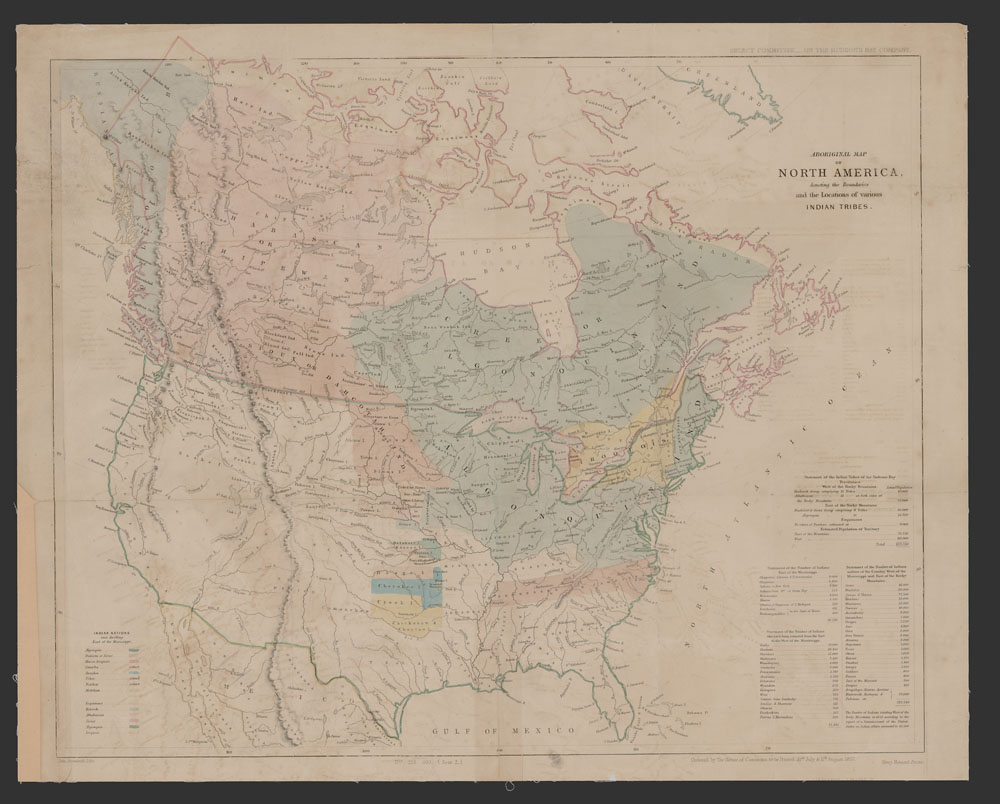
When most people think of maps, they think of geography and political borders, but maps can also be used to illustrate and describe almost anything, including census information, spoken languages, and group affiliations amongst others. To continue the topic, I have selected an 1857 map of North America that shows the regions where various First Nations groups resided at the time. Ideally, if I were to add this map to the exhibition, I would also want to include a modern map of where First Nation groups reside to show the public the momentous changes lived by our fellow citizens to allow them to see these changes as clearly as those they can pick out by comparing the globe to any modern map of Canada.

My other reasoning is a little more selfish. As an anthropologist, I understand and have learned through experience that the best way to appreciate and respect another culture is to learn about it, about the people, and where possible, live in it. Growing up, I had very little exposure to First Nations, their culture and history. Because of this, I never developed much of an appreciation for their culture or interest in learning about them. As an anthropologist and Canadian, I was ashamed of these feelings and sad when fellow Canadians express similar views. For the last few years, I have actively sought to educate myself. By including this piece, I hope to inspire others to appreciate, respect, and learn more about their fellow Canadians. The topic is particularly meaningful on Canada’s milestone year as this is the year we should celebrate coming together and developing stronger bonds, one nation to another.
A large colour map of North America denoting territories of various Aboriginal bands with legends in the corners.

Map of North America denoting the boundaries and location of various Aboriginal groups. (MIKAN 183842)

Biography

Colour headshot of a woman with glasses and long hair.Annabelle Schattmann is a physical anthropologist. She holds a Master of Arts in Anthropology from McMaster University (2015) and a Bachelor of Arts in Anthropology from Trent University (2012). She has participated in multiple research projects including a dig in Peru, cemetery excavation in Poland, and research on vitamin C and D deficiencies from various time periods in Canada and Europe.

Related Resources

McLeod, Donald W. “Chewett, William Cameron.” Dictionary of Canadian Biography.