The Expropriation of LeBreton Flats (1962)

Version française

By Ariane Gauthier

LeBreton Flats was once one of the oldest neighbourhoods in Ottawa. It began as the home of many lumber mills as early settlers sought to use the strong current of the Chaudière Falls to move massive quantities of lumber from a densely forested area. With this industry came its horde of workers, who chose to establish their families near their workplaces. These were the principal elements that helped to shape the Flats.

Map of Ottawa showing part of the so-called Lumber District, including the Ottawa River and the Chaudière Falls.

Insurance plan of Ottawa, Ontario, June 1878 – Sheet 3. (e010695480)

Despite the lively atmosphere prompted by this active industry and the additional hustle and bustle of the railway yards, LeBreton was an impoverished area mostly populated by Francophones, the Irish and, later, Italians. Still, the Flats endured. Even after the Great Fire of Ottawa-Hull—a massive fire that erupted in Hull, Quebec, on April 26, 1900, and jumped the Ottawa River to decimate parts of Ottawa—reduced the area to ashes, the neighbourhood was quickly rebuilt and life picked up where it had left off.

Black-and-white photo depicting thick columns of billowing smoke suffocating the LeBreton Flats area, as seen from Parliament Hill.

Great Fire of Ottawa-Hull. (a009286)

Things changed, however, on April 18, 1962, when the National Capital Commission issued a letter to the residents of the Flats informing them of their abrupt expropriation. Residents and business owners had until May 1, 1964—this date was later revised to December 31, 1964—to vacate their homes, after which plans had been made to raze everything to the ground. On the bones of this old neighbourhood, a massive new building for the Department of National Defence would take shape, destined to serve as its headquarters.

However, these ambitious plans were then abandoned. In 1965, after the final building was knocked down, Ottawa residents waited to see what would become of the vacated LeBreton Flats. None could have guessed that any plans to remake the area would be tabled for some 40 years.

In my search to understand this part of Ottawa history, I often found myself wondering about the families who had to leave their homes: those who had inherited familial houses they had known their whole lives, the new immigrants who had so recently settled into the city, and the business owners who had once served as the life force of LeBreton Flats. How sad it was to think about their lost dreams, ambitions and memories!

Plowing through our vast archival collection in a bid to find personalized experiences of the expropriation, I came across the following sub-series from the National Capital Commission fonds (RG34/R1181):

Central registry files
Reference: R1181-18-X-E, RG34-C-1-b
http://central.bac-lac.gc.ca/.redirect?app=fonandcol&id=134479&lang=eng

The central registry files mostly pertain to the management of National Capital Commission properties through negotiations and transactions to acquire and expropriate property. Among other things, they include many files on residences and businesses expropriated from the Flats in 1962. Uniquely, many of these files include photos of houses, apartment complexes, stores, etc., which figure as the core motivator for this blog post, particularly photos of buildings and streets that no longer exist.

Black-and-white photo of a man walking past a two-storey apartment building.

Man walking in front of apartment unit. The photograph is dated June 1962. (Photo taken by Ariane Gauthier – from R1181-18-X-E, box: 77.)

Black-and-white photo of a two-storey building with a corner store on the ground floor and apartments on the second floor.

A self-service corner store. (Photo taken by Ariane Gauthier – from R1181-18-X-E, box: 77.)

Three black-and-white photos of a two-storey apartment building. Top photo is the front view. Bottom left photo is the rear view, with clothing hanging from two clothing lines. Bottom right photo is the side view.

Three photos of the same apartment unit: front view, rear view and side view of the property. (Photo taken by Ariane Gauthier – from R1181-18-X-E, box: 77.)

Two black-and-white photos of a two-storey apartment building. Top photo is the front view. Bottom photo is the rear view.

Front and rear views of the Ottawa Feather & Mattress company building. (Photo taken by Ariane Gauthier – from R1181-18-X-E, box: 77.)

This is just a sample of what can be found by going through these files. Much more can be learned by carefully examining the textual documents accompanying these photos, but this is work I will leave to city historians.

After the neighbourhood was levelled in 1965, replaced by grass fields and shrubs, the Flats sat empty for some 40 years until the Canadian War Museum opened its doors in 2005. The construction of condo buildings and parks followed five years later. In 2019, the development of the City of Ottawa’s O-Train Confederation line led to the opening of Pimisi Station, which serves the LeBreton Flats area. Ongoing projects are seeing the area filled once again with new residential buildings, a possible hockey arena and, of course, Ādisōke. This shows us that the expropriation of 1962 was not the coup de grâce for LeBreton Flats. Just like after the Great Fire of Ottawa-Hull, LeBreton Flats is rebuilding and will soon continue from where it left off.

Additional Resources


Ariane Gauthier is a Reference Archivist in the Access and Services Branch at Library and Archives Canada.
Proud to be peculiar: The little-known story of the Archives Museum

Version française

By Geneviève Morin

One ordinary June day in 2011, an unordinary mystery landed on the desks of Library and Archives Canada’s (LAC) documentary art archivists. A small bronze statuette of James Wolfe by sculptor Vernon March had just been found at the Lord Elgin Hotel in Ottawa, carefully wrapped and secretly left unattended. The only clue was a note in which the anonymous author expressed regret at having stolen the statuette “in an act of foolishness” while visiting the Archives in the 1950s. Now in the twilight of his life, he was endeavouring to make amends…

The archivists familiar with the history of LAC’s non-textual collections immediately got to work: research was undertaken, paperwork was retrieved, and provenance was confirmed. The bronze likeness of General Wolfe had indeed been added to the Archives’ holdings in 1914! The statuette was gratefully retrieved and eventually transferred to its new current home, the Canadian Museum of History.

However, the question remains… Why would archives ever have collected that sort of sculpture in the first place? Do archives not typically stick to two-dimensional material like textual documents, photographs, maps and drawings? To be sure, even though many Canadians are aware that LAC and its predecessor institutions (the National Archives of Canada, the National Library of Canada and the Public Archives of Canada) have acquired non-textual material for over 130 years, few are familiar with the reason why our holdings were—and, in some cases, still are—so eclectic.

The bold ambition of Arthur Doughty

Simply put, the diversity of our past and present holdings is in large part owed to Canada’s second Dominion Archivist, Arthur Doughty. His ambition, as he explained in the Archives’ 1925 Catalogue of Pictures, was nothing short of making the institution “… a national department of history, where are preserved sources of every kind having value for the study of the history of Canada.” This was a substantial mandate, to say the least…

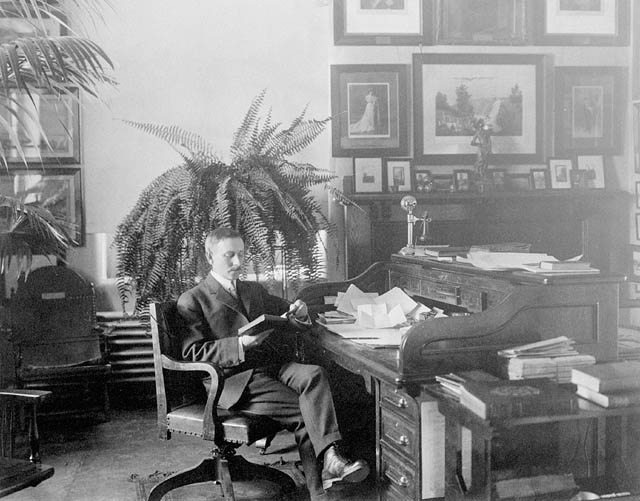
Black-and-white photograph of a man with a mustache wearing a dark suit and boots. He is sitting in a wood chair and reading a book beside a wood desk covered in papers. There are large plants, a wall with many framed images and a fireplace mantel in the background. General Wolfe’s leather campaign chair leans against the wall to the man’s right.

Dr. Arthur G. Doughty, Dominion Archivist, c. 1920, Pittaway Studio. (c051653)

Doughty’s vision caused a considerable increase in the types of material acquired by the Archives after his appointment, in 1904. The gargantuan Duberger model of Québec, pictured below, transferred from the British War Office in 1908, is one of the most striking examples of this change in acquisition practices.

Black-and-white photograph of a large room with display tables running along the sides and lights hanging from the ceiling. In the background, there is a large model of a city.

Grey Room, Public Archives of Canada, Sussex Street, after 1926. (a066642) (The model was built at Québec by draftsman Jean-Baptiste Duberger and Royal Engineer John By between 1806 and 1808. Today, the model is in the custody of Parks Canada.)

Over the years, the Archives became responsible for taking in thousands of diverse items, which included artefacts such as:

  • the red tunic worn by Isaac Brock at the time of his death during the Battle of Queenston Heights;
  • James Wolfe’s leather campaign chair (pictured above in Doughty’s office, left-hand side);
  • a war club said to have been used in the War of 1812 and several other weapons;
  • Indigenous eyewear, weapons and clothing;
  • mirrors, chandeliers and various pieces of furniture;
  • the nation’s most extensive collections of coins, tokens, paper money, medals and decorations;
  • and quirkier curiosities, such as a wooden potato pounder believed to have been used in the kitchen of Sir John Johnson, and an elaborate set of brass sleigh-bells having once belonged to Princess Louise and the Marquis of Lorne.

In short, nothing seemed to be off limits for the Archives, as long as it could teach Canadians something about their history.

Black-and-white photograph of a wood cabinet with a mirror. On top of the cabinet is an elaborately decorated mantel clock. There are two candelabras in the shape of cranes standing on turtles’ backs on either side of the cabinet.

Raingo Frères mantel clock on display at the Public Archives building, date unknown. (a066643)

A must-see for locals and visitors alike

Deemed “A Treasure-House for the Canadian Historian” by Saturday Night Magazine in 1910, the Archives came to develop a hugely successful museum program providing space for Canadians to immerse themselves in displays that combined publications, textual records, and varying forms of specialized media, such as maps, photographs, paintings, engravings, and three-dimensional artefacts. Coincidentally, the infamous Wolfe statuette can be seen in just such a display in the photograph below, taken around 1926, co-starring with Benjamin West’s painting The Death of General Wolfe in the Archives’ Northcliffe Room.

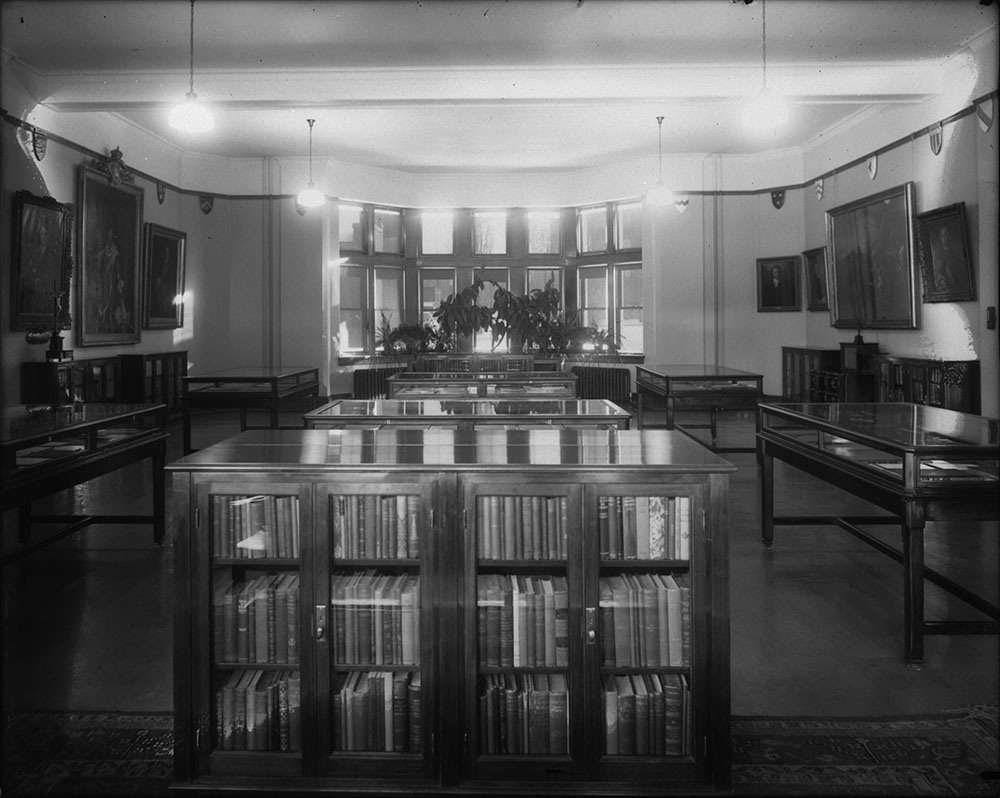
Black-and-white photo of a room with book cases and display cabinets. In the background, there are windows and plants.

The Northcliffe Room in the Public Archives Building, Sussex Street. Ottawa, Ont., ca. 1926-1930. (a137713). The Vernon March statuette of Wolfe can be seen on top of the display case below the large painting on the right wall.

Housed in various spaces that included three custom-built rooms on the ground floor of the Archives building at 330 Sussex Street, the permanent exhibits were regularly supplemented by special displays marking commemorative events, the intake of significant acquisitions, or the visit of important guests. Space was tight, but under the guidance of Doughty and curators Mr. Weber and A.E.H. Petrie, nearly every usable surface was considered an opportunity to showcase the collection—even hallways and Doughty’s own office.

Black-and-white photograph of a large room with display cabinets, a statue, flags, plants, framed images, chairs and a throne.

Minto Room, Public Archives of Canada, arranged for a reception for delegates attending the Imperial Conference – Ottawa, August 1932. (c000029) The sovereign’s throne [centre-right] was housed at the Archives Museum when not in use at the Senate of Canada.

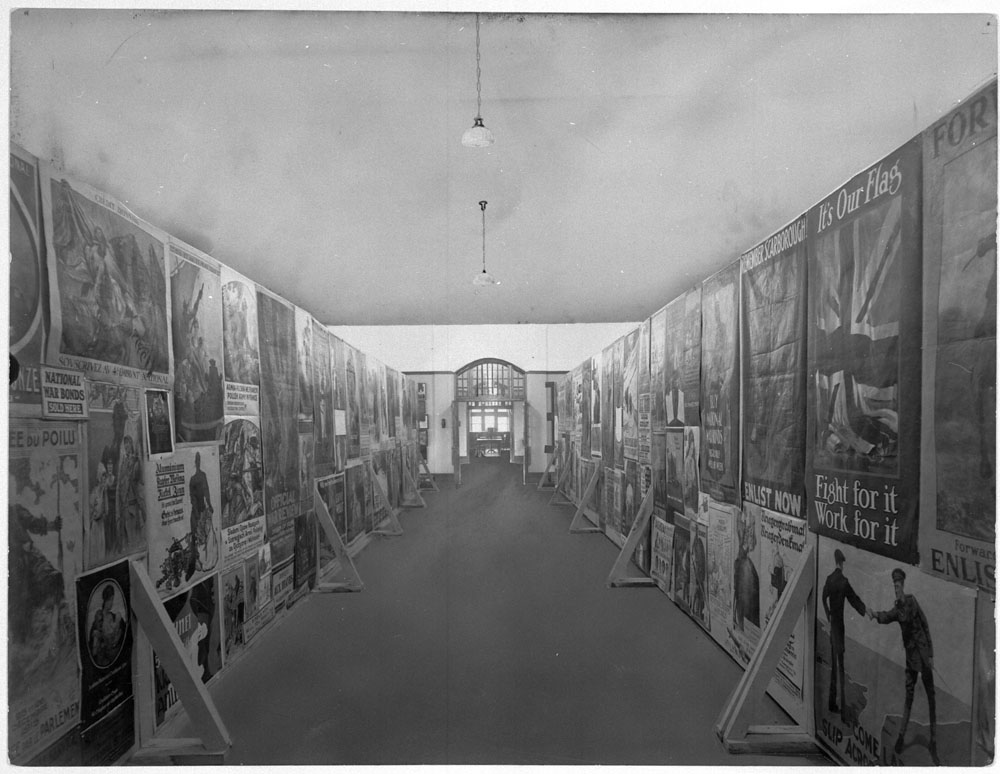
Black-and-white photograph of a long narrow room. There are two hanging lights in the middle of the room, and posters are plastered on each wall.

War Posters Room, Public Archives Building, Sussex Street, c. 1944 (a066638). We still find thumbtack holes in some of the war posters in LAC’s collections. Conservation and exhibition practices have greatly evolved since the days of the War Posters Room!

As a result, the Archives Museum hosted countless groups of schoolchildren, scholars, history enthusiasts and visiting dignitaries. The popular attraction was even graced by Princess Elizabeth and the Duke of Edinburgh in 1951. The royal couple enjoyed the experience so much that, as Archives officials proudly reported, “[by] the time the party had signed the visitor’s book and left for Government House, a much longer period had elapsed than had been arranged for in the official programme.”

Black-and-white photograph of four men and one woman looking at items in a glass display cabinet. One man is pointing at a document in the cabinet.

“Their Royal Highnesses the Princess Elizabeth and the Duke of Edinburg in the Public Archives, accompanied by the Hon. F. Gordon Bradley, Secretary of State (left).” Report of the Public Archives for the year 1951.

By the mid-1960s, the Museum’s popularity was growing by leaps and bounds. Unfortunately, as Mr. Petrie observed in 1960, this level of success did have its adverse effects: “One guard seems to be insufficient for the three rooms [as there have been] petty thefts and minor vandalism to collection items.” Security was struggling to keep up with growing crowds; perhaps these were the conditions in which the Wolfe statuette came to its unfortunate disappearance?

The unavoidable unsustainability

Ultimately, Doughty’s well-intentioned ambition could not keep going in this manner. After nearly 60 years of existence, the Museum had accumulated such a large three-dimensional collection that the Archives building was bursting at the seams. Space had become so tight that, in 1965, the exhibition spaces occupying the Sussex building had to be moved to temporary lodgings at the Daly Building, near the Château Laurier; so did the surplus artifacts that had until then been stored at the Loeb Building, on Besserer Street.

Black-and-white photograph of two buildings. On the left side of the image, there are blurry people and cars. In the foreground, power lines can be seen.

G.T.R. Hotel [Chateau Laurier] and Ria [Daly] Building. William James Topley, after 1911. (a009116) The federal government bought and began occupying the Daly Building, a commercial building, in 1921.

Appraisal of the Museum’s conundrum by both the Massey Commission of 1951 and the Glassco Commission of 1963 provided the necessary weight to the argument for downsizing. While the Archives had gone beyond their traditional role at a time when “no alternative was available,” it was obvious that being the national archives and a museum all at once was impossible and no longer necessary. The time had come to share the burden of responsibility with other existing institutions.

New building, reduced holdings

In 1967, the National Library and National Archives of Canada moved to new quarters, at 395 Wellington Street in Ottawa. While this modern, custom-designed building did include exhibition spaces, the displays of days past would not be replicated there; rather, focus would be dedicated to the wealth of resources found in the library and archives holdings.

The years surrounding the move were therefore occupied with the redistribution of the Museum’s collection. Most of the three-dimensional artefacts were transferred to the upcoming Museum of Man (now known as the Canadian Museum of History), while war trophies and military artefacts remained behind at the Sussex location to continue on as part of Canada’s War Museum. Approximately 16,000 coins and other monetary items were sent to the Bank of Canada, and the Archives’ philatelic holdings were taken in by the Post Office Department. The Archives retained its holdings of some 6,000 military, commemorative and ecclesiastical medals and tokens; these, along with the extensive collection of paintings, remained part of the Public Archives holdings of documentary art and objects. Mr. Petrie stayed on as Curator of Museum and Numismatics, showing groups around exhibits and paintings on display and conducting tours of the new building’s impressive decorative and architectural features.

A continuing legacy

As Library and Archives Canada evolves into the 21st century, the spirit of Doughty’s ambition and the legacy of the Archives Museum live on through a distinctly Canadian approach to archives. Bred out of collecting and caring for over 100 years’ worth of government records, private papers and non-textual “sources of every kind,” this approach has generated the eclectic array of expertise that remains with LAC’s professionals to this day. Most importantly, it has ensured that a diverse trove of documentary heritage continues to intrigue, inform and impress Canadians and visitors alike, even though security and access conditions have become just a bit tighter since the days of the Wolfe statuette affair.


Geneviève Morin is a Senior Archivist for Documentary Art, Objects and Photography, Government Archives Division.

Molly Lamb Bobak, Canada’s first female official war artist overseas: A Co-Lab challenge

Version française

By Krista Cooke

Black-and-white photograph taken from the side showing a smiling woman in uniform sitting on a pier with a drawing tablet and pencil in hand. In the background, a young blond child is standing, and sailboats are docked nearby

War artist Lieutenant Molly Lamb, Canadian Women’s Army Corps, sketching at Volendam, Netherlands, September 1945. (a115762)

Molly Lamb Bobak, the first female official war artist overseas, is arguably the Second World War painter who best captured Canadian women’s experiences of military life. In 1942, Molly Lamb (later Bobak) was fresh out of art school in Vancouver. The talented young painter promptly joined the Canadian Women’s Army Corps (CWAC) as a draftswoman—dreaming of one day becoming an official war artist.

Canada’s war art program, established during the First World War, resulted in a vast collection of artworks. Molly Lamb Bobak, who contributed to the Canadian War Records of the Second World War, was exceptional. She was Canada’s first female official war artist overseas. Works from her lifetime of painting and drawing are held at numerous institutions across Canada, including Library and Archives Canada (LAC), where a large collection of her works resides. One of the most compelling pieces, her wartime diary, is now more accessible: it has been digitized and can be transcribed through the collaboration tool Co-Lab.

Shortly after enlisting, Molly Lamb Bobak began writing a unique diary, which provides an invaluable record of the CWAC’s role in the war effort. Titled simply W110278, after her service number, it is a personal and insightful handwritten account of the everyday events of army life, accompanied by her drawings. Covering the period from November 1942 to June 1945, the diary contains 226 illustrated pages and almost 50 single sheet sketches interleaved among its pages.

A hand-drawn newspaper-style page with a column of text and illustrations of a woman in a military uniform and a diner scene. The titles “W110278” (Molly Lamb Bobak’s service number) and “Girl Takes Drastic Step!” are written at the top

Molly Lamb Bobak’s handwritten diary, amplified with colourful sketches. (e006078933)

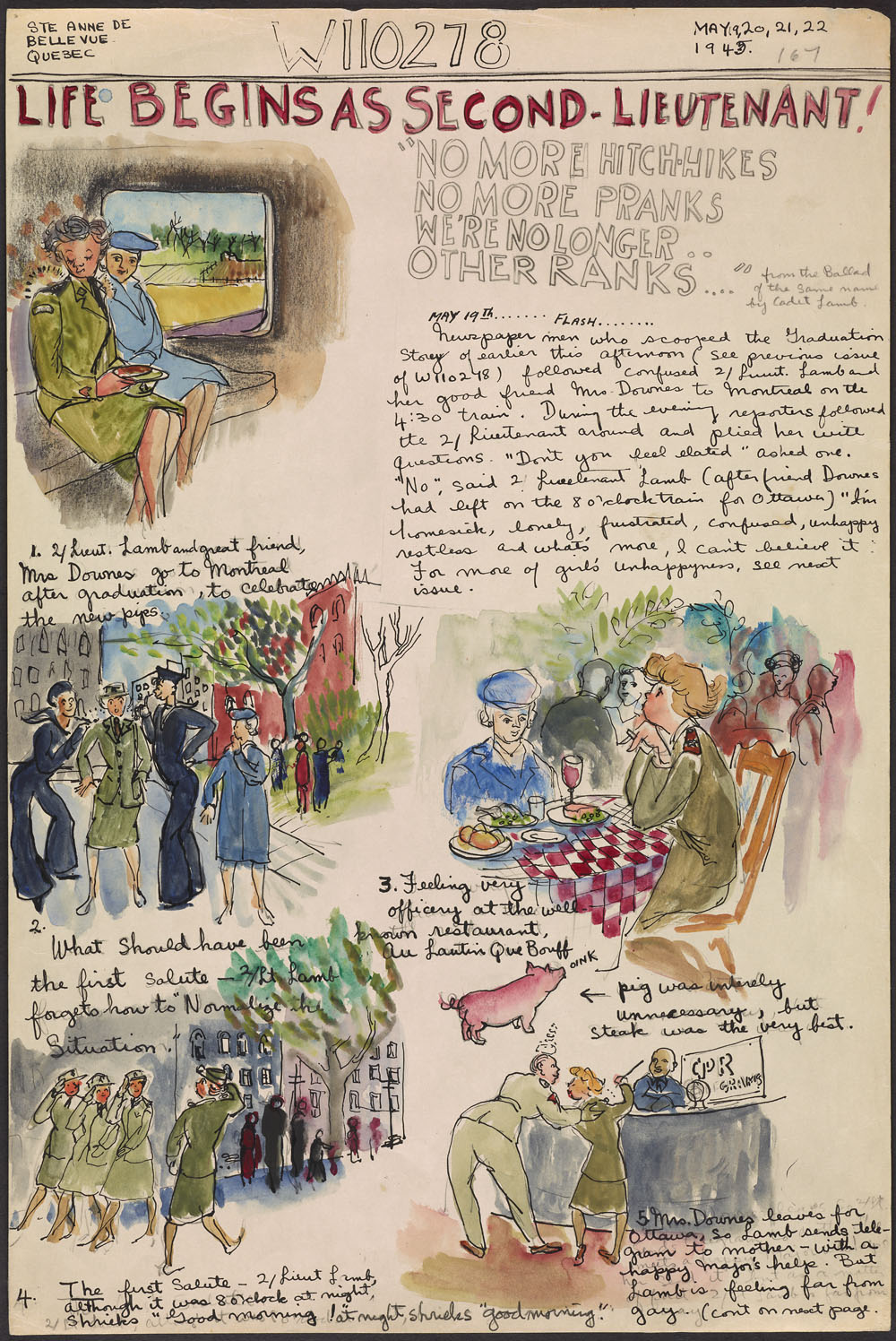
A hand-drawn page with text and illustrations of two women in military uniforms, women posing for images, women eating at a restaurant, a small pink pig, and women marching. The title reads, “Life Begins as Second Lieutenant!”

Another example from Molly Lamb Bobak’s handwritten diary. (e011161136)

The diary’s first page (top) captures the humorous tone and unique approach of the diary, which is written in newspaper style, with the pages resembling big-city broadsheets. The first headline reads “Girl Takes Drastic Step! ‘You’re in the Army now’ as Medical Test Okayed.” What follows are handwritten news bulletins with amusing anecdotes and vibrant illustrations, revealing women’s experiences in Second World War army life. These comprise a personal daily record of Lamb Bobak’s time in the CWAC. She worked serving in canteens before being sent on basic training in Alberta, eventually being promoted to Lieutenant in the Canadian Army Historical Section, in 1945. Throughout her years of service in Canada, she captured the world around her, later using many of these sketches as studies for her paintings.

Three years after enlisting, Molly Lamb Bobak achieved her ultimate goal when she became the first woman to be sent overseas as an official war artist. She recorded her excitement in her diary, writing “Lamb’s Fate Revealed…To Be First Woman War Artist!” Despite her talent, Lamb Bobak’s appointment as an official war artist was far from a foregone conclusion. Women’s perspectives had not been a priority for the program. As she later recalled, “[B]eing the first female war artist, with 9 men [in my group] . . . was sort of a great thing to have happened to me . . . because I know the Army didn’t want women [artists], in those days.” She credited family friend and Group of Seven painter A.Y. Jackson with her success. Indeed, he had written on her behalf to the director of the National Gallery of Canada, who was involved in the war art program, stating “If she had half a chance, she could go places.” And go places she did!

A black-and-white photograph, taken from the side, of a woman painting at an easel, holding a paintbrush and palette

Molly Lamb Bobak paints #1 Static Base Laundry (shown completed below). (a188549)

A colourful painting depicting a building and women (some in uniform) in a line, with rolling hills and trees in the background. This painting is the completed version of the painting on which Bobak is working in the photograph above

#1 Static Base Laundry, a painting now in the collections of the Canadian War Museum, Canadian War Museum 19710261-1617.

After the ceasefire in 1945, the military sent Molly Lamb Bobak to England, the Netherlands, Belgium and Germany. As one of almost 30 Canadian official war artists working during the Second World War, Lamb Bobak created works that are unique because of their focus on servicewomen. Roughly 50,000 Canadian women enlisted in the military during the Second World War, but their experiences were not generally of interest to male war artists or administrators of the war art program, who tended to focus on battlefield scenes and servicemen. As a CWAC herself, Molly Lamb Bobak had unparalleled access to her subjects and was able to capture the daily experiences of being a servicewoman. She later explained that “[T]he whole structure of army life is agreeable to a painter… and everywhere you turn there is something terrific to paint…. one could spend hours … drawing the C.W.A.C.s checking in and out, the new recruits, the fatigue girls in their overalls, the orderly officer.” During her time overseas, she produced dozens of paintings that today are part of the Beaverbrook Collection of War Art at the Canadian War Museum. Together with the material at Library and Archives Canada, it is possible to build a rich portrait of Molly Lamb Bobak’s military experiences and of her life as a painter. Following the war, she married fellow official war artist Bruno Bobak. Their assignment to a shared studio space in London, U.K., began a romance that lasted until their deaths (Molly Lamb Bobak died in 2014, and Bruno Bobak died in 2012). Their shared archival collection is housed at Library and Archives Canada.

We invite you to use our Co-Lab tool to transcribe, tag, translate and describe digitized records from our collection, such as Molly Lamb Bobak’s wartime diary.


Krista Cooke is a curator with the Exhibitions team at Library and Archives Canada. This blog post draws from an earlier version written by Carolyn Cook, formerly of LAC.

Faces of 1812

The Canadian War Museum is proud to present Faces of 1812, an exhibition created by Library and Archives Canada in conjunction with the opening of its major exhibition 1812.

Faces of 1812 presents some of the men and women, both combatants and civilians, who experienced the War of 1812. It likewise highlights the conflict as a rich and continuing source of artistic inspiration, commemoration, and reflection.

The War of 1812 united French- and English-speaking Canadians, First Peoples, and the British against a common foe. The confidence gained through their successful joint defence helped lay the foundations for modern Canada.

Faces of 1812, a complementary exhibition to the Canadian War Museum’s 1812 will be on display at the War Museum in Ottawa from June 13, 2012 until January 6, 2013.

You can also discover thousands of portraits on LAC‘s new Portrait Portal.

For more information, visit the Canadian War Museum website.

For more information on recent announcements at LAC, visit “News.