“I want to ride my bicycle!”: Cycling in the Canadian Expeditionary Force during the First World War

Version française

By Dylan Roy

“Get on your bike and ride,” my mother often told me in my youth when I would ask for a lift somewhere. Although I would sometimes begrudge her for forcing me to stay active (being the indolent child that I was), looking back, I am glad that I biked to the places I needed to go in my teenage years. Biking provided not only exercise, but also a form of agency and sorely needed sociability.

On reflection, cycling is a virtually ubiquitous phenomenon wherever people live. It came to me as a surprise that even the Canadian military used cycling. I just didn’t think of the reasons why they would. To me, it seemed like a far-fetched thing and an activity in which only civilians partook. However, the Canadian military has implemented the use of cyclists within its ranks throughout much of its history.

This series will focus on the military units who used bicycles as one of their primary duties during their service. The first entry into this series will focus explicitly on the divisions that served during the First World War. So, strap on your helmet and start peddling down the road of the following paragraphs to learn more about the brave bikers who served in our military during the Great War.

Dozens of soldiers standing at attention while holding bicycles for a panoramic photograph.

Panoramic photograph of the 2nd Division Cycle Corps, Canadian Expeditionary Force. (e010932293)

Before starting, it is important to highlight that Library and Archives Canada (LAC) offers a wide variety of resources to find information concerning the cyclist divisions, companies and Corps that took part in the First World War. One of the handiest is the Guide to Sources Relating to Units of the Canadian Expeditionary Force: Cyclists. This guide can inform a researcher about many aspects of the cyclist units. However, be warned: there are some transcription errors mentioned in the preface to the guides on the Sources Relating to Units of the Canadian Expeditionary Force page. They are, nonetheless, valuable tools for research.

Outside of LAC, the Official History of the Canadian Army in the First World War: Canadian Expeditionary Force, 1914-1919 is another secondary source that can provide important information concerning the cycling units.

With that out of the way, what did the cyclist units actually do during the war? The Canadian Encyclopedia provides this succinct summary of the cyclist units: “In WWI young men with the cycling urge were encouraged to join the Canadian Corps Cyclists’ Battalion. Over 1000 men eventually did so, their duties ranging from message delivery and map reading to reconnaissance and actual combat.”

Moreover, since our troops were equipped with bicycles, it meant that they were relatively mobile compared to infantry units. They were therefore considered “mounted” and, in fact, fell under the same umbrella as the Canadian Light Horse regiment. When they said “get off your high horse,” the cyclist units took it very seriously. You can see where the cyclists fell in the military hierarchy with the 1918 Canadian Expeditionary Force (CEF) organization chart below:
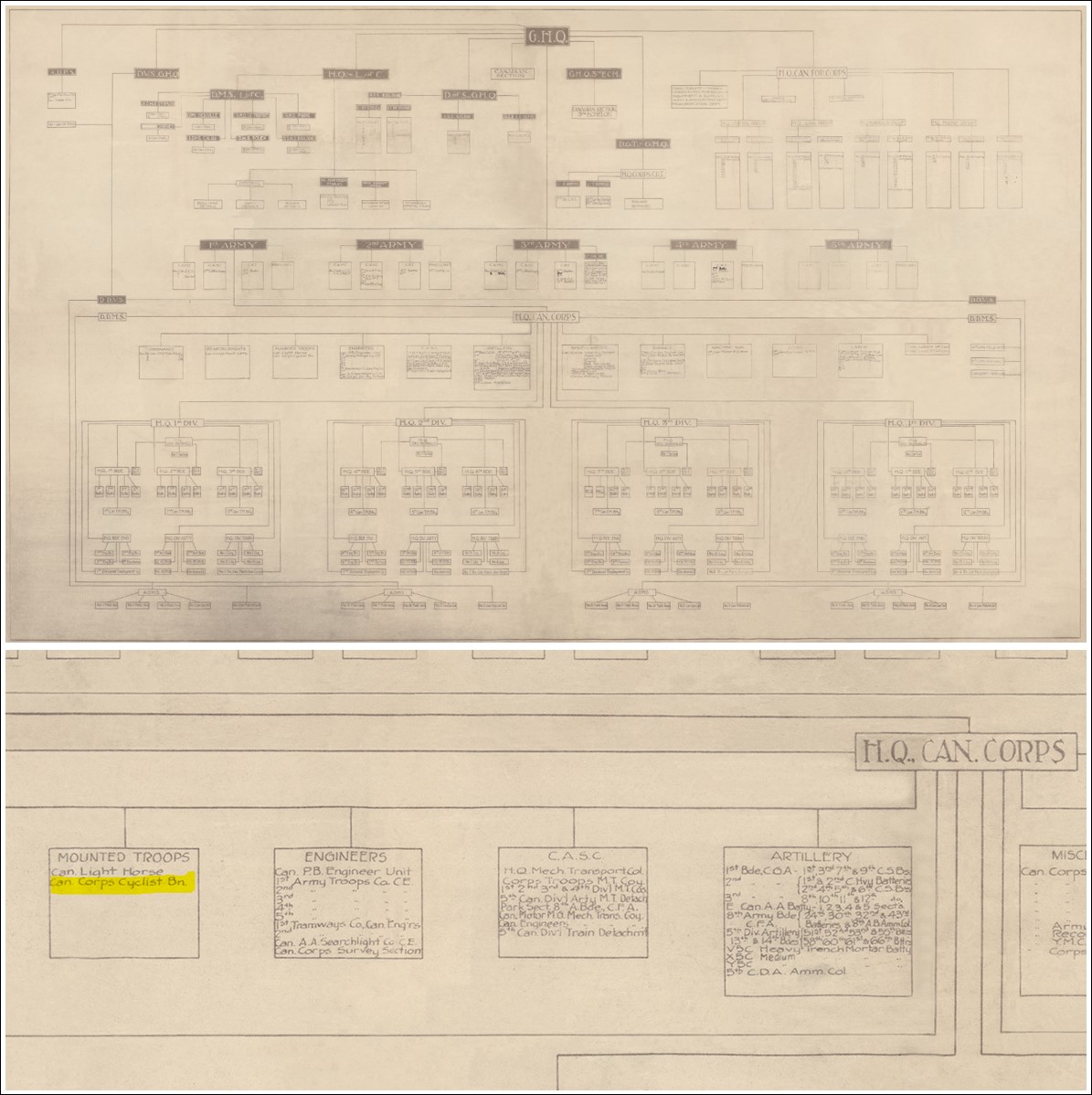
Two screenshots of a chart made for the organization of the Canadian Expeditionary Force (CEF) in 1918. The first chart outlines the hierarchy of the CEF during 1918 via chains of command. The second screenshot is from the same chart but highlights where the Canadian Corps Cyclist Battalion falls within the hierarchy.

Two screenshots of the 1918 Canadian Expeditionary Force organization chart. Full chart is displayed on top and the section which highlights the Canadian Corps Cyclist Battalion below. (Government of Canada website)

Although the cycling units were actively involved in the war, they first needed to be trained. LAC has a variety of videos on YouTube focusing on the Canadian military, including one that features some of the training aspect of the cyclist units titled The Divisional Cyclists : A Glimpse of a Day’s Training (1916).

The video demonstrates the importance of many topics, such as the more mundane aspects of military life (like laundry), while also shedding light on more crucial elements of training, such as drills, signalling and reconnaissance.
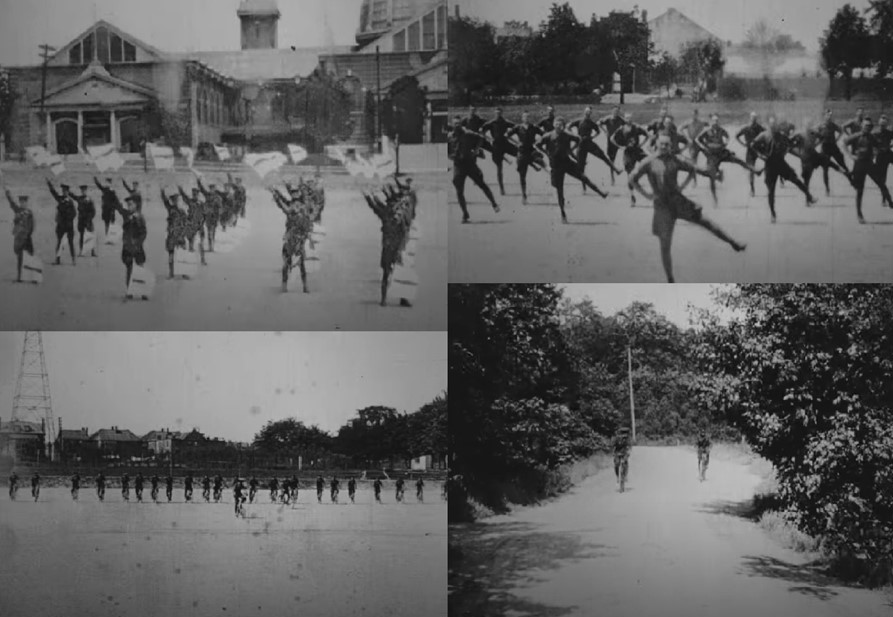
Four scenes from the film The Divisional Cyclists : A Glimpse of a Day's Training (1916). Top left features men in synchronization performing signalling drills with flags. Top right shows soldiers performing light aerobic exercises. Bottom left shows soldiers biking in unitary fashion along one another. Bottom right includes two men biking in a reconnaissance drill in a forest.

Four scenes from the video The Divisional Cyclists : A Glimpse of a Day’s Training (1916) demonstrating signalling, drill and reconnaissance training initiatives. (ISN 285582)

Once the cycling units had completed their training, they could partake directly in the war efforts. Our hardworking biking men-at-arms were no strangers to conflict, and they were part of some of the most notable battles of the First World War such as Ypres and Vimy. The following entry below from a war diary by the 1st Canadian Divisional Cyclist Company covers the horrific aspects of the battle of Ypres and how the division was involved on April 22nd, 1915, near Elverdinghe:

Terrific bombardment started on the front immediately EAST of here about 4:30 P.M. The whole line appeared to be enveloped by cloud of greenish smoke. At 6:30 P.M. requested arrival of many stragglers of the South African troops from the first line trenches all in a state nearing on collapse complaining of a new and deadly gas which had been wafted from the enemy’s trenches by a gentle NORTH-EAST wind, orders were given to D.M.T. to “stand-to.” At 7:15 orders came from DIV. H.Q. to proceed with all possible speed to there, which place was CHATEAU DES TROIS TOURST. Cyclists were ordered to “stand to” on the avenue leading to the ELVERDINGHE – YPRES road. Communication being down with various infantry, and artillery units of Division H.Q. from time to time asked for orderlies from the cyclists to report to different BRIGADE H.Q. as despatch riders. At 10:10 P.M. LIEUT. CHADWICK and No 1 Platoon were sent on a reconnoitering patrol on our immediate front across the canal. Corpl WINGFIELD with his section was despatched as a reconnoitering patrol behind the trench lines on our left.
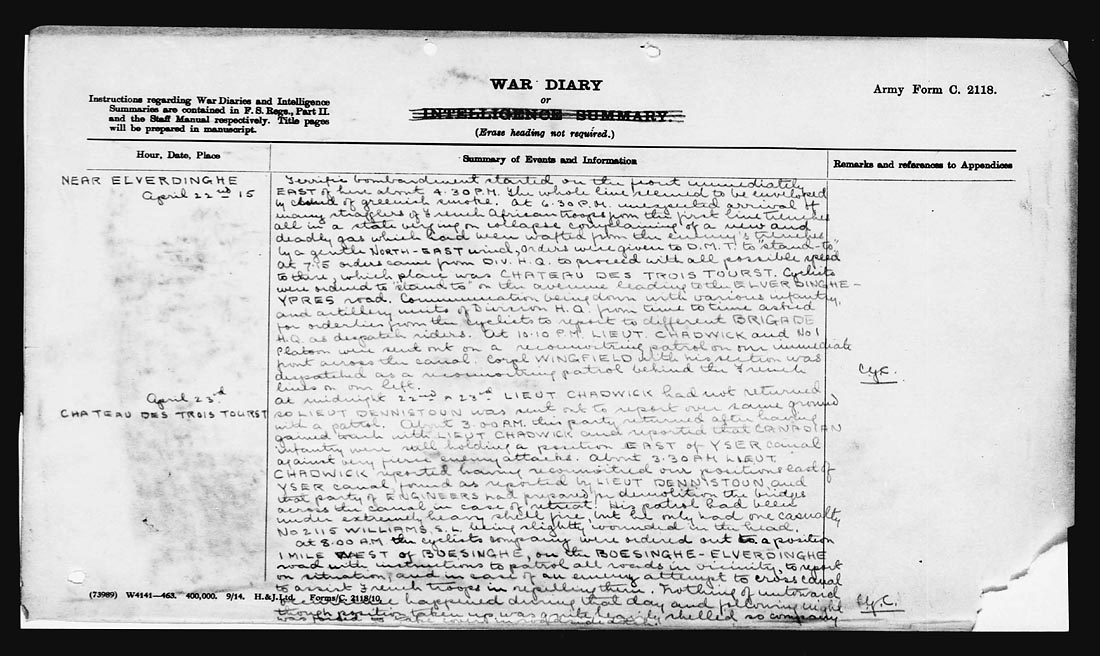
 

Screenshot of the war diary that was shared directly above.

Screenshot of War diaries – 1st Canadian Divisional Cyclist Company / Journal de guerre – 1re Compagnie divisionnaire canadienne de cyclistes. (e001131804, image 53)

The entry highlights the chaos of war and the hardships that many men suffered on that fateful day in April 1915. It also shares some of the more haunting aspects of the First World War, such as the use of gas described as green clouds of smoke. Additionally, it provides insight into some of the main tasks accomplished by the cyclists including communication, acting as despatches and reconnaissance.

The cyclist divisions continued to expand during the war and, as highlighted earlier, an entire battalion was eventually formed called the Canadian Corps Cyclist Battalion. At LAC, there is an entire sub-series devoted to this battalion that shares further information in the Biography/Administrative history section on how it was formed and eventually disbanded. It reads:

The Canadian Corps Cyclist Battalion was organized at Abeele in May 1916 under the command of Major A. McMillan, and was formed by amalgamating the 1st, 2nd, and 3rd Canadian Divisional Cyclist Companies. The battalion was demobilized at Toronto in April 1919 and was disbanded by General Order 208 of 15 November 1920. In Canada Cyclist Companies advertised for recruits “possessing more than average intelligence and a high standard of education.” (MIKAN 182377)

By viewing the lower-level descriptions from this sub-series, one can see records that pertain to the battalion. The sub-series includes a variety of topics such as a training syllabus of the reserve cyclist company and statements by Canadian prisoners of war (among others).
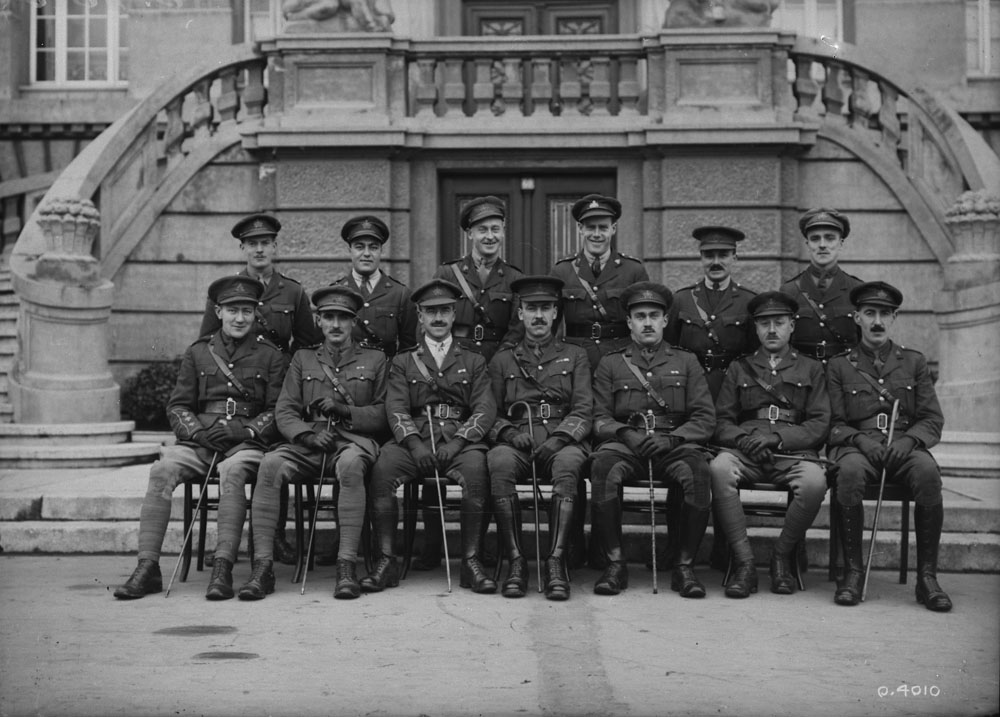
A black and white photograph of thirteen officers in uniform who served the Canadian Corps Cyclist Battalion taken in January 1919. Seven men sit on chairs in front of six men standing behind them.

Photograph of officers in the Canadian Corps Cyclist Battalion from January 1919. (PA-003928)

The Canadian cyclist units were no slouches, and they had a definitive impact on the war effort by facilitating reconnaissance, communication, signalling and direct combat. It is impressive to think that these men, who used very archaic forms of bicycles were able to tread the perilous terrain of Europe during the First World War to accomplish their duties while I, using a much better modern bike, complain about having to bike up a small hill on my way to work. It shows how much determination and bravery the men within the cyclist units of the Canadian military exerted during the First World War.

Additional Sources


Dylan Roy is a reference archivist in the Access and Services Branch at Library and Archives Canada.

Guide to DIY personal military displays

Version française

By Sacha Mathew

Did you know that you can easily make your own military heritage display by using the tools and digitized records found on the Library and Archives Canada website? Using the display we presented at a recent event as an example, I’ll show you step-by-step how you can make your very own display at home or at school.

Library and Archives Canada held a hugely successful Open House event in May, welcoming more than 3000 visitors to our Gatineau facilities and allowing them to enjoy an opportunity to view treasures in our vaults.

This small display of photographs and textual documents from our military collection was very popular. It had a personal touch, and many visitors asked us how we selected the records to display.

Overhead view of glass display case containing military photos and textual documents.

Military display used during LAC Open House event. Image courtesy of Alex Comber, archivist.

Your display can easily be tailored to present a person, an anniversary or a specific military unit. In our case, we wanted to highlight the 100th anniversary of the Royal Canadian Air Force (RCAF) taking place this year. That was our starting point.

Next, we needed to narrow our focus to make it easier to tell a story. Records give facts, but they don’t tell a story — that’s where interpreting the records comes in. Since the event was in Gatineau, we thought the public would be interested in exploring the personal stories of servicemen from the local area. We started by choosing the 425 “Alouette” Squadron, an RCAF unit. This is a French-Canadian bomber squadron established at the outbreak of the Second World War. By researching the 425 Squadron personnel roster and cross-referencing it with a list of RCAF casualties provided by the RCAF Association, we were able to find two local airmen: one from Montreal and the other from Ottawa.

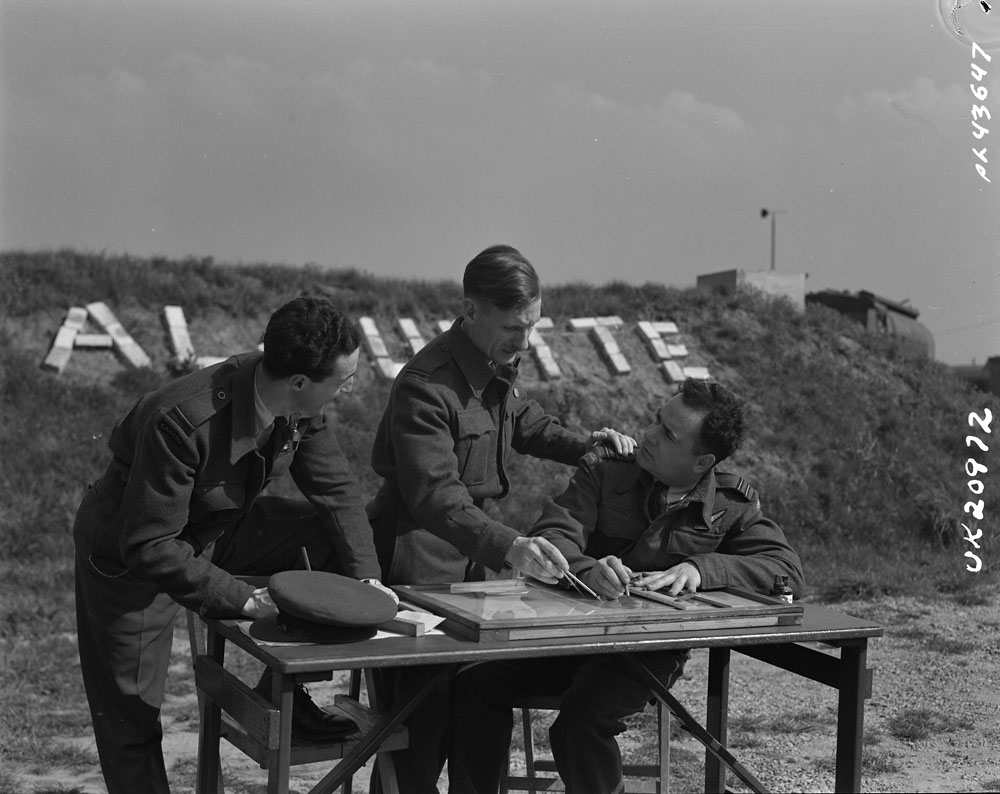
By an English airstrip, three Air Force officers planning while looking over a table with maps.

Pilot Officer J.W.L. Tessier; Pilot Officer J.A. Longmuir, DFC (Distinguished Flying Cross) of the Royal Air Force, attached to the Alouette squadron as Bomber Section Training Officer; and Flight Lieutenant Claude Bourassa, DFC, Commander of the French-Canadian squadron’s bomber section. 425 Squadron. 24 April 1945, PL-43647, e011160173.

For our display, we looked for specific individuals to feature in our display, which can also be done for local service members from your community or school. Choosing an individual is even easier if you are making a display for a family member, since you may already have someone in mind.

Once you’ve chosen an individual, you may look for their military personnel file. This file provides a tremendous amount of information and includes personal details (ever wonder what your great-grandfather’s address was in 1914?). The file can be easily found on the LAC website. However, it should be noted that not all records are open to the public and available online. All personnel files for the First World War are open and have been digitized (First World War Personnel Records), but only “War Dead” files are available online for the Second World War. “War Dead” refers to members that died during the war (Second World War Service Files – War Dead). Other Second World War and post-Second World War service files can still be obtained, but they must be requested through an Access to Information and Privacy request (Records you may request).

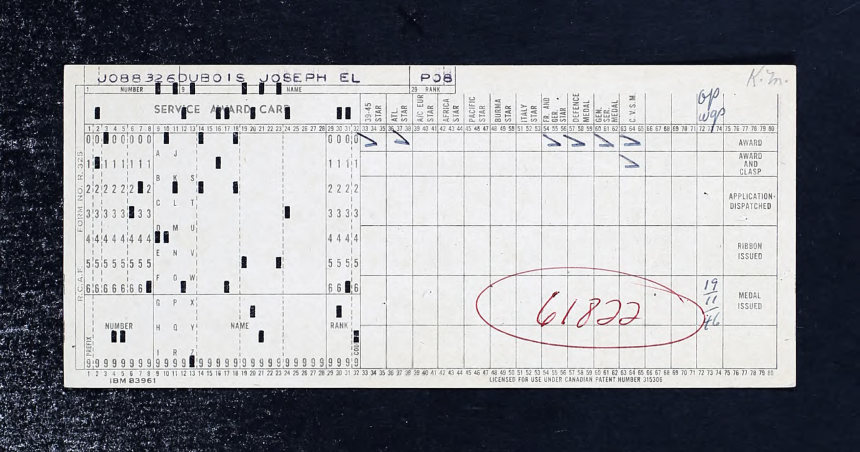
Now that you have the service file, you can decide what you want to display. For our display, we were limited by the size of the display case. If you have more space, you can pick as many documents as you like. You’ll find a variety of documents in the service file. For our airman, Pilot Officer (PO) J. Dubois, we selected a few documents that we found interesting: a letter of recommendation from his employer (T. Eaton & Co), his attestation papers, his medal card, his pay book, official correspondence with his parents in French and the report on his death. You can scroll through and read the digitized service file, then choose what you’d like to feature. Please remember to cite your sources, including reference numbers for archival documents.

As mentioned, interpreting the records you find can help you tell a story rather than just display your research. In the case of PO Dubois, we looked to his squadron records from the day he died, and we were able to better understand the circumstances of his final flight. Each of the three services has an official unit journal of their daily actions. They are called “War Diaries” for the Army, “Ship’s Logs” for the Navy and “Operations Record Books” for the RCAF. The personnel file gives you biographical information, and the unit journal gives you the context. The journal allows you to understand how the individual fits into the unit’s operations. You would interpret the documents by examining them together, giving you a much broader picture. That picture is the story, which you could write up or present orally.

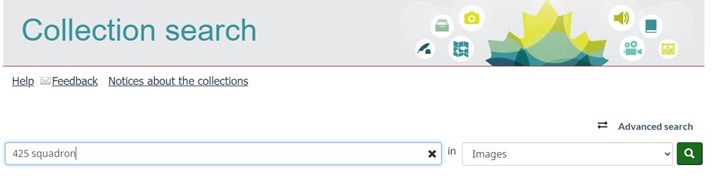
The only thing remaining is to add some photos to make the display more visually compelling. You may find the member’s photo in the service file, but this is not common for files from the World Wars. To find photos, I suggest setting Collection Search to “Images”. Here you can search by the unit designation and choose a few photos that are appropriate to the time frame that you are looking at. For our display, we easily found a few photos of 425 Squadron in England during the 1940s. Like the textual documents, it is important to give accurate photo credits for any photographs used in your display.

A screen capture from the LAC website showing the search bar set to “Images”.

Collection Search, LAC website.

By using the tools and resources from LAC’s online collection, you can make your own custom display for an individual or for a unit. It’s your choice how you’d like to present your display: you can print copies of documents and photos to make a framed display or scrapbook, or you can make a digital presentation. Making a display is an excellent way to connect with ancestors by learning about their lives, and it allows people to explore Canadian military heritage in a personal way. It is also an excellent research exercise and would prove a wonderful Remembrance Day project for young students.


Sacha Mathew is an archivist in the Government Archives Division at Library and Archives Canada.

Accessing Personnel Records of the First World War: A new database at Library and Archives Canada

Version française

By Richard Yeomans

On August 4, 1914, Britain formally declared war on Germany, a decision that brought Canada into the theatre of conflict in Europe because of its status as a dominion within the British Empire. Though the Dominion Government could decide the extent of its involvement, Prime Minister Robert Borden declared in a speech to the House of Commons on August 19, 1914, that Canada would “stand shoulder to shoulder with Britain and the other dominions in this quarrel. And that duty we shall not fail to fulfill as the honour of Canada demands it. Not for love of battle, but for the cause of honour.” More than half a million Canadians enlisted in the Canadian Expeditionary Force (CEF) between 1914 and 1918, including volunteers and conscripts, while thousands more found ways to contribute to the war effort on the home front.

There are roughly 622 000 individual First World War service file records held by Library and Archives Canada (LAC), which document enlistment (attestation), movement between units, medical histories, pay and discharge or notification of death. These files are generally between 25 and 75 pages in length and are excellent sources for many different types of historical and genealogical research.

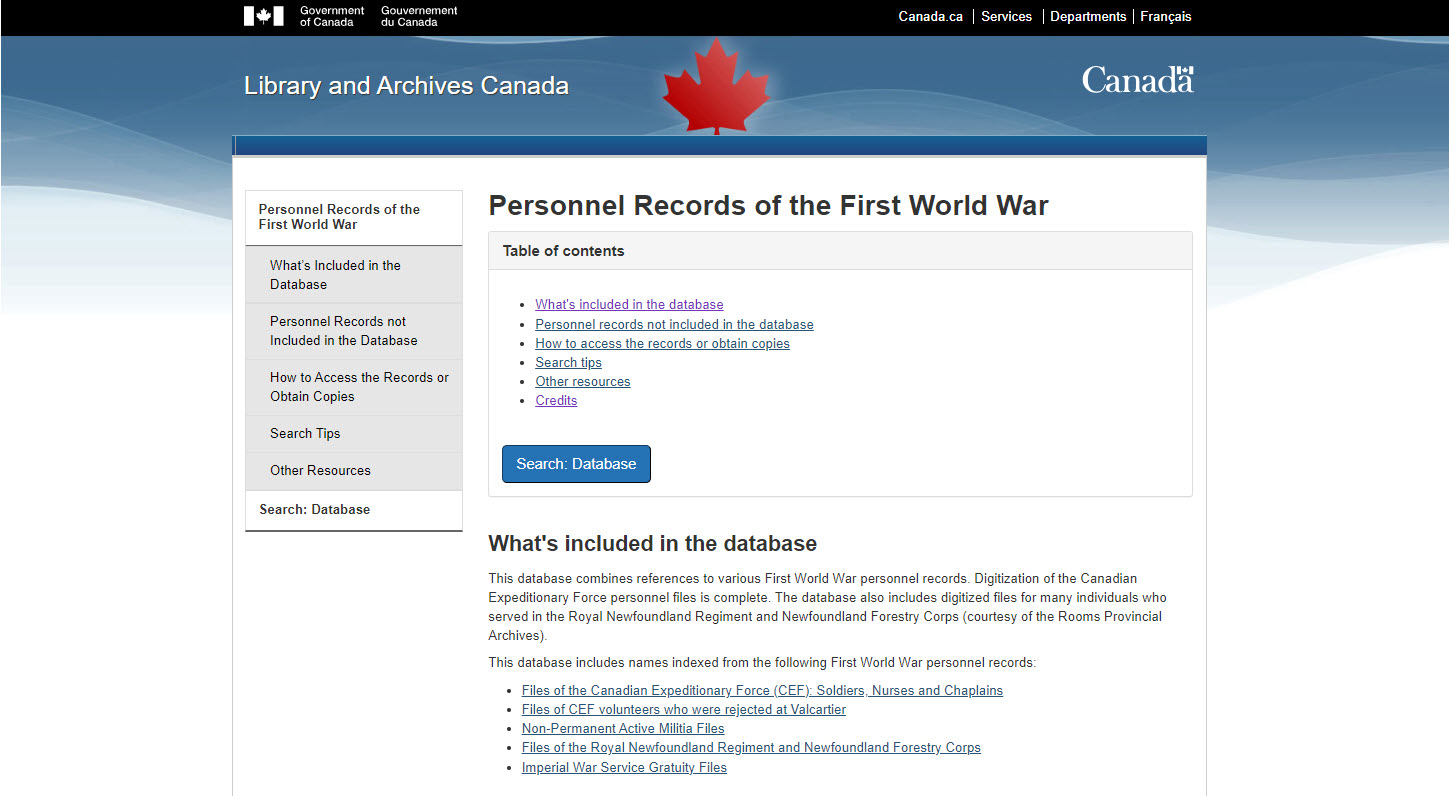
Screenshot of the original Personnel Records of the First World War page on Library and Archives Canada’s website.

Original Personnel Records of the First World War database (Library and Archives Canada).

Access to the Personnel Records of the First World War database at LAC has been available for free online for nearly two decades via a standalone Personnel Records database. This database incorporated CEF files with Imperial Gratuities, Non-Permanent Active Militia, Rejected CEF Volunteers, and Royal Newfoundland Regiment and Forestry Corps records. Researchers familiar with this older database were able to search the archives by first and last names, regimental numbers, city or province of birth and/or enlistment and box number. Results were displayed in alphabetical order but could be reordered by date of birth, rank or regimental number.

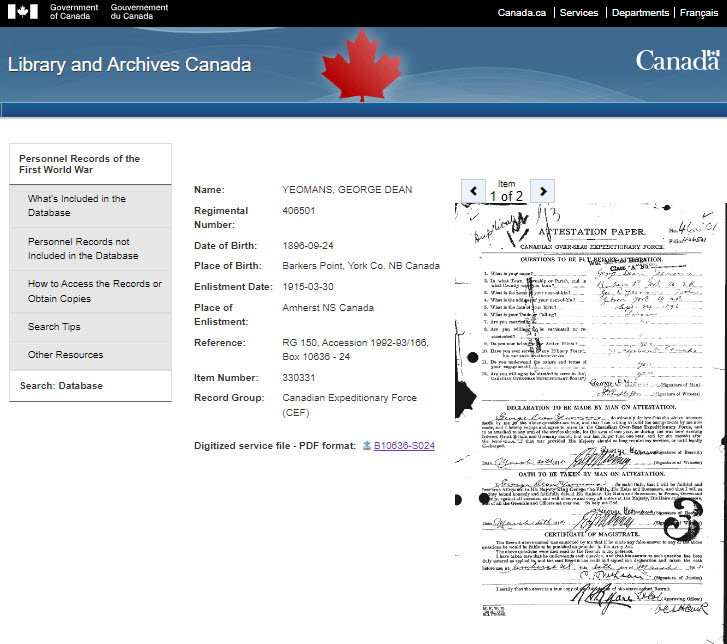
Selecting an individual file from the results list provided a generic description of the record and included a digitized copy of the service file in PDF format that could be either opened and read or downloaded and saved to your computer. Every service file had a unique web URL, which historical researchers and genealogists alike could copy or save to easily access later.

Screenshot of an individual file view in the Personnel Records of the First World War database on Library and Archives Canada’s website.

Individual file view in the original Personnel Records of the First World War database (Library and Archives Canada).

For 10 years, this database provided Canadians at home and across the globe with access to a collection of records that document an important part of their family histories and connections to a shared national history. Library and Archives Canada is committed to maintaining and expanding that level of access as we continue to develop and improve upon our digital archival databases including Collection Search, Census Search and our new First World War Personnel Records database.

Launched in November 2023, this new database was developed as part of ongoing work to bring all of LAC’s standalone databases into one federated search tool, Collection Search. This work is necessary because the older web application that hosts the standalone CEF database is no longer sustainable to maintain. To keep these records accessible for years to come, these files were successfully migrated into Collection Search and a new database tool was created to streamline access to the Personnel Records of the First World War. This database tool offers all the same search features as the original application while also offering new ways to search, filter and extract records and data for research.

Screenshot of the new First World War Personnel Records database on Library and Archives Canada’s website.

New First World War Personnel Records database (Library and Archives Canada).

Researchers may search the new database by using first and last names, regimental number, enlistment city and province, or by using specific terms including unit number and enlistment date.

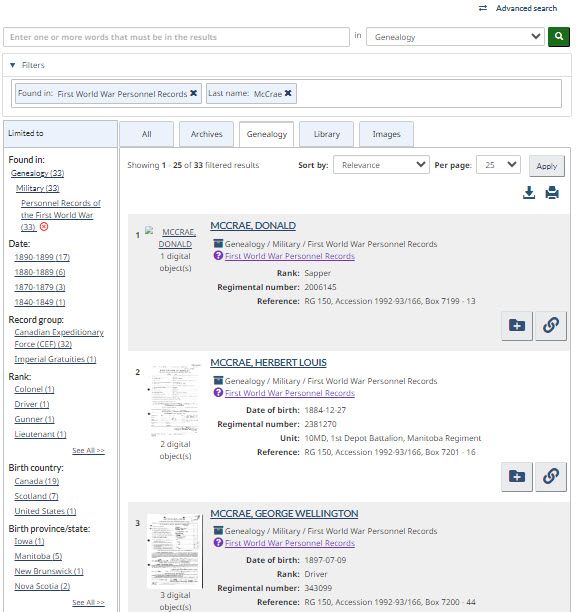
New features include the ability to search by date range, to save records of interest to your My Research using your LAC My Account and to apply filters during your search to help organize and limit the number of record results listed. It is important to note that both databases will provide you with the same number of search results based on similar search criteria. For example, searching the last name McCrae in either database will produce 33 different search results that you may select from. However, in the newer Personnel Records database, you can reduce the number of results using a variety of limiter options located on the search results page. These limiters include information such as military rank, date range for year of birth, birth country or different enlistment geographic options.

Screenshot of the search results for the last name McCrae on Library and Archives Canada’s website.

Search results for last name McCrae (Library and Archives Canada).

Applying these limiters will generate a reduced list of results that is more specific and refined according to the search parameters that you control. Because you control the search criteria, it is possible to perform both extremely specific and very general searches using the new Personnel Records database.

Finding Lieutenant-Colonel John McCrae

Accessing attestation papers and personnel records available online, for free, through LAC remains an important staple within our digitized archival catalogue. For example, researchers can access digitized archival records using the personnel records of Lieutenant-Colonel John McCrae, the Canadian physician and poet best known for authoring the war memorial poem “In Flanders Fields.”

Lieutenant-Colonel McCrae’s records may be found in several different ways, including searching by his first and last name, unit number, city of enlistment, or regimental number. Even just a name is a good starting point. Searching the last name McCrae yields 33 results in both the old and the new database, while searching for John McCrae generates 4 results.

Side by side screenshots of the search results for John McCrae in both databases on Library and Archives Canada’s website.

Search results for John McCrae in either database (Library and Archives Canada).

From the list of results, displayed above in both the old and new CEF databases, researchers can also view a general abstract about the file that includes (if available) regimental numbers, date of birth and archival reference information. In the older CEF database, this information could also be used to reorganize the list view of records. In the new database, it is still possible to reorganize results by date of birth or alphabetically, but unlike in the older database, you can reduce the number of results in the list view using the filters available. In this instance, we know that the John McCrae who penned “In Flanders Fields” was born in Guelph, Ontario, and we can select that option located under “Birth City” on the left-hand side of the results list. Doing so will generate a new list, now filtered to only one result that we can open and view.

Screenshot of the viewing tool showing the personnel record of John McCrae on Library and Archives Canada’s website with arrows pointing to specific parts of the image.

Viewing the personnel record of John McCrae (Library and Archives Canada).

Opening a record in the new CEF database looks different but still retains the functionality of the original database. The first page of the attestation paper will display, by default, on the screen as shown in the image above.

Green Arrow: In the image carousel below the attestation page, you can navigate between the pages of that record. At the end of the image carousel is a PDF icon. Selecting the icon will load a scan of the entire personnel file, which includes a copy of the attestation paper. This file may be downloaded, for free, as it was in the original database.

Black Arrow: If you have a LAC My Account, you can save records of interest to a research list. Clicking the “Add to My Research” button while signed into your LAC My Account will generate a list of your current save folders that you may select and add to, or you may create a new folder and add the record. Previously, researchers had to copy and save internet URLs to quickly access the records they viewed. Using the My Research feature of LAC’s My Account, you may now build entire research lists with records held at LAC, like a bibliography.

Yellow Arrow: To download the file in its entirety, simply click the download button, check that you agree to our copyright terms and conditions and select “Download file.” The record will then be downloaded to your computer or electronic device in PDF format.

Behind the scenes: Digital Access Services

Maintaining consistent and sustainable online access to the records that document the Canadian experience during the First World War presents many challenges. Building a database tool that can serve not only historians and genealogists but also individuals with limited experience using online archives is a balancing act. Creating a tool that can meet the needs of many kinds of researchers begins by asking how researchers experience LAC online and what products we can develop or adjust to improve that overall experience. Improvements to our digital products, such as the new First World War Personnel Records database, are ongoing and responsive to the feedback that we receive from users. If you wish to submit feedback about how we can improve the new First World War Personnel Records database or other digital products currently offered by LAC, please consider emailing your suggestions to the Digital Access Services team or scheduling a feedback session with our UX Designers. LAC’s Digital Access Services team is committed to preserving access to digitized military personnel files and recognizes the significance of these documents to researchers here in Canada and around the world.

The Digital Access Services team is comprised of User Experience Designers, Data Scientists, Web Programmers and Product Managers. The members of our team are also experienced genealogists, historians, historical researchers, archivists, and client-focused public servants who are likewise stakeholders in the preservation and promotion of Canada’s history and heritage. Maintaining free and public access to the roughly 622 000 individual First World War service files in addition to millions of census records, immigration and citizenship records, government publications such as the Canada Gazette, audio files, images, and so much more is a huge job. It is a task that requires time, patience, and more than a little bit of teamwork. Nevertheless, our work continues, and the Digital Access Services team looks forward to bringing new research tools and updates in 2024.

FAQ about Library and Archives Canada’s CEF records and databases

Why is the older First World War Personnel Files Database being decommissioned?

The original database is fast approaching being 10 years old. The platform that hosted the database, Microsoft SharePoint, was first released in 2001 and is becoming more obsolete as time goes on. This means that it will become more difficult for our Web Designers and Programmers to maintain the original database and we risk losing access to the military personnel records altogether. Library and Archives Canada’s Digital Access Services team has been proactive and began migrating records into Collection Search in 2019. This way we can preserve free and public access to these and other records for years to come.

Who oversees the new First World War Personnel Records database?

The Digital Access Services team at LAC is responsible for the maintenance of LAC’s online databases, including Collection and Census Search. Our team does not alter or edit archival documents. Rather, our work focuses on access to the digitized copies of records.

Is the First World War Personnel Records database distinct and separate from Collection Search?

Yes and no – the new database pulls records that have been migrated into Collection Search, which is LAC’s federated archival catalogue search tool. Digital Access Services continues to migrate records from other older standalone databases into Collection Search, while also acknowledging that many users have more specific research needs. Using database filters, or by creating search forms such as the new First World War Personnel Records database, we can streamline access to specific groups of records as if the standalone databases still exist within Collection Search.

Will internet URLs to the older database stop working? 

No – using URL redirects, saved internet links to specific files will redirect users to the location of that specific record within Collection Search. This means that if you have a collection of saved links to the location of specific military service files in the older application, you can still use those links to locate those records in the new application.

Am I still able to save and download service files?

Yes – the option to download PDF formatted copies of attestation and personnel files is available. Users with a LAC My Account may also save records to their My Research and create entire lists of service records that can be retained without the need to saving an internet URL link.


Richard Yeomans is the Quality Assurance Officer on the Digital Access Team – Access and Services Branch at Library and Archives Canada.
“Are You Fit, Soldier?”: Fitness in the CEF during the First World War

Version française

By Dylan Roy

Are you fit, soldier? Do you have what it takes to make it in the Canadian Expeditionary Force (CEF)? War is upon the world since 1914, and we need brave young recruits like yourself to take up the mantle of freedom and fight for the Crown!

However, before you can join the fight, we need to ensure that you are ready for the arduous rigours of battle! I do not say that lightly; it will be a gruelling task. Are you up for it?

To get you in shape, we need you to exercise regularly. However, the Special tables. Physical training note that “Exercises if correctly performed strengthen and stimulate every portion of the body. Some are harmful if correct positions are not assumed.” So remember, not only do you need to exercise, but you need to do it properly for it to be effective.

To get you in gear whilst carrying your gear, we need you to carry out the following exercises.

First, we need to train you how to stand at attention. Although it may seem like a simple thing, you must avoid two main faults: do not slouch back nor lean too far ahead. We need you straight and narrow. If you can first properly stand at attention, you are well on your way to being a disciplined soldier. For visual cues, consult the picture below:

Guide with two figures in incorrect positions of attention and two figures in correct positions of attention.

Guide on how to stand at attention (MIKAN 3831498).

Marching effectively is a fundamental aspect of any soldier worth his salt. However, one cannot simply march around willy-nilly. There needs to be structure and order in the way a soldier marches. The image below shows how to execute both a proper march and jump within the CEF’s principles:

Guide with three figures showing how to slow march, double march and upward jump.

Guide on how to properly march and jump within CEF’s principles (MIKAN 3831498).

Now that we have the fundamentals in order, we need to show you how we are going to make you true soldiers who can overcome the numerous obstacles that await you on the other side of the pond. This requires strength, agility and flexibility, and there are numerous exercises that will test such abilities.

“On-the-hands” exercises will allow you to rise up from a prone position. This is essential in warfare as taking cover and recovering from the prone position is crucial to success during battle. It could also be the determining factor between life and death.

Leg raises will test your core muscles as well as your upper body and legs. All these muscles work in conjunction with one another to facilitate full-body movements. A good soldier needs to be able to contort and control his body in many ways in order to execute both simple and complex actions.

Leg raises are great exercises as they can be performed in a variety of ways. You can do a sideways one-handed leg raise; a two-handed variation with the trunk facing the floor; and, finally, leg raises with your back on the ground. Remember, the core is the connector of both the arms and legs, and it therefore needs to be strong and flexible!

Below you will find examples of on-the-hands movements and leg raises, as well as the trunk backward-bend, which aids in flexibility. All these exercises will help to ensure both your safety and that of your comrades-at-arms while in battle!

Guide with five figures showing exercise positions of on the hands, on the left hand turn with leg raised, on the hands with leg raised, trunk backward-bend and right leg raised from lying on back with arms raised upward.

Guide of leg raise exercises and trunk backward-bend (MIKAN 3831498).

Where would the CEF be without the speed and agility of its soldiers? One way to ensure quick speed is through strong legs. To make a powerful lower body, train it! Exercises like heel raises and knee bends will strengthen the multitude of leg muscles necessary to run, sprint, march, jump, dip, duck, dodge and dive. Fortify them and you in turn fortify yourself! For examples of these two critical movements, see the picture below:

Guide with five figures showing position of closed, open and full open feet, heel raises and knee bends.

Guide on how to build strong legs (MIKAN 3831498).

Where would the legs be without the arms? We need strong soldiers who can lift their share and shoulder the burden that is sure to surface during the war. One of the best types of exercises to improve the strength of the arms is heaving exercises. As the Manual of physical training explains, “Heaving exercises are those in which the body hangs by the hands from some apparatus, either without other support or with the weight partially taken by the feet.” To see examples of heaving exercises, consult the image below:

Guide with eight figures showing the proper positions of pull-ups and one figure showing the incorrect way to do a pull-up.

Guide on how to improve arm strength through heaving exercises (MIKAN 3831502).

To conclude, we need soldiers who can not only face the hardships of war but who can overcome them. To do so requires strict discipline, obedience and regimentation. So what say you, soldier, are you fit enough to join the CEF?


Dylan Roy is a Reference Archivist in the Access and Services Branch at Library and Archives Canada.

Far in distance, but near at heart: the thorny issue of Canadian war graves

By Ariane Gauthier

Many Canadian war graves and military cemeteries have been established around the world, as a result of the conflicts in which Canada has been involved since Confederation (1867), from the Boer War (1899–1902) in South Africa to the conflict in Afghanistan (2001–14).

Three graves of Canadian soldiers who died in the Boer War (1899–1902).

The graves of soldiers Elliott, Laming and Devereaux, killed in the South African War (e006610211).

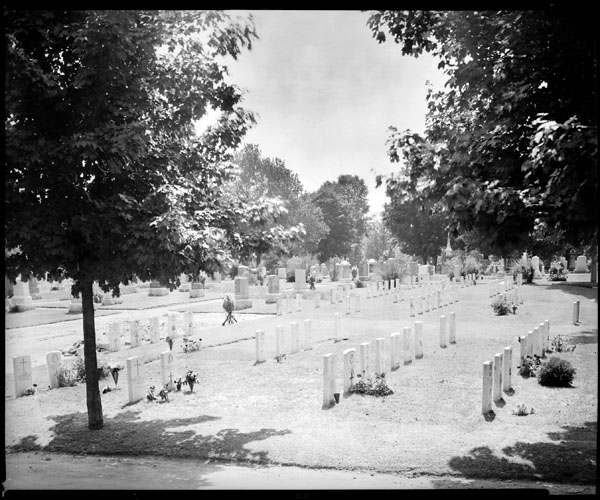
Photo of military cemetery in Ottawa, Ontario, taken by renowned photographer Yousuf Karsh on August 13, 1934.

Colonel H.C. Osborne, war graves (e010679418_s1).

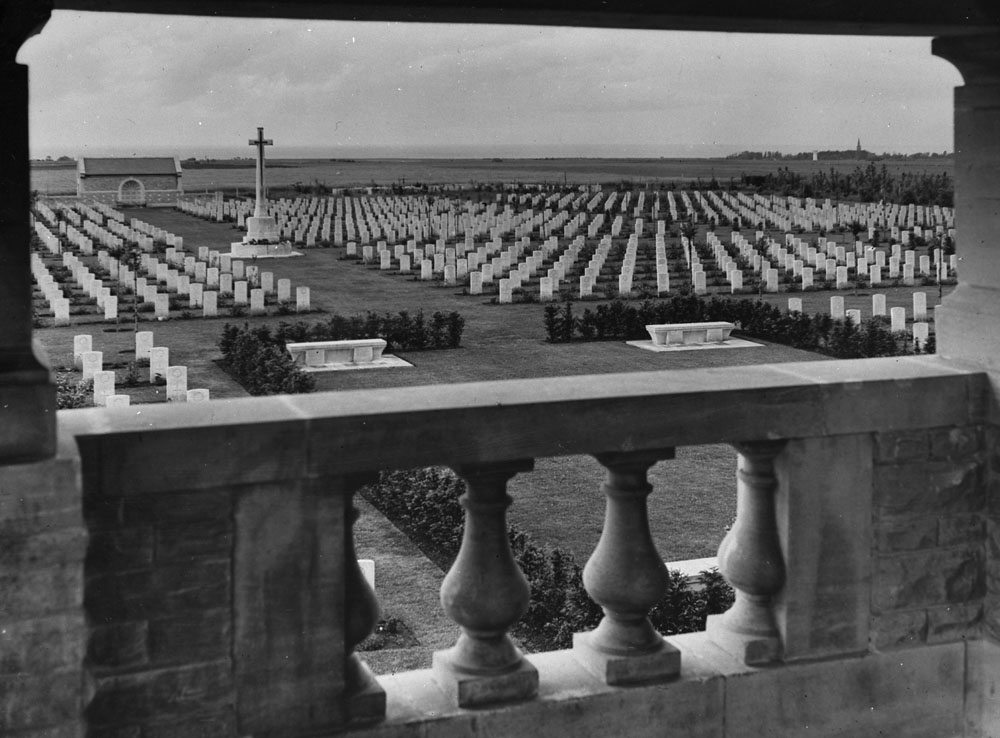
The Canadian cemetery at Bény-sur-Mer in France, where Canadian soldiers who lost their lives during D-Day and the Battle of Normandy in 1944 are buried.

Canadian military cemetery at Bény-sur-Mer, France (e011176110).

The Canadian cemetery in Agira, Italy, where Canadian soldiers who died during the Sicily campaign in 1943 are buried.

Canadian cemetery in Agira, Sicily (e010786150).

War cemetery in Japan, where Canadian soldiers who were killed during the Korean War (1950–53) are buried.

Mrs. Renwick lays a wreath on behalf of Canadian mothers and wives on Remembrance Day in Japan (a133383).

Have you ever wondered why so many Canadian families allowed for the final resting place of their loved ones to be where they fell in combat?

Quite simply, because it was the only option—at least, initially.

To understand, we must delve into the context of the First World War, the first mass industrial war. The technological and military advances of the modern era caused skyrocketing mortality rates. As a result, the British Empire had to manage the rapid recruitment of reinforcements in addition to the thousands of deaths in a war where the repatriation of bodies was practically impossible if not discouraged. It was dangerous to search for remains in active combat zones, and moving so many corpses could easily have led to worldwide epidemics. That said, the door remained open to changing the status quo once hostilities were over. On May 10, 1917, the Imperial War Graves Commission was created by Royal Charter, with a mandate to look into the issues of deceased soldiers and war cemeteries for the entire British Commonwealth.

Text document dated May 10, 1917, written by J.C. Ledlie, from “At the Court at Buckingham Palace, Present, The King’s Most Excellent Majesty in Council.”

War Office (United Kingdom) – Imperial War Graves Commission – Charter (MIKAN 1825922).

There was no consensus among families regarding the question of cemeteries being maintained in perpetuity. Lively debates about the war graves issue took place in many parliamentary institutions. Speakers appealed to the humanity and compassion of politicians, so that the families of fallen soldiers could bring home the bodies of their fathers, brothers, husbands or sons, and in some cases, their sisters and daughters. However, no petition could change the verdict issued by the Imperial War Graves Commission:

Two-page text document explaining that the repatriation of soldiers’ bodies is not permitted.

War Office (United Kingdom) – Imperial War Graves Commission – Refusal to permit removal of bodies from countries in which they are buried (MIKAN 1825922).

“To allow removal [of war dead] by a few individuals (of necessity only those who could afford the cost) would be contrary to the principle of equality of treatment; to empty some 400,000 identified graves would be a colossal work, and would be opposed to the spirit in which the Empire had gratefully accepted the offers made by the Governments of France, Belgium, Italy and Greece to provide land in perpetuity for our cemeteries and to “adopt” our dead. The Commission felt that a higher ideal than that of private burial at home is embodied in these war cemeteries in foreign lands, where those who fought and fell together, officers and men, lie together in their last resting place, facing the line they gave their lives to maintain. They felt sure (and the evidence available to them confirmed the feeling) that the dead themselves, in whom the sense of comradeship was so strong, would have preferred to lie with their comrades. These British cemeteries in foreign lands would be the symbol for future generations of the common purpose, the common devotion, the common sacrifice of all ranks in a united Empire. […]”

This decision ensured that Canadians who had died overseas during the First World War remained on those fields of honour. The cemeteries that were built in their memory can still be visited today; they are maintained by the Imperial War Graves Commission, now the Commonwealth War Graves Commission. On July 15, 1970, Canada’s policy on the repatriation of soldiers who had died overseas changed. Order in Council P.C. 1967-1894 stated that the family of a soldier killed in action on or after that date could request his or her repatriation for a funeral. The loved ones of deceased service members can now have them brought home.

Additional resources


Ariane Gauthier is a reference archivist in the Access and Services Branch at Library and Archives Canada.
Indigenous Peoples in the First World War: researching forgotten veterans

On the left of the graphic, Tatânga Mânî [Chief Walking Buffalo] [George McLean] in traditional regalia on horse. In the middle, Iggi and girl engaging in a “kunik”, a traditional greeting in Inuit culture. On the right, Maxime Marion, a Métis guide stands holding a rifle. In the background, there is a map of Upper and Lower Canada, and text from the Red River Settlement collection.By Ethan M. Coudenys

This article contains historical language and content that some may consider offensive, such as language used to refer to racial, ethnic and cultural groups. Please see our historical language advisory for more information.

Understanding the First World War from the perspective of the Indigenous Peoples of this land has been of paramount importance for many Indigenous researchers, such as myself. Dedicating hours upon hours to research a single Great War veteran is sometimes required just to identify that they were indeed Indigenous. While we have excellent resources about some of the very well-known First Nations, Inuit and Métis Nation service members from that war, there is still much to discover in this realm of historical knowledge.

This post is not meant to convey the story of the Indigenous people who served during the First World War, nor would I attempt to simply generalize the experiences of Indigenous peoples into a single blog post. Instead, I will share the stories of two very different individuals and relate how research techniques can be used to better research an Indigenous person who served in the Great War.

The story of John Shiwak

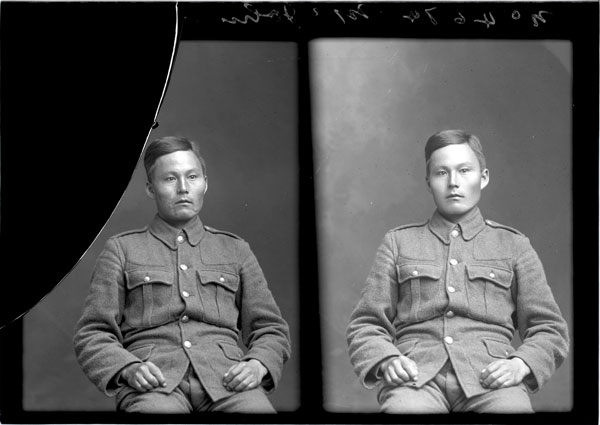
Two side-by-side photos of the same man seated and wearing an army uniform.

John Shiwak, Royal Newfoundland Regiment # 1735. The Rooms, Item E 29-45.

John Shiwak was born in 1889 in Rigolet, Labrador. A member of an Inuit community, he was an experienced hunter and trapper when he enlisted with the First (later “Royal”) Newfoundland Regiment on July 24, 1915. He was still in training when the regiment was sent over the top of the St. John’s Road trench at Beaumont-Hamel on July 1, 1916, the first day of the Battle of the Somme. When Shiwak joined the regiment in France a few weeks later, on July 24, he was one of many who saw the aftermath of the near destruction of the regiment in the 45 minutes that they fought on the Somme battlefield. In April 1917, Shiwak was promoted to lance corporal. Unfortunately, that November, less than a year before the guns fell silent, Lance Corporal John Shiwak met a sad end. In the middle of the battle for Masnières (during the larger First Battle of Cambrai), Shiwak’s unit was struck by a shell, killing him and six others.

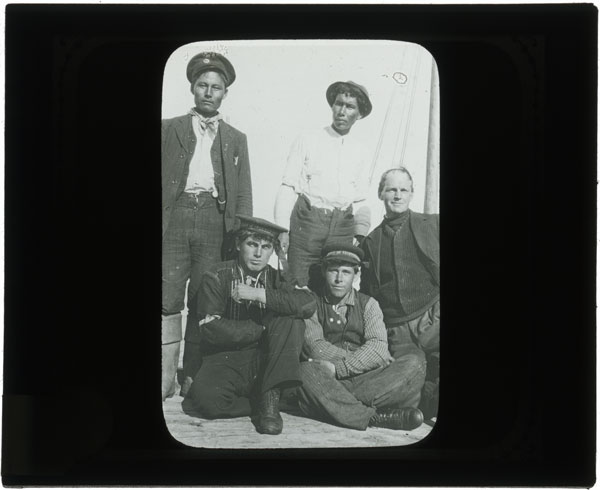
Group of five men standing or sitting.

Members of the Legion of Frontiersmen (before 1915); John Shiwak is standing at the left. The Rooms, Item IGA 10-25.

This story is not uncommon in accounts of the First World War. The Inuk man was killed in the line of duty, in the midst of his brothers in arms. Yet his story is even sadder: until now, the gravesite of Shiwak and those six other brave men were never located. It is theorized that a school was built above the grave, the construction happening without the knowledge that seven soldiers of the Great War were buried there. Nevertheless, as with all casualties without a known resting place, Shiwak is commemorated. His name is forever etched on the bronze plaques at the Beaumont-Hamel Newfoundland Memorial in France, and at a similar memorial in St. John’s, Newfoundland and Labrador.

The story of Angus Edwardson

The story of Private Angus Edwardson is of personal interest to me. He was my great-great-grandfather and fought at Passchendaele. He was born in 1894 in the northern, primarily Algonquin Anishinaabe, community of Lac-Barrière, about 300 kilometres northwest of Ottawa. On his enlistment form, Edwardson stated that he and his family resided in Oskélanéo, Quebec. For a very long time, our family did not know that he was Indigenous, nor did we know about his time in the trenches in any detail.

Luckily, in my line of work, one can discover some very interesting pieces of information. During a search through the 1921 Census, I found information that he was an “ancien soldat” (veteran); I was therefore able to find his attestation papers. While Edwardson’s story is much less noteworthy than that of Shiwak, his story provides an insight into the challenges of researching Indigenous men who fought in the Canadian Expeditionary Force (CEF) and indeed in the British forces as a whole.

Two pages of the attestation papers of Angus Edwardson.

Attestation papers of Angus Edwardson (regimental number 1090307).

In the physical description of Edwardson, the enlistment officer wrote that his complexion was “fair,” his eyes “blue,” and his hair “dark.” This description does not reflect the racial idea of an Indigenous person, nor did the enlistment officer note that Edwardson was First Nations by writing the commonly used term “Indian” under the section of the form entitled “Distinctive marks, and marks indicating congenital peculiarities or previous disease.”

From what we can see in his records, Edwardson was a member of the 253rd (Queens’ University) Highland Battalion, though he served with a number of other battalions and regiments during his time on the front. Notably, while serving with the 213th Battalion on August 28, 1918, he was wounded in the left hand by a bullet.

Challenges facing researchers

As I mentioned, not knowing that a member of the CEF was Indigenous is a major sticking point for researchers. The attestation files may not contain this information at all. In fact, this is very common in the later years of the First World War. Neither of the two men that I have written about have the telltale designation “Indian” on their attestation forms. The only way we can know for certain that these two men were indeed Indigenous is by relying on additional sources.

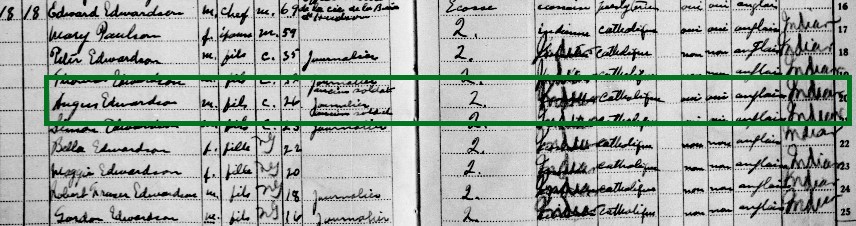
The first of such sources is the often-overlooked census records. The census provides vital information about research subjects, and individual information can greatly increase success in researching Indigenous members of the CEF and the Royal Newfoundland Regiment (RNR). In the case of Edwardson, I discovered that he was in fact Indigenous by looking at his record in the 1921 Census. For Shiwak, there was an entirely different route to finding his identity, which was incredibly difficult. I uncovered information about Shiwak’s ethnic heritage through the memoirs of Sydney Frost, a captain with the RNR, entitled A Blue Puttee at War. This memoir, however, is not the only way to find out that Shiwak was Indigenous.

List of names, ages and genders from the 1921 Census.

Census entry for Angus Edwardson and family, 1921 (e003065155).

Secondary sources about the First World War are numerous. For Shiwak, several appear when simply searching his name, but for other, lesser-known Indigenous members of the CEF, this may be more difficult. The excellent book For King and Kanata: Canadian Indians and the First World War by Timothy Winegard shows how we may be able to improve search techniques for Indigenous individuals and groups that served in the CEF. Though not explicitly, Winegard indicates the role of individual communities and their part in deciding to send men to enlist for the war effort. That said, this effort can be difficult, and it is worth reaching out to local genealogical societies and/or Indigenous communities for help in locating a list of names or simply an idea of how many men served from that community.

The final source of information that is quite useful in these cases is the so-called Indian Registers. These are archival documents with lists of names of members of bands. While the registers are a great resource for those researching members of a specific First Nations band and who are able to visit Library and Archives Canada in Ottawa, there are challenges remaining for those who do not know the band of their research subject or whether their subject died during the war. For individuals researching an Inuk or a member of a Métis Nation community, the challenges deepen, as there is very little primary source material from the period immediately after the Great War. It may be possible to identify Inuit or Métis Nation members of the CEF or RNR through secondary sources, but this can be challenging and take time.

Conclusion

Lance Corporal John Shiwak and Private Angus Edwardson both fought during the First World War. The former was Inuk and the latter was First Nations. The two cases exemplify the many challenges that face researchers when they are looking to find information about members of the CEF or RNR who were Indigenous. These challenges are multi-faceted, and they can pose significant difficulties in research into the stories of Indigenous veterans who fought in the Great War. There are some solutions and resources, including consulting archival records (census records specifically), checking with local Indigenous communities, and accessing some resources specific to Indigenous Peoples at Library and Archives Canada. Nevertheless, these proposed solutions can only go so far in helping researchers find information about Indigenous people who served in the First World War.

Additional resources 


Ethan M. Coudenys is a Genealogy Consultant at Library and Archives Canada. They are proudly of Innu heritage and the descendant of a residential school survivor.

Explore the records of No. 2 Construction Battalion

Version française

By Andrew Horrall

A note to users

Many of these records contain terms that were commonly used during the First World War but are now unacceptable and offensive. The use of these terms by military authorities is evidence of the racism faced by Black Canadian soldiers.

As described in the “Serving despite segregation” blog, No. 2 Construction Battalion was the first and only segregated Canadian Expeditionary Force unit in the First World War. Library and Archives Canada (LAC) has identified and digitized records relating to the unit to make its story, and the individual stories of the men who belonged to it, easy to explore and understand.

A printed form completed by men joining the Canadian Expeditionary Force. The form includes 12 questions about the individual, including name, date of birth and next of kin. At the bottom are a declaration and oath sworn and signed by the man, and a magistrate’s statement and signature confirming that the man had enlisted.

Attestation page for Arthur Bright, Canadian Expeditionary Force, RG 150, Accession 1992-93/166, Box 1066 – 39

Individual experiences

Archival records contain details about the individuals who served in No. 2 Construction Battalion. Each story is unique and evocative.

You can find the men’s individual personnel records by searching their names, or by entering “No. 2 Construction Battalion” in the “Unit” field in our database. Each file has been completely digitized and includes detailed information about the individual’s life, family and military service.

Friends and families serving together

Personnel records can also tell collective stories. We know that men often joined-up in small groups of family, friends or co-workers in hopes of serving together.

Here are two strategies to find and explore these small groups within the unit. Start by identifying all of the men, by entering “No. 2 Construction Battalion” in the “Unit” field in our database, then:

  • Sort the list in alphabetical order. You will see that many surnames appear more than once. Open the individual files of men with shared names and look at their places of birth, addresses and next of kin (often a parent) to explore whether and how they were related.

For example, we can see that these two men were brothers:

  • Sort the list by regimental service number. These were assigned to men in numerical order. Sorting the list in numerical order can recreate the lines of men as they enlisted at a recruiting station. Open the individual files to explore whether a man joined up alone or with a group.

For example, we know that the Bright brothers joined up together because they were assigned sequential service numbers. We also discover that the men with numbers on either side of them—who would have been standing next to them in the recruiting office in 1916—were all of similar age and occupation, and lived within a kilometre of one another in St. Catharines. How did they know each other?

Follow the men in civilian life

To explore Black Canadian history more widely, you can also find out about the civilian lives of many of the men by entering their names in other LAC databases in the “Ancestors Search” section of our website:

  • The 1911, 1916 and 1921 Canadian censuses; for example, the 1921 census lists Arthur and Norman Bright living together as lodgers at 3 Brown’s Lane, in downtown Toronto. Neither was married, and they were both working as labourers.
  • Passenger lists show when, where and with whom individuals immigrated to Canada.
  • Personnel records can open pathways for exploring Canada’s early-20th-century Black community and what it meant to serve in No. 2 Construction Battalion.
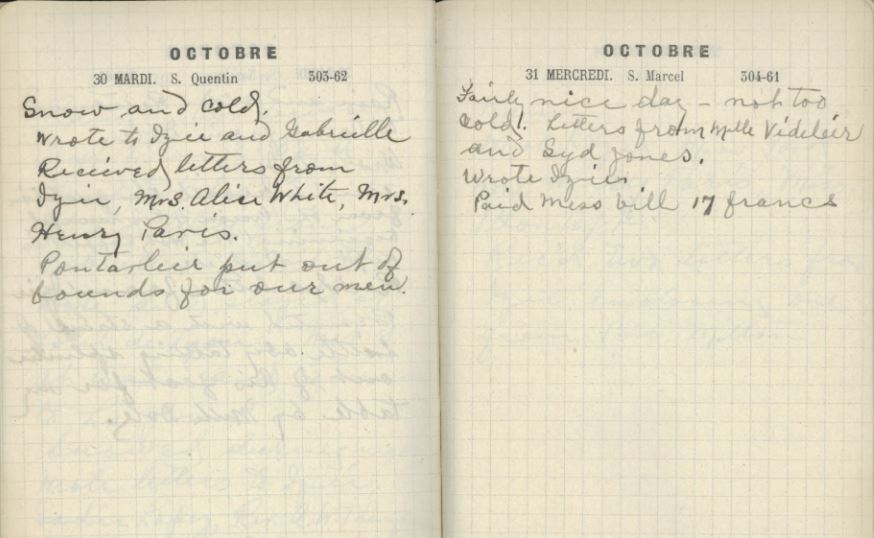
Two pages of a personal diary. The date is printed at the top of each page, October 30 and 31. Underneath it, Captain White wrote general observations about the weather, letters he wrote and received, and life in camp.

Two pages from the personal diary of Captain William  “Andrew” White, the unit’s chaplain (e011183038)

Day-to-day life in the unit

Two digitized documents allow you to explore the unit’s daily activities:

  • The personal diary of William “Andrew” White, No. 2 Construction Battalion’s chaplain. We believe that this is the only first-hand account written by a member of the unit.
  • The War Diary. Units on active service were required to keep a daily account of their activities. While war diaries do not focus on individuals, they describe the events that took place each day.

How the Canadian military managed the unit

LAC has digitized about half of the administrative, organizational and historical records relating to the unit. These documents provide insights into how the Canadian military managed the unit and the men belonging to it.

Digitized resources documenting No. 2 Construction Company held at LAC

Basic information about the unit

Other photographs depicting Black soldiers

Note that LAC holds many other photos showing Black soldiers, but these cannot be found in a regular search, since that information was not included in the original title.

Recruiting poster

Digitized textual records

Courts martial

Digitized records of courts martial involving members of No. 2 Construction Company and other Black men are available on Canadiana.org (Please note that the list below may not be complete)


Andrew Horrall is an archivist at Library and Archives Canada. He wrote the blog and, with Alexander Comber and Mary Margaret Johnston-Miller, identified records relating to the battalion.

Serving despite segregation: No. 2 Construction Battalion

Version française

By Andrew Horrall

Library and Archives Canada (LAC) holds the largest collection of records documenting No. 2 Construction Battalion, a segregated unit of the Canadian Expeditionary Force in the First World War. They wanted to fight, but racist attitudes among political and military leaders, and in society in general, prevented them from serving in the front lines. Instead, the unit was assigned to the Canadian Forestry Corps. The men spent the war in the French Alps, cutting down trees, milling raw logs into finished lumber and transporting the wood to the railway. The work was vital, since huge quantities of wood were needed to build and reinforce front-line defences, but it was far from the type of service that the men had hoped for.

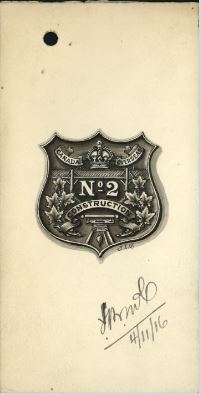
A black-and-white drawing of a badge in the shape of a shield. At the top is a royal crown and a banner reading “Canada Overseas.” Beneath are the words “No. 2” above another banner with the word “construction.” Maple leaves adorn each side, and a wooden bridge below the crown and a tool under the second banner symbolize that the unit’s members were builders.

The cap badge for No. 2 Construction Battalion (e011395922)

Canadian Expeditionary Force service files

  • (unit members are identified by “No. 2 Construction Battalion” in the database’s “Unit” field

Users should be aware that the military service files of over 800 men indicate No. 2 Construction Company as their unit, though many of these men never actually served with No. 2 Construction Company. Instead, they served with other CEF units. The reasons for the discrepancy between the information in personnel files and unit files is not entirely clear. It is likely that Canadian military authorities intended for the men to serve with No. 2 Construction Company, but pressing needs caused them to assign the men to other units. In other cases, the war may have ended before individuals could physically join No. 2 Construction Company.)

The unit was mobilized at Truro, Nova Scotia, in July 1916. It recruited from established Black communities in the Maritimes, southwestern Ontario, and across Canada, the Caribbean and the United States. At least two members were from much farther away: Cowasjee Karachi (regimental number 931759) came from modern-day Yemen, and Valdo Schita (regimental number 931643) was born near Johannesburg, South Africa.

A black-and-white photograph depicting 21 soldiers. They are casually posed outdoors, either sitting or standing on a pile of long wooden planks. Eight of the men appear to be in Russian uniforms, and the rest are Canadians, including two Black men.

Lt. F.N. Ritchie, Lt. Courtney and a few of the enlisted men of the Canadian Forestry Corps in France. This is the only photo of the unit held in the collection at LAC (a022752)

While the unit was composed of Black men, the officers were white, apart from the chaplain, Captain William “Andrew” White.

The unit is referred to by both the terms “battalion” and “company” in archival documents and published sources. It was originally created as a battalion, a unit composed of about 1,000 men in the Canadian Expeditionary Force. When only about 600 men arrived in England in 1917, military authorities redesignated it as a company, which better reflected its size.

The unit returned to Canada at the end of the war and was officially disbanded in September 1920. The story of No. 2 Construction Battalion faded over time, until families, community members and historians began recovering it in the early 1980s. By that time, there were only a handful of surviving members.

A note about terms used in the records

Many of the records documenting No. 2 Construction Company contain terms that were commonly used during the First World War but are no longer acceptable. LAC has replaced such terms in descriptions, but they are still found in many of the original documents. The use of these terms by military authorities is evidence of the racism faced by the men in the unit.


Andrew Horrall is an archivist at Library and Archives Canada. He wrote the blog and, with Alexander Comber and Mary Margaret Johnston-Miller, identified records relating to the battalion

Tom Cogwagee Longboat’s life and legacy

Version française

On the left of the graphic, Tatânga Mânî [Chief Walking Buffalo] [George McLean] in traditional regalia on horse. In the middle, Iggi and girl engaging in a “kunik”, a traditional greeting in Inuit culture. On the right, Maxime Marion, a Métis guide stands holding a rifle. In the background, there is a map of Upper and Lower Canada, and text from the Red River Settlement collection.

This article contains historical language and content that may be considered offensive, such as language used to refer to racial, ethnic and cultural groups. Please see our historical language advisory for more information.

By Elizabeth Kawenaa Montour

Tom Cogwagee Longboat’s name is associated with speed, athleticism, determination, courage and perseverance. His Onondaga name, “Cogwagee,” translates as “all” or “everything.” Facts, stories and photographs of his life have been collected, published and examined over the past century, in an attempt to capture, recreate and demystify his life.

Thomas Charles Cogwagee Longboat was born to George Longboat and Elizabeth Skye on July 4, 1886 (some sources have June 4, 1887). He was Wolf Clan of the Onondaga Nation from Six Nations Territory and lived a traditional life of the Haudenosaunee (Longhouse). At the age of 12 or 13, Longboat was forcibly sent to the Mohawk Institute Residential School, an Anglican denominational and English-language school, which operated from 1823 and closed in 1970. This experience did not go well for him and his fellow First Nations students, who were forced to abandon their language and beliefs to speak English and practice Christianity. Longboat reacted by escaping the school and running home. He was caught and punished, but then escaped a second time, with the foresight to run to his uncle’s farm, where he would be harder to find. This proved successful and marked the end of Longboat’s formal education. He worked as a farm labourer in various locations, which involved travelling great distances on foot.

Longboat began racing as an amateur in 1905. He won the Boston Marathon on April 19, 1907, in two hours, 24 minutes and 24 seconds, shaving nearly five minutes off the previous record for the world’s most prestigious annual running event. With this incredible race, he brought tremendous pride and inspiration to Indigenous peoples and Canadians. The following article was published the day after he won the marathon:

“The thousands of persons who lined the streets from Ashland to the B.A.A. were well repaid for the hours of waiting in the rain and chilly winter weather, for they saw in Tom Longboat the most marvelous runner who has ever sped over our roads. With a smile for everyone, he raced along and at the finish he looked anything but like a youth who had covered more miles in a couple of hours than the average man walks in a week. Gaining speed with each stride, encouraged by the wild shouts of the multitude, the bronze-colored youth with jet black hair and eyes, long, lithe body and spindle legs, swept toward the goal.

Amid the wildest din heard in years, Longboat shot across the line, breaking the tape as the timers stopped their watches, simultaneously with the clicking of a dozen cameras, winner of the greatest of all modern Marathon runs. Arms were stretched out to grasp the winner, but he needed no assistance.

Waving aside those who would hold him, he looked around and acknowledged the greetings he received on every side. Many pressed forward to grasp his hand, and but for the fact that the police had strong ropes there to keep all except the officials in check, he would have been hugged and squeezed mightily. Then he strode into the club, strong and sturdily.” (The Boston Globe, April 20, 1907)

A year after winning that race, Longboat competed in the marathon at the 1908 Olympics in London, England. He collapsed and dropped out at 32 kilometres, unable to finish the 42.2 km race. He then turned to professional running, and in 1909 received the title of Professional Champion of the World at a Madison Square Garden race in New York City.

A black-and-white page from the 1911 Canadian census with entries for each of 38 columns. The columns include such information as name and residence, personal description, place of birth, occupation and citizenship, and language and education.

A page from the 1911 census listing Thomas C. Longboat and his wife Loretta [Lauretta], in York County, Ontario. His profession is listed as “runner.” (e002039395)

A black-and-white photograph of two men in First World War military uniforms smiling and buying a newspaper from a young boy. The man on the right is accepting a newspaper from the boy and giving him money in exchange.

Private Tom Longboat, the Onondaga long-distance runner, buying a newspaper from a French boy, June 1917. (a001479)

In 1916, Longboat went overseas as part of the Canadian Expeditionary Force to fight in the First World War. He employed his natural talent and served as a dispatch runner. Longboat was mistakenly declared dead in the battlefields of Belgium, after being buried in rubble as a result of heavy shelling. His wife, Lauretta Maracle, a Kanienkenha:ka (Mohawk) woman, whom he had married in 1908, believed him to be deceased and remarried. Longboat subsequently married Martha Silversmith, an Onondaga woman, with whom he had four children. He continued his military career, serving as a member of the Veterans Guard in the Second World War while stationed at a military camp near Brantford, Ontario. The Longboat family settled in Toronto. Upon his retirement from employment with the City of Toronto, Longboat moved back to Six Nations. He passed away on January 9, 1949.

In 1951, he received posthumous recognition with the establishment of the prestigious Tom Longboat Trophy. The trophy is awarded annually to Indigenous athletes who exemplify the hard work and determination they put forth in their chosen endeavours. The original trophy remains at Canada’s Sports Hall of Fame in Calgary, with a travelling replica held by the Aboriginal Sports Circle in Ottawa. In 1955, he was inducted into Canada’s Sports Hall of Fame and the Indian Hall of Fame.

A red rectangle plaque with gold writing, with the crest of Canada and “Tom Longboat 1886–1949” at the top.

A Historic Sites and Monuments Board of Canada plaque honouring Tom Longboat, located at 4th Line Road, Six Nations Grand River Reserve, Ohsweken, Ontario. (Photo courtesy of Parks Canada)

Tributes in recognition of Longboat’s achievements continue today in many forms. A Government of Canada plaque was erected in his honour in 1976 at 4th Line Road, Six Nations, Ohsweken, Ontario. In 1999, Maclean’s magazine recognized him as the top Canadian athlete of the 20th century. Canada Post issued a stamp in 2000 commemorating his winning time. In Ontario, the Tom Longboat Day Act, 2008 designated June 4 as “Tom Longboat Day.” Tom Longboat Corner in Six Nations, a Tom Longboat Trail in Brantford, Ontario, a Tom Longboat Lane in Toronto, and a Tom Longboat Junior Public School in Scarborough, Ontario. There is also a Longboat Hall at 1087 Queen Street West in Toronto, the location of the YMCA where he trained. A statue of Longboat entitled “Challenge and Triumph,” created by David General, and an exhibit about him are on display at the Woodland Cultural Centre at Six Nations. Most recently, a children’s book about his life called Meet Tom Longboat was published in 2019.

Tom Cogwagee Longboat’s life and accomplishments are both fascinating and inspiring. To learn more about him, listen to our podcast, “Tom Longboat is Cogwagee is Everything,” which includes additional information.  Also check out the Tom Longboat Flickr album.

This blog is part of a series related to the Indigenous Documentary Heritage Initiatives. Learn how Library and Archives Canada (LAC) increases access to First Nations, Inuit and Métis Nation collections and supports communities in the preservation of Indigenous language recordings.


Elizabeth Kawenaa Montour is a project archivist in the Exhibitions and Online Content Division of the Public Services Branch at Library and Archives Canada.
Mighty Indigenous Warriors: From Egypt to the First World War

On the left of the graphic, Tatânga Mânî [Chief Walking Buffalo] [George McLean] in traditional regalia on horse. In the middle, Iggi and girl engaging in a “kunik”, a traditional greeting in Inuit culture. On the right, Maxime Marion, a Métis guide stands holding a rifle. In the background, there is a map of Upper and Lower Canada, and text from the Red River Settlement collection.

This article contains historical language and content that some may consider offensive, such as language used to refer to racial, ethnic and cultural groups. Please see our historical language advisory for more information.

By Elizabeth Kawenaa Montour and Sara Chatfield

When First Nations, Inuit and Métis Nation were recruited in 1914 to fight in the First World War, enlistees were not aware of the new reality of 20th-century warfare. As a prelude to the First World War, in 1884, approximately 56 Kanienkenha:ka (Mohawk), 30 Ojibway and 19 Métis men were recruited for Britain’s six-month Nile expedition in Egypt totalling 400 men. The men were chosen for their strength, endurance, and skill in handling boats and rafts—qualities that were needed to navigate up the numerous cataracts and rapids of the Nile River. They did not see active battle, as they arrived two days after the city of Khartoum, Sudan had fallen, and British Major Charles G. Gordon had been killed. The expedition returned with the loss of 16 men and stories of what they had seen. Along their journey on the Nile, they saw monolithic temples and statues carved out of hillsides at Abu Simbel, the Sphinx of Giza, the pyramids, exotic markets and Egyptian life in Cairo.

A black-and-white photograph of a large group of men standing in front of the Parliament buildings.

Canadian voyageurs in front of the Parliament Buildings, a detail from the “Canadian Nile Contingent,” 1884. (c002877)

Three decades later, their next involvement in an overseas military expedition was with the Canadian Expeditionary Forces (CEF) in the First World War. It was an opportunity for First Nations, Inuit and Métis Nation soldiers to see the world, and to prove their courage and combat skills. Soldiers were facing a major change in combat style and warfare. The new reality of war involved the use of chemical warfare, machine guns, fighter aircraft, armoured vehicles, and trench warfare.

Our latest Co-lab challenge, Correspondence regarding First Nations veterans returning after the First World War, illustrates some Indigenous peoples’ experiences during the war, touches upon how their communities coped during their absence, and gives information about their lives after they returned home. These documents provide us with information that the Personnel Records of the First World War may not. They offer information such as what the solider planned to do after the war, if he owned land or farm animals, or if he was suited to farming. There is also information about whether the soldier suffered any lingering disabilities, who they lived with, and if they had any dependants.

Created by the former Department of Indian Affairs, these records are unique in that an overseeing federal “Indian Agent” included personal information and comments on the returning First Nations soldiers. In contrast, this was not the case for non-Indigenous soldiers, as no similar sets of records exist for the rest of the CEF.

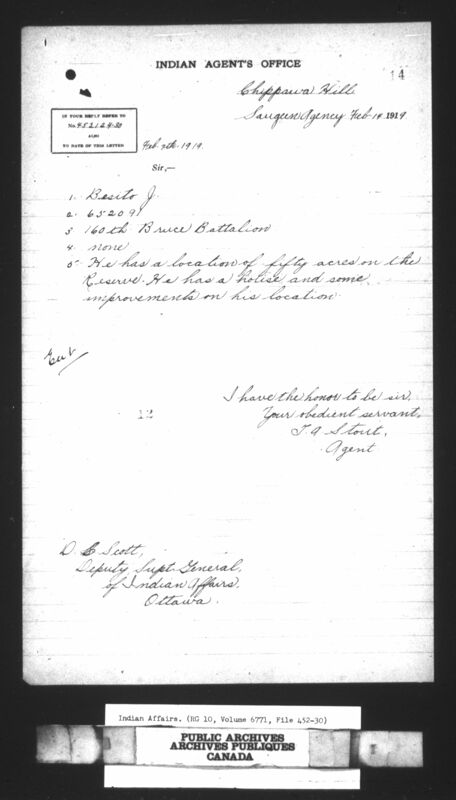
A page from the “Indian Agent’s Office,” Chippewa Hill, Saugeen Agency, February 14, 1919.

Document from RG10 Vol 6771 file 452-30 sent to Duncan Campbell Scott from T.A. Stout on February 14, 1919, providing information about John Besito. (Image found on Canadiana)

This personal information became part of the federal government files in Ottawa. The records are also unique in that the “Indian Agents” delved into the soldier’s post-service life. The information that was collected included gratuitous private information and personal judgements about the veterans and the civilian lives they returned to. For example, the “Indian Agent’s Office” notes dated February 1919 for Private John Besito from Saugeen Agency, Ontario, state, “He has a location of fifty acres in the Reserve. He has a house and some improvements on his location.”

As well as administrative information, such as CEF regimental numbers and membership in First Nation agencies and bands, these records also give us genealogical information. For example, the names of three deceased soldiers are listed in a letter to the Department of Indian Affairs dated February 12, 1919, written by the “Indian Agent” of the Griswold Agency in Manitoba. The letter states that the deceased soldiers are from Oak River and Oak Lake Reserves. The letter also includes the CEF regimental number of one of the deceased, Private John Taylor, and that the Department of Indian Affairs paid a pension to his wife and two children. Other correspondence informs us that Private Gilbert Moore, who was killed in action on March 24, 1918, left behind parents in poor circumstances and that they applied for a pension; and that Private Thomas Kasto left a mother who received a pension.

A black-and-white studio portrait of a First World War soldier in uniform and holding a rifle.

Photograph of Canadian Expeditionary Forces soldier Michael Ackabee. (e005176082)

As well as providing information about the soldiers who fought with the CEF, these files make reference to women in First Nation communities who provided funds to help with the war effort to organizations such as the Red Cross, the Girls Overseas Comfort Club, and the Canadian Patriotic Fund. Women in the communities knitted socks and made shirts to add to the “comfort boxes” that were mailed to the men overseas. They also fundraised by making beadwork, woven baskets, and quilts to sell at box socials and fairs.

Indigenous soldiers who survived the war often returned home changed, both positively and negatively. Sapper Peter Taylor, a Kahnawake soldier, suffered the rest of his life with complications from mustard gas poisoning until he passed away in 1955. Private Tom Longboat, the Olympic long distance runner from Six Nations of the Grand River reserve, returned home from his duty overseas in France to find his wife had remarried after receiving word that he had been killed.

A black-and-white photograph of two men in First World War military uniforms smiling and buying a newspaper from a young boy. The man on the right is accepting a newspaper from the boy and giving him money in exchange.

Private Tom Longboat, the Onondaga long distance runner, buying a newspaper from a French boy, June 1917. (a001479)

Many who returned home were affected mentally and physically. We give our gratitude for their sacrifices and service, and they will be forever acknowledged, honoured, and respected.

This blog is part of a series related to the Indigenous Documentary Heritage Initiatives. Learn how Library and Archives Canada (LAC) increases access to First Nations, Inuit and Métis Nation collections and supports communities in the preservation of Indigenous language recordings.


Elizabeth Kawenaa Montour is a project archivist and Sara Chatfield is a project manager in the Exhibitions and Online Content Division of the Public Service Branch at Library and Archives Canada.