Join us in celebrating our 1,000th blog post!

The Library and Archives Canada (LAC) Discover Blog has hit an important milestone! We have published 1,000 blog posts! For the past eight years, the blog has showcased our amazing documentary heritage collection, let researchers know what we are working on, and answered frequently asked questions.

To celebrate this momentous occasion, we are looking back at some of our most popular blog posts.

1940 National Registration File
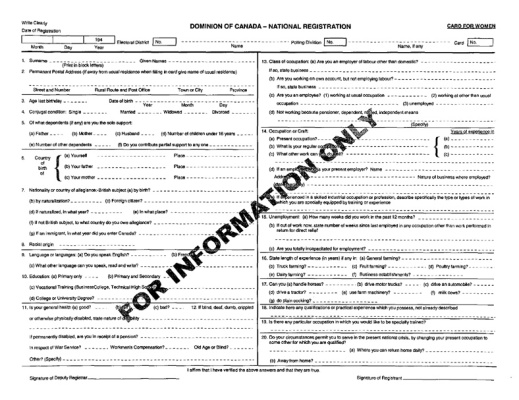
A typed, two-column questionnaire titled “Dominion of Canada—National Registration Card for Women” with “For Information Only” written diagonally across the middle.

Sample of a questionnaire for women, courtesy of Statistics Canada.

Year after year, this early blog post has consistently been at the top of our list of views and comments. It is not surprising that a genealogy themed post took the top place; what is surprising is that the 1940 National Registration File is not held at LAC, but can be found at Statistics Canada. Either way, it is a great resource and very useful to genealogists across the country.

Want to read more blog posts about genealogy at LAC? Try the post, Top three genealogy questions.

Do you have Indigenous ancestry? The census might tell you
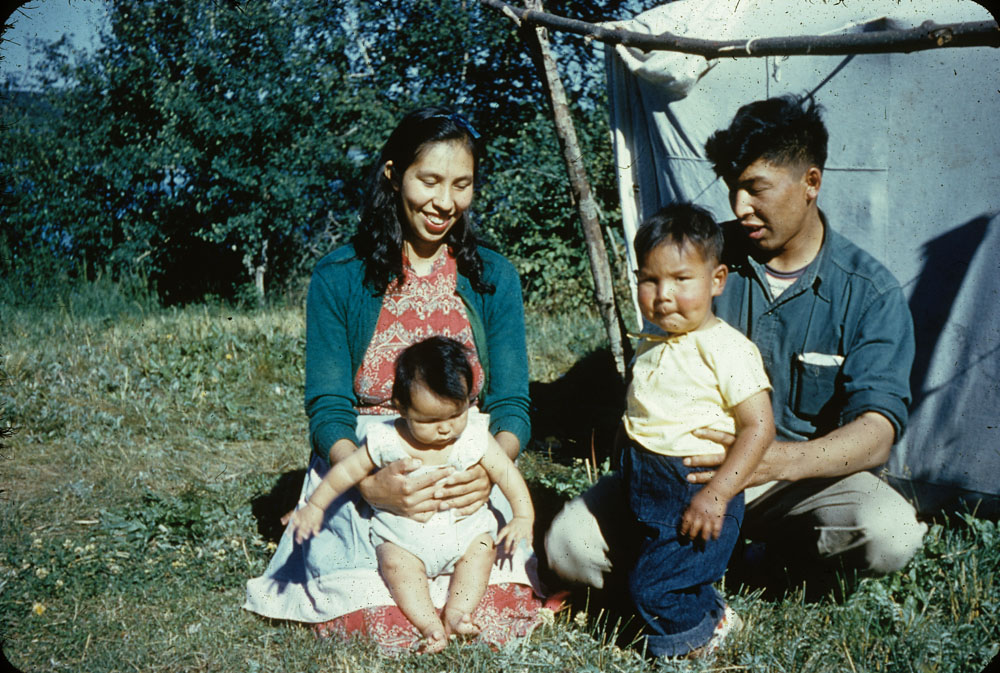
A woman and a man sit in the grass with their two young children in front of a canvas tent.

Indigenous man and woman [Alfred and Therese Billette] seated on the grass with two children [Rose and Gordon] outside their tent (e010999168).

Another popular post is the 2016 blog explaining how Canadian censuses could help you examine your past and research your unknown ancestral lineage to Indigenous heritage. Canadians might search for their Indigenous heritage to resolve questions of self-identity, or to know if they may participate with Indigenous organizations, or get Indigenous benefits.

Want to read more blog posts on how to research your Indigenous heritage? Try one of these posts, Department of Indian Affairs and Northern Development records: Estate files or The Inuit: Disc numbers and Project Surname.

The Grey Fox: Legendary train robber and prison escapee Bill Miner
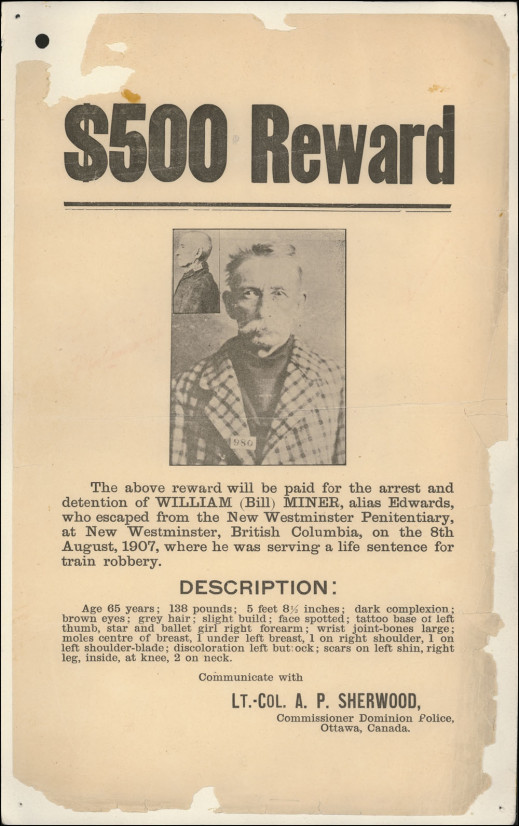
Poster showing a photograph of Bill Miner, announcing a $500 reward for his recapture, listing details as to his escape, and describing his physical characteristics.

Reward notice for the recapture of Bill Miner that was sent to police departments, publications and private detective agencies (e011201060-210-v8).

This exciting post tells the story of Bill Miner, who was nicknamed “The Grey Fox” and “The Gentleman Bandit.” Bill Miner was a legendary criminal on both sides of the Canada–U.S. border. Although he committed dozens of robberies and escaped from multiple prisons, many saw him as a generous folk hero who targeted exploitative corporations only. LAC holds many documents, publications, sound and video recordings, and other materials relating to Miner, and hundreds of these documents are now available on our website as a Co-Lab crowdsourcing challenge.

Want to learn more about records from the B.C. Penitentiary system? Try the post, British Columbia Penitentiary’s Goose Island: Help is 20 km away, or 9 to 17 hours as the pigeon flies.

Samuel de Champlain’s General Maps of New France

: A black-and-white hand-drawn map depicting Quebec, the Maritime provinces and the eastern part of Ontario in 1613.

Carte geographique de la Nouelle Franse en son vray meridiein Faictte par le Sr. Champlain, Cappine. por le Roy en la marine—1613 (in french only) (e010764734).

This popular 2013 post combines two aspects of Canadian interest: cartography and explorers! This article gives an overview of Champlain’s maps of New France held in the LAC collection. Also included in the post is a “suggested reading list” so researchers can learn more about Champlain’s cartography and travels.

Want to read more about the history of New France? Try the post, Jean Talon, Intendant of New France, 1665-1672.

Journey to Red River 1821—Peter Rindisbacher
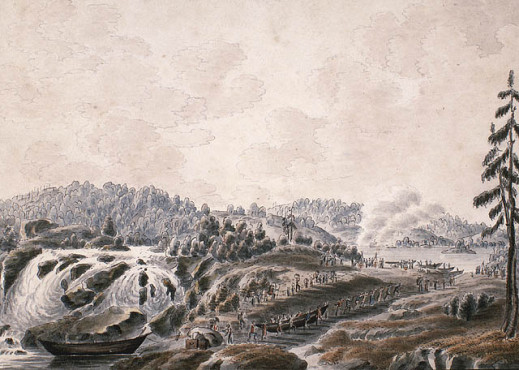
Painting depicting travellers walking single file while portaging their boats overland to avoid a waterfall.

Extremely wearisome journeys at the portages [1821] (e008299434).

This popular blog post describes the work of Peter Rindisbacher. Rindisbacher was 15 years old when he immigrated to Selkirk’s Red River settlement in 1821. Already an accomplished artist when he arrived in North America, he produced a series of watercolours documenting the voyage to Rupert’s Land and life in the settlement. His watercolours from the Red River area are among the earliest images of western Canada. Rindisbacher is considered the first pioneer artist of the Canadian and the American West.

Want to learn more about Peter Rindisbacher? Try the podcast, Peter Rindisbacher: Beauty by commission.
The Persons Case

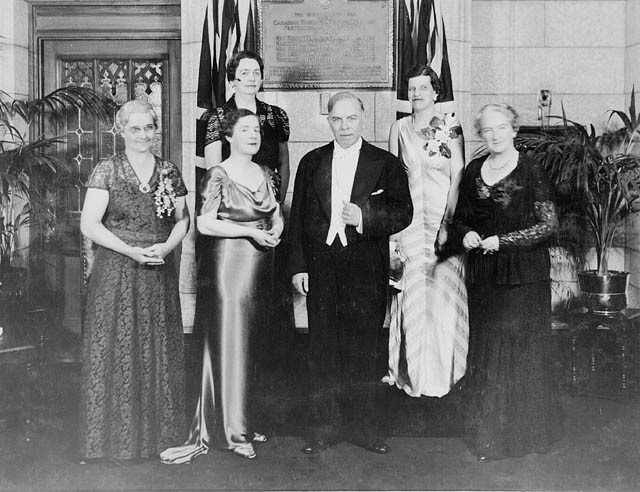
Five women in gowns wearing corsages and one man in a tuxedo standing in front of a plaque.

Unveiling of a plaque commemorating the five Alberta women whose efforts resulted in the Persons Case, which established the rights of women to hold public office in Canada (c054523).

This blog post illuminates the history of women’s fight for political equality in Canada. The Persons Case, a constitutional ruling that established the right of women to be appointed to the Senate, began in 1916 when Emily F. Murphy was appointed as the first female police magistrate in the British Empire. Undermining her authority, lawyers challenged her position as illegal on the grounds that a woman was not considered to be a person under the British North America Act, and therefore she was unable to act as magistrate. Murphy enlisted the help of Henrietta Muir Edwards, Nellie Mooney McClung, Louise Crummy McKinney, and Irene Marryat Parlby—now known as the “Famous Five”—who were engaged politically and championed equal rights for women.

Want to learn more about women’s rights throughout Canada’s history? Try the post, A greater sisterhood: the women’s rights struggle in Canada.

The Canadian Expeditionary Force Digitization Project is Complete!
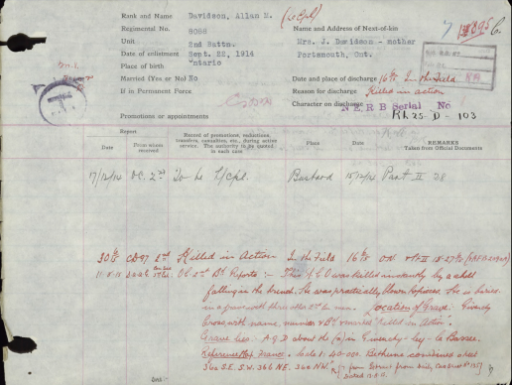
A page from the service file of “Scotty” Davidson describing how he was killed in action in the field by a shell falling in the trench, and how he is buried in a grave with three other 2nd Battalion men.

A page from Allan “Scotty” Davidson’s digitized service file describes how he was killed in action (CEF 280738).

The last post on our list is an impressive one! The blog announcing the completion of LAC’s 5-year project to digitize all 622,290 files of soldiers who enlisted in the First World War was well-received by many researchers.

Want to learn more about how the Canadian Expeditionary Force digitization project started? Try the post, Current status of the digitization of the Canadian Expeditionary Force Personnel service files.

We hope you enjoyed our trip down memory lane. You may also be interested in blogs about Canada’s zombie army, the Polysar plant, LAC’s music collection, historical French measurement standards, or the iconic posters from the Empire Marketing Board.
Canada and the 3rd Battle of Ypres: Passchendaele

“I died in hell. They called it Passchendaele.”

Siegfried Sassoon

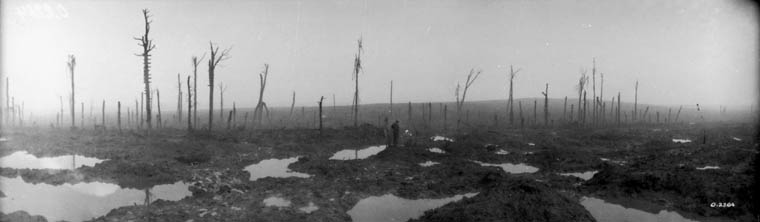
A black-and-white photograph of a bombed landscape. The ground is muddy with water-filled craters and a burned out forest.

Passchendaele, now a field of mud. Photo taken by William Rider-Rider in November 1917 (MIKAN 3194937)

The town of Ypres, Belgium and its surrounding countryside has special significance to the history of the Canadian Corps. In 1917, this area was the last portion of Belgium that remained outside German control. Little had changed in the region since Second Ypres in April 1915; the British held the city of Ypres while the Germans held the high ground of the Messines-Wytschaete Ridge to the south, the lower ridges to the east, and the flat terrain to the north.

On July 31, 1917, British, Australian, and New Zealand forces launched an offensive that would be known as the Third Battle of Ypres. As heavy rains poured down on the thick clay soil, shell holes created by a massive artillery barrage filled with water. Attacking soldiers struggling in deep mud offered easy targets for German gunners, and by some accounts as many soldiers drowned in the heavy mud as died from their wounds. Casualty estimates for the battle, which lasted from July 31 to November 20, 1917, range from 300,000 to 400,000 for the Allies and a roughly equal number for the Germans.

A black-and-white photograph of a soldier walking in a field of mud and puddles.

Mud and barbed wire through which the Canadians advanced during the Battle of Passchendaele. Photo taken by William Rider-Rider in November 1917 (MIKAN 3194807)

In early October, the four divisions of the Canadian Corps were transferred to the Ypres salient and tasked with the near impossible: capturing Passchendaele and the ridge. The offensive, to be executed in three stages, began on October 26, 1917. In the first stage, the 3rd Canadian Division captured Wolf Copse before reconnecting with the British 5th Army line. In the second stage, beginning on October 30, Canadian units secured a number of objectives and sent patrols into Passchendaele itself. In the final stage, from November 3 to 5, troops of the 1st and 2nd Divisions captured the village of Passchendaele in less than three hours. A final push on November 10 ended the campaign as the Canadians captured the remaining high ground north of the village.

While the Canadian Corps had achieved what no other Allied force had been able to, over 4,000 men died in the effort and 12,000 were wounded. The Third Battle of Ypres bolstered the Canadians’ reputation as storm troops, one of the best fighting forces on the western front. Nine Canadians were recognised with the Victoria Cross for their extraordinary actions in one of the most horrific battlefields ever known.

Library and Archives Canada’s series, First World War Centenary: Honouring Canada’s Victoria Cross recipients will profile each of them over the next three weeks.


Emily Monks-Leeson is an archivist in Digital Operations at Library and Archives Canada.

Launch of First World War personnel records database

We are pleased to announce an updated version of our “Service Files of the First World War, 1914-1918 – CEF” database. The new database, now called “Personnel Records of the First World War”, provides access to the service files of members of Canadian Expeditionary Force (CEF) along with records for other First World War personnel.

The new database includes records for the following groups:

Canadian Expeditionary Force

  • Imperial War Service Gratuities recipients
  • Non-Permanent Active Militia
  • Rejected CEF volunteers
  • Royal Newfoundland Regiment and Forestry Corps

Discover the Personnel Records of the First World War collection today!

And be sure to visit the First World War page of the Military Heritage section of our website for an overview of all our First World War records.

We wish to acknowledge the participation of the Provincial Archives Division of The Rooms corporation of Newfoundland and Labrador for access to its digitized personnel files.


Jeremiah “Jerry” Jones

This Black History Month, Library and Archives Canada highlights the service of Black Canadians during the First World War. While all Canadians were equally caught up in the patriotism of the early part of the war and the opportunities offered by military service, Black Canadians had difficulty enlisting due to the racism of the era. Although there was no official or explicitly stated policy of exclusion, the Canadian military left recruitment decisions to the discretion of individual commanding officers. Black Canadian volunteers along with those from other minority groups were left to enlist in whichever regiments would accept them. A special unit, the No. 2 Construction Battalion, was formed by members of the Black community in Nova Scotia. The battalion, whose members weren’t allowed to fight, dug trenches, repaired roads, and attracted hundreds of recruits from across Canada and even the United States.

A sepia-coloured photograph of a man in uniform wearing an officer’s belt and cap holding a baton in both hands across his upper thighs.

Jeremiah “Jerry” Jones, First World War private taken by an unknown photographer, from the personal collection of the Jones family (Wikipedia).

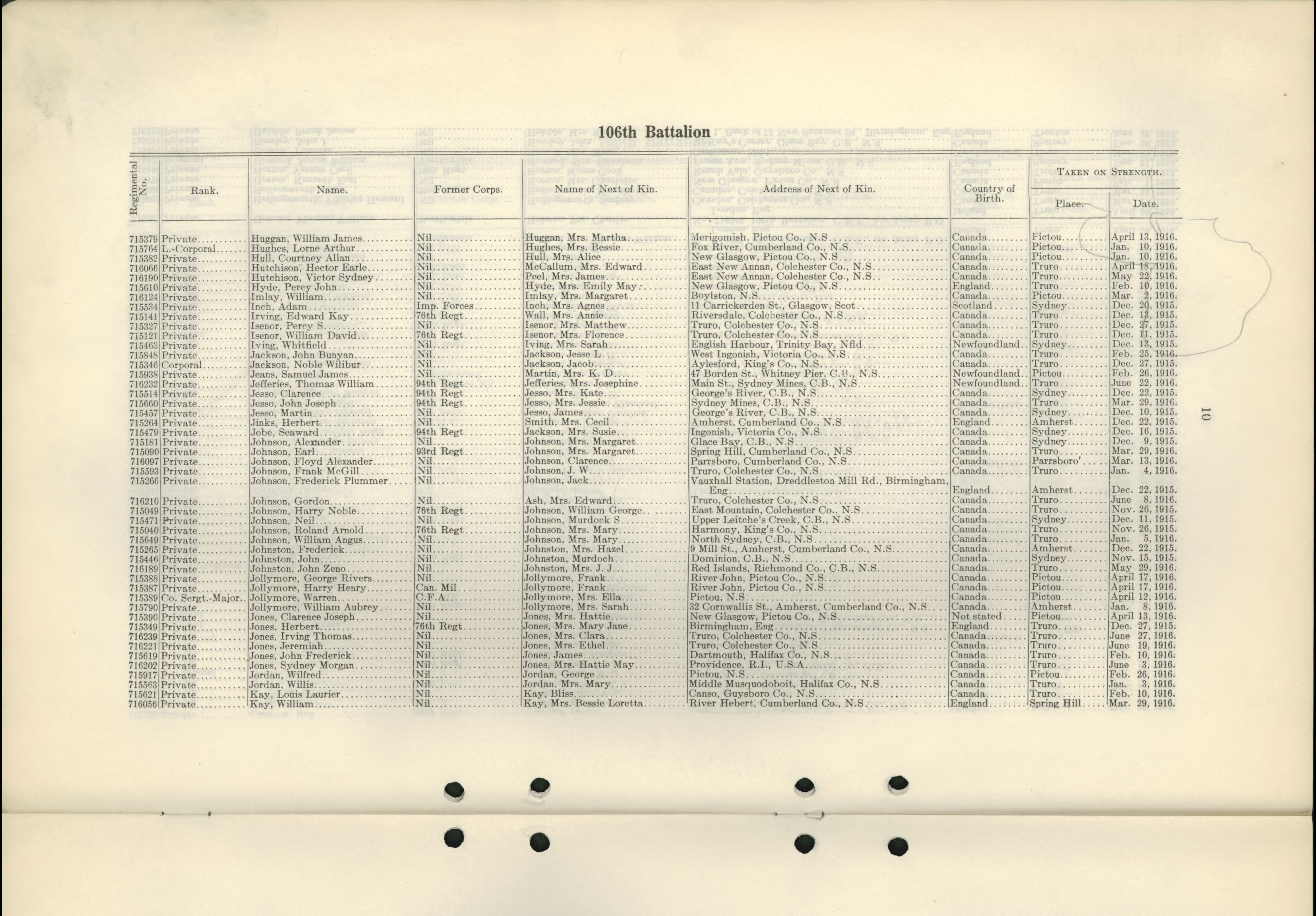
Among those Black Canadians who volunteered and served was Jeremiah “Jerry” Jones, a Nova Scotian soldier who enlisted with the 106th Battalion (Nova Scotia Rifles) in June 1916. Born in East Mountain, Nova Scotia on March 30, 1858, Jones was over 50 years old when he enlisted and lied about his age in order to join the army. Jones was sent overseas, where he transferred to the Royal Canadian Regiment and saw combat on the front lines in France, including the Battle of Vimy Ridge in April 1917. During the battle, with his unit pinned down by machine gun fire, Jones moved forward alone to attack the German gun emplacement. He reached the machine gun nest and threw a grenade that killed several German soldiers. The survivors surrendered to Jones, who had them carry the machine gun back to the Canadian lines and present it to his commanding officer. It is reported that Jones was recommended for a Distinguished Conduct Medal for his actions, though no record exists to show that he ever received the medal. In the decades following the war, the Truro Daily News and Senator Calvin Ruck highlighted Jones’ bravery and lobbied to have the Canadian government formally recognize his actions. Ruck in particular argued that the racist sentiment of the time had prevented Jones and other Black soldiers from being properly recognized for their heroism.

A nominal list showing the regimental number, rank, name, former corps, name of next of kin, address of next of kin, country of birth, and the place and date on which they were taken on strength.

Entry for Jeremiah Jones in the “Nominal Roll of Officers, Non-Commissioned Officers and Men” of the 106th Battalion (e011092698).

Jones was injured at the Battle of Vimy Ridge. He was formally discharged in Halifax in early 1918 after being found medically unfit. He died in November 1950. Jeremiah Jones was posthumously awarded the Canadian Forces Medallion for Distinguished Service on February 22, 2010.

Contributions of Indigenous Peoples in the First World War (1914–1918)

Indigenous peoples have a long tradition of military service in Canada dating back several centuries. Although not legally required to participate in the war, an estimated 4,000 Status Indians, and an unrecorded number of Métis and Inuit enlisted voluntarily and served with the Canadian Corps in the Canadian Expeditionary Force (CEF).

Almost all of the young men on many reserves enlisted for service. For example, approximately half of the eligible Mi’kmaq and Maliseet from New Brunswick and Nova Scotia volunteered for overseas duty. In other provinces, the number was even higher. In the small Saskatchewan community of File Hills, nearly all of the eligible men signed up to fight.


A number of Indigenous men who served in the CEF became snipers or scouts. Private Henry Norwest, a Métis from Fort Saskatchewan, Alberta, was one of the most famous snipers. Another proficient sniper was Corporal Francis Pegahmagabow, an Ojibwa from Parry Island Band, near Parry Sound, Ontario. Three-time recipient of the British Military Medal and two bars, Corporal Pegahmagabow was the most highly decorated Aboriginal soldier of the First World War. Lieutenant Cameron D. Brant, from the Six Nations of the Grand River Reserve near Brantford, Ontario, enlisted only three days after the Germans declared war on August 4, 1914. He died from poisonous gas during the Second Battle of Ypres, Belgium, in April 1915. Another Aboriginal man who served in the war was Olympic runner Tom Longboat, also from the Six Nations of the Grand River Reserve.

Indigenous women also made great sacrifices and played significant roles working behind the battle scenes. Nurse Edith Anderson, a Mohawk from the Six Nations of the Grand River Reserve, joined the Army Nurse Corps of the American Expeditionary Forces, and worked at an American hospital base in Vittel, France. Most of her work involved caring for patients who had been shot or gassed.

The exact number of Indigenous soldiers who lost their lives during the First World War is not known. It is estimated that at least 300 men were killed during battles or died from illness, such as tuberculosis.

From Enlistment to Burial Records: The Canadian Expeditionary Force in the First World War

Each year, Library and Archives Canada (LAC) receives countless questions on how to locate military services files, such as:

  • How do I find out more about a soldier (or a nursing sister) in the Canadian Expeditionary Force (CEF)?
  • When and where did he enlist?
  • How old did the soldier say he was? (Many underage soldiers gave an earlier year of birth when they enlisted)

A great place to begin your research is on our Genealogy and Family History’s Military pages.

To help guide you through the process, our experts have put together the following explanations.

Attestation papers

Also known as “enlistment” documents, these records indicate the date and place of birth, the marital status and the name and address of the next of kin.

The Soldiers of the First World War database contains references to more than 600,000 people who served during that conflict. Most of the corresponding attestation (enlistment) papers can be viewed online, including those of the Nursing Sisters.

To learn more, consult our article “Canadians and the First World War: Discover our Collection”.

Service files

These records contain key documents such as record of service, casualty form, discharge certificate and medal card. It also provides the name or number of
the unit in which the individual served overseas.

Find more information in our articles “What You Will Find in a Canadian Military Service File” and “Understand the Abbreviations Commonly Found in Military Service Files”.

War diaries

The War Diaries are a daily account and historical record of a unit’s administration, operations and activities.

Consult the War Graves page for information on the burial location of a soldier who was killed in action.

If the soldier survived the war, the Veterans Death Cards give information such as the next of kin, burial location and date of death. The digitized images, which are in alphabetical order, can be navigated in sequential order.

For the soldier who was decorated, a nominal index to medal registers, citation cards and records of various military awards provides further information on many soldiers’ achievements.

Our article “War Diaries: Discover what individuals or military units did during the war” can also guide you with your research.

Published histories

For an easy-to-read overview of the unit’s activities, we recommend starting with “published histories.” These books are often called “regimental histories” and our article Published Histories: Discover what individuals or military units did during the war” will give you more information.

Thematic guides

The Guide to Sources Relating to Units of the Canadian Expeditionary Force
lists references to records and files that complement the research in First World War records. This thematic guide further describes the contribution of most units in the CEF.

Other past articles of interest this Remembrance Day:

Questions or comments? We would love to hear from you!

New Finding Aid Online: Non-Permanent Active Militia

Library and Archives Canada (LAC) is pleased to announce that a new finding aid for the Non-Permanent Active Militia, RG 9 II-B-7, is now available online. View the 8,800 lower level descriptions today!

During the First World War, units of the Non-Permanent Active Militia were called upon to perform a variety of military tasks in Canada, notably to guard strategic sites such as armouries, bridges and canals.

The files are arranged alphabetically and can include a variety of forms dealing with enlistment, medical and dental history, hospitalization, discipline, pay, discharge and subsequent correspondence relating to the individual’s eligibility for war service gratuities and other service-related issues. Attestation papers, which are completed at the time of enlistment, are present in a number of the files. They include the recruit’s name and address, next-of-kin, date and place of birth, occupation, previous military experience and distinguishing physical characteristics.

This sub-series also contains small quantities of exceptional files: for members of the permanent force, for members of the Canadian Expeditionary Force (CEF) prior to embarkation overseas, for members of Royal Flying Corps, and for nursing sisters and other members of the Canadian Army Medical Corps.

Although the outside dates for the records are 1908-1983, the vast majority were created during the period 1914-1919.

Want to learn more about how to use finding aids? Consult our articles “Discover Finding Aids!” and “ Discover Finding Aids – Part Two”.

Be alerted when we have added new finding aids online by subscribing to our RSS feed.

For more information on recent announcements at LAC, visit “News”.

Guide to Sources Relating to Units of the CEF is Now Available Online

We are pleased to announce the launch of the Guide to Sources Relating to Units of the Canadian Expeditionary Force. The guide is an indispensable starting point for researching the records that document Canada’s participation in the First World War. It is a unique finding aid that brings together references to records and files scattered throughout several different archival fonds, which relate to almost every unit in the CEF.

The Guide was originally developed over many years by Barbara Wilson, an archivist with the former National Archives of Canada, now Library and Archives Canada. The guide has subsequently been updated with more recent acquisitions from official records, private papers and diaries, and by many other contributors from Library and Archives Canada. The guide was reviewed and updated with references to the Ministry of Militia and Defence records and daily orders, which are described by Library and Archives Canada as Record Group 9 or RG9.

For more information on recent announcements at LAC, visit “News”.