First World War Centenary: Honouring Canada’s Victoria Cross Recipients – Battle of Second Ypres

In the first week of April 1915, members of the 1st Canadian Division, including many of the earliest volunteers of the war, were moved north from Bethune, France to the active section of the line near Ypres, Belgium. A medieval Belgian city, Ypres was the scene of one of the war’s earliest and bloodiest battles in 1914 and had assumed great strategic importance. When the front stabilized in November 1914, the Allied lines bulged out around the city into the German line, forming a salient, surrounded on three sides by higher ground.

On April 22, 1915, in an effort to eliminate the salient, Germany became the first nation to use chemical weapons, releasing over 160 tons of chlorine gas across the Allied front. Members of the 1st Canadian Division, who had been in their trenches barely a week, found themselves desperately trying to defend a 6.5-kilometre gap in the Allied lines as the French division to their left crumbled in the face of Germany’s new weapon. The chlorine gas clung to the ground and filled the trenches, forcing the troops to climb out and into the path of heavy machine-gun and artillery fire.
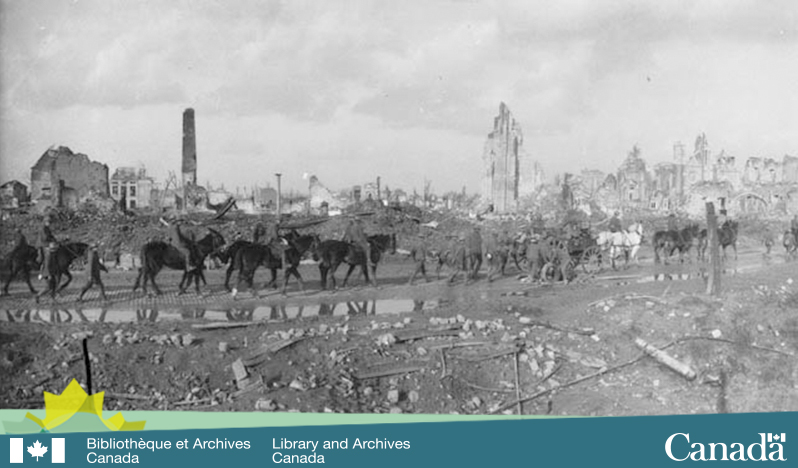
A black-and-white photograph showing a city completely destroyed by war. A column of troops, most on horseback, are travelling through it.

A scene of the destroyed city of Ypres, showing the Cathedral, Cloth Hall, and Canadian troops passing through, November 1917 (MIKAN 3194491)
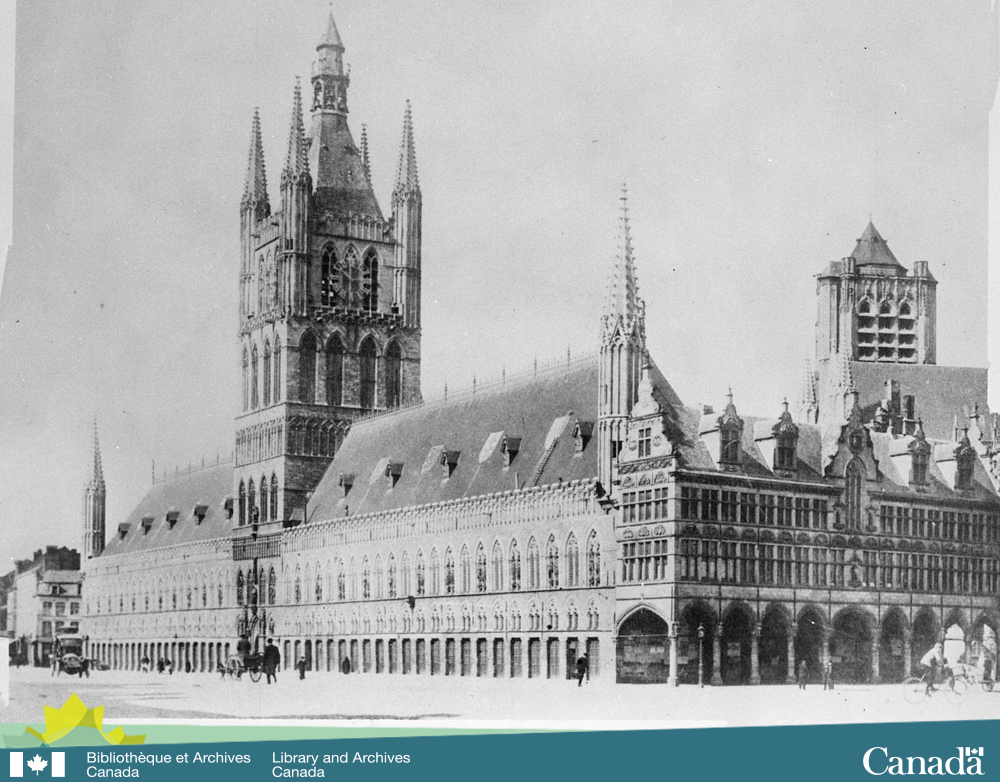
A black-and-white photograph of an ornate gothic building and other adjacent buildings.

The Cathedral and Cloth Hall in Ypres, before the Great War (MIKAN 3329077)

German troops moved forward but, having planned only a limited offensive and lacking adequate protection against their own chemical weapons, they were unable to exploit the break in the line. Throughout the night and the subsequent days, Canadian and British troops struggled to maintain the line. Canadians mounted a counterattack at Kitchener’s Wood (derived from Bois-de-Cuisinères) and endured the terrible fighting at St. Julian: their Canadian-made rifles jamming in the mud, and soldiers violently sick and gasping for air. Somehow, they managed to hold the line until reinforcements arrived on April 28. The losses were tremendous: 6,035 Canadians (or one in three soldiers) became casualties by the time the 1st Canadian Division was relieved. This toll among an army whose members had almost all been civilians just months prior.

At Second Ypres, the Canadians were initiated into the horrors of modern warfare, and from this moment on they would continue to develop into a highly respected formation in the Allied forces.

From April 23 to 25, as part of our series, First World War Centenary: Honouring Canada’s Victoria Cross Recipients, we will tell the stories of Lance-Corporal Frederick Fisher, Lieutenant Edward Donald Bellew, Company Sergeant-Major Frederick William Hall, and Captain Francis Alexander Caron Scrimger.

View the Flickr album – Canada at Ypres

The William Redver Stark sketchbooks: impressions and paper

In this part of the sketchbook examination, we are exploring two additional facets of page mapping. The first part will look at impressions left from the artist’s instruments on the drawing paper; the second will examine the paper and the bookbinding techniques in the sketchbooks.

Tool impressions

When an artist is drawing or sketching, his or her tools frequently leave deep impressions on the pages. These are great visual indicators that help to reposition out-of-order pages. The indentations on the paper surface appear as a repetitive pattern of a mark from one page to the next.

Colour photograph showing a sketchbook that has some deeply indented impressions on one of the pages.

Artist’s pencil impression; view from the verso of the drawing.

Other examples of impressions left on a paper surface are the binding materials used by the bookbinder. For example, after a text block is sewn, the bookbinder will apply an adhesive on the spine. He or she may apply too much adhesive, which then oozes through some of the sewing holes, forming a drop of glue inside the central folio. Upon drying and hardening, the drop can make an impression onto the adjacent sheet of paper.

Colour photograph showing the inside of a folio; the glue drop is clearly visible with the corresponding impression on the other page.

Glue residue in the binding structure that overflowed into the central folio leaving a mirror impression.

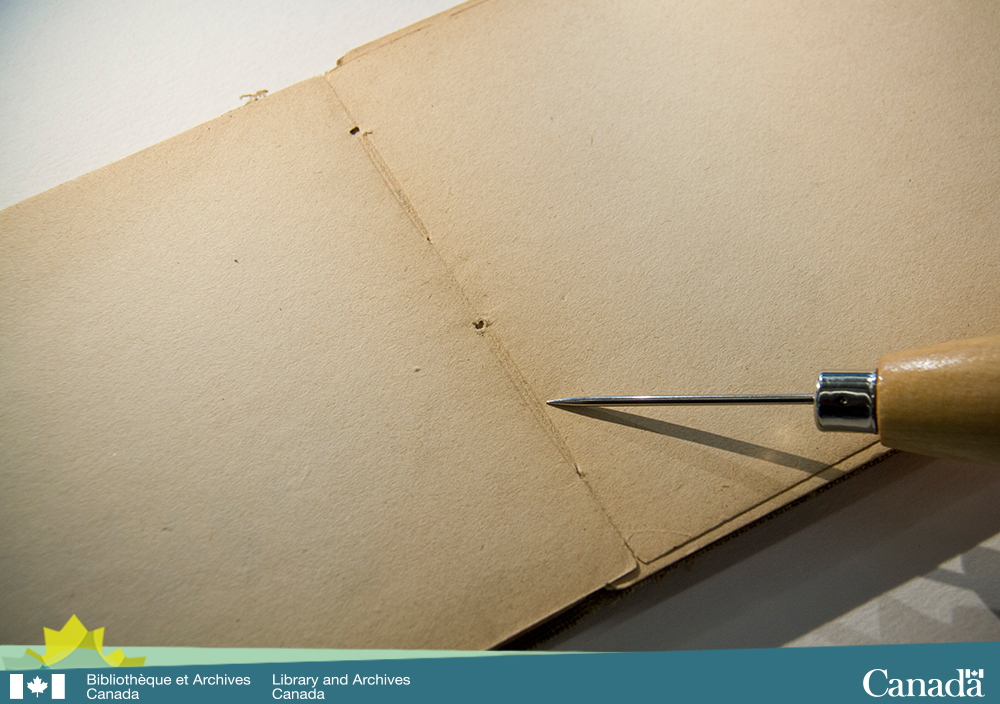
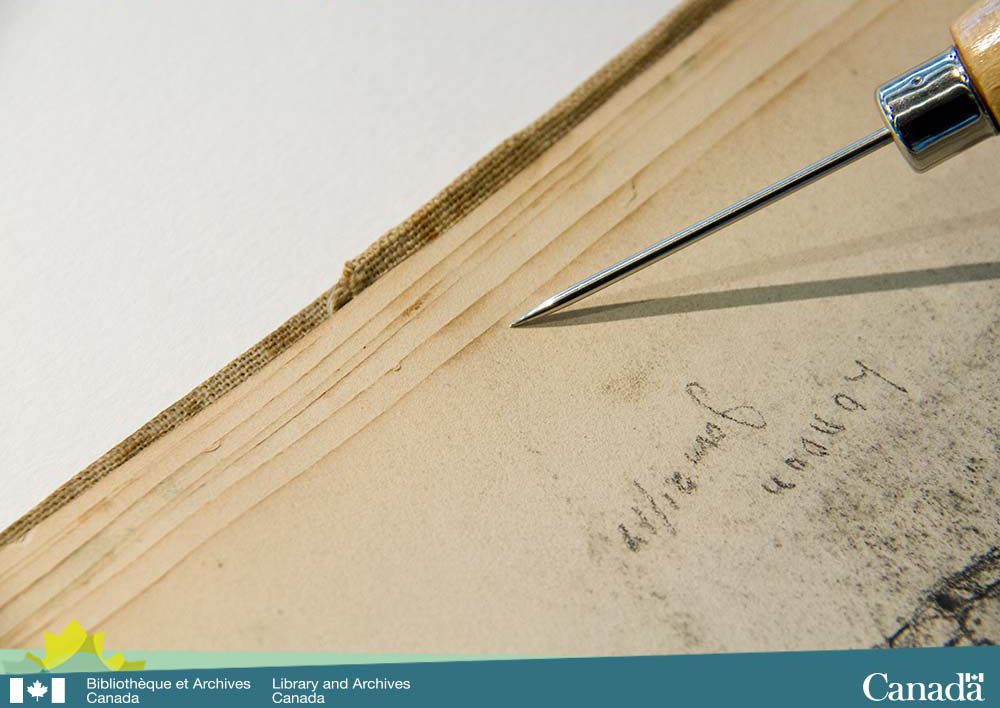
The sewing tapes and threads used in a binding can also leave impressions on the pages. The sewing tapes are glued underneath the paper of the inside covers. They often leave a repeating mirror impression of the tape, which helps determine the order of pages near the front or the back of a sketchbook. The sewing thread impressions found on detached pages also provide a good clue as to which sheets of paper are located in the centre folio of a section.

Colour photograph showing the detached spine of a sketchbook. The impression of the sewing tape is clearly visible on both the board paper and on the first page of the folio.

Detail of the sewing tape located under the board paper and the impression left on the adjacent page.

Colour photograph showing an open sketchbook lying flat on a table. An awl points to the sewing thread marks on the paper.

Visible transfer of the sewing thread mark onto the paper.

Page and paper analysis

A number of the Stark sketchbooks have soft, gradual convex and concave warping that extends across or along the edges of pages. This cockling happens when sketchbooks are in a high humidity environment. Here, the humidity causes a permanent distortion of the pages.

One of the sketchbooks was distorted along the edges of three sections. The undulating edges matched each other perfectly only when the pages were placed in the correct position. This gave us the verification needed for proper orientation and sequencing of the pages.

Colour photograph showing a sketchbook from the top; the bottom sections are clearly warped and distorted while the top ones are perfectly flat.

An example of cockling and undulation from the first to the third sections of the sketchbook and none in the last two sections.

Binding techniques

Paper can also reveal other clues to determine page order. One way to confirm page order is to look closely at the binding techniques, which leave very useful evidence.

When pages are first folded into sections, groups of three to eight sheets of paper are folded together. The folio on the inside of the section naturally has a sharper fold than each subsequent folio in the section. The folds become less sharp and incrementally wider as the number of folios per section increases. An examination of the fold of each half or complete folio can help determine the likely location within the sections: first, or centre of folio, second, third, fourth position, etc. An exact measurement of each page confirms the position as well.

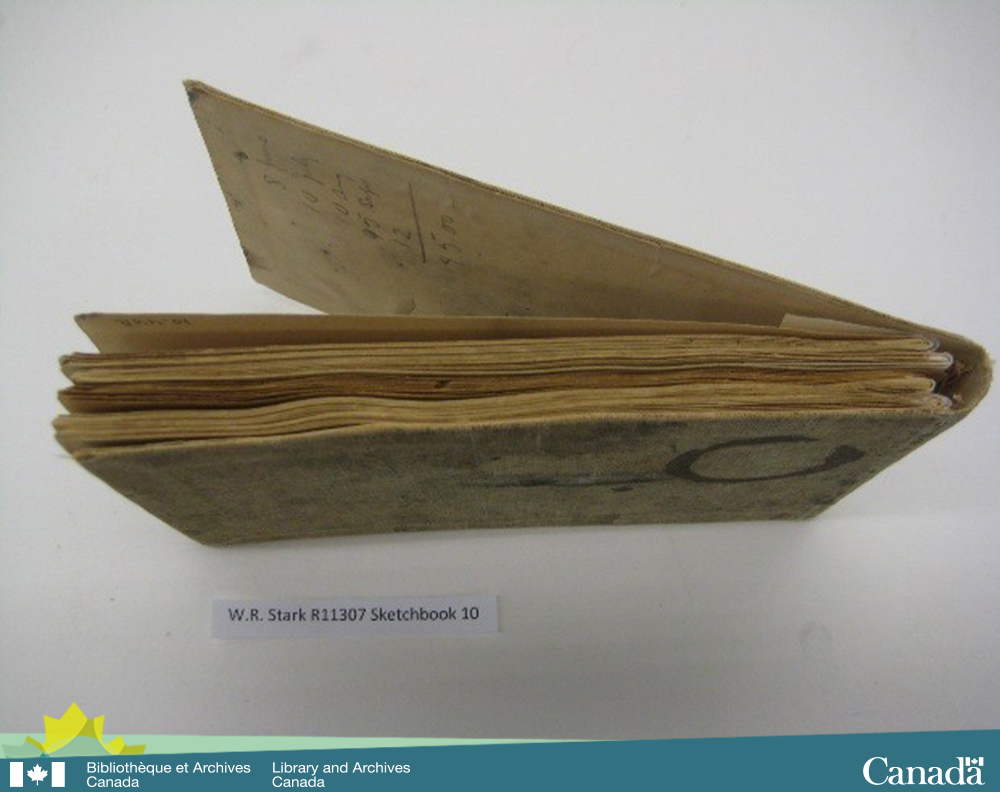
Rounding and backing is another binding technique that provides an indication of page sequence. The technique is usually accomplished by using a hammer to shape a previously sewn and glued spine. Rounding and backing results in a slight bend of the sections close to the spine; the sections near the front of the book bend slightly toward the front; the central sections are fairly straight; and the sections near the back of the book bend slightly toward the back. Rounding and backing was clearly visible in the Stark sketchbooks and thus a helpful indication of the sequence of sections and pages.

Colour photograph showing an angled view of a sketchbook that highlights the curving produced by the bookbinding technique.

View of the slight bend of the section near the front of the text block showing the effects of the binding technique that can help determine the right page order.

In our next instalment on page mapping, we will look at the dates that are scattered throughout the sketchbooks and how they match up with other sources of information at Library and Archives Canada.

Visit our Flickr or Facebook albums to view more images of the conservation examination.

First World War Centenary: Honouring Canada’s Victoria Cross recipients

As part of its commemoration of the centenary of the First World War, over the next three years we will profile each of Canada’s Victoria Cross recipients. Each profile will be published on the 100th anniversary of the day that the actions for which the recipient was awarded the Victoria Cross took place.

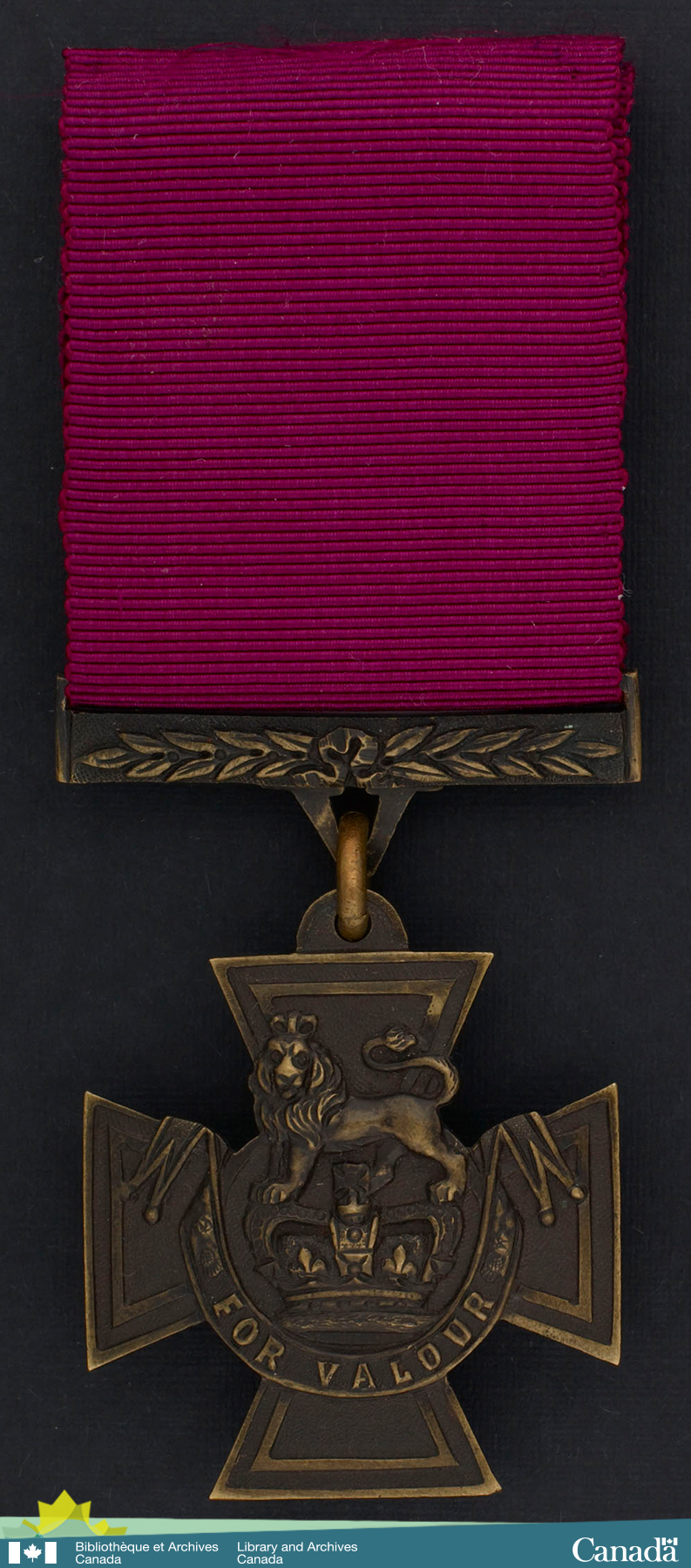
Colour photograph of a medal. Ribbon is crimson. Cross-shaped medal is bronze with a lion above a crown bearing the inscription For Valour on a scroll.

The Victoria Cross (MIKAN 3640361)

The Victoria Cross (VC) is the highest military decoration in the Commonwealth and takes precedence over all other medals, decorations and orders. A recognition of valour in the face of the enemy, the VC can be awarded to a person of any rank of military service and to civilians under military command. So far, 98 Canadians have been awarded the Victoria Cross, beginning with Alexander Roberts Dunn who in 1854 fought in the Battle of Balaclava in the Crimean War. The Victoria Crosses were awarded to 71 Canadian soldiers during the First World War, and 16 were awarded during the Second World War. The remaining VCs were awarded to Canadians for the Indian Rebellion of 1857 (in which William Hall of Nova Scotia became the first-ever black recipient of the VC) and the South African War (1899–1902).

In 1993, the Canadian Victoria Cross was adopted in place of the British VC. The medal is identical to the British VC but the inscription is in Latin—Pro Valore—a linguistic ancestor to both English and French. The Canadian Victoria Cross has yet to be awarded.

The profile series will also include links to photographs, service papers, war diaries, and other digitized artifacts in Library and Archives Canada’s collections that help to tell the stories of the Canadians who experienced the Great War on many fronts, including the home front, and whose actions and memories shape how contemporary Canadians remember and understand the first truly global conflict.

We will begin our First World War Victoria Cross profiles with Lance-Corporal Frederick Fisher.

The William Redver Stark sketchbooks: stains and losses

In this next article on examining these sketchbooks closely, we are looking at paper stains and losses. In this context, a stain is a discoloration of the paper fibre, while a loss is when an area of the paper is physically detached or missing.

Envision W.R. Stark tucking a sketchbook in his army bag or coat pocket in all kinds of weather or situations. As Stark was not an official war artist, he likely sketched in his spare time or when he was on leave. Through his sketchbooks we can follow him on a visit to the London Zoo, a stroll in the countryside or along the seacoast. His images typically depict daily life, people and landscapes.

These sketchbooks show many signs of physical deterioration because of Stark’s handling and shuffling of them during his war service, as well as the intervening 75 years between the end of the war and their acquisition. As you can imagine, being out on the front in terrible living conditions, water damage would be an important factor. Water not only warps the paper, but it can also leave a tideline. This happens when a liquid deposits dissolved materials such as dust, colouring matter and the like at the edge of the liquid, leaving behind a discrete line when the paper dries that is often darker than the remainder of the stain.

Tidelines found on two or more sequential pages are one of the many visual indicators used to determine the original order of the sketchbook pages.

Colour photograph of the inner spine of a book showing the darker line of a water stain

Detail of a tideline water stain with a darker perimeter along the spine.

Some oily or greasy marks and ink drops are also noted along the edges of the pages. These marks are often seen in an offset pattern that repeats itself from one leaf to the next in a decreasing or increasing fashion. These are also great clues for repositioning out-of-order leaves within a sketchbook.

Colour photograph of one side of an open book with its pages fanned out and a pointing device showing the oily stain that is repeated along the edge of each page

Oily stain found along the edges of multiple pages.

Colour photograph of a sketchbook taken from above showing the ink stains along the page edges

Ink stains showing the repeating pattern along the edges.

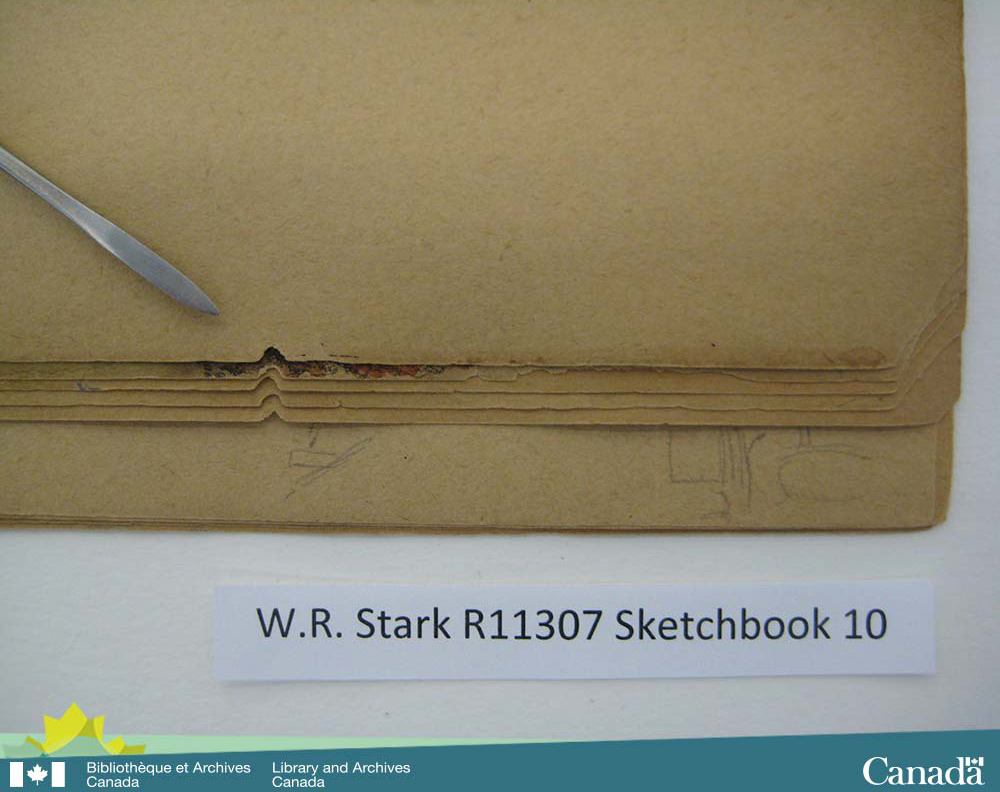
Other visual indicators that are helpful in this detective work are a repetitive pattern of paper loss along an edge. For example, several pages have been torn or indented in the same area.

Colour photograph of a sketchbook showing the repetitive, triangular-shaped area of paper that is missing from multiple pages.

An example of a repetitive pattern of paper loss along the edges of the sketchbook pages.

Visit our Flickr album on the conservation of the sketchbooks to see more photographs of this detective work. You can also view the previous articles in the Conservation series on the blog, Facebook and Twitter.

The William Redver Stark sketchbooks: page mapping

In the last article on William Redver Stark, we discovered that the 14 sketchbooks show signs of structural and physical damage. We also noted that all of the sketchbooks had some pages missing and five sketchbooks had numerous pages missing. It is impossible to determine if Stark removed the pages himself or whether they were removed by someone else at a later date. Nonetheless, removing pages resulted in a series of negative outcomes for the sketchbooks:

  • The remaining halves of the folio pages became loose in the text block
  • The loose pages were moved so that the original order and orientation were changed
  • The loose pages became damaged as their edges projected beyond the protective covers of the sketchbooks
  • The spines and sewing structures of the sketchbooks became unstable and deteriorated
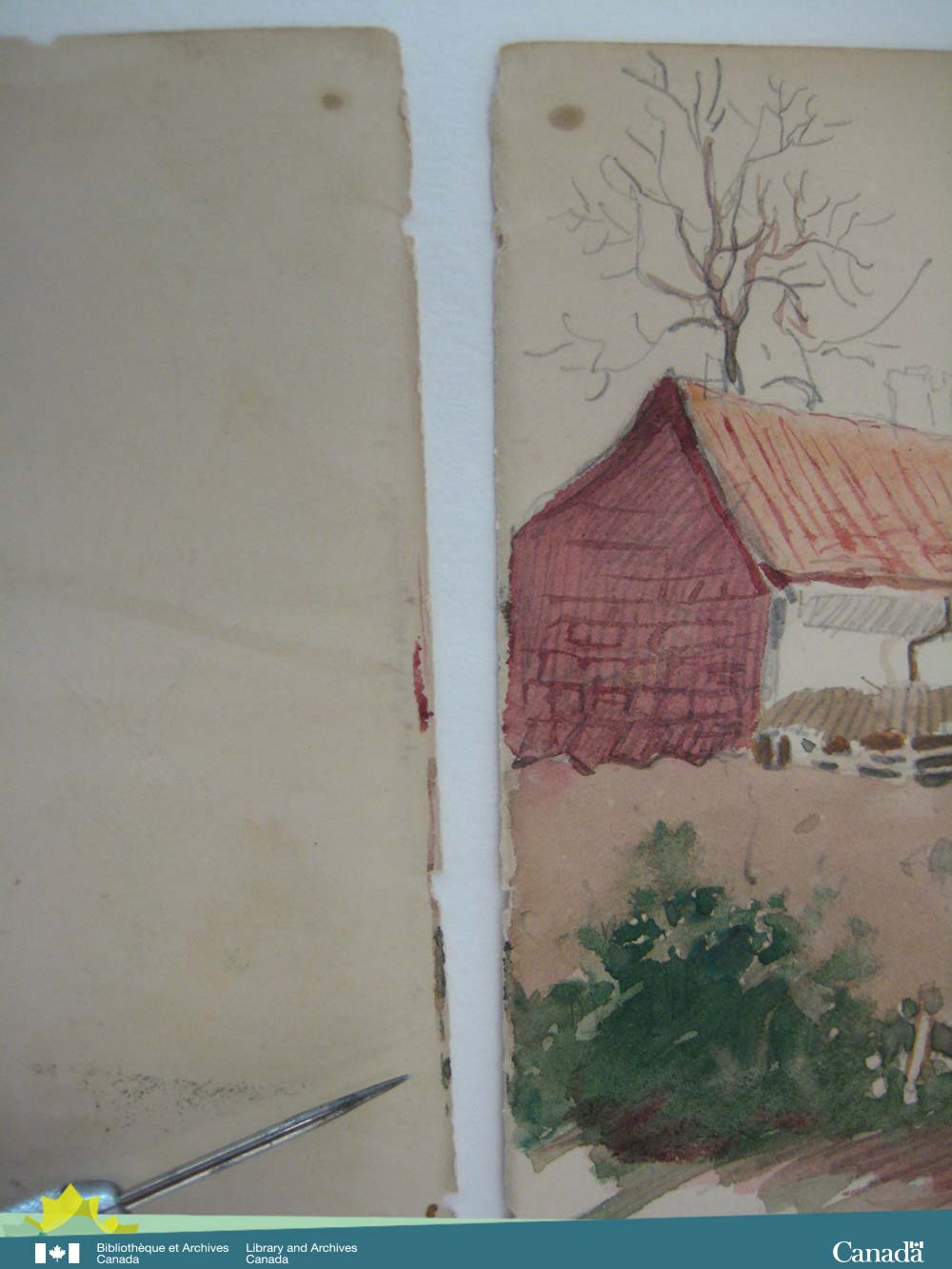
Colour photograph of two pages; the left hand page shows where there’s a thin line of the watercolour on the far right edge that is the continuation of the image.

The sequence of two single pages was discovered by a thin line of watercolour pigments on the edge of the left page which matches the right page.

To begin to remedy these issues, the conservation team examined each sketchbook page by page to determine the original orientation and order of pages. This was accomplished by looking at all the little details—the media, watercolour, ink or graphite, the bindings and every instance of damage to the pages—and mapping them out very carefully. The team used various light sources, angling the light to view physical details of the paper, a microscope for magnifying every minute detail and the precise measurement of each page.

Colour photograph of an open sketchbook showing a watercolour on the left and the transferred media on the right

Media transfer—this page was turned when the watercolour was still wet, transferring green and brown watercolour onto the facing page. The loose page is returned to sequence.

The most conclusive evidence for the original order of the pages was:

  • Media transfer and media overlap
  • Paper damage such as repetitive stains, tears and losses
  • Impressions left in the paper from the artist’s drawing instruments and the binding materials
  • Dimensions and undulations in the paper and the location of the binding’s sewing holes
  • Artist’s notations with dates and locations
Colour photograph of an open sketchbook. On the left page is a sketch of a lion which has transferred to the right page.

The graphite lion on the left is mirrored in a media transfer onto the right page confirming the sequence of these two loose pages.

Evidence that matched up two or more pages in a certain sequence was documented and the long process of revising the page order began. Each detail was catalogued in a template which really helped to develop an understanding of the sequence for each sketchbook.

Black-and-white image showing a chart that is used to catalogue the existing and the original order of the sketchbook pages.

The page mapping template describes the contemporary sequence and the most likely original collation of the sketchbook. The documentation includes details of the number of pages per signature (grouping of sheets folded and stitched together); the number and location of missing, repositioned and blank pages; pagination; and paper type. Artist’s inscriptions are recorded as well.

The first page mapping chart shows examples of media transfer and overlap. Media overlap would have occurred when Stark was actually sketching or painting as the media was applied beyond the intended area or page. Media transfer happened after sketching or painting when the sketchbook was closed and pages were in direct contact with either wet or friable (crumbly) pigments. In both cases, media was visible on the preceding or subsequent pages and provided evidence of the original order.

In the next part, we continue to explore page mapping by looking at damaged pages.

The William Redver Stark sketchbooks: the details

Over the next few months, the blog will feature a series of articles to uncover behind-the-scenes conservation work. This work ensures that the Library and Archives Canada collection is maintained, preserved and available for future generations to enjoy. We will be following along as the conservation team conserves the William Redver Stark sketchbooks. We had a preliminary overview of the restoration of the sketchbooks this year as well as a podcast about William Redver Stark. Now over the next months, the team will be conserving the sketchbooks and documenting the conservation process on the blog, Facebook and Twitter.

Examining the sketchbooks: the groundwork

The paper in the 14 sketchbooks is either wove watercolour or wove drawing paper. Wove paper is paper made on a closely woven wire roller or mold and having a faint mesh pattern. Unsurprisingly, the eight sketchbooks with drawing paper do not have watermarks. Watermarks are a design or symbol, such as the maker’s name, that is impressed on a piece of paper and can be seen when the paper is held up to the light. Three of the six watercolour paper sketchbooks have watermarks from different English papermakers.

Colour photograph showing a watercolour sketch of a horse. Along the bottom edge is the faint imprint of a watermark reading “1915 England”

Watermark reading “1915 England” on one of the sketchbooks.

The dimensions of the sketchbooks range from 84 x 126 mm to 145 x 240 mm which makes them roughly the size of a smart phone or a deck of cards. There is no pagination in any of the sketchbooks but a close examination reveals the sequence in which the artist used the sketchbooks—some were used from front to back, some back to front or in a completely random order.

Colour photograph of three stained sketchbooks on a white table with a smartphone beside them to show the relative sizes of the items.

Three sketchbooks laid out beside a smart phone for size comparison.

Further examination reveals other important nuggets of information. Some of the books have bookseller tickets, artists’ colourmen labels or ink stamps. These can provide further information on the composition of the paper, the format and provenance of the book. Some labels indicate the number of pages which is very useful in determining if pages are missing. The examination concluded that many pages were missing from these sketchbooks. The provenance information also reveals that the books came from a variety of book makers and booksellers in London and France and that some were marketed to English, French and German consumers.

Colour photograph of a yellow label with information on the maker of the sketchbook.

An example of an artists’ colourmen label showing the maker, the provenance of the sketchbook, the number of pages and quality of the paper.

The text blocks (the main book body) are composed of signatures of between four to eight folios. A signature is a group of folios. A folio is a single page, folded once. All but two of the sketchbooks were traditionally bound, one with two metal spine rings and another with a stapled binding. These two simple binding structures were hand produced and do not use the commercial industrial manufacturing commonly used in book production at the time. All the sketchbooks have hard board covers. The bindings are plain and utilitarian with no decoration on the covers or spines except for manuscript notations in ink or graphite possibly written by the artist. Two sketchbooks have leather spines with cloth on the boards. The others have beige canvas bindings with an elastic-wrap closure. Most of the sketchbooks have pencil holders.

The sketchbooks have not been previously repaired or conserved and all exhibit multiple minor or major stability issues as follows:

  • pages breaking off at the spine
  • paper tears and pieces of paper broken off
  • missing pages
  • pages out of their original order
  • broken sewing threads
  • weak or broken attachment of text blocks to covers
  • adhesive tape on covers
  • fragile areas on cloth covering and boards

The next article in the series, “The William Redver Stark sketchbooks: page mapping,” will look at how the conservation team determined the order of the pages in the sketchbooks.

Visit Flickr to view more images of the conservation examination.

The greater game of war

Canadian hockey stars were not immune to the call to duty when the First World War erupted in 1914. In fact, the strong young men who made up teams across the country represented the prime demographic for potential soldiers and helped promote the war as the ultimate game an athlete could play.

Developed in partnership with the Hockey Hall of Fame in Toronto, the new exhibition Hockey Marching as to War: The First World War and a Century of Military Ties to the Game recounts how the First World War impacted hockey players and transformed organized hockey during and after the war.

War poster depicting a soldier holding a rifle from which billowing smoke transforms into an illustration of an arena filled with fans watching hockey players on the ice; the soldier is looking at the representation.

“Why don’t they come?” Join the 148th Battalion, recruitment campaign, ca. 1914–1918 (MIKAN 3635547)

The 228th Battalion (Northern Fusiliers) was formed in 1916 and fielded a battalion hockey team who played for the National Hockey Association (NHA). The battalion included 12 professional or semi-professional hockey players. Ultimately, the team was a publicity stunt used to encourage recruitment, to boost morale and to deal with the shortage of players in the NHA during wartime.

But when the battalion was eventually called to the front, scandal erupted as it was revealed that some players were promised they would never have to go to war. Those players who went abroad found themselves assigned to a construction unit, building rails for the next two years.

Black and white panoramic photograph of four groups of soldiers standing outside in winter.

228th Battalion, CEF, 1916 (MIKAN 4474052)

Conn Smythe

Hockey legend Conn Smythe enlisted in 1915, a week after winning the Ontario Hockey Association championship. Smythe served in the Canadian Artillery, earning the Military Cross, before being transferred to the Royal Flying Corps in 1917. He then served as an airborne observer until being shot down and captured. Despite two escape attempts, he spent more than a year in a German prisoner-of-war camp. Smythe would later go on to become principal owner of the Toronto Maple Leafs.

Black and white photograph of a man in uniform looking directly at the camera.

Portrait of Lt. Conn Smythe, ca. 1914–1919 (MIKAN 3221254)

One-eyed Frank McGee

“One-eyed” Frank McGee, as he was known, enlisted in the army in 1914 despite having lost his left eye more than a decade earlier. McGee supposedly bluffed his way through the medical exam by trying to memorize the vision chart with his good eye. The doctor wrote “good” on his medical chart for McGee’s right eye, but left the assessment of his left eye blank—perhaps not wanting to tell the league’s top scorer that he was unable to fight for his country.

Digitized image of a form displaying medical information with fields in black print and handwritten answers in black ink.

Medical certificate of Lt. Frank Clarence McGee (from McGee’s CEF file PDF, p. 28)

In August 1916, McGee joined the Battle of the Somme and died one month later when he was hit by enemy shrapnel. A passage in his obituary read:

“Canadians who knew the sterling stuff of which Frank McGee was made . . . were not surprised when he donned another and now more popular style of uniform and jumped into the greater and grimmer game of war. And just as in his sporting career he was always to be found in the thickest of the fray, there is no doubt that on the field of battle Lieut. McGee knew no fear nor shunned any danger in the performance of his duty.”

(Ottawa Citizen, September 23, 1916)

If you’re in Toronto, check out the exhibition at the Hockey Hall of Fame until February 2015!

Photography of the First World War – Part II: Finding First World War Photos

Following on the first part of this series: The Canadian War Records Office, here are some strategies for locating photographs of the First World War produced by the Canadian War Records Office.

Browsing

You can browse the lower-level records by selecting the ‟sub-series” or ‟sub-sub-series consists of” hyperlinked entries. For example, trying this within the “O” prefix record yields “4134 lower level description(s)” (Note: records are being continually added so this number may change).

Browsing the “O” prefix Sub-sub-series.

Browsing the “O” prefix Sub-sub-series.

Choosing this strategy makes it possible to view the pictures by browsing through them sequentially. This works well if you’re not quite sure what you are searching for but want to have an idea of the way the pictures are described and the type of photographs that can be found in the collection.

Searching

A more robust strategy to locate specific photographs within each series is to use the advanced Archives Search function. You can search using the “O-?” (with the quotes) or the original accession number “1964-114,” and a name or keyword. Using quotes limits the search words to a specific order. Using the question mark (?) allows for an open-ended search. A similar use of the asterisk (*) allows a search that looks for the variants of a word, for example: nurs*: nursing, nurse, nurses.

Searching for nursing-related photographs in the “O” prefix series in Advanced Archives Search.

Searching for nursing-related photographs in the “O” prefix series in Advanced Archives Search.

If you are unsure which series will contain photographs that are of interest to you, try entering the accession number “1964-114” and a specific term, such as “Vimy” (349 results) or “bishop” (21 results).

The following image shows items for nurs*, resulting in nurse and nursing sisters.

Search results for the nurs* search.

Search results for the nurs* search.

Some of the search results may yield records that appear to be duplicates. This is because archivists often create bilingual records to make it easier for all Canadians to find items in the language of their choice. In the case of panoramas, duplication may come from multiple negatives for one finished photographic print, with each part of the negative having its own record.

Explore the Canadian War Records Office images, and discover the “official” photographic record of Canada’s involvement in the First World War.

Other related materials:

Photography of the First World War – Part I: The Canadian War Records Office

The year 2014 marks the centenary of the First World War. In preparation for this date, archivists at Library and Archives Canada (LAC) have been cleaning up the Official Canadian War Photographs Records. They have been made more accessible to Canadians by enhancing their descriptions through thematic organization in the online database. This has been part of a much larger project to organize and describe the entire Department of National Defence’s photograph collection at LAC to ensure that the records are accurate, complete and accessible to the public. When the war began in 1914, most photographers and journalists were ordered away from the front. The First Canadian Division entered the European war theatre the following year. Finally, in 1916, millionaire press baron Max Aitken was granted permission to start the Canadian War Records Office (CWRO) and it became Canada’s “eyewitness to war” sending reports home from the front. Soon, these reports were also accompanied by photographs and paintings.

In addition to acquiring photographs from various sources, over the course of the war the CWRO hired three photographers—Captain Henry Edward Knobel, William Ivor Castle and William Rider-Rider—to travel to France and photograph battles, life at the front, and other activities. These photographs can be accessed under the Canadian War Records Office and were organized and given prefixes by the CWRO such as:

The largest of these CWRO-created prefixes is the “O” prefix. It includes about 4705 images, which were taken between May 1916 and May 1919. We find some of the most famous Canadian images of the war in this series. It includes William Ivor Castle’s shots of “Going over the Top” and the “29th Battalion advancing over No Man’s Land during the Battle of Vimy Ridge.”

Black and white photograph showing soldiers climbing over a ridge.

Canadian troops ‟going over the top” during training course at a trench-mortar school. (MIKAN 3206096)

Both of these photographs were later found to be manipulations: the first being a photograph of a drill, and the latter being a composite of two images to add dead bodies and puffs of smoke.

Black and white composite photograph of soldiers advancing through a field of mud. There's puffs of smoke in the air and bodies in the foreground.

The 29th Infantry Battalion advancing over “No Man’s Land” through the German barbed wire and heavy fire during the Battle of Vimy Ridge (MIKAN 3192389)

The next part of this series will explain how to search for First World War photographs in the Canadian War Records Office collection.

Other related materials:

120th birthday of William George Barker, Canadian flying ace and Victoria Cross recipient

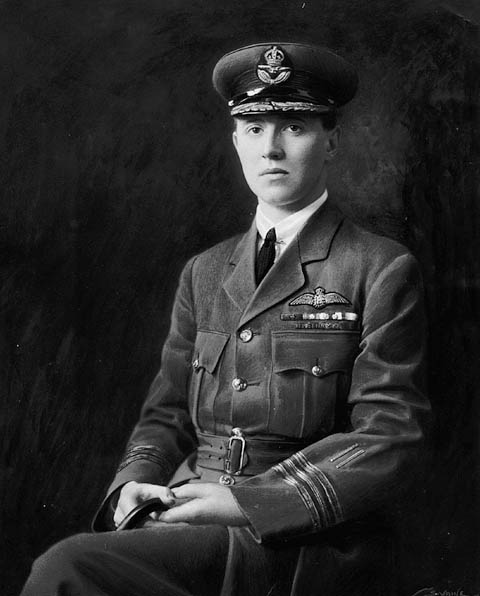
November third marked the 120th anniversary of the birth of William George Barker, Canadian First World War flying ace and Victoria Cross recipient. One of Canada’s most renowned fighter pilots and the most decorated serviceman in the history of the British Commonwealth, Barker shot down 50 enemy aircraft during the First World War.

Major William G. Barker, 1918.

Major William G. Barker, 1918 (MIKAN 3623168)

Barker was born in Dauphin, Manitoba on November 3, 1894. He enlisted in the 1st Canadian Mounted Rifles in December 1914 and arrived in France in September 1915 where he served as a machine gunner. In early 1916, Barker transferred to 9 Squadron, Royal Flying Corps, and was commissioned as a second lieutenant. He transferred to 15 Squadron in July and shot down his first enemy aircraft from the rear of a B.E.2 aircraft. He was awarded the Military Cross in the concluding stages of the Battle of the Somme for spotting German troops massing for a counter-attack and calling down an artillery attack that broke up the 4,000-strong force. After an injury in August 1917, Barker served as a flight instructor in the UK but his ongoing requests for front-line service saw him join the 28 Squadron by the end of the year. Though unexceptional as a pilot, Barker exceled through his aggression in combat and highly accurate marksmanship, coupled with a tendency to ignore orders and fly unofficial patrols.

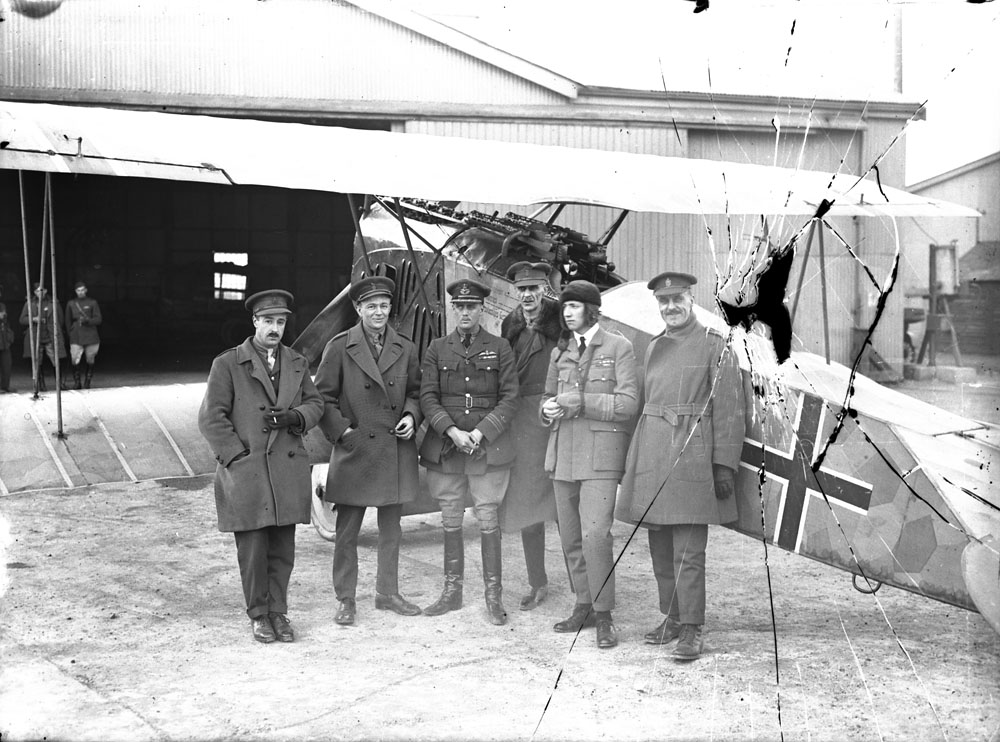
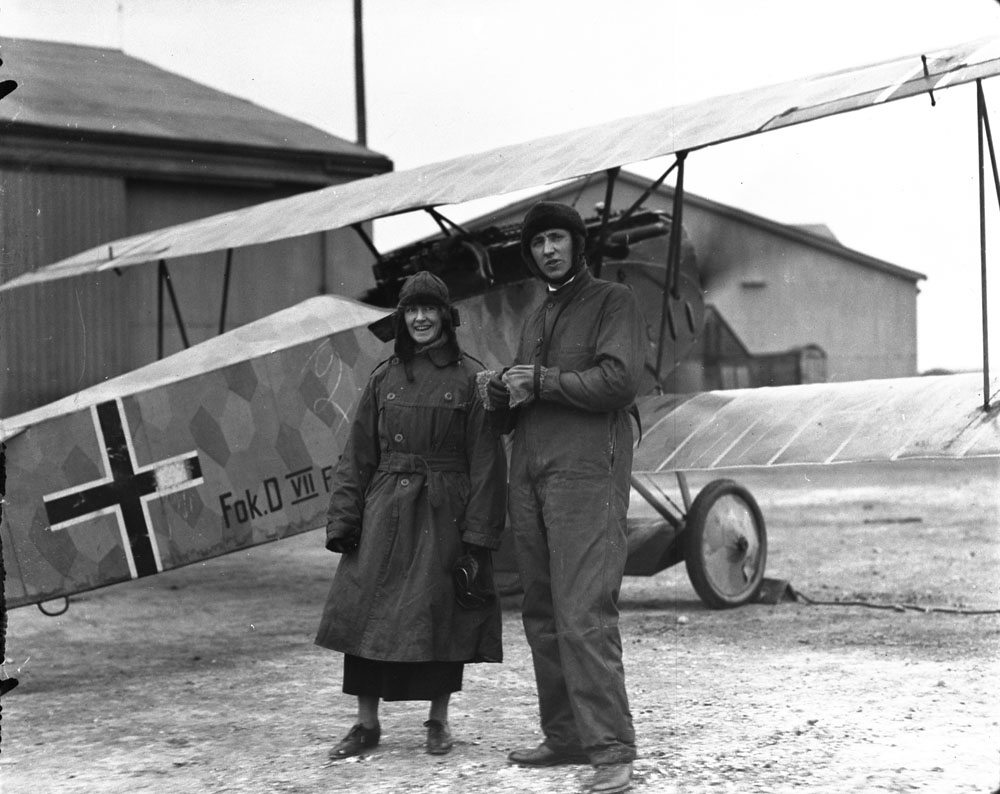
Major W. G. Barker, VC, (5th from left) with captured Fokker D.VII aircraft at Hounslow Aerodrome, April 1919.

Major W. G. Barker, VC, (5th from left) with captured Fokker D.VII aircraft at Hounslow Aerodrome, April 1919 (MIKAN 3523053)

On October 27, 1918, Barker was attached to 201 Squadron, Royal Air Force and flying a solo excursion over the Fôret de Mormal when he encountered a formation of Fokker D.VIIs from Jagdgruppe 12. In the ensuing battle, which took place immediately above the Canadian lines, Barker shot down four enemy aircraft before crash-landing inside Allied lines. Severely wounded, Barker had only recovered enough to walk the few paces at his Victoria Cross investiture ceremony at Buckingham Palace by March 1919.

Major W. G. Barker, VC, with captured Fokker D.VII aircraft at Hounslow Aerodrome, April 1919

Major W. G. Barker, VC, with captured Fokker D.VII aircraft at Hounslow Aerodrome, April 1919 (MIKAN 3214719)

As the most decorated serviceman in the British Commonwealth, Barker is credited with one captured and two (seven shared) balloons destroyed, 33 (and two shared) aircraft destroyed, and five aircraft out-of-control.

Following the war, he and fellow flying ace William “Billy” Bishop formed Bishop-Barker Aeroplanes Limited. Barker joined the fledgling Canadian Air Force as Wing Commander in 1922 and was appointed Acting Director in 1924. He suffered the physical effects of his injuries throughout his post-war life.

He died on March 12, 1930, aged 35, when he lost control of his Fairchild KR-21 biplane trainer during a demonstration flight at Rockcliffe Air Station. His funeral was the largest national state event in Toronto’s history.
Library and Archives Canada holds the CEF service file for Major William George Barker.

To learn more about Canada’s military past, visit the Military Heritage pages.