Friends of the LAC and the Treasures found at the Cubby/Librairie Le Recoin

Version française

By Evan Dalrymple

Many people know about the Friends of the Ottawa Public Library and their book stores across Ottawa, but the Friends of Library and Archives Canada (FLAC) and its Cubby bookshop is one of 395 Wellington’s best kept secrets. For those who know, it’s a treasure!
Two images of a book in the shape of a person. The open book is the head, with two hands holding the bottom corners of the cover and back cover. Above one of the images, it says “The Cubby Friends of LAC BOOKSTORE gently used books”. Under the second image, it says “Le Recoin LIBRAIRIE Les Amis de BAC livres légèrement usagés”.

The National Library and Friends’ logo on the bookshop. This logo is derived from the original mural by Alfred Pellan, titled La Connaissance / Knowledge. This mural is in the Pellan Room within the Public Archives and National Library Building at 395 Wellington. (MIKAN 4932244).

The Cubby is open every Tuesday from 10 a.m. to 3 p.m. in room 185 on the main floor of the Public Archives and National Library Building. I urge you to visit the Cubby in person or online to find the next addition to your personal library.

History of the Friends in Ottawa

In the early 1980s to the mid-1990s, Friends associations flourished in galleries, libraries, archives and Museums in Canada. Particularly in Ottawa, Friends’ associations earliest examples are the National Gallery of Canada (1958), the Canadian War Museum (1988) and the Ottawa Public Library (OPL) Main Branch (1982), which is the most well known of the associations.

The Friends of National Library of Canada was founded in 1991 by Marianne Scott, a former National Librarian of Canada (1984–1999) and the current president of FLAC.

In 2003, The Friends of the National Library of Canada and the Friends of the National Archives of Canada formed one single Friends organization—The Friends of Library and Archives Canada—in anticipation of the fusion of the National Archives with the National Library, which occurred in May 2004 with the official proclamation of the Library and Archives Canada Act.

The newsletter of the Friends of the National Library, “A note among friends,” published between 1992 and 2008, clearly demonstrate how book sales, boutiques and antiquarian book auctions have been monumentally successful ways to reach out to the larger community and to develop the National Library collection.
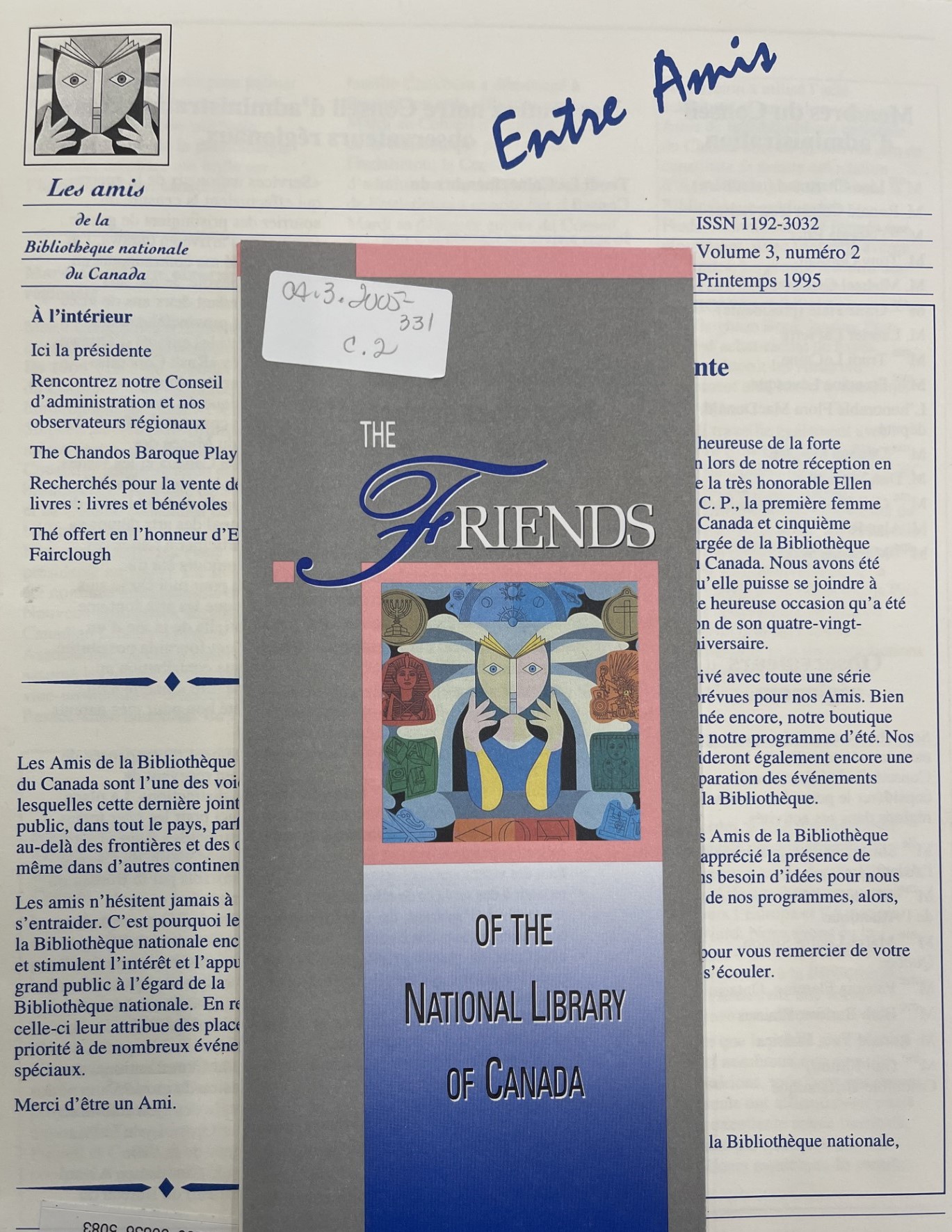
Page from a pamphlet with writing and the image of a logo.

A note among friends and The Friends of the National Library of Canada pamphlets (OCLC 1082162430 & OCLC 61127762).

Encouraging donations and gifts of treasures and fundraising for special acquisitions is central to the Friend’s constitution.

The Friends of National Archives organization also formed in 1995 under the leadership of Jean-Pierre Wallot (1985–1997), with their own newsletter “Between friends.” The National Archives also had a boutique, but less is known about their activities.

FLAC’s Big Book Sales and antiquarian book auctions

Many perhaps have heard of OPL’s yearly Mammoth Book Sales (MBS), but did you know that FLAC once hosted its own enormously successful “Big Book Sales”? These book sales, hosted alongside the Friends organizations of the Nepean Public Library, the Kanata Public Library, the Cumberland Public Library and local booksellers, have been a success in Ottawa for well over a decade. Even before consolidating in 2003 to create the Friends of the Ottawa Public Library Association, Friends organizations were thriving in various public libraries across Ottawa.
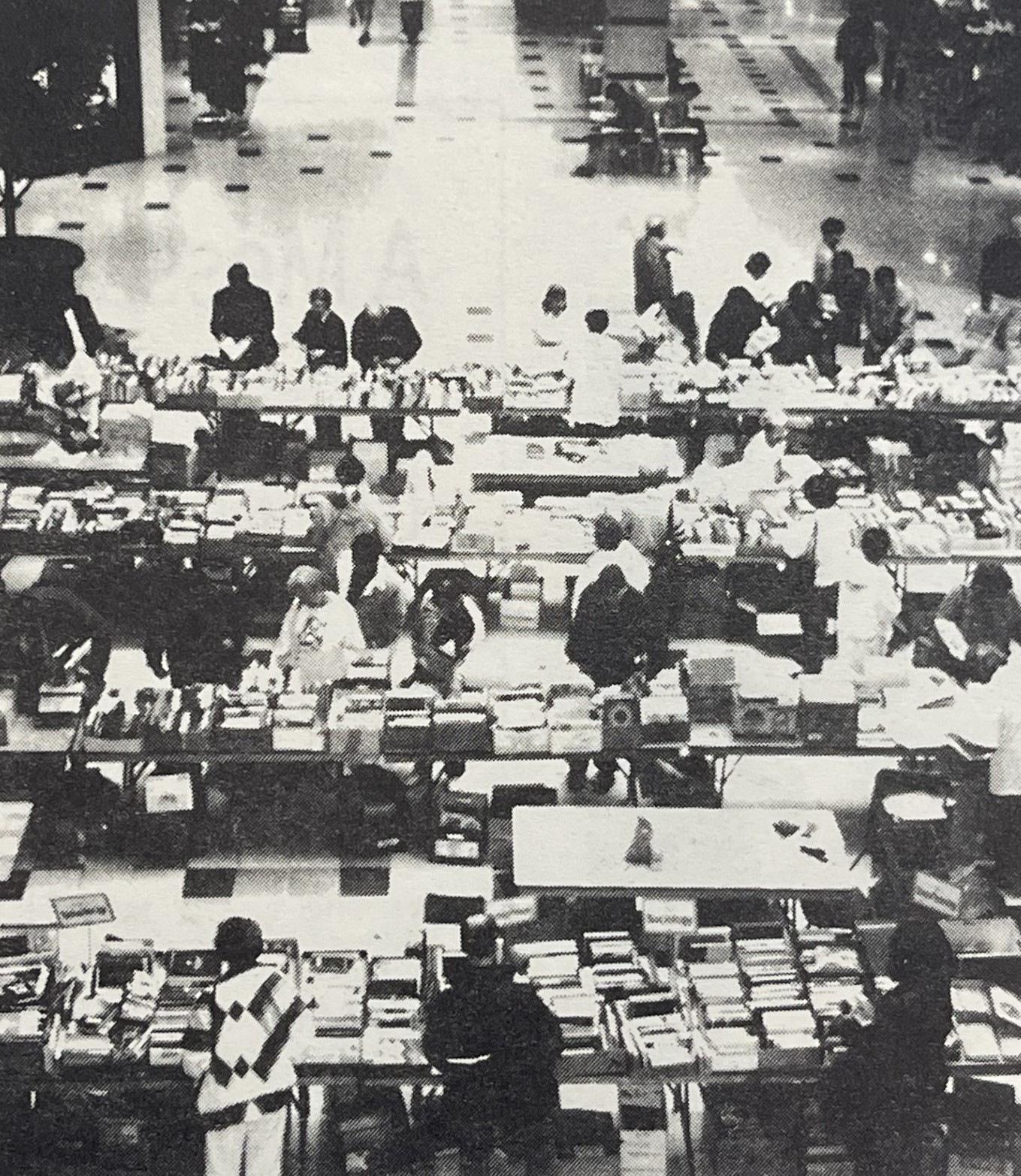
Photograph of people going through books placed on tables in a mall.

The first sale at St. Laurent mall from A note among friends, 1995, Winter, Volume 4, No. 1. (OCLC 1082162430).

The inaugural Big Book Sale took place September 23–25, 1995 at the St. Laurent Shopping Centre. According to the book sale committee, the sale by all measures was a resounding success. It raised $17,164.49, and an additional 423 books were donated to the National Library. In subsequent years, the Friends often doubled or tripled this amount.

FLAC initiated its first antiquarian book auction in the winter of 2000, continuing it until about 2008. As is the case today, all Canadian book donations are set aside and reviewed by a National Library staff member before they become part of the library collection. The Friends earmarked their rarer books for antiquarian book auctions. Today, FLAC features select books on their online store, inviting bids that are too good to pass up, so don’t miss out!

A history of the Cubby

Initially known as the “Friends Boutique,” the Cubby started in 1993 as a pop-up store situated in the sunken lobby of the Public Archives and National Library building. The Boutique was open from 11 a.m. to 3 p.m. daily from June 1st to the end of August.
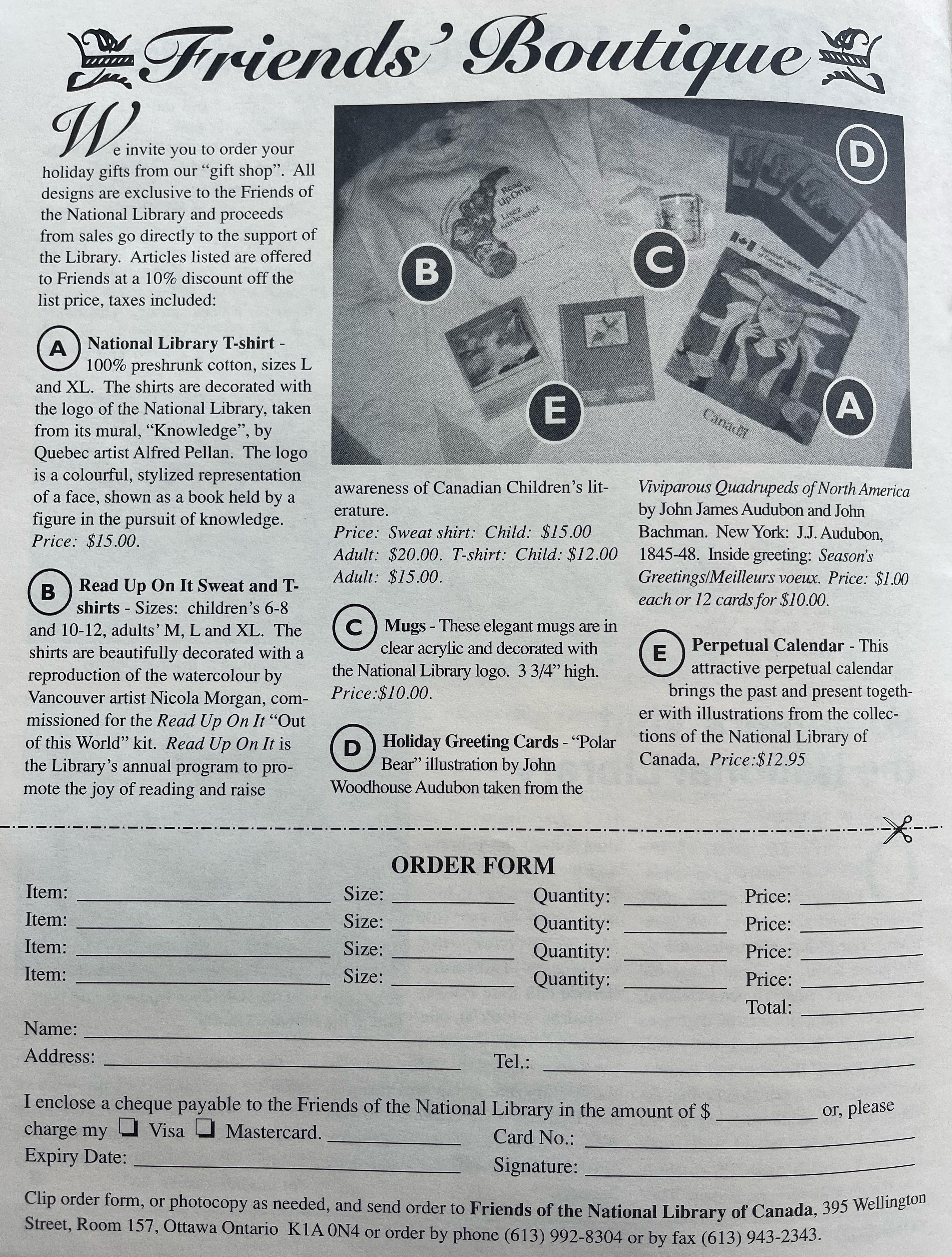
Page from a catalogue with a title “Friends' Boutique”, a photo with merchandise in the top right corner, descriptions of the merchandise and an order form at the bottom.

Thank you for being a Friend! The Fall 1996 catalogue, which featured the new Friends’ Boutique selling interesting merchandise (OCLC 1082162430).

The Boutique was staffed by two volunteers who also provided tours of the National Library in English and French, and it offered a remarkable selection of items, including postcards, posters, CDs from celebrated Canadian Musicians, as well as magnetic tapes from the National Library Music Division. T-shirts and sweatshirts emblazoned with “WOW” for Wellington Street West became especially popular. Many of the cherished items remain available at the Cubby today. Additionally, membership cards to FLAC are on offer—consider joining today!

In 2014, the Friends’ book sales division relocated to room 185 at 395 Wellington, attached to the Morley Callaghan meeting room. The basement now houses an extensive storage area for sorting a vast collection of books and hosts an office where Library and Archives Canada (LAC) staff can meticulously assess each donation.

By 2017 the FLAC bookstore, affectionately known as the Cubby, made its debut. The Cubby offered gently used books, with proceeds supporting the acquisitions of Canadiana for LAC. The store is open three days a week, bolstering its presence by running an annual big book sale and by opening its doors to the public on special occasions, including Canada Day.

Come 2019, the Cubby had enlisted the aid of over ten volunteers and succeeded in raising $3000, contributing to the purchase of significant works such as the rare edition of “Adventures of a Field Mouse,” by Catharine Parr Traill, and Leacock’s best-known book, “Sunshine Sketches of a Little Town” —the American version in the original dust jacket.

The pandemic in 2020 necessitated the closure of the Cubby, yet in response, FLAC pivoted to an online version of its antiquarian book sales of the past. So bid away!

Treasures found at the Cubby

The second and third laws of library science proposed by S.R. Ranganathan in 1931 (OCLC 1007655699)—that every reader has a book, and every book its reader—are ideas that resonate with my experiences at the Cubby.

In 2019, I visited an exhibit at the National Gallery of Canada which contained the Archives of Thoreau and J. E. H. MacDonald collection and the book West by East and other Poems by J. E. H. Macdonald (OCLC 11487298). This Ryerson Press book, enriched by Thoreau MacDonald’s drawings and the original dust jacket, are images that have etched themselves in my memory.

To my delight, I recently managed to acquire a rare copy—the first of five hundred pulled—through negotiation on the Cubby’s online platform!
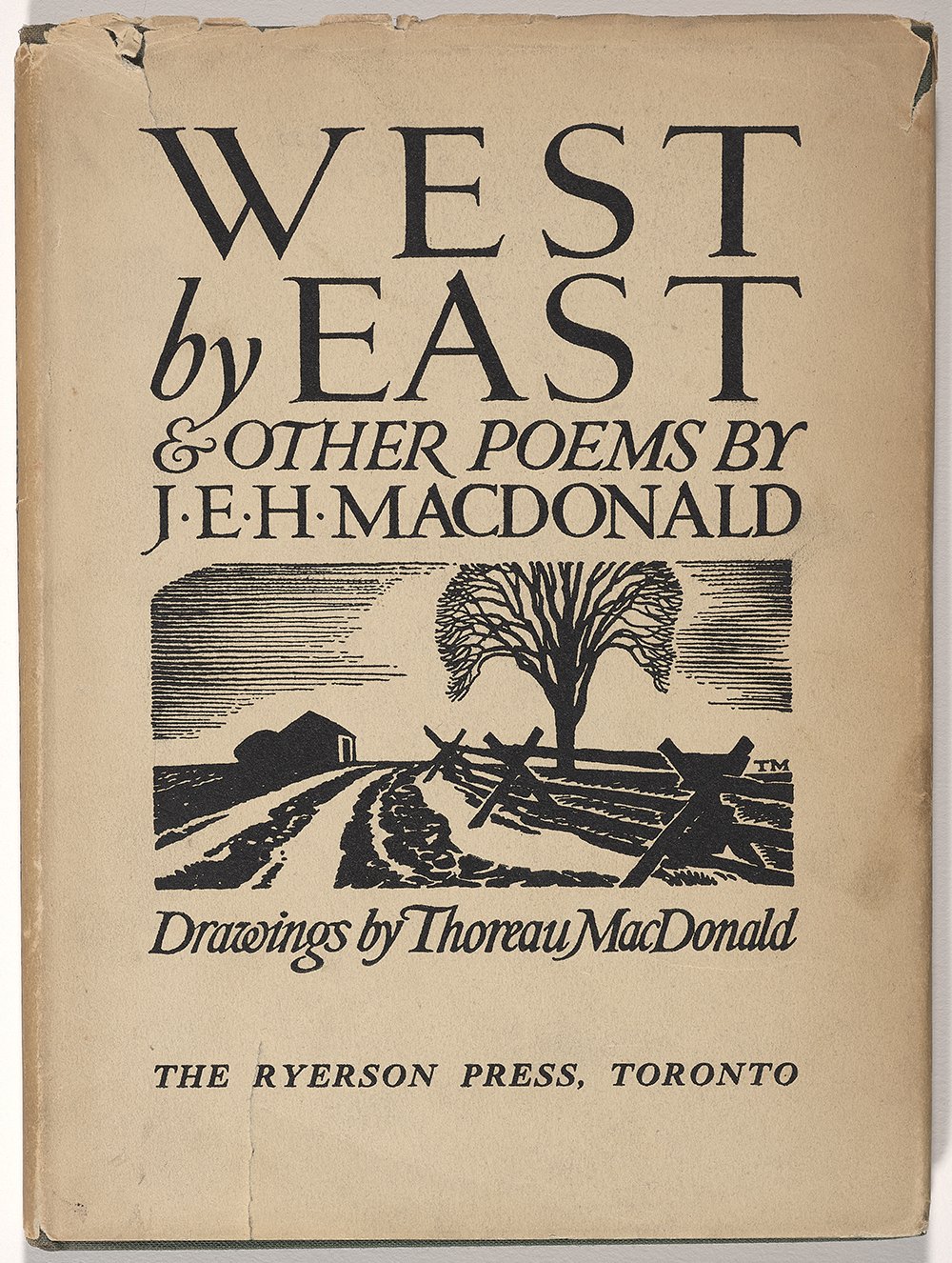
Book cover with drawing of a road lined by a fenced going towards a house. A tree can be seen in the background. West by East & other poems by J.E.H MacDonald is written on top of the drawing. Below its written Drawings by Thoreau MacDonald. The Ryerson Press, Toronto.

My copy of West by East by J.E.H MacDonald (OCLC 11487298) is one of the first five hundred copies produced.
Photo credit: J.E.H. MacDonald, West by East and other poems, with illustration by Thoreau MacDonald. Toronto 1933. National Gallery of Canada Library and Archives Photo: National Gallery of Canada

I have since discovered a treasure trove of Thoreau MacDonald-designed books at the Cubby store. These books are all in very good condition with original dust jackets from the 1930s from Ryerson Press Books and adorned with illustrations by Thoreau Macdonald.

First, I discovered a very handsome copy of Thoreau MacDonald: A Catalogue of Design and Illustration. My copy is signed by the humble compiler, Richard Landon, and is noted for its significance in Canadian book illustration history. Richard Landon was the head of Thomas Fisher Rare Book Library, which has been referred to as “the house that Richard Built.”

Since armed with this catalogue of book design and illustration, I also located two other treasures by the Confederation poets Duncan Campbell Scott (1862–1947) and Sir Charles George Douglas Roberts. Both books were inscribed and signed by the authors and had rare ephemera placed within. Could it be that these books were waiting on the cart of the Cubby for me?

In the Village of Viger (OCLC 3634059), by Duncan Campbell Scott, was designed and signed by Thoreau MacDonald. Duncan Campbell Scott was a poet and a controversial civil servant, leaving a complicated legacy for Canadians to consider regarding his part as an architect of the Residential Schools.
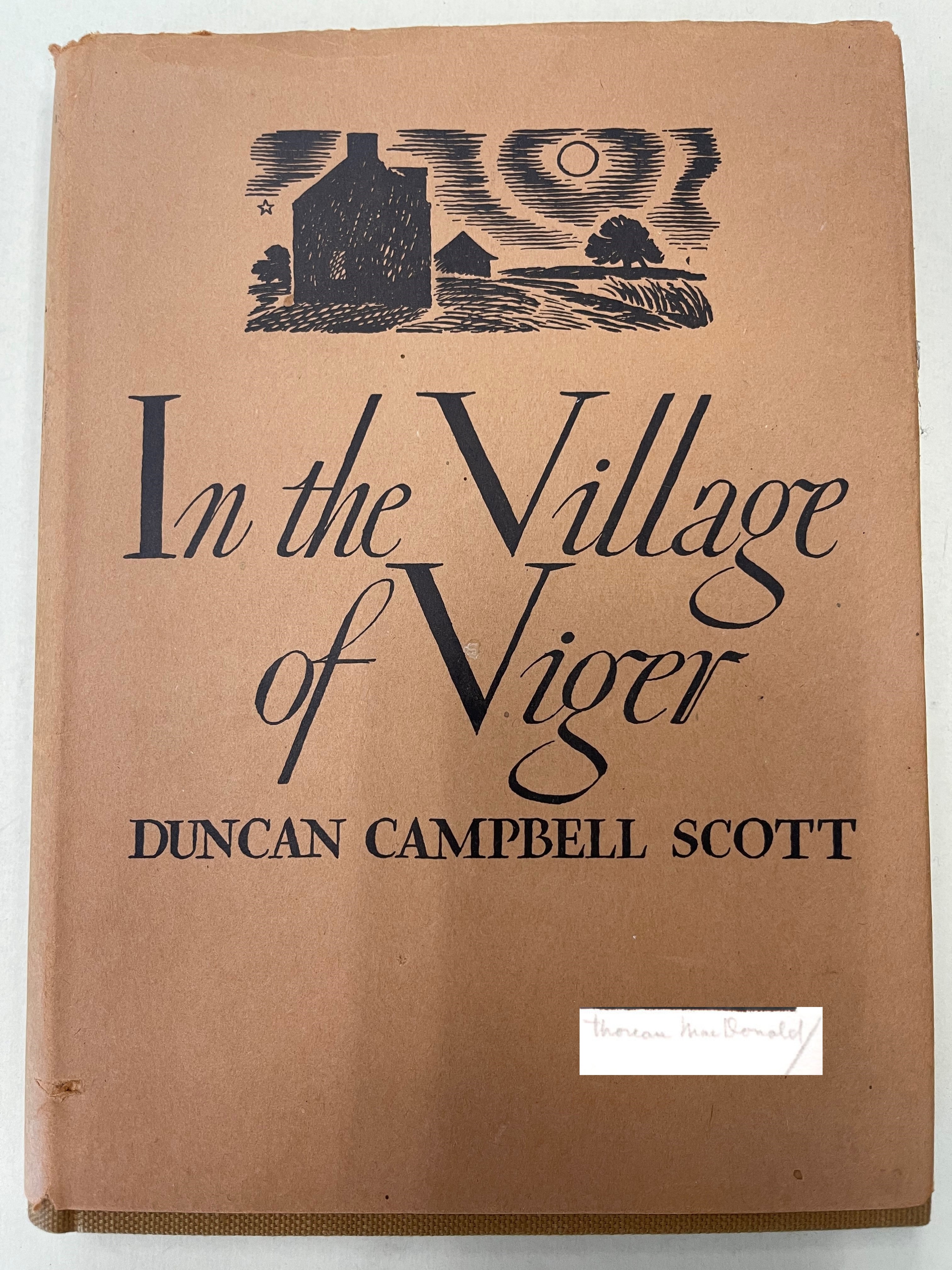
Book cover with a drawing of a house in forefront, a second house in the back, trees, grass, and a sun in the sky. The middle of the book cover reads In the Village of Viger, followed by the author’s name, Duncan Campbell Scott.

In the Village of Viger (OCLC 3634059) by Duncan Campbell Scott, a Confederation poet and an architect of the Residential Schools in Canada. My copy from the Cubby was signed by Thoreau MacDonald. Photo courtesy of the author, Evan Dalrymple.

My next find was the Selected Poems of Sir Charles G. D. Roberts (OCLC 27780946). This book was personally inscribed, and to my astonishment, I found various pieces of ephemera, including a signed mimeograph of his poem “Those Perish, Those Endure” about the Spanish Civil War and a signed article from the Dalhousie Review in April 1930, “More Reminisces About Bliss Carman”. Bliss Carman was Charles Robert’s cousin and a prolific Confederation Poet.
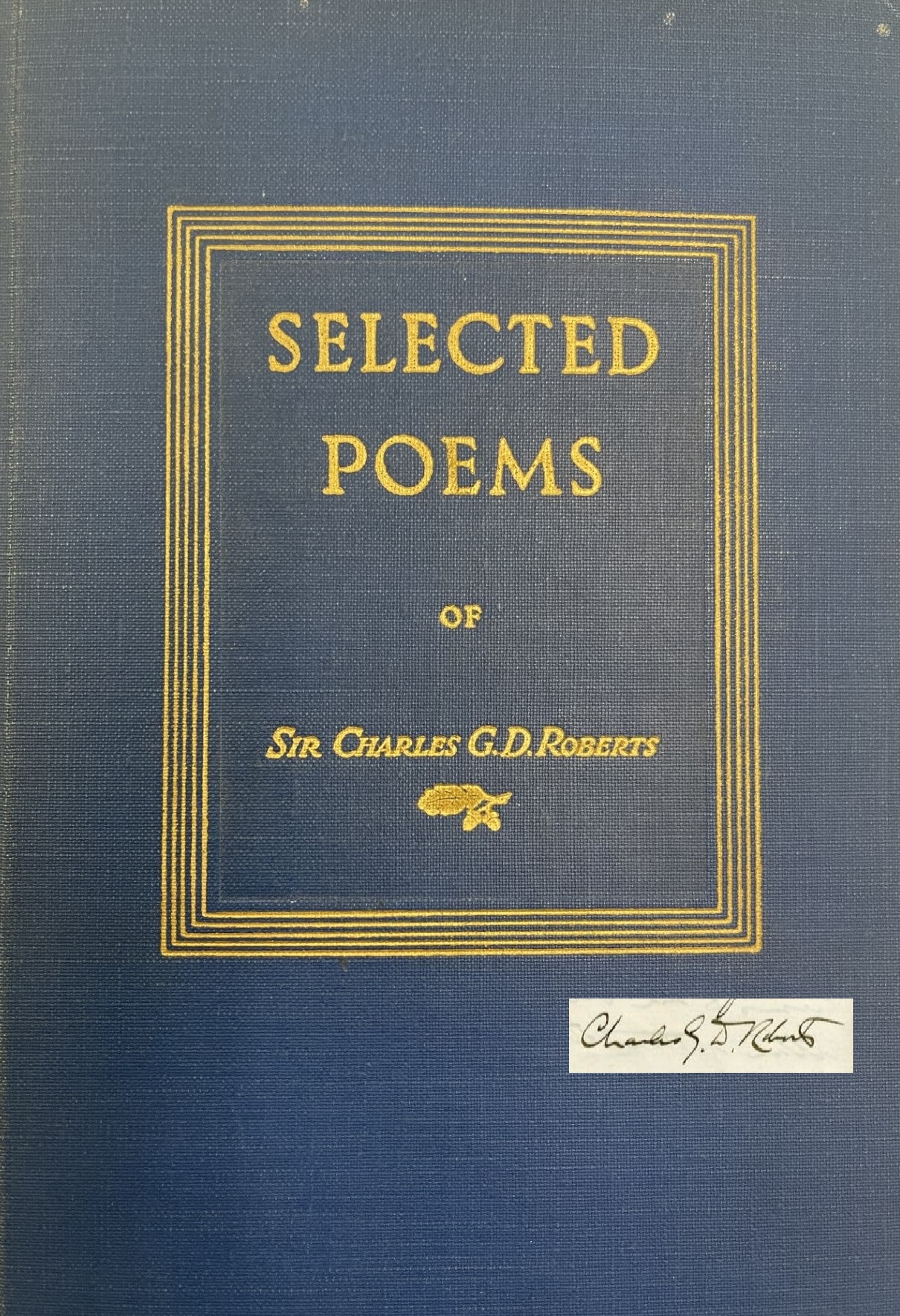
Cover page of a book with a frame-like rectangle with its title “Selected Poems” and the author’s name “Sir Charles G. D. Roberts” inside.

Selected Poems of Sir Charles G. D. Roberts (OCLC 27780946). My copy from the Cubby was signed and full of ephemera. Photo courtesy of the author, Evan Dalrymple.

The next chapter of the Cubby/ Le Recoin

At Ādisōke, a joint facility shared by the Ottawa Public Library and Library and Archives Canada, construction is well under way. Ādisōke is Anishinaabemowin word that means “storytelling,” and it promises to be a hub for our community. The question is—what will become of our Cubby?

Will it be a charming pop-up as from the bygone days, with “Big Book Sales” and auctions, or will it forge a new path? The fusion of the Ottawa Public Library and Library and Archives Canada may recreate the collaborative spirit we remember.

As we turn the page to the next chapter for the Friends and discover the new gathering space that will emerge at Ādisōke, we anticipate the new treasures that await us.

In closing, find your own treasures at the Cubby Big Book sale that will occur during LAC’s Doors Open Ottawa event on June 1 and 2, 2024. This will also mark 31 years of selling books—see you all at the Cubby!

To contact the Cubby, email Amis-friends@bac-lac.gc.ca or call 613-992-8304.

Further reading

  • Abley, Mark. 2013. Conversations with a Dead Man: The Legacy of Duncan Campbell Scott. Madeira Park, BC: Douglas & McIntyre (OCLC 856726449).
  • Landon, Richard, Marie Elena Korey, and Thomas Fisher Rare Book Library. 2014. A Long Way from the Armstrong Beer Parlour: A Life in Rare Books: Essays. Toronto, Ontario: Thomas Fisher Rare Book Library (OCLC 890957110).
  • From our rare book vault: What makes a book rare?, Library and Archives Canada Blog

Evan Dalrymple is a Reference Librarian for the Access and Services Branch at Library and Archives Canada, located at 395 Wellington.

From modest beginnings

Version française

By Forrest Pass

For an institution that conserves so many treaties, charters and proclamations, Library and Archives Canada’s own founding document is a modest one. On June 20, 1872—150 years ago—the federal cabinet appointed Douglas Brymner as “senior second-class clerk” responsible for a newly approved “Public Archives Service” within the Department of Agriculture. The handwritten order-in-council might look unassuming, but it marked the beginning of a century and a half of collecting and caring for Canadian documentary heritage.

The decision to establish a national archive was the result of a petition circulated in 1871 by the Quebec Literary and Historical Society. The petitioners lamented the “very disadvantageous position” of Canadian historians when it came to accessing historical documents and proposed a national repository. The government agreed in principle, but it could not offer any immediate funding. The project would have to wait until the next fiscal year.

A handwritten page that reads: “On a Memorandum dated 18th June 1872, from the Hon: the Minister of Agriculture, recommending that Mr Douglas Brymner, aged 42 years be added to the Staff of the Department of Agriculture as a Senior Record Class Clerk at a Salary of $1200.00 per annum – and he further recommends that during the present year the Salary of Mr Brymner be paid partly from the vote of Parliament for the collecting of Public Archives to the amount of $600 – as he proposes to employ Mr Brymner on the …”

A certified copy of Order-in-Council 1872-0712, dated June 20, 1872, approving Douglas Brymner’s appointment as a senior second-class clerk, responsible for both the Public Archives and “getting of information on Agriculture” (e011408984-001)

Douglas Brymner, a Montréal journalist, was not an obvious choice to be the country’s first archivist. He had an interest in history but was not active in historical circles. However, Brymner was not hired solely as an archivist; at first, he was to split his time between archival projects and “a preliminary enquiry for the getting of information on Agriculture.” Investigating the state of Canadian crops and livestock was as pressing a task as organizing a national archive, and Brymner, a former farmer as well as a journalist, seemed qualified to do both.

A man with a beard wearing a white shirt and a black jacket.

Douglas Brymner, the first Dominion Archivist, in an oil portrait by his son, artist William Brymner, 1886 (e008299814-v6)

Whatever the intention, Brymner soon found that building the archives was a full-time commitment. As he later recalled, “the work had to be begun ab ovo, not a single document of any description being in the room set apart for the custody of the Archives.” Within weeks, he was on the road, rummaging through courthouse attics, legislature basements and the dusty papers of prominent settler families.

This collection strategy reflected both the new archives’ limited mandate and the new archivist’s own concept of Canadian history. Before 1903, the archives did not collect recent government records. Instead, Brymner looked for documents of the pre-Confederation past, focusing on settler history, especially its political and military aspects. Although his reports indicated a passing interest in “Indian affairs” as an aspect of colonial policy, Brymner’s archives recorded Indigenous experiences or voices only incidentally, if at all.

His colonial focus led the archivist to prioritize the transcription of Canadian historical records in British and French archives, continuing the work that the Quebec Literary and Historical Society had quietly pursued for decades. Brymner travelled to London to investigate relevant collections there, while the Quebec historian Hospice-Anthelme Verreau did the same in Paris.

These were ambitious projects for the archives’ limited resources. In its first year, the new archives’ budget was a meagre $4,000 (about $94,000 in 2022 dollars). For office and storage space, Brymner’s chief, the deputy minister of Agriculture, had to haggle with the Post Office Department for the use of three rooms in the basement of the West Block on Parliament Hill.

A large stone building with towers, behind a dirt road and a wrought-iron and stone fence.

The West Block on Parliament Hill from Wellington Street, as it appeared when the Dominion Archives took up residence in the basement. The northwest wing of the building, including its imposing tower, was not completed until 1879. William Topley Studio photograph, about 1872 (a012386-v6)

Underfunding led to embarrassment. In 1880, Gilbert-Anselme Girouard, a New Brunswick Member of Parliament, suggested that Brymner hire the Acadian historian Pascal Poirier to transcribe Acadian parish records. However, on receiving Brymner’s reply, Girouard regretted that he could not possibly recommend Poirier or any other competent copyist for the paltry amount that the archives were prepared to pay.

More startling was the archives’ willingness to contemplate using what today would be considered child labour to cut costs. In 1878, F.J. Dore, Canadian Agent-General in London, sought permission from the British Museum, on Brymner’s behalf, to transcribe the papers of Sir Frederick Haldimand, the Governor of Quebec during the American Revolutionary War. Dore regretfully informed Brymner that the museum prohibited anyone under the age of 21 from working in its building. “Otherwise,” Dore wrote, “a number of Juvenile copyists might have been got to do the work at a much cheaper rate than the one quoted.” At the time, teenaged copying clerks were common in England and Canada alike. Nevertheless, the idea of using young, inexperienced copyists to save money underlines the early archives’ budgetary woes.

Yet for all these challenges, Brymner accomplished much in his first decade as archivist. Transcriptions from England began to arrive in the early 1880s. By 1884, the archives’ catalogued holdings filled some 1,300 volumes, with thousands of pages awaiting indexing and binding. Transcription projects in European archives would continue well into the 20th century.

A typed and handwritten form, signed by William Blackwood. There is a stamp in the right-hand corner, and writing in red over the left side of the page.

A shipping receipt for “one case of Archives,” likely one of the first batches of Haldimand transcriptions, 1881 (e011408984-001)

Among original documents, Brymner’s “first major archival acquisition” was a large accession of records from the Halifax Citadel. Primarily military in focus, the records touched on many aspects of early colonial history. Brymner acquired these in 1873, after negotiations with the British War Office.

Even before the Halifax records arrived, however, a small donation anticipated the institution’s eventual role as a library as well as an archive. In the summer of 1872, Brymner had visited the Séminaire de Québec, a 200-year-old religious community and college. The Séminaire was not interested in transferring its own rich archives to Ottawa, but Brymner did come away with a small consolation prize: a set of the Séminaire’s student newspaper, L’Abeille (“The Bee”), which occasionally featured transcribed historical documents.

Bound in red leather and buckram, this set of L’Abeille remains in the collection at Library and Archives Canada to this day. Several issues bear the embossed stamp of the “Dominion Archives – Library,” undoubtedly from Brymner’s day. A volume of a revived edition of L’Abeille, published between 1877 and 1881, is inscribed to the “Archives of Canada” by a director of the Séminaire, evidence of Brymner’s ongoing relationship with the donor.

Five books bound in red leather, with white paper flags sticking out of the top. The books are in a wooden book cart.

The Dominion Archives’ set of L’Abeille (“The Bee”). Brymner received the three slim volumes on the left in 1872, his first documented acquisition. The volume on the far right was donated to the archives in 1885 (OCLC 300305563) Photo Credit: Forrest Pass

A typed page of L’Abeille, Vol. 1, Petit Séminaire de Quebec, December 11, 1849, No. 12.

The front page of an 1848 issue of L’Abeille (“The Bee”), featuring a transcribed letter from François de Laval, the first Bishop of Quebec, dated 1690 (OCLC 300305563) Photo Credit: Forrest Pass

Douglas Brymner could only have imagined how the collection he started would grow over the following century and a half. Under his successor, Sir Arthur Doughty, the “Dominion Archives” evolved into the Public Archives of Canada, with a broad mandate to collect government records and private manuscripts, as well as maps, artwork and photographs. Before the creation of a national history museum, the Public Archives also collected artifacts and maintained a museum. The National Library of Canada, founded in 1953, complemented the work of the archives by collecting and preserving published documentary heritage. In 2004, the two institutions merged to form Library and Archives Canada. Today, collections at Library and Archives Canada include over 20 million books, 250 linear kilometres of archival records, over 30 million photographs and nearly half a million works of art.

The Library and Archives Canada of today is a far cry from a part-time archivist working in a cramped basement on Parliament Hill, making the most of his modest resources and as busy as, well, a bee!


Forrest Pass is a curator with the Exhibitions team at Library and Archives Canada.

Proud to be peculiar: The little-known story of the Archives Museum

Version française

By Geneviève Morin

One ordinary June day in 2011, an unordinary mystery landed on the desks of Library and Archives Canada’s (LAC) documentary art archivists. A small bronze statuette of James Wolfe by sculptor Vernon March had just been found at the Lord Elgin Hotel in Ottawa, carefully wrapped and secretly left unattended. The only clue was a note in which the anonymous author expressed regret at having stolen the statuette “in an act of foolishness” while visiting the Archives in the 1950s. Now in the twilight of his life, he was endeavouring to make amends…

The archivists familiar with the history of LAC’s non-textual collections immediately got to work: research was undertaken, paperwork was retrieved, and provenance was confirmed. The bronze likeness of General Wolfe had indeed been added to the Archives’ holdings in 1914! The statuette was gratefully retrieved and eventually transferred to its new current home, the Canadian Museum of History.

However, the question remains… Why would archives ever have collected that sort of sculpture in the first place? Do archives not typically stick to two-dimensional material like textual documents, photographs, maps and drawings? To be sure, even though many Canadians are aware that LAC and its predecessor institutions (the National Archives of Canada, the National Library of Canada and the Public Archives of Canada) have acquired non-textual material for over 130 years, few are familiar with the reason why our holdings were—and, in some cases, still are—so eclectic.

The bold ambition of Arthur Doughty

Simply put, the diversity of our past and present holdings is in large part owed to Canada’s second Dominion Archivist, Arthur Doughty. His ambition, as he explained in the Archives’ 1925 Catalogue of Pictures, was nothing short of making the institution “… a national department of history, where are preserved sources of every kind having value for the study of the history of Canada.” This was a substantial mandate, to say the least…

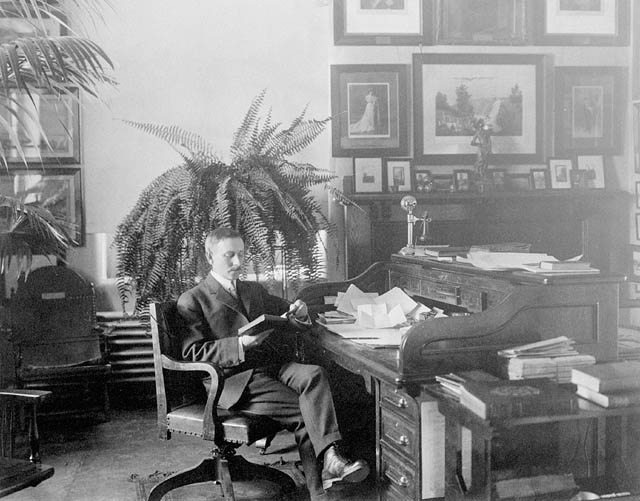
Black-and-white photograph of a man with a mustache wearing a dark suit and boots. He is sitting in a wood chair and reading a book beside a wood desk covered in papers. There are large plants, a wall with many framed images and a fireplace mantel in the background. General Wolfe’s leather campaign chair leans against the wall to the man’s right.

Dr. Arthur G. Doughty, Dominion Archivist, c. 1920, Pittaway Studio. (c051653)

Doughty’s vision caused a considerable increase in the types of material acquired by the Archives after his appointment, in 1904. The gargantuan Duberger model of Québec, pictured below, transferred from the British War Office in 1908, is one of the most striking examples of this change in acquisition practices.

Black-and-white photograph of a large room with display tables running along the sides and lights hanging from the ceiling. In the background, there is a large model of a city.

Grey Room, Public Archives of Canada, Sussex Street, after 1926. (a066642) (The model was built at Québec by draftsman Jean-Baptiste Duberger and Royal Engineer John By between 1806 and 1808. Today, the model is in the custody of Parks Canada.)

Over the years, the Archives became responsible for taking in thousands of diverse items, which included artefacts such as:

  • the red tunic worn by Isaac Brock at the time of his death during the Battle of Queenston Heights;
  • James Wolfe’s leather campaign chair (pictured above in Doughty’s office, left-hand side);
  • a war club said to have been used in the War of 1812 and several other weapons;
  • Indigenous eyewear, weapons and clothing;
  • mirrors, chandeliers and various pieces of furniture;
  • the nation’s most extensive collections of coins, tokens, paper money, medals and decorations;
  • and quirkier curiosities, such as a wooden potato pounder believed to have been used in the kitchen of Sir John Johnson, and an elaborate set of brass sleigh-bells having once belonged to Princess Louise and the Marquis of Lorne.

In short, nothing seemed to be off limits for the Archives, as long as it could teach Canadians something about their history.

Black-and-white photograph of a wood cabinet with a mirror. On top of the cabinet is an elaborately decorated mantel clock. There are two candelabras in the shape of cranes standing on turtles’ backs on either side of the cabinet.

Raingo Frères mantel clock on display at the Public Archives building, date unknown. (a066643)

A must-see for locals and visitors alike

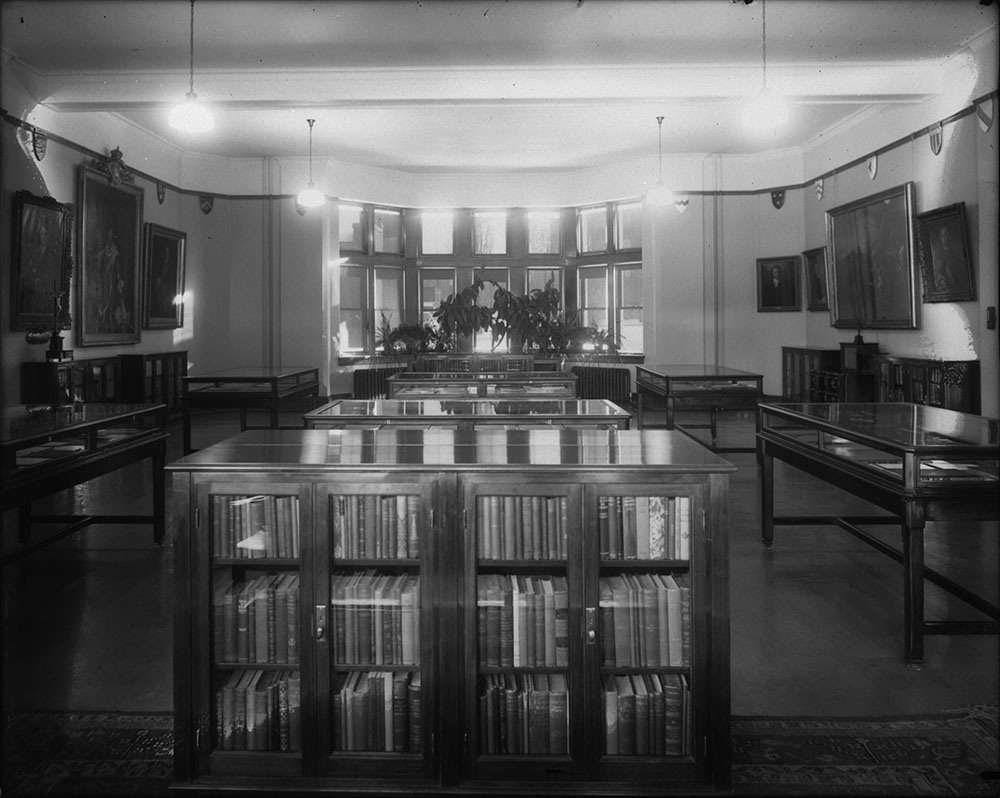
Deemed “A Treasure-House for the Canadian Historian” by Saturday Night Magazine in 1910, the Archives came to develop a hugely successful museum program providing space for Canadians to immerse themselves in displays that combined publications, textual records, and varying forms of specialized media, such as maps, photographs, paintings, engravings, and three-dimensional artefacts. Coincidentally, the infamous Wolfe statuette can be seen in just such a display in the photograph below, taken around 1926, co-starring with Benjamin West’s painting The Death of General Wolfe in the Archives’ Northcliffe Room.

Black-and-white photo of a room with book cases and display cabinets. In the background, there are windows and plants.

The Northcliffe Room in the Public Archives Building, Sussex Street. Ottawa, Ont., ca. 1926-1930. (a137713). The Vernon March statuette of Wolfe can be seen on top of the display case below the large painting on the right wall.

Housed in various spaces that included three custom-built rooms on the ground floor of the Archives building at 330 Sussex Street, the permanent exhibits were regularly supplemented by special displays marking commemorative events, the intake of significant acquisitions, or the visit of important guests. Space was tight, but under the guidance of Doughty and curators Mr. Weber and A.E.H. Petrie, nearly every usable surface was considered an opportunity to showcase the collection—even hallways and Doughty’s own office.

Black-and-white photograph of a large room with display cabinets, a statue, flags, plants, framed images, chairs and a throne.

Minto Room, Public Archives of Canada, arranged for a reception for delegates attending the Imperial Conference – Ottawa, August 1932. (c000029) The sovereign’s throne [centre-right] was housed at the Archives Museum when not in use at the Senate of Canada.

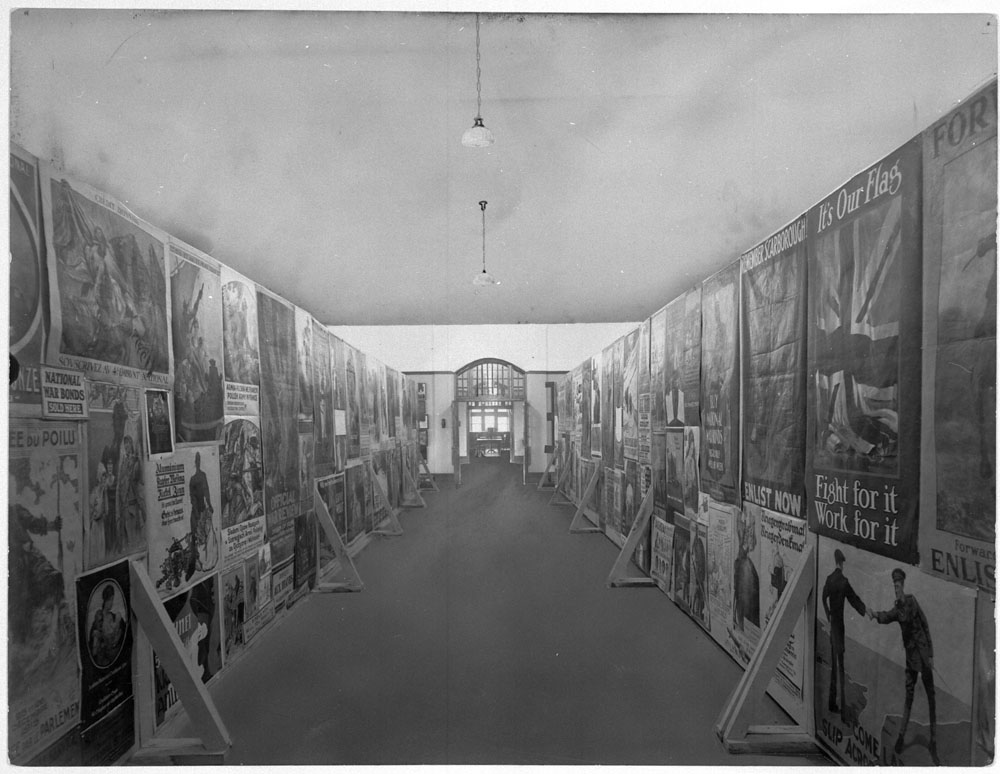
Black-and-white photograph of a long narrow room. There are two hanging lights in the middle of the room, and posters are plastered on each wall.

War Posters Room, Public Archives Building, Sussex Street, c. 1944 (a066638). We still find thumbtack holes in some of the war posters in LAC’s collections. Conservation and exhibition practices have greatly evolved since the days of the War Posters Room!

As a result, the Archives Museum hosted countless groups of schoolchildren, scholars, history enthusiasts and visiting dignitaries. The popular attraction was even graced by Princess Elizabeth and the Duke of Edinburgh in 1951. The royal couple enjoyed the experience so much that, as Archives officials proudly reported, “[by] the time the party had signed the visitor’s book and left for Government House, a much longer period had elapsed than had been arranged for in the official programme.”

Black-and-white photograph of four men and one woman looking at items in a glass display cabinet. One man is pointing at a document in the cabinet.

“Their Royal Highnesses the Princess Elizabeth and the Duke of Edinburg in the Public Archives, accompanied by the Hon. F. Gordon Bradley, Secretary of State (left).” Report of the Public Archives for the year 1951.

By the mid-1960s, the Museum’s popularity was growing by leaps and bounds. Unfortunately, as Mr. Petrie observed in 1960, this level of success did have its adverse effects: “One guard seems to be insufficient for the three rooms [as there have been] petty thefts and minor vandalism to collection items.” Security was struggling to keep up with growing crowds; perhaps these were the conditions in which the Wolfe statuette came to its unfortunate disappearance?

The unavoidable unsustainability

Ultimately, Doughty’s well-intentioned ambition could not keep going in this manner. After nearly 60 years of existence, the Museum had accumulated such a large three-dimensional collection that the Archives building was bursting at the seams. Space had become so tight that, in 1965, the exhibition spaces occupying the Sussex building had to be moved to temporary lodgings at the Daly Building, near the Château Laurier; so did the surplus artifacts that had until then been stored at the Loeb Building, on Besserer Street.

Black-and-white photograph of two buildings. On the left side of the image, there are blurry people and cars. In the foreground, power lines can be seen.

G.T.R. Hotel [Chateau Laurier] and Ria [Daly] Building. William James Topley, after 1911. (a009116) The federal government bought and began occupying the Daly Building, a commercial building, in 1921.

Appraisal of the Museum’s conundrum by both the Massey Commission of 1951 and the Glassco Commission of 1963 provided the necessary weight to the argument for downsizing. While the Archives had gone beyond their traditional role at a time when “no alternative was available,” it was obvious that being the national archives and a museum all at once was impossible and no longer necessary. The time had come to share the burden of responsibility with other existing institutions.

New building, reduced holdings

In 1967, the National Library and National Archives of Canada moved to new quarters, at 395 Wellington Street in Ottawa. While this modern, custom-designed building did include exhibition spaces, the displays of days past would not be replicated there; rather, focus would be dedicated to the wealth of resources found in the library and archives holdings.

The years surrounding the move were therefore occupied with the redistribution of the Museum’s collection. Most of the three-dimensional artefacts were transferred to the upcoming Museum of Man (now known as the Canadian Museum of History), while war trophies and military artefacts remained behind at the Sussex location to continue on as part of Canada’s War Museum. Approximately 16,000 coins and other monetary items were sent to the Bank of Canada, and the Archives’ philatelic holdings were taken in by the Post Office Department. The Archives retained its holdings of some 6,000 military, commemorative and ecclesiastical medals and tokens; these, along with the extensive collection of paintings, remained part of the Public Archives holdings of documentary art and objects. Mr. Petrie stayed on as Curator of Museum and Numismatics, showing groups around exhibits and paintings on display and conducting tours of the new building’s impressive decorative and architectural features.

A continuing legacy

As Library and Archives Canada evolves into the 21st century, the spirit of Doughty’s ambition and the legacy of the Archives Museum live on through a distinctly Canadian approach to archives. Bred out of collecting and caring for over 100 years’ worth of government records, private papers and non-textual “sources of every kind,” this approach has generated the eclectic array of expertise that remains with LAC’s professionals to this day. Most importantly, it has ensured that a diverse trove of documentary heritage continues to intrigue, inform and impress Canadians and visitors alike, even though security and access conditions have become just a bit tighter since the days of the Wolfe statuette affair.


Geneviève Morin is a Senior Archivist for Documentary Art, Objects and Photography, Government Archives Division.