Transcribing the Coltman Report – Crowdsourcing at Library and Archives Canada

By Beth Greenhorn

In the spring of 2016, Library and Archives Canada (LAC) digitized A General Statement and Report relative to the Disturbances in the Indian Territories of British North America, more commonly known as “the Coltman Report.” Its digitization was in support of the 200th-anniversary events commemorating the Battle of Seven Oaks, organized by the Manitoba Métis Federation in June 2016.

Top half of Page 1 of William Batchelor Coltman’s report concerning the Battle of Seven Oaks. Handwriting in faded black ink on cream coloured paper. The writing begins before and crosses over the red vertical margin line on the left side of the page.

Screenshot of Page 1 of the Coltman Report, 1818 (MIKAN 114974)

Continue reading

Superheroes of the Digital Universe: Digitizing the Bell Features Collection

By Meaghan Scanlon

Library and Archives Canada (LAC) is excited to announce a new digital resource for fans of Canadian comic books. The Bell Features Collection of Second World War-era comics has been completely digitized and is now available to researchers online.

The Bell Features Collection consists of 382 comic books, most in multiple copies, published in the 1940s by the Canadian comic book publisher Bell Features. These comics showcase an astounding selection of Canadian heroes such as Nelvana of the Northern Lights, Johnny Canuck, and Dixon of the Mounted.

Between November 2015 and March 2016, LAC’s digitization staff painstakingly photographed one copy of each issue held in the collection—a total of 193 comic books. At between 50 and 60 pages per comic, that’s around 10,000 pages!

Creating electronic copies of these delicate documents from LAC’s collection involved hours of careful labour from technicians in our digitization labs, who follow rigorous standards to get the best possible images while preserving the condition of the items.

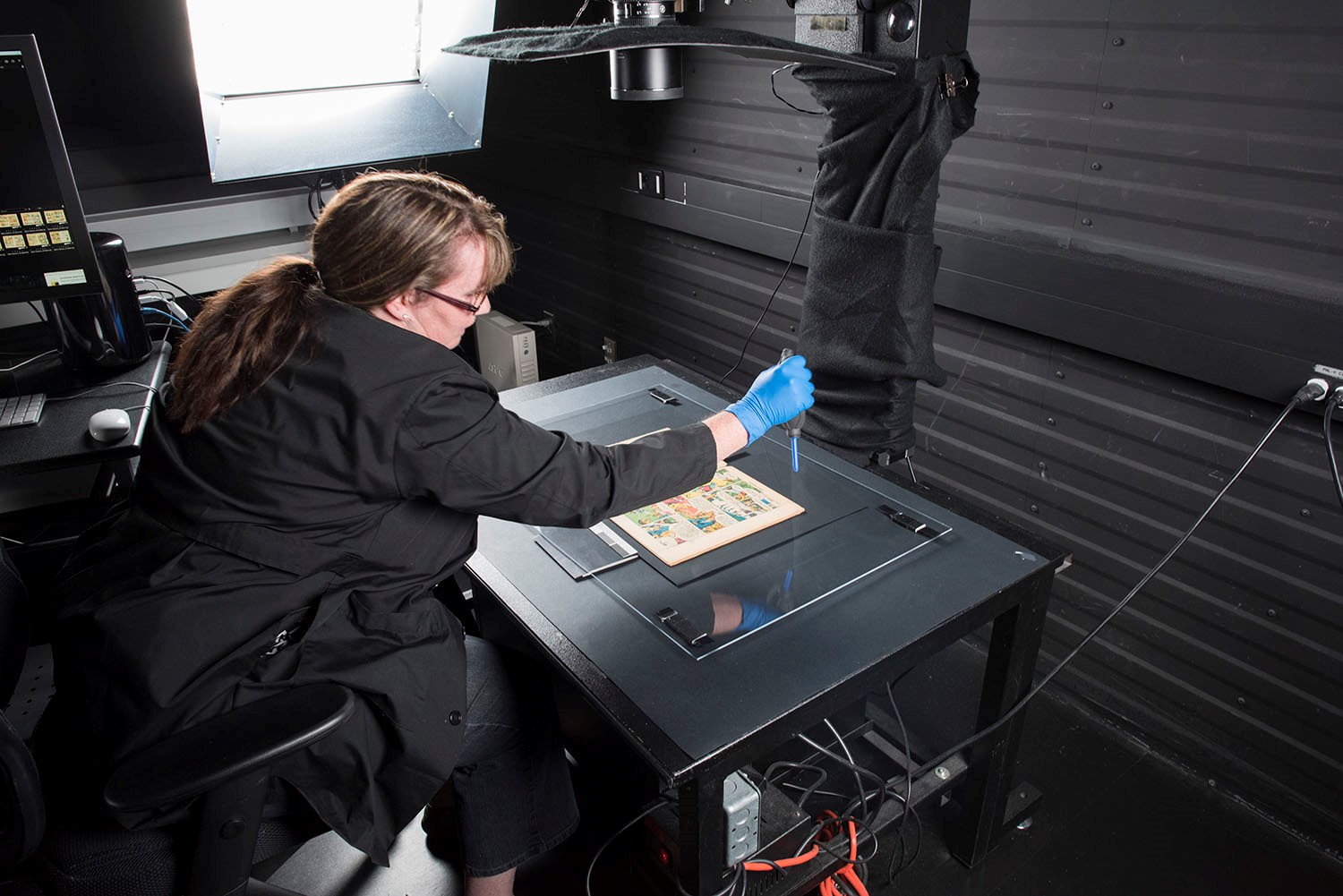
The process begins with a technician placing a comic on a flat copy stand under an overhead camera, making sure to line the comic up with the camera so that the image taken will be straight. A sheet of Plexiglas is laid over the item to keep it flat. The Plexiglas is on small risers to ensure as little contact as possible with the surface of the comic. This helps prevent damaging the item by placing too much pressure on its spine. Every superhero has an archenemy, and so, too, does the digitization specialist: dust. A single particle on the Plexiglas can create a spot that ruins an image. The technician keeps an anti-static blower on hand to defeat this threat.
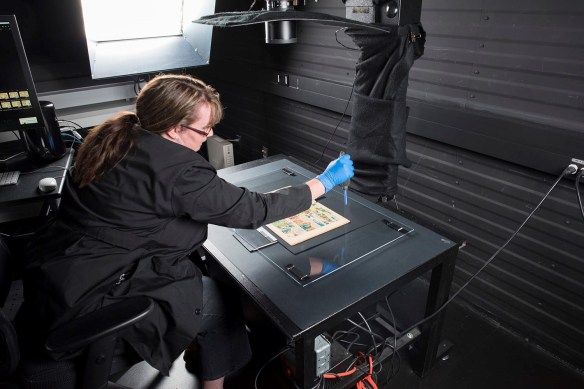
A comic book is placed on a flat black surface underneath a sheet of Plexiglas. A woman leans over the surface, using an anti-static blower to remove dust from the Plexiglas. The lens of a camera is visible above the table.

A digitization technician uses an anti-static blower to remove dust from the sheet of Plexiglas covering the comic book she is about to photograph. The camera lens can be seen suspended above the copy stand.

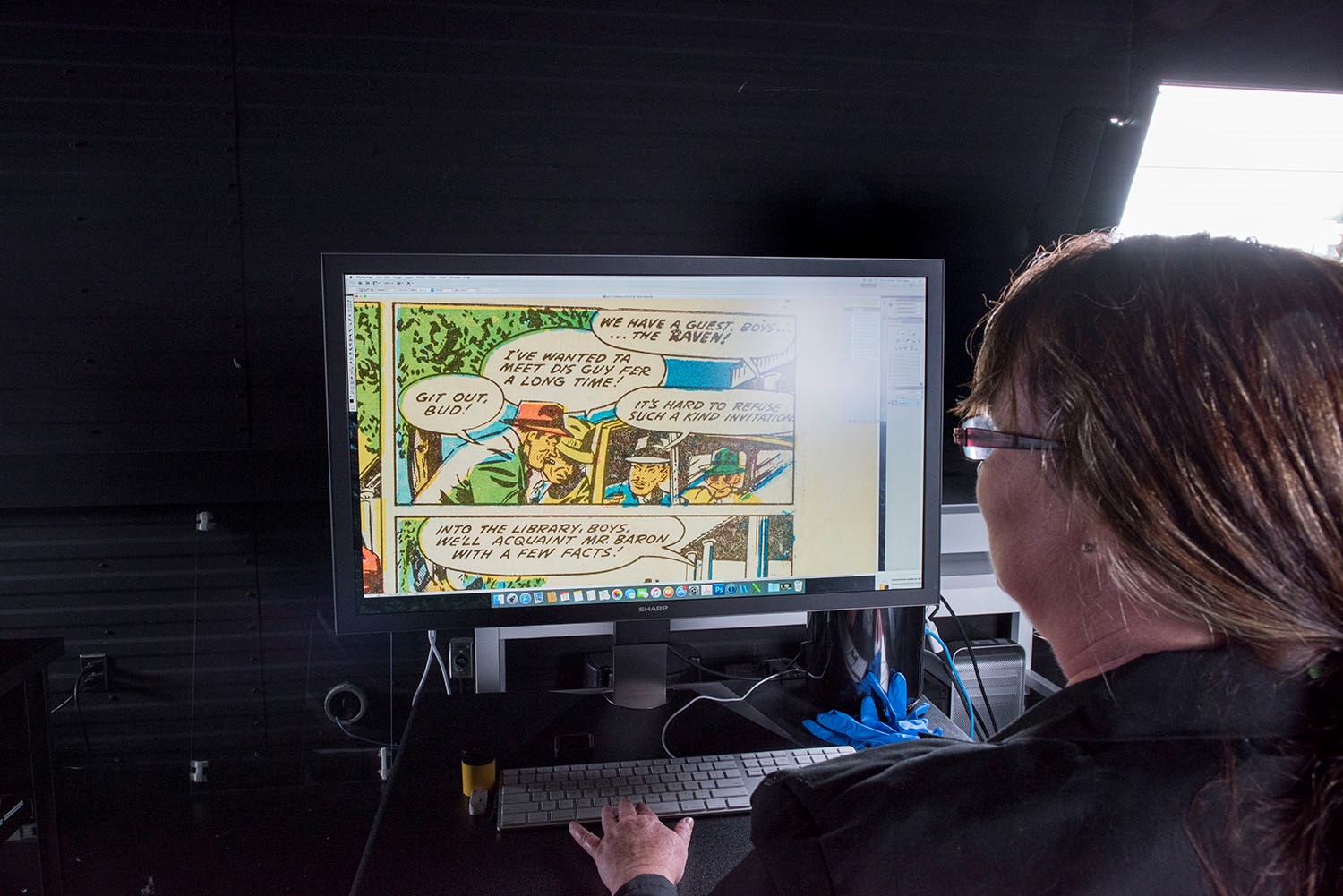
Once the comic book is in place, the technician uses an overhead camera to take a photograph. For the Bell Features Collection, a Phase One 645DF+ camera body with an IQ260 digital back and an 80-mm lens was used, with an F11 focus and a shutter speed of 1/13th of a second. The image taken with the camera is automatically uploaded to the technician’s computer, where she checks for imperfections. If she is satisfied with the image quality, she crops it in Photoshop and moves on to the next page.
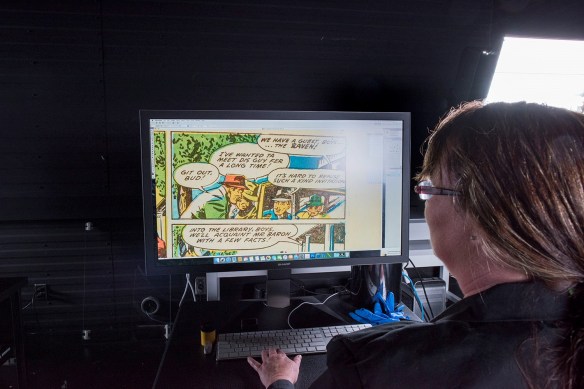
A woman faces a computer monitor showing an image of a page from a comic book.

A digitization technician checks for imperfections in the digitized image of a page from Slam-Bang Comics no. 7 (AMICUS 42623987), with art by Adrian Dingle.

This entire process is repeated for each page of each comic book. Once all the pages of an issue have been photographed and the images corrected, a PDF version is created. Finally, this PDF is uploaded to LAC’s servers and a link is added to the relevant record in LAC’s online library catalogue.

If you’re interested in checking out a few of these newly digitized old Canadian comics, you can find a small sample on our website. Hungry for more? The finding aid attached to the catalogue record for the Bell Features Collection (AMICUS 43122013) includes links to all of the digitized comics. You can also access them via the catalogue records for each of the individual titles in the Bell Features Collection; see for example the record for Active Comics (AMICUS 16526991).

In the Ottawa area? Encounter some of Bell Features’ characters on a bigger scale when you visit LAC’s exhibition Alter Ego: Comics and Canadian Identity. It runs at 395 Wellington Street in Ottawa until September 14th. Admission is free.

Additional resources


Meaghan Scanlon is the Special Collections Librarian in the Published Heritage Branch at Library and Archives Canada.

Linked Open Data sets for the First World War

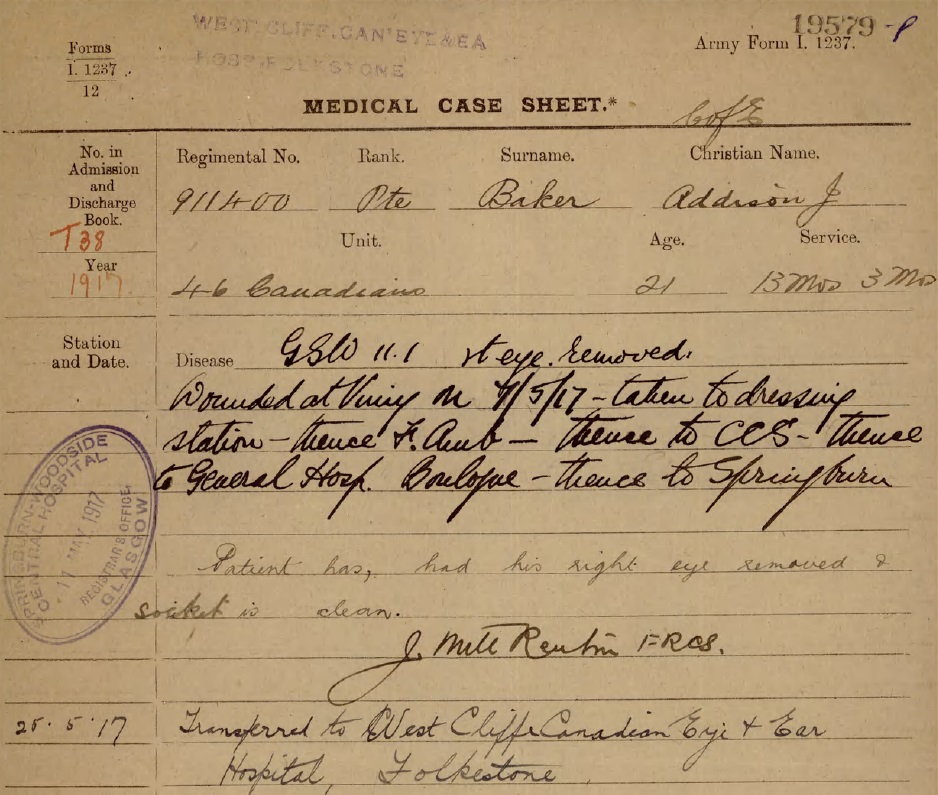
We are proud to report that Library and Archives Canada (LAC) has recently released a new data set on the Canadian Government Open Data portal as part of a First World War collaborative initiative with the Muninn Project. The project involved the partial transcription of the service records of soldiers who served in the Canadian Expeditionary Forces (CEF) during the First World War. LAC provided the digitized service files of 1,000 soldiers while the Munnin Project organized the crowdsourcing for the transcription and data linking of these historical documents. As a pilot project, the scope was limited to a specific medical form—the medical case sheet—which is found in most of the files and which contains information recorded by hospital staff on a specific soldier’s medical history.

Colour reproduction of a form which provides information on a soldier’s medical history. In this case, the soldier suffered a gunshot wound to the eye.

An example of a medical case sheet from the LAC collection – Private Addison Baker

The information that has been gathered from the transcriptions represents a spectrum of the types of health issues one would expect to occur in a large group of men. Some of the medical cases are directly related to combat injuries such as gunshot or shell wounds or shell shock. Others are related to the living conditions found in trenches which would increase ailments affecting the respiratory system and the outbreak of diseases such as influenza. A large proportion of the recorded information is just the everyday health issues of the time: toothaches, measles, etc.

To learn more about the information that was gathered from the service files, visit the First World War Linked Open Data project. The raw data is also available on the Canadian Open Data Portal in Linked Open Data and plain text format.

Discovering the Héritage Collection Through Archives Search

Since Library and Archives Canada (LAC) extended its long-standing partnership with Canadiana.org to digitize microfilms in August 2013, 17.4 million images and 535 collections have been added to the Héritage website. These microfilms cover personal, administrative and government records.

Up until recently, clients looking for microfilmed records in the collection would start their search on the LAC website, then go to the Héritage website to check if that content was already digitized. But now, you can find out whether a microfilmed record has been digitized or not just by consulting the MIKAN description!

In this example for the Royal Canadian Air Force files, the following graphical notice is displayed at the top of the page in the Title section:Graphical notice indicating that all or part of the records described have been digitized and are available online.Scrolling down to the Finding aid section, you will find the link to the Héritage website:

Exemple of a MIKAN entry with a the link to the Héritage website.

As other microfilms are digitized and made available on the Héritage website, similar links will be added to the corresponding MIKAN descriptions.

Happy hunting!

Métis Scrip

We are pleased to inform you that more than 24,000 references about money scrip (certificates) given to Métis family members were recently added online. These cancelled land scrip certificates were once issued to the Métis by the Department of the Interior in exchange for the relinquishment of certain land claims. A scrip would be issued “to the bearer” and could be applied to the purchase of, or as a down payment on, any Dominion lands open for entry in Manitoba and the Northwest Territories. These scrip were awarded to Métis heads of families and their children in the amounts of $240, $160 and $80.

How to find references

  1. Go to the search screen for Archives Search—Advanced.
  2. In the drop-down menu, select “Finding aid number” and then in the box, enter 15-24.

Screen capture of an advanced Archives Search with the first drop-down menu showing "Finding aid number" and the value of "15-24" and the second drop-down menu showing "Any Keyword and the value "Riel." Continue reading

Find colour photos of Canadian Second World War soldiers

Did you know that Library and Archives Canada (LAC) has rare colour photographs from the Second World War? During that time period, colour film was a new and untested medium for most professional photographers. These images were captured on Kodak Kodachrome film by members of the Canadian Film and Photo Unit (CFPU) in the days and weeks following D-Day, on June 6, 1944.

The CFPU, formed in 1941, was under the command of Captain William Abell of Winnipeg and was staffed by enlisted Canadian men and women. Their goal was to capture images of Canadian military personnel in action, which would then be released by the Department of National Defence to various media outlets. Today these images provide an invaluable record, in living colour, of Canadian servicemen and servicewomen, as well as changing photographic technologies and techniques.

The images are part of a larger set of 1,200 digitized Second World War colour photographs that can be viewed through LAC’s online database. Included are photos of various subject matter, such as Canadian troops in England, France, Holland, Germany, Italy, and on bases and in training in Canada; portraits of notable military figures; the Canadian Women’s Army Corps; troop entertainment; hospital transport ships; and the Canadian role in liberation/occupation duties as photographed by CFPU member Ken Bell.

Search the collection

LAC’s complete digitized collection of colour images from the CFPU includes over 2,000 additional digitized colour images dating to 1961. To view them, consult the ZK prefix. To search within this collection, go to Advanced Archives Search and search using “ZK prefix” and the search term of your choice. An electronic finding aid for the ZK prefix sub-series is also attached to this record and can aid in locating specific images. To learn more about using finding aids in your research, read Discover Finding Aids – Part Two.

See also:

Expanded Version of the Service Files of the Second World War – War Dead, 1939-1947 Database

Library and Archives Canada recently launched an updated and expanded version of the Service Files of the Second World War – War Dead, 1939-1947 database. Researchers can now access more than 1000 digitized genealogy packs of service files for Canadian servicemen and servicewomen killed in action during the Second World War.

More search fields

The database, available on the Library and Archives website through the Military Heritage portal, can now be searched using an increased number of access fields. These include: first and last name of the enlisted person, service number, date and place of birth, date and place of enlistment. By using these search features, Canadian students participating in Lest We Forget, a national project that gives them the opportunity to research the life stories of Canadian servicemen and servicewomen, will be able to quickly identify service files related to their community.

What kind of information can I find in these records?

The digitized service files contain documents and correspondence pertaining to enlistment and appointment, training and qualifications, awards and medals, medical history, and wills and insurance. Researchers can expect to find records such as the Canadian Active Service Force attestation paper, a Record of Service with information on training and education before and during service, documents from the Department of National Defence Estates Branch, and grave registration and post-war exhumation reports.

More information on the Killed in Action database

Along with details of service, this database offers a window into the lives of those who served and the families they left behind. Throughout the Second World War (1939-1945), Canadian men and women served in great numbers with the Canadian Army, Royal Canadian Air Force, and Royal Canadian Navy. From a population of just over 11,000,000 in 1939, Canada saw more than 1,159,000 of its citizens enlist. The price of victory was high: approximately 45,000 Canadians and close to 1000 Newfoundlanders lost their lives during and immediately following the war. In addition to these, more than 55,000 servicemen were wounded and countless civilians experienced the suffering and loss brought about by war. While providing a valuable resource for research, the KIA database helps to tell the story of those who served, fought, and died in a war that stretched across the globe.

New finding aids available online

Library and Archives Canada has begun an initiative that will see the digitization and transcription of several significant finding aids. Adding these finding aids online will help users find material much more easily. We will continue to add other finding aids throughout the year, but so far, the following finding aids have been transcribed:

Finding Aid 15-25: Colonization Company Money Scrip

After the Hudson’s Bay Company transfer of Rupert’s Land and the North-West Territories to the Dominion of Canada, a few private companies were allowed to buy land to sell it through sponsored settlement schemes.

Finding Aid 15-33: Military Bounty Land Warrants, Riel Rebellion

Officers and men who served in Manitoba during the Riel Rebellion were offered free land grants in the newly opened lands of the North-West. Members could receive scrip (money certificates) equal in value to and in lieu of the land grant.

Finding Aid 9-8: Department of Militia and Defence Pre-Confederation Records – Adjutant General’s Office, United Canada Correspondence

Letters received in the Office of the Adjutant General of Upper Canada. The correspondence relates to the appointment, promotion and retirement of officers, as well as the organization of units.

Finding Aid 9-4: Department of Militia and Defence – Adjutant General’s Office, United Canada Correspondence

Letters received by the Deputy Adjutant Generals of Canada West, Canada East and United Canada, between 1846 and 1869. The letters relate to the Active and Service Militia as well as the Sedentary (Non-Service) Militia. Some of the letters were received by the Premier of the Province of Canada from 1854 to 1856, Sir Allan MacNab.

How to find references

  1. Go to the search screen for Archives Search—Advanced.
  2. In the drop-down menu, select “Finding aid number” and then in the box, enter 15-24.
  3. In the next line, select “Any Keyword” and enter a surname, a place name, or a topic.
  4. Click on the “Submit” button.

Questions or comments? We would love to hear from you!

Sheet music from Canada’s past

Did you know that Library and Archives Canada (LAC) has one of the most comprehensive sheet music collection in the country? Thanks to Helmut Kallmann, the founding Chief of the Music Division at the National Library of Canada (now part of LAC), who collected any early Canadian sheet music he could find.

Recently, over a thousand pieces of sheet music from this collection were digitized and are now available online. These titles were published before 1918 and include a wide variety of patriotic and parlour songs, piano pieces, sacred music, etc.

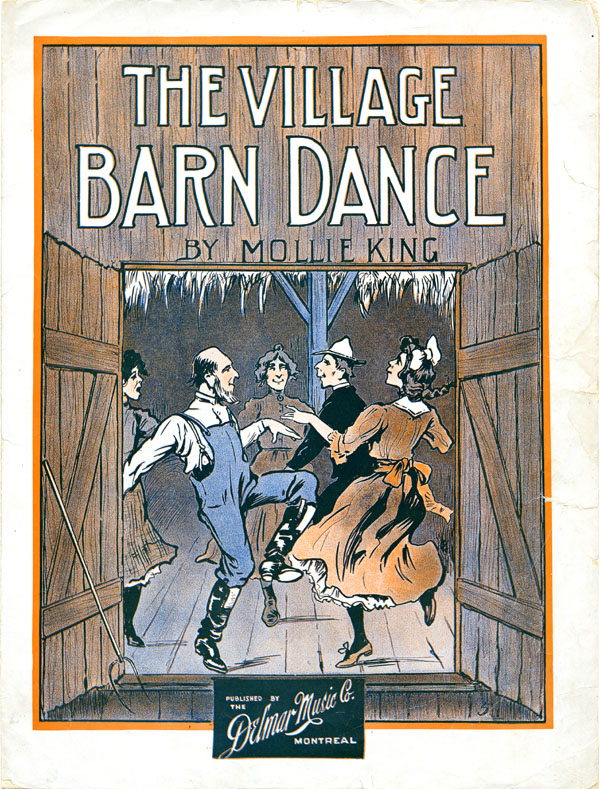
Colour image depicting people dancing in a barn.

Sheet music cover image of a musical piece entitled, “The Village Barn Dance” by Mollie King. Source

Visit LAC’s Sheet Music from Canada’s Past website to learn more or to search for music sheets. Here’s how:

  1. Click on Search Sheet Music located in the left menu.
  2. In the first box, click the down arrow and choose the time period you would like to search, e.g. “1900-1913.”
  3. In the second box, click the down arrow and choose the type of search, e.g. Title keyword (song title).
  4. In the third box, you can enter a search term, e.g. “barn”.
  5. Click the “Submit” button at the bottom.

The browsing options in the fourth box allows you to limit your search to digitized music for which there is either printed music or audio files available. Please note that default searching has been set at “All Time Periods”, “Any Keyword” but you can modify these settings by following the above steps.

Once you have found a piece of sheet music, you will see some or all of the following information:

  1. A description of the music.
  2. A small colour image of the front cover.
  3. A large colour image of the cover.
  4. A “View sheet music” icon.
  5. An “Audio” icon

As the sheet music is available as PDFs, you can print the music on letter size paper.

Historical Debates of the Parliament of Canada (Hansard) now online!

Congratulations to the Library of Parliament and Canadiana: the Historical Debates of the Parliament of Canada portal is now live!

This new portal contains the historical debates in both official languages from 1867 to the mid-1990s. This means you can now search and browse all published debates of both the Senate and the House of Commons from Parliament 1, Session 1, until the coverage begins on parl.gc.ca.

As mentioned above, the portal was developed by the Library of Parliament, in collaboration with Canadiana.org, a membership alliance dedicated to building Canada’s digital preservation infrastructure and providing wide-ranging access to Canadian documentary heritage. Library and Archives Canada is pleased to have provided support by producing the digital page images.

You can consult our blog Looking for the Debates of the House of Commons (Hansard) online? of June 2012 to help you find information on the House of Commons debates.