Top three genealogy questions

This article contains historical language and content that some may consider offensive, such as language used to refer to racial, ethnic and cultural groups. Please see our historical language advisory for more information.

We receive many interesting questions from our clients at the Library and Archives Canada Genealogy desk. Here are the top three questions asked:

Question 1. My grandfather came to Canada between 1905 and 1914. How do I find his passenger list entry?

First, search the name on one of the indexes available online. Try different spellings and birthdate variations if your initial search is not successful.

If that doesn’t work, there are other documents that indicate the year of immigration. Try census returns or the 1940 National Registration File. If you know the city where your ancestor settled, you may be able to narrow down the year of immigration by seeing when they appear in a city directory.

You can also try searching for other family members that came to Canada with him. Maybe the passenger list entry of his wife, “Esmerelda Jenkins”, might be easier to find than “John Jenkins” (names are for example only).

Question 2. My mother said that we have Indigenous heritage somewhere in our family. How do I prove that?

Complete your family tree. Don’t focus too much on finding the Indigenous link at this point. Pay close attention to information given on the census returns, especially the 1901 census.

All census returns will indicate the location where your ancestor resided, such as the town, village, major city or federal Indian reserve. Some census returns list ethnic origin, such as French, Irish, Indian, “Half-Breed”, “Scotch-Breed”, Algonquin or Mohawk. They can also list colour (“W” for White and “R” for “Red”) and first language/mother tongue, which may help your search.

Many of these terms are now considered offensive and are no longer in use today. Do not fixate on or limit yourself to modern terminology—your ancestor may have been identified under any number of labels depending on the period, location and circumstances.

Question 3. My grandfather served in the Second World War, but never spoke about it. How do I find out what he did?

Your first step in finding out details about your grandfather’s war experience is to apply to the Personnel Records Department for information from his file by filling out our Application for Military Service Information form. After you receive the available information from his Second World War service file, you can continue your research at regimental museums and by reading published regimental histories (some of which may be available in our library collection).

If you have a question that you would like to ask us, please drop by the Genealogy desk at 395 Wellington Street, in Ottawa or email us using our Genealogy Assistance Request form.

Indigenous syllabic scripts

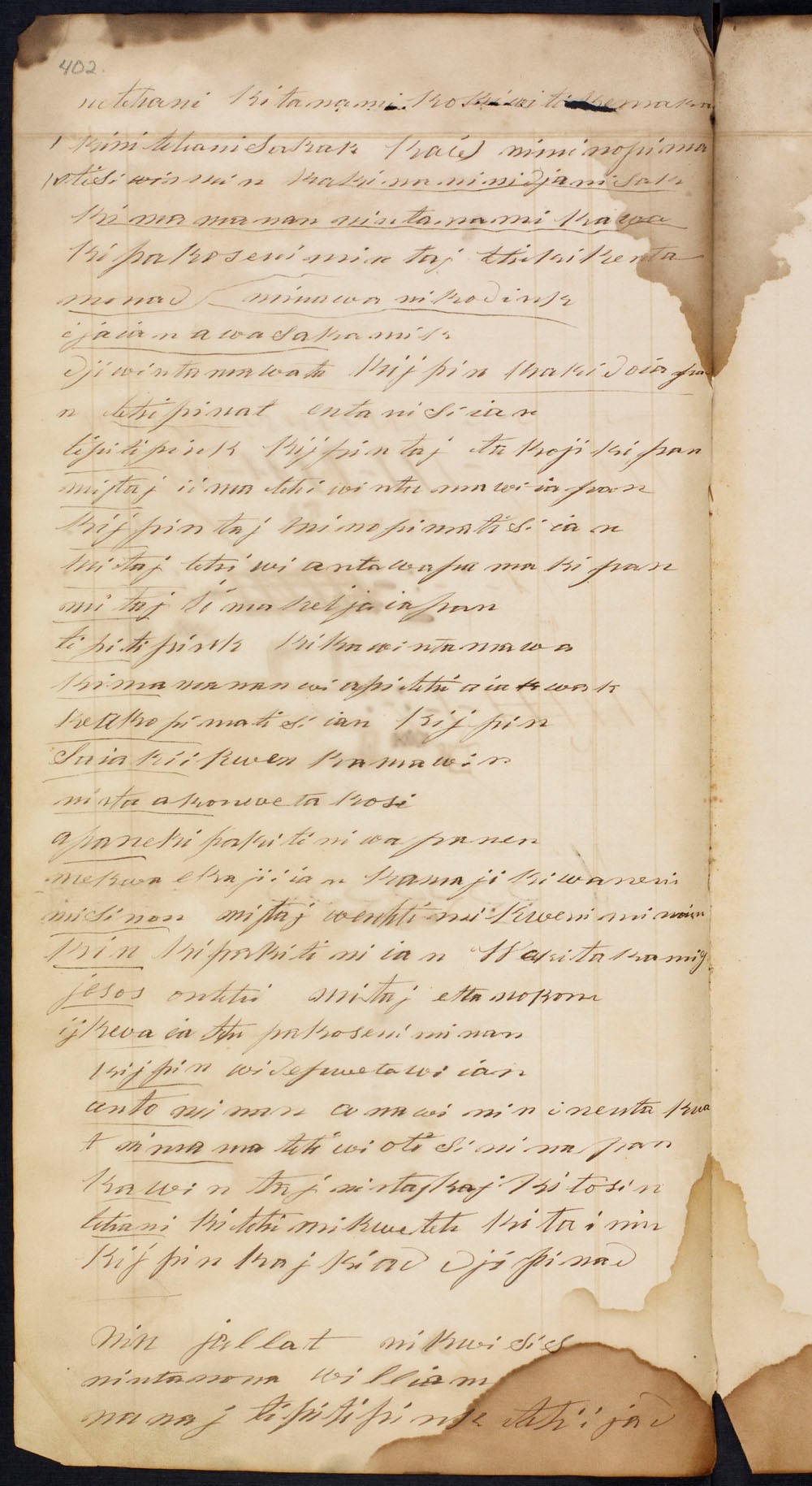
Before the development of syllabic writing systems, Indigenous peoples transmitted cultural knowledge orally, through wampum belts and totem poles, through rock engravings and paintings, and through hieroglyphs (symbols etched on birch bark or hides to represent a word or concept). Syllabic scripts were the first form of Indigenous writing whereby anything that could be spoken in an Indigenous language could be transcribed.

Reverend James Evans, a Methodist missionary, has often been credited with developing the first Indigenous syllabic script in 1839 or 1840 at Norway House in what is now Manitoba. Before the use of syllabics, missionaries and linguists translated religious texts into Indigenous languages using the Roman alphabet. Evans wanted his Cree parishioners to learn how to read and write, but he found the Roman alphabet limiting. As a result, he set out to develop a writing system that more accurately represented the sounds and words of the Cree language.

A colour photograph showing a hand holding the lower left corner of a book. The book is opened to the frontispiece showing a drawn portrait of Methodist missionary James Evans, wearing typical 19th century clothing and looking directly at the viewer.

A portrait of James Evans, creator of Cree syllabic, taken from the 1890 book, James Evans: Inventor of the Syllabic System of the Cree Language (AMICUS 6941574)

Evans derived his syllabic script from Pitman’s shorthand (a shorthand phonetic system that used symbols to represent sounds) and Braille (an embossed writing system for the visually impaired). He used nine geometric shapes to denote consonants, and their orientation suggests the vowels that follow. In addition to being the first Indigenous syllabic script, Evans’ syllabic is also the first Canadian script and the first typeface created in Canada. He recycled metal for typecasting from the linings of Hudson’s Bay tea chests and modified a fur press (for flattening pelts) to use as a printing press. Evans and his parishioners used the script to print religious texts on birch bark, deer hide and paper.

A colour photograph of two pages of a book on Cree syllabic providing examples of syllabic characters. The first page shows syllabic initials or primals, as well as examples of syllables. The second page shows finals or terminals and examples of word formation.

Images from the 1890 book, James Evans: Inventor of the Syllabic System of the Cree Language (AMICUS 6941574) showing the syllabic geometric shapes denoting consonants and their various orientations denoting vowels.

Although originally developed to write religious materials, syllabic scripts were used by the Cree people for their own purposes. Syllabics became an important part of Cree identity, despite having been developed by a non-Indigenous missionary, and is still used in Canada today.

Evans’ syllabic script was adapted for other Indigenous languages, notably Inuktitut. First introduced by the missionary Edmund Peck, syllabic is still used today by thousands of fluent Inuktitut speakers.

When Nunavut was established in 1999, the territorial government commissioned William Ross Mills of Tiro Typeworks to develop digital syllabic fonts. The results included the Pigiarniq and Euphemia fonts. Euphemia, which includes the entire range of Canadian syllabics in several different Indigenous languages, was licensed by Microsoft and Apple and is now standard on computers. This effectively enables Inuktitut speakers to sit down at virtually any computer around the world and start typing in their own language.

A colour image of a book written in Inuktitut syllabic script open to the first and second pages. The left page features the Inuktitut syllabary; the right page is text written in Inuktitut syllabic.

The first book in Inuktitut to be printed using syllabic characters, Selections from the Gospels in the Dialect of the Inuit of Little Whale River, printed by John Horden between 1855 and 1856 at Moose Factory, Ontario (AMICUS 13853827)

For more information on Canadian Indigenous syllabic scripts, please check out the following resources. Most are available in libraries or online.

  1. Banks, Joyce M. (2004). “‘And not hearers only’: Books in Native Languages,” History of the Book in Canada, Volume 1, edited by Patricia Lockhart Fleming et al. Toronto: University of Toronto Press. (AMICUS 29599541)
  2. Bringhurst, Robert. (2008). “The Invisible Book,” The Surface of Meaning: Books and Book Design in Canada. Vancouver: Canadian Centre for Studies in Publishing Press (AMICUS 33832941).
  3. Cree Syllabics,” The Canadian Encyclopedia (2015).
  4. Edwards, Brendan Frederick. (2005). “‘To put the talk upon paper’: Aboriginal Communities,” History of the Book in Canada, Volume 2, edited by Patricia Lockhart Fleming et al. Toronto: University of Toronto Press. (AMICUS 29599541)
  5. McLean, John. (1890). James Evans: Inventor of the Syllabic System of the Cree Language. Toronto: Methodist Mission Rooms. (AMICUS 6941574).
  6. Pirurvik Centre for Inuit Language, Culture, and Wellbeing.

Project Naming is Expanding!

This article contains historical language and content that some may consider offensive, such as language used to refer to racial, ethnic and cultural groups. Please see our historical language advisory for more information.

In early 2002, Library and Archives Canada (LAC) teamed up with the Nunavut Sivuniksavut Training Program and the Government of Nunavut’s Department of Culture, Language, Elders and Youth, to create Project Naming. The goal was to digitize photographs of Inuit from present-day Nunavut in LAC’s photographic collections in order to identify the people depicted in the images. At the time of the launch, LAC expected that the project would be concluded the following year. We never imagined that this initiative would become such a successful and popular project with the public.

To mark the annual National Aboriginal History Month in June 2015, LAC is pleased to announce the launch of Project Naming. While the project still includes communities located in Nunavut, it will be expanded to Inuit living in Inuvialuit (Northwest Territories), Nunavik (northern Quebec) and Nunatsiavut (Labrador), as well as First Nations and Métis communities in the rest of Canada. Project Naming: 2002–2012 will still be available online, but new content will only be added to the new project site.

Project Naming: 2002–2012 began with the digitization of 500 photographs from the Richard Harrington fonds. Since then, LAC has digitized approximately 8,000 photographs from many different government departments and private collections. Thanks to the enthusiasm and support from Inuit and non-Inuit researchers, nearly one-quarter of the individuals, activities or events portrayed in the images have been identified, and this information along with the images is now available in the database.

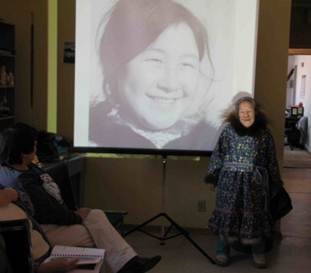
Over the years, LAC has received many wonderful stories and photographs from members of the public who have reconnected with their family and friends through the photographs. Among these was a photograph shared by the Kitikmeot Heritage Society that organized several community slide shows during the winter of 2011. Mona Tigitkok, an Elder from Kugluktuk, discovered her photograph as a young woman during one of these gatherings.

Colour photograph of an elderly Inuit woman wearing a fur-trimmed floral parka posing in front of a screen with a slide projection of her photograph when she was a young woman, taken at a community hall.

Mona Tigitkok posing with a picture of herself taken more than 50 years ago, Kugluktuk, Nunavut, February 2011. Credit: Kitikmeot Heritage Society.

Author and historian, Deborah Kigjugalik Webster, has used Project Naming, both personally and professionally. In her words:

I was first introduced to Project Naming a few years ago through my work in the Inuit heritage field, but there is also a personal connection for me—the database allows people to search by communities in Nunavut so I’ve discovered photographs of relatives and community members.

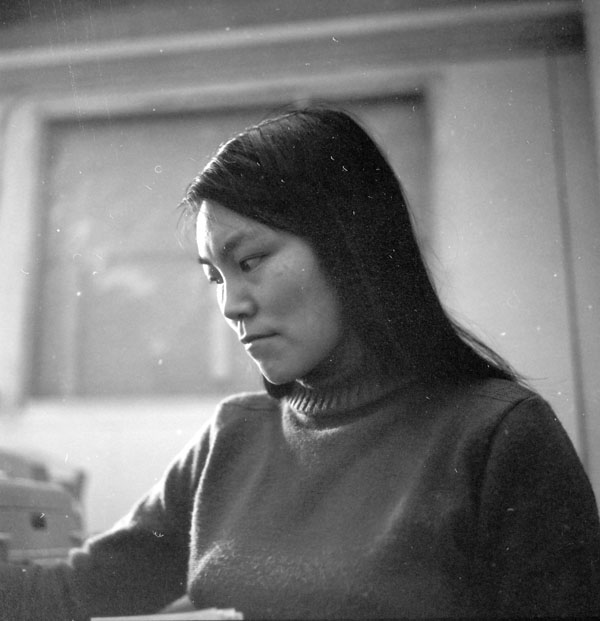
It was not uncommon in the past for photographers not to name the subjects of images. Often photo captions were simply “group of Eskimos” or “native woman” and so on. One afternoon, over tea, I showed some of the photographs from the Project Naming database to my mother, Sally Qimmiu’naaq Webster, and we were able to add a few names to faces from our home community of Baker Lake (Qamanittuaq). I felt a sense of satisfaction in identifying unnamed individuals in photographs and providing names to replace nondescript captions provided by the photographer. In a sense, when we do this we are reclaiming our heritage.

Photograph of a young Inuit woman wearing a turtle neck sweater looking away from the camera.

Photograph of the late Betty Natsialuk Hughson (identified by her relative Sally Qimmiu’naaq Webster). Taken in Baker Lake (Qamanittuaq), Nunavut, 1969 (MIKAN 4203863)

Project Naming allows people to not only identify individuals in images, but to add information including corrections to the spelling of names in an online form. It is well worth checking out the database, especially with an Elder, because seeing the image opens up discussion.

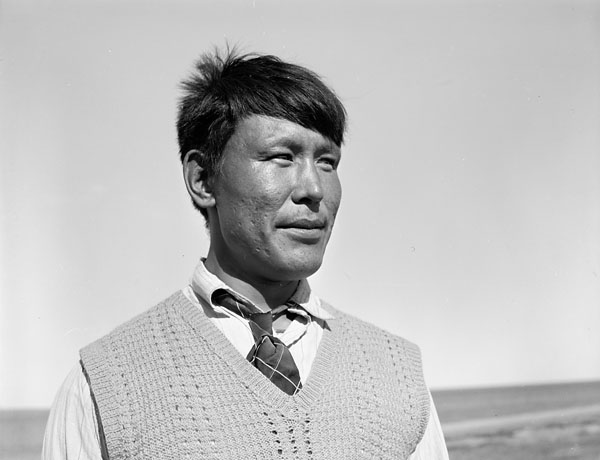
As part of my work I manage a Facebook page Inuit RCMP Special Constables from Nunavut to acknowledge the contributions of our Inuit Specials and pay tribute to them. Last year I posted a portrait photograph that I found on the Project Naming database of Jimmy Gibbons, taken in Arviat in 1946. Special Constable Gibbons was a remarkable man who joined the RCMP in 1936 and retired to a pension in 1965. This post was met with many enthusiastic likes, shares and comments from S/Cst. Gibbons’ descendants saying that he was their father, uncle or great-grandfather. Some people also simply said “thank you.” Shelley Ann Voisey Atatsiaq proudly commented, “No wonder I wrote earlier that I highly respect the R.C.M.P. I’ve got some R.C.M.P-ness in my blood. Thank you for sharing!”

Black-and-white photograph of a close-up of an Inuit man wearing a knitted vest and tie standing outside.

Jimmy Gibbons, Royal Canadian Mounted Police Special Constable, Arviat, Nunavut, August 1, 1946 (MIKAN 4805042)

For more information about the history of the project, read the article Project Naming / Un visage, un nom, International Preservation News, No. 61, December 2013, pp. 20–24.

As with the first phase of the project, LAC wants to hear from you through The Naming Continues form.

Start your search for Aboriginal content

Wampum belts

“Wampum belts” and “wampum strings”… what do these expressions refer to in the colonial archives of the Library and Archives Canada collection?

Wampum—a word originating among the Algonquian peoples in the southern parts of New England—refers to tubular white and purple beads made from certain seashells found only on the shores of the Atlantic Ocean. It is an abbreviation of wampumpeague (or wampumpeake), meaning “a string of white shell beads.” In the early 17th century, wampum became an important trade item in the growing fur trade in the northeast of the continent, in addition to serving as currency in the Dutch and English colonies until the 1660s.

Black and white drawing showing two types of wampum: belts and strings.

Drawing published in 1722 showing the difference between wampum strings and wampum belts (MIKAN 2953327)

The Iroquoian peoples from inland areas made special use of wampum in their formal diplomatic meetings with foreign or neighbouring groups. The shell beads were woven into strings and belts of varying sizes, which could contain anywhere from a few hundred to over ten thousand beads.

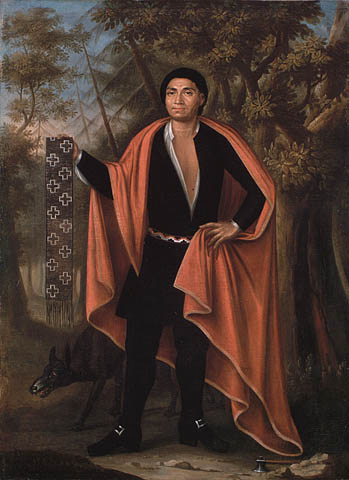
Oil painting on canvas showing a man standing in a forest with a wolf at his feet. He is dressed in black, wearing a red cape, and holding a wampum belt in his hand.

Portrait of Tee Yee Neen Ho Ga Row (baptized Hendrick), one of the “Four Indian Kings” who met the Queen of England in 1710 with a wampum belt in hand.

Playing a central role in international meetings and in maintaining good relationships, wampum belts were offered at official gatherings to record the words spoken, to render them official and legitimate. From the early 17th century to about the early 19th century, use of this diplomatic system spread to a large part of the American Northeast, from the vast Great Lakes region to the Maritimes, although with significant variations.

Black-and-white photograph showing several different kinds of wampum belts and strings.

Wampum belts and strings preserved by the Six Nations in the 1870s (MIKAN 3367331)

Since they were used to record spoken words, some wampum belts were kept for many years to ensure that the messages on them were maintained and preserved over time. That is why observers in the 17th and 18th centuries often compared wampum belts to archives or other official written documents (deeds, registers, annals, contracts, etc.).

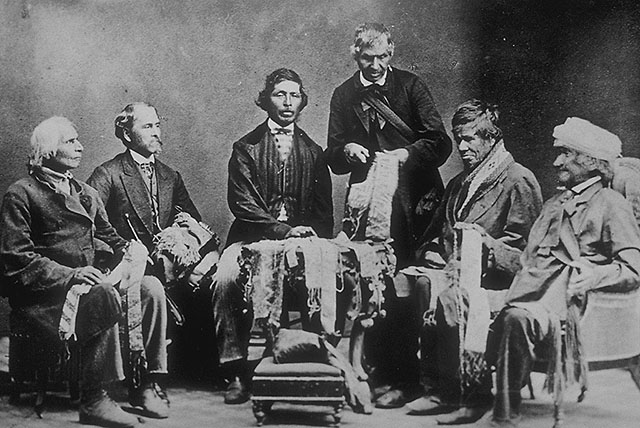
Black and white photo showing six men looking at wampum belts. Five individuals are seated and the sixth seems to be explaining a wampum belt.

Six Nations Iroquois chiefs explaining the wampum belts they were preserving in 1871 (MIKAN 363053)

Wampum belts were sometimes kept over a long period so that the terms of agreements reached would not be lost. As a support for oral tradition, wampum belts bearing the words spoken at a special event therefore had to be accompanied by a speech to be meaningful. Accordingly, the keeper of the wampum belts ensured that their meaning was repeated from time to time to community members. Periodically, he repeated publicly the “content” of the wampum belts preserved so that the nation’s history would be transmitted to the younger generation.

To continue your search: Wampum belts are frequently mentioned in the France fonds des colonies and the Haldimand fonds. The Héritage project is presently digitizing the many microfilm reels contained in these fonds.

Reindeer in Canada

In the early 1900s, the introduction of reindeer to Canada was seen as a possible way of supplying food and bringing an economic boost to remote northern areas of the country. This animal had been domesticated in many other northern nations and had played an important role in sustaining the population. While reindeer meat, milk and other bi-products such as hides and horns can provide resources vital to life, these animals are also strong—packing or pulling heavy loads great distances. As well, they are naturally adapted to the northern climate and environment.

Black-and-white photograph of a photo album collage. There are five photographs showing reindeer pulling sleds of various kinds, with people in the background. The pictures are labelled and some of the people are identified.

Reindeer have been used as draught animals for hundreds of years. Here we see herders with reindeer harnessed to sleds possibly on Richards Islands, N.W.T., circa 1942 (MIKAN 4326743)

Several efforts to introduce reindeer to Newfoundland and Baffin Island had early success but the most successful example was the Alaskan experiment. The American government, urged on by missionary groups, purchased 1,200 Siberian reindeer from Russia between 1892 and 1902. Another small herd was bought in Norway and shipped to Alaska, along with a group of Lapp herders and their families, hired to manage the animals and train the local indigenous population to become herders.

Canada’s government began to study the results of the American experiment. A Royal Commission on reindeer and musk-ox was appointed in 1919. The dramatic growth of the Alaskan herd was impressive, several hundred thousand deer, spread across a hundred herds, with several hundred local indigenous owners and herders engaged in the enterprise. Fresh meat was now available for local consumption, and sold to the southern states for profit.

Black-and-white photograph of a photo album collage. Four photographs showing reindeer carcasses and skins drying.

Reindeer meat drying on racks and being lifted on a hoist (possibly Elephant Point, Alaska and Richards Island, N.W.T., 1938 (MIKAN 4326727)

Many groups pressed the Canadian government for action, resulting in plans to purchase an Alaskan herd and move it to a suitable site in the Northwest Territories. Two Interior Department botanists searched for a location with good grazing, recommending a headquarters be established (to become known as Reindeer Station) east of the Mackenzie River delta. A contract was signed with the Loman Bros. Company for purchase and delivery of 3,515 animals at a price of $150 a head. The reindeer drive was expected to take 18 months and cover 1,500 miles but incredibly it took five years and travelled twice the distance. In March 1935, Andy Bahr and his crew delivered 2,370 reindeer. Shortly afterwards, 811 fawns were born, bringing the final total close to the initial target number.

Black-and-white photograph of a photo album collage. Four photographs showing reindeer herds. Some photographs are taken from afar, others are close-ups of the herd.

Reindeer herds on a summer range and in a corral, probably in Kidluit Bay, Richards Island, N.W.T., 1941(MIKAN 4326736)

The early success was followed by a series of setbacks, culminating in the death of four Inuit owners and a Lapp trainer in a boating accident in 1944. It became more difficult to interest traditional Inuit hunters to abandon their customary lifestyle for the often lonely and monotonous life of a herder. Months of effort could be overturned in a moment as storms or predators could cause a stampede resulting in the loss of many animals.

Black-and-white photograph of a group of men standing around a small reindeer chute and pen.

Inuit were original owners and employees of the first reindeer enterprises in Kidluit Bay, N.W.T. (MIKAN 3406119)

As with the other Canadian experiments, the Reindeer Project did not achieve the success of Alaska’s venture. The herds under Inuit control were passed back to government control and the Canadian Wildlife Service administered the operation until 1974, at which time it was sold to a private owner, Canadian Reindeer Ltd., and remains a private operation today. Although the ambitions of early advocates have not been achieved, the efforts form an interesting piece of Canada’s northern history.

Related resources

There are hundreds of documents and photographs held in the Library and Archives Canada collections which reveal much more detail about the reindeer experiment in Canada. You can have a look at some of them by searching the following sources:

Government sources

Prime Ministers’ papers

Private papers

The North-West Resistance

Version française

There are few historical events in our national story that solicit stronger opinions and create more debate than the disputes of 1870 and 1885 between the Métis in Western Canada and the Government of Canada. Various names refer to these two series of events, and their usage often reflects the loyalties, opinions and even biases of the user. Today, we see the application of such terms as rebellion, resistance, insurgency and disputes.

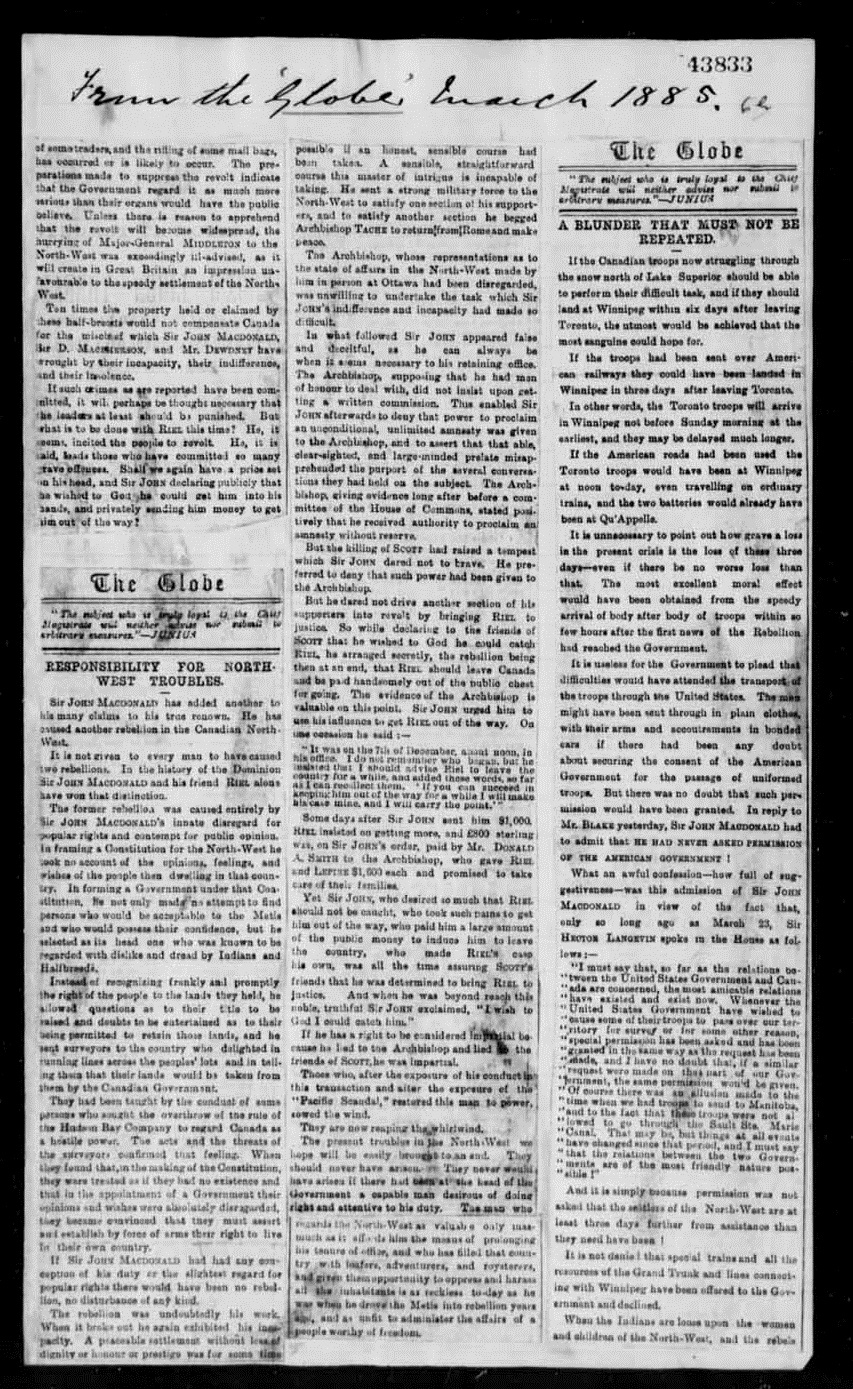
Arguably, the debate on the events of 1870 and 1885, Louis Riel, and the place of the Métis in our history and contemporary Canadian society has had an enduring effect on our national psyche. In March, 1885, an article published in The Globe of Toronto stated: “It is not given to every man to have caused two rebellions. In the history of the Dominion, Sir John Macdonald and his friend Riel alone have won that distinction.”

A black-and-white reproduction of a newspaper clipping from The Globe of Toronto in 1885. It is an article about the North-West Rebellion.

A newspaper clipping from The Globe of Toronto, 1885 (MIKAN 521291)

To put things into context, the 1870s saw the disappearance of the bison herds, pushing many First Nations peoples to near starvation. As for the Métis, the loss of the bison on which they also depended brought hardship that was further compounded by the end of the fur trade.

The Métis of the North-West Territories felt that the established North-West Council failed to represent their interests. They sought assurances from Ottawa that the titles to their river-lot homesteads and farms would be guaranteed in advance of any large-scale influx of settlers.

The Métis sent more than 70 petitions to Ottawa in an attempt to address these grievances, none of which were responded to. In the eyes of the Métis, the federal government was indifferent to any attempt to redress territorial grievances and protect occupant rights.

Frustrated white settlers newly arrived in the North-West Territories were also waiting for their property titles, as they were necessary for obtaining loans to improve their farms. At the same time, widespread dissatisfaction with the First Nations treaties and rampant poverty prompted Chief Big Bear, of the Plains Cree, to attempt to renegotiate the terms of the treaties. Hence, the First Nations issues and grievances were largely unrelated to those of the Métis and white settlers apart from their commonly held belief of a neglectful, distant and imperial Ottawa.

As a result, the Métis decided to resist any subsequent actions by the federal government. When Louis Riel organized an “illegal” provisional government, it incited Ottawa to assert its sovereignty in the North-West Territories.

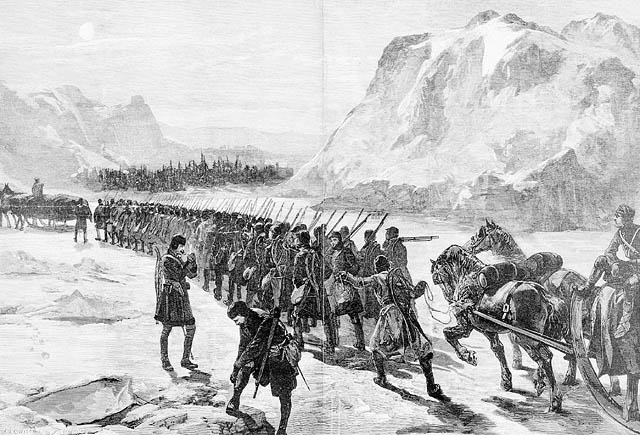
A black-and-white print taken from The Illustrated London News, 1885. The sketch shows a column of soldiers marching through a winter landscape.

The Resistance in the North-West Territories of Canada: Colonial troops marching over the ice of Nipigon Bay, Lake Superior, from The Illustrated London News, 1885 (MIKAN 2933970)

The North-West Resistance was a violent, five-month uprising against the Canadian government, fought mainly by Métis militants and their First Nations allies.

A pen-and-ink drawing over pencil depicting a wooded battle scene with the Métis behind a barricade firing against the approaching British army. The Métis are greatly outnumbered.

Battle of Batoche, 1885, by Charles William Jefferys (MIKAN 2835223)

With the Métis defeat at the Battle of Batoche (in present-day Saskatchewan), the North-West Resistance had essentially ended. For many, including Louis Riel and Chief Big Bear, the consequences were swift and direct.

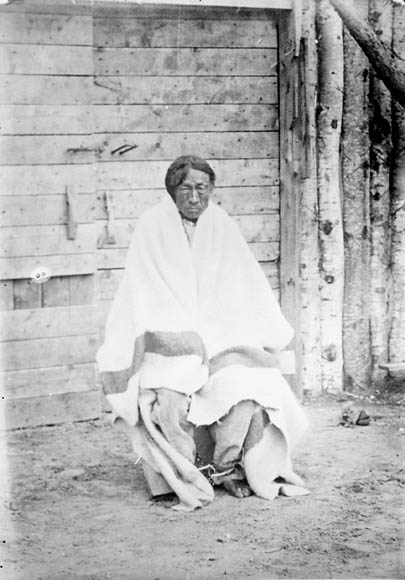
A black-and-white photograph of a man seated, wrapped in a blanket. He is looking directly at the viewer.

Chief Big Bear, 1886, by William Topley (MIKAN 3358338)

Métis and First Nations communities would suffer severe and lasting consequences from the events of 1885. In addition, relations between the French and the English and the Indigenous and non-Indigenous people of Canada would be set back for years to come.

Objects used in Indigenous communication

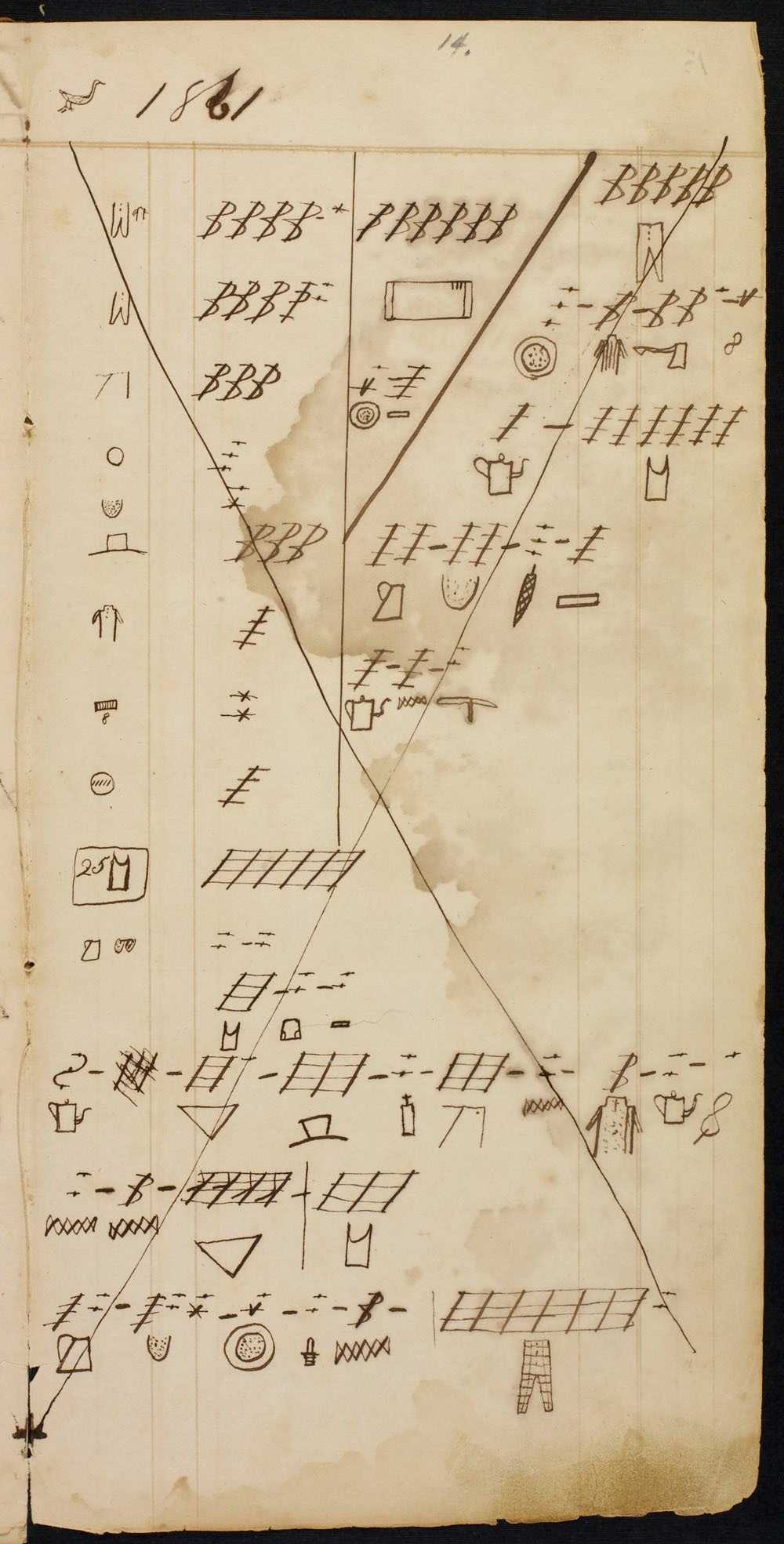
Long before European settlers came to America, Aboriginal peoples had developed communication systems that did not require writing or printing as was used in Europe or Asia. While it is generally acknowledged that Amerindians historically accessed their past primarily through oral traditions, we also know that they used physical means of communication for various purposes: for example, to communicate information; convey knowledge; commemorate events; identify certain titles, social positions and family ties; remember concepts, chants and ceremonies; and to situate past events in time and space.

Various modes of cultural transmission used drawings and symbols to express an idea or share information. Pictograms (stylized drawings used as symbols) were painted, drawn, traced, sculpted or woven using different materials. Themes often dealing with hunting, war and the supernatural world were represented in combinations of different colours, sizes and arrangements.

Written by a French Jesuit in 1666, “Mémoire au sujet des neuf familles qui composent la nation iroquoise [memoir of the nine families making up the Iroquois nation] (French only) includes drawings and explanations revealing how the Iroquois used pictograms to communicate information about family clans, military expeditions under way, the number of injured, etc.

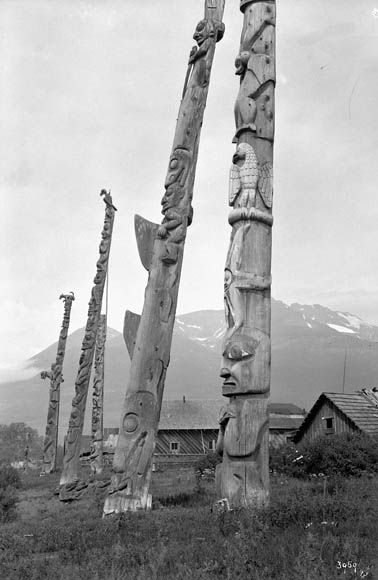
These Aboriginal communication systems are found on bark rolls, animal skins, totem poles and rock faces (the images are known as petroglyphs). We also know that the Iroquois used—and still use today—special ceremonial canes covered in motifs representing the 50 chiefs of the Haudenosaunee Confederation, and that Amerindians sometimes made marks in sticks of different sizes to remember what they needed to discuss at meetings. They would also make notches in trees to indicate, for example, details of their travels through the land.


Black-and-white photograph showing five wooden totem poles. In the background are houses and mountains.

Totem in Kitwanga, British Columbia (MIKAN 3587914)

Because signs and symbols were used primarily as memory aids to illustrate concepts, they do not refer to specific words in spoken language; therefore they cannot be read in the same way as one would read a text. As valid and reliable as the written word, these mnemonic devices have the advantage of communicating information between people who speak different languages. Anyone able to recognize and decode the icons and symbols can decipher and understand the message, much like road signs today.

Residential Schools: Photographic Collections

Version française

Library and Archives Canada (LAC) is presenting a series of galleries consisting of photographs of residential schools, federal day schools and other similar institutions attended by First Nation, Inuit and Métis children in Canada from the late 19th century to the 1990s.

Organized by province and territory, the images featured in these galleries derive from many collections held at LAC—both government and private—and represent a selection of our holdings. The majority of the photographs were taken by federal government employees who worked for the former Department of Indian Affairs and Northern Development. You can find photos of residential and federal day schools in Accession 1973-357, RG85 and RG10. Use Collection search—Advanced search to search for additional images not included in the galleries.

Two examples include the group of students at Cross Lake Indian Residential School in Manitoba and the page of six photographs showing different views of Lejac Indian Residential School and other buildings in Fraser Lake, British Columbia.

Black and white photograph of Indigenous girls seated at their desks with a nun standing beside them

Group of female students and a nun in a classroom at Cross Lake Indian Residential School, Cross Lake, Manitoba, February 1940. (e011080274)

Cream-coloured page with six black and white photographs depicting views of various buildings

Views of Lejac Indian Residential School, and other buildings, Fraser Lake, British Columbia, August 1941. (e011080315)

Some of the images are found in the collections of other government departments, including the Department of the Interior (Accession 1936-271), the Department of Mines and Technical Surveys (Accession 1960-125) and the National Film Board of Canada (Accession 1971-271).

Photographs of the students, staff and schools are also found in a number of private collections—Henry Joseph Woodside, Joseph Vincent Jacobson, Kryn Taconis and Charles Gimpel—to name a few.

Black and white photograph of a group of Indigenous girls and boys, nuns and two men posing in front of a building

Port Harrison (Inukjuak) Federal Hostel, group of students, nuns and Indigenous men, Quebec, ca. 1890, by Henry Joseph Woodside. (a123707)

Colour photograph of a group of Inuit boys posing in crouched positions on a large flat rock; two of them are holding rifles

Marksmanship group, Coppermine School (Tent Hostel), Kugluktuk, Nunavut, ca. 1958, by unknown photographer, Joseph Vincent Jacobson fonds. (e004923632)

You can access additional photographs of Indigenous students and schools using Collection search. For tips on searching the database, see the Online and non-digitized photographs section in Residential School Records Resources under What is found at Library and Archives Canada.

If you have information about a photograph, please let us know. We will add this information to the record in the database. You will need to include an image reference number, for example, PA-102543, e011080332, e011080332_s3 or the MIKAN number—3614170.

Albums featuring sample sets are available on LAC’s Flickr and Facebook pages.

Photos of Residential Schools – Quebec and Atlantic Regions now on Flickr 

Discover a sampling of photos of the Residential Schools in Quebec and Atlantic regions. To view the complete set, visit our Web page Residential Schools Photos.