 Over the next year, keep your eyes open for a new and exciting series of blog articles, promoting Library and Archives Canada’s (LAC) upcoming exhibition, Canada: Who Do We Think We Are?, developed in recognition of the 150th anniversary of Canadian Confederation. The exhibition opens on June 5, 2017, while the year-long blog series starts in January 2017.
Reading the blogs
Through this series, you will hear from staff who helped develop the exhibition, including anecdotes about their work at LAC. The series also includes articles by scholars, experts and ordinary Canadians, who all depend upon LAC’s collection, from across Canada—and even the other side of the globe!
In each article, a different “guest curator” will examine one item from the exhibition. We have come up with four questions, which we have had each of our guest curators answer. The questions give the curators a chance to tell us a bit about themselves, to provide extra information about their item and, finally, to virtually add an item or two to the exhibition.
The guest curator blog series will be published every month, between January and December 2017. Be sure to stay tuned all year, in order to find out who our guest curators are and what they chose.
Visiting the exhibition
And be sure to visit the physical exhibition in downtown Ottawa where you can see these, and many other Canadian treasures, in person. Canada: Who Do We Think We Are? will be on display free of charge at 395 Wellington Street between June 5, 2017, and March 1, 2018.
The exhibition explores different ideas of Canada, and being Canadian, over time.
Some of these ideas will be familiar today, and rather comfortable to us all—something like old, worn-down slippers. The idea of Canada as a “northern” nation, for example, goes right back to the colony’s earliest days. Others may simply seem old fashioned, like a 1944 image of the “typical” Canadian family. And still others may seem wrong, or even shocking, to modern eyes. These include certain past attitudes towards immigration, for example, and the country’s First Nations peoples.

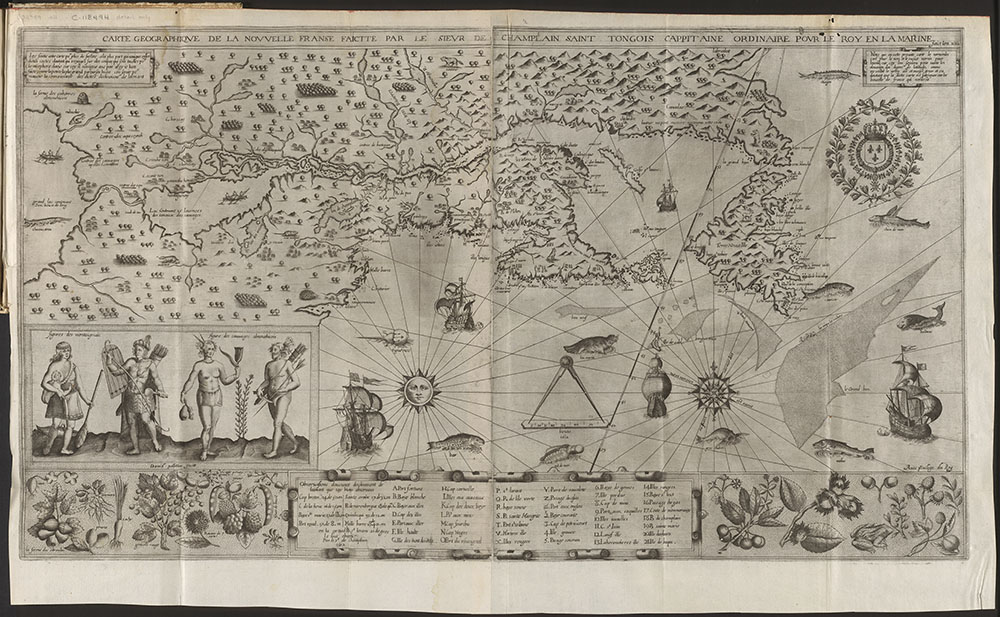
Carte geographique de la Nouvelle Franse faictte par le sieur de Champlain, 1613 [Geographical map of New France by Samuel de Champlain, 1613]. Samuel de Champlain’s beautiful illustration advertises the land’s wealth to investors (MIKAN 3919638 or AMICUS 4700723)





![Les voyages du sieur de Champlain…, 1613 and its map Carte geographique de la Nouvelle Franse faictte par le sieur de Champlain [Geographical map of New France by Samuel de Champlain], engraved by David Pelletier in 1612. (MIKAN 3919638) (AMICUS 4700723)](https://thediscoverblog.com/wp-content/uploads/2017/01/15543654392_3ac964f9a1_k.jpg)
 Library and Archives Canada Blog