Images of Working Dogs now on Flickr

Working dogs learn and perform tasks to support and sometimes amuse their owners.

A black-and-white photograph of a boy with his dog harnessed to a two-wheeled cart. The cart is loaded with dried cod.

Dog cart loaded with cod “Ready for market,” Gaspé, Quebec [e010861908]

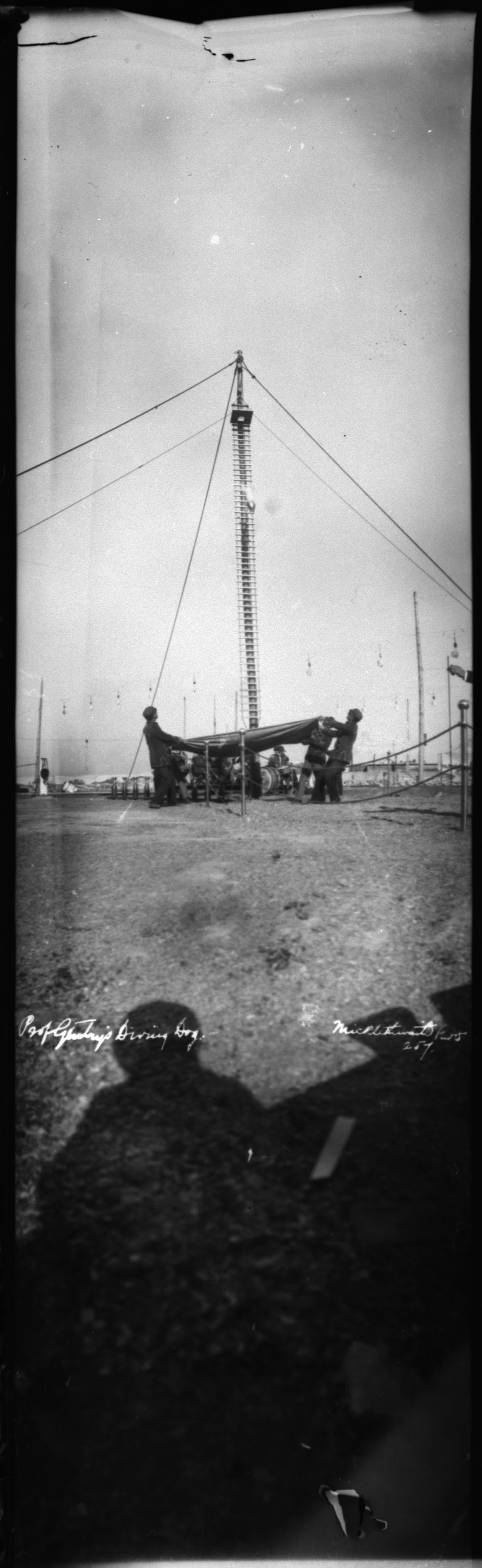
A black-and-white photograph of a circus dog jumping from a platform on a tall pole. Four men below hold a large blanket to catch the falling dog.

Professor Gentry’s diving dog, Toronto Industrial Exhibition, Ontario [PA-068465]

Regardless of whether they are purebreds or mixed breeds, these dogs are trained to do a variety of jobs very well. Some of the jobs include pulling carts and sleds, herding livestock, hunting, as well as providing valued services to the community such as policing, search and rescue, therapy, and guarding homes, businesses and buildings.

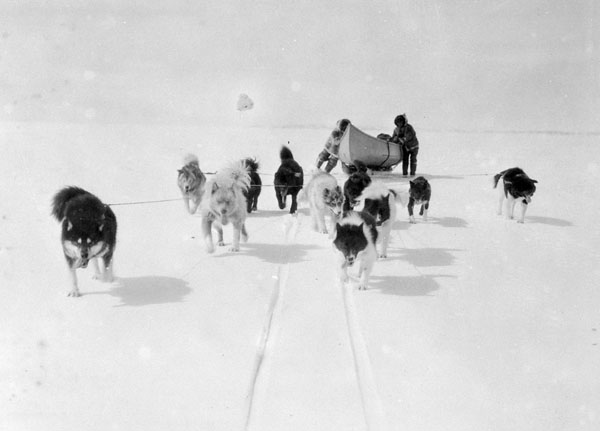
A black-and-white photograph of 11 dogs pulling a sled through the snow. Two men are supporting and balancing the weight of a large canoe on the sled.

A dog team on Gordon Bay, Hudson Strait, Nunavut [PA-121599]

A black-and-white photograph of a man with his four dogs wearing pack harnesses.

Dogs carrying packs ready for the trail, Valley of the Firth River, Yukon [PA-044646]

The breed chosen often depends on what the job requires; however, most dogs share common canine traits of strength, discipline, intelligence and loyalty.

A black-and-white photograph of a dog harnessed to a small two-wheeled passenger cart. A girl sits on the cart and holds the reins to her dog.

A girl driving a cart at Harvey’s, Toronto, Ontario [PA-069924]

Visit the Flickr album now!

New podcast! Check out our latest episode, “Songs of the Season”

Our latest podcast episode is now available. Check out “Songs of the Season.”

Library and Archives Canada has the largest collection of Canadian music in existence. There are over 250,000 sound and video recordings alone, not to mention huge collections of sheet music, printed scores, concert programs and books. Therefore, it goes without saying that LAC also has the largest collection of Christmas and holiday music as well.

Joining us today to talk about some of this Christmas and holiday music in LAC’s collection, is music archivist, and LAC co-choir leader, Joseph Trivers.

Subscribe to our podcast episodes using RSS, iTunes or Google Play, or just tune in at Podcast–Discover Library and Archives Canada: Your History, Your Documentary Heritage.

For more information, please contact us at bac.balados-podcasts.lac@canada.ca.

Images of Cartes-de-Visite now on Flickr

A carte-de-visite is a type of calling card popular during the mid- to late 19th century.

A black-and-white photograph of Napoléon Bourassa’s left profile.

Napoléon Bourassa [e008302188]

The card consisted of a photographic print glued onto a cardboard backing. These cards were inexpensive and easy to produce, and varied slightly in size. Cards were commonly given out to friends and family during holidays or for special events. Collectors, at the time, put their cards into albums. Images were not limited to family and friends—famous individuals from the past were also featured on cartes-de-visite.

A black-and-white photolithograph of two dogs, one large and one small, looking out from the entrance to a doghouse.

Two dogs [e011196678]

A black-and-white photographic portrait of 27 young girls wearing medals and seated around a nun.

Group of girls wearing medals seated around a nun [e010969237]

A black-and-white photographic portrait of a dog resting on a chair next to a boy and a man holding a rifle.

Hunter with a boy and dog [e011196672]

Visit the Flickr album now!

Governor General’s Literary Awards 2018

By Liane Belway

Each autumn at Library and Archives Canada, we celebrate the best in Canadian literature by supporting the Governor General’s Literary Awards. Begun in 1936 and administered by the Canada Council for the Arts since 1959, these awards showcase the best in the year’s literary publishing. (Conveniently just in time for holiday shopping, in case you are looking for a gift for the book lovers in your life.) Reflecting Canada’s rich literary diversity, the fourteen winners in two official languages and seven categories were announced on October 30.

Here are all the winners, in English and French.

Fiction

The Red Word by Sarah Henstra, published by ECW Press and distributed by Jaguar Books Group, ISBN 978-1-77041-424-2.

De synthèse by Karoline Georges, published by Éditions Alto and distributed by Diffusion Dimedia, ISBN 978-2-89694-349-4.

Poetry

Wayside Sang by Cecily Nicholson, published by Talonbooks and distributed by PGC Books/Raincoast, ISBN 978-1-77201-182-1.

La raison des fleurs by Michaël Trahan, published by Le Quartanier and distributed by Diffusion Dimedia, ISBN 978-2-89698-359-9.

Drama

Botticelli in the Fire & Sunday in Sodom by Jordan Tannahill, published by Playwrights Canada Press and distributed by University of Toronto Press, ISBN 978-1-77091-917-4.

Venir au monde by Anne-Marie Olivier, published by Atelier 10 and distributed by Flammarion/Socadis, ISBN 978-2-89759-303-2.

Non-fiction

Mamaskatch: A Cree Coming of Age by Darrel J. McLeod, published by Douglas & McIntyre and distributed by University of Toronto Press, ISBN 978-1-77162-200-4.

Avant l’après : voyages à Cuba avec George Orwell by Frédérick Lavoie, published by La Peuplade and distributed by Diffusion Dimedia, ISBN 978-2-924519-75-2.

Young People’s Literature–Text

Sweep: The Story of a Girl and Her Monster, by Jonathan Auxier, published and distributed by Puffin Canada/Penguin Random House Canada Young Readers, ISBN 978-0-7352-6435-9.

Ferdinand F., 81 ans, chenille, by Mario Brassard, published by Soulières éditeur and distributed by Messageries ADP, ISBN 978-2-89607-413-6.

Young People’s Literature–Illustrated Books

They Say Blue by Jillian Tamaki, published by Groundwood Books and distributed by University of Toronto Press, ISBN 978-1-77306-020-0.

Le chemin de la montagne by Marianne Dubuc, published by Comme des géants and distributed by Diffusion Dimedia, ISBN 978-2-924332-40-5.

Translation

Descent into Night, translated by Phyllis Aronoff and Howard Scott, published by Mawenzi House Publishers and distributed by University of Toronto Press. It is a translation of Explication de la nuit by Edem Awumey, published by Les Éditions du Boréal, ISBN 978-1-988449-16-6.

Le Monde selon Barney, translated by Lori Saint-Martin and Paul Gagné, published by Les Éditions du Boréal and distributed by Diffusion Dimedia. It is a translation of Barney’s Version by Mordecai Richler, published by Knopf Canada, ISBN 978-2-7646-2503-3.

Find out more:

https://ggbooks.ca/#winners

https://livresgg.ca/#gagnants

A wealth of great Canadian literature in both official languages is represented in the GG selections, so check out the winners at your local library or search in Voilà, Canada’s catalogue to find a lending library near you.


Liane Belway is a librarian in the Acquisitions section of Published Heritage at Library and Archives Canada.

Butterflies, love triangles and the northern lights

By Shane McCord

The recently concluded Library and Archives Canada (LAC) exhibition Premiere included four drawings by midshipman Robert Hood (c. 1797–1821). These drawings were first presented on the Discover Blog in April 2015, shortly after they had been acquired by LAC. Robert Hood was a talented draftsman, cartographer, scientist, natural historian, and anthropologist before the term existed. He is remembered today for his participation in the 1819–1822 Coppermine Expedition, led by John Franklin. While on this expedition, Hood was the first to document various species of animals and insects. He was also the first to note the electromagnetic nature of the aurora borealis. Posthumously, some of his drawings were reproduced and published in Franklin’s account of the expedition, which included a glowing report on Hood’s work and conduct.

While Hood is known, to a degree, for the contributions to scientific knowledge he made during the expedition, his story is also remembered for the part he played in a now infamous love triangle between himself, a Dené woman known as Greenstockings, and Sir George Back, another artist who was part of the expedition. The story, which includes a failed duel between Back and Hood, has been told many times and is neatly summarized in the Dictionary of Canadian Biography entry for Hood.

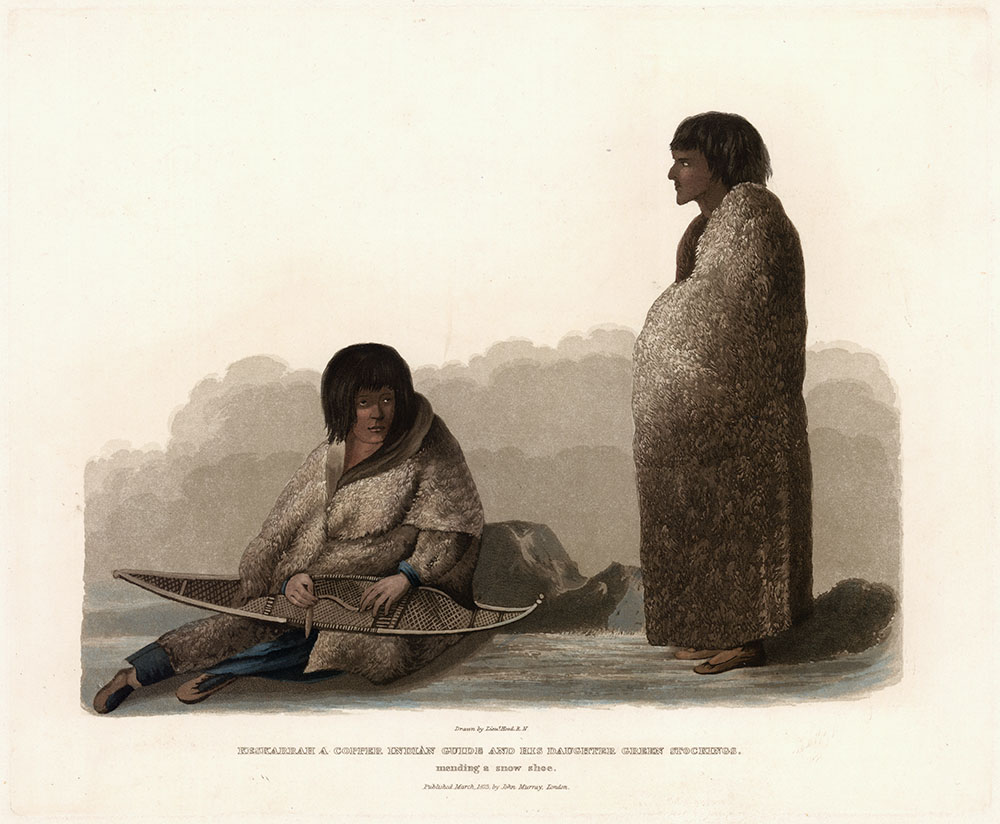
A colour lithograph of a woman sitting on the ground and mending a snowshoe, with a man standing on the right. Both figures are wearing long fur cloaks.

Keskarrah a guide from the Yellowknife Denes and his daughter Green Stockings, mending a snow shoe (e011156563)

All the members of the expedition were suffering from malnutrition and exhaustion, and Hood did not survive. He was likely near death when he was killed by a fellow member of the expedition, the voyageur Michel Terohaute. Terohaute was executed for the murder, and was later suspected of cannibalism.

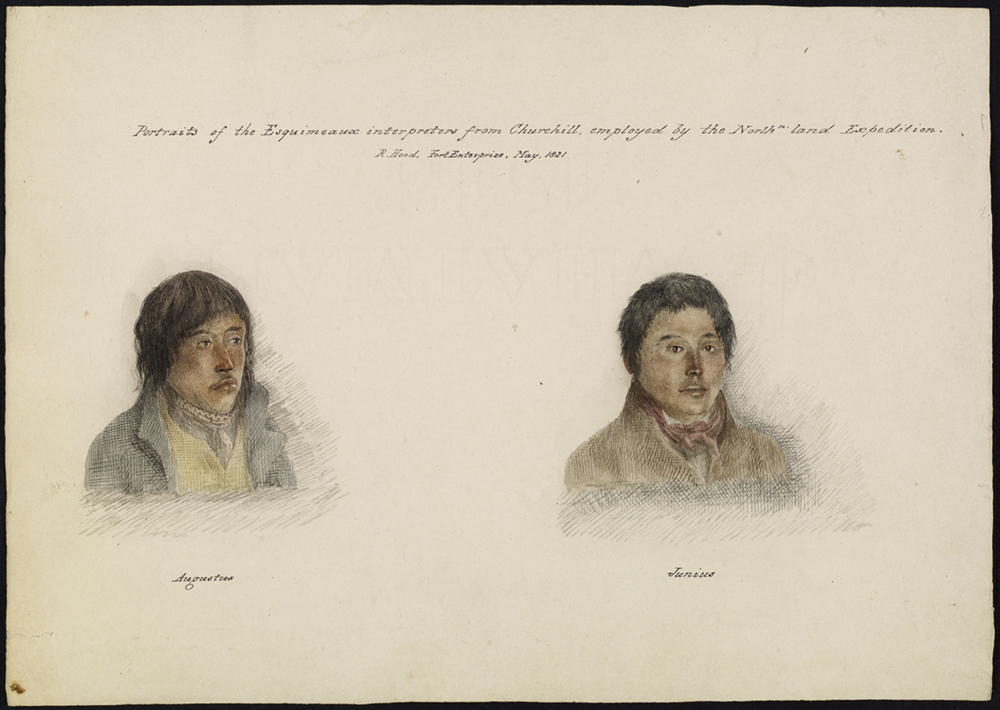
A watercolour of two young Inuit men wearing western-style clothing. One is captioned “Augustus”, the other “Junius”.

Portraits of the [Inuit] interpreters from Churchill, employed by the North Land Expedition. (e011154367)

The first of the four drawings shown in the Premiere exhibition is a double portrait of two Inuit guides and interpreters, Tattanoeuck (“Augustus”) and Hoeootoerock (“Junius”). Tattannoeuck was a member of three expeditions, two with Franklin (1819–1821, 1825–1827) and one with Back (1833–1835). He was heavily involved in these expeditions and was well respected by his companions, to the point that Sir John Richardson, a member of both the first and second Franklin expeditions, named a species of butterfly Callophrys augustinus in his honour. Hoeootoerock was separated from the members of the Coppermine Expedition during the crossing of the Coppermine, and is presumed to have died there.

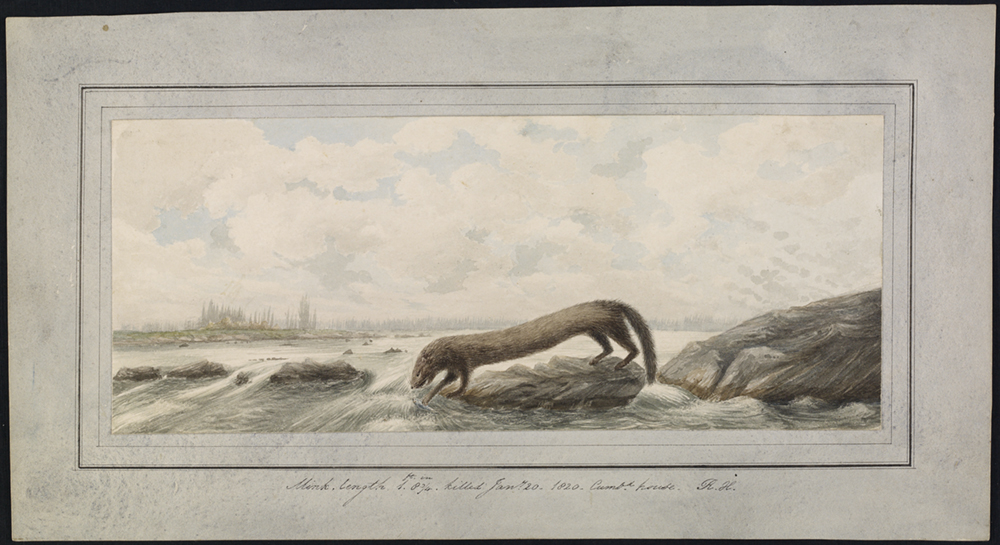
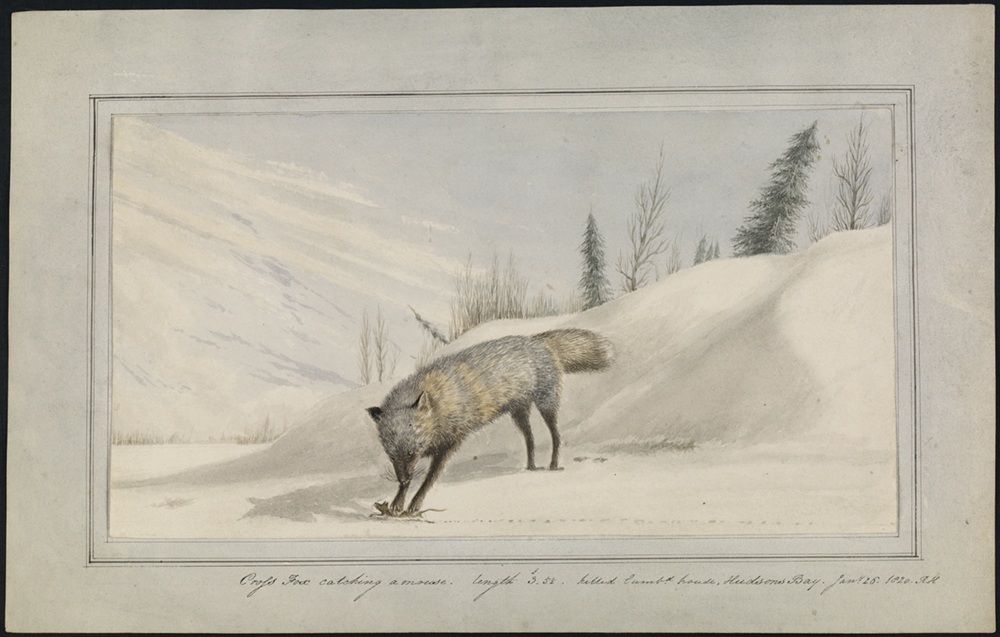
Two of the drawings are depictions of northern mammals: a mink and a cross fox. At the time these works were produced, such species were becoming objects of study in Western European science. Images such as these were among the primary reasons why Hood, an officer with a talent for drawing, was selected for the expedition. Apart from their aesthetic value, these images were important as evidence of wildlife in the region of the expedition and provided valuable information for the expansion of the fur trade.

A watercolour of a mink peering into the water by a rocky river shore.

[Mink] (e011154368)

A watercolour of a white fox hunting a mouse in a snowy landscape.

[Cross Fox catching a Mouse] (e011154369)

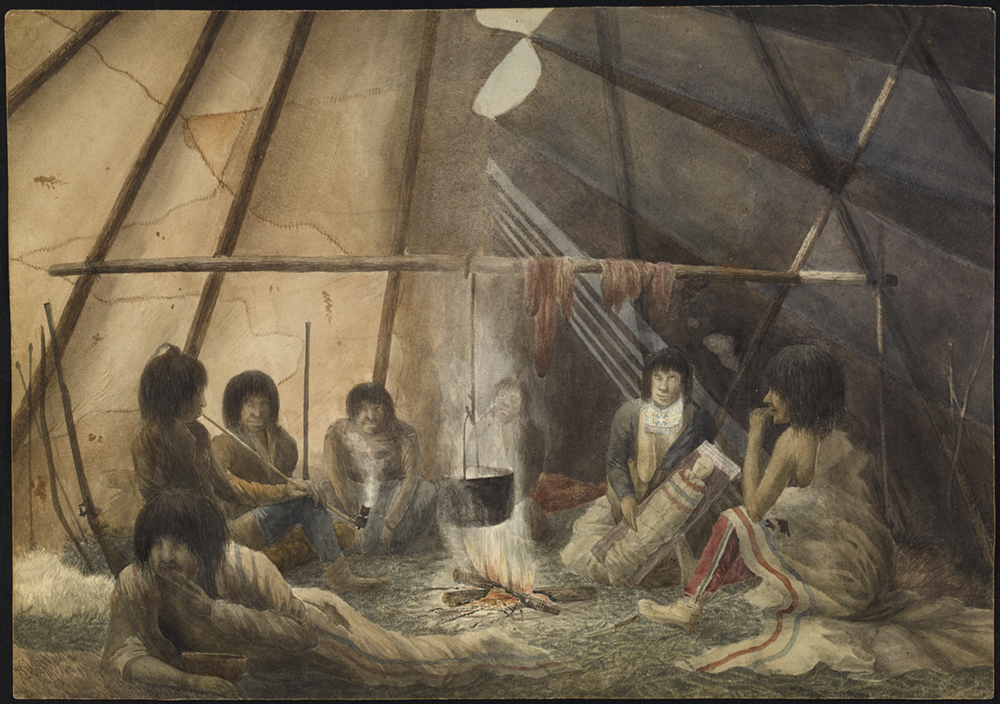
The final and most interesting drawing shows the interior of a Cree tent. The inscription is “Interior of a Southern Indian tent; taken on the Basquiase Hill, Cumberland House, Hudson’s Bay. The tent is made of Moose skin parchment; the cloathes [sic] of the indians are made of skins. The cloth obtained from the English factories. March 25th 1820 Robert Hood North Land Expedition.” The drawing is valuable for the anthropological information it provides and for its historical context. In Hood’s journal from the expedition, he describes making such a drawing on March 31, and he provides several anecdotes regarding the people in the tent. It is yet to be determined if this is that same drawing and there is an inaccuracy in the dates, or if Hood made a second drawing.

A watercolour showing the interior of a tent. Seven people are sitting around a fire. One is a mother with a child in a cradleboard. Pelts or meat are drying on a cross beam and a pot of food is over the fire. A musket and a bow and arrows are leaning against the side of the tent. One person is eating and another is smoking a pipe, while the others appear to be observing the artist (Hood) at work.

[Interior of a Cree tent] (e011154370)

All four of these drawings relay important documentary evidence about the region of Cumberland House, in what is now northern Saskatchewan. These drawings are also fascinating simply as items carried on that ill-fated journey. The Franklin expeditions are an important part of the history of Canada’s development as a nation, and the tragic aspects of the first expedition in particular have made it one of the most popular and well-known episodes in Arctic history.


Shane McCord is an art archivist in the Archives Branch of Library and Archives Canada.

1918 Spanish flu epidemic

By Marcelle Cinq-Mars

Toward the end of the First World War, as Canadian troops were involved in Canada’s Hundred Days, a new enemy—even tougher than the Kaiser’s Germany—attacked soldiers and civilians alike, ignoring borders.

In just a few months, the 1918 influenza epidemic spread around most of the world, reaching pandemic proportions. It became known as the “Spanish flu” because Spanish journalists, not subject to wartime censorship, were the first to report publicly on the epidemic in Europe.

Historians are divided on the precise origin of the 1918 influenza outbreak. However, they do agree that the rapid spread of the disease was hastened by the presence of large numbers of soldiers in military camps, which became excellent incubators for the virus. Soldiers returning to their home countries intensified the spread of the disease.

The first serious flu cases in Canada occurred toward the end of summer 1918, while the First World War was still raging. Port authorities in Halifax and Québec, where ships docked bringing home the wounded and the ill, noted the first cases and warned federal health officials about the situation.

Federal authorities quickly carried out medical examinations of passengers on ships travelling from Europe. They quarantined people who showed signs of influenza. Essentially, the officials tried the same measures that were used in the 19th century to deal with cholera epidemics. However, sailing ships had given way to ocean liners carrying thousands of soldiers to the war and back. Canada’s four quarantine stations could not halt the progress of the epidemic, despite the best efforts of the doctors trying to contain it.

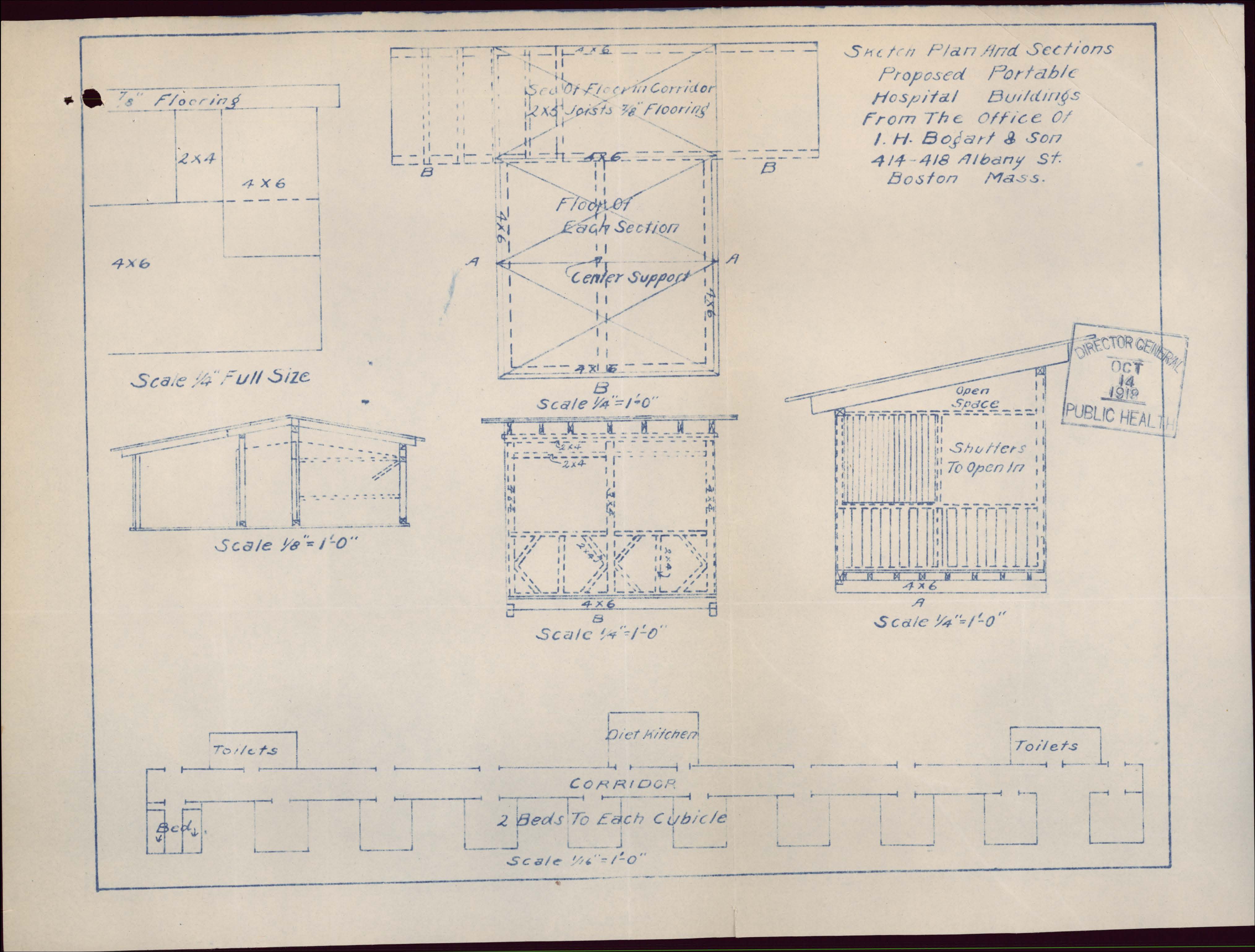
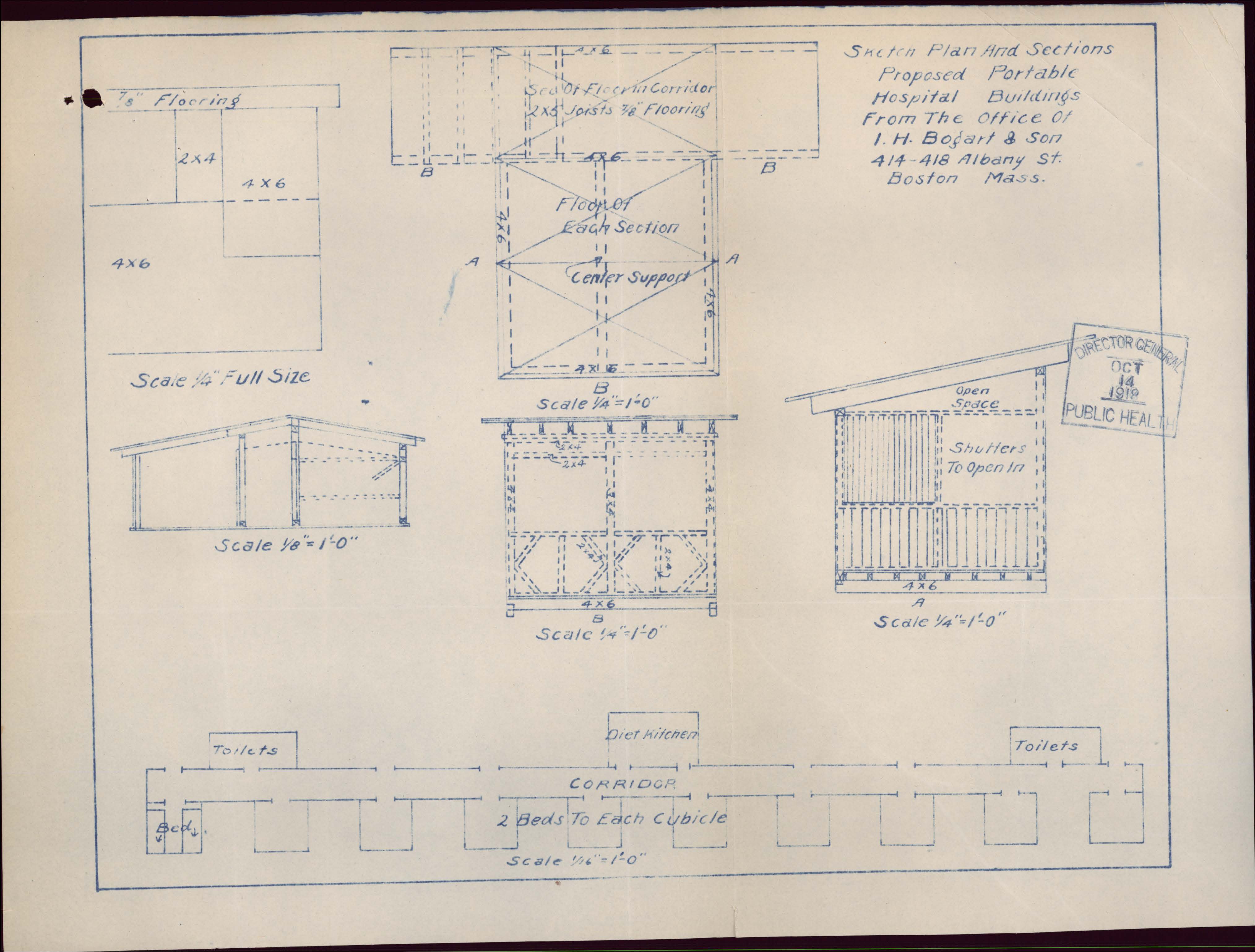
By autumn 1918, influenza was racing through the population like wildfire. Hospitals quickly became overcrowded and were hard pressed to receive more patients. Many people were therefore cared for at home or in temporary facilities, such as mobile military field hospitals. Overworked medical personnel were also hit by the flu themselves. This meant that relatives or friends were often called on to care for the sick, which contributed to the spread of the disease.

Sketch showing the various components of a mobile hospital.

Plan of a mobile hospital proposed by the firm I.H. Bogart & Son of Boston in the United States, RG29 vol. 300 (e011165378-045)

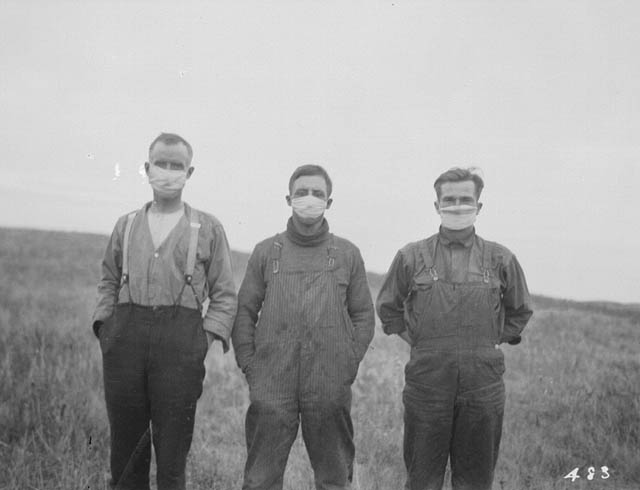
However, the number of deaths was soon growing so rapidly that there was even a waiting list for… cemetery burials. Across the country, health officials put regulations in place to try to stop the spread of the devastating outbreak. Schools, theatres, libraries and, in short, almost all public places—sometimes even churches—closed their doors. Many people wore masks to try to protect themselves, and anyone who dared to spit was strongly reprimanded. This was because, despite the fact that the epidemic could not be stopped, people knew it was influenza and the virus spread from person to person through the air.

Black-and-white photo of three men wearing hygienic masks.

Men wearing masks during the Spanish flu epidemic (a025025)

Soldiers returning to Canada at the end of the war found their families decimated. This was the case for soldier Arthur-Joseph Lapointe, father of Jean Lapointe, a retired senator. In his memoirs, Souvenirs et impressions de ma vie de soldat, 1916-1919, he recounts that on his return home, his father, looking deeply sombre, delivered very sad news:

“We did not want to tell you the extent of the misfortune that has befallen us, because we did not know when you might be coming back, and it would have made your life unbearable. A terrible flu epidemic took three of your brothers and two sisters in the space of nine days.” [translation]

Over several tragic months, the Spanish flu claimed the lives of more than 20 million people around the world, including some 50,000 in Canada—almost as many as died in the four years of fighting during the First World War.

Federal health officials were heavily criticized for implementing outdated and inadequate quarantine measures, and for their lack of vision and leadership. After taking stock of its ineffectual actions during the influenza pandemic, the federal government created the Department of Health in 1919.

Records related to this tragedy can be found at Library and Archives Canada. More information is available in our thematic guide on the Spanish flu epidemic.


Marcelle Cinq-Mars is a senior archivist in Military Affairs, Government Archives Division, at Library and Archives Canada.

Images of Sweaters, Jackets and Coats now on Flickr

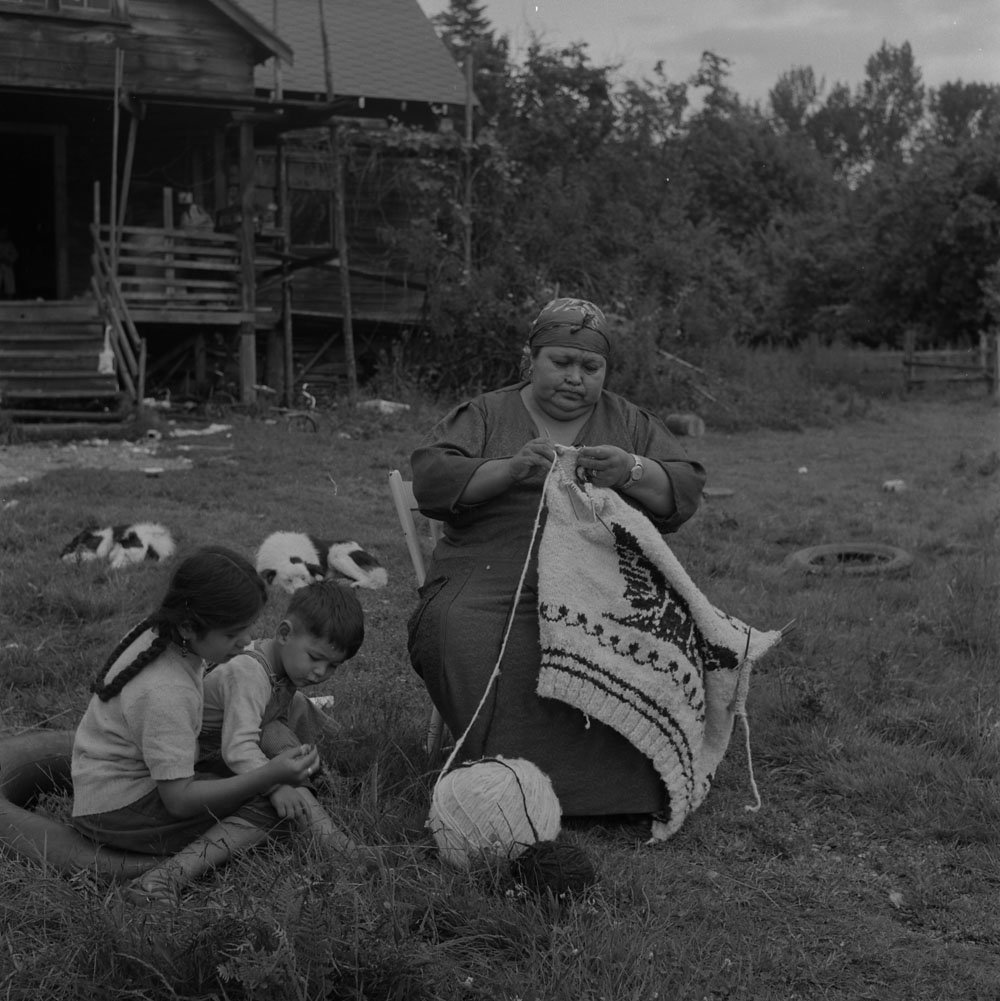
A black-and-white photograph of a woman sitting outside knitting a traditional Cowichan sweater. A boy and a girl sit next to her on the grass.

Ms. Pat Charlie knits a Cowichan sweater, British Columbia [e011176278]

Canada is a large and geographically diverse country with a wide range of seasons. Temperatures can vary from 40 degrees Celsius to minus 50 degrees. With the changing temperatures and environmental patterns across the country, Canadians naturally like to discuss the weather.

A black-and-white photograph of a tailor adjusting a suit jacket on a tailor’s mannequin.

Tailor adjusting a suit jacket on a tailor’s mannequin, Montreal, Quebec [e004666235]

A black-and-white photograph of a woman standing straight to model a military uniform consisting of a Norfolk jacket, skirt, and black shoes.

Woman wearing a Norfolk jacket, skirt, and black shoes [PA-063849]

During the autumn and winter months, clothing options get included in the conversation. Sweaters, jackets and coats come out with the cooling temperatures, first one at a time, then to be layered one on top of the other.

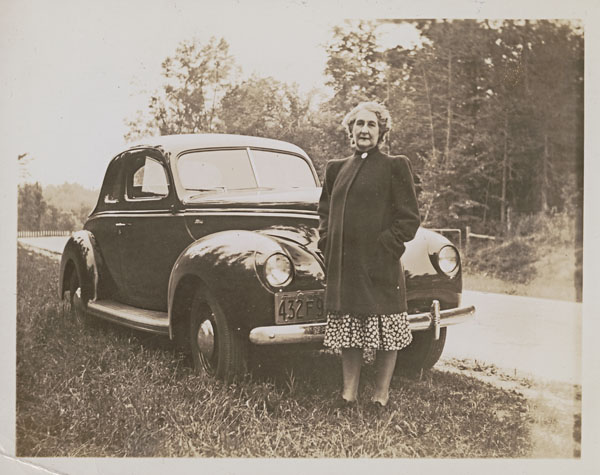
A black-and-white photograph of a woman wearing a coat and standing at the side of a road in front of her car.

Madge Macbeth wearing a coat and standing at the side of a road in front of her car “Amaryllis” [e008406104]

Visit the Flickr album now!

Maritime voices: Alistair MacLeod

By Leah Rae

About 360 kilometres from downtown Halifax, on the west coast of Cape Breton Island, lies the tiny community of Dunvegan. Too small to be a town, Dunvegan is a fork in the road located between Inverness and Margaree Harbour. It was here, in a small, hand-built shed overlooking the Atlantic Ocean (with Prince Edward Island in the distance) that writer Alistair MacLeod spent his summer vacations. It was in this shed that he wrote some of the greatest short stories in the English language and his one and only novel No Great Mischief.

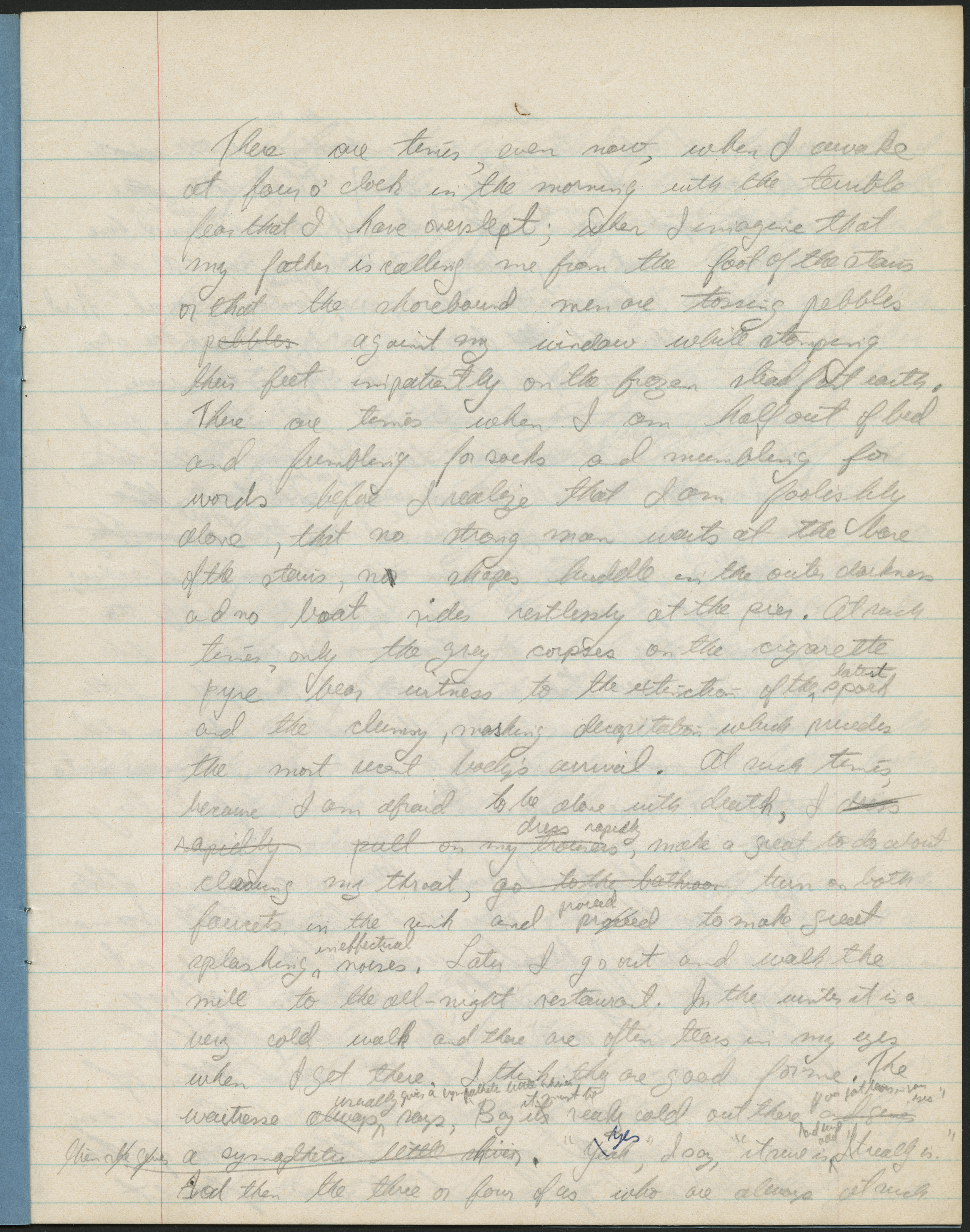
A handwritten first page of The Boat.

Front page of the manuscript for The Boat by Alistair MacLeod. © Estate of Alistair MacLeod (e011213687)

Like many “Capers” before him, MacLeod spent his youth working as a miner and a logger. He used his income to pay for his education, earning both his undergraduate degree and teaching degree from St. Francis Xavier University in Antigonish, Nova Scotia. MacLeod spent his career as an English and creative writing professor at the University of Windsor in Ontario. Between the demands of being a full-time professor and a father to six children, he found it challenging to find time for his writing during the school year. However, during his summer vacations, he and his family returned to the family home in Dunvegan (named for Dun Bheagan on the Isle of Skye in Scotland) where he had the opportunity to focus on his writing. MacLeod’s work examines the daily struggles of the people of Cape Breton Island. What gives MacLeod’s writing its power and its majesty is its lyricism: MacLeod often read his work out loud as a way to perfect the cadence of each line. He was a slow and methodical writer, carefully considering every word. Although he produced a very small body of work in his lifetime, the quality of that work is outstanding.

Library and Archives Canada (LAC) is lucky to be the repository for the Alistair MacLeod fonds. In the early 2000s, LAC acquired about 4.5 metres of material (both textual and graphic) created by MacLeod in Ontario and in Nova Scotia. The material spans his career as both a writer and a teacher. The fonds includes manuscripts, correspondence, essays, thesis notes, clippings, photos of MacLeod and more.

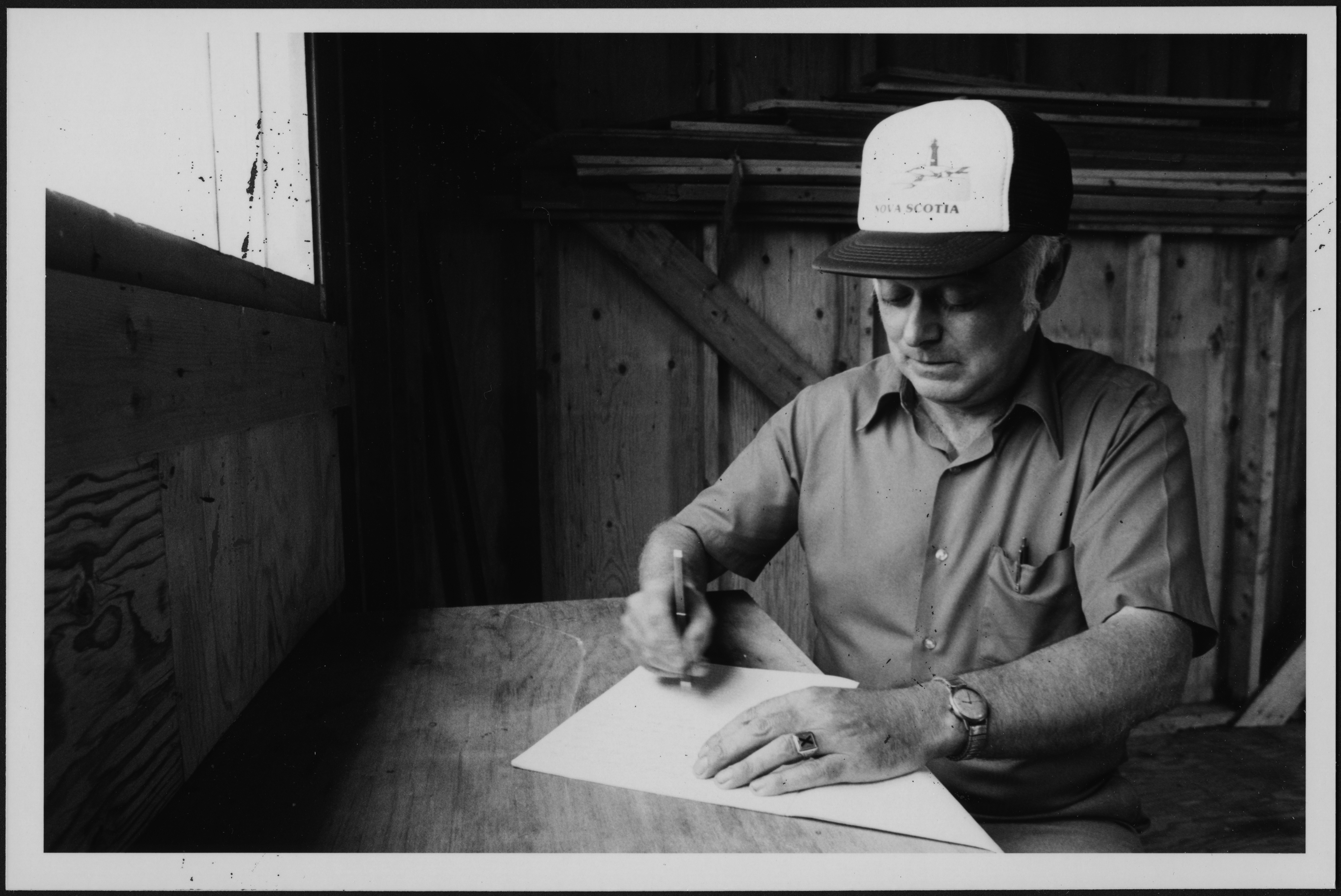
A black-and-white photograph of a man sitting at a rough desk with paper and pen in hand.

Alistair MacLeod working in his writing shed in Dunvegan, Nova Scotia. © Chuck Clark (e011213686)

Looking at MacLeod’s original manuscripts gives us a fascinating glimpse into his process as a writer. He was known in the Canadian literary community as a perfectionist, and you can see this is true in his manuscripts. The first draft of his short story The Boat is handwritten in an examination booklet from Notre Dame University (where MacLeod earned his PhD). If we look at the published version of the first paragraph of that story—perhaps one of the most beautiful paragraphs in English literature—it is nearly identical to the author’s draft version.

MacLeod continued the practice of handwriting his work throughout his career (a practice perhaps perceived by many writers today as very old fashioned!) He also wrote part of his manuscript for his novel No Great Mischief by hand. It is quite a special thing to see a work of this calibre written in long hand rather than as typewritten words on a page that we are so used to seeing nowadays. It gives you a very personal sense of MacLeod working diligently away during his few precious hours of free time, overlooking the beautiful cliffs of Cape Breton and the sea below.


Leah Rae is an archivist based in Halifax in the Regional Services and ATIP Division of Library and Archives Canada.

Soldiers at the Front, Workers in Factories

By Lucie Paquet

In August 1914, countries in Europe started a war that was expected to be over quickly. Like many Western countries, Canada mobilized and sent troops to fight on the Allied side during the First World War. The French army, largely deprived of heavy industry and mining resources, soon ran out of military materiel, which led to a marked increase in demand for all kinds of products. So from 1914 to 1918, Canada took action to address this situation by requisitioning nearly 540 industrial facilities across the country, from Halifax to Vancouver. Steel factories deemed essential by the government were converted to manufacture war materiel. To support the army, their activities were closely supervised by the Imperial Munitions Board, which appointed and sent more than 2,300 government inspectors to factories to supervise, test and evaluate the production of military goods. It was under these circumstances that The Steel Company of Canada (now Stelco) converted a large part of its operations to produce materiel for war.
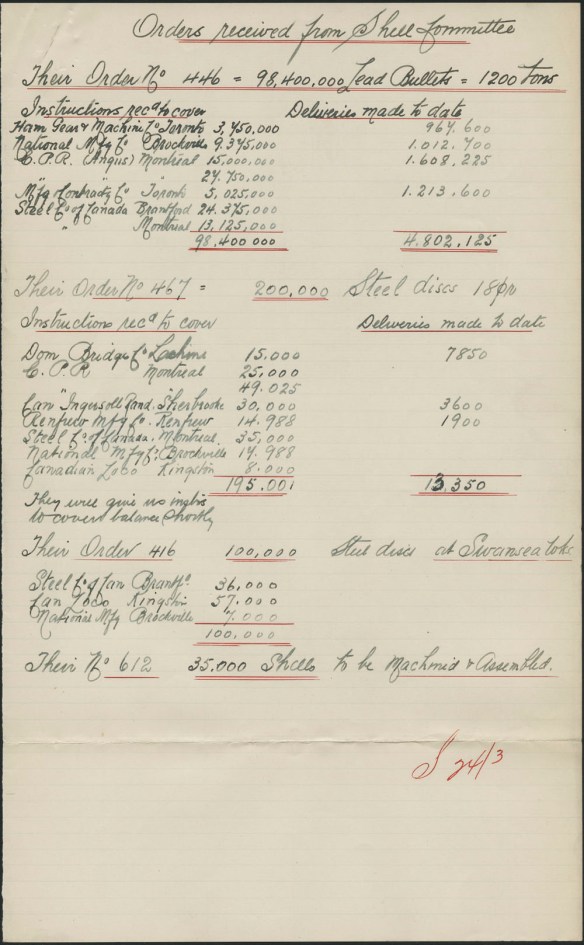
Handwritten list of orders sent by the Imperial Munitions Board, in black text with some red underlining, listing the number of shells produced by various industrial facilities in Canada.

Handwritten list of orders sent by the Imperial Munitions Board detailing the number of shells produced by various industrial facilities in Canada. (e011198346)

However, this change led to problems. Since the factories were not prepared to manufacture weapons quickly and to ensure consistent high quality, orders were delivered late and, very often, the equipment was defective. Stelco faced this reality and experienced these difficulties.
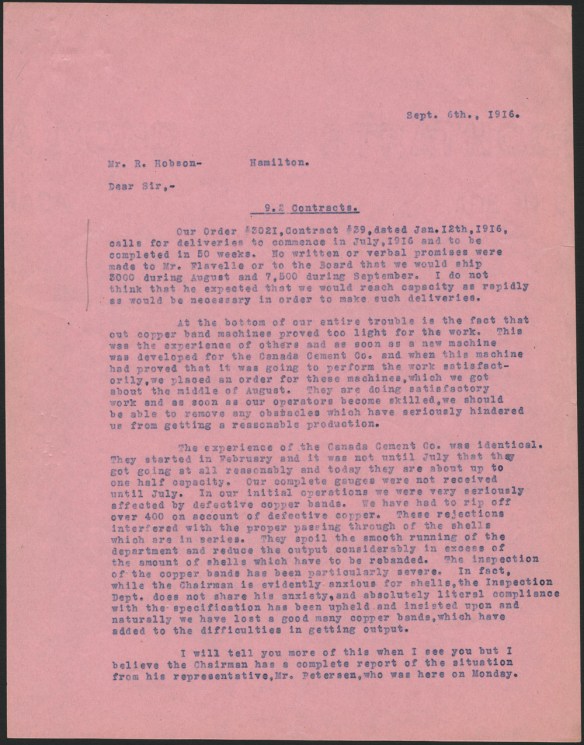
First page (pink) of a letter written in September 1916 by Montréal plant manager Ross H. McMaster to Stelco president Robert Hobson describing problems in producing and delivering shells.

Letter written in September 1916 by Montréal plant manager Ross H. McMaster to Stelco president Robert Hobson describing problems in producing and delivering shells. (e011198359-001)

Stelco’s biggest challenge involved the supply of raw materials. First, these had to be found and extracted; then the raw ore had to be transported from the mines to the plants; the necessary machinery and equipment had to be acquired and the new blast furnaces put into operation; and, finally, workers had to be trained for each stage of the manufacturing process. With its newly electric-powered mill for making steel bars, Stelco was able to start production quickly. It hired women to replace the hundred workers sent to the front, and it bought mining properties in Pennsylvania and Minnesota to supply coal and iron to its factories. Stelco also renovated and modernized its plants.

Table listing, in blue and red text, Stelco’s capital expenditures for the construction of new plants and the acquisition of additional equipment.

Statement prepared by Stelco outlining capital expenditures for the construction of new plants and the acquisition of additional equipment (e011198354)

Transportation systems were built to carry raw metals to Stelco’s processing plants in Montréal, Brantford, Gananoque and Hamilton. At the time, most major Canadian cities were linked by the Canadian National and Canadian Pacific railway lines, to transport soldiers and military goods.

Fall 1916 was a turning point in the steel industry, after two years of experimentation and production. As war continued to rage in Europe, metallurgists and industrialists decided to hold strategic meetings. The first meeting of the Metallurgical Association was held in Montréal on October 25, 1916, to discuss scientific advances in manufacturing military equipment. On that occasion, Stelco held an exhibition to showcase its products.


Two printed pages from the Canadian Mining Institute Bulletin with black-and-white photographs of shells produced by Stelco.

Photos in the Canadian Mining Institute Bulletin showing shells produced by Stelco. (e011198345)

In 1917, Stelco built two new plants in Hamilton. In addition to artillery pieces, steel panels were also manufactured for the construction of ships, rail cars, vehicles and aircraft parts.

As the war intensified, the demand for munitions increased dramatically. Production levels rose, prompting a reorganization of the world of work. To speed up production, workers were now paid wages based on the time allocated to manufacture each part. Bonuses were also awarded to the fastest workers.

Table showing the average number of minutes that workers spent on each step in manufacturing a 9.2-inch shell part, as well as the estimated number of minutes normally required to complete each task.

Table showing the average number of minutes that workers spent on each step in manufacturing a 9.2-inch shell part, as well as the estimated number of minutes normally required to complete each task. (e011198358)

Black-and-white photograph showing the interior of a munitions and barbed-wire factory in 1916.

View of the interior of a munitions and barbed-wire factory in 1916. (e011198375)

The war effort created a strong sense of brotherhood and patriotism, and workers put their demands on hold. A message from the superintendent of the shell department, delivered on January 4, 1917, clearly shows the pressure in the factories and the crucial role of the workers.
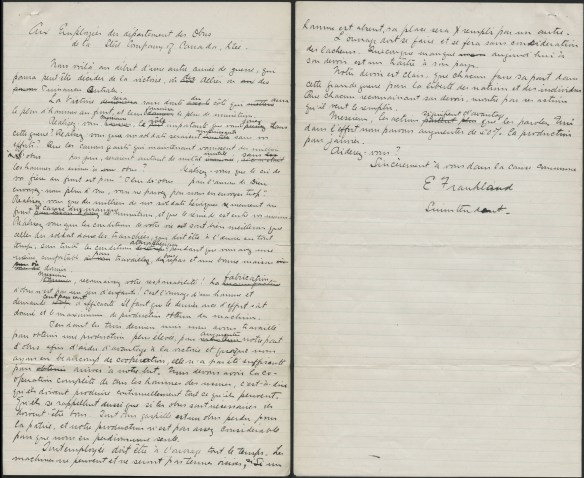
Handwritten letter written by superintendent E. Frankland to employees of Stelco’s shell department. (e011198367; a French version of this letter is also available: e011198368)

More than a hundred workers from the steel mills would fight in the trenches; most of them were sent to France. This list, dated November 16, 1918, shows the name and rank of each worker who went to fight, the name of his battalion or regiment, and his last known home base.

Four typewritten pages listing Stelco workers who went to fight in the First World War (1914–1918).

List of Stelco workers who went to fight in the First World War (1914–1918). (e011198365)

Fundraising campaigns were organized during the war to help soldiers and their families. Workers contributed a portion of their wages to the Canadian Patriotic Fund.

Cover page, in black and white, and pages 23 and 24, in black and red, of a record of contributions to the Canadian Patriotic Fund.

Cover page and pages 23 and 24 of a record of contributions to the Canadian Patriotic Fund. (e0111983867 and e011198385)

The work of factory workers was very demanding. Although the tasks required a high degree of precision, they were repetitive and had to be performed swiftly on the production line.

Left, a black-and-white photograph of workers on a production line for shells. Right, a blue Imperial Munitions Board form for progress achieved by a production line in a given week.

Left, Stelco workers on a production line for 9.2-inch shells. Right, an Imperial Munitions Board form for progress achieved by a production line in a given week. (e011198374 and e011198362)

The products were heavy and dangerous to handle. The workers melted the steel in the blast furnaces and then poured it into rectangular moulds. With tongs, they removed the glowing hot steel ingots and placed them on wagons. The ingots were then transported to the forge, where they were rolled into round bars according to the dimensions required to form the various shell tubes.

Black-and-white photograph of a worker using long tongs on a glowing hot steel ingot.

Reproduction of a photograph of a worker using long tongs to remove a glowing hot 80-pound steel ingot from a 500-tonne press. (e01118391)

Black-and-white photograph of workers posing beside hundreds of shell cylinders.

Stelco workers pose proudly beside hundreds of shell cylinders made from molten steel. (e01118373)

A large quantity of steel bars was produced to manufacture 9.2-inch, 8-inch, 6.45-inch and 4.5-inch shells.

Black-and-white photograph of the interior of a shell factory in Montréal on May 12, 1916.

View of the inside of Stelco’s shell factory on Notre-Dame Street, Montréal, May 12, 1916. (e01118377)

In 1915, Stelco’s plants in Brantford, Ontario, and on Notre-Dame Street in Montréal forged some 119,000 shells. The combined production of the two plants increased to 537,555 shells in 1917, then reached 1,312,616 shells in 1918. Under great pressure, Canadian factories continued to process millions of tonnes of steel into military materiel until the Armistice ending the First World War was signed in November 1918.


Lucie Paquet is a senior archivist in the Science, Governance and Political Division at Library and Archives Canada

Images of Automobiles now on Flickr

A black-and-white photograph of an early automobile parked outside of a barn.

An early automobile [PA-013110

Henry Seth Taylor built the first automobile in Canada in 1867. At the time, all automobiles, whether produced domestically or imported from the United States, were unique luxury items only a few could afford.

A black-and-white photograph of a man, a woman and six children in a convertible car parked in front of a house.

A man, a woman and six children pose in an automobile parked in front of David Gillies’ home in Carleton Place, Ontario [PA-059307

In 1904, the Ford Motor Company of Canada Limited started operations, and by 1913 there were approximately 50,0000 automobiles on Canadian roads. Following in Ford’s footsteps, General Motors and Chrysler eventually opened up Canadian plants to manufacture automobiles.

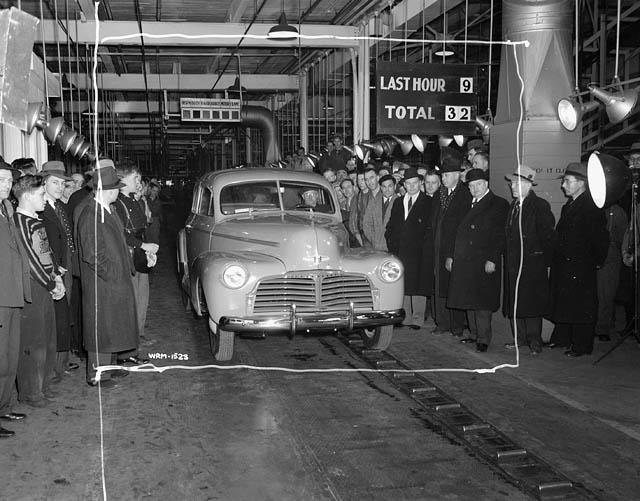
A black-and-white photograph of an automobile coming off the factory production line. There are groups of men on either side of the vehicle.

Last civilian passenger car built at the General Motors plant, Oshawa, Ontario [e000760672]

Domestic automobile manufacturing companies could not compete with the American companies and were eventually bought out, or went bankrupt. However, the Canadian subsidiaries of American companies flourished, and by 1923 Canada became the second largest producer and exporter of automobiles and parts.

A colour photograph of two men guiding the frame of a red station wagon onto a moving production line.

Lowering car onto production line tracks, Ford Motor Company of Canada [e010975565]

Today Canada continues to be a major producer and global exporter of automobiles and parts. The industry is the largest manufacturing sector in the country.
Visit the Flickr album now!