The invention of basketball and the Canadian participants in the first ever basketball game

By Normand Laplante

December 21, 2016 marks the 125th anniversary of the invention of basketball by Canadian James Naismith and of the first game ever played. In the fall of 1891, Naismith was studying to become a YMCA physical education instructor at the International YMCA Training Institute in Springfield, Massachusetts. He was given the task of finding a suitable indoor recreational sport for a physical education class for men aspiring to become executive YMCA secretaries. This group of “incorrigibles” had shown little interest in undertaking traditional calisthenics and gymnastics exercises and their reluctance had led the two previous physical instructors assigned to the group to quit. Naismith first attempted to have the class play modified indoor versions of football, soccer and even the Canadian game of lacrosse. However, these initiatives proved unsuccessful, largely due to the physical restraints imposed by a small gymnasium. Naismith then came up with the idea of a new sport, based on a children’s game Duck on the rock, where two teams would battle each other to throw a ball into the opposing team’s basket to score points. On December 21, 1891, Naismith presented his 13 rules for the new game to the class and separated the group into two teams of nine players. While the final score of the game was only 1-0, the new sport proved to be a big hit with the players.

A black-and-white photograph with a list of all the players pictured, as well as those missing from the photograph who were part of the first team.

Members of the world’s first basketball team, Springfield, Massachusetts, 1891 (c038009-v8)

The participants in the first game included four Canadians who, like Naismith, were studying at the International YMCA Training Institute in Springfield: Lyman W. Archibald, Finlay G. MacDonald and John George Thompson, from Nova Scotia, and Thomas Duncan Patton, from Montreal. As graduate trainees of the Institute returning to their new duties in Canada, some members of the “First Team” were
instrumental in spreading the new sport through the YMCA network in different regions of Canada.
Detail from a black-and-white photograph of the first basketball team.

Lyman W. Archibald, Springfield, Massachusetts, 1891 (c038009-v8)

Originally from Truro, Nova Scotia, Lyman W. Archibald (1868-1947) became general secretary and physical director of the St. Stephen, New Brunswick, YMCA in 1892 and organized one of the first basketball games played in Canada in the fall of 1892 in this town on the Canada-US border. In 1893, Archibald moved on to Hamilton, Ontario where, as a YMCA physical instructor, he brought the sport to that region.

Update (January 2024): While the St. Stephen court is the oldest surviving basketball court in the world, new research reveals that it is highly probable Ottawa is the birthplace of the sport in Canada, since it was the first place on record to organize a game of basketball. As described in The Ottawa Journal newspaper, the first recorded game took place at the Ottawa YMCA on Monday, October 3, 1892, when the facility reopened for the winter. This was less than 10 months after the first ever basketball game played at Springfield College under Dr. Naismith.
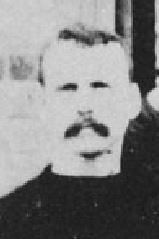
Detail from the black-and-white photograph of the first basketball team.

John G. Thompson, Springfield, Massachusetts, 1891 (c038009-v8)

After graduating from the YMCA Training Institute in 1895, John G. Thompson (1859-1933), from Merigomish, Nova Scotia, returned to his home province and, in 1895, was appointed physical education director at the new YMCA building in New Glasgow, where he introduced basketball to the Pictou County region.
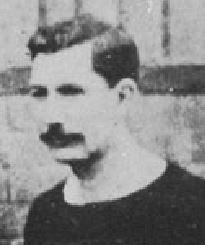
Detail from the black-and-white photograph of the first basketball team.

T. Duncan Patton, Springfield, Massachusetts, 1891 (c038009-v8)

T. Duncan Patton (1865-1944), originally from Montreal, was one of the two team captains selected by Naismith for the first game. He is said to have introduced the sport to India as a YMCA missionary in 1894. Later on, as YMCA secretary in Winnipeg in the early 1900s, Patton influenced the early organizers of the game in that city.

Library and Archives Canada (LAC) holds the D. Hallie Lowry collection which includes photographs of Naismith and of participants of the first basketball game in Springfield. The National Council of Young Men’s Christian Associations of Canada fonds includes a copy of James Naismith’s 1941 book, Basketball: Its Origins and Development, autographed by some of the members of the first basketball team, including Canadians T. Duncan Patton and Lyman W. Archibald; and Patton’s personal published account of the origins of the sport, Basketball: How and When Introduced, written before 1939. LAC’s collection also has photographs of early basketball teams which provide visual documentation of the development of the sport in Canada.

A black-and-white photograph showing four young men posing around a basketball.

An early photograph of a Canadian basketball team which included Norman Bethune (second from the bottom) with Clark, Lewis and McNeil, members of the Owen Sound Collegiate Institute basketball team, ca 1905 (a160721)

Related Links


Normand Laplante is a senior archivist in the Society and Culture Division of the Private Archives Branch at Library and Archives Canada.

Update (January 2024): Leo Doyle is the founder of the Ottawa Basketball Network, a not-for-profit organization that advocates for improved growth and equitable access to the game of basketball.

Images for Mining and Miners now on Flickr

Mining is one of Canada’s primary industries, involving the extraction and processing of valuable ores. The country produces a wide range of minerals, including gold, silver, aluminum and many more. The industry and its workers have played a critical role in Canada’s industrial and social development. Over time, the mining industry has experienced a variety of advancements, challenges and even opposition related to its environmental effects. However, Canada remains one of the world’s foremost mining countries, a leader in mining-related exploration, expertise and finance.

Images digitized through the Documentary Heritage Communities Program

This album features examples of images that have been digitized by external heritage communities and that have received funding for digitization and access projects.

The Documentary and Heritage Communities Program (DHCP) ensures that Canada’s continuing memory is documented and accessible to current and future generations by adopting a collaborative approach with local documentary heritage communities. The program is delivered in the form of contributions that support the development of Canada’s local archival and library communities by increasing their capacity to preserve, provide access to and promote local documentary heritage. Additionally, the Program provides opportunities for local documentary heritage communities to evolve and remain sustainable and strategic.

The DHCP provides financial assistance to the Canadian documentary heritage community for activities that:

  • increase access to, and awareness of Canada’s local documentary heritage institutions and their holdings; and
  • increase the capacity of local documentary heritage institutions to better sustain and preserve Canada’s documentary heritage.

How much does your collection weigh? – Part two

By Lisa Hennessey

In 2011, construction of Library and Archives Canada’s (LAC) new Nitrate Film Preservation Facility (NFPF) was complete. This building was constructed following the National Fire Protection Association’s Standard for the Storage and Handling of Cellulose Nitrate Film (NFPA 40) and, as such, LAC had to follow certain rules. One of these rules limits the total amount of nitrate film that can be housed in each fire-resistant storage compartment to 305 metres (1,000 feet).

The NFPA 40 guidelines speak in terms of length of film and were clearly written for motion picture film, this format being easily measured in metres or feet. Dealing in length of material is harder, however, when planning for the storage of nearly 600,000 still photographic negatives of various formats stored across 1,600 containers. How much is 305 metres when you are talking about a container full of 4×5 negatives? Instead, LAC decided to deal in weight. It was estimated that 305 metres of motion picture film represents approximately 4.5 kilograms (10 pounds) of nitrate. This would be our new maximum amount per compartment.

For the most part, LAC’s nitrate negatives are housed in paper envelopes (sometimes multiple negatives per envelope) and stored in cardboard containers. To determine the total weight of nitrate film per container the first step was to find out the weight of an empty container. LAC staff weighed an empty sample of each of the various container types found in the collection. We also weighed an empty sample of each size of envelope. Next, a survey team worked through the entire collection weighing each full container and then estimating the number of envelopes of each size inside. Once this was known, it was simply a matter of subtracting the weight of the physical container and the paper envelopes from the total weight, which resulted in a pretty good estimate of how much nitrate was in each container. Any container that was found to have more than 4.5 kilograms of nitrate film was rehoused in two containers.

A colour photograph of a woman wearing nitrile gloves and taking a negative out of an envelope. The table in front of her is full of envelopes and archival boxes.

Rehousing nitrate film in new containers

Continue reading

How to Cite Archival Sources

Citing archival material in an academic paper for school or for publication can be a challenge. A complete set of references must contain all the details about each source used in your research so that each one can be relocated and examined in its descriptive context. That’s not always as straightforward as it sounds, especially with respect to archival material.

The style guide that your professor, editor, or publisher recommends is a good starting place. A number of style guides offer useful information on how to cite archival or manuscript material. Most of the questions we receive about citation styles relate to those followed by the American Psychological Association or APA and the Chicago Manual of Style.

If those guides aren’t helpful, seek advice from a reference librarian at a university library or browse its website for a condensed style guide, available on most university library sites. Local public libraries may also have hard copies or online versions of various style guides, so it’s worth checking their catalogues or speaking to their reference team.

If you still have questions about citing materials from Library and Archives Canada’s collection, consult the web page How to Cite Archival Sources, which has examples of footnotes and citations for several different types of archival material.

Always keep in mind, too, that the main point of a citation is to leave a trail that will lead future researchers back to the source you used in your research. And if you’re unsure about what information to include in your citation, remember that more is better than too little. It’s much easier to sift through too much information than it is to fill in the blanks!

How much does your collection weigh?

By Lisa Hennessey

This may not be a typical question faced by an archive or library, but it was a question Library and Archives Canada (LAC) had to answer back in 2009 when preparing to move its nitrate film collection to a new storage facility.

At first blush, the obvious solution to this question would be to bring in a scale and weigh all the boxes. However, in this particular case LAC needed to calculate only the weight of the nitrate film itself, not the weight of any containers, envelopes, film cans or albums. That was a challenge. How do you weigh a collection without actually weighing it?

LAC’s nitrate collection consists of 5,575 reels of film, dating from as early as 1912, and close to 600,000 still photographic negatives. From the early 1970s on, this material was stored at a facility on the Rockcliffe Air Base in Ottawa, Ontario. Built in the 1940s to house aerial photographic material produced by the Department of National Defence, the Rockcliffe building was showing its age by the late 1990s and a proposal was put forward to build a new storage building for the nitrate film. In 2011, construction on the new Nitrate Film Preservation Facility (NFPF) was completed.

A colour photograph of the entrance of a grey building with a row of yellow flowers in front.

The Nitrate Film Preservation Facility

Continue reading

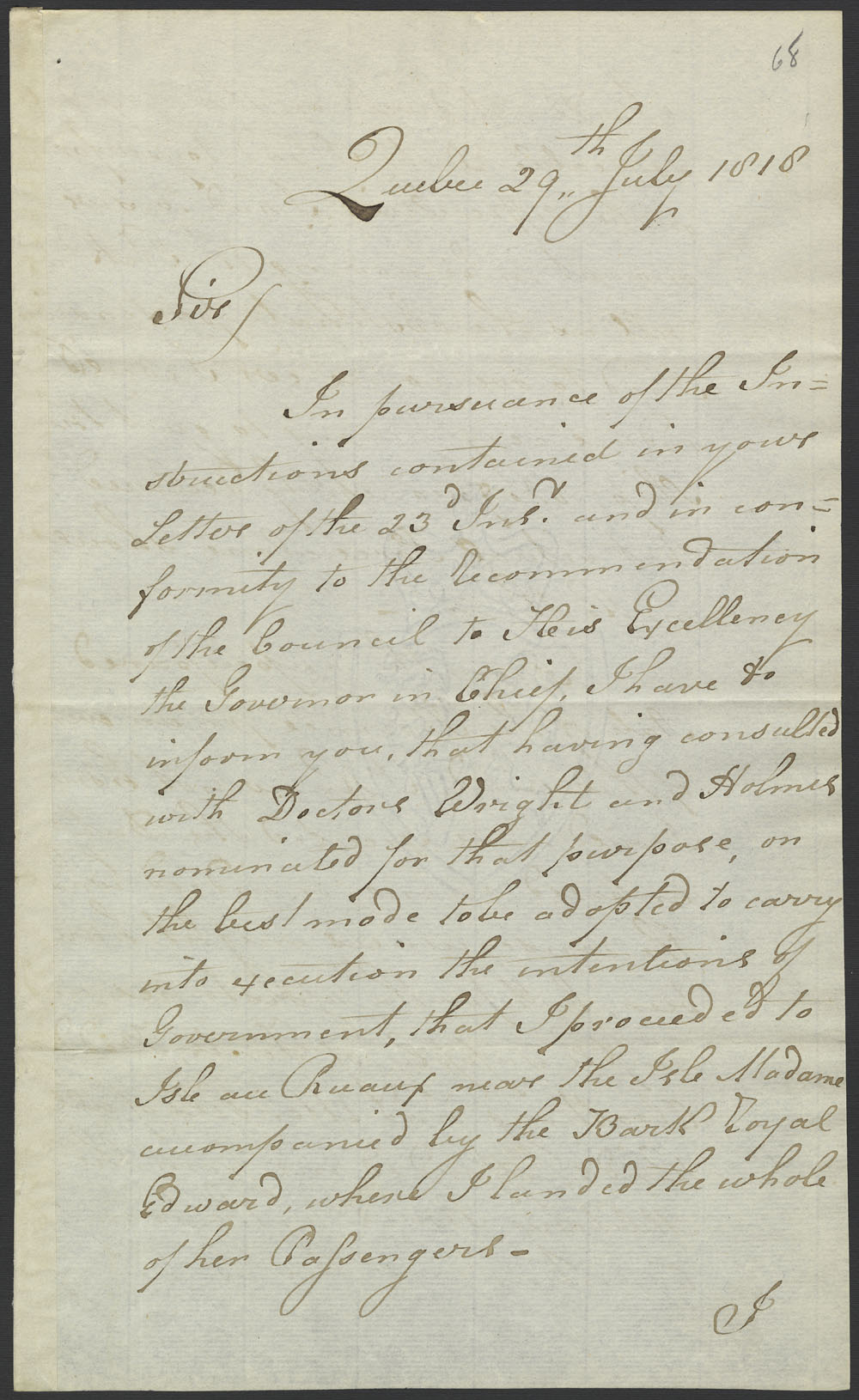
A document of interest: an 1818 letter dealing with the treatment of Irish immigrants suffering from typhoid fever

By Martin Lanthier

In the early 19th century, the arrival of ships carrying sometimes-ill immigrants raised fears that epidemics would spread in Lower Canada. The colony’s elite became aware of the situation and took initiatives to address the problem.

The correspondence of the Civil Secretary to the Governor of Lower Canada (RG4-A1, MIKAN 105377) includes documents that reflect these concerns and that describe incidents faced by physicians at the time. One particular example is a letter from Dr. William Hacket, dated July 29, 1818, in which he describes his efforts to care for Irish settlers suffering from typhoid fever.

The immigrants had arrived at the city of Québec on July 21 aboard the Royal Edward. A number of them were sick and, after a few days, it was decided to treat them. Since no hospital could accommodate such a large number of patients (119), and because conditions on board the vessel were unsanitary, the order was given to quarantine and treat the patients on Île au Ruau [or Île aux Ruaux], near Grosse Île in the St. Lawrence River. Dr. Hacket was put in charge, assisted by two colleagues, Dr. Wright and Dr. Holmes.

In his letter, written six days after the arrival of the passengers on the island, Dr. Hacket first describes his difficulties in convincing them to leave the ship—some declared that they would only be removed by force. He then goes on to say that without the help of soldiers, who set up a camp, he would never have been able to accommodate and treat the patients.

First page of a handwritten letter, black ink on white paper.

Letter from Dr. William Hacket to A.W. Cochrane, Civil Secretary, Québec, July 29, 1818 (RG4-A1, volume 180 MIKAN 126122). e011181012

Continue reading

Transcribing the Coltman Report – Crowdsourcing at Library and Archives Canada

By Beth Greenhorn

In the spring of 2016, Library and Archives Canada (LAC) digitized A General Statement and Report relative to the Disturbances in the Indian Territories of British North America, more commonly known as “the Coltman Report.” Its digitization was in support of the 200th-anniversary events commemorating the Battle of Seven Oaks, organized by the Manitoba Métis Federation in June 2016.

Top half of Page 1 of William Batchelor Coltman’s report concerning the Battle of Seven Oaks. Handwriting in faded black ink on cream coloured paper. The writing begins before and crosses over the red vertical margin line on the left side of the page.

Screenshot of Page 1 of the Coltman Report, 1818 (MIKAN 114974)

Continue reading

Five years of blogging at Library and Archives Canada!

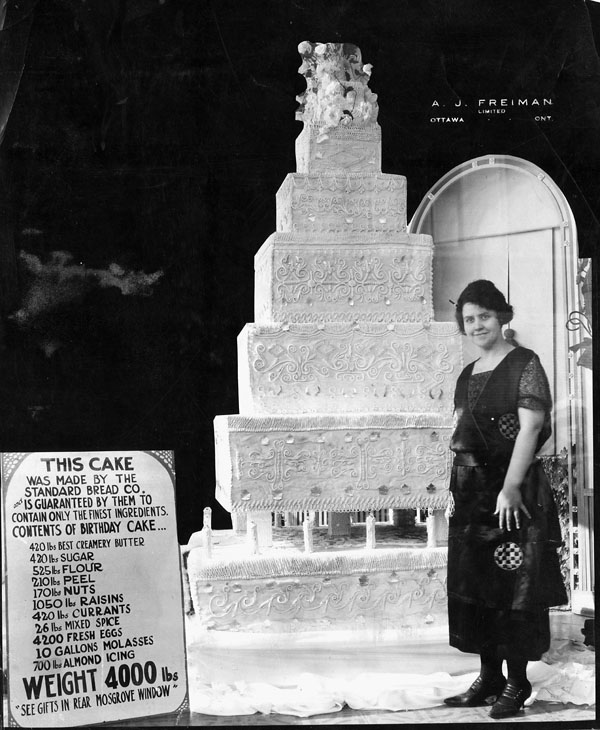
A black-and-white photograph of a giant cake with a young woman standing on one side of the cake and on the other side is a poster with a list of ingredients contained in the cake.

Woman standing next to a 4,000 pound cake made to promote Freimans department store (MIKAN 3615467)

It’s been five years today since we published our first blog, “Published Histories: Discover what individuals or military units did during the war” and since then more than 650 posts have been published.

It is very easy to forget major milestones in a project and yet it is so important to look at the past to realize the progress we have made.

This is the perfect opportunity to thank everyone who made it possible to succeed. We can’t name all who contributed to the success of the blog, but we want to thank everyone who did.

How does an article get published?

Before a blog is posted, there is a lot of collaboration among the different teams throughout the organization. First, the blog has to be written by content experts working at Library and Archives Canada (LAC) and they do it on a completely voluntary basis. Then there’s an initial review and formatting of the text before sending it off to Communications for editing and translation. Once we have final copies in both languages, they are uploaded to WordPress simultaneously.

Our blog highlights our collection and our services. We have a lot of awesome images and documents, but sometimes copyright stands in the way. And even though we double- and triple-check articles prior to publishing, sometimes a mistake gets through or a link is broken—so we appreciate it when our readers let us know.

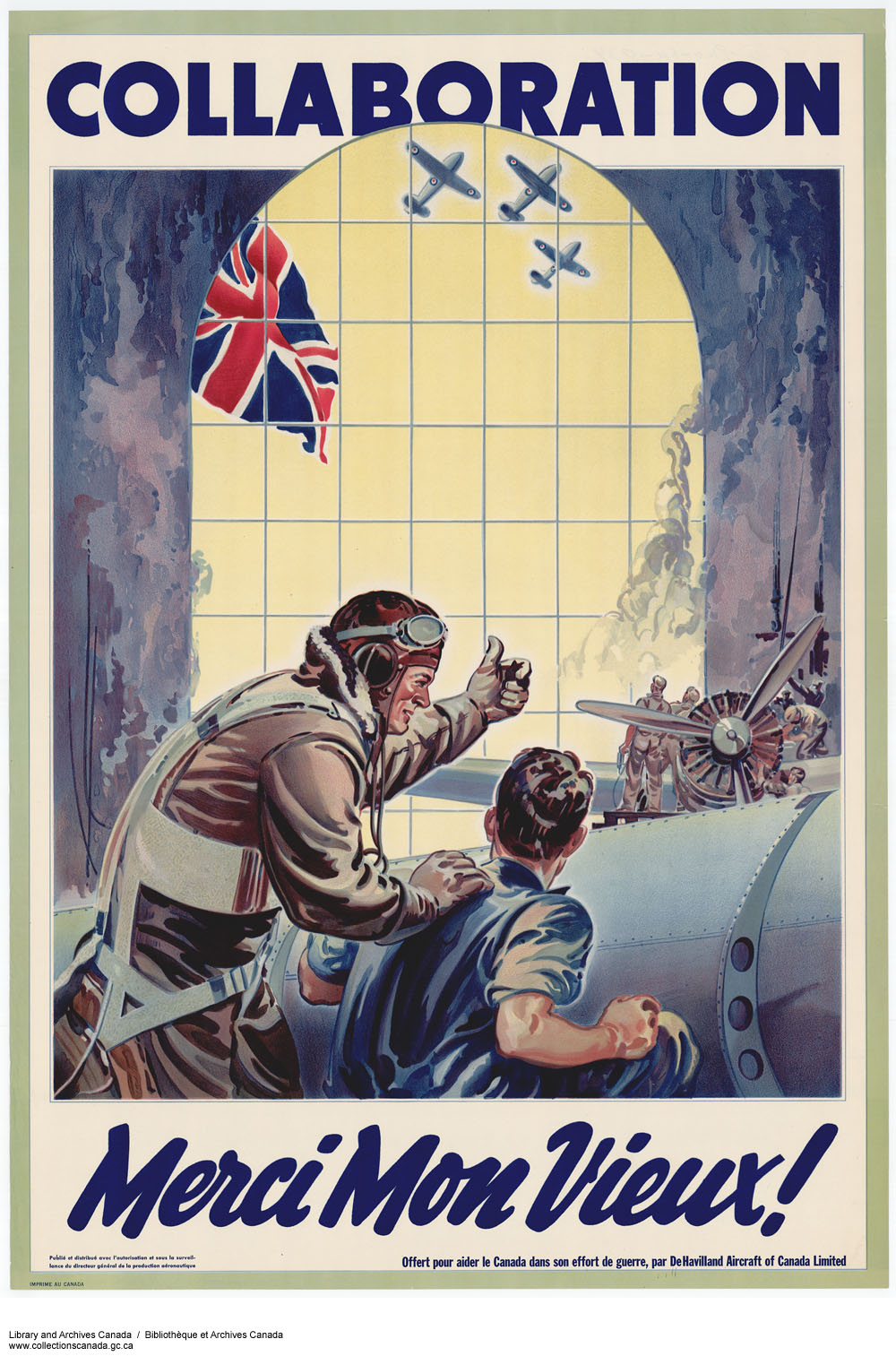
A colour print showing a pilot talking to a mechanic in an airplane hangar. Flying planes and a British flag can be seen through the window. The word “Collaboration” is written at the top of the poster and “Merci Mon Vieux!” is at the bottom.

A poster about Canada’s war effort and production sensitive campaign titled, “Collaboration: Merci Mon Vieux!” (MIKAN 2846765)

What we have written about

In five years, we have touched upon many subjects such as searching the collection, genealogy and family heritage, rare books, immigration, and military heritage. The most popular topics are military heritage for the English blogs, and genealogy for the French blogs. The most popular English blog is The 1940 National Registration File and the most popular French blog is Recherche d’actes de naissance, de mariage et de décès (English version). We will continue to make our collection known with some special projects scheduled for next year such as a series of blogs resulting from a partnership between LAC and The National Archives (UK), another series about Canada 150, and a lot more. Follow us so you won’t miss any of it!

Of course, the blog wouldn’t exist without you—so a big thank you to all our readers! We are happy to share our knowledge so you can learn and discover more about your Canadian heritage.

Now how about a slice of that cake?

Library and Archives Canada releases its latest podcast episode, “Wilfrid Laurier: It’s Complicated”

Library and Archives Canada (LAC) is releasing its latest podcast episode, “Wilfrid Laurier: It’s Complicated.”

Sir Wilfrid Laurier had the largest unbroken term of office as Canada’s seventh prime minister. He was considered one of Canada’s greatest politicians, full of charisma, charm and passion, qualities that served him well in office, and also in his personal life. This passion is seen in many of the letters he wrote to his wife Zoé. But perhaps we gain a deeper insight into his character through his letters to Émilie Lavergne.

In this episode, we traveled to the Perth and District Union Library, in Perth, Ontario. We sat down with Mr. Roy MacSkimming, author of the historical novel, Laurier in Love, to gain some insight into these letters.

Subscribe to our podcast episodes using RSS, iTunes or Google Play, or just tune in at Podcast–Discover Library and Archives Canada: Your History, Your Documentary Heritage.

For more information, please contact us at bac.balados-podcasts.lac@canada.ca.