Curling could be considered the unofficial national sport of Canada. Explore the evolution of the game of Curling; its development as an organized sport; and the creation of a Canadian curling culture.
New Flickr set: Curling in Canada
Reply

Curling could be considered the unofficial national sport of Canada. Explore the evolution of the game of Curling; its development as an organized sport; and the creation of a Canadian curling culture.
Library and Archives Canada (LAC) currently has an exhibition at 395 Wellington Street in Ottawa, which runs until January 22, 2016. Hockey Marching as to War engages viewers in the many stories of hockey players’ involvement in Canada’s First World War effort—from the men who enlisted and served overseas to the women who took up sticks at home.
A particularly fascinating story is the emergence of highly successful military hockey teams. In 1916, Winnipeg’s 61st Battalion won the prestigious Allan Cup—the senior amateur hockey championship—and Montreal’s 87th Battalion was good enough to play an exhibition game against Montreal professionals, including players from the Canadiens.
No military team was more famous than the 228th Battalion, whose history is there for all to see in LAC’s rich collection of government records. Known as the Northern Fusiliers, the 228th mustered in North Bay, Ontario, under the command of Lt.-Col. Archie Earchman, and was so successful recruiting talented hockey players that in the fall of 1916 it was invited to join the National Hockey Association (NHA), the main professional league and forerunner of the National Hockey League.
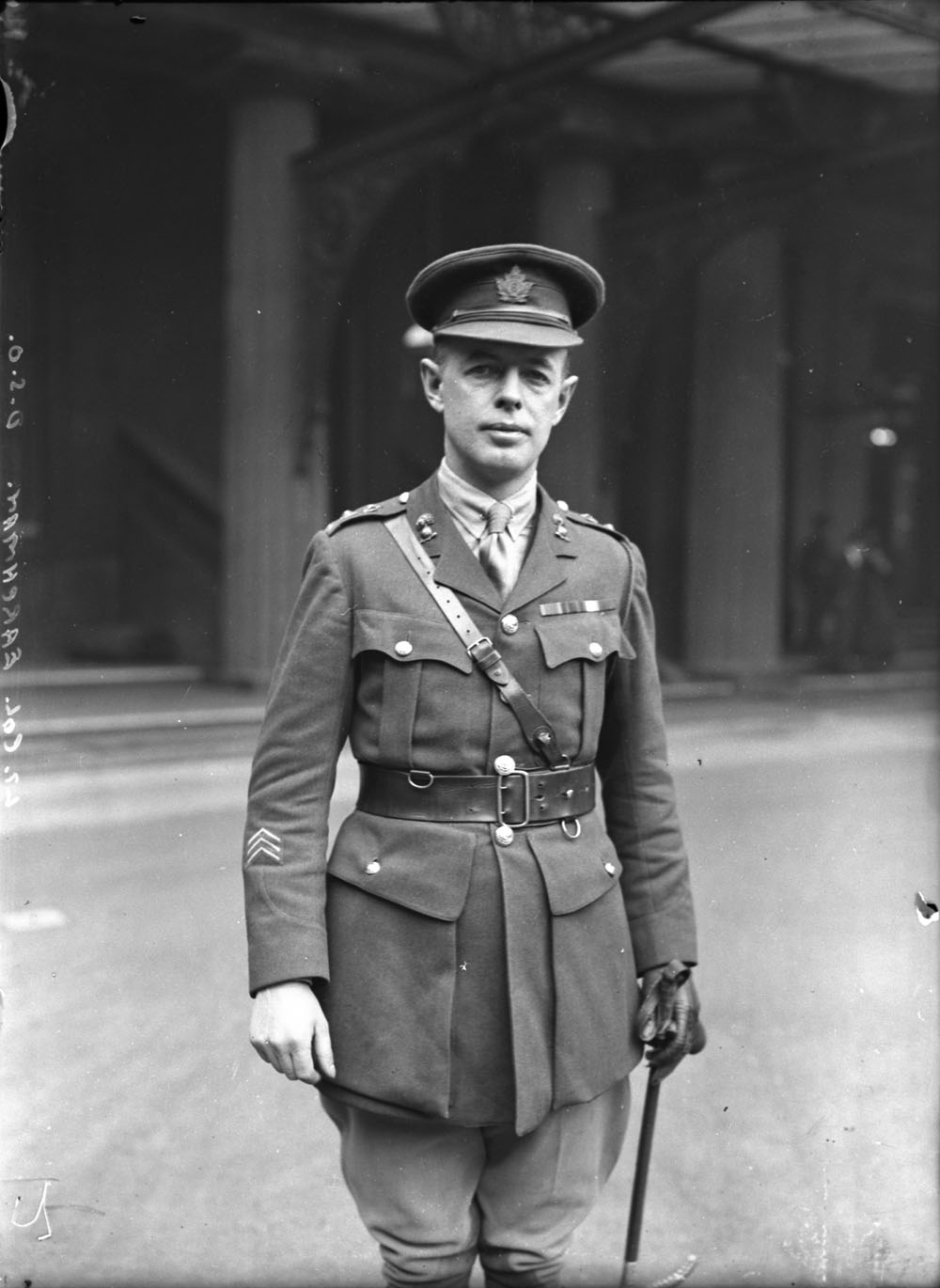
Lieutenant Colonel Earchman, D.S.O., Toronto, Ontario, undated (MIKAN 3215233)
The son of a commercial lithographer, Frederick Horsman Varley was born and raised in the steel town of Sheffield, England. Varley’s talent as an artist was recognized early when, at the age of 11, he was enrolled in the Sheffield School of Art. By the time Varley was 21, he had completed three years of fine arts study at the Académie Royale des Beaux-Arts in Antwerp, Belgium. Before immigrating to Canada in 1912, Varley had worked as a commercial artist in London, England, as well as an art teacher in his home town of Sheffield.

Frederick Horsman Varley, probably at the Vancouver School of Decorative & Applied Arts, ca. 1927 by photographer John Vanderpant (MIKAN 3509585)
This article contains historical language and content that some may consider offensive, such as language used to refer to racial, ethnic and cultural groups. Please see our historical language advisory for more information.
We receive many interesting questions from our clients at the Library and Archives Canada Genealogy desk. Here are the top three questions asked:
First, search the name on one of the indexes available online. Try different spellings and birthdate variations if your initial search is not successful.
If that doesn’t work, there are other documents that indicate the year of immigration. Try census returns or the 1940 National Registration File. If you know the city where your ancestor settled, you may be able to narrow down the year of immigration by seeing when they appear in a city directory.
You can also try searching for other family members that came to Canada with him. Maybe the passenger list entry of his wife, “Esmerelda Jenkins”, might be easier to find than “John Jenkins” (names are for example only).
Complete your family tree. Don’t focus too much on finding the Indigenous link at this point. Pay close attention to information given on the census returns, especially the 1901 census.
All census returns will indicate the location where your ancestor resided, such as the town, village, major city or federal Indian reserve. Some census returns list ethnic origin, such as French, Irish, Indian, “Half-Breed”, “Scotch-Breed”, Algonquin or Mohawk. They can also list colour (“W” for White and “R” for “Red”) and first language/mother tongue, which may help your search.
Many of these terms are now considered offensive and are no longer in use today. Do not fixate on or limit yourself to modern terminology—your ancestor may have been identified under any number of labels depending on the period, location and circumstances.
Your first step in finding out details about your grandfather’s war experience is to apply to the Personnel Records Department for information from his file by filling out our Application for Military Service Information form. After you receive the available information from his Second World War service file, you can continue your research at regimental museums and by reading published regimental histories (some of which may be available in our library collection).
If you have a question that you would like to ask us, please drop by the Genealogy desk at 395 Wellington Street, in Ottawa or email us using our Genealogy Assistance Request form.
Throughout the late 19th and early 20th centuries, lighthouses were an integral part of life in Atlantic Canada, which was home to over 135 of them. It was the responsibility of the lightkeeper to keep the light burning no matter what, a commitment that often involved his entire family. Library and Archives Canada holds records of many lighthouses from Atlantic Canada.
A lighthouse of particular interest is the Cape Bear lighthouse on Prince Edward Island. Next door to the lighthouse is the Marconi wireless station, which received one of the first distress signals sent from the Titanic.
But who were the lightkeepers who kept the lights burning?
For over 75 years, Vancouver’s Shaughnessy Hospital served veterans and civilians of British Columbia, providing medical care and rehabilitation services, and becoming a research and teaching centre. Library and Archives Canada’s photos and other records of the hospital document this evolving role, with images including patient care and rehabilitation, buildings and equipment, and staff and volunteers.
The hospital opened in 1917 as a convalescent home for First World War veterans. By 1919 it had increased its capacity for medical services and patient care to become a military hospital.

Original staff of Shaughnessy Military Hospital – [1919?], copied 1952 (e011156698-v8)
As immigration and settlement expanded across Canada, a variety of travel means were adopted from Aboriginal people’s communities. Many of these methods, like the canoe, are still used today for work and leisure activities.
At the end of October 1881, the Government of Canada appointed architect Thomas Fuller (1823–1898) to the job of Chief Architect in the Department of Public Works. Fuller—already celebrated for his design work for Ottawa’s Parliament Buildings—would continue in this job until his retirement in 1897. During his sixteen-year tenure, he was responsible for the design and construction of numerous public buildings across the country, including some 80 post office buildings. Fuller designed post offices that were landmarks, and as such helped to foster a federal architectural image (or “Dominion Image”) that was instantly recognizable to ordinary citizens.
Fuller’s post offices were of a unique character, and yet each had a family resemblance. They were usually two-and-half storeys high, rectangular in shape, and had a one-storey rear extension. They also had high gables located at the centre of the street-facing facade as well as a distinctive combination of French Renaissance and High Gothic architectural details.
Fuller also took advantage of site location. His post offices were located at a town or city’s important intersection or at the end of a main street. Fuller used a distinctive picturesque formula—on some buildings he added a tower, on others he might have added a side projection or a corner entrance, a side elevation that duplicated the gable of the main facade, or even a central clock tower. Continue reading
Library and Archives Canada is in the process of extracting from outdated storage devices, and then preserving, the datasets of studies undertaken by federal departments. The studies covering a wide range of topics, such as the environment, health and immigration, are being made available on the Open Data portal. To learn more about the structure of the data see our blog Open Data: Providing access to historical Government of Canada studies.
Here is a summary of the datasets we have made available over the past few months. Curious about what these studies discovered? Check them out on the Open Data portal
By Dalton Campbell
On December 25, 1927, a Fairchild aircraft flew along the north shore of the St. Lawrence from La Malbaie to Sept-Îles, Quebec. As the plane approached each town, the pilot lowered the altitude of the aircraft and threw out a packet of mail attached to a parachute. The postmaster retrieved the parachute and mail as the pilot flew to the next town.
This was the first official Post Office air mail delivery for the communities along the north shore of Quebec. In the winter, these communities—like many others throughout Canada—had been isolated with irregular mail delivery arriving after slow transport by boat or dogsled.
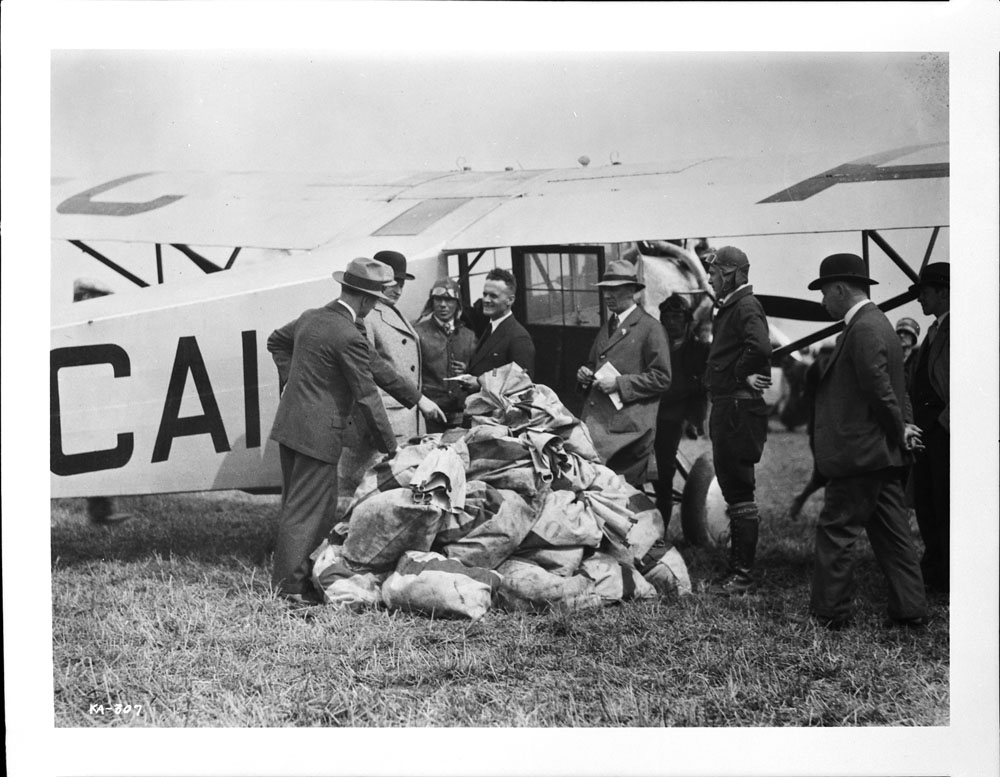
Reknowned pilot Roméo Vachon at the doors of the Fairchild FC-2W aircraft of Canadian Transcontinental Airways Ltd. inaugurating airmail service between Montreal and Rimouski, Quebec, May 5, 1928. The mail was transferred from transatlantic ships at Rimouski and flown to Montreal and then to Toronto, saving 24 hours in delivery. (MIKAN 3390347)
 Library and Archives Canada Blog