1915: Would you follow this example?

The recruiting posters below are part of a remarkable collection of more than 4,000 posters from many combatant nations, acquired under the guidance of Dominion Archivist Dr. Arthur Doughty as part of a larger effort to document the First World War.
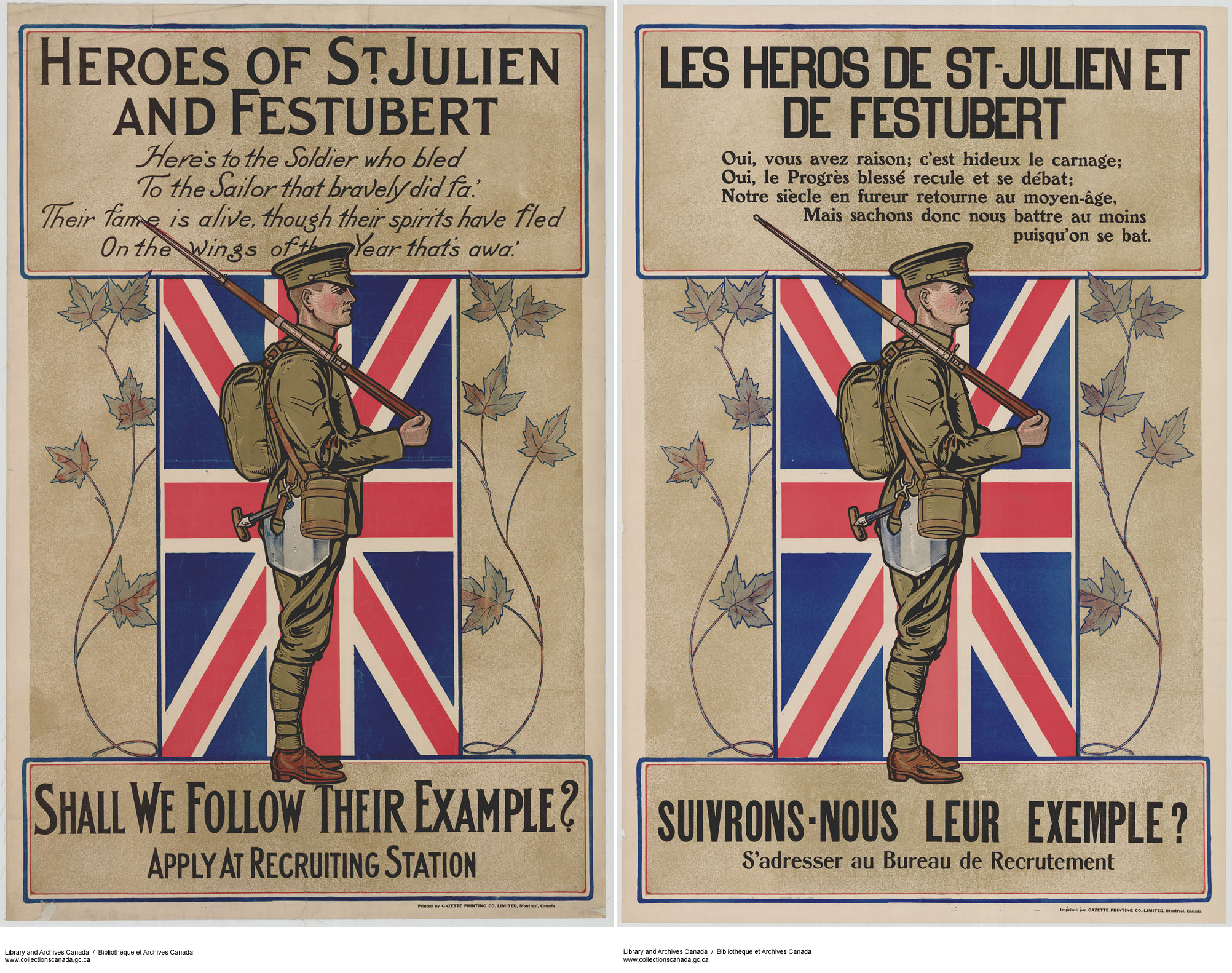
Image of two posters side by side, one in English and one in French. The imagery shows a soldier standing sideways, in front of the Union Jack, with a rifle balanced on his shoulder. He is wearing the uniform and equipment of the 1915 Canadian soldier: Ross rifle, pack, cap, puttees, and MacAdam shield-shovel (also known as the Hughes shovel).

An English and French version of a poster using the same imagery, but with text conveying very different motivations. (MIKAN 3667198 and MIKAN 3635530)

As the deadly stalemate on the Western Front continued through 1915, warring nations were forced to organize recruitment drives to raise new divisions of men for the fighting. The two battles referenced in the poster were certainly not great victories for the Canadian Expeditionary Force, which had only recently commenced military operations. The desperate defence at St. Julien, an action during the Second Battle of Ypres, along with the inconclusive May 1915 Battle of Festubert, were all that authorities had to draw upon to raise fresh troops for service overseas.

The sentimental verse and patriotic imagery was conventional for this type of poster. It would appeal to Canadians with strong ties to Britain, but would offer little encouragement to French Canadians, First Nations’ communities, or to other groups to sign up. One interesting element is that the text is not a simple translation: in English the theme is heroic sacrifice, whereas in French it is about ending the carnage and restoring “progress.”

These posters offer a realistic depiction of a soldier early on in the war. This lance-corporal is armed with the Ross rifle, whose serious defects have featured in Canadian histories of the First World War. He is wearing short ankle boots and puttees (long lengths of cloth wrapped around his calves), which were cheaper to manufacture than knee-length boots but offered less protection from cold or wet. Steel helmets had not yet been developed, leaving his head and upper body vulnerable to any flying debris or shrapnel.

He is also burdened by the MacAdam shield-shovel (hanging at his hip). This invention was the result of a collaboration between Minister of Militia Sir Sam Hughes, and his secretary, Ena MacAdam. It attempted to combine a personal shield with a shovel. The shovel blade had a sight hole in it that was supposed to allow a soldier lying on the ground to aim and fire his rifle through the hole while shielded behind its protection. However, the shovel was too heavy and dirt would pour through the hole. Also, the shield was too thin to stop German bullets! Thankfully, this failed multi-tool quietly disappeared from the standard equipment issued before the First Division crossed from England to France. This poster is an important artifact of its time. It shows that in 1915, Canadians soldiers fighting overseas still had a very long road ahead of them.
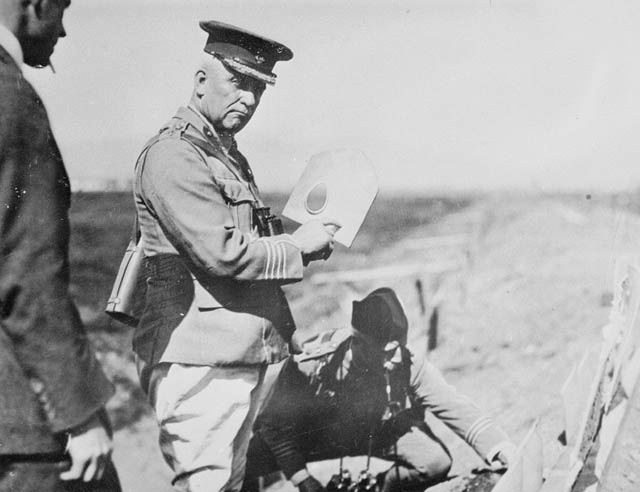
Black-and-white photograph showing three men, two are clearly in uniform. One officer (Minister of Militia Sam Hughes) is holding the MacAdam shield-shovel which is a spade-shaped piece of metal with a hole on one side, while the other officer is kneeling on the ground doing something indiscernible. The third is looking at the spade.

Sam Hughes holding the McAdam shield-shovel (MIKAN 3195178)
Related resources

Release of an updated version of the Immigrants from China database

May is Asian Heritage Month in Canada, during which we acknowledge the long and rich history of Asian Canadians and their contributions to Canada. Asian Heritage Month also provides an opportunity for Canadians to reflect on and celebrate the contributions of Canadians of Asian heritage to the growth and prosperity of Canada.

To celebrate Asian culture, Library and Archives Canada is pleased to announce the addition of more than 35,000 references to its Immigrants from China database. It now includes references to the C.I.9 certificates issued to people of Chinese origin born outside Canada and wanting to leave Canada for a limited time without losing their Canadian status. The actual records include a photograph and provide information such as the individual’s name, age and place of birth, as well as the port and date of departure, and the ship’s name.

Children of Topley Images now on Flickr 

The William Topley collection at Library and Archives Canada is an invaluable resource for those interested in nineteenth-century Canadian photographic portraiture. Comprised of over 150,000 glass plate negatives as well as studio proofs and counter books. While Topley did photograph subject matter other than people, portraits were his chosen specialty and the collection is a wonderful example of early Canadian studio work.

Children were often the subject of these portraits, posing alone or with siblings.

The Children of Topley – Pint-sized portraits from the William Topley collection

The William Topley collection at Library and Archives Canada is an invaluable resource for those interested in nineteenth-century Canadian photographic portraiture. Comprised of over 150,000 glass plate negatives as well as studio proofs and counter books, the Topley collection dates from 1868 to 1923, and illustrates the prolific career of Topley, a Montreal-area native, who began his solo career by opening a branch of the William Notman studio on Ottawa’s Wellington Street. While Topley did photograph subject matter other than people, portraits were his chosen specialty and the collection is a wonderful example of early Canadian studio work.

By the early 1870s Topley had purchased the studio he had been managing for William Notman, and was attracting upwards of 2,300 sitters per year. Topley’s prestigious downtown Ottawa location—he moved multiple times over the years, but always within walking distance to parliament—meant he attracted much of the city’s elite, including politicians and other important figures, who made their way to the photographer’s studio to have their portraits taken.

Children were often the subject of these portraits, posing alone or with siblings. In looking through these images we notice not only recognizable names, identifying some of these children as the offspring of the capital city’s movers and shakers, but something unchanged despite the time period. We see beyond the formality, the constricting clothing and stiff poses, and recognize that these portraits are not too different from those we might take today. We recognize children dressed up for a photo, attempting to sit still, looking either overly eager or slightly bored.

Black-and-white photograph of a young girl in a white dress.

Missie McLaren, 1873 (MIKAN 3461050)

Studio photographers of this era often had clients pose with props, and Topley was no different. In his portraits of children we notice items like books, skipping ropes, dolls or pets clutched in the hands of the small sitters. Some children stand or sit up very straight with serious, concentrated expressions on their faces, while others lounge tiredly in chairs. In these ones especially, we can imagine how tedious the long exposures must have felt to a child, how many plates the photographer might have had to take to get a proper, non-blurry image.

Black-and-white photograph of a young girl with her chin resting on her hands, a book beside her.

Missie Cambie, 1877 (MIKAN 3435180)

Also interesting are the portraits of babies with hidden, or barely-in-the-frame mothers. It was quite common at the time for babies to sit on their mothers’ laps for a portrait, while a blanket or other fabric was thrown over the mother so that only the baby would be the focus. In several of Topley’s portraits of babies, we see a more subtle approach, with the mother encouraging the child from the edge of the frame. The photographer would later crop the mother out for the final print.

Black-and-white photograph of a young child with the mother to the right, partially blacked out.

Missie Ruttan, 1876 (MIKAN 3434482)

These wonderful portraits provide an alternative perspective on the face of Canada’s capital in the nineteenth century, and seem to offer a bridge from past to present, where some things never change.

Black-and-white photograph of two young boys in black jackets, one seated and one standing on a chair.

Two boys posing—Master Borthwick, 1882 (MIKAN 3418410)

Black-and-white photograph of a young girl dressed in winter clothing.

Missie Helena Topley, 1882 (MIKAN 3418246)

Related resources:

Did your ancestors come from Norway?

Do you want to know who your first Norwegian ancestor was and when he or she left Norway and arrived in Canada? Are you curious about your Norwegian origins?

If so, our website is a great place to begin your research. Here you will find a page dedicated to genealogical research on the Norwegians. This page provides you with historical information, archival documents and published material from the Library and Archives Canada collection, as well as links to other websites and institutions.

If your ancestor came to Canada between 1865 and 1935, you might find his or her name on the passenger lists.

Stabilizing the new books added to the Rare Book Collection

A collection of pre-1800 books were recently transferred to Library and Archives Canada’s Rare Books Collection. A census of the collection revealed that the majority of the books had various levels of leather deterioration. In some cases, the leather was cracked and flaking, and in other, more extreme cases, the leather was powdering and crumbling. This is an inherent and common issue seen in manufactured skins from this period. Leather deterioration takes place by two processes: Reaction of tannins used in leather manufacture to environmental pollutants (hydrolysis) and exposure of leather to light, heat and oxygen (oxidation). Both hydrolysis and oxidation result in the gradual disintegration of the leather fibre network and weaken its structural integrity. The by-product of leather disintegration is an acidic powder, often orange or red in colour. Not only does this deterioration cause an immediate threat to the individual book structure, but it also threatens the rest of the collection through the contamination of leather dust and particulate. In many cases, the leather leaves visible residue on surfaces and surrounding books. For these reasons, the conservators at Library and Archives Canada (LAC) developed and carried out a remedial treatment to stabilize the leather.

A colour photograph showing several books on a table. The book in the foreground has extremely deteriorated leather and the spine has separated from the front cover.

Deteriorated leather: The first step in the process was to assess the level of deterioration and carry out an initial surface cleaning of the books to remove as much leather dust as possible. This was carried out in the rare books vault, on all 500 books, using a gentle vacuum and small brush.

The most effective method of stabilizing deteriorated leather is through the use of a surface consolidant. A consolidant is a solution which is applied directly to the leather to seal the surface. Although it can’t stop or reverse the chemical instability in degraded leather, it creates a barrier that protects the leather from airborne pollutants and reduces the flaking and powdering. Handling affected leather books after surface consolidation is a much cleaner experience as well.

Testing

A series of tests were performed to determine the sensitivity of the leather to water and solvents. Based on these findings, we were able to reach a conclusion on the most suitable consolidant recipe to use.

Colour photograph showing a piece of paper that has been marked out into squares with leather samples in each square. Each square shows the pre- and post-shrink test samples.

The testing carried out was called Shrink Temperature Test, where small samples of leather removed from the books were heated in water until a reaction occurred. The lower the reaction temperature the less stable the leather. The tests concluded that some leathers were quite unstable and that they could be easily damaged by the application of consolidants containing water and solvents.

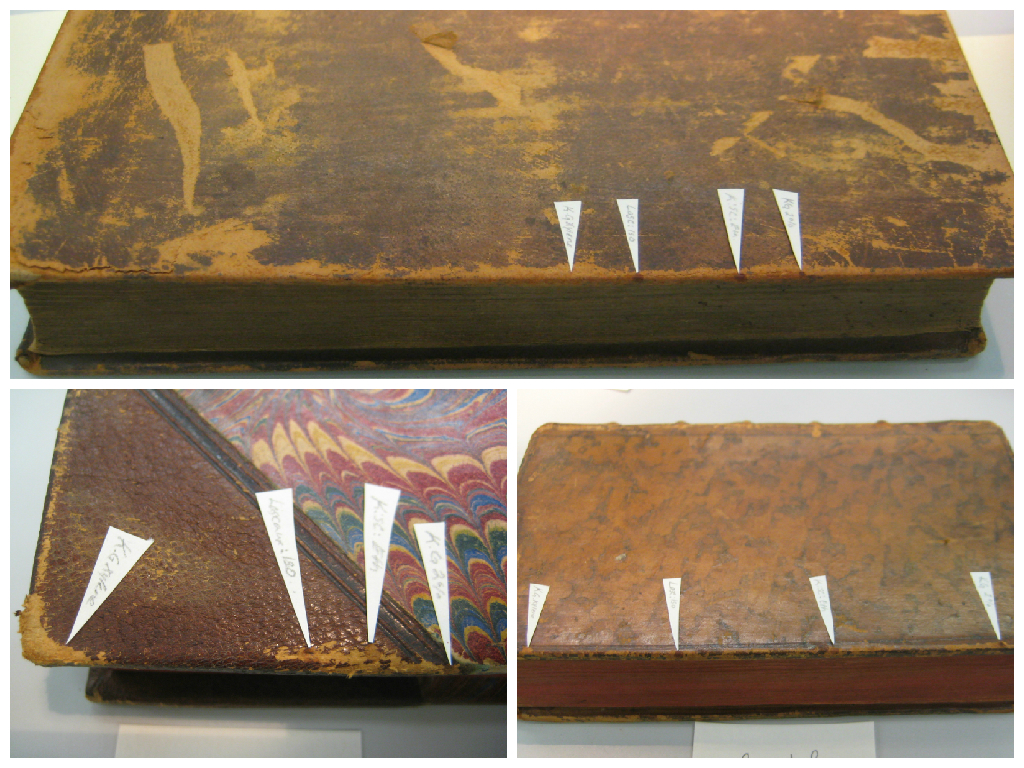
A collage of three colour photographs each showing a book with little white flags on it. The flags are located in the areas that were spot tested with the consolidants.

Spot testing: Four consolidant recipes were made up and tested on three volumes representing the identified species of leather found in the pre-1800 books, that of goat, sheep, and calf. The test relied on visual examination to determine the likelihood of discolouration by staining or residue deposit by the various surface consolidants.

The tests conclusively revealed that one particular consolidant exhibited no visible signs of staining or residue on the leather; Hydroxypropylcellulose dissolved in one solvent, then diluted in another. It was decided to use this recipe to treat the collection.

A colour photograph showing a woman holding a book in her gloved hands applying the consolidant with a fine brush under a fume hood.

Applying the consolidant under a fume hood.

The consolidant was applied to localized areas using a small brush. The treatment was carried out in a fume hood, due to the solvents used in the consolidant recipe. The books were then left to off-gas for 24 hours in the fume hood before being returned to permanent storage.

Now that the leather surface of the book has been stabilized, we can determine, with the help of the census information, what other, if any, treatments are necessary to make these books more resilient and available for future generations to access.

Self-portraits by women artists in Library and Archives Canada’s collection

Until the beginning of the last century, official self-portraits by women artists were rare, compared to those created by men. This was, in large part, because few women worked and were recognized as professional artists during the early periods. But it is also because many self-representations created by women were in non-traditional formats—hidden within amateur sketchbooks, or private diaries… even stitched or sewn.

A few of Library and Archives Canada’s (LAC) most interesting sketched and painted examples are currently on display as part of The Artist Herself: Self-Portraits by Canadian Historical Women Artists, a new exhibition co-curated by Alicia Boutilier of the Agnes Etherington Art Centre and Tobi Bruce of the Art Gallery of Hamilton.

The exhibition deliberately expands the traditional definition of ‘self-portrait’; most of the works it showcases would not have been considered self-portraits at the time they were created.

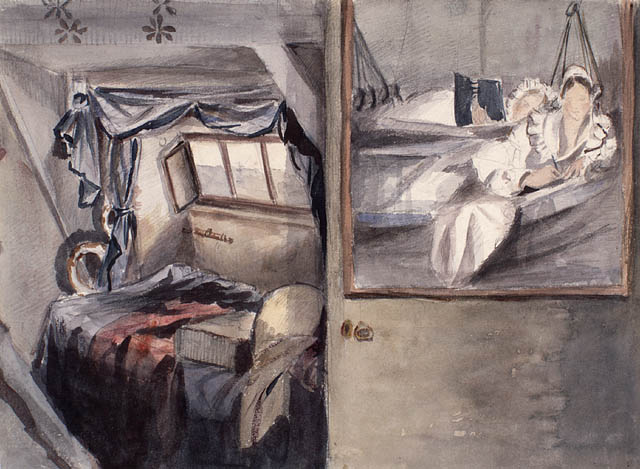
It includes this page from the private sketchbook of Katherine Jane (Janie) Ellice (1813–1864), an accomplished amateur artist and wife of an official with the North West (fur trading) Company. Ellice used the reflection from a mirror on the wall of her ship’s cabin to capture a quick, and very private, image of herself aboard ship.

Watercolour sketch shows the artist and her sister, dressed in nightwear, reclining in a bunk of their ship’s cabin.

Mrs. Ellice and Miss Balfour reflected in the looking glass of their cabin on board the H.M.S. Hastings (MIKAN 2836908)

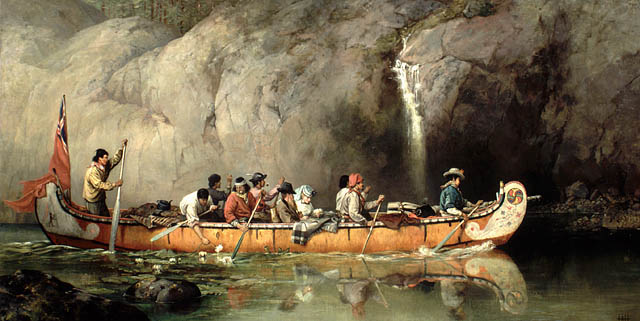
It also includes Canoe Manned by Voyageurs Passing a Waterfall, by Frances Anne Hopkins (1838–1919), another ‘fur-trade wife’—but one who would develop something of a professional artist career. Hopkins’ enormous voyageur-themed canvases often include representations of herself that seem almost incidental. It’s believed that she appears, in this painting, as a passenger in the canoe:

Painting shows a group of fur trade workers steering a Hudson’s Bay Company canoe past a small waterfall; the artist and her husband may be passengers seated in the middle of the canoe.

Canoe manned by voyageurs passing a waterfall (MIKAN 2894475)

These are only a few examples, from LAC’s collection, of historical self-portraits made by women. It’s worth noting that the collection also includes many others, both historical—and modern.

The Artist in her Museum was created by contemporary Métis artist Rosalie Favell in 2005.

Colour digital print shows the artist, full-length, and flanked by a mammoth, a beaver, and an artist’s palette. She draws aside a red curtain to reveal a gallery of mounted black-and-white photographs.

The Artist in her Museum, 2005. © Rosalie Favell (MIKAN 3930728)

Favell used digital technology to manipulate an iconic American self-portrait from the 19th century. By putting her own image in place of the original sitter, Favell appropriated a classic work, assigning new meanings within an older convention.

Modern self-portraits, like Favell’s, compare intriguingly with the historical self-representations showcased in The Artist Herself. Today’s more relaxed and expanded definitions of portraiture allow contemporary artists to successfully play within the genre. They also allows us to look back, with fresh eyes, on the self-representations created by women in the past.

Visit the exhibition in Kingston between May 2 and August 9, 2015. Stay tuned for further dates as the exhibition tours nationally, before closing in Hamilton during the summer of 2016.

100th anniversary of the composition of the iconic poem “In Flanders Fields”

John McCrae’s “In Flanders Fields” is one of the best-known literary works to emerge from the First World War. The poem’s most lasting legacy is its popularization of the poppy as a symbol of remembrance for those killed in war.

McCrae is thought to have written the poem during the second week of the Second Battle of Ypres while he was stationed at what later became the Essex Farm Advanced Dressing Station, just north of the town of Ypres. McCrae, a Major and military doctor, was second-in-command of the 1st Brigade Canadian Field Artillery. The exact circumstances in which the poem was written, however, remain the stuff of legend. The most cited stories of the poem’s origin centre on McCrae’s grief over the death of his friend, Lieutenant Alexis Helmer, an officer of the 1st Brigade Canadian Field Artillery who was killed by a direct hit from a German shell on the morning of May 2. One account says that McCrae was so distraught after his friend’s funeral (for which McCrae, himself, said the committal service in the absence of a chaplain) that he composed the poem in just 20 minutes as a means of calming himself down. Another story has it that McCrae was seen writing his poem the next day, May 3, sitting on the rear step of an ambulance while looking at Helmer’s grave and the poppies that had sprung up near the dressing station. His commanding officer, Lieutenant-Colonel Morrison, tells a third story: that McCrae drafted his poem while passing time between the arrivals of wounded soldiers. Adding to the mystery is the fact that the Imperial War Museum in England has a tracing of an original holograph of the poem, written by McCrae for Captain Tyndale-Lea, which claims that McCrae wrote the poem on April 29, 1915, three days before Lieutenant Helmer’s death.

The handwritten poem on yellowed paper in very faded ink.

A copy of “In Flanders Fields” written in John McCrae’s hand. Morrison was a friend and the commanding officer of the poet as well as a physician, December 8, 1915 (MIKAN 179238)

How the poem was submitted for publication is also a matter of speculation. By one account, McCrae threw the poem away but it was recovered by another soldier and sent to a London newspaper. Possibly McCrae himself submitted it, as he made a number of handwritten copies to give to friends shortly after drafting it. The poem was printed by Punch magazine on December 8, 1915. Within months it became the most popular poem of the war.

While no institution is known to have John McCrae’s original first draft of the poem, Library and Archives Canada (LAC) has two manuscript versions of it, both written and signed by McCrae. One is dated December 8, 1915 and is part of a collection donated to LAC by Major-General Sir Edward W.B. Morrison, who was McCrae’s friend and fellow officer. The other is typed on paper and is part of a collection of documents donated by James Edward Hervey McDonald, an original member of the Group of Seven painters. LAC also holds an extensive and richly detailed collection of John McCrae’s letters and diaries, spanning much of his life, from childhood to shortly before his death from pneumonia in January 1918.

Black-and-white photograph showing a man in military uniform sitting down on steps with a dog at his side.

Lt.-Col. John McCrae and his dog Bonneau, circa 1914 (MIKAN 3192003)

Additional Resources