Library and Archives Canada Blog

This is the official blog of Library and Archives Canada (LAC).

Library and Archives Canada Blog

“I leave you Éva Gauthier”

Version française

By Isabel Larocque

When Éva Gauthier made her first professional performance at Notre-Dame Cathedral in Ottawa, none could have predicted that the 17-year-old girl would one day rank among the greatest singers in the history of Canada.

Éva Gauthier was born in 1885 in a Francophone neighbourhood in Ottawa; she was the niece of Zoé Lafontaine and her husband Sir Wilfrid Laurier. Éva showed an innate ability for music at a tender age, and her family soon recognized her potential, encouraging her to continue on that path. Aside from taking singing classes with several renowned teachers, Éva also sang as a soloist at Saint Patrick’s Basilica in Ottawa.

She also benefitted from financial support from her uncle, Sir Wilfrid Laurier. As such, at age 17, she was able to go study at the Conservatoire de Paris with one of the most famous teachers of the time, Auguste-Jean Dubulle. A big believer in Éva’s talent, Aunt Zoé brought her to Europe and even played the piano for Éva’s audition at the Conservatoire.
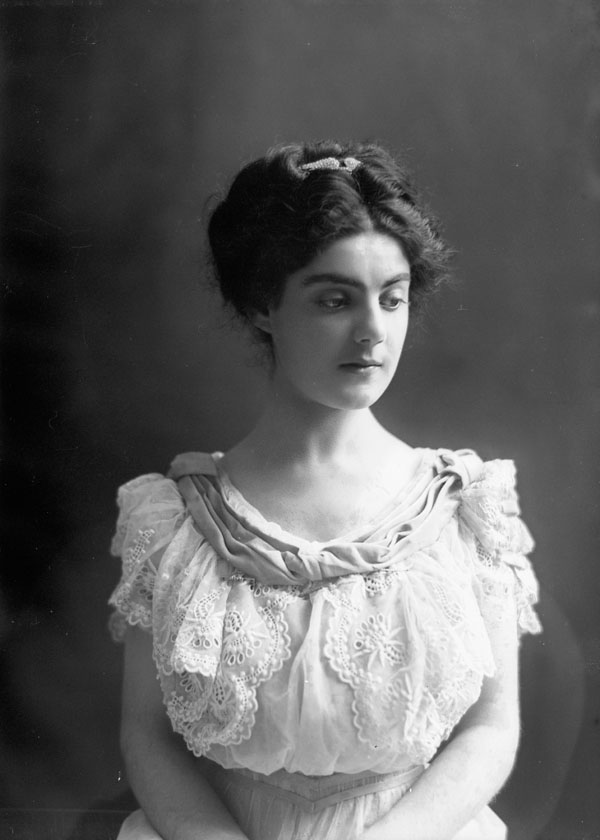
Black-and-white photo of a young woman in a white lace dress, facing the camera.

Éva Gauthier, 1906. Photo: William James Topley. (a193008)

During her studies and early career, Éva Gauthier was lucky enough to rub shoulders with the greatest musicians and teachers of her time. So it wasn’t long before she was noticed. In 1906, the great singer Emma Albani, her mentor, introduced her thus during her farewell tour: “As my artistic legacy to my country, I leave you Éva Gauthier.” With an introduction like that, there was no doubt young Éva’s future was very promising!
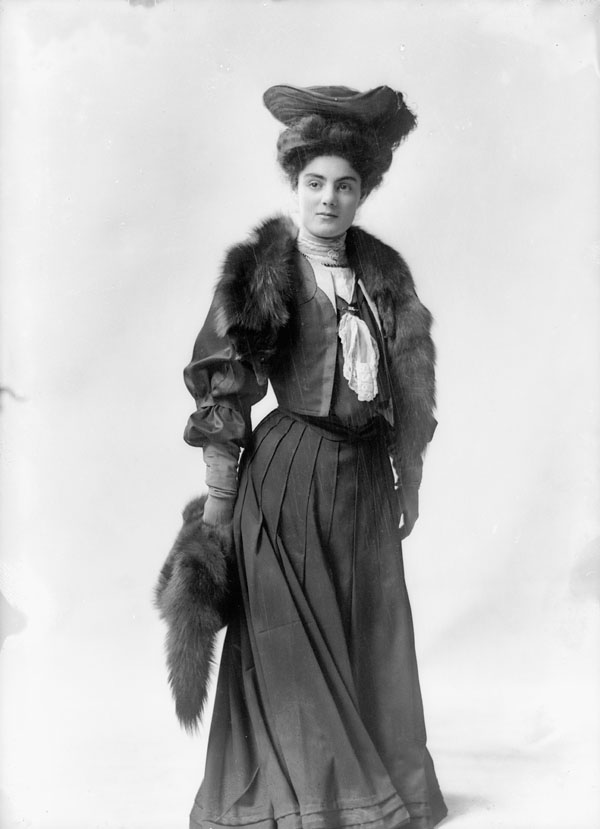
Black-and-white photo of a woman standing and facing the camera, wearing a dark-coloured dress, a fancy hat and a fur stole.

Éva Gauthier, 1906. Photo: William James Topley. (a193009)

Despite her small size, Éva Gauthier had a powerful voice that certainly turned heads. In 1909 in Italy, she got the role of Micaela in the opera Carmen and she made a standout performance. But her career in opera was very short. While preparing for her second role―at Covent Garden in the opera Lakmé―the stage director removed her from the cast, fearing that her talent would outshine the lead actress. Devastated, Éva Gauthier turned her back on opera and decided to leave Europe.

She went to Indonesia to join Frans Knoot, who would eventually become her husband. She remained in Asia for four years, an adventure that gave her life a new direction. During her stay, she studied Javanese music with Indonesian gamelans and immersed herself into an exotic, unfamiliar musical and cultural style. She put on several shows, notably in China and Japan, and received glowing reviews: “This dainty Canadian singer has a voice of great flexibility, power and range. The entire evening was a musical treat. The applause was loud, long and well deserved.”

Her experience in Asia gave Éva a particular sound and a unique style. This allowed her to stand out when she returned to North America, where far-eastern music was still relatively unknown. Her refusal to adhere to traditions was one of Éva’s characteristic traits. She never let conventions define her and so brought about a renewal of musical culture in the 20th century.
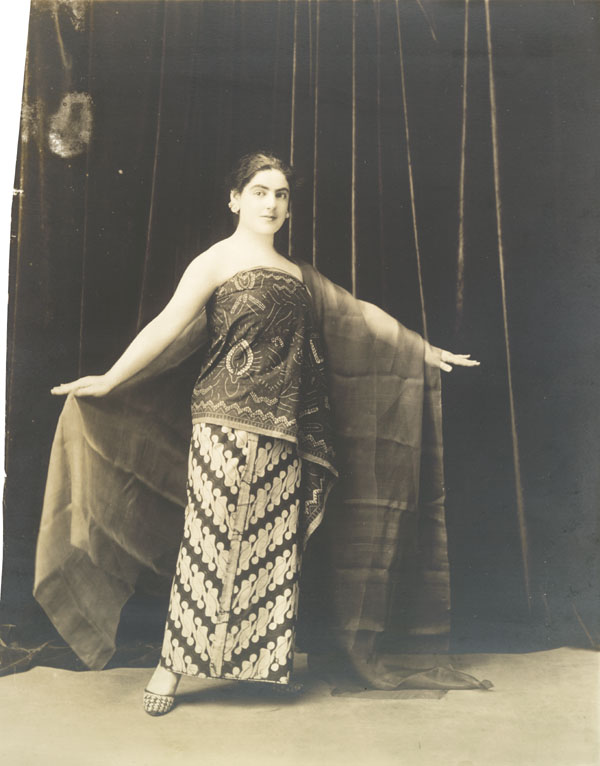
Black-and-white photo of a woman facing the camera and wearing a traditional Javanese dress.

Éva Gauthier wearing one of the Javanese costumes she was known for. (ncl002461)

After her return to North America, Éva Gauthier―who now enjoyed a certain notoriety―put on several shows a year. The greatest musicians approached her, asking her to sing their compositions. Igor Stravinsky swore by her alone and demanded that she be the first to sing every one of his pieces. Éva mingled with musical personalities and befriended a good number of them, including pianists and composers Maurice Ravel and George Gerswhin.

It was with the latter that she gave a memorable concert at the Aeolian Hall in New York, in 1923, that brought together classical and modern music. Gershwin accompanied the singer on the piano during a daring premiere. Éva Gauthier even integrated jazz music into the program, a style she greatly loved but which was still poorly regarded. Although critics were not kind, the general public enjoyed the breath of fresh air and the event became a landmark in musical history.

Éva Gauthier gave hundreds of performances during the rest of her career, both in America and Europe, integrating various styles into her ever-entertaining performances. She focused the final years of her life on teaching students how to sing and, though she was no longer on stage, she remained very active in the music scene, acting as mentor to the next generation of artists. Her impeccable technique, her daring attitude and her refusal to follow convention opened the way to new artists and helped make Éva Gauthier a true legend of modern music.

If you want to hear some musical excerpts sung by Éva Gauthier, visit the Virtual Gramophone by Library and Archives Canada. There you will find several French Canadian folklore classics performed by the singer.

You can also listen to our Éva Gauthier podcast and flip through our Éva Gauthier Flickr album.


Isabel Larocque is project manager for Library and Archives Canada’s Online Content team.
The Group of Seven and me: A few degrees of separation

Version française

By Ellen Bond

The bus trip from Barrie to Kleinburg, Ontario, in 1972 did not take long. We arrived at the McMichael Gallery, home to the McMichael Canadian Art Collection, on a sunny spring day. I remember a wide, open space with long pathways from the parking lot that were lined with small trees leading to a cool-looking wooden building with massive stone pillars.

At that time in my life, my family would spend parts of our summers on Georgian Bay (Lake Huron) at Wymbolwood Beach and on the north shore of Lake Superior in Terrace Bay. Walking into the McMichael Gallery was like looking through the lens of my summer: paintings of the places that provided me with so much joy and happiness. I was instantly drawn to the colours, lines, thick brush strokes, and how the paintings captured the rocks, the windswept trees and the majestic landscape.

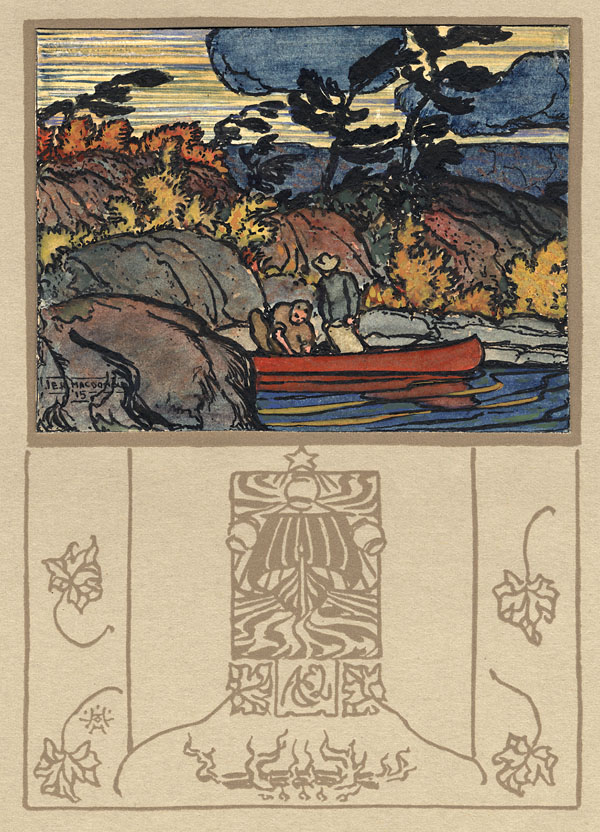
A watercolour painting of people in a red canoe with colourful trees and windswept trees in the background.

The Red Canoe, painted by J.E.H. MacDonald, 1915. (e003894355)

One hundred years ago, on May 7, 1920, the Group of Seven mounted their first formal exhibition at the Art Gallery of Toronto (now known as the Art Gallery of Ontario). It was the first time that the public had the chance to see over 120 of their paintings in a single location. At that first exhibition, according to the McMichael website, only six paintings sold. One of those paintings today would be worth much more than the total amount originally paid for all six.

In 1920, the Group of Seven consisted of Franklin Carmichael, Lawren Harris, A.Y. Jackson, Frank Johnston, Arthur Lismer, J.E.H. MacDonald and Frederick Varley. Johnston left the group in 1920 and moved to Winnipeg, and in 1926, A.J. Casson was invited to join. Two other members, Edwin Holgate and L.L. FitzGerald, joined in 1930 and 1932 respectively. Although Tom Thompson is sometimes mistakenly considered a founding member, he died tragically in 1917 before the group was even formed.

A black-and-white photo of a group of men in suits seated around a table during a meal.

Group at the Arts and Letters Club, Toronto. Pictured: Bertram Booker, A.Y. Jackson, Merrill Denison, J.E.H. MacDonald, Lawren Harris, Frederick B. Housser and an unidentified man. (PA-196166)

The Group of Seven are famous across Canada. In schools, libraries and art schools, their paintings are used as examples, and students are often taught to paint landscapes in their style. I remember my niece Emma painting a group-like painting at school. It hung on the wall of her house by the stairs and looked very professional. The Group of Seven are easily “googled,” and you can find some of their paintings regularly displayed, or even for sale, from coast to coast in Canada. Recently, while visiting the Thompson Landry Gallery in the Distillery District in Toronto, I actually saw a Group of Seven painting for sale. It was my first time, and I stood and stared at it, wishing I had an extra $133,000 to buy it right then and there. I was in awe!

According to the theory of six degrees of separation, any person can be connected to any other person through six or fewer social connections. Two of my friends have close connections (two or fewer) to Group of Seven members Arthur Lismer and A.Y. Jackson.

I first met Ronna Mogelon through a friend and was amazed at her cake-decorating skills. When I found out she lived in the historic log cabin that I admired every time I drove by, I was even more excited to know her. Then I found out about her connection to Lismer. Here is her story:

My mum and dad were very artsy and involved in the art community in Montréal in the ’60s. They hosted art shows in their home, before artists could find galleries to represent them. My mother, Lila, was from Saint John, New Brunswick, and was very close with painter Fred Ross, who was her teacher at art school. (Several of his works are hanging in the National Gallery of Canada, in Ottawa, Ontario.) Before he had a regular gallery, he showed his artwork at our house.

As well, my father, Alex, wrote the monthly art column in The Montrealer, a magazine from the ’60s and ’70s. Mum usually interviewed the artists, and Dad wrote the story from her reel-to-reel recordings. A real tag team! So our family was very involved with the arts.

Anyhow, my parents wanted us to have a good background in art, and so they sent us to the Montreal Museum of Fine Arts on Saturday mornings to take art classes with Arthur Lismer. Most kids went to nursery school. We went to Arthur Lismer school.

A black-and-white photo of a man standing with his left hand on his hip and a pipe in his hand.

Portrait of Arthur Lismer, photographed in Quebec by Basil Zarov in 1953. (e011000857)

Because I was so young, my recollections are rather scattered. I remember how tall he was, but then again, being only six years old, I was pretty short at the time. I seem to recall he smoked a pipe. I remember how I felt like a real artist because we got to stand at an easel and paint. My older sister, Marcia, who took the class a few years previous to me, remembers the big art show at the end of the year, where all the artists’ paintings were on display and she got to dress up in her best outfit. My cousin Richard remembers the licorice pipes that we got at the end of the class on our way home.

I’m not sure if his classes had an effect on me, but I suppose they might have. Years later, I chose art as my field of endeavour and graduated from Concordia University, Montréal, with a Bachelor of Fine Arts. Maybe some of his teaching rubbed off after all!

As I mentioned earlier, I have spent many of my summers partially on Lake Superior. My parents were both born and raised in the northwestern Ontario area, I was born in Terrace Bay, and for me it seems like home. One of my sister’s friends, Johanna Rowe, was born and raised in Wawa, Ontario. We have visited and even stayed at Johanna’s camp on the mouth of the Michipicoten River where it meets Lake Superior. It is one of the most beautiful places that I have ever been. White sand beaches, incredible rocks to hop on, a huge sand spit—at the mouth of the river—that sometimes disappears after a storm, giant driftwood logs from unknown forests …  truly spectacular!

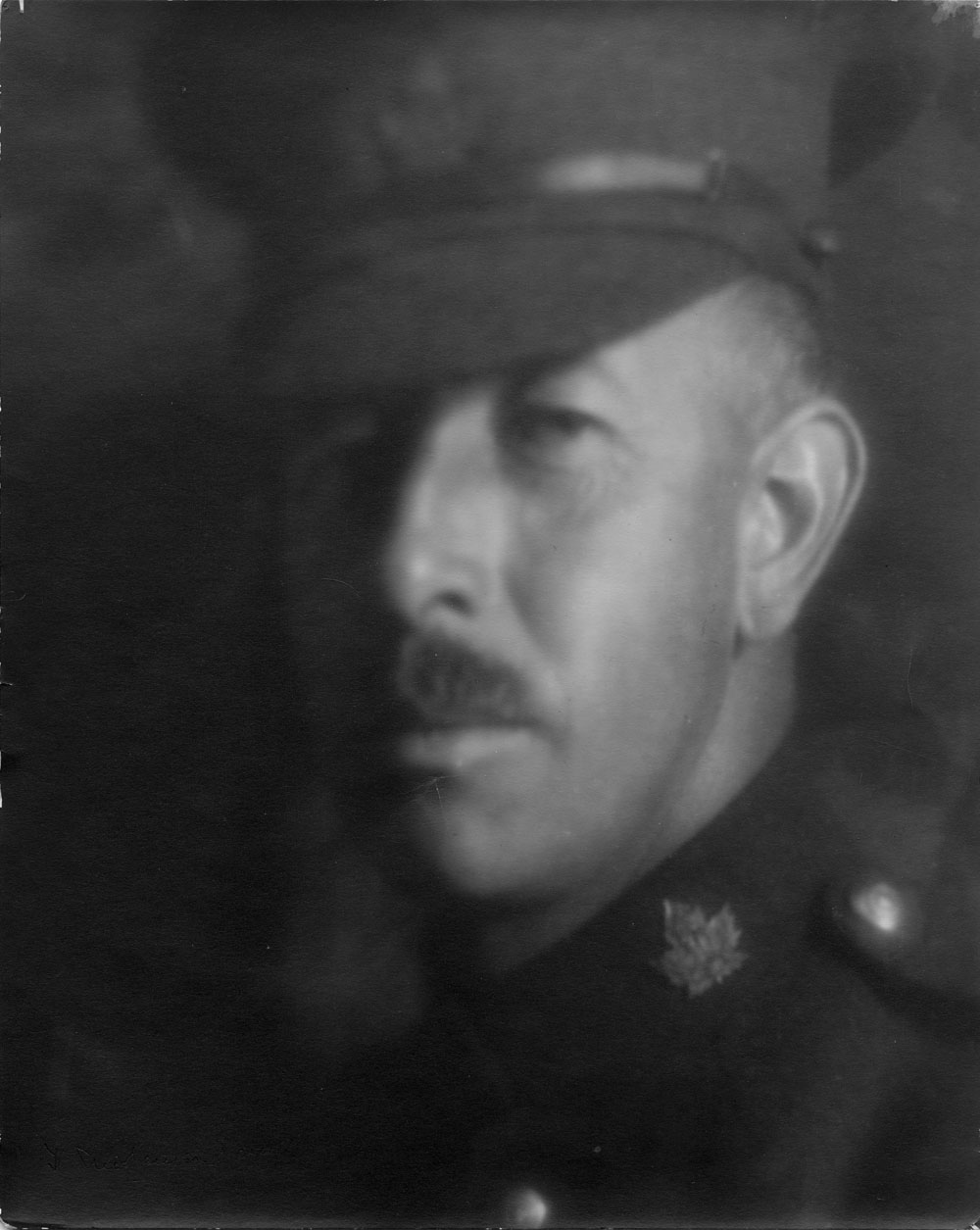
A black-and-white photo of a man in a military uniform.

A.Y. Jackson, 1915, in his First World War uniform. (e002712910)
Take a look at Jackson’s military record (PDF).

Johanna, a local Wawa historian and member of the Canadian Association of Heritage Professionals, has a special relationship with this area where A.Y. Jackson chose to create his art. Here is her story:

I grew up listening to my grandmother’s stories about how a member of the Group of Seven had a cottage in Wawa and regularly took trips with local boat owners to explore and paint along the Superior shoreline.

During a special Glenn Gould and Group of Seven training event in 2015, I was introduced to Ken Ross, son of Harry and Jennie Ross, friends of A.Y. Jackson who co-purchased a cottage together on Sandy Beach in 1955.

Between 1955 and 1966, Jackson ventured by foot and by boat from his tiny Sandy Beach cabin. Accompanied by friends and fellow explorers, he created hundreds of sketches and paintings depicting the Lake Superior landscape from Batchawana Bay to Pukaskwa. Many of Jackson’s Wawa sketches were painted in the vicinity of Sandy Beach.

At the end of Jackson’s Wawa paint trips, he and the Ross family would invite friends and neighbours to a social and bonfire on the beach. Jackson would have all his sketches on display leaning against large pieces of driftwood or tacked to the logs on the outside of his cabin. Folks could purchase one of his creations for $30 to $50, or commission Jackson to make a larger version over the winter back in his studio for $300-plus. Apparently, those he did not sell would sometimes end up as fuel in the bonfire. Jackson was also very generous with his sketches and often gifted them to locals who provided transportation out on Superior, invited him to their homes for dinner, or simply let him sit and paint the view in front of their property.

During my research, I discovered there is no complete inventory of his creations. These sketches are now turning up at fine-art auctions across the continent. In the past five years, there have been at least 30 paintings pop out of the woodwork which we know Jackson painted in the Wawa area. He often wrote Wawa or Michipicoten on the back of the painting. And for those of us who have a first-hand knowledge of the landscape, the roll of the hills, the dent in the shoreline, we are able to pick out the exact spot where Jackson sat and painted. It is the ultimate Canadian scavenger hunt … discovering the site where a member of the Group of Seven was inspired to sit and let the creative spirit flow through their paintbrush to a blank canvas. Still gives me a tingle up my spine each time. …

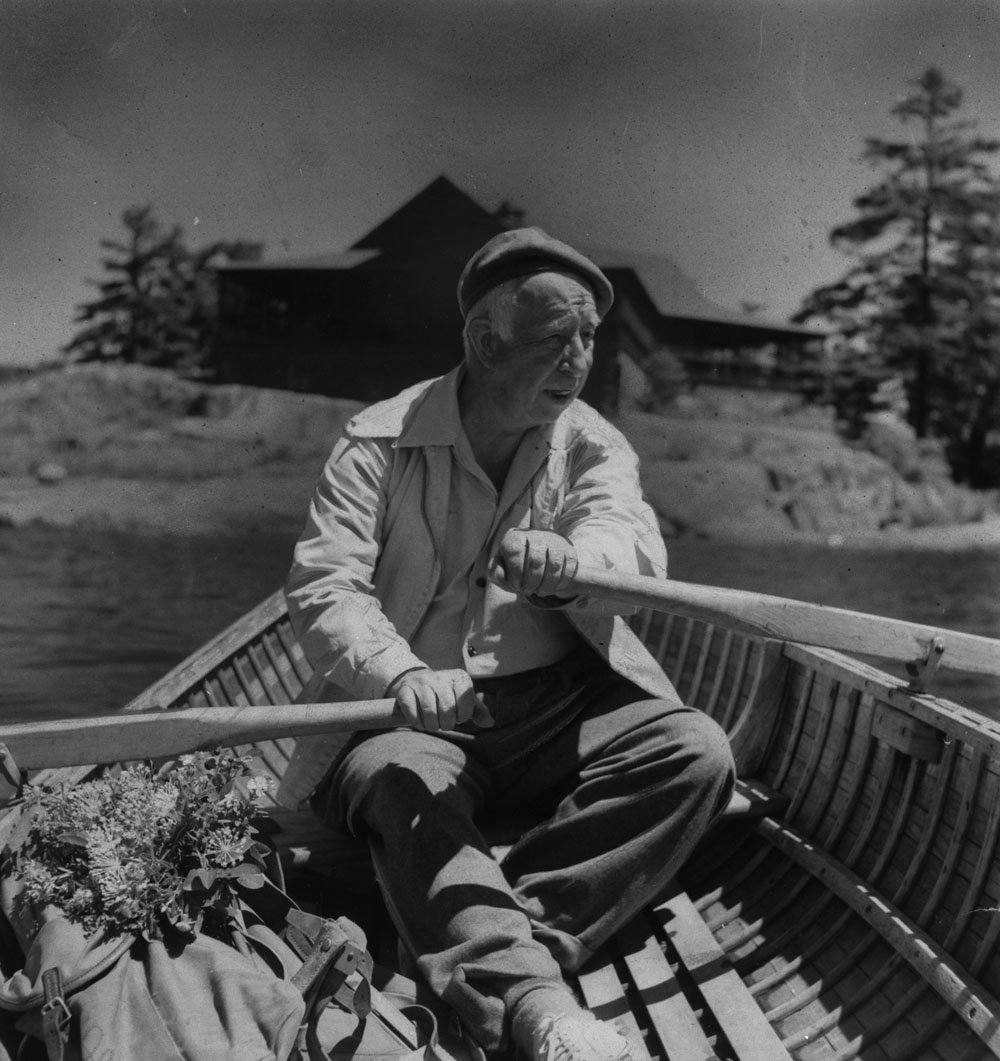
A black-and-white photo of a man rowing a wooden boat.

A.Y. Jackson in a boat, 1959. (e011177131)

The times I have spent on Georgian Bay and Lake Superior have burned memories in my mind so bright, I can still feel the wind of the Great Lakes blowing in my hair, the waves crashing and pounding in my ears, and the brilliant blue of the water dancing in my eyes. I am thankful for my experiences there, and also thankful that Canada’s most well-known artists were able to capture those feelings in their paintings. I look forward to connecting again on my next trip.

For more images, visit the Flickr album!


Ellen Bond is a Project Assistant in the Online Content team at Library and Archives Canada.

Madge Macbeth: Writer of everything and anything

By Vasanthi Pendakur

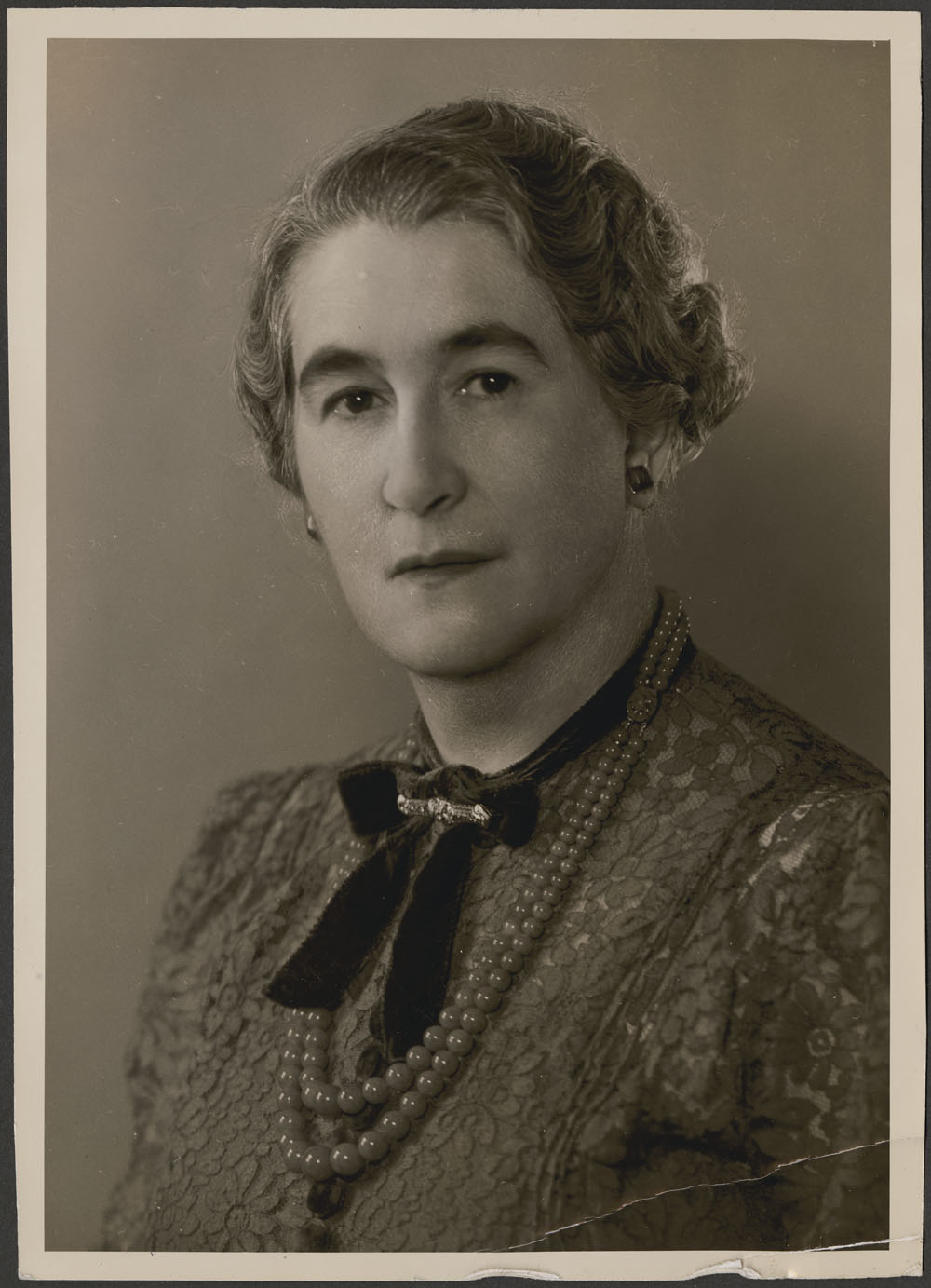
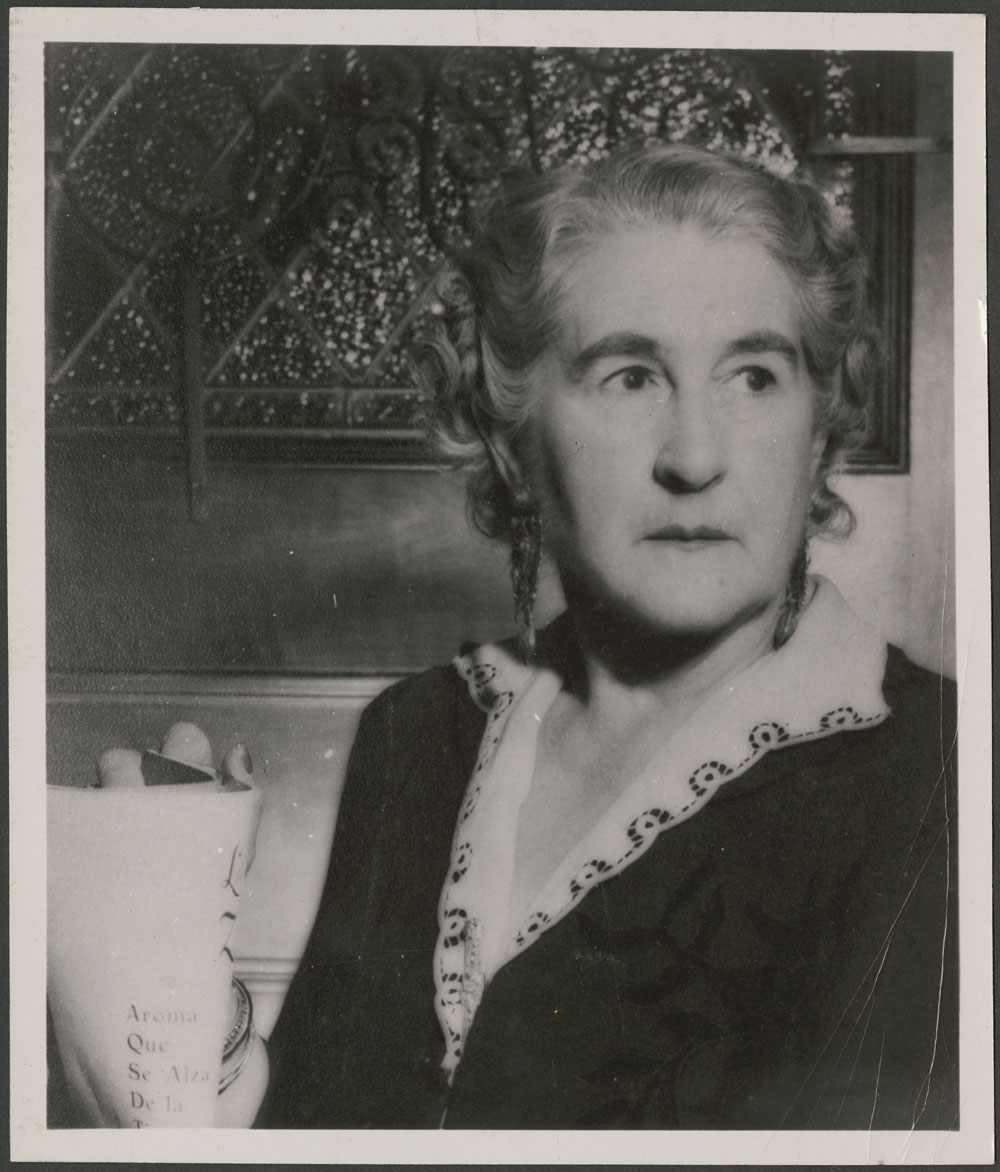
Portrait-style photograph of a woman wearing a lace blouse, jade beads and a diamond pin facing the camera.

Portrait of Madge Macbeth (e010935318)

Madge Macbeth was a prolific American-Canadian writer of short stories, novels, plays, travel books, newspaper articles, and interviews throughout the first half of the 20th century. She was deeply involved with authors’ associations and in theatre, being a founding member of the Ottawa Little Theatre and the first female president of the Canadian Authors Association, a position she held for three terms.

Macbeth was born Madge Hamilton Lyons in Philadelphia, to Bessie Maffitt and Hymen Hart Lyons, on November 6, 1878. As a child, she produced plays and edited her own newspapers. She may have been influenced by her grandmother, Louisa Hart Maffitt, who was one of the first professional American press women and a suffragist.

After the family settled in Baltimore, Madge Lyons was sent to Hellmuth College in London, Ontario, for her education. In her memoir Boulevard Career, she recalled that Hellmuth in the 1890s did not teach Canadian literature and that its curriculum centred on the classics. After completing her schooling, she performed as a mandolinist and vaudeville actress for a few years before marrying Charles Macbeth in 1901.

The couple first moved to Detroit, and then settled in Ottawa. Macbeth instantly loved Ottawa. In her writings, she stated that Ottawa provided a means of satisfying my in-born and unquenchable love of people.” This is certainly true. She became friends with many of the leading lights of Ottawa, including the photographer Yousuf Karsh and Mayor Charlotte Whitton.

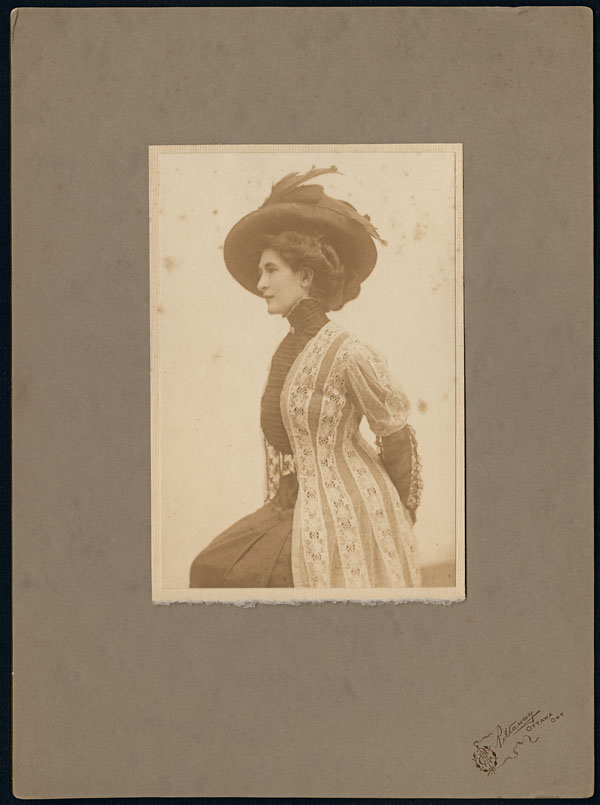
Side profile of Madge Macbeth in a black dress and white lace jacket wearing a feathered hat.

Portrait of Madge Macbeth as a young woman in Ottawa (e008406101)

Disaster struck around 1908. Macbeth’s husband caught tuberculosis and later died, her young son became ill, and her mother lost all her money. Writing was one of the few professional careers open to women at the time. As she recounted in an interview with Maclean’s: I began to write…with the deluded idea that it was something I could do at home. Long since I have learned that it is just the place where one can’t write in peace.” At the time, the Canadian market for writing was small. Editors were looking for American or British writers, and in many instances Canadians were confined to advertisements or second runs.

Macbeth began with short pieces in magazines, and had a few early successes with her novels The Changeling (1909), and The Winning Game (1910). This was followed by a dry spell. A helpful mentor at this time was Marjorie MacMurchy, one of the earliest press women in Canada. MacMurchy suggested Macbeth try getting interviews with members of Parliament, because magazines were more interested in public officials than in fiction.

Her luck returned. A Canadian editor accepted a piece she had written, and soon other work followed. Macbeth wrote anything she could get her hands on: advertisements, brochures for the Canadian Pacific Railway, serials, novels, travel books, plays, radio dramas, propaganda (during World War II), newspaper articles, and columns. She wrote under her own name and various pseudonyms, both male and female. Her writing style and subject matter changed from book to book, but most of her pieces were suffused with a strain of humour or satire, and her main characters were usually women. She wrote about marriage, sex, travel, adventure, religion, and political intrigue. Later in her career, she travelled extensively, usually alone, for lecture series or for material to turn into more books.

Madge Macbeth holding a document and looking off to the side.

Madge Macbeth holding a document (e010935329)

Many of her novels focussed on the middle and upper classes. In fact, popular political satire novels, like The Kinder Bees (1935) and The Land of Afternoon (1924), were based on her knowledge of upper-class society in Ottawa. Both were written under the closely guarded pseudonym of “Gilbert Knox.” One of her most popular novels was Shackles (1926), which highlighted first-wave feminist thinking of the time. The novel is the story of Naomi Lennox, a middle-class woman fighting for respect as a writer and for freedom within her church and marriage. The book was highly praised by some and condemned by others for its portrayal of sex in marriage.

Macbeth’s articles discussed similar themes as well as showcased women in the arts, business, education, and suffrage. One article entitled “How much sex should be put into novels?” was published in 1947. In it, Macbeth argued that authors were reporters describing the world around them. She was critical of authors using too much sex in their books, but argued that ignoring it completely was also a disservice to reality and literature. One exchange with a reformer went like this: Why don’t you authors write about nice things?” He complained. … “Do you enjoy uplift books?” I shot at him, “Or do you want them published for the other fellow?

Throughout her career, Macbeth was deeply involved with authors’ associations and in theatre. Not only was she the first female president of the Canadian Authors Association, but she held the position for three terms, a record at the time. She used the position to promote Canadian literature and continually supported younger writers. As well, her interest in theatre led to the founding of the Ottawa Drama League, later the Ottawa Little Theatre. Her stated goal with this project was to wean children from cheap movies, to give them a knowledge and love of good dramatic literature.” Macbeth pestered MPs for support until the project came to fruition. It is now one of the oldest theatre companies in Canada.

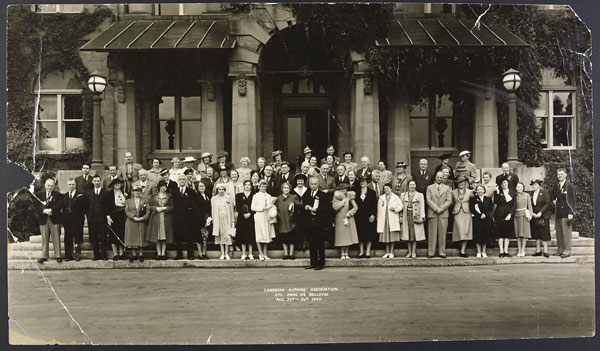
Large group of men and women standing in front of the entrance to a building.

Group portrait of the Canadian Authors Association (e008406116)

Macbeth’s work was very progressive, but elements of her writing show her Victorian upbringing. While her subject matter was enlightened, her books tended to fit into the conventions of the time. She supported fledging writers and was proud of supporting herself and creating space for other women to do the same. At the same time, she wrote articles arguing that women had forgotten their domestic responsibilities, and called spinsterhooda half baked life. She wrote as a member of her class, and some of her language would not be used today. These contradictions are symbolic of her long career and the changes that took place in society from her Victorian upbringing to her death in the 1960s.  Boulevard Career ends with a discussion of how much society, and Ottawa in particular, had changed over her career, especially for women. Her writing and her life were part of this change, half in the future and half in the past.

Macbeth donated her papers to the National Archives in 1958. The fonds includes manuscripts of many of her novels, copyright information, and correspondence on a number of topics, including Macbeth’s lecture series, her involvement with the Ottawa Drama League, and her work with the Canadian Authors Association. The fonds also comprises diaries, scrapbooks, and a large collection of photos of Macbeth over her life. These photos show her dramatic side and her love of the theatre. The fonds gives us insight into her long career and ensures that her work will be remembered.

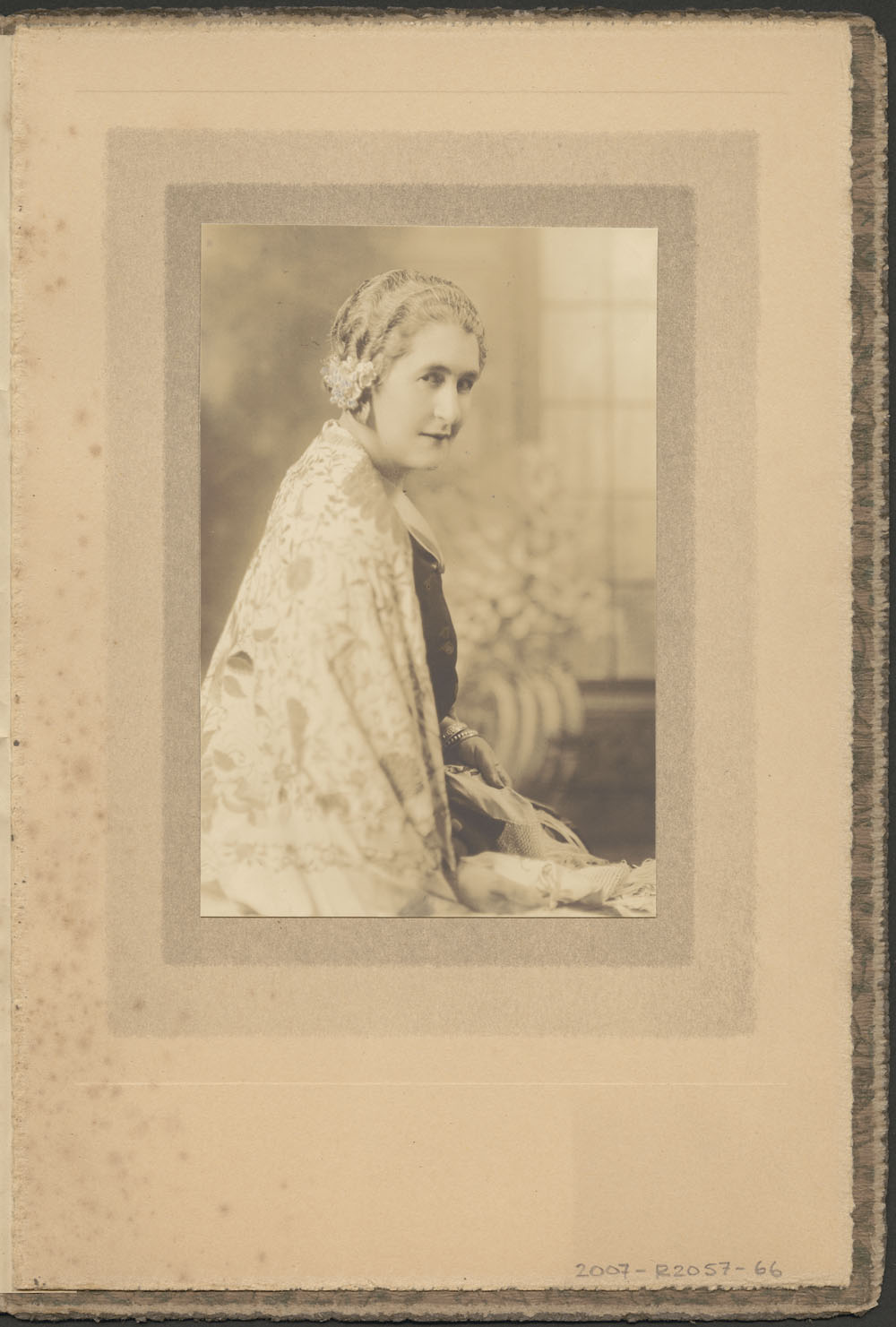
Side portrait of Madge Macbeth wearing a pale patterned cape.

Portrait of Madge Macbeth wearing a cape (e010935313)

Additional resources


Vasanthi Pendakur is a project manager in the Online Content team at Library and Archives Canada.

Images of Cartes-de-Visite now on Flickr

A carte-de-visite is a type of calling card popular during the mid- to late 19th century.

A black-and-white photograph of Napoléon Bourassa’s left profile.

Napoléon Bourassa [e008302188]

The card consisted of a photographic print glued onto a cardboard backing. These cards were inexpensive and easy to produce, and varied slightly in size. Cards were commonly given out to friends and family during holidays or for special events. Collectors, at the time, put their cards into albums. Images were not limited to family and friends—famous individuals from the past were also featured on cartes-de-visite.

A black-and-white photolithograph of two dogs, one large and one small, looking out from the entrance to a doghouse.

Two dogs [e011196678]

A black-and-white photographic portrait of 27 young girls wearing medals and seated around a nun.

Group of girls wearing medals seated around a nun [e010969237]

A black-and-white photographic portrait of a dog resting on a chair next to a boy and a man holding a rifle.

Hunter with a boy and dog [e011196672]

Visit the Flickr album now!

Images of Sweaters, Jackets and Coats now on Flickr

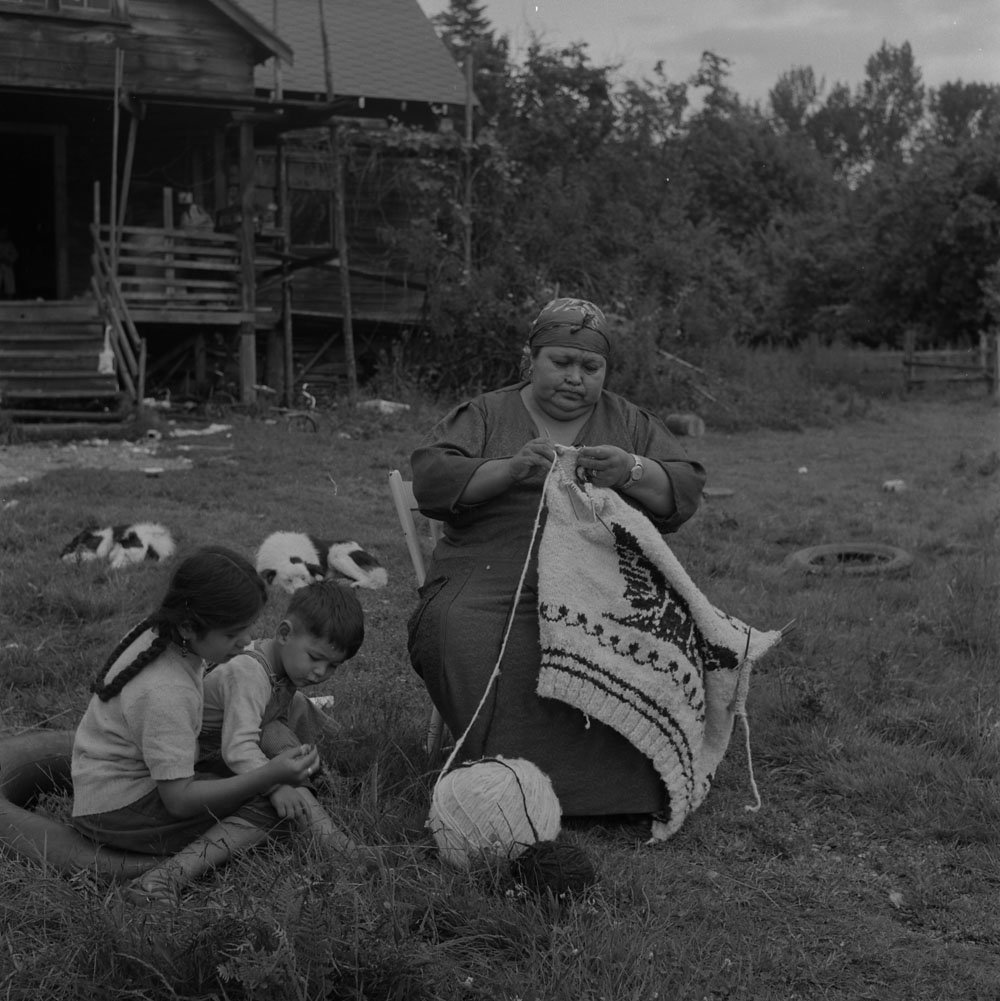
A black-and-white photograph of a woman sitting outside knitting a traditional Cowichan sweater. A boy and a girl sit next to her on the grass.

Ms. Pat Charlie knits a Cowichan sweater, British Columbia [e011176278]

Canada is a large and geographically diverse country with a wide range of seasons. Temperatures can vary from 40 degrees Celsius to minus 50 degrees. With the changing temperatures and environmental patterns across the country, Canadians naturally like to discuss the weather.

A black-and-white photograph of a tailor adjusting a suit jacket on a tailor’s mannequin.

Tailor adjusting a suit jacket on a tailor’s mannequin, Montreal, Quebec [e004666235]

A black-and-white photograph of a woman standing straight to model a military uniform consisting of a Norfolk jacket, skirt, and black shoes.

Woman wearing a Norfolk jacket, skirt, and black shoes [PA-063849]

During the autumn and winter months, clothing options get included in the conversation. Sweaters, jackets and coats come out with the cooling temperatures, first one at a time, then to be layered one on top of the other.

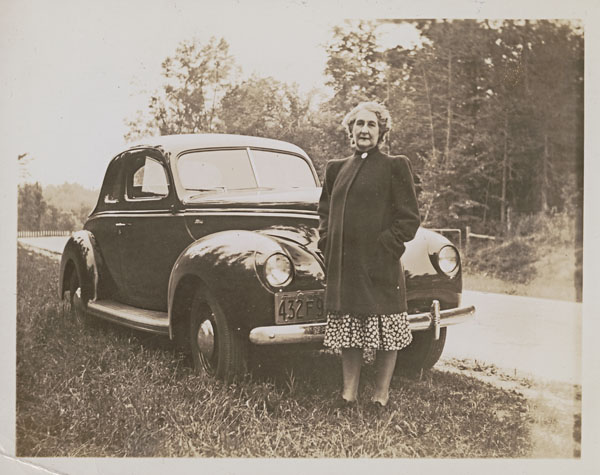
A black-and-white photograph of a woman wearing a coat and standing at the side of a road in front of her car.

Madge Macbeth wearing a coat and standing at the side of a road in front of her car “Amaryllis” [e008406104]

Visit the Flickr album now!

Images of the First Special Service Force (The Devil’s Brigade) now on Flickr

A black-and-white photograph of around a dozen soldiers wearing parachute gear, lined up to board a Douglas C-47 for training.

Personnel of the First Special Service Force boarding a Douglas C-47 aircraft for parachute training, Fort William Henry Harrison, Helena, Montana, United States [MIKAN 3378674]

The First (or 1st) Special Service Force, nicknamed The Devil’s Brigade, was a combined Second World War Canadian and American commando group. It was located and trained at Fort Harrison near Helena, Montana, United States. Force members received intensive training as ski troops and in stealth tactics, hand-to-hand combat, the use of explosives for demolition, parachuting, amphibious warfare, rock climbing and mountain warfare.

A black-and-white photograph of a soldier wearing white winter gear and crouching down to fix his ski bindings. A parachute is blowing in the wind behind him.

Member of the First Special Service Force during a winter training exercise, Blossburg, Montana, United States [MIKAN 3378683]

The Force saw extensive combat duty during the years 1943–1944 in Italy and southern France. It was known for always achieving its objectives. The Force was disbanded on December 5, 1944, but many modern Canadian and American Special Forces units, such as Joint Task Force 2 (JTF2), the Green Berets and the Navy SEALs, trace their heritage to this unit.

A black-and-white photograph of three soldiers with camouflage makeup preparing to go out on an evening patrol.

Personnel of the First Special Service Force preparing to go on an evening patrol, Anzio beachhead, Italy [MIKAN 3378968]

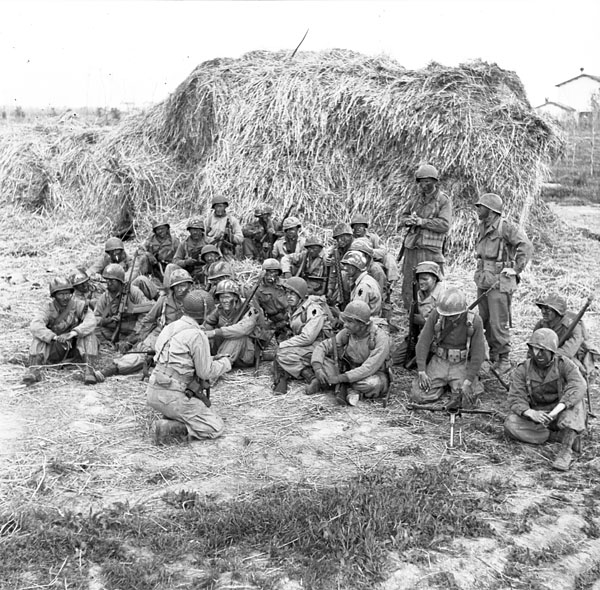
A black-and-white photograph of some two dozen soldiers sitting behind a large hay bale. The soldiers are being briefed before setting out on patrol.

Personnel of the First Special Service Force being briefed before setting out on a patrol, Anzio beachhead, Italy [MIKAN 3396066]

Visit the Flickr album now!

The Battle of Vimy Ridge

Version française

A banner that changes from a black-and-white photograph of a battle scene on the left to a colour photograph of the Vimy Memorial on the right.Everything was in place for the hour of the assault, 5:30 a.m. on April 9, 1917.

The preceding hours of darkness aided by cloud cover had permitted the infantry to file forward unobserved into their jumping-off positions, many of which were clearly observable to the enemy in daylight. Had this movement been witnessed, an enemy barrage might have broken up the assault wave with serious casualties; as it was, the positions were gained without notice.

In the half-light of zero hour under a cold overcast sky, when manoeuvring was still largely obscured from the enemy, the intense bombardment opened with sudden fury, and the advance of the infantry began. Continue reading

Images of Gilmour & Hughson Forestry now on Flickr

Allan Gilmour (1775–1849) was a senior partner in the firm of Pollok, Gilmour & Co. from which numerous co-partnerships and offshoots evolved, and played a prominent part in the Scottish and Canadian lumber and shipbuilding businesses. Allan Gilmour’s brothers and nephews opened numerous branches in Canada—at Miramichi, Quebec, Montréal and elsewhere. The Bytown operation began after the opening of a Montréal partnership in 1828, which dealt in supplies for the square timber trade on the Ottawa River. In 1841, his nephew Allan Gilmour Jr. took over this operation with James Gilmour, named it Gilmour & Co., and opened the Bytown branch to procure timber and sawn lumber for the Quebec market. Eventually, lumber operations grew significantly.

A black-and-white photograph of the Gilmour and Hughson mill on the river. The mill is in the foreground with timber floating on the river and along the bank.

View of the Gilmour and Hughson mill from the water (MIKAN 5006499)

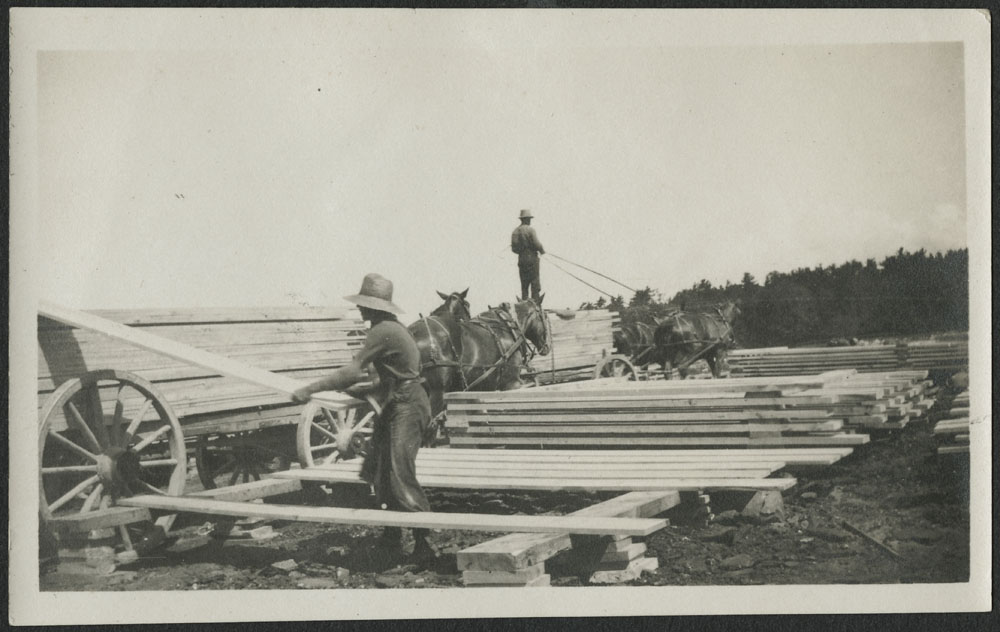
A black-and-white photograph of a man loading milled lumber onto a horse-drawn wagon. A second, full wagon is leaving the area with its driver and horses.

Men loading lumber at the Gilmour and Hughson mill (MIKAN 5006500)

In the 1870s, the branches at Miramichi, Quebec and Montréal closed, leaving the Ottawa lumber operation in the control of John Gilmour’s sons. In 1891, the company Gilmour & Hughson was formed by John Gilmour Jr. and Ward Hughson, an Albany lumberman. In 1895, the concern was incorporated (58-59 Vic., Cap. 89). In the mid-1920s, it was announced that Gilmour & Hughson Ltd. was being sold to the firm of Riordon & Co. However, Riordon & Co. went into bankruptcy and the properties owned by Gilmour & Hughson and its operations were taken over by the Gatineau Company Limited, a subsidiary of the Canadian International Paper Co.

A black-and-white photograph of the Gilmour and Hughson mill on the river. The mill is in the foreground with timber floating on the river and along the bank.

View of the Gilmour and Hughson mill from the water (MIKAN 5006499)

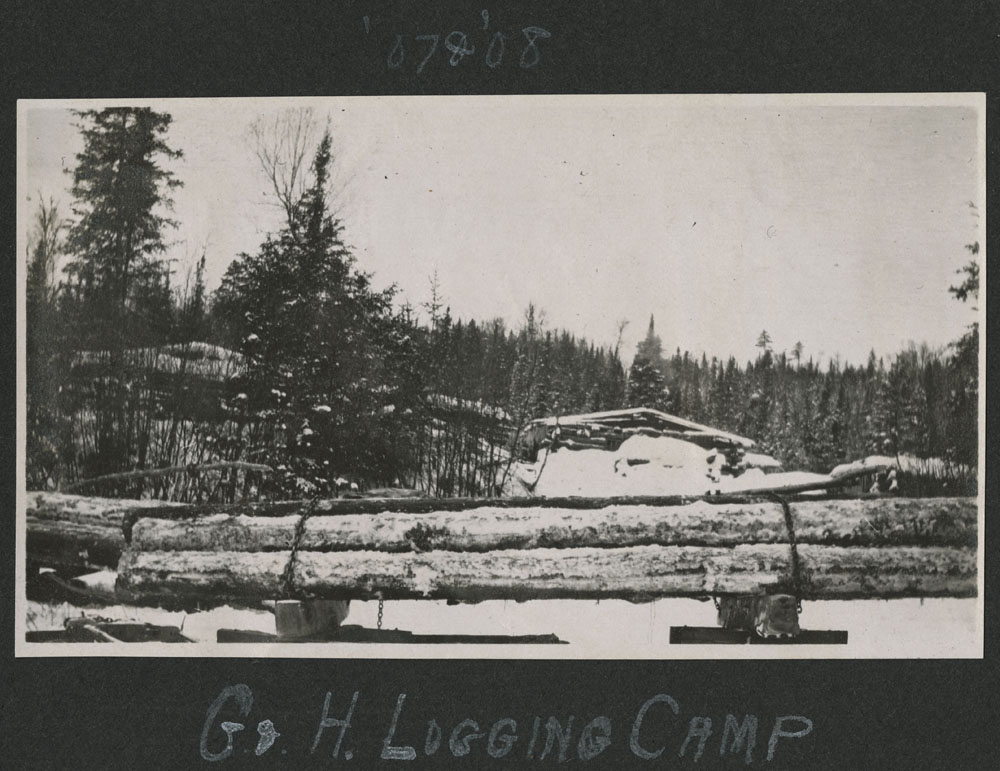
A black-and-white photograph of a Gilmour and Hughson logging camp during the winter. Log shelters are in the background along a line of trees. Fresh cut timber is stacked and chained in the foreground.

Gilmour and Hughson Logging Camp (MIKAN 5006507)

Visit the Flickr album now!

Images of Boxing now on Flickr

Boxing is the sport of fighting with padded, gloved fists in a square, roped-off ring under a set number of rounds and rules.

A black-and-white photograph of two boxers fighting on the deck of the SS Justicia, surrounded by the ship’s complement of soldiers.

Canadian troops aboard the SS Justicia, en route to Liverpool, England, watch a boxing match (MIKAN 3384735)

However, the first boxers in Canada did not use gloves. Bareknuckle fisticuffs were the norm during the early 19th century, with some bouts lasting 40 rounds. Outside of the military and a few men’s clubs, boxing was not sanctioned in the provinces of Canada, as the sport did not have a great reputation for fair play or honest promotion. Respectability for the sport came slowly, and views changed during the 1890s. The popularity of the sport grew steadily during the early 20th century.

A black-and-white photograph of two soldiers boxing. One wears black trunks and the other wears white trunks. Soldiers outside the ring watch the match.

Soldiers boxing in the exhibition grounds (MIKAN 3384740)

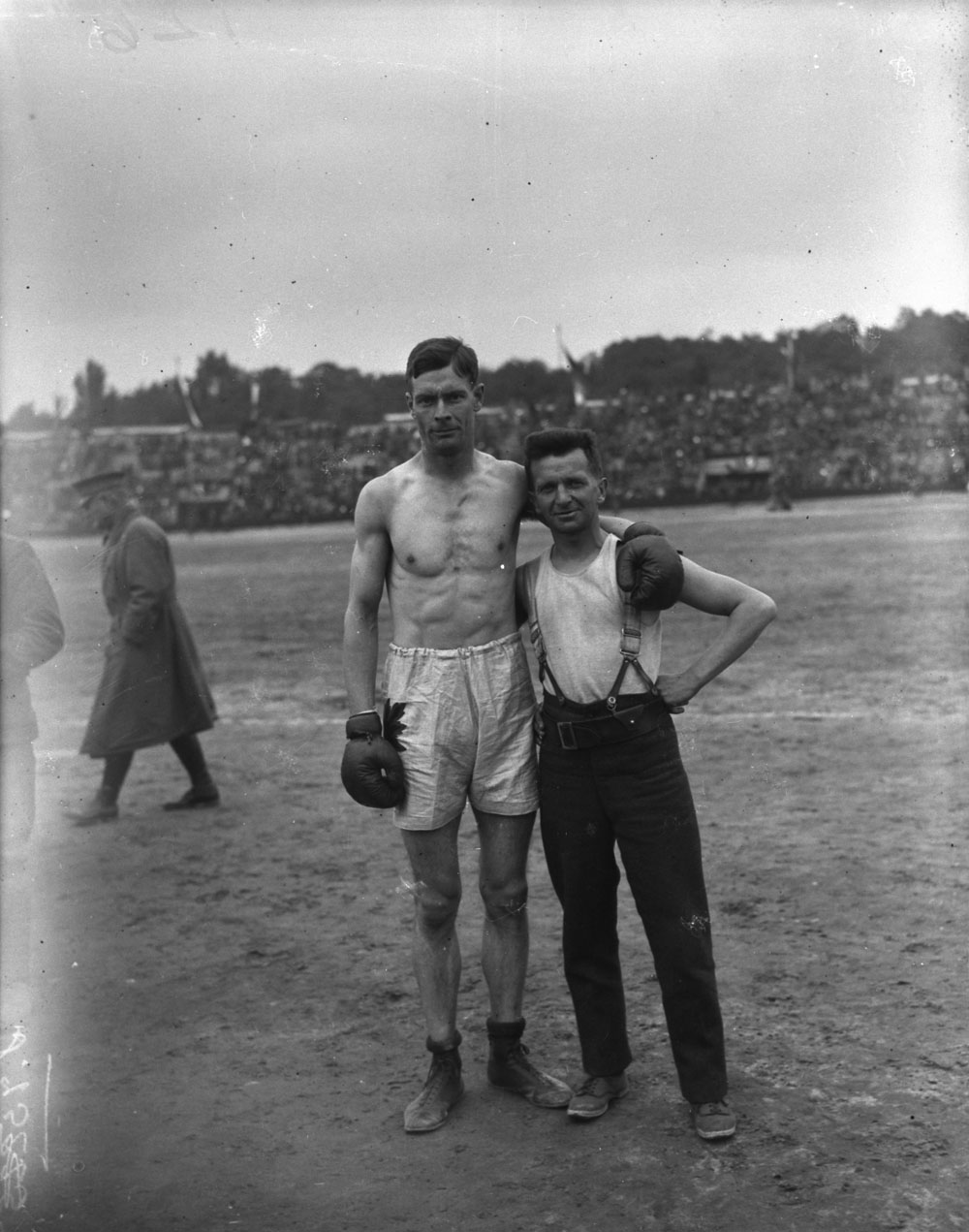
A black-and-white photograph of middleweight boxer Edwin A. Harris (Canada) in his trunks and gloves, posing with another soldier.

Edwin A. Harris (Canada), middleweight finalist in boxing, at the Inter-Allied Games, Pershing Stadium, Paris, France (MIKAN 3384730)

Today, the Canadian Amateur Boxing Association oversees the sport in coordination with 10 provincial and three territorial boxing associations. Some athletes eventually turn to professional boxing, while others retain their amateur status with the intent to represent Canada in international events, such as the Olympics or Commonwealth Games.

Visit the Flickr album now!

The Halifax Explosion: Records at Library and Archives Canada

By Valerie Casbourn

On the morning of December 6, 1917, two ships, the Imo and the Mont-Blanc, collided in the Narrows of Halifax Harbour. The Mont-Blanc was a munitions ship on its way to join a convoy sailing to war-torn Europe. The cargo of the Mont-Blanc caught fire, and after burning for 20 minutes, the ship exploded. The blast ripped through the city killing almost 2,000 people, injuring thousands more and causing widespread devastation in Halifax, Dartmouth, and the Mi’kmaq community of Turtle Grove. The “Halifax Explosion” as it became known, brought the danger and destruction of the First World War home to Canada, and left an indelible mark on the city of Halifax.

A black-and-white photograph of several people walking down a street with destroyed buildings on both sides.

Aftermath of the Halifax Explosion. The building on the left was the Hillis & Sons Foundry. (c003624b)

Guides to Records about the Halifax Explosion

Library and Archives Canada (LAC) holds various records that tell part of the story of the Halifax Explosion, its aftermath, and the relief work and investigations following the disaster. The first place to look is LAC’s thematic guide, Halifax Explosion. Some of the records listed in the guide are available on digitized microfilm reels on the Héritage website. Other records are available for onsite consultation at LAC.

The guide primarily lists records about the disaster and its aftermath kept by the Canadian federal government. This includes records such as the formal investigation into the collision of the Imo and the Mont-Blanc conducted by the Dominion Wreck Commissioner (RG42, Vol. 596, Parts 1-2 and RG42, Vol. 597, Parts 3-4). There is also correspondence of the wartime Chief Press Censor, Ernest J. Chambers (RG6, Vol. 621, File 350, Microfilm reel T-102) that documents both the urgent need to report news of the disaster accurately, but not to reveal any information about the defences of Halifax Harbour.

Image of a telegram that reads: “3:45 p.m. Telegram sent to Geo. D. Perry? Gen. Mgr. G.N.W. Telegraph Co, Toronto, Ont. Telegram sent to J. McMillan, Mgr. C.P. Ry. Telegraphs, Montreal. Ottawa, Ont., December 6, 1917. In view of contradictory reports abroad regarding Halifax explosion I hope everything possible is being done to facilitate a transmission of all press reports. This most desirable from a national point of view. Ernest J. Chambers, Chief Press Censor.”

from Ernest J. Chambers, Chief Press Censor, to G.N.W. Telegraph Co. and C.P. Ry. Telegraphs (T-102, Image 119)

Image of a telegram that reads: “Ottawa, December 7, 1917. C.O. Knowles, Toronto. In connection with reports of Halifax disaster it is important that nothing be published revealing information as to defences, strength and disposition of garrison, etc. Neither should details be given as to naval and transport activities at the port during war. No photographs of Halifax or vicinity taken since commencement of war should be published. Desirable that special correspondents despatched to Halifax inform themselves as to local censorship requirements. Ernest J. Chambers.”

from Ernest J. Chambers, Chief Press Censor, to C.O. Knowles, Canadian Press Limited. (T-102, Image 136)

If you are looking for images, try LAC’s Flickr album of digitized photographs taken after the Halifax Explosion. LAC also has a more detailed description of the explosion at First World War: Tragedy on the Home Front.

A black-and-white photograph showing a line of people digging through the rubble of destroyed buildings.

Aftermath of the Halifax Explosion. (c001833)

How to Search for More Records

You can find more records related to the Halifax Explosion by using the Collection Search tool to search for keywords such as “Halifax explosion” or “Halifax disaster”; or try searching for other keywords related to the disaster. Click on the “Archives” tab to limit your search results by date, or by the type of material (i.e., photographs or textual material).

The records at LAC come from the Canadian federal government and from private individuals and organizations. Some records are available online, and others are available for onsite consultation by visiting in person, or by ordering reproductions.

Correspondence about the Halifax Explosion: Sir Robert Borden fonds

There are far too many different records about the Halifax Explosion to mention them all here, but correspondence in the Sir Robert Borden fonds (MG26-H) tells one small part of the story. Sir Robert Borden was the Prime Minister of Canada and the Member of Parliament for Halifax at the time of the explosion, and his papers include telegram messages giving news of the disaster, messages of sympathy for the people of Halifax, offers of assistance, and more.

Much of the correspondence related to the explosion is in the file “Halifax Disaster 1917–1918” (MG26-H, Vols. 89–90, Pages 46309–47016, microfilm reel C-4325, which is available on the Héritage website, starting at image 301).

A Great North Western Telegraph Company of Canada telegram, which reads: “Moncton, N.B. Dec. 6, 1917. J.D. Reid, Ottawa. It is reported that ship loaded with explosives at pier six as she was backing out of pier about half past eight this morning an inward bound ship ran into her and she caught fire, they tried to sink her before she exploded but failed. She blew up at nine o’clock. It is reported the city in bad state and much damage done but account wires being down unable to get any detail. Will give further information soon as obtained. Assistant General Manager Brown going to Halifax by Special. C.A. Hayes.”

This initial report of the disaster was sent to Ottawa from Moncton because the explosion damaged telegraph and telephone wires in Halifax and cut off communications to the city. (Reel C-4325, Image 321)

A Western Union telegram which reads: “RM Boston Mass. Dec 7 via Ottawa Ont. 8 1917. Robert Borden, Prime Minister, Halifax, NS. From your knowledge of conditions at Halifax what can we best do at once to help relieve the distress of the people at Halifax last night medical relief train left here at ten o’clock due at Halifax at eight pm tonight we have a ship here at our disposal that can leave here Sunday morning and would be due in Halifax Monday morning can she dock. H.B. Endicot Chairman Mass Halifax Relief Committee.”

An offer of help from Boston, sent to Sir Robert Borden by H.B. Endicott, Chairman of the Massachusetts-Halifax Relief Committee (Reel C-4325, Image 321)

Related Resources:


Valerie Casbourn is an archivist with the Regional Services and ATIP Division at Library and Archives Canada.