Capital City Portraits: Faces from the Topley Collection

One of the most popular collections at Library and Archives Canada is the William James Topley photograph collection, acquired in 1936. The Topley collection is comprised of over 150,000 glass plate and nitrate negatives, in addition to 68 studio proof albums, daily assignment logs and account books.

Dating from 1868 to 1923, the large collection illustrates the prolific career of Topley, a Montréal-area native, who began his solo career by opening a branch of the William Notman studio on Ottawa’s Wellington Street. Having worked in Montréal for a number of years as an apprentice to the well-known photographer, William James Topley, would eventually drop the Notman name and run his own studio from a series of Ottawa addresses, moving from Wellington Street to the corner of Metcalfe and Queen, and finally to two separate addresses on Sparks Street.

The photographs produced during Topley’s lengthy career serve as a fascinating visual reference to life in Ottawa, as well as other Canadian cities and towns. His images include street scenes documenting daily life, commissioned photographs of store fronts, Parliament Hill before, during, and after the 1916 fire, and perhaps most compelling, his portraits of citizens, both famous and otherwise.

By 1872, the Topley studio was attracting more than 2,300 sitters a year, including prime ministers, governors general, members of Ottawa’s high society, businessmen, and average citizens. He created his famous composite image of the first major Canadian fancy dress ball, hosted by the Earl of Dufferin and his wife, in 1876.

Many of Topley’s clients were the families of Ottawa’s movers and shakers. Being the capital city, it was common for relatives of politicians, land owners and lumber barons to make their way to Topley’s studio at some point, to sit for a portrait. In the early nineteenth century, it was still a somewhat prestigious event to have your portrait taken, and wives, children, and even pets were photographed at the studio, some of them multiple times over the years.

In viewing these wonderful portraits, it is fascinating to see the clothing, hairstyles, and expressions of Ottawa’s earlier citizens, and interesting to see the faces of people for whom some of Ottawa’s streets, parks and schools are named.

Miss Powell, 1870

Miss Powell, 1870 (MIKAN 3479280)

Miss E. Pattie and cat, 1873

Miss E. Pattie and cat, 1873 (MIKAN 3461227)

Mr. Brewer, 1875

Mr. Brewer, 1875 (MIKAN 3433630)

Miss Sparks and Miss Magee, 1889.

Miss Sparks and Miss Magee, 1889 (MIKAN 3448969)

Mrs. Bronson, 1869

Mrs. Bronson, 1869 (MIKAN 3478860)

Other local portait sitters

For further research

Images of Princess Patricia’s Canadian Light Infantry now on Flickr 

The Princess Patricia’s Canadian Light Infantry is one of three Permanent Force infantry regiments of the Canadian Army.

William James Topley’s Fancy Dress Ball Photographs

One of the most celebrated and well-known photographs by Ottawa photographer William James Topley (1845–1930) is his composite image of the first major Canadian fancy dress ball, hosted by the Earl of Dufferin and his wife on February 23, 1876. This composite, which was constructed in the months following the event by cutting out individual photographs and pasting them onto a painted backdrop of the Rideau Hall ballroom, recreates a moment from this prestigious social affair. Look closely and see if you can make out the different costumes…

Composite image of the Dufferin Grand Fancy Ball at Rideau Hall on February 23, 1876. The image was created in the months following the event, and was probably finished in May or June.

Composite image of the Dufferin Grand Fancy Ball at Rideau Hall on February 23, 1876. The image was created in the months following the event, and was probably finished in May or June. (Source: MIKAN 3260601)

The fancy dress ball was a private costumed event that grew in popularity over the course of the nineteenth century in Canada. Those who were invited to a fancy ball would often portray characters from history, literature, Shakespearean plays, mythology, legends, nursery rhymes, or fairy tales, or even ones from “exotic” lands. While guests at fancy balls were expected to conform to certain societal expectations, they could also exercise a few liberties.

For example, women were permitted to wear their hair loose and flowing at the ball (normally it would have been worn up). They could also dress in outfits that revealed more of their legs than a typical ball gown of the day. Miss Minnie Smart, who came dressed in uniform as a heroic “vivandière” for the Dufferin Grand Ball, is certainly revealing a fair amount of her stockings in this photographic portrait!

Miss Minnie Smart dressed as a “vivandière,” originally a type of female auxiliary in the French army who sold food and drink to the soldiers.

Miss Minnie Smart dressed as a “vivandière,” originally a type of female auxiliary in the French army who sold food and drink to the soldiers. (Source: MIKAN 3421162)

Many of the costumes that men wore required tight leggings. This undoubtedly resulted in a few of the guests feeling self-conscious about their bodies, which were normally hidden under conventional dark suits.

Mr. Newby dressed as a “Court Jester.” He wore this same costume again for a skating carnival that took place in 1881.

Mr. Newby dressed as a “Court Jester.” He wore this same costume again for a skating carnival that took place in 1881. (Source: MIKAN 3477362)

There were also those who dressed as characters from other lands. These individuals often acted out their roles in very stereotypical ways, and their costumes did not necessarily reflect the identity that they were appropriating. Mr. Waddell, who came dressed as a “Heathen Hindoo,” apparently had his face painted brown with iodine, leaving a stain that lasted for days after the event.

Mr. Waddell dressed as a “Heathen Hindoo.”

Mr. Waddell dressed as a “Heathen Hindoo.” (Source: MIKAN 3477518)

Not only do these photographs serve as entertaining records of the men and women who attended this exclusive event, but they are also important visual remnants of the past that reflect the social, political and economic contexts in which they were created.

For further research


Images of Fancy Dress Balls now on Flickr

Victorians from all walks of life loved to dress up in costume, or “fancy dress,” for parlour games, theatricals and balls. Assuming fantasy characters for an evening provided a form of escapism from their rigidly conventional lives. Canadians were no exception.

Characters for fancy dress were inspired by various facets of Victorian culture and different historical periods.

View the fancy dress ball images on Flickr.

Step back in time: Library and Archives Canada helps the National Gallery of Canada recreate a First World War exhibition experience

When Canadian troops joined the action on the western front, there were no official military photographers. The front line was unsafe for commercial photographers, and officers and men were not allowed to use personal cameras. As a result, there are no official photographic records of Canadian participation in early battles, such as the Second Battle of Ypres, in April 1915.

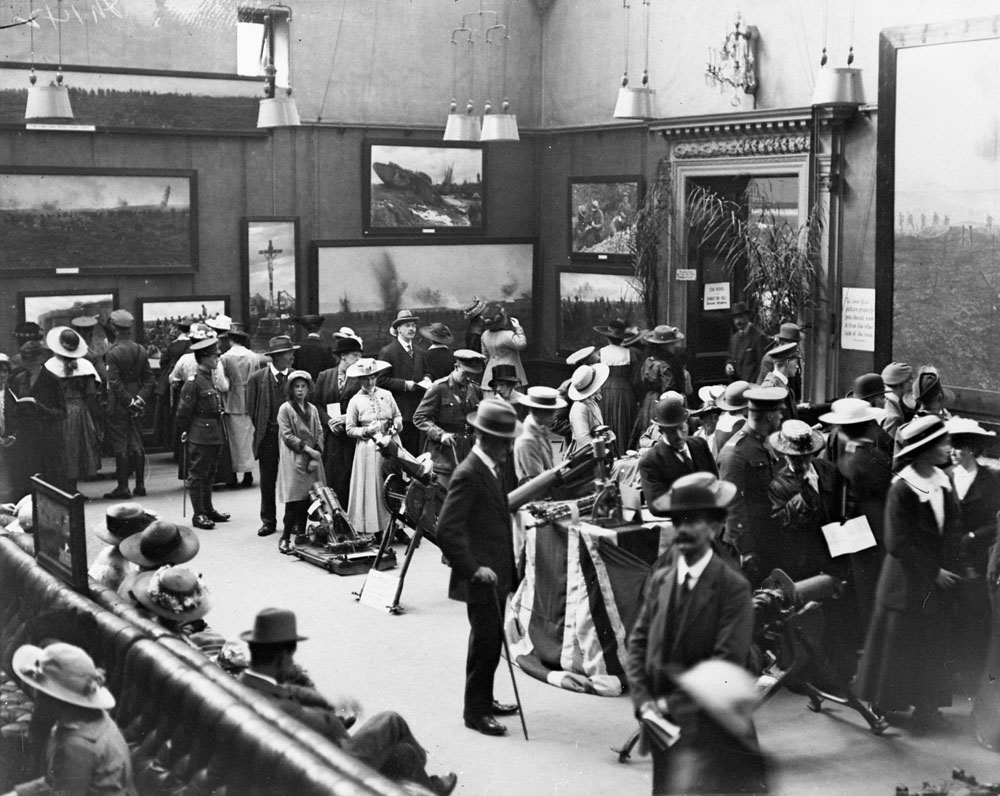
The Canadian War Records Office, established in January 1916, immediately recognized the importance of photography, both for keeping a lasting documentary record of the war and for boosting morale. The first official Canadian war photographer was appointed in April 1916. That same year, the first of several immensely popular exhibitions of official Canadian war photographs was unveiled at the Grafton Galleries, in central London.

Princess Christian among others viewing images at the Second Exhibition of Canadian Battle Pictures, Grafton Galleries, London, July 1917 (MIKAN 3394829)

Princess Christian among others viewing images at the Second Exhibition of Canadian Battle Pictures, Grafton Galleries, London, July 1917 (MIKAN 3394829)

Today, Library and Archives Canada’s (LAC) holdings include most of the negatives created by Canada’s official war photographers, preserved in their original glass plate format. These are some of the most poignant, horrifying, and yet compelling images in LAC’s photography collection.

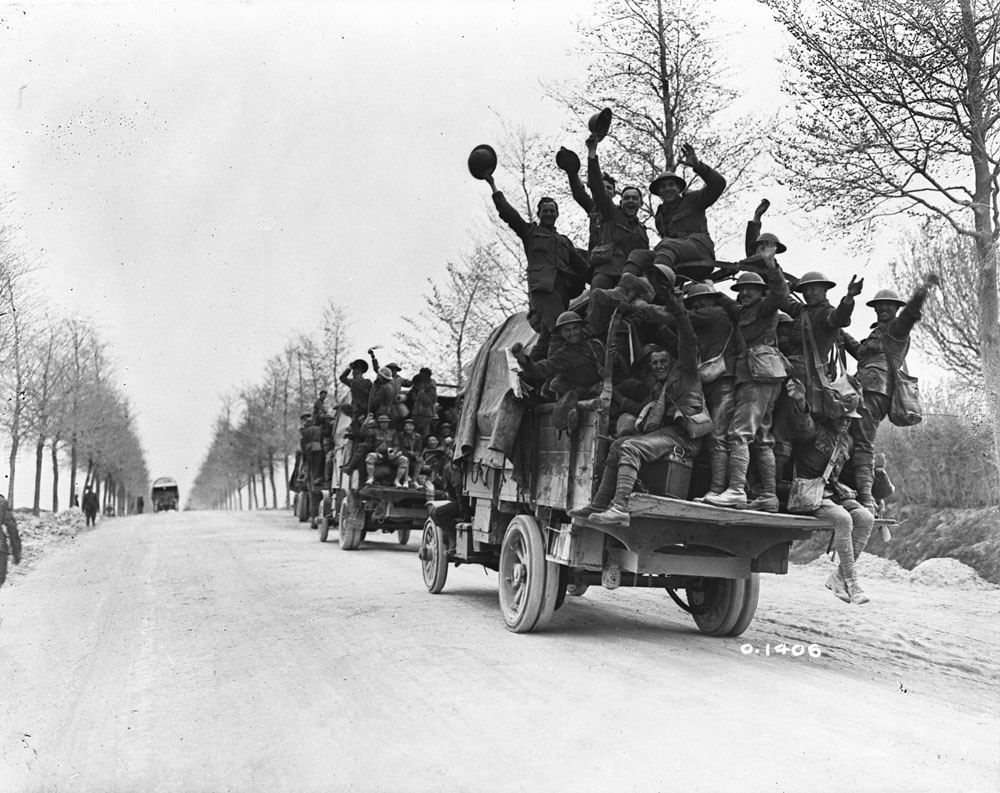
The Great War, the Persuasive Power of Photography, a new exhibition at the National Gallery of Canada, curated by Ann Thomas, incorporates many of these negatives in the near-exact recreation of one entire room from the second Grafton Galleries exhibition, held in 1917. The room, which is designed to put the modern viewer in the shoes of a viewer from 1917, features a dramatic to-scale reproduction of a photograph of the Battle of Vimy Ridge, called the largest photograph ever made during its time. It also includes a cropped version of this photograph of Canadian troops after the battle.

Canadian troops en route to destination for a rest period after taking part in the capture of Vimy Ridge (MIKAN 3521924)

Canadian troops en route to destination for a rest period after taking part in the capture of Vimy Ridge (MIKAN 3521924)

View from inside the Grafton Galleries, London, at the Second Exhibition of Canadian Battle Pictures, July 1917 (MIKAN 3394834)

View from inside the Grafton Galleries, London, at the Second Exhibition of Canadian Battle Pictures, July 1917 (MIKAN 3394834)

Canada’s official war photographers:

  • Captain Henry Edward Knobel (April 1916 to August 1916)
  • William Ivor Castle (August 1916 to June 1917)
  • William Rider-Rider (June 1917 to December 1918)

See other images reproduced for the room or visit the exhibition at the National Gallery of Canada from June 27 to November 16, 2014.

Arctic Images from the Turn of the Twentieth Century

Explorers and travellers have long been documenting their Arctic adventures in diaries, manuscripts, maps, sketches and watercolours. Their accounts portray the Arctic as a mystical land, whose inhabitants and way of life seem unspoiled, and this imagery was further disseminated to audiences abroad with the invention of the photograph.

The following photographs are part of the Arctic Images from the Turn of the Twentieth Century exhibition presented at the National Gallery of Canada. Featuring material from Library and Archives Canada’s collections, the exhibition showcases rarely seen images, which document photographers’ travels in the Canadian north. In many cases, these images present a romanticized view of the people and places.

One of the earliest images is this photograph of a hunter, taken by George Simpson McTavish while he was stationed at the Hudson’s Bay Company at Little Whale River, Quebec, in 1865.

Portrait of a hunter, a beluga, a seal skin “daw” (a buoy), and a kayak along the edge of the Little Whale River, Quebec. Photographer: George Simpson McTavish (MIKAN 3264747)

Portrait of a hunter, a beluga, a seal skin “daw” (a buoy), and a kayak along the edge of the Little Whale River, Quebec. Photographer: George Simpson McTavish (MIKAN 3264747)

The majority of photographers who ventured to the Arctic regions were men, and for the most part, were employed by the Hudson’s Bay Company and the Canadian government. Geraldine Moodie was one of the few female photographers. She had a successful photography studio prior to moving north with her husband when he was posted to the North West Mounted Police station in Fullerton (Qatiktalik in Inuktitut), Nunavut. Her portrait of an Inuit widow and her children, taken around 1904, is a good example of her beautifully composed images.

Widow and her children, Nunavut, by Geraldine Moodie (MIKAN 3376416)

Widow and her children, Nunavut, by Geraldine Moodie (MIKAN 3376416)

The vast majority of photographs of Inuit emphasized the ethnological attitudes of the era by presenting them as “types,” such as this 1926 image of an unidentified man.

Unidentified man, Chesterfield Inlet (Igluligaarjuk), Nunavut, by Lachlan T. Burwash, Department of Indian and Northern Affairs (MIKAN 3376543)

Unidentified man, Chesterfield Inlet (Igluligaarjuk), Nunavut, by Lachlan T. Burwash, Department of Indian and Northern Affairs (MIKAN 3376543)

In other cases, Canadian government staff took photographs to highlight federal government initiatives and policies, such as this 1948 image of four women looking at a family allowance poster. Below it, also from Health and Welfare Canada’s Medical Services Branch, is the portrait of Bella Lyall-Wilcox carrying her baby sister, Betty Lyall-Brewster. Taken in 1949, the lighting and composition of this portrait link it aesthetically to the pictorial tradition of the majority of photographs in this exhibition.

Women looking at a family allowance poster, Baker Lake (Qamanittuaq), Nunavut, by unknown photographer, Health and Welfare Canada (MIKAN 3613868)

Women looking at a family allowance poster, Baker Lake (Qamanittuaq), Nunavut, by unknown photographer, Health and Welfare Canada (MIKAN 3613868)

Bella Lyall-Wilcox (left) and Betty Lyall-Brewster, Taloyoak (formerly Spence Bay), Nunavut, by Studio Norman, Health and Welfare Canada (MIKAN 3613832)

Bella Lyall-Wilcox (left) and Betty Lyall-Brewster, Taloyoak (formerly Spence Bay), Nunavut, by Studio Norman, Health and Welfare Canada (MIKAN 3613832)

The Arctic Images from the Turn of the Twentieth Century exhibition opened on March 14, 2014, and will continue until September 1, 2014, at the National Gallery of Canada. For more information about LAC’s photographic collections portraying Inuit and the Arctic, visit our Project Naming web page.

Insight into Library and Archives Canada’s collection: interview with photographer Martin Weinhold

Recently, the Library and Archives Canada Discover Blog had a chance to interview documentary photographer Martin Weinhold about some of his photographs of Canadians at work, held in Library and Archives Canada’s collection.

Kenwyn Bertrand, I, worker.

Kenwyn Bertrand, I, worker. MIKAN 3842771, e010934568

  1. These photographs are part of a larger series. In just a few words, please tell us what series this is and what inspired it?
  2. The photographs are part of the “WorkSpace Canada” collection, a long-term project that still is a work in progress. The project’s goal is a general description of the world of work in Canada in the early 21st century; a kind of visual inventory centred around the human aspect of labour, work and action. The idea for this photographic documentary was triggered in 2005 when I read Hannah Arendt’s book “The Human Condition.”

    Kenwyn Bertrand, II, worker.

    Kenwyn Bertrand, II, worker. MIKAN 3842782, e010934567

  3. Please tell us why you chose to take three different photographs of the same subject?
  4. I wanted to introduce Kenwyn Bertrand, a worker at a car shredder yard in Hamilton, Ontario, with a threefold approach: giving the viewer a notion of the work environment and the activity happening there, as well as showing a facet of his individual personality. This pattern is the general approach for the “WorkSpace Canada” series.

    When I came to the car shredder yard I had a kind of production schedule already in mind. From previous visits and observations I knew the so-called picking shacks were one part of the operation, and I knew they were a must in the overall description of the place. I wanted to visually translate what it was like being on shift there. Kenwyn and I discussed what would be important for me to photograph and what wouldn’t. For Kenwyn, being at his workplace meant this repeated waiting for the copper parts among the rubbish on the conveyor belt—the whole reason his job existed. Then there was the locker room, the place where every shift began and ended. And the only possible place for a portrait. Although for privacy we had to wait until every worker from Kenwyn’s shift had left.

    Kenwyn Bertrand, III, worker.

    Kenwyn Bertrand, III, worker. MIKAN 3842786, e010934566

  5. How can we tell that these are Martin Weinhold photographs?
  6. I think—I hope—the intensity of my dealing with the subject can be seen. I try to establish an intense relationship with every person I photograph. Time is the crucial precondition for that. Time is the luxury I insist on having with my documentary work. If the viewer can read the intensity in my photographs and see it as typical for a Martin Weinhold photograph—that would make me very happy.

About Face: Library and Archives Canada portrait exhibition at Queen’s Park

Three original works of art and over 30 high-quality reproductions from the Library and Archives Canada (LAC) portrait collection are on display in the Lieutenant Governor’s Suite at Queen’s Park in Toronto until March 31, 2014. The portraits are part of About Face: Celebrated Ontarians Then and Now, an exhibition developed by the Office of the Lieutenant Governor of Ontario in collaboration with LAC. These historical and modern portraits represent men and women from a wide range of cultural backgrounds and walks of life, who helped shape the Ontario of today.

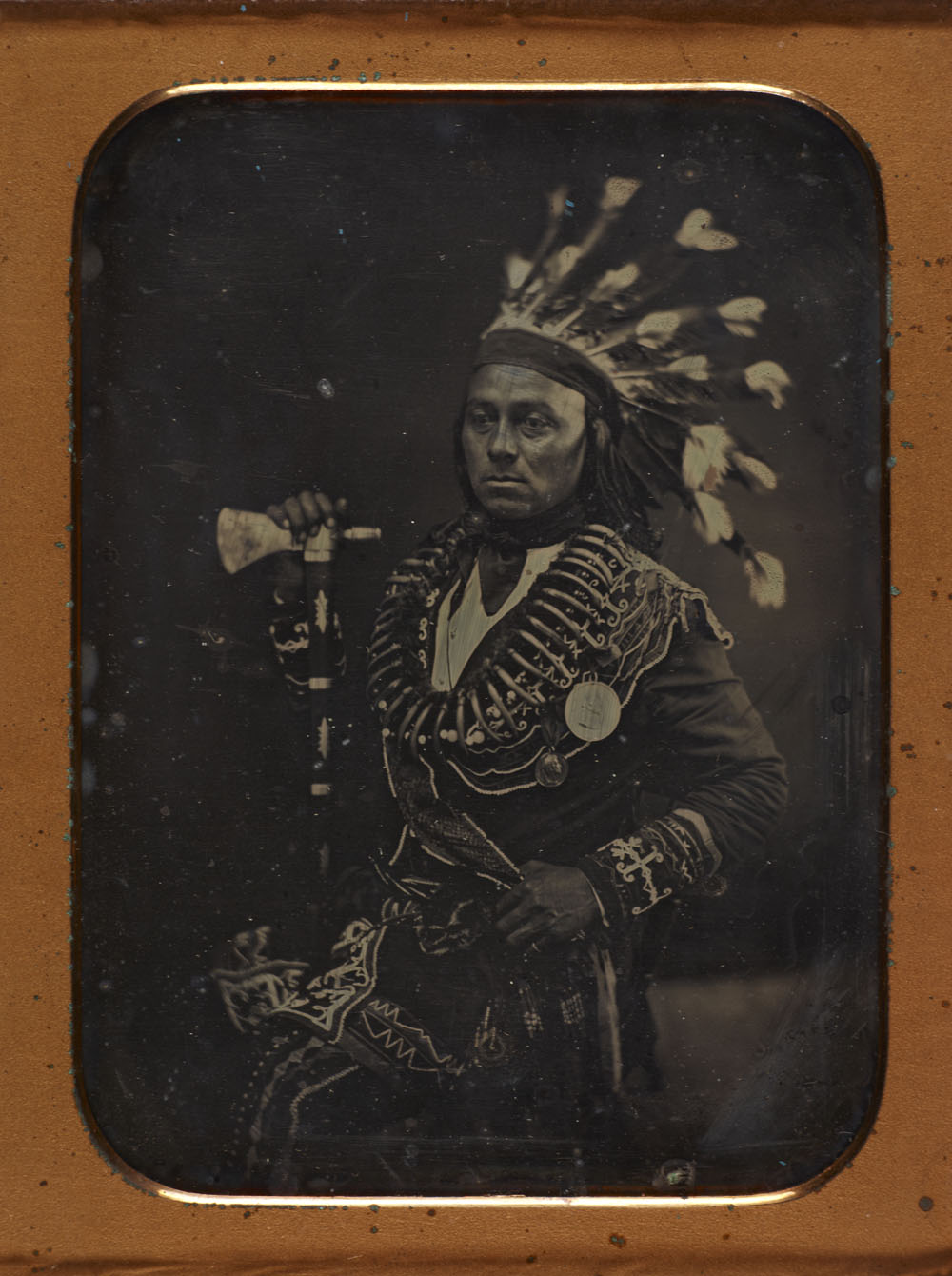
This rare portrait of Maun-gua-daus, for example, is one of the earliest photographs of an Indigenous person in LAC’s collection. A member of the Ojibway nation, Maun-gua-daus was educated by Methodist missionaries and served as a mission worker and interpreter in Upper Canada (now Ontario). From 1845 to 1848, he took part in a tour of England, France and Belgium, demonstrating the ritual, dance and sport found in Ojibway culture. This photograph was probably taken during that tour, in about 1846. It was made using the daguerreotype process, the first method widely used for producing photographic images.

Maun-gua-daus (or Maun-gwa-daus), alias George Henry, original chief of the Ojibway nation of Credit (Upper Canada)

Maun-gua-daus (or Maun-gwa-daus), alias George Henry, original chief of the Ojibway nation of Credit (Upper Canada) (Source: MIKAN 3198805)

An iconic portrait of figure skater Barbara Ann Scott was taken in 1946 by another notable Ontarian, Yousuf Karsh. At the time, the young lady from Ottawa was a Canadian national champion, but had yet to win a European championship and a world figure-skating title. Scott became “Canada’s sweetheart” and Olympic gold-medal champion in 1948, at the age of 19. In this photograph, Karsh frames the skater’s youthful face in what appears to be a saintly halo.

Barbara Ann Scott

Barbara Ann Scott (Source: MIKAN 3192044)

Come see for yourself! Contact the Office of the Lieutenant Governor of Ontario, Queen’s Park to arrange a viewing of the exhibition.