Discover the Access Codes for Archival Records at Library and Archives Canada – Part III

Earlier blogs (Part I and Part II) on restricted records explained the various codes that govern access to Canadian federal government records at Library and Archives Canada. In Part I, we learned that access code “32” beside a reference to a particular archival container means that the material is restricted under the provisions of Canada’s Access to Information Act and Privacy Act. However, that doesn’t mean that all of the container’s contents are restricted.

Each year, many files in archival containers are requested by researchers, and in many cases those files are open. But in order for an entire archival container to have access code “90,” meaning that it is open for research, all the files in that particular container must be open. Even if one file or just part of one file is restricted, the code against the container remains 32 – closed. However, researchers wishing to access a container marked code “32” have the right to submit a request for the material they need.

It is quite possible that the file or files to be consulted have already been reviewed and are accessible. The only way to know is to order the ones you wish to see. Library and Archives Canada’s Access to Information and Privacy staff will examine the request, and if the particular file or files requested have been previously reviewed and opened, you will receive them in an “interim” archival container.

For more assistance, you may ask Library and Archives Canada’s consultation staff or Access to Information and Privacy team.

Historical Debates of the Parliament of Canada (Hansard) now online!

Congratulations to the Library of Parliament and Canadiana: the Historical Debates of the Parliament of Canada portal is now live!

This new portal contains the historical debates in both official languages from 1867 to the mid-1990s. This means you can now search and browse all published debates of both the Senate and the House of Commons from Parliament 1, Session 1, until the coverage begins on parl.gc.ca.

As mentioned above, the portal was developed by the Library of Parliament, in collaboration with Canadiana.org, a membership alliance dedicated to building Canada’s digital preservation infrastructure and providing wide-ranging access to Canadian documentary heritage. Library and Archives Canada is pleased to have provided support by producing the digital page images.

You can consult our blog Looking for the Debates of the House of Commons (Hansard) online? of June 2012 to help you find information on the House of Commons debates.

From our rare book vault: What makes a book rare?

Version française

When you hear the words “rare book,” you might think of an old, valuable book that’s hard to find. That’s a pretty good general definition, but let’s take a closer look at some factors that can make a book “rare”:

Age

Although old books are often rarer than new books, age can be relative. The first printing press did not arrive in Canada until 1751—about 300 years after the first books were printed in Europe. A book printed in France in 1760 might not be considered very old. By contrast, one printed in Canada in the same year is extremely old, in Canadian terms. And, at Library and Archives Canada (LAC), we consider anything printed in Canada before 1867 old enough to go in the Rare Book Collection.

Provenance

A book’s provenance is the history of its origin and ownership. A book once owned by a famous person may have added value, particularly if the owner signed it or made notes in the margins.

[Coloured photo of a book’s front inside cover, with William Lyon Mackenzie King’s inscription dated September 8, 1894 on the right page. The opposite page has a Public Archives Canada/Archives publiques Canada book plate.]

William Lyon Mackenzie King’s inscription on the front page of An Introduction to the History of the Science of Politics by Sir Frederick Pollock (OCLC 1056964672).

Physical condition

A book in perfect condition is more desirable than one with a detached cover and missing pages. Maps or illustrations, or an intricate binding may also add to a book’s rarity. Old books do not always live their entire lives between the same covers, and it is common to find several copies of the same book that look different on the outside.

Scarcity

If there aren’t many copies of a book, it is, by definition, rare. Books printed in editions of fewer than 300 copies generally go into LAC’s Rare Book Collection, regardless of their publication date.

Significance

Some books, such as first editions of well-known novels, have more historical value than others. However, significance can be subjective; collectors may see value in a little-known edition of a favourite author’s work, while others might look at the same book and see no value at all.

That being said, a book might have all these qualities and still not be considered “rare” if no one is interested in it. In the end, rarity, like beauty, is often in the eye of the beholder.

Visit our Facebook album for illustrations of some of these points.

Stay tuned for upcoming articles as we explore the hidden gems in LAC’s rare book vault!

Hidden Treasures – Winnie the bear

Discovering hidden treasures in our institution’s vast collection of archival material is one of the exciting benefits of researching at Library and Archives Canada (LAC). Recently, two previously undescribed photographs of the bear mascot Winnie, the famous Canadian inspiration for A.A. Milne’s Winnie-the-Pooh stories, were found and made available online.

A reference technician from LAC was searching for First World War photographs taken in March 1915 of the 15th Canadian Battalion in the trenches of Neuve-Chapelle, France. The technician consulted the usual sources (online database, onsite Finding Aids, and contact cards from the Department of National Defence photographic collection) and found a description of a possible and unexpected item in the personal collection of Horace Brown.

The photographs from this collection were retrieved from storage; some of them were very small and difficult to view. One seemed to be of a soldier wearing a very odd hat. Further investigation with the aid of a lighted magnifying glass revealed the “soldier” was actually a bear cub and the curious headgear was its ears! A second image of the bear cub was also identified in the collection. A bit of sleuth work revealed that Horace Brown, a member of the Canadian Expeditionary Force, had been stationed at Salisbury Plain, England during October and November 1914, at the same time as Lieutenant Harry Colebourn with his mascot, Winnie.

Although many photographs exist of the famous bear in the Manitoba Archives and private collections, these were the first ones to be identified in LAC’s holdings. The images may now be viewed by all Winnie the bear (and Winnie-the-Pooh) fans here and here on our website.

Harry Colebourn with Winnie the bear - Salisbury Plain.

Harry Colebourn with Winnie the bear – Salisbury Plain. (e011067493-v8)

Harry Colebourn with Winnie the bear - Salisbury Plain.

Harry Colebourn with Winnie the bear – Salisbury Plain. (e011067494-v8)

How to read AMICUS records—Part 2

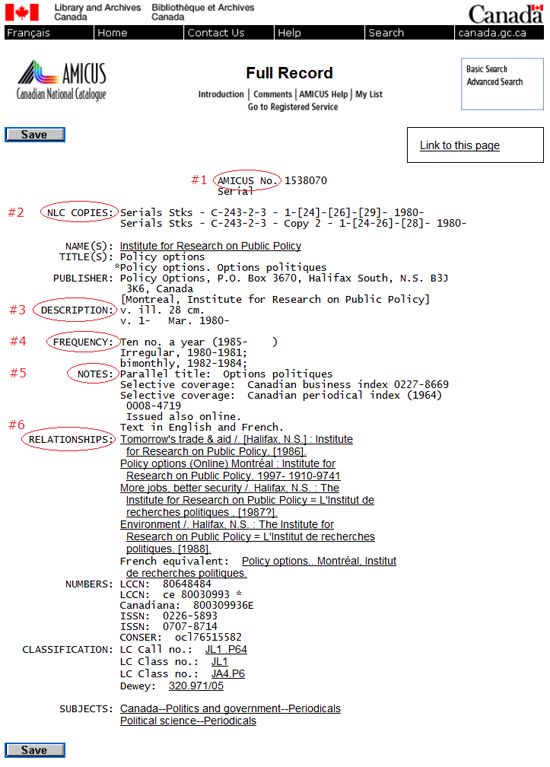
Our previous article on this topic explained how to decode an AMICUS record for books, documents and reports (monographs). Today’s article provides you with tips on decoding an AMICUS record for journals, magazines, newspapers or any type of ongoing publication (serials).

To help you better understand, the numbers on the image correspond to the fields described in the article.

Screen capture of the AMICUS full record with corresponding fields (source: AN1538070)

1. AMICUS No.: Keep track of this number! You will need it to request issues of the serial, whether you place a request for retrieval before visiting Library and Archives Canada (LAC) or once you are on site.

2. NLC (National Library Collection) Copies: Provides key information on which issues of the serial record are available in our collection. It is essential to distinguish between the LAC holdings for the serial found in NLC Copies (No. 2) and the description of the publishing history of the serial found in the Description (No. 3). The complete run of a serial is sometimes unavailable at LAC or may be available in a microform version. If a microform version exists, it will be included as a link in Relationships (No. 6).

The following punctuation marks are used to describe serial holdings:
Punctuation Mark Meaning Example
Hyphen   An unbroken range of holdings v. 1-30 means the library has each issue of the serial from volumes 1 to 30 in its holdings.
Square brackets  [ ] Incomplete holdings [1950] means that holdings include some issues published in 1950.
Question mark  ? Uncertain holdings information v. 18-42? means that holdings may include volumes 18 to 42.
Slash  / A single physical item with two connected volumes v. 12/13 indicates that volumes 12 and 13 are contained in a single physical item.
Comma  , A gap in the holdings v. 1-3, 5 means the library has volumes 1 to 3 and 5 but not volume 4.
Semicolon  ; A publication break (not a gap) in the holdings v. 1-3; 5- indicates that after volume 3 the publisher jumped to 5 without publishing volume 4.

3. Description: Indicates when the serial began publication.

4. Frequency: Specifies how frequently the serial has been published over the years.

5. Notes: Offers additional information about the serial, such as where it has been indexed and its alternate titles.

6. Relationships: Provides links to related versions, for example, in other languages or in other formats, such as a journal available online or on microfilm. In this case, you will find a link to the online version of this journal held in our electronic collection.

Questions or comments? We would love to hear from you!

How to read AMICUS records—Part 1

Have you ever used our AMICUS library catalogue to try to find a book and were unsure about how to decode the information?

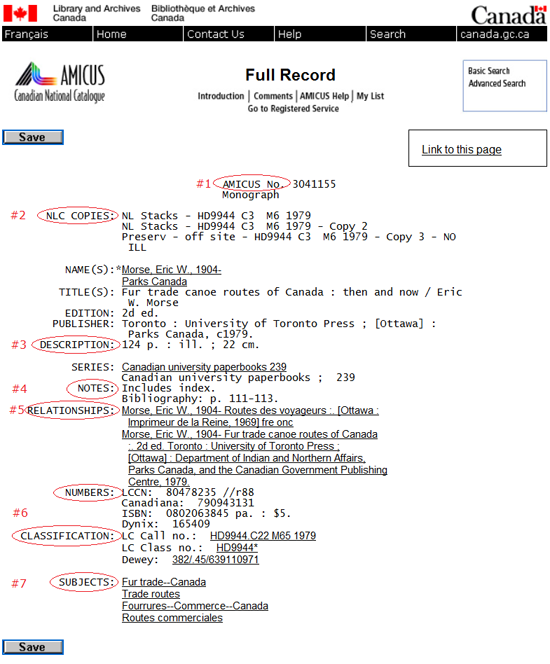
Here are tips on decoding an AMICUS record for books, reports or documents (monographs). To help you better understand, the numbers on the image correspond to the fields in the article.

Screen capture of the AMICUS full record with corresponding fields (source: AN 3041155)

1. AMICUS No.: Keep track of this number! You will need the AMICUS No., the name(s) of the author(s) and the title of the work to place a request for retrieval before visiting Library and Archives Canada (LAC) or once you are on site. Immediately below the AMICUS No., the type of record is specified; this tells you if the record is for a book, a report or a document (monograph), or a journal, a magazine, a newspaper or any type of ongoing publication (serial).

2. NLC (National Library Collection) Copies: Indicates the number of copies available at LAC. If you do not find NLC copies in the record, start your search over and make sure that you are searching the LAC catalogue only, not the entire database. As we are a closed stack library, the shelf location information is for internal purposes only and is not useful to you. Please note that preservation copies are presently unavailable.

3. Description: Tells you the number of pages and if the work contains illustrations or maps.

4: Notes: Provides additional information about the work, for example, other title information, additional information on the contents, whether it contains bibliographic references.

5. Relationships: Provides links to related versions of the work, for example, in other languages or in other formats, such as online or on microfiche.

6. Numbers and Classification: Generally of interest to other libraries only. The call numbers are suggestions for other libraries and are not LAC call numbers.

7. Subjects: Provides the standardized subject headings assigned to the work. Click on any subject heading to find additional materials on that topic.

Stay tuned for an upcoming article on how to read AMICUS records for journals, magazines, newspapers or any other type of ongoing publication (serials).

Questions or comments? We would love to hear from you!

How to make the most of your reference appointment

Reference librarians and archivists at Library and Archives Canada (LAC) are happy to assist you by:

• showing you how to make the best use of our research tools
• directing you toward suggested resources

You may wish to take a proactive approach to your research project before making a reference appointment. Being better prepared in the following ways will allow you to maximize your time with a LAC professional.

Have you laid the groundwork using sources near you?

Local municipal and university libraries provide a wealth of resources to researchers. These resources are an important first stop for anyone embarking on a historical research project.

Read everything you can about your subject. Books and journal articles provide important background and context for your research project. Verifying the bibliographies and source citations of such published items can often help identity additional research resources, which may or may not be held at LAC.

Take notes! When consulting any source, be sure to take well-organized notes and to fully transcribe all references. For published sources, you will need to have the complete title, the author’s name, and the place and date of publication. For archival sources, be sure to note the name of the archives that holds the records, the collection name, collection code, box or volume number, file titles and dates. Bring these references to your appointment at LAC along with the tools necessary for taking additional notes.

Have you done a preliminary search with our online tools?

Our Academic Researchers page can help you set the stage. If you are unfamiliar with what an archive is, we recommend our guide on Using Archives and our blog post Discover Finding Aids!

Remember that not everything we have is available online.

Do you have the right archive or library?

LAC holds a wealth of archival material of national and federal significance relating to Canadian history. However, we do not hold everything. Provinces, universities, counties, cities, corporations and social organizations all maintain their own unique archival and library collections. Depending on your topic, these may prove to be not only the most relevant but possibly the only resources available to you.

For example, information relating to land grants, local land titles and lot history is generally held at the provincial level. If you are interested in the history of a local arts festival or business, then the city archives or local historical society will likely be the best resource to consult. Please note that in the case of corporations and social organizations, their unique historical records may not be open for public research. In the case of some unique provincial resources, a fee for use may be required.

For the scientific research and innovation community, the Canada Institute for Scientific and Technical Information, which is the national science library at National Research Council Canada, represents a valuable online resource.

Access to Information and Privacy legislation or Donor restrictions and how they affect your access to our collections

Did you know that both government and non-government records held in the archival collections of Library and Archives Canada (LAC) are subject to access restrictions?

For federal government records, the Access to Information Act gives Canadian citizens the right to access information. It is also important to note that, in Canada, there is no “30-year rule” that applies to government documents, even if such rules exist in other countries.

For archival fonds or collections donated by private individuals, there will often be restrictions on research access. These are sometimes called “Donor restrictions.”

For access to both federal government records and documents donated by private individuals, legal mechanisms are involved and must be respected without exception.
So when you need to consult restricted material at LAC, you must factor into your project deadlines the time required to process your request. Processing time will vary based on the request and the materials involved.

For more information on restrictions and how to request access, please consult the Discover the Access Codes for Archival Records at Library and Archives Canada Part I and Part II pages on our blog.

Did you know that not everything is available online?

In an age when more and more information is available on the Internet, it is easy to assume that if you can’t find what you’re looking for online, it probably doesn’t exist. But this may not always be the case. For instance, at Library and Archives Canada (LAC), we have a vast collection of historical material. Yet most of this collection predates the digital era, which means that it just doesn’t exist in digital format.

It also means that not everything at LAC is indexed or discoverable online, and that you may not find something described in our online tools even though we have it.

So, if, after starting your research, using our major online tools, you cannot find what you are looking for, but suspect it is in LAC’s collection, make sure to ask us about it. Our knowledgeable reference librarians and archivists can help identify tools and resources to guide you in your research.

Stay tuned for our upcoming blog post on preliminary research and preparing for your reference appointment.

Summary of comments received in French up to September 30th, 2013

  • A user asked how to obtain the recording of an interview done in 1975 at the University of Moncton. LAC suggested to consult the Film, Video and Sound database. LAC also has recordings that are not described at the item level. For those, research needs to be done on premises to consult finding aids.

How to retrieve a Canadian newspaper when visiting LAC on site

Thanks to our article on “How to Find a Canadian Newspaper on Microfilm” you may now know how to easily access our Geographical List and how to read a newspaper entry. But how can you access these newspapers while you are on site at 395 Wellington Street in Ottawa?

Some of our newspapers on microfilm are available in the self-serve section on the third floor, but most need to be requested via AMICUS, our library catalogue. Once you have located your AMICUS number, you can make a retrieval request in AMICUS by following the steps below:

To access our AMICUS catalogue, go to one of our computer workstations and open the Internet browser. You can access the catalogue by selecting the “Library Catalogue – AMICUS OPAC” link from the workstation homepage.

Use the AMICUS number to get to the correct record by selecting the “AMICUS No.” option from the drop-down menu.

Remember:

Not all the AMICUS records have been updated to show all the newspaper dates available. If you don’t see your date listed in the AMICUS record, don’t worry! You can trust the dates given in the Geographical List even if you don’t see them in the AMICUS record.

Once you have found the right record for your date range, press the “Retrieve” button. Enter your date in the first space provided and don’t forget to enter your user card barcode number.

Your retrieval request will take 2 to 3 hours to process. You can then retrieve your microfilm reels in the third floor Consultation Room. Make sure to search for them under the first letter of your last name. You will find microfilm readers available in the same room. For more information on using these microfilm readers, consult our article “Tips and tricks on how to use a microform reader”.

Questions or comments? We would love to hear from you!