Introducing Co-Lab: your tool to collaborate on historical records

A turquoise banner with the words Co-Lab: Your collaboration tool Crowdsourcing has arrived at Library and Archives Canada (LAC). You can now transcribe, add keywords and image tags, translate content from an image or document and add descriptions to digitized images using Co-Lab and the new Collection SearchBETA.

Take on a challenge

To make it even more interesting, we will launch what we call “challenges”.  These challenges are content put together under a theme. For example one of our first challenges is on Rosemary Gilliat (Eaton)’s. Your challenge will be to transcribe her diary and describe her photographs from her Arctic travels. Or instead, try your hand at transcribing the love letters from Sir Wilfred Laurier to his sweetheart and future wife, Zoé – another challenge now available.

A screenshot of the Co-Lab Challenges page showing what challenges are available.Contribute using Collection SearchBETA

When you are conducting research using our new search tool and find images, you’ll see that you have the option to “enable this image for Co-Lab contributions”. After answering just a few short questions, you can enable an image found in Collection SearchBETA for Co-Lab use and transcribe/translate/tag/describe to your heart’s content. If an image has already been enabled for Co-Lab use, you’ll be able to add your own or edit the contributions of others’. If you create a user account, you will be able to keep track of your contribution history and be able to hear about new challenges and updates to Co-Lab.

A new way to view images

A screenshot of an excerpt of a handwritten letter in a window and on the right-hand side there’s a space to transcribe the letter and underneath is a box with the transcription status.

The launch of Co-Lab also introduces a new image viewer – which lets you scroll to zoom in on different parts of the image, or click and drag to move around the image itself. This is particularly useful when looking to transcribe or add keywords and image tags to describe small details!

What if something’s wrong?

It’s inevitable that mistakes will be made, especially when transcribing handwritten documents. Every image in Co-Lab is subject to review by other crowd members. If you see something written incorrectly, go ahead and edit it yourself, or mark it as “Needs review” for others to take a second, or third look.

The best thing about this new tool is that every contribution made by the public directly benefits fellow researchers and improves access. Every addition to a record becomes new metadata – which is searchable within 24 hours, helping LAC’s records become more “discoverable” day after day. Transcription of textual material that was previously just digital images also becomes accessible to those who use text-to-speech machines or screen readers, and translation of transcribed documents opens the door to unilingual Canadians.

For more info and frequently asked questions, you can read the About Co-Lab page. If you’re ready to start contributing, give a hand to history and try Co-Lab now.

New additions to Rare Books album now on Flickr, 2018

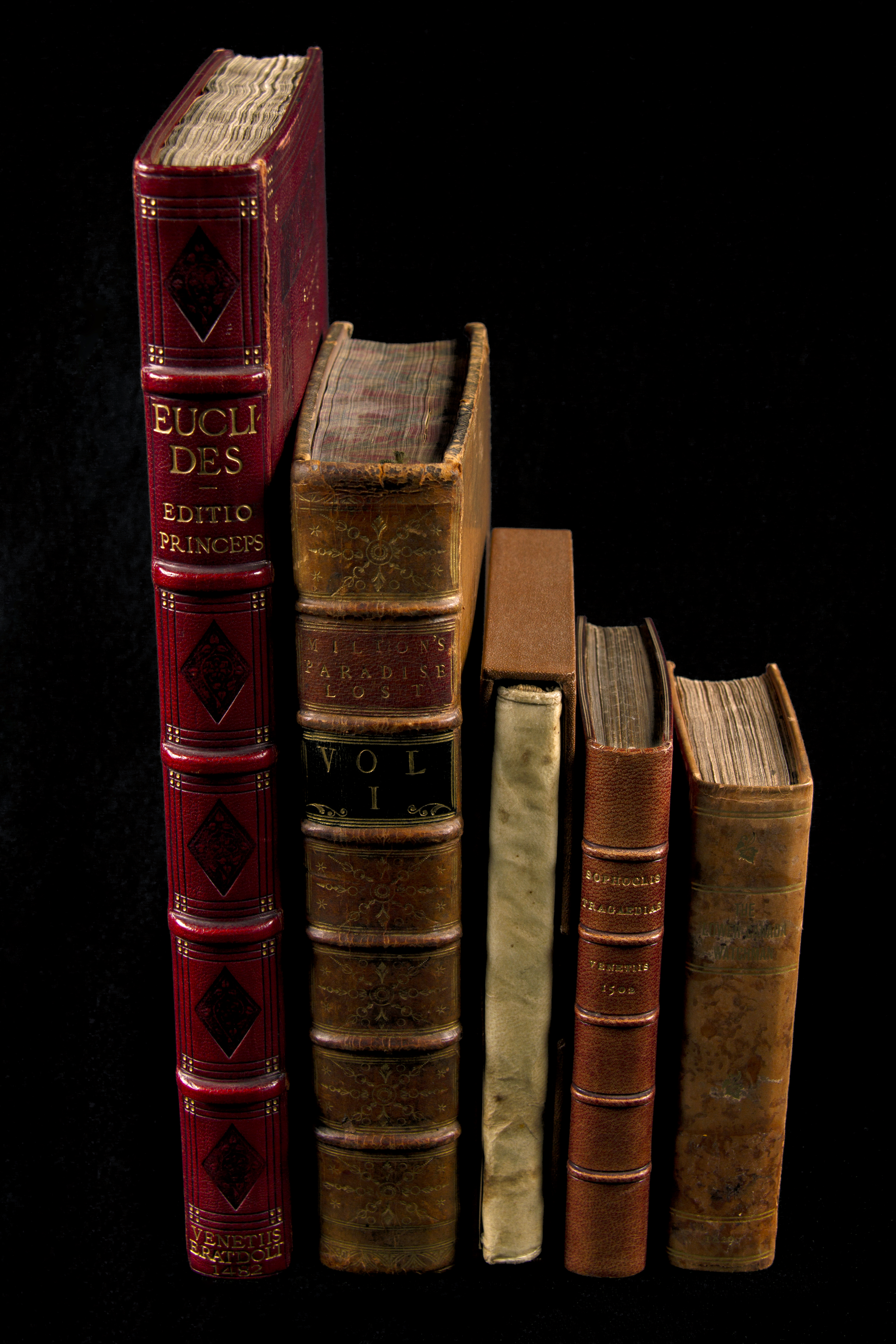
Colour photograph of a row of books: left to right: Euclid’s Elementa, 1482; Milton’s Paradise Lost, 1758; Relation de ce qui s’est passé en la mission des pères de la Compagnie de Iésus …, 1651; Sophocleos Tragoediai, 1502; The Lower-Canada Watchman, 1829.

Row of books [left to right: Euclid’s Elementa, 1482; Milton’s Paradise Lost, 1758; Relation de ce qui s’est passé en la mission des pères de la Compagnie de Iésus …, 1651; Sophocleos Tragoediai, 1502; The Lower-Canada Watchman, 1829. [Filename IMG_3472]

The Rare Book Collection at Library and Archives Canada is one of the largest collections of rare Canadiana in the world. Canadiana is defined as works printed in Canada or printed outside of Canada but concerning Canada, written or illustrated by Canadians.

Visit the Flickr album now!

Rosemary Gilliat’s Arctic Diary

Version française

By Katie Kendall

In June 1960, photographer Rosemary Gilliat (later known as Rosemary Gilliat Eaton), along with journalist Barbara Hinds, travelled across the Arctic. Northern Affairs Canada and the National Film Board of Canada sponsored her journey. Her assignment in Iqaluit (formerly Frobisher Bay, Nunavut), Kuujjuag (formerly Fort Chimo, Quebec), Kangiqsualujjuag (formerly George River, Quebec), Killiniq (formerly Port Burwell, Nunavut), and Cape Dorset (Nunavut), was to take photographs of life in the north. During this period, Gilliat kept an extensive diary of her travels, describing the people, places, ways of life, events, and even the flora and fauna she encountered.

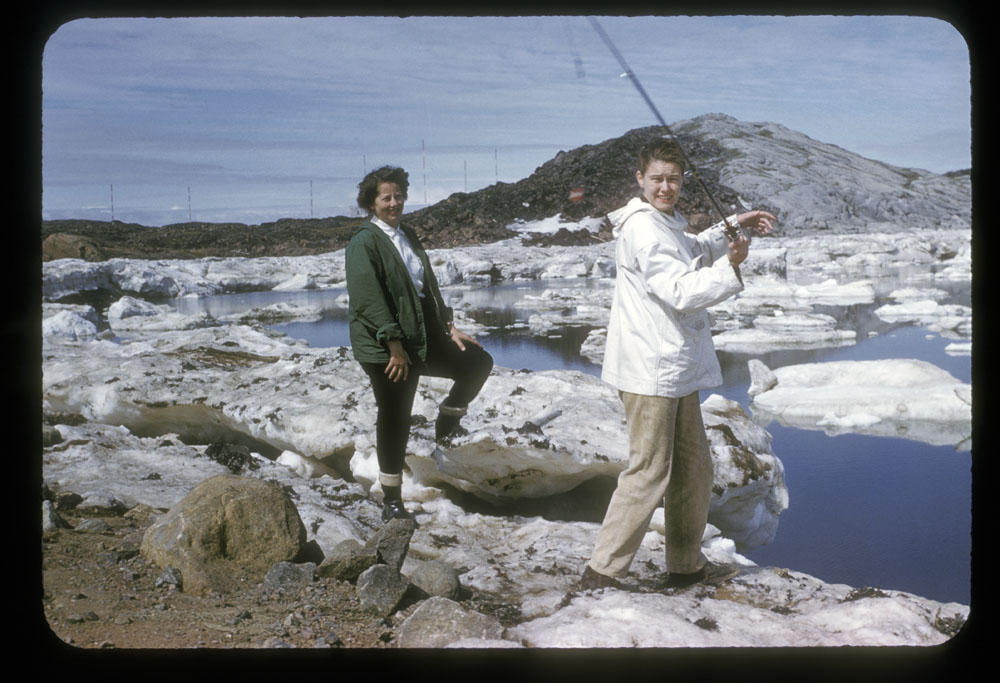
A colour photograph of two women fishing on the banks of a water body. They are standing on rocks and there are ice floes in the water.

Rosemary Gilliat (L) and Barbara Hinds (R) fishing. (MIKAN 4731485)

As a practicum student at Library and Archives Canada (LAC) this term, I read the diary in full, taking note of important dates, people, places, and events. This will help improve the archival descriptions of Gilliat’s photographs in LAC’s collection. Many of the photos taken by Gilliat during this trip have been included as part of Project Naming, a LAC initiative that enables Indigenous peoples to engage in identifying the people, places, and activities in historical photos. Gilliat’s 455-page diary and many of her photos from the Arctic will be available for the public to help transcribe, tag and describe in our new and upcoming tool Co-Lab!

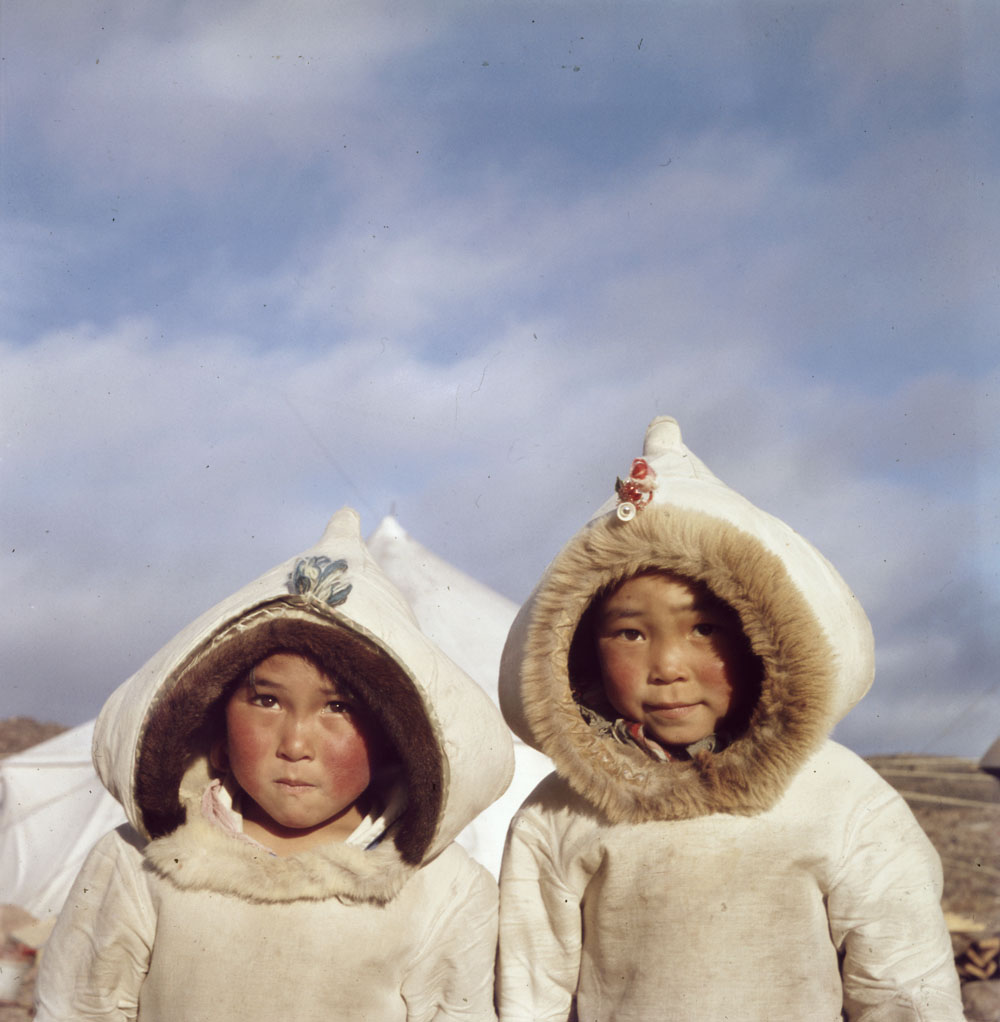
A colour photograph of two Inuit children wearing traditional coats in front of a white tent in a rocky landscape.

Two children wearing white parkas in the Arctic. (MIKAN 4324336)

Gilliat’s diary describes many fascinating aspects of the Arctic in the summer of 1960, reflected in the almost-daily entries. Gilliat describes the landscape of the north in spectacular detail, and particularly focuses on the Arctic flowers at the start of her travels, when she had not yet made many acquaintances. Her occasional frustration with friend and travel companion Hinds is relatable, and her frequent photographic mishaps (for example, forgetting to carry film) are amusing. The snippets of news from the outside world provide the reader with a glimpse of life at that time. For example, Gilliat receives news about the ongoing space race—Russian dogs Belka and Strelka successfully orbit the Earth and return from space in August 1960—prompting Gilliat to muse on when the world will see the first human in space, which would happen less than a year later in April 1961. Gilliat also takes note of women’s roles in the north, referencing the second wave women’s movement of the 1960s.

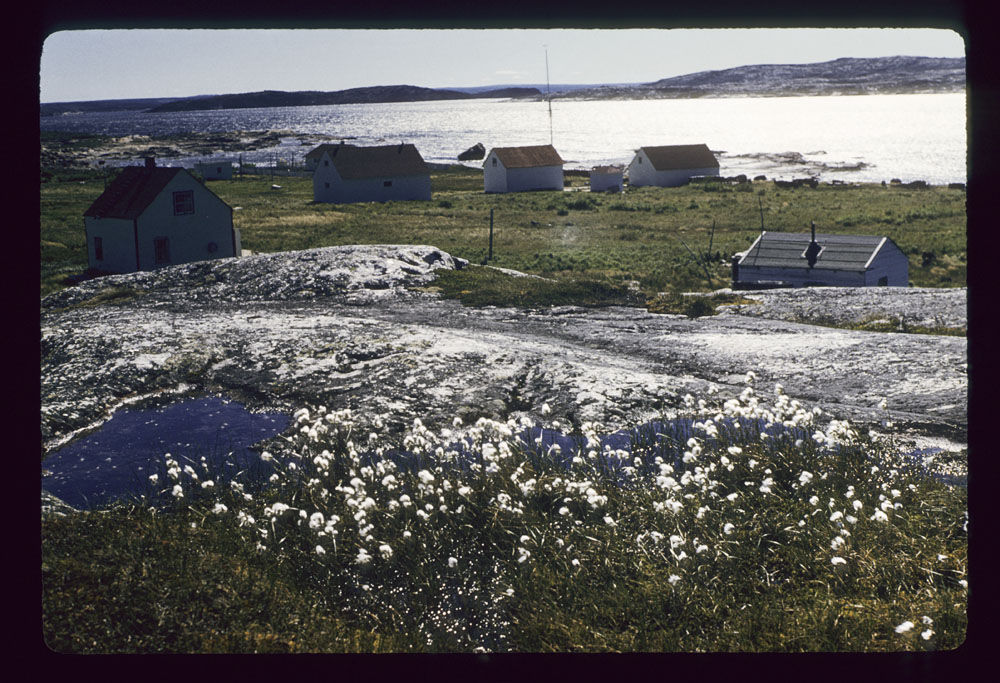
A colour photograph of a community of wooden houses on the shores of a water body. There are flowers in the foreground.

Landscape view of wooden houses by the water. (MIKAN 4731543)

Most importantly, Gilliat shares experiences with the Inuit of the communities she visits, accompanying members of the community while they fish for char, hunt for seals, and travel from one location to the next by boat or plane. Gilliat had a couple of near-death experiences travelling by boat through storms and ice, and was stranded a couple of times (once on an island for several days). In late August, she witnessed a beautiful polar bear swimming, only to realize that Eetuk, Isa, Sarpinak and Moshah, her Inuit companions, were going to kill it to provide food for their people. Gilliat’s expressive writing vividly explains her conflicting feelings on the event.

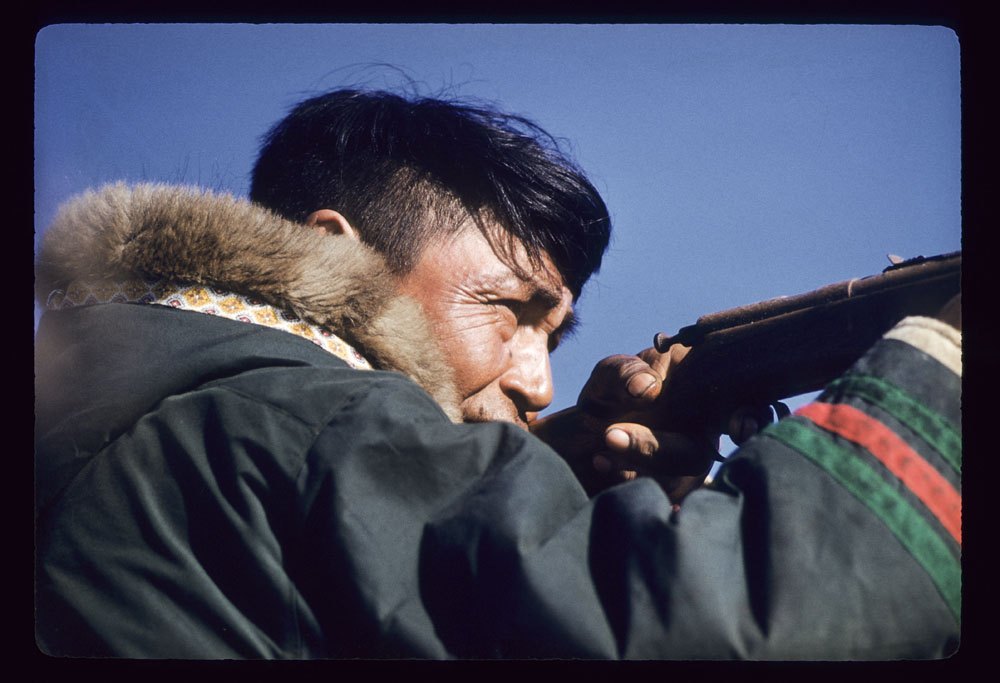
A colour photograph of a man seen in profile aiming a gun. He’s wearing a traditional fur-trimmed parka with alternating green and red stripes on the sleeves.

Oshaneetuk, a sculptor and hunter, on a seal hunt, Cape Dorset, Nunavut. (MIKAN 4731420)

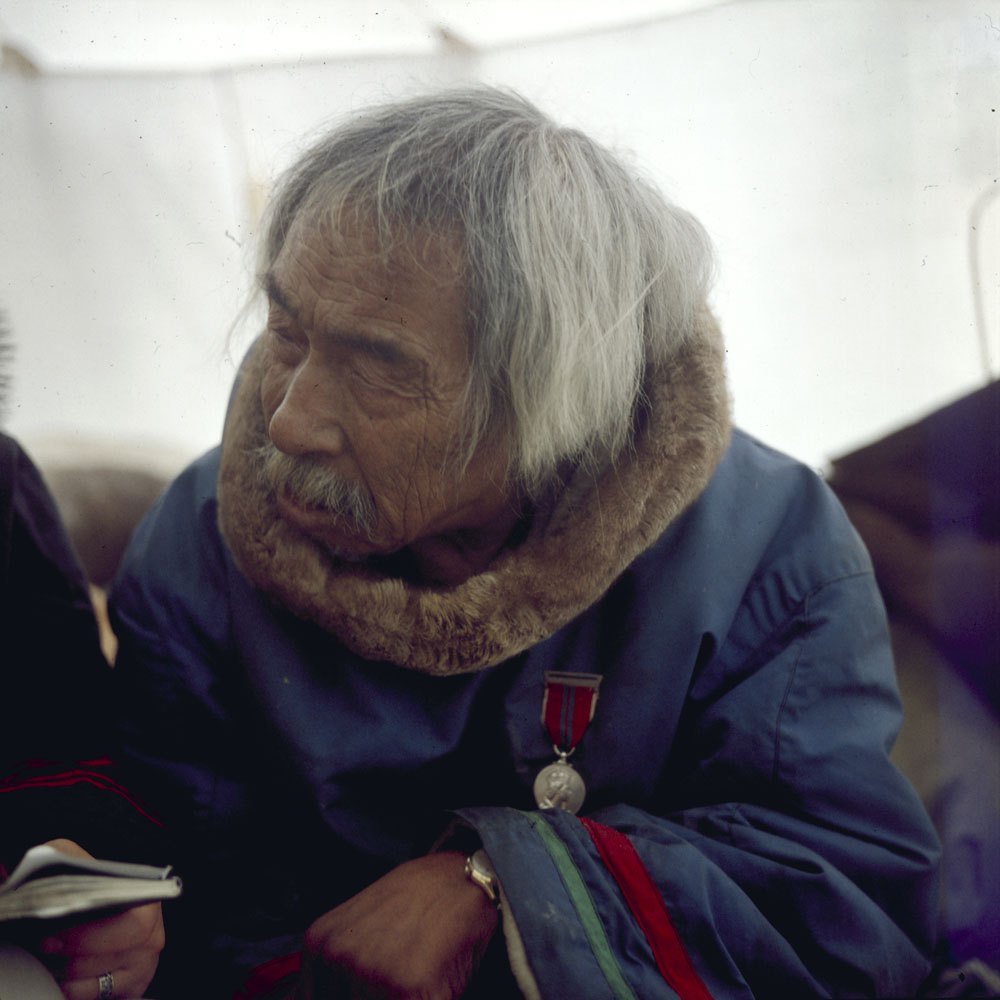
The hunting expeditions and tumultuous sailing events are thrilling, but the quiet moments between Gilliat and Inuit friends stand out. For example, in Cape Dorset, she meets Kingwatsiak, one of the oldest and most respected members of the community. Kingwatsiak invites Gilliat into his home and asks her to take a photograph of him. He also asks her to write a request on his behalf to Queen Elizabeth II. Kingwatsiak wishes for a photograph of her younger son, Prince Andrew, as his name (in English) is also Andrew. The letter is included in the diaries, and explains that he received a medal at the Queen’s coronation and travelled to Scotland as a young man and attended Queen Victoria’s Jubilee. He asks the Queen to deliver the photograph soon, as “I am now a very old man” and therefore may not have much time left.

A colour photograph of an elder wearing a traditional coat with green and red stripes on the sleeves. He is also wearing a medal with an image of Queen Victoria engraved on it.

Kingwatsiak in a tent, Cape Dorset, Nunavut. (MIKAN 4324230)

Although much of the terminology and ways of thinking are outdated, Gilliat’s descriptive anecdotes and direct observations makes the diary a joy to read. She remains objective but eternally optimistic, describing what she sees but never letting it dampen her outlook on the beauty of the Arctic and the kindness and resolve of its people.


Katie Kendall was a practicum student (MA Art History, Carleton University) in the Exhibitions and Online Content Division at Library and Archives Canada.

The Yves Baril fonds at Library and Archives Canada

By James Bone

Without a doubt, Yves Baril’s art has been printed more than that of any other Canadian artist. Yet, unless you’re absorbed in the world of Canadian philately or numismatics, you’ve also probably never heard of him. Known for his exquisite and detailed portraiture, Yves Baril is Canada’s master engraver, having produced engravings for more than 146 Canadian postage stamp issues, the Canadian bank notes printed from the late 1950s to 1990s, Canadian Tire money, share and bond certificates, labels and coupons. With millions of these products printed and circulating, and especially for the postage stamps and bank notes, Yves Baril’s work has passed through the hands of many—or perhaps most—Canadians.

Born in 1932 in Verdun, Quebec, Yves Baril grew up in Montreal’s southwest boroughs and studied the arts, including painting and typography, at the Montreal Museum of Fine Arts School and the Montreal School of Graphic Arts. Following his graduation, Baril would take up an engraving apprenticeship in 1953 in Ottawa with the Canadian Bank Note Company, Limited, a private printing company specializing in bank notes and security documents. Studying under master engraver Silas Robert Allen, Baril began by attempting to mimic the work of his teacher. His break came in 1955 when the Post Office Department rejected the engraving made by Allen for a stamp commemorating the immigration of homesteaders into Saskatchewan and Alberta. It was too late in the production cycle to start over, and in desperation Baril’s engraving was submitted as a substitute. Perhaps to everyone’s surprise, and to Allen’s chagrin, the Post Office preferred Baril’s version and accepted it, launching Baril’s career as an engraving artist.

An envelope from the Canadian Bank Note Company, Limited, sent to Yves Baril, Esq., c/o Canadian Bank Note Company, Limited, marked as First Day Cover, stamped with Day of Issue/Jour d’Émission, and signed by the engraver, Yves Baril.

Yves Baril’s autographed first day cover for the 1955 Alberta and Saskatchewan postage stamp he engraved, June 30, 1955 (MIKAN 3951112). Copyright: Canada Post Corporation (postage stamp), assigned to LAC (autograph).

Baril would spend the rest of his career with Canadian Bank Note, developing his craft with additional training with its parent company, American Bank Note, in New York City, and with its subsidiary, Bradbury, Wilkinson and Company, in London, England. In addition to Baril’s work on Canadian postage stamps, bank notes and company coupons, he is also credited with engravings for six United Nations postage stamps (used for sending mail from UN offices) and eleven United States postage stamps. His most notable work was in portraits of Queen Elizabeth II for postage stamps commemorating the royal visits in 1959 and 1964, based on a painting by Pietro Annigoni and a photograph by Anthony Buckley, respectively. These portrait engravings each required hundreds of hours of work and the Queen’s personal approval of the final product.

A red stamp featuring Queen Elizabeth II wearing a cape. An engraving of a crown is in the upper left corner.

Colour trial die proof for the 1959 royal visit (MIKAN 2212875). Copyright: Canada Post Corporation.

A block of four stamps depicting Queen Elizabeth II seated for an official portrait. Dressed in formal attire, she is wearing a crown and has a sash draped diagonally across one shoulder, clasped at the waist and adorned with jeweled pins.

Block of four postage stamps for the 1964 royal visit (MIKAN 2214233). Copyright: Canada Post Corporation

In 2009 and 2015, Yves Baril made donations of his archival material to Library and Archives Canada. These donations include log books that note which days and for how many hours he worked on each engraving, his own commentary on his work, commemorative first day covers for the issue of postage stamps featuring his work, and an album of philatelic treasures collected from material disposed by Canadian Bank Note. All of this material is available for consultation at Library and Archives Canada in the Yves Baril fonds. Also held at Library and Archives Canada in the Post Office Department fonds (RG3 / R169) are hundreds of other records related to the work of Yves Baril, including hundreds of proofs printed from his engravings and many of the original steel dies he engraved that were used to make printing plates for postage stamps.

A handwritten journal entry explaining the process for the production of a stamp.

Entry from Yves Baril’s commentary notebook on the 1973 caricatures postage stamp issues (MIKAN 4868428). Copyright: assigned to Library and Archives Canada.

Yves Baril recently visited Library and Archives Canada to discuss his fonds. While here, he spoke about his training, apprenticeship, work and experiences as a Francophone based in Ottawa through the latter half of the 20th century. He also showcased some of his other personal projects, including a steel die engraved to recreate Canada’s first postage stamp, the Three Pence Beaver, and a suite of engraving tools that he made by hand in the 1950s that are still functional today.

A picture of a stamp showing five generations of British sovereigns.

Design essay for an unissued postage stamp found in Yves Baril’s album featuring the British Monarchs from Queen Victoria to King George VI, including King Edward VIII, whose image does not appear on any Canadian postage stamp (MIKAN 4877973). Copyright: assigned to Library and Archives Canada.


James Bone is an archivist in the Private Specialized Media Division of the Private Archives Branch at Library and Archives Canada.


New additions to the Virtual Gramophone – Roméo Beaudry

By Margaret Ashburner

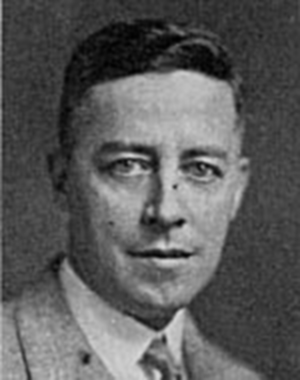
A black-and-white photograph of a man looking right at the camera and wearing a grey suit.

Roméo Beaudry. Source: Canadian Music Trades Journal, Toronto, Fullerton Pub. Co., September 1931, ISSN 0383-0705.

Roméo Beaudry was a key figure in the emerging gramophone music scene in Canada. He founded Starr Phonograph of Quebec and specialized in producing gramophone discs for the francophone market. In addition to this, Beaudry was a busy composer and translator. He wrote many unique and popular songs as well as adapting American songs to French. This selection of newly digitized 78’s provides examples of Beaudry’s extensive work as both a translator and a composer.


Margaret Ashburner is the Special Collections Librarian of the retrospective music collection at Library and Archives Canada

A diplomat, a Prime Minister, and a scholar: remembering Lester B. Pearson

Version française

By Mariam Lafrenie

It goes without saying that the Right Honourable Lester B. Pearson achieved much in his life. Whether you look at his success politically, academically or even athletically—Pearson always excelled. Although Pearson served as Canada’s prime minister from 1963 to 1968, his legacy and indeed his influence began long before his prime ministership: as chairman of the NATO council (1951), as President of the United Nations General Assembly (1952), and as a Nobel Peace prizewinner (1957).

Nevertheless, Pearson’s five-year legacy is very impressive: a new flag, the Canada Pension Plan, universal medicare, a new immigration act, a fund for rural economic development, and the Royal Commission on Bilingualism and Biculturalism which led to the foundation of a bilingual civil service.

A black-and-white photograph of a formally dressed couple. The man is holding a box with a medallion.

Lester B. Pearson and his wife, Maryon at the Nobel Peace Prize Award Ceremony, Oslo, Norway, December 1957. Photograph by Duncan Cameron. (c094168)

A black-and-white photograph of a man standing up and addressing a room of people.

Lester B. Pearson, at the United Nations Conference on International Organization, San Francisco, Calif., USA, 1945. (c018532)

Rising quickly through the ranks and moving from one portfolio to another, Pearson proved himself a worthy and talented diplomat. After a 20-year career in External Affairs, his success did not end there, but followed him throughout the next decade as leader of the Liberal Party (1958-1968). Without a doubt, some of his most exciting—if not his most significant achievements—came during his time as Prime Minister.

A flag for Canada

The quest for a Canadian flag—one that represented everything that Canada had become in the last century and all that Pearson hoped it could become—was fraught with bitter debate and controversy. Indeed, as many may recall, “The Great Flag Debate” raged for the better part of 1964 and saw the submission of approximately 3,000 designs by Canadians young and old.

“Under this flag may our youth find new inspiration for loyalty to Canada; for a patriotism based on no mean or narrow purpose, but on the deep and equal pride that all Canadians will feel for every part of this good land.” – Address on the inauguration of the National Flag of Canada, February 15, 1965

These words, spoken by Lester B. Pearson during the inaugural ceremony of the Red Maple Leaf flag on February 15, 1965 at Parliament Hill, highlight precisely what he aspired to achieve—a uniquely Canadian identity. Few prime ministers can attest to leaving a legacy so great as to have forged an entirely new cultural symbol for their country.

A black-and-white photograph of a man holding an illustration of the Canadian flag.

Lester B. Pearson’s press conference regarding the new flag, December 1964. Photograph by Duncan Cameron. (a136153)

A year of celebration

Not only was Pearson responsible for championing a new Canadian flag, but he was also lucky enough to remain in office during Canada’s centennial year. In his Dominion Day speech on July 1, 1967, Pearson called on Canadians to celebrate their past and their achievements, but also encouraged them to think of the future and of the legacy that they could leave for the next generation of Canadians. Much like this year, when we celebrated Canada’s 150th anniversary of Confederation and were encouraged to think of our future as a nation, 1967 was also a year filled with celebrations.

The aim of the centennial celebrations were twofold: to create memorable events and activities for all Canadians and to create a tangible legacy that current and future generations could enjoy. In fact, both the provincial and federal governments encouraged Canadians to celebrate by creating their own centennial projects—films, parades and festivals, tattoos, recreation centres, stadiums, etc.—and agreed to match their spending. One of the most memorable celebrations was that of the 1967 International and Universal Exposition or Expo 67, as it was nicknamed. Open from April 27 to October 29, Expo 67 is considered one of the most successful World’s Fairs and one of Canada’s landmark moments.

A colour photograph of a group of men standing in front of an enlarged map of New France.

Expo 67’s opening day with its General Commissioner Pierre Dupuy, Governor General of Canada Roland Michener, Prime Minister of Canada Lester Bowles Pearson, Premier of Québec Daniel Johnson and Mayor of Montréal Jean Drapeau. (e000990918)

For many Canadians, 1967 characterized the peak of nostalgia and indeed a year filled with optimism. With this optimism and increased governmental spending, Pearson’s popularity boomed and further solidified his accomplishments as prime minister and widespread support for the Liberal Party amongst Canadians.

Conclusion

Forty-five years ago, on December 27, 1972, after a long and successful political career, Lester B. Pearson passed away. His passing struck a chord with many Canadians as more than 1,200 people attended his funeral service to pay their last respects. Pearson’s legacy and indeed his name are still present today in the numerous awards and buildings named in his honour. Paving the way for what many Canadians and the international community alike have come to love about Canada, Pearson can be said to have shaped and indeed laid the foundation for the Canada we know today.

A black-and-white photo of man standing under an interesting architectural building.

Prime Minister of Canada Lester Bowles Pearson in front of the Katimavik at Expo 67. (e000996593)

The Lester B. Pearson fonds preserved by Library and Archives Canada consists of 435.71 meters of textual records, over 3,500 photographs, 315 audio recordings on various formats, 3 films totalling 47 minutes, 54 items of documentary art, and 98 medals.

Related links


Mariam Lafrenie is an undergraduate student research fellow from Queen’s University who worked in the Private Archives Branch at Library and Archives Canada during the summer of 2017.

Library and Archives Canada releases its latest podcast episode, “A Look inside the Preservation Centre

A colour photograph of a large modern building made out of glass with metal pillars.Ever wonder where Library and Archives Canada stores, protects and preserves Canada’s diverse and rich documentary heritage? Join us for this episode as we take you on a walking tour of LAC’s Preservation Centre in Gatineau, Quebec. This state-of-the-art facility is the crown jewel of documentary heritage preservation in Canada and we are celebrating its 20th anniversary in 2017. In this episode, we will guide you through the Preservation Centre, discussing its award-winning architecture and offering insight into how we store and preserve our national treasures.

To view images associated with this podcast, here’s a direct link to our Flickr album.

Subscribe to our podcast episodes using RSS, iTunes or Google Play, or just tune in at Podcast–Discover Library and Archives Canada: Your History, Your Documentary Heritage.

For more information, please contact us at bac.balados-podcasts.lac@canada.ca.

“Incited to Potlatch”

By Sevda Sparks

A potlatch is a ceremonial gift-giving feast practiced by indigenous people of the Pacific Northwest in Canada and the United States. The Canadian government’s potlach ban began in 1885, and underwent many amendments to strengthen it until its removal in 1951. Library and Archives Canada’s holdings include a wealth of material on the potlatch, including many letters and petitions on the suppression of the custom as well as efforts to continue it. Of special interest is the correspondence of Kwakwakawakw Chief Billy Assu, Indian Agent William Halliday, and British Columbia Chief Justice Matthew Begbie.

A black-and-white photograph of a streetscape with potlatch participants and items to be given away.

Potlatch, Alert Bay, British Columbia, June 1907 (MIKAN 3368269)

In the midst of the potlatch ban, Chief Billy Assu wrote to the deputy superintendent of Indian Affairs, J. D. MacLean, in 1919, explaining the potlach or “our old custom of giving away.” In describing the roots of the celebration, and the desire to retain it, Assu stated:

“We all know that things are changing. In the old days, the only things that counted were such things as food, dried fish, roots, berries, and things of that nature. A chief in those days would get possession of all these things and would pass them on to those who had not got any… ”

The potlach was a way to hold onto important cultural customs despite the changing times. Assu also commented more broadly on the potlatch in indigenous society:

“…some were trained to make canoes, some to hunt, some to catch fish, some to dry fish, some to get material to make our clothes, then we divided this up amongst the others. This was the beginning of our feast of giving away.”

Section 149 of the Indian Act, which banned the potlach, was a challenge to enforce, both practically and legally. It was difficult to determine exactly what the potlatch was, under the law, and to prove when it was happening. In 1889, Chief Justice Begbie found the legislation on the potlatch to be lacking when it came to sentencing, stating:

 “…if the legislature had intended to prohibit any meeting announced by the name of “potlatch” they should have said so. But if it be desired to create a new offence previously unknown to the law there ought to be some definition of it in the statute.”

The law was amended in 1895, and agents were particularly determined to prosecute those who were “incited to potlatch”, despite the lack of legal evidence in some cases, as demonstrated by William Halliday, agent to assistant deputy and secretary J. D. McLean in Ottawa. The methods of curtailing the potlach extended to holding meetings between agents and First Nations leaders, so that the agents could “read to them the specific article…and give reasons why the potlach should be condemned and done away with.” Agents deemed the tradition wasteful, leaving nations “near penury.”

After such a meeting, agent Halliday states:

“Yesterday and today they have been to a certain extent violating that section as they have been holding mourning ceremonies, part of which consists in singing mourning songs and part in receiving gifts from the surviving relatives, but I have not interfered with them in any way.”

Such accounts from agents and other departmental officials illustrate an attempt to monitor, control and suppress basic aspects of First Nations culture, even beyond the potlatch itself. This continued despite efforts by indigenous leaders to explain indigenous lifestyle and customs to government officials.

A black-and-white photograph of a group of potlatch participants with items to be given away.

Potlatch, 1907 (MIKAN 3572940)

The great contrast among Chief Assu’s letter, Justice Begbie’s remarks and Agent Halliday’s account allows for a more complete understanding of the potlatch ban issue. Assu’s letter is straightforward in describing the potlatch and its importance. Begbie’s comments speak to the challenges in attempting to use legislation to control cultural practices. Halliday’s account provides insight into the mindset and practices of the Canadian government at the time. Having access to these multiple perspectives highlights the importance of archival records in researching complex historical issues.

Additional resources


Sveda Sparks worked at Library and Archives Canada’s Vancouver public service point in the summer of 2017 as part of the Federal Student Work Experience Program (FSWEP).


The Halifax Explosion: Records at Library and Archives Canada

By Valerie Casbourn

On the morning of December 6, 1917, two ships, the Imo and the Mont-Blanc, collided in the Narrows of Halifax Harbour. The Mont-Blanc was a munitions ship on its way to join a convoy sailing to war-torn Europe. The cargo of the Mont-Blanc caught fire, and after burning for 20 minutes, the ship exploded. The blast ripped through the city killing almost 2,000 people, injuring thousands more and causing widespread devastation in Halifax, Dartmouth, and the Mi’kmaq community of Turtle Grove. The “Halifax Explosion” as it became known, brought the danger and destruction of the First World War home to Canada, and left an indelible mark on the city of Halifax.

A black-and-white photograph of several people walking down a street with destroyed buildings on both sides.

Aftermath of the Halifax Explosion. The building on the left was the Hillis & Sons Foundry. (c003624b)

Guides to Records about the Halifax Explosion

Library and Archives Canada (LAC) holds various records that tell part of the story of the Halifax Explosion, its aftermath, and the relief work and investigations following the disaster. The first place to look is LAC’s thematic guide, Halifax Explosion. Some of the records listed in the guide are available on digitized microfilm reels on the Héritage website. Other records are available for onsite consultation at LAC.

The guide primarily lists records about the disaster and its aftermath kept by the Canadian federal government. This includes records such as the formal investigation into the collision of the Imo and the Mont-Blanc conducted by the Dominion Wreck Commissioner (RG42, Vol. 596, Parts 1-2 and RG42, Vol. 597, Parts 3-4). There is also correspondence of the wartime Chief Press Censor, Ernest J. Chambers (RG6, Vol. 621, File 350, Microfilm reel T-102) that documents both the urgent need to report news of the disaster accurately, but not to reveal any information about the defences of Halifax Harbour.

Image of a telegram that reads: “3:45 p.m. Telegram sent to Geo. D. Perry? Gen. Mgr. G.N.W. Telegraph Co, Toronto, Ont. Telegram sent to J. McMillan, Mgr. C.P. Ry. Telegraphs, Montreal. Ottawa, Ont., December 6, 1917. In view of contradictory reports abroad regarding Halifax explosion I hope everything possible is being done to facilitate a transmission of all press reports. This most desirable from a national point of view. Ernest J. Chambers, Chief Press Censor.”

from Ernest J. Chambers, Chief Press Censor, to G.N.W. Telegraph Co. and C.P. Ry. Telegraphs (T-102, Image 119)

Image of a telegram that reads: “Ottawa, December 7, 1917. C.O. Knowles, Toronto. In connection with reports of Halifax disaster it is important that nothing be published revealing information as to defences, strength and disposition of garrison, etc. Neither should details be given as to naval and transport activities at the port during war. No photographs of Halifax or vicinity taken since commencement of war should be published. Desirable that special correspondents despatched to Halifax inform themselves as to local censorship requirements. Ernest J. Chambers.”

from Ernest J. Chambers, Chief Press Censor, to C.O. Knowles, Canadian Press Limited. (T-102, Image 136)

If you are looking for images, try LAC’s Flickr album of digitized photographs taken after the Halifax Explosion. LAC also has a more detailed description of the explosion at First World War: Tragedy on the Home Front.

A black-and-white photograph showing a line of people digging through the rubble of destroyed buildings.

Aftermath of the Halifax Explosion. (c001833)

How to Search for More Records

You can find more records related to the Halifax Explosion by using the Collection Search tool to search for keywords such as “Halifax explosion” or “Halifax disaster”; or try searching for other keywords related to the disaster. Click on the “Archives” tab to limit your search results by date, or by the type of material (i.e., photographs or textual material).

The records at LAC come from the Canadian federal government and from private individuals and organizations. Some records are available online, and others are available for onsite consultation by visiting in person, or by ordering reproductions.

Correspondence about the Halifax Explosion: Sir Robert Borden fonds

There are far too many different records about the Halifax Explosion to mention them all here, but correspondence in the Sir Robert Borden fonds (MG26-H) tells one small part of the story. Sir Robert Borden was the Prime Minister of Canada and the Member of Parliament for Halifax at the time of the explosion, and his papers include telegram messages giving news of the disaster, messages of sympathy for the people of Halifax, offers of assistance, and more.

Much of the correspondence related to the explosion is in the file “Halifax Disaster 1917–1918” (MG26-H, Vols. 89–90, Pages 46309–47016, microfilm reel C-4325, which is available on the Héritage website, starting at image 301).

A Great North Western Telegraph Company of Canada telegram, which reads: “Moncton, N.B. Dec. 6, 1917. J.D. Reid, Ottawa. It is reported that ship loaded with explosives at pier six as she was backing out of pier about half past eight this morning an inward bound ship ran into her and she caught fire, they tried to sink her before she exploded but failed. She blew up at nine o’clock. It is reported the city in bad state and much damage done but account wires being down unable to get any detail. Will give further information soon as obtained. Assistant General Manager Brown going to Halifax by Special. C.A. Hayes.”

This initial report of the disaster was sent to Ottawa from Moncton because the explosion damaged telegraph and telephone wires in Halifax and cut off communications to the city. (Reel C-4325, Image 321)

A Western Union telegram which reads: “RM Boston Mass. Dec 7 via Ottawa Ont. 8 1917. Robert Borden, Prime Minister, Halifax, NS. From your knowledge of conditions at Halifax what can we best do at once to help relieve the distress of the people at Halifax last night medical relief train left here at ten o’clock due at Halifax at eight pm tonight we have a ship here at our disposal that can leave here Sunday morning and would be due in Halifax Monday morning can she dock. H.B. Endicot Chairman Mass Halifax Relief Committee.”

An offer of help from Boston, sent to Sir Robert Borden by H.B. Endicott, Chairman of the Massachusetts-Halifax Relief Committee (Reel C-4325, Image 321)

Related Resources:


Valerie Casbourn is an archivist with the Regional Services and ATIP Division at Library and Archives Canada.

Digital preservation at the crossroads

By Faye Lemay

Did you know that Library and Archives Canada (LAC) has not only photos, books, paintings and manuscripts, but we also have a collection of digital material? Since we are the stewards of Canada’s documentary heritage, we need to make digital and analogue content available and usable.

Imagine creating a WordPerfect file in 1996, saving it to a floppy disk and then trying to open it today. Three things could occur: 1) you might not have a floppy drive, 2) the floppy disk might not work anymore, or 3) you might not have the software to open the WordPerfect file. Now imagine this on a scale that includes thousands of different types of files created by federal government workers, private Canadian citizens, publishers, etc., and stored on many different kinds of systems, diskettes and computers.

A colour photograph of an envelope containing different types of floppy disks.

Floppy disks in the Published Heritage collection.

Digital collections are inherently vulnerable to degradation and decay at a speed much faster than paper. To ensure the material lasts hundreds of years, digital preservation specialists must monitor and take action to prevent digital loss. These specialists monitor what types of file formats people are using (e.g., PDF, WPD), plan for changes in technology and create multiple copies, which are stored in climate-controlled vaults. We also make sure that the content of the files has not changed over time. Given how fast technology changes, we are always thinking ahead to prevent losing these treasured collections.

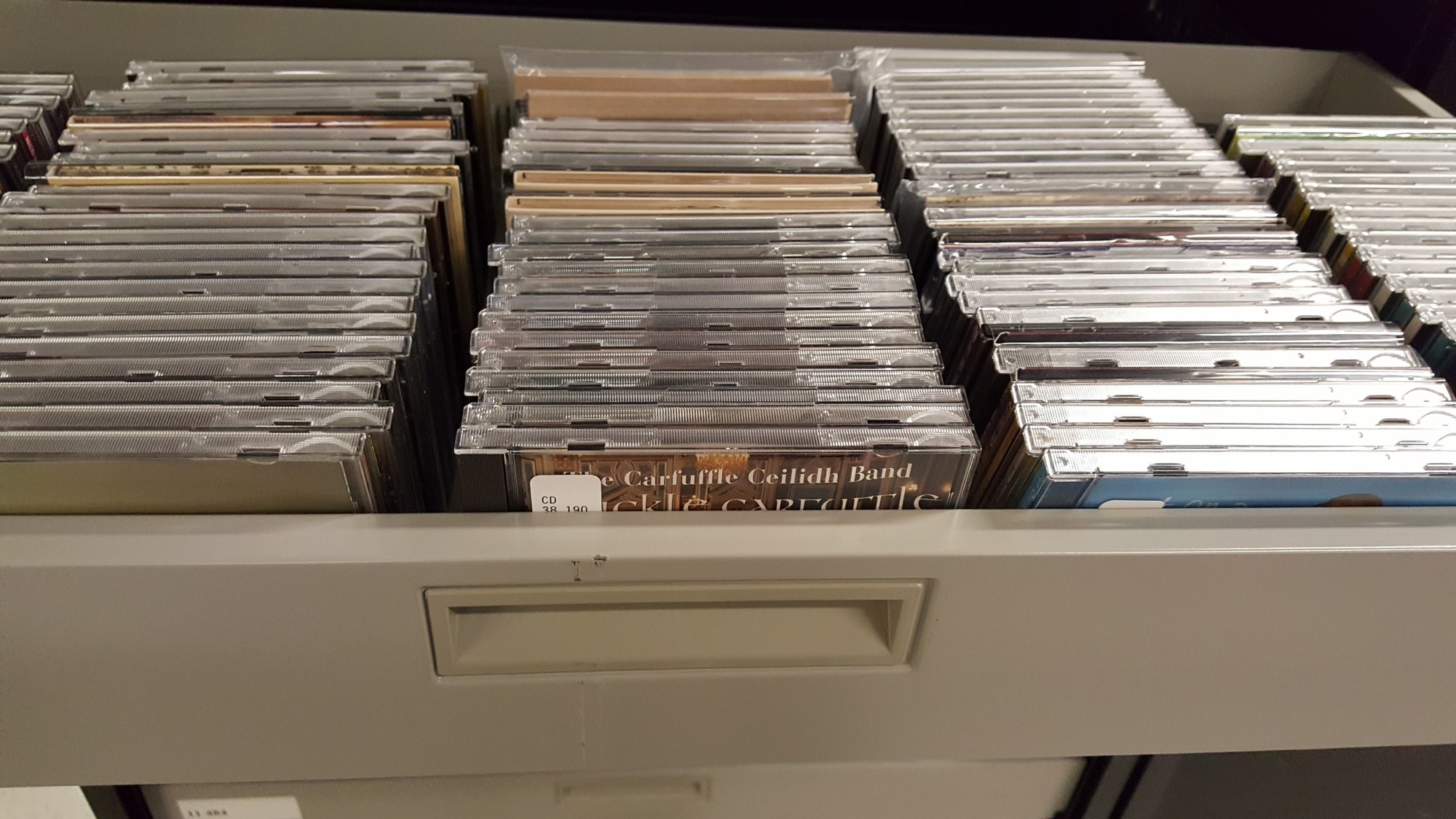
A colour photograph of a cabinet drawer containing hundreds of CD cases.

A small sample of the music CD collection, encompassing over 70,000 titles.

For LAC, our digital crossroads is now. We are in an era where digital collections are surpassing analogue collections in size. A recent inventory of our digital material revealed a vast and varied collection, both online and in physical media such as floppy disks, CDs and DVDs. This inventory also revealed that the volume of digital copies of university theses held at LAC is approaching that of analogue copies—and we only began acquiring theses in PDF digital formats in 1998. Since 2014, LAC has been acquiring theses in digital formats only. Official federal publications are also now primarily in digital format, since the government publishing regulations switched in 2013 to allowing online formats only. In addition, for the first time in its history, LAC received a private donation with 90 per cent of the collection in digital file format.

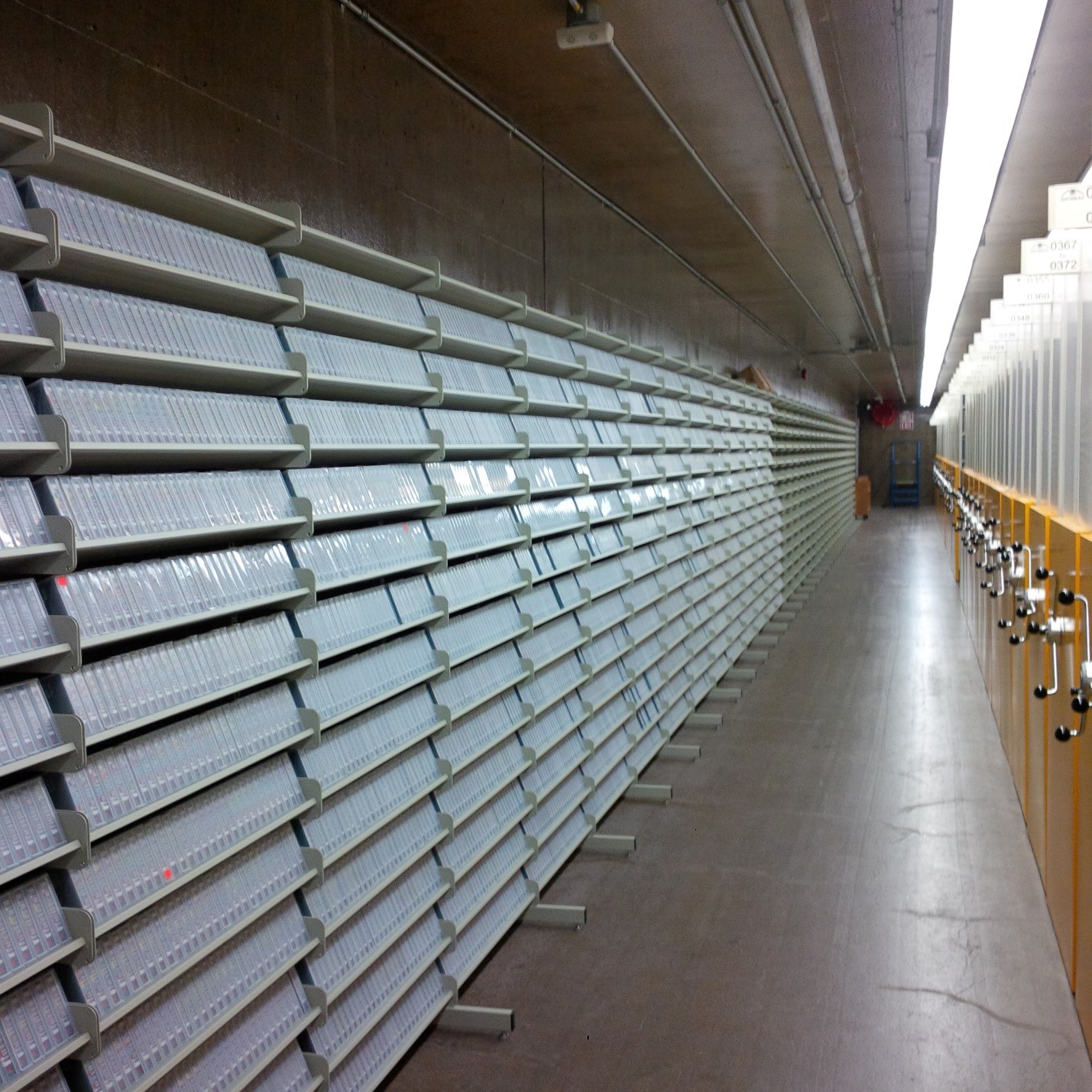
The LAC Digital Archive in the Preservation Centre serves as the central repository for LAC’s digital collections. Currently we preserve over five (5) petabytes of digital material, comprising primarily audiovisual material, the Government of Canada Web Archive, and digitized copies of paper records.  Five petabytes of data would be equivalent to 1,338 metres (4,390 feet) of DVDs stacked on top of one another!

Despite the considerable effort to preserve digital content today, we recognize that there is much more to be done to ensure all digital collections at LAC are protected.

November 30, 2017, marks the first annual International Digital Preservation Day. As a member of the Digital Preservation Coalition, we celebrate this day by launching the Strategy for a Digital Preservation Program. This strategy describes the additional steps needed to further preserve LAC’s digital treasures for the future and ensure that we are on the right path to success.

A colour photograph of a long white shelf on the left and high-density storage on the left.

Linear Tape Open (LTO) tape library of digital documentary heritage that are preserved in the LAC Digital Archive at the Preservation Centre.


Faye Lemay is a manager of digital preservation in the Digital Operations and Preservation Branch of Library and Archives Canada.