Library and Archives Canada releases its latest podcast episode, “Mackenzie King: Against his Will”

Library and Archives Canada is releasing its latest podcast episode, Mackenzie King: Against his Will.

Black-and-white image of William Lyon Mackenzie King sitting on his front porch.William Lyon Mackenzie King was Canada’s longest serving prime minister. He is also increasingly viewed as one of the greatest. However, King’s accomplishments are not restricted to the realm of politics. He was also a prolific correspondent and kept an ongoing, almost daily diary from 1893, until a few days before his death in 1950. In it, King not only wrote down meticulous accounts of his life in politics, but also included fascinating details from his private life.

On today’s episode, we talk with professor and author Christopher Dummitt, whose latest book details the history behind the diaries and how they became available for the world to read.

Subscribe to our podcast episodes using RSS, iTunes or Google Play, or just tune in at Podcast–Discover Library and Archives Canada: Your History, Your Documentary Heritage.

For more information, please contact us at bac.balados-podcasts.lac@canada.ca.

The beginning of the Conclusions: documenting the exercise of power

By Michael Dufresne

The recent addition of records to the Cabinet Conclusions database offers access to the attendance records, agenda and the minutes of Cabinet from 1977 to 1979. The minutes are not verbatim accounts of Cabinet meetings but provide excellent summaries of the discussions and various positions taken by Cabinet members. These newest records straddle both governments of Pierre Elliott Trudeau and the short-lived government of Joe Clark. They cap off the long preamble to the repatriation of the constitution and the advent of the Charter of Rights and Freedoms. They are an important part of the corporate memory of the federal government and reveal a range of subjects, preoccupations, concerns and opportunities confronting the most powerful institutions in our parliamentary system.

A pen-and-brush drawing depicting a man standing in a circus ring holding a whip and reading a book while a lion sitting on a raised platform looks over his shoulder.

Editorial cartoon by John Collins depicts Joe Clark as a lion tamer reading the book “How to Control Gov’t Spending,” published in The Gazette, Montreal, 1979. Copyright held by Library and Archives Canada (MIKAN 2863264)

We might take it for granted that a democratic state provides some measure of transparency for those wishing to know why and how a decision is made. Our democratic sensibilities might be offended to know that, while we could probably trace our democratic heritage to well before the 1940s, it was not until then that Cabinet kept an agenda and minutes of its deliberations. The lack of records documenting Cabinet deliberations can encourage an exaggerated sense of the power of the Prime Minister. “The story went around,” writes historian Michael Bliss in his book, Right Honourable Men: The Descent of Canadian Politics from Macdonald to Mulroney, “that when Bennett was seen mumbling to himself, he was holding a Cabinet meeting.” When there are no official records to document Cabinet’s discussions, who is going to contradict the memory of the Prime Minister?

From 1867 to 1940, a succession of six men served as Clerk of the Privy Council; their duties reflected the comparatively modest role of the state in Canadian society before the Second World War. But with the appointment in 1940 of Arnold Danforth Patrick Heeney, things were clearly changing. Heeney became the seventh Clerk of the Privy Council since Confederation and the country’s first Secretary to the Cabinet.

Upon his arrival in Ottawa, he was surprised by the informal ways in which important business was conducted. “I found it shattering to discover,” Heeney writes in his autobiography, The Things that are Caesar’s, “that the highest committee in the land conducted its business in such a disorderly fashion that it employed no agenda and no minutes were taken. The more I learned about Cabinet practices, the more difficult it was for me to understand how such a regime could function at all.”

Changes to the Privy Council Office (PCO) were inspired by reforms to the United Kingdom’s Privy Council in 1916 by Sir Maurice Hankey. The changes were, in part, an acknowledgment of the growing demands on modern government. Possible changes had been discussed for several years, but nothing had been done. Why then did they occur in 1940? The challenges of governing while prosecuting the Second World War demanded changes to how government organized and documented its deliberations and actions. Order-in-Council PC 1121 of March 25, 1940 heralded the beginning of the modern PCO. It read, in part:

“The great increase in the work of the Cabinet … has rendered it necessary to make provision for the performance of additional duties of a secretarial nature relating principally to the collecting and putting into shape of agenda of Cabinet meetings, providing of information and material necessary for the deliberations of the Cabinet and the drawing up of records of the results, for communication to the departments concerned … ”

Order-in-Council PC 1940-1121 ushered in a significant change in the universe of government information, but it was not until 1944 that the formal Cabinet Conclusions were created and preserved. In the absence of these official records, researchers have to look to Prime Ministers’ personal papers to perhaps discover some form of documentation of Cabinet meetings.

The Cabinet Conclusions have practical value for the administration of the state and democratic significance for the insight and transparency they make possible. More than mere instruments of modern bureaucracy, they offer an inside look at the deliberations, discussions, debates and decision making of the federal government’s most powerful politicians and, to a degree, the high-ranking bureaucrats who serve them. Library and Archives Canada’s acquisition and preservation of these records along with the access it helps facilitate, provide a revealing window into the workings of our democratic state.

The latest additions to the database close out the 1970s, and will inspire new insights into the history of Canada, and about the federal government, particularly those entrusted with its leadership. Researchers can search the Cabinet Conclusions by keyword (one of their own choosing or one from a list of keywords capturing a handful of major issues confronting the government in each year), dates, agenda and records of attendance. The Conclusions offer more than documentary evidence of government deliberations and decision making; they are a means of discovering other Cabinet documents. In other words, the Conclusions can offer you the answers to complete your search, but they can also act as the beginning of your search for more and better answers. In addition, the Conclusions are a means of discovering related Cabinet documents, which may include backgrounders and Cabinet memoranda that informed discussions around the Cabinet table. Those records are not digitized and are not available in the database. However, researchers will find references to those Cabinet documents in the Conclusions—and once the number of a document is known, it can be searched using the year it was created and the finding aid 2-15 to locate it.

See the Cabinet Conclusions database for more detailed instructions on search options.

Related resources


Michael Dufresne is an archivist in the Government Archives Division of the Archives Branch at Library and Archives Canada.

A diplomat, a Prime Minister, and a scholar: remembering Lester B. Pearson

Version française

By Mariam Lafrenie

It goes without saying that the Right Honourable Lester B. Pearson achieved much in his life. Whether you look at his success politically, academically or even athletically—Pearson always excelled. Although Pearson served as Canada’s prime minister from 1963 to 1968, his legacy and indeed his influence began long before his prime ministership: as chairman of the NATO council (1951), as President of the United Nations General Assembly (1952), and as a Nobel Peace prizewinner (1957).

Nevertheless, Pearson’s five-year legacy is very impressive: a new flag, the Canada Pension Plan, universal medicare, a new immigration act, a fund for rural economic development, and the Royal Commission on Bilingualism and Biculturalism which led to the foundation of a bilingual civil service.

A black-and-white photograph of a formally dressed couple. The man is holding a box with a medallion.

Lester B. Pearson and his wife, Maryon at the Nobel Peace Prize Award Ceremony, Oslo, Norway, December 1957. Photograph by Duncan Cameron. (c094168)

A black-and-white photograph of a man standing up and addressing a room of people.

Lester B. Pearson, at the United Nations Conference on International Organization, San Francisco, Calif., USA, 1945. (c018532)

Rising quickly through the ranks and moving from one portfolio to another, Pearson proved himself a worthy and talented diplomat. After a 20-year career in External Affairs, his success did not end there, but followed him throughout the next decade as leader of the Liberal Party (1958-1968). Without a doubt, some of his most exciting—if not his most significant achievements—came during his time as Prime Minister.

A flag for Canada

The quest for a Canadian flag—one that represented everything that Canada had become in the last century and all that Pearson hoped it could become—was fraught with bitter debate and controversy. Indeed, as many may recall, “The Great Flag Debate” raged for the better part of 1964 and saw the submission of approximately 3,000 designs by Canadians young and old.

“Under this flag may our youth find new inspiration for loyalty to Canada; for a patriotism based on no mean or narrow purpose, but on the deep and equal pride that all Canadians will feel for every part of this good land.” – Address on the inauguration of the National Flag of Canada, February 15, 1965

These words, spoken by Lester B. Pearson during the inaugural ceremony of the Red Maple Leaf flag on February 15, 1965 at Parliament Hill, highlight precisely what he aspired to achieve—a uniquely Canadian identity. Few prime ministers can attest to leaving a legacy so great as to have forged an entirely new cultural symbol for their country.

A black-and-white photograph of a man holding an illustration of the Canadian flag.

Lester B. Pearson’s press conference regarding the new flag, December 1964. Photograph by Duncan Cameron. (a136153)

A year of celebration

Not only was Pearson responsible for championing a new Canadian flag, but he was also lucky enough to remain in office during Canada’s centennial year. In his Dominion Day speech on July 1, 1967, Pearson called on Canadians to celebrate their past and their achievements, but also encouraged them to think of the future and of the legacy that they could leave for the next generation of Canadians. Much like this year, when we celebrated Canada’s 150th anniversary of Confederation and were encouraged to think of our future as a nation, 1967 was also a year filled with celebrations.

The aim of the centennial celebrations were twofold: to create memorable events and activities for all Canadians and to create a tangible legacy that current and future generations could enjoy. In fact, both the provincial and federal governments encouraged Canadians to celebrate by creating their own centennial projects—films, parades and festivals, tattoos, recreation centres, stadiums, etc.—and agreed to match their spending. One of the most memorable celebrations was that of the 1967 International and Universal Exposition or Expo 67, as it was nicknamed. Open from April 27 to October 29, Expo 67 is considered one of the most successful World’s Fairs and one of Canada’s landmark moments.

A colour photograph of a group of men standing in front of an enlarged map of New France.

Expo 67’s opening day with its General Commissioner Pierre Dupuy, Governor General of Canada Roland Michener, Prime Minister of Canada Lester Bowles Pearson, Premier of Québec Daniel Johnson and Mayor of Montréal Jean Drapeau. (e000990918)

For many Canadians, 1967 characterized the peak of nostalgia and indeed a year filled with optimism. With this optimism and increased governmental spending, Pearson’s popularity boomed and further solidified his accomplishments as prime minister and widespread support for the Liberal Party amongst Canadians.

Conclusion

Forty-five years ago, on December 27, 1972, after a long and successful political career, Lester B. Pearson passed away. His passing struck a chord with many Canadians as more than 1,200 people attended his funeral service to pay their last respects. Pearson’s legacy and indeed his name are still present today in the numerous awards and buildings named in his honour. Paving the way for what many Canadians and the international community alike have come to love about Canada, Pearson can be said to have shaped and indeed laid the foundation for the Canada we know today.

A black-and-white photo of man standing under an interesting architectural building.

Prime Minister of Canada Lester Bowles Pearson in front of the Katimavik at Expo 67. (e000996593)

The Lester B. Pearson fonds preserved by Library and Archives Canada consists of 435.71 meters of textual records, over 3,500 photographs, 315 audio recordings on various formats, 3 films totalling 47 minutes, 54 items of documentary art, and 98 medals.

Related links


Mariam Lafrenie is an undergraduate student research fellow from Queen’s University who worked in the Private Archives Branch at Library and Archives Canada during the summer of 2017.

New archival fonds – Ambassador Arthur R. Menzies

By Patrick Latulippe

Are you interested in discovering the extraordinary story of a Canadian who was born in China and later returned to the People’s Republic of China as Ambassador of Canada? Would you like to learn about the subtleties and the depth of the work performed by Canada’s ambassadors abroad?

Thanks to the recent acquisition of the Arthur R. Menzies fonds by Library and Archives Canada, you may now access this outstanding material. These archives include thousands of handwritten letters detailing the personal and professional life of Arthur Menzies, a diplomat who worked primarily in Asia but also represented Canada in over a dozen countries during his 30-year career.

A black-and-white photograph of three boys on bicycles.

Young Arthur Menzies in China, on bicycle (at left). Summer vacations in Pei Tai Ho, China, 1930–1935 (MIKAN 4976252)

These archives, carefully preserved by the Menzies family for over half a century, will enable researchers to learn all about the incredible life and career of His Excellency Ambassador Menzies.Biographical sketch Arthur Redpath Menzies was born in China on November 29, 1916, the son of Christian missionaries James Mellon Menzies and Annie Sedgwick Menzies. His father was an amateur archaeologist who contributed significantly to the scholarly study of oracle bones from the Shang dynasty. Arthur Menzies was educated at the University of Toronto and Harvard University. In 1940, he withdrew from doctoral studies in Far Eastern History and Chinese at Harvard University to join the Department of External Affairs in Canada. In 1943, Menzies married Sheila Isabel Halliday Skelton, daughter of Isabel and O.D. Skelton (Under-Secretary of State for External Affairs from 1925 to 1941). Arthur and Sheila Menzies had two children: Kenneth and Norah. Arthur Menzies was Second Secretary in Havana (1945–1946), Head of the Canadian Liaison Mission in Japan (1950–1952), High Commissioner to Malaysia (1958–1961) and Burma (1959–1961), Head of the Defence Liaison Division in Ottawa (1961–1965), High Commissioner to Australia (1965–1972) and Fiji (1970–1972), Ambassador to the North Atlantic Council (1972–1976), Ambassador to the People’s Republic of China (1976–1980) and the Socialist Republic of Vietnam (1976–1979), and Ambassador for Disarmament (1980–1982). Menzies retired in 1982. He was very active in retirement, writing several books during the last decade of his life. In 2009, he published Australia & the South Pacific: Letters Home, 1965–1972. Menzies received the Order of Canada in 2001. He died on March 4, 2010.

Interesting archival material in the fonds

World Trip Diaries

The Menzies family set out to explore the world in 1928. This inspiring adventure is described in great detail in the World Trip Diaries kept by mother Annie and the family’s three children: Arthur, Frances and Marion. This part of the fonds helps us to understand the first extraordinary international travels by Arthur Menzies. It is also interesting to consider these experiences in relation to the later duties of Ambassador Menzies in Asia, Oceania and Europe.

A colour photograph showing two pages of a personal diary.

Two pages by Annie Menzies in the World Trip Diaries, 1928 (MIKAN 4976256)

Correspondence

The Correspondence Series is certainly one of the most interesting series in the fonds. The series consists of more than 10 boxes of correspondence (over 2 metres of letters, with each box containing hundreds of letters!) sent by or to the Menzies family. This correspondence will allow Canadians to see the complexity of relationships with family and friends when diplomatic postings require part of a family to move overseas, while the rest of the family stays in Canada. The evolution of these relationships over time, such as when the children are older and choose not to follow their parents to overseas postings, is fascinating. One can also sense the attachment to friends even though the family is living far away for several years. The correspondence is rich and constant between the many friends, colleagues and members of the Redpath, Menzies, Sedgwick and Skelton families. The period from 1965 to 1972 was the subject of a book, Australia & the South Pacific: Letters Home, 1965–1972, published by Arthur Menzies in 2009. The variety of sources in this series will satisfy even the most meticulous researchers!

A typewritten letter discussing domestic affairs of an impending move.

A personal letter from Arthur Menzies to Mrs. Skelton (MIKAN 4976262)

Australia and the South Pacific

Ambassador Menzies represented Canada overseas at key moments in history. For example, he was High Commissioner to Australia when the Fiji islands gained their independence from the United Kingdom. Arthur Menzies thus became, de facto, Canada’s first High Commissioner to Fiji. He also kept his post in Australia and maintained ties with other British colonies in the region that would become independent later in the 1970s, such as Papua New Guinea and the Solomon Islands.

A colour photograph of a man wearing shorts, a shirt and sandals. He has a camera on a lanyard around his neck. The man is standing beside another man who is wearing shorts and an elaborate mask.

Kenneth Menzies (left) with masked Papua New Guinea man, July 5, 1967 (MIKAN 4976273)

China and Vietnam

In what was probably the most important posting of his career, Arthur Menzies was appointed as the Ambassador of Canada to China and Vietnam in 1976. His fluency in Mandarin and his experience were undoubtedly strong factors in his selection. The posting to China meant a return to the country of his birth for Menzies. The series of archival fonds covering this period is rich in photographs, and it documents the dozens of places that Arthur and Sheila Menzies visited in all parts of the two countries.

A black-and-white photograph of two men bowing to each other. One of the men is holding a piece of paper and extending it toward the other. In the background, a third man is observing the scene.

Ambassador Menzies presenting his credentials to a Chinese official, 1976 (MIKAN 4976275)

Not to mention …

Arthur Menzies also wrote numerous books and articles, mainly about his life as an ambassador. The fonds, which is largely accessible to all, enables us to consult the notes and drafts that led to the final publications.

The fonds contains an extraordinary number of photographs (5,103: 1,300 black-and-white and 3,803 colour photos) that enable us to find out about regions and parts of countries that are still difficult to visit today, such as Fiji and Burma (Myanmar). These visual aids often include dates and annotations. A more thorough search could uncover the specific itineraries of advocacy missions around the world by Menzies as Canadian ambassador.

It is now possible to conduct more in-depth research into this key figure in Canada’s diplomatic history in the 20th century, thanks to the vast array of material in his archival fonds at Library and Archives Canada. The Arthur R. Menzies fonds awaits your discovery!


Patrick Latulippe is an archivist in the Science and Governance Private Archives Division at Library and Archives Canada.


O Canada! A bilingual history

Version française

By Jessica Di Laurenzio

Library and Archives Canada has recently acquired the records of the Frederick Harris Music Company, a large Canadian music publisher often associated with the Royal Conservatory of Music in Toronto. In the company’s early days, beginning in the 1910s, Frederick Harris rigorously fought to obtain Canadian copyright for as much music as possible. One of the songs he published around this time was the English-language version of “O Canada.” However, the “O Canada” that Harris first published was not the same song that Canadians know today as their official national anthem.

“O Canada” became the official national anthem in 1980, exactly 100 years after Calixa Lavallée first composed the music. He was commissioned to write it by Lieutenant Governor Théodore Robitaille of Quebec. Judge Adolphe-Basile Routhier wrote the French lyrics at the same time, and the anthem was performed on Saint Jean-Baptiste Day in Quebec City in 1880. “Chant National” (the original name for “O Canada”) was an anthem for the French-Canadian people, written in part as a response to the popularity of “God Save the Queen” in English Canada.

A black-and-white photograph of a man with a prominent mustache, wearing a suit and bow tie. The photo is oval-shaped on a grey matte board.

Portrait of Calixa Lavallée (e010900310)

People in English Canada liked Lavallée’s music so much that, a couple of decades later, they decided to create their own version. However, rather than simply translating Routhier’s lyrics into English, several Anglophone lyricists wrote their own words, which helps explain why today the meaning of some of the French and English lyrics of “O Canada” differ greatly.

Sheet music cover. In the centre, there is a photo of a man in an overcoat and trousers holding a top hat and a cane. The composer’s and lyricist’s names are at the bottom between a sketch of the city of Québec and a tree that stretches to the top of the page to decorate the title with maple leaves.

Cover of the first edition of “O Canada” (OCLC 1007545258).
L.N. Dufresne, cover “O Canada” (Québec: Arthur Lavigne, 1880).
Musée de la civilisation, bibliothèque du séminaire de Québec. Fonds ancient, 204, SQ047145.

Original French lyrics by Routhier:

O Canada! Terre de nos aïeux,
Ton front est ceint de fleurons glorieux!
Car ton bras sait porter l’épée,
Il sait porter la croix!

Ton histoire est une épopée
Des plus brillants exploits.
Et ta valeur, de foi trempée,

Protègera nos foyers et nos droits.

English Translation:

O Canada! Land of our ancestors,
Glorious deeds circle your brow.
For your arm knows how to wield the sword,
Your arm knows how to carry the cross.

Your history is an epic
Of brilliant deeds.
And your valour steeped in faith

Will protect our homes and our rights,
Will protect our homes and our rights.

English-speaking lyricists took a different approach to the lyrics, often focusing on Canada’s natural beauty instead of the country’s valour and epic history. Sometimes, their approaches were a little too similar, causing accusations of plagiarism. Robert Stanley Weir and Edward Teschemacher were two of the Anglophones who came up with their own versions, and both chose to use the phrase “our home and native land.” The similarities created copyright tension between Delmar Music Co. and Frederick Harris, the respective publishers of the Weir and Teschemacher versions, both published around 1910.

Cover of sheet music for “O Canada!,” Canadian National Anthem by C. Lavallée.

Cover of sheet music for “O Canada,” published by Frederick Harris Music Co., 1914, words by Edward Teschemacher (OCLC 1007512736).

Along with Weir and Teschemacher, people across Canada came up with their own English versions of “O Canada.” By 1927, the Weir version had emerged as the most popular rendition, and was used as an official song for the Diamond Jubilee of Confederation. However, because so many other versions existed, it did not gain official status as the national anthem for some time.

Prime Minister Lester B. Pearson tried to introduce a bill to make it the official version in 1967, but it was not until the centennial anniversary of Lavallée’s music, in 1980, that “O Canada” became the country’s official national anthem. Routhier’s original lyrics from 1880 made up the French version, while Weir’s words gained official status as the English version—regardless of the fact that their meanings were so different.

Photo of a rectangular postage stamp with colourful graphics of three men, with their names written beside them: Calixa Lavallée, Adolphe-Basile Routhier, and Robert Stanley Weir. The stamp reads “Canada Postes-Postage, O Canada! 1880–1980.”

Commemorative stamp, 1980, showing Lavallée, Routhier, and Weir (s000844k).


Jessica Di Laurenzio is an archival assistant with Literature, Music, and Performing Arts, Private Archives Branch at Library and Archives Canada.

Sir Wilfrid Laurier podcast images now on Flickr 

Sir Wilfrid Laurier had the largest unbroken term of office as Canada’s seventh prime minister. He was considered one of Canada’s greatest politicians, full of charisma, charm and passion, qualities that served him well in office, and also in his personal life. This passion is seen in many of the letters he wrote to his wife Zoé. But perhaps we gain a deeper insight into his character through his letters to Émilie Lavergne.

Accessing our history: a project about prime ministers

By Mariam Lafrenie and Rachel Klassen

In collaboration with Queen’s University, Library and Archives Canada (LAC) has launched a project to highlight the speeches of Canada’s prime ministers. To begin the project, LAC’s Governance and Political Archives Section was pleased to work with Mariam Lafrenie, a Queen’s undergraduate student research fellow. Mariam became the project’s prime minister researcher over the summer of 2016. Her findings allowed our section to plan how to meet the project’s central objectives of facilitating greater access to the fonds of Canada’s prime ministers preserved by LAC, and to bring Canadians closer to their political history. To conclude this first phase, we asked Mariam to share her thoughts about both the project and some of the notable speeches she encountered.

Mariam Lafrenie’s reflections

Having worked in the fonds of several prime ministers, including Sir Charles Tupper, I have gained a unique perspective on Canadian history and heritage. I have seen the determination of Canada’s future and the goals agreed upon by our Fathers of Confederation, but I have also watched the evolution of these goals. Each prime minister attempted to redefine Canadian identity and the meaning of a unified nation.

Prime Minister Louis St. Laurent understood his Canada as a place where diversity and freedom flourished, but also as a place where discrimination and terrorism were inherently intolerable. He was known as “Uncle Louis” to Canadians, and during his prime ministership, he oversaw the establishment of the United Nations and Newfoundland’s entry into Confederation.

An older man is standing on a stage and reaching out to a crowd of children.

Prime Minister Louis St. Laurent with group of children, 1949 (MIKAN 3220798)

Prime Minister John Diefenbaker fought for the indomitable right of all Canadians to be free. In his Canada, being Canadian meant possessing the ability to express your beliefs and opinions, but also having the responsibility to uphold this standard for all of humanity.

I am Canadian, a free Canadian, free to speak without fear, free to worship God in my own way, free to stand for what I think right, free to oppose what I believe wrong, free to choose those who shall govern my country. This heritage of freedom I pledge to uphold for myself and all mankind. John Diefenbaker, House of Commons, July 1, 1960

An older man is standing and speaking to people seated at desks.

Prime Minister John Diefenbaker speaks in the House of Commons, October 14, 1957 (MIKAN 3214921)

Prime Minister Lester Pearson left a legacy of perseverance and diplomacy. His Canada was about social advancement, and it witnessed the creation of universal medicare, the Canada Pension Plan, and the Royal Commission on Bilingualism and Biculturalism. Most notably, however, he is remembered for his dedication to the pursuit of a national flag worthy of an independent and unified Canada.

Cover page of a published speech, includes text and a portrait of a white man.

“I Stand for Canada!” speech delivered by Lester Pearson (MIKAN 4924761)

Prime Minister Pierre Trudeau dedicated 15 years of service to Canadians and brought Canada through the October Crisis and the Quebec Referendum of 1980. He also spiritedly fought to unify Canadians, from coast to coast, and to entrench their rights and freedoms, as his Canada became a fully autonomous nation with its own constitution.

There still remains much to be discovered about Canada’s prime ministers. As LAC and Queen’s continue with this project, greater access to the prime ministers’ fonds will support this discovery!

Related links:


Mariam Lafrenie is an undergraduate student research fellow from Queen’s University who worked in the Private Archives Branch at Library and Archives Canada during the summer of 2016.

Rachel Klassen is a political portfolio archivist working in the Private Archives Branch at Library and Archives Canada.

How to find Government of Canada press releases

By Emily Dingwall

Government of Canada press releases, also referred to as news releases, are issued for the media to announce the latest news of government departments. At Library and Archives Canada (LAC), we hold a number of press releases, some in hard copy format in our archival holdings, and some in our published collection. The LAC collection is a great starting point to search for older releases that are not currently online. However, it should be noted that the collection is not comprehensive because press releases were not collected systematically throughout the years. This blog post will focus only on the available materials we have in our published collection, most of which span the years 1945 to 2004. It will also discuss how to find more recent press releases on individual government department websites and through the Government of Canada Web Archive (GC WA).

News releases in our published collection can be retrieved through the AMICUS library catalogue. It is helpful to know the department and time period you are seeking, as the releases have been catalogued chronologically for each government department. Here is an example of a series of press releases in our collection from the former Department of Communications. For more search tips, please contact us with your question or visit us in person. There are also search tips available in AMICUS.

To find more recent news releases, such as those dating back to the late 1990s, try searching the GC WA. The GC WA is available through our website and provides access to harvested material from former Government of Canada websites. The archive can be searched by keyword, department name, or URL. It is most effective to search by department name (available through the red menu on the left), then scroll through the list of departments and click on specific ones of interest. This will take you to different snapshots of the websites where you can navigate to the news section to view the releases. Please note that this is an archived website, so certain links may not be functional, and older content on the website is no longer being updated.

A colour image showing screen captures of two Government of Canada web pages side by side.

A screen capture of the introductory page for the Government of Canada Web Archive (left) and the page listing the departments (right).

In regard to the most recent news updates, the releases for the last several years (depending on the department) are mainly available through individual websites for government departments, crown corporations, and the Prime Minister’s Office. For example, Innovation, Science and Economic Development Canada (formerly Industry Canada) has news releases on its website archived back to 2012.

There is a Government of Canada News Releases website as well, which is a list of the most recent news releases compiled from all federal departments.

Please contact us for any other questions you may have on Government of Canada press releases!


Emily Dingwall is a Reference Librarian in the Reference Services Division at Library and Archives Canada.

Opening the vaults: 20 million pages and counting!

In 2013, Library and Archives Canada (LAC) announced the opening of 10 million pages under its Block Review Project. LAC is happy to announce that the count is now up to 20 million pages open as a result of this initiative.

This project is allowing greater access to many LAC archival government records covering a myriad of federal departments and documenting all operations and functions of the Canadian federal government.

Of particular interest is the opening of approximately two million pages documenting the federal government’s centennial celebrations in 1967. The records, held by the Expo 67 fonds and the Exhibitions Branch of the former Department of Trade and Commerce, cover all aspects of the preparations and operations of Expo 67. They complement previously opened material in the records of the Centennial Commission. Together, they constitute a body of archival records ready for research, as Canadians prepare to celebrate our sesquicentennial in 2017.

Also opened are over four million pages from the former Canadian Department of Trade and Commerce, documenting Canada’s international trade functions from the 1880s to the 1980s. Canada’s international trade relations with the Commonwealth and other countries have been an important government function from the time of Confederation to the present. The records provide evidence of this long and illustrious history, documenting our trade relations with specific countries and all international trade functions.

The Expo 67 and international trade records are just two of a number of federal government collections to which the block review is now allowing greater access.

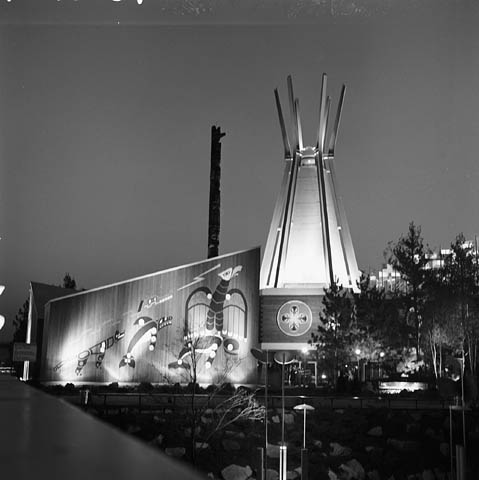
A black and white photograph of a building with native art on the front wall and a tipi-like structure adjacent to it. The top of a totem pole can be seen behind the building.

Native People of Canada Pavilion – Expo 67 (MIKAN 3192403)

Who will make good? The Land Development Records of the Canadian National Railway and its corporate predecessors

Railways have long played a prominent role in the stories we tell about Canada’s development as a nation. Promising to facilitate travel and trade across the vast expanse of Canada’s geography, the construction of transcontinental railway lines was once seen as pivotal to the formation of a coherent national identity.

But railway companies also participated in the settlement of Western Canada by serving as the developers and property agents for land granted to them by the federal government. Following the transfer of Rupert’s Land to Canada in 1870, railway land grants were a key component of the government’s plan to increase the population of western regions already occupied by indigenous communities, Métis settlements, and Hudson’s Bay Company outposts. Even in the early twentieth century, land grants were used to encourage the railway companies to extend their tracks across the whole of the continent, and railway construction was partly financed through the lease and sale of this land.

The Winnipeg Regional Services office holds a rich aggregation of records documenting the sale and lease of Western Canadian farm and townsite land by the Canadian National Railway and its corporate predecessors. Originating from the various subsidiary property companies linked to the Canadian National Railway, the Canadian Northern Railway, and the Grand Trunk Pacific Railway, these records sketch vivid portraits of Western Canadian settlers and some of the many challenges they faced in the early and mid-twentieth century. Continue reading