“Incited to Potlatch”

By Sevda Sparks

A potlatch is a ceremonial gift-giving feast practiced by indigenous people of the Pacific Northwest in Canada and the United States. The Canadian government’s potlach ban began in 1885, and underwent many amendments to strengthen it until its removal in 1951. Library and Archives Canada’s holdings include a wealth of material on the potlatch, including many letters and petitions on the suppression of the custom as well as efforts to continue it. Of special interest is the correspondence of Kwakwakawakw Chief Billy Assu, Indian Agent William Halliday, and British Columbia Chief Justice Matthew Begbie.

A black-and-white photograph of a streetscape with potlatch participants and items to be given away.

Potlatch, Alert Bay, British Columbia, June 1907 (MIKAN 3368269)

In the midst of the potlatch ban, Chief Billy Assu wrote to the deputy superintendent of Indian Affairs, J. D. MacLean, in 1919, explaining the potlach or “our old custom of giving away.” In describing the roots of the celebration, and the desire to retain it, Assu stated:

“We all know that things are changing. In the old days, the only things that counted were such things as food, dried fish, roots, berries, and things of that nature. A chief in those days would get possession of all these things and would pass them on to those who had not got any… ”

The potlach was a way to hold onto important cultural customs despite the changing times. Assu also commented more broadly on the potlatch in indigenous society:

“…some were trained to make canoes, some to hunt, some to catch fish, some to dry fish, some to get material to make our clothes, then we divided this up amongst the others. This was the beginning of our feast of giving away.”

Section 149 of the Indian Act, which banned the potlach, was a challenge to enforce, both practically and legally. It was difficult to determine exactly what the potlatch was, under the law, and to prove when it was happening. In 1889, Chief Justice Begbie found the legislation on the potlatch to be lacking when it came to sentencing, stating:

 “…if the legislature had intended to prohibit any meeting announced by the name of “potlatch” they should have said so. But if it be desired to create a new offence previously unknown to the law there ought to be some definition of it in the statute.”

The law was amended in 1895, and agents were particularly determined to prosecute those who were “incited to potlatch”, despite the lack of legal evidence in some cases, as demonstrated by William Halliday, agent to assistant deputy and secretary J. D. McLean in Ottawa. The methods of curtailing the potlach extended to holding meetings between agents and First Nations leaders, so that the agents could “read to them the specific article…and give reasons why the potlach should be condemned and done away with.” Agents deemed the tradition wasteful, leaving nations “near penury.”

After such a meeting, agent Halliday states:

“Yesterday and today they have been to a certain extent violating that section as they have been holding mourning ceremonies, part of which consists in singing mourning songs and part in receiving gifts from the surviving relatives, but I have not interfered with them in any way.”

Such accounts from agents and other departmental officials illustrate an attempt to monitor, control and suppress basic aspects of First Nations culture, even beyond the potlatch itself. This continued despite efforts by indigenous leaders to explain indigenous lifestyle and customs to government officials.

A black-and-white photograph of a group of potlatch participants with items to be given away.

Potlatch, 1907 (MIKAN 3572940)

The great contrast among Chief Assu’s letter, Justice Begbie’s remarks and Agent Halliday’s account allows for a more complete understanding of the potlatch ban issue. Assu’s letter is straightforward in describing the potlatch and its importance. Begbie’s comments speak to the challenges in attempting to use legislation to control cultural practices. Halliday’s account provides insight into the mindset and practices of the Canadian government at the time. Having access to these multiple perspectives highlights the importance of archival records in researching complex historical issues.

Additional resources


Sveda Sparks worked at Library and Archives Canada’s Vancouver public service point in the summer of 2017 as part of the Federal Student Work Experience Program (FSWEP).


The Halifax Explosion: Records at Library and Archives Canada

By Valerie Casbourn

On the morning of December 6, 1917, two ships, the Imo and the Mont-Blanc, collided in the Narrows of Halifax Harbour. The Mont-Blanc was a munitions ship on its way to join a convoy sailing to war-torn Europe. The cargo of the Mont-Blanc caught fire, and after burning for 20 minutes, the ship exploded. The blast ripped through the city killing almost 2,000 people, injuring thousands more and causing widespread devastation in Halifax, Dartmouth, and the Mi’kmaq community of Turtle Grove. The “Halifax Explosion” as it became known, brought the danger and destruction of the First World War home to Canada, and left an indelible mark on the city of Halifax.

A black-and-white photograph of several people walking down a street with destroyed buildings on both sides.

Aftermath of the Halifax Explosion. The building on the left was the Hillis & Sons Foundry. (c003624b)

Guides to Records about the Halifax Explosion

Library and Archives Canada (LAC) holds various records that tell part of the story of the Halifax Explosion, its aftermath, and the relief work and investigations following the disaster. The first place to look is LAC’s thematic guide, Halifax Explosion. Some of the records listed in the guide are available on digitized microfilm reels on the Héritage website. Other records are available for onsite consultation at LAC.

The guide primarily lists records about the disaster and its aftermath kept by the Canadian federal government. This includes records such as the formal investigation into the collision of the Imo and the Mont-Blanc conducted by the Dominion Wreck Commissioner (RG42, Vol. 596, Parts 1-2 and RG42, Vol. 597, Parts 3-4). There is also correspondence of the wartime Chief Press Censor, Ernest J. Chambers (RG6, Vol. 621, File 350, Microfilm reel T-102) that documents both the urgent need to report news of the disaster accurately, but not to reveal any information about the defences of Halifax Harbour.

Image of a telegram that reads: “3:45 p.m. Telegram sent to Geo. D. Perry? Gen. Mgr. G.N.W. Telegraph Co, Toronto, Ont. Telegram sent to J. McMillan, Mgr. C.P. Ry. Telegraphs, Montreal. Ottawa, Ont., December 6, 1917. In view of contradictory reports abroad regarding Halifax explosion I hope everything possible is being done to facilitate a transmission of all press reports. This most desirable from a national point of view. Ernest J. Chambers, Chief Press Censor.”

from Ernest J. Chambers, Chief Press Censor, to G.N.W. Telegraph Co. and C.P. Ry. Telegraphs (T-102, Image 119)

Image of a telegram that reads: “Ottawa, December 7, 1917. C.O. Knowles, Toronto. In connection with reports of Halifax disaster it is important that nothing be published revealing information as to defences, strength and disposition of garrison, etc. Neither should details be given as to naval and transport activities at the port during war. No photographs of Halifax or vicinity taken since commencement of war should be published. Desirable that special correspondents despatched to Halifax inform themselves as to local censorship requirements. Ernest J. Chambers.”

from Ernest J. Chambers, Chief Press Censor, to C.O. Knowles, Canadian Press Limited. (T-102, Image 136)

If you are looking for images, try LAC’s Flickr album of digitized photographs taken after the Halifax Explosion. LAC also has a more detailed description of the explosion at First World War: Tragedy on the Home Front.

A black-and-white photograph showing a line of people digging through the rubble of destroyed buildings.

Aftermath of the Halifax Explosion. (c001833)

How to Search for More Records

You can find more records related to the Halifax Explosion by using the Collection Search tool to search for keywords such as “Halifax explosion” or “Halifax disaster”; or try searching for other keywords related to the disaster. Click on the “Archives” tab to limit your search results by date, or by the type of material (i.e., photographs or textual material).

The records at LAC come from the Canadian federal government and from private individuals and organizations. Some records are available online, and others are available for onsite consultation by visiting in person, or by ordering reproductions.

Correspondence about the Halifax Explosion: Sir Robert Borden fonds

There are far too many different records about the Halifax Explosion to mention them all here, but correspondence in the Sir Robert Borden fonds (MG26-H) tells one small part of the story. Sir Robert Borden was the Prime Minister of Canada and the Member of Parliament for Halifax at the time of the explosion, and his papers include telegram messages giving news of the disaster, messages of sympathy for the people of Halifax, offers of assistance, and more.

Much of the correspondence related to the explosion is in the file “Halifax Disaster 1917–1918” (MG26-H, Vols. 89–90, Pages 46309–47016, microfilm reel C-4325, which is available on the Héritage website, starting at image 301).

A Great North Western Telegraph Company of Canada telegram, which reads: “Moncton, N.B. Dec. 6, 1917. J.D. Reid, Ottawa. It is reported that ship loaded with explosives at pier six as she was backing out of pier about half past eight this morning an inward bound ship ran into her and she caught fire, they tried to sink her before she exploded but failed. She blew up at nine o’clock. It is reported the city in bad state and much damage done but account wires being down unable to get any detail. Will give further information soon as obtained. Assistant General Manager Brown going to Halifax by Special. C.A. Hayes.”

This initial report of the disaster was sent to Ottawa from Moncton because the explosion damaged telegraph and telephone wires in Halifax and cut off communications to the city. (Reel C-4325, Image 321)

A Western Union telegram which reads: “RM Boston Mass. Dec 7 via Ottawa Ont. 8 1917. Robert Borden, Prime Minister, Halifax, NS. From your knowledge of conditions at Halifax what can we best do at once to help relieve the distress of the people at Halifax last night medical relief train left here at ten o’clock due at Halifax at eight pm tonight we have a ship here at our disposal that can leave here Sunday morning and would be due in Halifax Monday morning can she dock. H.B. Endicot Chairman Mass Halifax Relief Committee.”

An offer of help from Boston, sent to Sir Robert Borden by H.B. Endicott, Chairman of the Massachusetts-Halifax Relief Committee (Reel C-4325, Image 321)

Related Resources:


Valerie Casbourn is an archivist with the Regional Services and ATIP Division at Library and Archives Canada.

New archival fonds – Ambassador Arthur R. Menzies

By Patrick Latulippe

Are you interested in discovering the extraordinary story of a Canadian who was born in China and later returned to the People’s Republic of China as Ambassador of Canada? Would you like to learn about the subtleties and the depth of the work performed by Canada’s ambassadors abroad?

Thanks to the recent acquisition of the Arthur R. Menzies fonds by Library and Archives Canada, you may now access this outstanding material. These archives include thousands of handwritten letters detailing the personal and professional life of Arthur Menzies, a diplomat who worked primarily in Asia but also represented Canada in over a dozen countries during his 30-year career.

A black-and-white photograph of three boys on bicycles.

Young Arthur Menzies in China, on bicycle (at left). Summer vacations in Pei Tai Ho, China, 1930–1935 (MIKAN 4976252)

These archives, carefully preserved by the Menzies family for over half a century, will enable researchers to learn all about the incredible life and career of His Excellency Ambassador Menzies.Biographical sketch Arthur Redpath Menzies was born in China on November 29, 1916, the son of Christian missionaries James Mellon Menzies and Annie Sedgwick Menzies. His father was an amateur archaeologist who contributed significantly to the scholarly study of oracle bones from the Shang dynasty. Arthur Menzies was educated at the University of Toronto and Harvard University. In 1940, he withdrew from doctoral studies in Far Eastern History and Chinese at Harvard University to join the Department of External Affairs in Canada. In 1943, Menzies married Sheila Isabel Halliday Skelton, daughter of Isabel and O.D. Skelton (Under-Secretary of State for External Affairs from 1925 to 1941). Arthur and Sheila Menzies had two children: Kenneth and Norah. Arthur Menzies was Second Secretary in Havana (1945–1946), Head of the Canadian Liaison Mission in Japan (1950–1952), High Commissioner to Malaysia (1958–1961) and Burma (1959–1961), Head of the Defence Liaison Division in Ottawa (1961–1965), High Commissioner to Australia (1965–1972) and Fiji (1970–1972), Ambassador to the North Atlantic Council (1972–1976), Ambassador to the People’s Republic of China (1976–1980) and the Socialist Republic of Vietnam (1976–1979), and Ambassador for Disarmament (1980–1982). Menzies retired in 1982. He was very active in retirement, writing several books during the last decade of his life. In 2009, he published Australia & the South Pacific: Letters Home, 1965–1972. Menzies received the Order of Canada in 2001. He died on March 4, 2010.

Interesting archival material in the fonds

World Trip Diaries

The Menzies family set out to explore the world in 1928. This inspiring adventure is described in great detail in the World Trip Diaries kept by mother Annie and the family’s three children: Arthur, Frances and Marion. This part of the fonds helps us to understand the first extraordinary international travels by Arthur Menzies. It is also interesting to consider these experiences in relation to the later duties of Ambassador Menzies in Asia, Oceania and Europe.

A colour photograph showing two pages of a personal diary.

Two pages by Annie Menzies in the World Trip Diaries, 1928 (MIKAN 4976256)

Correspondence

The Correspondence Series is certainly one of the most interesting series in the fonds. The series consists of more than 10 boxes of correspondence (over 2 metres of letters, with each box containing hundreds of letters!) sent by or to the Menzies family. This correspondence will allow Canadians to see the complexity of relationships with family and friends when diplomatic postings require part of a family to move overseas, while the rest of the family stays in Canada. The evolution of these relationships over time, such as when the children are older and choose not to follow their parents to overseas postings, is fascinating. One can also sense the attachment to friends even though the family is living far away for several years. The correspondence is rich and constant between the many friends, colleagues and members of the Redpath, Menzies, Sedgwick and Skelton families. The period from 1965 to 1972 was the subject of a book, Australia & the South Pacific: Letters Home, 1965–1972, published by Arthur Menzies in 2009. The variety of sources in this series will satisfy even the most meticulous researchers!

A typewritten letter discussing domestic affairs of an impending move.

A personal letter from Arthur Menzies to Mrs. Skelton (MIKAN 4976262)

Australia and the South Pacific

Ambassador Menzies represented Canada overseas at key moments in history. For example, he was High Commissioner to Australia when the Fiji islands gained their independence from the United Kingdom. Arthur Menzies thus became, de facto, Canada’s first High Commissioner to Fiji. He also kept his post in Australia and maintained ties with other British colonies in the region that would become independent later in the 1970s, such as Papua New Guinea and the Solomon Islands.

A colour photograph of a man wearing shorts, a shirt and sandals. He has a camera on a lanyard around his neck. The man is standing beside another man who is wearing shorts and an elaborate mask.

Kenneth Menzies (left) with masked Papua New Guinea man, July 5, 1967 (MIKAN 4976273)

China and Vietnam

In what was probably the most important posting of his career, Arthur Menzies was appointed as the Ambassador of Canada to China and Vietnam in 1976. His fluency in Mandarin and his experience were undoubtedly strong factors in his selection. The posting to China meant a return to the country of his birth for Menzies. The series of archival fonds covering this period is rich in photographs, and it documents the dozens of places that Arthur and Sheila Menzies visited in all parts of the two countries.

A black-and-white photograph of two men bowing to each other. One of the men is holding a piece of paper and extending it toward the other. In the background, a third man is observing the scene.

Ambassador Menzies presenting his credentials to a Chinese official, 1976 (MIKAN 4976275)

Not to mention …

Arthur Menzies also wrote numerous books and articles, mainly about his life as an ambassador. The fonds, which is largely accessible to all, enables us to consult the notes and drafts that led to the final publications.

The fonds contains an extraordinary number of photographs (5,103: 1,300 black-and-white and 3,803 colour photos) that enable us to find out about regions and parts of countries that are still difficult to visit today, such as Fiji and Burma (Myanmar). These visual aids often include dates and annotations. A more thorough search could uncover the specific itineraries of advocacy missions around the world by Menzies as Canadian ambassador.

It is now possible to conduct more in-depth research into this key figure in Canada’s diplomatic history in the 20th century, thanks to the vast array of material in his archival fonds at Library and Archives Canada. The Arthur R. Menzies fonds awaits your discovery!


Patrick Latulippe is an archivist in the Science and Governance Private Archives Division at Library and Archives Canada.


Library and Archives Canada, in collaboration with SSHRC, is releasing its latest podcast episode, Canada 150: Reflect and Reimagine

Colour image of white maple leaf on red background with arrows pointing to the right.As Canada marks its 150th year as a nation, we look back on our past with immense pride, but also with a critical eye.

In this episode, Canada 150: Reflect and Reimagine, we teamed up with the Social Sciences and Humanities Research Council (SSHRC) to talk about the future of Canada and look at the ways in which examining our history can help to inform decisions about the future. Join us as we speak with Dr. Chad Gaffield, renowned historian and former president of SSHRC, and connect with a number of SSHRC-funded scholars and researchers from across the country to discuss their visions of Canada’s future.

Subscribe to our podcast episodes using RSS, iTunes or Google Play, or just tune in at Podcast–Discover Library and Archives Canada: Your History, Your Documentary Heritage.

For more information, please contact us at bac.balados-podcasts.lac@canada.ca.

Digital preservation at the crossroads

By Faye Lemay

Did you know that Library and Archives Canada (LAC) has not only photos, books, paintings and manuscripts, but we also have a collection of digital material? Since we are the stewards of Canada’s documentary heritage, we need to make digital and analogue content available and usable.

Imagine creating a WordPerfect file in 1996, saving it to a floppy disk and then trying to open it today. Three things could occur: 1) you might not have a floppy drive, 2) the floppy disk might not work anymore, or 3) you might not have the software to open the WordPerfect file. Now imagine this on a scale that includes thousands of different types of files created by federal government workers, private Canadian citizens, publishers, etc., and stored on many different kinds of systems, diskettes and computers.

A colour photograph of an envelope containing different types of floppy disks.

Floppy disks in the Published Heritage collection.

Digital collections are inherently vulnerable to degradation and decay at a speed much faster than paper. To ensure the material lasts hundreds of years, digital preservation specialists must monitor and take action to prevent digital loss. These specialists monitor what types of file formats people are using (e.g., PDF, WPD), plan for changes in technology and create multiple copies, which are stored in climate-controlled vaults. We also make sure that the content of the files has not changed over time. Given how fast technology changes, we are always thinking ahead to prevent losing these treasured collections.

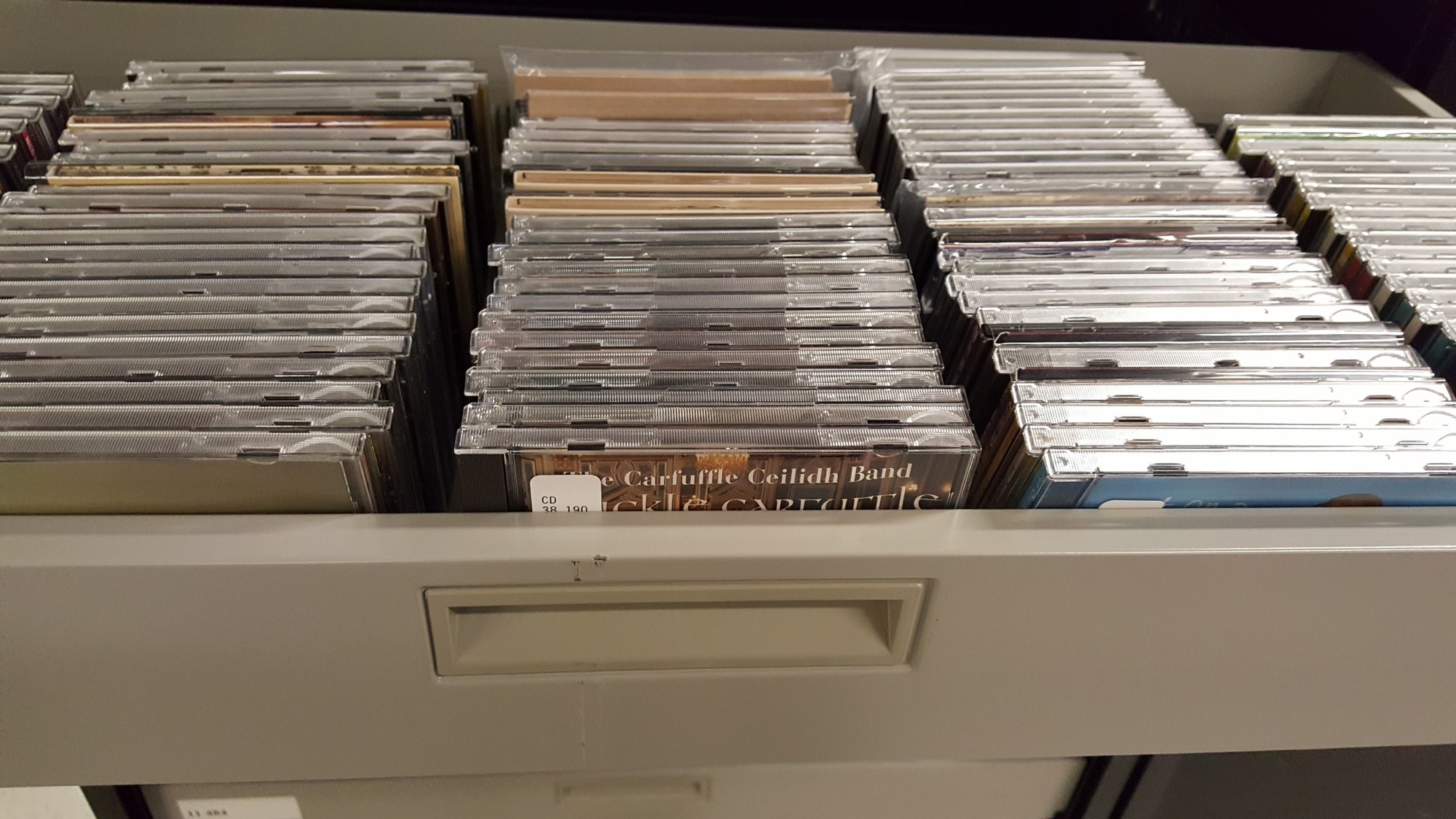
A colour photograph of a cabinet drawer containing hundreds of CD cases.

A small sample of the music CD collection, encompassing over 70,000 titles.

For LAC, our digital crossroads is now. We are in an era where digital collections are surpassing analogue collections in size. A recent inventory of our digital material revealed a vast and varied collection, both online and in physical media such as floppy disks, CDs and DVDs. This inventory also revealed that the volume of digital copies of university theses held at LAC is approaching that of analogue copies—and we only began acquiring theses in PDF digital formats in 1998. Since 2014, LAC has been acquiring theses in digital formats only. Official federal publications are also now primarily in digital format, since the government publishing regulations switched in 2013 to allowing online formats only. In addition, for the first time in its history, LAC received a private donation with 90 per cent of the collection in digital file format.

The LAC Digital Archive in the Preservation Centre serves as the central repository for LAC’s digital collections. Currently we preserve over five (5) petabytes of digital material, comprising primarily audiovisual material, the Government of Canada Web Archive, and digitized copies of paper records.  Five petabytes of data would be equivalent to 1,338 metres (4,390 feet) of DVDs stacked on top of one another!

Despite the considerable effort to preserve digital content today, we recognize that there is much more to be done to ensure all digital collections at LAC are protected.

November 30, 2017, marks the first annual International Digital Preservation Day. As a member of the Digital Preservation Coalition, we celebrate this day by launching the Strategy for a Digital Preservation Program. This strategy describes the additional steps needed to further preserve LAC’s digital treasures for the future and ensure that we are on the right path to success.

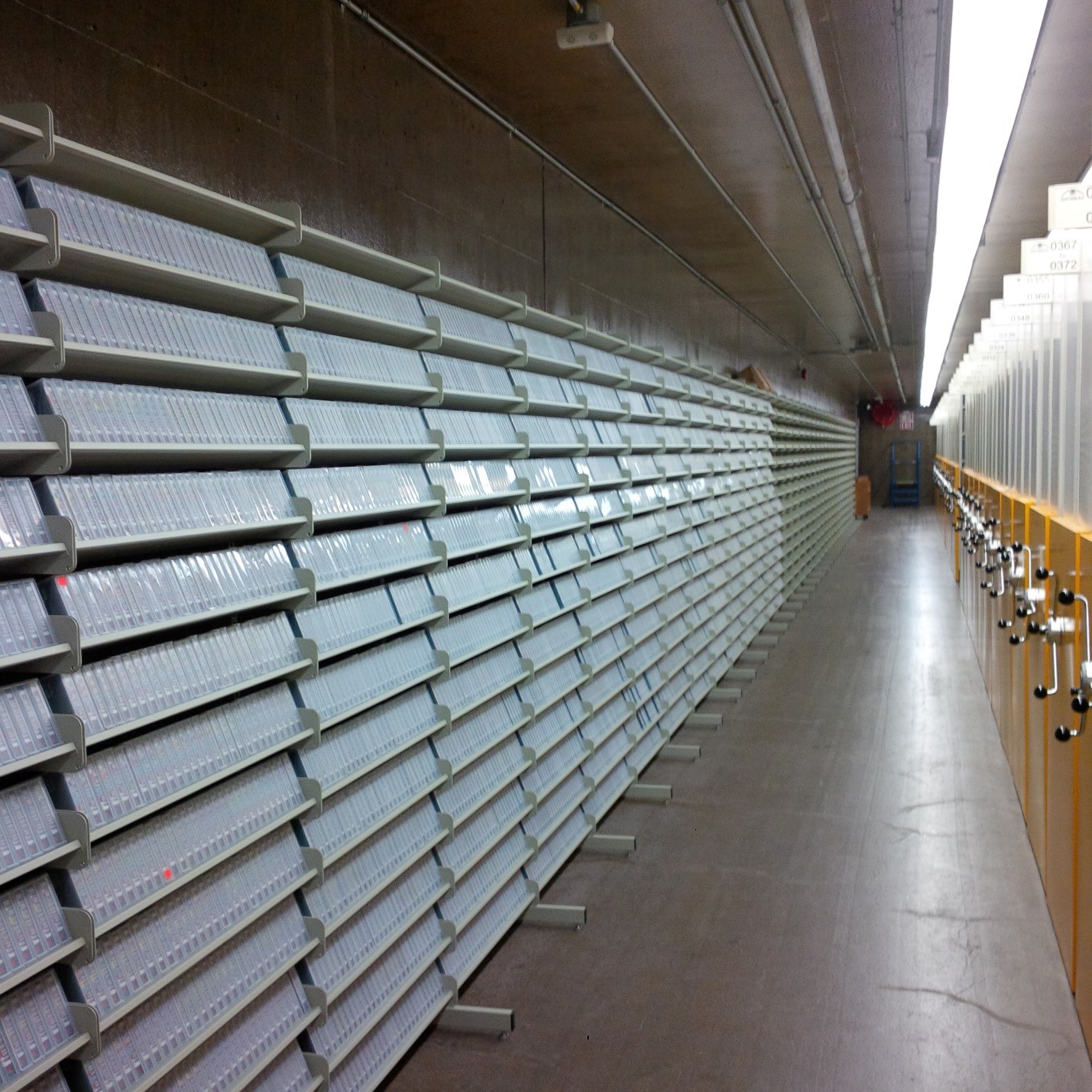
A colour photograph of a long white shelf on the left and high-density storage on the left.

Linear Tape Open (LTO) tape library of digital documentary heritage that are preserved in the LAC Digital Archive at the Preservation Centre.


Faye Lemay is a manager of digital preservation in the Digital Operations and Preservation Branch of Library and Archives Canada.

Reading hockey at the Canadian Museum of History

By Jennifer Anderson

Library and Archives Canada (LAC) is about more than just “stuff”; it is also the home of leading experts in Canadian history and culture. While LAC archivist Jennifer Anderson was at the Canadian Museum of History (CMH) on an Interchange Canada agreement, she co-curated the popular exhibition, “Hockey.” During the exhibition research, she consulted LAC staff and experts across the country. LAC also loaned 30 artifacts to the museum for this exhibition, and offered digital copies of hockey images from its vaults.

You can see the results that teamwork brings! Having run from March 10 until October 9, 2017 in Gatineau, the exhibition will start up again on November 25, 2017 (the 100th anniversary of the NHL) in Montréal at Pointe-à-Callière, before continuing its cross-country tour.

“Hockey”: the exhibition that started with a book…

…or two…or a few hundred. Biographies, autobiographies, histories—comic books, and novels for young people; we read those, too! And as many newspaper and magazine articles as we could find.

The exhibition team swapped books like fans trade hockey cards!

Books moved us, pushed us, challenged us and at times even frightened us. I cried and laughed over them, took notes and then forgot to because I was too engrossed in the reading. We read about big personalities like Maurice Richard and Pat Burns, about game changers like Sheldon Kennedy and Jordin Tootoo, and about Ken Dryden’s observations of young people and families in the game. We were deeply inspired by Jacques Demers’ work to advance youth literacy initiatives. Borrowing literacy teachers’ best practices, we chose to use fonts of different sizes and based the look of our exhibit on the style of a hockey card. The goal: make reading fun and accessible.

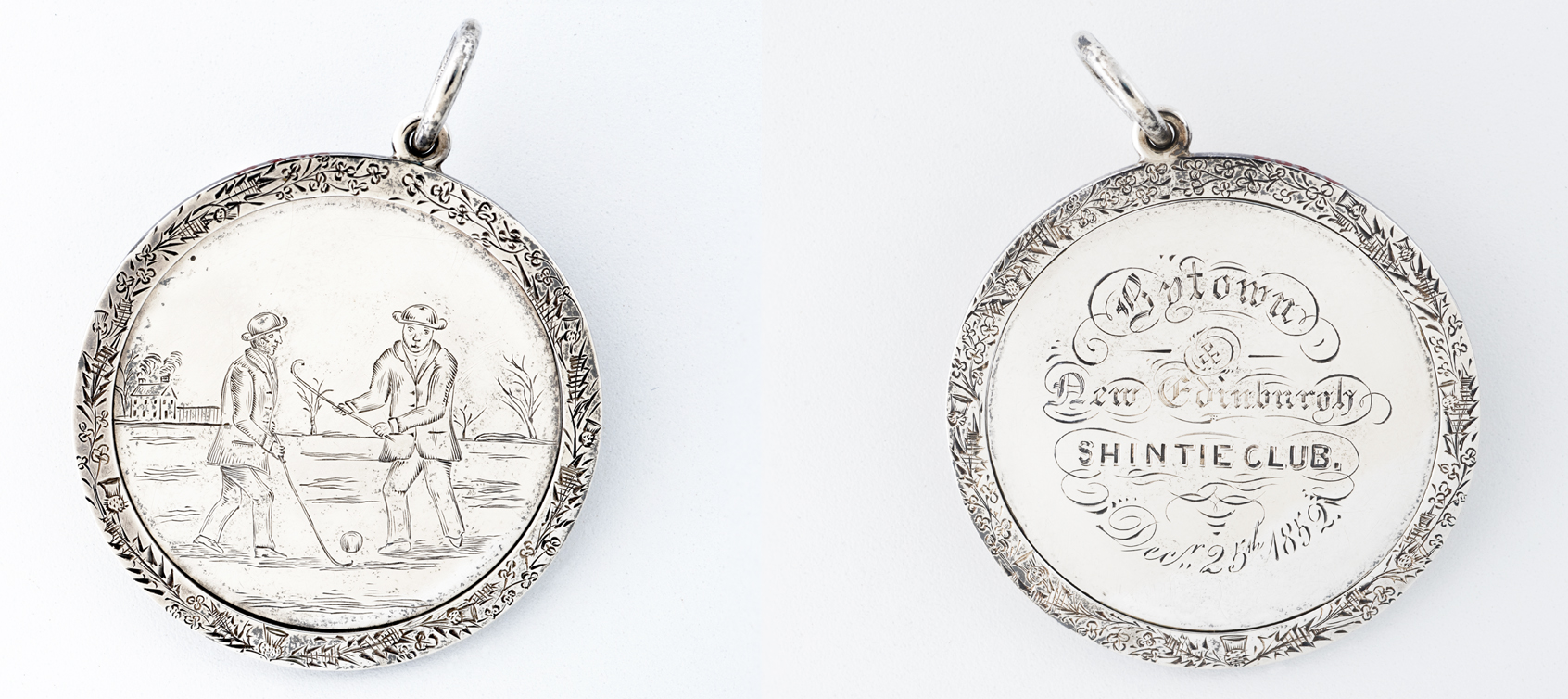
One of the first books I read was Paul Kitchen’s fascinating tale of the early history of the Ottawa Senators, Win, Tie or Wrangle (2008). Kitchen did much of his research from a desk at LAC, and he spun some of his discoveries into an online exhibition, Backcheck. From his book, we were able to identify a little-known shinty medallion depicting a stick-and-ball game, which took place on the grounds of Rideau Hall in 1852. Drawing on Kitchen’s footnotes, I reached out to the Bytown Museum, and was thrilled to learn they would be happy to lend the artifact for the exhibit. The conservators at the CMH buffed it up a bit, and images of this early piece of hockey history were included in the exhibition souvenir catalogue.

A colour photograph showing two sides of a silver medallion. The one side shows a game of shinty taking place outdoors and the second side reads “Bytown and New Edinburgh Shintie Club, Dec. 25th 1852.”

Front and back views of the silver New Edinburgh Shintie Club medallion, 1852, Bytown Museum, A203. Canadian Museum of History photos, IMG2016-0253-0001-Dm, IMG2016-0253-0001-Dm.

Paul Kitchen would probably be the first to acknowledge that any research project is a team sport, and our exhibition team reached out to many experts who had earlier worked with Kitchen, or had been inspired by him. Within LAC, Normand Laplante, Andrew Ross, and Dalton Campbell have continued the tradition of sports history, and their archival work led us to explore LAC’s collections for material to place in the exhibit. At the CMH, there are hockey experts galore, but Jenny Ellison is the “captain.” The team brought on Joe Pelletier as a research assistant to scout out images and hidden bits of information, based on the work he had already provided voluntarily. Hockey researchers and curators from across the country sent us artifacts, images and information.

Loaning originals is such an important part of the diffusion of any collection. Thirty individual items were loaned by LAC to the CMH for this exhibition. The LAC Loans and Exhibitions Officer admitted to being particularly touched by the team’s interest in The Hockey Sweater by Roch Carrier (now a popular animated film). As a child, she had received this book from one of her best friends, and only recently located this much-loved book. She has since shared it with her own children, and enjoyed telling them about her own childhood memories of this popular story about hockey.
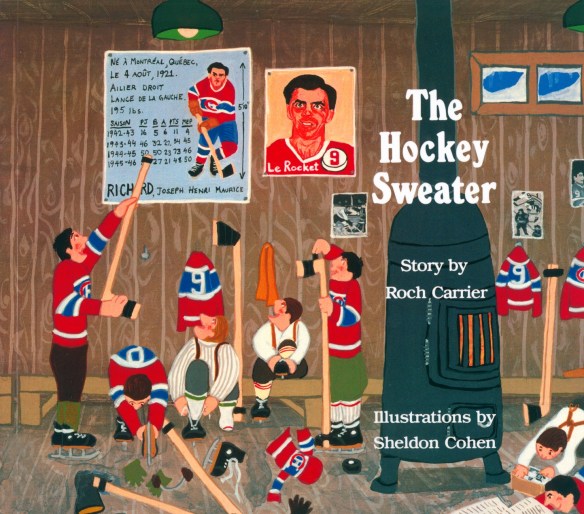
A colour image of a book cover showing boys dressed like Maurice Richard getting ready for a hockey game

The Hockey Sweater by Roch Carrier and illustrated by Sheldon Cohen. Used by permission of Tundra Books, a division of Penguin Random House Canada Limited (AMICUS 4685355)

Carolyn Cook, LAC curator, was pleased to see Bryan Adams’ portrait of Cassie Campbell in the exhibition. This portrait was one of several taken by Adams for Made in Canada, a book of photographs of famous Canadian women sold as a fundraiser for breast cancer research. “Cassie Campbell is an iconic figure in the world of women’s hockey,” said Cook. “Her on-ice accomplishments opened the door to the next generation of girls coming up in the game and, as the first woman to do colour commentary on ‘Hockey Night in Canada,’ she has broken through the glass ceiling. This close-up portrait of her exudes strength, control and determination—qualities that have contributed to Campbell’s success.”

In the early research period, Richard Wagamese’s book, Indian Horse, hit a chord and resonated with the team. Michael Robidoux’s book on Indigenous hockey, Stickhandling Through the Margins, motivated us to ensure that space be put aside for the full integration of Indigenous voices in the game, whether from the early leadership of Thomas Green, or through the artwork of Jim Logan to spark discussion of hockey in society.

Drawing on Carly Adams’ book, Queens of the Ice, the museum acquired and exhibited a rare Hilda Ranscombe jersey. We also read the footnotes in Lynda Baril’s Nos Glorieuses closely, and as a result were able to secure a number of important artifacts that were still in private collections, including a trophy awarded to Berthe Lapierre of the Montréal Canadiennes in the 1930s. And when we read about Hayley Wickenheiser skating to school in the drainage ditches along the roadside, building up the muscles that made her a leader in the sport, on and off the ice, we put her story near the centre of the exhibition.

A few of our favourite books found their way directly into the museum cases, to tell their own stories.

For instance, where we highlighted the role of the team-behind-the-team, we gave Lloyd Percival’s book The Hockey Handbook a central spot in the case. Gary Mossman’s recent biography of Percival was a big influence here, and in particular, I was fascinated by the powerful impact Percival’s book had on how hockey players and coaches approached the game. Imagine a time when players ate more red meat and drank beer the night before a game, rather than following Percival’s advice to eat yogurt and fresh fruit! And yet it was not that long ago! Apparently the book was taken up by Soviet hockey coach Anatoli Tarasov, and we saw its impact on the ice in 1972. Percival also had an interesting perspective on burnout, or “staleness” as he called it—a theory that has application for both on- and off-ice players.

Stephen Smith, author of Puckstruck, lent the museum collectible and fun cookbooks that teams published—this spoke to the overlap between popular fan culture and the down-to-earth and very practical realities of nutrition in high-performance sport.

The Museum of Manitoba loaned bookmarks that had been distributed to school kids by the Winnipeg Jets, each with a hockey player’s personal message about the importance of literacy in everyday life. These were displayed next to the hockey novels and comic books from LAC.

The exhibition team wondered about how to tackle prickly issues like penalties, violence and controversy. Then we hit on the most natural of all approaches—let the books and newspaper articles tell the stories! So next to an official’s jersey, you will find our suggested reading on the ups and downs of life as a referee, Kerry Fraser’s The Final Call: Hockey Stories from a Legend in Stripes. In the press gallery section, the visitor gets a taste for the ways that sports journalists have made their mark on the game. Next to a typewriter, an early laptop and Frank Lennon’s camera, we placed Russ Conway’s book Game Misconduct: Alan Eagleson and the Corruption of Hockey.

To capture the importance of youth literacy, we carefully chose books that we tested ourselves for readability.
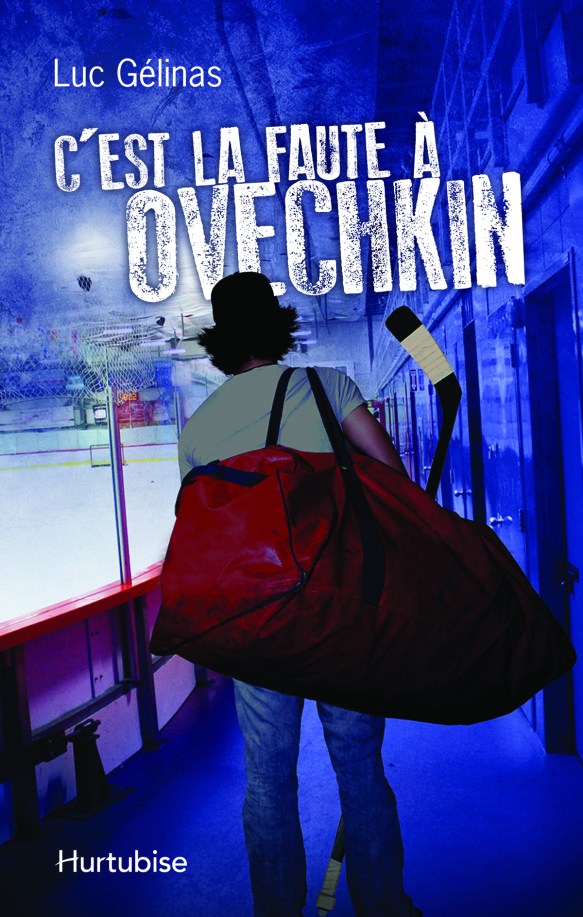
A book cover showing a man walking in a hockey arena carrying a large red duffel bag and a hockey stick.

C’est la faute à Ovechkin by Luc Gélinas, Éditions Hurtubise inc., 2012 (AMICUS 40717662)
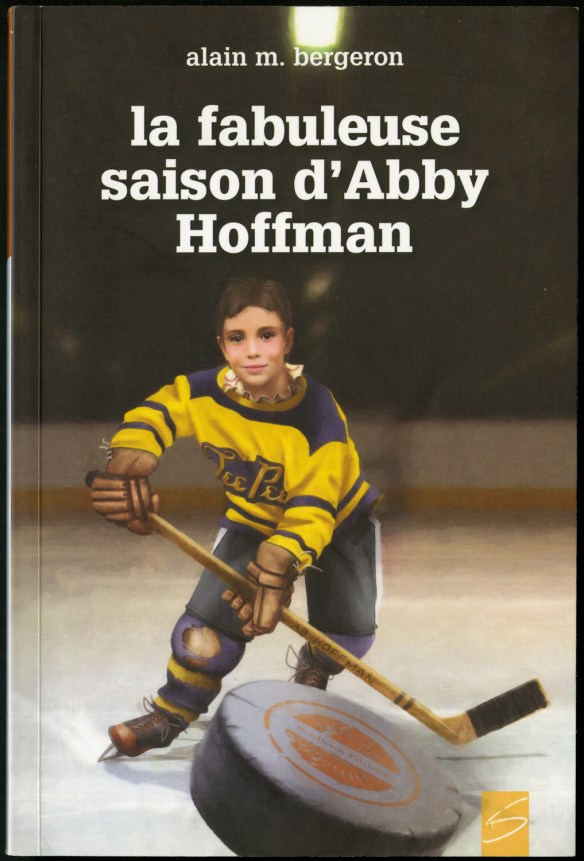
A book cover showing a child playing hockey wearing a yellow-and-black uniform and chasing a hockey puck.

La Fabuleuse saison d’Abby Hoffman by Alain M. Bergeron, Soulières, 2012 (AMICUS 40395119)
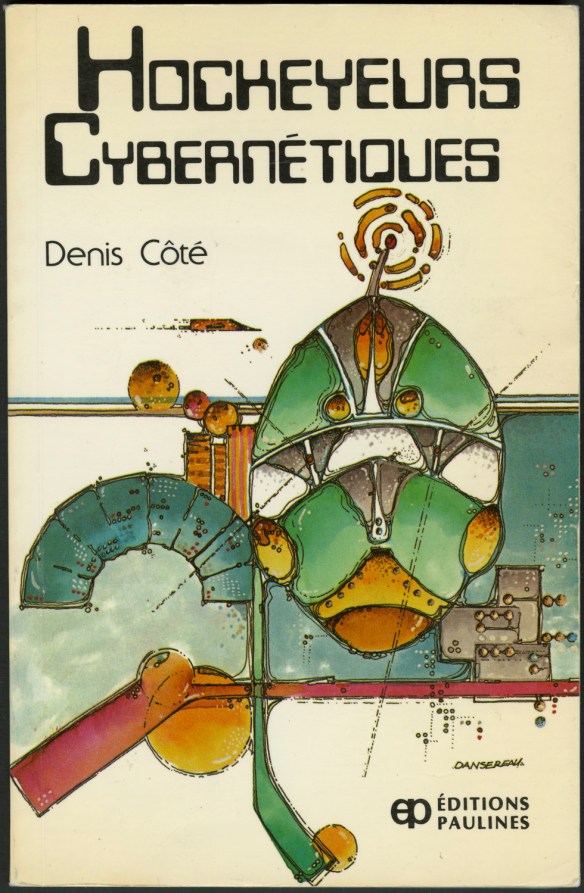
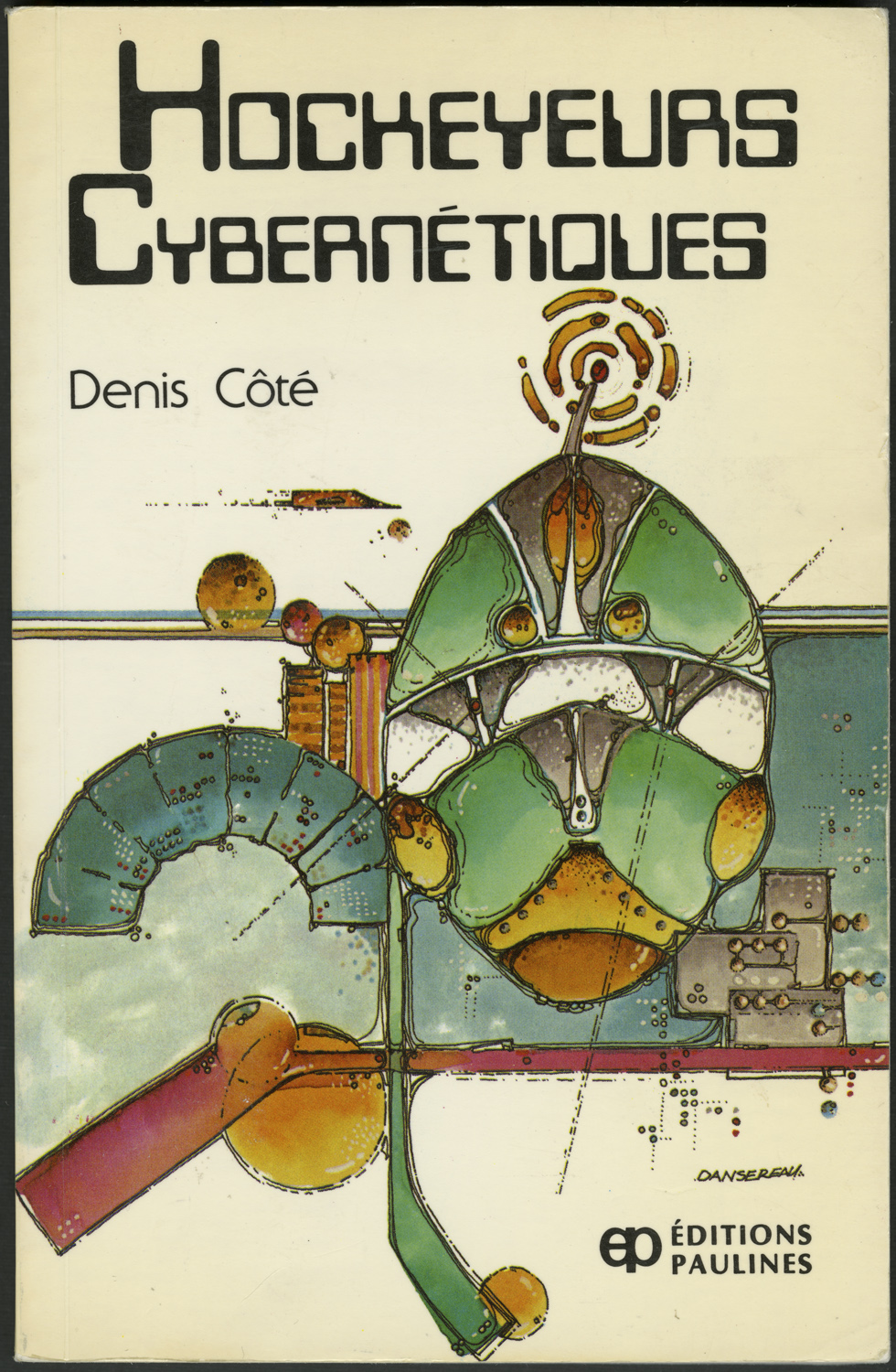
A book cover showing an abstract illustration that incorporates a hockey stick.

Hockeyeurs cybernétiques by Denis Côté, Éditions Paulines, 1983 (AMICUS 3970428)

Literacy became a thread running through the exhibition, in ways big and small. Thanks to all the librarians who helped us get our hands on these books! It may be too ambitious, but I continue to cherish the hope that the exhibition and this blog will inspire you to pick up a book, visit a library, and enjoy the game as much as we did.

Wishing to bring a fresh read to the sport, Jenny Ellison and I are editing a group of new essays on the sport, to be published in 2018 (Hockey: Challenging Canada’s Game — Au-delà du sport national) Check it out!

Do you have a favourite book about hockey?  Let us know in the comments.


Jennifer Anderson was co-curator of the exhibition “Hockey” at the Canadian Museum of History. Currently, she is an archivist in the Archives Branch at Library and Archives Canada.

Guest curator: Jill Delaney

Banner for the guest curator series. CANADA 150 is in red along the left side of the banner and then the bilingual text: Canada: Who Do We Think We Are? and under that text is Guest curator series.Canada: Who Do We Think We Are? is a new exhibition by Library and Archives Canada (LAC) marking the 150th anniversary of Canadian Confederation. This exhibition is accompanied by a year-long blog series.

Join us every month during 2017 as experts, from LAC, across Canada and even farther afield, provide additional insights on items from the exhibition. Each “guest curator” discusses one item, then adds another to the exhibition—virtually.

Be sure to visit Canada: Who Do We Think We Are? at 395 Wellington Street in Ottawa between June 5, 2017, and March 1, 2018. Admission is free.


This article contains historical language and content that some may consider offensive, such as language used to refer to racial, ethnic and cultural groups. Please see our historical language advisory for more information.

Temples of Today by John Vanderpant, ca. 1934

Black-and-white photo of a grain elevator with tall, circular towers in front of a taller rectangular building.

“Temples of Today” by John Vanderpant, ca. 1934. (MIKAN 3784205)

Photographer John Vanderpant saw Canada’s grain elevators as temples. They were part of his utopian vision for the country, based on a faith in trade and industry. For him, industry would define the nation’s future.


Tell us about yourself

It is amazing to think that I have been working at LAC for almost two decades now. The work in the photography section is incredibly diverse as are the collections themselves, and my time here has gone by incredibly quickly.

I come from an art history background, but I have always been as interested in the context of the work, as in its aesthetic qualities. By exploring the social, cultural and historical context of a photograph, we can begin to understand why it exists in the first place. Why was it created, who asked for it to be created, where and how it was circulated—all of these questions fascinate me. I suppose this is how I ended up as an archivist, because context and provenance are the pillars of any archival collection. I enjoy both the detective aspect of working on the historical photographs in the collection, and working with current photographers, digging into the rationale behind the taking of a photograph. I’ve published and presented on a wide variety of LAC photographs and collections over the years, including photos by John Vanderpant and Yousuf Karsh that were taken on cross-Canada trips in 1930 and the early 1950s respectively. These cross-country trips really intrigue me. They seem like a Canadian rite of passage even today, but they also speak volumes to the ever-shifting notion of Canadian identity.

Is there anything else about this item that you feel Canadians should know?

The John Vanderpant fonds has become one of LAC’s most important photographic fonds, as his work has grown in stature through the research of a number of Canadian art historians over the last 30 or 40 years. The photograph was taken around 1934 in the Vancouver ports area. Vanderpant was one of Canada’s leading pictorialist and straight photographers, and his series of images of the grain silos in Vancouver is now considered iconic.

When Vanderpant arrived in Canada from Holland in 1911, he saw the nation as most other Europeans did—a vast and empty wilderness. By the time he took the photograph “Temples of Today” in 1934, he dreamed of a country with the immense potential and unexploited resources to become an industrial powerhouse of the future. Of course he was not alone in this sentiment, and the interwar years were a period of great urban and industrial development in Canada. This photograph in particular illustrates his turn away from the more painterly, “fuzzy” qualities of pictorialism toward straight photography. This style embraced a stripped down modernist aesthetic and, just as importantly, a subject matter that represented a strong belief in a future dominated by an urban and industrial life. “Temples of Today” purposely eschews beauty, focussing instead on the massiveness of the silos coming out of the shadows into full light, with the foregrounding of the hydro poles reinforcing the industrial message. The photograph perfectly illustrates the development of a popular philosophy about the natural progression of mankind through industrialization. Vanderpant strongly subscribed to this view and wrote articles and gave many public lectures on the topic. But along with this forward focus, Vanderpant, with so many other Canadians of the time, completely dismissed the Indigenous peoples of the country, seeing Canada as a kind of terra nullius or unoccupied land ready to be exploited and developed however the settler culture wanted. Vanderpant’s photographs are rightly lauded today as an exceptional representation of an aspect of Canadian life that was largely viewed as unpalatable up to that point, but they also concealed, by omission, the importance of the founding communities of the nation.

Tell us about another related item that you would like to add to the exhibition

It is interesting to compare Vanderpant’s ideas about Canada, as represented in “Temples of Today,” with those of the German photographer Felix Man who visited Canada at almost the same time this photograph was taken. Man, considered to be a pioneer of photojournalism and of the photo essay format, travelled across Canada for six months in 1933, commissioned by the German picture magazine Berliner Illustrirte to “visit Canada and photograph all the most important things.” LAC acquired about 200 of his images in 1985 in order to document how Canada was perceived by a European during the interwar period. Like Vanderpant, Man was overwhelmed and inspired by the vastness of the country he visited. He visited almost every region, but was particularly taken with the prairies and the northern regions—going as far as Churchill, Manitoba, and Great Bear Lake, Northwest Territories.

But in most other ways, Man’s view of Canada could not have been more different than Vanderpant’s. Both held what could be described as romantic views of Canada. Vanderpant romanticized a future, industrialized and urban Canada, while Man held a more typically European view of a Canada frozen in a romanticized past. He was heavily influenced by the stories of Indigenous heroes written by fellow German Karl May (who famously only visited North America after his books were published). His idealized fantasies of the “noble savage” remain popular in central and Eastern Europe to this day. Man’s photographs vividly depict this romantic image of Canada. While Vanderpant’s images focus on the development of Canada, Man, as photographic historian Joan Schwartz has noted, largely excluded urban Canada in his photographs. Instead, his camera captured such views as the unrelenting snow and ice around Churchill in winter, and the “Banff Indian Days,” a popular tourist attraction in which Indigenous peoples donned stereotypical costumes, erected wigwams, and put on displays of hunting and horsemanship for pay.

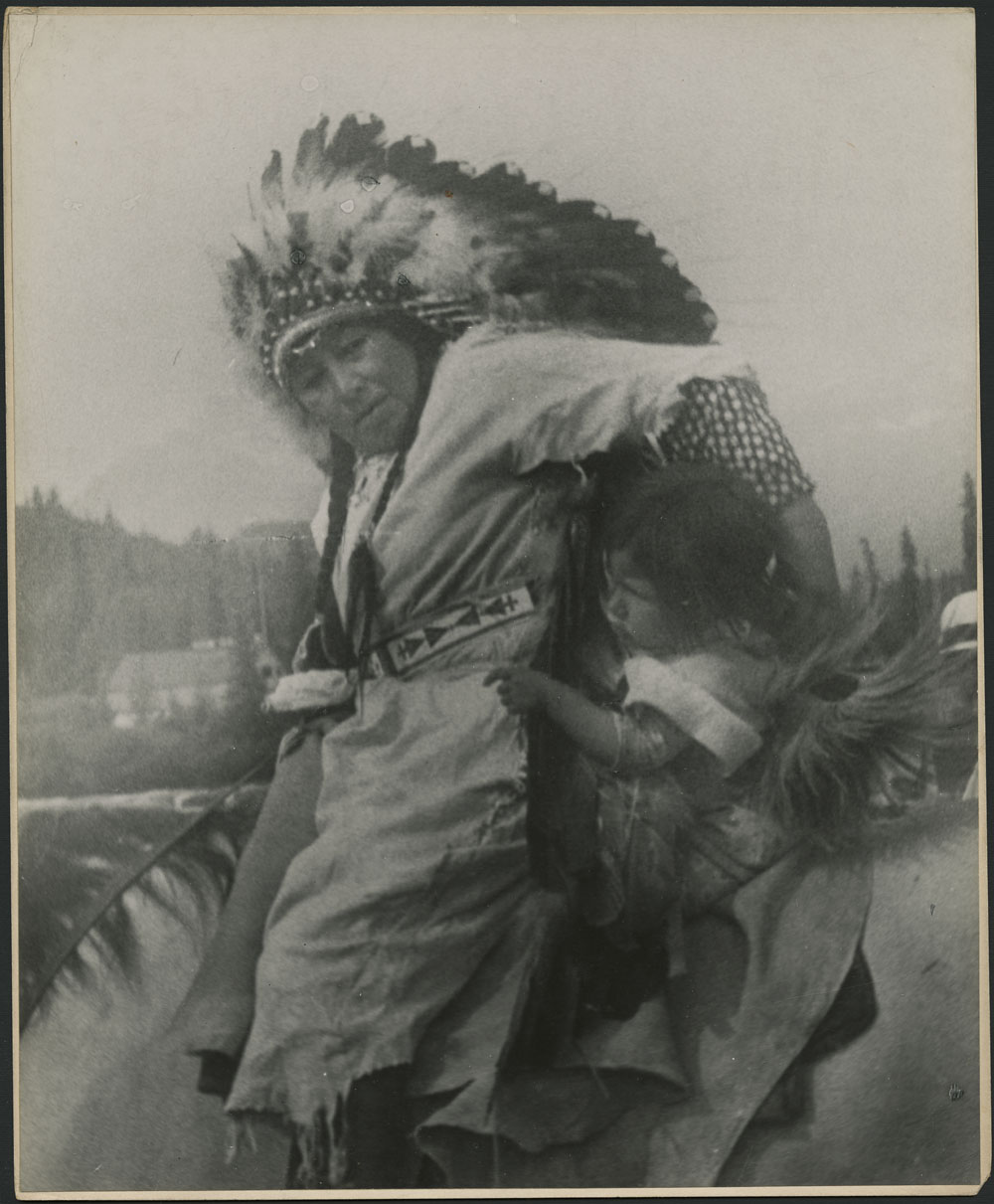
Woman on horseback holding a little girl to her side. The woman is wearing a plain dress with a patterned belt and a feathered headdress over her braided hair.

“Indian Woman with Child” by Felix Man, taken during “Banff Indian Days” in Banff, Alberta, 1933. (MIKAN 3333566)

His photograph of the Indigenous woman and child on horseback is an excellent example, with its grainy aesthetic, and the woman in an elaborate headdress (which in reality were only worn by women in exceptional circumstances) reaching back to embrace the small child. The “Madonna and child” symbolism presents all the qualities necessary to build a stereotypical and generalized narrative of 20th-century Indigenous peoples as still living their so-called traditional lives, and the images of the Banff “Indian Days” were very popular with the European press.

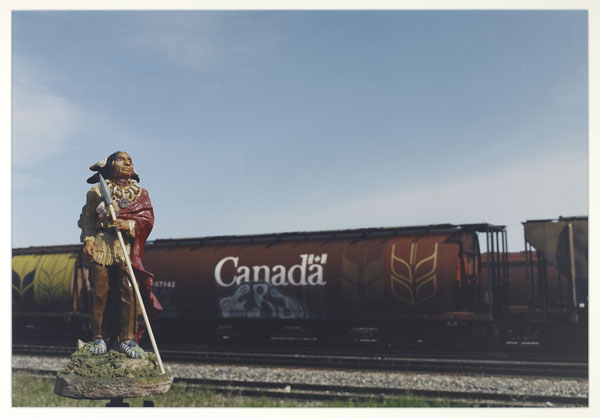
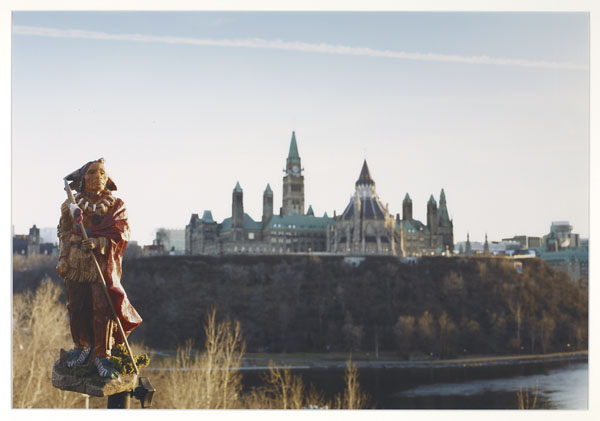
The exclusion of Indigenous peoples in John Vanderpant’s representations of an industrial and urban Canada, and the fixing of them into a mythical past by Felix Man, also tie into the works of urban Iroquoian photographer Jeff Thomas in this exhibition. Using toy figurines posed with the Parliament buildings in the first instance, and in front of a rail car emblazoned with the word “Canada” in the second, Thomas seeks to reinsert Indigenous peoples into both Canada’s history and present. Thomas’ photographs introduce critical concerns about the roles Indigenous people played in the building of the nation-state of Canada and in the building of the railroad. Using the figurines, he plays on the stereotypes which were perpetuated and disseminated by photographers like Man, but also with the omission of Indigenous peoples from the narrative of the past, present and future of Canada. Considering these two seemingly unconnected photographs from the 1930s together allows us to bring these two stereotypical views of Canada together, and to see how the knowledge of the immediate and broader contexts in which they were created can deepen our understanding of not only the photographs themselves, but of Canada’s past and present as well.

First Nations figure set in front of a train marked “Canada” with grain graffiti on its side.

Canada Day 2005, Brandon, Manitoba, Canada from The Delegate on Tour Series by Jeff Thomas, 2005 (MIKAN 3932014) ©Jeff Thomas

Indigenous figurine set across the river from Parliament Hill.

Parliament Hill, Ottawa, Canada, 2007 from The Delegates on Tour Series by Jeff Thomas. (MIKAN 3932081) ©Jeff Thomas

Biography

Jill Delaney is an archivist in the acquisition of photography of the Visual, Sound and Landscape section, Private Archives Branch. She holds a Master of Canadian Studies from Carleton University (1991) and a doctorate in Art and Architectural History and Theory from SUNY-Binghamton (1997). Jill joined LAC in 1998 as a photography archivist and has been working with the collections ever since, with the exception of an assignment in the architectural records section.

Images of snowshoes now on Flickr

Snowshoes distribute a person’s weight over snow, enabling one to walk without sinking too deeply.

A black-and-white photograph of an unidentified First Nations woman sitting on a chair and working on the webbing of a large round snowshoe.

Aboriginal woman making snowshoes, Pointe Bleue, Quebec (MIKAN 3367092)

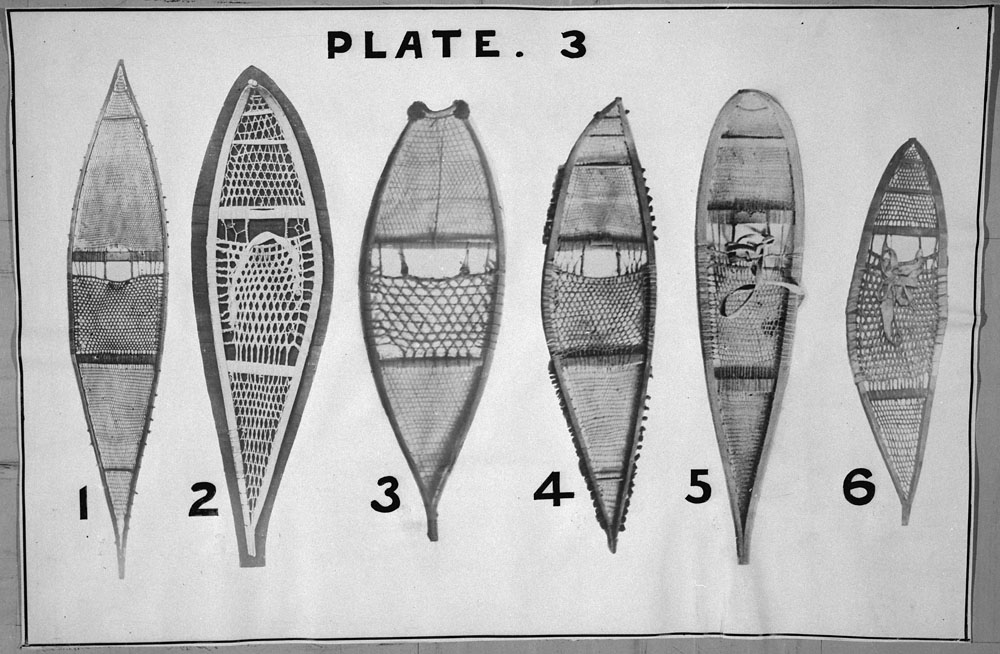
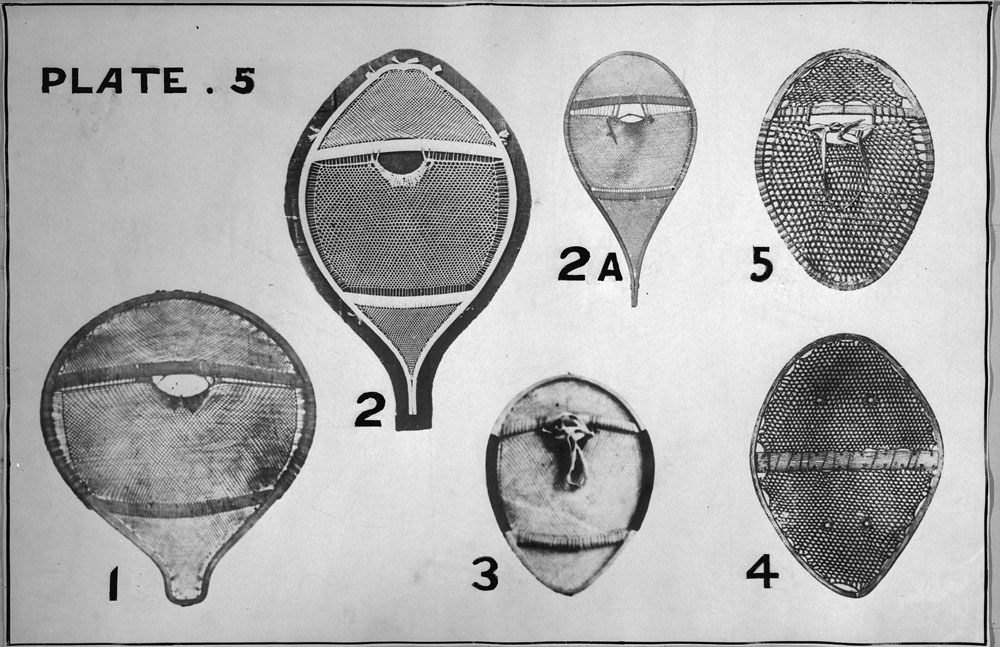
Traditional snowshoes are made with wooden frames and leather strips for webbing and boot bindings. Modern equivalents use metal or synthetic materials, but follow similar design characteristics to their predecessors. Early snowshoe design in North America spans the continent where regular snowfall occurs. The shapes and sizes vary dependent on the location. Snowshoes are available in round, triangular, and oval shapes, or can be very long. Each design addresses different types of snow, whether powdery, wet or icy. First Nations and Inuit communities are known for their design and use of snowshoes.

A black-and-white photograph showing six kinds of long snowshoes made with various materials and styles of webbing.

Styles of snowshoes (MIKAN 3401671)

A black-and-white photograph showing six kinds of round or oval-shaped snowshoes made with various materials and styles of webbing.

Styles of snowshoes (MIKAN 3401670)

European settlers were quick to adopt snowshoes for travel, hunting, and even military purposes. Snowshoeing clubs in Canada were started the mid-1800s for sport and leisure activities—leading the way for these unique aboriginal inventions to become a fixture in Canadian society.

A black-and-white photograph of thirteen children and their teacher posing with their snowshoes at the entry deck of a Canadian National Railway school car.

Canadian National Railway School Car, Capreol, Ontario (MIKAN 3381288)

Visit the Flickr album now!

Lieutenant-Colonel Harcus Strachan, VC

By Emily Monks-Leeson
This week, Library and Archives Canada’s Discover Blog honours Lieutenant-Colonel Harcus Strachan, Canadian Victoria Cross recipient for his actions during the First World War Battle of Cambrai, which took place one hundred years ago today.

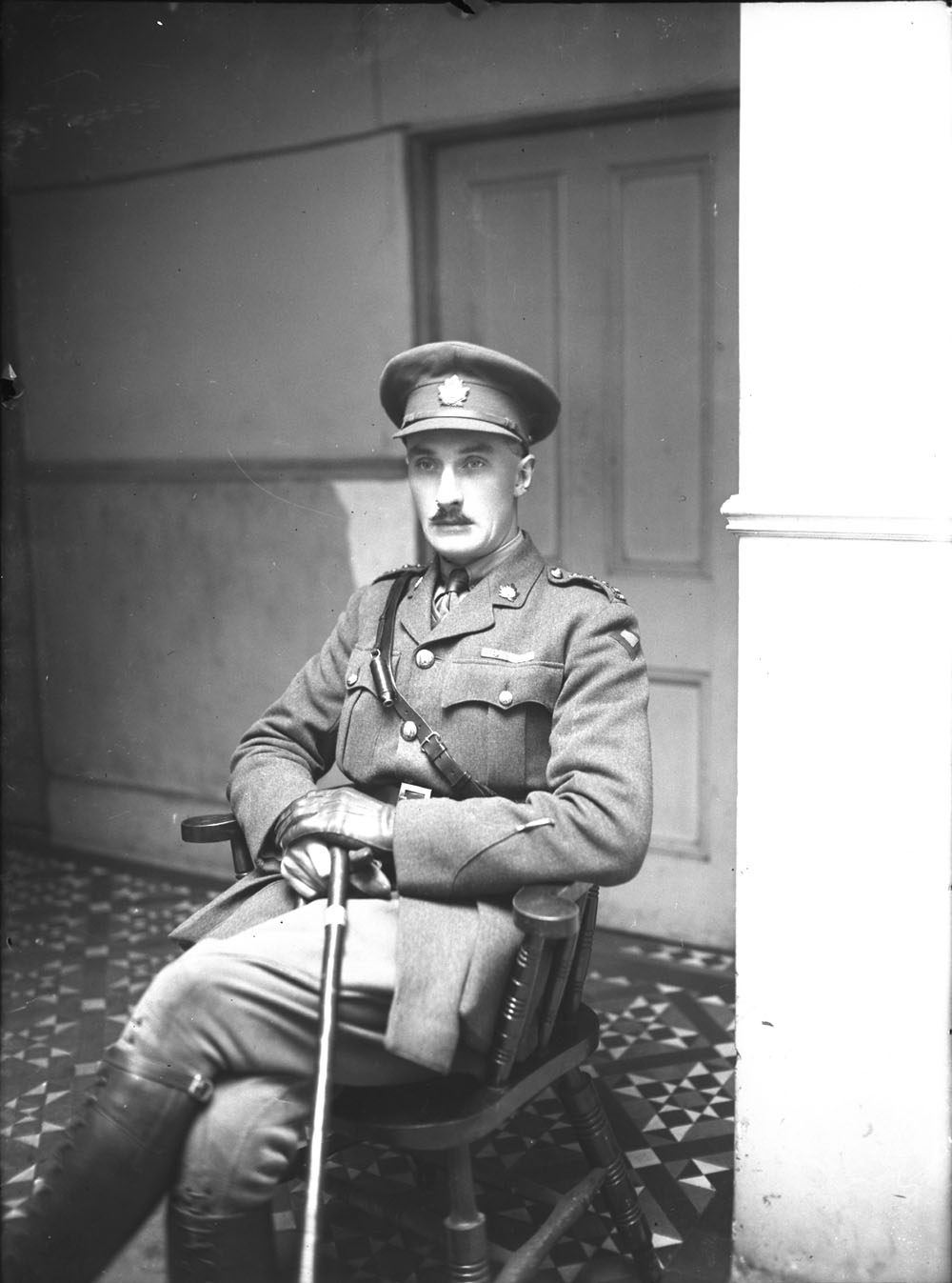
A black-and-white photograph of a seated officer wearing a cap and all the accoutrements of an officer.

Lieutenant Harcus Strachan, VC, undated (MIKAN 3221434)

Born in Borrowstounness, Scotland, in 1887, Strachan immigrated to Canada in 1908. He enlisted in The Fort Garry Horse regiment, based in Winnipeg, Manitoba, in 1915. He was a commissioned lieutenant and, on November 20, 1917, took command of a mounted squadron of The Fort Garry Horse at Masnières, France. When the squadron leader was killed, Lieutenant Strachan led the squad through the German line of machine gun posts and charged the German battery, killing seven of the gunners in hand-to-hand fighting. He then cut telephone communications three kilometers behind the German lines, rallied his surviving men, and fought his way back through to his own lines with all unwounded men and fifteen German prisoners. His citation in the London Gazette asserts that this operation “was only rendered possible by the outstanding gallantry and fearless leading of this officer” (London Gazette, no. 30433, December 18, 1917).

A black-and-white photograph of a line of mounted soldiers riding through a village.

Lieutenant Strachan, VC, and a squadron of The Fort Garry Horse passing through a village on the Cambrai front, December 1917 (MIKAN 3405685)

A typewritten report of the events of the day.

The Fort Garry Horse war diary, dated November 20, 1917, Page 2 of Lieutenant Strachan’s report (MIKAN 2004724)

Lieutenant-Colonel Strachan was promoted to captain and received his Victoria Cross from King George V on January 6, 1918. It became a tradition for the “Garrys” to hold a parade every year on the anniversary of Strachan’s Victoria Cross. Strachan survived the war and later commanded the 1st Battalion of the Edmonton Fusiliers during the Second World War. He died in Vancouver on May 1, 1982. Strachan was recently honoured with an historical plaque on the shores of Harcus Strachan Lake, 250 kilometers east of Thompson, Manitoba.

Library and Archives Canada has the fully digitized service file for Lieutenant-Colonel Harcus Strachan in the Personnel Records of the First World War database.


Emily Monks-Leeson is an archivist in Digital Operations at Library and Archives Canada.

Victoria Cross Recipients: First World War now on Flickr

The Victoria Cross (VC) is the highest military decoration in the Commonwealth and takes precedence over all other medals, decorations and orders. A recognition of valour in the face of the enemy, the VC can be awarded to a person of any rank of military service and to civilians under military command. So far, 98 Canadians have been awarded the Victoria Cross, beginning with Alexander Roberts Dunn who in 1854 fought in the Battle of Balaclava in the Crimean War. The Victoria Crosses were awarded to 71 Canadian soldiers during the First World War, and 16 were awarded during the Second World War. The remaining VCs were awarded to Canadians for the Indian Rebellion of 1857 (in which William Hall of Nova Scotia became the first-ever black recipient of the VC) and the South African War (1899–1902).

In 1993, the Canadian Victoria Cross was adopted in place of the British VC. The medal is identical to the British VC but the inscription is in Latin—Pro Valore—a linguistic ancestor to both English and French. The Canadian Victoria Cross has yet to be awarded.

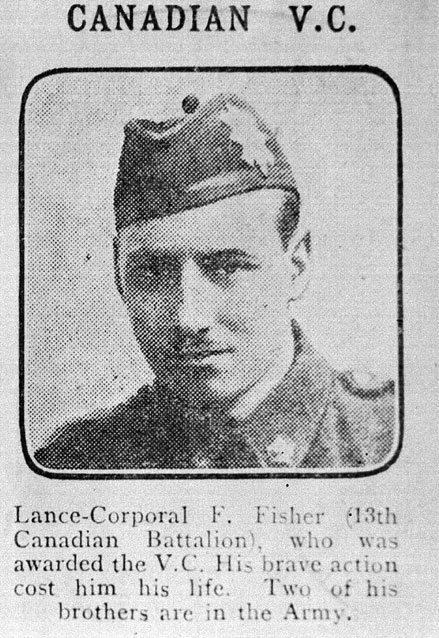
A black-and-white image of Lance-Corporal F. Fisher.

Lance-Corporal F. Fisher, April 23, 1915 (MIKAN 3215642)

A black-and-white photograph of Lieutenant George Burdon McKean.

Lieutenant George Burdon McKean, April 27-28, 1918 (MIKAN 3218939)

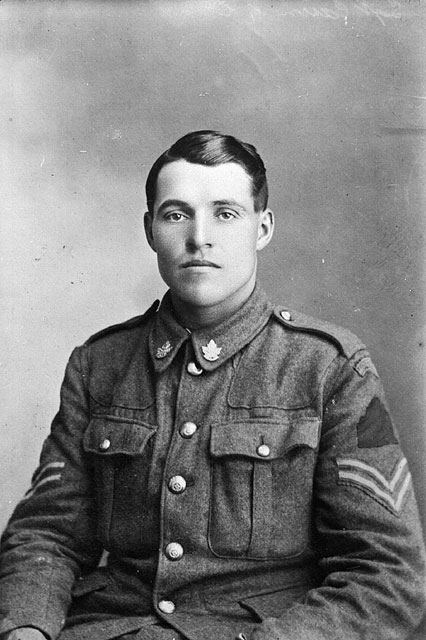
A black-and-white photograph of Sergeant Alexander Picton Brereton.

Sergeant Alexander Picton Brereton, August 9, 1918 (MIKAN 3213059)

A black-and-white photograph of Sergeant Hugh Cairns.

Sergeant Hugh Cairns, November 1, 1918 (MIKAN 3191892)

Visit the Flickr album now!