Vimy Ridge: a journey of maps (part 2)

By Ethan M. Coudenys

Picture the scene of the moments leading up to a massive military advance. On the morning of April 9, 1917, a cold rain falls on the Douai plain in France. To the west, a great number of Canadians have gathered to begin their attack on Vimy Ridge at precisely 5:30 a.m. Of the approximately 30,000 men preparing to advance that day, roughly a third are hidden underground in tunnels built specifically to hide them from the German forces’ lookouts. At the moment of attack, the men burst from the tunnels and shower brimstone and hellfire on the forces that oppose their advance.

A tunnel at Vimy Ridge.

Grange Subway under Vimy Ridge, August 17, 2022. Image courtesy of the author, Ethan M. Coudenys.

These tunnels were mainly constructed by the Welsh Companies of the Royal Engineers. The Welsh miners were mostly professional miners, and they would cut through the chalk stone 10 to 15 metres below the battlefield in near-total darkness. Some 10 kilometres of underground tunnels ran from the furthest Canadian rear trench to the front of the line. They were used to move supplies, run messages and conceal the advancing army on the day of the attack.

Speaking from my experience as a tour guide at the Canadian National Vimy Memorial at Vimy Ridge, these tunnels, often filled with water, bats, rats and unusual smells (probably far worse back then), were incredibly confusing to traverse during the First World War. There were electric lights every 20 metres or so, but the tunnels were dark, twisting and loud. Chalk conducts sound, so soldiers could hear, not only every shell falling on the surface with some clarity, but also miners digging away and the few soldiers and officers shuffling through the tunnels.

To avoid confusion, maps were created to prevent messengers and officers from getting lost in the subterranean labyrinth. Only one of these tunnels, the Grange Subway, is currently open to visitors at the Vimy Ridge National Historic Site. The Durand Group, a research and exploration association, is carrying out the dangerous work of investigating and uncovering tunnels and redoubts, but these efforts have not yet resulted in additional tunnels being opened to the general public. Nevertheless, the Durand Group’s work provides insights into what the maps of different tunnels were like at this time in the war, as the association maps and reports on newly uncovered tunnel systems in France and Belgium.

The attack on Vimy Ridge consisted of two different phases. The first, and most famous, is the taking of the ridge along the 12-kilometre-long front line for which the Canadian Expeditionary Force (CEF) was responsible. The CEF had four main objectives, but Hill 145, the highest part of the ridge, was the declared central target for the operation. The second phase was taking the Pimple (also known as Hill 119). This was a heavily fortified and well-manned artillery and heavy machine gun post at the top of a hill. It was very easy to defend, and very useful if the German forces wanted to regain territory lost in the first phase. Thus, the second phase of the Battle of Vimy Ridge is now known as the Battle of Hill 119 (or the Pimple).
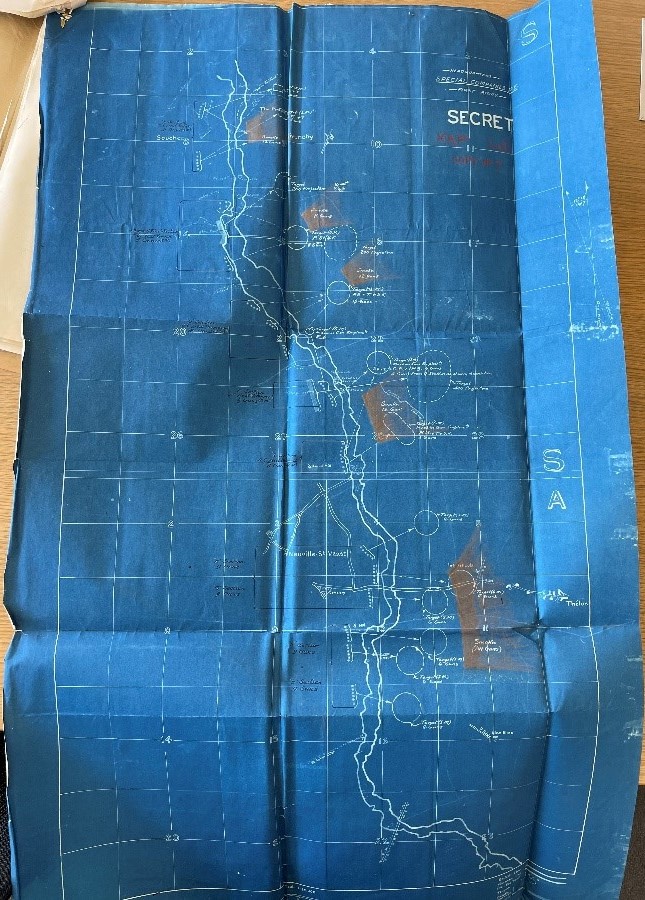
Map showing artillery plan, including smoke screens.

Artillery barrage plan – Battle of Hill 119 (or the Pimple) (MIKAN 3946966). Photo: Ethan M. Coudenys.

Mapping the artillery attack

The Vimy Ridge and Pimple attacks were Canada’s contribution to the larger military operation of the Battle of Arras, which took place along a 30-kilometre front led by mostly British forces. One of the most important elements of the attacks was the efforts of the artillery brigades, for which both Canadian and British artillery units worked in tandem to aid the advance of the infantry troops. This effort required immense preparedness and incredible tenacity. It was critical for artillery units to follow the same schedule, to ensure that the barrage of artillery shells would advance at a very specific pace of 100 metres every three minutes. Every unit was therefore issued maps and specific timings on each of the changes in range, as well as the speed of firing. This tactic was called a rolling (or creeping) barrage.

To expand on the discussion in part 1 of this post, a rolling barrage is a military tactic largely developed by British and Canadian generals who had witnessed the failure of artillery support at the Battle of the Somme in France (July–mid-November 1916). The rolling barrage tactic involved firing a wall of shells into no man’s land and advancing the wall slowly, so that the opposing forces could not exit their shelters to mount an effective defence before the infantry troops reached their line. This tactic was effective in eliminating defensive enemy snipers and machine guns during the start of the Vimy Ridge battle. Canadian writer Pierre Berton states in his work on Vimy Ridge that the roar of the artillery firing was so loud that it could be heard as far away as London. To the soldiers advancing into dangerous territory, it seemed as though the sky was made of lead, because of the sheer number of shells flying overhead.

Let us now turn to the various maps of the artillery on Vimy Ridge. For the assault on Hill 145, it was important for the infantry and artillery to be synchronized. The artillery commanders received the same maps as the infantry units so they could measure the advances of the various divisions and brigades, sometimes kilometres away.

More importantly, the artillery officers received maps of specially chosen target areas, to help them destroy major defensive installations before the infantry came into range of those positions. These target areas could be machine-gun nests, sniper posts, defensive artillery pieces or mortar emplacements. Part of the plan of attack was to ensure that there was a significant time gap between the first and second advance. For example, the distance between a red line and a black line would be roughly a 30-minute interval, during which the secondary wave of infantry and supporting troops could move up. In other words, the artillery would fire on specific targets for a set amount of time, wait 30 minutes to allow the infantry to advance, then fire on more distant targets. This allowed for the infantry to rest and fortify their newly taken positions, while the artillery targeted the potentially dangerous defensive fortifications further along the front.

To capture the Pimple, the strategy was quite different. While the artillery continued to use the rolling barrage, they also used two new tactics that were introduced and developed during the Great War. The first was creating what some scholars have called a “killing field,” where, through heavy artillery fire, defending troops are forced to leave their shelter for open space and then are targeted by machine guns and artillery. The second was the launching of smoke screens. The artillery would launch barrels of burning oil into the battlefield, creating a thick, black cloud of smoke to hide the advancing infantry. These two tactics would become a trademark approach of the Canadians in later battles, including the Battle of Hill 70 in Lens, France (August 15–25, 1917) and the Third Battle of Ypres (Passchendaele) in Belgium (July 31–November 10, 1917).

While the rolling barrage was successful in the preliminary attacks on Hill 145, the capture of the Pimple was one of the most costly battles in Canadian military history, with over 10,000 men killed, injured or missing.

Conclusion

The mapping of a battlefield is not a new concept. From the age of the Roman Empire to the Napoleonic Wars, generals and warlords have used maps to plan attacks and navigate battlefields. However, the development and production of these maps was usually done exclusively for high-ranking officers and non-commissioned members. At the Battle of Vimy Ridge, to ensure better overall preparedness among troops and to prevent confusion among infantry soldiers, maps of the battlefield were produced and distributed widely, so that even low-ranking lieutenants and lance-corporals would have access to the plan of attack. This innovation in how the allies fought during the First World War resulted in a hugely successful attack upon the German forces’ position on Hill 145 (Vimy Ridge) and Hill 119 (the Pimple) during the Battle of Vimy Ridge, part of the greater Battle of Arras. Maps illustrated clear and focused goals for individual units, and they demonstrated the tactics that the soldiers, artillery and support services would use to take the ridge. These maps followed many months of preparations for the Vimy Ridge battle; they were a major contributing factor in the CEF’s successful capture of Hill 145.

Additional resources


Ethan M. Coudenys is a Genealogy Consultant at Library and Archives Canada.

Vimy Ridge: a journey of maps (part 1)

By Ethan M. Coudenys

Cartography is the practice of drawing or making maps; during the First World War, this was vital for planning and preparing attacks and defensive actions. Battles in France like those of the Marne, Somme and Verdun were mostly planned with large maps by high-ranking officers and non-commissioned members. However, for the battle at Hill 145—better known as Vimy Ridge—cartography played an integral role in the planning of the assault by the Canadian Expeditionary Force (CEF).

Group of men going through barbed wire with shells exploding in the background.

Canadians advancing through German wire entanglements, Vimy Ridge, April 1917 (a001087).

Before we begin, we should set the scene by talking about the CEF before the Battle of Vimy Ridge. The Canadians had fought in various battlefields in France and Belgium, including with distinction at Flers-Courcelette (August–November 1916) in France, about 50 kilometres from Vimy. Under the command of Lieutenant-General (later Field Marshal and Governor General) Sir Julian Byng, the CEF had become a very successful fighting force. In November 1916, the Canadians began moving to the east of the French town of Arras. There, they began preparing for an attack on Hill 145, where the German forces had taken nearly three years to build very heavily fortified lines of trenches.

The Battle of Vimy Ridge, which began on April 9, 1917, was not an isolated operation; it was a small part of the Battle of Arras. The two major points of the battle for the ridge, for which the Canadians were responsible, were the ridge itself (Hill 145) and the Pimple (Hill 119). Incredible preparations went into planning this attack.

Between the beginning of the war in 1914 and when the Canadians took up positions in late November 1916, French and Moroccan divisions had tried to take Vimy Ridge. They advanced the allied front line closer to the ridge. During the Battle of Verdun, the British took over these positions, and they expanded and strengthened the relatively weak fortifications. By November 1916, the CEF entered the front line at Vimy with very good fortifications.

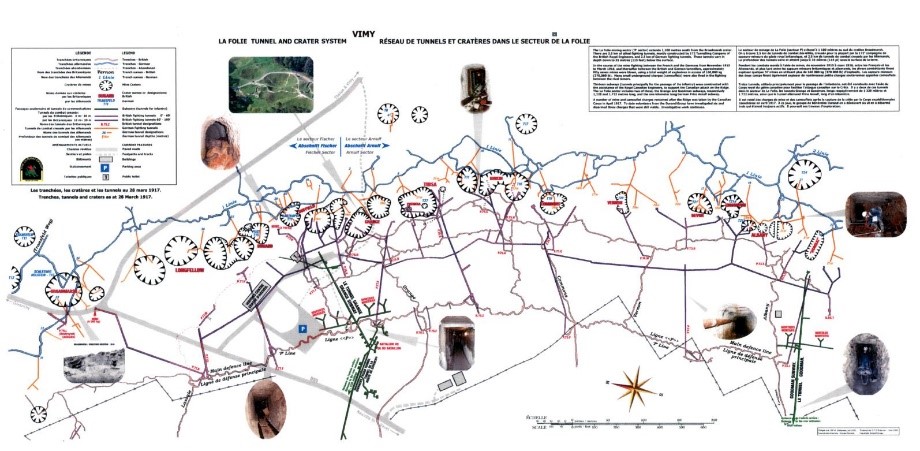
Map showing a tunnel-and-crater system.

Map 1 – Map of La Folie battlefield: group of tunnels, near Vimy. Courtesy of Veterans Affairs Canada – European Operations.

The Canadians were called to the line at Vimy for the first time as an entire corps, fighting side by side. This was incredibly important not only for the soldiers but also for the young nation. For many, it signified the start of a process whereby Canadians would collectively build their cultural and national identity.

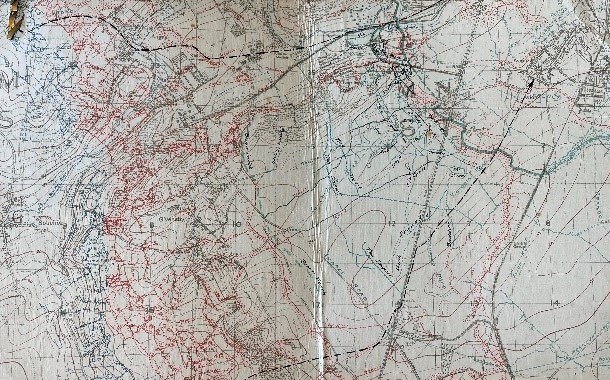
We can better understand the importance of cartography in battle by first reviewing some of the maps that are presented today at the Visitor Education Centre in the Canadian National Vimy Memorial in France. There, Canadian guides—all university and college students—educate the public about the Battle of Vimy Ridge, including the tunnels that were built to support the advance of Canadian troops in April 1917. In maps 1 and 2, the different tunnels and trench lines used during the battle for the ridge are shown.

Map showing the battlefield during the Battle of Vimy Ridge.

Map 2 – Battlefield map of the Battle of Vimy Ridge: modern map. Courtesy of Veterans Affairs Canada – European Operations.

How were the maps made?

Maps were important for infantry soldiers because they helped to ground and situate them in an environment marked by constant fear, confusion and proximity of death. During the months leading up to the Vimy Ridge battle, soldiers were sent into the German forces’ trenches to gain information about the enemy’s fortifications and weapon emplacements that lined the front. Moreover, the Royal Flying Corps (later the Royal Air Force) used aerial photography to pinpoint areas of fortifications and map points of interest for the attack. Let us examine this gathering of information by soldiers.

The CEF collected information by sending small incursions into the German lines, with soldiers memorizing the layouts of the other side’s trench systems. These could be completed by a small group of men or a very large group (5,000 or more in one instance) and took place from November 1916 until the eve of the battle in April 1917.

During the infamous trench raids, Canadian soldiers would be tasked with memorizing the layout of the trenches and important locations in the German forces’ lines. These vital recollections were later reflected in detailed maps, which were used by the Canadians to help reduce confusion among the infantry. The trench raids could be incredibly dangerous, both for the men raiding and for the defenders. Often these attacks would take place at night, and both attackers and defenders could suffer heavy losses.

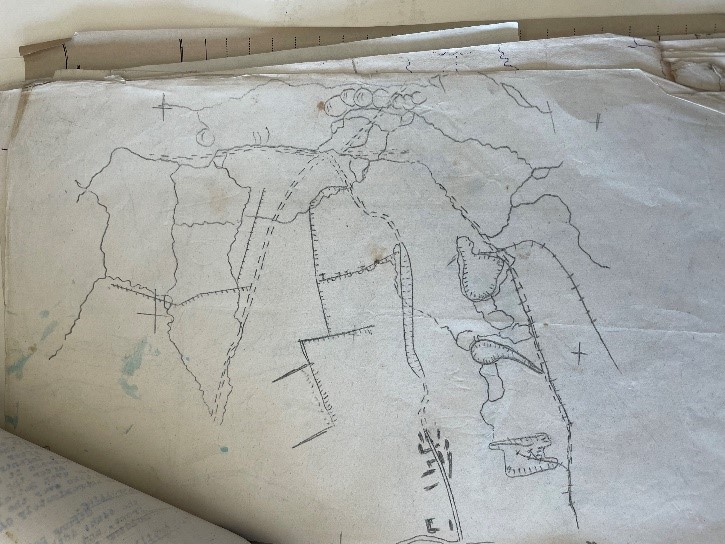
Hand-drawn map of German trenches after a raid before the Battle of Vimy Ridge.

Hand-drawn map of German forces’ trenches after a raid, Vimy Ridge, 1917 (MIKAN 4289412). Photo: Ethan M. Coudenys.

The maps that were created as a result of these raids, such as the example above, were often drawn by hand, from memory, by individual soldiers.

What maps were made?

Map showing artillery barrage in the Vimy region in France.

Artillery barrage map, 1st Field Survey Company, Royal Engineers, near Vimy, 1917 (e000000540).

We are very fortunate to have access to a vast number of maps from the Great War in the collection at Library and Archives Canada. Some of the most frequently requested by researchers are the trench line maps of the Western Front. As mentioned above, these maps were drawn through painstaking and sometimes bloody collection of information by soldiers, engineers and pilots. These maps were issued widely to both low-ranking officers and non-commissioned members of the infantry to help them succeed in the attack on April 9, 1917.

The first map issued, and perhaps the most important for the advance, was the barrage map. During the attack on Vimy Ridge, the Canadian artillery, supported by numerous British field artillery units, used the tactic of a rolling (or creeping) barrage to subdue resistance by the German forces while the infantry advanced behind a wall of falling shells. This process was incredibly well timed, and it needed to be, to avoid any friendly fire casualties. Thus, maps were created and used by the artillery units to launch this barrage on the German forces’ lines. These maps detail the targets of the artillery leading up to the four main objectives of the CEF between April 9 and 12, 1917. They show the 100-metre advances of the rolling barrage every three minutes, allowing the infantry units following the barrage to successfully move behind the wall of fire. The maps also show the various targets of particular interest, including fortifications, machine gun emplacements, mortar emplacements and munitions storage areas.

Cardboard map detailing the Western Front at Vimy Ridge.

Infantry soldier’s pocket map, made of cardboard, Vimy Ridge, 1917 (MIKAN 4289412). Photo: Ethan M. Coudenys.

The most widely used maps in the attack on Vimy Ridge were those issued to infantry units. These maps were small copies of larger planning maps used by high-ranking officers, but they included the individual objectives of each platoon and company. This was an incredibly important step in planning and executing the attack on the ridge. Despite the confusion caused by gun and rifle fire, the maps helped the advancing soldiers to stay on course.

The change of policy allowing soldiers to carry their own battlefield maps might seem like a minor one, but it had a significant effect on the CEF’s success in the Battle of Vimy Ridge.

 Additional resources

  • The Underground War: Vimy Ridge to Arras by Phillip Robinson and Nigel Cave (OCLC 752679022)
  • Vimy by Pierre Berton (OCLC 15063735)
  • Vimy 1917: Canadians and the Underground War by Dominique Faivre (OCLC 1055811207)

Ethan M. Coudenys is a Genealogy Consultant at Library and Archives Canada.

Breaking ground: 150 years of federal infrastructure in British Columbia – Kootenay Region: Rossland Post Office

By Caitlin Webster

British Columbia joined Canada 150 years ago, and in the years that followed, federal infrastructure expanded throughout the province. This infrastructure is well documented throughout Library and Archives Canada’s collections. This eight part blog series highlights some of those buildings, services and programs, as well as their impact on B.C.’s many distinct regions.

In the pre-war years of the early 20th century, Canada saw unprecedented growth, both in its population and its federal infrastructure. As the population increased by 64 percent between 1900 and 1914, demand for expanded federal institutions grew as well, and the federal building inventory tripled in size.

Much of this growth was taking place in newly established towns such as Rossland, a mining town in southeastern British Columbia. Like many small towns in Canada, it received a substantially built post office in the early 1900s. Due to the great volume of construction across the country, many of these buildings shared common architectural elements. The 1903 Rossland Post Office followed this standard design, featuring a steeply pitched and truncated roof, round-arched openings, and gables with ornamental parapets.

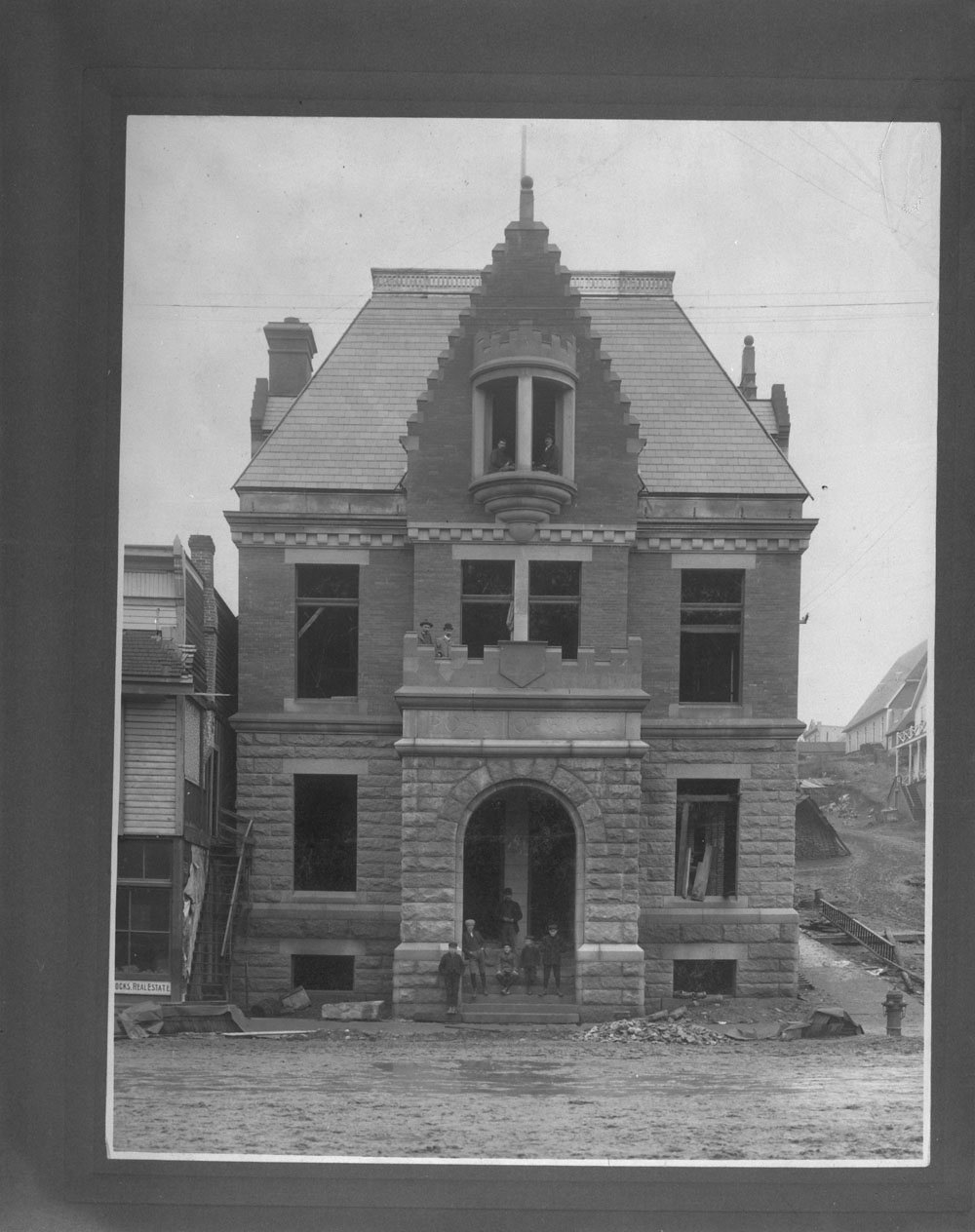
Black-and-white photograph of the exterior of the post office building. Small groups of men and children stand at the building’s unfinished entrance and one of its unfinished windows.

Post office [under construction], Rossland, B.C. (a046453-v8)

With the outbreak of the First World War, economic growth abruptly ended. As a result, many of these federal buildings acquired an unexpected prominence in small towns. Some buildings became city halls or other municipal buildings, while others, like the Rossland Post Office, retained their original purpose.

The federal buildings of this era were prominent due to the quality of their construction and the building materials chosen. In most instances, the Department of Public Works avoided the use of wood and instead chose iron, stone, brick and other sturdy materials. The goal of this approach was to protect federal assets against fire and other hazards, and to serve as an example of quality construction in their various communities.

Unfortunately, the use of such materials provided only partial protection for the Rossland Post Office. On March 1, 1929, what became known as the “Big Fire” swept through the town’s business district. The blaze destroyed all of the wood-frame buildings between the Bank of Montreal and the post office. Firefighters used dynamite on some structures in an attempt to create a firebreak, which unfortunately destroyed all of the post office windows and hastened the fire damage to the structure.

Rossland’s Big Fire, March 1–2, 1929 (a046410-v8)

In the end, the Rossland Post Office lost its distinctive roof with ornate gables. However, the stone-and-brick construction enabled the restoration of the two remaining floors. The prominent structure still serves as the city’s post office, and it is now part of Rossland’s Official Heritage Register.

To learn more about the architectural styles of federal buildings, see Crown Assets: The Architecture of the Department of Public Works, 1867–1967, by Janet Wright, 1997 (OCLC 1017536309).


Caitlin Webster is a senior archivist in the Reference Services Division at the Vancouver office of Library and Archives Canada.

Charlie Chaplin goes to war — Part I: Starting your genealogy research from a First World War record

By Emily Potter

William Charles Chaplin, in actual fact—and, yes, the title is misleading. A little like the information you can sometimes find while doing family history research in a First World War file!

In Genealogy Services, one of the most common questions we receive is from clients asking about an ancestor’s First World War service. In many cases, military service is one of the defining stories they have heard about their ancestor, and they are keen to learn more about it.

Military personnel files are also chockful of biographical information and can be a great starting-off point for your genealogy research.

Let’s explore what genealogical information can be gleaned from a file through a fun exercise. For this exercise, I chose a soldier’s personnel file: that of William Charles Chaplin. Keep in mind that, when doing genealogy research, we are looking for names of ancestors, as well as dates or places of key life events, such as births, marriages and deaths. For this exercise, let’s see whether we can find that information for this person. We’ll also see what we can find out about his parents and his spouse.

Searching the personnel file

References to the personnel files of Canadian soldiers, nursing sisters and chaplains can be looked up in the Library and Archives Canada (LAC) Personnel Records of the First World War database. The digitized files can be accessed for free.

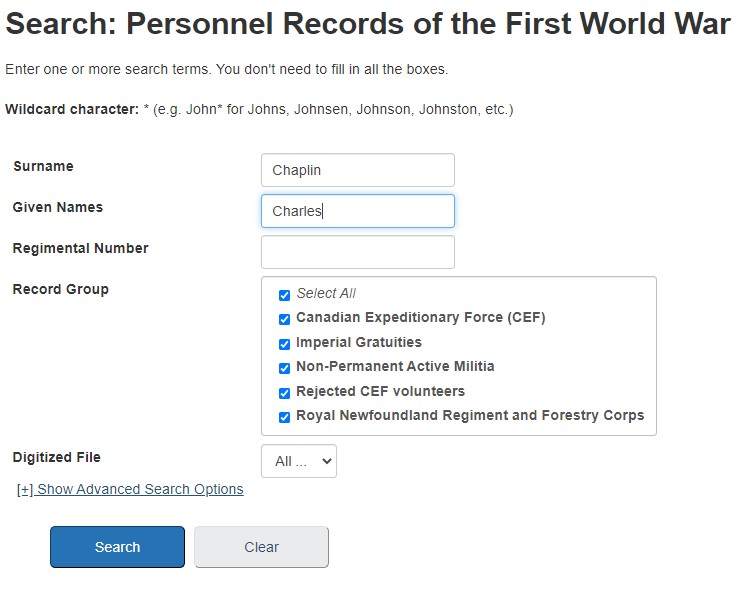
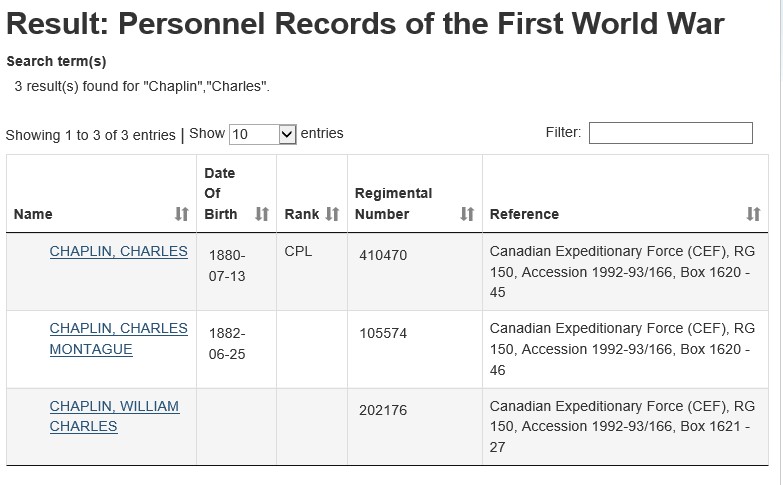
We begin by searching the database. At the search screen, enter your ancestor’s surname and given names, and click Search.

As you can see, I chose to search for the name “Charles Chaplin.”

A screenshot of the search results for the name “Charles Chaplin” from the Personnel Records of the First World War database.

Search results for “Charles Chaplin.”

Review the results to see which reference matches your ancestor. If your ancestor had a common name, this will be more difficult because there could be hundreds of results. Be sure to check out the database’s Search Tips if you’re having trouble.

From the Result screen, I selected the entry “Chaplin, William Charles.”

Screenshot of the reference page for “Chaplin, William Charles” from the Personnel Records of the First World War database.

Reference page for “Chaplin, William Charles.”

Once you have clicked on the name, you’ll see the reference information for the file. In most cases, there will also be a thumbnail image of the attestation paper. To access the complete file, click on the link marked “Digitized service file – PDF format.”

Screenshot of the envelope holding William Charles Chaplin’s service file from the Personnel Records of the First World War database.

File envelope for William Charles Chaplin, RG150 Accession 1992-93/166, Box 1621 – 27, Image 1.

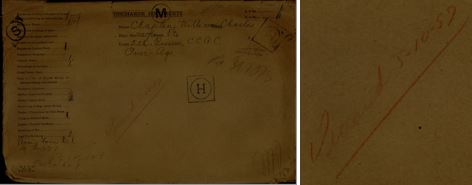
Among the first images in this digitized file, we see the envelope that held William Charles Chaplin’s physical file. This is where we find our first piece of information. The writing on the envelope indicates that Chaplin died on October 5, 1957.

The exterior of the envelope also includes the note “over age.” This implies that Chaplin was discharged for being too old to serve. In order to enlist, recruits had to be between the ages of 18 and 45, but it was common for men to lie about their age in order to appear eligible to serve.  Envelopes aren’t always included in the file, but when they are, they can include helpful information.

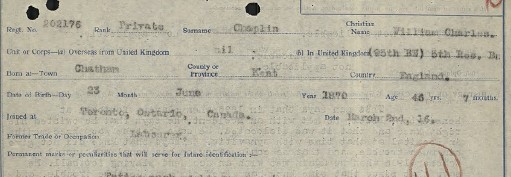
The attestation paper from William Charles Chaplin’s service file in the Personnel Records of the First World War database. The words “Attestation Paper, 95th Battalion” are typed at the top centre. The word “Original” is handwritten at the top right-hand corner.

Attestation paper for William Charles Chaplin, RG150 Accession 1992-93/166, Box 1621 – 27, Image 3.

As we move to the third image of the PDF, we see the attestation paper. This is the document that was filled out when a soldier enlisted. This document indicates that Chaplin was born on June 23, 1874. This date may not be accurate because, as mentioned above, the envelope indicated that he was “over age.” It is possible that he lied about his age in order to enlist.

The attestation paper also indicates that he was born in Kent, England, but was living in Toronto at the time of enlistment.

Usually, a parent or spouse is listed as the significant other. In this case, we see that Chaplin has listed his daughter Miriam Chaplin. The reason for this is that his wife had died; this is confirmed by his answer to question seven.

From looking at the second page of the attestation paper, we also discover that Chaplin was Anglican.

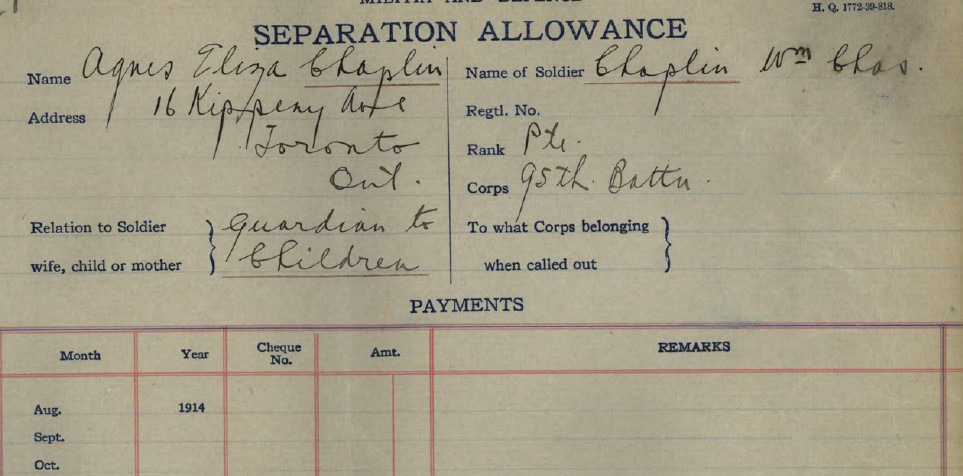
The separation allowance card from William Charles Chaplin’s service file in the Personnel Records of the First World War database. It has “Separation Allowance” typed at the top.

Separation Allowance document for William Charles Chaplin, RG150 Accession 1992-93/166, Box 1621 – 27, Image 17.

Genealogical information is not limited to the attestation paper. Additional details can often be found throughout a service file.

For example, in some cases, when a soldier married while in service, a document showing the change from the soldier’s pay being sent to the mother’s address to its being sent to the wife’s is included in the file.

In this case, on numerous pay sheets, we see the pay being sent to Agnes Eliza Chaplin, who appears to have been the designated guardian of Chaplin’s children.

An examination card issued by the Standing Medical Board, Shorncliffe, from William Charles Chaplin’s service file in the Personnel Records of the First World War database.

Examination card for William Charles Chaplin, RG150 Accession 1992-93/166, Box 1621 – 27, Image 35.

On image 35, we get another clue about his age, indicating again that Chaplin was overage when he enlisted. Here we see his age as 46 in October 1916. If we accept his birth date as June 23, this would mean his birth year was in fact 1870, not 1874 as stated on his attestation paper.

A typed and handwritten document, titled Particulars of Family of an Officer or Man Enlisted in C.E.F. [Canadian Expeditionary Force], from William Charles Chaplin’s service file in the Personnel Records of the First World War database.

Particulars of family document for William Charles Chaplin, RG150 Accession 1992-93/166, Box 1621 – 27, Images 45 and 46.

Images 45 and 46 are of the document Particulars of Family of an Officer or Man Enlisted in C.E.F. From them, we glean a whole bunch of additional information.

We find out that Chaplin had six children: Marian (also spelled Miriam elsewhere in the file), James, Richard, George, Agnes, and William. The children’s ages are also provided. From looking at the date of the document and knowing their ages, we can guess the approximate year of birth for each of the children.

From the second page of the document, we learn that Chaplin’s father has died and that Agnes Chaplin is his mother. This suggests that the guardian, Agnes Eliza Chaplin, whose name was mentioned in other documents, was his mother because the address provided for her is the same as the one that appears on image 17.

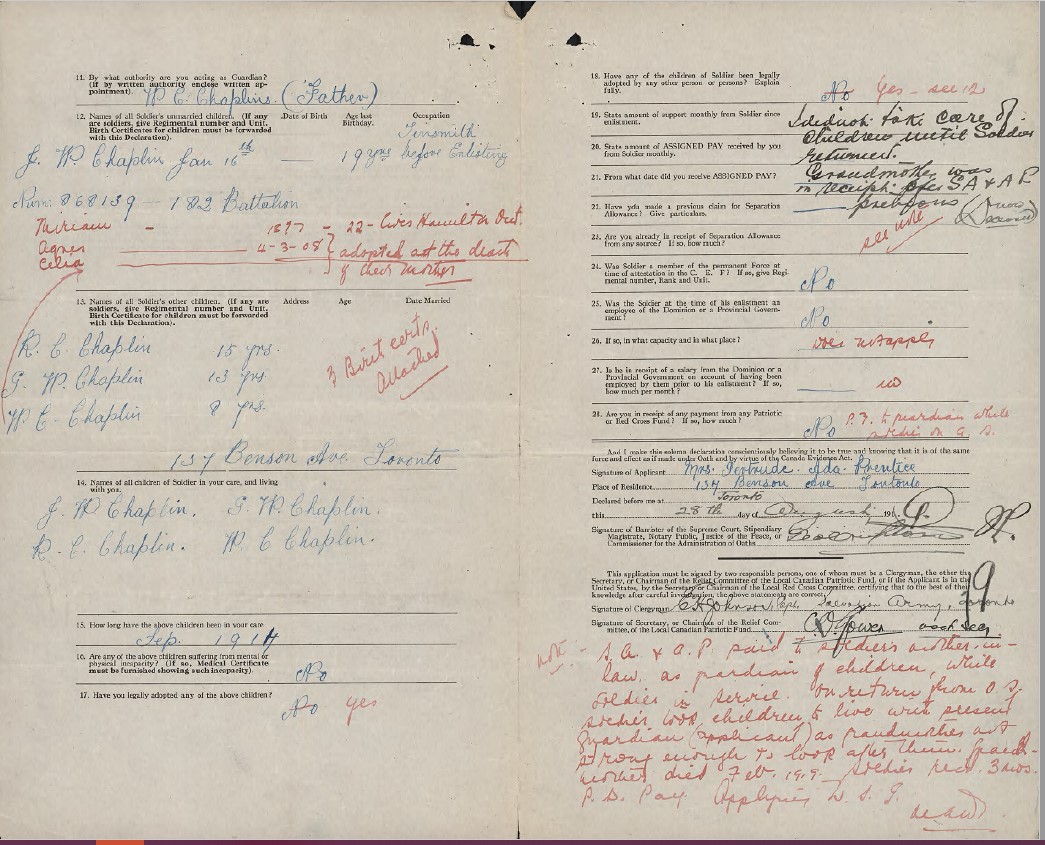
A typed and handwritten document called Canadian Expeditionary Force (Information for Separation Allowance Board) from William Charles Chaplin’s service file in the Personnel Records of the First World War database.

Canadian Expeditionary Force (Information for Separation Allowance Board), William Charles Chaplin, RG150 Accession 1992-93/166, Box 1621 – 27, Image 87.

On images 87 and 88, we come across a document titled Canadian Expeditionary Force (Information for Separation Allowance Board). This document was completed in 1919 by Gertrude Ada Prentice to have Chaplin’s separation allowance and assigned pay transferred to her, as she was now the one caring for the children.

Confusingly enough, the first page of the document indicates that Chaplin’s wife’s name was Eliza Agnes Chaplin and that she passed away on March 1, 1914.

Wasn’t his mother’s name listed as Agnes Chaplin? It is quite possible that they have the same name, but it is also very possible that mistakes were made by those completing the forms.

A typed and handwritten document from William Charles Chaplin’s service file from the Personnel Records of the First World War database. The handwriting is in red, black and blue ink.

Page from the CEF service file of William Charles Chaplin, RG150 Accession 1992-93/166, Box 1621 – 27, Image 88.

The first bit of information we find on image 88 is that his son J.W. Chaplin also served in the First World War and that his regimental number was 868139. Presumably, this is James, the eldest son, mentioned on image 45.

It appears that Chaplin’s daughters Agnes and Celia were adopted by Prentice when their mother died. Although not yet formally adopted, the boys were also living in her care at this time.

We also see that the children’s grandmother died in February 1919.

The note at the bottom states the following:

S.A.[separation allowance] and A.P. [assigned pay] paid to soldier’s mother-in-law as guardian of children, while soldier in service. On return from O.S. [overseas] soldier took children to live with present guardian (applicant) as grandmother not strong enough to look after them. Grandmother died Feb. 1919…

The quote above indicates that it was Chaplin’s mother-in-law caring for the children, not his mother. In some ways, this makes more sense. Specifically, the fact that his wife and his mother-in-law share the same given names is more logical because it was quite common to pass down names in a family. Mothers and daughters would sometimes share the same given names, much like fathers and sons.

On the other hand, why would his mother-in-law have the same surname as he does? Perhaps Prentice made an error when stating that the children had been with Chaplin’s mother-in-law and not his mother.

There is definitely an error somewhere in the file, but which is it? Unfortunately, this is the nature of genealogy research: we sometimes find information that simply does not add up.

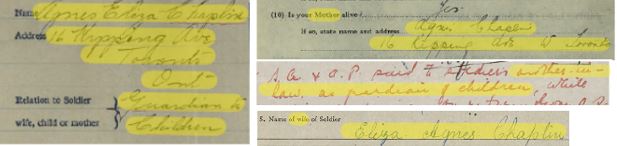
Close-ups with yellow highlighting of typed and handwritten documents from William Charles Chaplin’s service file in the Personnel Records of the First World War database. The handwriting is in red and black ink.

Details from images 21, 46, 88, 87 (clockwise from left) from Chaplain’s service file, RG150 Accession 1992-93/166, Box 1621 – 27.

From the above images, we can see that Agnes Eliza Chaplin, who lived at 16 Kipping Avenue, is indicated as either his mother or mother-in-law at different points in the file.

Let’s have a look at the personnel file of Chaplin’s son James W. Chaplin to see whether it can shed any light on this issue.

Screenshot of the reference page for James William Chaplin from the Personnel Records of the First World War database.

Reference page for James William Chaplin from the Personnel Records of the First World War database.

A quick search in the Personnel Records of the First World War database revealed the reference shown in the image above.

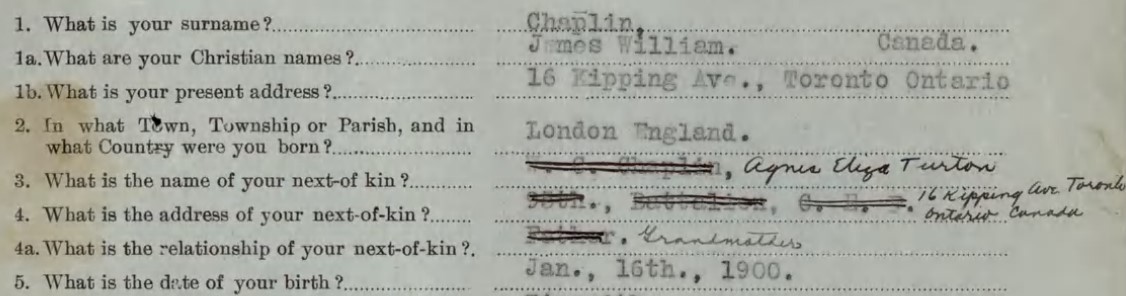
A portion of a soldier’s attestation page, with numbered columns on the left and typing with some entries crossed out and handwritten.

Detail of the attestation paper from James William Chaplin’s service file, RG150, Accession 1992-93/166, Box 1621 – 14, Image 3.

Upon opening the digitized file, there is some immediate clarification. James has listed his next of kin as his grandmother, Agnes Eliza Turton, living at 16 Kipping Avenue, Toronto, Ontario.

This suggests to me that the Agnes Eliza Chaplin in the file was always Agnes Eliza Turton, the mother-in-law of William Charles Chaplin.

But then why was Agnes listed with her last name as Chaplin throughout the file?

It is unclear whether this information was merely a clerical error that was copied several times or his choosing to identify her in this manner because he feared that there would be issues with his pay being sent to someone who was not a blood relation. Unfortunately, we really have no means of knowing.

Alt text: A typed document bearing red markings.

Detail of a page from William Charles Chaplin’s service file (RG150 Accession 1992-93/166, Box 1621 – 27, Image 97).

Returning to the file of William Charles Chaplin, we come across one last piece of helpful information. On image 97, we have another birthdate for Chaplin, June 23, 1870. This date aligns with the fact that he was discharged for being overage and is most likely more accurate than the date listed on his attestation paper. We also find out that he was born in the town of Chatham.

Let’s review what we have learned about William Charles Chaplin from his file:

  • Date and place of birth: June 23, 1870, Chatham, Kent, England
  • Date and place of marriage: Unknown
  • Date and place of death: October 5, 1957, place unknown
  • Mother’s name: Unknown
  • Father’s name: Unknown
  • Spouse’s name: Eliza Agnes Turton, daughter of Agnes Eliza; died before March 2, 1916
  • Children’s names: Miriam, James, Richard, George, Agnes, William, and Celia

This is quite a lot of information to discover about the soldier, not to mention all the information on Chaplin’s children, from looking only at his personnel file. This information includes not only the children’s names but also their ages, from which we can surmise their approximate birth years. We also know that two of his daughters were adopted by a Gertrude Ada Prentice and that she cared for his other children after his mother-in-law died.

Keep in mind that not all personnel files will include this amount of information, but we can definitely see how the files can serve as a great starting point for your genealogy research (and can also include conflicting information!).

We can now use this information to dive deeper into William Charles Chaplin’s family history, by searching other genealogy sources. Continue learning about this in Part II of this blog article.


Emily Potter is a genealogy consultant in the Public Services Branch of Library and Archives Canada.

Explore the records of No. 2 Construction Battalion

Version française

By Andrew Horrall

A note to users

Many of these records contain terms that were commonly used during the First World War but are now unacceptable and offensive. The use of these terms by military authorities is evidence of the racism faced by Black Canadian soldiers.

As described in the “Serving despite segregation” blog, No. 2 Construction Battalion was the first and only segregated Canadian Expeditionary Force unit in the First World War. Library and Archives Canada (LAC) has identified and digitized records relating to the unit to make its story, and the individual stories of the men who belonged to it, easy to explore and understand.

A printed form completed by men joining the Canadian Expeditionary Force. The form includes 12 questions about the individual, including name, date of birth and next of kin. At the bottom are a declaration and oath sworn and signed by the man, and a magistrate’s statement and signature confirming that the man had enlisted.

Attestation page for Arthur Bright, Canadian Expeditionary Force, RG 150, Accession 1992-93/166, Box 1066 – 39

Individual experiences

Archival records contain details about the individuals who served in No. 2 Construction Battalion. Each story is unique and evocative.

You can find the men’s individual personnel records by searching their names, or by entering “No. 2 Construction Battalion” in the “Unit” field in our database. Each file has been completely digitized and includes detailed information about the individual’s life, family and military service.

Friends and families serving together

Personnel records can also tell collective stories. We know that men often joined-up in small groups of family, friends or co-workers in hopes of serving together.

Here are two strategies to find and explore these small groups within the unit. Start by identifying all of the men, by entering “No. 2 Construction Battalion” in the “Unit” field in our database, then:

  • Sort the list in alphabetical order. You will see that many surnames appear more than once. Open the individual files of men with shared names and look at their places of birth, addresses and next of kin (often a parent) to explore whether and how they were related.

For example, we can see that these two men were brothers:

  • Sort the list by regimental service number. These were assigned to men in numerical order. Sorting the list in numerical order can recreate the lines of men as they enlisted at a recruiting station. Open the individual files to explore whether a man joined up alone or with a group.

For example, we know that the Bright brothers joined up together because they were assigned sequential service numbers. We also discover that the men with numbers on either side of them—who would have been standing next to them in the recruiting office in 1916—were all of similar age and occupation, and lived within a kilometre of one another in St. Catharines. How did they know each other?

Follow the men in civilian life

To explore Black Canadian history more widely, you can also find out about the civilian lives of many of the men by entering their names in other LAC databases in the “Ancestors Search” section of our website:

  • The 1911, 1916 and 1921 Canadian censuses; for example, the 1921 census lists Arthur and Norman Bright living together as lodgers at 3 Brown’s Lane, in downtown Toronto. Neither was married, and they were both working as labourers.
  • Passenger lists show when, where and with whom individuals immigrated to Canada.
  • Personnel records can open pathways for exploring Canada’s early-20th-century Black community and what it meant to serve in No. 2 Construction Battalion.
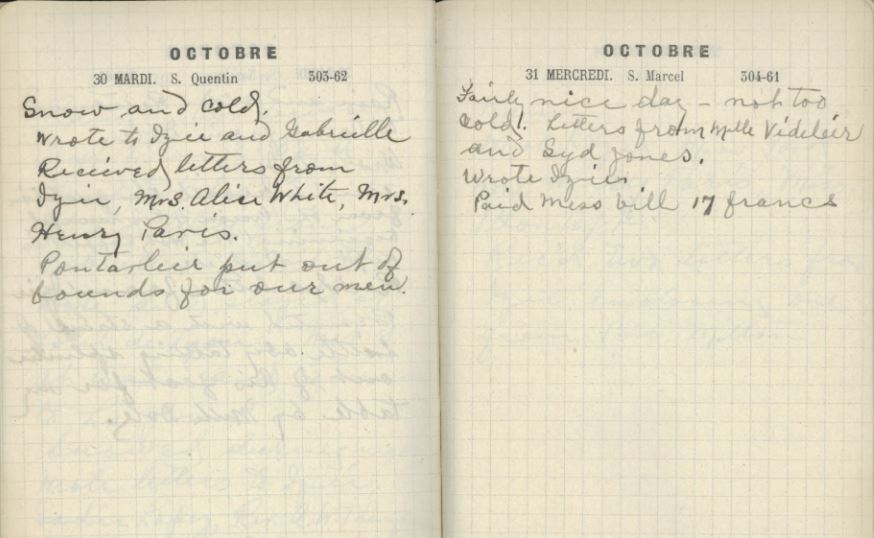
Two pages of a personal diary. The date is printed at the top of each page, October 30 and 31. Underneath it, Captain White wrote general observations about the weather, letters he wrote and received, and life in camp.

Two pages from the personal diary of Captain William  “Andrew” White, the unit’s chaplain (e011183038)

Day-to-day life in the unit

Two digitized documents allow you to explore the unit’s daily activities:

  • The personal diary of William “Andrew” White, No. 2 Construction Battalion’s chaplain. We believe that this is the only first-hand account written by a member of the unit.
  • The War Diary. Units on active service were required to keep a daily account of their activities. While war diaries do not focus on individuals, they describe the events that took place each day.

How the Canadian military managed the unit

LAC has digitized about half of the administrative, organizational and historical records relating to the unit. These documents provide insights into how the Canadian military managed the unit and the men belonging to it.

Digitized resources documenting No. 2 Construction Company held at LAC

Basic information about the unit

Other photographs depicting Black soldiers

Note that LAC holds many other photos showing Black soldiers, but these cannot be found in a regular search, since that information was not included in the original title.

Recruiting poster

Digitized textual records

Courts martial

Digitized records of courts martial involving members of No. 2 Construction Company and other Black men are available on Canadiana.org (Please note that the list below may not be complete)


Andrew Horrall is an archivist at Library and Archives Canada. He wrote the blog and, with Alexander Comber and Mary Margaret Johnston-Miller, identified records relating to the battalion.
Serving despite segregation: No. 2 Construction Battalion

Version française

By Andrew Horrall

Library and Archives Canada (LAC) holds the largest collection of records documenting No. 2 Construction Battalion, a segregated unit of the Canadian Expeditionary Force in the First World War. They wanted to fight, but racist attitudes among political and military leaders, and in society in general, prevented them from serving in the front lines. Instead, the unit was assigned to the Canadian Forestry Corps. The men spent the war in the French Alps, cutting down trees, milling raw logs into finished lumber and transporting the wood to the railway. The work was vital, since huge quantities of wood were needed to build and reinforce front-line defences, but it was far from the type of service that the men had hoped for.

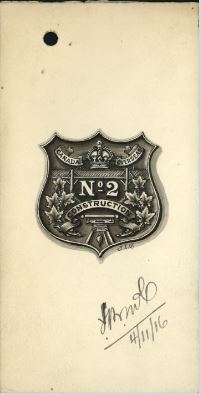
A black-and-white drawing of a badge in the shape of a shield. At the top is a royal crown and a banner reading “Canada Overseas.” Beneath are the words “No. 2” above another banner with the word “construction.” Maple leaves adorn each side, and a wooden bridge below the crown and a tool under the second banner symbolize that the unit’s members were builders.

The cap badge for No. 2 Construction Battalion (e011395922)

Canadian Expeditionary Force service files

  • (unit members are identified by “No. 2 Construction Battalion” in the database’s “Unit” field

Users should be aware that the military service files of over 800 men indicate No. 2 Construction Company as their unit, though many of these men never actually served with No. 2 Construction Company. Instead, they served with other CEF units. The reasons for the discrepancy between the information in personnel files and unit files is not entirely clear. It is likely that Canadian military authorities intended for the men to serve with No. 2 Construction Company, but pressing needs caused them to assign the men to other units. In other cases, the war may have ended before individuals could physically join No. 2 Construction Company.)

The unit was mobilized at Truro, Nova Scotia, in July 1916. It recruited from established Black communities in the Maritimes, southwestern Ontario, and across Canada, the Caribbean and the United States. At least two members were from much farther away: Cowasjee Karachi (regimental number 931759) came from modern-day Yemen, and Valdo Schita (regimental number 931643) was born near Johannesburg, South Africa.

A black-and-white photograph depicting 21 soldiers. They are casually posed outdoors, either sitting or standing on a pile of long wooden planks. Eight of the men appear to be in Russian uniforms, and the rest are Canadians, including two Black men.

Lt. F.N. Ritchie, Lt. Courtney and a few of the enlisted men of the Canadian Forestry Corps in France. This is the only photo of the unit held in the collection at LAC (a022752)

While the unit was composed of Black men, the officers were white, apart from the chaplain, Captain William “Andrew” White.

The unit is referred to by both the terms “battalion” and “company” in archival documents and published sources. It was originally created as a battalion, a unit composed of about 1,000 men in the Canadian Expeditionary Force. When only about 600 men arrived in England in 1917, military authorities redesignated it as a company, which better reflected its size.

The unit returned to Canada at the end of the war and was officially disbanded in September 1920. The story of No. 2 Construction Battalion faded over time, until families, community members and historians began recovering it in the early 1980s. By that time, there were only a handful of surviving members.

A note about terms used in the records

Many of the records documenting No. 2 Construction Company contain terms that were commonly used during the First World War but are no longer acceptable. LAC has replaced such terms in descriptions, but they are still found in many of the original documents. The use of these terms by military authorities is evidence of the racism faced by the men in the unit.


Andrew Horrall is an archivist at Library and Archives Canada. He wrote the blog and, with Alexander Comber and Mary Margaret Johnston-Miller, identified records relating to the battalion

A day in the life of a reference librarian

By Kristen Frame

Library and Archives Canada (LAC) has a vast collection of published material that includes fiction and non-fiction, newspapers, government reports, Parliamentary debates, maps and atlases, music scores and recordings, and films. This blog article will give you an idea of how this vast collection helps reference librarians to answer research questions.

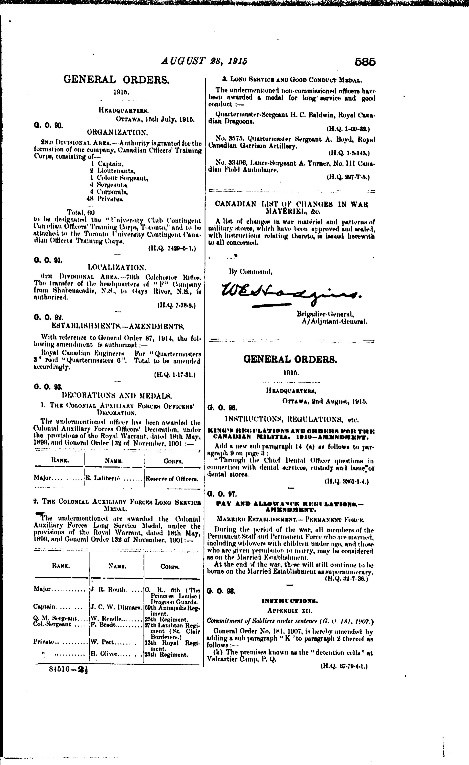
As a reference librarian, I receive questions on a wide variety of topics, which require different types of published material to answer. I recently received a request to find a copy of a Militia General Order from the First World War. This specific General Order from August 1915 cancelled a regulation that required married men to have consent from their wives in order to enlist. To answer this particular question, I had to make use of multiple sources of published material from our collection.

General Orders

A photograph of the title page of a book.
Department of National Defence, General Orders, 1915

I began my search with LAC’s bound copies of published General Orders from 1897 to 1945. These can be requested using our online catalogue, Aurora.

I consulted the volume from 1915, but the General Order that cancelled the requirement to have consent from wives to enlist was not in this volume.

Canada Gazette

A typed page with two columns from the Canada Gazette.
Page from Canada Gazette, August 21, 1915, that includes General Orders; image from A Nation’s Chronicle: The Canada Gazette

Next, I decided to check to see if the Canada Gazette published this General Order, as it regularly published General Orders during wartime. Issues of the Canada Gazette from 1941 to 1997 are available online in our A Nation’s Chronicle: The Canada Gazette database. Again, my search came up empty, as there was no mention of the order in the 1915 Canada Gazette.

Secondary sources

My next step was to consult secondary sources (books and articles) to see if any research had already been done on this General Order. I did find references to the General Order in the following publications:

However, these references did not include any information about where—or whether—this General Order was published. This General Order was becoming a real mystery!

Newspapers

Two newspaper articles side by side.
The Toronto Daily Star, August 20, 1915, page 7; The Globe, August 21, 1915, page 6

At this point in my research, I decided to search newspapers to confirm that this order was passed in August 1915. I searched the Toronto Star and Globe and Mail from August 1915 and found articles from both newspapers reporting that the regulations for enlistment had changed, and men were now free to enlist in the Canadian Expeditionary Force without the consent of their wives (if married) or parents (if under 17).

Orders in Council

A typed page with General Orders 1915 at the top.
P.C. 1915–1948, Overseas Expeditionary Forces, Regulations Enlistment 1915/08/19, Actg M. M. and D. [Acting Minister of Militia and Defence], 1915/08/14 (e010920460)

Now that I had confirmation that the General Order was passed in August 1915, I felt it was likely that the government did not publish this General Order. But as a last resort, I searched our Orders-in-Council database using Collection Search. At that time, some General Orders were approved by Orders-in-Council. And there it was! At long last, I had found the General Order that cancelled the regulation requiring married men to have consent from their wives to enlist.

As you can see, the General Order was not easy to find. This particular search illustrates how many different kinds of published material can be used to answer a research question.

Do you have a question that could use the assistance of a librarian or archivist? Submit your question in writing to us today .


Kristen Frame is a Reference Librarian in the Reference Services Division at Library and Archives Canada.
Dressing the Troops: Knitting During the Wars

Version française

By Cara Downey

Canadian knitters played a significant role in outfitting those who served in various wars, including the First and Second World Wars, as well as the Korean War. Knitters made socks, sweaters and other items for soldiers, pilots, sailors, merchant seamen, the sick and wounded, as well as prisoners of war and refugees. This work was encouraged by various volunteer groups: the Canadian Red Cross Society, the Imperial Order of the Daughters of Empire (IODE), branches of the armed services and their auxiliaries (for example, the Navy League), and others. Special patterns were printed, and the required knitting materials were distributed to volunteers. (See Shirley A. Scott, Canada Knits: Craft and Comfort in a Northern Land, pages 32 to 39)

The patterns listed strict requirements for the garments, with knitters generally requested to stick to “plain knitting” (that is, stocking stitch), since unnecessary decoration decreased speed and increased use of yarn. (Shirley A. Scott, Canada Knits: Craft and Comfort in a Northern Land, page 39) 

The book Red Cross Knitting Instructions for War Work, issued by the Canadian Red Cross Society in 1940, provides further instructions:

  • Knit items in specific colours, for example:
    • Socks for the Navy were to be knit in navy blue or grey, Army socks in khaki, grey or “heathers,” Air Force socks in black or grey, bed socks for hospitals in white or grey;
    • Toques were to be knit in navy blue for the Navy and in khaki for the Army; toques were not required for the Air Force.
  • Join wool by splicing, not with knots;
  • Cast on all ribbing stitches loosely;
  • “Join two socks of pair together with light coloured wool pulled through two inside thicknesses of cuff. Do not knot, but tie in firm bow. Fasten one size label (on each pair of socks) on the outside on cuff, if size runs between sizes, label smaller size.” (Red Cross Knitting Instructions for War Work, pages 3, 13, and 15).
    A black-and-white photograph of soldiers in uniform sitting outdoors while knitting.

    Resting but busy (e010963520)

    Knitting was generally performed by women on the home front (regardless of class), children (particularly girls), as well as the sick or injured. The photo Resting but busy (dated c. 1918–1925) shows convalescing soldiers knitting as a form of relaxation and therapy. 

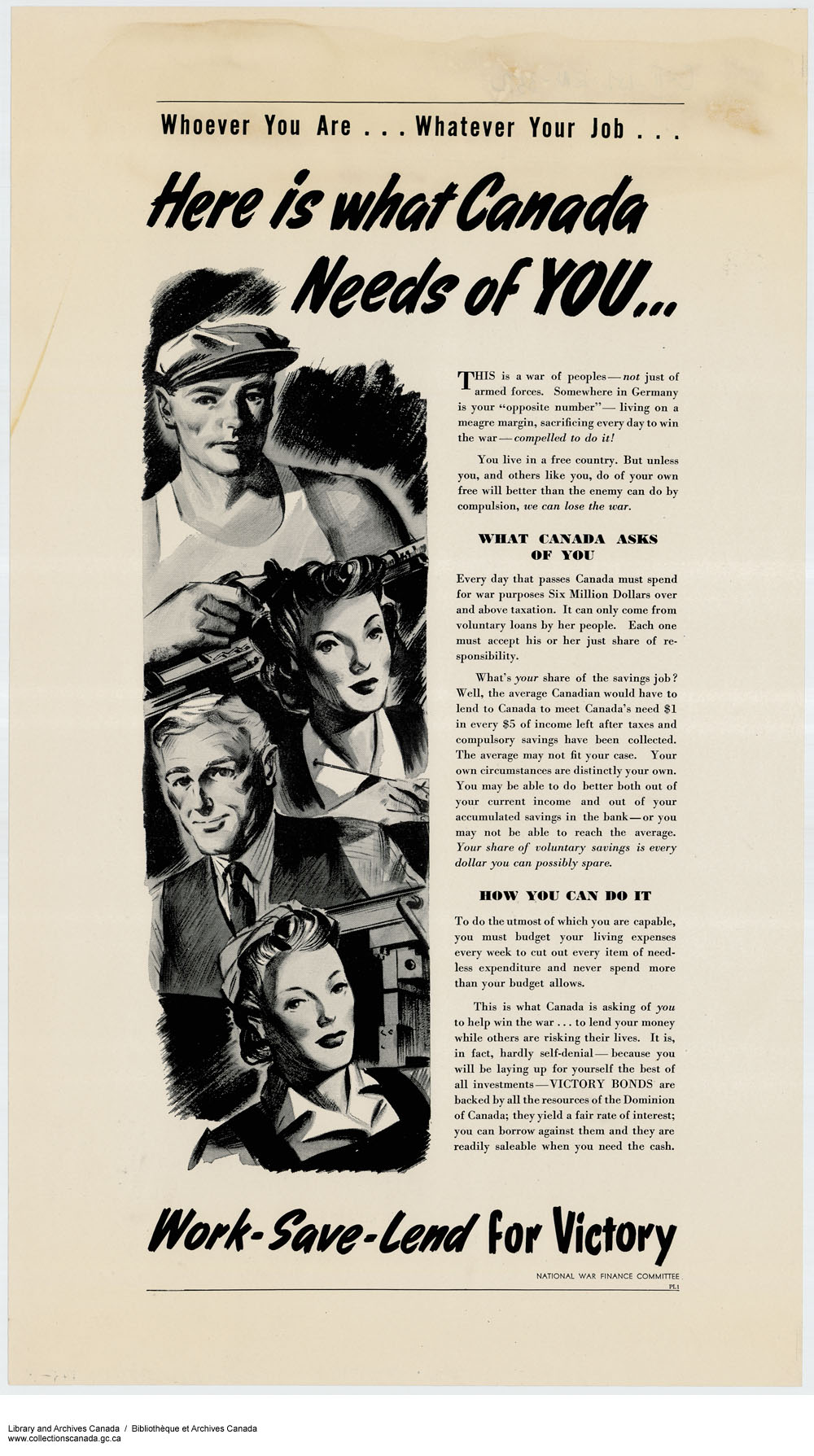
    Knitting was encouraged through various means. One example is the printed posters exhorting people to “knit for the boys.” The American Red Cross produced the poster Our Boys Need Sox, Knit Your Bit during the First World War, and Canada’s National War Finance Committee published the poster Whoever You Are … Whatever Your Job … Here is What Canada Needs of YOU … Work – Save – Lend for Victory in 1942, which included a picture of a woman knitting.

    A poster that reads “Whoever You Are ... Whatever Your Job ... Here is What Canada Needs of YOU ... Work - Save - Lend for Victory” and features drawn portraits of two men and two women.

    Whoever You Are … Whatever Your Job … Here is What Canada Needs of YOU … Work – Save – Lend for Victory (e010695660)

    Knitting was so common during this time that it entered popular culture—in songs such as Knitting socks for Daddy’s men (published in 1915) and The pretty little mitt that Kitty knit (published in 1940)—and in books. Characters in L.M. Montgomery’s Rilla of Ingleside (published in 1921) participated in knitting circles and knitted at home to contribute to the war effort. Katherine Hale dedicated the book Grey Knitting and Other Poems (published in Toronto in 1914) to “The Women Who Knit.” 

    The contribution of knitters should not be dismissed. While it is difficult to count the number of items given to the diverse groups that collected goods and to know the number of individuals involved, the Canadian Red Cross estimates that a total of 750,000 volunteers knit 50 million articles (for soldiers, the sick, refugees, and others) during the Second World War alone. (Halifax Women’s History Society, “The Monument Design: The Design for The Volunteers.”) For the Scotia Chapter of the IODE during this period, this meant a contribution that included 350 pairs of socks, 525 sweaters, 125 helmets, 50 pairs of mittens, 12 pairs of gloves, and 65 scarves. (Sharon M.H. MacDonald, Hidden Costs, Hidden Labours: Women in Nova Scotia During Two World Wars, page 141)

    Visit the Flickr album for more images of knitting!


    Cara Downey is a senior analyst in the Governance, Liaison and Partnerships Division. 

CIL: The story of a brand

Version française

By François Larivée

The CIL name is a commercial brand that immediately evokes something in the collective consciousness, namely paint. However, for those who explore the history behind this well-known brand, it probably comes as a surprise to learn that CIL’s origins are in the manufacturing of explosives and munitions.

Black-and-white photograph showing a large rectangular billboard anchored to an embankment and featuring an advertisement for CIL. The ad looks like a painting, with a house at each end, in a suburban landscape. Between the two houses, the oval CIL logo is visible, with the words “Peintures” in the top left and “Paints” in the bottom right.

CIL advertising billboard on Monkland Boulevard, Ville LaSalle, Quebec, circa 1950 (a069072)

Explosive beginnings

The origins of CIL can be traced back to 1862, before Confederation. That year, the Hamilton Powder Company was formed in Hamilton, Ontario. The company specialized in the production of black powder, which was then used as an explosive for a variety of purposes, particularly for railway construction, a booming industry at the time.

The Hamilton Powder Company’s activities culminated in 1877, when it was awarded a major contract to participate in the construction of the national railway linking Eastern Canada and British Columbia. (This railway was famously a condition set by British Columbia for joining Confederation.) The black powder produced by the company was then used to enable the railway’s perilous crossing of the Rocky Mountains in 1884 and 1885.

Following its expansion, the Hamilton Powder Company moved its head office to Montréal. It was also near Montréal, in Belœil, that from 1878 onward, the company developed what would become its main explosives production site.

In 1910, it merged with six other Canadian companies, most of which also specialized in the production of explosives. Together, they formed a new company: the Canadian Explosives Company (CXL). Although explosives remained the bulk of the company’s production, new activities were added, including the manufacture of chemical products and munitions.

One of the companies involved in the merger, the Dominion Cartridge Company, already specialized in the manufacture of munitions, particularly rifle cartridges (used mainly for hunting). It was founded in Brownsburg, Quebec, in 1886 by two Americans—Arthur Howard and Thomas Brainerd—and Canadian John Abbott, who would later become the country’s third prime minister. In 2017, Library and Archives Canada acquired a significant portion of CIL’s archival holdings relating to its Brownsburg plant.

World wars and munitions

During the first half of the 20th century, the company produced more and more munitions. Indeed, as a consequence of the two world wars, the demand for military ammunition in particular increased sharply.

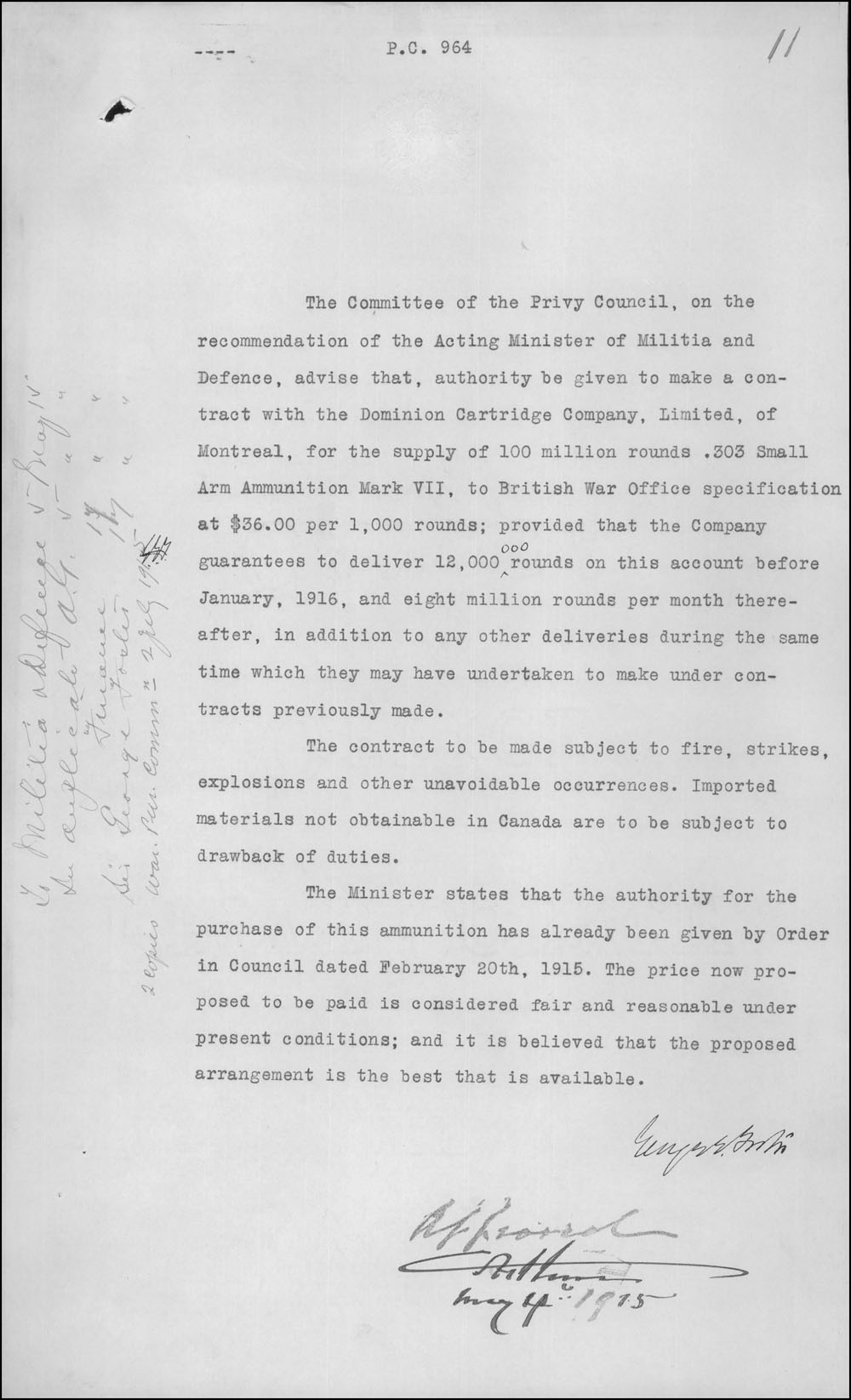
As early as 1915, the Dominion Arsenal (responsible for the production of military ammunition in Canada) could not meet the demand on its own. The Canadian government therefore sought the help of Dominion Cartridge, then one of the largest private companies in this sector. The company thus obtained major contracts to produce military ammunition.

Order-in-Council approved and signed on May 4, 1915, by the Privy Council Office on the recommendation of the Department of Militia and Defence. It authorizes the establishment of a contract with the Dominion Cartridge Company Limited of Montréal for the production of 100 million .303 Mark VII munitions, according to the specifications of the British War Office, at $36 per thousand pounds.

Privy Council Office Order-in-Council approving a contract with the Dominion Cartridge Company for the production of munitions, May 1915 (e010916133)

To reflect the gradual diversification of its operations, the company changed its name to Canadian Industries Limited (CIL) in 1927.

After the outbreak of the Second World War, CIL further increased its production of munitions. In 1939, in partnership with the Crown, it established a subsidiary company dedicated exclusively to this sector of activity, Defence Industries Limited (DIL). The Crown owned the factories and equipment, but it delegated the management of operations to CIL. The Crown also provided CIL with the funds to operate the plants, although it did not purchase their production.

Given the considerable ammunition requirements of the Allied forces, DIL expanded rapidly. It opened many factories: in Ontario, in Pickering (Ajax), Windsor, Nobel and Cornwall; in Quebec, in Montréal, Brownsburg, Verdun, Saint-Paul-l’Hermite (Cherrier plant), Sainte-Thérèse (Bouchard plant), Belœil and Shawinigan; and in Manitoba, in Winnipeg.

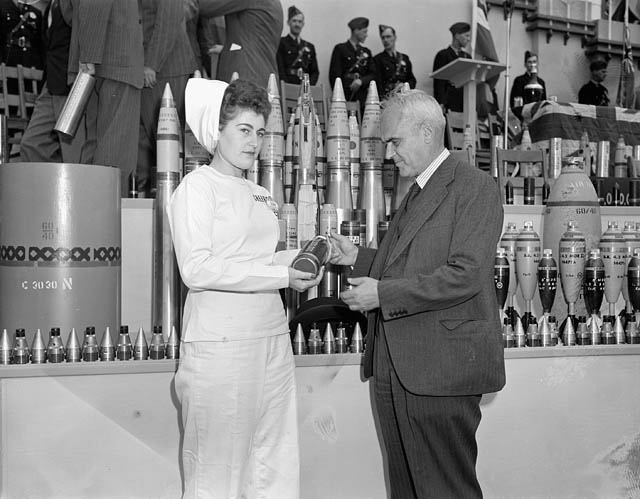
Some occupied huge sites, turning DIL into one of the largest industrial complexes of the time. In 1943, at the peak of its activity, it employed more than 32,000 people, the vast majority of whom were women.

Black-and-white photograph of a female employee wearing a white uniform and cap, holding a projectile for presentation to the Honourable C.D. Howe. Behind them, several projectiles of different sizes are displayed on a table. In the background, a few civilians and military personnel are standing on a platform behind a lectern.

Edna Poirier, an employee of Defence Industries Limited, presents the Honourable C.D. Howe with the hundred-millionth projectile manufactured in the Cherrier plant, Saint-Paul-l’Hermite, Quebec, September 1944 (e000762462)

Black-and-white photograph showing employees in front of factory buildings, moving away from what appears to be a locker building. Most are seen from behind; others are facing the camera or talking to each other. In the background are a few train carriages.

Workers leaving the Cherrier plant of Defence Industries Limited to take the train, Saint-Paul-l’Hermite, Quebec, June 1944 (e000762822)

New products and a centennial

After the Second World War, CIL gradually reduced its production of munitions, which it abandoned definitively in 1976 to concentrate on chemical and synthetic products, agricultural fertilizers, and paints. It then began to invest a large part of its operating budget into the research and development of new products. Its central research laboratory, which was established in 1916 near the Belœil plant, grew in size, as evidenced by a large part of CIL’s archival holdings held at Library and Archives Canada.
The development of the explosives factory and laboratory in the Belœil region led to the creation of a brand-new town in 1917: McMasterville, named after William McMaster, first chairman of the Canadian Explosives Company in 1910.

Black-and-white photograph of a worker wearing protective equipment and a visor, pouring a white liquid from a machine. The liquid flows out as a uniform band into a cylinder that the worker holds in his right hand. Some smoke rises from the liquid.

Worker pouring liquid nylon from an autoclave, Canadian Industries Limited, Kingston, Ontario, circa 1960 (e011051701)

Black-and-white photograph of a worker filling a bag by holding it under the spout of a machine. A stack of empty bags sits next to him. The bags read “CIL Fertilizer.”

Bagging of chemical fertilizer at the Canadian Industries Limited plant, Halifax, Nova Scotia, circa 1960 (e010996324)

Although CIL was diversifying its operations, the production of explosives remained the company’s main driver of growth and profitability. These explosives were used in many major ventures, including mining projects in Sudbury, Elliot Lake, Thompson, Matagami and Murdochville, and hydroelectric projects in Manicouagan, Niagara and Churchill Falls. They were also used in the construction of the St. Lawrence Seaway and the Trans-Canada Highway.

To mark its centennial in 1962, the company had a major building constructed in downtown Montréal: the CIL House (now the Telus Tower). The work was carried out between 1960 and 1962 and is a testament to CIL’s growth.

Around the same time, the company bought a heritage house in Old Montréal, which it restored and named the CIL Centennial House initially, then the Del Vecchio House (in honour of the man who had it built). The company periodically exhibited collection pieces there from its weapons and ammunition museum in Brownsburg.

The company faded, but the brand endures

In 1981, CIL moved its head office from Montréal to Toronto. Its central research laboratory was moved from McMasterville to Mississauga. The McMasterville explosives factory remained in operation, despite the many workplace accidents—some fatal—that happened there. It gradually reduced its production before closing for good in 2000.

However, CIL’s heyday had long since passed. From 1988 onward, the company had just been a subsidiary of the British chemical company ICI (which was itself acquired by the Dutch company AkzoNobel in 2008).

But to complete the story, in 2012, the American company PPG purchased AkzoNobel’s coatings and paint production division, thereby acquiring the well-known CIL paint brand, which still exists today.

Related resources


François Larivée is an archivist in the Science, Environment and Economy Section of the Archives Branch.

Tom Cogwagee Longboat’s life and legacy

Version française

On the left of the graphic, Tatânga Mânî [Chief Walking Buffalo] [George McLean] in traditional regalia on horse. In the middle, Iggi and girl engaging in a “kunik”, a traditional greeting in Inuit culture. On the right, Maxime Marion, a Métis guide stands holding a rifle. In the background, there is a map of Upper and Lower Canada, and text from the Red River Settlement collection.

This article contains historical language and content that may be considered offensive, such as language used to refer to racial, ethnic and cultural groups. Please see our historical language advisory for more information.

By Elizabeth Kawenaa Montour

Tom Cogwagee Longboat’s name is associated with speed, athleticism, determination, courage and perseverance. His Onondaga name, “Cogwagee,” translates as “all” or “everything.” Facts, stories and photographs of his life have been collected, published and examined over the past century, in an attempt to capture, recreate and demystify his life.

Thomas Charles Cogwagee Longboat was born to George Longboat and Elizabeth Skye on July 4, 1886 (some sources have June 4, 1887). He was Wolf Clan of the Onondaga Nation from Six Nations Territory and lived a traditional life of the Haudenosaunee (Longhouse). At the age of 12 or 13, Longboat was forcibly sent to the Mohawk Institute Residential School, an Anglican denominational and English-language school, which operated from 1823 and closed in 1970. This experience did not go well for him and his fellow First Nations students, who were forced to abandon their language and beliefs to speak English and practice Christianity. Longboat reacted by escaping the school and running home. He was caught and punished, but then escaped a second time, with the foresight to run to his uncle’s farm, where he would be harder to find. This proved successful and marked the end of Longboat’s formal education. He worked as a farm labourer in various locations, which involved travelling great distances on foot.

Longboat began racing as an amateur in 1905. He won the Boston Marathon on April 19, 1907, in two hours, 24 minutes and 24 seconds, shaving nearly five minutes off the previous record for the world’s most prestigious annual running event. With this incredible race, he brought tremendous pride and inspiration to Indigenous peoples and Canadians. The following article was published the day after he won the marathon:

“The thousands of persons who lined the streets from Ashland to the B.A.A. were well repaid for the hours of waiting in the rain and chilly winter weather, for they saw in Tom Longboat the most marvelous runner who has ever sped over our roads. With a smile for everyone, he raced along and at the finish he looked anything but like a youth who had covered more miles in a couple of hours than the average man walks in a week. Gaining speed with each stride, encouraged by the wild shouts of the multitude, the bronze-colored youth with jet black hair and eyes, long, lithe body and spindle legs, swept toward the goal.

Amid the wildest din heard in years, Longboat shot across the line, breaking the tape as the timers stopped their watches, simultaneously with the clicking of a dozen cameras, winner of the greatest of all modern Marathon runs. Arms were stretched out to grasp the winner, but he needed no assistance.

Waving aside those who would hold him, he looked around and acknowledged the greetings he received on every side. Many pressed forward to grasp his hand, and but for the fact that the police had strong ropes there to keep all except the officials in check, he would have been hugged and squeezed mightily. Then he strode into the club, strong and sturdily.” (The Boston Globe, April 20, 1907)

A year after winning that race, Longboat competed in the marathon at the 1908 Olympics in London, England. He collapsed and dropped out at 32 kilometres, unable to finish the 42.2 km race. He then turned to professional running, and in 1909 received the title of Professional Champion of the World at a Madison Square Garden race in New York City.

A black-and-white page from the 1911 Canadian census with entries for each of 38 columns. The columns include such information as name and residence, personal description, place of birth, occupation and citizenship, and language and education.

A page from the 1911 census listing Thomas C. Longboat and his wife Loretta [Lauretta], in York County, Ontario. His profession is listed as “runner.” (e002039395)

A black-and-white photograph of two men in First World War military uniforms smiling and buying a newspaper from a young boy. The man on the right is accepting a newspaper from the boy and giving him money in exchange.

Private Tom Longboat, the Onondaga long-distance runner, buying a newspaper from a French boy, June 1917. (a001479)

In 1916, Longboat went overseas as part of the Canadian Expeditionary Force to fight in the First World War. He employed his natural talent and served as a dispatch runner. Longboat was mistakenly declared dead in the battlefields of Belgium, after being buried in rubble as a result of heavy shelling. His wife, Lauretta Maracle, a Kanienkenha:ka (Mohawk) woman, whom he had married in 1908, believed him to be deceased and remarried. Longboat subsequently married Martha Silversmith, an Onondaga woman, with whom he had four children. He continued his military career, serving as a member of the Veterans Guard in the Second World War while stationed at a military camp near Brantford, Ontario. The Longboat family settled in Toronto. Upon his retirement from employment with the City of Toronto, Longboat moved back to Six Nations. He passed away on January 9, 1949.

In 1951, he received posthumous recognition with the establishment of the prestigious Tom Longboat Trophy. The trophy is awarded annually to Indigenous athletes who exemplify the hard work and determination they put forth in their chosen endeavours. The original trophy remains at Canada’s Sports Hall of Fame in Calgary, with a travelling replica held by the Aboriginal Sports Circle in Ottawa. In 1955, he was inducted into Canada’s Sports Hall of Fame and the Indian Hall of Fame.

A red rectangle plaque with gold writing, with the crest of Canada and “Tom Longboat 1886–1949” at the top.

A Historic Sites and Monuments Board of Canada plaque honouring Tom Longboat, located at 4th Line Road, Six Nations Grand River Reserve, Ohsweken, Ontario. (Photo courtesy of Parks Canada)

Tributes in recognition of Longboat’s achievements continue today in many forms. A Government of Canada plaque was erected in his honour in 1976 at 4th Line Road, Six Nations, Ohsweken, Ontario. In 1999, Maclean’s magazine recognized him as the top Canadian athlete of the 20th century. Canada Post issued a stamp in 2000 commemorating his winning time. In Ontario, the Tom Longboat Day Act, 2008 designated June 4 as “Tom Longboat Day.” Tom Longboat Corner in Six Nations, a Tom Longboat Trail in Brantford, Ontario, a Tom Longboat Lane in Toronto, and a Tom Longboat Junior Public School in Scarborough, Ontario. There is also a Longboat Hall at 1087 Queen Street West in Toronto, the location of the YMCA where he trained. A statue of Longboat entitled “Challenge and Triumph,” created by David General, and an exhibit about him are on display at the Woodland Cultural Centre at Six Nations. Most recently, a children’s book about his life called Meet Tom Longboat was published in 2019.

Tom Cogwagee Longboat’s life and accomplishments are both fascinating and inspiring. To learn more about him, listen to our podcast, “Tom Longboat is Cogwagee is Everything,” which includes additional information.  Also check out the Tom Longboat Flickr album.

This blog is part of a series related to the Indigenous Documentary Heritage Initiatives. Learn how Library and Archives Canada (LAC) increases access to First Nations, Inuit and Métis Nation collections and supports communities in the preservation of Indigenous language recordings.


Elizabeth Kawenaa Montour is a project archivist in the Exhibitions and Online Content Division of the Public Services Branch at Library and Archives Canada.