Library and Archives Canada Blog

This is the official blog of Library and Archives Canada (LAC).

Library and Archives Canada Blog

Black Porter Perspectives: Giving Voice to Rail Service During and After the Second World War

Version française

By Stacey Zembrzycki

This four-part Black Porter Perspectives blog series is inspired by a striking and haunting set of images found within the Department of National Defence (DND) accession 1967-052. These photographs provide a window into service to country through various vantage points during and after the Second World War, revealing the intersections of class, race and duty.
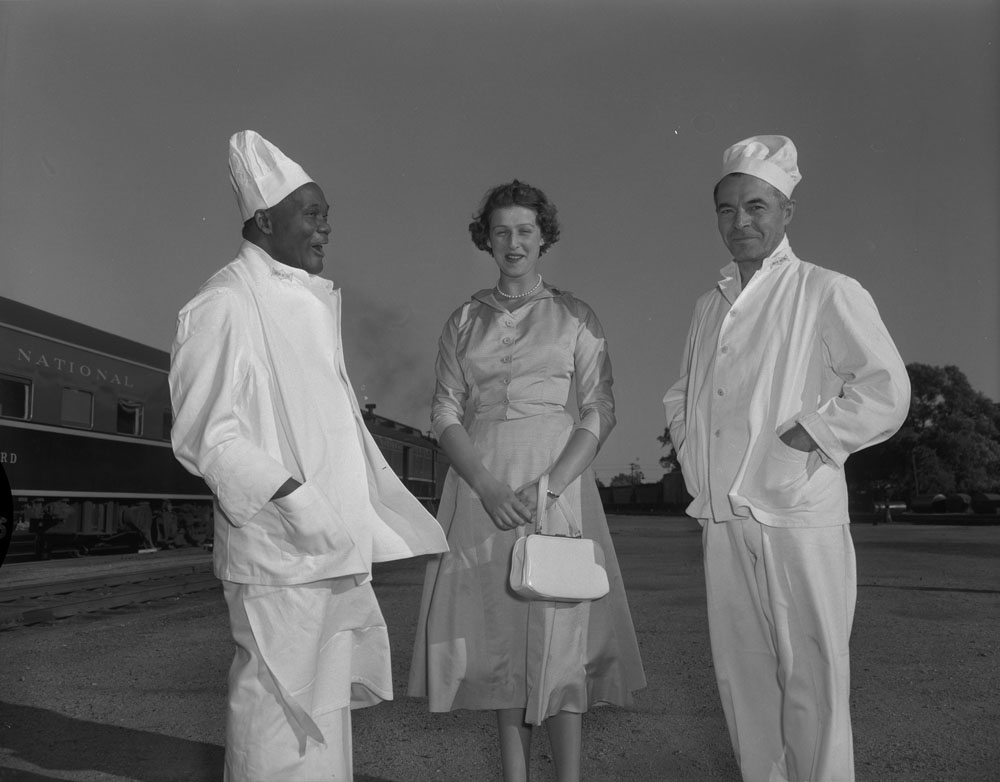
A white woman standing between a black man on the left and a white man on the right.

Princess Alexandra represents the British Crown on Canadian soil during her Royal Tour in 1954. (e011871943)

Volunteer, and in some cases, conscripted servicemen departing for and returning from battle offer us a glimpse into the realities of preparing for war, deploying to distant fronts, and returning home again.
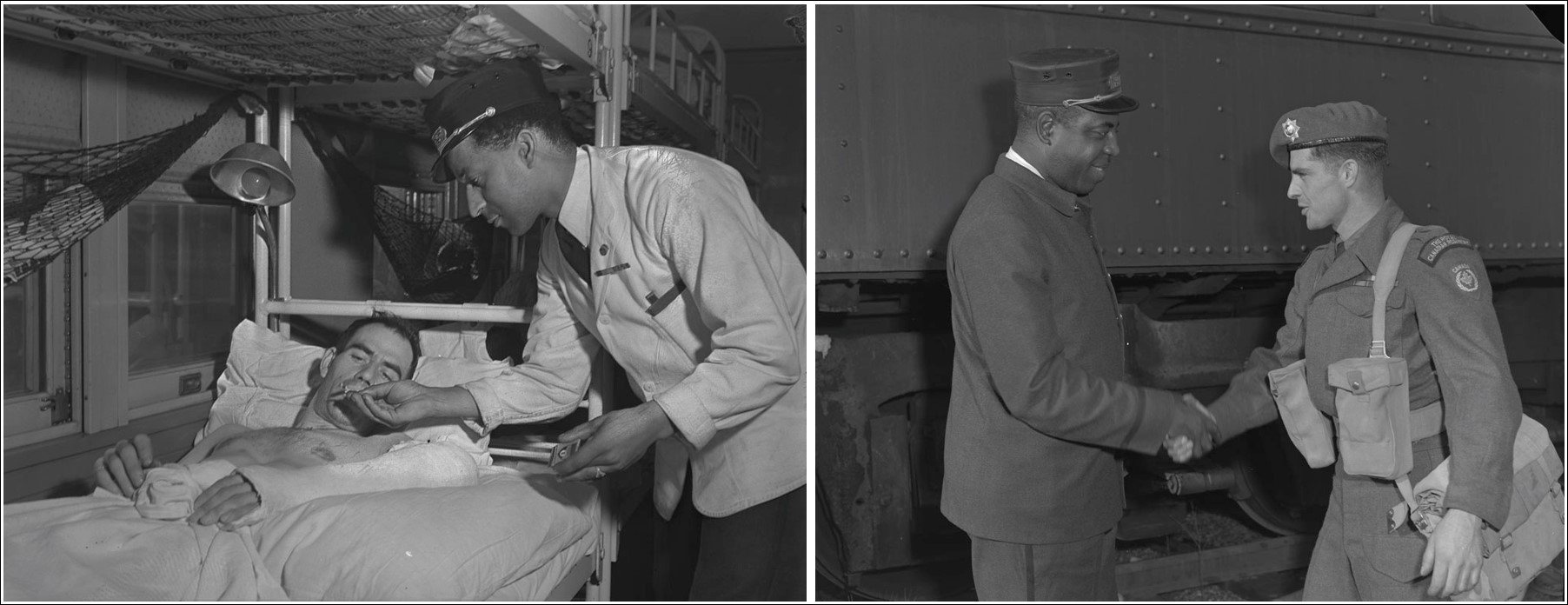
Side-by-side photographs of a Black sleeping car porter lighting a cigarette for an injured white soldier lying in a bed on a train, and of a Black sleeping car porter shaking hands with a white soldier.

Image on left: A sleeping car porter and an injured soldier on the Lady Nelson hospital train. Image on right: Porter Jim Jones of Calgary shakes hands with Private Harry Adams, a Halifax member of the Royal Canadian Regiment, as Canadian Army Special Force units arrive at Fort Lewis, Washington, for brigade-strength training. (e011871940 and e011871942)

Black men, often identified as train staff in the image descriptions, appear in every photograph—serving as the unifying thread in these historical moments. Their essential work, whether as cooks or sleeping car porters, made train travel possible, luxurious even, in times of war and peace. While this labour has often been silenced and overlooked in our national narratives, it is undeniably present in these images.

How can we begin to piece together the experiences that are captured in these images? One way is to turn to the Stanley G. Grizzle collection, particularly the interviews he conducted in 1986 and 1987 with former Canadian National (CN) and Canadian Pacific Railway (CPR) sleeping car porters. Grizzle sought to document the exploitative company culture Black men endured up to the mid-twentieth century and the long and complex struggle that ultimately led to their unionization. At the same time, he also made space for his narrators to recount memorable stories from their time on the rails. These recollections, if listened to closely, allow us to begin piecing together a narrative that enables us to better contextualize some of these DND images. Like the past, however, these moments remain fleeting and fragmentary, with much lost to history.

Five interview clips from Grizzle’s collection provide insight into what portering looked like during the Second World War. While these exchanges provide few details about the images above, they offer glimpses into porters’ working conditions and the added responsibilities they shouldered during wartime. Let’s listen to what these conversational tangents reveal about their experiences:

You can read the transcript from this sound clip here. (ISN 417383, File 1, 34:30)

You can read the transcript from this sound clip here. (ISN 417397, File 2, 9:26)

You can read the transcript from this sound clip here. (ISN 417379, File 1, 17:18)

You can read the transcript from this sound clip here. (ISN 417379, File 1, 5:56)

You can read the transcript from this sound clip here. (ISN 417386, File 1, 32:12)

The experiences of the men, the people they served, and their feelings about the additional duties thrust upon them as a result of the Second World War offer valuable insights that help humanize the role of portering. For George Forray, the demands of wartime rail service provided financial security, allowing him—and many others—to secure full-time employment during this turbulent period. Bill Overton, while recounting the hard-fought union gains he helped achieve, shared a story of being overwhelmed by 83 hungry Air Force cadets needing lunch. While there were white off-duty staff members on the train at the time, he explained the challenges of asking for their assistance. Through his account, we gain a deeper understanding of the intricacies and misunderstandings surrounding overtime pay during this era and the racialized structures that governed and divided rail workers.

In one of the clearest and most concise wartime stories in Grizzle’s collection, an unknown narrator recounts—despite audible breaks in the sound recording—details of transporting German prisoners of war. While he describes the sleeping cars’ physical environment and the meals served, much is left to the imagination, leaving gaps about how porters perceived this service and the potential dangers they faced. These insights are largely lost to history. Eddie Green builds on this discussion while speaking about the evolution of train technology in the early twentieth century. The reintroduction of outdated train cars to meet wartime demands posed significant challenges and physical dangers for porters, who had to navigate these risks while managing increased passenger loads. The stress would have been tremendous.

In many ways, the final interview clip brings the narrative full circle. In it, Joseph Morris Sealy reflects on how the high demand for wartime rail service paved the way for significant union gains. Government-backed wage increases served as a crucial starting point for negotiating the first collective agreement between the International Brotherhood of Sleeping Car Porters and the CPR in 1945. There was no going back to the way things were before the war. The uninterrupted movement of people and goods by rail had proven essential to sustaining a stable and functioning economy. Porters, fully aware of the critical role they played, fought to ensure they were treated fairly and justly compensated.

While piecing together the contextual information behind the images included above may not be possible, these accompanying narratives contain enough information to reveal what may have been happening before and after photographers captured these moments in time. They give a voice to the experiences of porters, shedding light on the complexities of their work during and after the Second World War. Yet, as with all historical sources, this oral and photographic evidence underscores the challenges of reconstructing the past—we must work with the fragments available to us. Despite their limitations, these sources compel us to fundamentally rethink our national narrative and the pivotal role of Black labour within it.

Additional Resources


Stacey Zembrzycki is an award-winning oral and public historian of immigrant, ethnic, refugee, and racialized experiences. She is a faculty member in the Department of History and Classics at Dawson College.
Black Porter Perspectives: Through the Lens of Military Records

Version française

By Rebecca Murray

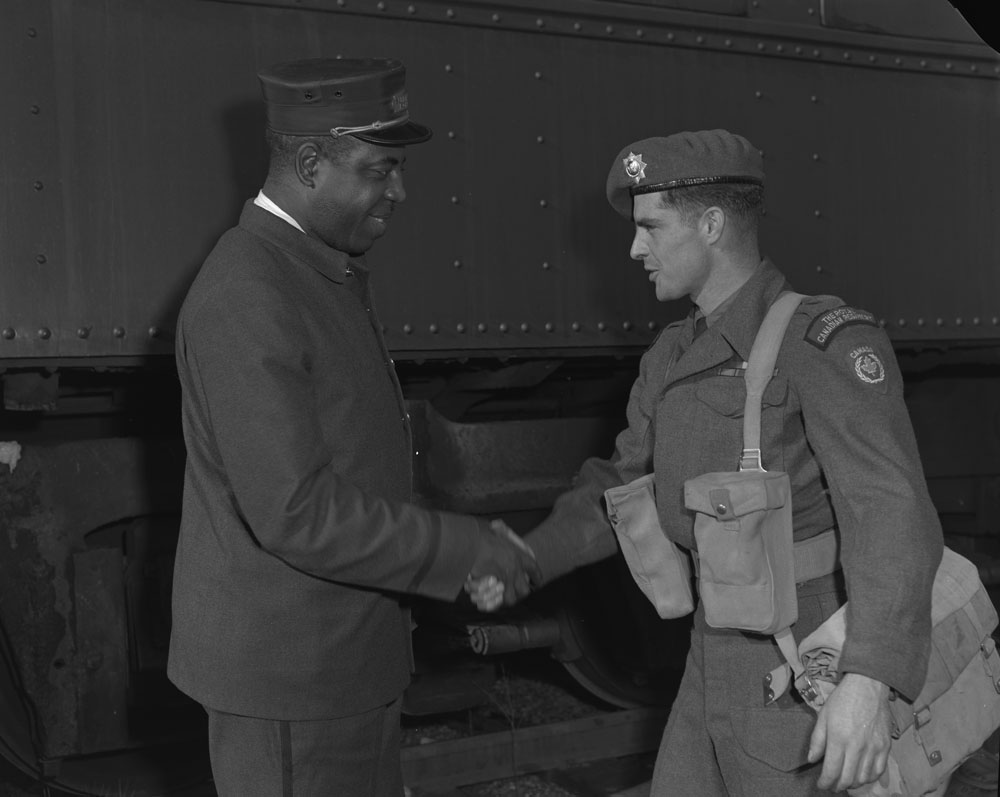
Library and Archives Canada (LAC) holds over 30 million images in various formats, including born digital images, negatives and photographic prints. A single archival photograph can tell us much about the fashion, weather, technology, customs and culture of an era! Yet, much of these secondary, but important, themes found in imagery are often ignored in the archival description process, with more attention given to the primary subjects or those captured by the photographer’s gaze. The popular saying “a picture is worth 1000 words” rings true every time I look at an image from the holdings. Even in this relatively simple image of two figures with little to no visible background, there is a wealth of detail and history to explore. What can the uniforms worn by the two men tell us? If there was a building or landscape in the background, what could we learn about where this image was taken?

Photograph of a sleeping car porter (on the left) shaking hands with a soldier (on the right).

1967-052, item Z-6244-4 “Arrival of RCRs at Fort Lewis: Units of the Canadian Army Special Force having completed their move to Fort Lewis, Wash., will shortly commence training at brigade strength. Among the recent arrivals with the Royal Canadian Regiment was one of many Halifax men serving with the Special Force. He is Pte. Harry Adams, above, seen being wished “Best of luck” by Porter Jim Jones of Calgary. (e011871942)

I first came across this image while reviewing others from the Department of National Defence (DND) accession 1967-052 for servicewomen, none of whom are pictured here. Though my main focus was the depiction of servicewomen, a minority group in these photographs, there are many other secondary or non-traditional narratives that are reflected in visual records, including those of sleeping car porters. Despite holding a degree in Canadian history, I had only recently been introduced to these men and their experiences through various books, including Genevieve Graham’s Bluebird and Suzette Mayr’s The sleeping car porter.

If you were to come to LAC looking for photographs of railway porters, you likely wouldn’t start in the DND photographs. Instead, you’d be drawn to those found in the Department of Transport (RG12) or the Canadian National Railways (RG30) fonds archives. In this instance, neither the porters nor the railway (nor the War in Korea) are mentioned in the description of the “Z prefix – CA” sub-sub-series. This is not entirely surprising, as it’s a large set of photographs — approximately 7 500 images — covering several decades worth of events, including the Second World War. Fewer than 15% of the images in this sub-sub-series are described at the item (photograph) level in the database, but most are described to varying levels of detail in digitized finding aids (item lists) that are attached to the sub-sub-series level description. The full caption for image Z-6244-4, which is available only on the original envelope and must be ordered for in-person consultation, mentions the presence of the porter and — surprisingly to this researcher — identifies him by name: Porter Jim Jones of Calgary. This is a stark contrast to most of the other images identified as part of my research. I wondered why this photograph had been so well described relative to others. Without a complete listing of captions and photographer’s notes, there is only so much we can infer from the limited data that we do have.

Coming across these images and working to pair them with their full descriptions, especially when they include the names of individuals and other identifiers, is an opportunity to press pause on one’s research intentions. The relatively hidden history in these images merits well more than a thousand-word description.

We call this process reparative description: the remediation of practices or data that have excluded, silenced or mischaracterized people or histories in archival records. Whether on a large scale or one photograph at a time, this is an ongoing process. So, when I came across these images of porters and other Black railway staff from the Second World War era, I kept notes and shared them with my colleagues who were working on the Discover Library and Archives podcast, Voices Revealed: “Porter Talk.” We were then able to work with other colleagues who are interested in this period, the presence of porters in the DND photographs and their representation in the collection as a whole.

Keep an eye out for the next piece in this series.


Rebecca Murray is a Literary Programs Advisor in the Outreach and Engagement Branch at Library and Archives Canada.

Women in the War: the Royal Canadian Air Force at 100

Version française

By Rebecca Murray

Please note that many of the visuals for this article were taken from digitized microfiche; as such, the image quality varies, and individual item-level catalogue descriptions are not always available.

The Royal Canadian Air Force (RCAF) is celebrating 100 years in 2024. Library and Archives Canada (LAC) holds records from the RCAF’s earliest days through to the 21st century. From its role in Canadian aviation to operations abroad, the RCAF has an important place in Canadian military history. Other posts on this site address infrastructure like airports (specifically RCAF Fort St. John) and notable moments such as the Avro Canada CF-105 Arrow. This post will focus on the photographic holdings of the RCAF at LAC, specifically the Second World War–era photographs of servicewomen.

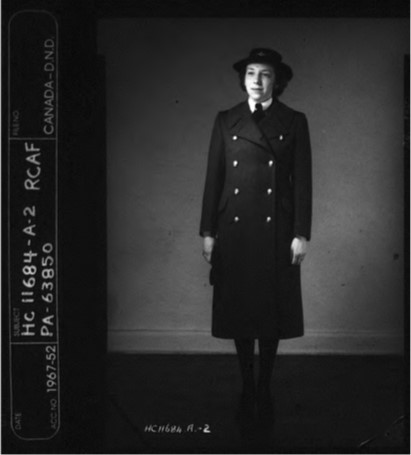
A uniformed woman stands against a blank wall.

HC 11684-A-2 “Great coat with hat and gloves,” 04/07/1941 (MIKAN 4532368).

Another colleague’s post outlines the history of the RCAF Women’s Division (RCAF-WD), so I won’t repeat it here, except to say that it was formed on July 2, 1941 (officially as the Canadian Women’s Auxiliary Air Force, changing its name by early 1942) and would eventually see more than 17,000 women serving within its ranks.

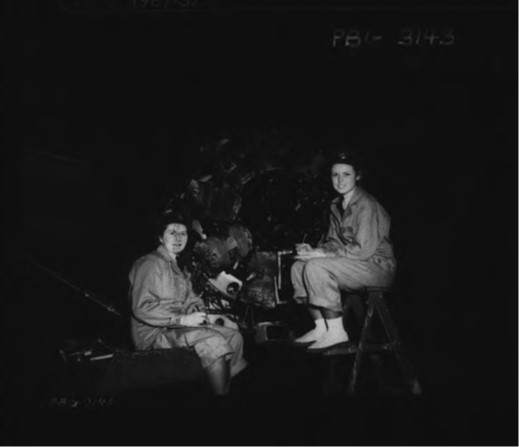
Two women wearing coveralls sit on either side of a propellor.

PBG-3143 “Women’s Division—Aero Engine Mech.,” 23/10/1942 (MIKAN 5271611).

The Department of National Defence fonds (RG24/R112) holds photographs of these women and documents their service during the Second World War era. Comprising over 500,000 photographs, this collection is a rich resource for anyone interested in the period as it includes photographs from both Canada and overseas. Over the past six years, I have been working closely with the photographs to find the servicewomen. Some of them are documented clearly and given centre stage in photographs. Others are found on the fringes, sometimes almost indistinguishable at first glance from their male counterparts in group photographs.

A seated uniformed man wearing glasses (left) looks towards a standing uniformed woman (right).

RE-1941-1 “Pay and Accounts Section (Crosswinds),” 25/09/1944 (MIKAN 4740938).

The occasion of the RCAF’s 100th birthday is a fitting moment to share the results of the work with this particular sub-series of photographs while highlighting the role that servicewomen played in the RCAF’s ranks during this period. Composed of 53 sub-sub-series of photographs, usually distinguished by location, the images vary widely—from aerial views of Canada to official portraits to post-war photographs of life and operations at European bases like North Luffenham and Station Grostenquin. The bread and butter of this sub-series, though, for most interested parties, is the imagery that documents the day-to-day operations and lives of servicemen and women during the Second World War, whether at home or abroad.

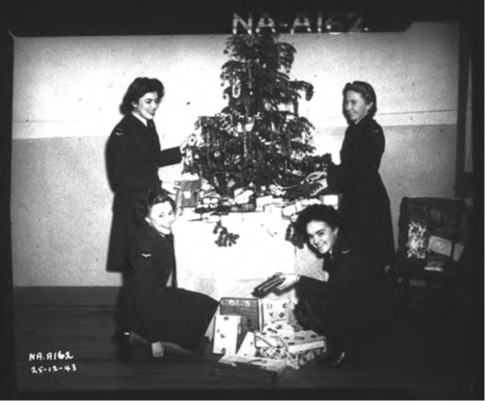
Four uniformed women stand and kneel around a Christmas tree positioned atop a table. Wrapped gifts appear on the floor and underneath the tree.

NA-A162 “WD’s Xmas tree & Xmas dance,” 25/12/1943 (MIKAN 4532479).

At over 160,000 distinct images, this sub-series is a treasure trove for any researcher with an interest in the period! Approximately 1,900 of those images (1%) are of servicewomen, both RCAF-WDs and nursing sisters who served in the RCAF. Servicewomen are best represented within this sub-series in photos from Ottawa, Rockcliffe or Headquarters, with strong representation from those taken at regional bases such as those in Newfoundland, Prince Edward Island and British Columbia.

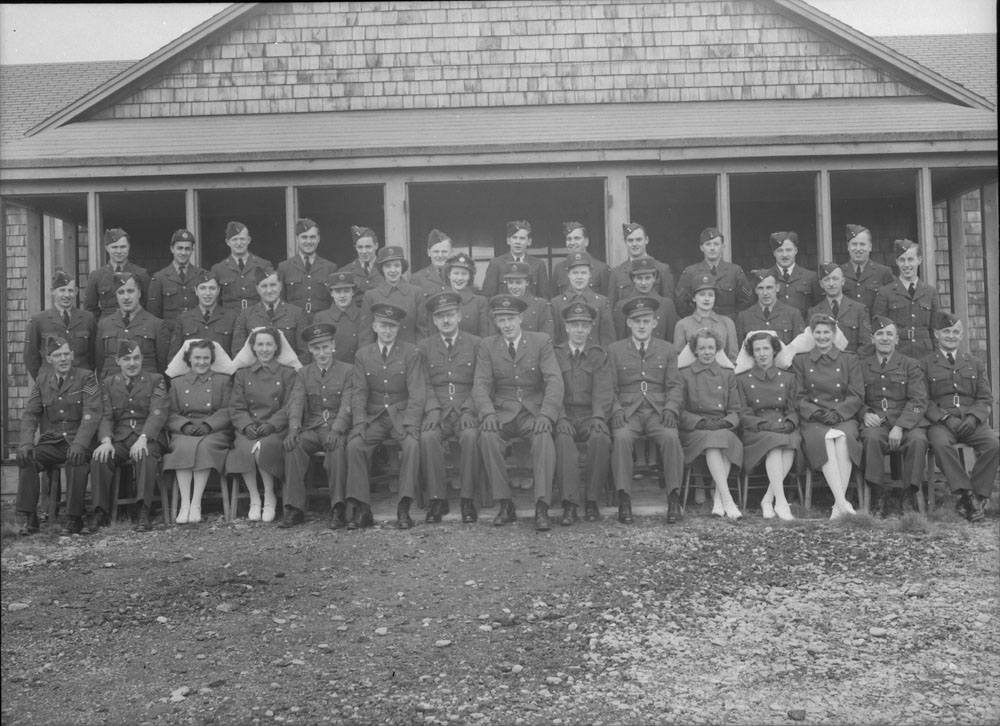
The photographic collection shows us the WDs (as they were known colloquially) at work and play. They are often shown in groups celebrating holidays or fun moments against the backdrop of a horrific war. Other images suggest levity (see images NA-A162 above and SS-230B below) but also show the serious work being done (see image PBG-3143 earlier in this post). Formal group photographs, such as the nursing sisters shown in G-1448 below, are very common. For many of the more remote or rural bases, especially in the earliest years of the war, nursing sisters are the only women present in the associated photographic records.

A formal group photo with 41 individuals, including 12 servicewomen, five of whom are wearing the distinctive white veil of a nursing sister. The group is organized in three rows; the front row is seated.

G-1448 “[Hospital staff, No. 1 Naval Air Gunnery School, R.N., Yarmouth, N.S.],” 05/01/1945 (a052262).

A group of fifteen women, mostly in civilian dress, engages in various leisure pursuits in what looks like a living room or lounge-like setting. Many appear to be engaged in needlecraft.

SS-230B “Sewing Circle (WD’s) Intelligence Officers,” 04/04/1943 (MIKAN 5285070).

Do you want to know more? Did your aunty or grandma serve in the RCAF-WD? Are you interested in knowing more about her service?

Check out LAC’s extensive resources and records related to the Second World War, including information on how to request military service files. Service files for Second World War—War Dead (1939–1947) are available via our online database.

Explore other photographic holdings at LAC, such as the PL prefix—Public Liaison Office sub-sub-series, a fabulous resource for RCAF photographs that sits, archive-wise, just outside of accession 1967-052 (the focus for this particular research project). Any researcher looking for a RCAF aunty or grandma (or grandpa!) in the archives should include these photographs in their search.

There’s more information about the RCAF’s Centennial on the official RCAF website.


Rebecca Murray is a Literary Programs Advisor in the Programs Division at Library and Archives Canada.

Expect the Unexpected!

By Forrest Pass

What do Inuit mapmakers, German composer Ludwig van Beethoven, a notorious Italian stamp forger and Soviet spies have in common? Their works are all represented in the collections at Library and Archives Canada. These artifacts are also showcased in Unexpected! Surprising Treasures From Library and Archives Canada, which opens at the Canadian Museum of History on Thursday, December 8, 2022. This new exhibition gives curious visitors a chance to see, first-hand, many intriguing items that they might not expect to find at Canada’s national library and archives.

The exhibition features some 40 original documents, maps, photographs, rare books and works of art. Regular readers of this blog will know that researchers and staff are always coming across surprises in the collection. A few of the items displayed in Unexpected! are perennial favourites. Others are new finds, the never-before-exhibited results of research into the unusual stories that library and archival collections can reveal.

A handwritten document on lined paper, with some words in black ink scratched out in red ink.

A secret agent receives instructions from his handlers. The delivery of this and other Soviet espionage documents to Canadian authorities in 1945 helped to start the Cold War. (e011316511_s1)

These stories are clustered around three themes. The first, Wonders, presents artifacts that delighted or intrigued their audiences when they were created, and they continue to do so today. Visitors will discover how a manuscript composition by Beethoven ended up in Canada. They can experience an 18th-century version of virtual reality. They may also contemplate two contrasting visions of the Arctic: one, the product of an imaginative European cartographer who had never visited the region, and the other, the work of two Inuit mapmakers with deep connections to the land.

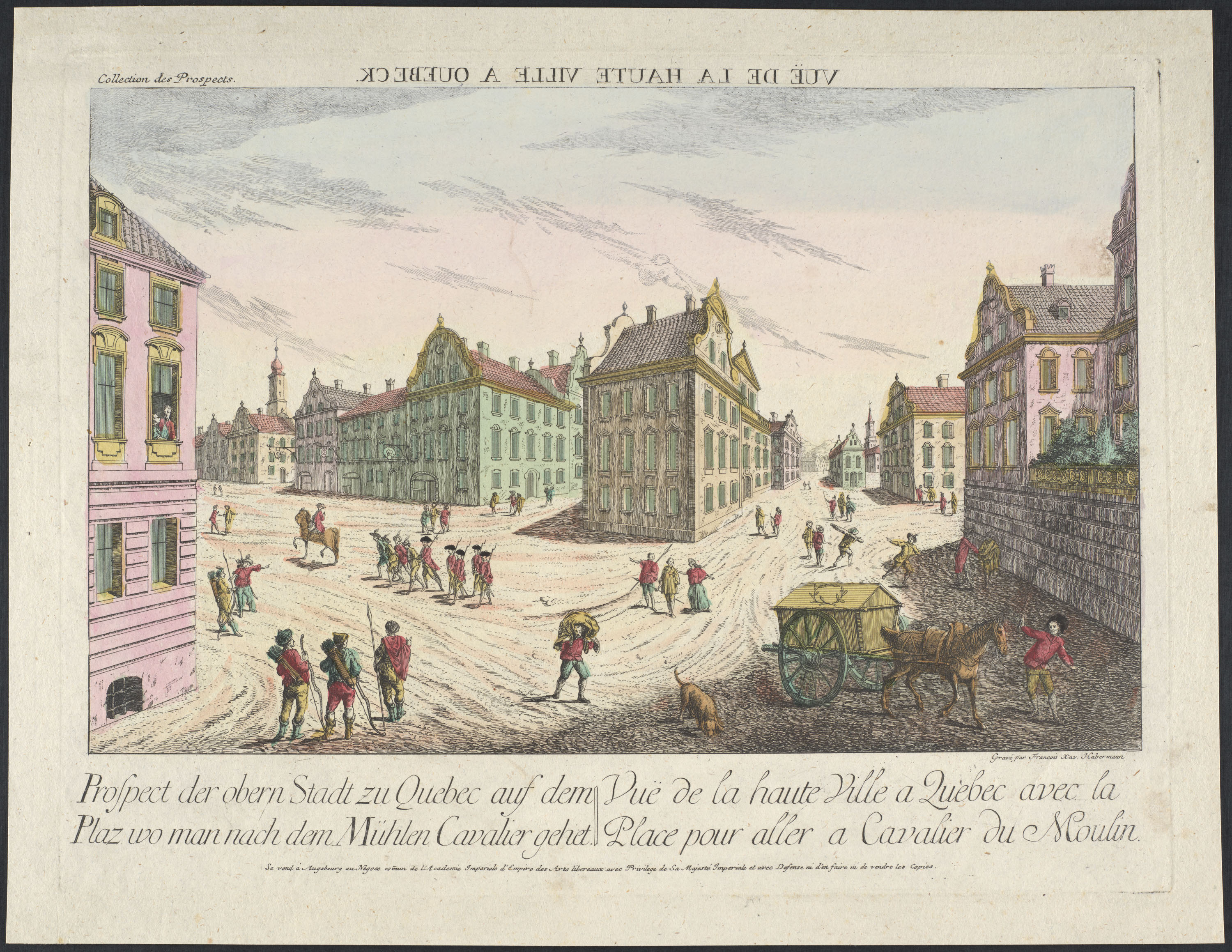
A street with pink, green and beige buildings, soldiers, a dog, and a horse and carriage.
Perspective views, like this imaginary street scene in the city of Québec, appear to be three-dimensional when viewed through a device called a zograscope. The exhibition features a reconstructed zograscope, enabling visitors to experience virtual reality, 1770s-style. (e011309357)
In the second theme, Secrets, Unexpected! explores how and why people keep secrets, and how they share secrets with those who need to know. Visitors can crack a coded love letter, ponder the rich symbolism of a centuries-old masonic ritual painting, and find out why the Dominion Archivist once mused (or “mew-sed”?) about putting cats on the government payroll.

The final theme, Mysteries, presents some unresolved puzzles. Here, visitors can pore over the contents of a UFO investigation file, or come face to face with the rare “Fool’s Cap Map,” printed in the 1500s and perhaps the most mysterious map ever created.

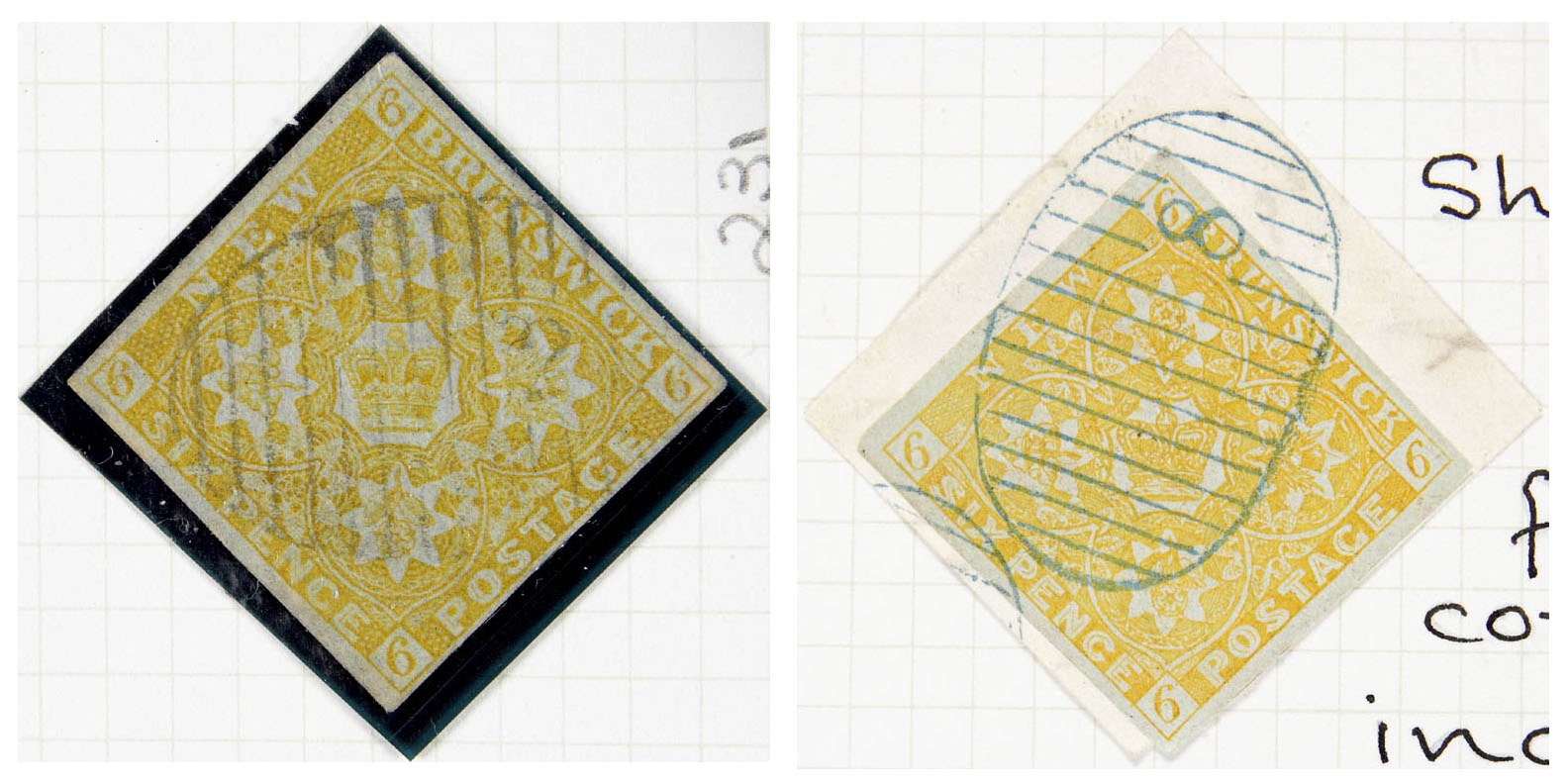
Two yellow stamps placed diagonally on a page. They both have a blue ink stamp.

One of these 1851 New Brunswick postage stamps is a forgery. Can you spot the fake? (e011309360 and e011309361)

The stories that these artifacts tell can be funny, thought-provoking or simply curious. What links them all is that each artifact, when you scratch beneath its surprising surface, reveals something important about the past. There are good reasons why they have found their way into the collections at Library and Archives Canada.

This is the latest in a series of exhibitions developed in partnership between Library and Archives Canada and the Canadian Museum of History. As the curator for Unexpected!, I have had the privilege and pleasure of collaborating on this project with a multidisciplinary team of exhibition and collections professionals from both institutions. In addition to providing the venue, the museum has contributed creative development expertise and a scenographic approach that recalls the look and feel of mid-century mysteries and spy thrillers. The museum’s technicians also took up the challenge of constructing several interactive elements that will enhance visitors’ understanding and appreciation of the original artifacts.

Unexpected! Surprising Treasures From Library and Archives Canada is at the Canadian Museum of History until November 26, 2023. Watch this blog as well as Library and Archives Canada’s social media channels in the coming weeks and months to learn more about the astonishing treasures on display.


Forrest Pass is a curator in the Exhibitions team at Library and Archives Canada.

Women in the war: a Co-Lab challenge

By Rebecca Murray

Canadian women are part of the photographic record of the Second World War. The Department of National Defence fonds (RG24/R112) includes over two million photographs, from Comox in British Columbia to Naples in Italy. These women are our great-grandmothers, grandmothers, mothers, aunts, sisters, cousins and friends.

This Co-Lab challenge invites you to identify servicewomen and nursing sisters who served in Canada and abroad between 1942 and 1945. The photographs range from images of a single person to large groups. The selected photographs depict them at work and play, on ships, in kitchens and libraries, playing sports and dancing. In most cases, none of the women have been identified; in fact, the word “unidentified” is often part of the title of the image.

Identifying these individuals is key to having a better understanding and knowledge of the roles they played during the Second World War. In tandem with other efforts to identify images of servicewomen and nursing sisters within the archival record, this Co-Lab challenge will help to expand the narrative.

Can you help us to identify these women who served? Here are some examples of the photographs you will find in the challenge.

A black-and-white photograph of a woman in a military uniform looking at the camera. She has a pen in her right hand, papers on her desk and a black candlestick-style telephone to her left.

An unidentified member of the Canadian Women’s Army Corps (CWAC), England, July 19, 1944. Credit: Capt. Jack H. Smith (a162428-v6)

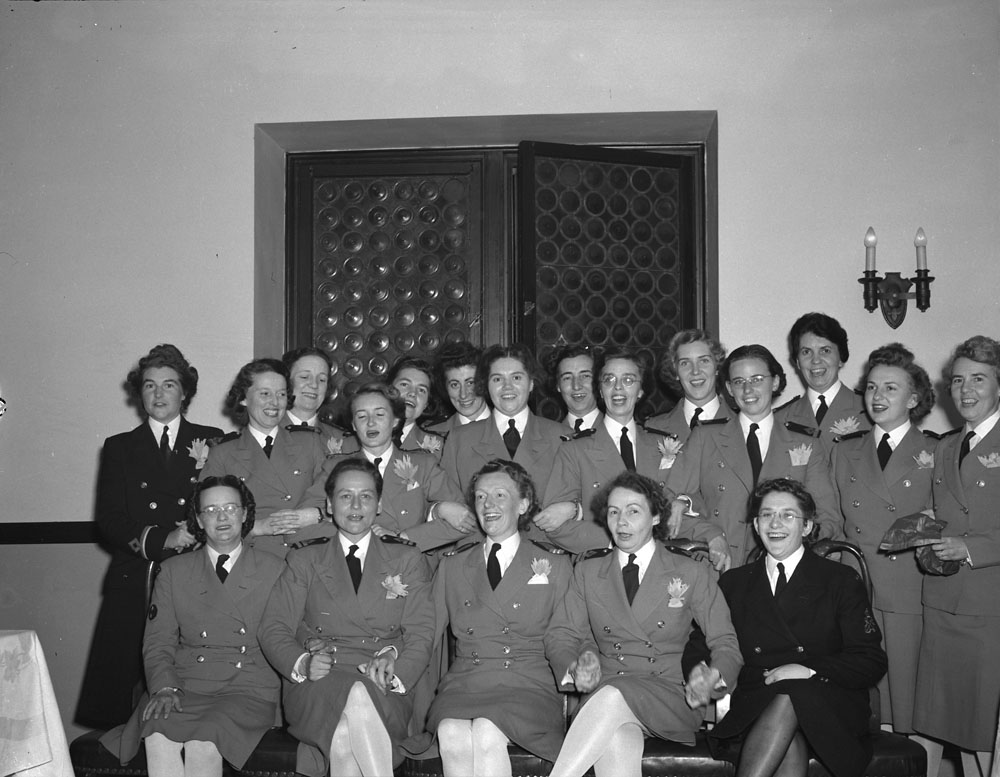
A black-and-white photo of a group of women in military uniforms smiling at the camera. There are two women in dark suits. The women in the first row are seated and holding hands. Some of the women standing in the back row have their arms linked.

Women’s Royal Canadian Naval Service members (“Wrens”), August 1943 (e011180809)

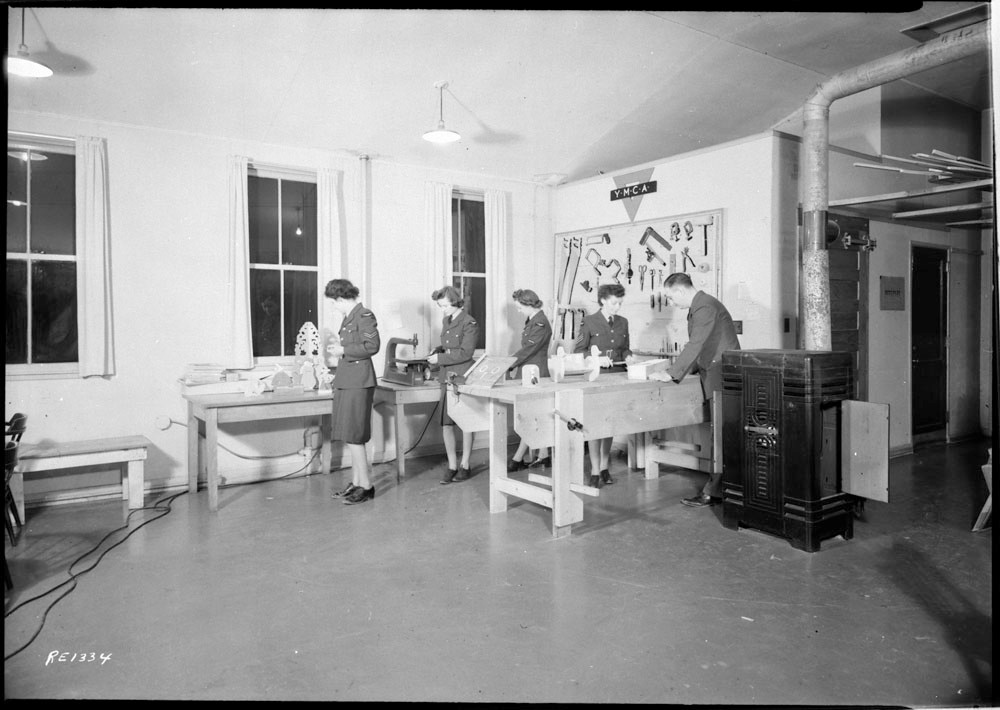
A black-and-white photo of four women and a man in a shop with tools and tables. There are three windows and a sign that reads YMCA.

Royal Canadian Air Force Women’s Division craft shop, Rockcliffe, Ontario, April 11, 1944 (a064867-v8)

To search the holdings at Library and Archives Canada for other photographs of servicewomen and nursing sisters, use Collection Search to explore accession 1967-052, where photographs are organized by branches of the armed forces, or try a keyword search (e.g. 1967-052 Halifax Wren).

For more information on the women’s divisions in the three branches of the Canadian Armed Forces during the Second World War, please refer to these blog posts:

Canadian women served in numerous capacities throughout the Second World War—well beyond what is represented in these photographs. Naming these women and identifying them within the archival record will build a more inclusive narrative and allow generations of servicewomen, their families and Canadians to recognize and highlight the extraordinary roles that they played during the Second World War.

We invite you to use our Co-Lab tool to transcribe, tag, translate and describe digitized records in this challenge. You can also make contributions to any image through our Collection Search tool.


Rebecca Murray is a Senior Reference Archivist in the Reference Services Division at Library and Archives Canada.

Brodie Macpherson: Early photo printer

By Samantha Shields

Biography

Brodie Macpherson, born Archibald Brodie Macpherson, nicknamed “Handlebars” (presumably for mustache-related reasons), was a notable figure in Canada for his role in the photographic community during the rise of colour printing.

A colour portrait photograph of Brodie Macpherson in a military uniform sporting a handlebar moustache. The figure is cropped at the chest and appears against a blank background.

Self-portrait, approx. 1945 (e010767976)

Born in Toronto, Ontario, on November 26, 1909, to University Professor Walter Ernest and Elsie Margaret Macpherson, Brodie was the eldest of three children and the first to attend the University of Toronto. He enrolled in the Faculty of Applied Science and Engineering in 1927 and graduated in 1931. He would go on to serve as a member of the Royal Canadian Air Force in the Second World War before returning home to start his photography business in early 1946. Macpherson’s engineering background, in conjunction with his subsequent years of experience working in the lithography business, would serve him well in the colour printing trade.

The rise of colour photography

Colour photography began to gain momentum in the mid-1930s with the advancement of colour transparencies. Colour prints were also possible at this time, but they were far less popular with photographers than black-and-white prints. The process of making and printing separation negatives was too expensive and complicated for most hobbyists, and the finished prints were rarely worth all the effort for professional photographers. Portrait and scenic photographers were certainly not interested in spending a small fortune to produce prints that critics would frequently describe as garish, vulgar, and unnatural.

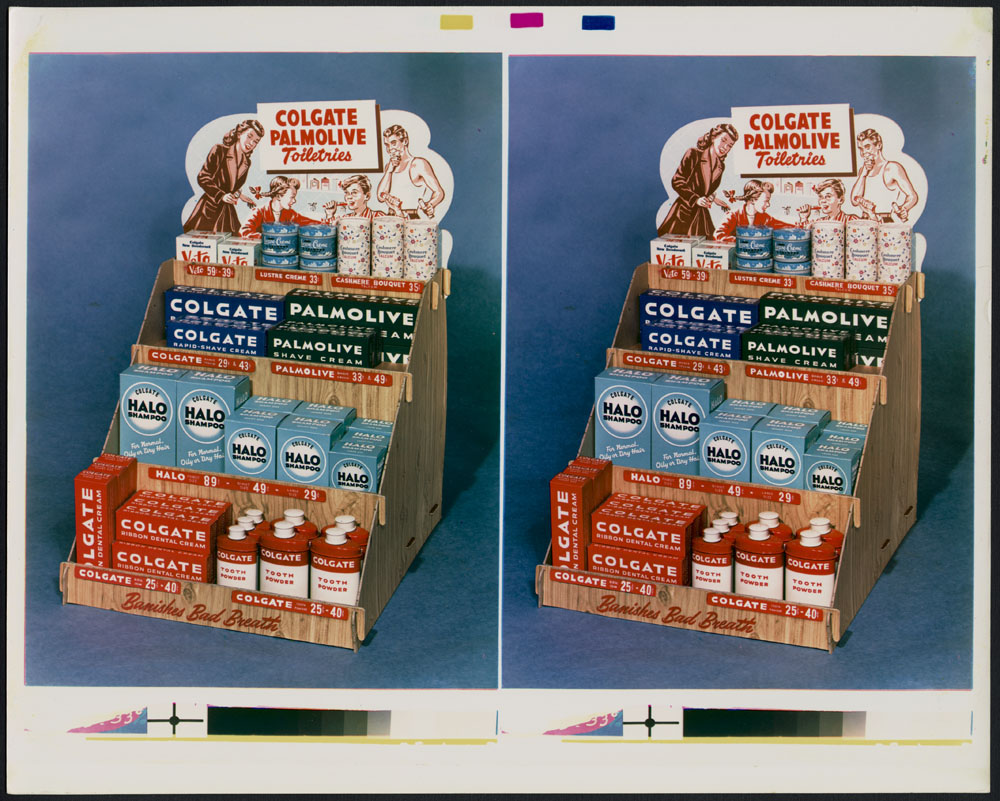
Dual colour photographs of a tiered display holding Colgate and Palmolive products, such as shaving cream, shampoo, dental cream, and tooth powder. The display was photographed in-studio against a blue background.

A shop display for Colgate Palmolive toiletries. (e011312591)

Despite its many shortcomings, colour truly excelled in the realm of advertising. While bright and clashing colours can be visually jarring, they are also excellent for attracting attention. During this era, colourful photographs increasingly adorned the pages of magazines, billboards, and sales tools.

Advertising was ideally suited for colour, since much of it involved bulk orders, where repetition and quantity could distribute the high cost and complexity of making an initial print over multiple copies.

Brodie Macpherson – the business

In February 1946, rather than resume his pre-war employment with Harris Lithography, Macpherson, embarked on making and selling quantities of colour photographs using modified versions of Eastman Kodak’s Wash-off Relief and Dye Transfer processes. Given the operational similarities, a background as a lithographic camera operator proved particularly useful in this work.

Macpherson’s business approach was simple: provide the best possible product for the lowest reasonable price. This goal was achieved by

  • limiting sales to colour prints, thereby reducing the need to stock equipment and materials to process black-and-white prints, and promoting a specialization in colour.
  • selling prints in bulk only, thereby maximizing the life of the chemicals and lowering costs overall. As chemicals would begin to expire rapidly when poured into trays, it was not economical to let materials spoil between small orders.
  • experimenting and mixing his own chemicals. Macpherson was able to further streamline his printing process, maintain a consistent quality, and avoid some of the higher costs associated with purchasing prepared chemicals. These cost savings were passed on to the consumer.
  • building and customizing tools, from production equipment (e.g., cameras and lights) to printing (e.g., lightbulbs and tray rockers). Macpherson was continually designing, experimenting, and tweaking to improve and perfect the process.
  • communicating and collaborating with suppliers, manufacturers (including Kodak), fellow photographers, and printing labs, and continually sharing research, information, and resources to help improve the production of colour photography.
A black-and-white photograph of Macpherson’s camera.

Macpherson built his own one-shot colour separation camera, which allowed him to expose three plates behind different coloured filters simultaneously. Otherwise, the exact same photo would need to be taken successively for each filter colour. (e011312590)

From the outset, clients considered the quality of Macpherson’s colour prints to be strong, and his prices—while still more expensive than those of black-and-white or hand-colour photographs—reasonable. His price lists were consistently lower than those of other colour-printers in the area, and remained unchanged for the duration of the business. Over the next 18 years, Macpherson would go on to fill orders for clients from all over Canada and from the United States.

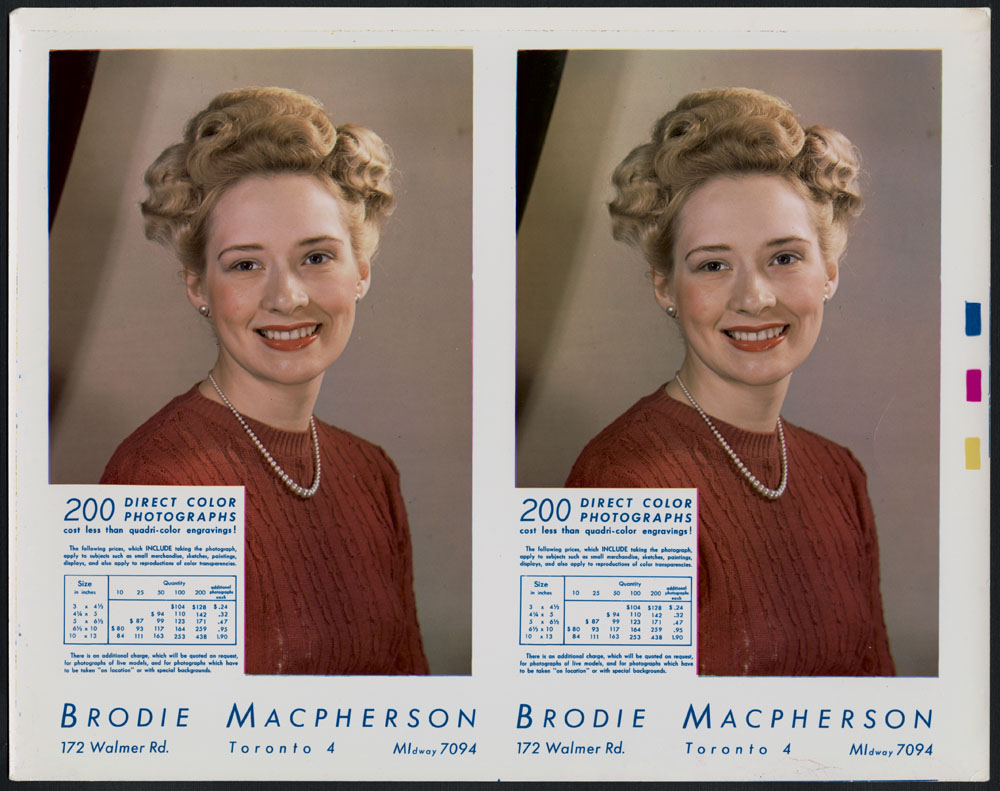
Two identical studio portraits of an unknown woman with blond hair, red lipstick, and a red knit sweater. Macpherson’s price list and contact information is superimposed on the bottom left-corner and also appears below the image.

An advertisement and price list for ordering coloured photographs from Brodie Macpherson.
(e011312588)

The colour studio, located at 172 Walmer Road, in Toronto, in the basement of his family home, operated officially until Macpherson’s retirement in 1964.

The Toronto Camera Club (TCC) – Colour Print Group

According to the President of the Toronto Camera Club, Frank E. Hessin, Macpherson was “unquestionably [the] driving force in the [Toronto Camera] Club” for the promotion of colour prints. In 1946, he proposed the creation of—and subsequently chaired—the TCC’s Colour Print Group. Over the next several years, he employed the TCC’s facilities to teach the colour separation process to anyone willing to learn.

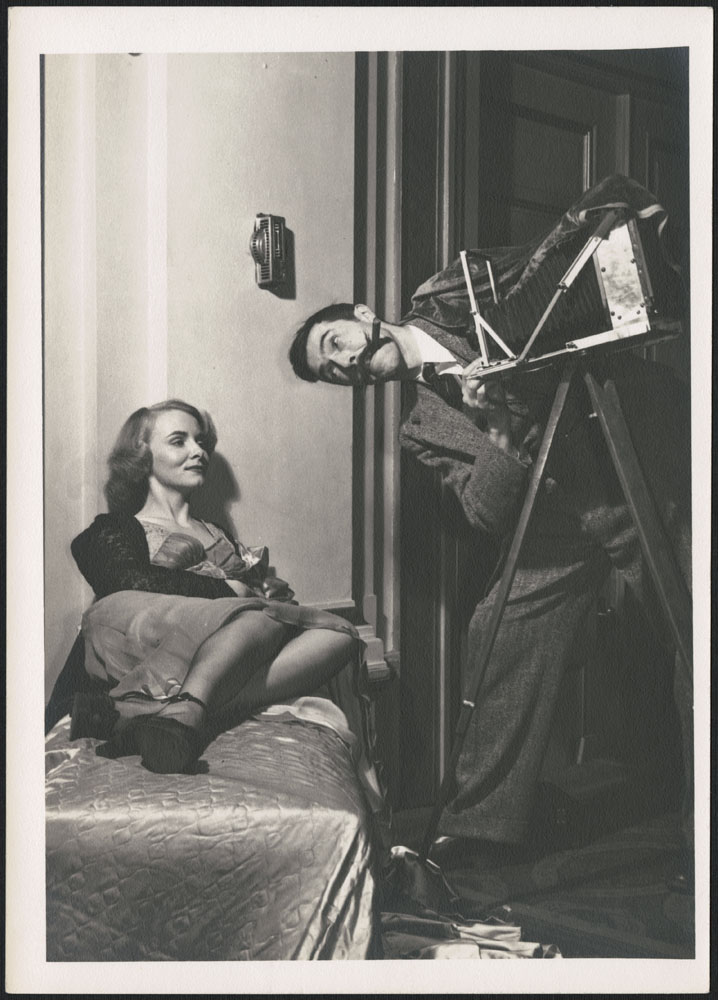
A black-and-white photograph of Brodie Macpherson pretending to photograph a reclined Miss 1948, Lialla Raymes.

Brodie Macpherson and Miss 1948, Lialla Raymes, during a skit portraying the changing trends in photography to mark the 60th Anniversary of the Toronto Camera Club. (e011310464)

Everett Roseborough, a fellow TCC member, writes the following characterization of Macpherson, which echoes throughout the correspondence and articles in the Brodie Macpherson fonds (R791).

“Opinionated [and found] seated in the back row at photographic society meetings, stroking his moustache, he could be counted on to object to something. Following a concerted groan by those present, frequently he would be proven correct.” (Photographic Historical Society of Canada, 1994)

Ever the son of a university professor and librarian

Undeniably clever, Macpherson would readily share information and freely offer his opinion and advice. He was an invaluable resource, as photographers active during this era considered Macpherson to be the best colour photographer / printer in the city.

Over the years, as colour-photography technology continued to improve in speed and accuracy, Macpherson’s skills in this area and his knowledge of colour-print specifications continued to be recognized. He regularly shared his research findings and encouraged discussion through various photography publications, private letters, photography clubs, public lectures, and evenings in his studio accompanied by records and top-shelf scotch.

A print of a cut round cake on a black plate, situated atop a box bearing the printing matrix and creator number C363.

An early colour photograph by Brodie Macpherson demonstrating the layering of yellow, magenta, and cyan to achieve a full-colour print. (e011312589)

Retirement

Already spending most of the winter months in Barbados, Macpherson semi-retired from the printing business in 1964, at the age of 55. While he was no longer accepting any new business, during his time in Toronto, he would still fill orders of reprints from existing negatives for previous clients.

A promotional photograph displaying eight different Purity biscuit and cookie products in clear bags against a white background.

A series of promotional prints commissioned by Purity Factories Ltd., Saint John’s, Newfoundland and Labrador. The company placed several orders with Macpherson, and continued to request reprints until 1970. (e011312592)

By the late 1960s, the photographic processes used by Macpherson had largely been replaced by Kodak’s new—and simpler—Ektacolor material. As a result, it became increasingly difficult to obtain the necessary supplies in Canada, and the reprinting stopped altogether.

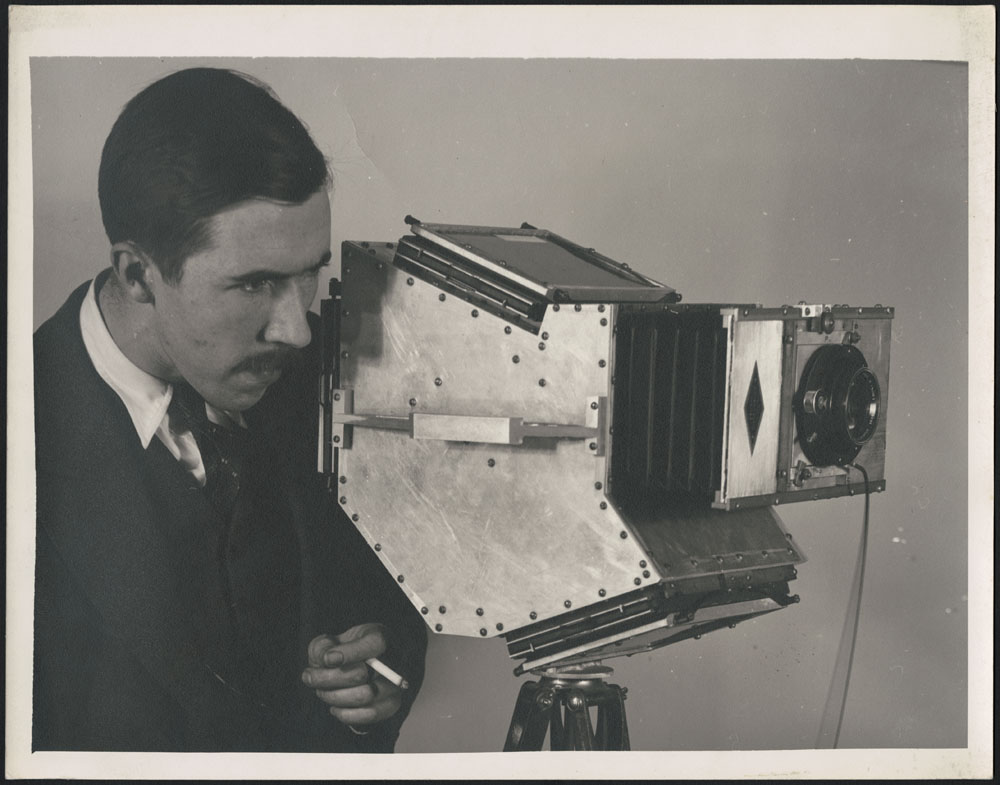
A black-and-white photograph of Brodie Macpherson using his Devin-style one-shot camera.

Portrait of Brodie Macpherson at work. (e011310471)

A recluse by nature, Macpherson quietly closed up his home and studio sometime in the 1970s, reportedly moving to Florida without a trace (Roseborough, 1994). Subsequent efforts to locate Macpherson in Toronto, Florida, and Bermuda post-1970 were unsuccessful.

Macpherson’s successful career in colour photography, particularly during a period of rapid technological development, is a true testament to his entrepreneurial spirit, his dedication, and his mastery of the craft.


Samantha Shields is a Photo Archivist in the Social Life and Culture Division at Library and Archives Canada.

A selection of records about D-Day and the Normandy Campaign, June 6 to August 30, 1944

By Alex Comber

With part 1 of this post, we marked the 75th anniversary of D-Day and commemorated Canada’s participation in the June 6, 1944, invasion of northwestern Europe, and the Normandy Campaign, which ended on August 30, 1944. In part 2, we explore some of the unique collections that Library and Archives Canada (LAC) holds about these events, and highlight some records that are the most accessible to our clients online. Through outreach activities, targeted and large-scale digitization, DigiLab and our new and Co-Lab initiatives, LAC is striving to make records more easily available.

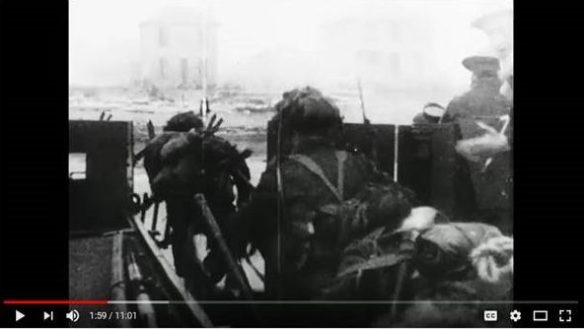
A black-and-white image taken from moving film, showing soldiers exiting a landing craft.

A frame of Canadian Army Newsreel No. 33, which includes a sequence of film from the Canadian D-Day landings on June 6, 1944

LAC staff receive many reference requests about our collections of photos. Canadian Film and Photo Unit (CFPU) personnel went ashore 75 years ago, on D-Day, filming and photographing as they landed. During the Normandy Campaign, they continued to produce a visual record that showed more front-line operations than official photographers had been able to capture in previous conflicts. Film clips were incorporated into “Canadian Army Newsreels” for the audiences back home, with some clips, such as the D-Day sequence above, being used internationally.

Photographers attached to the army and navy used both black-and-white and colour cameras, and the ZK Army and CT Navy series group the magnificent colour images together.

A colour photograph showing an armoured vehicle with a large main gun.

A British Centaur close-support howitzer tank assisting Canadians during the Normandy Campaign (e010750628)

Some of the most iconic imagery of the Canadian military effort in Normandy was incorporated into the Army Numerical series; by the end of hostilities, this had grown to include more than 60,000 photographs. The print albums that were originally produced during the Second World War to handle reproduction requests can help in navigating this overwhelming amount of material. Researchers at our Ottawa location refer to these volumes as the “Red Albums,” because of their red covers. These albums allow visitors to flip through a day-by-day visual record of Canadian army activities from the Second World War. LAC has recently digitized print albums 74, 75, 76 and 77, which show events in France from June 6 until mid-August 1944.

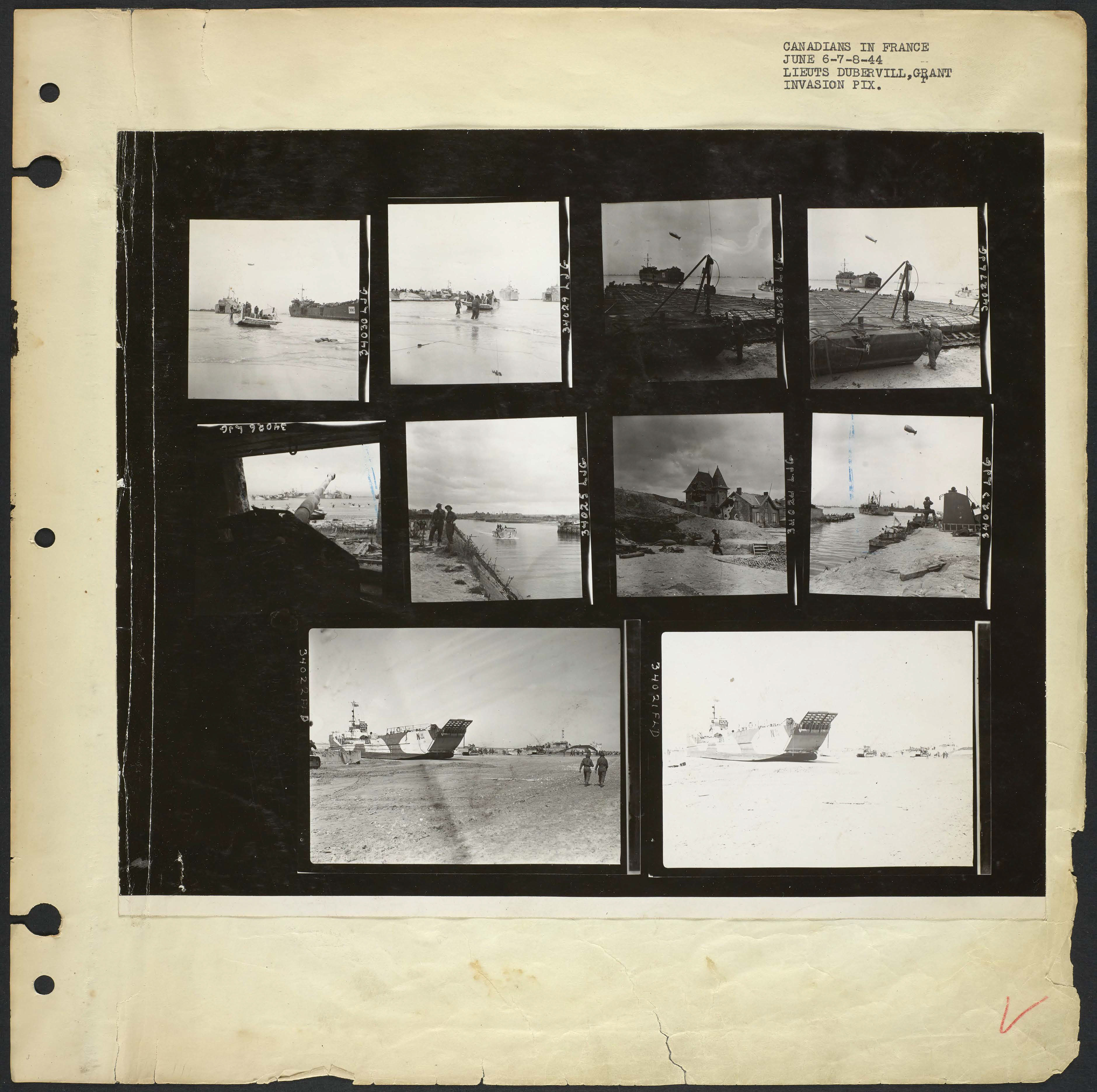
A page of black-and-white photographs showing photos of landing craft, destroyed enemy beach defences, and villages and landing beaches.

A page from Army Numerical print album Volume 74 of 110, showing the immediate aftermath of the landings (e011217614)

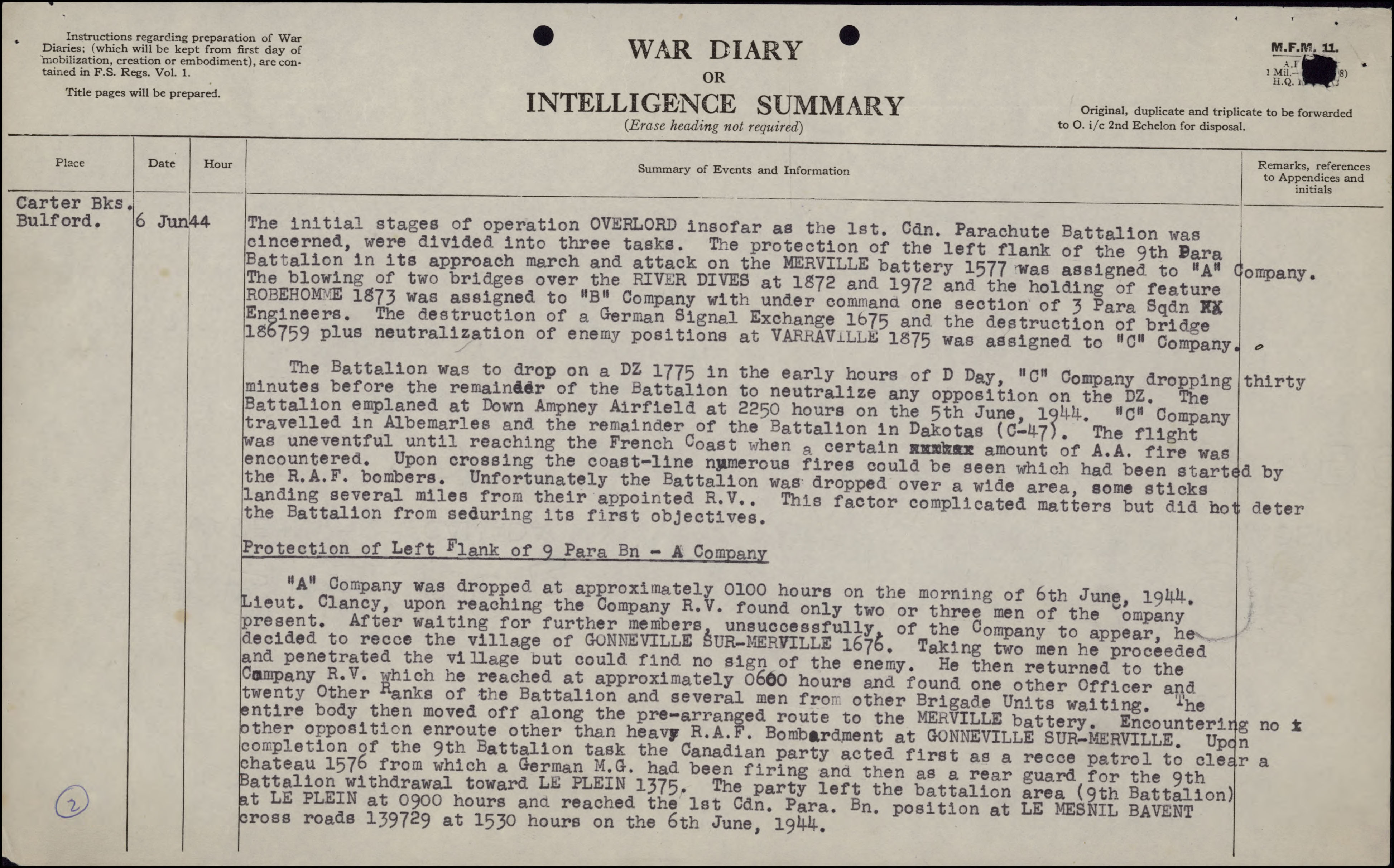
LAC also holds an extensive collection of textual records related to the events of June–August 1944. One of the most important collections is the War Diaries of Canadian army units that participated in the campaign. Units overseas were required to keep a daily record, or “War Diary,” of their activities, for historical purposes. These usually summarized important events, training, preparations and operations. In the Second World War, unit war diaries also often included the names of soldiers who were killed or seriously injured. Officers added additional information, reports, campaign maps, unit newsletters and other important sources in appendices. Selected diaries are being digitized and made accessible through our online catalogue. One remarkable diary, loaded in two separate PDF scans under MIKAN 928089, is for the 1st Canadian Parachute Battalion, the first Canadian soldiers in action on D-Day, as part of “Operation Tonga,” the British 6th Airborne Division landings.

A colour digitized image of a typescript account of D-Day operations.

Daily entry for June 6, 1944, from the War Diary of the 1st Canadian Parachute Battalion, detailing unit objectives for Operation Overlord (D-Day) (e011268052)

War diaries of command and headquarters units are also important sources because they provide a wider perspective on the successes or failures of military operations. These war diaries included documents sourced from the units under their command. Examples that are currently digitized include the Headquarters of the 3rd Canadian Infantry Division, from June and July 1944.

: A colour digitized image of a typescript account of D-Day operations.

War Diary daily entries for early June 1944, including the first section of a lengthy passage about operations on June 6, 1944 (e999919600)

LAC is also the repository for all Second World War personnel files of the Canadian Active Service Force (Overseas Canadian Army), Royal Canadian Navy and Royal Canadian Air Force. The service files of approximately 44,000 men and women who died while serving in these forces from 1939 to 1947 are open to the public. These records include the more than 5,000 files of those who died in operations during the Normandy Campaign. As the result of a partnership with Ancestry.ca, a portion of every open service file was digitized. This selection of documents was then loaded on Ancestry.ca, fully accessible to Canadians who register for a free account. To set up a free account and access these files on Ancestry.ca, see this information and instruction page on our website.

These records have great genealogical and historical value. As the following documents show, they continue to be relevant, and they can powerfully connect us to the men and women who served in the Second World War, and their families.

Medical document that shows a schematic view of upper and lower teeth, with annotations indicating missing teeth and dental work.

Private Ralph T. Ferns of Toronto went missing on August 14, 1944, during a friendly-fire incident. His unit, the Royal Regiment of Canada, was bombed by Allied aircraft as soldiers were moving up to take part in Operation Tractable, south of Caen. Sixty years later, near Haut Mesnil, France, skeletal remains were discovered. The Department of National Defence’s Casualty Identification Program staff were able to positively identify Private Ferns. The medical documents in his service file, including this dental history sheet, were important sources of information. Ferns was buried with full military honours at Bretteville-sur-Laize Canadian War Cemetery in 2008, with his family in attendance

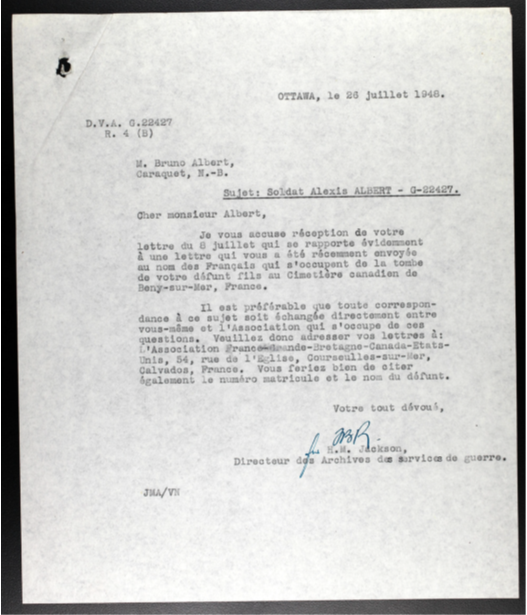
An official document written in French, dated July 1948, that responds to a family request to communicate with those caring for the grave of Private Alexis Albert, North Shore (New Brunswick) Regiment.

Private Alexis Albert, serving with the North Shore (New Brunswick) Regiment, was killed in action in France on June 11, 1944. Four years later, his father, Bruno Albert, living in Caraquet, New Brunswick, requested the address of the family that was tending his son’s grave at Bény-sur-Mer Canadian War Cemetery in France, to thank them. The Director of War Service Records, Department of Veterans Affairs, provided this response, which helped to connect the grieving family in Canada with French citizens carefully maintaining the burial plot in Normandy.

These are only a few examples of LAC records related to the Canadian military effort in France from June 6 until the end of August 1944. Our Collection Search tool can locate many other invaluable sources to help our clients explore the planning and logistical efforts to sustain Canadian military operations in France, delve deeper into the events themselves, and discover personal stories of hardships, accomplishments, suffering and loss.

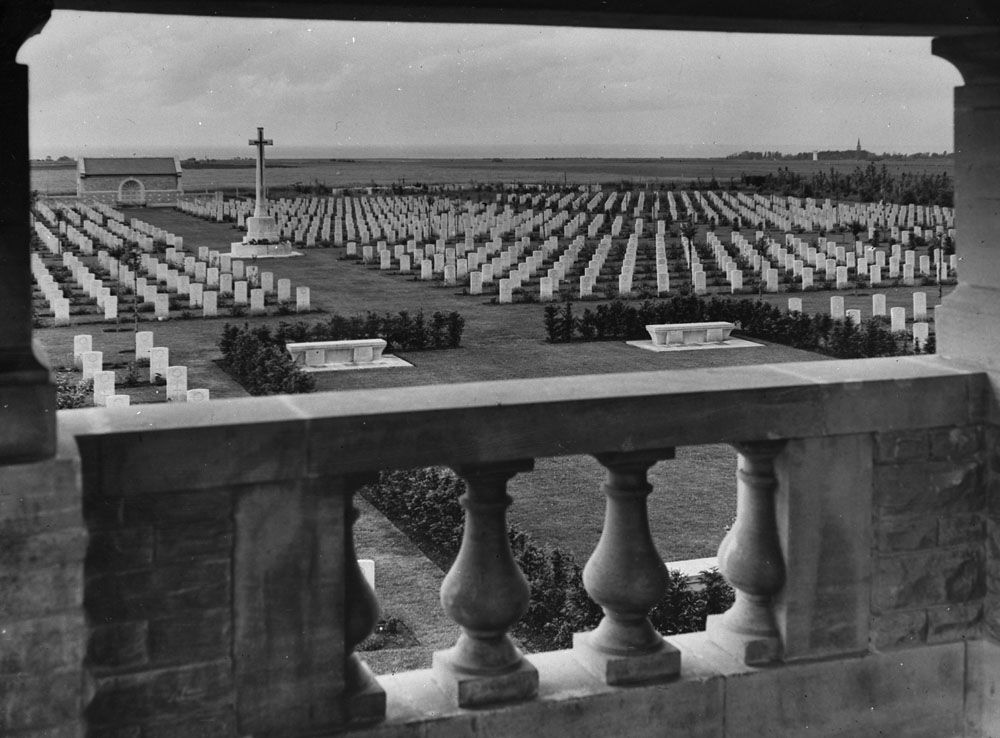
A black-and-white photograph showing many rows of Imperial War Graves Commission headstones, and a large Cross of Sacrifice.

Bény-sur-Mer Canadian War Cemetery, which includes the graves of 2,000 Canadian soldiers who died during the early phases of the Normandy Campaign (e011176110)


Alex Comber is a Military Archivist in the Government Archives Division at Library and Archives Canada.

Images of Boxing now on Flickr

Boxing is the sport of fighting with padded, gloved fists in a square, roped-off ring under a set number of rounds and rules.

A black-and-white photograph of two boxers fighting on the deck of the SS Justicia, surrounded by the ship’s complement of soldiers.

Canadian troops aboard the SS Justicia, en route to Liverpool, England, watch a boxing match (MIKAN 3384735)

However, the first boxers in Canada did not use gloves. Bareknuckle fisticuffs were the norm during the early 19th century, with some bouts lasting 40 rounds. Outside of the military and a few men’s clubs, boxing was not sanctioned in the provinces of Canada, as the sport did not have a great reputation for fair play or honest promotion. Respectability for the sport came slowly, and views changed during the 1890s. The popularity of the sport grew steadily during the early 20th century.

A black-and-white photograph of two soldiers boxing. One wears black trunks and the other wears white trunks. Soldiers outside the ring watch the match.

Soldiers boxing in the exhibition grounds (MIKAN 3384740)

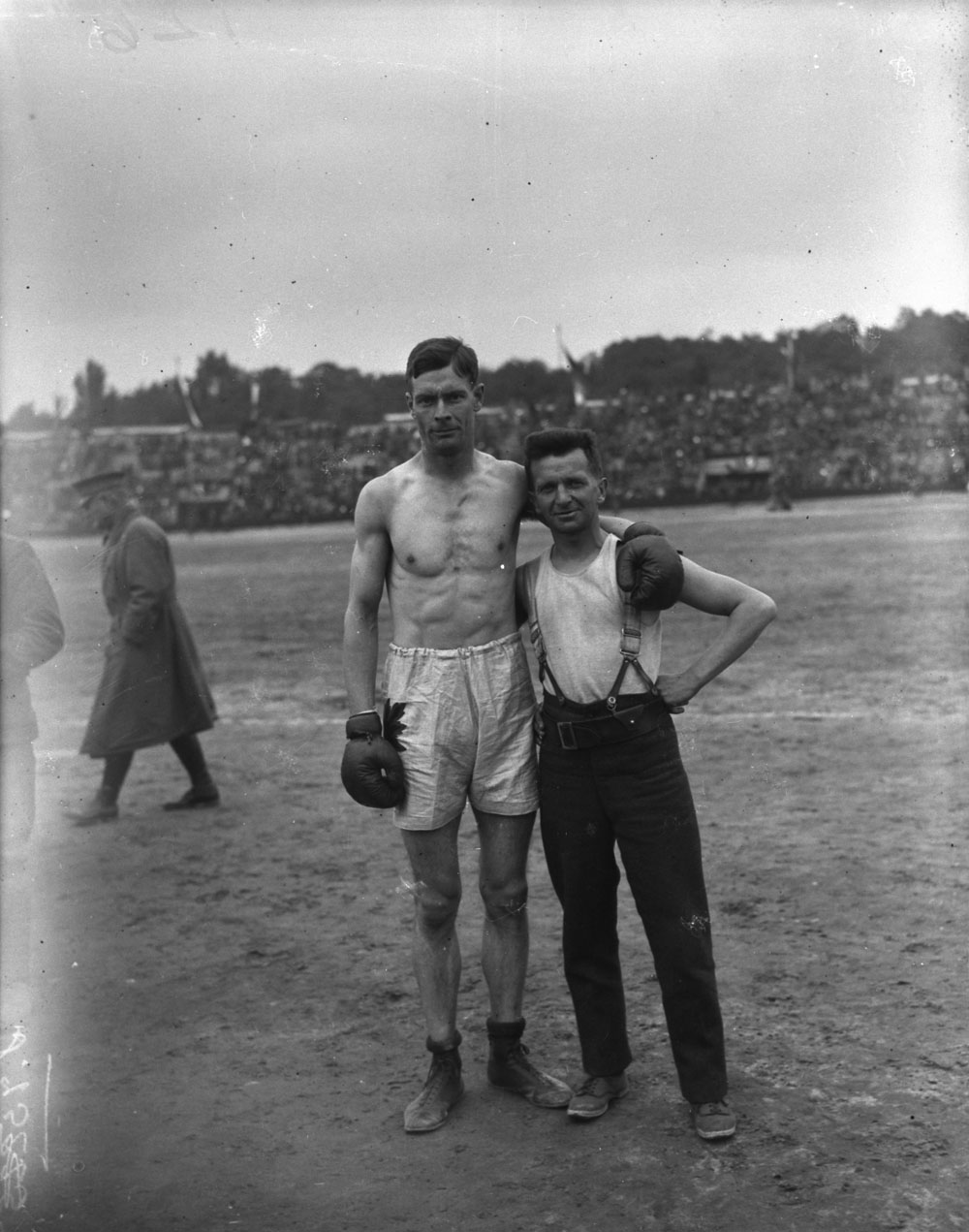
A black-and-white photograph of middleweight boxer Edwin A. Harris (Canada) in his trunks and gloves, posing with another soldier.

Edwin A. Harris (Canada), middleweight finalist in boxing, at the Inter-Allied Games, Pershing Stadium, Paris, France (MIKAN 3384730)

Today, the Canadian Amateur Boxing Association oversees the sport in coordination with 10 provincial and three territorial boxing associations. Some athletes eventually turn to professional boxing, while others retain their amateur status with the intent to represent Canada in international events, such as the Olympics or Commonwealth Games.

Visit the Flickr album now!

Paws and reflect: the legacy of Margaret Marshall Saunders’s Beautiful Joe

By Alyssa Currie

The Story

Beautiful Joe is a bestselling children’s story written by Margaret Marshall Saunders. The novel describes the life of a mistreated dog who finds happiness when he is adopted by a kind family. It gives a voice to domestic animals by presenting the story from Joe’s perspective and stressing animal cruelty. Using the name Marshall Saunders, the author originally entered her story into a contest by the American Humane Society in 1893 and won first place. The text was published a year later and quickly became a bestseller, reportedly the first Canadian book to sell over a million copies.

Our collections include two photographs and two autographed postcards related to Beautiful Joe. These records are remarkable because they document the real-life inspiration for the story and its connection to Saunders’s animal advocacy efforts. The preface to Beautiful Joe reads:

BEAUTIFUL JOE is a real dog, and “Beautiful Joe” is his real name. He belonged during the first part of his life to a cruel master, who mutilated him in the manner described in the story. He was rescued from him, and is now living in a happy home with pleasant surroundings, and enjoys a wide local celebrity.

The character of Laura is drawn from life, and to the smallest detail is truthfully depicted. The Morris family has its counterparts in real life, and nearly all of the incidents of the story are founded on fact.

Margaret Marshall Saunders, Preface to Beautiful Joe

The Photographs

Margaret Marshall Saunders first encountered “Beautiful Joe” during a visit to her brother and his fiancé, Louise Moore, in Meaford, Ontario. Upon returning to her family home in Halifax, Nova Scotia, Saunders began writing, determined to share Joe’s story. Though Saunders based her novel on reality, she adapted elements of the story to suit her fictional setting. For example, the location was changed to an American town to suit the rules of the contest and appeal to American readers. Saunders also renamed the Moore family, who originally adopted “Beautiful Joe,” as the Morris family and introduced elements of her own family into their narrative.

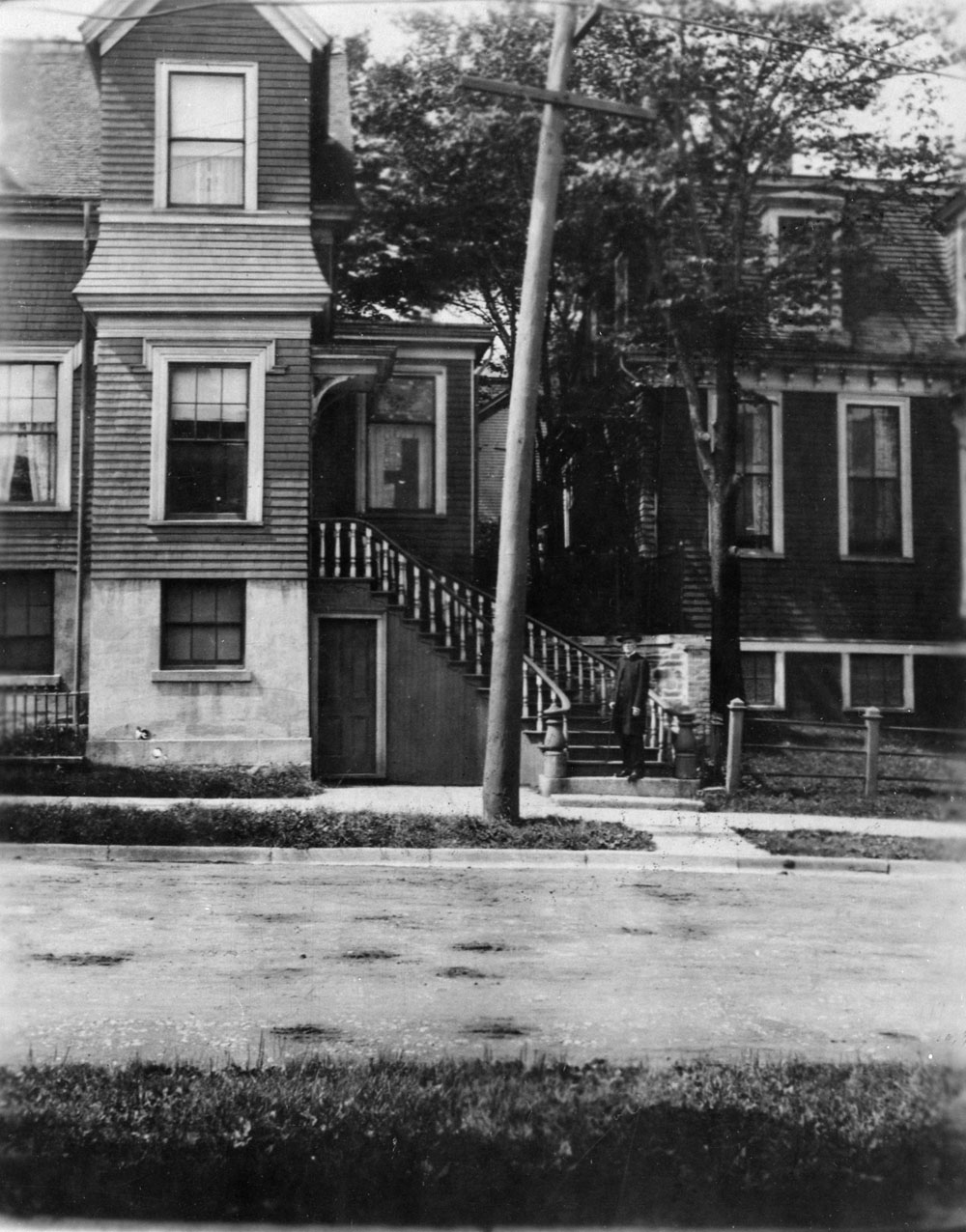
Black-and-white photograph featuring Dr. Edward M. Saunders, standing on the front staircase of a three-story Victorian style house. Dr. Saunders is wearing a black clerical suit and a black hat. The photograph was taken from across a residential street.

The Saunders family residence in Halifax, Nova Scotia where Beautiful Joe was written (a051627-v8)

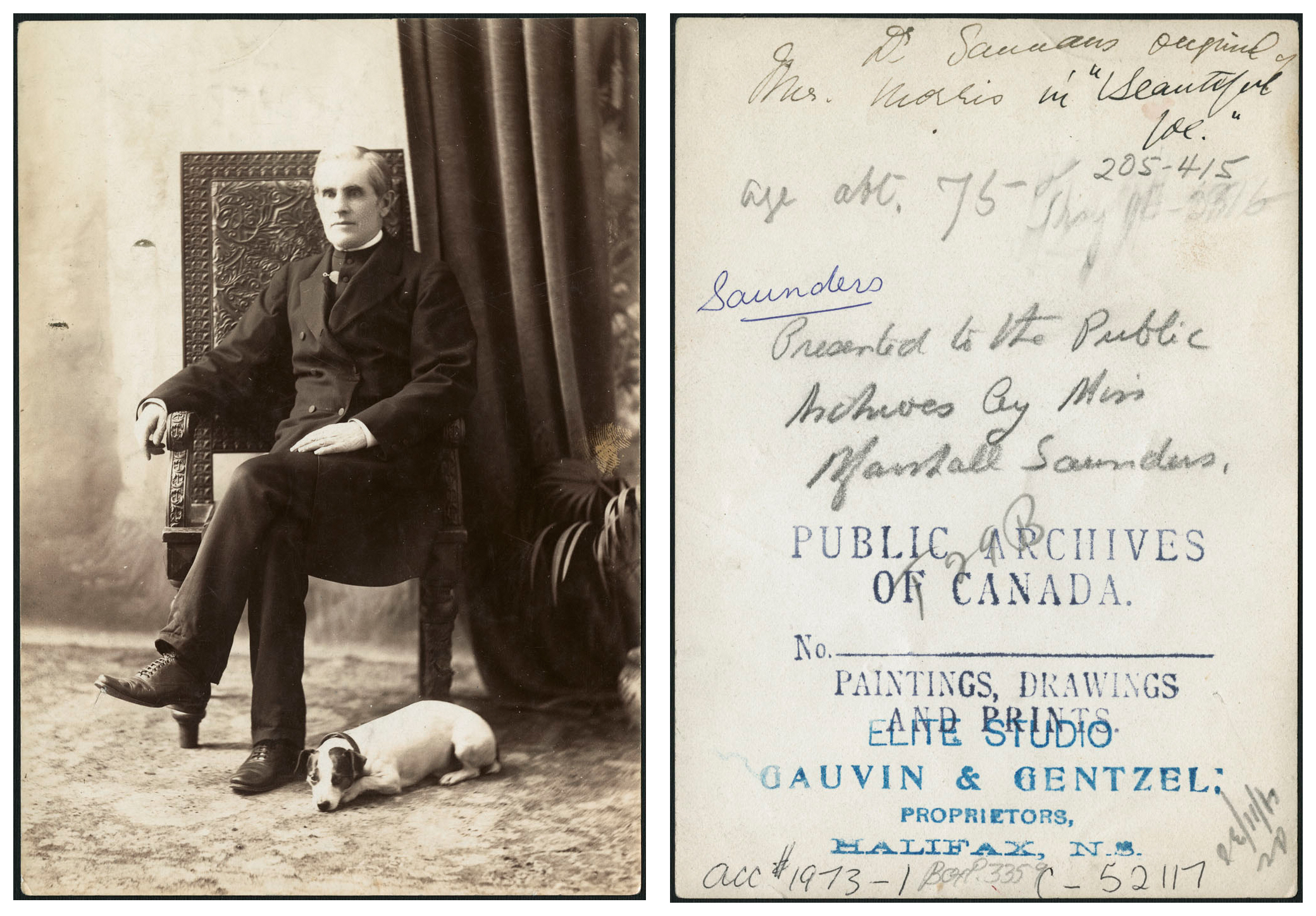
Throughout the narrative, Saunders appears to model the Morris family after her own. This likeness is supported by a photograph of Dr. Edward M. Saunders donated by the author. A handwritten note, possibly from Margaret herself, on the reverse of the photograph reads:

Dr. Saunders original of Mr. Morris in “Beautiful Joe”

Black-and-white photograph of a middle-aged man sitting in an ornate chair with a small dog, possibly a Russell terrier, laying at his feet. The man is wearing a black clerical suit. Dark drapery and a potted plant appear in the right of the portrait. The back of the photograph includes a stamp from Gauvin & Gentzel Studio.

Dr. Edward M. Saunders, father of Margaret Marshall Saunders and inspiration for the character Mr. Morris in Beautiful Joe. Handwritten notes on the back of the photograph document its connection to Beautiful Joe (e011184730-v8)

The Postcards

Two recently described postcards from our literary archives further emphasize the story’s connection to reality and the enduring legacy; both postcards were printed years after the book’s original publication and signed by the author. The first postcard features a picture of the original “Beautiful Joe” and provides a visual counterpart for the story’s protagonist.

Black-and-white postcard featuring a photograph of a dark dog with no ears in a sitting position. The postcard is captioned “BEAUTIFUL JOE” and autographed in black ink, “Marshall Saunders, 1930.” The back of the postcard features a small picture of Margaret Marshall Saunders with the caption, “Marshall Saunders, author of the world famous book, ‘Beautiful Joe.’” The postcard has not been mailed.

Autographed postcard featuring the original “Beautiful Joe” who inspired the story (e011184731-v8)

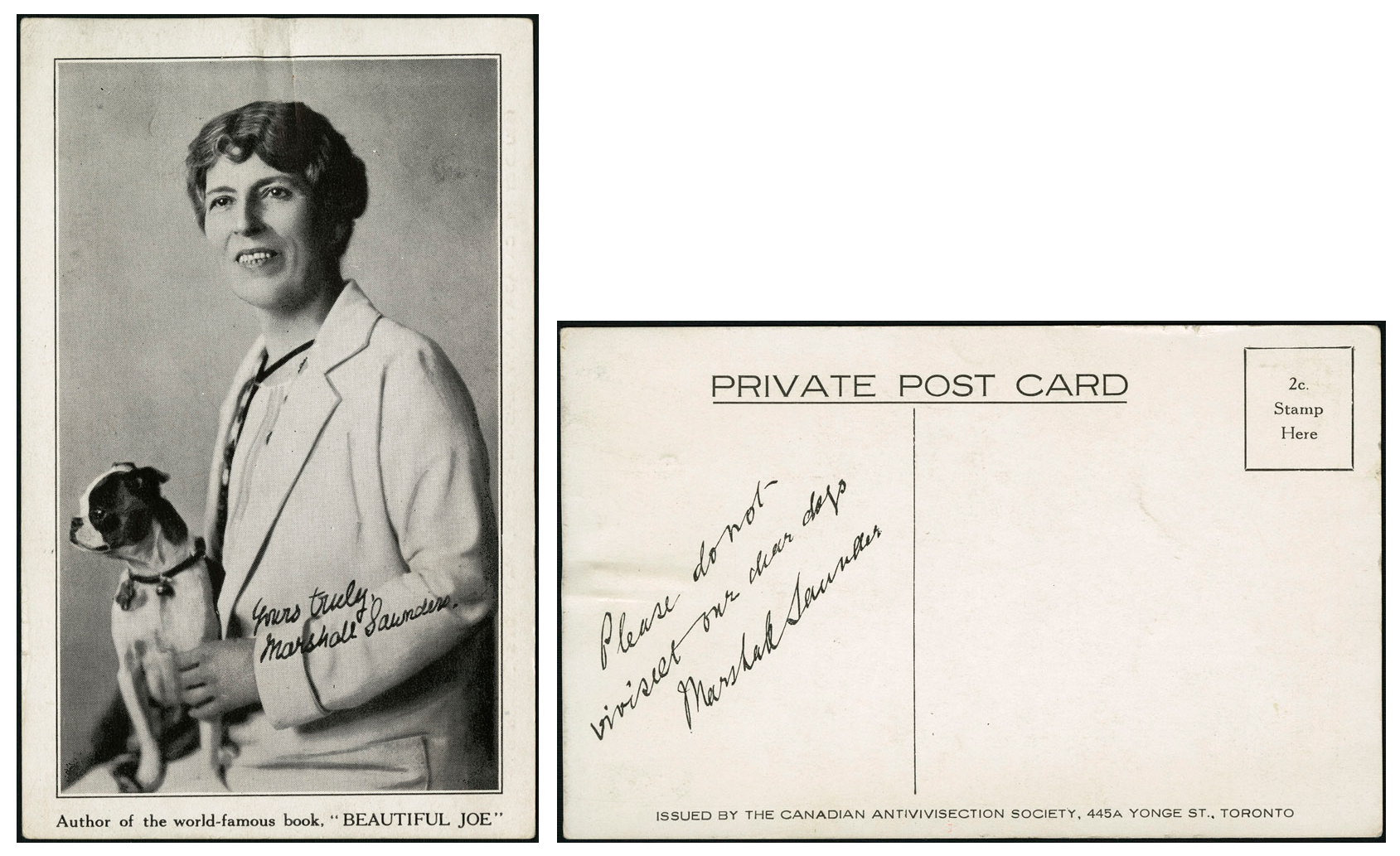
As Beautiful Joe gained national and then international recognition, Saunders used its popularity to promote animal welfare. She collaborated with animal advocacy groups on campaigns, which in turn promoted the sale of her own literary works. A postcard issued by the Canadian Antivivisection Society demonstrates this reciprocal relationship; it features Saunders, with the caption, “Author of the world-famous book ‘BEAUTIFUL JOE.’” The author autographed the front of the postcard and signed the back:

“Please do not vivisect our dear dogs, Marshall Saunders.”

Black-and-white postcard featuring a photograph of a middle-aged woman wearing a lab coat and holding a small dog on her lap. The postcard is captioned, “Author of the world-famous book, ‘BEAUTIFUL JOE’” and autographed in black ink, “Yours truly, Marshall Saunders.” The back of the postcard reads “ISSUED BY THE CANADIAN ANTIVIVISECTION SOCIETY, 445A YONGE ST., TORONTO” and is signed by the author. The postcard has not been mailed.

Autographed postcard featuring Margaret Marshall Saunders, “Author of the world-famous book, ‘BEAUTIFUL JOE’” (e011184732-v8)

The Legacy

Saunders was a bestselling author by the time of her death on February 15, 1947. Later that year, the Government of Canada recognized her accomplishments by naming her a “Person of National Historical Significance.” Over a century has passed since Margaret Marshall Saunders wrote Beautiful Joe, but still her legacy remains.


Alyssa Currie is a master’s student from the University of Victoria working in the Literature, Music, and Performing Arts Archives Section at Library and Archives Canada.

Project Naming is Expanding!

This article contains historical language and content that some may consider offensive, such as language used to refer to racial, ethnic and cultural groups. Please see our historical language advisory for more information.

In early 2002, Library and Archives Canada (LAC) teamed up with the Nunavut Sivuniksavut Training Program and the Government of Nunavut’s Department of Culture, Language, Elders and Youth, to create Project Naming. The goal was to digitize photographs of Inuit from present-day Nunavut in LAC’s photographic collections in order to identify the people depicted in the images. At the time of the launch, LAC expected that the project would be concluded the following year. We never imagined that this initiative would become such a successful and popular project with the public.

To mark the annual National Aboriginal History Month in June 2015, LAC is pleased to announce the launch of Project Naming. While the project still includes communities located in Nunavut, it will be expanded to Inuit living in Inuvialuit (Northwest Territories), Nunavik (northern Quebec) and Nunatsiavut (Labrador), as well as First Nations and Métis communities in the rest of Canada. Project Naming: 2002–2012 will still be available online, but new content will only be added to the new project site.

Project Naming: 2002–2012 began with the digitization of 500 photographs from the Richard Harrington fonds. Since then, LAC has digitized approximately 8,000 photographs from many different government departments and private collections. Thanks to the enthusiasm and support from Inuit and non-Inuit researchers, nearly one-quarter of the individuals, activities or events portrayed in the images have been identified, and this information along with the images is now available in the database.

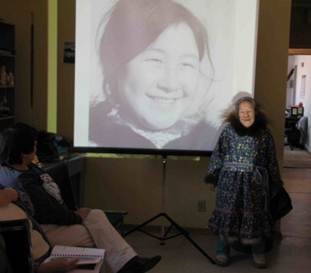
Over the years, LAC has received many wonderful stories and photographs from members of the public who have reconnected with their family and friends through the photographs. Among these was a photograph shared by the Kitikmeot Heritage Society that organized several community slide shows during the winter of 2011. Mona Tigitkok, an Elder from Kugluktuk, discovered her photograph as a young woman during one of these gatherings.

Colour photograph of an elderly Inuit woman wearing a fur-trimmed floral parka posing in front of a screen with a slide projection of her photograph when she was a young woman, taken at a community hall.

Mona Tigitkok posing with a picture of herself taken more than 50 years ago, Kugluktuk, Nunavut, February 2011. Credit: Kitikmeot Heritage Society.

Author and historian, Deborah Kigjugalik Webster, has used Project Naming, both personally and professionally. In her words:

I was first introduced to Project Naming a few years ago through my work in the Inuit heritage field, but there is also a personal connection for me—the database allows people to search by communities in Nunavut so I’ve discovered photographs of relatives and community members.

It was not uncommon in the past for photographers not to name the subjects of images. Often photo captions were simply “group of Eskimos” or “native woman” and so on. One afternoon, over tea, I showed some of the photographs from the Project Naming database to my mother, Sally Qimmiu’naaq Webster, and we were able to add a few names to faces from our home community of Baker Lake (Qamanittuaq). I felt a sense of satisfaction in identifying unnamed individuals in photographs and providing names to replace nondescript captions provided by the photographer. In a sense, when we do this we are reclaiming our heritage.

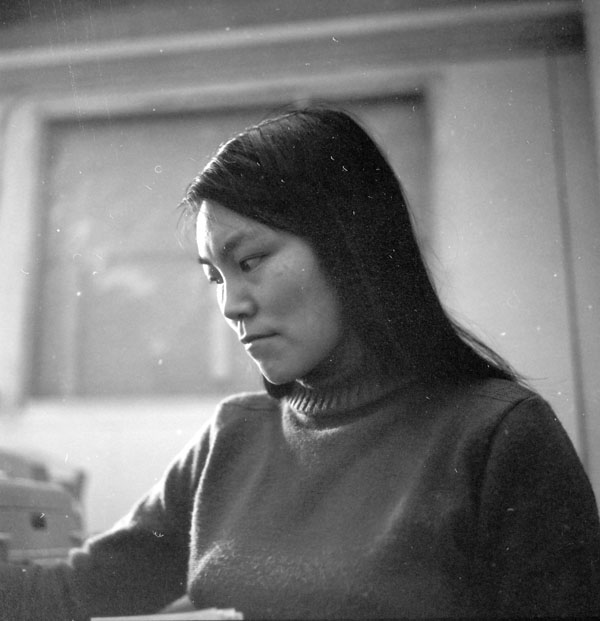
Photograph of a young Inuit woman wearing a turtle neck sweater looking away from the camera.

Photograph of the late Betty Natsialuk Hughson (identified by her relative Sally Qimmiu’naaq Webster). Taken in Baker Lake (Qamanittuaq), Nunavut, 1969 (MIKAN 4203863)

Project Naming allows people to not only identify individuals in images, but to add information including corrections to the spelling of names in an online form. It is well worth checking out the database, especially with an Elder, because seeing the image opens up discussion.

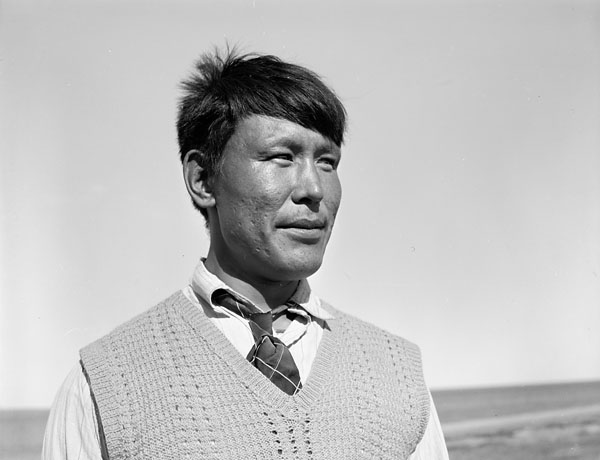
As part of my work I manage a Facebook page Inuit RCMP Special Constables from Nunavut to acknowledge the contributions of our Inuit Specials and pay tribute to them. Last year I posted a portrait photograph that I found on the Project Naming database of Jimmy Gibbons, taken in Arviat in 1946. Special Constable Gibbons was a remarkable man who joined the RCMP in 1936 and retired to a pension in 1965. This post was met with many enthusiastic likes, shares and comments from S/Cst. Gibbons’ descendants saying that he was their father, uncle or great-grandfather. Some people also simply said “thank you.” Shelley Ann Voisey Atatsiaq proudly commented, “No wonder I wrote earlier that I highly respect the R.C.M.P. I’ve got some R.C.M.P-ness in my blood. Thank you for sharing!”

Black-and-white photograph of a close-up of an Inuit man wearing a knitted vest and tie standing outside.

Jimmy Gibbons, Royal Canadian Mounted Police Special Constable, Arviat, Nunavut, August 1, 1946 (MIKAN 4805042)

For more information about the history of the project, read the article Project Naming / Un visage, un nom, International Preservation News, No. 61, December 2013, pp. 20–24.

As with the first phase of the project, LAC wants to hear from you through The Naming Continues form.

Start your search for Aboriginal content