Marion Meadmore, Mary Guilbault, and Dorothy Betz: Celebrating Indigenous women’s leadership in the early years of the Friendship Centre Movement and beyond

Version française

By Karyne Holmes

This article contains historical language and content that may be considered offensive, such as language used to refer to racial, ethnic and cultural groups. Please see our historical language advisory for more information.

In 1978, Marion Meadmore (née Ironquill) set a historical milestone by becoming the first Indigenous woman lawyer called to the bar in Canada. This pivotal moment amplified a legacy that had been building for over two decades. Long before this significant achievement, she had already established herself as a prominent leader dedicated to creating supports and services for the well-being of the urban Indigenous community.

Originally from the Peepeekisis Nation in Saskatchewan, Marion Meadmore attended residential school for ten years before travelling to Winnipeg to pursue studies at the University of Manitoba. When she arrived in Winnipeg in the early 1950s, no organizations existed to support the specific needs of new residents of Indigenous heritage. Drawing from her personal experience, Marion became a passionate advocate for creating spaces where Indigenous people could connect and help one another in an urban environment.

In 1954, she connected with other First Nations and Métis Nation activists, including Mary Guilbault, to establish the Urban Indian Association. This organization aimed to identify and address the needs of urban Indigenous people. Marion and Mary collaborated to identify the specific challenges faced by the community. Their primary objectives included assisting people in obtaining housing, employment, and health care, as well as providing a social gathering space. They placed a particular focus on supporting young people who were moving to Winnipeg in high numbers after surviving residential school.

Their ambition was to establish a referral centre—a dedicated place to welcome and provide information and assistance to anyone in need. The efforts of the Urban Indian Association included meeting with several government agencies to obtain their support, and organizing fundraising events.

Photo of four women talking around a coffee table, holding pens and papers.

Members of the Planning Committee for the Indian and Métis Conference in Winnipeg. Left to right: Marion Meadmore, Mrs. Ronald Robinson, Gladys Bear and Dorothy Betz, 1961. (e011052439)

In June 1958, Mary and Marion participated in the Indian and Métis Conference, an annual meeting sponsored by the Winnipeg Welfare Planning Council. During this meeting, Mary made the pivotal motion to establish a referral centre for Indigenous people in Winnipeg. The recommendation was for a service “to guide and council in matters of employment, housing, education, and other community services.” That day, a resolution was adopted and a planning committee was immediately formed to develop the centre.

The Urban Indian Association achieved their goal soon after when their envisioned referral centre was established as the Indian and Métis Friendship Centre in 1959 at 376 Donald Street. At the time, it was estimated that 5,000 Indigenous people were living in Winnipeg. Mary and Marion, along with Dorothy Betz, were among those most instrumental in founding the new centre.

Dorothy Betz (née Nepinak), born at the Pine Creek First Nation in 1929, arrived in Winnipeg alone by train in 1948 in search of employment. Having spent 15 years in residential school and lost both her parents and grandparents during her childhood, Dorothy felt isolated in the unfamiliar city. Upon arrival, she walked along Main Street, where she had been advised she could “always find a relative.” She recognized and approached two cousins in a café, who provided her with her first place to stay in the new city. Her own experience of feeling overwhelmed fueled her devotion to helping others for many years to come. She recalled that before the Friendship Centre “we didn’t have a place of our own—all we had was Main Street, but we weren’t too ecstatic about it.”

Photo of seven women talking. A banner hangs above them reading “First Anniversary, Indian and Métis Friendship Centre.”

Celebrating the first anniversary of the Indian and Métis Friendship Centre. Left to right: Harriet Mason, Marlene Brant, Ethel Blacksmith, Pauline Vanier, Dorothy MacKay, Mary Guilbault, Dorothy Betz, 1960. (MIKAN 23956)

The opening of the Indian and Métis Friendship Centre in Winnipeg marked the onset of the Friendship Centre Movement, the most significant off-reserve Indigenous service delivery infrastructure in Canada. Friendship centres are not-for-profit charity organizations that are mandated to serve the needs of urban Indigenous people by providing culturally appropriate resources and services. They have become renowned for their range of effective programs in areas of culture, family, recreation, language, housing, health, justice, education, employment, and more.

Since the earliest years of Winnipeg’s Indian and Métis Friendship Centre, group programs have been at the core of the organization’s work. Initial popular programs included recreational activities like sewing groups, and the Education and Library Committee, which planned lectures on history and established a resource library on Indigenous experiences, knowledges, and cultures.

The Indian and Métis Friendship Centre continues its work today as the Winnipeg Indigenous Friendship Centre. There are now over 120 friendship centres nationwide. After the centre opened its doors, Marion, Mary, and Dorothy continued to be influential women of action in Winnipeg.

Marion Meadmore co-founded the National Indian Council in 1961, the first national organization advocating the needs and rights of First Nations people, both with and without “Indian Status.” The National Indian Council is recognized as the predecessor to the Assembly of First Nations and the Congress of Aboriginal Peoples. Marion later returned to the University of Manitoba to earn her law degree, opened the first all-female law firm in Winnipeg, and co-founded the Indigenous Bar Association of Canada.

Group of one woman and five men side by side looking directly at the camera.

Temporary Committee of the new National Indian Council of Canada. Left to right: Telford Adams, George Manuel, A.H. Brass, Marion Meadmore, David Knight and Joe Keeper, 1961. (e011373501)

Mary Guilbault was a dedicated social worker for 26 years at the Manitoba Department of Health and Social Services. She played a significant role in establishing the Manitoba Métis Federation in 1967, where she served on the Board of Directors specializing in the Education Portfolio until 1974.

Dorothy Betz provided seven years of volunteer service to the Friendship Centre before managing the organization’s Court Program. She was appointed as the Canadian delegate to the Fifth United Nations Congress in Geneva, Switzerland, where she drew international attention to the discrimination and barriers faced by Indigenous people in the justice system.

When Dorothy’s father passed away when she was just seven years old, his final message to her, spoken in Anishinabemowin, was a heartfelt wish: for her to grow up “to be kind and generous, always helpful to people, and forgiving.” Dorothy’s devotion to helping her urban Indigenous community in Winnipeg earned her an unparalleled reputation for optimism, kindness, and generosity. Fluent in Anishinabemowin, she applied her language skills to interpret and guide many in understanding their rights and the law, and was influential in developing the first Court Communicators Program with the Province of Manitoba.

Photo of a man and a woman looking directly at the camera and smiling.

Percy Bird and Dorothy Betz. (OCLC 35881259, page 8)

These accomplishments are only a fraction of the extraordinary work they achieved. These three inspiring women, instrumental in the early years of the Friendship Centre Movement in Winnipeg, contributed countless hours as board members, volunteers, and advisors for several local and national organizations, all while raising their young families. Their stories of strength, action, and wisdom represent the many remarkable urban Indigenous women across Canada, past and present, who uplift their communities every day.

Additional Resources:


Karyne Holmes is a curator in the Exhibitions and Loans Division at Library and Archives Canada (LAC) and was an archivist for We Are Here: Sharing Stories, an initiative to digitize and describe Indigenous content at LAC.

Adoption of Cree Syllabics

Version française

On the left, Tatânga Mânî [Chief Walking Buffalo] [George McLean] is in his traditional First Nation regalia on a horse. In the centre, Iggi and a girl engage in a “kunik,” a traditional greeting in Inuit culture. On the right, Maxime Marion, a Métis guide, holds a rifle. In the background, there is a map of Upper and Lower Canada, and text from the Red River Settlement collection.

This blog is part of our Nations to Nations: Indigenous Voices at Library and Archives Canada series. To read this blog post in Cree syllabics and Standard Roman Orthography, visit the e-book.

Nations to Nations: Indigenous Voices at Library and Archives Canada is free of charge and can be downloaded from Apple Books (iBooks format) or from LAC’s website (EPUB format). An online version can be viewed on a desktop, tablet or mobile web browser without requiring a plug-in.

By Samara mîkiwin Harp

Photograph showing the keys of a manual typewriter. Each of the keys, which are black, has two characters in syllabics that are white.

Cree syllabic typewriter created by knowledge experts from Cree communities, linguistics experts from the former Department of Indian and Northern Affairs, and Olivetti Canada Limited.
Olivetti Canada Limited, Olivetti News Magazine, June–July 1973, p. 2. (e011303083)

While the origins of Cree syllabics remain debatable, one thing is certain: Cree syllabics quickly became popular with nêhiyawak (people of the Cree nation) thanks to their accurate representation of nêhiyawêwin (the Cree language) sounds and the teaching of the syllabary at the grassroots level.

In the winter of 1841, nêhiyaw hunters and trappers from Norway House (present-day Manitoba) who set off to trade brought along hymns printed in Cree syllabics. In less than a decade, the syllabary spread to the west and east, with thousands of nêhiyawak becoming literate in syllabics. nêhiyawak usually learned how to read and write syllabics without the aid of missionaries. They taught themselves by referring to the syllabics chart. This knowledge of how to write Cree was transmitted through traders, friends and family. Some scholars say that literacy rates among the nêhiyawak surpassed those of the French and English settlers. Clearly, syllabics worked well to capture the sounds of nêhiyawêwin.

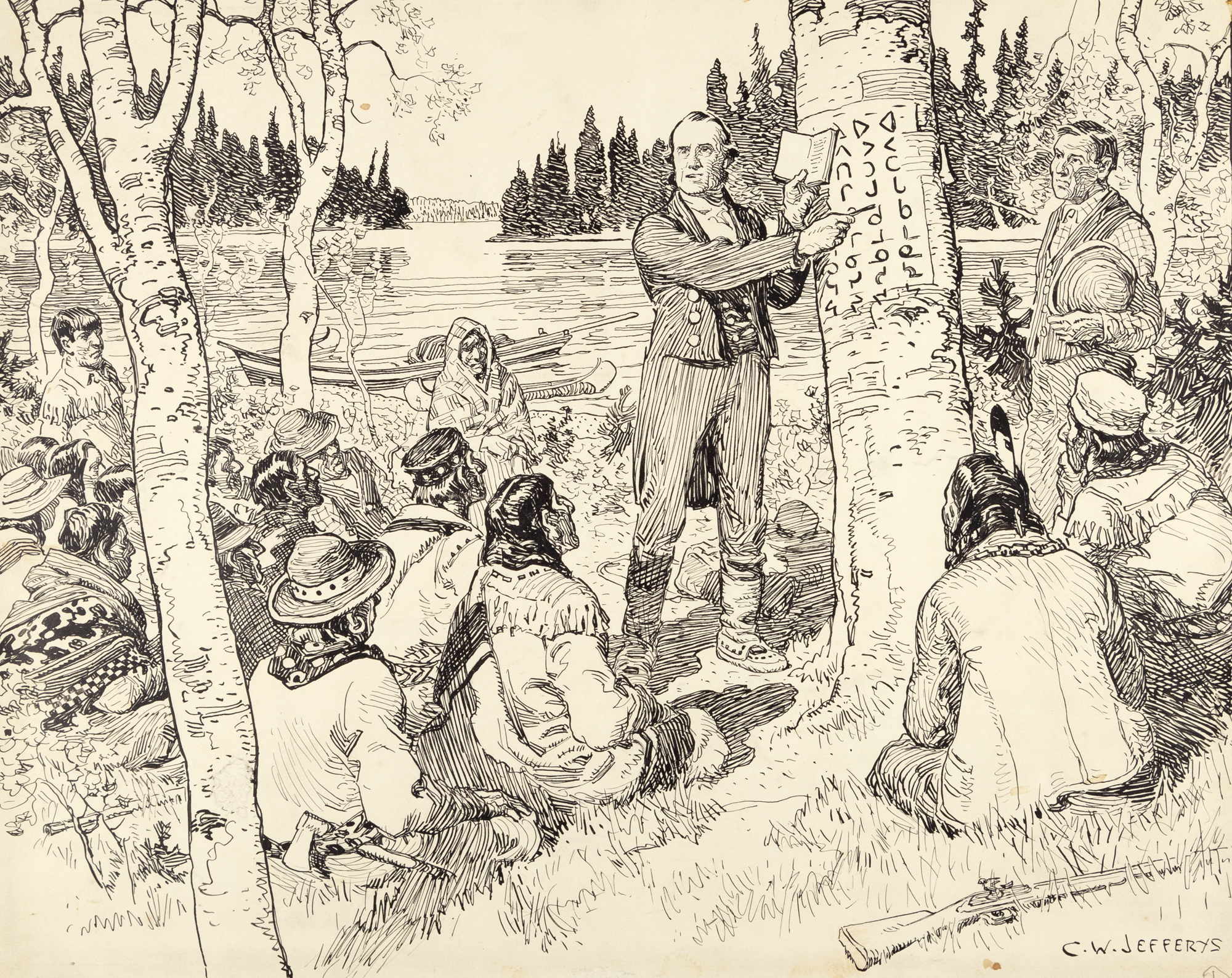
Pen-and-ink drawing of a man in a short jacket and long pants standing beside a birch tree. He is giving a lecture and holds a small book in his left hand as he points to several rows of syllabics etched on the tree trunk. There is a group of men seated cross-legged on the ground facing the man giving the lecture. Some are wearing hats, patterned blankets, buckskin jackets or shirts with bandanas. Another man, wearing a vest and holding a hat, is standing on the other side of the tree. He is looking directly at the man giving the lecture.

The Reverend James Evans sharing the Cree syllabics chart and hymn book that he collaborated on with Indigenous peoples. (MIKAN 2834503)

It is clear that James Evans created the physical type font (stamps for printing) for syllabics, and he played a role in helping to popularize them by printing a Cree syllabary chart and hymns in the Cree syllabary. With the help of Evans’s translation team, a book entitled Cree Syllabic Hymn Book was printed in 1841.

Unfortunately, neither Evans nor contemporary scholars gave proper credit to the Indigenous people who worked with him, an oversight rectified a century and a half later by Lorena Sekwan Fontaine:

“Evans’ translating team was largely responsible for the success of this independent printing. Team members were primarily of Aboriginal ancestry and were either bilingual or multilingual. For example, Thomas Hassell (Chippewyan) had learned fluent Cree, French and English; Henry Bird Steinhauer (Ojibway) had attended a mission school in Upper Canada and knew Greek, Hebrew, English, in addition to Cree; and John Sinclair who, as the son of an HBC officer and a Cree mother, was fluent in Cree.” (1)
Page from a book with a facsimile of a pale grey rectangular box on the top half that contains syllabic writing in black. The bottom half contains eight columns of typed words in black ink, mostly in Cree, organized on 12 lines. There are two typed English sentences at the bottom of the page.

Facsimile published in 1841 from the original Cree Syllabic Hymn Book, by James Evans, Norway House (present-day Manitoba), p. 23. (OCLC 1152061)

Page from a book showing a facsimile with 11 rows of handwritten syllabics in black. Two horizontal lines divide the top seven and the lower four rows. There are 10 rows of English sentences typed in black in the lower third of the page. Two horizontal lines divide the top six and the bottom four rows.

Facsimile of a hymn from the original Cree Syllabic Hymn Book, by James Evans, Norway House (present-day Manitoba), 1841. Published by the Bibliographic Society of Canada, Toronto, 1954. (OCLC 1152061)

To see a fully digitized version of the 1841 Cree Syllabic Hymn Book by James Evans, visit the University of Alberta Libraries’ Peel’s Prairie Provinces collection.

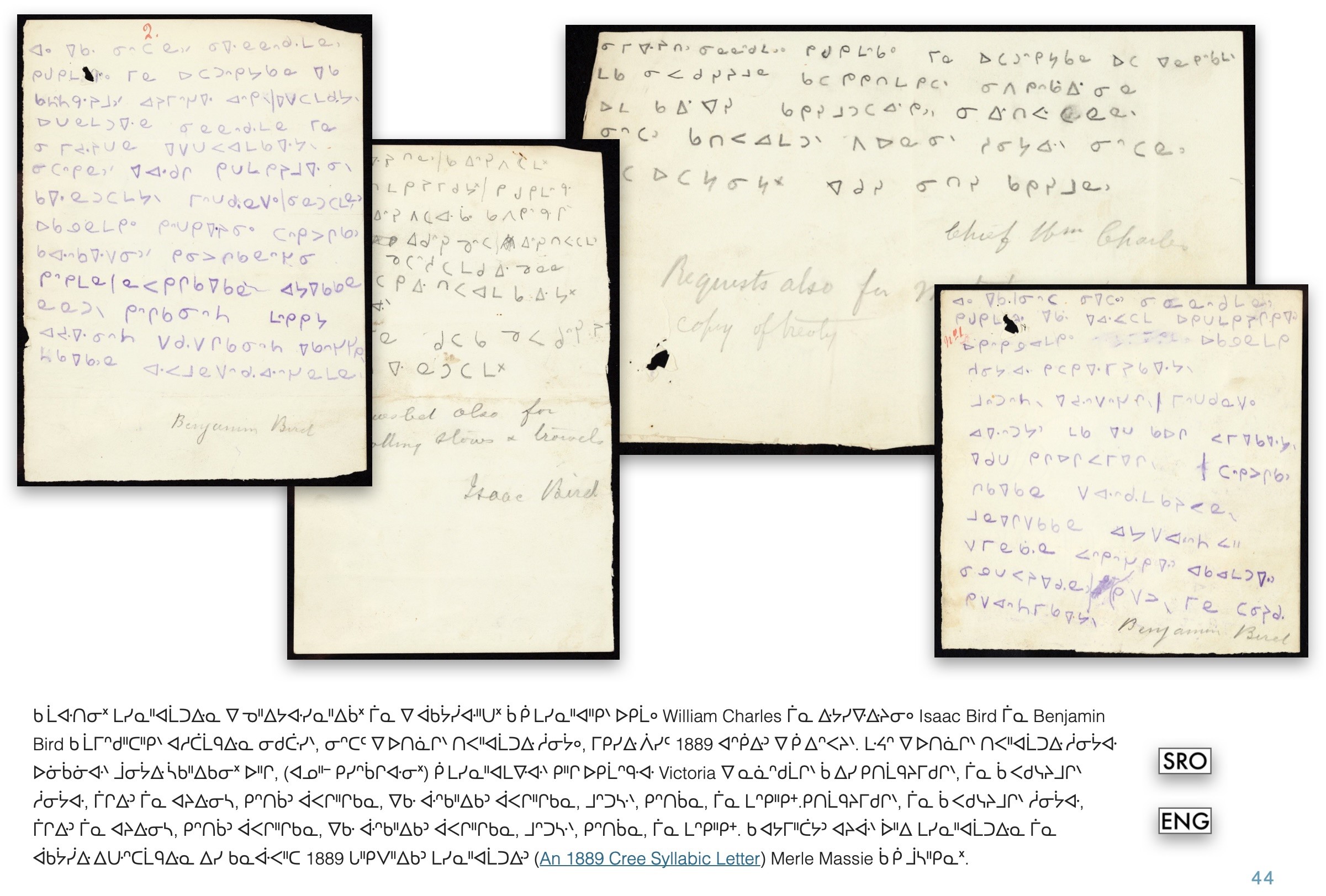
Four individual letters written in pencil in syllabics on sheets of paper. There are lines in syllabics that fill the pages. The authors’ signature in English are under these lines.

Group of letters written in Cree with some English by Chief William Charles and councillors Isaac Bird and Benjamin Bird regarding Treaty 6, February 1889. Before receiving their first treaty payment, the Cree leaders from Montreal Lake (present-day Saskatchewan) wrote to Queen Victoria asking for her compassion to their people, and their expectations that included money, food and clothing, tools and household utensils, livestock, seeds, and medicines. (MIKAN 2058802)

To read more about these letters and the English translations, see “An 1889 Cree Syllabic Letter” by Merle Massie.

Over time, syllabics continued to increase in popularity. They were used in government offices, street signs and personal correspondence. There was even a Cree syllabics typewriter, shown in the photograph at the beginning of this essay. The typewriter was developed by Olivetti in collaboration with representatives from various Cree organizations in Western Canada and Quebec. According to the 2016 Census, nêhiyawêwin is one of the most widely spoken Indigenous languages in Canada.

Cree syllabics had not only become popular with nêhiyânâhk (Cree country), but their use also spread to other languages such as Anishinaabemowin, Inuktitut and some of the Dene languages, by adapting the syllabary to those languages (see Inuktut Publications essay in Nations to Nations: Indigenous Voices at Library and Archives Canada).

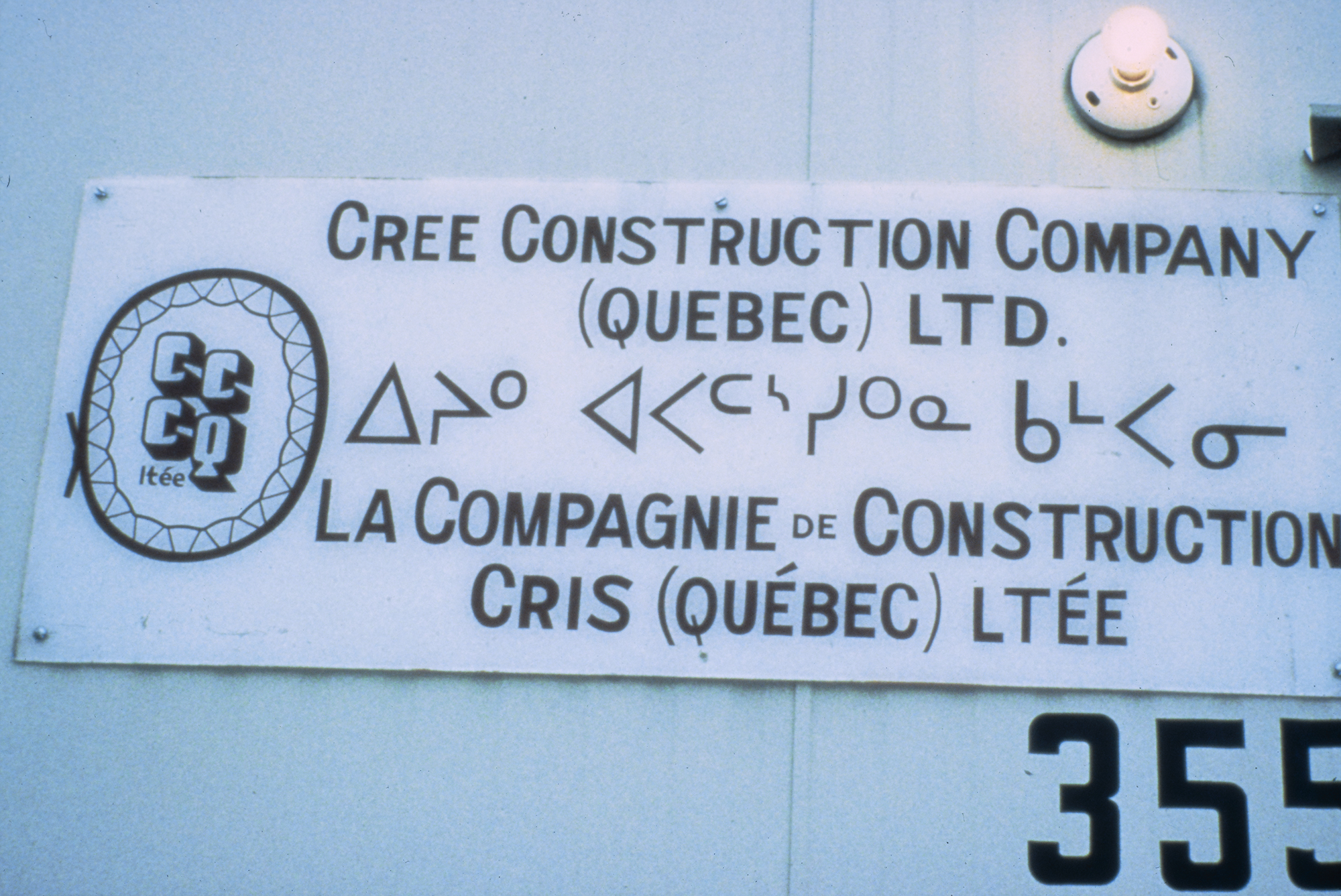
Photograph of a white rectangular sign affixed to a wooden wall with nails. The sign has the name of a construction company typeset in black in English, syllabics and French. The company’s logo is on the left side of the sign. Directly below the sign on the right side is the number 355 in large font in black.

Cree Construction Company sign from Quebec, unknown location, ca. 1978–1988. Credit: George Mully. (e011218399)

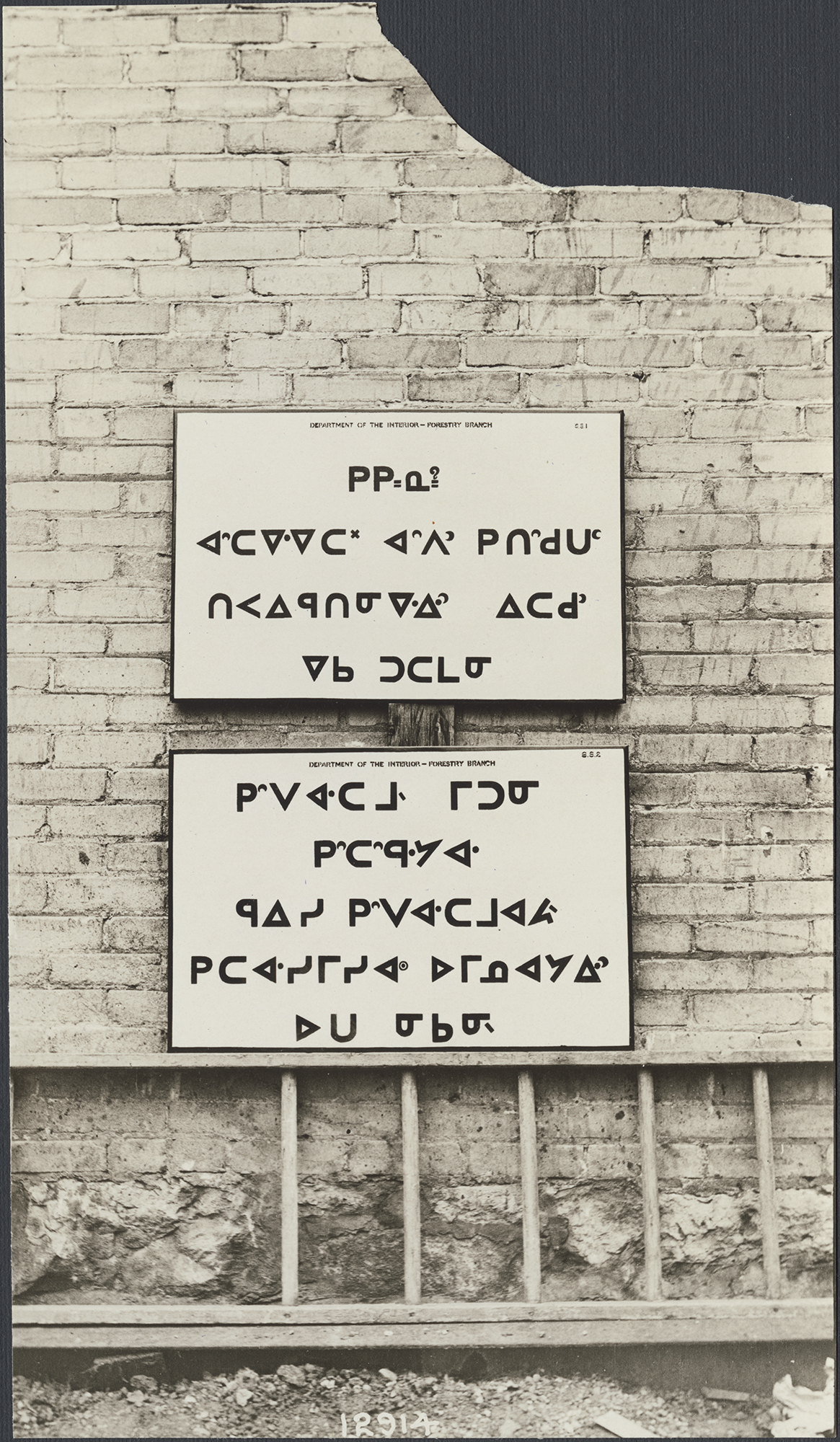
Photograph of a close-up view of a light grey brick wall. There are two rectangular white signs attached to the centre of the wall. The upper sign has four lines of syllabics, and the lower one has five lines of syllabics. Both are in black ink. There is a ladder laying horizontally across the base of the wall.

Department of the Interior, Forestry Branch, sign in Cree, unknown location, unknown date. (e010752312)

Methodist Reverend James Evans as inventor of the syllabary is questionable at best. Evidence points to the fact that he was unskilled in the nêhiyawêwin, yet we are expected to believe that he created a syllabary that worked so well with nêhiyawêwin. While the theory that Evans conceived the syllabary is widely supported in mainstream history, I was unable to find anything concrete that supported this idea. The only evidence I could confirm was that he created the physical stamps for printing in syllabics. Archdeacon Horsefield, who translated the 1841 Cree hymn book, commented on Evans’s Cree abilities as follows:

“The vocabulary of the author is pretty extensive, but his syntax is poor: he uses plural nouns with singular verbs, and vice versa, is uncertain of word order and (not unnaturally) lost among some of the more complicated forms of the truly weird and wonderful Cree verb.” (2)

A researcher named Louis (Buff) Parry read Evans’s diaries and letters but could not find any evidence of how or when Evans invented “his” syllabics (3). Indeed, Christian churches had much to gain by claiming the invention of the syllabary. They could spread the word of the Bible while declaring that they had brought a great gift to nêhiyawak.

In time, Church and Crown joined forces to implement the Indian residential school system. By 1894, children aged 6 to 16 were forced to attend these schools. Part of these colonizing efforts included rules that restricted the use of Indigenous languages. Many children of these residential school survivors were deprived of their language due to the physical and emotional abuses their parents endured in the colonial school system.

nêhiyawak proved their resiliency by easily and quickly adapting to ways of writing, reading and teaching their language. We are capable and resourceful people who had ways of recording knowledge before contact. These ways may not have fit the Eurocentric models, but they existed. I have no doubt that we played a much larger role in the creation of Cree syllabics than is related in history books. It is my hope that we can continue on this path of language revitalization to undo the damage inflicted upon us by the residential school system, inaccurate historical records and colonization.

References

  1. Lorena Sekwan Fontaine, “Our Languages are Sacred: Finding Constitutional Space for Aboriginal Language Rights,” doctoral thesis, University of Manitoba, Winnipeg, 2018, p. 62.
  2. James Evans, Cree Syllabic Hymn Book, Norway House, N.W.T.: [Rossville Mission Press, 1841], p. 9.
  3. Lesley Crossingham, “Cultural director says missionaries didn’t invent syllabics, Indians did,” Windspeaker, vol. 5, no. 42, 1987, p. 2.

Windspeaker finding aid at Library and Archives Canada

Additional Resources Related to Cree Writing and Syllabics


Samara mîkiwin Harp was an archivist with the Listen, Hear Our Voices initiative at Library and Archives Canada. She now works in Woods Cree language revitalization and is further pursuing archival studies. Samara grew up in Winnipeg, Manitoba, with Cree roots in both the Southend and Pelican Narrows areas of Treaty 6 in northern Saskatchewan. The first of her father’s family arrived in Ontario in the 1800s from Ireland and England.

A rediscovered manuscript: the first journal of John Norton (Teyoninhokarawen)

Version française

By Isabelle Charron

This article contains historical language and content that may be considered offensive, such as language used to refer to racial, ethnic and cultural groups. Please see our historical language advisory for more information.

Photo of a handwritten page from a journal.

First page of the journal of John Norton (item 6251788)

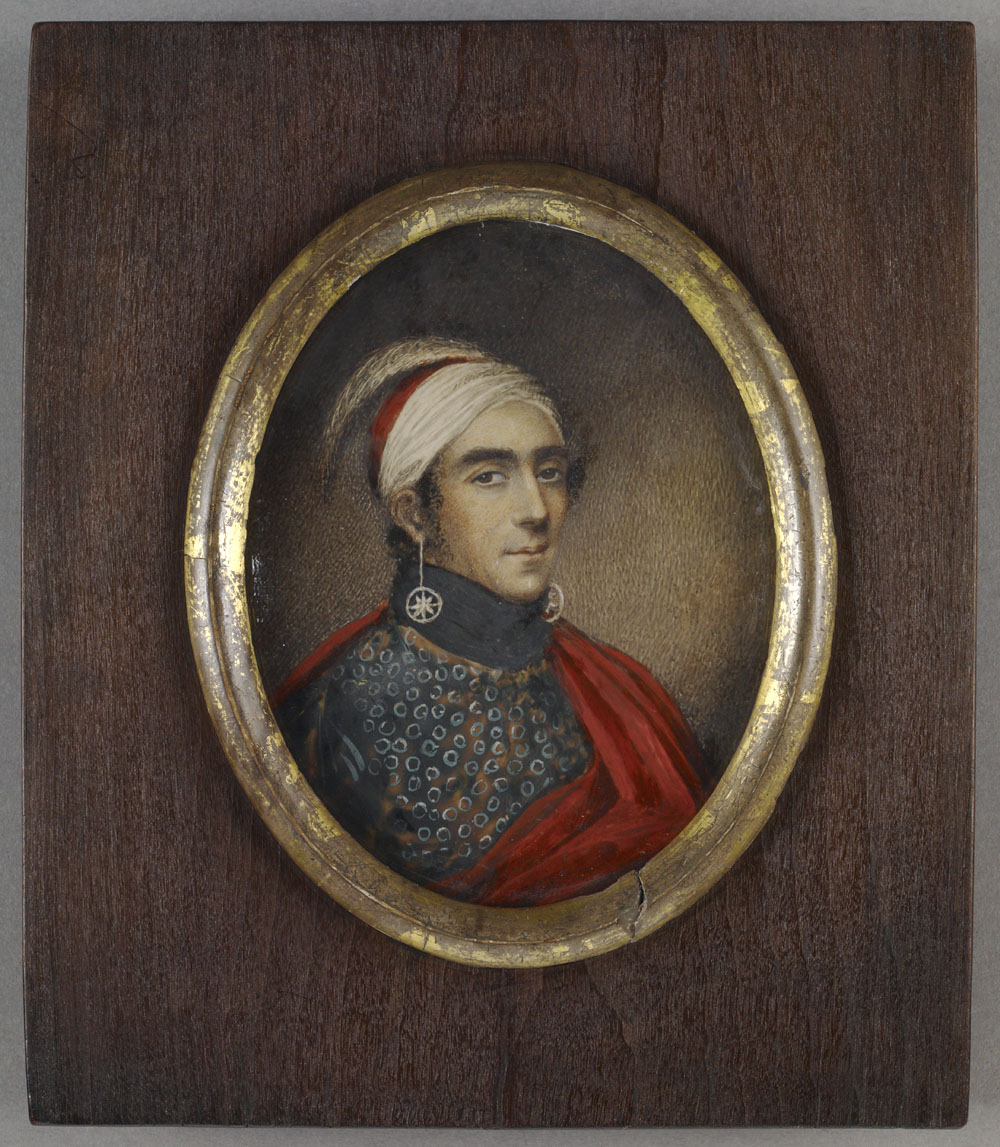
Image of an oval-shaped painting on ivory.

Portrait of John Norton by Mary Ann Knight, 1805 (e010933319)

Library and Archives Canada (LAC) recently acquired an unpublished autograph journal by John Norton (Teyoninhokarawen) (1770–1827), along with letters (John Norton Teyoninhokarawen fonds*). This acquisition was made possible by a contribution from the Library and Archives Canada Foundation. The journal’s existence was documented in correspondence from the early 19th century, but its location remained unknown until recently. These documents are an important link in the life and literary production of Norton, a fascinating character, as well as essential evidence for understanding the history of the Six Nations (Haudenosaunee), Canada and North America.

Born in Scotland, Norton had Indigenous ancestry: his father was Cherokee, brought to Great Britain by a British officer following the Anglo-Cherokee War, and his mother was Scottish. His family background shaped his astonishing journey. In addition, he was marked by military life from a very young age. His father, a soldier in the British army, took part in several campaigns in North America, during which his family followed him. In fact, Norton mentions in a letter that one of his earliest memories was the Battle of Bunker Hill (Boston, June 17, 1775) (item 6252667). Back in Scotland at an unknown date, he received an excellent education.

Norton and his parents were in the city of Québec in 1785. Like his father, he joined the army, but he deserted in 1787 at Fort Niagara. He later travelled and may have lived with the Cayuga Nation. In 1791, he worked as a schoolteacher in the Mohawk community of Tyendinaga (Bay of Quinte, Ontario). He then took part in battles in the Ohio Valley with various allied Indigenous peoples against American forces. He was also involved in the fur trade for Detroit merchant John Askin before being hired as an interpreter by the Department of Indian Affairs. He then lived with the Six Nations (Haudenosaunee) at the Grand River (Ontario) and became close to Mohawk Chief Joseph Brant (Thayendanegea). The latter adopted him as a nephew in 1797, and in 1799 Norton became chief for diplomacy and war for the Six Nations. He was given the Mohawk name of Teyoninhokarawen.

The Norton journal acquired by LAC is 275 pages long (item 6251788). He wrote it at the Grand River between 1806 and 1808 in the form of letters to a friend. He recounts his journey to England and Scotland in 1804–1805. It was at Brant’s request that he made this trip to clarify issues relating to Six Nations land ownership at the Grand River, in connection with the Haldimand Proclamation (October 25, 1784). His diplomatic mission failed because his authority was challenged by some, including William Claus, superintendent of Indian Affairs. However, on a personal level, Norton was able to reconnect with his maternal family and became a very popular figure among the political, business, religious, intellectual and aristocratic elite. He participated in social events and attended scientific conferences and debates in the House of Commons. He made valuable friends, including the brewer Robert Barclay, the Reverend John Owen and the second Duke of Northumberland (Hugh Percy), also a friend of Brant. During this time, Norton translated the Gospel of John into Kanien’kehá (Mohawk language), published by the British and Foreign Bible Society as of 1804 (OCLC number 47861587). In London, in 1805, artist Mary Ann Knight painted his portrait, now in LAC’s collection (item 2836984).

Pages from a handwritten journal.

Pages 183–185 of the journal of John Norton (e011845717)

In 1808, Norton sent his journal to Robert Barclay in England, who planned to publish it with the accompanying letters. This project, on which the Reverend Owen also worked, never materialized, and the documents remained in the Barclay family. In his journal, Norton describes his encounters and the places he visited. He expresses his thoughts on a variety of topics typical of his era and touching on colonial reality, such as the British army, American independence (and its consequences for Indigenous peoples on both sides of the border), freedom, slavery (he is an abolitionist), education, the status of women among Indigenous people, agriculture, trade (including the fur trade), business and land exploration. He plans several projects for the Haudenosaunee and is concerned about the education of young people. He questions the image of the Haudenosaunee portrayed by certain authors and insists on the refinement of their language. Christianity is also of great importance to Norton.

Norton’s correspondence reveals some details about his biography and his family (items 6252667 and 6258811). In it, he recalls his return to the Grand River in 1806, divisions in his community and his desire to take part in campaigns with the British army (item 6251790). He speaks about different Indigenous peoples and their relationships with British colonial authorities (items 6251794 and 6252528, for example). He promotes the alliance between Indigenous peoples and Great Britain but is very critical of the Department of Indian Affairs. This alliance proved essential in the War of 1812, during which Norton distinguished himself by leading groups of Indigenous warriors. He refers to this conflict in his letters (item 6258793), as well as his visit to the Cherokee in 1809–1810 (item 6258679). The correspondence also includes a transcript of a letter from chiefs of the Six Nations to Francis Gore, lieutenant governor of Upper Canada (item 6252665). Finally, a letter from someone close to Barclay confirms that George Prevost, governor-in-chief of British North America, held Norton in high regard (item 6258814).

It should be noted that Norton wrote a second journal while in England in 1815–1816, which covers his visit to the Cherokee, the War of 1812 and the history of the Six Nations. Still preserved in the Archives of the Duke of Northumberland at Alnwick Castle in England, this journal was published in 1970 and 2011, and the War of 1812 section was also published in 2019 (see references below).

A great traveller, polyglot, author, translator, letter writer, diplomat, politician, warrior, activist, trader, farmer, father, Scotsman, Cherokee, Haudenosaunee … so many epithets characterize John Norton, who already fascinated people during his lifetime. He is said to have been the inspiration for the main character in John Richardson’s 1832 novel Wacousta, a Canadian literary classic. Richardson had known Norton and was the grandson of John Askin, the fur trader for whom Norton had worked in his youth.

We hope that these newly acquired documents, which are important additions to our collection, will generate much interest and shed new light on Norton’s life and work, as well as on the history of the Haudenosaunee and Canada in the early 19th century.

Happy exploring!

To learn more

  • Alan James Finlayson, “Emerging from the Shadows: Recognizing John Norton,Ontario History, vol. 110, No. 2, fall 2018.
  • John Norton, A Mohawk Memoir from the War of 1812: John Norton—Teyoninhokarawen, Carl Benn, ed., Toronto, University of Toronto Press, 2019 (OCLC 1029641748).
  • John Norton, The Journal of Major John Norton, 1816, Carl F. Klink, James J. Talman, ed., introduction to new edition and additional notes by Carl Benn, Toronto, The Champlain Society, vol. 72, 2011 (1970) (OCLC 281457).
  • Carl F. Klinck, “Norton, John,” in Dictionary of Canadian Biography, vol. 6, University of Toronto/Université Laval, 2003 (1987).
  • Cecilia Morgan, Travellers Through Empire: Indigenous Voyages from Early Canada, Montréal & Kingston, McGill-Queen’s University Press, 2017 (OCLC 982091587).
  • Guest Curator: Shane McCord, Library and Archives Canada Blog, posted on September 14, 2017.

*Since these documents were created in English, their individual descriptions are also in English.


Isabelle Charron is a Senior Archivist in the Private Archives and Published Heritage Branch at Library and Archives Canada.

Fifty Years after the Mackenzie Valley Pipeline Inquiry: Navigating the Records (Part 3)

Version française

Mackenzie Valley Pipeline Inquiry Blog banner with a view of Mackenzie River Delta from Black Mountain near Aklavik in Northwest Territories.

By Elizabeth Kawenaa Montour

This article contains historical language and content that some may consider offensive, such as language used to refer to racial, ethnic, and cultural groups. Please see our historical language advisory for more information.

The Mackenzie Valley Pipeline Inquiry was enacted fifty years ago in 1974 by the Canadian Government. Library and Archives Canada (LAC) holds the original collection of the Inquiry records, which are managed by Government Archives Division.

This is the final blog of a three-part series on the Mackenzie Valley Pipeline Inquiry (MVPI). This blog will focus on providing instructions on locating a selection of specific types of MVPI records through Collection Search.

Discovering MVPI digitized collection materials

The records of the MVPI were transferred to the Public Archives of Canada in February 1978. All MVPI records are open to the public for research purposes, though not all MVPI records are digitally accessible online.  A digitally accessible record will show the digitized image of the record above the Record Information Page when retrieved and opened through Collection Search. These records can be requested and accessed on-site at LAC.

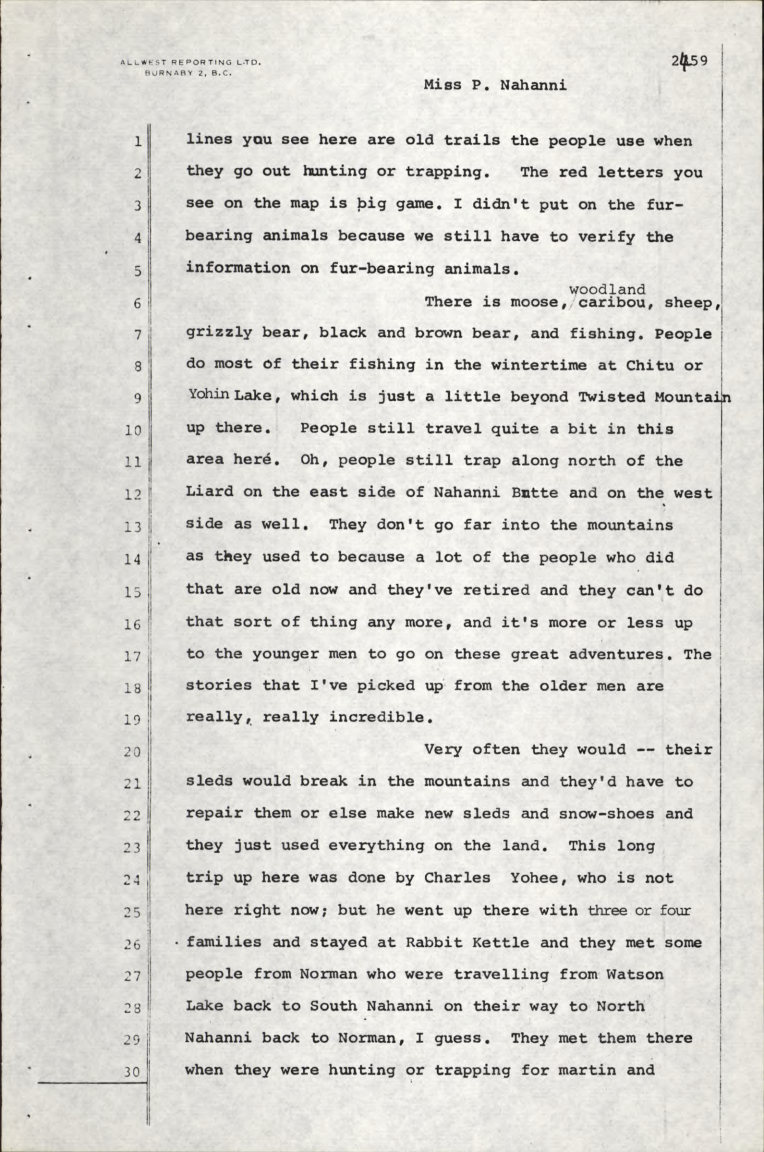
Typed transcript of proceedings regarding the Inquiry of a map, with interpretation by Phoebe Nahanni (map referred to as Exhibit C-184), showing trails for hunting, trapping and travelling. Number 2459 is at top right of page. Each line of typed text numbered from 1 to 30 vertically.

Transcript Number C24 – Trout Lake and Nahanni Butte, NWT from transcripts of community hearings. Date: 24 August 1975. Page 71 of 80 (e011412138).

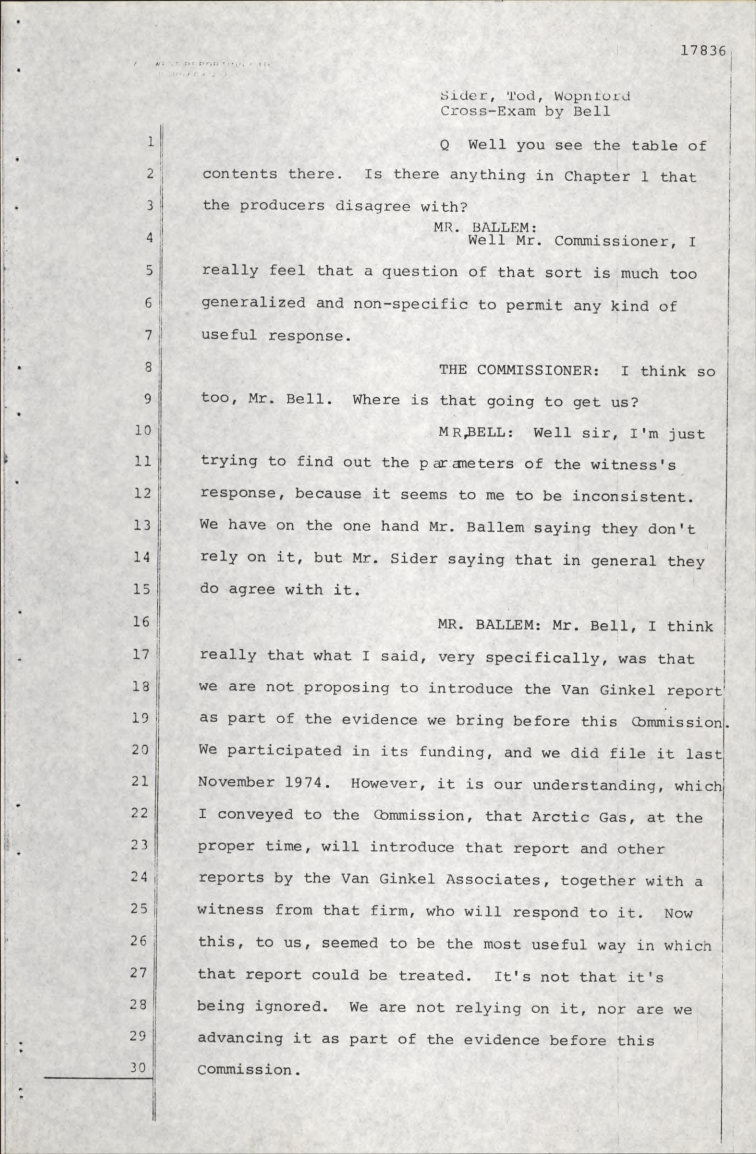
Typed transcript of proceedings regarding the Inquiry of John Ballem, Q.C. for producer companies being cross-examined by Glen W. Bell for Northwest Territories Indian Brotherhood. Includes comment by Commissioner. Number 17836 visible at top right of page. Each line of typed text numbered from 1 to 30 vertically.

Transcript Number 117 – Inuvik, NWT from transcripts of formal hearings. Date: 26 January 1976. Page 83 of 164 (e011412099).

Resources for records searches

The following information provides more specific guidance on searching for MVPI records.

The main sous-fonds is titled Mackenzie Valley Pipeline Inquiry (multiple media), or you may find it by using the search term “Mackenzie Valley Pipeline Inquiry” in Collection Search to find the result “Reference: R216-165-X-E, RG126. Date: 1970-1977”. Additional keywords for searches may include “Berger Commission” or “Berger Inquiry”.

The MVPI sous-fonds contains three main groups of series-level records, which are Transcripts of proceedings and testimony (digitized), Exhibits presented to the Inquiry (digitized) and Operational and administrative records (not digitized).

Each record may contain an electronic link to a related finding aid. This is found in the “Record information – Details section” and listed as “Finding aid: show detail”.

1 – Transcripts of proceedings and testimony – Reference: R216-3841-6-E, RG126

Please note: Shortcuts for locating both “formal hearings transcript” and “community hearings transcript” files using Collection Search are listed after section 3 – Operational and administrative records.

For formal hearings, reference “R216-172-7-E, RG126. Date: 1974-1976. Digitized”.

The sub-series includes 217 digitized transcript files, which are identified by number and location. The majority of the formal hearings were held in Yellowknife, with the remainder held in Inuvik (Northwest Territories), Whitehorse (Yukon) or Ottawa (Ontario).

Finding aid 126-5 is a verified file list of the formal hearing transcripts indicating transcript number, file title (the location), dates and permanent volume numbers.

For community hearings, reference “R216-169-7-E, RG126. Date 1975-1976. Digitized”.

The sub-series includes 77 digitized transcript files. Transcripts are identified by number and location. Community hearing transcript numbers are prefixed with the letter “C”.

Finding aid 126-8 is a verified file list of the community hearings transcripts including transcript number, file title (the location), parts, dates and permanent volume number.

Finding aid 126-3, from pages 111–120, is a list of Inquiry community witnesses and includes transcript numbers. In order to locate the Inquiry community transcript, preface the transcript number with the letter “C”. For example, to find text about “Antoine Abalon”, enter the search terms “Mackenzie C-18”. The result is Transcript Number C18 – Fort Good Hope, NWT. Scroll down list of names to Antoine Abalon, p. 1795.

2 – Exhibits presented to the Inquiry – Reference: R216-3840-4-E, RG126 Date: 1972-1977

Community hearings exhibits “R216-168-5-E, RG126 Date: 1975-1976” includes 700 digitized files. Exhibits are identified as “Submission” followed by a number with a “C”-prefix (e.g. Submission C585). The sub-series contains 627 digitized files, and 73 were not digitized due to the file folders being empty or for copyright reasons.

For Vancouver hearings exhibits, reference “R216-173-9-E, RG126 Date: 1976. Not digitized”. Records consist of exhibits from the Vancouver hearings of the MVPI held in May and June 1976. CV1-CV22 each denote a community exhibit with a description, person submitting and date. Hearings were also held in nine other centres in southern Canada (RG126, Vol. 9).

Formal hearings exhibits “R216-171-5-E, RG126 Date: 1975-1977” include 906 exhibits and are not digitized.

Additional MVPI records not included with the three main groups described above are listed below.

For photography, search for “Exhibits presented to the Mackenzie Valley Pipeline Inquiry, Reference: RG126, R216, 1978-115 NPC Box 3929. Date 1974-1975”. The accession includes 165 black and white and 819 colour photographs. They are not digitized. The accession consists of photographs depicting the planning and execution of the Mackenzie Valley Pipeline that were submitted as exhibits to the Inquiry. Subjects include, but are not limited to, land conditions, terrain, wildlife, construction views, disturbances to the tundra, forests, geological formations, Ellesmere Island, caribou entangled in wire, Banks Island, seismic reports, muskox habitat and environmental hazards to the pipeline.

For maps, search for “Exhibits by special interest and northern community groups to the Mackenzie Valley Pipeline Inquiry, Reference: RG126M 78903/14, 78903/14 CA. Date: 1972-1976”. The accession is not digitized. Accession consists of cartographic items which were presented by special interest and Northern community groups as exhibits to the MVPI. It includes technical details relating to the construction of the pipeline, environmental impact assessment maps and sets of land use maps. The accession also includes maps showing the pipeline corridors and the actual pipeline routes as proposed by Canadian Arctic Gas Pipeline Ltd. and Foothills Pipeline Ltd.

3 – Operational and administrative records Reference: R216-174-0-E, RG126 Vol. 72. Date: 1970-1977

The series includes textual recording, sound recording and moving images, and it is not digitized. The series consists of correspondence with the public, participants and staff members on all aspects of the Inquiry’s work; files on administrative arrangements regarding the Inquiry’s actual operations; Justice Thomas Berger’s memoranda to various parties; speeches delivered by Berger; French and English editions of the final reports; timetables of events; summaries of proceedings; indexes; posters and lists of documents. The series includes six lower-level descriptions: Committee for Original People’s Entitlement, Correspondence – General, Canadian Broadcasting Corporation, Canadian Arctic Gas Pipelines LTD, Canadian Arctic Resources Committee – Northern Assessment Group and Canadian Arctic Resources Committee.

Navigating the records using shortcuts

The search methods suggested here are not examples of methods that are considered regular search terms, but irregular techniques based on how data was input into the system and created for researcher convenience.  They cannot be applied to other areas of the database.

Shortcuts to locate “community hearing transcripts”

To find a community transcript by location

If you know the location of the community hearing, enter the search terms “Mackenzie transcripts [location]” into Collection Search (archives filter) and note “transcripts” (must be plural). For example, “Mackenzie transcripts Aklavik”.

The results will include all the transcripts of the hearings in that location.

For example, the above search inquiry would yield the search results Transcript Number C40 – Aklavik, NWT, Transcript Number C3 – Aklavik, NWT and Transcript Number C1 – Aklavik, NWT.

To find a community transcript by date

Enter the search terms “transcript DD-MONTH-YYYY” into Collection Search (archives filter).

Note: the date must be entered in this order and the month must be spelled out. For example, “transcript 5 August 1975”.

The result you would find in this example is Fort Good Hope, NWT.

To find a date of a community hearing

Enter the search terms “community hearings transcript” into Collection Search (archives filter)

Go to “Record Information-Details”. Click and open “Finding aid”.

Finding Aid 126-8 is a verified file list of the community hearings transcripts including transcript number, file title [location], parts, date and permanent volume number.

To find a community transcript by transcript number

Enter the search terms “Mackenzie C-number” into Collection Search (archives filter). For example, “Mackenzie C-18” (with or without the hyphen).

The result you would find in this example is Transcript Number C18 – Fort Good Hope, NWT.

To find the sound recording of a particular community hearing

Enter the search terms “Date [YYYY-MM-DD] Mackenzie” into Collection Search (archives filter)

Note: the numeric date must be entered in this order.

The sound recording must be accessed on-site at LAC.

Shortcuts to locate “formal hearings transcripts”

To find a date of a formal hearing

Enter the search term “formal hearings transcript” into Collection Search (archives filter).

Go to “Record Information-Details”. Click and open “Finding aid”.

FA-126-5 is a verified file list of the formal hearings transcripts, including transcript number, file title [location], parts, dates and permanent volume numbers.

To find a formal hearing transcript by date

Enter the search terms “transcript DD MONTH YY” into Collection Search (archives filter).

Note: the date must be entered in this order and the month must be spelled out. For example, “transcript 8 April 1975”.

The result you would find in this example is Yellowknife, NWT.

To find a formal hearing transcript by transcript number

Enter the search terms “Transcript number” into Collection Search (archives filter). For example, “Transcript 35”

The result you would find in this example is Transcript Number 35 – Yellowknife, NWT.

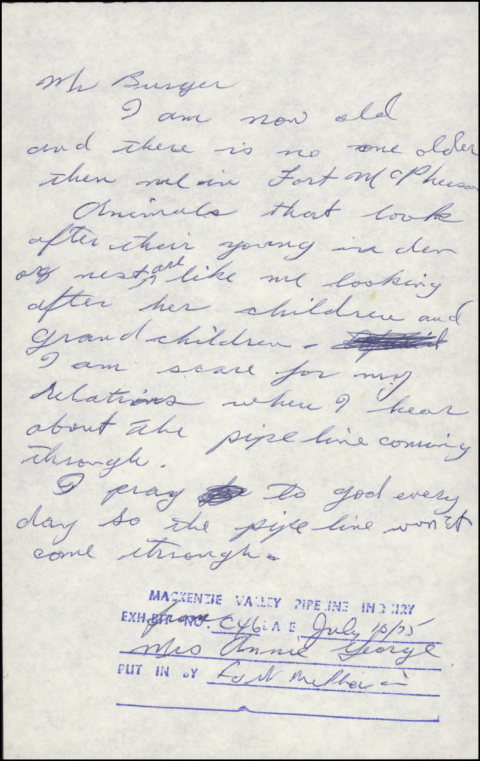
Handwritten three-paragraph letter written in cursive in blue ink by Mrs. Annie George to Mr. Berger, dated July 1975. She writes, “Mr. Berger, I am now old and there is no one older than me in Fort McPherson. Animals that look after their young in den or nest are like me looking after her children and grandchildren. I am scare for my relations where I hear about the pipeline coming through. I pray to god every day so the pipeline won’t come through.” Stamped: Mackenzie Valley Pipeline Inquiry, Exhibit No. C46, Date: July 10, 1975, Mrs. Annie George, Put in by: (illegible)

Exhibit Submission C46, RG126, Volume number: 3. Letter written by Mrs. Annie George, Elder, to Mr. Berger, MVPI Commissioner. Date: July 1975. Exhibit presented to the Inquiry at Community hearings. (e011407938)

Additional resources


Elizabeth Kawenaa Montour is an archivist in the Government Archives Division of the Government Record Branch at Library and Archives Canada.

Friends of the LAC and the Treasures found at the Cubby/Librairie Le Recoin

Version française

By Evan Dalrymple

Many people know about the Friends of the Ottawa Public Library and their book stores across Ottawa, but the Friends of Library and Archives Canada (FLAC) and its Cubby bookshop is one of 395 Wellington’s best kept secrets. For those who know, it’s a treasure!

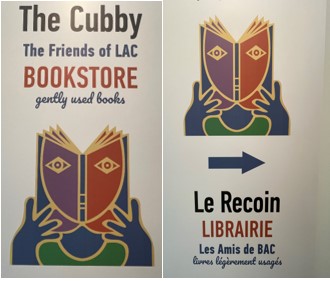
Two images of a book in the shape of a person. The open book is the head, with two hands holding the bottom corners of the cover and back cover. Above one of the images, it says “The Cubby Friends of LAC BOOKSTORE gently used books”. Under the second image, it says “Le Recoin LIBRAIRIE Les Amis de BAC livres légèrement usagés”.

The National Library and Friends’ logo on the bookshop. This logo is derived from the original mural by Alfred Pellan, titled La Connaissance / Knowledge. This mural is in the Pellan Room within the Public Archives and National Library Building at 395 Wellington. (MIKAN 4932244).

The Cubby is open every Tuesday from 10 a.m. to 3 p.m. in room 185 on the main floor of the Public Archives and National Library Building. I urge you to visit the Cubby in person or online to find the next addition to your personal library.

History of the Friends in Ottawa

In the early 1980s to the mid-1990s, Friends associations flourished in galleries, libraries, archives and Museums in Canada. Particularly in Ottawa, Friends’ associations earliest examples are the National Gallery of Canada (1958), the Canadian War Museum (1988) and the Ottawa Public Library (OPL) Main Branch (1982), which is the most well known of the associations.

The Friends of National Library of Canada was founded in 1991 by Marianne Scott, a former National Librarian of Canada (1984–1999) and the current president of FLAC.

In 2003, The Friends of the National Library of Canada and the Friends of the National Archives of Canada formed one single Friends organization—The Friends of Library and Archives Canada—in anticipation of the fusion of the National Archives with the National Library, which occurred in May 2004 with the official proclamation of the Library and Archives Canada Act.

The newsletter of the Friends of the National Library, “A note among friends,” published between 1992 and 2008, clearly demonstrate how book sales, boutiques and antiquarian book auctions have been monumentally successful ways to reach out to the larger community and to develop the National Library collection.

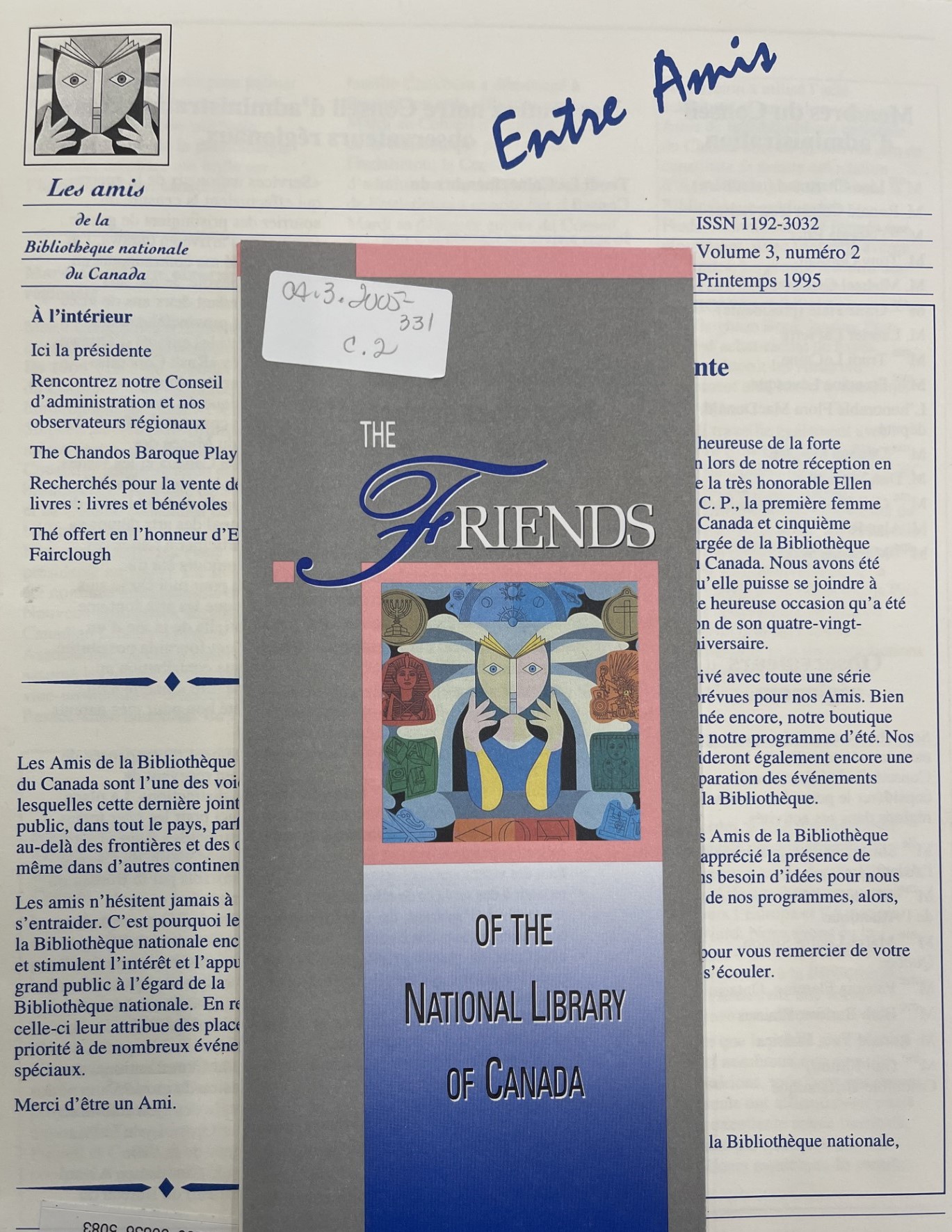
Page from a pamphlet with writing and the image of a logo.

A note among friends and The Friends of the National Library of Canada pamphlets (OCLC 1082162430 & OCLC 61127762).

Encouraging donations and gifts of treasures and fundraising for special acquisitions is central to the Friend’s constitution.

The Friends of National Archives organization also formed in 1995 under the leadership of Jean-Pierre Wallot (1985–1997), with their own newsletter “Between friends.” The National Archives also had a boutique, but less is known about their activities.

FLAC’s Big Book Sales and antiquarian book auctions

Many perhaps have heard of OPL’s yearly Mammoth Book Sales (MBS), but did you know that FLAC once hosted its own enormously successful “Big Book Sales”? These book sales, hosted alongside the Friends organizations of the Nepean Public Library, the Kanata Public Library, the Cumberland Public Library and local booksellers, have been a success in Ottawa for well over a decade. Even before consolidating in 2003 to create the Friends of the Ottawa Public Library Association, Friends organizations were thriving in various public libraries across Ottawa.

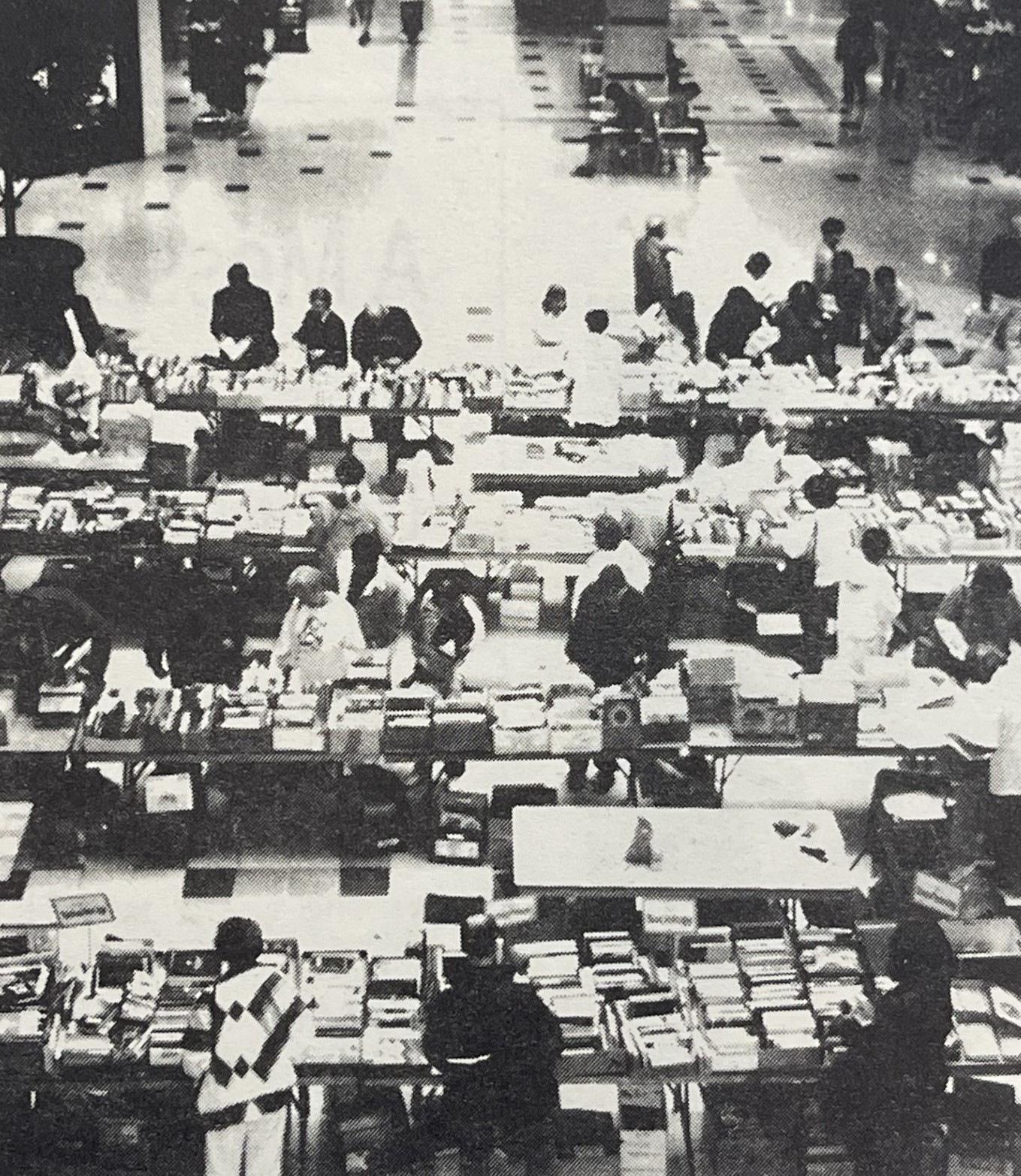
Photograph of people going through books placed on tables in a mall.

The first sale at St. Laurent mall from A note among friends, 1995, Winter, Volume 4, No. 1. (OCLC 1082162430).

The inaugural Big Book Sale took place September 23–25, 1995 at the St. Laurent Shopping Centre. According to the book sale committee, the sale by all measures was a resounding success. It raised $17,164.49, and an additional 423 books were donated to the National Library. In subsequent years, the Friends often doubled or tripled this amount.

FLAC initiated its first antiquarian book auction in the winter of 2000, continuing it until about 2008. As is the case today, all Canadian book donations are set aside and reviewed by a National Library staff member before they become part of the library collection. The Friends earmarked their rarer books for antiquarian book auctions. Today, FLAC features select books on their online store, inviting bids that are too good to pass up, so don’t miss out!

A history of the Cubby

Initially known as the “Friends Boutique,” the Cubby started in 1993 as a pop-up store situated in the sunken lobby of the Public Archives and National Library building. The Boutique was open from 11 a.m. to 3 p.m. daily from June 1st to the end of August.

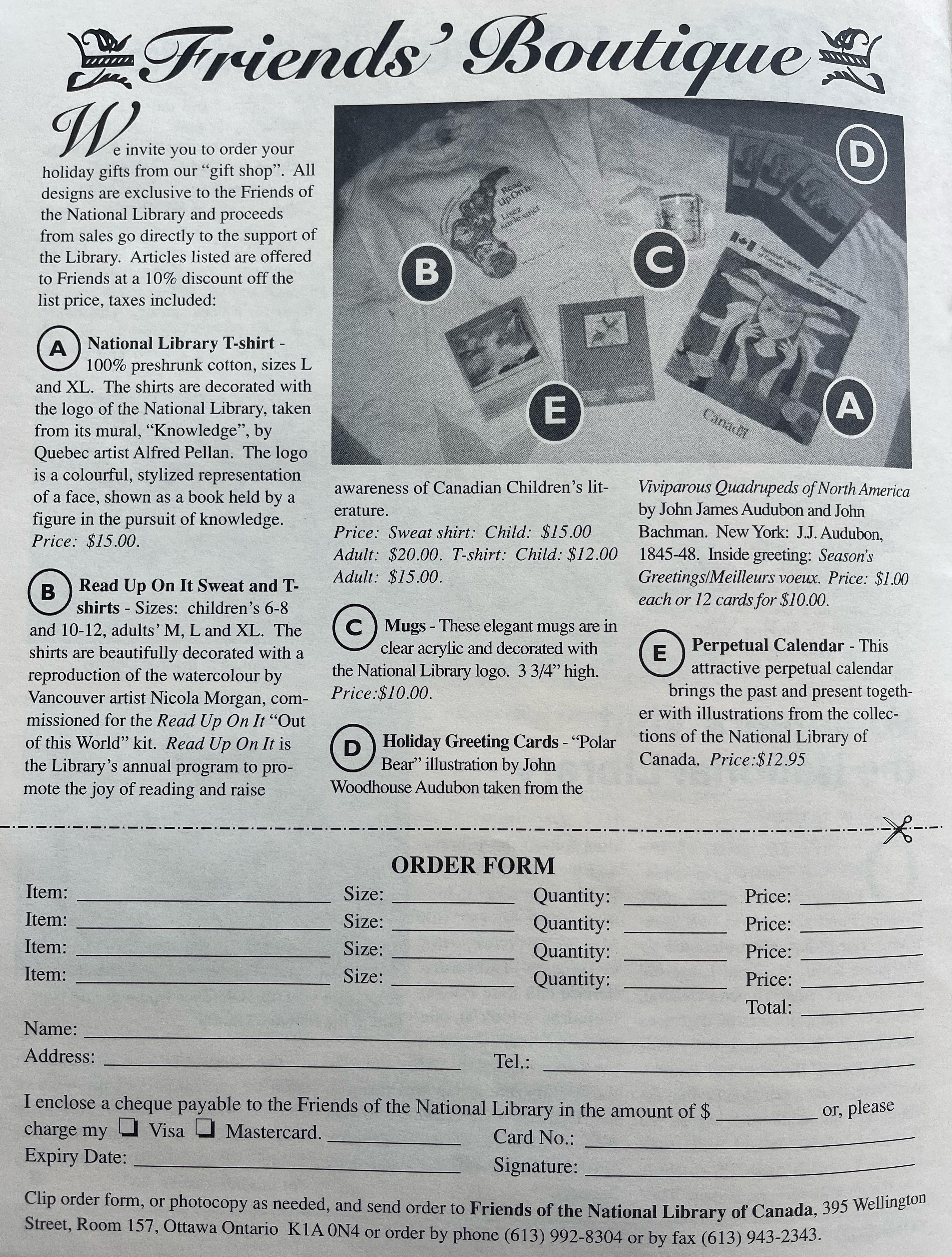
Page from a catalogue with a title “Friends' Boutique”, a photo with merchandise in the top right corner, descriptions of the merchandise and an order form at the bottom.

Thank you for being a Friend! The Fall 1996 catalogue, which featured the new Friends’ Boutique selling interesting merchandise (OCLC 1082162430).

The Boutique was staffed by two volunteers who also provided tours of the National Library in English and French, and it offered a remarkable selection of items, including postcards, posters, CDs from celebrated Canadian Musicians, as well as magnetic tapes from the National Library Music Division. T-shirts and sweatshirts emblazoned with “WOW” for Wellington Street West became especially popular. Many of the cherished items remain available at the Cubby today. Additionally, membership cards to FLAC are on offer—consider joining today!

In 2014, the Friends’ book sales division relocated to room 185 at 395 Wellington, attached to the Morley Callaghan meeting room. The basement now houses an extensive storage area for sorting a vast collection of books and hosts an office where Library and Archives Canada (LAC) staff can meticulously assess each donation.

By 2017 the FLAC bookstore, affectionately known as the Cubby, made its debut. The Cubby offered gently used books, with proceeds supporting the acquisitions of Canadiana for LAC. The store is open three days a week, bolstering its presence by running an annual big book sale and by opening its doors to the public on special occasions, including Canada Day.

Come 2019, the Cubby had enlisted the aid of over ten volunteers and succeeded in raising $3000, contributing to the purchase of significant works such as the rare edition of “Adventures of a Field Mouse,” by Catharine Parr Traill, and Leacock’s best-known book, “Sunshine Sketches of a Little Town” —the American version in the original dust jacket.

The pandemic in 2020 necessitated the closure of the Cubby, yet in response, FLAC pivoted to an online version of its antiquarian book sales of the past. So bid away!

Treasures found at the Cubby

The second and third laws of library science proposed by S.R. Ranganathan in 1931 (OCLC 1007655699)—that every reader has a book, and every book its reader—are ideas that resonate with my experiences at the Cubby.

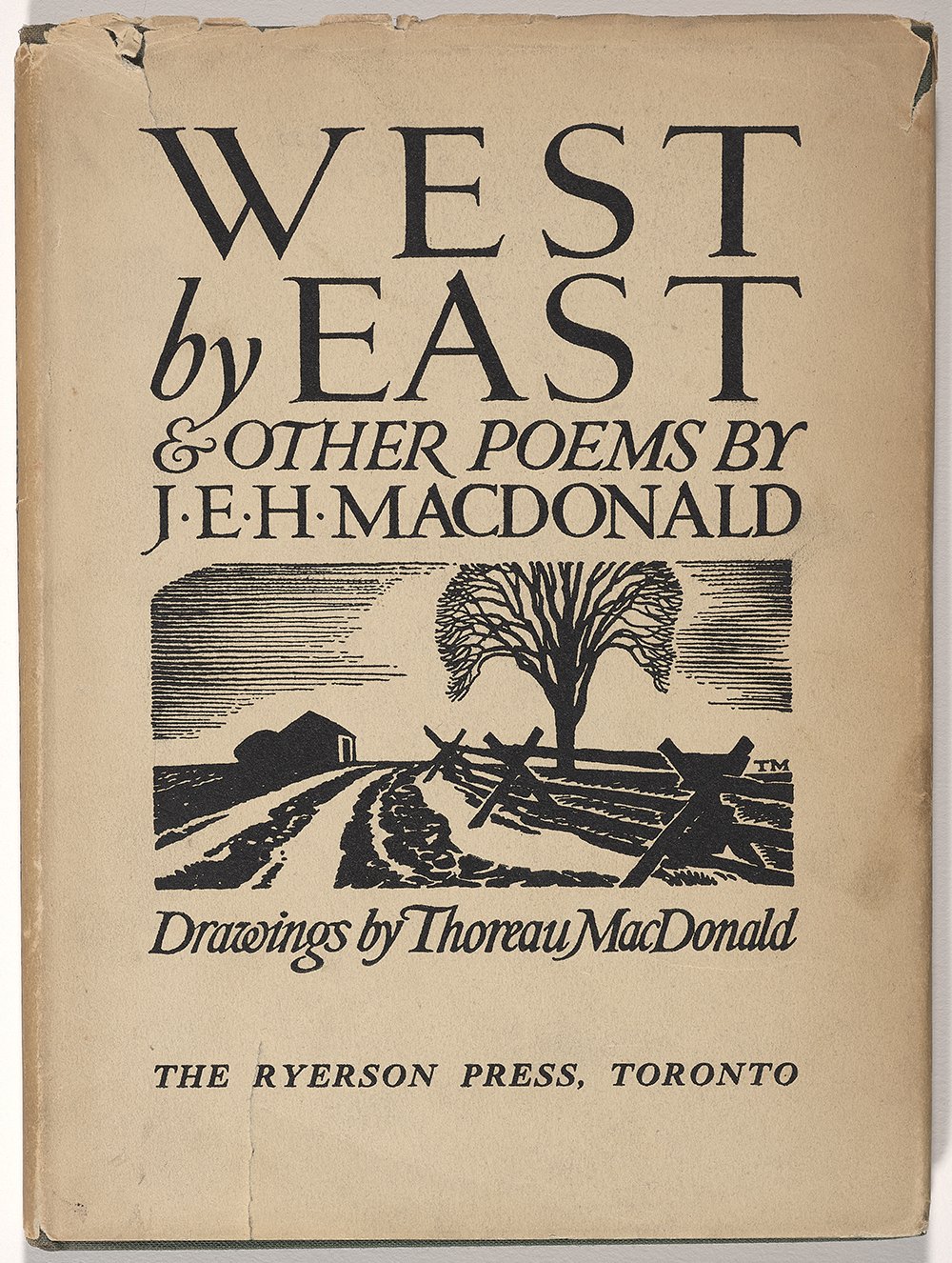
In 2019, I visited an exhibit at the National Gallery of Canada which contained the Archives of Thoreau and J. E. H. MacDonald collection and the book West by East and other Poems by J. E. H. Macdonald (OCLC 11487298). This Ryerson Press book, enriched by Thoreau MacDonald’s drawings and the original dust jacket, are images that have etched themselves in my memory.

To my delight, I recently managed to acquire a rare copy—the first of five hundred pulled—through negotiation on the Cubby’s online platform!

Book cover with drawing of a road lined by a fenced going towards a house. A tree can be seen in the background. West by East & other poems by J.E.H MacDonald is written on top of the drawing. Below its written Drawings by Thoreau MacDonald. The Ryerson Press, Toronto.

My copy of West by East by J.E.H MacDonald (OCLC 11487298) is one of the first five hundred copies produced.
Photo credit: J.E.H. MacDonald, West by East and other poems, with illustration by Thoreau MacDonald. Toronto 1933. National Gallery of Canada Library and Archives Photo: National Gallery of Canada

I have since discovered a treasure trove of Thoreau MacDonald-designed books at the Cubby store. These books are all in very good condition with original dust jackets from the 1930s from Ryerson Press Books and adorned with illustrations by Thoreau Macdonald.

First, I discovered a very handsome copy of Thoreau MacDonald: A Catalogue of Design and Illustration. My copy is signed by the humble compiler, Richard Landon, and is noted for its significance in Canadian book illustration history. Richard Landon was the head of Thomas Fisher Rare Book Library, which has been referred to as “the house that Richard Built.”

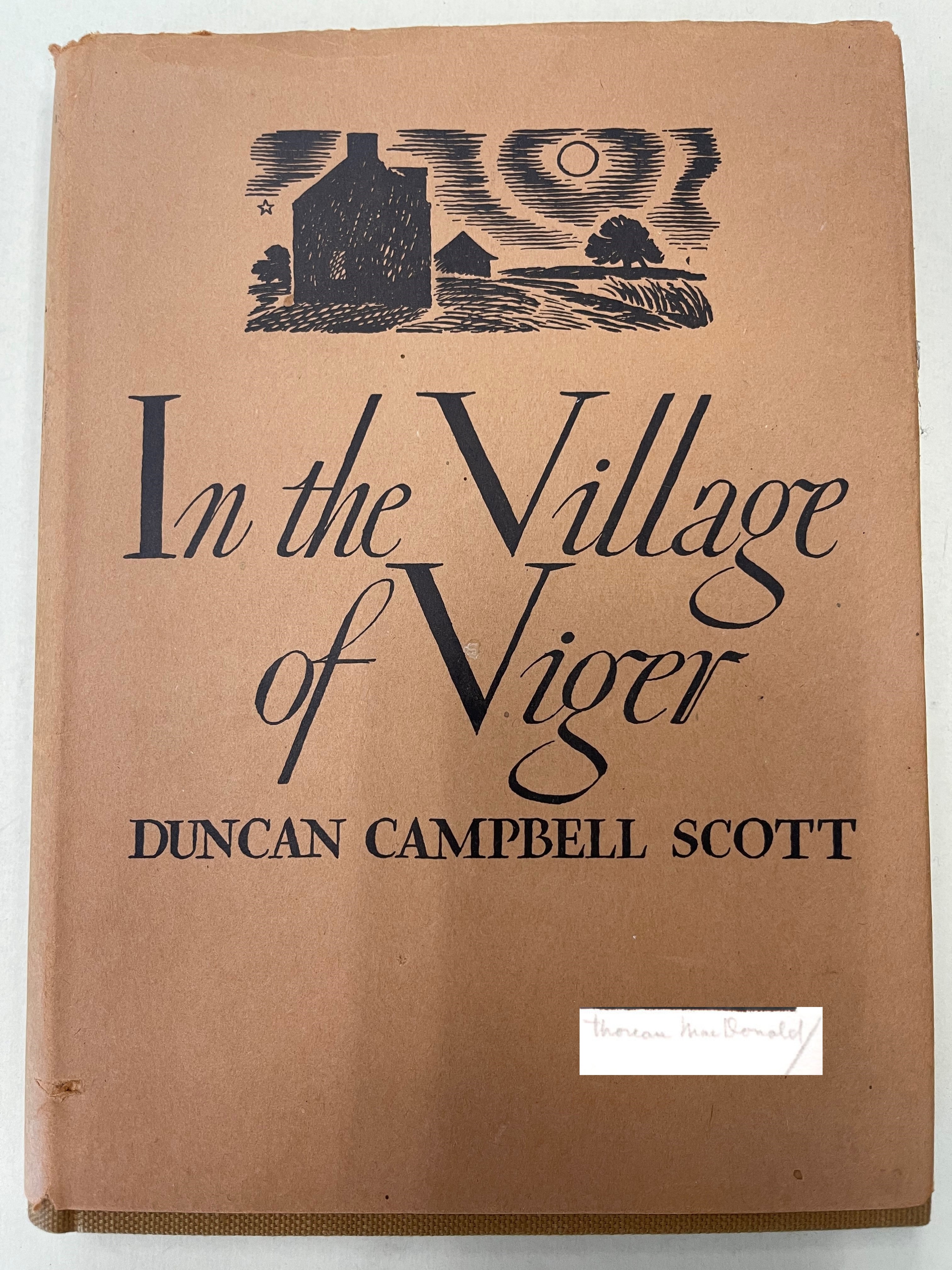
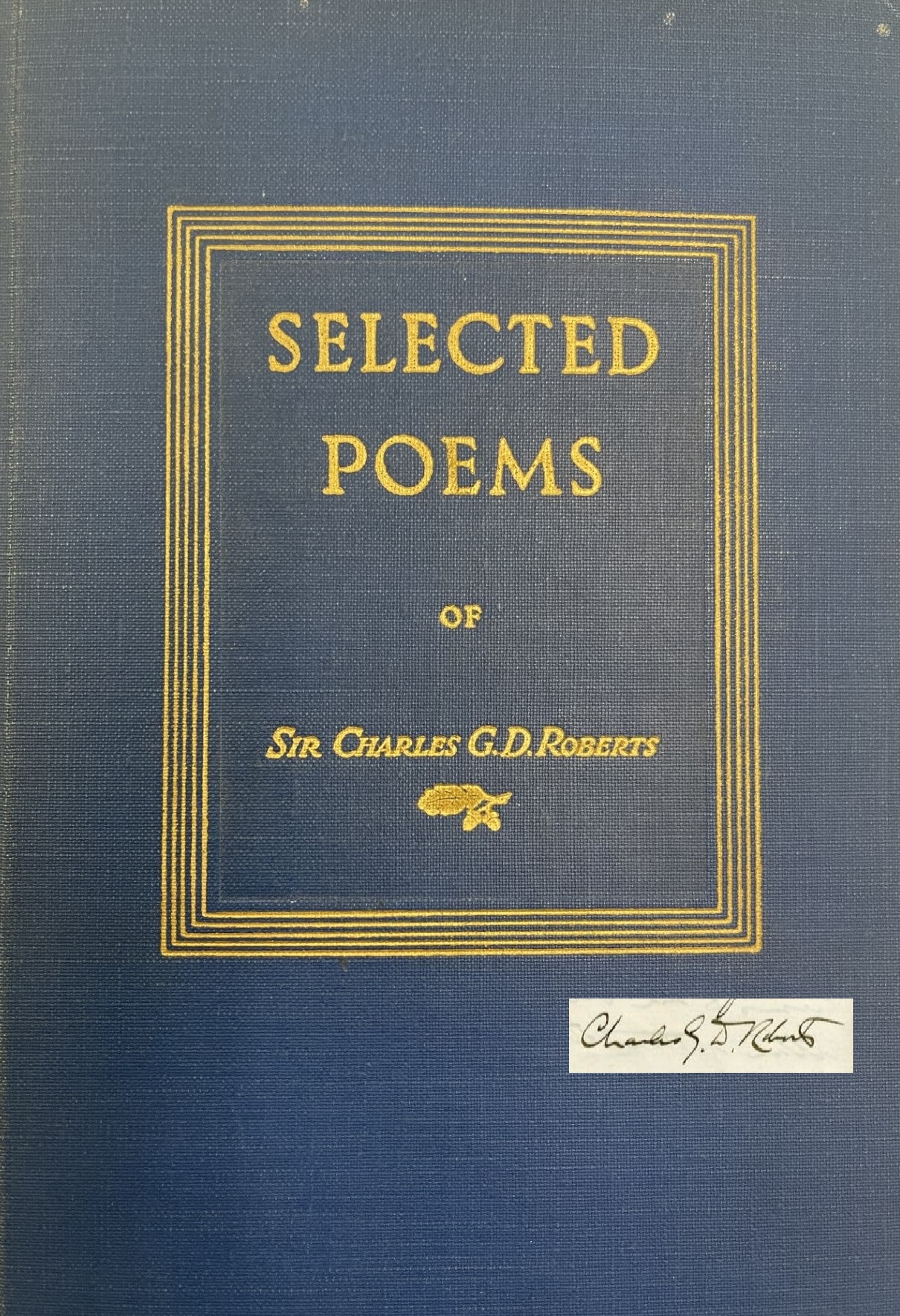
Since armed with this catalogue of book design and illustration, I also located two other treasures by the Confederation poets Duncan Campbell Scott (1862–1947) and Sir Charles George Douglas Roberts. Both books were inscribed and signed by the authors and had rare ephemera placed within. Could it be that these books were waiting on the cart of the Cubby for me?

In the Village of Viger (OCLC 3634059), by Duncan Campbell Scott, was designed and signed by Thoreau MacDonald. Duncan Campbell Scott was a poet and a controversial civil servant, leaving a complicated legacy for Canadians to consider regarding his part as an architect of the Residential Schools.

Book cover with a drawing of a house in forefront, a second house in the back, trees, grass, and a sun in the sky. The middle of the book cover reads In the Village of Viger, followed by the author’s name, Duncan Campbell Scott.

In the Village of Viger (OCLC 3634059) by Duncan Campbell Scott, a Confederation poet and an architect of the Residential Schools in Canada. My copy from the Cubby was signed by Thoreau MacDonald. Photo courtesy of the author, Evan Dalrymple.

My next find was the Selected Poems of Sir Charles G. D. Roberts (OCLC 27780946). This book was personally inscribed, and to my astonishment, I found various pieces of ephemera, including a signed mimeograph of his poem “Those Perish, Those Endure” about the Spanish Civil War and a signed article from the Dalhousie Review in April 1930, “More Reminisces About Bliss Carman”. Bliss Carman was Charles Robert’s cousin and a prolific Confederation Poet.

Cover page of a book with a frame-like rectangle with its title “Selected Poems” and the author’s name “Sir Charles G. D. Roberts” inside.

Selected Poems of Sir Charles G. D. Roberts (OCLC 27780946). My copy from the Cubby was signed and full of ephemera. Photo courtesy of the author, Evan Dalrymple.

The next chapter of the Cubby/ Le Recoin

At Ādisōke, a joint facility shared by the Ottawa Public Library and Library and Archives Canada, construction is well under way. Ādisōke is Anishinaabemowin word that means “storytelling,” and it promises to be a hub for our community. The question is—what will become of our Cubby?

Will it be a charming pop-up as from the bygone days, with “Big Book Sales” and auctions, or will it forge a new path? The fusion of the Ottawa Public Library and Library and Archives Canada may recreate the collaborative spirit we remember.

As we turn the page to the next chapter for the Friends and discover the new gathering space that will emerge at Ādisōke, we anticipate the new treasures that await us.

In closing, find your own treasures at the Cubby Big Book sale that will occur during LAC’s Doors Open Ottawa event on June 1 and 2, 2024. This will also mark 31 years of selling books—see you all at the Cubby!

To contact the Cubby, email Amis-friends@bac-lac.gc.ca or call 613-992-8304.

Further reading

  • Abley, Mark. 2013. Conversations with a Dead Man: The Legacy of Duncan Campbell Scott. Madeira Park, BC: Douglas & McIntyre (OCLC 856726449).
  • Landon, Richard, Marie Elena Korey, and Thomas Fisher Rare Book Library. 2014. A Long Way from the Armstrong Beer Parlour: A Life in Rare Books: Essays. Toronto, Ontario: Thomas Fisher Rare Book Library (OCLC 890957110).
  • From our rare book vault: What makes a book rare?, Library and Archives Canada Blog

Evan Dalrymple is a Reference Librarian for the Access and Services Branch at Library and Archives Canada, located at 395 Wellington.

Discovering my grandfather, Robert Roy Greenhorn, his life in Canada (Part 4)

Version française

Group of boys working in a field at the Philanthropic Society Farm School.

By Beth Greenhorn

This article contains historical language and content that some may consider offensive, such as language used to refer to racial, ethnic, and cultural groups. Please see our historical language advisory for more information.

I concluded Part 3 of this series about my grandfather, Robert Roy Greenhorn, with his departure to Fairknowe Home in Brockville, Ontario in the spring of 1889. This was the Canadian distributing home operated by Scottish philanthropist, William Quarrier.

Black and white page with letterhead with two rows of black capital letters across the top of the page that reads, ‘Distributing Home for Scotch Children and Canadian Orphan Home, Fairknowe, Brockville, Ont.’ There is a graphic image of a two-story home with a wide verandah in the middle. The image is flanked by cursive typed writing in black. There is a stamp in the top right corner with the date the letter was received. The date the letter was sent appears in the bottom right.

Letterhead for Fairknowe Home, Brockville, Ontario, Immigration Branch, RG 76, Vol. 46, File 1381, Part 6, Headquarters Central Registry files, 1892-1950. Source: Immigration Program : Headquarters central regi… – Image 378 – Héritage (canadiana.ca).

Before the parties of children left Scotland, families in Ontario applied to Quarriers Orphan Homes for a child. During the farewell event in Glasgow for my grandfather’s departure, William Quarrier assured the well-wishers that care “was exercised in choosing suitable homes for them [the children] in the new country. Both boys and girls were watched over till they reached the age of eighteen.” (untitled [iriss.org.uk]), p. 23, March 15, 1889, the North British Daily Mail)

The application form offered families a choice of a boy or a girl and asked for the desired age range. If requesting a boy, there was a section about the type of farm the family owns, the number of hours of work each day, the acreage and the number of cows to be milked. Additionally, each applicant needed to provide the names of five character references: their minister, reeve, physician and two other prominent individuals.

The children’s placements were regulated by legally binding contracts or indentures. According to a Web exhibition by the Canadian Museum of History, the indenture forms:

…clearly set out the responsibilities of the rescue home, the child, the master, and the mistress. For a youngster under the age of ten, the master or mistress received $5 a month from the agency for lodging, feeding, schooling and clothing the child, who was expected to do minor chores around the house and farm. Between 11 and 14, children received only their board, clothing and some schooling in exchange for their labour. From 14 to the end of the indenture at aged 18, the children were expected to perform adult’s work on a full-time basis, and thus were entitled to wages. (Civilization.ca – Crossroads of Culture – Trunks and Travel / Barnardo Children [historymuseum.ca]).

White sheet of paper with black typed writing. There is a stamp in black with the date the letter was received on the upper ride side.

Indenture form, stamped by the Department of the Interior, March 24, 1900, Immigration Branch, RG 76, vol. 46, file 1532, part 1. Source: Immigration Program : Headquarters central regi… – Image 379 – Héritage (canadiana.ca).

My grandfather, like the majority of Home Children, came from industrial urban areas in the United Kingdom. He would have performed some daily chores while living at Bridge of Weir. However, this would not have prepared him for farm life in rural Ontario or the harsh Canadian winters (Canadian Immigration Historical Society [cihs-shic.ca]). Coupled with these adversities, many of the children were subjected to other hardships. While some Home Children had positive experiences and were treated like family members, a number experienced great suffering, including physical and sexual abuse and neglect (Compensation offered for surviving British Home Children and Child Migrants | Ups and Downs – British Home Children in Canada [wordpress.com]). Emigration organizations, including Quarriers, were expected to carry out annual visits to ensure the children were receiving proper care. According to a 1907 souvenir booklet published by Quarrier’s organization, the children who emigrated to Canada were “under careful supervision [allowing] them to grow up worthy citizens of the great Colony” (William Quarrier- Brockville Ont 7,200 immigrated – BRITISH HOME CHILDREN IN CANADA [weebly.com]), slide 2).

But as the late author and co-founder of British Home Child Group International, Sandra Joyce observed:

This is where the system began to break down. Siblings were separated upon their arrival here and though, some of the farmers genuinely cared for the children, many just saw them as cheap labour. Others submitted them to abuse of a horrific nature. Monitoring a child’s placement was usually left up to the luck of the draw (British Home Children – SANDRA JOYCE).

Each year, the children inspectors were responsible for monitoring over 2,000 children throughout southern Ontario, making this undertaking next to impossible. (Canadian Immigration Historical Society [cihs-shic.ca]).

Following their arrival to Canada, my grandfather and his brother were sent to different farm families. The 1891 Census of Canada records my great-uncle, John, age 15, working as a domestic servant for Robert and Mary Parker on a farm near Brockville, Ontario. According to my Aunt Anna, Robert lost touch with John, who had gone north and eventually settled out West. I found an obituary for a John Greenhorn on Ancestry, born around 1877 in Scotland, and deceased March 31, 1961, at the age of 84 in Victoria, British Columbia. I believe this is my great-uncle.

As mentioned in Part 3, I had hoped to find records for my grandfather after his arrival to Fairknowe Home in Brockville. Unfortunately, this information had been destroyed. During conversations with my father, Ralph, I learned that his father first lived with a family near the hamlet of Philipsville, Ontario, approximately 46 kilometres from Brockville. I do not know how long my grandfather lived with this family, but from what I understand, he was mistreated before being taken in by the Kings, who lived on a nearby farm. By 1891, my grandfather, age 12, was registered as a domestic servant living with Aulga (sic) [Auldjo] and Mary (Ann) King and their adult children, William and Christine (1891 Census of Canada). When the 1901 Census of Canada was taken, Robert was still living with Anldfo (sic) and Mary Ann King, along with their granddaughter, Gladys Marshall. I was heartened to see that his relationship with the Kings had changed. No longer a domestic servant, he was recorded as being adopted by the King family. My Aunt Anna remembered how Robert spoke highly of the Kings, who he said “were always good to me.” (conversation, August 22, 2023). The 1901 Census of Canada, combined with my aunt’s recollection, suggest that my grandfather’s circumstances had taken a positive turn, and he lived with a family who cared for him.

This next part might seem off topic, but I assure you, it is relevant to my grandfather’s story. The best student job I ever had took place over two summers in the early 1980s. It involved a historical research project about heritage buildings and families in Bastard and South Burgess Township, which includes the hamlet of Philipsville. The project was led by historian Diane Haskins and culminated with My Own Four Walls: heritage buildings and the family histories in Bastard and South Burgess Township, published in 1985. This job gave me the opportunity to spend a week at the National Archives of Canada, now Library and Archives Canada (LAC), researching the Ontario census records on microfilm. I never imagined that I would eventually work at LAC, but I digress. Back to my grandfather’s story.

When I spoke with my Aunt Anna in August 2023, she brought out her copy of My Own Four Walls. The chapter focussing on Philipsville includes a photograph of Reuben Haskin’s grist and sawmill, taken circa 1900. The man kneeling on a beam and holding an axe in the top left is identified as Bill Greenhorn. I recall this photograph from my research as student 40 years ago but had never seen a photograph of my grandfather as a young man until 2018 during a visit with my cousin, Joyce Madsen, my Aunt Jennie’s daughter. After I began working on our grandfather’s story, Joyce generously gave me the portrait of Robert taken in his early twenties (see Part 1). I assumed that whoever had inscribed the names of the individuals on this photograph had misidentified the man holding the axe and had the incorrect surname. As far as I knew, there were only three Greenhorns in south-eastern Ontario at the turn of the century: my grandfather, Robert, and his brothers, John and Norval.

Photograph of a group of people, seven men, two women and two children posing on the ground, a beam and a ladder in front of an open wooden building.

Reuben Haskin’s Grist and Sawmill, Philipsville, Ontario, ca. 1900. Top row, left to right, Robert Greenhorn, other two men unidentified. Middle row, left to right, Joe Halladay, Kenneth Haskin, unidentified child, Allan Haskin and Philo Haskin. Front row, left to right, Helen Haskin, Bertha Haskin, Miss Shire and Mr. McCollum. Courtesy of Bruce Haskins. (OCLC 16752352, p. 96)

While working on this blog series, I learned from the 1911 Census of Canada that my grandfather was employed as a labourer at a sawmill and boarded with Reuben and Bertha Haskin in Philispville. If my Aunt Anna had not reminded me of this photograph in My Own Four Walls, I would never have made this connection.

On July 14, 1916, the Ontario Land Registry Access records for Leeds County show that Auldjo and Mary Ann King granted parts of lots 21 and 22, the land next to their farm, to Robert for $10, with unspecified conditions tied to Mary Ann’s life expectancy. Two months later, on September 16, 1916, Robert married my grandmother, Blanche Carr. (Ancestry.ca – Ontario, Canada, Marriages, 1826–1939) Born in May 1898, she was 19 years my grandfather’s junior but would have known Robert her entire life, having grown up just down the road from the King’s farm.

My grandparents owned a dairy and beef farm and sugar bush, which my family affectionately calls “the Farm.” They had eight children, seven of whom survived into adulthood: Jennie, Roy, Josephine (Jo), John, Jean, Arnold and my father, Ralph. Nellie, born in 1924, died the following year. She is buried with my grandparents in the Halladay Burial Place in Elgin, Ontario.

Photograph of a group of two rows of men, women and children standing in indoor clothing on snow in front of a wooden frame building on the right and a tree on the left.

In front of the farm house, Philipsville, Ontario, ca. 1940. Front row, left to right, Uncle Arnold, Alex Morrison (Aunt Jo’s husband), my grandmother Blanche, Aunt Jo, Aunt Jean, my grandfather Robert and Uncle John. Back row, left to right, Uncle Roy, Mary and Hugh (Aunt Jo’s children) and my father, Ralph. Courtesy of the author, Beth Greenhorn.

Life for my grandparents was not easy, especially in the early years of their marriage. Their first home, located a few properties from the King family farm, had its challenges. My Aunt Anna recalled how Blanche’s midwife described their house as “a poor shack of a place” with buckets to catch the rain coming through the roof (email from Anna Greenhorn to Beth Greenhorn, January 19, 2024). After receiving my aunt’s email, I rechecked my father’s unpublished memoir. He briefly mentioned Margaret (Meg) Nolan, the midwife who delivered all of Blanche’s children. In the 1931 Census of Canada, Margaret Nolan, age 62, was employed as a practical nurse and still living in Philipsville.

By the 1921 Census of Canada, Blanche and Robert Greenham (sic) had purchased land next to the King family, where they eventually built their house. Robert’s occupation was a farmer. They had three children: Jennie age five, Roy age three and Jo age two at that time.

During my conversation with Aunt Anna last August, she told me about how my grandparents first built the barn and where they lived while the house was being constructed. Earning a living took priority, and they needed a shelter to milk the cows. As soon as construction on the house permitted, my grandmother and aunts, Jennie and Jo, and possibly Nellie and Jean, moved in. My grandfather and uncles, Roy and John, continued sleeping in the barn until the house had some interior walls for privacy.  My father said that they had no electricity until he was in grade 10 or 11, which would have been the mid-1940s.

Farming was, and still is, hard work, requiring long hours 365 days of the year. It also demanded support from the entire family. While there was never money for any luxuries, my father said there was always plenty of food on the table, with lunch being the heartiest meal of the day. It usually consisted of mashed potatoes and gravy, several kinds of vegetables, roast beef or ham, and it always ended with a big slice of fruit pie. Most of the food was grown on “the Farm” (unpublished memoir, pp. 7-8).

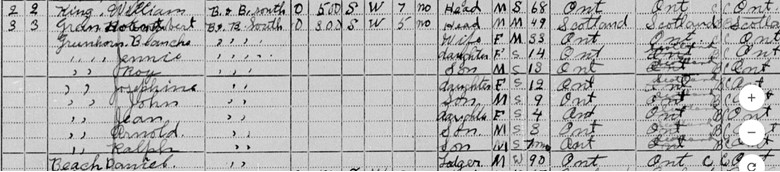
Black and white detail from a census record showing 17 columns and the names of 11 individuals handwritten in black ink on individual rows.

1931 Census for Robert and Blanche and their seven children. They were living beside William King, the son of Auldjo and Mary Ann King. Daniel Beach, a lodger, was Mary Ann King’s elderly father. Source: 1931 Census (bac-lac.gc.ca), Leeds, Subdistrict – Bastard and Burgess, no. 4, page 2 of 13.

Researching my grandfather Robert Roy Greenhorn’s story has been a bittersweet journey of discovery. I can only imagine how terrifying it would have been coming to a new country at the age of nine and being separated from his older brother. It is distressing to know that my grandfather was treated poorly by his first host family. I was able to find comfort that he was taken in by a kind couple, for whom he cared.

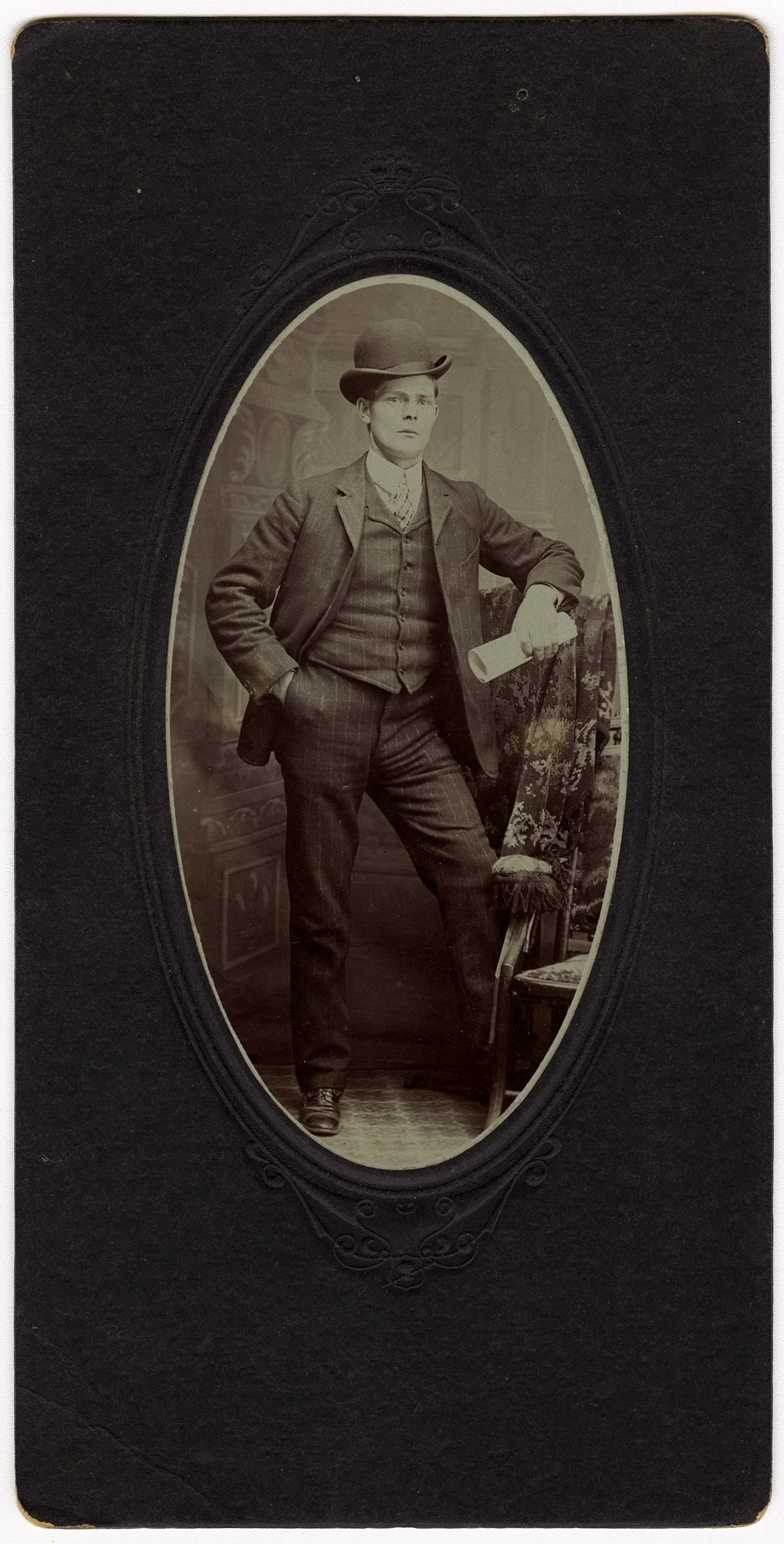
Studio portrait of a young man in an oval frame on rectangular black mat board. He is wearing a three-piece suit and bowler hat and holding a scroll of paper and has one elbow propped on the back of chair.

Robert Roy Greenhorn, photographer and location unknown, ca. late 1890s. Photograph courtesy of Pat Greenhorn.

This photograph of my grandfather was probably taken in his early twenties. Having one’s portrait taken in the late nineteenth century was a special occasion. He was dressed in his best and likely only suit, and his vest looks a bit small, like he had outgrown it. He holds a scroll of paper, a prop indicating that he can read and write. The directness of his gaze conveys confidence. His body language is one of self-assurance. While my grandfather’s life was not a traditional rags-to-riches tale, his story is one of resilience and determination.

Additional Resources


Beth Greenhorn is an Online Content Manager in the Outreach and Engagement Branch at Library and Archives Canada.

A new old book for LAC

Version française

By Meaghan Scanlon

Library and Archives Canada (LAC) recently acquired a copy of the book Relation de ce qvi s’est passé en la mission des pères de la Compagnie de lésvs aux Hurons, pays de la Nouuelle France, és années 1648. & 1649. The acquisition was supported by the Library and Archives Canada Foundation.

Published in Paris in 1650, the book is part of a series of publications known as the Jesuit Relations. The Jesuit Relations are reports written by Jesuit missionaries who were stationed in New France. Published annually from 1632 to 1673, these reports served to update the missionaries’ superiors in France about the progress of the mission. Through their publication, the Relations became widely available and thus also helped build support among the French public for the Jesuit efforts in New France. While the content of the Jesuit Relations must be viewed in the colonial context of their production, the books are nonetheless significant documents of the history of New France. They are a valuable—albeit one-sided and heavily edited—source of information about the Indigenous peoples of the area known as New France and their early interactions with the European settler missionaries.

The item purchased by LAC is the first edition of the Jesuit Relation that details the events of the years 1648 and 1649. The credited author, Paul Ragueneau, was the superior of the Jesuit mission in the territory of the Huron-Wendat people. The report deals with major historical events. These include the conflict between the Haudenosaunee (Iroquois) and the Huron; the resulting destruction of the Jesuits’ mission in Huron territory (Wendake) by the Haudenosaunee; and the deaths of Jesuits Jean de Brébeuf and Gabriel Lalemant, both of whom were later canonized by the Catholic Church.

LAC’s Rare Book Collection focuses on Canadiana published before 1867. (LAC defines published Canadiana as publications produced in Canada, about Canada, or created by people from or with ties to Canada.) Within the Rare Book Collection, LAC has an outstanding collection of about 65 Jesuit Relations. While LAC does not have a copy of the earliest report published in 1632, it does hold at least one copy of one edition for almost every subsequent year.

Today, the Jesuit Relations are considered “important” rare books, but they were likely viewed as more akin to mass market literature at the time of their publication. This historical perception is reflected in the way the copies in LAC’s collection are bound. Several of the books are in “limp vellum” bindings. A limp binding is opposed to a hardcover binding, in which the book’s cover materials are glued to some type of board to create a hard cover. With a limp binding, there are no boards. Think of limp bindings as the historical equivalent to paperback books, except that instead of paper, the covers of older books are usually made of animal skin. In the case of many of LAC’s Jesuit Relations, the specific skin used is known as vellum, hence the term limp vellum.

Just as modern paperbacks are now an economical option, limp bindings would have been less expensive for seventeenth-century book buyers than hardcover books. Another sign of the inexpensive nature of the bindings of the Jesuit Relations in LAC’s collection is that they are also mostly very plain, with no decorations other than the titles handwritten in ink on the spines. Additionally, the books tend to be very small, typically around 20 cm in height.

The new acquisition is so slight, in fact, that the delivery person who brought it to LAC said he was sure he was dropping off an empty box! It too is in a limp vellum binding. Interestingly, its vellum cover is made from an old piece of sheet music that looks as though it could date from the sixteenth or seventeenth century. Historically, it was common for bookbinders to use scrap materials like old manuscript pages in their work. Of course, recycling supplies is a way to save money, and a cover made from reused vellum is perhaps another indication that the book in question was considered “cheap,” for lack of a better word.

However, there are signs that this binding does not date from the time of the book’s publication. The endpapers are made of different, newer paper than the text block of the book. The margins of the book’s pages are also very thin, indicating that the pages were cropped at some point, likely when the book was rebound.

The specific details of what alterations may have been made to this book over its lifespan are a mystery for LAC’s book conservators to attempt to unfold. However, if, as it appears, the volume was rebound at some point in the almost 400 years since its publication, whoever did the work made the effort to use materials and techniques faithful to those that might have been employed during the era when the book was originally published.

A photograph showing a small book bound in a piece of vellum with musical notations handwritten on it in red and black ink in a calligraphic style. The vellum appears to date from the sixteenth or seventeenth century.

Cover of LAC copy 2 of Relation de ce qvi s’est passé en la mission des pères de la Compagnie de lésvs aux Hurons, pays de la Nouuelle France, és années 1648. & 1649, published in Paris by Sébastien Cramoisy, 1650 (OCLC 1007175731).

Additional resources


Meaghan Scanlon is a Senior Special Collections Librarian in the Published Acquisitions Division at Library and Archives Canada.

Discovering my grandfather, Robert Roy Greenhorn, his life in The Orphan Homes of Scotland (Part 3)

Version française

Group of boys working in a field at the Philanthropic Society Farm School.By Beth Greenhorn

This article contains historical language and content that some may consider offensive, such as language used to refer to racial, ethnic, and cultural groups. Please see our historical language advisory for more information.

I would like to thank Mary Munk (a retired colleague from Library and Archives Canada’s Genealogy and Family History); my aunt, Anna Greenhorn; my cousin, Pat Greenhorn; and Steven Schwinghamer (Pier 21) for their help with part 3 and part 4 of this series.

While writing the third article about my grandfather, Robert Roy Greenhorn, I had not located any documents pertaining to his emigration to Canada. I reached out to Quarriers Records Enquiry, but according to the British Home Children in Canada website, the reports kept by Quarrier’s Orphan Homes of Scotland about the children’s progress in their Canadian homes were destroyed, apparently as a result of a miscommunication when the Canadian operation closed in 1938. I had also hoped to track down records regarding his placements with the two host families he lived with after arriving at Fairknowe Distributing house in Brockville, Ontario in 1889, but I have had no such luck to date.

Thus far I have only been able to locate two records specifically related to my grandfather.

The first is this group portrait taken in March 1889 shortly after his arrival to Fairknowe Home. Robert and his brother John are both in this photograph. All the boys’ names are listed alphabetically by first name below the image. I have never seen a childhood photograph of my grandfather, making it impossible to identify him. According to my aunt, Anna Greenhorn (my Uncle John’s wife), my grandfather was tiny for his age. I know from his Passenger List that he was among the youngest boys in his party. I wonder if he was amongst the smallest boys standing in the front row?

Black and white photograph of a large group of boys, several men and women standing on the ground, front steps, and verandah of a white stucco building.

“The Siberian Arrival Party,” March 26, 1889, Fairknowe Home, Brockville, Ontario. Photo: William Quarrier- Brockville Ont 7,200 immigrated – BRITISH HOME CHILDREN IN CANADA (weebly.com)

The second reference is a brief statement found on page 43 in Narrative of Facts, William Quarrier’s annual report for 1894. It mentions “…a boy of 9, brother to two taken before and now in Canada doing well. This one has been with a married sister, but he is getting beyond control and although so young has been pilfering, etc.” (Source: untitled (iriss.org.uk)) The nine year old boy is Norval, my grandfather’s youngest brother, and Jeanie, now married, is the sister. Norval left Scotland March 29, 1894. He arrived in Halifax, Nova Scotia on April 16, 1894, before going onto Fairknowe Home in Brockville, Ontario.

In Part 2 of this series, I left off with my grandfather and his brother, John, transferring from the City Orphan Home in Glasgow to the Orphan Homes of Scotland, located at Bridge of Weir, approximately 25 kilometres away. They moved after beds became available following that year’s emigration of boys to Canada. This was June 11, 1886. The Orphan Homes of Scotland would be home to Robert and John for almost three years.

By the time my grandfather and his brother arrived at the Orphan Homes of Scotland, it had grown from two cottage homes that could each accommodate 20 to 30 children, into a self-contained community with just under 600 children in residence (Source, p. 37). Known as “The Village,” the community was made of 16 cottage homes, laundry facilities, workshops and bake houses, a store and post office, a stable and cowshed, a poultry coop, a greenhouse, the Mount Zion Church, classrooms and a house for the superintendent. The central building housed the main hall, school rooms and teachers’ lodgings. There was also the “James Arthur,” a land-locked ship for training boys who would work in the navy.

On March 14, 1889, a special meeting was held at “The Village” to bid the boys bound for Canada a farewell.  Robert and John, along with 128 other boys, departed Scotland the following day. Members of the public from Glasgow and Paisley were invited to the reception. According to a story in the Glasgow Herald titled “Orphan Homes of Scotland: Departure of Children for Canada” (March 15, 1889, p. 8.), several hundreds of vehicles carrying well-wishers arrived at Bridge of Weir Station. I will never know if Robert and John’s older sister Jeanie, who had been working in Paisley in 1885, was among the guests. If she did attend, I hope she had an opportunity to see her younger brothers one last time and give them both a hug goodbye.

Every boy and girl who emigrated to Canada was given a wooden trunk, stamped with their first initial and surname. My cousin, Pat Greenhorn, inherited our grandfather’s trunk, the only memento remaining from his childhood. As mentioned in Part 1 of this series, each child was expected to work, generally as domestic servants for the girls and farm labourers for the boys. Therefore, the trunks were equipped with work clothes fit for the Canadian seasons, an outfit for church, toiletries, a sewing kit for mending socks and clothing and a Bible. Additionally, the children were given a copy of John Bunyan’s Pilgrim’s Progress, a religious allegory about a man named Christian. Ashamed and filled with sin, Christian leaves the City of Destruction for the Celestial City in search of redemption. Undoubtedly, this popular book was chosen for the religious and moralistic teachings to encourage the children as they embarked on their journey and a new life in Canada.

Colour photograph of a brown wooden trunk with a name stencilled in white capital letters across the middle-to-right side and another name stamped in smaller black capital in the lower left corner.

Robert Greenhorn’s trunk from Quarrier Orphan Homes of Scotland. Photograph courtesy of Pat Greenhorn.

Robert and John travelled on the S.S. Siberian, operated by the Allan Line. LAC does not have any digitized images of this ship. It does, however, have a postcard of the S.S. Sardinian, which brought Home Children to Canada beginning in 1875. It is similar to the vessel my grandfather travelled on. The S.S. Sardinian was also featured on the 2010 Canadian postage stamp commemorating Home Children (see Part 1).

Colour photograph of a ship with black sides and a red strip across the bottom and a red, black, and white smokestack. There is a smaller white boat with four oars, and a smokestack emitting smoke anchored at the right front. The name of the ship is written in red typeset letters in the upper right corner of the image.

The S.S. Sardinian, operated by the Allan Line, ca. 1875-1917 (a212769k).

LAC has the Passenger List for the Quarrier boys, along with the rest of the cabin passengers, departing from Glasgow and Liverpool to Canada on the S.S. Siberian in March 1889. My grandfather, entered as Rob Greenhorn, is among the boys aged nine.

As with the Quarrier’s emigration parties, my grandfather travelled to Canada in steerage, the cheapest fare on long-distance steamer voyages. Descriptions of these living and sleeping quarters sound miserable. Located in the space containing the machinery, the lowest part of a ship, passengers in steerage class were overcrowded and had little fresh air, causing an unbearable stench. (Steerage – Wikipedia). In his 1889 annual report, William Quarrier thanked the Allan Line “for the convenience and comfort of the party,” which was “as usual most liberal and satisfactory.” (1889, p. 24 untitled (iriss.org.uk)) My grandfather’s recollection of the voyage differed from that of Quarrier’s. During a conversation last summer with my Aunt Anna, she recounted Robert’s experience on the S.S. Siberian. According to my grandfather, he and the other boys were packed like sardines, with 14 in a cabin and thick air that stunk. (Source: conversation, Anna Greenhorn and Beth Greenhorn, August 22, 2023)

My grandfather arrived in Halifax, Nova Scotia on March 26, 1889, nine days following their departure. After deboarding the ship, the boys were processed by immigration officials in the cargo shed at Pier 2. This photograph from the Nova Scotia Archives shows what it looked like before fire destroyed it in 1895.

Black and white photograph of a long one-story brick building on a wooden wharf. There are several sail boats in front of the wharf, and a large brick building with the name of the company in white letters is behind the building on the left side.

Pier 2 cargo shed, with the Intercolonial Railway Co.’s Elevator in the background, Halifax Harbour, before 1895. Photo: Harry and Rachel Morton Fonds, accession no. 2005-004/004, Longley Album Part 1, no. 40, Nova Scotia Archives.

Prior to 1892, the Immigration Branch was under the jurisdiction of the Department of Agriculture. The immigration facilities in Halifax were rudimentary. In January 1889, three months before my grandfather’s arrival, the Deputy Minister of Agriculture, John Lowe, inspected Pier 2 cargo shed. He concluded it was less than adequate. In a memorandum, dated April 23, 1889, he wrote:

At present the immigrants are landed in the freight shed at the I.C.R. [Inter Colonial Railway] deep water terminus. There is a small room at the corner of this intended for the shelter of women and children, but its accommodation is altogether insufficient for the numbers of immigrants arriving. Great inconvenience arises…in the freight shed and when large numbers come and have to wait for some hours…the hardships inflicted on the immigrants are very severe, serious sickness having in some cases been caused to delicate children. Proper shed accommodation for the use of immigrants arriving at Halifax is, for the reasons stated, are both absolutely necessary and urgent. Another winter should not be allowed to pass without the erection of such accommodation. (RG17, vol. 610, file 69092)

Following the immigration inspection, my grandfather and his party boarded an Intercolonial Railway train bound for Fairknowe Home in Brockville, Ontario. The distance between Halifax and Brockville is 1,730 kilometres (1,074 miles). This would have been another exhausting trip, taking at least several days or more.

In the fourth and last article of this series, Robert Roy Greenhorn’s story will take us to Canada; more specifically, to Fairknowe Home in Brockville, Ontario and later to Philipsville, Ontario, where he would live for the remainder of his life.

Additional Resources


Beth Greenhorn is an Online Content Manager in the Outreach and Engagement Branch at Library and Archives Canada.

Fifty Years after the Mackenzie Valley Pipeline Inquiry: Listening to Voices (Part 2)

Version française

Mackenzie Valley Pipeline Inquiry Blog banner with a view of Mackenzie River Delta from Black Mountain near Aklavik in Northwest Territories.By Elizabeth Kawenaa Montour

This article contains historical language and content that some may consider offensive, such as language used to refer to racial, ethnic, and cultural groups. Please see our historical language advisory for more information.

The Mackenzie Valley Pipeline Inquiry (MVPI), also known as the Berger Inquiry, was enacted fifty years ago in 1974 by the Canadian government. The purpose of the Inquiry was to investigate the potential impacts of the pipeline and report findings, which would be followed by appropriate actions. The final report (Volume One and Volume Two) was published in 1977. Library and Archives Canada (LAC) holds the original collection of Inquiry records, which are managed by the Government Archives Division.

This is part two of a three-part series on the MVPI. This blog will highlight two individuals who were central to the thoroughness of the Inquiry process as well as provide additional search methods for Inquiry records.

Part one presented a glimpse of the people and land of the Yukon and Northwest Territories (NWT) who would be affected by the proposed Mackenzie Valley Pipeline, along with a narrative of events that led up to the enactment of the Inquiry by the Canadian government. The final blog, part three, will focus on more specific searches for the records.

Commissioner Thomas R. Berger and interpreter and Inuk broadcaster Abraham Okpik

The Inquiry to study the potential environmental and socio-economic impacts of the proposed gas pipeline project was headed by Justice Thomas R. Berger. A former Justice of the B.C. Supreme Court, he possessed legal experience in First Nations issues. He had recently represented the Nisga’a and argued the Aboriginal title case Calder et al. v. Attorney-General of British Columbia, [1973] S.C.R. 313. This led to the 1973 Calder decision by the Supreme Court of Canada, which recognized that Aboriginal title to land existed prior to colonization and that Nisga’a land title had never been extinguished.

Abraham “Abe” Okpik, who was born in the Mackenzie River Delta, was an interpreter for the Inquiry in 1974. He also served as a linguistic representative for CBC to report on the Inquiry hearings. Okpik’s language skills combined with his life experiences were crucial for the Inquiry to establish communication and understanding with people from different Arctic communities.

In 1965, Okpik was the first Inuk to sit on the Council of the Northwest Territories (NWT). His legal surname at the time was “W3-554” due to the Canadian government system of using disc numbers to identify people in the North. Okpik eventually chose his new surname and was selected to head Project Surname in 1970. Under this project, Okpik visited Inuit camps and communities in northern Quebec and the NWT to record the surnames people wanted to replace their identification numbers. In 1976, Okpik was awarded the Order of Canada in recognition of his contributions to the preservation of the Inuit way of life and his work on the Berger Inquiry.

A colour portrait photograph of Abe Okpik standing indoors wearing a black Inuit parka with yoke and red, yellow and green floral embroidery on a white yoke with red fringe. He has black fur mitts on.

Abe Okpik, 1962 (e011212361).

Conclusions of the Inquiry

Commissioner Berger summed up his thoughts in his November 1978 article on the MVPI with comments on industrialization, energy waste, the creation of wilderness parks and whale sanctuaries, and the need for humanity to reflect on its use of resources. He recognized the North as the last frontier and that the pristine and undeveloped areas were critical habitat for many creatures and their continued survival. He writes that in his MVPI report there are two sets of conflicting attitudes and values: “the increasing power of our technology, the consumption of natural resources and the impact of rapid change” versus “the growth of ecological awareness, and a growing concern for wilderness, wildlife resources and environmental legislation.”

The Inquiry concluded that a pipeline along the Mackenzie Valley to Alberta was feasible, but that it should only proceed after further study and after the settlement of Indigenous land claims. Based on this conclusion, a ten-year moratorium on construction was declared.

Voices speaking for land and life

The Inquiry was groundbreaking in its implementation of direct consultation that included hearings with the people of the communities that would be impacted by the project. They were aware that the pipeline would bring change and affect their relationship with the animals and the land. They spoke of their way of life and of knowledge that had been passed to them. Audio recordings of these oral testimonials are culturally invaluable. Their knowledge at that specific moment in time is preserved and available for future generations to hear.

Black-and-white photograph of a herd of caribou moving over frozen river and snow-covered landscape.

Reindeer taking part in the Canadian Reindeer Project crossing the Mackenzie River, 1936 (a135777).

Fred Betsina, a 35-year-old Dene from Detah Village, NWT, explained at the Detah Community Hearing why he did not want a pipeline. He told how he knew from trapping and hunting caribou that they were not able to jump over a 48-inch pipe—that they can’t jump higher than 12 inches, so instead they need to go around whatever is blocking their path. He stated that he wanted to see the land settlement claims settled before he saw a pipeline. His last comment was, “… us Indians. We got no money in the bank, nothing … The only money we got in the bank is the cash out in the bush … We get our meat from there, and fish is the cash … that’s what you call a bank here…”  He spoke for the wildlife, for his people and for his family’s needs.

The gathering of people from distantly located communities also presented opportunities to forge new friendships and strengthen alliances. The Inquiry gave a space for informal discussion on economic and political subjects.

Discovering MVPI collection materials

The records of the MVPI were transferred to the public archives of Canada in February 1978. All MVPI records are open to the public for research purposes, though not all records are digitally available.

Screenshot of Collection Search – Research Information Page with three dark horizontal bars with text: Record information – Brief, Record information – Details, and Ordering and viewing options.

Mackenzie Valley Pipeline Inquiry (multiple media) R216-165-X-E, RG126. Date: 1970–1977 (MIKAN 383).

Additional sources and tips for records searches

The following is to provide more specific guidance on searching for MVPI records in Collection Search.

On the Record Information Page for the Mackenzie Valley Pipeline Inquiry (Reference: R216-165-X-E, RG126), there are three sections: Record information – Brief, Record information – Details, and Ordering and viewing options.

If you open the second section (Record information – Details), you will find a link titled, “View lower-level description(s).” Clicking on that link will open the three main series of records: Transcripts of proceedings and testimony, Exhibits presented to the Inquiry, and Operational and administrative records

Opening one of three series of records above will link to the Record Information Page for that series. To view the lower-level records within each series, open the “Record information – Details” section and click on the “View lower-level description(s)” link.

In Transcripts of proceedings and testimony (R216-3841-6-E, RG126), you will find two lower-level descriptions:

In Exhibits presented to the Inquiry (R216-3840-4-E, RG126), you will find four lower-level descriptions:

In Operational and administrative records (R216-174-0-E, RG126), you will find six lower-level descriptions:

*Please note not all MVPI records are available online digitally. MVPI records that are not digitally accessible online will have to be requested and accessed onsite at LAC. A digitally accessible record will show the digitized image of the record at the top of its Record Information Page.

The final blog in this series will provide detailed strategies to navigate the records.


Elizabeth Kawenaa Montour is an archivist in the Government Archives Division of the Government Record Branch at Library and Archives Canada.

Sweet Potato Pie: A Timeless Delight from 1909 to Today!

Version française

Cooking with Library and Archives Canada bannerBy Dylan Roy

You probably don’t know me, but you might recognize my hands from previous blog posts in this series by Ariane Gauthier. If you haven’t read the articles yet, I highly recommend doing so. In these baking adventures, I served as the muscle and hand model, guided by Ariane, a far more passionate and skilled baker than I. However, for the sweet potato pie recipe featured in this article, I embarked (mostly) solo into the complex and fascinating realm of baking.

As a novice baker attempting my first-ever baking project, I was initially apprehensive about following a recipe that provided very little guidance. Despite my doubts, my pie turned out quite tasty! I invite you to follow my journey below and try making the recipe for yourself.

Before delving into the culinary endeavours ahead, let’s explore the chosen recipe’s source.

Published in 1909, Culinary Landmarks or Half-Hours with Sault Ste. Marie Housewives was a labour of love by members of the St. Luke’s Woman’s Auxiliary from the Sault Ste. Marie area, in Ontario. It’s the third edition of what was originally known as the Handy Cook Book. The first version was so well received that a second and lengthier third edition were published. The third edition includes the recipe I followed.

The first question an inexperienced baker like myself might ask is: where does one start? The answer lies in following the recipe from Culinary Landmarks or Half-Hours with Sault Ste. Marie Housewives, which can easily be found in Aurora, Library and Archives Canada’s (LAC) library catalogue.

Recipe for sweet potato pie, by Mrs. P.T. Rowland.

A recipe for sweet potato pie from Culinary Landmarks or Half-Hours with Sault Ste. Marie Housewives (OCLC 53630417).

The ingredients for this recipe are rather simple. You need one pound of sweet potato, three-quarters of a pound of butter, three-quarters of a pound of sugar, six eggs, nutmeg, a bit of whisky, and some lemon zest (along with the components for the pie pastry, which we’ll discuss further below).

Upon reviewing this recipe, you’ll notice that there are no instructions on how to prepare the pie crust. As a rookie baker, this posed a significant challenge for me. Fortunately, I found salvation in a previous article in this series, which explains how to make pie dough.

Photo featuring ingredients for sweet potato pie: butter, whisky, flour, sugar, lemon, nutmeg, eggs, and sweet potato.

Ingredients used by the author to make the sweet potato pie recipe from Culinary Landmarks or Half-Hours with Sault Ste. Marie Housewives. Image courtesy of Ariane Gauthier.

Once you’ve gathered all your ingredients, you can start the pie-making extravaganza! The first step involves boiling the sweet potatoes. While the original recipe advises boiling the potatoes with the skin on, I opted to peel them for my own reasons.

After boiling them, I started the arduous task of pressing the still-hot potatoes through a colander. Be prepared for a bit of exertion during this step, but rest assured—it’s a great opportunity for a workout!

Collage of three images, including slices of sweet potatoes being added to a pot of boiling water; sweet potatoes being mashed with a spatula; and sweet potatoes being pressed through a colander.

Boiling and pressing sweet potatoes. Image courtesy of Ariane Gauthier.

Next, I beat six eggs in a bowl and set them aside. Then, I creamed together the butter and sugar. After that, I mixed in the sweet potatoes, continuing to blend. Finally, I added the eggs until the mixture was homogeneous.

Collage of four images, including sugar being poured into a mixer with butter; mashed sweet potatoes being added to the same mixer; and eggs being added after all the other ingredients.

Mixing butter, sugar, sweet potatoes and eggs. Image courtesy of Ariane Gauthier.

While mixing everything together, I must admit it didn’t look appetizing. However, I reminded myself to trust the process and have patience. This baking experience taught me the importance of believing in the recipe and persevering despite initial appearances. So, despite the unappealing look, I remained optimistic and continued on.

Once everything was mixed, I began incorporating the recipe’s flavours: nutmeg, whisky and lemon zest. This step is vital for enhancing the pie’s flavour profile. Initially, I added an ounce of whisky and a small amount of lemon zest and nutmeg. However, upon tasting, I found it lacking. Therefore, I continued to mix while gradually adding more lemon zest and nutmeg. After a few minutes, I achieved the perfect balance. Voilà! The mixture was ready to fill the pie pastry. As for the pastry itself, I baked it for about five minutes before adding the mixture, which may or may not have been a brilliant idea (I’ll leave that for you to discover by trying it yourself!).

Side-by-side images of whisky being poured into a mixer with other ingredients, and filling being poured into a pie crust.

Mixing in an ounce of whisky and adding the mixture to the pie crust. Image courtesy of Ariane Gauthier.

Baking the pie for about 30 minutes at 400°F (about 205°C) seemed to do the trick. I was a little worried about the filling puffing up, but I left the pie in the oven, even though it looked like a balloon ready to pop! I utilized some of the leftover dough to create designs on the pie and even had enough mixture left to make pudding. My cooking partner Ariane also made a pie. You can check out our final creations below.

Image featuring two sweet potato pies with embellishments made from leftover crust mix; a sweet potato pudding; and a pair of red oven mitts.

Sweet potato pies and pudding. The author’s pie is on the right, while Ariane’s pie is on the left.
Image courtesy of Ariane Gauthier.

Despite it being my first attempt at baking, I’m pleased to report that my pie turned out to be delicious, a sentiment echoed by my colleagues who sampled it. While the first pie provided valuable lessons on what to do and what to avoid, leading to improvements in the second attempt, the process was not without its trials and errors. Nevertheless, I wholeheartedly encourage you to try your hand at baking this pie and to share your thoughts as you savour a slice of history! With that said, I’d like to conclude this blog with an excerpt from the book that inspired this recipe:

Pastry: The queen of hearts, she made some tarts. All on a summer day; The knave of hearts, he ate a tart, And then, oh, strange to say! It smote his inmost, vital part—His heart was gone straightway.

Detail from Culinary Landmarks or Half-Hours with Sault Ste. Marie Housewives (OCLC 53630417).

If you try this recipe, please share pictures of your results with us using the hashtag #CookingWithLAC and tagging our social media: FacebookInstagramX (Twitter)YouTubeFlickr and LinkedIn.


Dylan Roy is a Reference Archivist in the Access and Services Branch at Library and Archives Canada.