Breaking ground: 150 years of federal infrastructure in British Columbia – Peace River Region: RCAF Fort St. John

By Caitlin Webster

British Columbia joined Canada 150 years ago, and in the years that followed, federal infrastructure expanded throughout the province. This infrastructure is well documented throughout Library and Archives Canada’s collections. This eight part blog series highlights some of those buildings, services and programs, as well as their impact on B.C.’s many distinct regions.

Public airports have been a constant in Canada since the 1920s, when purpose-built facilities replaced the rudimentary airfields and landing strips of the early days of flight. However, the Second World War led to a marked increase in civilian and military airport construction.

In the late 1930s, the Department of Transport constructed a basic airfield in Fort St. John, British Columbia. Located on the traditional territories of the Treaty 8 First Nations, the airfield served as part of a transport route through Grande Prairie, Fort St. John, Fort Nelson, Watson Lake and Whitehorse. When the United States entered the Second World War in 1941, this route offered a strategic location for transportation to Alaska, and for the construction of the Alaska Highway. As a result, in 1943 the U.S. Air Force completely rebuilt the airport in Fort St. John, with resurfaced runways, new fuel facilities, hangars, barracks and accompanying buildings.

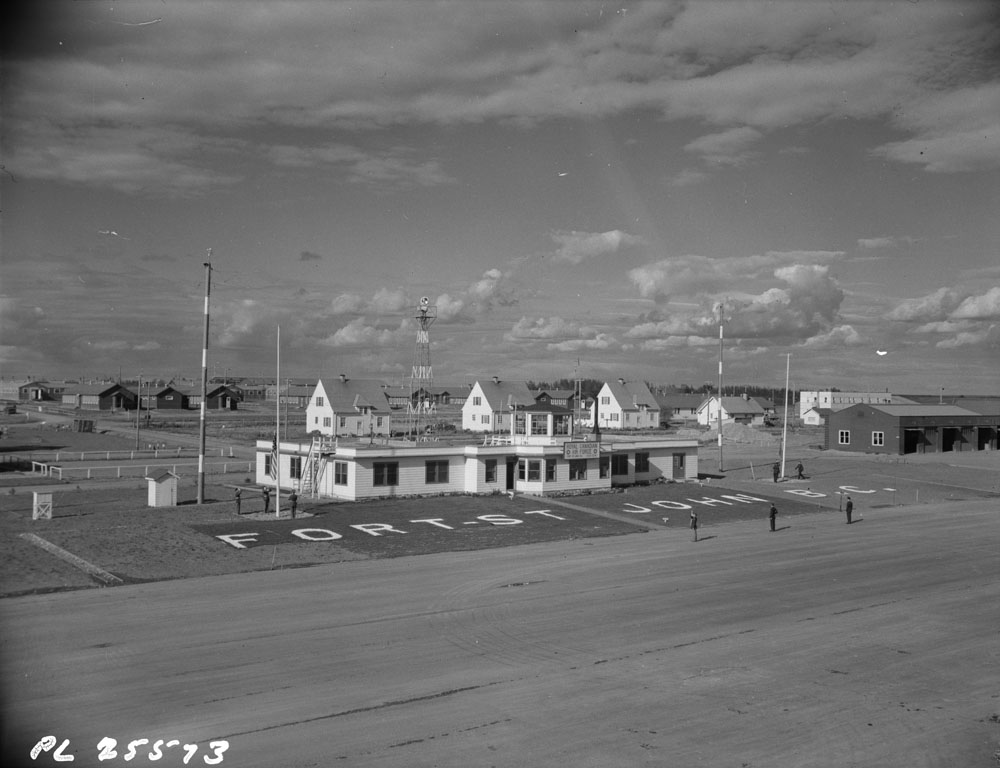
: Black-and-white photograph of the administration building at RCAF Fort St. John, B.C. Various individuals stand at attention as three men raise a flag. Several buildings and other structures are also in the background.

Administration building at RCAF Fort St. John, B.C. (e011309348)

RCAF Fort St. John opened in 1943, with personnel performing such duties as maintaining runways and buildings, facilitating incoming and outgoing flights, and monitoring weather conditions. Personnel at the detachment were involved in flights to help the Halfway River First Nation during a 1949 diphtheria outbreak by airdropping supplies of anti-toxin, and by airlifting individuals to medical centres for treatment.

Staff at the detachment also participated in popular outdoor activities in the area, such as picnics, swimming, hunting and fishing. In addition, the station organized teams to play in local amateur sports leagues, including baseball and hockey. However, in the summer of 1948, a polio outbreak in the area forced the station to cancel many of these activities. Certain sections of the station itself were quarantined from July to September of that year due to polio outbreaks among staff.

: Page from a Royal Canadian Air Force operations record book, with columns indicating place, date, time and reference to appendices. Entries on the page are for RCAF Fort St. John, and they date from June 9, 1948, to June 20, 1948.

Page from Royal Canadian Air Force operations record books, including a note indicating the cancellation of Air Force Day due to a local polio outbreak (RG24-E-7; image found on Heritage Canadiana)

By 1950, activity at the station was winding down, and on October 1, 1950, RCAF Fort St. John was officially disbanded. The RCAF funded its maintenance costs until March 31, 1951. In April 1951, it transferred responsibility for the airport to the Department of Transport. Today, the North Peace Regional Airport serves as an important gateway for business and tourism in the area.

To learn more about RCAF Fort St. John, check out the Royal Canadian Air Force operations record books, which contain details of daily duties, flying operations, events and social activities for various units. Microfilm copies of the records are available online, including entries for RCAF Fort St. John on reels C-12185 and C-12399.


Caitlin Webster is a senior archivist in the Reference Services Division at the Vancouver office of Library and Archives Canada.

Explore the records of No. 2 Construction Battalion

Version française

By Andrew Horrall

A note to users

Many of these records contain terms that were commonly used during the First World War but are now unacceptable and offensive. The use of these terms by military authorities is evidence of the racism faced by Black Canadian soldiers.

As described in the “Serving despite segregation” blog, No. 2 Construction Battalion was the first and only segregated Canadian Expeditionary Force unit in the First World War. Library and Archives Canada (LAC) has identified and digitized records relating to the unit to make its story, and the individual stories of the men who belonged to it, easy to explore and understand.

A printed form completed by men joining the Canadian Expeditionary Force. The form includes 12 questions about the individual, including name, date of birth and next of kin. At the bottom are a declaration and oath sworn and signed by the man, and a magistrate’s statement and signature confirming that the man had enlisted.

Attestation page for Arthur Bright, Canadian Expeditionary Force, RG 150, Accession 1992-93/166, Box 1066 – 39

Individual experiences

Archival records contain details about the individuals who served in No. 2 Construction Battalion. Each story is unique and evocative.

You can find the men’s individual personnel records by searching their names, or by entering “No. 2 Construction Battalion” in the “Unit” field in our database. Each file has been completely digitized and includes detailed information about the individual’s life, family and military service.

Friends and families serving together

Personnel records can also tell collective stories. We know that men often joined-up in small groups of family, friends or co-workers in hopes of serving together.

Here are two strategies to find and explore these small groups within the unit. Start by identifying all of the men, by entering “No. 2 Construction Battalion” in the “Unit” field in our database, then:

  • Sort the list in alphabetical order. You will see that many surnames appear more than once. Open the individual files of men with shared names and look at their places of birth, addresses and next of kin (often a parent) to explore whether and how they were related.

For example, we can see that these two men were brothers:

  • Sort the list by regimental service number. These were assigned to men in numerical order. Sorting the list in numerical order can recreate the lines of men as they enlisted at a recruiting station. Open the individual files to explore whether a man joined up alone or with a group.

For example, we know that the Bright brothers joined up together because they were assigned sequential service numbers. We also discover that the men with numbers on either side of them—who would have been standing next to them in the recruiting office in 1916—were all of similar age and occupation, and lived within a kilometre of one another in St. Catharines. How did they know each other?

Follow the men in civilian life

To explore Black Canadian history more widely, you can also find out about the civilian lives of many of the men by entering their names in other LAC databases in the “Ancestors Search” section of our website:

  • The 1911, 1916 and 1921 Canadian censuses; for example, the 1921 census lists Arthur and Norman Bright living together as lodgers at 3 Brown’s Lane, in downtown Toronto. Neither was married, and they were both working as labourers.
  • Passenger lists show when, where and with whom individuals immigrated to Canada.
  • Personnel records can open pathways for exploring Canada’s early-20th-century Black community and what it meant to serve in No. 2 Construction Battalion.
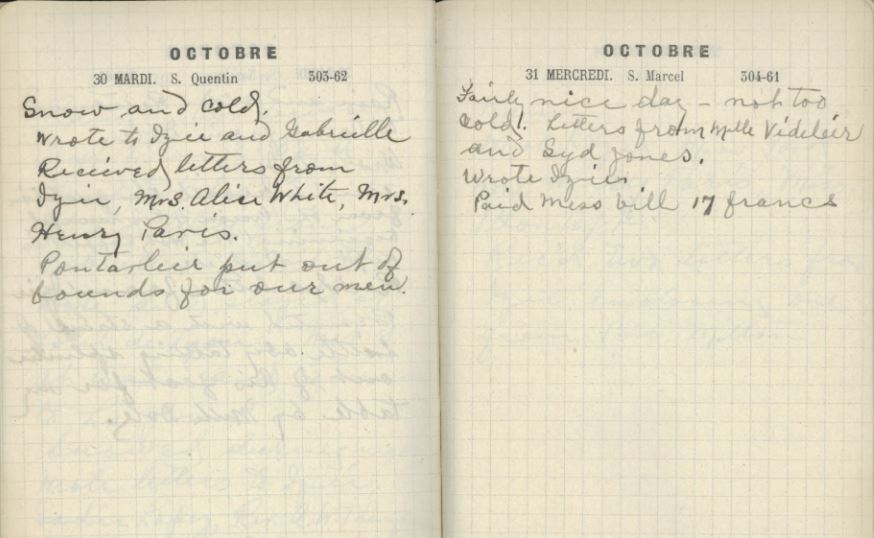
Two pages of a personal diary. The date is printed at the top of each page, October 30 and 31. Underneath it, Captain White wrote general observations about the weather, letters he wrote and received, and life in camp.

Two pages from the personal diary of Captain William  “Andrew” White, the unit’s chaplain (e011183038)

Day-to-day life in the unit

Two digitized documents allow you to explore the unit’s daily activities:

  • The personal diary of William “Andrew” White, No. 2 Construction Battalion’s chaplain. We believe that this is the only first-hand account written by a member of the unit.
  • The War Diary. Units on active service were required to keep a daily account of their activities. While war diaries do not focus on individuals, they describe the events that took place each day.

How the Canadian military managed the unit

LAC has digitized about half of the administrative, organizational and historical records relating to the unit. These documents provide insights into how the Canadian military managed the unit and the men belonging to it.

Digitized resources documenting No. 2 Construction Company held at LAC

Basic information about the unit

Other photographs depicting Black soldiers

Note that LAC holds many other photos showing Black soldiers, but these cannot be found in a regular search, since that information was not included in the original title.

Recruiting poster

Digitized textual records

Courts martial

Digitized records of courts martial involving members of No. 2 Construction Company and other Black men are available on Canadiana.org (Please note that the list below may not be complete)


Andrew Horrall is an archivist at Library and Archives Canada. He wrote the blog and, with Alexander Comber and Mary Margaret Johnston-Miller, identified records relating to the battalion.

Serving despite segregation: No. 2 Construction Battalion

Version française

By Andrew Horrall

Library and Archives Canada (LAC) holds the largest collection of records documenting No. 2 Construction Battalion, a segregated unit of the Canadian Expeditionary Force in the First World War. They wanted to fight, but racist attitudes among political and military leaders, and in society in general, prevented them from serving in the front lines. Instead, the unit was assigned to the Canadian Forestry Corps. The men spent the war in the French Alps, cutting down trees, milling raw logs into finished lumber and transporting the wood to the railway. The work was vital, since huge quantities of wood were needed to build and reinforce front-line defences, but it was far from the type of service that the men had hoped for.

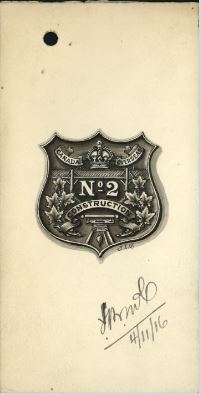
A black-and-white drawing of a badge in the shape of a shield. At the top is a royal crown and a banner reading “Canada Overseas.” Beneath are the words “No. 2” above another banner with the word “construction.” Maple leaves adorn each side, and a wooden bridge below the crown and a tool under the second banner symbolize that the unit’s members were builders.

The cap badge for No. 2 Construction Battalion (e011395922)

Canadian Expeditionary Force service files

  • (unit members are identified by “No. 2 Construction Battalion” in the database’s “Unit” field

Users should be aware that the military service files of over 800 men indicate No. 2 Construction Company as their unit, though many of these men never actually served with No. 2 Construction Company. Instead, they served with other CEF units. The reasons for the discrepancy between the information in personnel files and unit files is not entirely clear. It is likely that Canadian military authorities intended for the men to serve with No. 2 Construction Company, but pressing needs caused them to assign the men to other units. In other cases, the war may have ended before individuals could physically join No. 2 Construction Company.)

The unit was mobilized at Truro, Nova Scotia, in July 1916. It recruited from established Black communities in the Maritimes, southwestern Ontario, and across Canada, the Caribbean and the United States. At least two members were from much farther away: Cowasjee Karachi (regimental number 931759) came from modern-day Yemen, and Valdo Schita (regimental number 931643) was born near Johannesburg, South Africa.

A black-and-white photograph depicting 21 soldiers. They are casually posed outdoors, either sitting or standing on a pile of long wooden planks. Eight of the men appear to be in Russian uniforms, and the rest are Canadians, including two Black men.

Lt. F.N. Ritchie, Lt. Courtney and a few of the enlisted men of the Canadian Forestry Corps in France. This is the only photo of the unit held in the collection at LAC (a022752)

While the unit was composed of Black men, the officers were white, apart from the chaplain, Captain William “Andrew” White.

The unit is referred to by both the terms “battalion” and “company” in archival documents and published sources. It was originally created as a battalion, a unit composed of about 1,000 men in the Canadian Expeditionary Force. When only about 600 men arrived in England in 1917, military authorities redesignated it as a company, which better reflected its size.

The unit returned to Canada at the end of the war and was officially disbanded in September 1920. The story of No. 2 Construction Battalion faded over time, until families, community members and historians began recovering it in the early 1980s. By that time, there were only a handful of surviving members.

A note about terms used in the records

Many of the records documenting No. 2 Construction Company contain terms that were commonly used during the First World War but are no longer acceptable. LAC has replaced such terms in descriptions, but they are still found in many of the original documents. The use of these terms by military authorities is evidence of the racism faced by the men in the unit.


Andrew Horrall is an archivist at Library and Archives Canada. He wrote the blog and, with Alexander Comber and Mary Margaret Johnston-Miller, identified records relating to the battalion

Breaking ground: 150 years of federal infrastructure in British Columbia – Northwest Region: The Dominion Telegraph Service’s Yukon Telegraph Line

By Caitlin Webster

British Columbia joined Canada 150 years ago, and in the years that followed, federal infrastructure expanded throughout the province. This infrastructure is well documented throughout Library and Archives Canada’s collections. This eight part blog series highlights some of those buildings, services and programs, as well as their impact on B.C.’s many distinct regions.

As British Columbia negotiated its terms for joining Confederation, one of the conditions included the establishment of a telegraphic service. Canada’s Dominion (or Government) Telegraph Service, which formed part of the Department of Public Works, was responsible for providing this. It operated telegraph lines in remote areas not covered by railway telegraph systems or private firms. In B.C., the federal government operated lines in the south and on Vancouver Island, and as it expanded its presence in northern B.C. and Yukon in the 1890s, work began on the Yukon Telegraph Line.

In 1899, the Privy Council Office approved the construction of a telegraph line between Dawson City in what is now Yukon and Bennett, B.C. Now a ghost town, Bennett was once a thriving centre for the Klondike Gold Rush.

Black-and-white photograph of the town of Bennett, B.C., at the edge of Bennett Lake. There are buildings and temporary structures along the shoreline, with a mountainside in the background and a wooden bridge in the foreground.

Part of Bennett, B.C. (a016295-v8)

Soon after the line to Bennett was completed, work began on a branch line to Atlin, and then an extension from Atlin to the transcontinental line at Quesnel. This work finished in 1901, although the construction of various branch lines continued over the next decade. As the construction work progressed, the Department of Public Works built telegraph offices and stations at regular intervals along the line. Stations in towns and settlements often housed other federal government services such as post offices and customs houses. Operators at these stations worked regular business hours and enabled customers to send and receive telegrams.

Black-and-white photograph of the three-storey post office building in Atlin, B.C. A sign on the building reads “Dominion Government Telegraph Office.”

Post office in Atlin, B.C. (a046672-v8)

To help ensure that the line had sufficient voltage to carry telegraph messages between the stations, crews also constructed intermediate battery stations, also known as repeater stations, along the more remote sections of the line. At first, these “bush stations” were simple one-room cabins, housing both the assigned operator and the lineman. As these sites rarely saw customers requesting telegrams, both operators and linemen undertook the difficult work of keeping the telegraph wires in good order. In the summer of 1905, crews built second cabins at these isolated stations to ease some of the difficulties of living in such close quarters.

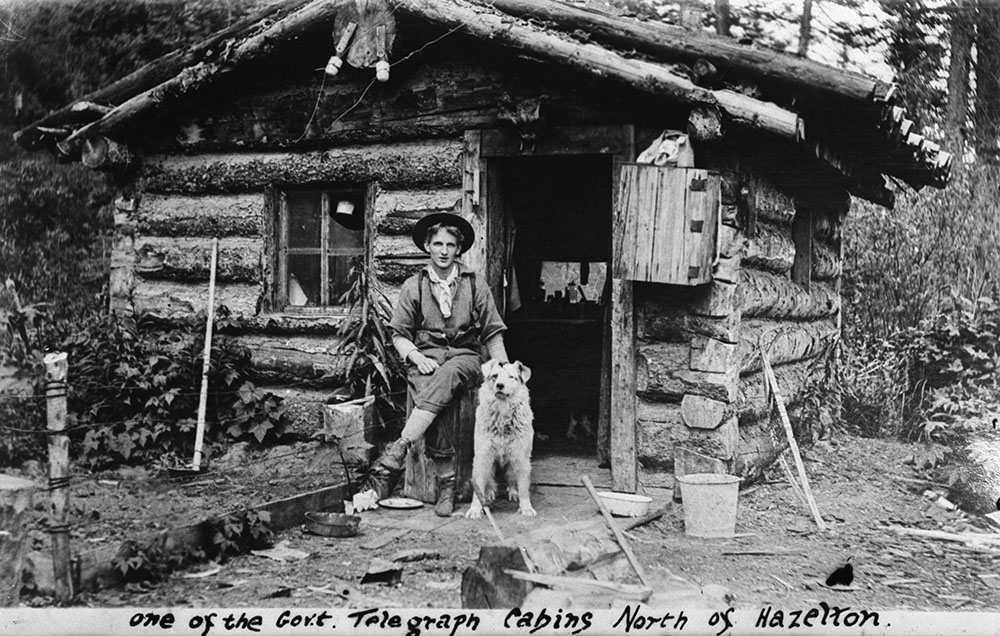
Black-and-white photograph of a young man and his dog sitting in front of a one-room log cabin.

One of the government telegraph cabins [Dominion Government Telegraph cabin, North of Hazelton; telegraph operator Jack Wrathall and dog sit in front of the cabin] (a095734-v8)

Even smaller were the refuge cabins, where linemen could stay overnight if caught in bad weather while maintaining the line. Spaced approximately 10 miles (16 kilometres) apart, these small 8 x 10-foot (2.4 by 3 metres) cabins contained a stove, bunk and limited food supplies.

The telegraph lines affected local First Nations, ranging from the Lhtako Dene, Nazko, Lhoosk’uz Dene and ?Esdilagh Nations near Quesnel to the Taku River Tlingit First Nation in Atlin. Early work on telegraph lines in the 19th century often proceeded without consultation or agreements with First Nations, which led to confrontations when work crews trespassed on their land. A number of First Nations made use of materials left from earlier abandoned telegraph lines, using the wire on bridges and traps. Some First Nations men worked on the telegraph lines, serving as construction workers, linemen and pack-train operators. The most famous among them was Simon Peter Gunanoot, who helped to construct the line and later worked delivering provisions to the bush stations. Accused of murder in 1906, he evaded searchers for 13 years before turning himself in. At his trial in 1919, a jury acquitted him in a mere 15 minutes, and his remarkable story has since inspired books, documentaries and short films.

By the 1920s and 1930s, the federal government began replacing telegraph lines with radio and telephone communications. At the same time, interest in the line as a trail for adventure hiking grew. While the federal government sold off or abandoned the last portions of the Yukon Telegraph Line by 1951, parts of the line are still used by guide outfitters today.

To learn more about the Yukon Telegraph Line, check out the following resources:

  • “A socio-cultural case study of the Canadian Government’s telegraph service in western Canada, 1870–1904,” John Rowlandson thesis, 1991 (OCLC 721242422)
  • Wires in the Wilderness: The Story of the Yukon Telegraph, Bill Miller, 2004 (OCLC 54500962)
  • Pinkerton’s and the Hunt for Simon Gunanoot: Double Murder, Secret Agents and an Elusive Outlaw, Geoff Mynett, 2021 (OCLC 1224118570)

Caitlin Webster is a senior archivist in the Reference Services Division at the Vancouver office of Library and Archives Canada.

A page in Canada’s history: Carnegie libraries

By Sara Chatfield

A black-and-white photograph of a two-storey stone building with a columned portico and ivy growing up its sides.

The Ottawa Public Library opened in 1905, funded by a Carnegie grant. (a044774-v8)

Libraries have always been special places for me. When I was young, my grandmother worked as a reference librarian at my local library, making my visits to the library extra memorable. I have always appreciated the scope of what you could find within the walls of a library: I loved the books, the magazines and chatting with the librarians about new arrivals. But the thing I loved most (and still love most today) about libraries are the buildings that house library collections, especially historic Carnegie library buildings. Carnegie libraries are distinctive buildings built in the late 1800s and early 1900s by Andrew Carnegie to promote free library access in North America and the world.

A colour photo of a one-storey building with brown-brick exterior walls and a green roof. A small set of stairs and a railing lead up to the entrance.

The Renfrew Public library, built in 1919/1920 and funded by a Carnegie grant. Photo credit: Sara Chatfield

To me, Carnegie library buildings have a majestic yet welcoming appearance. The early buildings (1901–1905) were not designed according to standardized plans. The architects, who hailed from Canada and the United States, were free to use their imaginations. Later buildings have similar design elements, such as arched windows, cupolas, porticos and symmetrical columns.

A black-and-white photo of a two-storey building with a columned portico. A man is walking in front of the building. Power lines can be seen to the right and behind the building.

The Galt Public Library, built in 1903, through a Carnegie grant given in 1902 (a031832)

I am not alone in my love of Carnegie library buildings. A former Ontario Minister of Citizenship and Culture once wrote that “Carnegie libraries represent a significant part of the cultural history and architectural heritage of Ontario.”

Carnegie libraries would not have existed without Andrew Carnegie and his lifelong love of libraries and learning. Andrew Carnegie (1835–1919) was born in Scotland and immigrated to the United States with his family in 1848. He amassed a fortune with his Carnegie Steel Company, which he sold in 1901. He placed the money from the sale in trust for philanthropy, which became his main occupation. In total, the philanthropist gave grants to build 2,509 free public libraries to English-speaking communities worldwide. Andrew Carnegie believed the best way to provide free education and foster growing communities was to establish public libraries.

A black-and-white photograph of two ornate buildings, one with a columned portico and a cupola. People walking, a street car, and power lines are in the foreground.

The Vancouver Public Library (right) opened in 1903 with funding from a Carnegie grant. Since 1980, this building has served as the Carnegie Community Centre, which houses a library branch on the main floor. (a009531)

Carnegie provided the grant for each library building, but did not contribute funds towards the purchase of books or staff salaries. To secure a Carnegie grant for a library, cities and towns had to fulfill the “Carnegie Formula.” Among other criteria, this formula stipulated that cities provide the site, guarantee an annual budget and ensure free public access. Many applications for grants were refused because a town or city already had adequate library services or would not be able to guarantee the yearly funds needed for the upkeep of the facility. Some communities did not apply for or accept money from the Carnegie foundation, as they viewed Andrew Carnegie as a robber baron and disapproved of his business methods.

Of the 2,509 Carnegie libraries built in the early 1900s, 125 were constructed in Canada. Of those 125 libraries, 111 were built in Ontario. The majority of the libraries were built in the United States and Great Britain/Ireland. Carnegie libraries were also built in South Africa, Australia, Serbia, New Zealand, Fiji, Mauritius, Barbados and Guyana, among other places.

A colour photo of a brown-brick building with several beige accent columns as well as pediments and curved windows. There are red flowers to the left in the foreground.

The former Perth Carnegie Library, now known as the Macmillan Building. The two-storey library was designed in the Beaux-Arts style by renowned architect Frank Darling. The building was severely damaged by fire in 1980 and restored in 1982. Photo credit: Emily Tregunno

I have always found it interesting that the Carnegie Foundation gave grants to build libraries in both small towns and large cities. For example, in 1901, a grant was given to Ayr, Ontario, whose population was 807. At the time of construction of its Carnegie library, Perth, Ontario, had a population of slightly more than 3,500 residents.

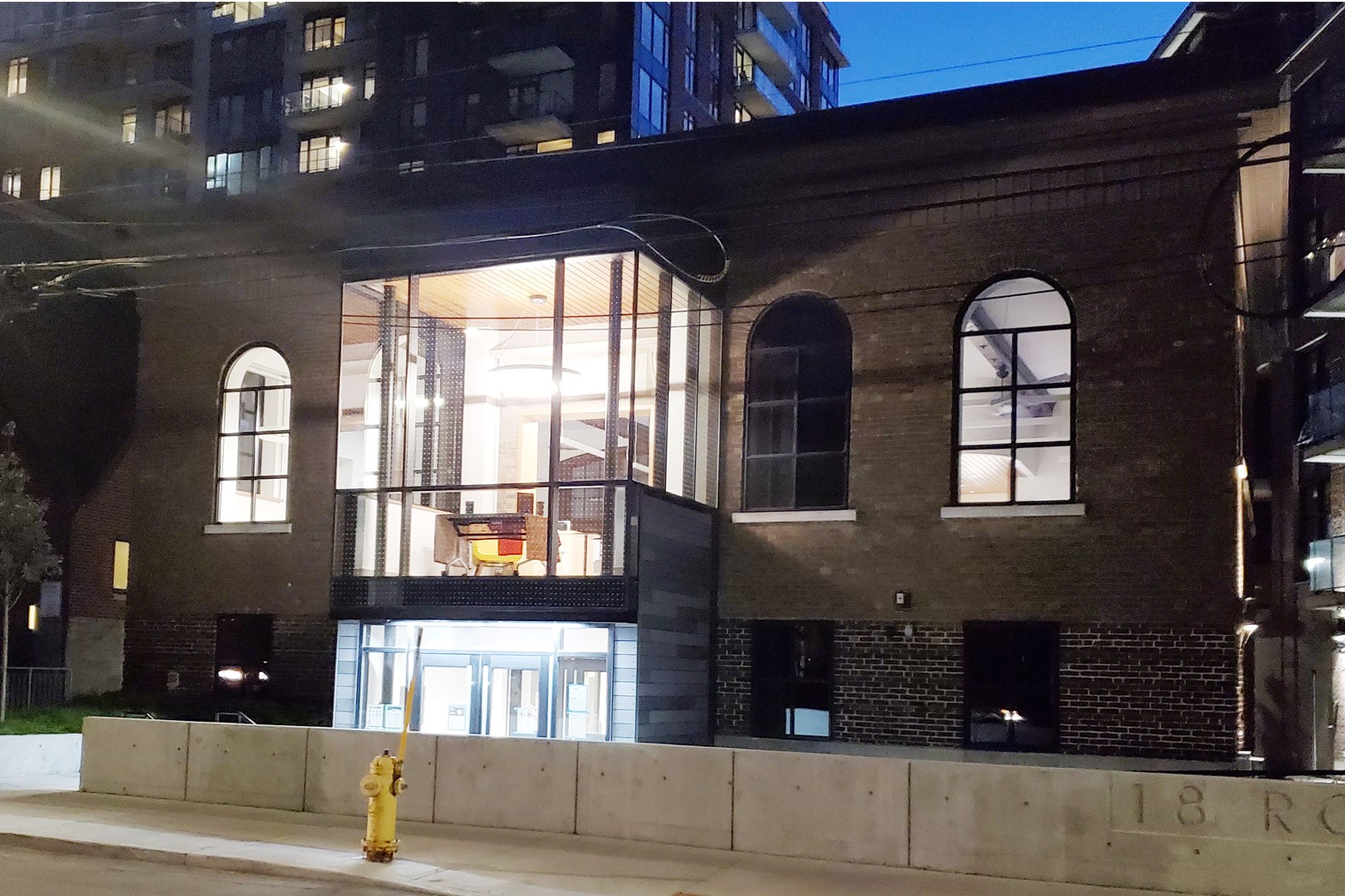
A brown brick 2 storey building with curved windows on the top floor. The entrance is glass and there is a yellow fire hydrant in the foreground.

Ottawa’s Rosemount Branch of the Ottawa Public Library, built in 1918. A major renovation to upgrade the branch took place recently. Photo credit: Sara Chatfield

Many library collections outgrew their original Carnegie library buildings. Some of the buildings have been torn down, some have been damaged by fire, some of the buildings have been repurposed, and some municipalities have chosen to expand and renovate. Ottawa’s Rosemount Branch, originally known as the Ottawa West Branch, is an example of a Carnegie building that has undergone substantial renovations. Interestingly, the 1917 grant to build the Ottawa West/Rosemount Branch was the last of its type given in Canada.

A black-and-white photo of a two-storey square building with a large number of pedimented windows, a columned portico and a small balcony. There is text written across the bottom, which reads “HJW, 1788, Dawson Yukon, Carnegie Library July 1907.”

The Dawson City, Yukon, Carnegie Library. The grant for this library was given in 1903. The building was designed by Robert Montcrieff. Construction was completed in 1904. (a016721-v8)

Unfortunately, some communities could not sustain the financial strain of maintaining a library. The Dawson City library, built in 1903/1904 was popular and well attended. However, by 1920, the city’s population had shrunk to fewer than one thousand people, and the city could not continue to fund the institution. In 1920, the building was sold to the Masonic Lodge.

A black-and-white photo of a two-storey square building with several windows, some of them arched, an arched entrance, and columns. The building is surrounded by a decorative metal gate. There is text written across the bottom, which reads “Carnegie Library.”

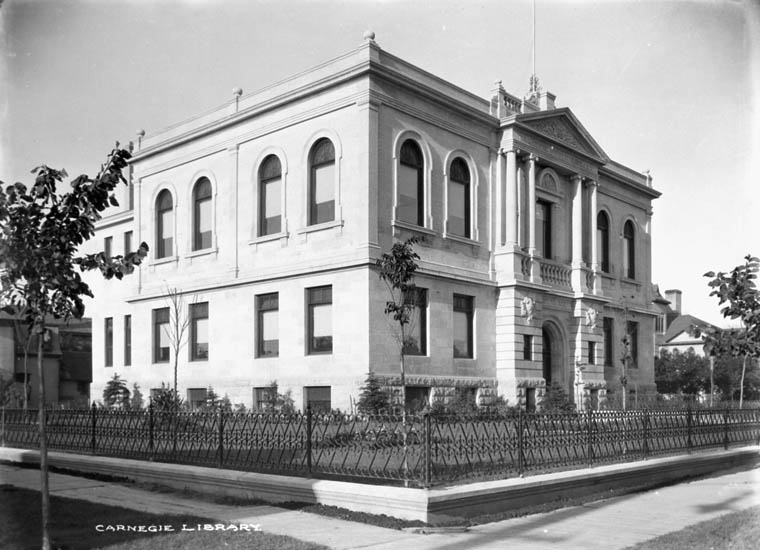
The Winnipeg Carnegie Library, built in 1904/1905. This was the city’s first public library. It served as the city’s main branch until 1977. (a031593)

From 1995 to 2013, the Winnipeg Carnegie Library building was home to the City of Winnipeg Archives. According to a 2019 report by the Association of Manitoba Archives, construction was under way in 2013 to transform the former Carnegie Library into state-of-the-art facilities for the municipal archives, when an intense rainstorm damaged the roof and sent staff and the archive holdings to a temporary warehouse location.

Of the 125 library buildings built in Canada from 1904 to 1922, approximately 20 have been demolished. Several of the buildings are still being used as libraries as originally intended.

  • A colour photograph of a brown-brick building with a curved entrance. Two short flights of stairs lead to the building entrance.
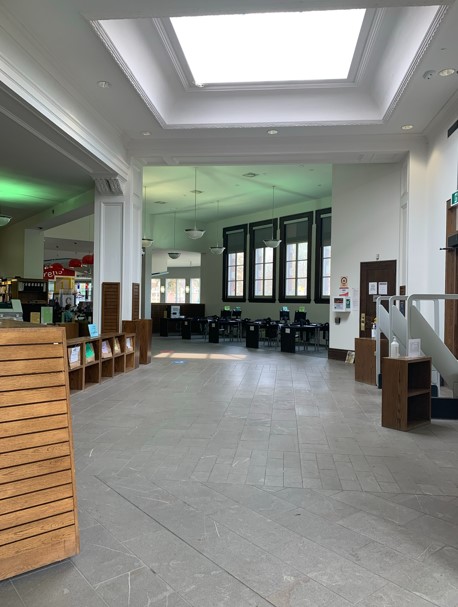
  • A colour photograph of the inside of a library. A large skylight, book shelving and computer terminals can be seen in the room. There are four windows at back.
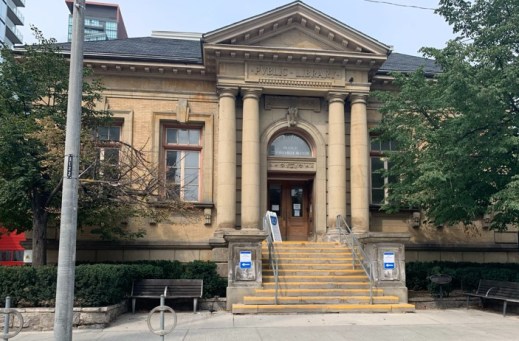
  • A colour photograph of a beige building with a columned entrance and a pediment above the front door. There is single set of stairs leading to the building. The words “Public Library” are etched above the entrance.
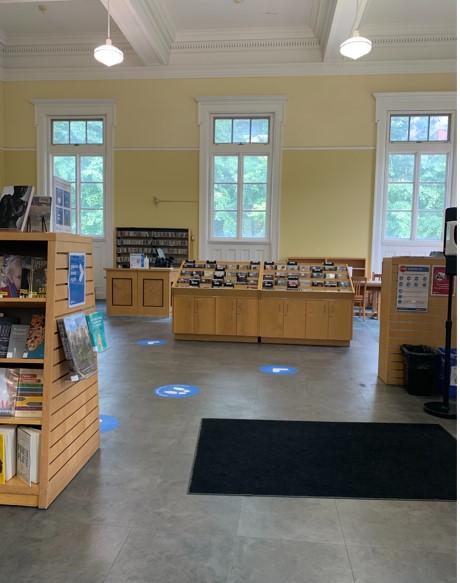
  • A colour photograph of a large room with three windows, two hanging lights, a black mat and book shelves.
 

Keep an eye out for these historic buildings. You might come across one in a small town near you!

Additional resources:

  • Local Library, Global Passport: The Evolution of a Carnegie Library, by J. Patrick Boyer (OCLC 191759655)
  • The Man Who Loved Libraries: The Story of Andrew Carnegie, by Andrew Larsen and Katty Maurey (OCLC 970404908)
  • The Best Gift: A Record of the Carnegie Libraries in Ontario, by Margaret Beckman, Stephen Langmead and John Black (OCLC 11546081)
  • Ottawa Carnegie Library – Application for State papers (RG2, Privy Council Office, Series A-1-a, vol 964)

Sara Chatfield is a project manager in the Exhibitions and Online Content Division at Library and Archives Canada.

Women in the war: a Co-Lab challenge

By Rebecca Murray

Canadian women are part of the photographic record of the Second World War. The Department of National Defence fonds (RG24/R112) includes over two million photographs, from Comox in British Columbia to Naples in Italy. These women are our great-grandmothers, grandmothers, mothers, aunts, sisters, cousins and friends.

This Co-Lab challenge invites you to identify servicewomen and nursing sisters who served in Canada and abroad between 1942 and 1945. The photographs range from images of a single person to large groups. The selected photographs depict them at work and play, on ships, in kitchens and libraries, playing sports and dancing. In most cases, none of the women have been identified; in fact, the word “unidentified” is often part of the title of the image.

Identifying these individuals is key to having a better understanding and knowledge of the roles they played during the Second World War. In tandem with other efforts to identify images of servicewomen and nursing sisters within the archival record, this Co-Lab challenge will help to expand the narrative.

Can you help us to identify these women who served? Here are some examples of the photographs you will find in the challenge.

A black-and-white photograph of a woman in a military uniform looking at the camera. She has a pen in her right hand, papers on her desk and a black candlestick-style telephone to her left.

An unidentified member of the Canadian Women’s Army Corps (CWAC), England, July 19, 1944. Credit: Capt. Jack H. Smith (a162428-v6)

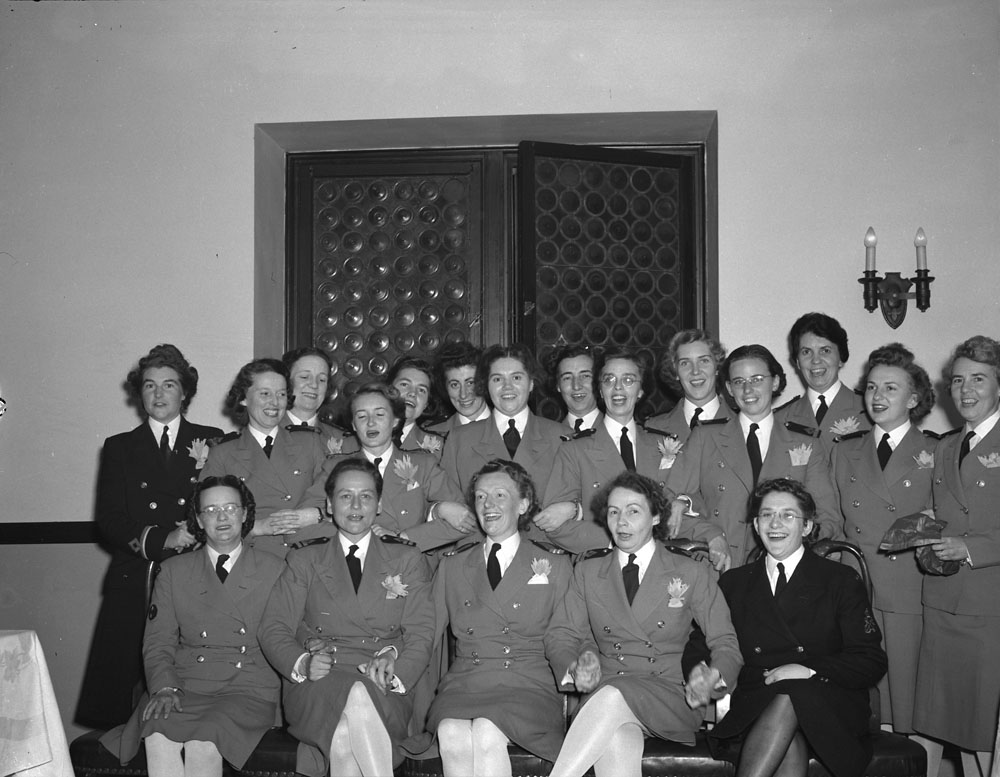
A black-and-white photo of a group of women in military uniforms smiling at the camera. There are two women in dark suits. The women in the first row are seated and holding hands. Some of the women standing in the back row have their arms linked.

Women’s Royal Canadian Naval Service members (“Wrens”), August 1943 (e011180809)

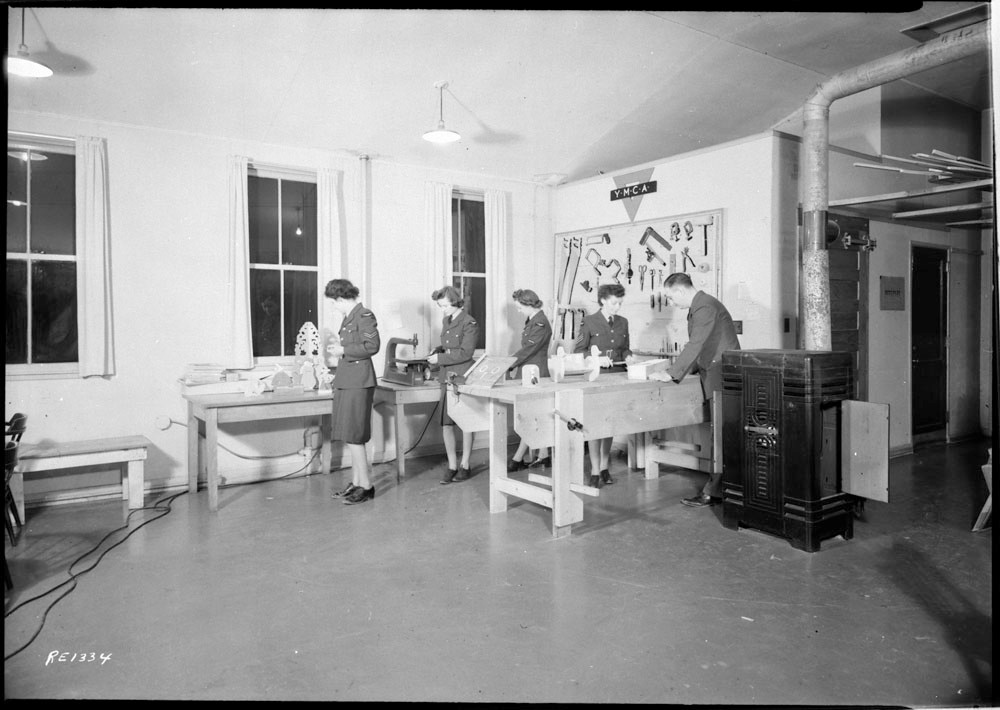
A black-and-white photo of four women and a man in a shop with tools and tables. There are three windows and a sign that reads YMCA.

Royal Canadian Air Force Women’s Division craft shop, Rockcliffe, Ontario, April 11, 1944 (a064867-v8)

To search the holdings at Library and Archives Canada for other photographs of servicewomen and nursing sisters, use Collection Search to explore accession 1967-052, where photographs are organized by branches of the armed forces, or try a keyword search (e.g. 1967-052 Halifax Wren).

For more information on the women’s divisions in the three branches of the Canadian Armed Forces during the Second World War, please refer to these blog posts:

Canadian women served in numerous capacities throughout the Second World War—well beyond what is represented in these photographs. Naming these women and identifying them within the archival record will build a more inclusive narrative and allow generations of servicewomen, their families and Canadians to recognize and highlight the extraordinary roles that they played during the Second World War.

We invite you to use our Co-Lab tool to transcribe, tag, translate and describe digitized records in this challenge. You can also make contributions to any image through our Collection Search tool.


Rebecca Murray is a Senior Reference Archivist in the Reference Services Division at Library and Archives Canada.

Summiting Mount Logan in 1925: Fred Lambart’s personal account of the treacherous climb and descent of the highest peak in Canada – A Co-Lab Challenge

By Jill Delaney

When Howard “Fred” Lambart’s (1880–1946) painful, frozen feet finally touched solid ground again on July 4, 1925, he thought he would feel elated. After all, it had been 44 days since he and his fellow mountaineers had made contact with anything other than snow and ice on their ascent of Mount Logan, Canada’s highest peak (5,959 m). The expedition had exhausted them all, and Lambart could only manage a sense of relief at having made it this far. There were still 140 kilometres of hard travel to go before they reached the town of McCarthy, Alaska.

A sepia coloured photograph of a group of men with Mount Logan in the background.

Photograph of the party taken by Captain Hubrick at McCarthy, Alaska. From left to right: N.H. Read, Alan Carpe, W.W. Foster, A.H. MacCarthy, H.S. Hall, Andy Taylor, R.M. Morgan, Howard “Fred” Lambart (e011313489_s1).

Lambart was part of a team of eight climbers assembled by the Alpine Club of Canada and the American Alpine Club in 1925 to tackle Mount Logan, located in the remote southwestern corner of Yukon Territory, in what is now Kluane National Park and Reserve. The mountain is in the Tachal Region of the Kluane First Nation’s traditional territory, “A Si Keyi.” The Lu’an Mun Ku Dan (Kluane Lake People) and the Champagne and Aishihik peoples have lived there for generations.

Most Lu’an Mun Ku Dan, Champagne and Aishihik First Nations people identify themselves as descendants of the Southern Tutchone. Others came from nations such as the Tlingit, the Upper Tanana and the Northern Tutchone. In the Southern Tutchone language, the indigenous peoples of this region are known as “the people who live beside the tallest mountains.”

Lambart had climbed many of the peaks surrounding Mount Logan as a surveyor for the Geodetic Survey of Canada. As part of this work, he had conducted photo-topographic work on the Yukon–Alaska border in 1912–1913.

No European settler had yet attempted to conquer the behemoth that is Mount Logan, the most massive mountain in the world. It was and still is a remote sub-arctic mountain, with notoriously terrible weather due to its proximity to the west coast. The 1925 climbing team, made up of Lead Captain A.H. MacCarthy, Assistant Lead Fred Lambart, Alan Carpe, H.S. Hall, N.H. Read, R.M. Morgan, Andy Taylor and W.W. Foster, hiked 1,025 km in 63 days. They carried packs of up to 38 kilograms for most of this time, and climbed a total of 24,292 metres, or more than four times the elevation of the mountain, in order to transport their supplies up the mountain themselves. Thanks to the Lambart Family Fonds at Library and Archives Canada (LAC), containing both Lambart’s personal diary and over 200 photographs taken during the expedition, we have a detailed and intimate account of the thrills and extreme hardships of this remarkable climb. Alan Carpe also created a documentary film, The Conquest of Mount Logan. It is a fitting time to revisit the event, with the recent completion of the first of two ascents in 2021–2022 by Dr. Zac Robinson, Dr. Alison Criscitiello, Toby Harper-Merrett and Rebecca Haspel, from the Alpine Club of Canada and the University of Alberta. Using photographs from the 1925 expedition, they are conducting a repeat photography project, as well as an ice-coring project, to better understand climate and change.

Fred Lambart came from an upper-middle-class British-Canadian family, and graduated from McGill University with a bachelor’s degree in science. He initially worked on surveys for the Grand Trunk Pacific Railway, before becoming a Dominion Land Surveyor in 1905. His daughter Evelyn would go on to an illustrious career as a filmmaker at the NFB. His daughter Hyacinthe was an early female Canadian pilot. Tragically, his two sons, Edward and Arthur, were killed during the Second World War.

The 1925 Mount Logan expedition came during a period of very active mountaineering, when Europeans saw “conquering” summits as moments of national, colonial and imperial prestige. Several attempts to summit Mount Everest were made during this time. In 1897, the Italian alpinist the Duke of Abruzzi (reportedly having his packers carry his brass bed up the mountain for him) summited Mount St. Elias, the second-highest peak in the Canadian northwest. Lambart himself was recorded as the first European to summit Mount Natazhat (4,095 m), in 1913.

Preparations for the 1925 Mount Logan expedition began in 1922. They included fundraising and the selection of the team. All agreed that A.H. MacCarthy should lead, with Lambart named as assistant. MacCarthy scouted three different routes in the years leading up to the official expedition, returning to the mountain again in February 1925 to cache 8,600 kilograms of supplies in advance, at various points along the route.
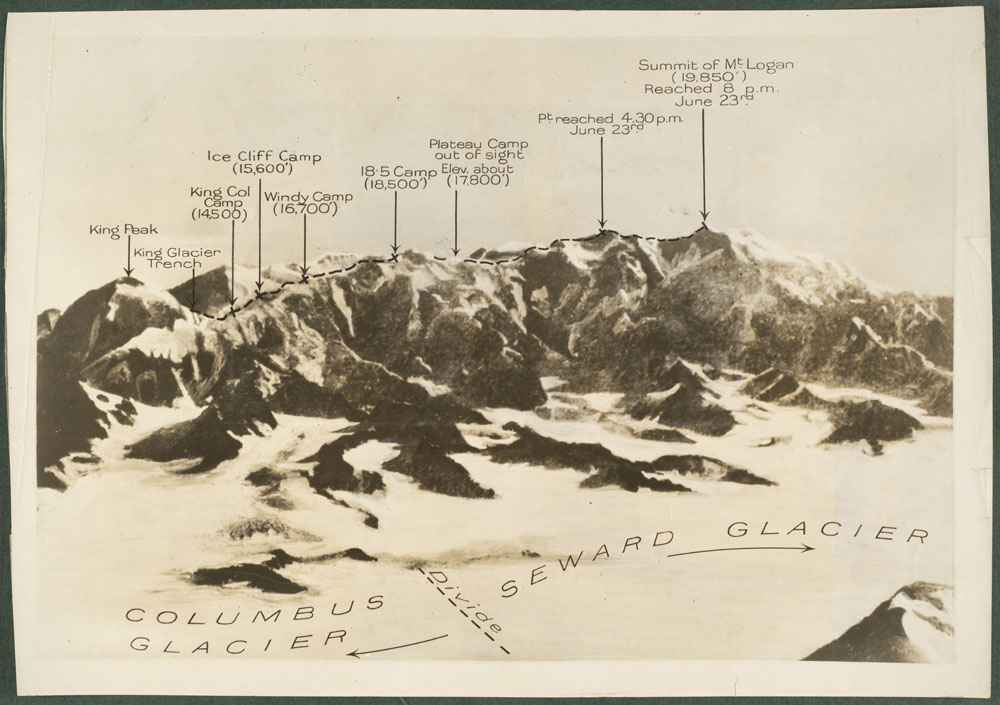
Photograph of Mount Logan with the names of the peaks and routes annotated.

Annotated photograph showing the route of the 1925 expedition (e011313492).

The team leaves McCarthy, Alaska, on May 12 and begins its climb on May 18. Much of the ascent is taken up with grinding slogs by the team members (they have no packers once they step foot onto the mountain) relaying their supplies up and down the glaciers to their various camps. Nevertheless, the alpinists do find moments to note the incredible beauty of their surroundings. On June 6, Lambart writes, “the early morning lighting on the mountains and lakes on the day developing into one of perfect clearness was a vision not to be forgotten.”

By June 11, while camping at King Col (5,090 m), the climbers’ exertion is beginning to show, along with signs of elevation sickness amongst a few of the members. Lambart reports shortness of breath, and Morgan and Carpe both vomit during the night, while MacCarthy’s eyes begin to suffer. “If Mac doesn’t let up there are a few that will not get through who otherwise could have done so,” writes Lambart. Discussions are held to try to convince MacCarthy to slow the pace.

The food supply begins to be something of an obsession, with Lambart’s calculations taking up more and more space on the pages of his diary. Lambart also notes that they plan to leave King Col the next day to try to make it to the summit and back in four days.
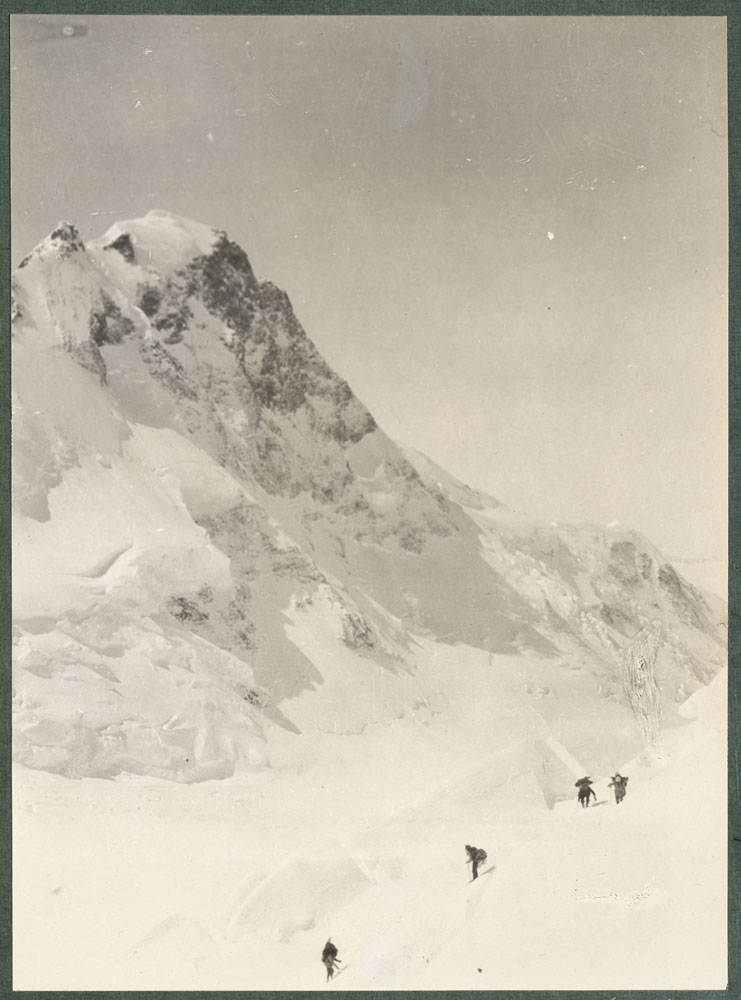
A photograph of Mount Logan with four climbers in the foreground.

Team members working a way up through the ice wall above King Col, King Peak towering above (e011313500_s1).

In reality, it takes another 10 days of exhausting climbing with snowshoes and crampons before they finally summit on June 23. The team begins to use ropes to keep team members safe as they tackle bad weather, steep climbs across icefalls, extreme cold and constant fatigue. Morgan, accompanied by Hall, turns back due to poor health. The remaining six continue to push upward, not knowing what lies ahead. While ascending what they think is the summit, Logan wrote the following:

[…] we saw straight off east about 3 miles the real summit of Logan which up to this time, I don’t think any of us had seen before. This was our goal, it was now 4:30 and the weather was holding.

A bit of up and down and a few switchbacks up the final steep, icy slopes—and, finally…

[…] we are on the top of the highest point in the Dominion of Canada. […] We all congratulated Mac and shook hands. […] Carpe ran the Bell and Howell a few seconds, Read took some snaps, but we were reminded by Andy that there was a storm brewing […]

Just 25 minutes is spent savouring their achievement. Almost immediately, the weather begins to close in around them, and the temperature drops rapidly. The sunshine they had enjoyed at the peak disappears as a heavy fog moves in, completely hiding any signs of the trail leading back to their camp. “We are in real peril,” Lambart later notes in his diary. Conditions are deteriorating so rapidly they decide to bivouac on a patch of steep hard snow, where they “were all burrowing like a bunch of rabbits,” to create shelters for the night. Lambart shares a burrow with Read, and gives his heavy coat to Taylor, who is on his own in another burrow. Much to his later misfortune, Lambart overcompensates with four pairs of socks in his boots, restricting the circulation to his toes. He wakes in the middle of the night to try to stamp some feeling back into them, but he will suffer from this miscalculation for the remainder of the expedition and beyond. Several of his toes were amputated later in life.
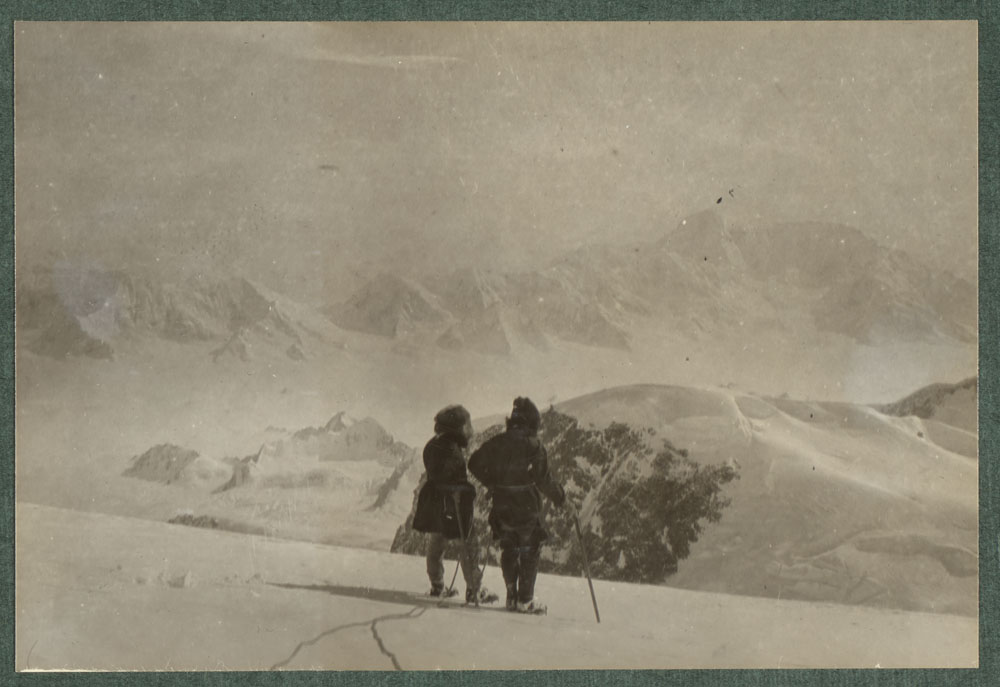
Photograph of two people standing side by side looking away from the camera.

Two members of the expedition looking out from King Ridge (e011313497_s2).

Although the mountain top remains shrouded in fog the next morning, they have no real choice but to continue in order to locate the trail to find their way back. In the process, both Taylor and Mac walk off cliffs they cannot see, falling several metres each, but without serious injury. Eventually they locate one of the willow poles they had placed every 150 feet as markers on the way up. Nevertheless, the ordeal is not over. The first rope becomes confused and marches in the wrong direction at one point, leaving them several hours behind the others in returning to camp. Lambart begins to hallucinate:

My glasses were dark and the scene ahead was of two figures constantly silhouetted against a dead whiteness where ground and sky was one. A strange imagination possessed me all the while that I could not drive away, namely, the presence of fences and fields and farms with habitations to right and left of us.

A much deserved day of rest follows, but they are back on the trail the day after, which Lambart finds to be “one of the most [difficult] tests of endurance and suffering of the whole trip.” MacCarthy’s obituary for Lambart later revealed that, on what is likely this same day (June 26), Lambart became exhausted in another bout of severe weather, and collapsed face down on their descent to the high-level campsite (5,640 m). He begged MacCarthy to leave him in order to save the others, “a murderous proposal” in MacCarthy’s mind, and Taylor supported him until they stumbled back to camp. Lambart remembers nothing of this.

The remainder of the descent goes relatively smoothly, with the temperature and the weather improving most days, and with the climbers having less equipment and supplies to carry. Additional days of rest are taken from time to time. The team begins abandoning supplies along the route, including Read’s diary, which is never retrieved. On July 1, the first signs of life are joyfully spotted—a bird at Cascade camp and bumble bees and flies at the Advance Base Camp below.

On July 4, their feet finally touch land again. Their relief is quickly dampened by the realization that bears had destroyed not just one, but two, caches of food the team had stowed for their return. Luckily, the next day, they find food that had been left hanging in a tree for them by a colleague. They celebrate that evening, but the next day are back hard at work, constructing rafts to carry them down the Chitina River in order to shorten their trek into town. The raft in which Lambart, Taylor and Read are travelling quickly transports them 72 km downstream to a meadow, from which they begin the final long hike of their journey. The raft conveying MacCarthy, Carpe and Foster follows, but “shot by us in a wider and better channel to our left. Mac held up his hand triumphantly as they went by. This was the last we saw of them.” Lambart, Taylor and Read arrive back in town late at night on July 12, racing each other the last few kilometres in their haste to arrive (in spite of Lambart’s very painful feet). There is no sign of the MacCarthy raft for several worrying days. MacCarthy, Carpe and Foster are finally located on July 15, having overshot their mark, tipped their raft and walked back toward McCarthy until they happened upon a road crew.

Lambart called the expedition “one of the strangest ventures of my life.” The men returned to their homes to much acclaim and publicity, with The New York Times naming Lambart one of the world’s greatest climbers. They wrote their report and printed their photos. Carpe developed and edited his motion picture, to be shown to appreciative audiences in the comfort of heated movie theatres and plush seats.

It would be 25 years before another team would attempt to climb Mount Logan. Today, climbers can fly onto one of the glaciers to avoid the long trek to the base of the massif. It is nevertheless considered to be one of the most challenging climbs in the world.

Our latest Co-Lab challenge allows users to tag images and transcribe entries from Lambart’s diary!

Other LAC resources:


This blog was written by Jill Delaney, Lead Archivist, Photography, in the Specialized Media Section of the Private Archives Division at Library and Archives Canada. Assistance was provided by Angela Code of the Listen Hear our Voices initiative.

The Dinosaurs of St. George’s Island, Calgary

By Richard Howe

One day in the 1930s, a group of people were enjoying a beautiful day on the park grounds of central Calgary’s St. George’s Island. The group’s peaceful picnic was disturbed when a drunk man appeared and began to bother them. A park officer approached, and the man, sensing danger, ran away unsteadily. Pursued by the park officer, the intoxicated man just barely managed to navigate the park’s pathways. Then, suddenly, he stopped in shock, staring spellbound at the bright green dinosaur standing right in front of him. After a short pause, the man straightened up and turned around, heading directly for the park’s exit. As he exited the park, his strides were steady. The park officer abandoned his pursuit, deciding that the shock had sufficiently sobered the troublemaker.

If you have some doubts about this story, I don’t blame you, but The Calgary Daily Herald reported on the incident shortly after it was alleged to have occurred. And the part about dinosaurs on St. George’s Island, at least, is true. Back in the late 1930s, there were close to 20 different prehistoric creatures there, and by the 1970s, there were over 40. These life-sized concrete sculptures were part of the Natural History Park at the Calgary Zoo. All of them are gone now, except for one. By the time I was old enough to visit the zoo on St. George’s Island, I didn’t even know that the others had been there at all.

The story about the drunk man comes from the front page of the newspaper on August 28, 1937, in an article about the completion of the new “Dinosaur Gardens.” In the accompanying photo, three human figures gather around the feet of a giant brontosaurus sculpture, not even reaching the dinosaur’s knees. That dinosaur—120 tons, 10 metres high, 32 metres long—would quickly become known as “Dinny,” and over 80 years later, it is the sole surviving dinosaur sculpture still standing on St. George’s Island.

A large sculpture of a brontosaurus in front of some tall trees, with two children running toward it.

“Dinny” is the last dinosaur sculpture remaining on St. George’s Island (e010973614)

As a child growing up in Calgary in the late 1980s and early 1990s, I remember that Dinny held a special place in the hearts of many adult Calgarians. It was notable how often they spoke of their fond memories of visiting the zoo as children and of climbing Dinny as a rite of passage. The urban landscape changes quickly in Calgary. The preparations for the 1988 Olympics had recently transformed much of the city’s downtown. If being a dinosaur wasn’t enough, Dinny was special just because it was something from Calgary’s ever-vanishing past.

The suggestion for building a dinosaur park in Calgary is said to have come from zoo society member (and later zoo society president from 1959 to 1965) Lars Willumsen after he visited the dinosaur park in Tierpark Hagenbeck (Hagenbeck Zoo) in Hamburg, Germany, in 1934. The world’s very first dinosaur park had been built back in 1854, in Crystal Palace Park in London, England. A few other parks, like the one in Germany, had sprung up around the world in the decades since. One of the goals of these parks was to help the public to understand the emerging field of paleontology and its discoveries, and to provide this education in an entertaining way.

Work on Calgary’s Natural History Park started in 1935. Alberta had been especially hard hit by the economic problems of the 1930s, but despite a meagre budget, a determined group of people were able to make something that the city would be proud of for years to come. Sculptor Charles A. Beil, a well-known artist living in nearby Banff, was recruited to help design the first dinosaurs. He was aided by engineer Aarne Koskeleinen and sculptor John Kanerva, who helped to figure out the method of construction and ended up doing most of the physical work. Charles Mortram Sternberg, a paleontologist working for the National Museum of Canada (a precursor to the Canadian Museum of Nature), was provided by the federal government to consult and guide the project and to ensure that the representations were appropriate and accurate. Dr. Omer H. Patrick, founding president of the Calgary Zoological Society since 1929, spearheaded the project. When Dr. Patrick presented the park to the city, former prime minister R.B. Bennett was invited to give the dedication address. “It was his initiative, foresight and expenditure which made this thing possible,” Bennett said of Patrick. “He took the lead.”

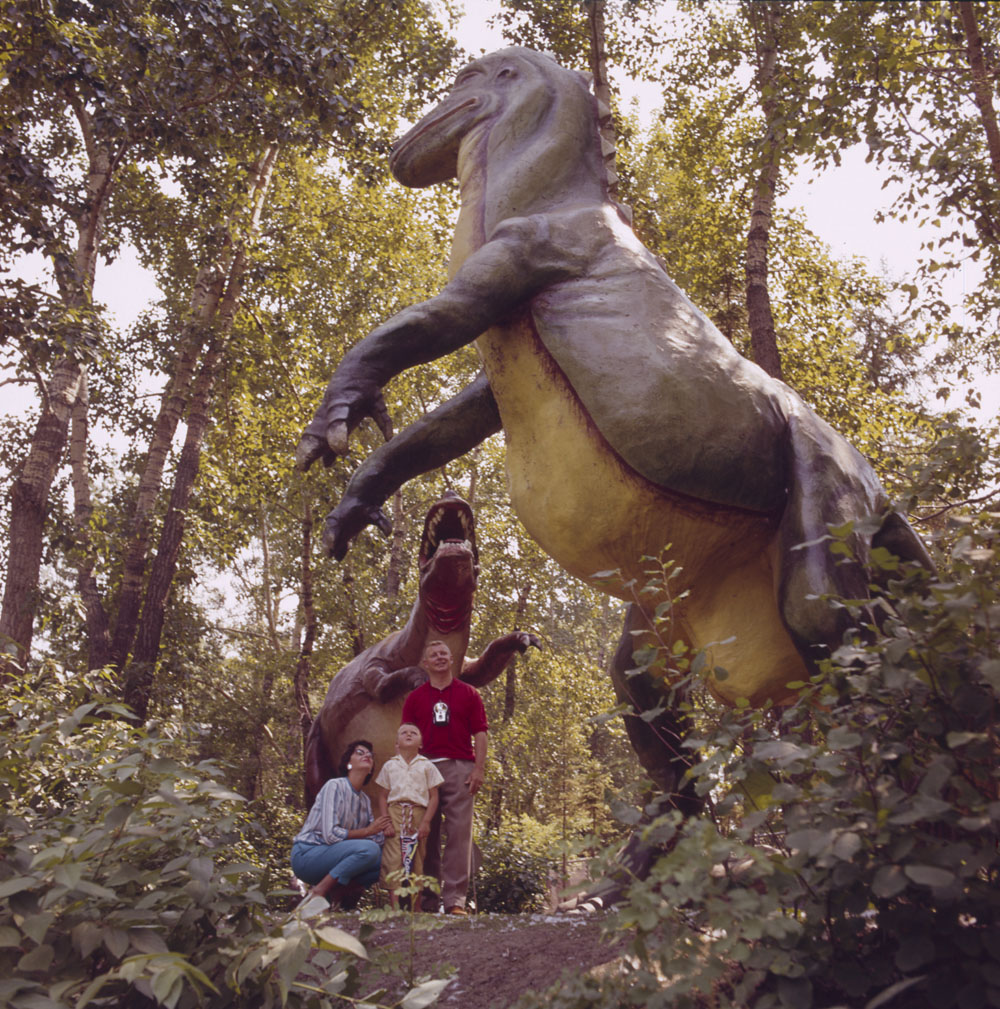
A woman, child and man stand under a large model of a dinosaur, surrounded by trees. The group is looking toward another dinosaur model.

Tourists admire sculptures of dinosaurs on St. George’s Island in Calgary, Alberta, in 1961 (e010976082)

The park turned out to be a great success and a popular tourist attraction. In 1952, one of the first-ever CBC television news broadcasts featured a story on the Natural History Park. When Scottish paleontologist Dr. William Elgin Swinton visited the park in 1957, he told stories of British service members who brought back postcards from the dinosaur park after serving in Canada during the Second World War. It became local legend that Dinny was the most-photographed object in all of Calgary. Dinny was made the zoo’s official symbol in 1959 and even appeared on the cover of an issue of Maclean’s magazine the following year. Until 1967, when the Husky Tower (four years later renamed the Calgary Tower) was built, Dinny was probably Calgary’s best-known landmark.

Today, near where Dinny stands, a bronze plaque commemorates the Natural History Park and the people who worked to create it. The names of Patrick, Willumsen, Sternberg, Beil, Koskeleinen and Kanerva are listed as founders. The plaque was unveiled in 1974 in a small ceremony near the park’s entrance. Dr. Patrick had died in 1947, but the five other men, most of them in their eighties, attended the ceremony.

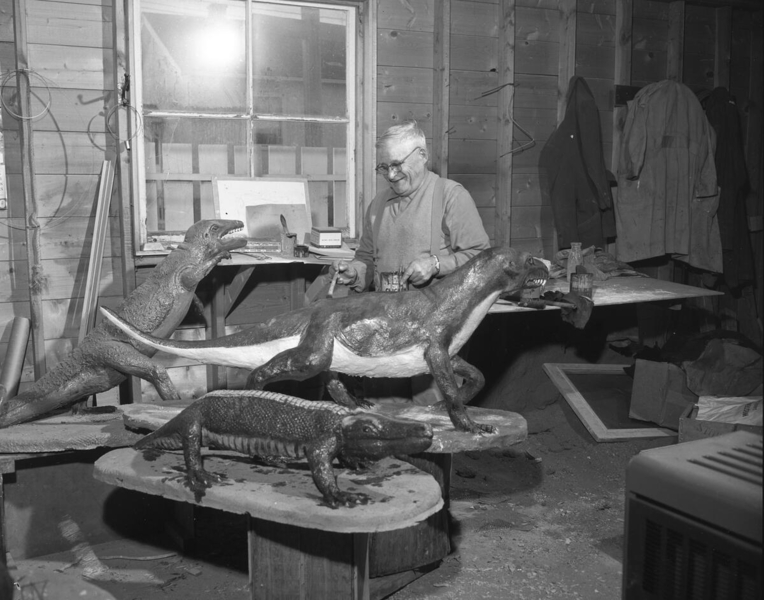
A man is in a garage or workshop, standing near three sculptures of prehistoric reptiles and holding a can of paint and a paintbrush in his hands.

John Kanerva with some of his creations. Published in The Albertan, November 14, 1956 (Jack De Lorme, “John Kanerva, dinosaur builder, Calgary, Alberta,” 1956-11 [CU1139955]. Courtesy of Libraries and Cultural Resources Digital Collections, University of Calgary)

It was John Kanerva’s name that was mentioned the most. After the park and dinosaurs were built, Kanerva had continued to work at the zoo, making new dinosaurs and maintaining the originals. They became his life’s work. “Yes, John did most of it,” Dr. Sternberg said at the ceremony. Kanerva’s long association with Calgary’s beloved dinosaurs—and especially his role as Dinny’s sculptor—had made him a minor local celebrity. Sitting in his wheelchair as the plaque was uncovered, the 91-year-old smoked a thin cigar. He was surrounded by his family, friends and former colleagues, who applauded as bagpipes played. Many had been pushing the city for years to honour Kanerva and the other men with a permanent landmark, and Alderman Tom Priddle, who unveiled the plaque, apologized for the delay.

In 1975, the Calgary Zoo announced an extensive 10-year redevelopment plan. As Calgary had grown, so had the zoo and its reputation. With the goal of improving living conditions for the zoo’s animals, the decision was made to make room on St. George’s Island for new and expanded animal habitats.

This would be the end for the Natural History Park. However, owing to its popularity and history at the zoo, a new Prehistoric Park was planned just north of St. George’s Island, on the other side of the Bow River. The original plan was to move many of the original dinosaurs to the new park, in addition to adding some new sculptures. By this time, many of the dinosaurs, including Dinny, were showing signs of age and in disrepair.

The new park opened in 1983. While most of the plans for the Prehistoric Park were fulfilled, the dinosaurs were not moved, and they were destroyed at some point. However, new sculptures were indeed added at the new location. They were made of fibreglass this time, which would be easier to maintain, and their depictions were more modern, more in line with the public’s perception of what dinosaurs looked like. The original dinosaurs would have been difficult and costly to move and repair. A tough economic climate during development of the park had made sacrifice a necessity in order to ensure its completion. The dinosaurs were subject to the same boom-to-bust economic cycle as every other resident of Calgary, and in their case, they fell victim to it.

Dinny was thankfully—and perhaps literally—spared the wrecking ball. In 1987, at the zoo’s urging, the sculpture was made a provincial historical resource, protecting it as an important historical work. Along with Dinny’s new designation, the sculpture received some attention that year to repair some of the damage incurred over many decades.

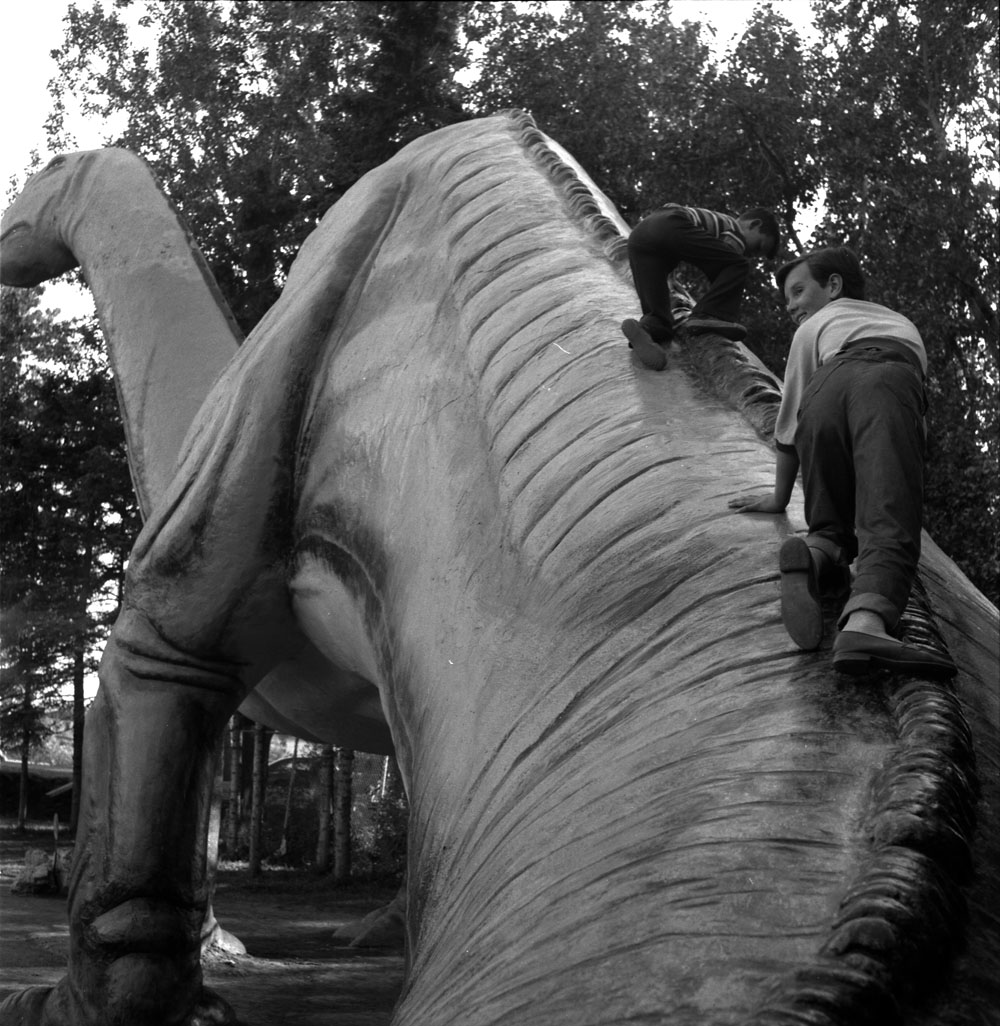
A black-and-white photograph of two children climbing up a large model dinosaur.

Children climb on Dinny the dinosaur at the Calgary Zoo, Alberta (e010973689)

In recent years, the Calgary Zoo has taken a renewed interest in Dinny. Structural work was completed in 2019, involving reinforcement of the neck and rear left leg. Surface restoration and repainting started in June 2021 and is set to be completed by the end of the summer.

There was a time when John Kanerva would repaint Dinny every few years, but I don’t know when the sculpture was last repainted. In fact, I don’t think I’ve ever seen Dinny with a fresh coat of paint. I’m looking forward to it. Dinny was meant to transport people to the past, to millions of years ago. But for me, I’ll be reminded of a much more recent time. Seeing Dinny looking once again like the pride of the city will be like visiting a Calgary I had always heard about but never got to know.


Richard Howe is a digital imaging technician in the Digitization Services Division at Library and Archives Canada.

Reference services across borders

By Virtue Tran

Library and Archives Canada (LAC) serves a diverse clientele with diverse information needs. In Reference Services, we see many queries coming in from across the globe. Though service for this international community is essentially the same as for inquirers from Canada, responses should take account of the challenges associated with accessing the collection across borders. This blog provides a glimpse of who our international clients are, a sample of interesting questions we have received, and a look at some of the techniques our reference specialists use to facilitate access by this community.

Our clients

Our clients are from all over the world! In the years 2018 to 2020, requests came from the following countries and regions:

  • Africa: Ivory Coast (Côte d’Ivoire), Djibouti, Morocco, Tunisia
  • Americas: Brazil, Martinique, Trinidad and Tobago, United States
  • Asia: India, Japan, Taiwan
  • Europe: Belgium, France, Germany, Ireland, Italy, Portugal, Russia, Switzerland, United Kingdom
  • Middle East: Israel, United Arab Emirates
  • Oceania: Australia

The above list is only a small sample of the international locations from which we receive requests. Many inquirers are professors and students doing research on either a specific Canadian topic or one with a Canadian component (such as ethnic groups who have immigrated to Canada; government policies and the Canadian cultural scene). Students in information science who have an interest in LAC as an institution or in the state of librarianship and archives in Canada comprise a niche within this clientele.

Then there are archivists, librarians and genealogists. As this is part of their day-to-day jobs, these clients are experts in searching for information. They usually have tools of the trade that allow them to conduct more complex searches. Their questions are geared mainly toward finding information on behalf of their own clients or for internal work. Recent examples include the Direção-Geral do Livro, dos Arquivos e das Bibliotecas [national book, archives and libraries department] of Portugal and the Scottish Natural Heritage Library. Finally, inquiries from members of the public vary widely. They are often driven by curiosity, hobbies or research into family history.

Here are three examples of topics that have piqued the interest of our international clients:

From Martinique: Guadeloupe domestics in 1910–1911

Request for information regarding the Canadian immigration service during that period and biographies of various immigration public servants who worked on the file of Guadeloupe domestic workers. This is found mainly in books discussing the history of immigration legislation and the policies of Canada. At the time, the Department of the Interior was responsible for immigration. Because immigration of Black people was discouraged, as was the case for other ethnic groups, immigration officers would find ways to deport them under the Immigration Act of 1910.

Further sources:

LAC database: Immigrants to Canada, Porters and Domestics, 1899-1949

Calliste, A. (1991). Canada’s immigration policy and domestics from the Caribbean: The second domestic scheme. In S. Brickey and E. Comack (eds.), The social basis of law: Critical readings in the sociology of law (2nd ed., pp. 95–121). Halifax: Garamond Press.  OCLC 24743137   This chapter sources information from various archival documents available at LAC.

Kelley, N., and Michael, J.T. (2010). The Making of the Mosaic: A History of Canadian Immigration Policy. 2nd ed. Toronto: University of Toronto Press.  OCLC 531018353 Chapter 4, “Industrialization, Immigration, and the Foundation of the Twentieth-Century Immigration Policy, 1896-1914,” pertains mainly to the discriminatory treatment of Asian immigrants under the section “Selective Admission Restrictions.” The discriminatory treatment of Black immigrants is also discussed, but to a lesser extent.

Macklin, A. (1992). Foreign domestic worker: Surrogate housewife or mail order servant. McGill Law Journal 37(3), 681–760.   ISSN: 0024-9041 — OCLC 768130032

Yarhi, E. (2016). Order-in-Council P.C. 1911-1324: the Proposed Ban on Black Immigration to Canada. The Canadian Encyclopedia. Historica Canada.

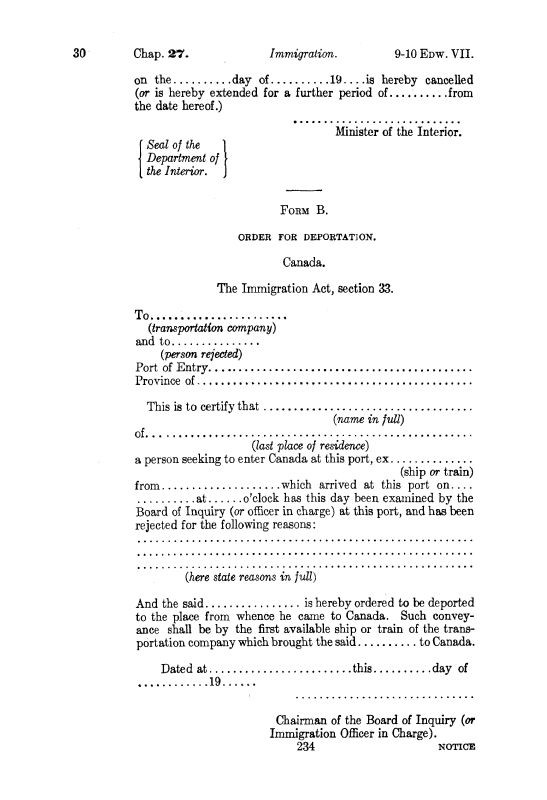
A typed page (Form B of the Immigration Act of 1910, used for deportations).

Form B – Order for deportation (C-10411 reel on Héritage).

From France: “Les Belles Mères” by La Bolduc

Request for information on the song “Les Belles Mères” by this famed folk musician. This song borrowed the “Red River Valley” melody as mentioned in an extensive biography published on our webpage. It is available on Virtual Gramophone along with other digitized songs by La Bolduc while materials such as books, articles and musical scores are searchable through our catalogue Aurora.

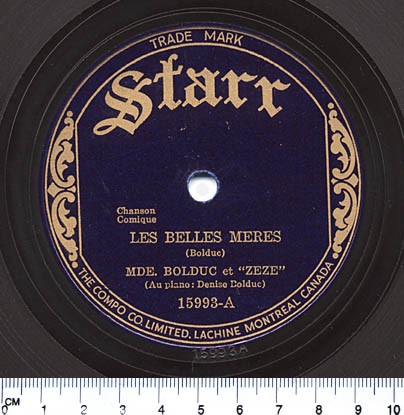
A colour picture of the label of the song “Les Belles Mères” with golden lettering on a navy disk.

Label of the song “Les Belles Mères” (published by the Compo Company Limited) (OCLC 1007640213).

From the United Kingdom: Stephen Leacock recordings

Request for a list of audio records of the writings of Stephen Leacock. Specifically, the requester wanted to know the names of those who were speaking in the recordings. LAC holds many audio recordings that can be located through our Aurora catalogue. Information about the readers is found within the bibliographical records, in the section on performers, in the notes or even in the title.

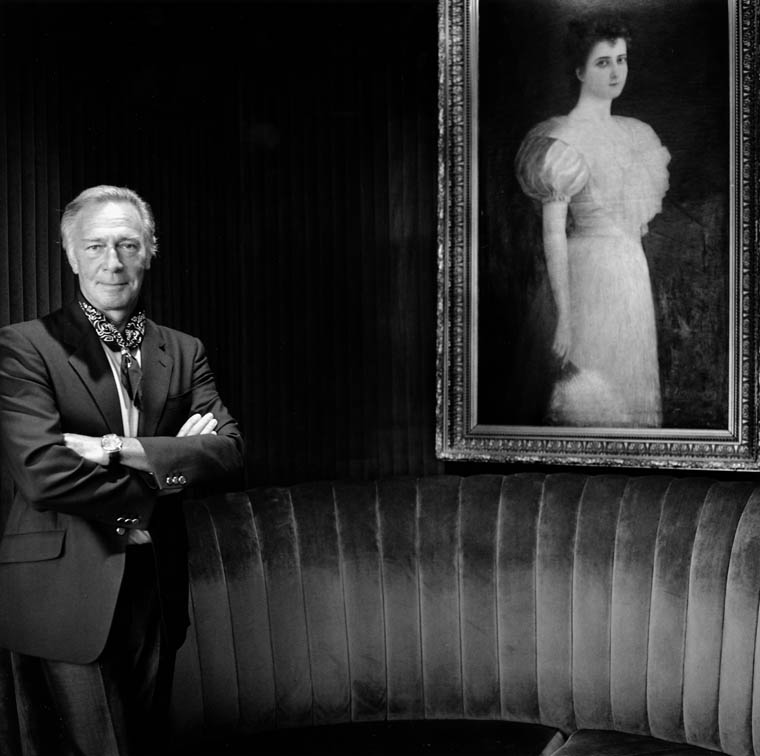
A black-and-white photograph of Christopher Plummer in a suit standing on the left with his arms crossed. A large framed painting of a woman in a dress holding a fan is hung on the right side.

The celebrated actor Christopher Plummer read and adapted Stephen Leacock’s writings. (a182414); for an example, see OCLC 3589995).

Accessing the collection: Options

It is standard practice to redirect clients who are not in the vicinity of Ottawa, Ontario, to institutions closer to their location in order for them to access relevant materials. However, when the materials cannot be located that way, three techniques are often used:

1. The Internet

The list of online resources is long, but here are a few that are heavily used by reference librarians. LAC maintains various resources that can serve as a starting point for research. They are accompanied by an explanatory page that provides a concise summary of the subject and, sometimes, a list of publications for further readings. Other helpful resources are the Government of Canada Publications portal and the Internet Archive’s Canadian Libraries collections, which host a massive amount of official publications, departmental libraries collections, and Canadiana, a staple for pre-1921 Canadian content.

2. Interlibrary loans

LAC does not offer an interlibrary loan (ILL) service. As a result, reference librarians count on local libraries that often provide this service to help connect clients with the publication they need. In the United States, many universities have Canadian holdings, and some public libraries will offer ILL with their Canadian counterparts. While the chances of finding a publication in institutions overseas diminish greatly, not all is lost. Specialized collections exist at universities with Canadian studies programs and within national libraries and museums, to name but a few. The fact that many international organizations are based in Europe should not be discounted. Those organizations often have libraries that collect Canadian content relevant to their work. While they are unlikely to lend out, they are generally open to the public and researchers.

3. Copy services

Copy services are always an option. LAC can provide copies of documents, images, etc., in various formats, including digital, which can be requested in PDF or JPEG format. Most institutions will also offer this service for a fee, but figuring out which institutions hold a copy is the hard part. This is when reference books, bibliographies and union catalogues come in handy. A dated resource will still offer valuable insight for determining the correctness of the references provided and identifying the institutions that used to hold copies. These tidbits of information are useful for tracing back publications, especially older materials that are oftentimes discarded when they no longer meet the needs of users.

With skills, perseverance and a little bit of serendipity, LAC’s Reference Services will connect you with our Canadian heritage. So don’t be shy about sending in your queries to Ask us a Question; we will be happy to assist you in your research!


Virtue Tran is a reference librarian in the Reference Services Division at Library and Archives Canada.

A colonial governor’s creative math

Version française

By Forrest Pass

This article contains historical language and content that may be considered offensive, such as language used to refer to racial, ethnic and cultural groups. Please see our historical language advisory for more information.

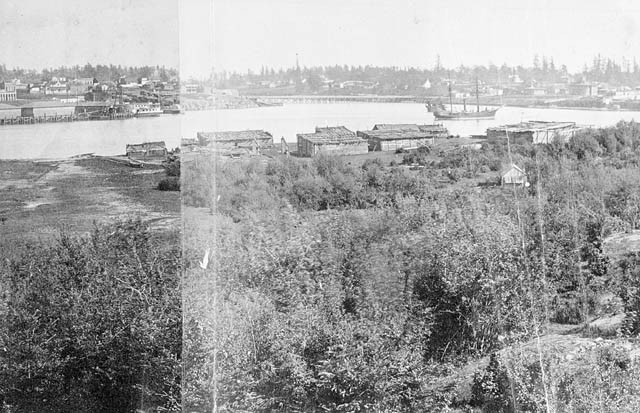
On July 20, 2021, British Columbia marks 150 years of provincehood. This photograph of Victoria unintentionally tells an often forgotten story about the new province-to-be on the eve of its entry into Confederation. In the background, across the Inner Harbour, we see a colonial frontier capital with the old government buildings, nicknamed “the Birdcages,” to the right and the warehouses and wharves of the commercial district to the left.

A black-and-white photograph of villages on either side of a harbour, with a large ship on the water. There are forests behind each village.

View of Victoria Harbour, about 1870, by Frederick Dally. (c023418)

The foreground provides a different perspective. The buildings are the lək̓ʷəŋən (Lekwungen) village at p’álәc’әs (Songhees Point). The lək̓ʷəŋən people have lived in what is now Greater Victoria since time immemorial. Although he may not have intended it, photographer Frederick Dally captured an important truth: “British Columbia” in 1871 was, in fact, a series of First Nations and Métis Nation communities with a very small European settler one.
This fact influenced British Columbia’s entry into Confederation in unexpected ways. Documents in the collection at Library and Archives Canada record the British Columbia negotiators’ efforts to use the large First Nations population in the colony to their own advantage while simultaneously dispossessing those same Nations of their traditional territories and resources.

Vancouver Island had become a British colony in 1849. Nine years later, the discovery of gold in the Fraser River brought some 30,000 fortune seekers to the nearby mainland and prompted the organization of a second colony, British Columbia.

By the late 1860s, however, the gold rush had ended. The island and mainland colonies were united in 1866 as a cost-saving measure, and the settler population of united British Columbia dropped to about 10,000. Having spent a fortune on wagon roads and other construction projects, the government was almost bankrupt. The Canadian government sensed an opportunity and orchestrated the appointment of Sir Anthony Musgrave as British Columbia’s governor in 1869. Musgrave had served as Governor of Newfoundland and although he had failed to unite that colony with Canada, his commitment to Confederation was well known.

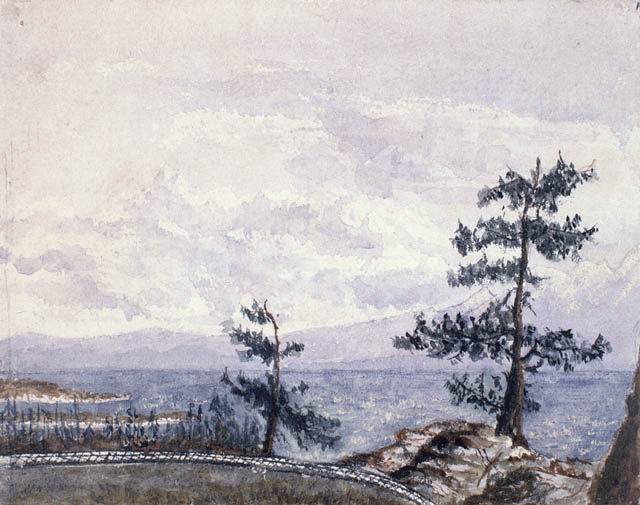
A watercolour painting of two trees with a body of water and a mountain in the background

“View from the Morning House, Government House, Victoria,” watercolour by Frances Musgrave, about 1870. Frances’ brother, Governor Sir Anthony Musgrave, may have enjoyed a similar view when writing his dispatches on British Columbia’s proposed entry into Confederation. (c028380k)

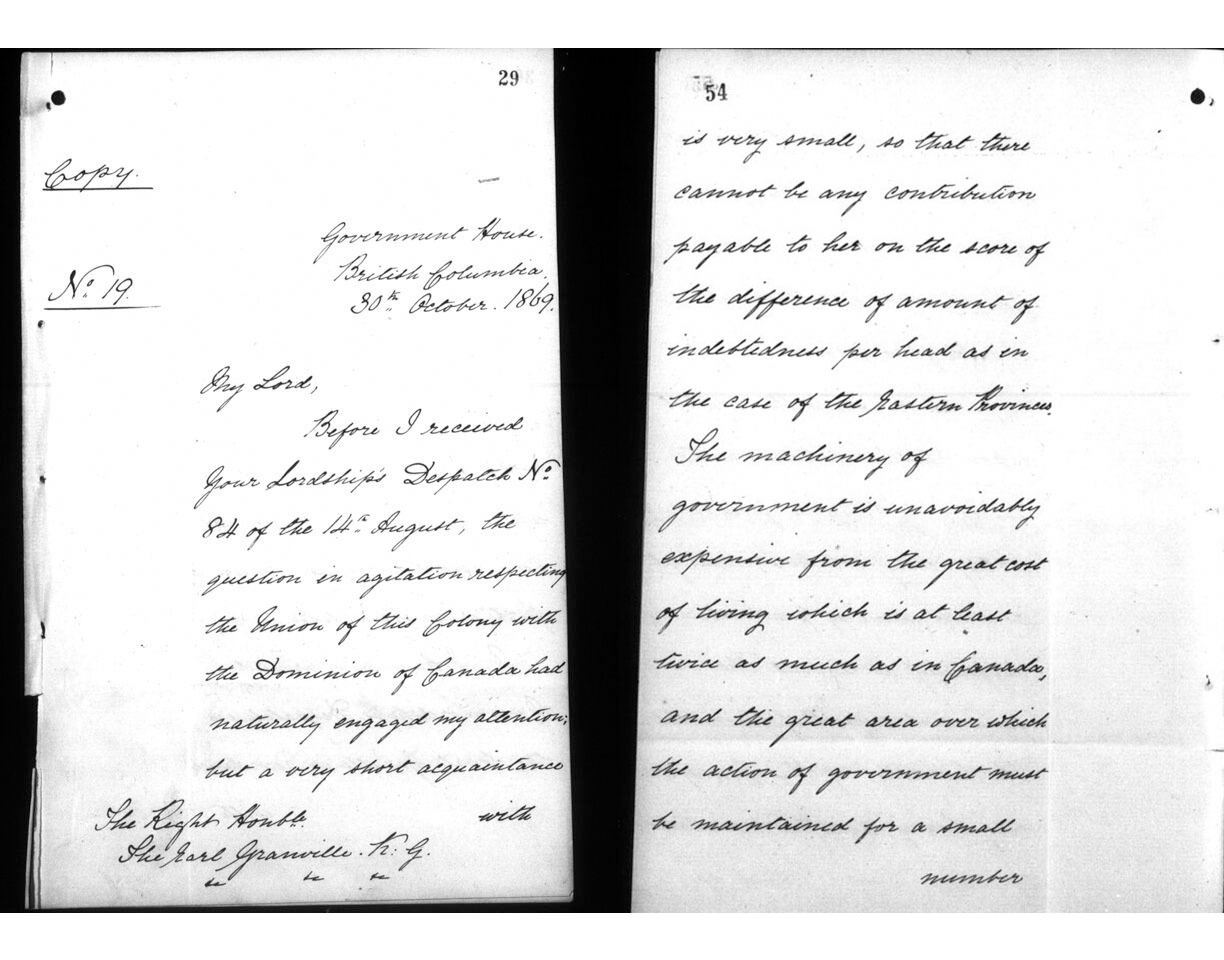
On arriving in Victoria, Musgrave wrote to the British Colonial Secretary about the prospects of Confederation with Canada. Cost was a major obstacle. Governing a large but sparsely colonized territory was expensive and the annual federal subsidy of eighty cents per resident that all provinces received would be “insignificant” in British Columbia’s case.

Two pages with handwriting in black ink.

Letter from Sir Anthony Musgrave to Lord Granville, British Colonial Secretary, describing the obstacles to Confederation, October 30, 1869: “The machinery of government is unavoidably expensive from the great cost of living which is at least twice as much as in Canada…” (RG7 G21 Vol 8 File 25a Pt 1, Heritage)

Insignificant, that is, unless Musgrave could justify a larger population estimate. This involved some creative math. In an 1870 letter to the Governor General of Canada, Sir John Young (later Lord Lisgar), Musgrave showed his work. British Columbia relied heavily on imported goods, so Musgrave divided the colony’s annual customs revenue (about $350,000, or $7.2 million today) by the per capita customs revenue of the eastern provinces ($2.75, or $56.51 today). By this calculation, British Columbia had a population of 120,000 rather than 10,000 for setting its annual subsidy and its representation in the Parliament of Canada.

To bolster his argument, Musgrave pointed to the First Nations population. After all, he noted, First Nations people in British Columbia were “consumers” and paid customs duties just as settlers did. Including First Nations people brought the real population closer to Musgrave’s creative calculation.

Remarkably, Canada’s negotiators agreed in principle, though the draft Terms of Union reduced the population estimate to 60,000. Nevertheless, when the Parliament of Canada debated the British Columbia agreement in March 1871, the opposition howled that by including First Nations people the Terms violated the principle of representation by population. “We have never given representation under our system to Indians,” complained Liberal leader Alexander Mackenzie. Similarly, David Mills, an Ontario MP, argued that First Nations people were not part of “the social bond, and could not stand on the same footing as the white population.”

But Musgrave never suggested that First Nations people should “stand on the same footing” as settlers. He did not believe that they should vote nor that they should benefit from that larger annual subsidy. In this sense, his formula was similar to the infamous clause in the Constitution of the United States that counted each enslaved person as three fifths of a person when calculating a state’s representation in Congress. Just as the three-fifths compromise used the enslaved population to increase the political influence of slaveholders, Musgrave’s formula increased British Columbia’s national influence without acknowledging the existing rights, title and sovereignty of the Indigenous majority.

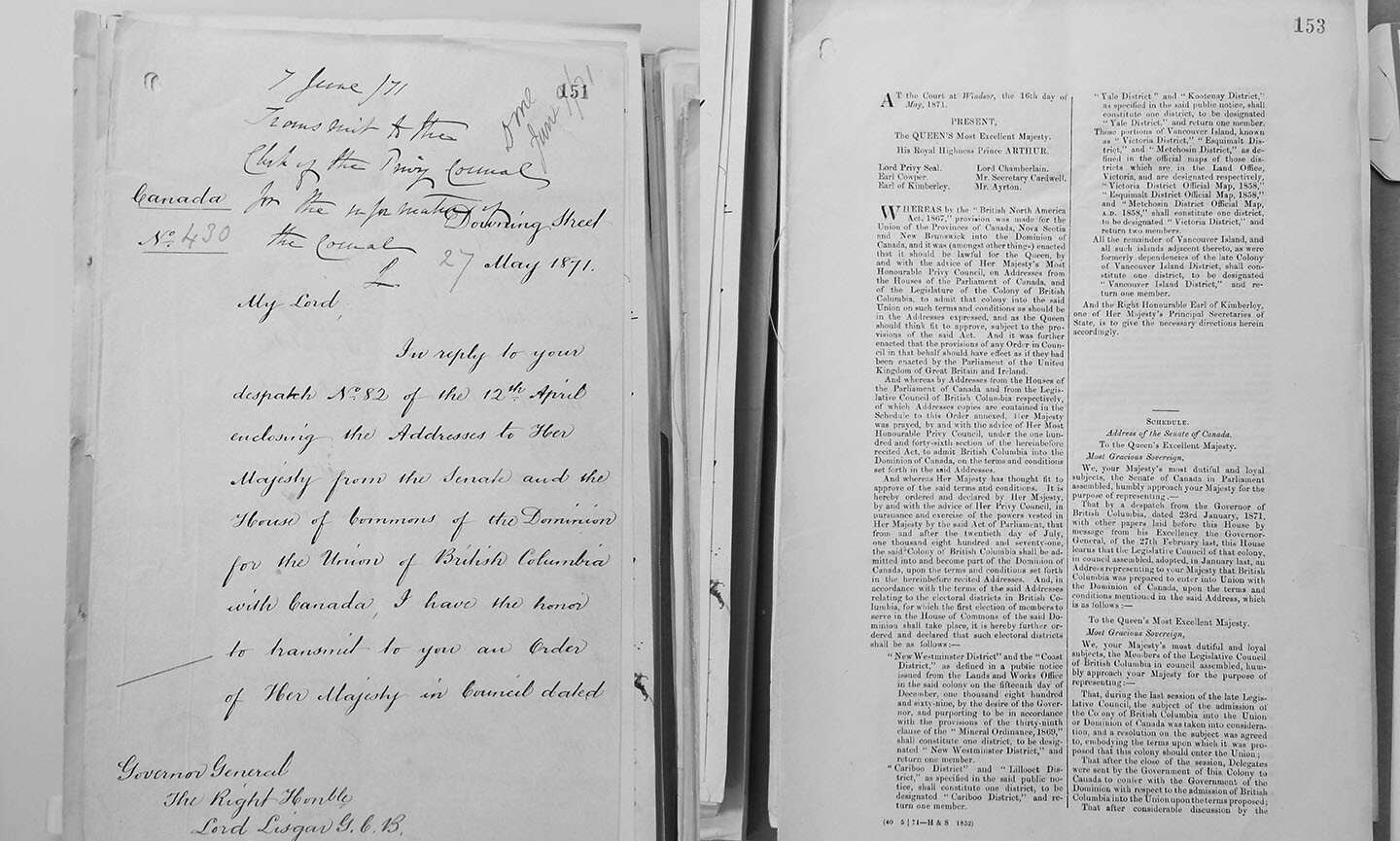
Despite opposition objections, British Columbia became Canada’s sixth province on July 20, 1871. The correspondence on the subject in the Governor General’s records at Library and Archives Canada concludes with an official copy of the Terms of Union—a rare original printing of this important constitutional document. In his cover letter, the Colonial Secretary, Lord Kimberley, wished Canada and British Columbia “a career of progress and prosperity worthy of their great natural fertility and resources.”

Two pages, one with black ink handwriting and one typed with two long columns.

An original printing of the British Columbia Terms of Union, with the Colonial Secretary’s cover letter to the Governor General of Canada. (RG7 G21 Vol 8 File 25a Pt 1, Heritage)

First Nations people would not share much in that “progress and prosperity.” Under the Terms of Union, Canada agreed to follow “a policy as liberal as that hitherto pursued” when dealing with First Nations. This was a cruel joke, as neither pre- nor post-Confederation policy was particularly “liberal.” Except for the Douglas Treaties, a series of controversial land purchases around Victoria in the 1850s, the colonial governments of British Columbia had signed no treaties with First Nations. After Confederation, federal and provincial policy would result in the marginalization of First Nations and the Métis Nation in their own territories and communities. For example, the lək̓ʷəŋən residents at p’álәc’әs would move to another village site in 1911, to make way for the growing settler city. First Nations people were integral to Musgrave’s population formula, which had helped to convince British Columbia settlers to support Confederation with Canada. However, the province’s entry into Confederation was no cause for celebration for most Indigenous people in the region, an important point to remember as we observe the 150th anniversary.


Forrest Pass is a curator with the Exhibitions team at Library and Archives Canada.