Pidji-ijashig – Anamikàge – Pee-piihtikweek – Tunngasugit – ᑐᙵᓱᒋᑦ – Welcome

On the left, Tatânga Mânî [Chief Walking Buffalo] [George McLean] is in his traditional First Nation regalia on a horse. In the centre, Iggi and a girl engage in a “kunik,” a traditional greeting in Inuit culture. On the right, Maxime Marion, a Métis guide, holds a rifle. In the background, there is a map of Upper and Lower Canada, and text from the Red River Settlement collection.

This blog is part of our Nations to Nations: Indigenous Voices at Library and Archives Canada series.

By Karyne Holmes

This article contains historical language and content that some may consider offensive, such as language used to refer to racial, ethnic and cultural groups. Please see our historical language advisory for more information.

Nations to Nations: Indigenous Voices at Library and Archives Canada is a multilingual and interactive e-book that features hundreds of items in the care of Library and Archives Canada (LAC) through the perspectives of First Nations, Inuit and Métis Nation staff. The first stages of developing the e-book began in 2018, shortly after I had joined LAC as a researcher for We Are Here: Sharing Stories (WAHSS), LAC’s initiative in researching, digitizing and describing Indigenous-related records to make them more accessible. I was honoured to be invited as one of the co-authors for the e-book and have the task of writing the e-book’s introductory text, “Pidji-ijashig – Anamikàge – Pee-piihtikweek – Tunngasugit – ᑐᙵᓱᒋᑦ – Welcome.” In writing the introduction, I reflected on how finding historical family documents has been personally significant and why the research and access work of WAHSS is so meaningful. I wanted to communicate the value behind projects like the e-book and WAHSS. The introductory message also highlights how the e-book celebrates language knowledge and language reclamation.
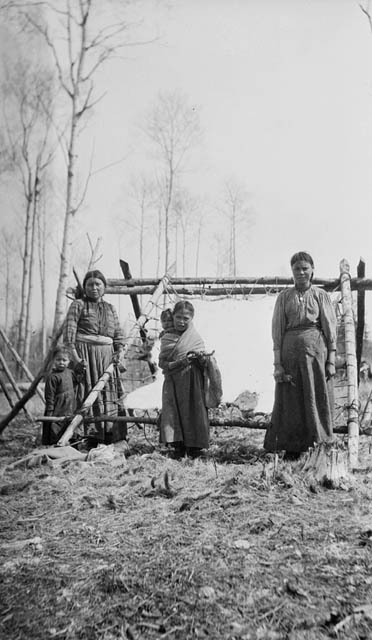
Black-and-white photograph of two women and a girl standing outdoors in front of a stretched moosehide laced onto a wooden frame. The girl is carrying an infant, and the woman on the left is holding the hand of a small child. They are on grassy vegetation, and there is a row of tall deciduous trees without leaves in the background.

Dëne Sųłiné women and children standing in front of a moosehide tanning frame, Christina Lake, Alberta, 1918 (a017946). This photo is featured in “Traditional Caribou and Moosehide Tanning in Northern Dene Communities” by Angela Code.

The Steering Committee on Canada’s Archives recently released a Reconciliation Framework as a response to Call to Action 70 issued by the Truth and Reconciliation Commission of Canada. The report acknowledges that the “colonial archival record has significantly contributed to the formation of a Canadian historical narrative that privileges the accomplishments of Eurocentric settler society at the expense of First Nations, Inuit, and Métis identities, experiences, and histories.” A fundamental message of the framework is that archives must respect Indigenous peoples’ intellectual sovereignty over materials created by or about them, and they must integrate Indigenous perspectives, knowledge, languages, histories, place names and interpretations into Indigenous-related archives.

The framework outlines ways that we can incorporate reconciliation into archival practices that reflect the work that has started at LAC. Our collaborative Nations to Nations publication is a valuable educational resource that shows the importance of re-contextualizing archival records to bring awareness to the diversity within First Nations, Inuit and Métis Nation perspectives and lived experiences.

“Pidji-ijashig – Anamikàge – Pee-piihtikweek – Tunngasugit – ᑐᙵᓱᒋᑦ – Welcome” in Nations to Nations: Indigenous Voices at Library and Archives Canada

To read the following text in Anishinabemowin, see the e-book. Nations to Nations: Indigenous Voices at Library and Archives Canada is free of charge and can be downloaded from Apple Books (iBooks format) or from LAC’s website (EPUB format). An online version can be viewed on a desktop, tablet or mobile web browser without requiring a plug-in.

 Archives and library collections provide a glimpse into the lives and experiences of our ancestors. This is true for all people, but they have special significance to Indigenous peoples. Ongoing colonial policies and actions have separated our families, thus cutting our connections and access to culture, community, knowledge and stories. Archival records and publications can facilitate the discovery of family and community history. They can also ignite memories and restore knowledge. For many, these have been partially lost through the residential school era and the ongoing forced removal of Indigenous children from their families. Historical records can recover missing pieces and unearth new information about our personal and community histories. They can allow us to share our stories with the world, in our own words.
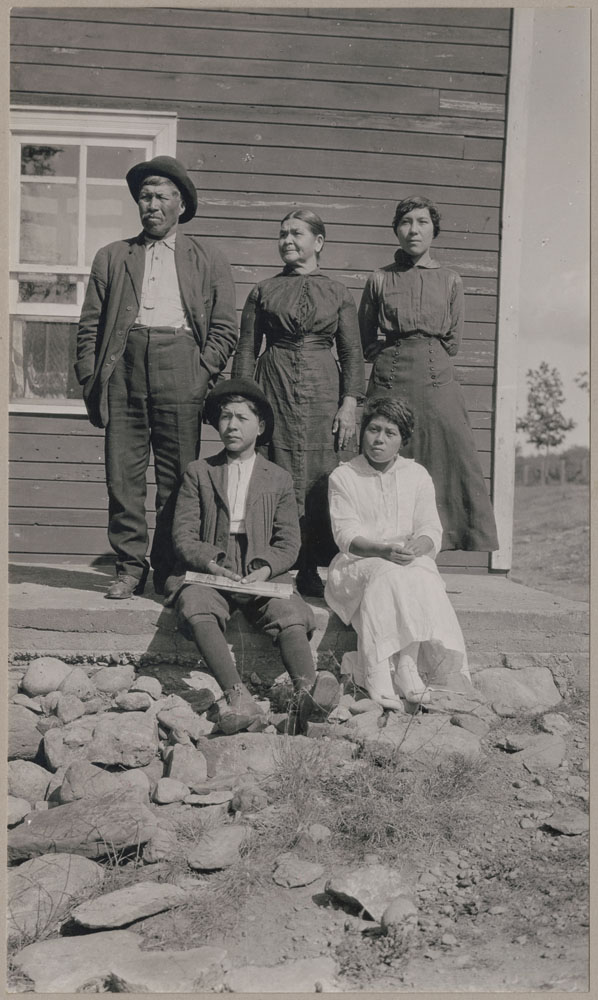
Husband and wife standing outside a building with their daughter standing next to her mother and their son and second daughter sitting in front of them.

Michel Wakegijig and his family outside their home at Wiikwemkoong First Nation, ca. 1916 (e011310537-040_s1).

Although the value held within historical records is recognized, the majority of documents at Library and Archives Canada (LAC) were created, collected and interpreted through a colonial lens. As a result, many records pertaining to Indigenous communities are marred by missing details and inaccurate portrayals, and they are often described with a focus on what the record creator perceived to be of interest and importance. It is crucial to apply Indigenous insight, to contextualize and interpret records that pertain to First Nations, Inuit and the Métis Nation.
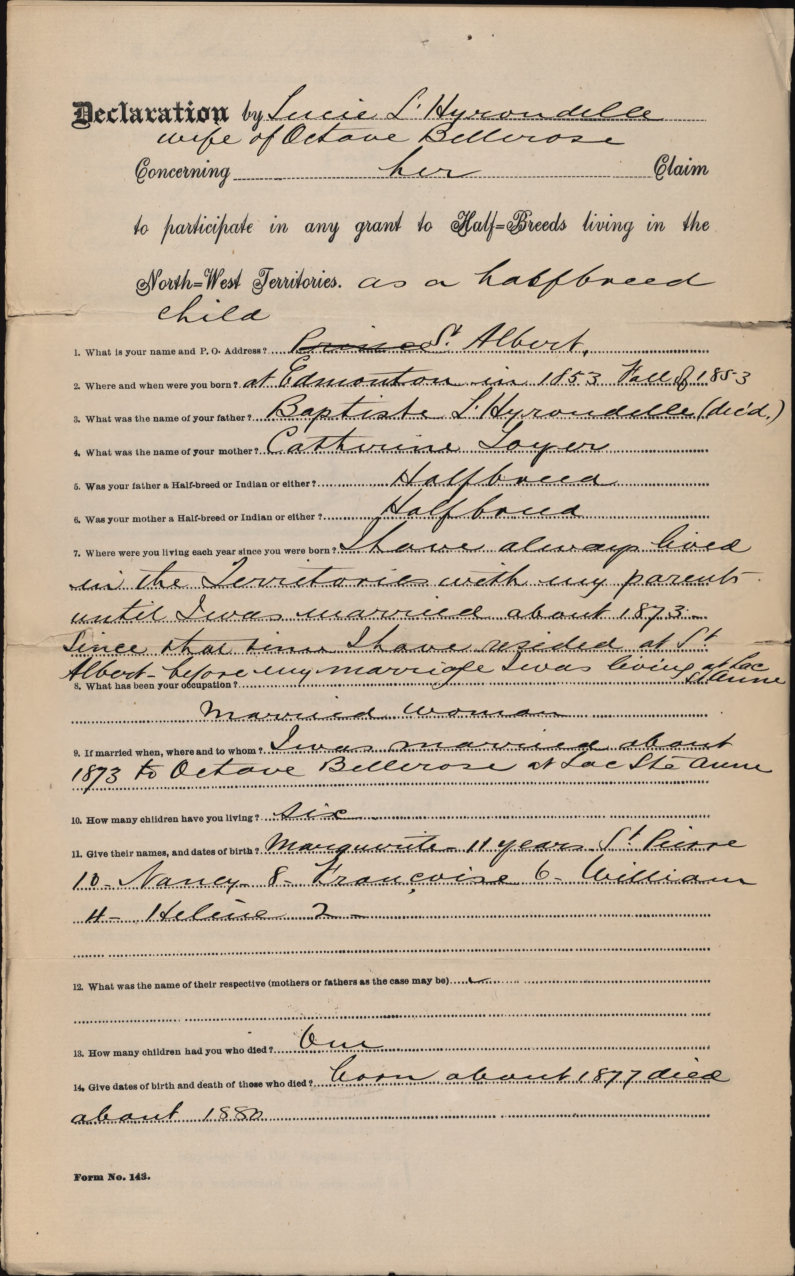
Textual form with typed questions and handwritten responses.

Page from the declaration of Lucie Bellerose on her scrip application, signed at St. Albert in 1885. Digitized scrip records contain biographical information on Métis Nation ancestors (e011358921).

Current initiatives at LAC are working toward prioritizing First Nations, Inuit and Métis Nation stewardship of Indigenous content. We Are Here: Sharing Stories is modifying archival record descriptions through a decolonizing lens. We are incorporating place names, community names, persons’ names and cultural terms into descriptions so that they accurately represent the record. Listen, Hear Our Voices is providing support to communities who wish to control and preserve the language-specific materials created and housed within their own communities.
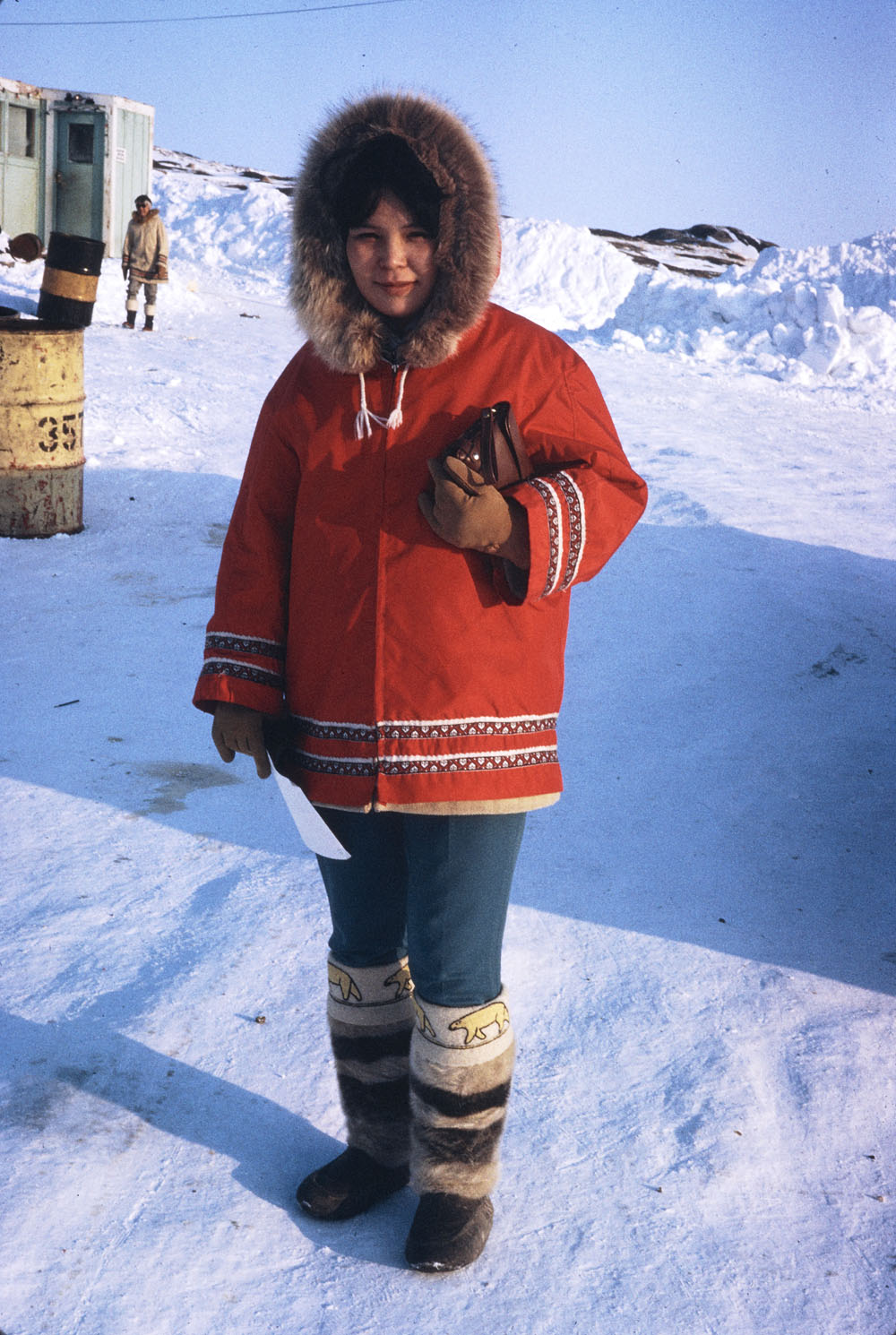
Photograph of a woman standing outside on snow-covered ground. She is wearing a red parka with a fur-trimmed hood covering her head, and knee-high boots with fur and embroidered polar bears. She is holding a brown leather purse with her left arm.

Young Inuk woman from Kinngait (formerly Cape Dorset) in red qilapaaq (straight-hemmed) style parka and kamiik (boots) with polar bears embroidered on the duffel liners, Iqaluit, Nunavut (formerly Frobisher Bay, Northwest Territories), 1968 (e011212600). The description of this photo was provided through the We Are Here: Sharing Stories project.

This e-book features a collection of archival documents and published material held at LAC that was selected by LAC team members who identify as First Nations, Inuk or Métis Nation. The records we chose are drawn from transcripts, photographs, maps, audiovisual material and publications. They highlight the importance of our cultural identity, and they reflect personal experiences in learning and knowing about our own histories. The essays feature different voices, multiple perspectives and personal interpretations of records.
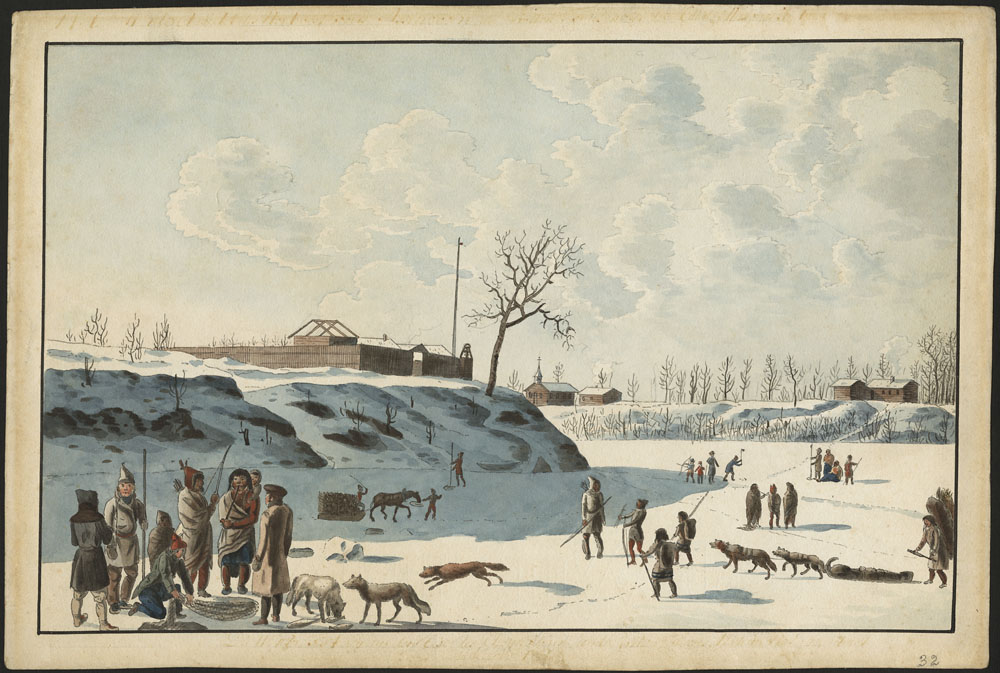
Watercolour of a group of people with two dogs standing on a frozen river in the lower-left corner. Several hold fishing spears. Another dog is running toward the group. In the background on the river are a number of smaller groups of people, several dogs and a horse. There is a wooden fort on the embankment on the left side, and some smaller wooden structures on the opposite embankment in the distance.

Winter fishing on the Assiniboine and Red rivers, with a fort in the background (present-day Winnipeg), Manitoba, 1821 (e011161354). This artwork is featured in “Fishing on the Red River for 3,000 Years” by William Benoit.

Where possible, translations are provided in the Indigenous language spoken by the people represented in each essay. For Indigenous peoples, language is inextricably tied to culture. Indigenous languages are exceptionally descriptive of objects, experience and emotion, which cannot be wholly explained or translated into English or French. Languages of First Nations, Inuit and the Métis Nation have been learned intergenerationally through stories, songs and land-based experiences. Language is largely influenced by the physical landscape and its resources; these have shaped Indigenous vocabularies that hold unique representations and values distinct to each culture. First Nations, Inuit and the Métis Nation across Canada are reclaiming their languages to connect to their history, to secure cultural continuity, and to honour their ancestors by knowing the languages through which they understood the world.

We respect the wishes of First Nations, Inuit and the Métis Nation about how they would like their languages and identities expressed in English and French. This may mean that some conventional rules of grammar are not applied.

Additional resources


Karyne Holmes is a curator in the Exhibitions and Loans Division and was an archivist for We Are Here: Sharing Stories, an initiative to digitize and describe Indigenous content at Library and Archives Canada.
Cradleboards: keeping babies safe and portable

On the left, Tatânga Mânî [Chief Walking Buffalo] [George McLean] is in his traditional First Nation regalia on a horse. In the centre, Iggi and a girl engage in a “kunik,” a traditional greeting in Inuit culture. On the right, Maxime Marion, a Métis guide, holds a rifle. In the background, there is a map of Upper and Lower Canada, and text from the Red River Settlement collection.

This blog is part of our Nations to Nations: Indigenous Voices at Library and Archives Canada series. To read this blog post in Kanien’keha, visit the e-book.

Nations to Nations: Indigenous Voices at Library and Archives Canada is free of charge and can be downloaded from Apple Books (iBooks format) or from LAC’s website (EPUB format). An online version can be viewed on a desktop, tablet or mobile web browser without requiring a plug-in.

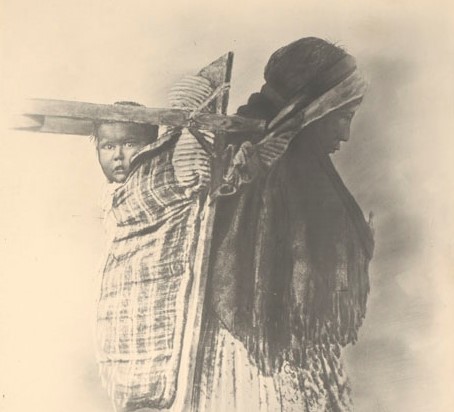
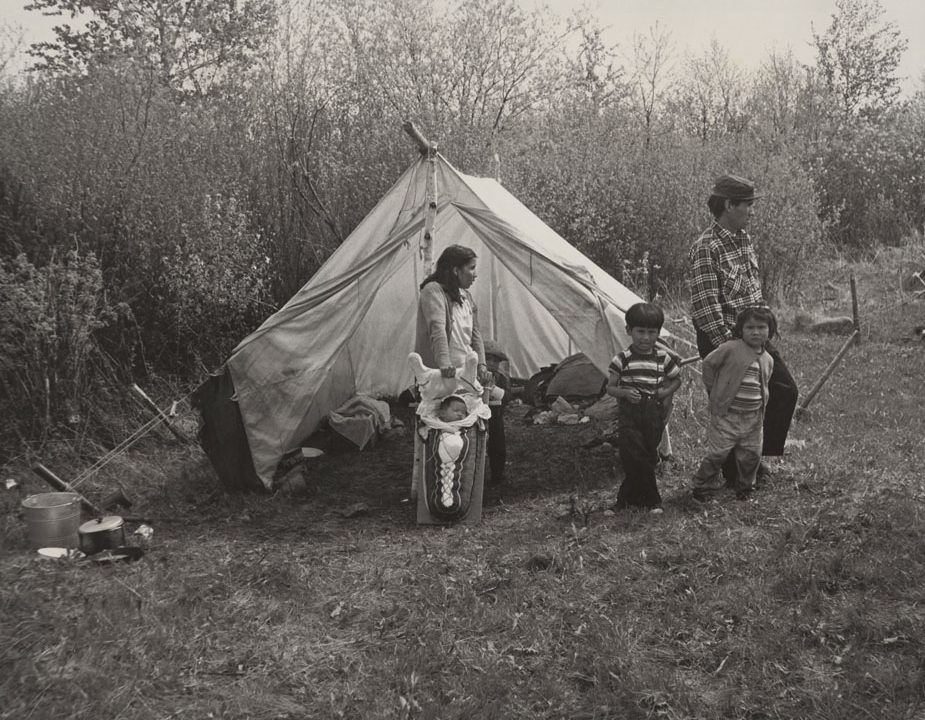
First Nations and Métis Nation communities used cradleboards to secure and carry infants. While the style and form varied between nations, cradleboards were typically made from thin pieces of wood to which a baby was firmly swaddled in a piece of fabric and secured with ties. Cradleboards provided parents with a safe way to carry their children during travel and allowed them use of their hands while working.

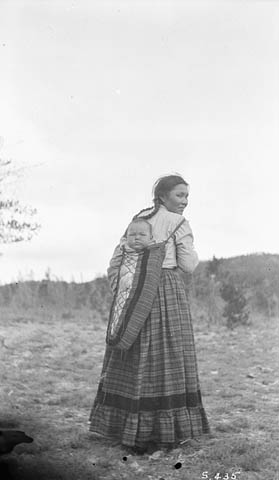
First Nation woman with a baby on a cradleboard on her back.

First Nation woman carrying a baby on a cradleboard with a tumpline (e011303100-006)

To learn more about images of cradleboards in the collections at Library and Archives Canada, we invite you to read Kanien’keha:ka author Elizabeth Kawenaa Montour’s blog article “First Nations cradleboards: understanding their significance and versatility” and her essay “First Nations cradleboards: an enduring heritage.”

First Nation family with a baby secured onto a cradleboard in front of a tent near Lac Seul in Ontario.

Mary Ann Trout-Carpenter and her husband George Carpenter with their children. The baby in the cradleboard is either Melvin or Donna. James is standing behind his mother, George is in the centre, and Marianne is standing in front of her father. Lac Seul First Nation, Ontario. (e008300467)

The essay is featured in Nations to Nations: Indigenous Voices at Library and Archives Canada, a multilingual and interactive e-book. This e-book features 28 unique essays written by Elizabeth Kawenaa Montour and other First Nations, Inuit and Métis Nation staff. It is presented mostly in the Indigenous languages spoken by the people represented in each essay, and accompanied by English and French versions. The authors are Indigenous archivists, curators and advisors who have a personal connection to the collection items that they chose for their essays. Their essays show the diversity of the histories, languages and cultures of Indigenous peoples.

First Nation woman with a baby on a cradleboard on her back.

First Nation woman carrying a baby on a cradleboard, unknown location, 1918 (a017973)

“Cradleboard” in some Indigenous languages

    • Anishnaabeg: tiginaaganan
    • Oji-cree: tikinagan (also spelled tiginaagan, tikkanaagan or tikanagan)
    • Kanien’kéha: kahrhon
    • Michif: tikinagan
    • Mi’kmaq: migjowajij alapilaqan
    • Ojibwe: dikinaagan
    • Plains Cree (nêhiyawêwin): askotaskopison

Additional resources

  • Cradleboards, Library and Archives Canada’s Flickr album

Hiding in Plain Sight and the Métis Nation: How did it all start?

Banner for the Hiding in Plain Sight exhibitionBy Beth Greenhorn and William Benoit

When we began our research on a possible Métis exhibition in 2014, we had no idea what it would explore or how, what content we could uncover, or what the public’s perception would be. Prior to this, Library and Archives Canada (LAC) had not created an exhibition that focused on Métis Nation citizens, culture and history. When building an exhibition, we often wonder if our labour will be well received. Will the project have longevity or be a momentary flash in time?

While we knew that we wanted to highlight Métis records in the holdings at LAC, we quickly learned that even for us as LAC staff, these records were difficult to find. In the fall of 2014, a keyword search for “Métis” in art, photographic, cartographic and stamp records yielded fewer than 100 documents. We found it hard to believe that LAC holdings contained so few items related to the Métis. The issue had to be about the search terms historically used by archives to describe the Métis. Or the images depicting Métis individuals, activities and communities were described incorrectly. In spite of these obstacles, we were up for the challenge!

Work on the exhibition ramped up in 2015. We curated it in partnership with the Manitoba Métis Federation (MMF) and the Métis National Council (MNC). Their assistance and knowledge in curating this exhibition were invaluable in its success.

Between 2014 and 2016, we reviewed and updated over 1,800 records by adding “Métis” to the titles or descriptive notes, to make these documents more accessible and to better reflect the diverse voices of the collections at LAC. In addition to improving access to existing records, LAC digitized over 300 new photographic items pertaining to Métis history, many of which were featured in the exhibition. The strategies that we developed to uncover Métis content in the collections at LAC—using historical Métis communities and looking for indications of Métis material culture—offered the perfect title for the exhibition. The content we were searching for was “hiding in plain sight” all along; we just needed to uncover it.

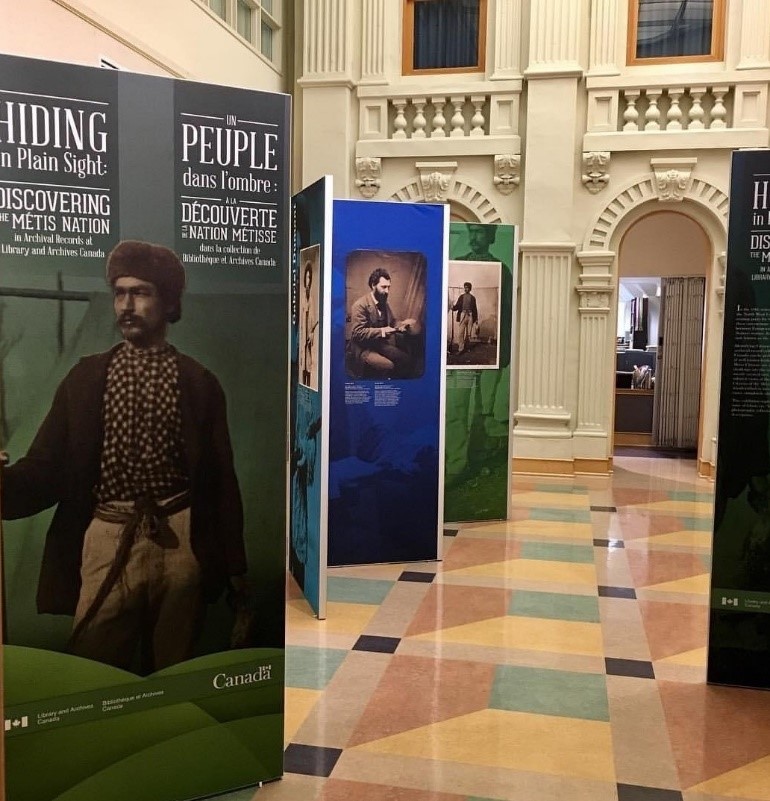
Hiding in Plain Sight opened in February 2016 in LAC’s main building at 395 Wellington Street in Ottawa. We organized the exhibition into two themes: known portraits of Métis citizens, and artwork and photographs portraying visual clues to Métis culture.

The exhibition became bigger than we had ever imagined. In February 2017, it was adapted for an international audience when Hiding in Plain Sight: The Métis Nation was displayed at the UNESCO headquarters in Paris, France. Through the enthusiasm and financial support of the MMF, the MNC and the Government of Canada, Hiding in Plain Sight was transformed into a travelling exhibition of digital reproductions. Since opening at the Centre du patrimoine in Saint-Boniface, Manitoba, in June 2017, the exhibition has travelled to 15 communities in Manitoba, Saskatchewan, Alberta and British Columbia.

Colour photograph of an exhibition space showing large vertical panels with photographs and texts.

Installation of Hiding in Plain Sight at the Centre du patrimoine in Saint-Boniface, Manitoba, in June 2017. Photo: Library and Archives Canada

Hiding in Plain Sight was shown at the Red Deer Museum and Art Gallery in Alberta from December 2018 to March 2019. Memories and treasures generously shared by local Métis citizens from their personal collections both personalized the exhibition and complemented the reproductions of artwork and photographs held at LAC.

The exhibition is currently on display at the Swift Current Museum in Saskatchewan. We are delighted by its popularity, and in particular that Métis Nation citizens living outside Ottawa have access to documentary heritage material about their history. It is also important that the general public has the opportunity to learn about the Métis and their rich history and culture in a manner that is accurate and appropriate.

Paving the way to greater access to Indigenous-related records

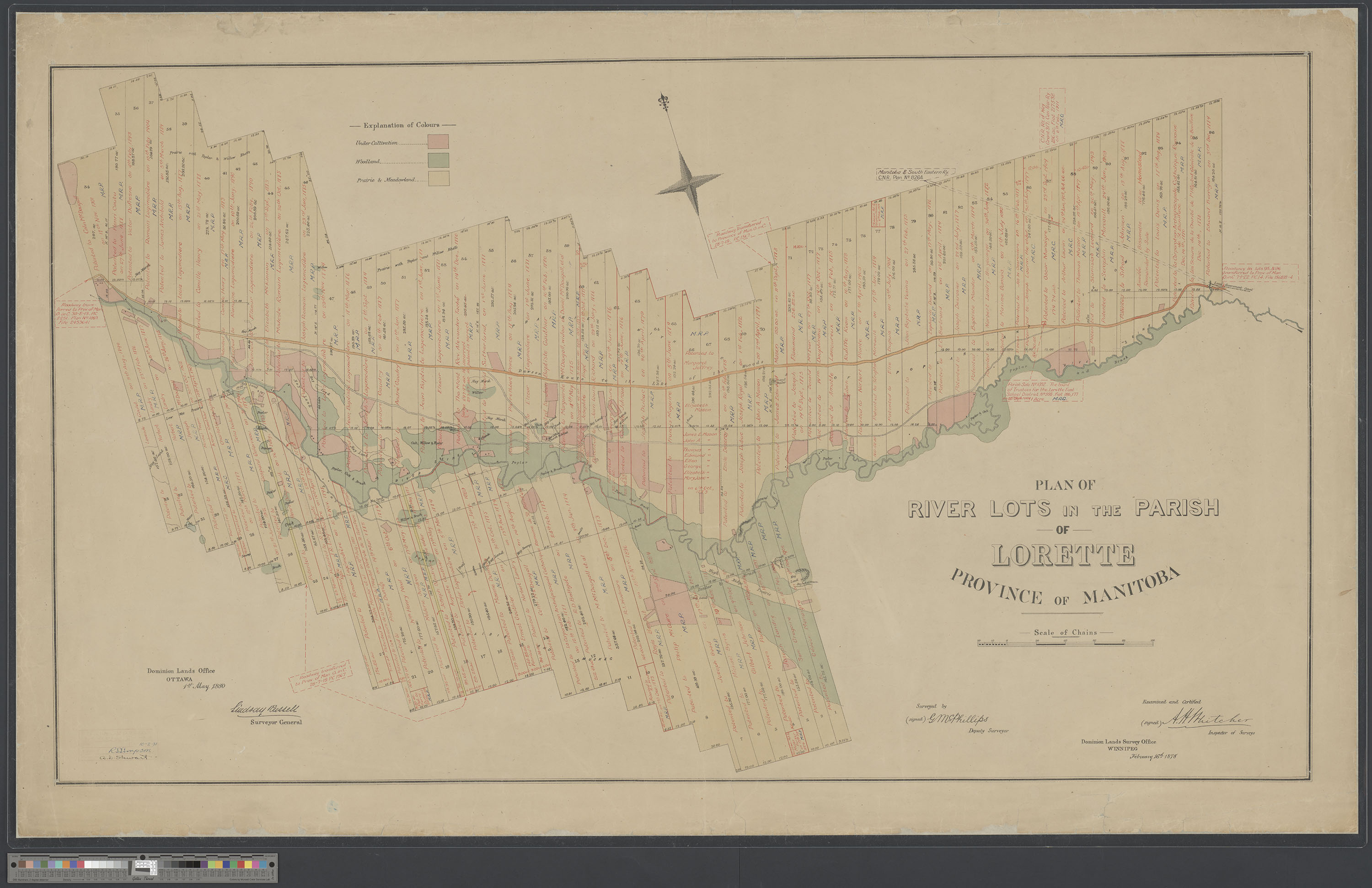
Whereas Hiding in Plain Sight focuses on art and photographic collections, LAC has increased the amount of digitized content related to the Métis Nation. From 2018 to 2021, the We Are Here: Sharing Stories (WAHSS) initiative digitized nearly 600,000 records from all media pertaining to First Nations, Inuit and the Métis Nation in Canada. More than half of these records relate to the Métis Nation. The WAHSS team incorporated the names of places, communities and individuals, along with cultural terms, into descriptions to more accurately represent the records and make it easier to find relevant documents. Among the records digitized were thousands of Métis Scrip and Red River lot maps, including this 1880 plan showing the Parish of Lorette, Manitoba.

A map in colour showing numbered farming lots along a river, with the names of individuals.

Plan of river lots in the Parish of Lorette, Manitoba, 1880 (e0011213853)

In 2021, LAC published Nations to Nations: Indigenous Voices at Library and Archives Canada. This multilingual and interactive e-book features 28 essays written by First Nations, Inuit and Métis Nation colleagues at LAC. Nine essays focus on the Métis Nation, presenting audio recordings in Heritage Michif of select images. Nations to Nations is free of charge and downloadable from Apple Books (iBooks format) or from the LAC website (EPUB format). An online version can be viewed on a desktop, tablet or mobile web browser without requiring a plug-in.

The second WAHSS initiative that began in 2022 continues to digitize records related to First Nations, Inuit and the Métis Nation. Significantly, the current WAHSS team is building on the reparative work we started in 2014 by finding and modifying archival record descriptions through a decolonizing lens.

To learn more about Hiding in Plain Sight, you can read the blog article written in 2016, when the exhibition opened in Ottawa.

To learn more about LAC’s commitment to playing a significant role in reconciliation, you can read LAC’s Indigenous Heritage Action Plan.

Additional resources related to the Métis Nation


Beth Greenhorn is a settler living on the unceded, traditional territory of the Kitigan Zibi Anishinabeg and the Algonquins of Pikwakanagan. She is a Senior Project Manager in the Outreach and Engagement Branch at Library and Archives Canada.

 William Benoit is Red River Métis. He grew up in the historic Métis community of St. Norbert, Manitoba. He has a background in Canadian history and Indigenous genealogy. He is an Advisor, Internal Indigenous Engagement, in the Outreach and Engagement Branch at Library and Archives Canada.

Origins of Cree syllabics

Version française

On the left, Tatânga Mânî [Chief Walking Buffalo] [George McLean] is in his traditional First Nation regalia on a horse. In the centre, Iggi and a girl engage in a “kunik,” a traditional greeting in Inuit culture. On the right, Maxime Marion, a Métis guide, holds a rifle. In the background, there is a map of Upper and Lower Canada, and text from the Red River Settlement collection.

This blog is part of our Nations to Nations: Indigenous Voices at Library and Archives Canada series. To read this blog post in Cree syllabics and Standard Roman Orthography, visit the e-book.

Nations to Nations: Indigenous Voices at Library and Archives Canada is free of charge and can be downloaded from Apple Books (iBooks format) or from LAC’s website (EPUB format). An online version can be viewed on a desktop, tablet or mobile web browser without requiring a plug-in.

By Samara mîkiwin Harp

Mixed-media artwork. In the centre is a rectangular black-and-white photograph depicting two rows of First Nations children seated and standing in front of a brick building. The photograph is overlaid on a background that is organized into vertical bands on both sides with horizontal bands that run across the top and bottom. The bands are mostly shades of purple, red and blue, and at the top, each has layers of multi-coloured curvilinear and angled lines that look like pencil crayons. There is a black band with white syllabics text running across the top of the photograph, and on the lower-right corner there is a small white rectangular form with black handwriting in English.

If Only We Could Have Our Stories Told, by Jane Ash Poitras, 2004 (e010675581)

This mixed-media work by Cree artist Jane Ash Poitras features a group of children at residential school awaiting the missionaries’ teachings. Church and Crown purposefully disregarded our teachings and stories in an effort to assimilate us. “If only we could have our stories told” expresses the desire of our people to reclaim our language and culture that were taken from us.

“In all the oral accounts of the origins of the Cree syllabary it was told that the missionaries learned Cree syllabics from the Cree. In the [Wes] Fineday account Badger Call was told by the spirits that the missionaries would change the script and claim that the writing belonged to them.” [Please note that in the literature on the subject, Badger Call is also known as Calling Badger and Badger Voice.]

Preliminary research shows that it is generally accepted that the Reverend James Evans (1801–1846) created Cree syllabics sometime during the early 19th century. In 1828, while teaching in Anishinaabe (Ojibway) country, Evans was immersed in “Ojibway” and became proficient in the language. In August 1840, Evans was stationed at a mission in the Cree-speaking community of Norway House (in present-day Manitoba). Anishinaabemowin (Anishinaabe language) and nêhiyawêwin (the Cree language) are in the Algonquian language family and are somewhat similar in their use of sounds.

Black-and-white illustration of a group of people seated on the ground encircling a kneeling man who is recording syllabic writing on a sheet of bark on top of a large stone. Several of the seated people hold sheets of bark with syllabics. A woman is standing in the right foreground and looking toward the group. She is carrying an infant in a cradleboard on her back. There are three teepees behind the group, and a forest in the background.

James Evans recording syllabics on birch bark with a group of nêhiyawak (people of the Cree nation), unknown date, illustration in Egerton R. Young, The Apostle of the North, Rev. James Evans, New York, Chicago: Fleming H. Revell Co., [1899], plate between pages 190 and 191 (OCLC 3832900)

Evans worked on the development of a writing system for Ojibway for several years. It is thought that this work formed the basis for his later success in developing a Cree syllabary (a set of written characters representing the syllables of the Cree language). By October 1840, Evans had printed a Cree syllabary chart, and in November of the same year, he printed 300 copies of “Jesus, My All, to Heaven Is Gone,” a short hymnal in syllabics.

Cream-coloured page from a book with black type. It has a chart divided into a wide centre column flanked by two narrow columns. At the top of the centre column is a line with language sounds, and below it are nine rows of syllabics. The left column contains nine sets of letters from the Roman alphabet that correspond to the syllabics, while the right column contains nine sets of syllabic characters and English letters. There are two typed headings in English at the top of the page above the chart. Below the chart are three typed lines in English and syllabics. The page number is located in the centre at the bottom.

Replica of the Cree syllabary chart developed ca. 1840, published in Egerton R. Young, The Apostle of the North, Rev. James Evans, New York, Chicago: Fleming H. Revell Co., [1899], p. 187 (OCLC 3832900)

Cream-coloured page from a book with a combination of English and syllabics in black type. The page is filled with five numbered paragraphs, each containing four lines in syllabics. The page title is in English across the top. Just above the paragraphs are two lines in syllabics and English.

The first hymn written and printed in Cree syllabics, ca. 1840, published in Egerton R. Young, The Apostle of the North, Rev. James Evans, New York, Chicago: Fleming H. Revell Co., [1899], p. 193 (OCLC 3832900)

Despite his seemingly incredible skill with nêhiyawêwin, Evans required the knowledge of an interpreter, Thomas Hassall, for the duration of his time in Cree country. Hassall was a Dene man who was able to speak Dene, Cree, English and French. Tragically, Evans accidentally killed Hassall during a duck-hunting trip and, it was rumoured, Evans himself never fully recovered from Hassall’s death. By 1845, the Reverend was facing charges of sexual misconduct toward three Indigenous women and was sent back to England to answer for his crimes. According to Evans’s brother, “before leaving Norway House for England, [James Evans] burned nearly all his manuscripts.” If we are to believe this account, it is quite possible that the physical evidence to establish the creator of Cree syllabics has been lost forever.

Further research suggests that Evans conceived his ideas for the syllabary from other sources that he never credited. According to the British and Foreign Bible Society annual report in 1859, “The idea he derived from an Indian Chief.”

Additional evidence pointing to the influence of nêhiyawak (people of the Cree nation) in the creation of syllabics has also been proposed. For example, the four-directional nature of the syllabics hints at a Cree influence, as the Cree ways of knowing utilize the four directional teachings. We also find evidence in missionary reports that “hieroglyphics” were “painted upon” pieces of birch bark before the arrival of the missionaries: “It was not until Missionaries were sent among the Cree Indians, that any other mode of conveying ideas, except orally, existed; if we exclude the rude hieroglyphics painted upon large pieces of birch bark.” Furthermore, nêhiyawak were known to have used birch bark for creating birch bark bitings. Using the eye teeth, the artist bites designs into thin pieces of birch bark, creating perfectly symmetrical designs when unfolded. This ancient art form can be achieved through a wide variety of folds. A typical folding pattern starts with a square piece of bark, which is folded into a right angle, followed by a complementary-angle fold that, when completed, results in what mathematicians refer to as perfect symmetry. This pre-contact style of art uses spatial thinking and reasoning to create records of ceremony, stories, events and later beadwork patterns. Similarly, Cree syllabics can be arranged in perfect symmetry. Cree oral history says that when the syllabics were gifted to the people from the spirit world, the syllabics were on birch bark.

It is my belief that today’s syllabics are ultimately the result of collaboration between numerous Indigenous people and James Evans. However, to delve deeper into their origins, learners must enter into the world of Cree oral history. My research into oral histories available online uncovered the story of mistanâkôwêw (Calling Badger), a spiritual man from the west in the area now known as Stanley Mission, Saskatchewan. In this account, mistanâkôwêw entered the spirit world and returned with the knowledge of Cree syllabics. A similar story exists about a man named mâcîminâhtik (Hunting Rod) who lived in the east. Fortunately, there are some recordings by Winona Wheeler and Wes Fineday, available online through the CBC, which discuss the Cree origin stories on syllabics.

Additional Resources


Samara mîkiwin Harp was an archivist with the Listen, Hear Our Voices initiative at Library and Archives Canada. She now works in Woods Cree language revitalization and is further pursuing archival studies. Samara grew up in Winnipeg, Manitoba, with Cree roots in both the Southend and Pelican Narrows areas of Treaty 6 in northern Saskatchewan. The first of her father’s family arrived in Ontario in the 1800s from Ireland and England.

Kimutset Labradorimi

Version française

On the left, Tatânga Mânî [Chief Walking Buffalo] [George McLean] is in his traditional First Nation regalia on a horse. In the centre, Iggi and a girl engage in a “kunik,” a traditional greeting in Inuit culture. On the right, Maxime Marion, a Métis guide, holds a rifle. In the background, there is a map of Upper and Lower Canada, and text from the Red River Settlement collection.

This blog is part of our Nations to Nations: Indigenous Voices at Library and Archives Canada series. To read this blog post in Inuttut, visit the e-book.

Nations to Nations: Indigenous Voices at Library and Archives Canada is free of charge and can be downloaded from Apple Books (iBooks format) or from LAC’s website (EPUB format). An online version can be viewed on a desktop, tablet or mobile web browser without requiring a plug-in.

by Jennelle Doyle

Dog sledding has remained at the core of Inuit communities since time immemorial; the use of dog sleds and dog teams is one of many reasons why Inuit are historically such good navigators of the nuna (land). Inuit learned to read the land over time, using their Kimutset (dog teams) to travel long distances, hunt, collect firewood and carry out many other tasks essential to everyday life in Labrador. Kimutset were our ambulances, our freight carriers, our food transporters and our vehicles. Without them during winter, all we had was our feet.

A Kimutsik (dog team) consists of anywhere from 2 to 12 or more Kimmet (husky dogs), depending on what is being towed. The Kimmet are tethered to a Kamutik (sled) by means of an anuk (harness), which is most often made from anuksak (usually sealskin made into harness). Today, anuksak is less commonly used, and rope or cord is favoured.

Black-and-white photograph of a group of dogs sitting on a mound of snow piled against a frame building. Horizontal slats of wood cover a window. A lone dog stands near the lower right corner.

Kimmet, Nain, Nunatsiavut (Labrador), [1920–1922]. (e011369232-023_s1)

Over sea ice, the fan-type anuk is utilized, so that the Kamutik moves more smoothly over the uneven surface. A tandem anuk, where the Kimmet pull single file, is used on occasion, usually in areas with more trees. As you can imagine, not having a Kimutsik in the past was very limiting and, in some cases, dangerous if you could not get out on the nuna/nunak for supplies or to hunt.

Although many mushers have adopted English commands for their Kimutsik, Inuttut commands are still used today. Inuttut commands are being reintroduced in some communities as Inuit highlight the importance of speaking their ancestral language in day-to-day life. Some notable commands are â! (stop!), au/auk (right), ha’ra (left), hau (come), huit! (go! or mush!) and kimmik (heel). Note the important distinction between the capitalized K and the lowercase k in the Roman orthography of Inuttut (Labrador dialect): Kimmik means dog, and kimmik means “a heel.” The two words sound different as well; the first word has an initial “h”-like sound.

Kimmet generally stay outside all year. When my great-grandmother was a child, a sled dog could commonly be seen sleeping on top of an illuk/illusuak (sod house) in aujak (summer). Today, you can find sled dogs in pens or near the sea ice. They are fed KimmiKutitsiak/KimmiKautitsak (dog food), which consists of mainly country food scraps like caribou and arctic char. Utsuk (seal fat) provides Kimmet with energy while keeping them warm in the cold months of ukiuk (winter) and giving them a nice coat.

Then and now

In the early days, settlers who came to Labrador relied heavily on Inuit sled dog guides and locals for survival. The Grenfell Mission, a medical mission in Labrador, established in the late 1800s by Dr. Wilfred Grenfell, would never have reached the majority of Labrador communities and some northern Newfoundland communities had it not been for Inuit guides and their Kimutset. This reliance is outlined in many mission diaries, though Grenfell eventually learned enough about sled dogs to have his own team.

Inuit continue to adjust to an ever-changing environment. The introduction of the snowmobile has certainly led to a decline in the number of dog teams, but you will still find Kimutsik (dog-sled team) across Inuit Nunaat/Nunangat. Dog sledding is now highly recreational, and a favourite tourist attraction in the North. This is a good thing; it supports Inuit mushers and, thus, Inuit families, cultural preservation and practice. There are also annual heritage races in some communities as well as at the Labrador Winter Games, held every three years in Happy Valley–Goose Bay for all communities in Labrador.

Black-and-white photograph of a boy walking towards the viewer in the lower right corner. There are two men on either side of a packed sled in the middle ground. Further in the distance is a group of dogs on harnesses pulling the sled. In the far distance is a large hill with patches of snow.

Inok/Inuuk (two) men with a Kimutsik heading out on the bay, Inuk boy in foreground, Nain, Nunatsiavut (Labrador), [1920–1922]. (e011369232-027_s2)

Vocabulary

  • Anuk – harness
  • Anuksak – harness made from sealskin
  • Kamutik – sled
  • Kimmet – husky dogs (sled dogs)
  • Kimmik – husky dog (sled dog)
  • kimmik – heel (command for dogs)
  • KimmiKutitsiak/KimmiKautitsak – dog food
  • Kimutset – dog teams
  • Kimutsik – dog team
  • Utsuk – seal fat

Labrador Inuttut Dictionary


Jennelle Doyle was an archivist with the Listen, Hear Our Voices initiative at Library and Archives Canada. Jennelle grew up in Churchill Falls, Labrador, her family being from both the south coast of Labrador and the island of Newfoundland. 

Dene language groups

On the left, Tatânga Mânî [Chief Walking Buffalo] [George McLean] is in his traditional First Nation regalia on a horse. In the centre, Iggi and a girl engage in a “kunik,” a traditional greeting in Inuit culture. On the right, Maxime Marion, a Métis guide, holds a rifle. In the background, there is a map of Upper and Lower Canada, and text from the Red River Settlement collection.

This blog is part of our Nations to Nations: Indigenous Voices at Library and Archives Canada series. To read this blog post in Denesųłiné, visit the e-book.

Nations to Nations: Indigenous Voices at Library and Archives Canada is free of charge and can be downloaded from Apple Books (iBooks format) or from LAC’s website (EPUB format). An online version can be viewed on a desktop, tablet or mobile web browser without requiring a plug-in.

By Angela Code

The Dene (also known as Athabascan, Athabaskan, Athapascan or Athapaskan peoples) are among the largest group of Indigenous peoples in North America. Their traditional territories expand all along the northern and western regions of the continent, covering a total area of about 4,022,000 square kilometres. There are approximately 48 distinct Dene languages and various dialects. Dene, Eyak and Tlingit are subdivisions under the Na-Dene Language Family. Haida was also considered to be a part of this language family, but it is now determined to be a language isolate (not connected to other languages). In 2008, a number of linguists supported a proposal connecting Na-Dene to the Yeniseian languages of central Siberia, which further broadens the language family into Na Dene-Yeniseian.

Dene languages are categorized into three groups: Northern, Pacific Coast and Southern.

Black-and-white photograph from an elevated view showing a large group of people standing together in an elongated circular formation in the middle ground. Behind the group are four white canvas tents, and beyond the tents is a forest.

Treaty dance of members from Tłı̨chǫ (formerly Dogrib) First Nation, Behchokǫ̀ (formerly known as Rae-Edzo or Fort Rae), Northwest Territories, 1937.

The Northern Dene language group ranges across Alaska, Yukon, the Northwest Territories, Nunavut, British Columbia, Alberta, Saskatchewan and Manitoba. There are 32 Northern Dene languages: Holikachuk, Ingalik (Degxit’an/Deg Hit’an), Upper Kuskokwim, Koyukon, Tanaina (Dennina/Dena’ina), Ahtna, Tannacross, Upper Tanana, Middle Tanana, Lower Tanana, Gwich’in (Kutchin/Loucheaux), Hän, Northern Tutchone, Southern Tutchone, Kaska, Tagish, Tahltan, Sekani (Tsek’ene), Beaver, Dakelth (Carrier), Shutah (Mountain), Bearlake, Hare, Tłįchǫ Yatiì (Dogrib), Northern Slavey, Southern Slavey, Dëne Sųłiné (Chipewyan), Babine-Witsuwit’en, Tŝilhqot’in (Chilcotin), Nicola, Tsetsaut and Tsuut’ina (Sarcee).

There are nine Pacific Coast Dene languages, originating in Washington, Oregon and northern California. These languages comprise Hupa (Hoopa Chilula), Mattole–Bear River, Wailaki (Eel River), Cahto, Upper Umpqua (Etnemitane), Lower Rogue River (Tututni/Coquille), Upper Rogue River (Galice-Applegate), Tolowa and Kwalhioqua-Clatskanie (Willapa).

Black-and-white photograph of a woman carrying a young boy on her back. The boy is secured by a beaded baby belt that is strapped across the woman’s shoulders. She is wearing a dark shawl with long fringe. The woman is smiling and turning her face toward the boy. Behind them is a one-storey log building with a chimney.

Caroline Kaye (née Robert) carrying her son Selwyn in a beaded baby belt, Teet’lit Zheh (also known as Fort McPherson), Northwest Territories, 1947.

There are seven Southern Dene languages spoken in Utah, Colorado, Arizona, New Mexico, Texas, Oklahoma and northwestern Mexico. These languages are Navajo, Western Apache, Plains Apache, Lipan, Jicarilla, Chiricahua and Mescalero.

Additional Resources:


Angela Code worked as an archivist with the Listen, Hear Our Voices project at Library and Archives Canada.

Métis carioles and tuppies

Version française

On the left, Tatânga Mânî [Chief Walking Buffalo] [George McLean] is in his traditional First Nation regalia on a horse. In the centre, Iggi and a girl engage in a “kunik,” a traditional greeting in Inuit culture. On the right, Maxime Marion, a Métis guide, holds a rifle. In the background, there is a map of Upper and Lower Canada, and text from the Red River Settlement collection.

This blog is part of our Nations to Nations: Indigenous Voices at Library and Archives Canada series.

Nations to Nations: Indigenous Voices at Library and Archives Canada is free of charge and can be downloaded from Apple Books (iBooks format) or from LAC’s website (EPUB format). An online version can be viewed on a desktop, tablet or mobile web browser without requiring a plug-in.

By William Benoit

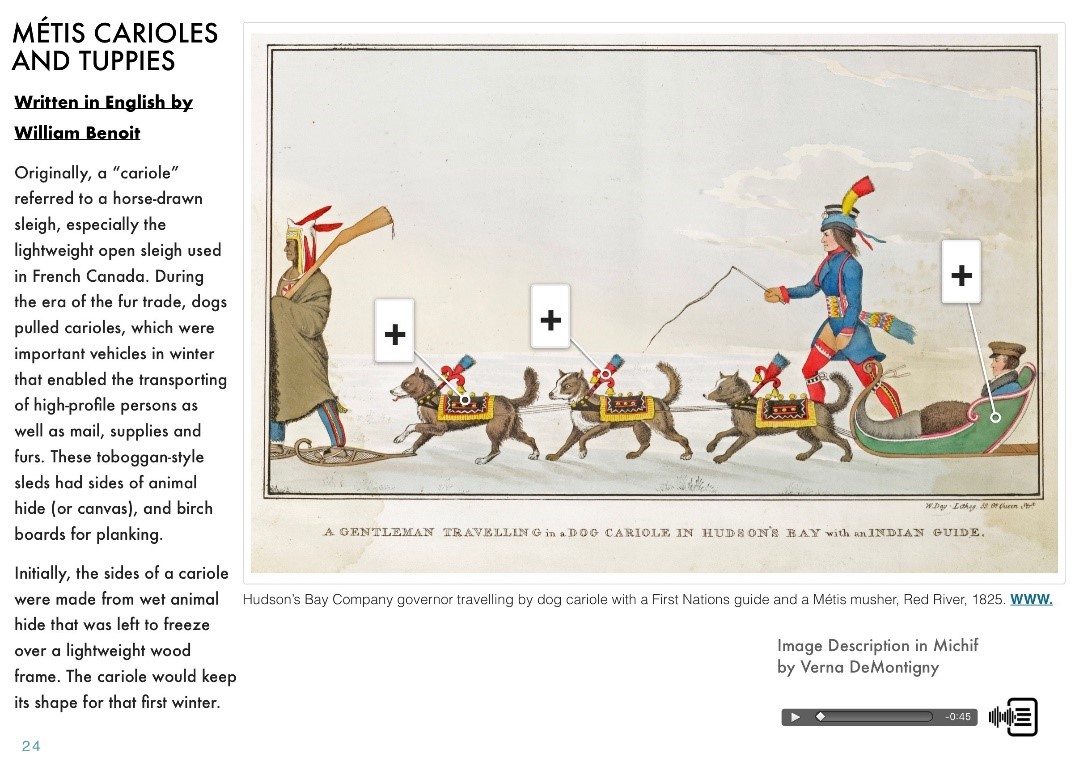
Originally, a “cariole” referred to a horse-drawn sleigh, especially the lightweight open sleigh used in French Canada. During the era of the fur trade, dogs pulled carioles, which were important vehicles in winter that enabled the transporting of high-profile persons as well as mail, supplies and furs. These toboggan-style sleds had sides of animal hide (or canvas), and birch boards for planking.

Coloured lithograph of two men walking and one man seated in a cariole pulled by three dogs.

Hudson’s Bay Company governor travelling by dog cariole with a First Nations guide and a Métis musher, Red River, 1825. (c001940k)

Initially, the sides of a cariole were made from wet animal hide that was left to freeze over a lightweight wood frame. The cariole would keep its shape for that first winter. With the spring thaw, the owner would remove the leather and use it for something else. This practice was then repeated the following winter. In later years, the sides of carioles were decorated with painted designs.

Colour reproduction of a dog cariole arriving at a home met by a group of men, women and children.

People travelling by dog cariole to meet others for Christmas, Manitoba, unknown date. (e002291374)

The custom of decorating sled dogs with ornamented harnesses and embroidered blankets or “tuppies” (Michif tapii, from French tapis, “rug”) originated with the Red River Métis during the first half of the 19th century. Their tuppies and the “standing irons” upright part of their dog harnesses were trimmed with large jingle bells, fringe, tassels, pompoms and feathers. One can only imagine the sense of celebration when seeing and hearing the arrival of Métis sled dogs.


William Benoit is the Advisor for Internal Indigenous Engagement in the Office of the Deputy Librarian and Archivist of Canada at Library and Archives Canada.

Hidden histories

On the left, Tatânga Mânî [Chief Walking Buffalo] [George McLean] is in his traditional First Nation regalia on a horse. In the centre, Iggi and a girl engage in a “kunik,” a traditional greeting in Inuit culture. On the right, Maxime Marion, a Métis guide, holds a rifle. In the background, there is a map of Upper and Lower Canada, and text from the Red River Settlement collection.

This blog is part of our Nations to Nations: Indigenous Voices at Library and Archives Canada series.

Nations to Nations: Indigenous Voices at Library and Archives Canada is free of charge and can be downloaded from Apple Books (iBooks format) or from LAC’s website (EPUB format). An online version can be viewed on a desktop, tablet or mobile web browser without requiring a plug-in.

By Ryan Courchene

The archival and published collections held at Library and Archives Canada (LAC) are amazing, and so extensive that you will never be able to see them all. You can find hidden gems every single day just by looking, either online on LAC’s website, or in one of the several buildings with archival holdings across Canada.

I work in the Winnipeg office, which alone holds over 30,000 linear feet (nearly 9,150 metres) of archival records. On a business trip to Ottawa in 2016, I had the opportunity to shadow the reference service employees at 395 Wellington Street. While there, I noticed three catalogue drawers near the desk and inquired about what they contained.

Colour photograph from a hallway, through a glass wall with two doors, of a reference room.

The reference room at LAC in Ottawa, seen from the hallway. The catalogue drawers containing research cards with copies of photographs can be seen on the left of the room. Photo Credit: Tom Thompson

Colour photograph of four metal shelving units with eight pull-out drawers containing cards with copies of photographs and associated reference information.

Reference room catalogue drawers, organized by subject headings and geographical locations, containing research cards with copies of photographs held in the collections at LAC in Ottawa. Photo Credit: Tom Thompson

I was told that they held small cards with images in the collection that were copied from microfilm and microfiche. Intrigued, I decided to look at some of the cards on my lunch break. I soon discovered the “Birth of the West” collection, which contains hundreds of incredible photographs of Western Canada, with many focusing on Indigenous images by Ernest Brown. I learned that the images contained in the drawers were only card copies of the originals; the images themselves are small and of poor quality. From a researcher’s perspective, this can be both frustrating and helpful when conducting on-site research. As with this image of the moose, many photographs indexed in the card catalogues have never been digitized. In these situations, the cards provide immediate access to images without having to order the original material in off-site storage.

The photographs in this noteworthy collection are not only visually stunning but also remarkable for the wealth of historical information on Canada and the First Nations peoples of the West. Even though there are hundreds of images in the collection, one image really caught my eye. It tells a fascinating story that evolves every time I examine it.

Colour photograph of a cream-coloured catalogue card. The left half contains typed information in black organized into different categories. A copy of a black-and-white photograph turned sideways on the right side depicts a moose with a harness hitched to a travois. The moose stands in front of a teepee.

Catalogue card of a copy of a photograph of a young moose with a harness hitched to a travois and standing in front of a teepee, unknown location, ca. 1870–1910. Photo Credit: Tom Thompson

This photograph depicts a small home, which could belong to a Métis or First Nation family, blankets hung to dry, some cleared tree brush, a pot of food by the fire pit, a beautiful teepee, and of course a domesticated young moose with a harness hitched to a travois. The one item that I did not notice immediately, which is probably the most important part of the image, is the hand holding the rope attached to the moose. My grandfather used to tell me about how he cleared his own land so he could farm and raise cattle. Is this what was happening here? Or was something else going on? Each time I look at the image, a new story emerges that raises more questions.

Detail from a black-and-white photograph showing a person’s hand holding onto a rope.

Detail of the photograph of a young moose with a harness hitched to a travois and standing in front of a teepee, unknown location, ca. 1870–1910. Photo Credit: Tom Thompson

After seeing this image of the young moose, I wanted a copy for myself. Since I was working backwards, I had to find the image in the collection to see if it was already digitized, and if not, verify any restrictions on getting a copy. To my disappointment, I found that it was not digitized, and I decided not to push the request any further.

It was not until 2019 that I learned the Ernest Brown collection was being digitized by the We Are Here: Sharing Stories (WAHSS) initiative. The moose photograph is one of 126 images in an album entitled “Birth of the West.” Dating from ca. 1870–1910, the album consists of photographs taken in the Northwest Territories (now Manitoba, Saskatchewan, Alberta and Nunavut) and British Columbia. In addition to fully digitizing and describing this album, the WAHSS team has digitized over 450,000 images, including photographic records, textual documents and maps, with the goal of providing free online access to primary sources, no travel required!

In October 2019, I was finally able to order a copy. It fills me with great joy to know that I have the first print from the digitized copy of this amazing image, which hangs in my office today.

Photograph of a black-and-white photograph with a thick white border mounted on a dark grey page in an album. The image depicts a moose with a harness hitched to a travois standing in front of a teepee.

Young moose with a harness hitched to a travois, unknown location, ca. 1870–1910. This photograph is on page 28 of the “Birth of the West” album. (e011303100-028)


Ryan Courchene is an archivist in the Indigenous Initiatives division at Library and Archives Canada.

Exploring Indigenous peoples’ histories in a multilingual e-book—Part 2

On the left, Tatânga Mânî [Chief Walking Buffalo] [George McLean] is in his traditional First Nation regalia on a horse. In the centre, Iggi and a girl engage in a “kunik,” a traditional greeting in Inuit culture. On the right, Maxime Marion, a Métis guide, holds a rifle. In the background, there is a map of Upper and Lower Canada, and text from the Red River Settlement collection.

By Beth Greenhorn in collaboration with Tom Thompson

Library and Archives Canada (LAC) launched Nations to Nations: Indigenous Voices at Library and Archives Canada to coincide with the first National Day for Truth and Reconciliation on September 30, 2021. The essays in this first edition of the interactive multilingual e-book featured a wide selection of archival and published material ranging from journals, maps, newspapers, artwork, photographs, sound and film recordings, and publications. Also included are biographies for each of the authors. Many recorded a personalized audio greeting for their biography page, some of which are spoken in their ancestral language. The essays are diverse and, in some cases, quite personal. Their stories challenge the dominant narrative. In addition to authors’ biographies, we included biographical statements by the translators in recognition of their expertise and contributions.

The Nations to Nations e-book was created as part of two Indigenous initiatives at LAC: We Are Here: Sharing Stories (WAHSS) and Listen, Hear Our Voices (LHOV). The essays were written by Heather Campbell (Inuk), Anna Heffernan (Nishnaabe), Karyne Holmes (Anishinaabekwe), Elizabeth Kawenaa Montour (Kanien’kehá:ka), William Benoit (Métis Nation) and Jennelle Doyle (Inuk) in LAC’s National Capital Region office. They were joined by Ryan Courchene (Métis-Anichinabe), from LAC’s regional office in Winnipeg, and Delia Chartrand (Métis Nation), Angela Code (Dene) and Samara mîkiwin Harp (nêhiyawak), archivists from the LHOV initiative.

This edition features the following First Nations languages and/or dialects: Anishinaabemowin, Anishinabemowin, Denesųłiné, Kanien’kéha, Mi’kmaq, nêhiyawêwin and Nishnaabemowin. Essays related to Inuit heritage are presented in Inuttut and Inuktitut. Additionally, the Inuit heritage content is presented in Inuktut Qaliujaaqpait (Roman orthography) and Inuktut Qaniujaaqpait (Inuktitut syllabics). The e-book presents audio recordings in Heritage Michif of select images in essays pertaining to the Métis Nation.

The development of this type of publication was complex. It presented technical and linguistic challenges that required creativity and flexibility. But the benefits of the Indigenous-led content outshine any of the complications. Given the space and time, the authors reclaimed records of relevance to their histories, offering fresh insights through their interpretations. The translators brought new meanings to the records, describing most, if not all, of them for the first time in First Nations languages, Inuktut and Michif.

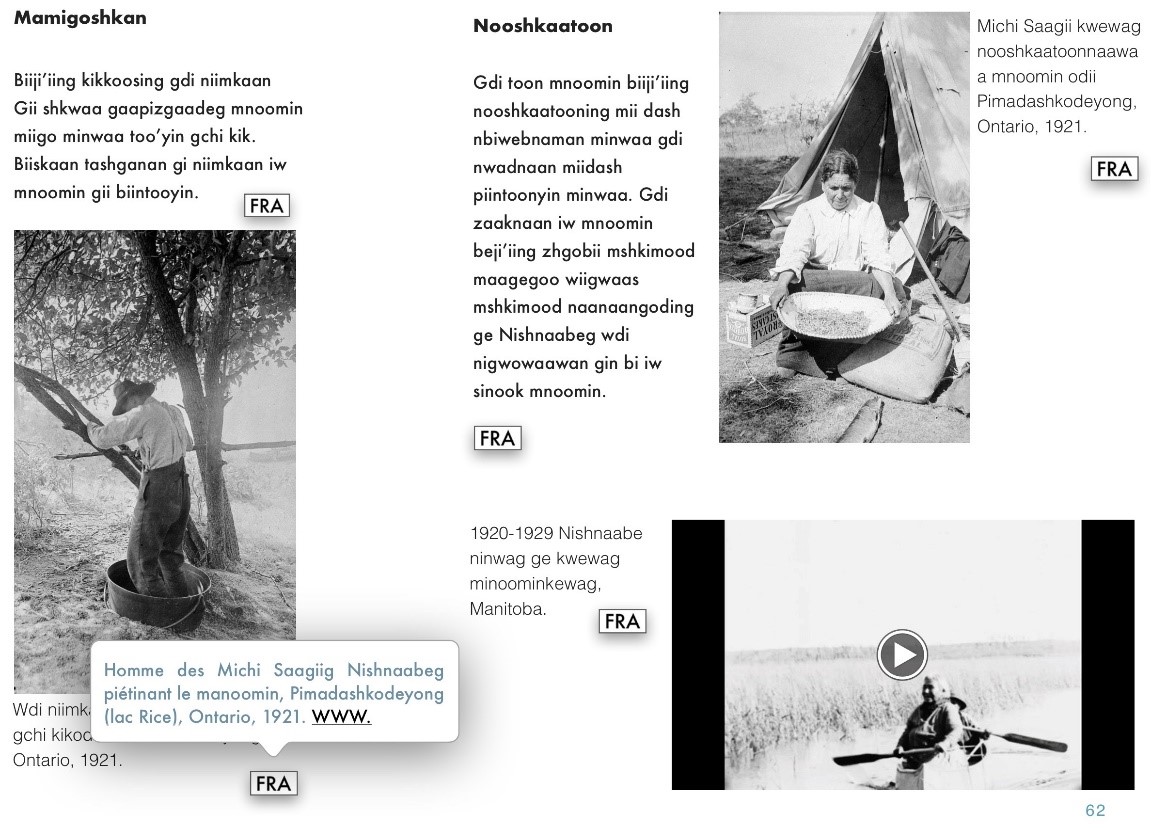
Describing her experience while researching and writing her essay regarding manoominikewin (the wild rice harvest) of the Michi Saagiig Nishnaabeg (Mississauga Ojibwe), archivist Anna Heffernan wrote: “I hope that people from Hiawatha, Curve Lake, and the other Michi Saagiig communities will be happy and proud to see their ancestors in these photos, and to see them represented as Michi Saagiig and not just ‘Indians’.”

A page from the e-book with three black-and-white images of people demonstrating different stages of wild rice harvesting.

Page from “Manoominikewin: The Wild Rice Harvest, a Nishnaabe Tradition” by Anna Heffernan, translated into Nishnaabemowin by Maanii Taylor. Left image: Michi Saagiig Nishnaabeg man tramping manoomin, Pimadashkodeyong (Rice Lake), Ontario, 1921 (e011303090); upper-right image: Michi Saagiig Nishnaabeg woman winnowing manoomin, Pimadashkodeyong (Rice Lake), Ontario, 1921 (e011303089); lower-right image: silent film clips featuring Ojibway men and women from an unidentified community harvesting manoomin, Manitoba, 1920–1929 (MIKAN 192664)

Reflecting on her experience, archivist Heather Campbell described the positive impact of the process:

“So often when we see something written about our communities, it is not written from the perspective of someone who is from that community. To be asked to write about Inuit culture for the e-book was an honour. I was able to choose the theme of my article and was trusted to do the appropriate research. As someone from Nunatsiavut, to be given the opportunity to write about my own region, knowing other Nunatsiavummiut would see themselves reflected back, was so important to me.”

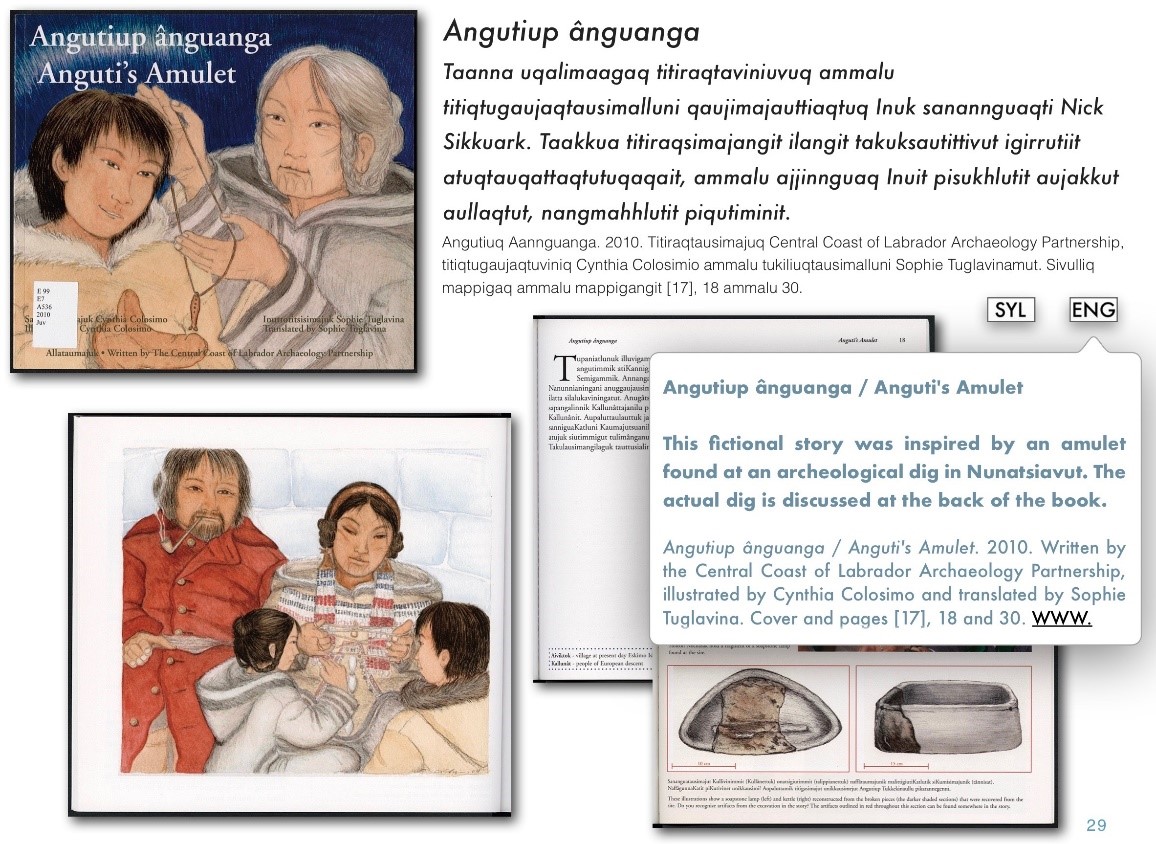
A page from the e-book that shows pages from a picture book, text written in Inuktut Qaliujaaqpait and English.

Page from “Inuktut Publications” by Heather Campbell, translated into Inuktut Qaliujaaqpait by Eileen Kilabuk-Weber, showing selected pages from Angutiup ânguanga / Anguti’s Amulet, 2010, written by the Central Coast of Labrador Archaeology Partnership, illustrated by Cynthia Colosimo and translated by Sophie Tuglavina (OCLC 651119106)

William Benoit, Internal Indigenous Advisor at LAC, wrote a number of shorter essays about Métis Nation language and heritage. While each text can be read on its own, collectively they provide insights into various aspects of Métis culture. In his words: “Although the Métis Nation represents the largest single Indigenous group in Canada, we are misunderstood or misrepresented in the broader national narrative. I appreciate the opportunity to share a few stories about my heritage.”

A page from the e-book with text in English on the left side and a lithograph of a snowy landscape with a man seated in a cariole (sled) pulled by three dogs in colourful coats. A man wearing a blanket and snowshoes is on the left in front of the dogs. A man holding a whip and wearing clothing associated with Métis culture (a long blue jacket, red leggings and an embellished hat) walks on the right-hand side of the sled.

Page from “Métis Carioles and Tuppies” by William Benoit, with a Michif audio recording by Métis Elder Verna De Montigny. Image depicting Hudson’s Bay Company governor travelling by dog cariole with a First Nations guide and a Métis Nation musher, Red River, 1825 (c001940k)

The creation of the Nations to Nations e-book has been a meaningful undertaking and positive learning experience. Two and a half years in development, the e-book has truly been a group effort involving the expertise and collaboration of the First Nations, Inuit and Métis Nation authors, Indigenous language translators, and Indigenous advisors.

I am grateful for the opportunity to collaborate with so many amazing and dedicated individuals. A special “thank you” goes to the members of the Indigenous Advisory Circle, who offered their knowledge and guidance throughout the development of this publication.

As part of ongoing work to support Indigenous initiatives at LAC, we will feature the essays from Nations to Nations as blog posts. We are excited to introduce Ryan Courchene’s essay “Hidden Histories” as the first feature in this series.

Nations to Nations: Indigenous Voices at Library and Archives Canada is free of charge and can be downloaded from Apple Books (iBooks format) or from LAC’s website (EPUB format). An online version can be viewed on a desktop, tablet or mobile web browser without requiring a plug-in.


Beth Greenhorn is a senior project manager in the Exhibitions and Online Content Division at Library and Archives Canada.

Tom Thompson is a multimedia production specialist in the Exhibitions and Online Content Division at Library and Archives Canada.

Exploring Indigenous peoples’ histories in a multilingual e-book—Part 1

On the left, Tatânga Mânî [Chief Walking Buffalo] [George McLean] is in his traditional First Nation regalia on a horse. In the centre, Iggi and a girl engage in a “kunik,” a traditional greeting in Inuit culture. On the right, Maxime Marion, a Métis guide, holds a rifle. In the background, there is a map of Upper and Lower Canada, and text from the Red River Settlement collection.

By Beth Greenhorn in collaboration with Tom Thompson

Library and Archives Canada (LAC) recently published an interactive multilingual e-book called Nations to Nations: Indigenous Voices at Library and Archives Canada. This e-book grew out of two Indigenous documentary heritage initiatives, We Are Here: Sharing Stories and Listen, Hear Our Voices, and it features essays written by First Nations, Inuit and Métis Nation colleagues at LAC. The process for creating this publication was unlike any work LAC had previously carried out.

The project team began with just two people: me and Tom Thompson, a multimedia production specialist. I was tasked with coordinating an e-book that would focus on Indigenous records held at LAC. We determined that an e-book was an excellent fit to showcase newly digitized content. An e-book offered the best platform to incorporate interactive material, such as audiovisual records. It also provided the capability to feature Indigenous languages and dialects.

Work began after the United Nations declared 2019 as the International Year of Indigenous Languages. With this in mind, we consulted with our Indigenous colleagues. The discussions were heartening.

Initially, we intended to feature archival content and other historical materials held at LAC that were created by Indigenous peoples in their ancestral languages. After several months of unsuccessful research, we realized that with the exception of a small number of documents, there was little content written in First Nations languages or Inuktut, the Inuit language. As for Michif, the language of the Métis Nation, there is no known documentation in the collection at LAC.

Faced with this reality, the e-book team needed a new strategy on how to create a publication that supports Indigenous languages when the bulk of published and archival records was created by settler society. Following several brainstorming discussions, the answer became clear and was surprisingly simple. Instead of focusing on historical records written in Indigenous languages, the authors would choose collection items in any media that they found meaningful and then discuss them in their essays. The essays would be translated into the Indigenous language represented by the people portrayed in each section. Content that was translated into an Indigenous language would be presented as the primary text, with English and French versions being secondary.

The title, Nations to Nations: Indigenous Voices at Library and Archives Canada, was chosen by the authors and emphasizes the distinction of the different nations and the diversity of voices. By positioning the authors’ voices at the front and centre, the stories provide a richer understanding of the world through awareness of the Indigenous knowledge and perspectives.

Recognizing that many Indigenous communities have limited Internet connectivity, dynamic content has been embedded in the e-book wherever possible. This includes high-resolution images, podcast episodes, audio clips and film footage. An Internet connection is still required to download the e-book and to access some content, such as database records, blog articles and external links.

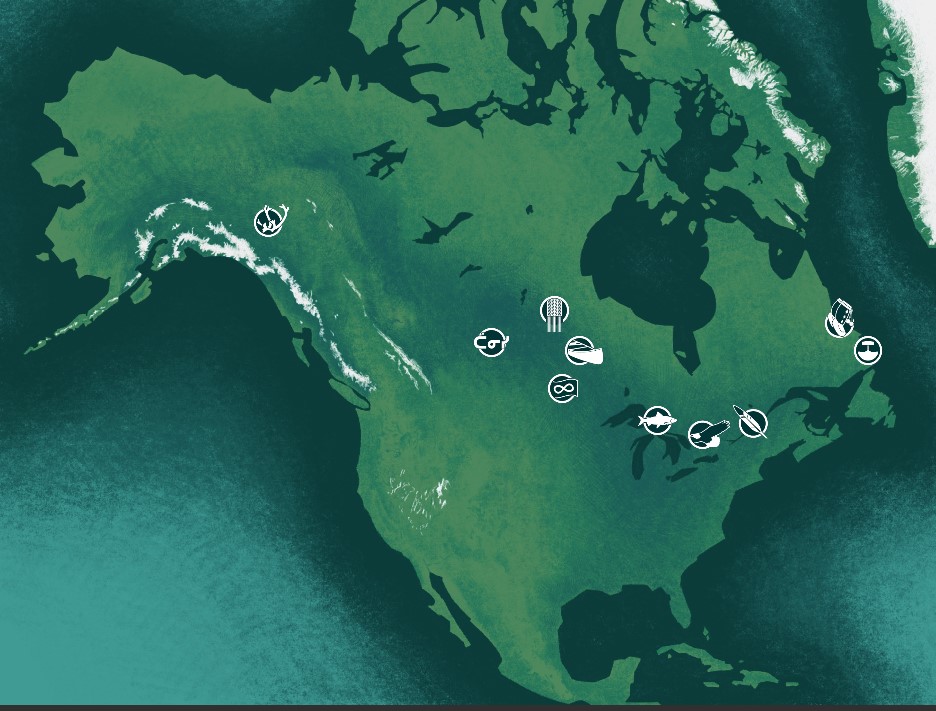
A map of North America with symbols placed across Canada.

Pre-contact map of North America without any geopolitical borders, with icons linking to author biographies and essays. Image: Eric Mineault, LAC

Following a recommendation from the Indigenous Advisory Circle at LAC, we hired Indigenous language experts and knowledge keepers to translate the essays and related texts in the e-book. Of all of the tasks involved in the creation of this e-book, finding qualified translators was one of the most rewarding, yet challenging, activities. Many of the languages are at risk and, in some cases, are critically endangered. While language revitalization work has begun in many communities to create standardized lexicons and dictionaries, there were many words in English with no equivalent in the Indigenous language. Quite often, the translators needed to consult with Elders in their communities to confirm terminology and to find a word or phrase that would convey the same meaning.

One of LAC’s biggest paradigm shifts was in presenting the Indigenous language as the principal content, and in offering English and French as supporting texts. In an effort to emphasize this shift, the authors chose words to describe places, proper names and descriptions in their ancestral languages. These words are accompanied by translations in English or French in parentheses, the first time they are introduced to the reader, and only the Indigenous words are used for all further references.

Nations to Nations: Indigenous Voices at Library and Archives Canada is free of charge and can be downloaded from Apple Books (iBooks format) or from LAC’s website (EPUB format). An online version can be viewed on a desktop, tablet or mobile web browser without requiring a plug-in.


Beth Greenhorn is a senior project manager in the Exhibitions and Online Content Division at Library and Archives Canada.

Tom Thompson is a multimedia production specialist in the Exhibitions and Online Content Division at Library and Archives Canada.