Federal Indian Day Schools: Education under the Indian Act—what did this mean for Métis Nation and Inuit children?

Version française

By William Benoit and Alyssa White

This article contains historical language and content that may be considered offensive, such as language used to refer to racial, ethnic and cultural groups. Please see our historical language advisory for more information.

The federal government, in cooperation with the Roman Catholic, Anglican, United and Presbyterian churches, operated nearly 700 Federal Indian Day Schools (Day Schools) across the country, in every province and territory except for Newfoundland and Labrador. They operated from the 1860s to the 1990s. Unlike Indian Residential Schools, Day Schools were only operated during the day. However, their purpose was like that of their residential counterparts: to assimilate First Nations, Inuit and Métis Nation children into white society and by extension erase their Indigenous languages and cultures.
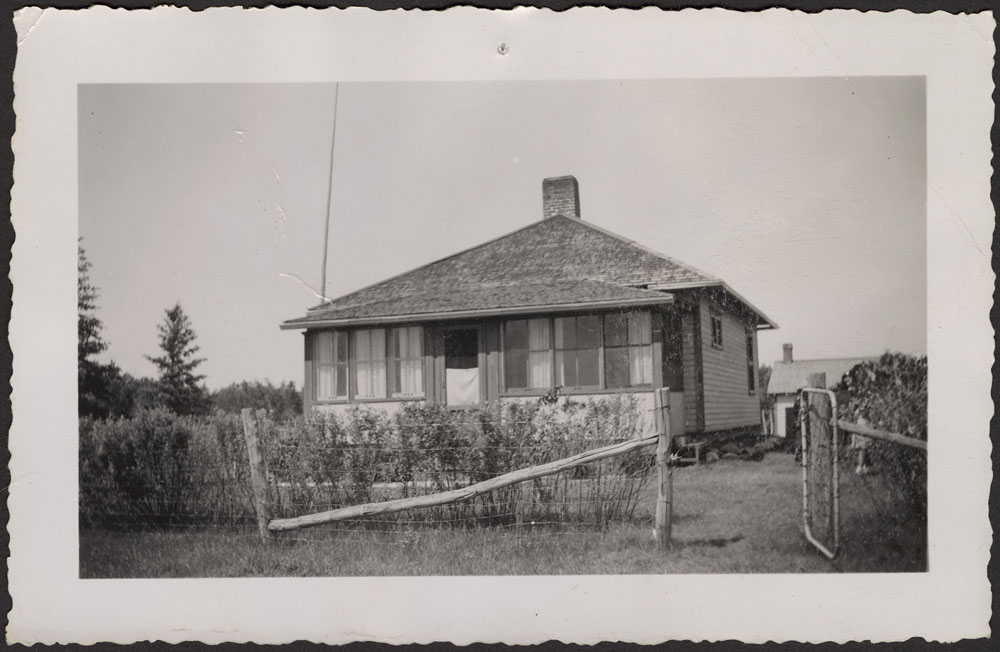
Black-and-white photograph of a white-frame bungalow with a hip roof located behind a wire fence with wooden posts and an opened metal gate.

Fishing Lake Day School, near Wadena, Saskatchewan, ca. 1948. (e011080261)

Many Indigenous students who attended Day Schools faced verbal, physical and sexual abuse during their time in that system. In addition, communities were not given a say in the curriculum or how the schools were run. It was not until the 1970s, 1980s and 1990s—when the federal government started transferring control of Day Schools to the First Nations and Inuit they ostensibly served—that these communities had any management over what and how their children were taught.

Crown-Indigenous Relations and Northern Affairs Canada estimates that between 180,000 and 210,000 individuals attended a Federal Day School between 1923 and 1994, based on historical departmental enrolment data and actuarial expertise. The system did not impact all First Nations, Inuit and Métis Nation in the same fashion. The largest percentage of students was First Nations, with Inuit and Métis Nation students representing smaller percentages. Each group had a unique relationship with the federal government – including whether or not the government would acknowledge the Métis or Inuit as being part of their educational or financial responsibility – and distinctive difficulties and problems were created not just in the educational services the government purported to provide to Canada’s Indigenous Peoples, but also in the care and consistency with which they kept their records.

This article will discuss the impact of the Federal Day Schools upon Métis Nation and Inuit communities, as their experiences were different and often less documented than those of First Nations.

Métis Nation children at Federal Indian Day Schools: numbers are not determinable

Did Métis Nation children attend Federal Indian Day Schools across Canada? The answer is yes, though determining the number of identifiable Métis students is practically impossible. But one can safely assume that Métis and non-Status Indian students residing in the catchment areas of Federal Indian Day Schools may have attended those schools. This is particularly probable if there was no provincial or church-run school in the vicinity for those children to attend.

The federal government has focused its attention on individuals who fall under the Indian Act. Historically, it speaks most of those who have Indian Status and less of those whom it identifies as Métis and non-Status Indian. This glib observation is key to any discussion of Métis attendance at Federal Indian Day Schools. It speaks to historical Métis access to education, health programs and other government services. Métis and non-Status individuals have been subjected to what has been referred to as a “jurisdictional wasteland” and “tug-of-war,” since both the federal and provincial governments have denied responsibility for, and legislative authority over, these peoples.

The Indian Act

One must also consider the larger discussion of status as defined by the Indian Act and how it impacts the self-identity of Indigenous peoples.

Under the Indian Act, Status Indians are wards of the Canadian federal government, a paternalistic legal relationship that illustrates the historical imperial notion that Indigenous peoples are like children, requiring control and direction to bring them into more “civilized” colonial ways of life. Federal Indian Day Schools, like Indian Residential Schools, were the federal government’s response to its need to control and direct its wards.

The Indian Act applies only to Status Indians and has not historically recognized Métis and Inuit. As a result, Métis and Inuit have not had Indian status and the rights conferred by this status, despite being Indigenous and participating in Canadian nation-building.

History and context surrounding the identification of Métis Nation children

Accurate attendance numbers of non-Status Indians (First Nations), Métis and Inuit are dependent on whether the federal government acknowledged its legal responsibility to legislate on issues related to them. For Inuit, the government’s legal obligation is usually considered to begin in 1939, following the Supreme Court decision in Reference as to whether “Indians” includes “Eskimo” (1). For Métis and non-Status Indians, the date is 2016, when the Supreme Court ruled that they should also legally be considered “Indians” under the Constitution Act (2).

Federal government records reflect the sad fact that little, or no data was collected when there was no legal obligation to serve these communities. Consequently, Federal Day School records created between the 1860s and the 1990s do not clearly identify Métis and non-Status students. A similar point could be made for Inuit prior to 1939. Unfortunately, this means that government records do not provide a clear understanding of the numbers of Métis children who attended Federal Indian Day Schools.

Inuit children at Federal Indian Day Schools: taken far from family and home

Today, four regions make up Inuit Nunangat: the Inuvialuit Settlement Region (northern Northwest Territories), Nunavut, Nunavik (northern Quebec) and Nunatsiavut (northern Labrador). While the earliest Federal Day Schools in southern Canada were opened in the early 1860s, the opening of schools in Nunavut did not occur until the late 1940s through mid 1950s.
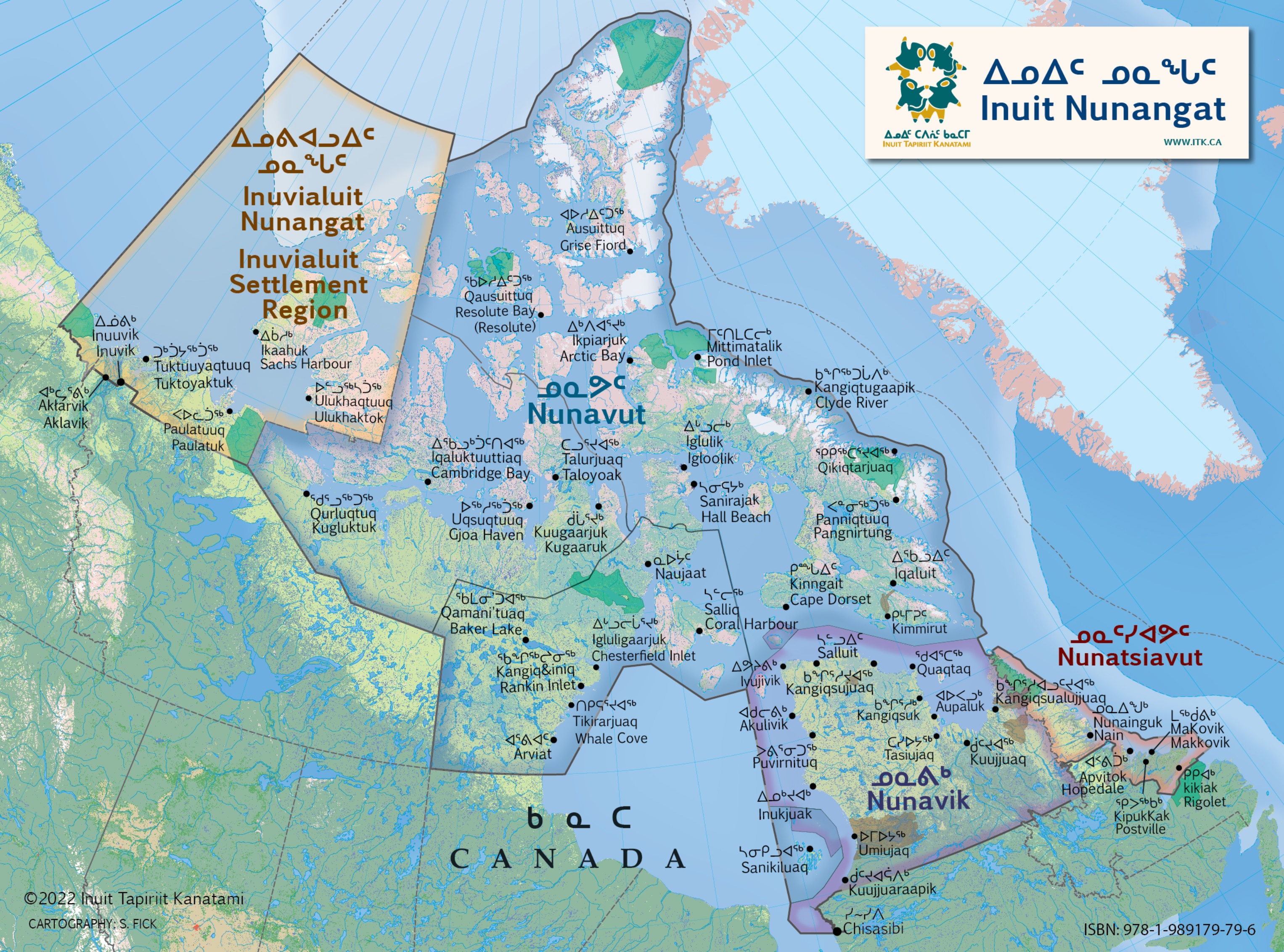
Graphic image of a map. The land mass is light green and the areas showing water are blue. The community names are written in Inuktitut syllabics, followed by the Inuit name and the English name.

Map of Inuit Nunangat (Inuit homeland). Courtesy of Inuit Tapiriit Kanatami.

Some of the closest school options for Inuit children would have been at Old Crow Village (Yukon), Fort Simpson (Northwest Territories), Churchill (Manitoba), Fort Severn (Ontario) and Fort George (Quebec), but these schools were not necessarily permanent. It was not uncommon for remote Day Schools to close periodically for years.

In contrast to Indian Residential Schools (or Federal Hostels), which housed students on site and away from their families and homes, Day Schools were built so that students would be able to return home after their school day and not be required to travel extended distances to live elsewhere for months at a time. The catch to this was that Day Schools were typically only built on or near First Nation communities, with little consideration of Inuit communities and students until the 1940s.

Although Day Schools were intended to prevent separation and alienation, Inuit children would end up being taken, sometimes suddenly and without warning for extended distances to live elsewhere to attend a Day School. The schools were often located in areas with completely different climates, ecosystems, social cultures and languages, with unrecognizable plants or animals. Shock would be too gentle a word to describe the sense of alienation those children must have felt on arrival.

This picture below, by all appearances, shows a happy moment caught on film: two smiling boys enjoying a day out with their families to see an airplane in the hamlet of Iglulik. What this photograph does not show is what happened minutes later, when the boys were put onto the plane and taken 800 kilometres away to Sir Joseph Bernier Federal Day School in Igluligaarjuk (Chesterfield Inlet) without any prior knowledge of what was about to happen. (3)
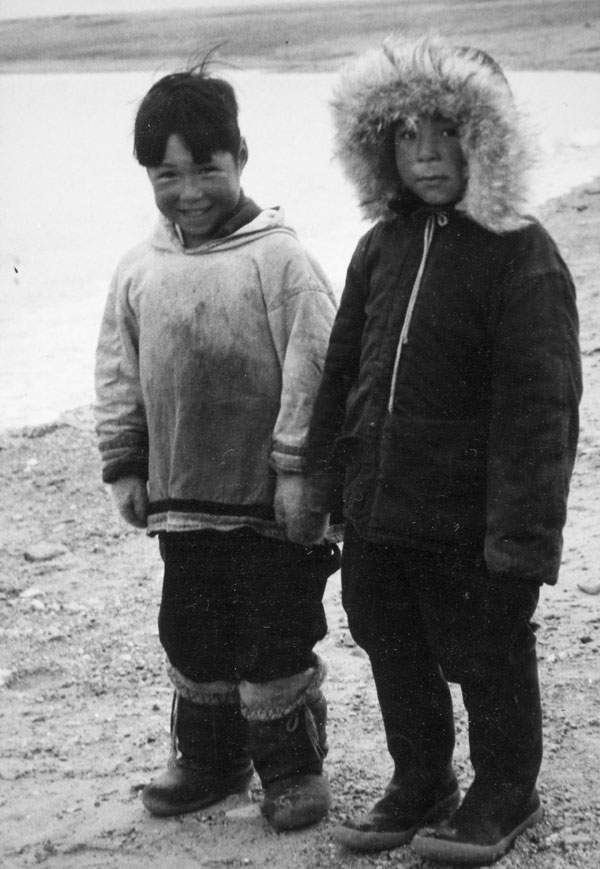
Black-and-white photograph of two boys standing on a shoreline looking at the camera.

Kutik (Richard Immaroitok) and Louis Tapadjuk (right), Iglulik, Nunavut, 1958. (e004923422)

Considering that school attendance was compulsory by the 1920s, one can imagine the compounded stress and fear experienced by Inuit families when it came to federal control of their children’s education.

Day Schools in the North were not large facilities, commonly consisting of one to three classrooms and a teacherage, facilitating anywhere from eight to two dozen students at a time depending on location and local population. Once a school was full, any additional children in the area would have been sent further south and west until room could be found for them.
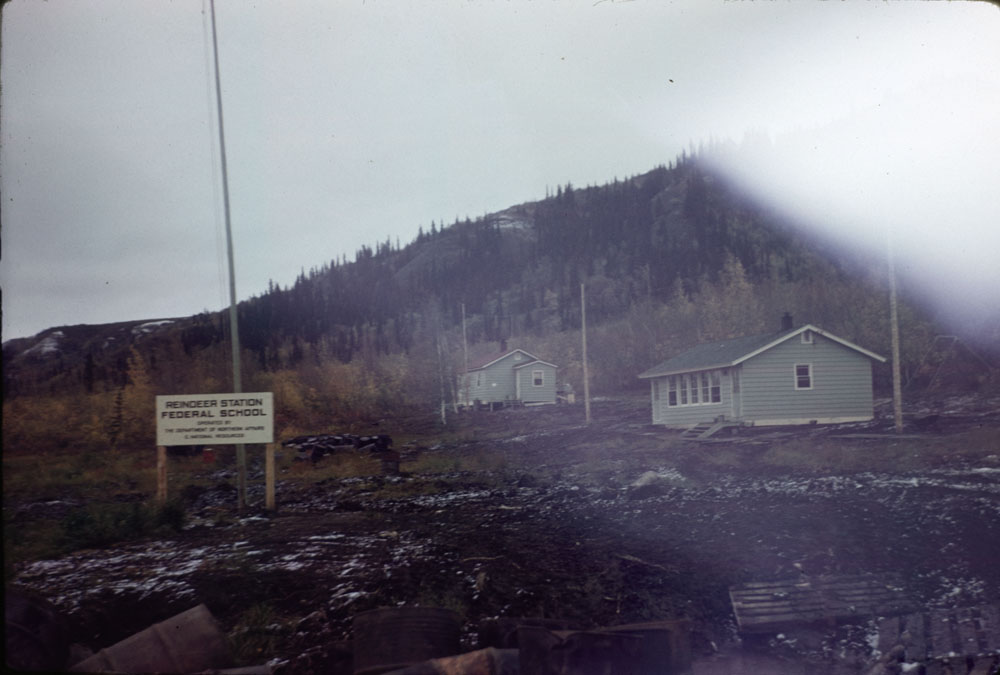
Colour photograph of two one-story frame buildings painted pale green located on a rocky foreground with a large tree-covered hill in the background. There is a white sign with black lettering mounted on wood posts on the left side.

Reindeer Station Day School, Qunngilaaq, Northwest Territories, between 1950 and 1960. (e011864959)

Children who did not have access to a local Day School were sent to residential, boarding or foster homes in communities ranging anywhere from hundreds to thousands of kilometres away from their families and everything that was familiar to them. They would be handed over to the care and keeping of total strangers, in places that would have been entirely strange to them, that they were not free to leave. Visits from family were not guaranteed due to travel costs and time. This meant that Inuit students were separated from their families not just for months but occasionally for years at a time.

Between the 1940s and 1980s, more schools were built across the country, including locations in the far North, such as those serving the remote communities on the southern shore of Ellesmere Island and Resolute Bay in Nunavut.

To give a better idea of the spread and demographics of Day Schools in Canada and the struggles of remote communities, of the 699 Day Schools on record, a total of 75 were opened across the combined land masses of the Yukon, Northwest Territories, Nunavut and northern Quebec. Only seven of those existed prior to the 1940s (in the Yukon and Northwest Territories), with the other 68 being built between 1940 and 1969.

The Day Schools Project

The Day Schools Project (DSP) is identifying, describing, digitizing and making accessible government records that include information pertaining to Federal Indian Day Schools. The project’s goal is to prepare these files and documents for public access.

The records being digitized include nominal rolls from various schools across Canada as well as information regarding foster homes, boarding homes, hostels, transfer requests and authorizations, adoption records and school discharge records. These can be used to trace the trail of schools and homes that many Indigenous children passed through.

It is important to note that most of the Day Schools records are restricted by law but can still be accessed according to access to information and privacy legislation. The DSP is trying to build foundations to make access to records as easy as possible. This includes identifying ways to make current procedures and resources easier for people to understand and navigate, for example, by adding detailed information to the archival records. To learn more about accessing records digitized by the DSP, see the Day Schools Project: Overview and the Day Schools Project: Research Guide.

Besides making information more accessible to Indigenous communities, Day School records can be accessed by the public, many of whom were never taught about these histories and as a result never truly understood the scope of the scars they have left behind.

Ultimately, First Nations, Inuit and the Métis Nation need access to the histories for healing, finding closure and continuing the work of building towards their futures. The general Canadian public needs access to these histories to better understand the realities of how this country was formed and to support a future that is and does better for all its people.

The road to reconciliation is long, but the key to progress is in access to information and public education. Indigenous data sovereignty and community access to documents remain some of the greatest hurdles still to overcome.

Additional resources (Library and Archives Canada)

External resources

References

  1. Reference as to whether “Indians” includes “Eskimo,”1939 CanLII 22, [1939] SCR 104 is a decision by the Supreme Court of Canada regarding the constitutional status of Inuit in Canada. The case concerned section 91(24) of the Constitution Act, 1867, then the British North America Act, 1867, which assigns jurisdiction over “Indians, and Lands reserved for the Indians” to the federal government. The Supreme Court found that for the purposes of section 91(24), Inuit should be considered Indians.
  2. Daniels v. Canada (Indian Affairs and Northern Development), 2016 SCC 12, [2016] 1 SCR 99 is a decision by the Supreme Court of Canada regarding the constitutional status of Métis and non-Status Indians in Canada. The Métis Nation and non-Status Indians are also “Indians” under s. 91(24). The Supreme Court of Canada ruled in Daniels v. Canada that the federal government, rather than provincial governments, holds the legal responsibility to legislate on issues related to Métis and non-Status Indians. Section 91(24) of the Constitution Act, 1867 concerns the federal government’s exclusive legislative powers.
    Note: Recognition as Indians (First Nation individuals) under this section of law is not the same as Indian status, which is defined by the Indian Act. Therefore, the Daniels decision does not grant Indian status to Métis or non-Status peoples. However, the ruling could result in new discussions, negotiations and possible litigation with the federal government over land claims and access to education, health programs and other government services.
  3. Greenhorn, Beth. “The Story behind Project Naming at Library and Archives Canada.” In Atiquput: Inuit Oral History and Project Naming, edited by Carol Payne, Beth Greenhorn, Deborah Kigjugalik Webster and Christina Williamson, 70-71. Montreal and Kingston: McGill-Queen’s University Press, 2022.

William Benoit is the Indigenous Advisor on the Day Schools Project.
Alyssa White is an Archival Assistant on the Day Schools Project.

Indigenous Peoples in the First World War: researching forgotten veterans

On the left of the graphic, Tatânga Mânî [Chief Walking Buffalo] [George McLean] in traditional regalia on horse. In the middle, Iggi and girl engaging in a “kunik”, a traditional greeting in Inuit culture. On the right, Maxime Marion, a Métis guide stands holding a rifle. In the background, there is a map of Upper and Lower Canada, and text from the Red River Settlement collection.By Ethan M. Coudenys

This article contains historical language and content that some may consider offensive, such as language used to refer to racial, ethnic and cultural groups. Please see our historical language advisory for more information.

Understanding the First World War from the perspective of the Indigenous Peoples of this land has been of paramount importance for many Indigenous researchers, such as myself. Dedicating hours upon hours to research a single Great War veteran is sometimes required just to identify that they were indeed Indigenous. While we have excellent resources about some of the very well-known First Nations, Inuit and Métis Nation service members from that war, there is still much to discover in this realm of historical knowledge.

This post is not meant to convey the story of the Indigenous people who served during the First World War, nor would I attempt to simply generalize the experiences of Indigenous peoples into a single blog post. Instead, I will share the stories of two very different individuals and relate how research techniques can be used to better research an Indigenous person who served in the Great War.

The story of John Shiwak

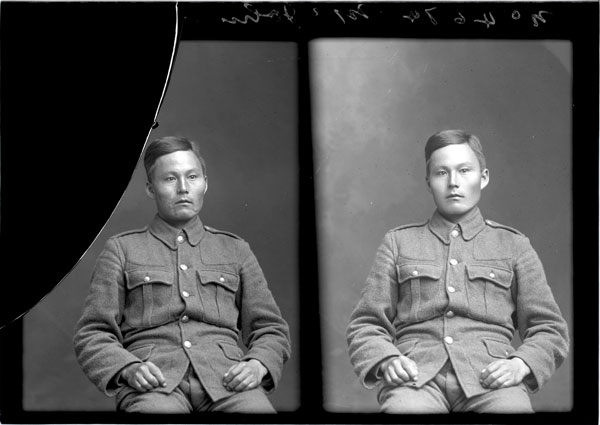
Two side-by-side photos of the same man seated and wearing an army uniform.

John Shiwak, Royal Newfoundland Regiment # 1735. The Rooms, Item E 29-45.

John Shiwak was born in 1889 in Rigolet, Labrador. A member of an Inuit community, he was an experienced hunter and trapper when he enlisted with the First (later “Royal”) Newfoundland Regiment on July 24, 1915. He was still in training when the regiment was sent over the top of the St. John’s Road trench at Beaumont-Hamel on July 1, 1916, the first day of the Battle of the Somme. When Shiwak joined the regiment in France a few weeks later, on July 24, he was one of many who saw the aftermath of the near destruction of the regiment in the 45 minutes that they fought on the Somme battlefield. In April 1917, Shiwak was promoted to lance corporal. Unfortunately, that November, less than a year before the guns fell silent, Lance Corporal John Shiwak met a sad end. In the middle of the battle for Masnières (during the larger First Battle of Cambrai), Shiwak’s unit was struck by a shell, killing him and six others.

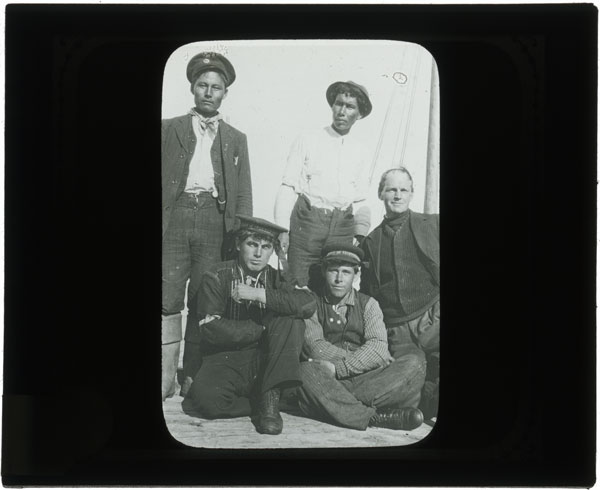
Group of five men standing or sitting.

Members of the Legion of Frontiersmen (before 1915); John Shiwak is standing at the left. The Rooms, Item IGA 10-25.

This story is not uncommon in accounts of the First World War. The Inuk man was killed in the line of duty, in the midst of his brothers in arms. Yet his story is even sadder: until now, the gravesite of Shiwak and those six other brave men were never located. It is theorized that a school was built above the grave, the construction happening without the knowledge that seven soldiers of the Great War were buried there. Nevertheless, as with all casualties without a known resting place, Shiwak is commemorated. His name is forever etched on the bronze plaques at the Beaumont-Hamel Newfoundland Memorial in France, and at a similar memorial in St. John’s, Newfoundland and Labrador.

The story of Angus Edwardson

The story of Private Angus Edwardson is of personal interest to me. He was my great-great-grandfather and fought at Passchendaele. He was born in 1894 in the northern, primarily Algonquin Anishinaabe, community of Lac-Barrière, about 300 kilometres northwest of Ottawa. On his enlistment form, Edwardson stated that he and his family resided in Oskélanéo, Quebec. For a very long time, our family did not know that he was Indigenous, nor did we know about his time in the trenches in any detail.

Luckily, in my line of work, one can discover some very interesting pieces of information. During a search through the 1921 Census, I found information that he was an “ancien soldat” (veteran); I was therefore able to find his attestation papers. While Edwardson’s story is much less noteworthy than that of Shiwak, his story provides an insight into the challenges of researching Indigenous men who fought in the Canadian Expeditionary Force (CEF) and indeed in the British forces as a whole.

Two pages of the attestation papers of Angus Edwardson.

Attestation papers of Angus Edwardson (regimental number 1090307).

In the physical description of Edwardson, the enlistment officer wrote that his complexion was “fair,” his eyes “blue,” and his hair “dark.” This description does not reflect the racial idea of an Indigenous person, nor did the enlistment officer note that Edwardson was First Nations by writing the commonly used term “Indian” under the section of the form entitled “Distinctive marks, and marks indicating congenital peculiarities or previous disease.”

From what we can see in his records, Edwardson was a member of the 253rd (Queens’ University) Highland Battalion, though he served with a number of other battalions and regiments during his time on the front. Notably, while serving with the 213th Battalion on August 28, 1918, he was wounded in the left hand by a bullet.

Challenges facing researchers

As I mentioned, not knowing that a member of the CEF was Indigenous is a major sticking point for researchers. The attestation files may not contain this information at all. In fact, this is very common in the later years of the First World War. Neither of the two men that I have written about have the telltale designation “Indian” on their attestation forms. The only way we can know for certain that these two men were indeed Indigenous is by relying on additional sources.

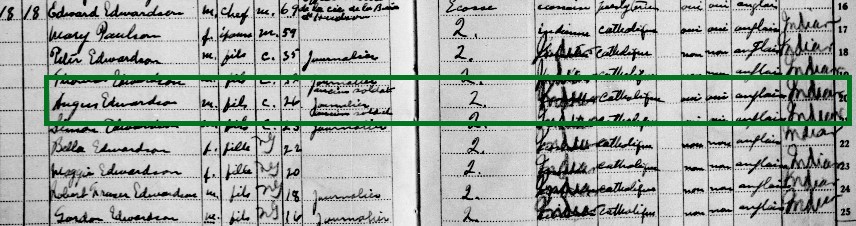
The first of such sources is the often-overlooked census records. The census provides vital information about research subjects, and individual information can greatly increase success in researching Indigenous members of the CEF and the Royal Newfoundland Regiment (RNR). In the case of Edwardson, I discovered that he was in fact Indigenous by looking at his record in the 1921 Census. For Shiwak, there was an entirely different route to finding his identity, which was incredibly difficult. I uncovered information about Shiwak’s ethnic heritage through the memoirs of Sydney Frost, a captain with the RNR, entitled A Blue Puttee at War. This memoir, however, is not the only way to find out that Shiwak was Indigenous.

List of names, ages and genders from the 1921 Census.

Census entry for Angus Edwardson and family, 1921 (e003065155).

Secondary sources about the First World War are numerous. For Shiwak, several appear when simply searching his name, but for other, lesser-known Indigenous members of the CEF, this may be more difficult. The excellent book For King and Kanata: Canadian Indians and the First World War by Timothy Winegard shows how we may be able to improve search techniques for Indigenous individuals and groups that served in the CEF. Though not explicitly, Winegard indicates the role of individual communities and their part in deciding to send men to enlist for the war effort. That said, this effort can be difficult, and it is worth reaching out to local genealogical societies and/or Indigenous communities for help in locating a list of names or simply an idea of how many men served from that community.

The final source of information that is quite useful in these cases is the so-called Indian Registers. These are archival documents with lists of names of members of bands. While the registers are a great resource for those researching members of a specific First Nations band and who are able to visit Library and Archives Canada in Ottawa, there are challenges remaining for those who do not know the band of their research subject or whether their subject died during the war. For individuals researching an Inuk or a member of a Métis Nation community, the challenges deepen, as there is very little primary source material from the period immediately after the Great War. It may be possible to identify Inuit or Métis Nation members of the CEF or RNR through secondary sources, but this can be challenging and take time.

Conclusion

Lance Corporal John Shiwak and Private Angus Edwardson both fought during the First World War. The former was Inuk and the latter was First Nations. The two cases exemplify the many challenges that face researchers when they are looking to find information about members of the CEF or RNR who were Indigenous. These challenges are multi-faceted, and they can pose significant difficulties in research into the stories of Indigenous veterans who fought in the Great War. There are some solutions and resources, including consulting archival records (census records specifically), checking with local Indigenous communities, and accessing some resources specific to Indigenous Peoples at Library and Archives Canada. Nevertheless, these proposed solutions can only go so far in helping researchers find information about Indigenous people who served in the First World War.

Additional resources 


Ethan M. Coudenys is a Genealogy Consultant at Library and Archives Canada. They are proudly of Innu heritage and the descendant of a residential school survivor.

Pidji-ijashig – Anamikàge – Pee-piihtikweek – Tunngasugit – ᑐᙵᓱᒋᑦ – Welcome

On the left, Tatânga Mânî [Chief Walking Buffalo] [George McLean] is in his traditional First Nation regalia on a horse. In the centre, Iggi and a girl engage in a “kunik,” a traditional greeting in Inuit culture. On the right, Maxime Marion, a Métis guide, holds a rifle. In the background, there is a map of Upper and Lower Canada, and text from the Red River Settlement collection.

This blog is part of our Nations to Nations: Indigenous Voices at Library and Archives Canada series.

By Karyne Holmes

This article contains historical language and content that some may consider offensive, such as language used to refer to racial, ethnic and cultural groups. Please see our historical language advisory for more information.

Nations to Nations: Indigenous Voices at Library and Archives Canada is a multilingual and interactive e-book that features hundreds of items in the care of Library and Archives Canada (LAC) through the perspectives of First Nations, Inuit and Métis Nation staff. The first stages of developing the e-book began in 2018, shortly after I had joined LAC as a researcher for We Are Here: Sharing Stories (WAHSS), LAC’s initiative in researching, digitizing and describing Indigenous-related records to make them more accessible. I was honoured to be invited as one of the co-authors for the e-book and have the task of writing the e-book’s introductory text, “Pidji-ijashig – Anamikàge – Pee-piihtikweek – Tunngasugit – ᑐᙵᓱᒋᑦ – Welcome.” In writing the introduction, I reflected on how finding historical family documents has been personally significant and why the research and access work of WAHSS is so meaningful. I wanted to communicate the value behind projects like the e-book and WAHSS. The introductory message also highlights how the e-book celebrates language knowledge and language reclamation.

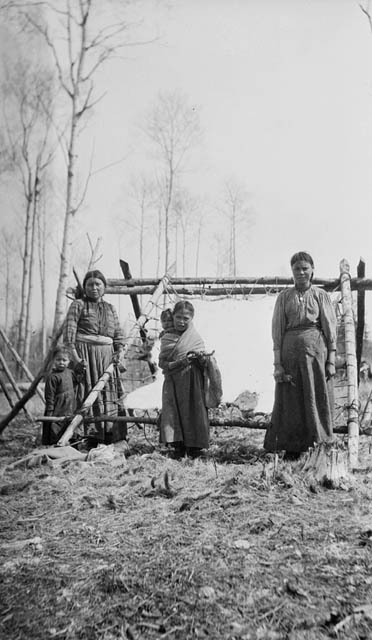
Black-and-white photograph of two women and a girl standing outdoors in front of a stretched moosehide laced onto a wooden frame. The girl is carrying an infant, and the woman on the left is holding the hand of a small child. They are on grassy vegetation, and there is a row of tall deciduous trees without leaves in the background.

Dëne Sųłiné women and children standing in front of a moosehide tanning frame, Christina Lake, Alberta, 1918 (a017946). This photo is featured in “Traditional Caribou and Moosehide Tanning in Northern Dene Communities” by Angela Code.

The Steering Committee on Canada’s Archives recently released a Reconciliation Framework as a response to Call to Action 70 issued by the Truth and Reconciliation Commission of Canada. The report acknowledges that the “colonial archival record has significantly contributed to the formation of a Canadian historical narrative that privileges the accomplishments of Eurocentric settler society at the expense of First Nations, Inuit, and Métis identities, experiences, and histories.” A fundamental message of the framework is that archives must respect Indigenous peoples’ intellectual sovereignty over materials created by or about them, and they must integrate Indigenous perspectives, knowledge, languages, histories, place names and interpretations into Indigenous-related archives.

The framework outlines ways that we can incorporate reconciliation into archival practices that reflect the work that has started at LAC. Our collaborative Nations to Nations publication is a valuable educational resource that shows the importance of re-contextualizing archival records to bring awareness to the diversity within First Nations, Inuit and Métis Nation perspectives and lived experiences.

“Pidji-ijashig – Anamikàge – Pee-piihtikweek – Tunngasugit – ᑐᙵᓱᒋᑦ – Welcome” in Nations to Nations: Indigenous Voices at Library and Archives Canada

To read the following text in Anishinabemowin, see the e-book. Nations to Nations: Indigenous Voices at Library and Archives Canada is free of charge and can be downloaded from Apple Books (iBooks format) or from LAC’s website (EPUB format). An online version can be viewed on a desktop, tablet or mobile web browser without requiring a plug-in.

 Archives and library collections provide a glimpse into the lives and experiences of our ancestors. This is true for all people, but they have special significance to Indigenous peoples. Ongoing colonial policies and actions have separated our families, thus cutting our connections and access to culture, community, knowledge and stories. Archival records and publications can facilitate the discovery of family and community history. They can also ignite memories and restore knowledge. For many, these have been partially lost through the residential school era and the ongoing forced removal of Indigenous children from their families. Historical records can recover missing pieces and unearth new information about our personal and community histories. They can allow us to share our stories with the world, in our own words.

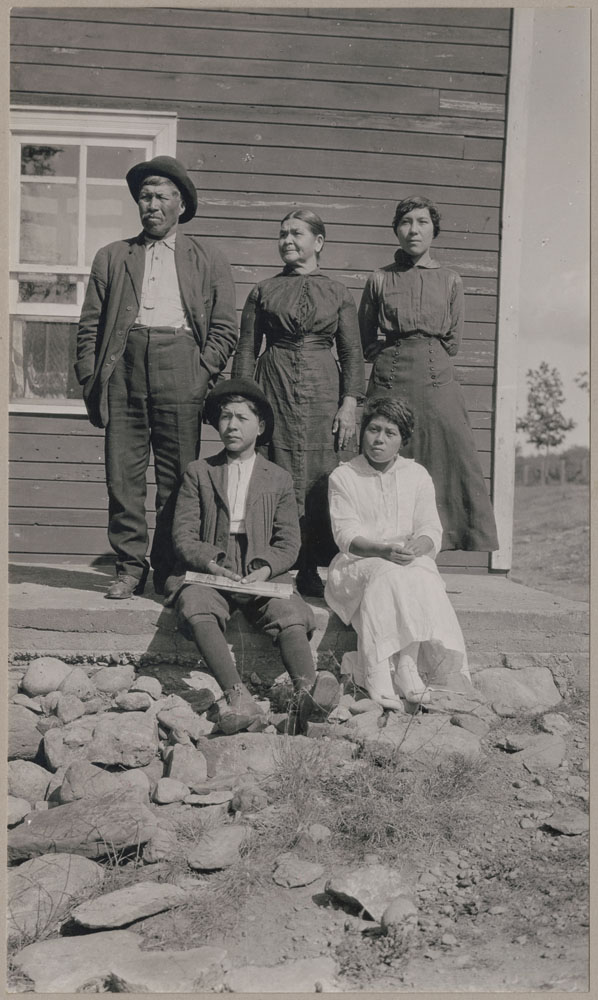
Husband and wife standing outside a building with their daughter standing next to her mother and their son and second daughter sitting in front of them.

Michel Wakegijig and his family outside their home at Wiikwemkoong First Nation, ca. 1916 (e011310537-040_s1).

Although the value held within historical records is recognized, the majority of documents at Library and Archives Canada (LAC) were created, collected and interpreted through a colonial lens. As a result, many records pertaining to Indigenous communities are marred by missing details and inaccurate portrayals, and they are often described with a focus on what the record creator perceived to be of interest and importance. It is crucial to apply Indigenous insight, to contextualize and interpret records that pertain to First Nations, Inuit and the Métis Nation.

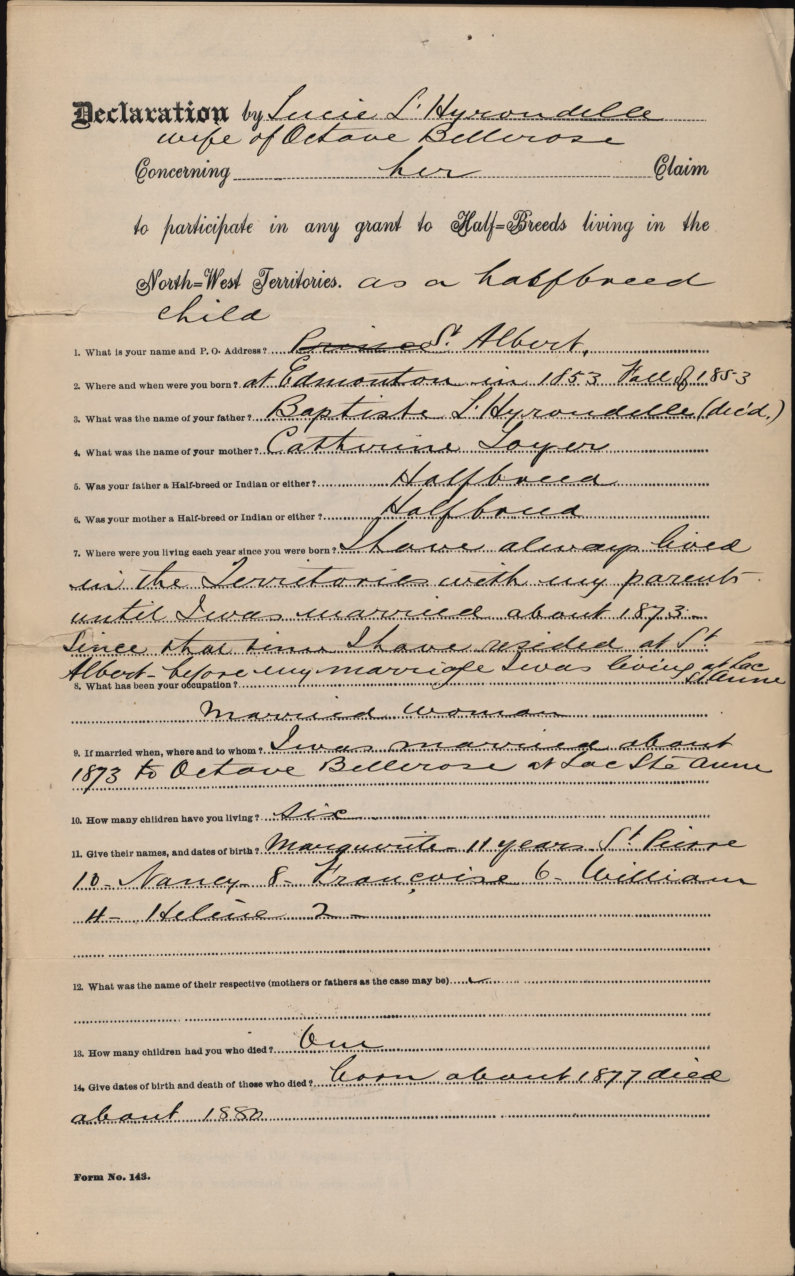
Textual form with typed questions and handwritten responses.

Page from the declaration of Lucie Bellerose on her scrip application, signed at St. Albert in 1885. Digitized scrip records contain biographical information on Métis Nation ancestors (e011358921).

Current initiatives at LAC are working toward prioritizing First Nations, Inuit and Métis Nation stewardship of Indigenous content. We Are Here: Sharing Stories is modifying archival record descriptions through a decolonizing lens. We are incorporating place names, community names, persons’ names and cultural terms into descriptions so that they accurately represent the record. Listen, Hear Our Voices is providing support to communities who wish to control and preserve the language-specific materials created and housed within their own communities.

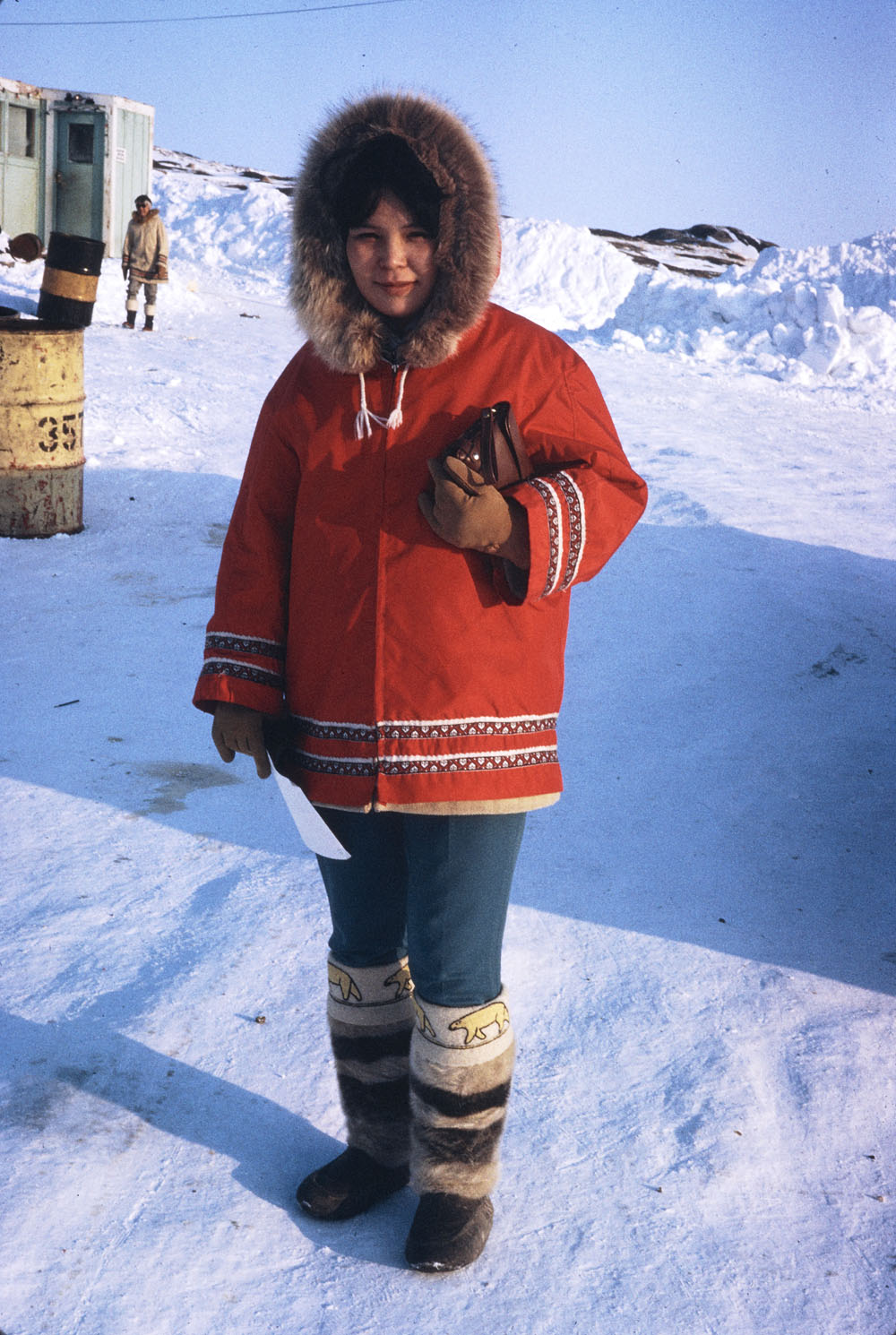
Photograph of a woman standing outside on snow-covered ground. She is wearing a red parka with a fur-trimmed hood covering her head, and knee-high boots with fur and embroidered polar bears. She is holding a brown leather purse with her left arm.

Young Inuk woman from Kinngait (formerly Cape Dorset) in red qilapaaq (straight-hemmed) style parka and kamiik (boots) with polar bears embroidered on the duffel liners, Iqaluit, Nunavut (formerly Frobisher Bay, Northwest Territories), 1968 (e011212600). The description of this photo was provided through the We Are Here: Sharing Stories project.

This e-book features a collection of archival documents and published material held at LAC that was selected by LAC team members who identify as First Nations, Inuk or Métis Nation. The records we chose are drawn from transcripts, photographs, maps, audiovisual material and publications. They highlight the importance of our cultural identity, and they reflect personal experiences in learning and knowing about our own histories. The essays feature different voices, multiple perspectives and personal interpretations of records.

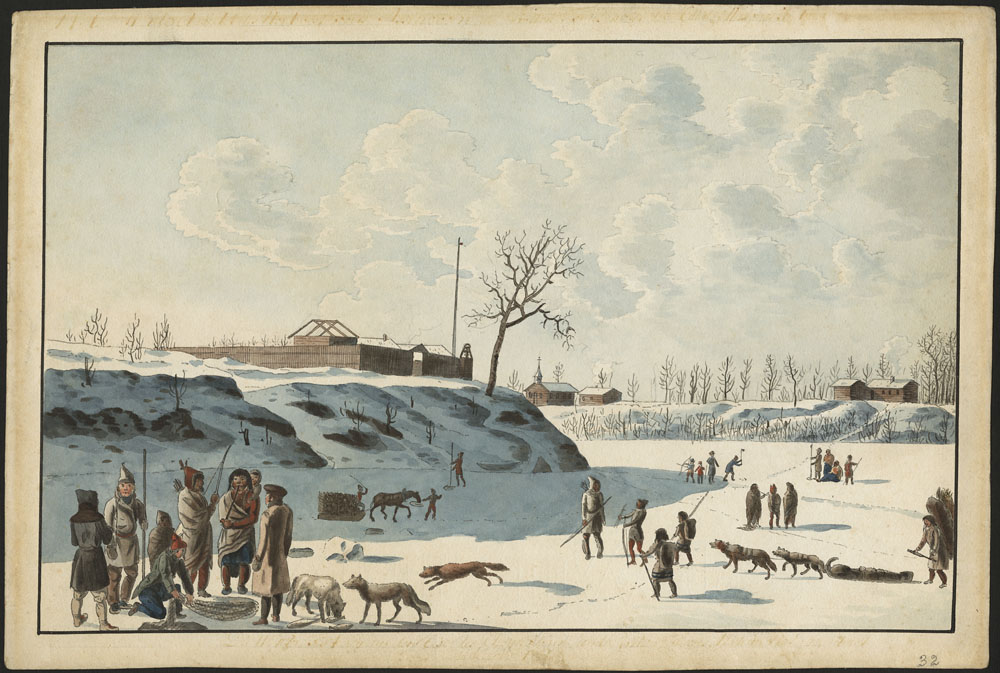
Watercolour of a group of people with two dogs standing on a frozen river in the lower-left corner. Several hold fishing spears. Another dog is running toward the group. In the background on the river are a number of smaller groups of people, several dogs and a horse. There is a wooden fort on the embankment on the left side, and some smaller wooden structures on the opposite embankment in the distance.

Winter fishing on the Assiniboine and Red rivers, with a fort in the background (present-day Winnipeg), Manitoba, 1821 (e011161354). This artwork is featured in “Fishing on the Red River for 3,000 Years” by William Benoit.

Where possible, translations are provided in the Indigenous language spoken by the people represented in each essay. For Indigenous peoples, language is inextricably tied to culture. Indigenous languages are exceptionally descriptive of objects, experience and emotion, which cannot be wholly explained or translated into English or French. Languages of First Nations, Inuit and the Métis Nation have been learned intergenerationally through stories, songs and land-based experiences. Language is largely influenced by the physical landscape and its resources; these have shaped Indigenous vocabularies that hold unique representations and values distinct to each culture. First Nations, Inuit and the Métis Nation across Canada are reclaiming their languages to connect to their history, to secure cultural continuity, and to honour their ancestors by knowing the languages through which they understood the world.

We respect the wishes of First Nations, Inuit and the Métis Nation about how they would like their languages and identities expressed in English and French. This may mean that some conventional rules of grammar are not applied.

Additional resources


Karyne Holmes is a curator in the Exhibitions and Loans Division and was an archivist for We Are Here: Sharing Stories, an initiative to digitize and describe Indigenous content at Library and Archives Canada.

Kimutset Labradorimi

Version française

On the left, Tatânga Mânî [Chief Walking Buffalo] [George McLean] is in his traditional First Nation regalia on a horse. In the centre, Iggi and a girl engage in a “kunik,” a traditional greeting in Inuit culture. On the right, Maxime Marion, a Métis guide, holds a rifle. In the background, there is a map of Upper and Lower Canada, and text from the Red River Settlement collection.

This blog is part of our Nations to Nations: Indigenous Voices at Library and Archives Canada series. To read this blog post in Inuttut, visit the e-book.

Nations to Nations: Indigenous Voices at Library and Archives Canada is free of charge and can be downloaded from Apple Books (iBooks format) or from LAC’s website (EPUB format). An online version can be viewed on a desktop, tablet or mobile web browser without requiring a plug-in.

by Jennelle Doyle

Dog sledding has remained at the core of Inuit communities since time immemorial; the use of dog sleds and dog teams is one of many reasons why Inuit are historically such good navigators of the nuna (land). Inuit learned to read the land over time, using their Kimutset (dog teams) to travel long distances, hunt, collect firewood and carry out many other tasks essential to everyday life in Labrador. Kimutset were our ambulances, our freight carriers, our food transporters and our vehicles. Without them during winter, all we had was our feet.

A Kimutsik (dog team) consists of anywhere from 2 to 12 or more Kimmet (husky dogs), depending on what is being towed. The Kimmet are tethered to a Kamutik (sled) by means of an anuk (harness), which is most often made from anuksak (usually sealskin made into harness). Today, anuksak is less commonly used, and rope or cord is favoured.

Black-and-white photograph of a group of dogs sitting on a mound of snow piled against a frame building. Horizontal slats of wood cover a window. A lone dog stands near the lower right corner.

Kimmet, Nain, Nunatsiavut (Labrador), [1920–1922]. (e011369232-023_s1)

Over sea ice, the fan-type anuk is utilized, so that the Kamutik moves more smoothly over the uneven surface. A tandem anuk, where the Kimmet pull single file, is used on occasion, usually in areas with more trees. As you can imagine, not having a Kimutsik in the past was very limiting and, in some cases, dangerous if you could not get out on the nuna/nunak for supplies or to hunt.

Although many mushers have adopted English commands for their Kimutsik, Inuttut commands are still used today. Inuttut commands are being reintroduced in some communities as Inuit highlight the importance of speaking their ancestral language in day-to-day life. Some notable commands are â! (stop!), au/auk (right), ha’ra (left), hau (come), huit! (go! or mush!) and kimmik (heel). Note the important distinction between the capitalized K and the lowercase k in the Roman orthography of Inuttut (Labrador dialect): Kimmik means dog, and kimmik means “a heel.” The two words sound different as well; the first word has an initial “h”-like sound.

Kimmet generally stay outside all year. When my great-grandmother was a child, a sled dog could commonly be seen sleeping on top of an illuk/illusuak (sod house) in aujak (summer). Today, you can find sled dogs in pens or near the sea ice. They are fed KimmiKutitsiak/KimmiKautitsak (dog food), which consists of mainly country food scraps like caribou and arctic char. Utsuk (seal fat) provides Kimmet with energy while keeping them warm in the cold months of ukiuk (winter) and giving them a nice coat.

Then and now

In the early days, settlers who came to Labrador relied heavily on Inuit sled dog guides and locals for survival. The Grenfell Mission, a medical mission in Labrador, established in the late 1800s by Dr. Wilfred Grenfell, would never have reached the majority of Labrador communities and some northern Newfoundland communities had it not been for Inuit guides and their Kimutset. This reliance is outlined in many mission diaries, though Grenfell eventually learned enough about sled dogs to have his own team.

Inuit continue to adjust to an ever-changing environment. The introduction of the snowmobile has certainly led to a decline in the number of dog teams, but you will still find Kimutsik (dog-sled team) across Inuit Nunaat/Nunangat. Dog sledding is now highly recreational, and a favourite tourist attraction in the North. This is a good thing; it supports Inuit mushers and, thus, Inuit families, cultural preservation and practice. There are also annual heritage races in some communities as well as at the Labrador Winter Games, held every three years in Happy Valley–Goose Bay for all communities in Labrador.

Black-and-white photograph of a boy walking towards the viewer in the lower right corner. There are two men on either side of a packed sled in the middle ground. Further in the distance is a group of dogs on harnesses pulling the sled. In the far distance is a large hill with patches of snow.

Inok/Inuuk (two) men with a Kimutsik heading out on the bay, Inuk boy in foreground, Nain, Nunatsiavut (Labrador), [1920–1922]. (e011369232-027_s2)

Vocabulary

  • Anuk – harness
  • Anuksak – harness made from sealskin
  • Kamutik – sled
  • Kimmet – husky dogs (sled dogs)
  • Kimmik – husky dog (sled dog)
  • kimmik – heel (command for dogs)
  • KimmiKutitsiak/KimmiKautitsak – dog food
  • Kimutset – dog teams
  • Kimutsik – dog team
  • Utsuk – seal fat

Labrador Inuttut Dictionary


Jennelle Doyle was an archivist with the Listen, Hear Our Voices initiative at Library and Archives Canada. Jennelle grew up in Churchill Falls, Labrador, her family being from both the south coast of Labrador and the island of Newfoundland. 

Exploring Indigenous peoples’ histories in a multilingual e-book—Part 2

On the left, Tatânga Mânî [Chief Walking Buffalo] [George McLean] is in his traditional First Nation regalia on a horse. In the centre, Iggi and a girl engage in a “kunik,” a traditional greeting in Inuit culture. On the right, Maxime Marion, a Métis guide, holds a rifle. In the background, there is a map of Upper and Lower Canada, and text from the Red River Settlement collection.

By Beth Greenhorn in collaboration with Tom Thompson

Library and Archives Canada (LAC) launched Nations to Nations: Indigenous Voices at Library and Archives Canada to coincide with the first National Day for Truth and Reconciliation on September 30, 2021. The essays in this first edition of the interactive multilingual e-book featured a wide selection of archival and published material ranging from journals, maps, newspapers, artwork, photographs, sound and film recordings, and publications. Also included are biographies for each of the authors. Many recorded a personalized audio greeting for their biography page, some of which are spoken in their ancestral language. The essays are diverse and, in some cases, quite personal. Their stories challenge the dominant narrative. In addition to authors’ biographies, we included biographical statements by the translators in recognition of their expertise and contributions.

The Nations to Nations e-book was created as part of two Indigenous initiatives at LAC: We Are Here: Sharing Stories (WAHSS) and Listen, Hear Our Voices (LHOV). The essays were written by Heather Campbell (Inuk), Anna Heffernan (Nishnaabe), Karyne Holmes (Anishinaabekwe), Elizabeth Kawenaa Montour (Kanien’kehá:ka), William Benoit (Métis Nation) and Jennelle Doyle (Inuk) in LAC’s National Capital Region office. They were joined by Ryan Courchene (Métis-Anichinabe), from LAC’s regional office in Winnipeg, and Delia Chartrand (Métis Nation), Angela Code (Dene) and Samara mîkiwin Harp (nêhiyawak), archivists from the LHOV initiative.

This edition features the following First Nations languages and/or dialects: Anishinaabemowin, Anishinabemowin, Denesųłiné, Kanien’kéha, Mi’kmaq, nêhiyawêwin and Nishnaabemowin. Essays related to Inuit heritage are presented in Inuttut and Inuktitut. Additionally, the Inuit heritage content is presented in Inuktut Qaliujaaqpait (Roman orthography) and Inuktut Qaniujaaqpait (Inuktitut syllabics). The e-book presents audio recordings in Heritage Michif of select images in essays pertaining to the Métis Nation.

The development of this type of publication was complex. It presented technical and linguistic challenges that required creativity and flexibility. But the benefits of the Indigenous-led content outshine any of the complications. Given the space and time, the authors reclaimed records of relevance to their histories, offering fresh insights through their interpretations. The translators brought new meanings to the records, describing most, if not all, of them for the first time in First Nations languages, Inuktut and Michif.

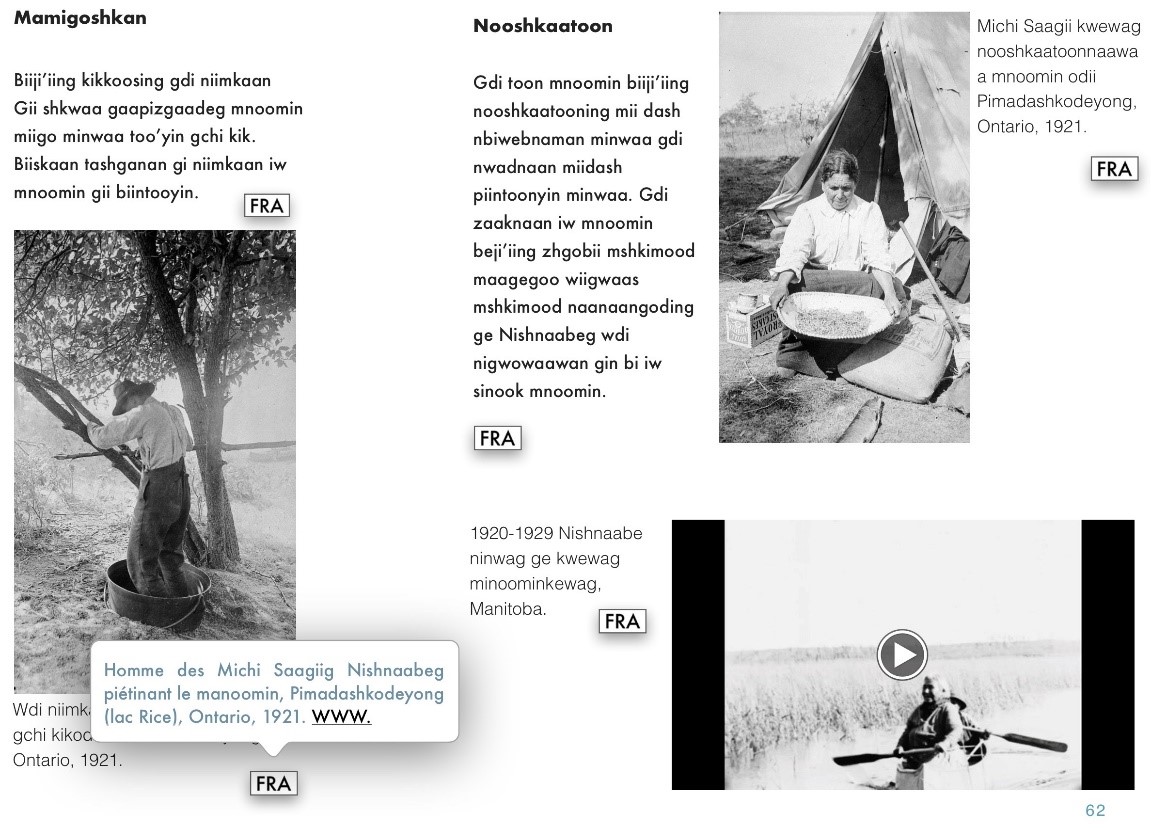
Describing her experience while researching and writing her essay regarding manoominikewin (the wild rice harvest) of the Michi Saagiig Nishnaabeg (Mississauga Ojibwe), archivist Anna Heffernan wrote: “I hope that people from Hiawatha, Curve Lake, and the other Michi Saagiig communities will be happy and proud to see their ancestors in these photos, and to see them represented as Michi Saagiig and not just ‘Indians’.”

A page from the e-book with three black-and-white images of people demonstrating different stages of wild rice harvesting.

Page from “Manoominikewin: The Wild Rice Harvest, a Nishnaabe Tradition” by Anna Heffernan, translated into Nishnaabemowin by Maanii Taylor. Left image: Michi Saagiig Nishnaabeg man tramping manoomin, Pimadashkodeyong (Rice Lake), Ontario, 1921 (e011303090); upper-right image: Michi Saagiig Nishnaabeg woman winnowing manoomin, Pimadashkodeyong (Rice Lake), Ontario, 1921 (e011303089); lower-right image: silent film clips featuring Ojibway men and women from an unidentified community harvesting manoomin, Manitoba, 1920–1929 (MIKAN 192664)

Reflecting on her experience, archivist Heather Campbell described the positive impact of the process:

“So often when we see something written about our communities, it is not written from the perspective of someone who is from that community. To be asked to write about Inuit culture for the e-book was an honour. I was able to choose the theme of my article and was trusted to do the appropriate research. As someone from Nunatsiavut, to be given the opportunity to write about my own region, knowing other Nunatsiavummiut would see themselves reflected back, was so important to me.”

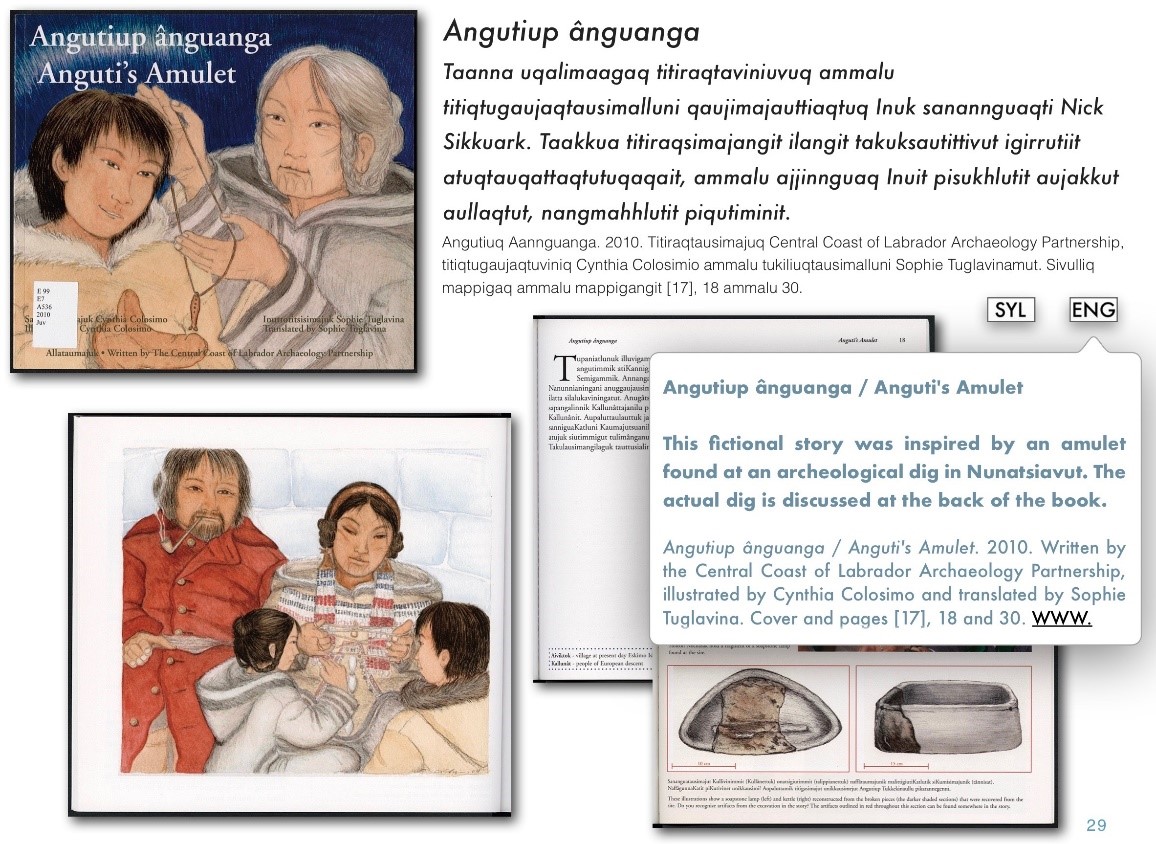
A page from the e-book that shows pages from a picture book, text written in Inuktut Qaliujaaqpait and English.

Page from “Inuktut Publications” by Heather Campbell, translated into Inuktut Qaliujaaqpait by Eileen Kilabuk-Weber, showing selected pages from Angutiup ânguanga / Anguti’s Amulet, 2010, written by the Central Coast of Labrador Archaeology Partnership, illustrated by Cynthia Colosimo and translated by Sophie Tuglavina (OCLC 651119106)

William Benoit, Internal Indigenous Advisor at LAC, wrote a number of shorter essays about Métis Nation language and heritage. While each text can be read on its own, collectively they provide insights into various aspects of Métis culture. In his words: “Although the Métis Nation represents the largest single Indigenous group in Canada, we are misunderstood or misrepresented in the broader national narrative. I appreciate the opportunity to share a few stories about my heritage.”

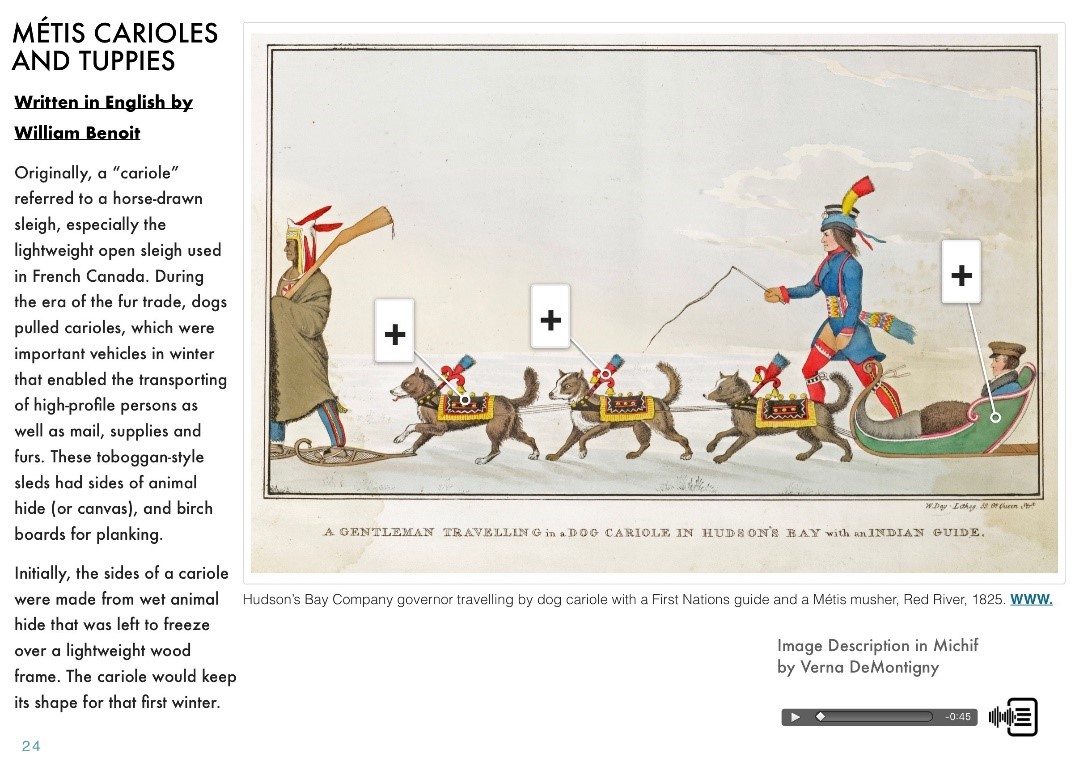
A page from the e-book with text in English on the left side and a lithograph of a snowy landscape with a man seated in a cariole (sled) pulled by three dogs in colourful coats. A man wearing a blanket and snowshoes is on the left in front of the dogs. A man holding a whip and wearing clothing associated with Métis culture (a long blue jacket, red leggings and an embellished hat) walks on the right-hand side of the sled.

Page from “Métis Carioles and Tuppies” by William Benoit, with a Michif audio recording by Métis Elder Verna De Montigny. Image depicting Hudson’s Bay Company governor travelling by dog cariole with a First Nations guide and a Métis Nation musher, Red River, 1825 (c001940k)

The creation of the Nations to Nations e-book has been a meaningful undertaking and positive learning experience. Two and a half years in development, the e-book has truly been a group effort involving the expertise and collaboration of the First Nations, Inuit and Métis Nation authors, Indigenous language translators, and Indigenous advisors.

I am grateful for the opportunity to collaborate with so many amazing and dedicated individuals. A special “thank you” goes to the members of the Indigenous Advisory Circle, who offered their knowledge and guidance throughout the development of this publication.

As part of ongoing work to support Indigenous initiatives at LAC, we will feature the essays from Nations to Nations as blog posts. We are excited to introduce Ryan Courchene’s essay “Hidden Histories” as the first feature in this series.

Nations to Nations: Indigenous Voices at Library and Archives Canada is free of charge and can be downloaded from Apple Books (iBooks format) or from LAC’s website (EPUB format). An online version can be viewed on a desktop, tablet or mobile web browser without requiring a plug-in.


Beth Greenhorn is a senior project manager in the Exhibitions and Online Content Division at Library and Archives Canada.

Tom Thompson is a multimedia production specialist in the Exhibitions and Online Content Division at Library and Archives Canada.

Exploring Indigenous peoples’ histories in a multilingual e-book—Part 1

On the left, Tatânga Mânî [Chief Walking Buffalo] [George McLean] is in his traditional First Nation regalia on a horse. In the centre, Iggi and a girl engage in a “kunik,” a traditional greeting in Inuit culture. On the right, Maxime Marion, a Métis guide, holds a rifle. In the background, there is a map of Upper and Lower Canada, and text from the Red River Settlement collection.

By Beth Greenhorn in collaboration with Tom Thompson

Library and Archives Canada (LAC) recently published an interactive multilingual e-book called Nations to Nations: Indigenous Voices at Library and Archives Canada. This e-book grew out of two Indigenous documentary heritage initiatives, We Are Here: Sharing Stories and Listen, Hear Our Voices, and it features essays written by First Nations, Inuit and Métis Nation colleagues at LAC. The process for creating this publication was unlike any work LAC had previously carried out.

The project team began with just two people: me and Tom Thompson, a multimedia production specialist. I was tasked with coordinating an e-book that would focus on Indigenous records held at LAC. We determined that an e-book was an excellent fit to showcase newly digitized content. An e-book offered the best platform to incorporate interactive material, such as audiovisual records. It also provided the capability to feature Indigenous languages and dialects.

Work began after the United Nations declared 2019 as the International Year of Indigenous Languages. With this in mind, we consulted with our Indigenous colleagues. The discussions were heartening.

Initially, we intended to feature archival content and other historical materials held at LAC that were created by Indigenous peoples in their ancestral languages. After several months of unsuccessful research, we realized that with the exception of a small number of documents, there was little content written in First Nations languages or Inuktut, the Inuit language. As for Michif, the language of the Métis Nation, there is no known documentation in the collection at LAC.

Faced with this reality, the e-book team needed a new strategy on how to create a publication that supports Indigenous languages when the bulk of published and archival records was created by settler society. Following several brainstorming discussions, the answer became clear and was surprisingly simple. Instead of focusing on historical records written in Indigenous languages, the authors would choose collection items in any media that they found meaningful and then discuss them in their essays. The essays would be translated into the Indigenous language represented by the people portrayed in each section. Content that was translated into an Indigenous language would be presented as the primary text, with English and French versions being secondary.

The title, Nations to Nations: Indigenous Voices at Library and Archives Canada, was chosen by the authors and emphasizes the distinction of the different nations and the diversity of voices. By positioning the authors’ voices at the front and centre, the stories provide a richer understanding of the world through awareness of the Indigenous knowledge and perspectives.

Recognizing that many Indigenous communities have limited Internet connectivity, dynamic content has been embedded in the e-book wherever possible. This includes high-resolution images, podcast episodes, audio clips and film footage. An Internet connection is still required to download the e-book and to access some content, such as database records, blog articles and external links.

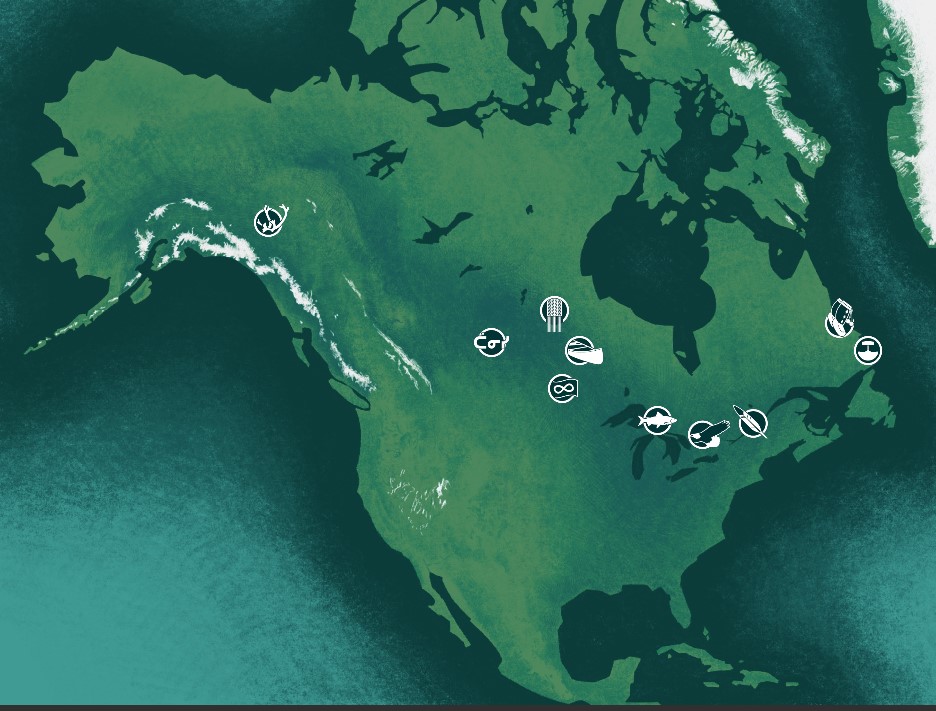
A map of North America with symbols placed across Canada.

Pre-contact map of North America without any geopolitical borders, with icons linking to author biographies and essays. Image: Eric Mineault, LAC

Following a recommendation from the Indigenous Advisory Circle at LAC, we hired Indigenous language experts and knowledge keepers to translate the essays and related texts in the e-book. Of all of the tasks involved in the creation of this e-book, finding qualified translators was one of the most rewarding, yet challenging, activities. Many of the languages are at risk and, in some cases, are critically endangered. While language revitalization work has begun in many communities to create standardized lexicons and dictionaries, there were many words in English with no equivalent in the Indigenous language. Quite often, the translators needed to consult with Elders in their communities to confirm terminology and to find a word or phrase that would convey the same meaning.

One of LAC’s biggest paradigm shifts was in presenting the Indigenous language as the principal content, and in offering English and French as supporting texts. In an effort to emphasize this shift, the authors chose words to describe places, proper names and descriptions in their ancestral languages. These words are accompanied by translations in English or French in parentheses, the first time they are introduced to the reader, and only the Indigenous words are used for all further references.

Nations to Nations: Indigenous Voices at Library and Archives Canada is free of charge and can be downloaded from Apple Books (iBooks format) or from LAC’s website (EPUB format). An online version can be viewed on a desktop, tablet or mobile web browser without requiring a plug-in.


Beth Greenhorn is a senior project manager in the Exhibitions and Online Content Division at Library and Archives Canada.

Tom Thompson is a multimedia production specialist in the Exhibitions and Online Content Division at Library and Archives Canada.

Five Myths about the Arms of Canada

This article contains historical language and content that some may consider offensive, such as language used to refer to racial, ethnic or cultural groups. Please see our historical language advisory for more information.

By Forrest Pass

The Coat of Arms of Canada (also known as the Arms of Canada, the Canada Coat of Arms and the Royal Coat of Arms of Canada) turns 100 on November 21, 2021. An official emblem of the Government of Canada, the coat of arms appears on Canadian passports, banknotes, military badges, and public buildings. Elements of the coat of arms have influenced the design of other emblems, notably the National Flag of Canada, adopted in 1964.

A colour painting of a coat of arms. The shield at the centre is divided into five sections. The first section is red with three gold lions. The second section is gold with a red lion within a red fleur-de-lis border. The third section is blue with a gold harp. The fourth section has three gold fleurs-de-lis. The bottom (fifth) section is silver with a sprig of three green maple leaves. Above the shield is a crest consisting of a crowned gold lion holding a red maple leaf in its right paw. The lion stands on a twisted wreath of red-and-white silk atop a gold royal helmet. The motto “A mari usque ad mare” is written on a blue scroll below the shield, which rests on roses, thistles, shamrocks and lilies. The shield is supported by a lion and a unicorn. The lion holds a lance to which a British flag is attached. The unicorn holds a lance with a blue flag charged with three gold fleurs-de-lis, the banner of pre-Revolutionary France.

The final design for the Coat of Arms of Canada, 1921. Illustration by Alexander Scott Carter. (e008319450) The signatures of the committee members, including Dominion Archivist Arthur Doughty, appear in the bottom right-hand corner.

Library and Archives Canada preserves the records of the committee that designed the coat of arms. This committee, struck by the federal cabinet in 1919, included Dominion Archivist Arthur Doughty. Unlike the flag debate some four decades later, the coat of arms question never prompted a parliamentary debate or widespread public discussion. As a result, few Canadians know much about the deliberations that led to the adoption of the coat of arms, and popular myths about the emblem’s history and meanings have filled the gap. Here are five misconceptions, debunked by primary sources.

Myth # 1: The three maple leaves on a single stem were chosen to represent Canadian multiculturalism.

The three maple leaves on the shield are the Arms’ most distinctively Canadian feature. Since the 1960s, some commentators have suggested that this arrangement of leaves represents the unity of Canadians of different backgrounds. In her twangy ballad Three Red Leaves, written during the Great Flag Debate of 1964, country-and-western singer Diane Leigh praised the “Three red leaves all tied together / [that] Bind three nationalities in unity / English, French, and new Canadians / Living in this land of opportunity.” Until very recently, some official publications also described the leaves as symbolizing Canadians of all origins, including First Nations, Inuit, and the Métis Nation, who were conspicuously absent from Leigh’s lyrics.

An emblem’s meaning evolves with the country it represents, so the symbolism of “unity in diversity” is attractive today. However, there is no evidence that the committee intended the leaves to represent this Canadian ideal. Rather, a sprig of three maple leaves was already a popular emblem by 1921. It first appeared as decoration on a Saint-Jean-Baptiste Day poster in 1850. The three-leaf motif also appears on the provincial arms of Quebec and Ontario, which the heralds of the College of Arms in London designed in 1868. In 1868, as in 1921, the choice of three leaves was probably aesthetic rather than symbolic: three leaves fill the triangular base of a heraldic shield better than one.

A typed page with the heading “Association Saint Jean-Baptiste” featuring a sprig of three maple leaves. Components of a parade, including “Drapeau britannique,” “les pompiers canadiens,” “la Société mercantile d’économie,” “la Societé de tempérance” and “Bannière du commerce,” are listed below the heading in a variety of typefaces.

A poster advertising the annual procession of the Association Saint-Jean-Baptiste, Montréal, June 24, 1850. (OCLC 1007829742) This is perhaps the earliest use of three maple leaves on a single stem.

Myth # 2: King George V chose red and white to be the national colours of Canada.

Beginning in the 1940s, Colonel Archer Fortescue Duguid, a military historian and heraldry enthusiast, suggested that King George V had chosen red and white to be Canada’s national colours because these were the colours of the wreath and mantling—the flowing cloth around the helmet—of the Arms of Canada. Therefore, Duguid argued, a new Canadian flag must also be red and white.

The idea that the Arms design would determine Canada’s national colours originated in 1918 with Eugène Fiset, the Deputy Minister of Defence. To Fiset, red suggested Britishness, military sacrifice, and autumn splendour. White evoked chilly Canadian winters. The coat of arms committee’s first design incorporated Fiset’s proposed red maple leaves on a white background, as well as a red-and-white wreath on top of the shield.

A colour painting of a coat of arms. The shield at the centre is divided into five sections. The first section is white with a sprig of three red maple leaves. The second section is red with three gold lions. The third section is gold with a red lion within a fleur-de-lis border. The fourth section is blue with a gold harp. The fifth section is blue with three gold fleurs-de-lis. On top of the shield is a crest consisting of a crowned gold lion holding a maple leaf in its right paw and standing on a patch of green grass, the whole resting on a twisted wreath of red-and-white silk. Under the wreath is a shield. Below the shield, the motto “A mare usque ad mare” is written in a grey scroll. The shield is supported by a lion and a unicorn.

The committee’s first proposal, illustrated by Alexander Scott Carter, 1920. (e011313790) Green maple leaves replaced the red in the final version, but the red-and-white wreath, and eventually red-and-white mantling, remained.

However, not everyone was a fan. Sir Joseph Pope, Undersecretary of State for External Affairs, preferred green maple leaves to red ones, which to him suggested death and decay. In the end, Pope prevailed, but the red-and-white mantling remained, probably by accident.

No one, least of all the King, cared much about the mantling in 1921. When a concerned citizen complained in 1922 that the mantling should be red and gold—the main colours of the shield—committee members shrugged and replied that it was too late to make changes. Neither the royal proclamation nor an official pamphlet issued in 1922 to explain the Arms’ symbolism mentions national colours. In 1946, during parliamentary hearings on a new Canadian flag, heraldry buff Hugh Savage rebutted Duguid: a national flag, not a coat of arms, typically gave a country its “national colours.”

Nevertheless, Duguid’s theory convinced many people and contributed to the choice of red and white for the Canadian flag in 1964.

Myth # 3: The chained unicorn commemorates the British conquest of New France.

The supporters in the form of a lion and a unicorn are borrowed from the Royal Arms of the United Kingdom, reflecting the Imperial loyalties of the committee. The unicorn originally represented Scotland. Its chain perhaps recalls medieval legends about how difficult it is to tame these mythical beasts.

Because the Canadian chained unicorn also holds a royal French banner, some have interpreted this depiction as symbolizing British dominance over French Canada. There is no evidence that the committee intended, or even considered, this possible interpretation.

However, the committee’s inclusion of three gold fleurs-de-lis on the shield did concern the King’s heraldic advisors. The College of Arms worried that the fleurs-de-lis, intended to honour French Canadians, might imply that Canada claimed sovereignty over France! Canada’s Commissioner-General in Paris discreetly confirmed with French officials that the design would not spark a diplomatic spat.

A colour painting of a coat of arms. The shield at the centre is divided into seven sections. The first and fourth sections are red with three gold lions. The second section is gold with a red lion within a fleur-de-lis border. The third section is blue with a gold harp. The fifth and seventh sections are white, and each has a single green maple leaf. The sixth section is blue with three gold fleurs-de-lis. Above the shield is a crest consisting of a crowned gold lion holding a red maple leaf in its right paw. The lion stands on a twisted wreath of red-and-white silk. Below the shield, the motto “A mari usque ad mare” is written on a blue banner. The shield is supported by a lion and a unicorn. The lion holds a lance to which a British flag is attached. The unicorn holds a lance with a blue flag charged with three gold fleurs-de-lis, the banner of pre-Revolutionary France.

Counter-proposal from the College of Arms, London, September 1921. (e011313801) The English College of Arms suggested a new placement of the fleurs-de-lis so as not to imply that Canada ruled France. The Canadians rejected this idea.

Myth # 4: The committee that designed the coat of arms did not consider including Indigenous symbols in the design.

The symbols of two colonizing powers, Great Britain and France, dominate the Arms of Canada; there is no reference to Indigenous peoples. Yet one proposed design did spark a discussion with respect to featuring First Nations figures as supporters. It was a submission from Edward Marion Chadwick, a Toronto lawyer interested in both heraldry and First Nations cultures.

A black-and-white drawing of a coat of arms. The shield at the centre features a lion between two maple leaves at the top and a fleur-de-lis at the bottom. On top of the shield is a crest, consisting of a moose with its right hoof raised, standing on a twisted wreath and flowing cloth mantling; the crest sits on top of an esquire’s helmet marked with a cross. Below the shield, there is a scroll that reads “Dieu Protege Le Roy.” Two First Nations men support =the shield. They are wearing feathered headdresses and fringed buckskin clothing. One holds a tomahawk; the other holds a calumet, or ceremonial pipe.

Proposed Canadian Coat of Arms, by Edward Marion Chadwick, 1917. (e011313794) The supporters featured in Chadwick’s version were intended to represent First Nations from Eastern and Western Canada.

Including Indigenous figures and emblems in colonial heraldry was not unprecedented. The centuries-old arms of Nova Scotia and Newfoundland and Labrador both have First Nations figures as supporters, and the pre-Confederation seal of Upper Canada included a calumet, or ceremonial pipe, to commemorate treaties and alliances. However, to Sir Joseph Pope, who often spoke for the coat of arms committee, Indigenous peoples were a forgettable part of the past. “I myself do not see any necessity for commemorating the Indians at all,” wrote Pope in dismissing Chadwick’s proposal.

Pope’s response was racist, and reflected the opinion of many white Canadians of the time. Few people today would approve of Chadwick’s design either, but for very different reasons. Chadwick did strive to depict clothing and regalia accurately. However, to modern eyes, his proposal smacks of stereotyping and cultural appropriation. His supporters are “noble savages,” romantic fantasies of what First Nations individuals look like. They represent regions of the country rather than constitute meaningful inclusion of Indigenous people, who were not consulted about the coat of arms project. Today, many Indigenous individuals rightfully object to the way that they have appeared in heraldry. As a result, the provincial government of Newfoundland and Labrador, for example, is now reconsidering how First Nations individuals are depicted on its coat of arms, designed in 1635. Canada would undoubtedly be doing the same if Chadwick’s design had prevailed.

Myth # 5: The Arms of Canada can never be changed.

Could the Canadian government change the Arms of Canada to make them more representative of a diverse country? Coats of arms have an air of ancient permanence, but even very old emblems can evolve. For example, the Royal Arms of the United Kingdom—the model for Canada’s Arms—have changed half a dozen times since the union of the English and Scottish crowns, in 1603, most recently  in 1837). Since 1921, artists have twice reinterpreted the official version of the Arms of Canada, in 1957 and 1994, to update its “look and feel” without changing the formal elements.

If, one day, the Government of Canada wants to change the Arms design, it will require the collaboration of the Canadian Heraldic Authority, the division of the Office of the Secretary to the Governor General responsible for granting and registering coats of arms in Canada. The next time a major change occurs, there will be no need to consult British heraldic authorities, though the Queen (or King) will still have to approve the final design.

Whether it resulted in modifications to the current arms or in a completely new design, the process today would undoubtedly be more participatory—and more transparent—than it was a century ago.


Forrest Pass is a curator with the Exhibitions team at Library and Archives Canada.

Inuit of the 1975 Canadian $2 bill

Version française

On the left of the graphic, Tatânga Mânî [Chief Walking Buffalo] [George McLean] in traditional regalia on horse. In the middle, Iggi and girl engaging in a “kunik”, a traditional greeting in Inuit culture. On the right, Maxime Marion, a Métis guide stands holding a rifle. In the background, there is a map of Upper and Lower Canada, and text from the Red River Settlement collection.

By Ellen Bond

In October 2020, I found an article from the Nunatsiaq News about the Canadian $2 bill printed by the Bank of Canada from 1975 to 1979. The bank note was the first Canadian bill to show Indigenous people. Through further research, I found two other articles about the same bill, another from the Nunatsiaq News in 2018 and one from the Bank of Canada Museum blog in 2020. In the 2018 Nunatsiaq News article “Taissumani, April 7,” there is a photo of the back of the $2 bill, on which the names of those featured on the bank note are written in syllabics by the late Leah Idlout.

A colour photo of the back of the 1975–1979 Canadian $2 bill, on which the names of the six individuals depicted are written in syllabics.

The late Leah Idlout wrote the names of the six men on the back of the Canadian $2 bill in syllabics. (Image courtesy of John MacDonald and the Bank of Canada.)

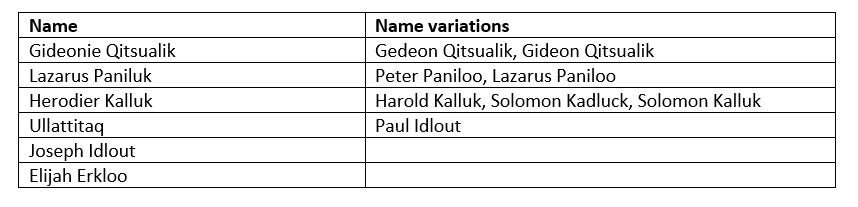
Below is a chart showing various spellings of the featured Inuit men’s Inuktitut names. The names in the first column will be used in this blog.

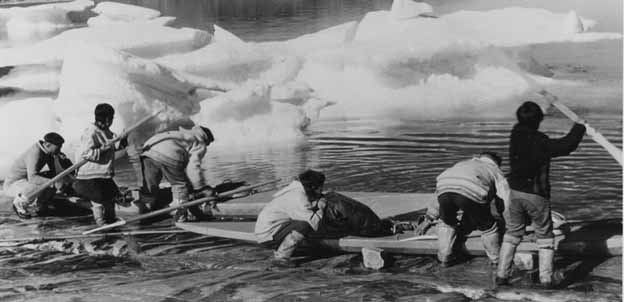
The $2 bill was created from an engraving by C. Gordon Yorke based on the photograph taken in 1951 by filmmaker Doug Wilkinson for his film Land of the Long Day. While the actual film is available “onsite only” in the collection held at Library and Archives (LAC), it can be found online at the National Film Board (NFB). The location of the film was Joseph Idlout’s camp at Alukseevee Island, about 60 kilometres from Mittimatalik (also known as Pond Inlet), Nunavut (formerly the Northwest Territories). The scene depicts hunters preparing their qajait (kayaks) to chase, spear and retrieve narwhals spotted swimming in the water and resting among ice floes.

A black-and-white photo of six Inuit hunters loading their qajaqs with supplies for the hunt.

Photo was used to create the engraving for the back of the 1975–1979 Canadian $2 bill. Left to right: Crouching next to a qajaq, Gideonie Qitsualik inflates a sealskin float; Lazarus Paniluk lifts a harpoon; Herodier Kalluk loads a qajaq; Ullattitaq inflates a sealskin float; Joseph Idlout shifts a qajaq into the water; and Elijah Erkloo raises a paddle. Photo was taken during the filming of Land of the Long Day, directed by Doug Wilkinson, Nuvuruluk, Nunavut, 1952. Source: Doug Wilkinson, Baffin Island, Canada, around 1951, NCC 1993.56.541.

Many photographs in the collection held at LAC were acquired and catalogued without detailed information or without information from original inscriptions and captions found on records. Hence, these photographs reflect the biases and attitudes of non-Indigenous society at the time. Project Naming is an initiative conceived by Nunavut Sivuniksavut that initially sought to identify the names of Inuit depicted in archived photographs. Begun in 2002 as a collaboration between Nunavut Sivuniksavut, the Government of Nunavut and the National Archives of Canada (now LAC), Project Naming was later expanded to include First Nations and Métis from across Canada. It posts archived photographs to its social media pages. The date, location, event or other identifying information for the photographs may also be missing or may be limited.

The three articles about the $2 bill had our interest piqued. This made us wonder, in a reverse Project Naming way, does LAC have other named photographs of these men? Here is what we found:

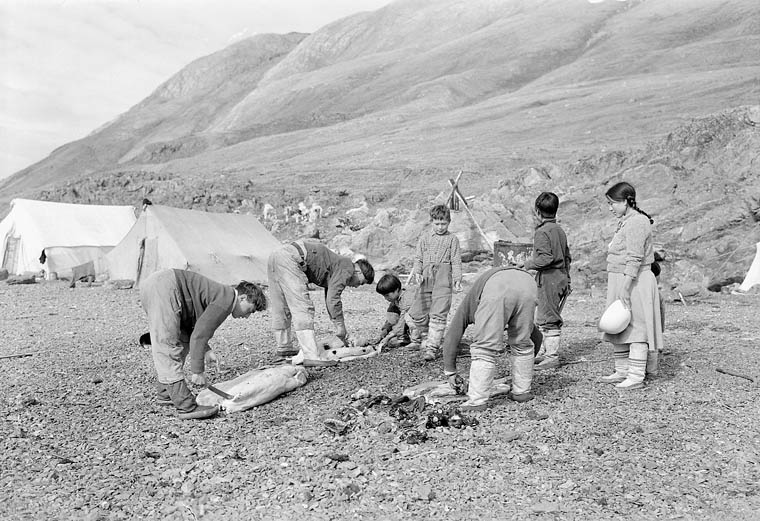
Gideonie Qitsualik – On the $2 note, Gideonie is located at the far left. Leaning over a qajaq, he is inflating a sealskin float. There is one other photo (below) of Gideonie in the LAC collection. It was taken at about the same time. In this photo, Gideonie is second from left. Gideonie later became a well-known Anglican minister in Gjoa Haven, Nunavut.

Black-and-white photo showing four adults and three children cutting up seals. They are on a rocky beach. Canvas tents are in the background.

At front right, Joseph Idlout is bending over. The others, from left to right, are Herodier Kalluk, Gideonie Qitsualik, Daniel Komangaapik, Uirngut, Ullattitaq (Paul Idlout), and Rebecca Qillaq Idlout. They are cutting up seals. (PA-189095)

Lazarus Paniluk – Lazarus is the second man from left on the $2 bill. He is holding a harpoon. He has not yet been named in any other photos in the LAC collection.

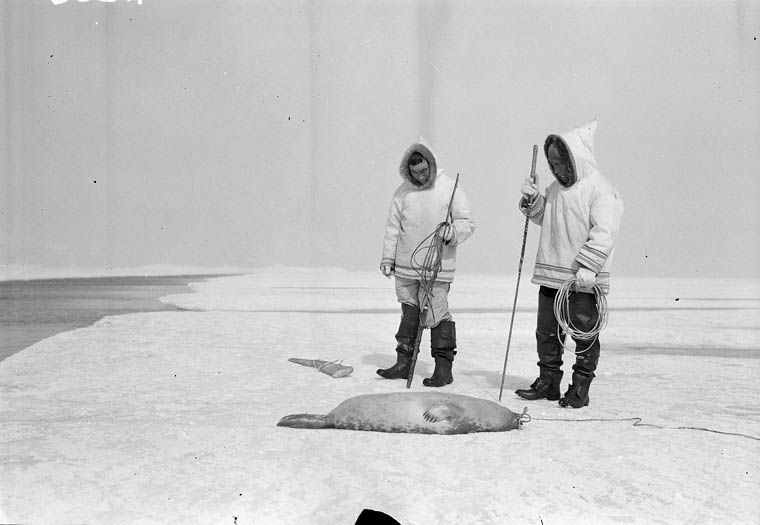
Herodier Kalluk – Herodier is the third man from left on the $2 note. He is loading the qajaq. There are two other photos of Herodier in the LAC collection. In this photo, below, taken in 1952, Herodier is on the left, and Joseph Idlout is on the right. Idlout had just caught a seal with his harpoon. Herodier is the grandfather of Juno Award-winning singer Tanya Tagaq.

A black-and-white photo of Inuuk standing next to a seal on the ice.

Herodier Kalluk (left) and Joseph Idlout look at a harpooned seal on the ice off Button Point, near Mittimatalik/Tununiq, Nunavut. (PA-145172)

Ullattitaq – Ullattitaq (also known as Paul Idlout) is the fourth man from left on the back of the $2 bill. He is shown inflating a sealskin float. There are two other named photos showing Ullattitaq in the LAC collection. The photo below shows Ullattitaq as a young boy in September 1945 in Mittimatalik/Tununiq. Ullattitaq later became Bishop of the Arctic.

Black-and-white photo of a young boy wearing a fur-lined hood.

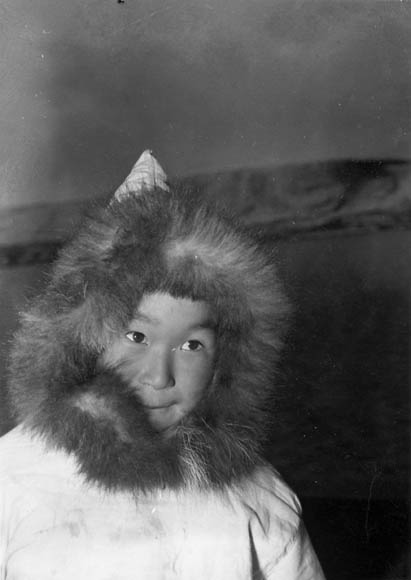
Ullattitaq (Paul Idlout) at Mittimatalik/Tununiq, Nunavut, September 1945. (e002344212)

Joseph Idlout – Joseph, the fifth man from left on the back of the $2 note, who is shifting a qajaq into the water, was the leader of a small community of families, including the Aulatsivik hunting camp, where Doug Wilkinson filmed his movie. Joseph is the person with the most photos in the LAC collection: he is featured in nine! Joseph is in the middle in the photo below.

Black-and-white photo of three Inuit men standing outside in the winter. All three are dressed in traditional clothing.

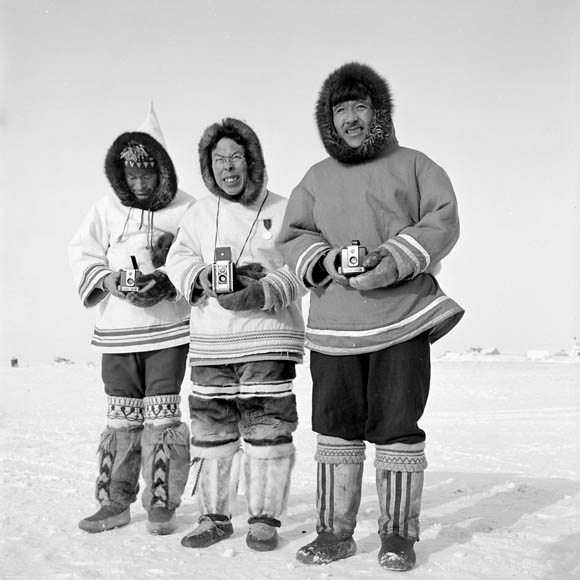
From left, Daniel N. Salluviniq (Saudlovenick), Joseph Idlout, and Zebeddie Amarualik, all holding Brownie cameras as they await the arrival of the Governor General, Vincent Massey, in Qausuittuq (also known as Resolute Bay), Nunavut, March 1956. (e002265651)

A black-and-white photograph showing a man in a qajaq about to throw a harpoon. There are snow-covered mountains in the distance.

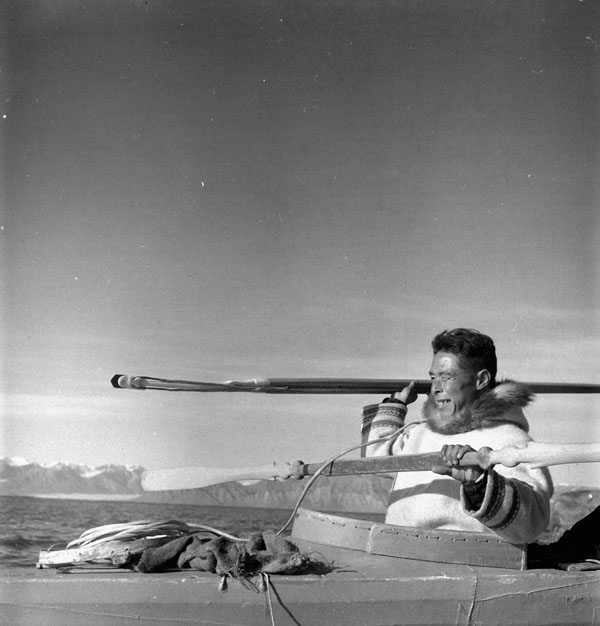
Joseph Idlout prepares to throw an ivory harpoon from his qajaq, Mittimatalik/Tununiq, Nunavut, July 1951. (RD-002169)

Elijah Erkloo – Elijah is the first man at right in the image on the back of the $2 bill. He is getting one of the paddles ready. A search for Elijah did not turn up any photos, but there is a photo of his grandfather. According to the two articles in the Nunatsiaq News, Elijah was a young boy when the film was filmed. Elijah later became the MLA for Amittuq (formerly Foxe Basin). Elijah notes that Joseph Idlout, his uncle, was the leader in camp. This is probably why LAC has so many photos of Joseph.

A black-and-white photo of a man with long hair and a mustache.

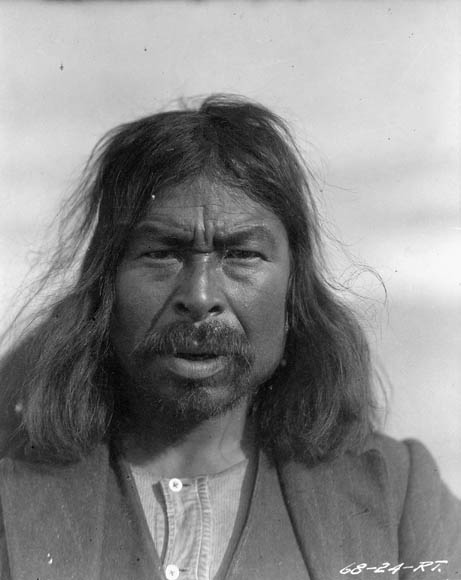
Akomalee of Baffin Island, 1924. Akomalee, the grandfather of Elijah Erkloo, was a local Elder of Mittimatalik, Nunavut. (PA-102276)

Identification of people and learning their names is important. The work of Project Naming has provided opportunities to identify individuals and give back to communities across the country. If you or anyone you know has more information about the men of the $2 bill, please let us know. That can include other photos of them in the collection at LAC in which they are not named, or more information about any of the individual men. We can then add this new information to the records, making them more complete.

Project Naming social media pages:


Ellen Bond is a Project Assistant with the Online Content team at Library and Archives Canada.

Frederick W. Waugh’s time in Nunatsiavut

On the left of the graphic, Tatânga Mânî [Chief Walking Buffalo] [George McLean] in traditional regalia on horse. In the middle, Iggi and girl engaging in a “kunik”, a traditional greeting in Inuit culture. On the right, Maxime Marion, a Métis guide stands holding a rifle. In the background, there is a map of Upper and Lower Canada, and text from the Red River Settlement collection.

This article contains historical language and content that some may consider offensive, such as language used to refer to racial, ethnic and cultural groups. Please see our historical language advisory for more information.

By Jennelle Doyle

When searching an archive, all too often we find things in places where we would not ordinarily expect. The life journeys of explorers, researchers, anthropologists and other individuals who have donated material to an archive are integral to identifying the scope of a given collection. Frederick W. Waugh was an ethnologist who worked for a time with the Anthropology Division of the Geological Survey of Canada. His visit to the Inuit community of Nain in Nunatsiavut, the region of Inuit Nunangat situated in northern Labrador, in 1921–22 is reflected in a photo album his son R.F. Waugh donated to Library and Archives Canada (LAC).

Frederick Waugh had set out for Labrador in 1921, noting in his journal his intent to photograph and study Montagnais people (now Innu Nation [Naskapi–Montagnais]). However, Waugh ended up at Nain and primarily photographed and documented Inuit who lived in that area. His photographs, in an album at LAC, provide a glimpse into the everyday life of Nainimiut: dogsledding, gathering driftwood, skinning seals, ice fishing and more.

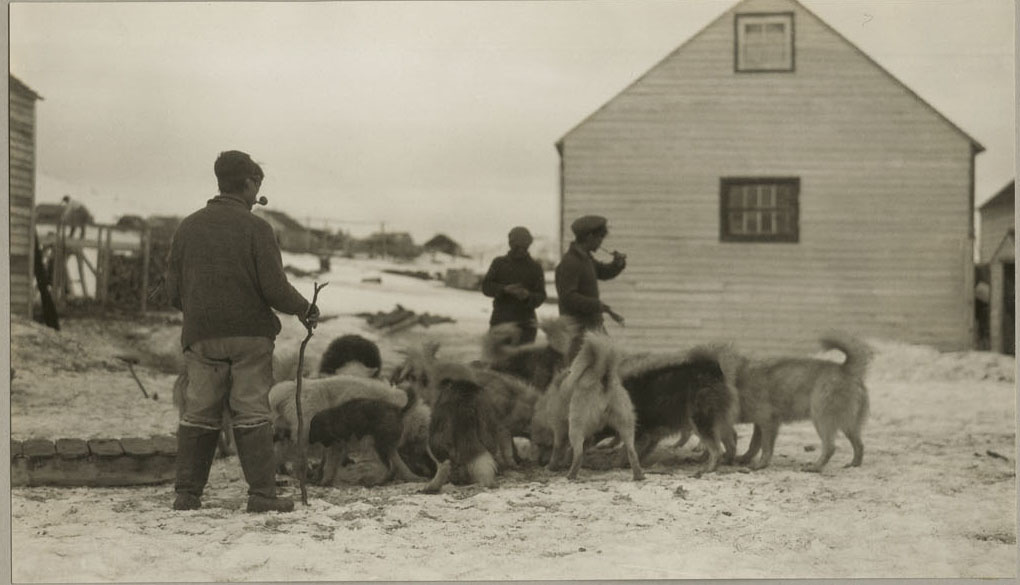
A black and white photograph of three men standing around a group of sled dogs, who are eating. There is a white building in the background.

Three Inuit men feeding sled dogs (e011369232-025)

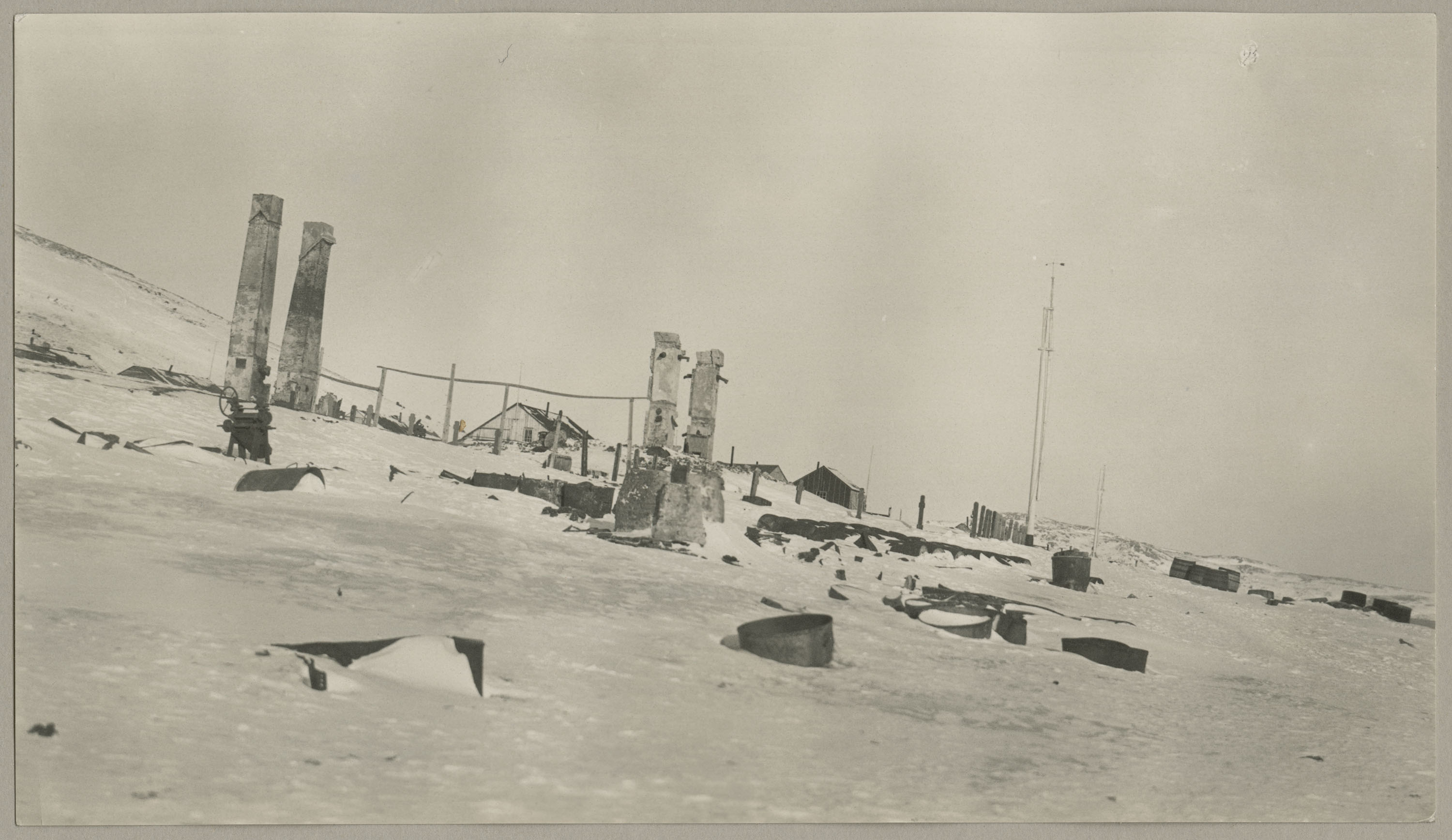
The album captures an interesting time in the community. In Nunatsiavut, Moravian ties are strong and many Nunatsiavummiut (Inuit of Nunatsiavut) still follow Moravian practices. German-speaking Moravian missionaries from Europe began settling in Labrador in the late 1700s. They established eight missions along the coast, one of which was Nain in 1771. In 1921, the Moravian church in Nain burned down. Waugh’s photographs captured the early efforts to rebuild the church using debris from the original structure (pictured here). The Memorial University Archives has images of the Moravian church before the fire, as well as other photographs of Nain in this period.

A black and white photograph of the ruins of a building with snow-covered items scattered around.

Ruins of Nain’s Moravian Mission, which burned in the fall of 1921, Nunatsiavut. Photo Credit: Waugh (e011369232-018)

The Canadian Museum of History houses copies of similar photographs, as well as Waugh’s journals. His journals from this period were titled “Labrador Eskimo Notes.” These journals provide a detailed account of various medicines, games, hunting practices, food knowledge and customs. As noted in his journals from Labrador, one of his most frequent sources was Amos Voisey.

A black and white photograph of four boys in parkas looking towards the camera. There are two buildings in the background.

Four boys in parkas and black-bottom kamek (sealskin boots) (e011369232-009)

Archives can sometimes be tangled webs that are difficult to navigate. I hope that by highlighting this album, it will help connect some of the dots for others who are interested in content relating to Nain, or Fredrik W. Waugh himself. Some of the names of those pictured in the photos may be inaccurate. We encourage you to reach out if you have any additional information that could help us create a more accurate record.

All in all, these beautiful photographs speak for themselves.

If you are interested in Nain, Nunatsiavut and the Nunatsiavummiut, visit Heather Campbell’s blog about Judith Pauline White.

This blog is part of a series related to the Indigenous Documentary Heritage Initiatives. Learn how Library and Archives Canada (LAC) increases access to First Nations, Inuit and Métis Nation collections and supports communities in the preservation of Indigenous language recordings.


Jennelle Doyle is an archivist with the Listen, Hear Our Voices initiative at Library and Archives Canada. Jennelle grew up in Churchill Falls, Labrador, her family being from both the south coast of Labrador and the island of Newfoundland. She has been located in Ottawa since 2019 and is currently a master’s student at the University of Ottawa while continuing her work on the initiative.

Tunniit/Tattoos: The Complicated History of Photographing Inuit Tattoos

On the left of the graphic, Tatânga Mânî [Chief Walking Buffalo] [George McLean] in traditional regalia on horse. In the middle, Iggi and girl engaging in a “kunik”, a traditional greeting in Inuit culture. On the right, Maxime Marion, a Métis guide stands holding a rifle. In the background, there is a map of Upper and Lower Canada, and text from the Red River Settlement collection.

This article contains historical language and content that some may consider offensive, such as language used to refer to racial, ethnic and cultural groups. Please see our historical language advisory for more information.

Last year my colleague Beth Greenhorn and I were chatting about a photograph she had come across of two Inuit women and a child. They were wearing elaborate atigii (inner parkas) with a cloth background behind them. One of the women was wearing odd mittens—one black and one with a distinctive knitted diamond pattern. I was sure I had seen this woman before. I have been researching Inuit tattoos for over ten years, as part of my own art practice. At first, I just collected images and did not take note of the source of the material, something I have been kicking myself for ever since! A few years ago, I started creating a more detailed collection, saving the original image identification numbers. When I began working at Library and Archives Canada (LAC), in 2018, I started searching through our collection for more images and created a list for future reference. In that list, I found “Hattie.”

Black-and-white photograph of two women and a child wearing parkas, sitting in front of a fabric background.
[Two Inuuk women and a child]. The woman on the left is Ooktook (Niviaqsarjuk, also called Uuttuq), who is Qairnirmiut. Her name means “lying on the ice.” She was called “Hattie” by photographers Geraldine and Douglas Moodie. The boy is Harry Unainuk Gibbons. The woman on the right is Taptaqut, Harry’s mom. Photo credit: George Comer, 1905. (e011310102).

At least four different people have photographed “Hattie”: George Comer, Geraldine Moodie, Albert Peter Low, and J.E. Bernier. In some photos, I think she has been misidentified. In others, a different woman is also called “Hattie,” “Ooktook,” and “Niviaqsarjuk.” This is perhaps because the women had similar-sounding names, or they were thought to look alike, or the photographer simply got confused after returning to the south and having the photographs processed.

Another institution instrumental to my work that informed my findings is the Glenbow Museum. This museum houses the Geraldine Moodie collection, which also includes photographs of women from the same region and time period. In the Glenbow descriptions, and in a comment on our Project Naming Facebook page, this woman was identified as Ooktook. Through Project Naming, people are identified by community members. For this reason, I consider it to be the most reliable source.

A black-and-white photograph of six women with facial tattoos wearing parkas, before a cloth backdrop.
[Photograph of six women with facial tattoos wearing parkas, before a cloth backdrop. Niviaqsarjuk is seated in the centre in the first row] [Left to right—back row: [unknown], Atunuck, Uckonuck; front row: Aka “Pikey” Niviaqsajuk/Shoofly?, Taptaqut], March 8, 1905. Credit: J.E. Bernier (C-001499)

In the image above, one can see the woman seated at front and centre is the same person Ooktook/Niviaqsarjuk/Hattie. She is wearing the exact same outfit as in the photo by Comer right down to the patterned mitten on her left hand, except that, in this photo, she has facial tattoos. In the original photo Beth shared with me, her face is bare! What does this mean? Is it the same woman? Are the tattoos draw on? Were they tracing pre-existing tattoos, or were they completely fabricating these designs?

Recently, I came across an interesting article about the photographic work of Michael Bradley and his project Puaki, which featured photographs of Maori people of New Zealand, well-known for their facial tattoos called Tā moko. The process Bradley uses is wet plate collodion, popular in the 1800s. When Maori people with tattoos were photographed by means of this process, their Tā moko disappeared! The collodion process could not properly capture colours in the blue/green spectrum. Is this what happened with the tattoos of Inuit women from the early 1900s?

With the guidance of Joanne Rycaj Guillemette, the Indigenous Portfolio archivist for Private Archives here at LAC, we did some digging to see exactly which photographic process was used in this photograph of Niviaqsarjuk. Mikan (LAC’s internal archival catalogue) did not have the answer; neither did the former paper-based filing system. The Comer collection of photos are actually copies, and it turned out the originals are held at the Mystic Seaport Museum, in Connecticut. Going through my personal collection of photos, I found an image that looked familiar, and then searched the Mystic Seaport Museum for the ID number. I found the woman referred to by Comer as “Jumbo.” In the description, I found what I was looking for. It states:

Glass negative by Capt. George Comer, taken at Cape Fullerton, Hudson Bay, on February 16, 1904. Comer identified this image as a young girl known as Jumbo, showing the tattooing of the Southampton Natives. This is one of a group of photos taken by Comer to record facial tattooing of various Inuit groups of Hudson Bay. He had Aivilik women paint their faces to simulate the tattooing styles of various other groups. Information from original envelope identifies this as Photo 55, # 33. The number 30 is etched into emulsion on plate. Lantern slide 1966.339.15 was made from this negative. Identical to 1963.1767.112. 1963.339.58 shows the same young woman in a similar pose.

This was the confirmation I needed that the designs were in fact painted on and that the designs were from other regions! I do not know how often this happened, but finding similar images from other collections has me concerned about the authenticity of tattoo designs in photographs from this period and into the 1950s. I searched the Comer collection further and found more than one woman photographed with and without tattoos, including the woman called “Shoofly,” Comer’s “companion,” whose real name was Nivisanaaq.

A black-and-white photograph of five Inuit women with facial tattoos standing in front of a white cloth backdrop
Aivilliq Women, 1903–1904. Credit: Albert Peter Low (a038271). Nivisanaaq (nicknamed “Shoofly) at centre in a beaded atigii with painted tattoos. Note the woman to her right, whom we also see in the image below.
A black-and-white photo of 15 women and two babies, posed in three rows.
Aivillik women and children on the “Era” Credit: Albert Peter Low 1888–1909, location unknown. (a053565) Nivisanaaq is present again, to the right of centre, second row, in this photograph, wearing her beaded atigii with boot motifs. Note that the woman at her left in the image above is now in front of her at centre; both are without tattoos in this photo.

In the Donald Benjamin Marsh fonds, also held at LAC, we see another example of painted tattoos. The unidentified women from Arviat in these two photographs by Donald Benjamin Marsh are most likely the same person, as one can tell from comparing their facial features, especially the broken or missing tooth on the left side of her mouth. On the right side of her face, she has no tattoos; on the left side, however, the tattoos are quite prominent. The lines are very dark and wide. When one compares these images to photographs of women with authentic tattoos, one can see the difference. Here, the lines are quite fine and faint, but still visible.

Left: A colour photo of an Inuk woman with facial tattoos wearing a white parka with red straps looking at the camera. Right: A black-and-white photo of an Inuk woman wearing a decorated parka standing in snow.
Left: Inuit woman with facial tattoos and braids. Donald Benjamin Marsh fonds, Arviat, date unknown. (e007914459) Right: [Smiling Inuk woman in a beaded amauti]. Original title: Smiling Inuit woman in a decorated amauti, Donald Benjamin Marsh fonds, Unknown Location, N.W.T. [Nunavut]: c. 1926–1943. (e004922736)
A black-and-white photograph of an Inuk woman with tattoos on her face and arms smiling while braiding her hair. Right: A black-and-white photograph of an Inuk woman in a fur parka.
Left: Mary Edetoak, a patient, who still has traditional Inuit tattoos, 1958. (e011176882) Right: Elderly Inuit woman with her hair down [graphic material], 1929. Inscription reads, “Old native woman Eskimo, heavily tattooed but does not photograph.” Credit: G.H. Blanchet (e004665345),

This discovery reminds me of the actions of well-known photographer Edward S. Curtis, who travelled through North America photographing Native American peoples. (Note: We use the term “First Nations” in Canada, but “Native American” is used in the United States of America). Curtis often manipulated scenes by dressing sitters in clothing from an earlier era, removed contemporary elements, and added props that created a romanticized and inauthentic representation of them. Not only is this type of manipulation dehumanizing, it leaves behind a legacy of misinformation.

As a reaction to colonialization and assimilation policies, Indigenous Peoples are going through a period of cultural resurgence. When those of us who are looking to reclaim elements of our culture, such as tattooing, come across these images and assume the designs originate in the region the people are living in. Someone in Arviat, seeing a photo of her great-grandmother, for example, might want to reclaim the markings of her relative and mistakenly get the same markings, not knowing the design is from a completely different family and region. One can only imagine how distressing this would be.

A main goal of We Are Here: Sharing Stories is to update descriptions to make them culturally sensitive and accurate. To this end, we are updating descriptions for the above-mentioned collections, to add the women’s correct names if known and a note explaining the significance of the tattoos. This note also addresses the practices of some photographers of the time that may result in tattoo designs that are not authentic to the women or their region. Although we cannot change the past, it is my hope that these actions will help inform researchers and community members alike from this point on. Nakurmiik (thank you).

A black-and-white photograph of a smiling Inuk woman with facial tattoos.
Kila, a tattooed Inuit woman, from the Dolphin and Union Strait area, Coronation Gulf, N.W.T. [Nunavut], 1916. (a165665)

This blog is part of a series related to the Indigenous Documentary Heritage Initiatives. Learn how Library and Archives Canada (LAC) increases access to First Nations, Inuit and Métis Nation collections and supports communities in the preservation of Indigenous language recordings.